62.3 F
Chicago
Monday, September 28, 2026
Home Blog Page 1771

FBI, DoD, State Dept. Push Back On Musk’s Monday Deadline For ‘Accomplishments’ Email

0
FBI, DoD, State Dept. Push Back On Musk’s Monday Deadline For ‘Accomplishments’ Email

Update (1647ET): Following Elon Musk’s Saturday tweet instructing federal workers to list at least five accomplishments over the past week by Monday at midnight, or face termination – which was followed up by an actual email from the Office of Personnel Management (OPM), several agencies issued statements telling their employees to pump the brakes.

So far the Pentagon, FBI, State Department, and various parts of the Intelligence Community have told their employees to hold off.

“When and if required, the Department will coordinate responses to the email you have received from OPM. For now, please pause any response to the OPM email titled ‘What did you do last week,” said DoD Under Secretary of Defense for Personnel and Readiness Darin Selnick in a statement.

That followed a similar statement by FBI Director Kash Patel, who told the bureau that they would conduct their own employee reviews that align with the agency’s procedures.

The State Department told its employees; “The State Department will respond on behalf of the Department. No employee is obligated to report their activities outside of their Department chain of command.”

While National Intelligence Director Tulsi Gabbard told employees of agencies she oversees in the Intelligence Community (IC): “Given the inherently sensitive and classified nature of our work, I.C. employees should not respond to the OPM email,” according to The Hill.

Meanwhile, Everett Kelley, the national president of the American Federation of Government Employees (AFGE), wrote a letter to Musk and OPM acting director Charles Ezell, directing its 800,000 members to defy the demand.

“Federal employees report to their respective agencies through their established chains of command; they do not report to OPM,” said Kelly, adding that the demand was “irresponsible” and a “sophomoric attempt” to cause confusion and intimidate federal workers.

“I am also requesting that OPM rescind the email and apologize to all federal employees,” he said.

Musk has defended the ‘accomplishments’ email, saying that it was designed to weed out “non-existent people or the identities of dead people” who are collecting government checks. He also agreed with commentator and author Mike Cernovich that this also helps to identify high-performing employees.

*  *  *

You can support ZeroHedge by purchasing one of these high-quality, sharp, kickass ZeroHedge Multitools which comes with belt pouch. On sale until Monday!

Satisfaction guaranteed or your money back.

*  *  *

Update (1118ET): After panic swept through Washington over Elon Musk’s email requiring all federal employees to send an email by Monday at midnight with five bullet points explaining what they got done last week, Musk explained the reasoning behind the last minute demand: “immense fraud.”

“The reason this matters is that a significant number of people who are supposed to be working for the government are doing so little work that they are not checking their email at all!” Musk wrote on X. “In some cases, we believe non-existent people or the identities of dead people are being used to collect paychecks. In other words, there is outright fraud.”

Musk then said that the email is “a very basic pulse check,” adding in a subsequent post “They are covering immense fraud.“

*  *  *

Update (2356ET): Panic has predictably ensued over Elon Musk’s requirement that all federal employees provide a five bullet point summary of what they accomplished last week, due by midnight on Monday (full details below).


While newly minted FBI Director Kash Patel exempted agency employees from the requirement (with much of the intelligence community reportedly set to get the same pass), there’s a lot of upset feds out there.

Senator Tina Smith (D-MN) lashed out, posting to X, “This is the ultimate dick boss move from Musk – except he isn’t even the boss, he’s just a dick.” (she said on the heels of a coordinated campaign to brand him ‘Co-President Musk’)

To which Musk replied, “What did you accomplish this week?”

The Rapid Response team, which posts daily information about the Trump agenda, was happy to oblige.

Stay tuned for more…

* * *

Update (2308ET): New FBI Director Kash Patel sent an email to all agency employees on Saturday night instructing them to “pause any responses” to Elon Musk’s request that all federal employees provide summaries of their accomplishments over the past week or face termination.

“The FBI, through the Office of the Director, is in charge of all of our review processes, and will conduct reviews in accordance with FBI procedures,” reads the note from Patel. “When and if further information is required, we will coordinate the responses. For now, please pause any responses.“

Meanwhile, at least one federal employee apparently don’t have time to answer the email – but did have time to complain to a MSM reporter about having to do it.

*  *  *

Elon Musk is ‘running the Twitter playbook on the government,’ after writing in a Saturday post on X that all federal employees will be receiving an email “shortly” requesting to “understand what they got done last week.”

Those who fail to reply “will be taken as a resignation.”

And there it is (though no mention of the implied resignations for failure to respond):

When X user ‘The Rabbit Hole’ commented that Musk is “running the Twitter playbook on the government,” Musk replied: “It works.“

The post came hours after President Donald Trump encouraged Musk to “get more aggressive” with the Department of Government Efficiency (DOGE), adding “REMEMBER, WE HAVE A COUNTRY TO SAVE.“

Musk’s email comes after roughly 77,000 federal employees accepted DOGE’s “Fork in the Road” email offering roughly 8 months of pay in exchange for resigning. After that, DOGE moved to fire thousands of employees across various agencies – mostly those in a probationary period who have been in their jobs for less than one year.

It also comes after the Trump administration scored a legal victory when a judge allowed Musk and crew to continue accessing federal data and arranging for mass layoffs.

Last week, Trump signed an executive order directing agencies to work with DOGE to make “preparations to initiate large-scale reductions in force.”

*  *  *


Tyler Durden
Sun, 02/23/2025 – 16:47

Chilean Migrants Charged In String Of Multi-Million Dollar NFL Player Heists

0
Chilean Migrants Charged In String Of Multi-Million Dollar NFL Player Heists

We wonder if Taylor Swift still has Travis Kelce voting Democrat…

After all, it is now being reported that Chilean migrants were at the center of a string of heists that stung NFL players like Kelce, along with Joe Burrow and Patrick Mahomes. 

A newly unsealed federal complaint reveals that since October 2024, a South American Theft Group (SATG) has been breaking into the homes of NFL and NBA players while they were away for games, according to Fox News.

The complaint says: “In many circumstances, professional sports teams will publicize their schedules and locations of their games, making it easy for the SATG to know when a particular athlete on a particular professional sports team will be away from his residence.” 

The Fox News report says that newly unsealed federal complaint adds four more suspects to a group accused of nationwide burglaries targeting professional athletes.

Authorities say the suspects, part of a South American Theft Group (SATG), conducted extensive surveillance on their targets, sometimes posing as groundskeepers or delivery workers. A photo released by the U.S. Attorney’s Office shows them posing with stolen goods, with one suspect wearing Kansas City Chiefs gear.

The complaint details burglaries of multiple NFL and NBA players, including Chiefs stars Patrick Mahomes and Travis Kelce on Oct. 5 and 7, 2024, as well as Milwaukee Bucks’ Bobby Portis on Nov. 2, 2024. “This is a place I’ve considered home,” Portis posted after the burglary. “While I was at my game yesterday, I had a home invasion, and they took most of my prized possessions.”

Three of the suspects have also been charged in the December burglary of Cincinnati Bengals quarterback Joe Burrow’s home. The complaint mentions similar incidents involving a Tampa Bay Buccaneers player, a Cincinnati Bengals player, and a Memphis Grizzlies player, though their names were not disclosed.

All seven defendants face charges of conspiracy to commit interstate transportation of stolen property, carrying a maximum penalty of 10 years in federal prison.

Following the arrests, the NFL issued a security alert warning players that professional athletes have become “increasingly targeted for burglaries by organized and skilled groups.” The memo advised players to enhance home security and avoid sharing real-time updates or displaying valuables online.

Tyler Durden
Sun, 02/23/2025 – 14:35

This Next Market Crash Will Break Our Fragile Brains

0
This Next Market Crash Will Break Our Fragile Brains

Submitted by QTR’s Fringe Finance

I always find it funny when I think about critics of people viewing the economy from an Austrian lens. The old joke is that “newsletter writers” like myself could never cut it managing a portfolio and, to make a living, need to scare people into reading and subscribing—not only to my view on the economy, but to my newsletter.

But at least for now the stocks I’m watching for 2025 are holding up this year (currently about +10.4% vs. the S&P +1.9% as of this weekend, on an equal weighted basis) and, as I’ve explained on countless podcasts, I write an Austrian-centric newsletter because it is derived from the basis of my core beliefs about the economy and the world of finance, as best as I can understand it.

In other words, I’m an Austrian school thinker first, and a “fear monger” second.

Take, for another example, my friend Peter Schiff. I know Peter well and believe him to be a person who is ethically beyond reproach and someone who comes by his steadfast views on free market capitalism honestly. He is constantly criticized as someone who is disingenuous in his economic beliefs because he happens to run a gold company. But I know the truth: he runs a gold company because it is based on his beliefs to begin with, not the other way around.


🔥 50% OFF FOR LIFE: Using this coupon entitles you to 50% off an annual subscription to Fringe Finance for life: Get 50% off forever


And let’s be realists for a second. Our “pessimistic” beliefs on markets and the economy—simply referred to by people like me as “reality”—are vastly outnumbered by the majority of perma-bull financial market participants: retail investors, institutional investors, sell-side analysts, corporate executives, financial media personalities, the government, central bankers, and almost every single other person that has some place in the global financial economy. Not unlike us “newsletter writers” that supposedly need to shill our beliefs to make a living, the majority of other people in the financial universe also need to shill their shit and their beliefs to hold up in order to make a living.

While us Austrians haven’t upended modern monetary theory just yet, every time the Fed can’t predict what inflation is going to do, and every time CNBC anchors and Wharton professors shit their pants at the first sight of a market drawdown, and every time a financial institution goes bust from being too optimistic with its capital, credibility erodes slightly from the mainstream financial bedrock and osmoses itself over to our little dark, tinfoil-hat-wearing corner of the financial world.

And I’ll be the first to admit: the “establishment” view on the global economy has continued to dominate—not just the nominal stock market scoreboard but also the prevailing state of mind of all participants contained therein over the last few decades. When you’re a sports bettor that constantly lays the chalk on the favorite, and the favorite has come in the last 99 times out of your last 99 bets, why wouldn’t you take the favorite one more time on the 100th bet?

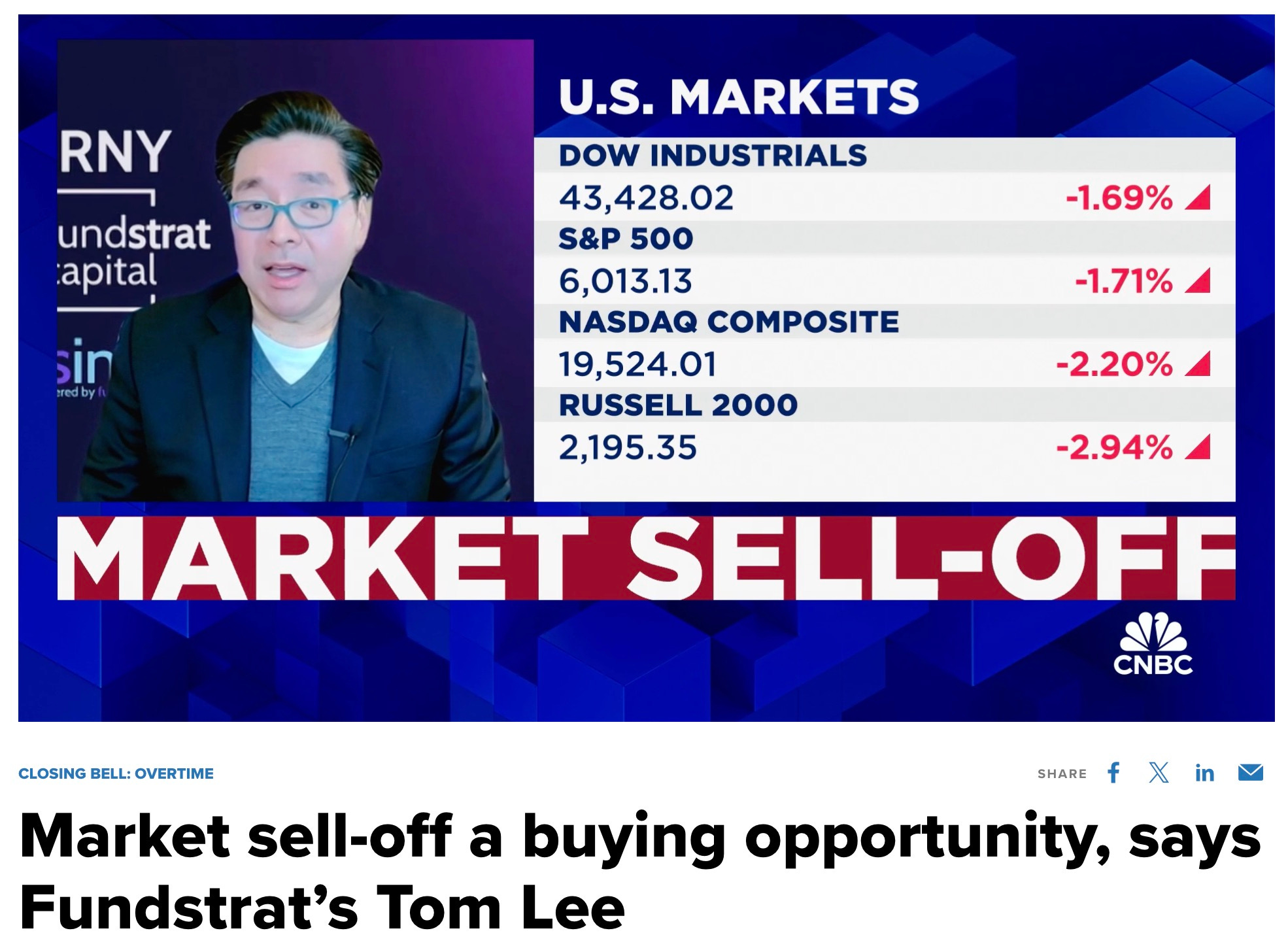
So once again, after this past Friday’s market selloff, strategists like a concerned-looking Tom Lee do what they do best: return to financial airwaves in order to proclaim that everything is fine, this time definitely isn’t different, and investors should consistently be buying the top of the market regardless of macroeconomic conditions, valuations, or a guarantee of certain death via asteroid the very next day.

Stop me if you’ve heard this one before.

It’s difficult to ignore that Tom Lee has “nailed it” on markets over the last decade, and I need to give credit where it’s due. Holding your nose and buying stocks without giving a single solitary fuck about valuations or the macroeconomy has sadly been the most effective way to generate returns over the last decade or two. But as every piece of financial literature you’ve ever read says somewhere on it: past performance is not indicative of future results.

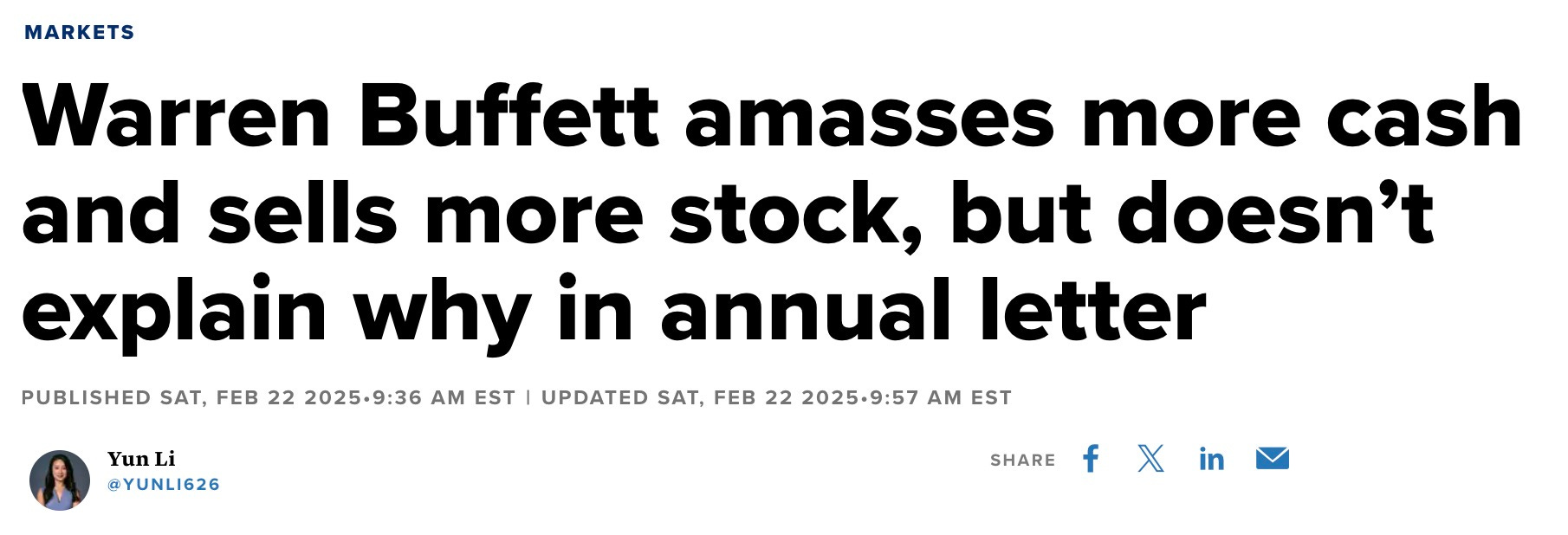
And people that don’t make daily appearances on CNBC — like, oh, say, Warren Buffett, for instance — are taking another road: getting into cash.

Maybe it’s a just a coincidence?

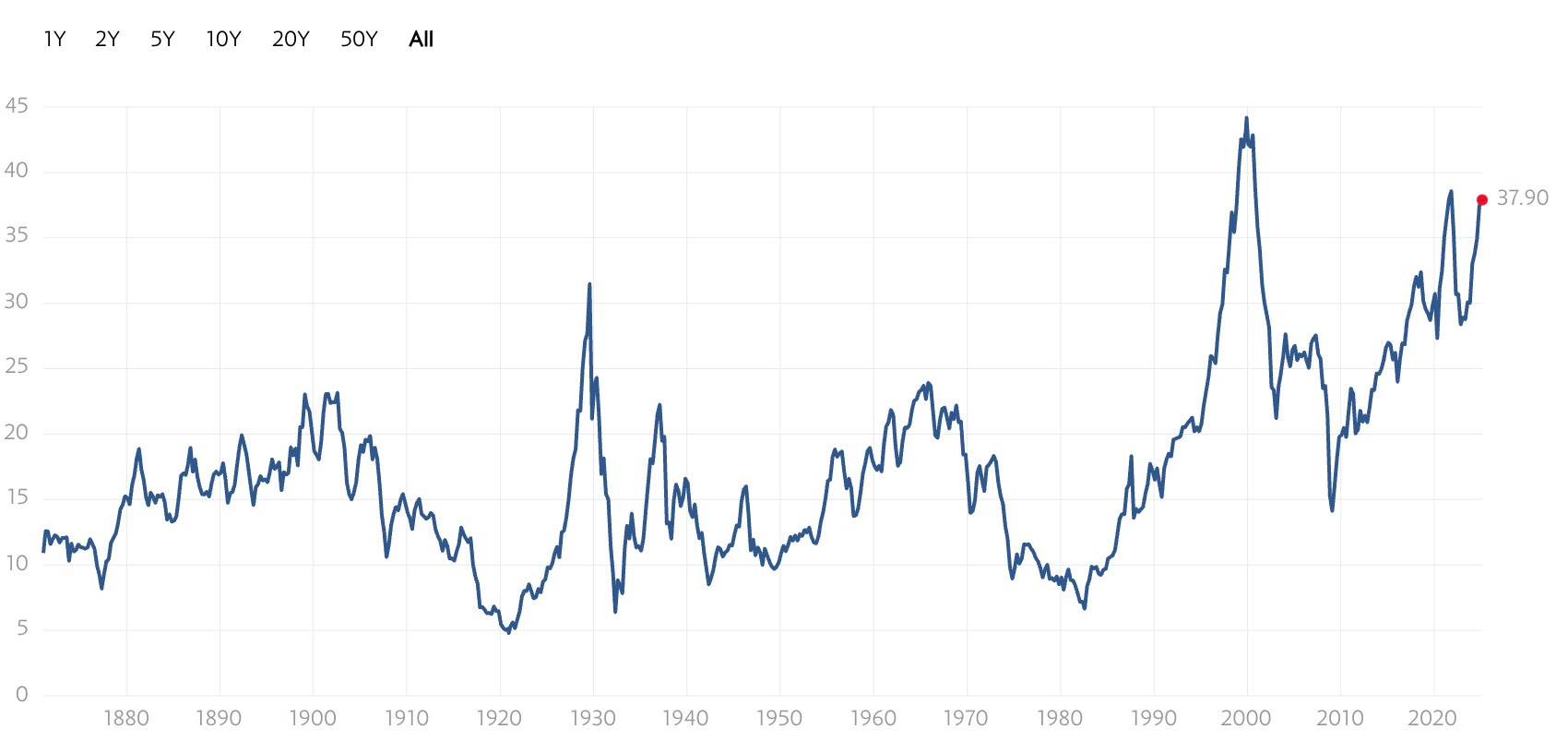
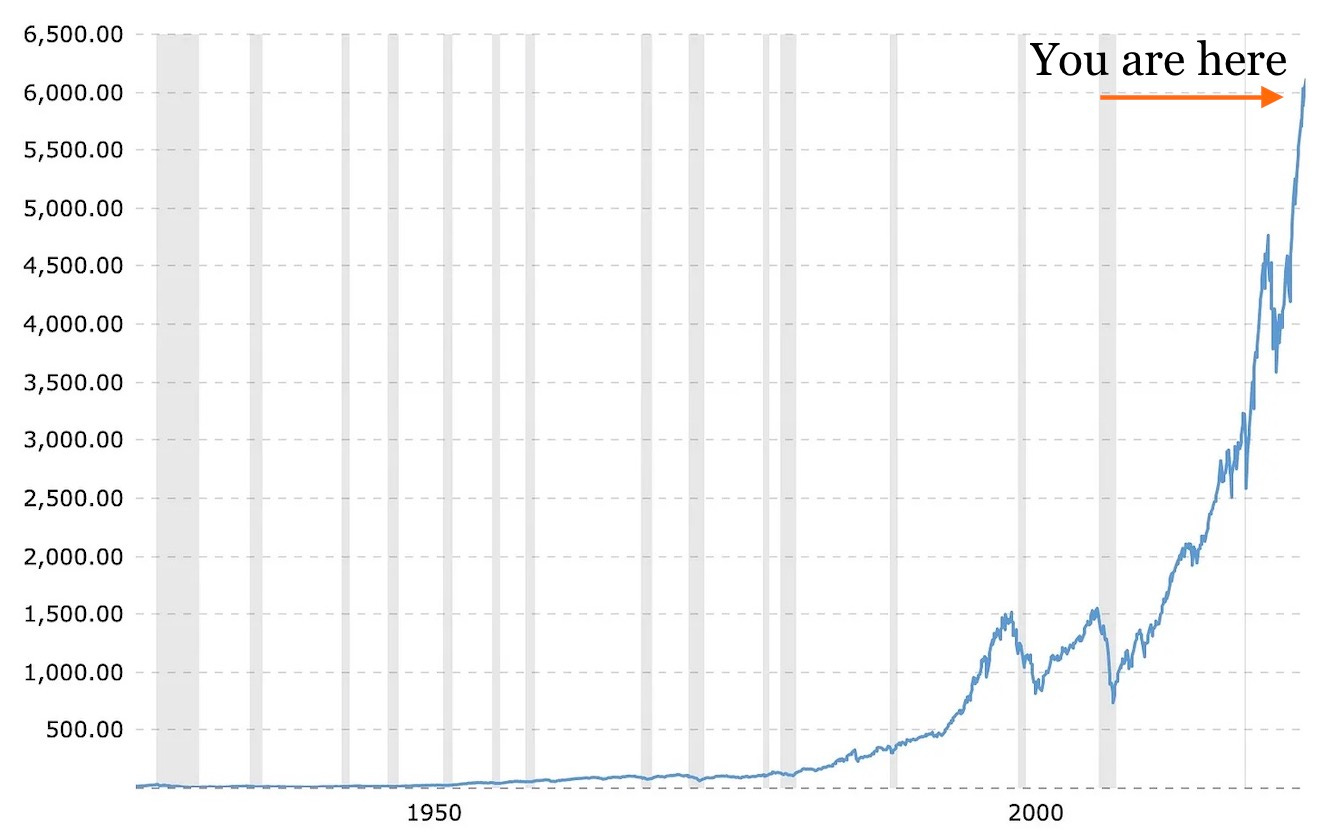
Though the tune of buying the dip has hardly changed, the environment it’s being sung in has. Stocks now trade at a Shiller PE that’s approaching 40x, a level only eclipsed once in history during the 2000s dot-com bubble.

But if the market’s price-to-earnings ratio and the macroeconomy didn’t matter when stocks were trading at 30x earnings, why should they matter with stocks trading at 40x earnings?

This indifference to valuations—helped along by the “passive bid” of 401(k)s and ETFs consistently buying the market at any given price (well explained by Bill Fleckenstein here on Julia LaRoche’s podcast, and then updated here during his appearance last week), combined with what is widely perceived to be an unlimited Fed put, combined with the unprecedented amount of liquidity doled out as a result of COVID, combined with the stock market becoming accessible to literally any human being on earth that wants to take their shot thanks to the advent of retail trading apps—has distorted expectations and psychology not just about the stock market, but also about the basic fundamentals of economics and finance, in a way that many of us probably would not have even thought fathomable 50 years ago.

Modern monetary theory has acted like a risk-hunger marijuana edible that all traders and investors have been forced to swallow, resulting in an insatiable, decades long case of the market munchies.

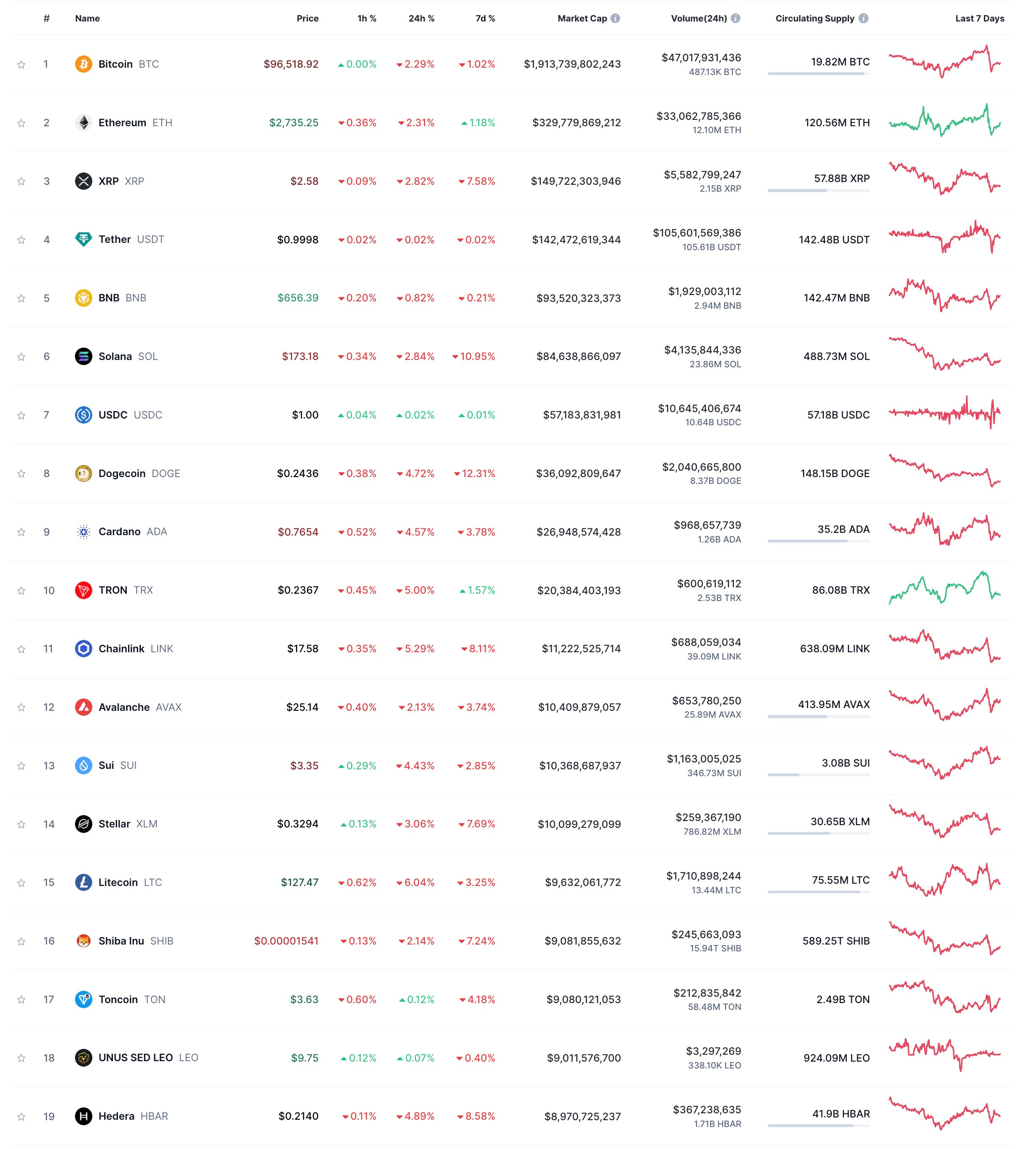
In fact, liquidity has been so ubiquitous and markets have been so rigged that people are speculating upwards of $3 trillion in an asset class — crypto — that, to the best of my understanding, offers very little product or service and exists almost entirely digitally.

If you want to try to make the argument that overvalued equities can sometimes be hard to recognize, especially when they only seem to continue to go up and valuations only seem to continue to expand, that’s one thing. But how, with a straight face, can anyone argue that $3 trillion worth of crypto is in some way “undervalued,” let alone serves a purpose at all?

Here’s a list of the top 19 cryptocurrencies by market cap.

Let’s put Bitcoin aside for a second and assume there’s a value to the protocol in the network. What are the other 18 of these doing? Dogecoin? Sui? Hedera? The rest of the top 50 gets even better. Uniswap? Polkadot? Ondo? Kaspa? VeChain?

I feel like the guys in Major League reading the roster before opening day.

“Ricky Vaughn, Willie Hays? I’ve never heard of most of em. Mitchell Friedman?”

What are all these…things…doing? As best as I can tell, pretty much nothing—other than becoming $1.5 billion in liabilities for those who custody them, like Ethereum was this past week.

I’m fairly confident that almost all of the crypto market outside of Bitcoin and Ethereum is nothing more than pure excess.

And, of course, the same type of useless excess exists in equity markets, as well, in the form of thousands of companies burning cash and surviving while paying their executives solely from stock sales. But at least these completely useless, bullshit equities give us the courtesy of inventing some idiotic story about their product or service and what it will do to help humanity. Joke memecoins like Dogecoin and Fartcoin, don’t even do that. They are the literal definition of pure, useless speculation, with their respective labels laughing back directly in the face of the investors who buy them. The first line of this NBC article about Fartcoin is: “Yes, it’s called Fartcoin. Yes, it is totally useless.”

If the saying “hubris comes before the fall” turns out to be even 1% accurate, we are likely in for an unexpected comeuppance for the ages. Other than lighting giant sacks of $100 bills on fire on live television just to make a statement about how little you care about return on investment, it doesn’t get more hubris-laden than buying something like the Hawk Tuah girl’s crypto coin.

Global corporate bonds or this. You decide.

And we see the same bullshit with equities too.

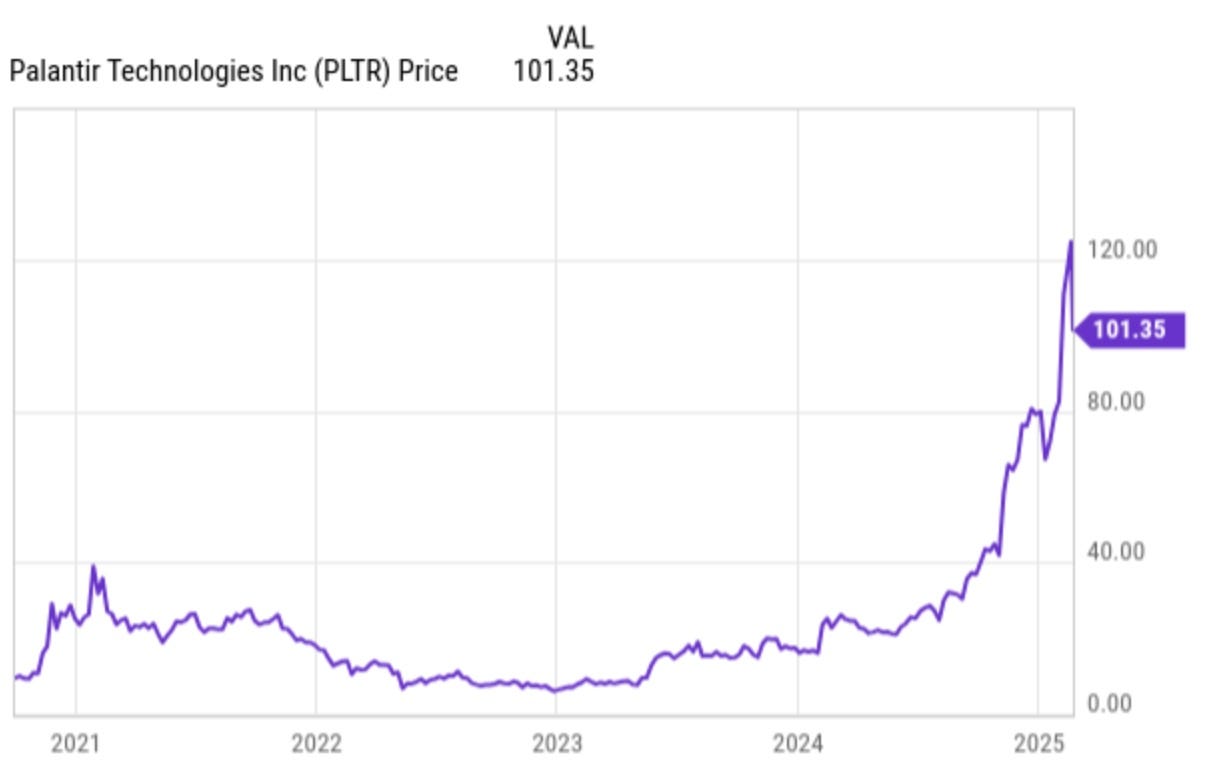
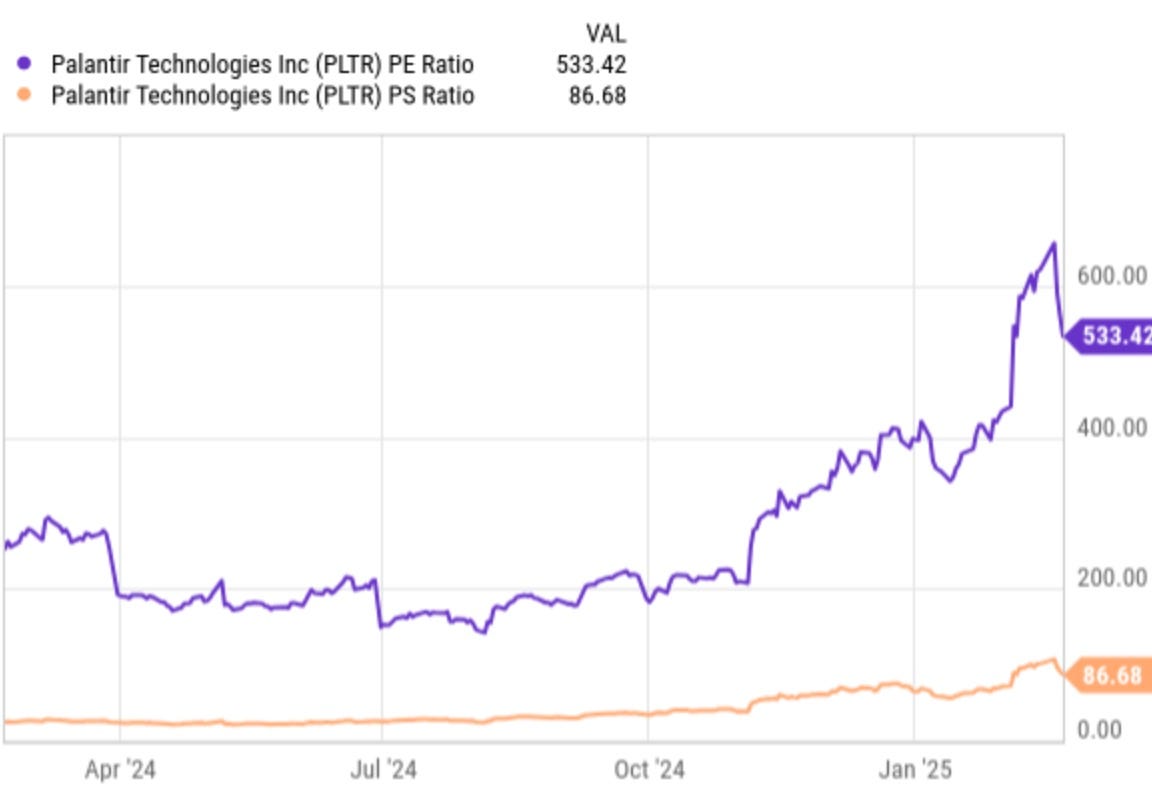
Last week, when there was a momentary headline about the Pentagon possibly cutting spending, Palantir—a stock known loosely to be tied to defense spending—took a momentary breather from its 18 month long parabolic rise, which has seen its stock go up nearly 10x, to correct 5% in one session. Any investor even remotely interested in fundamentals would have told you going into that week that at roughly 550x trailing earnings and 95x sales, the stock was already trading in extraordinarily aggressive territory.

Even after the 5% move lower, the stock still closed the session at about 530x trailing 12-month earnings and 86x trailing 12-month sales. In other words, the stock took in a minuscule hiccup of reality after doing nothing but tearing ass higher for two years.

One may think to themselves: “Any analyst with half a brain or investor with the slightest bit of financial acumen probably could have or should have seen a pullback in the company’s valuation coming.”

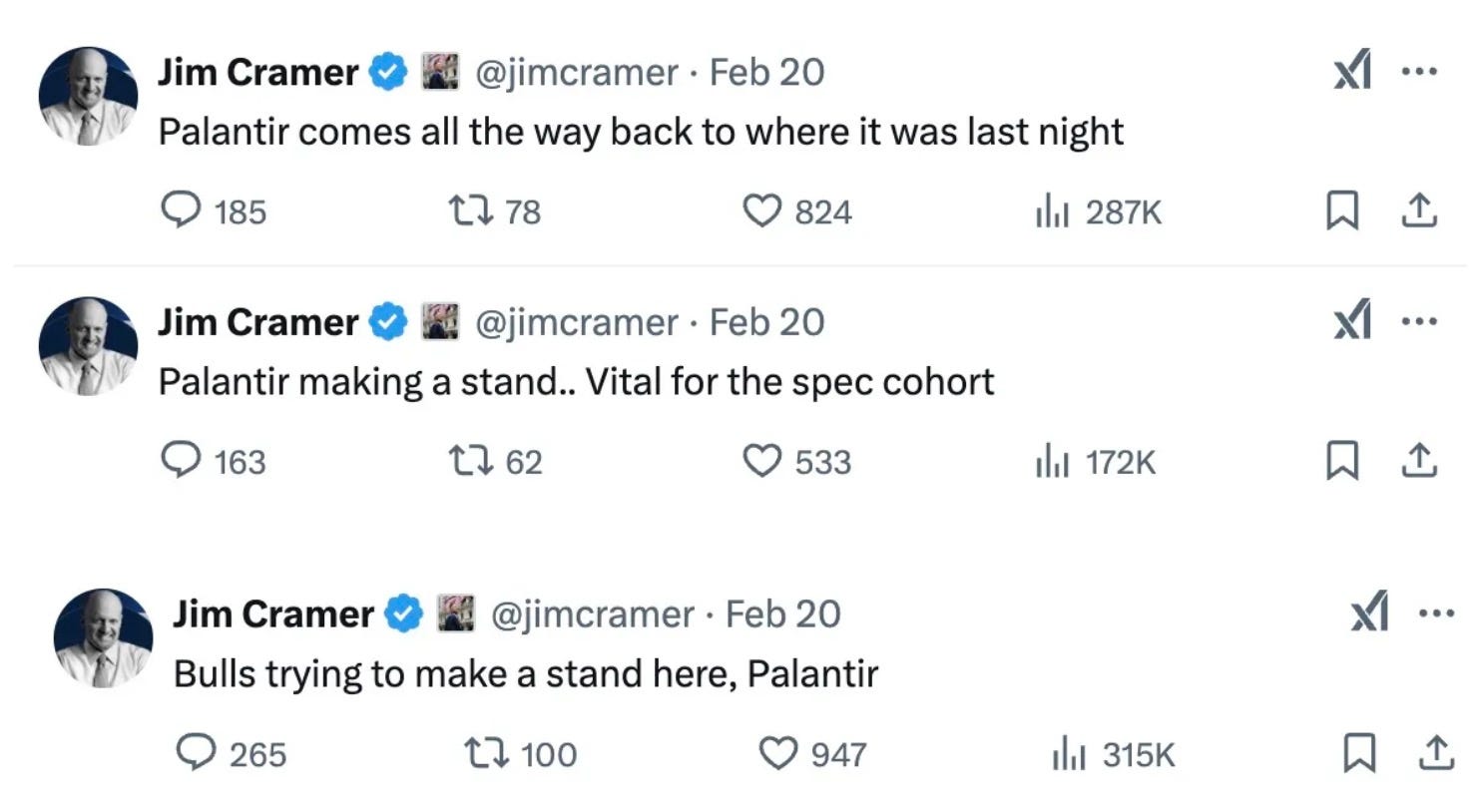
But no. Instead of accepting a subatomic level of reality and warming to the notion that the stock probably shouldn’t be trading anywhere near where it is today to begin with, Jim Cramer took to Twitter to watch every tick and cheer for the company—using a very matter-of-fact tone that came across to me as though he was saying bulls should be able to see the stock double again and again and again, ad infinitum, despite any lack of reason for doing so. Behold, this “analysis”:

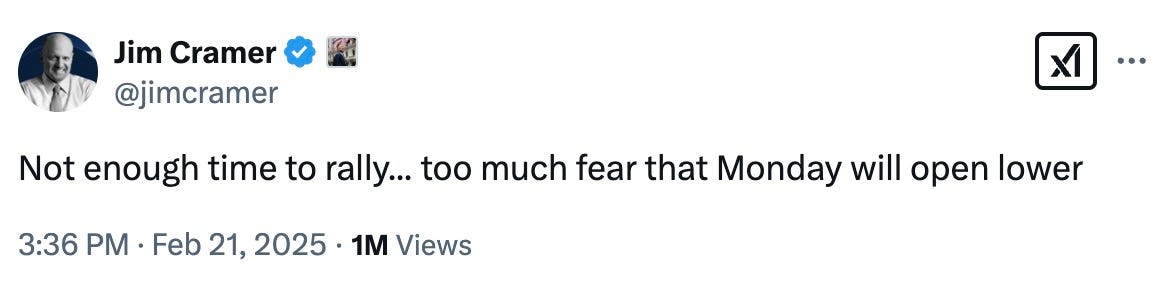
And then, commenting on the overall market, Cramer took what appeared to be the same tone, indicating to me he thinks bulls should always be vindicated, bears should always be eating large quantities of shit, and the market should go up every single day, all day, regardless of whether or not it has any reason to.

“Not enough time to rally,” he lamented at the end of the day, succumbing to the horrifying reality that we’re going to have one of those rare ‘red’ days in the market that feel like they come once every academic semester at this point.

“This marks the end. All life as we know it ends at 4PM with the closing bell,” Cramer may have thought to himself before hitting “Tweet”.

Behold the horror of the great crash of February 2025:

Oh, the humanity. Won’t someone think of the children?

I know Jim Cramer has a job to do, and I respect that. I like him just like I like Tom Lee. It isn’t personal. I know his job is to side with retail investors and try to show market neophytes that there is “a bull market somewhere.” I actually agree with the sentiment—there can always be a bull market somewhere—but that doesn’t mean that stocks always have to go up.

When you take these types of disturbing assumptions and you download them onto Cramer’s millions of Twitter followers and television viewers—then you couple that with a Federal Reserve whose unwritten third mandate has proven to be never letting stocks go down, ever, for any reason—is it any wonder that the entire retail investing public has subscribed to the notion of closing their eyes, holding their breath, and buying the dip in any situation, including the end of the world?

This hubris and outright delusion exists as the sharpest tip of an exceptionally long spear of irrational market exuberance, arrogance, crowd-herd mentality, and greed, mixed with financial unsophistication.

The entire economy existing within the confines of a Modern Monetary Theory system that is set up to rig asset prices higher is one thing. To be fair, it would be foolish not to expect the market to have irrational and overly optimistic expectations.

But the fever pitch of where expectations are now, combined with what I believe is a mathematical certainty that markets will eventually have to move lower in dramatic fashion, means that the next crash might just very well break the brains of a good portion of the investing public.

From here, a sharp and decisive move lower in markets probably first comes as the result of an economy grinding slower, and then, in dramatic fashion, the quick cascade of deleveraging and speculation unwinding will torture people financially. But psychologically is where it is really going to torture a whole new generation of investors who have yet to feel any significant prolonged financial pain. Think about it: the COVID crash was over in a couple of weeks.

This means that there is an entire market full of investors who have not felt any type of prolonged recession or drawdown in markets. And they have definitely not felt a depression or the psychological uncertainty of what can happen if the market loses confidence in the currency or the creditworthiness of the United States.

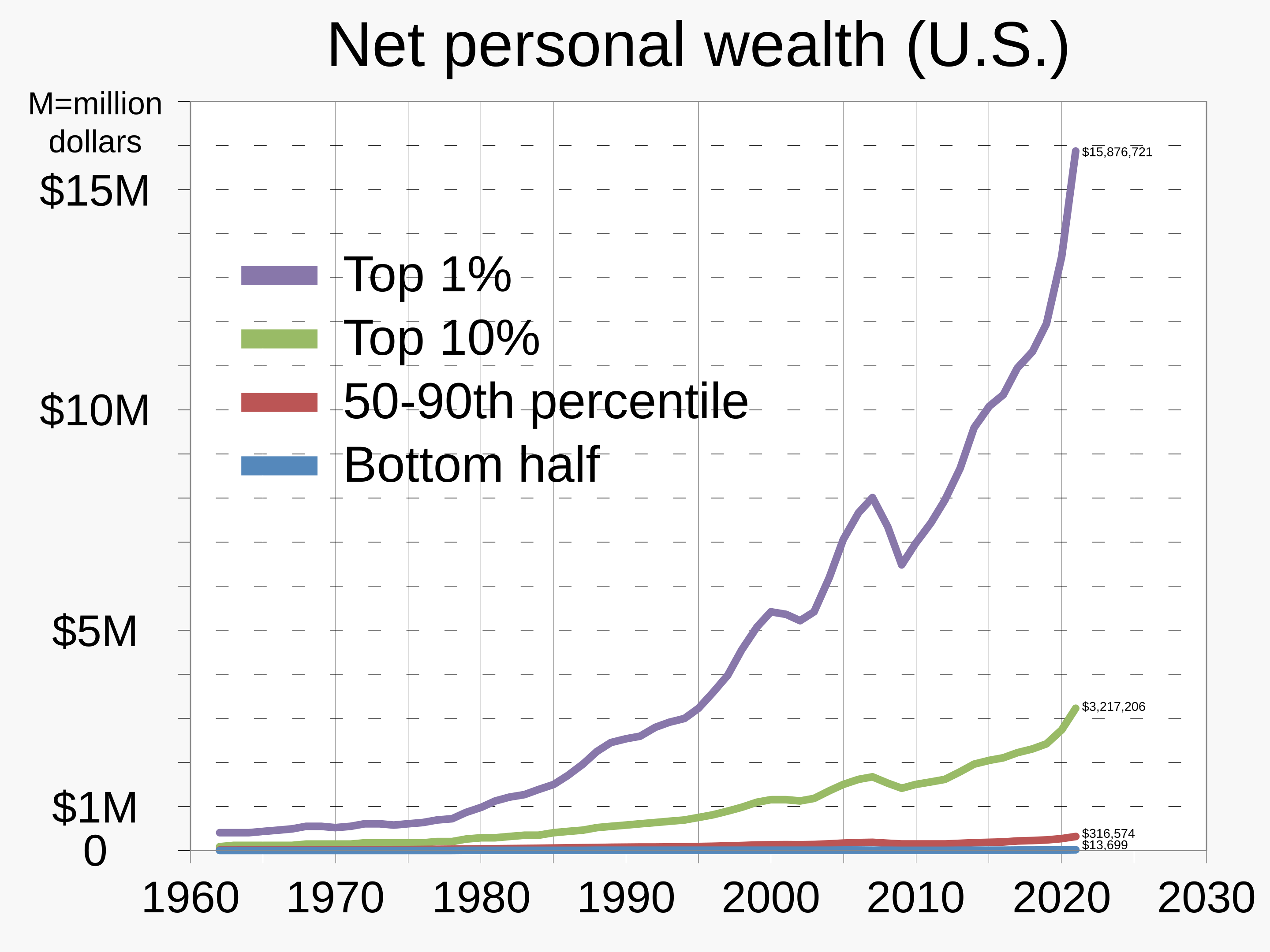
The Fed put is always going to be there, and nominal prices are probably always going go up. But at some point, just like a lot of the populace has learned about money printing over the last 10 years thanks to Bitcoin, people are also going to learn about the differences between nominal prices and real prices. They will compare the price of assets to inflation. They won’t be fooled by prices rising faster than the value of their assets. In fact, they will know exactly what it means: that the system, as the Fed wants it to exist today, doesn’t work, widens the inequality gap, and disproportionately negatively affects the middle and lower classes.

We bailed out a tech bubble in the early 2000s, and the result of our bailout came back as a housing crisis. We bailed out housing in 2008, and the result of that, if you ask me, is going to either be a currency or sovereign debt crisis.

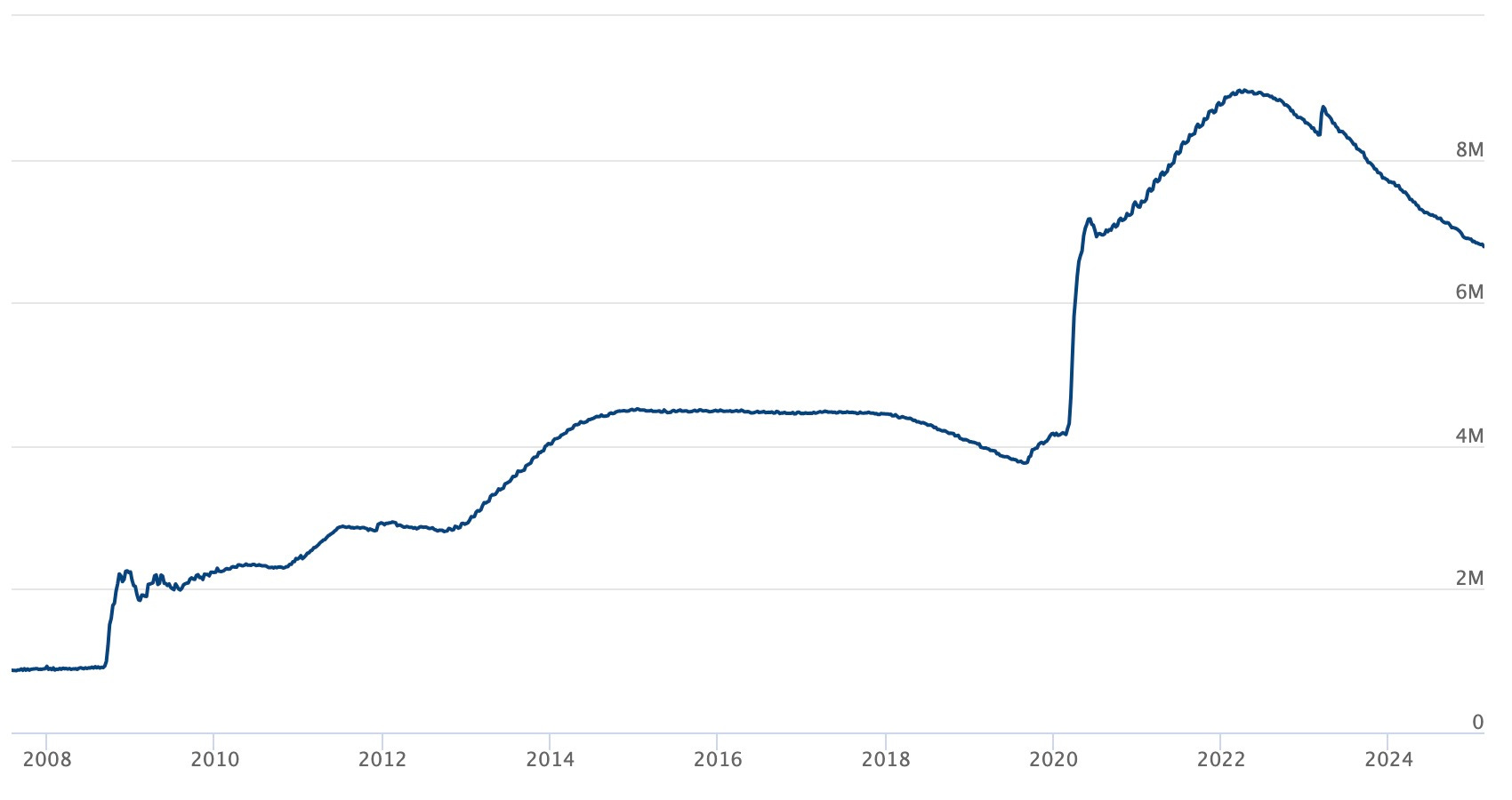
Total assets of the Federal Reserve. Guess what comes next.

There will come a point one day where, psychologically, the Fed intervenes and stock prices may go up again, but the average investor is living out depressionary hardships. And I mean this for people who are lucky enough to even own financial assets. Many lower- and middle-class families don’t even have significant amounts of financial assets but, rather, have negative net worth. The wreckage to these classes will be unlike anything we’ve ever seen before.

Make no mistake about it—we appear to be stuck between a rock and a hard place where the only exit door seems to be stagflation. This is something we haven’t combated since the 1970s, and the monetary policy and fiscal layout of the country right now is so distorted that people from the 1970s wouldn’t even recognize it.


🔥 50% OFF FOR LIFE: Using this coupon entitles you to 50% off an annual subscription to Fringe Finance for life: Get 50% off forever


The Fed has no option to raise rates into a stagflationary environment because of the ungodly amount of debt we have outstanding. Even with rates where they are now, I believe the Fed is out over its skis and has already sealed the fate of guaranteed defeat for the economy and markets.

So what happens then? We’re stuck between welcoming a deflationary depression by raising rates to try to combat inflation, or we’re going to have to let inflation run wild. We’ve never been in this situation before in modern history. And even more frightening than that is the fact that market participants and the average American citizen are the most coddled and the least equipped to handle bad news related to the economy than they’ve ever been.

I write this article today not to stir up fear but to do what I did leading up to the country panicking about COVID: to try and get some mental exercise in so that if the shit truly hits the fan, psychologically, it won’t be a total blindside surprise to everyone, including myself.

See you Monday morning.

QTR’s Disclaimer: Please read my full legal disclaimer on my About page here. This post represents my opinions only. In addition, please understand I am an idiot and often get things wrong and lose money. I may own or transact in any names mentioned in this piece at any time without warning. Contributor posts and aggregated posts have been hand selected by me, have not been fact checked and are the opinions of their authors. They are either submitted to QTR by their author, reprinted under a Creative Commons license with my best effort to uphold what the license asks, or with the permission of the author.

This is not a recommendation to buy or sell any stocks or securities, just my opinions. I often lose money on positions I trade/invest in. I may add any name mentioned in this article and sell any name mentioned in this piece at any time, without further warning. None of this is a solicitation to buy or sell securities. I may or may not own names I write about and are watching. Sometimes I’m bullish without owning things, sometimes I’m bearish and do own things. Just assume my positions could be exactly the opposite of what you think they are just in case. If I’m long I could quickly be short and vice versa. I won’t update my positions. All positions can change immediately as soon as I publish this, with or without notice and at any point I can be long, short or neutral on any position. You are on your own. Do not make decisions based on my blog. I exist on the fringe. The publisher does not guarantee the accuracy or completeness of the information provided in this page. These are not the opinions of any of my employers, partners, or associates. I did my best to be honest about my disclosures but can’t guarantee I am right; I write these posts after a couple beers sometimes. I edit after my posts are published because I’m impatient and lazy, so if you see a typo, check back in a half hour. Also, I just straight up get shit wrong a lot. I mention it twice because it’s that important.

Tyler Durden
Sun, 02/23/2025 – 14:00

Zelensky Says ‘Ready’ To Resign For The Sake Of Peace, NATO Membership

0
Zelensky Says ‘Ready’ To Resign For The Sake Of Peace, NATO Membership

Speaking at the “Ukraine: The Year 2025” forum on Sunday, Ukrainian President Volodymyr Zelensky told an audience of all heads of ministries, agencies, and top officials that he’s ready to resign as president if it brings peace. He suggested the country be guaranteed NATO membership in exchange for his stepping down.

“I am ready to leave my post if it brings peace. Or exchange it for NATO,” Zelensky said in response to journalists’ questions, and at a moment he’s feeling immense pressure from US President Donald Trump. Ukraine regional media Kyiv Post was among the first to report the resignation comments.

Via Associated Press

The same statement was also translated in Russian state media as follows: “If peace for Ukraine, if you really need me to leave my post, then I’m ready. I can exchange this for NATO, if there are such conditions. I am focusing on the security of Ukraine today, not in 20 years, and I do not intend to be in power for decades,” Zelensky said. He still asserted that martial law has to be lifted before their can be national elections, according to Ukraine’s constitution.

This comes after a week of an open spat with the White House, wherein Trump called Zelensky a ‘dictator’ for refusing to hold democratic elections and for criticizing US efforts at achieving peace with Moscow. Kiev complains it’s been cut out of US-Russia engagement, while Trump has pointed out the Ukrainians and Europeans had three years in which they rebuffed peace openings at every turn.

Zelensky briefly addressed this tit-for-tat at the forum, saying he is not offended by Trump calling him a dictator as he’s not a dictator, according to the remarks.

Zelensky tries to brush off Trump calling him a ‘dictator’: “Only a dictator would be offended by the word dictator.”

According to Ukraine media sources, Zelensky on Sunday “also announced an important international summit on the Russo-Ukrainian war scheduled for Monday, Feb 24. Leaders from 13 partner countries will attend in person, while 24 others will join online. Zelensky hinted that major decisions could come from the meeting.”

“Tomorrow’s summit is crucial. It might even be a turning point – we’ll see,” he said. Zelensky in the comments affirmed that previously approved military aid continued to flow, but that Ukraine still needs 20 Patriot air defense systems.

He explained his government needs to sign agreement that will be ‘win-win’ for both US and Ukraine, ‘pleasant’ for both parties. But so far the haggling over mineral rights has been anything but pleasant.

Ukrainian Foreign Minister Andrii Sybiha addressed the same forum and said the following, “We are convinced that in this third year of brutal Russian aggression, we truly have a chance. We are telling many partners that perhaps now is the time to fasten diplomatic seat belts. We must not give in to emotions.”

There have been weekend reports that the two sides are close to achieving a mineral deal. However, the US side has stuck by some demands that Zelensky and his officials previously rejected as not doable.

“Ukraine on Saturday was seriously considering a revised American proposal for its vast natural resources that contains virtually the same provisions that Kyiv previously rejected as too onerous, according to Ukrainian officials and a draft of the deal,” The New York Times reports.

“In fact, some of the terms appear even tougher than in a previous draft,” the report emphasizes. “The latest proposal comes after a week in which President Volodymyr Zelensky of Ukraine resisted signing the earlier version in a public dispute with President Trump.”

Tyler Durden
Sun, 02/23/2025 – 13:25

House Speaker Johnson Responds To The Idea Of ‘DOGE Dividend’ Checks

0
House Speaker Johnson Responds To The Idea Of ‘DOGE Dividend’ Checks

Authored by Jack Phillips via The Epoch Times (emphasis ours),

House Speaker Mike Johnson (R-La.) on Thursday appeared cool to the idea that the Trump administration could send checks to Americans based on savings related to the Department of Government Efficiency (DOGE).

House Speaker Mike Johnson (R-La.) speaks during the annual Conservative Political Action Conference (CPAC) at the Gaylord National Resort & Convention Center at National Harbor in Oxon Hill, Md., on Feb. 20, 2025. Saul Loeb/AFP via Getty Images

When discussing the prospect on Thursday, Johnson downplayed the idea in light of the budget deficit, while allowing that it would be politically beneficial to the Republican Party.

“Everybody loves a check, but … we have a giant deficit. I think we need to pay down the credit card,” he told a crowd at the Conservative Political Action Committee (CPAC) event held in Washington on Thursday. “Fiscal responsibility is what we do,” he added, according to live streaming video of the event.

Earlier this week, President Donald Trump and Elon Musk, a Trump adviser who championed the work of DOGE, said that checks might be distributed to Americans.

A day earlier, Trump said at the FII Priority summit, an investment conference in Miami, that his administration is “thinking about giving 20 percent back to the American citizens and 20 percent back to pay down debt.”

Trump also said the potential for dividend payments would incentivize people to report wasteful spending. “They’ll be reporting it themselves,” Trump said. “They participate in the process of saving us money.”

Later, as the president flew back to Washington aboard Air Force One, a reporter asked him about the plan floated by Musk.

“I love it,” Trump said.

Earlier this week, Musk wrote on his social media platform X that he “will check with the president” in response to a suggestion that Trump and Musk should announce a “DOGE Dividend” that would send a refund to taxpayers from part of the savings resulting from DOGE’s audits of federal agencies and programs. Its efforts to downsize the government have also led to thousands of federal government employees being fired or laid off.

In a press briefing on Thursday, Trump’s deputy chief of staff for policy, Stephen Miller, said the checks would be worked on in the budget reconciliation process in Congress. He said Congress needs to pass a measure in order to send those checks.

“This is all going to be worked on in the reconciliation process that is going on right now,” Miller said.

Miller, Trump, and Musk have not provided further details about the refund proposal. The Epoch Times contacted the White House press office for comment.

In terms of cost-cutting, U.S. Treasury Secretary Scott Bessent said in a Fox News interview that about $50 billion in spending has been slashed due to DOGE’s findings since it started.

“So that’s a very good start,” Bessent said, adding that DOGE’s efforts could ultimately lead to “several percent” of the U.S. gross domestic product, or GDP, in savings.

Responding to criticism about the Musk-affiliated agency that was created by Trump in an executive order last month, Bessent said that Americans “don’t have to be concerned” about DOGE’s activity in the IRS.

DOGE and Musk have recently faced multiple lawsuits, including one filed by tax groups earlier this week that accused the advisory body of possibly violating American taxpayers’ privacy. In a separate case, meanwhile, a federal judge in Washington declined to block Musk and DOGE from accessing data or suggesting cuts at seven federal agencies.

The Associated Press contributed to this report.

Tyler Durden
Sun, 02/23/2025 – 12:50

German Exit Polls Are Out: Conservatives Win, Will Form Coalition Govt; AfD Comes In Light

0
German Exit Polls Are Out: Conservatives Win, Will Form Coalition Govt; AfD Comes In Light

Update: The German election exit polls are in, and the result is on light side for the AfD which were polling around 21%, but appear to have ended up with 19.5% of the vote, coming in short of a blocking position.

  • *GERMAN CONSERVATIVES GET 29% IN ELECTION: ARD EXIT POLL
  • *GERMAN AFD GETS 19.5% IN ELECTION: ARD EXIT POLL
  • *GERMAN SOCIAL DEMOCRATS GET 16% IN ELECTION: ARD EXIT POLL
  • *GERMAN GREENS GET 13.5% IN ELECTION: ARD EXIT POLL
  • *GERMAN LEFT PARTY GETS 8.5% IN ELECTION: ARD EXIT POLL
  • *GERMAN LIBERAL FDP GETS 4.9% IN ELECTION: ARD EXIT POLL
  • *GERMAN FAR-LEFT BSW GETS 4.7% IN ELECTION: ARD EXIT POLL

And visually, the ARD exit poll:

And ZDF: here AfD just fractionally better at 20%, but still below the 21-22% they would poll last week.

Unlike previous elections which were anemic affairs, participation today was a whopping 84%, the highest since German reunification in 1990.

The emerging picture is one where the initial exit polls are in line with the most recent public polling, showing a CDU victory, with the SPD and Greens collapsing while the AFD doubles its support from 10% in 2021 and is set to become the main opposition power in the new government. Of note, and to get an indication of how unpopular legacy politics in Germany have become, the Social Democrat party of Chancellor Olaf Scholtz posted its worst result since World War 2.

  • *GERMANY’S SCHOLZ: IT’S A BITTER ELECTION RESULT FOR THE SPD

In other words, Germany’s opposition conservatives won the national election on Sunday, putting leader Friedrich Merz on track to be the next chancellor…

  • *CDU’S MERZ: WE HAVE WON THIS ELECTION
  • *CDU’S MERZ: NEED A GOVT WITH A GOOD PARLIAMENTARY MAJORITY
  • *MERZ WANTS TO FORM GERMAN GOVERNMENT AS SOON AS POSSIBLE

… while the populist Alternative for Germany came in second, its best ever result. Naturally, the SPD was not happy:

  • *SPD’S MIERSCH: IT’S A HISTORICAL DEFEAT FOR SPD, BITTER EVENING
  • *SPD’S MIERSCH: FRIEDRICH MERZ HAS THE MANDATE TO FORM A GOVT
  • *SPD’S MIERSCH: BORIS PISTORIUS WILL PLAY IMPORTANT ROLE IN SPD

That said, with 29% of votes in exit polls, the CDU/CSU falls short of parliamentary majority needed to govern alone. However, it will likely be able to form a two-party governing coalition with the SPD.

Meanwhile, since the AfD – which has been shunned by every other party and will not participate in any strategic alliances with anyone – did not enjoy a last minute burst in support, and came in at or just below where the polls said would, it will come in short of having a blocking position in the new government, and as a result will not be able to prevent either the stimulus flood or the easing of the debt brake which so many had already priced in. Still, the AfD’s spirit was high:

  • AFD’S WEIDEL: WILL OVERTAKE CDU AT NEXT ELECTION

Finally, the Greens – which came in at 13.5% – have succeeded at minimizing their losses and remaining a significant player in the Bundestag, which was the goal their entire campaign was structured to achieve.

Despite his resounding victory, conservative leader Friedrich Merz was roundly criticized during the campaign for trying to push through hard-line immigration measures with the help of the far-right AfD, triggering mass demonstrations and even a rebuke from former Chancellor Angela Merkel (who was the former leader of the CDU/CSU).

According to Bloomberg, Merz consistently polls poorly with women and younger voters, and there seems little enthusiasm for him overall. But one fact speaks to his party’s success: asked which party they considered the most competent in three core policy areas — foreign and security; immigration; and the economy and finances — respondents to a Forsa poll taken for the RTL/ntv on the eve of the election, placed Merz’s party top in each field. Even on the AfD’s calling card issue of migration, Merz’s bloc stood well out in front, while on the economy, it led Scholz’s SPD by a whopping 42% to 12%.

* * *

We previously previewed tomorrow’s German election in an extensive article (see “Everything You Need To Know About The Upcoming German Election“) but with so much at stake, with Elon now going all in…

… and with the situation more fluid by the day…

Source: Polymarket

… it’s time for a quick reassessment of where we stand (we summarize various reports from DB, Goldman and Bloomberg).

1. Executive Summary

Polls, coalition options and potential impact on policies

  • Polls: The conservative CDU/CSU is leading the polls with 31 followed by the far right AfD at around 21 the Social Democrats at 15 and the Greens at 13%. A lot of attention will be on whether the three smaller parties (FDP, BSW, Left) make it into parliament
  • Timeline: First projections based on exit polls after 6 pm CET on February 23 preliminary results from 6 30 pm CET on and then updated during the night/early morning
  • Coalition formation: Coalition negotiations might take several weeks as they require some difficult compromises 

Coalition options

  • Base case – two party grand coalition: Polls suggest that the Conservatives could form a coalition government with either the SPD or the Greens A CDU/CSU SPD coalition appears more likely as polls suggest it could achieve a more comfortable majority On defence/foreign policy, there are significant policy overlaps with the Greens
  • Surprise – three party centrist coalition – “Kenya”(CDU/CSU-SPD-Greens) or “Germany”(CDU/CSU-SPD-FDP). On the one hand, a three party coalition could prove to be rather fractious and result in fraught policy compromises On the other hand, a “ coalition might increase the chance of a meaningful shift in fiscal policy if centrist parties kept the two thirds majority 

What’s are the risks?

  • Downside risk – blocking minority of fringe parties (AfD & BSW): This would imply that constitutional change for setting up an off budget defense/infrastructure fund/debt brake reform is contingent on concessions to the fringe parties or not possible at all
  • Absolute tail risk – AfD as part of the government: Extremely high bar to be crossed all parties credibly rule out that option ex ante

Potential impact on policies

  • Fiscal policy pivot towards higher spending – The perceived erosion of Europe’s security architecture makes it likely for the new government to swiftly agree on funding higher defence spending outside the debt brake. The fiscal impulse could be material However, the short term growth multiplier should not be overestimated, with the bulk of military procurement going abroad Debt brake reform for the Länder might provide additional and more immediate fiscal stimulus from 2026 onwards
  • Compromises on structural reforms – A CDU/CSU led coalition could potentially agree on a step by step reduction of the corporate tax burden, streamlined administrative processes, and measures to lower electricity prices, but no major pension reform 

How much of the election is already factored into our forecasts?

  • For 2025, Deutsche Bank expects the economy to grow by 0.5%. The bank’s 2026 forecast is predicated on a meaningful probability that the next government relaxes the constitution debt brake to allow more debt financed investment. Without it, the status quo would imply structural stagnation

2. Backround

  • A deeply divided coalition government in Berlin has failed to take the hard decisions needed to turn Germany’s economy around. The snap election on Feb 23. is therefore a chance for voters to deliver a stronger government capable of tackling the country’s pressing problems.
  • The main danger is that the poll yields another fragmented parliament. This could leave a power vacuum at the heart of Europe during a particularly challenging time and, eventually, result in a government that is too weak to implement much-needed reform. Furthermore, much of the proposed fiscal stimulus emanating out of Germany has already been priced into European stocks, so a “tail” outcome tomorrow could have a major adverse impact on European markets.
  • The greater the number of parties that enter parliament, the higher the risk that the center-right Christian Democratic Union (CDU)/Christian Social Union (CSU) alliance and the Social Democratic Party (SPD) have too few seats to form a grand coalition.
  • Policy uncertainty is already through the roof in Germany and this is weighing on growth as companies delay investment decisions. The more time it takes to form a coalition, the greater the delay in kickstarting an economic recovery.
  • The duration of coalition talks will also show how willing parties are to overcome their differences to tackle urgent issues such as structurally weak growth, a potential US-Russia deal on Ukraine and a transatlantic trade war.
  • Polling stations will close on Sunday at 6:00 pm Berlin time. Sufficient clarity about the election results should emerge during the evening. The CDU/CSU alliance is set to win, according to opinion polls. The far-right Alternative for Germany (AfD) would have to close a 10-percentage-point gap to defeat the center-right parties.  
  • Barring any surprises, CDU leader Friedrich Merz will become the next chancellor. However, the CDU/CSU alliance is unlikely to have enough seats to lead a cabinet on its own, which means it will have to form a coalition with other parties.
  • Merz has repeatedly declared he will not cut a deal with the AfD. The Free Democratic Party (FDP) isn’t seen as a suitable partner, since it will probably not have enough seats to make a difference — it might even struggle to make it into the Bundestag (national parliament).
  • The most obvious option for Merz is to form a coalition with either the SPD, the Greens, or both. The ideological distance between the Greens and the CDU on social issues such as migration remains large, which means it might be easier for him to cut a deal with the social democrats.
  • Still, much will depend on the distribution of seats in parliament. The more parties enter the Bundestag, the higher the risk that the CDU/CSU and the SPD might not have enough seats to form a government by themselves.

3. Timeline:

Timeline for the Bundestag election 2025: What will happen from voting until government formation

4. Polls

Germany heading towards new leadership? Conservatives are leading the polls, while the right wing AfD and Left gained further support

Accuracy of polls seems reasonably good: Far right AfD seems not to be systematically underestimated in polls

What is driving voters’ decisions? State of the economy is more important for voters’ decisions than immigration

5. Electoral System

Germany‘s mixed electoral system demystified: Peculiarities of the voting system might have an impact on the election outcome

Postal voting has started two weeks ago: Increasingly popular option among German voters

6. Coalition Formation

Zooming in on coalition negotiations: Coalition agreement in spring might provide psychological boost to confidence

Preview of potential coalition options: Conservatives likely to lead the next government according to current polls

7. Policy Outcomes

CDU/CSU – SPD or CDU/CSU – Green coalition – agree to disagree? Where do ex ante policy stances differ?

Potential impact of CDU/CSU policies on the economy: More supply-side policies, but still fiscal hawkishness

Economic policy implications: Fiscal policy pivoting towards higher defence spending

The fiscal defence policy nexus: Smaller parties not necessarily standing in the way of constitutional reform

Constitutional majorities and fiscal regime change: The more fragmentation, the less likely a fiscal regime shift

Zeitenwende 2.0 moment in defence spending: Pivot towards higher defence spending early in the next parliamentary term

Fiscal regime change – a cheat sheet for potential options: Policy options, needed majorities and potential timelines

Germany’s stance on joint EU borrowing: How to fund the VdL 2.0 policy priorities

8. Economic Outlook

How much of the election outcome is already factored into DB’s forecasts? A meaningful relaxation of the debt brake is not part of the 2025 baseline forecasts

9. Much-Needed Reforms

  • A stable coalition would also strengthen Germany’s ability to respond to a long list of pressing economic challenges and thus, support growth in the medium and long term. Germany has to improve its productivity and revive competitiveness while at the same time deal with the threat of high US tariffs and the requirement to boost defense spending.  
  • What all these challenges have in common is that they will likely end up costing a lot of money. The good news is that, in principle, Germany would have the necessary fiscal leeway. According to our estimates, it could raise public investment spending by 1% of GDP in the coming years and the debt-to-GDP ratio would still fall until 2040 and settle below the 60% mark.
  • One main thing to watch is whether the parties that favor a reform of the very strict national fiscal rule, the so-called debt brake, will have the necessary two-third majority in parliament to deliver the required constitutional revision. Conversely, a very fragmented parliament would undermine the ability of the centrist parties to revise the current borrowing limit.

10. Tail Risks

What’s in the tails? Surprises, downside and extreme tail risks

Scenarios for a blocking minority of the far right AfD: Would require significant shift of approval rates and no small party entering the Bundestag

11. Challenges to Forming a Government

  • The country’s political fragmentation means that negotiations to form a coalition might not be straightforward. CDU’s Merz has shown during the campaign that he wants to move more to the right on migration.
  • That’s further away from the SPD’s stance and in order to make any deal with Merz more palatable to its electorate, the social democrats will try to extract as much as possible (for instance on economic issues) during negotiations.
  • Recent elections show coalition negotiations have taken a substantially long time to wrap up. However, the bleak economic situation and uncertain geopolitics might provide an incentive for parties to accelerate discussions. In fact, how long it takes to form a government will indicate how willing parties are to work together to deal with Germany’s impending challenges.
  • A minority government or new elections would be the available options if coalition negotiations were to fail. However, parties would likely try to avoid a repeat poll given voters might punish them for failing to form a government.

12. Election of the Federal Chancellor: Usually just a formality

More in the full presentation available to pro subscribers.

Tyler Durden
Sun, 02/23/2025 – 12:15

The Collapse Of The Zelensky Cult

0
The Collapse Of The Zelensky Cult

Authored by Jeff Carlson & Hans Mahncke via Truth Over News,

At long last, someone has said it. Trump has finally called it like it is—Zelensky is the emperor with no clothes. In fact, he’s the dictator with no clothes, propped up by Western elites who refused to see what was in plain sight. But the illusion is shattered. Trump didn’t just call him a dictator, he shut him out of peace talks and made it clear that if Zelensky wants to be taken seriously, he needs to hold elections, abandon his defiant posturing, and start behaving like a statesman rather than a petulant client.

For years, wherever Zelensky went, Western elites and their media lapdogs treated him as untouchable—questioning him was practically a crime. The adulation didn’t even begin in 2022 when full-scale war erupted. It started back in 2019, when Zelensky became the vehicle for Trump’s first impeachment, cast as the poor, beleaguered leader whom Trump had supposedly tried to extort. It was all a lie, but that didn’t matter. The media and political class needed him propped up, so they did—shielding him from scrutiny no matter how absurd his behavior became.

The arrogance and defiance Zelensky has displayed didn’t emerge in a vacuum—it was merely the latest chapter in a pattern of reckless entitlement that defined Ukraine’s political class long before he took office. To understand it, we have to go back to 2016, when Ukrainian officials blatantly interfered in the U.S. election, attacking Trump in a way that was not just unprecedented but completely beyond the norms of international relations. It’s one thing for a foreign power to quietly prefer one candidate over another—but for a small, dependent country to openly wage political warfare against the leading contender in a U.S. presidential race was madness.

Their prime minister publicly denounced Trump, claiming he “challenged the very values of the free world.” Ukraine’s Interior Minister went even further, calling Trump a “dangerous misfit” who was “dangerous both for Ukraine and for the United States to the same extent.” Their ambassador to Washington launched a blistering op-ed—something virtually unheard of in international diplomacy—and Ukraine’s intelligence services leaked a fabricated ledger to sabotage Trump’s campaign manager, Paul Manafort, in an operation that led directly to Manafort’s ouster. Even Ukraine’s equivalent of a CIA director, Valentin Nalyvaichenko, later all but admitted to the interference, stating, “Of course, they all recognize that our [anti-corruption bureau] intervened in the presidential campaign.”

When Trump won anyway in 2016, he let it slide. He wasn’t going to punish Ukraine for backing the wrong horse. Instead, he sought peace—because, as the media and establishment so often overlook, the war in Ukraine didn’t begin in 2022 but in 2014, and it had long been Trump’s ambition to end it. But his hands were tied by the Russia collusion hoax, which effectively criminalized diplomacy with Moscow. Anytime he wanted to do anything, he was met by loud and hysterical screaming from the media, the establishment and Democrats. When the Russian ambassador visited the White House, as is totally customary, the media went apoplectic, accusing Trump of treason. When Trump met Putin in Helsinki in 2018, the hysteria reached off-the-charts proportions. Putin had given Trump a soccer ball from that year’s World Cup for Trump’s 12-year-old son, and the media claimed it may have been a listening device.

Trump was given no room to maneuver. Instead of pursuing peace, he was forced to arm Ukraine—a step even Obama had refused to take. Then came the impeachment hoax, with Zelensky at its center, making matters infinitely worse. Any attempt at serious negotiations—any engagement with Russia, any acknowledgment that peace requires concessions—would have been seized upon as proof that Trump was a traitor. The very idea of compromise was framed as “selling out” Ukraine, the same false charge leveled against Trump in the first place.

Wounded by the impeachment hoax, Trump was hobbled, and then came Biden. With him, Zelensky got everything he wanted—billions in weapons and reckless escalations that led directly to war.

For years we were told that NATO entry had nothing to do with the outbreak of the wider war in 2022, but now even the NATO chief admits NATO expansion was key to Russia’s invasion of Ukraine. In fact, Biden and his team of inept and corrupt comrades had all but promised Ukraine NATO entry in the lead-up to the 2022 war. Biden held out NATO membership to Ukraine in December 2021, as did his secretary of state, Antony Blinken. Defense Secretary Lloyd Austin went even further, saying the door was open to Ukraine for NATO membership during an October 2021 trip to Ukraine. And let’s not forget that Biden’s national security advisor, Jake Sullivan, was one of the chief architects of the Russia collusion hoax, which directly impeded Trump from being able to do anything during his first term.

Yet even as Biden and his team recklessly escalated tensions, Zelensky remained oblivious to the risks, convinced that the West’s blank check would never bounce. When the war exploded into a full-scale conflict in 2022, the U.S. poured hundreds of billions into Ukraine, fueling the fight with no clear strategy or exit plan.

Zelensky had one job: to prevent the war or, failing that, to end it as quickly as possible. Instead, he sold his country off—to Western cold warriors who saw Ukraine as a pawn, to proxy war zealots determined to prolong the fight, and to domestic grifters gorging on American largesse. When a real chance for peace emerged early in the war, he didn’t seize it. He threw it away at the command of Boris Johnson and Joe Biden, dragging Ukraine even deeper into a war that should never have happened.

As former German Chancellor Gerhard Schröder—one of the last of the old-guard Western leaders—later revealed, he had been mediating the Istanbul peace talks in April 2022. Ukraine and Russia had largely reached an agreement—until Johnson and Biden stepped in and told Zelensky to walk away. He obeyed, choosing war over peace at the command of those who had their own agendas—agendas that had nothing to do with the lives or deaths of hundreds of thousands of Ukrainians.

Yet even as public support waned and the global political landscape shifted, Zelensky refused to adapt—convinced that the money, weapons, and political backing would never stop flowing.

In September 2024, Zelensky came to the United States, and campaigned in Pennsylvania for Kamala Harris, completely oblivious to the possibility that she might lose. While in the United States, he also gave an interview to The New Yorker, making his feelings about Trump and JD Vance clear. Dismissing Trump outright, he claimed, “My feeling is that Trump doesn’t really know how to stop the war, even if he might think he knows how.” He was just as condescending toward Vance, calling him “too radical” and adding, “I don’t take Vance’s words seriously.” He even suggested that Vance needed to be educated by Jewish Americans, claiming they were “a strong power base in the United States.”

Those are hardly the words of a leader capable of navigating peace talks, adapting to shifting political winds, or showing even a trace of gratitude toward the American taxpayers who bankrolled his war. Instead of adjusting, Zelensky doubled down on his arrogance, blind to the fact that the very people he mocked might soon be the ones calling the shots.

Despite his endless missteps, poor political acumen, and habit of backing the wrong horse, Zelensky kept getting last chances.

Shortly after Trump’s inauguration, Treasury Secretary Scott Bessent visited Kiev to discuss financial matters. Zelensky’s response was more arrogance, refusing to agree to an arrangement to at least partly repay America’s colossal expenditures on Ukraine. And let’s not forget: U.S. taxpayers weren’t just funding the war effort. They were covering 90% of Ukraine’s media, paying Ukrainian pensions, and subsidizing their civil service. It wasn’t just about weapons—it was about propping up an entire state.

Zelensky had yet another chance to reset when he met Vance in Munich last week. He failed again. No humility, no recalibration—just the same tired routine.

Munich was likely the moment Trump and Vance concluded that as long as Zelensky remained in power, a peace deal was impossible. And how did he respond? By lashing out. Within a day of Munich, he was claiming that Trump “lives in a disinformation space,” only further cementing his own irrelevance.

For years, Zelensky behaved like a spoiled child indulged by weak-willed caretakers. Under Biden, no demand was too excessive, no tantrum too outrageous. When Trump arrived, he never adjusted and never recalibrated. And now the indulgence is over. The adults are back.

Trump made that unmistakable in a post yesterday on Truth Social, calling Zelensky what he is: a dictator. The media, Democrats, and European elites are in hysterics—but the truth is finally out. That which was once unsayable has now been said. For years, Zelensky wrapped himself in the language of democracy while shutting down opposition parties, silencing independent media, and, worst of all, canceling elections outright. That isn’t democracy—it’s dictatorship. The charade is over. And unless Zelensky undergoes a complete and immediate transformation, the war will end without him. One way or another, it is coming to a close. The show is over.

Subscribe to Truth Over News here…

Tyler Durden
Sun, 02/23/2025 – 11:40

“They Are Covering Immense Fraud”: Musk Says Surprise Fed Emails Meant To Uncover ‘Non-Existent Or Dead People’ Collecting Paychecks

0
“They Are Covering Immense Fraud”: Musk Says Surprise Fed Emails Meant To Uncover ‘Non-Existent Or Dead People’ Collecting Paychecks

Update (1118ET): After panic swept through Washington over Elon Musk’s email requiring all federal employees to send an email by Monday at midnight with five bullet points explaining what they got done last week, Musk explained the reasoning behind the last minute demand: “immense fraud.”

“The reason this matters is that a significant number of people who are supposed to be working for the government are doing so little work that they are not checking their email at all!” Musk wrote on X. “In some cases, we believe non-existent people or the identities of dead people are being used to collect paychecks. In other words, there is outright fraud.”

Musk then said that the email is “a very basic pulse check,” adding in a subsequent post “They are covering immense fraud.“

*  *  *

You can support ZeroHedge by purchasing one of these high-quality, sharp, kickass ZeroHedge Multitools which comes with belt pouch. On sale until Monday!

Satisfaction guaranteed or your money back.

*  *  *

Update (2356ET): Panic has predictably ensued over Elon Musk’s requirement that all federal employees provide a five bullet point summary of what they accomplished last week, due by midnight on Monday (full details below).


While newly minted FBI Director Kash Patel exempted agency employees from the requirement (with much of the intelligence community reportedly set to get the same pass), there’s a lot of upset feds out there.

Senator Tina Smith (D-MN) lashed out, posting to X, “This is the ultimate dick boss move from Musk – except he isn’t even the boss, he’s just a dick.” (she said on the heels of a coordinated campaign to brand him ‘Co-President Musk’)

To which Musk replied, “What did you accomplish this week?”

The Rapid Response team, which posts daily information about the Trump agenda, was happy to oblige.

Stay tuned for more…

* * *

Update (2308ET): New FBI Director Kash Patel sent an email to all agency employees on Saturday night instructing them to “pause any responses” to Elon Musk’s request that all federal employees provide summaries of their accomplishments over the past week or face termination.

“The FBI, through the Office of the Director, is in charge of all of our review processes, and will conduct reviews in accordance with FBI procedures,” reads the note from Patel. “When and if further information is required, we will coordinate the responses. For now, please pause any responses.“

Meanwhile, at least one federal employee apparently don’t have time to answer the email – but did have time to complain to a MSM reporter about having to do it.

*  *  *

Elon Musk is ‘running the Twitter playbook on the government,’ after writing in a Saturday post on X that all federal employees will be receiving an email “shortly” requesting to “understand what they got done last week.”

Those who fail to reply “will be taken as a resignation.”

And there it is (though no mention of the implied resignations for failure to respond):

When X user ‘The Rabbit Hole’ commented that Musk is “running the Twitter playbook on the government,” Musk replied: “It works.“

The post came hours after President Donald Trump encouraged Musk to “get more aggressive” with the Department of Government Efficiency (DOGE), adding “REMEMBER, WE HAVE A COUNTRY TO SAVE.“

Musk’s email comes after roughly 77,000 federal employees accepted DOGE’s “Fork in the Road” email offering roughly 8 months of pay in exchange for resigning. After that, DOGE moved to fire thousands of employees across various agencies – mostly those in a probationary period who have been in their jobs for less than one year.

It also comes after the Trump administration scored a legal victory when a judge allowed Musk and crew to continue accessing federal data and arranging for mass layoffs.

Last week, Trump signed an executive order directing agencies to work with DOGE to make “preparations to initiate large-scale reductions in force.”

*  *  *


Tyler Durden
Sun, 02/23/2025 – 11:18

MSNBC Cancels Far-Left-Crazed Host Joy Reid As Woke Implosion Accelerates 

0
MSNBC Cancels Far-Left-Crazed Host Joy Reid As Woke Implosion Accelerates 

A major shake-up is underway at MSNBC as the network’s new president has canceled far-left prime-time host Joy Reid’s show, “The ReidOut,” multiple sources familiar with the changes confirmed to The New York Times.

Reid’s final episode is planned for sometime this week, according to sources, adding that her prime-time spot will be swapped out with several anchors, including political commentator Symone Sanders Townsend, former Democratic strategist and former chairman of the Republican National Committee Michael Steele, and journalist Alicia Menendez. 

The move signals Rebecca Kutler’s effort to overhaul MSNBC after being named the network’s president earlier this month. Ratings have plummeted since Trump secured the White House in last November’s presidential election. Many hosts, including Reid, have been visibly struggling with severe cases of “TDS.”

“Joy Reid’s show getting canceled is devastating news for the left. Now where will they go for their daily dose of race-baiting lies and far-left conspiracy theories?!” journalist Breanna Morello wrote on X. 

The crazed TV host has been one of the loudest Trump bashers in corporate media and still does not have enough common sense to understand the Overton Window shifted last summer from artificially being held at the left to now center-right. 

Yet, to this day, she continues to spread far-left misinformation and disinformation propaganda, even as ratings plummet—not just for her show, but for the entire network.

Nielsen Media Research data shows that viewership for the ReidOut show has crashed 50% since Trump won the election. 

The latest cable news ratings as of Feb. 20 show that MSNBC was ahead of CNN but well behind Fox News in the prime-time news race. 

Here’s some of the looney batshit crazy toxic propaganda the woke host (soon to be unemployed) pushed to the American people:

And it gets worse:

Oh – and remember when this happened?

Back to Kutler, a former senior executive at CNN, who has made it very clear that MSNBC faces severe headwinds in the Trump era. 

“Our jobs are hard on a normal day, and these are not normal times,” Kutler told MSNBC employees on her first day. This comes as the dying network is being spun off by cable giant Comcast, NBCUniversal’s parent company.

More shake-ups at MSNBC are ahead. NYT explained: 

Other major changes are expected at MSNBC. In January, Rachel Maddow, the network’s best-known anchor, returned to hosting her 9 p.m. show five days a week during the first 100 days of the Trump administration after having scaled back to only Mondays. At the time, the network said that Alex Wagner, who had hosted the 9 p.m. show four days a week, would return at the end of April.

That is no longer the case. Instead, MSNBC is planning to appoint a new anchor to fill Ms. Wagner’s spot, the two people said. A likely candidate for that hour is Jen Psaki, a former White House press secretary in the Biden administration, who hosts shows on Sunday at noon and 8 p.m. on Mondays, the people said, though adding that this decision hadn’t been finalized.

This comes as dying corporate media has spent the last 15 years pushing an info war of a woke agenda on the American people to divide the nation instead of actually reporting the news. The result has been not only a collapse in public trust but also a sharp decline in ratings.

Not even the government’s censorship blob could keep leftist corporate media alive, as alternative news media is set to flourish in an era under Trump’s executive order called “Restoring Freedom Speech and Ending Federal Censorship.”

*  *  *

You can support ZeroHedge by purchasing one of these high-quality, sharp, kickass ZeroHedge Multitools which comes with belt pouch. On sale until Monday!

Satisfaction guaranteed or your money back.

Tyler Durden
Sun, 02/23/2025 – 11:05

Trump Admin Goes To War With Zelensky & Europe In UN Resolution Showdown

0
Trump Admin Goes To War With Zelensky & Europe In UN Resolution Showdown

As the war of words between the Trump and Zelensky administrations has grown, so has a diplomatic war and rift at the United Nations in New York. It has resulted in a crisis which may result in deadlock over a planned statement commemorating the Ukraine war’s three-year mark.

The United States is seeking to stymie a draft resolution Ukraine prepared to bring before the UN Security Council and General Assembly. The Ukraine resolution has support from European nations, which is intended to call out three years since the Russian invasion, and condemn Moscow.

The Ukrainian proposed text blames Russia for starting the war and calls for its swift end. “In a note to capitals, seen by The Wall Street Journal, U.S. diplomats told European counterparts over the past day that Washington would oppose the Ukrainian resolution if it advances and pressed the Europeans to persuade Kyiv to withdraw its text,” WSJ writes.

A Saturday statement on X by Ukraine’s Foreign Minister Andrii Sybiha blasted efforts to alter any resolution in a way that deflects blame from Russia. “The root causes of this war are Putin’s denial of Ukraine’s right to exist and his wish to destroy our nation,” he posted. “This is why Russia started this war, commits atrocities, and tries to change borders by force.”

The chief complaint is that the US version makes no reference to who started it.

The Trump administration is reportedly mulling a change proposed by Russia, which is a permanent member of the security council, and this has set off fierce diplomatic conflict, per Reuters:

The U.S. text mourns the loss of life during the “Russia-Ukraine conflict” and reiterates “that the principal purpose of the United Nations is to maintain international peace and security and to peacefully settle disputes.”

It also “implores a swift end to the conflict and further urges a lasting peace between Ukraine and Russia.”

Russia has proposed an amendment to that line – to be voted on by the General Assembly – so it reads “implores a swift end to the conflict, including by addressing its root causes, and further urges a lasting peace between Ukraine and Russia.”

For Russia, key among the root causes is NATO expansion and Western efforts to militarize Ukraine, as well as Kiev’s anti-Russia actions in the predominantly speaking Donbass region.

The WSJ underscores that in Trump playing nice with Russia, “The clash pits the U.S. and Russia on one side against Ukraine and Europe on the other, in the most dramatic display of trans-Atlantic tensions in years.”

Apparently the US side isn’t budging even if the face of strong European push-back and pressure:

The diplomats said the U.S. on Friday asked Ukrainian officials to withdraw their resolution. Ukraine refused. Meanwhile, British and French officials asked Washington to amend its draft. The U.S. said it wouldn’t, the diplomats said. 

And the Trump administration is not going to back down, to be sure, as has been evident within only the first month of the Republican president returning to office.

In siding with the Moscow-proposed change to the resolution, the US side is being accused by Europe and Ukraine as essentially caving to Russian demands. “We urge all U.N. member states to join the United States in this solemn pursuit,” Rubio has said of efforts to quickly negotiate peace.

Ukraine’s FM Sybiha has meanwhile stated that in conversions with Rubio and American diplomats, “I stressed that Russian responsibility for the war cannot be put into question.”

* * *

Below is a full statement from Secretary of State Marco Rubio stating that The UN Must Act to Bring Peace to Europe:

“President Trump is committed to ending the Russia-Ukraine war and to a resolution that leads to a lasting peace, not just a temporary pause. This Monday, February 24, will mark three years of the Russia-Ukraine war.  This war has now dragged on for far too long, and at far too terrible a cost to Ukraine and Russia.

The United States has proposed a simple, historic resolution in the United Nations that we urge all member states to support in order to chart a path to peace.  This resolution is consistent with President Trump’s view that the UN must return to its founding purpose, as enshrined in the UN Charter, to maintain international peace and security, including through the peaceful settlement of disputes.  If the United Nations is truly committed to its original purpose, we must acknowledge that while challenges may arise, the goal of lasting peace remains achievable.  Through support of this resolution, we affirm that this conflict is awful, that the UN can help end it, and that peace is possible.

We strongly believe that this is the moment to commit to ending the war. This is our opportunity to build real momentum toward peace.  We urge all UN member states to join the United States in this solemn pursuit.”

Tyler Durden
Sun, 02/23/2025 – 08:45