69.2 F
Chicago
Monday, September 28, 2026
Home Blog Page 1775

Pentagon Purge: Trump Fires Chairman Of Joint Chiefs, Navy Chief And Other Top Brass

0
Pentagon Purge: Trump Fires Chairman Of Joint Chiefs, Navy Chief And Other Top Brass

Making good on a campaign pledge to shake up the senior military ranks to ensure a focus on his policy priorities, President Trump on Friday night took the extraordinary step of firing the chairman of the Joint Chiefs of Staff and five more senior Pentagon officers. The fired chair, Air Force Gen. Charles Q. Brown Jr., had only served two-and-a-half years of his four-year term.  

Chairmen of the Joint Chiefs usually stay in their posts when control of the White House changes hands. Trump’s move immediately triggered accusations that he was politicizing the US military. “A professional, apolitical military that is subordinate to the civilian government and supportive of the Constitution rather than a political party is essential to the survival of our democracy,” said Rhode Island Sen. Jack Reed in a statement 

To replace Brown, Trump has nominated retired USAF Lt. Gen. Dan “Razin” Cain. The selection of Cain is highly unusual: Not only had he already retired from service, but he would be the first three-star general to ascend to the highest post in the US military. Cain is a graduate of the Virginia Military Institute and an F-16 pilot credited with 150 combat hours and two tours in Iraq. From 2021 to 2024, Cain served as the CIA’s associate director for military affairs, collaborating on several highly classified initiatives, the New York Times reports. 

Announcing the nomination on Truth Social, Trump’s praised Cain’s performance against ISIS: 

“During my first term, Razin was instrumental in the complete annihilation of the ISIS caliphate. It was done in record setting time, a matter of weeks. Many so-called military ‘geniuses’ said it would take years to defeat ISIS. General Caine, on the other hand, said it could be done quickly, and he delivered.”

When confirmed, retired Lt. Gen. Dan “Razin” Cain will be the first three-star to chair the joint chiefs (CIA photo)

While praising Cain, Trump accused his own predecessor for failing to recognize Cain’s talents. “Despite being highly qualified and respected to serve on the Joint Chiefs of Staff during the previous administration, General Caine was passed over for promotion by Sleepy Joe Biden. But not anymore!” 

Trump was gracious, however, toward the fired chairman, thanking Brown for “his over 40 years of service to our country,” calling him “a fine gentleman and an outstanding leader,” and wishing him “a great future for him and his family.”

Brown was just one of six casualties on Friday night. After Trump’s announcement, Secretary of Defense Pete Hegseth issued a statement indicating that Chief of Naval Operations Adm Lisa Franchetti, Air Force Vice Chief of Staff James Slife have also been removed, along with the judge advocates general of the Army, Navy and Air Force.

Selected by Biden to command the Navy, Adm Lisa Franchetti’s role as first female on the joint chiefs of staff was cut short on Friday night

While no reason was given for the removal of the top lawyers of three largest military branches, the action comes after Hegseth’s repeated criticism of what he says are unwarranted restrictions on how soldiers conduct themselves on the battlefield. In his Senate confirmation hearing, Hegseth said military lawyers put “his or her own priorities in front of the war fighters, their promotions, their medals, in front of having the backs of those making the tough calls on the front lines.”

As for the other officers, Trump and Hegseth promised to clear out officers deemed too have embraced woke ideology, to include emphasis on diversity, equity and inclusion over merit and performance. In his book, War on Warriors, Hegseth criticized Brown for “[making] the race card one of his biggest calling cards,” and Hegseth questioned whether Brown’s ascent resulted from merit or his skin color. Trump himself nominated Brown to become the Air Force chief of of staff in 2020, and heralded the fact that Brown would be the “first-ever African American military service chief.”

Gen. Charles “CQ” Brown was promoted to chairman of the joint chiefs by President Biden (AP Photo/Cliff Owen via Washington Times) 

In November, Hegseth called for Brown to be fired, along with others on the wrong side of woke-ism:

“First of all, you’ve got to fire the chairman of the Joint Chiefs…But any general that was involved — general, admiral, whatever — that was involved in any of the DEI woke shit has got to go. Either you’re in for warfighting, and that’s it. That’s the only litmus test we care about.”

In his book, Hegseth also questioned Franchetti’s qualifications to serve as the highest ranking Navy officer, sarcastically writing, “If naval operations suffer, at least we can hold our heads high. Because at least we have another first! The first female member of the Joint Chiefs of Staff — hooray.”

More recently, Hegseth used a Pentagon town hall to declare that diversity initiatives were “dividing the force as oppose to uniting it.” Driving the point home, he pointedly attacked one of the most cherished rhetorical cornerstones of woke ideology, saying, “The single dumbest phrase in military history is ‘our diversity is our strength’.” 

Tyler Durden
Sat, 02/22/2025 – 09:55

Peter Schiff: The Government Should Fear The Public

0
Peter Schiff: The Government Should Fear The Public

Via SchiffGold.com,

Last week Peter joined Aaron Hoddinott on the Pinnacle Digest YouTube channel for an interview on Peter’s career, why the Fed can’t get anything right, the perennial gold vs. Bitcoin debate, and Aaron’s disagreements with Peter on the dollar. If you missed it, be sure to check out Peter’s podcast from Sunday!

To kick off the discussion, Peter reflects on how the Federal Reserve’s mistake early in his career motivates his thoughts today:

I’ve had my economic understanding and my suspicions with respect to government and the Fed since as long as I can remember. Obviously, the biggest mistakes that I saw the Fed make first was the Greenspan response to the 1987 stock market crash, which I found problematic….

The Fed just repeats its mistakes over and over. It’s hard for me to understand to what degree the Federal Reserve knows they’re making mistakes.

Continuing his critique, Peter questions the Fed’s self-awareness and accountability, noting that its cyclical errors are tough to stop:

I always have a hard time trying to discern whether or not they’re dishonest or ignorant. It’s one or the other. Or maybe it’s just predecessors who’ve been running the Fed for decades – they went down this path after 1971 and they can’t get off it. They made their bed a long time ago, and this is where we are. Once you go down this path, it’s very difficult to get off it because you have to admit the mistakes, but rather than do that, they just compound them by repeating them.

Shifting the focus to precious metals, Peter defends gold’s status as a competitive reserve asset and questions the stability of fiat currencies:

I would disagree with your position on gold. I think gold is a viable competitor to the dollar. I think that central banks have a choice as to what asset they’d prefer to hold as a reserve to back up their own currency. And I think that gold, hands down, is a better place for central banks to put their trust than the U.S. dollar because foreign central banks don’t use dollars as a payment mechanism – they’re holding them in reserves. Now as far as what other currency private companies could choose to trade in, I think gold also works a lot better than the dollar.

Aaron asks Peter about Bitcoin’s capped supply. Peter points out that this limit only applies to Bitcoin, while other cryptos may not have the same feature:

I’ve never bought into the finite supply argument of Bitcoin because it’s a finite supply of something of which there is an infinite supply of alternatives. Gold is in finite supply because it’s scarce in the earth. But gold has properties that are unique to it. … You know, we decided arbitrarily, somebody decided to limit the supply of Bitcoin. You know, it’s not that there’s some other factor other than a self-imposed limit, but there is no limit to the number of cryptos that can be created.

Expanding on his view of Bitcoin, Peter dismisses its role as money. It is not generally used as a medium of exchange. Instead, it operates more like other speculative financial assets:

To the extent that it’s used today, it [Bitcoin] is more as barter. I mean, yeah, there could be individuals that are accumulating Bitcoin that might accept it as payment because they want the Bitcoin. … I look at Bitcoin more as a collectible than anything. … But what excites people about a collection of Bitcoins is this prospect that it’s going to make them rich because Bitcoin is going to be a million.

Peter wraps with a reminder about the importance of keeping government power in check:

There’s a famous quote that when the people fear the government, it’s tyranny; when the government fears the people, you have freedom. You know, we need to turn the table so that the government is afraid of us, not the other way around. They’ve gotten so big. That’s why they’re able to steal from us with impunity. That’s why these government agencies can get away with all this waste, fraud, and abuse – because they haven’t feared the public in the Constitution. 

Tyler Durden
Sat, 02/22/2025 – 09:20

Russia Says It’s Retaken 64% Of Kursk Territory Lost After Ukraine Offensive

0
Russia Says It’s Retaken 64% Of Kursk Territory Lost After Ukraine Offensive

Ukraine’s Zelensky has previously signaled he hopes to get territory in the Donbass back from Russia by swapping it in return for Kursk. Ukraine’s ambitious and high-risk Kursk offensive began in early August, and has resulted in dozens of towns and hundreds of square kilometers brought under Ukrainian military occupation.

But in a status update issued Friday, Russia’s military declared that most of the territory has since been taken back, saying that nearly 65% of what was lost has been regained. 

“More than 800 square kilometers [309 square miles] have been liberated, which amounts to about 64% of the territory initially occupied,” Sergei Rudskoi, first deputy head of Russia’s General Staff, told a military newspaper.

“Currently the initiative in the Kursk region is fully on our side. Russian forces are advancing in all areas,” Rudskoi described to Krasnaya Zvezda.

He also said that around “around 75%” of Ukraine’s Donetsk, Zaporizhzhia and Kherson regions’ are held by Russia, in Ukraine’s east, and that Ukrainian forces at this point control “less than 1%” of the eastern Luhansk region.

Rudskoi further said that throughout last year Russia took “almost 4,500 square kilometers of territory” in Ukraine, and dubbed it a “breakthrough” year.

“The Kyiv regime will not be able to significantly change the situation on the battlefield any more,” Rudskoi added.

Ukraine’s cross-border offensive into Kursk was always meant to force the Kremlin to divide its forces in order to defend its land, but this by and large has not happened – or in other words Putin has not taken the bait.

Instead, there have long been reports that thousands of North Korean troops have assisted Russian forces in seeking to take it back. But Moscow hasn’t appeared in a hurry, and has not sacrificed its gains in Donetsk to make it happen.

Russia’s defense ministry has made frequent statements highlighting Ukraine’s immense losses trying to hold the seized Kursk territory over the last several weeks, stressing that it is Zelensky who has gotten the worse end of the gambit.

Some Russian sources have claimed Ukraine has lost some 50,000 troops during the invasion of Russian territory. The huge cross-border operation has been pushed back slowly by the Russian side, and the momentum is clearly in Moscow’s favor.

Tyler Durden
Sat, 02/22/2025 – 08:45

US Flies B-52 Bombers Over Middle East In Show Of Force Amid Regional Tensions

0
US Flies B-52 Bombers Over Middle East In Show Of Force Amid Regional Tensions

Authored by Tom Ozimek via The Epoch Times (emphasis ours),

The U.S. Air Force sent two B-52 bombers on a high-profile “force projection” overflight across the Middle East on Feb. 17, in a bid to send a clear warning to adversaries and reinforce deterrence against escalating threats.

Two B-52s conduct a CENTCOM bomber task force mission in the Middle East on Feb. 17, 2025. CENTCOM

The bombers, which launched from RAF Fairford in the UK, flew over the airspace of nine Middle Eastern nations, U.S. Central Command (CENTCOM) said in a Feb. 18 statement. The mission included aerial refueling and live munitions drops, with U.S. F-15s and fighter escorts from four partner nations providing security.

“Bomber Task Force missions demonstrate U.S. power projection capability, commitment to regional security, and ability to respond to any state or non-state actor seeking to broaden or escalate conflict in the CENTCOM region,” Gen. Michael Erik Kurilla, CENTCOM commander, said in a statement.

While CENTCOM declined to specify which countries participated in the mission, the deployment follows recent U.S.-led airstrikes against terrorist targets in Syria and Iraq, a carrier withdrawal from the region after a collision with a merchant ship, and heightened Iranian military activity.

Two major airstrikes were carried out in recent days by CENTCOM and regional partners, aimed at degrading terrorist networks.

U.S. forces launched a precision airstrike in northwest Syria on Feb. 15, killing a top financial and logistics official for Hurras al-Din (HaD), an al-Qaeda affiliate. Iraqi Security Forces, enabled by CENTCOM, struck an ISIS cell near Rawa, Iraq on Feb. 12, killing five ISIS operatives and destroying weapons, suicide vests, and explosives.

“We will continue to relentlessly pursue terrorists in order to defend our homeland, and U.S., allied, and partner personnel in the region,” Kurilla said in a statement.

The B-52 bomber mission also coincides with a temporary U.S. naval void in the region after the USS Harry S. Truman sustained damage in a collision with a commercial bulk carrier near Egypt’s northern coast, prompting its departure.

This marks the third time since the Israel–Hamas war began in 2023 that the United States has lacked a carrier presence in the Middle East, leaving regional waters open to increased Iranian military activity.

Iran, meanwhile, has continued its military buildup, unveiling new precision-guided drones in Khuzestan province and conducting missile drills near the Strait of Hormuz last month, according to Iranian state media reports.

Tehran has been ramping up its uranium enrichment operations, with U.N. nuclear watchdog chief Rafael Grossi recently warning that Iran is “pressing the gas pedal” on enriching uranium to near weapons grade. Some experts estimate that Iran already has enough material to make around 10 small nuclear warheads about the size of the bombs dropped on Hiroshima in 1945, which killed 100,000 people in an instant. Iranian officials maintain the enrichment program is peaceful and for civilian purposes.

The B-52 flyover also came on the same day as a key U.S.–Russia meeting in Saudi Arabia, where officials tentatively agreed to restore previous diplomatic ties and establish de-escalation working groups over Ukraine.

The talks—led by U.S. Secretary of State Marco Rubio—excluded both Ukrainian and European officials, triggering backlash from America’s European allies.

The B-52 mission marks a revival of the deterrence and strength-projection tactics known from President Donald Trump’s first term, when overflights were used to pressure Tehran after the 2018 U.S. withdrawal from the Iran nuclear deal.

Trump signed a national security memorandum on Feb. 4 that restores a policy of “maximum pressure” on Tehran, “denying Iran all paths to a nuclear weapon, and countering Iran’s malign influence abroad.”

The memorandum also calls for Iran’s terrorist network to be neutralized and for its development of missiles to be countered.

Tyler Durden
Sat, 02/22/2025 – 08:10

Germany’s Baerbock Issues Warning To US Over Failure To Back “Liberal Democracies”

0
Germany’s Baerbock Issues Warning To US Over Failure To Back “Liberal Democracies”

After days of EU officials essentially begging Washington to give the bloc a seat at the table in talks with Russia to end the Ukraine war, German Foreign Minister Annalena Baerbock has warned the US that its actions could severely damage relations with Europe.

She urged for the European Union to put more pressure on Washington, and coupled the statement with a warning of what will happen if “liberal democracies” can’t be supported. This is after President Trump has blasted Ukraine and the Zelensky government for refusing to hold elections or achieve peace with Moscow.

“We are increasing the pressure on the Americans” to signal “that they have a lot to lose if they stop standing by the liberal democracies of Europe,” she said Friday during a campaign event near Berlin.

Getty Images

Her words sound like a threat issued in the direct of President Trump, which he’s unlikely to take very kindly too, at a moment the US administration has been denouncing Zelensky’s ‘rude’ behavior.

She repeated Berlin’s warnings against a “sham peace” in Ukraine, and voiced the need to prevent forcing Kiev into painful and unfair concessions.

“A sham peace – that is, a peace that is not peace, but blackmail or a surrender is not peace, but the opposite: further preparation for even more war and violence,” the German top diplomat said. She again emphasized that she and Germany will support Ukraine “as long as it needs it.”

On the question of the future of European-US relations under Trump, Baerbock said at this point drawing firm conclusions are premature, noting that “nothing has been decided there.”

Meanwhile EU officials aren’t the only ones in ‘shock’ after Trump dismissed Zelensky as a ‘dictator’ this week, but Ukrainian officials too are alarmed that Kiev’s biggest backer has clearly turned:

“It is painful, it’s not easy, it’s not easy to process,” Kira Rudik, member of the Ukrainian parliament and leader of the opposition Golos party, said of Trump’s remarks.  

…The rhetorical tit-for-tat was a mistake, said Oleksiy Goncharenko, a member of the Ukrainian parliament for the opposition European Solidarity party. 

Zelensky’s own officials are desperately warning him not to take the bait, and to ignore Trump’s rhetorical harshness against Ukraine.

“What’s happening, it’s a catastrophe,” Goncharenko added. “That was a very big mistake from Zelensky to react to what Trump said… that Trump is in a disinformation bubble — after that it was clear Trump would react. We know that these things, for him being criticized publicly, I don’t know, it is the worst possible thing.”

Der Spiegel cover: “Betrayed. First Zelensky, then us? The US’s radical withdrawal from its allies”

The Ukrainian official continued, “The best thing now, I think, just is not to reply anymore and try to find somebody who will message Trump and try to rebuild at least some kind of relationships — because we need United States, that’s all. We desperately need the US.”

Tyler Durden
Sat, 02/22/2025 – 07:35

European Military Chiefs Proposed Dubious Plan To Send 30,000 Troops To Ukraine

0
European Military Chiefs Proposed Dubious Plan To Send 30,000 Troops To Ukraine

Authored by Dave DeCamp via AntiWar.com,

The Times reported on Wednesday that European military chiefs have proposed a plan to deploy 30,000 troops to Ukraine to provide security guarantees as part of a potential future peace deal.

The report said the UK and France are leading the discussions about deploying a “reassurance” force to Ukraine, an idea that’s been firmly rejected by Moscow. In response to the report, Kremlin spokesman Dmitry Peskov reiterated Russia’s opposition to the deployment of NATO troops to Ukraine.

Via Daily Mail

Peskov pointed to recent comments from Russian Foreign Minister Sergey Lavrov, who said the “presence of armed forces from NATO countries [in Ukraine]… is completely unacceptable to us.”

US Secretary of Defense Pete Hegseth has also ruled out the idea of a NATO deployment to Ukraine, saying if a peacekeeping force is deployed, it must be a non-NATO mission. But the British and French plan envisions the US providing support for the European deployment.

The Times report reads: “A US backstop, which is deemed essential for the plan, would likely be based on the ‘extraordinary strength in air power’ that NATO countries have. It could be in the form of US aircraft based in Poland and Romania, subject to the agreement of President Trump, an official suggested.”

The report comes after British Prime Minister Keir Starmer said he was ready to send British troops to Ukraine. While Starmer is eager, others doubt the British military is really up for the deployment. Lord Danatt, head of the British Army from 2006 to 2009, has said the British military is too “run down” to lead the mission.

“Our military is so run down at the present moment, numerically and as far as capability and equipment is concerned, it would potentially be quite embarrassing,” Danatt said.

“If we were to deploy 10,000 troops each rotation for six months, that would effectively tie up 30,000 or 40,000 troops, and we just haven’t got that number available.”

Tyler Durden
Sat, 02/22/2025 – 07:00

Arctic Defense: The Growing Geopolitical Battle For The North

0
Arctic Defense: The Growing Geopolitical Battle For The North

Authored by Brian Giesbrecht via The Epoch Times,

The Distant Early Warning Line (DEW Line) runs north of the Arctic Circle from Alaska in the west to Baffin Island in the east, then continues across Greenland.

It was built by the United States, with the cooperation of Canada, at the height of the Cold War in the 1950s as a defence against the Soviet Union.

Most of the self-sufficient bases on this line had a paved runway, with equipment and personnel necessary to keep the runway cleared. The bases had to be operational for the dozens of fighter planes that were kept at the ready by U.S. Strategic Air Command, in case Soviet jets came over the North Pole.

Most of those sites fell into disuse, and the DEW Line became the North Warning System. Not much has happened since then. 

Although the federal government has promised to address the deterioration of our defences, nothing of substance has been done by Ottawa to deal more effectively with the defence of our vast North. Similarly, although the government has promised to modernize its NORAD (North American Aerospace Defence Command) commitments, it has been largely ignored.

The Trump administration has made it clear that it finds Canada’s defence readiness to be unacceptable. The complaint is legitimate.

The fact is that the world is very different from what it looked like in the 1950s and 60s. At that time, the Soviet Union was the major threat to the West, while communist China was desperately poor and weak. Under Mao’s “Great Leap Forward” and later his “Cultural Revolution,” millions starved. China looked then more like North Korea than the economic and military behemoth it has become today. We certainly didn’t fear it as a threat.

Now, both communist China, and an increasingly aggressive Russia are formidable foes. They are also very interested in the North. Ominously, they have recently partnered with each other in a “friendship without limits” which raises the possibility that they might collaborate (or be collaborating right now) on joint plans for the military and commercial exploitation of the North.

The fact that shipping on a large scale through the Northwest Passage might be a possibility in the not-so-distant future is one of the reasons why. The passage can cut shipping distances drastically, so huge amounts of money and fuel can be saved. Future passage from Asia to Europe via the Northeast Passage (also called the Northern Sea Route) and Northwest Passage would be incredibly valuable—strategically, militarily and commercially—for both Russia and China.

Russia is far ahead of Canada on northern strategy and development. It has at least 40 ships capable of breaking through ice, including eight nuclear-powered icebreakers. Canada has no icebreakers that are nuclear powered. Recent promises to build two are years away from fruition. The Americans are acutely aware of Russia’s northern superiority.

Northern security goes some way to explaining Donald Trump’s very public offer to buy Greenland. 

Whether he is serious about buying it, or just wants better access guarantees, is something known only to Trump and his closest advisers.

The prospect of Greenland falling under the control of its adversaries (and possible future enemies) must alarm the Pentagon. Is such a prospect remote? Consider the fact that there are only 56,000 Greenlanders. China and Russia, separately or jointly, could make each Greenlander a millionaire with $56 billion. That is a small sum for those giants. Is it not possible that America wants to get to Greenlanders with an offer first? After all, Denmark has assured the Greenlanders that they can become independent with a simple vote. The prospect of becoming millionaires might have strong appeal to the relatively poor indigenous inhabitants of that huge, cold island. Trump’s concerns about the security of his nation are very real. He probably sees preventing China or Russia (separately or as a combined force) from gaining control of Greenland as absolutely vital.

More likely than bribing Greenlanders, Chinese Communist Party-controlled corporations could gain a foothold in Greenland by making attractive offers to the inhabitants, as the CCP has done throughout the developing world with its Belt and Road Initiative. The days of European empires, with Europeans waving attractive trinkets in the faces of poor natives, have been replaced with today’s savvy Chinese businessmen doing essentially the same thing.

But a glance at the map shows how close Greenland is to Canada. Trump probably has many of the same concerns about the vast, largely undefended Canadian Arctic that he has about Greenland. And some of Canada’s recent actions are probably causing alarm in the Trump camp.

An example might be the ceding of partial sovereignty by Canada to Nunavut. Nunavut is a huge land mass. Like Greenland, it is rich in natural resources, particularly natural gas. And, like Greenland, it is also strategically important.

Nunavut sits smack dab on a Northwest Passage that might be worth trillions of dollars in the future. Who controls the passage could turn out to be a determining factor in whether the West, or “no-limits” China/Russia, will be the victor in future Great Power struggles. Like Greenland, Nunavut has a small population, about 38,000 mainly poor Inuit people. The Foreign Interference Commission has been clear that besides targeting governments at different levels, foreign actors also try to exploit indigenous communities.

We have seen how important the issue of CCP control of the Panama Canal is to the Americans. The possibility of China/Russia control of the Northwest Passage could well be equally important to them. Not to be alarmist, but shouldn’t the fact that that China has already—very quietly—been making huge deals with semi-autonomous indigenous territories concern Canadians as well?

Will semi-autonomous Nunavut decide that their consent is required to use the passage, perhaps even from Canadian vessels? Now that United Nations Declaration on the Rights of Indigenous Peoples (UNDRIP) has become law in Canada, could indigenous people in these semi-autonomous indigenous territories assert tribal law that would trump other laws? If you think this is too far-fetched, consider that fact that our Supreme Court has already held that tribal law cancels Charter protections in some cases, and even held that indigenous people who are not Canadian citizens and do not live in Canada can have rights to Canadian resources. How does the United States view such giveaways of Canadian sovereignty to indigenous groups?

Nunavut is not the only part of Canada that is being ceded, or partially ceded, to indigenous groups. In British Columbia, Haida Gwaii (formerly Queen Charlotte Islands) looks like it will have a status similar to Nunavut.

BC’s government seems determined to give other parts of the province over to the many First Nations who live there as well. Each would presumably be able to make their own laws, and make commercial agreements with whomever they choose. That would include CCP-controlled companies.

There will no doubt be protective provisions in those agreements, but B.C. has adopted the Declaration on the Rights of Indigenous Peoples Act (DRIPA). A double whammy of DRIPA and UNDRIP might arm indigenous groups with effective weapons to assert sovereignty, even in the face of government opposition. Canadian courts have been amazingly willing to give indigenous groups what they want. What are the chances that Haida Gwaii separatists are even now planning business deals with CCP-controlled corporations that will make Washington—and should make Ottawa—extremely uncomfortable?

How will the Trump, or future administrations, see these developments? Will Americans tolerate a British Columbia, or a Canada, that cedes its sovereignty to people who are increasingly being urged to see themselves not as British Columbians or Canadians but as victims of a “colonizing” Canada? Or how does the United States regard a Canada that closes its eyes to human smuggling on semi-autonomous Mohawk border reserves? Americans see their security being compromised.

Under pressure from the United States, Canada is only now promising to build more icebreakers and improve northern defence.

A federal election is in the offing. A prime minister will be chosen. His or her new government will negotiate agreements with the United States that will undoubtedly include doing things we should have done long ago: enhancing our northern defence, meeting our NATO commitments, and rebuilding our dilapidated armed forces. Our political leaders will also be forced to do a major rethink on all matters relating to North American security.

Trump, or any American president, would not even think of giving away sovereignty as Canada is doing so casually. As we think about security, perhaps this is a good time for Canada to work closely with indigenous communities to strengthen Arctic defence, ensuring that all regions remain integrated within a unified security framework.

Views expressed in this article are opinions of the author and do not necessarily reflect the views of The Epoch Times or ZeroHedge.

Tyler Durden
Fri, 02/21/2025 – 23:25

First In-Orbit Image Released From Classified X-37 Spaceplane

0
First In-Orbit Image Released From Classified X-37 Spaceplane

On Thursday evening, the Secretary of the Air Force Public Affairs published the first-ever in-orbit image captured by Boeing’s X-37 spaceplane, which was shared on the DVIDS website.

USAF Public Affairs described the photo, taken by an onboard camera designed to monitor the X-37’s “health and safety,” as showing Earth in the distant background during a series of “experiments in a highly elliptical orbit in 2024.” 

“As part of the X-37 B’s seventh mission, the vehicle executed a series of first-of-its-kind maneuvers, called aerobraking, to safely change its orbit using minimal fuel,” the public affairs office said. 

The top-secret spaceplane, built by Boeing and operated by the Air Force Rapid Capabilities Office and the Space Force, has spent years in space quietly conducting classified missions. Its real purpose has yet to be revealed. 

With each successive top-secret mission, the X-37B spends long and longer time in orbit:

In the age of DOGE, perhaps it’s time for the Space Force to provide more color on the spaceplane’s objectives to determine if the return on investment for taxpayers is truly justified.

Tyler Durden
Fri, 02/21/2025 – 23:00

Mapping The Growth Of Government

0
Mapping The Growth Of Government

Submitted by OpenTheBooks

As DOGE continues searching for and flagging waste, fraud and abuse across the federal government, American taxpayers are hearing about a lot of outrageous spending – and obscure agencies and projects – for the first time.

The scandalous spending at USAID on foreign programs (think a transgender opera in Colombia) and progressive NGO’s (think The Aspen Institute) set off an explosion of headlines. Separately, our own auditors found $22 BILLION spent by the Office of Refugee Resettlement – a division of Health and Human Services – on aid to migrants since 2020. Again, NGO’s were granted the money to go out and act as ideological proxies for the Biden administration.

It’s become clear that Americans need an exhaustive map of the federal government and how much spending at each agency has grown over time.

When we began that work, we immediately found another problem.

Record keeping within the Federal Register, which is supposed to be the definitive guide to government policy, is shockingly bad.

At least 75 agencies listed there are effectively defunct or obsolete; they’ve been subsumed by other entities, renamed, or don’t even exist any longer.

Not only are agencies listed that are long-defunct, but records of those agencies are often not updated, so members of the public must conduct deep research to ascertain the composition of their own government.

The vast scope of DOGE’s task becomes much clearer in that context.

We doubled down and began taking inventory of the remaining agencies that do exist, so that taxpayers can track the changing number of federal employees per agency and the growth in expenditures over the years. We’re untangling this web in a public database.

By cataloguing every federal agency, it will create a clearer picture of the government as it stands. Where is there duplication? Bloat? Which agencies are mostly sending cash out the door for others to do the work of government?

For DOGE to be as effective as possible, it’s necessary to have the best possible understanding of the status quo as of 2024.

Open the Books will periodically release a list of agencies our auditors have studied, charting their growth, expense and activity over time. Are taxpayers getting their money’s worth? Are they getting anything at all? Regardless of your affiliation, it’s in everyone’s interest to open the books together and find out.

THE FIRST 50

Already, we’ve charted nearly 50 federal agencies as far back as the data goes, tracking the growth in headcount and the growth in outlays (money spent by the agency).

They include the Department of Justice; Department of Defense; Department of Transportation; Department of Homeland Security (and its many subagencies like FEMA, ICE and the Border Patrol); Department of Education; Department of Health and Human Services (which includes the National Institutes of Health, the Centers for Disease Control, the Centers for Medicare and Medicaid Services and the Food & Drug Administration); and an assortment of independent agencies ranging from the now-infamous USAID to the lesser known, like the Administrative Conference of the United States.

We’ll continue updating this list over the next weeks until taxpayers have the full picture. It’s an absolute avalanche of data with historical context, and we invite every concerned citizen, journalist, member of Congress, and DOGE employee to take a close look. There’s an untold number of stories to be mined from these topline numbers!

KEY EXAMPLES

Critics of DOGE have complained – early and often – that the size of the federal workforce has not grown enormously since the last time cuts were implemented in the Clinton era. Why make cuts when the country has grown and the federal workforce has stayed static? they demand to know.

At agency after agency, a pattern emerges. While headcounts may or may not grow appreciably, spending seems to soar much faster regardless.

Across the political spectrum, there are explanations to be had – it’s not just inflation.

Progressive critics of the efficiency project say the real problem is privatization of government services – private-sector outsourcing like Medicare Advantage or huge equipment contracts signed by the Pentagon. More small-government proponents lament the amount of NGO’s that sop up taxpayer dollars to act as ideological proxies for the administration in power.

SIDEBAR: Our most recent story details shocking amounts of money filtered out of HHS to nonprofit organizations for aid to migrants. Not just life-saving aid, but help with home and auto loans, small business startups, fixes for credit histories, and much more! $22.6 Billion worth. Nonprofit group International Rescue Committee alone received $598 million since 2020! READ MORE.

There’s plenty of data to suggest both can be true, and then some. (We can’t forget improper payments either!)

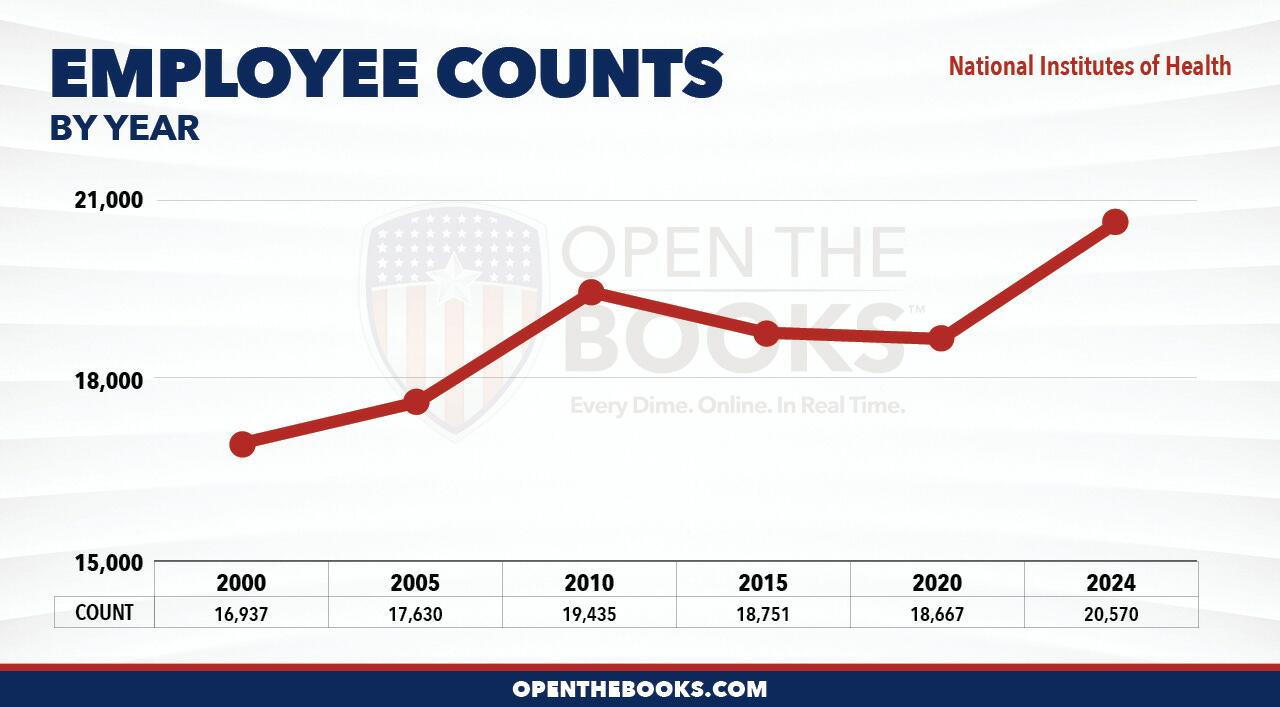
National Institutes of Health

Take the National Institutes of Health for example. Sure, headcount grew 21.5% higher than in the year 2000. But over the same period, spending has skyrocketed 301% of that figure.

Department of Education

The pattern repeats, even more extremely, at the Department of Education. Employee headcounts actually decreased since 2000, to 13.9% lower. But spending? It rose to astonishing 749% of the prior total.

That calculation looks even more galling on the heels of recent news the American students are not recovering from Covid learning losses – they’ve fallen further behind on reading and made little improvement in math. The National Assessment of Educational Progress—known as America’s report card – showed “growing numbers of students lack basic reading skills,” according to the Associated Press. Peggy Carr, commissioner for the National Center of Education Statistics, told journalists that “poor results can no longer be blamed solely on the pandemic, warning the nation’s education system faces ‘complex challenges.’”

FEMA

What about the Federal Emergency Management Agency (FEMA)? They’ve come under fire for shortfalls in their Disaster Relief Fund, and for spending big sums to house migrants in hotels. Well, their employee count actually did rise significantly – it’s just that their spending still outpaced it by miles.

FEMA headcount was 290% higher in 2024 than in 2000. But spending swelled more than seven times faster – to 2,096% of the prior spending levels! There has to be a better way to get aid to disaster zones that’s more timely and efficient – and get away from mission creep like migrant housing.

USAID

For good measure, we’ll take a look at the Agency for International Development (USAID), as it’s been the subject of so much news. Head count since 2000 has grown 218% larger. But spending has risen to 467.7% of outlays from 2000. That’s a lot of DEI for Serbian workplaces and trans comic books for Peru.

Tyler Durden
Fri, 02/21/2025 – 22:35

These Are The Countries Who Depend On Remittances The Most

0
These Are The Countries Who Depend On Remittances The Most

Remittance inflows to low- and middle-income countries rose to $685 billion in 2024, up from $647 billion the previous year, according to estimates from the World Bank. 

Globally, remittances also grew, reaching $905 billion.

In absolute terms, India ($129 billion), Mexico ($68 billion), and China ($48 billion) remained the top recipients of remittances in 2024. However, it’s smaller and poorer economies that feel the impact the most, as these inflows make up a significant share of their economies. Tajikistan, where remittances accounted for 45.4 percent of GDP in 2024, is one such case. OECD analysts say this is partly driven by the higher demand in Russia for migrant workers.

As Statista’s Anna Fleck shows in the following chart, three of the top four countries where remittances made up the largest share of GDP were classified as highly fragile by the OECD. 

Infographic: The Countries Who Depend On Remittances The Most | Statista 

You will find more infographics at Statista

Nicaragua (27.2 percent of GDP), for example, saw high remittances as economic and political instability drove migration, primarily to the United States. Honduras was previously also listed a “high fragility” context in an earlier OECD report, but has since been downgraded to a lower fragility rating.

Overall, the OECD identified 14 out of 61 highly or extremely fragile contexts where remittances made up more than 10 percent of GDP in 2023.

Tyler Durden
Fri, 02/21/2025 – 22:10