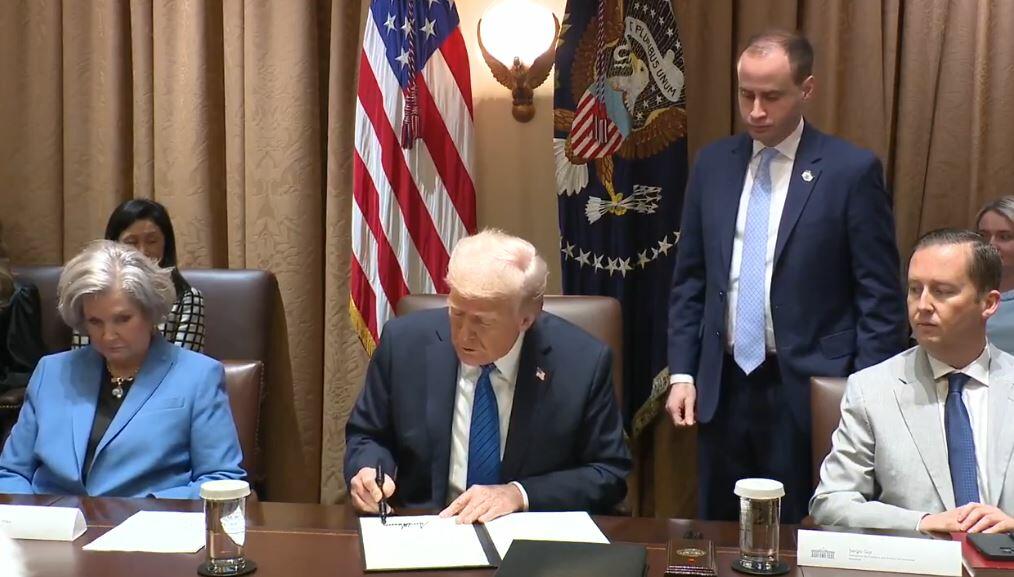
Trump Tackles Election Integrity With Sweeping Executive Order; Will Punish States That Don’t Comply
On Tuesday, President Trump signed a sweeping executive order aimed at election security.
The order will cut federal funding for states that refuse to take steps to secure their elections, tasks the Department of Homeland Security with ensuring that illegal immigrants are not voting, adds a citizenship question on the federal voting form for the first time.
It also orders the Justice Department to vigorously pursue election crimes – particularly in states that are out of compliance with federal law on election security, and seeks to ensure compliance with national election day rules.
The order also calls for the prosecution of foreign interference in US elections (like paying a British spook to produce a fabricated hoax against a candidate – which nothing is ever done about, even now?).
Watch:
🚨 POTUS signs an executive order on election integrity that includes the following provisions:
– Requires documentary, government-issued proof of U.S. citizenship on its voter registration forms.
– Conditions federal election-related funds on states complying with the integrity… pic.twitter.com/6A5zVdOAYn
Trump Eyes Two-Stage Tariffs On April 2 To ‘Strengthen Legal Framework’: Report
As April 2nd approaches – the day President Donald Trump is set to roll out a global tariff regime, the Financial Times reports that Trump is now considering ‘a two-step approach,’ which would split tariffs into two stages; targeted emergency tariffs now to raise money for planned tax cuts, and more after his administration has completed probes into trading partners to provide a more robust legal framework to deploy “reciprocal” tariffs (we charge them the same percentage they’re charging us).
Basically while Trump and Lutnick want to go full bore now, US trade representative Jamieson Greer (a lawyer who worked for Trump’s first trade chief Robert Lighthizer), insisted they pump the brakes in order to legally justify sweeping tariffs.
The dual-track strategy is poised for a high-profile unveiling on April 2, a date Trump has branded “Liberation Day,” spurring a flurry of diplomatic activity as allies seek exemptions.
Among proposals his team has been discussing is a plan to launch so-called Section 301 investigations into trading partners, while simultaneously using rarely invoked emergency powers to apply immediate tariffs in the interim. -FT
Speaking Monday, Trump vowed “substantial” tariffs on U.S. trading partners, though he also suggested the possibility of selective leniency.“They’ve charged us so much that I’m embarrassed to charge them what they’ve charged us,” Trump said – hours after announcing new tariffs on buyers of Venezuelan oil, including China. “But it’ll be substantial.”
According to the Financial Times, officials close to the matter say the administration is eyeing an immediate deployment of tariffs using emergency authorities such as the International Emergency Economic Powers Act (IEEPA), or Section 338 of the Tariff Act of 1930 – a provision that permits duties of up to 50% on foreign goods on trading partners.
One more obscure route, now considered a long shot, involves Section 122 of the 1974 Act, which permits temporary tariffs of up to 15% for 150 days – a stopgap measure that may not deliver the revenue or optics the former president is seeking.
Lawyers and people familiar with the plans also told FT that Trump could immediately slap tariffs on vehicle imports on April 2, reviving a national security study into the global auto industry from his first term.
On Monday, Trump said tariffs on cars could be announced “over the next few days.”
The debate within the Trump team has at times split along functional lines.
The two main points of contact have also differed in their approaches, say people familiar with the discussions. While commerce secretary Howard Lutnick has served as the administration’s chief negotiator, he has lambasted trading partners over their trade surpluses and tax policies, before demanding “a deal”.
US trade representative Jamieson Greer, a lawyer who previously worked for Trump’s first-term trade chief Bob Lighthizer, has increasingly asserted himself as the legal planner, seeking to create a durable blueprint for the president’s drive to reorder global trade. -FT
Greer has notably advocated for launching investigations into trading partners before applying tariffs, according to people familiar with his thinking. This would rely on tested trade law, but could delay tariffs by up to six months.
White House spokesperson Kush Desai said the final details of the reciprocal tariff plan remain under wraps, but emphasized internal alignment on the broader goal: “Although the final reciprocal tariff plan for April 2 has yet to be unveiled by President Trump, every member of the Trump administration is aligned on finally leveling the playing field for American industries and workers.”
Foreign governments are responding with urgency. The U.K. is weighing revisions to its digital services tax targeting U.S. tech firms, while the European Union has dispatched Trade Commissioner Maroš Šefčovič for emergency talks with Lutnick and Greer.
Any plan unveiled on April 2 is expected to be a refinement of Trump’s original campaign promise to apply universal tariffs to all U.S. imports – a proposal that has morphed over time but remains rooted in economic nationalism.
* * *
You can support ZeroHedge with the purchase of a high-quality, sharp,ZeroHedge Multitool.
The Trump administration is proving once again that promises made are promises kept. After successfully releasing over 80,000 pages of files connected to the assassination of John F. Kennedy on March 18, the focus has now shifted to perhaps what should be an even more explosive collection of documents—the Jeffrey Epstein files.
As you know, there was a huge document dump of files related to the Jeffrey Epstein case last month that was, to say the least, underwhelming. Part of the problem, it turns out, was that rogue officials out of the Southern District of New York office had withheld documents from the Department of Justice.
So, where’s the good stuff? Well, according to a report from Vanity Fair, it should be coming soon.
It’s the FBI’s flagship field office, with more than a thousand agents and another thousand or so civilian employees. And right now, multiple sources with knowledge of the matter say that one priority at the bureau’s New York field office is taking precedence over all others: the review and redaction of sensitive information in the Jeffrey Epstein case files, to prepare for possible publication.
“It’s literally all hands on deck,” one source familiar with the matter tells me, adding that dozens and dozens of agents are working around the clock on the case, instead of on their regular duties. “I even saw an agent walking in with a pillow,” the source added.
Attorney General Pam Bondi, appearing on Maria Bartiromo’s “Sunday Morning Futures,” spoke about this massive undertaking. Bartiromo pressed Bondi about the release of files related to Jeffrey Epstein. Acknowledging the complexity of handling such sensitive material, Bartiromo noted, “I recognize that when you’re dealing with children, it takes much more time. You’ve got to ensure that what you’re sending out publicly is not revealing any personal information.” She then asked Bondi whether more details would be forthcoming.
Bondi confirmed that updates were on the horizon, stating, “You’re absolutely right, Maria. You know, tens of thousands of pages of documents and hundreds and hundreds of victims, um, of Jeffrey Epstein.”
Bartiromo reacted with a stunned “Wow.”
Bondi assured viewers that federal authorities were making progress. “The FBI, they have been working round the clock at my directive, at [FBI Director] Kash Patel’s directive,” she said, adding that FBI Deputy Director Dan Bongino is also involved. “Dan Bongino’s there, who is a great asset for all of us at the FBI as well.”
Pam Bondi reveals there are tens of thousands of pages of documents and hundreds of child victims tied to Jeffrey Epstein.
Bondi says the FBI is working around the clock under orders from her, Kash Patel, Dan Bongino to ensure the files are released. pic.twitter.com/aiN9ct7zUb
Bondi reiterated the need to safeguard victims while ensuring transparency. “We have to protect their identity, their personal information, to make sure they’re safe,” she said. “But other than that, we are releasing all of these documents as soon as we can get them redacted to protect the victims of… of, of all of these horrific crimes he has committed.”
Bartiromo responded, “Understood.”
Rest assured, transparency is coming, everyone.
* * *
The deep state doesn’t want you to know the truth about Epstein’s powerful connections. Want exclusive analysis of the upcoming document dump and insights mainstream media won’t share? Join PJ Media VIP today using code FIGHT for 60% off. Get ad-free access to uncensored reporting, exclusive content, and live chats with our fearless writers. Don’t miss out on the real story—support independent journalism that dares to expose the truth.
How The Signal Leak Kickstarted The “Mar-A-Lago Accord”
By Benjamin Picton of Rabobank
The Signal And The Noise
US stocks rallied sharply yesterday following an unexpectedly strong services PMI report and comments from Donald Trump suggesting that reciprocal tariffs due to take effect next week may be somewhat watered down. Trump said that he “may give a lot of countries breaks” as he would be “embarrassed” to charge the USA’s trading partners tariff rates commensurate to the barriers that US exporters face to access those markets. However, it DOES seem to be the case that a ‘Dirty 15’ countries running persistent large trade surpluses with the United States will be targeted.
The NASDAQ rose 2.27%, the S&P500 closed up 1.76% and the DOW finished 1.42% higher. European stocks struggled, as did the Nikkei, but both Hong Kong and mainland China indexes closed higher. US 10-year Treasury yields rose by almost 9bps to 4.34%, and 2-year yields we’re also up by almost 9bps to 4.04%.
Bloomberg reports comments from a unnamed White House official that sectoral tariffs (tariffs levied by product group) that had also been slated to take effect on April 2nd may now be delayed. That represents a possible short-term reprieve for autos, pharmaceuticals, lumber, copper and agriculture – which have all been nominated as likely targets for tariffs – but there is still a great deal of uncertainty about what will be announced and some of these sectors may end up having duties applied to them next week.
In another major announcement yesterday President Trump said that 25% tariffs would be applied to any country importing Venezuelan oil and the Treasury Department informed Chevron that a license for operating in Venezuela would only be extended until the end of May. Trump said that these duties would apply on top of any existing tariffs, so importers like China – who has already been stung with 20% tariffs since Trump took office – could face average duty rates of 45% or more.
China, India, Malaysia and Western Europe are all major importers of Venezuelan crude, and Gulf Coast refineries could be impacted by reduced availability of heavy crude as a result of export restrictions. Brent closed 1.16% higher at $73/bbl while the active WTI contract climbed 1.22% to $69.11/bbl.
While tariff noise captured many of the headlines overnight, there was also a curious incident whereby the Editor-in-Chief of the Atlantic magazine reported that he was mistakenly added to a private Signal group chat where plans for US strikes on the Houthis in Yemen were discussed. Participants in the chat appear to include Defence Secretary Pete Hegseth, Vice President J.D. Vance, Secretary of State Marco Rubio, Treasury Secretary Scott Bessent and National Security Advisor Mike Waltz (among others).
Even more interesting than the fact that classified national security discussions were apparently held amongst senior officials via a commercial messaging app (with a journalist along for the ride) is the content of the discussions themselves. The ‘JD Vance’ account noted that “3% of US trade runs through the Suez. 40% of European trade does” and went on to say “I just hate bailing Europe out again” while adding “if there are things we can do upfront to minimize risk to Saudi oil facilities we should do it”. The Pete Hegseth account responded “I fully share your loathing of European free-loading. It’s PATHETIC.”
Participants openly discussed the United States being the only naval power “on our side of the ledger” capable of ensuring freedom of navigation through the Red Sea region. A participant speculated to be White House Deputy Chief of Staff Stephen Miller added “we soon make clear to Egypt and Europe what we expect in return. We also need to figure out how to enforce such a requirement. EG, if Europe doesn’t remunerate, then what? If the US successfully restores freedom of navigation at great cost there needs to be some further economic gain extracted in return.”
All of this is quite extraordinary, but also quite revealing of the Trump Administration’s thinking on relations with allies and partners. Nothing better highlights the transactional nature of this presidency than the raw geopolitical calculus of cabinet members discussing the need for Europe to be made to pay costs for ensuring the free flow of trade through the Suez Canal. This added trade pressure comes at a time when European industry is already losing competitiveness against American rivals, as we explore here.
As mentioned in this Daily yesterday, European officials are already sweating on whether they can rely on the United States to provide Dollar liquidity via Fed swap lines in a crisis. The logical response to this kind of uncertainty is for developed market central banks to be forced into holding more substantial foreign currency reserves, as developing market central banks typically do.
That means more bids for US Treasury securities, and another way in which the US grand strategy of holding borrowing costs low while safeguarding the global role of the Dollar, narrowing the trade deficit and rebuilding US industrial capacity to ensure hard power supremacy vis-à-vis China could play out.
Russia, Ukraine Agree To US-Brokered ‘Ceasefire At Sea’
Washington and Moscow are seeking to revive the Black Sea Grain deal, which had held for much of 2022, allowing Ukraine to ship its grain and agricultural products to global markets.
The White House on Tuesday published two readouts from successive days of talks in Riyadh with Russian and Ukrainian delegations, which feature a ceasefire at sea “to ensure safe navigation, eliminate the use of force, and prevent the use of commercial vessels for military purposes in the Black Sea.”
And even as the two warring sides continue to send drones and missiles against the other, the US said that all involved have agreed to “develop measures for implementing” the earlier agreement to stop strikes against energy infrastructure.” But have they actually agreed? Both sides are saying yes but once again this could be very short-lived.
ZELENSKIY SAYS UKRAINE TO IMPLEMENT PARTIAL CEASEFIRE NOW
OIL EXTENDS LOSSES AS UKRAINE TO IMPLEMENT PARTIAL CEASEFIRE
KREMLIN CONFIRMS AGREEMENT ON SAFE NAVIGATION IN BLACK SEA
ZELENSKY BLASTS US RESTORING RUSSIAN AGRICULTURE EXPORTS
ZELENSKIY SAYS UKRAINE’S UNDERSTANDING IS THAT AGREED CEASEFIRE IS EFFECTIVE IMMEDIATELY FOLLOWING US ANNOUNCEMENT
ZELENSKIY SAYS HE WILL ASK TRUMP FOR WEAPONS, NEW RUSSIAN SANCTIONS IF MOSCOW BREAKS CEASEFIRE
Movement of Russian military vessels beyond Eastern Black Sea would violate sea agreement, Ukraine says
Ukraine and Russia will also “continue working toward achieving a durable and lasting peace,” both White House statements said.
Both versions also emphasized that “the United States reiterated President Donald J. Trump’s imperative that the killing on both sides of the Russia-Ukraine conflict must stop, as the necessary step toward achieving an enduring peace settlement.”
The Russia-specific document further indicated that the US would help “restore Russia’s access to the world market for agricultural and fertilizer exports, lower maritime insurance costs, and enhance access to ports and payment systems for such transactions.” Russia and Ukraine have yet to sign on:
Russia said on Tuesday it was willing to strike a new agreement on the safety of shipping in the Black Sea – a possible stepping stone towards a ceasefire with Ukraine – but only if the United States ordered President Volodymyr Zelenskiy to respect it.
Foreign Minister Sergei Lavrov said only such an order would provide the assurances that Russia needed.
“To that end, the United States will continue facilitating negotiations between both sides to achieve a peaceful resolution, in line with the agreements made in Riyadh,” the White House said.
But on the same day these readouts were issued, the Kremlin continued to charge that Ukraine has already continually violated the energy ceasefire.
“Ukraine continues to attack Russian civilian infrastructure, proving that Kiev does not actually want peace,” Russian Foreign Ministry spokeswoman Maria Zakharova has charged.
So it remains a big question whether the energy ceasefire can ‘expand’ to include a Black Sea ceasefire, given neither has actually as yet gotten off the ground.
Russian Foreign Minister Sergey Lavrov has also said the West is giving Ukraine false hope, also through continued arms shipments and supplies.
“Without them [Western states], Ukraine would have been defeated long ago … But you see, both London and Paris are pumping Ukraine with weapons,” Lavrov said Tuesday.
Russia Has ‘Influenced’ The Trump Administration, Zelensky Charges
After a reported 12-hours of negotiations in a luxury hotel in Riyadh, neither the Russian nor US sides have had a lot to say. An initial US readout sounded a tone of optimism, while the Russian side called the talks “useful”.
“We talked about everything, it was an intense dialogue, not easy, but very useful for us and the Americans,” Russian negotiator Grigory Karasin said, describing that “lots of problems were discussed”.
But at this moment Moscow likely has little incentive to drill down in negotiations when it can perhaps more quickly get what it wants on the battlefield.
With talks not advancing very quickly, Ukrainian President Volodymyr Zelensky is lately out with more criticism of the White House, again risking provoking the wrath of Donald Trump.
In a Time magazine interview published Sunday, Zelensky charged that US administration officials are succumbing to Kremlin propaganda. He specifically identified the notion that Kiev doesn’t really want to reach a ceasefire deal with Moscow as an example of Russian propaganda.
“I believe Russia has managed to influence some people on the White House team through information,” Zelensky claimed.
“Their signal to the Americans was that the Ukrainians do not want to end the war, and something should be done to force them,” he explained.
The Ukrainians have also slammed a recent Tucker Carlson interview with Trump special envoy Steve Witkoff as another example of Russian narratives being advanced:
“(Russia) reclaimed these five regions. They have Crimea, and they’ve gotten what they want. So why do they need more?” Witkoff said.
Another instance that the Ukrainian president said was part of the Russian narrative was Trump’s comments about the encirclement of “thousands” of Ukrainian troops in Kursk Oblast.
“That was a lie,” Zelensky said.
All of this comes after weeks ago the White House briefly halted weapons transfers to Kiev, as well as intelligence-sharing. While these programs have been restarted, the intel-sharing is reportedly much more limited, and can’t be used of attacks on Russian territory (at least according to official media).
Zelensky’s latest accusations reflect a growing desperation. The more he loses traction and influence with the White House, the more he’s likely going to revive lazy Russiagate-style talking points.
He’s at the same time unwilling to seriously talk territorial concessions, which is probably the one thing that will solve the war. Short of these concessions, Moscow will keep pressing on the battlefield.
Hordes of lunatics at an AOC/Bernie Sanders rally were recorded threatening violence and calling for President Trump to be tortured and murdered.
One attendee wielding a sign depicting Trump’s severed head was asked “are you calling for for his death?” and responded “I am yes, I believe it’s time the people straight cut his fucking head off.”
Another blathered about hanging Trump by his ankles from a lamppost until dead, stating “the only good fascist is a dead fascist.”
Another attendee stated that violence “is the only thing they’re going to listen to now,” adding that “I feel like we’ve done the rallies… if (violence) is what we need to do then that’s what we need to do.”
If you had to choose a side would you stand with normal everyday people who want more efficient government and an administration that works in their best interest, or skull mask wearing freaks who want to chop off the President’s head?
Threatening the president of the United States is a class D felony under United States Code Title 18, Section 871. It is punishable by up to 5 years in prison, a maximum fine of $250,000, a $100 special assessment, and up to 3 years of supervised release.
Is it any wonder these mentally disturbed people start acting like this when the Democrats they have been conditioned to worship are openly calling for violence?
* * *
Your support is crucial in helping us defeat mass censorship. Please consider donating via Locals or check out our unique merch. Follow us on X @ModernityNews.
Trump Stands By Waltz, Hegseth As Dems Gun For Their Jobs After Signal Leak
Congressional Democrats are trying to turn the Jeffrey Goldberg Signal chat revelations in The Atlantic into a major national scandal, and are gunning for the jobs of Trump’s national security adviser Mike Waltz and Defense Secretary Pete Hegseth.
“Nobody was texting war plans, and that’s all I have to say about that,” Hegseth told reporters within hours after the controversy was unleashed Monday. This was as the National Security Council issued an initial statement saying the message thread “appears to be authentic.” Meanwhile…
DEMOCRAT WARNER ASKS INTELLIGENCE AGENCY HEADS TO RELEASE ENTIRE SIGNAL CHAT IF IT IS NOT CLASSIFIED, AS THEY ASSERT
Goldberg, who says he was inadvertently added to the group, apparently by Waltz, described that he was shocked to see ‘war plans’ discussed in real time, regarding Yemen operations.
But Hegseth has rejected the claims that highly sensitive and classified war plans were being discussed. “You’re talking about a deceitful and highly discredited so-called ‘journalist’ who’s made a profession of peddling hoaxes time and time again,” Hegseth said further.
Goldberg later in a MSNBC interview pushed back, saying that “precise details” of the attack on the Houthis were shared in the chat, and viewed by him.
“He can say that it wasn’t a war plan, but it was a minute-by-minute accounting of what was about to happen, organized by CENTCOM… and [shared] with a bunch of civilian leaders,” Goldberg said.
President Trump is meanwhile standing by his national security team, even as Goldberg has claimed to CNN of Hegseth, “He was texting attack plans.”
On Waltz, Trump told NBC’s Garrett Haake, “Michael Waltz has learned a lesson, and he’s a good man.” Trump described that it was one of Waltz’s aides who added Goldberg’s number to the chat.
“It was the only glitch in two months, and it turned out not to be a serious one,” he said.
Democratic Rep. Seth Moulton of Massachusetts is one among many who disagree. “There is no world in which this information should have been shared in non-secure channels,” he said in a written statement. “Hegseth is in so far over his head that he is a danger to this country and our men and women in uniform.”
Press secretary Karoline Leavitt on Tuesday also pushed back, saying these weren’t war plans. She said the White House is “looking into how Goldberg’s number was inadvertently added to the thread.”
Goldberg is still trying to blame Hegseth for everything, when Michael Waltz is the one responsible for the entire snafu.
Now why would that be? Why would Goldberg repeatedly attack a victim of the breach instead of HIS FRIEND WHO SECRETLY INVITED HIM IN?
She further described that the White House Counsel’s Office has “provided guidance on a number of different platforms for President Trump’s top officials to communicate as safely and efficiently as possible.”
She called Goldberg “well-known for his sensationalist spin” and said, “Thanks to the strong and decisive leadership of President Trump, and everyone in the group, the Houthi strikes were successful and effective.” She then said, “Terrorists were killed and that’s what matters most to President Trump.”
* * *
Sean Davis of The Federalist highlights another significant issue:‘they now know who Waltz talks to when nobody is looking’…
“Hegseth should’ve known.” What nonsense. If you can’t trust the president’s top national security adviser to initiate a conversation without secretly including dishonest and corrupt hoax-peddling journos, that is a problem that begins and ends with the national security adviser.
Signal only shows names now, not numbers. And each user determines how his own name shows up, which means if you are invited into a chat after others have been added—and one of those people is not accurately showing their name—you would have no way of knowing a previously added person was a mole.
Similarly, if a trusted friend or colleague called you to speak with you but secretly had another person on the line, or met with you in person while his phone or other device was recording or relaying the conversation to another party, you wouldn’t blame the person who was being spied on. That would be insane. You would obviously place the entirety of the blame on the individual whose incompetence or corruption or malice was the sole cause of the breach of trust and security.
Trump may still trust Waltz, but I guarantee you very few others who have to work with Waltz trust him right now, and for good reason. Even in direct personal conversations in SCIFs or the White House, I guarantee top officials will be far less open with their views given that they now know who Waltz talks to when nobody is looking. And that is a huge liability for Trump, and the country.
Conference Board Consumer Expectations Plunge To 12 Year Lows; Inflation Expectations Rise
Another day, another sentiment measure disappoints…
The Conference Board Consumer Confidence headline print fell from 100.1 (upwardly revised) to 92.9 (below 94.0 exp). Under the hood, it was not pretty with the measure of expectations for the next six months dropped nearly 10 points to 65.2, the lowest in 12 years, while a gauge of present conditions declined more modestly.
Source: Bloomberg
“Consumer confidence declined for a fourth consecutive month in March, falling below the relatively narrow range that had prevailed since 2022,” said Stephanie Guichard, Senior Economist, Global Indicators at The Conference Board.
“Of the Index’s five components, only consumers’ assessment of present labor market conditions improved, albeit slightly. Views of current business conditions weakened to close to neutral. Consumers’ expectations were especially gloomy, with pessimism about future business conditions deepening and confidence about future employment prospects falling to a 12-year low.
Meanwhile, consumers’ optimism about future income—which had held up quite strongly in the past few months—largely vanished, suggesting worries about the economy and labor market have started to spread into consumers’ assessments of their personal situations.”
Labor market conditions stabilized very modestly from their very recent downtrend…
Source: Bloomberg
Likely in response to recent market volatility, consumers turned negative about the stock market for the first time since the end of 2023.
In March, only 37.4% expected stock prices to rise over the year ahead – down nearly 10 percentage points from February and 20 percentage points from the high reached in November 2024. On the flip side, 44.5% expected stock prices to decline (up 11 ppts from February and over 22 ppts more than November 2024).
Meanwhile, average 12-month inflation expectations rose again – from 5.8% in February to 6.2% in March – as consumers remained concerned about high prices for key household staples like eggs and the impact of tariffs… still well below the chaos monkeys at UMich…
Finally, we noted that March’s fall in confidence was driven by consumers over 55 years old and, to a lesser extent, those between 35 and 55 years old. By contrast, confidence rose slightly among consumers under 35, as an uptick in their assessments of the present situation more than offset gloomier expectations. The decline was also broad-based across income groups, with the only exception being households earning more than $125,000 a year.
Chinese Tech Stocks Plunge From 3 Year High To Correction In Just 5 Days
For those whose heads are still spinning from the furious speed of the recent plunge of the S&P into correction, here’s round two: overnight Chinese tech stocks extended their recent drop, and fell from a three-year high to the brink of a correction in just five sessions, fueled by a lack of positive surprise in earnings and rapidly cooling sentiment. The Hang Seng Tech Index dropped 3.8% on Tuesday, extending its slide from a March 18 high to nearly 10%. And if one goes back to the March 6 high, the Index is already in a 10% correction. The broader MSCI Asia Pacific Index declined as much as 0.4%, reversing a gain of 0.5%, dragged down by Chinese internet stocks Alibaba and Tencent who were among the biggest drags.
Xiaomi, which raised $5.5 billion in an upsized placement on Monday, tumbled 6.3%. The sale follows BYD’s $5.6 billion offering earlier this month. While the funding may benefit the companies over the longer term, shares are under immediate pressure due to increased supply and as they were sold at discount, analysts said.
Elsewhere, Alibaba fell nearly 4% following its chairman’s warning on a potential bubble forming in AI datacenter construction. While Alibaba has been investing heavily in artificial intelligence, chairman Joe Tsai said he was “astounded by the type of numbers that’s being thrown around” in the United States.
“People are talking about $500 billion, several hundred billion dollars. I don’t think that’s entirely necessary. I think in a way, people are investing ahead of the demand that they’re seeing today.” He said he thought it was worrying when people began to talk about building data centers on spec, adding that he was seeing “the beginning of some kind of bubble.”
Tsai’s comment chilled a world-beating rally in Chinese tech stocks which has rapidly reversed as the initial shock-and-awe from DeepSeek’s AI model wanes, with investors demanding more real-life applications – and actual results – before bidding up shares further. While the nation’s tech earnings mostly topped estimates or came in line in the just-concluded reporting season, such expectations were already baked in.
Earnings have been good so far, but they weren’t enough to bring “positive surprise,” said Steven Leung, an executive director at UOB Kay Hian Hong Kong Ltd. “Xiaomi’s upsized share placement has weighed on market sentiment today with some investors worrying about such offering creating pressure on market liquidity.”
Sentiment was further hurt by a Goldman report slashing its forecast for AI Servers “due to the combined reasons of product transitioning and uncertainties of demand and supply.” The bank now expects 19k/ 57k of rack-level AI servers (in 144-GPU equivalent) for 2025/ 26E, down from previously 31k / 66k in 2025/ 26E. Accordingly, the bank also revised down the target price of Quanta, Hon Hai, FII, Wistron, AVC, Auras, by 7%~21% (more in the full Goldman report available to pro subs).
Tuesday’s retreat bucks gains across most of Asia following signals from US President Donald Trump that the sector-specific and reciprocal tariffs expected on April 2 may be less daunting than feared. The Hang Seng China Enterprises Index fell 2.7%.
Yet even with the week’s slide, the Hang Seng Tech gauge remains up more than 23% for the year, vastly outperforming US stocks. Investors have rushed to re-evaluate Chinese tech stocks since the rise of DeepSeek in January, with President Xi Jinping’s embrace of major business leaders also accelerating stock gains.
That said, any further selloff will worry investors, and may potentially undermine a growing narrative that Chinese markets can become an alternative investment ground as investors reassess US exceptionalism.
Another big decliner on Tuesday was Sunny Optical Technology Group, which plunged 10% after the company cautioned against a capacity glut. All 30 members of the Hang Seng Tech gauge ended in the red.
“Alibaba’s caution around a potential bubble in AI data center buildouts has added pressure, hinting that the red-hot AI theme may face a short-term bump,” said Charu Chanana, chief investment strategist at Saxo Markets.