77.5 F
Chicago
Tuesday, September 29, 2026
Home Blog Page 1812

Suggested Trump Admin Reform – End The Illegal ENDS Epidemic

0
Suggested Trump Admin Reform – End The Illegal ENDS Epidemic

Authored by Roderick Law via RealClearHealth,

As President Trump and border czar Tom Homan set about getting control of our southern border, they have an opportunity not only to clamp down on the horrors of human trafficking and drug smuggling. They can also deal a blow to the Chinese companies that make $3.5 billion a year selling contraband e-cigarettes and vapes in the U.S. and the Mexican cartels that smuggle them.

It is estimated that 98 percent of the electronic nicotine delivery systems (ENDS) sold in the nation are illegal products, and most of them are made in China. They are cheaper, more potent and manufactured with far less health and safety regulation than American products. Often, the products are flavored, packaged and branded to appeal to children and adolescents.

Last summer, the Food and Drug Administration (FDA) finally got serious about the flood of untested and possibly hazardous products that find their way from China to U.S. convenience stores. The agency launched a taskforce with the Department of Justice to crack down on vape smuggling. In October, it announced that it had seized $76 million worth of contraband vapes. In December, authorities interdicted $81.5 million worth of e-cigarettes and vapes just in Chicago.

While fighting smuggling and holding retailers accountable for selling illicit products are productive steps, the FDA has it in its power to impact demand for contraband vapes. The FDA’s Center for Tobacco Products (CTP) has had jurisdiction over e-cigarettes since 2016. To sell new tobacco products in the United States, companies must file a “premarket tobacco application” (PMTA) and receive a “marketing granted order” (MGO) from the CTP. Companies pay “user fees” to the FDA to cover the cost of the research and testing on the products.

E-cigarettes and other vapes have been marketed as a healthier alternative to smoking – delivering nicotine without tar and some other byproducts of tobacco. They have helped many smokers quit and are therefore considered a harm-reduction tool. But the CTP has approved just 34 new products out of 26.6 million applications since 2019. Nature abhors a vacuum, and so does the ENDS market. Users want selection and low prices. Retailers want product for their shelves. Illegal Chinese vapes fill the void.

On the surface, CTP seems like low-hanging fruit for Elon Musk’s Department of Government Efficiency. But efficiency isn’t the real problem. Ideology is. On nicotine, the FDA shares a prohibitionist mindset with the anti-smoking activist groups it works closely with. In fact, it shares a revolving door with those special interests. The FDA has taken it upon itself to limit the availability of harm-reducing ENDS.

The CTP allegedly does a lot of goalpost moving. In December, the U.S. Supreme Court heard arguments in a case brought by two domestic vape manufacturers who maintain the agency pulled what the 5th Circuit Court of Appeals characterized as a “regulatory switcheroo.” The companies say the agency changed standards and imposed new requirements for approval after the companies submitted their PMTAs. Asked by Justice Brett Kavanaugh why the companies were suing the FDA instead of simply resubmitting amended applications, their lawyer cited the agency’s glacial approval pace. The companies simply “can’t afford to wait that out.”

For their part, retailers have long complained that the FDA is unclear and even evasive about what products are legal for sale. The agency moved to address the issue by launching a Searchable Tobacco Products Database. But inexplicably, the database didn’t include two of the most popular products on the market, Zyn and Juul. They’re legal products. The FDA notes that the database “is not an exhaustive list of all tobacco products that can be legally marketed.” Then why bother with a database at all?

The problem of illegal, potentially dangerous Chinese vapes lining the shelves of gas stations and smoke shops can’t be fought on just one front. President Trump has promised (indirectly) to staunch the flow of products from across the Mexican border. The CTP needs to do the job Congress gave it and process applications. If it won’t, it and the FDA more broadly need a serious housecleaning.

Roderick Law is the Communications Director for the Functional Government Initiative. He is a graduate of the George Washington University, with a BS in international affairs and a MA in security policy studies. 

Tyler Durden
Tue, 02/11/2025 – 20:55

David Tepper Boosted China Holdings Before Latest Rally

0
David Tepper Boosted China Holdings Before Latest Rally

By Yiqin Shen, Bloomberg Markets Live reporter and strategist

Billionaire investor David Tepper ramped up his stake in China-related stocks and ETFs last quarter, just before the development of DeepSeek reignited a rally in the country’s shares.

The president and founder of Appaloosa Management LP, who made waves in September with a call to buy “everything” related to China, increased the firm’s holding of e-commerce company JD.com by roughly 43% in the fourth quarter, according to the latest 13F filing.

The money manager also boosted his stake in Alibaba, another e-commerce giant, by 18%. The stock remains the hedge fund’s largest holding, accounting for about 16% of its $6.4 billion portfolio.

The moves came amid a volatile stretch for Chinese stocks, when investors showed signs of wavering commitment after Beijing rolled out a stimulus blitz in late September. The government’s efforts sparked a frenetic rally into early October, but the momentum faded in the following months amid disappointment over the scale of fiscal stimulus, a weak economic outlook and a property crisis. Alibaba fell 20% in the fourth quarter, while JD.com declined 13%.

Tepper also added exposure to the KraneShares CSI China Internet exchange-traded fund (ticker KWEB) and to the iShares China Large-Cap ETF (ticker FXI), as well as to KE Holdings Inc. and Baidu Inc., the filing showed. Chinese stocks and ETFs giving exposure to the country’s shares made up about 37% of his portfolio as of the end of December, in terms of market value, little changed from the previous quarter.

China’s market has been on a stronger footing to start the year, with some of China’s equity benchmarks outperforming US and European peers. That’s in part because of China’s growing clout in the artificial-intelligence space, on the back of the success of DeepSeek’s AI model.

As a result, investors have been re-evaluating the nation’s beaten-down shares, although they’re also assessing the impact of US President Donald Trump’s move to slap 10% tariffs on China. On Friday, the Hang Seng Tech Index entered a bull market while the Hang Seng China Enterprises Index is less than 5% from overtaking its October peak.

Alibaba, which is building its own AI model, has climbed nearly 30% since the start of the year. The company may be able to manage the US-China trade war’s impact on revenue better than its Chinese rivals because its overseas operations are more geographically diverse, according to Bloomberg Intelligence.

Full 13F breakdown below (link).

Tyler Durden
Tue, 02/11/2025 – 20:30

Stubbornness, Divine Providence And Donald Trump

0
Stubbornness, Divine Providence And Donald Trump

Authored by Frank Miele via RealClearPolitics,

Donald Trump has always been a complex character, but to fully understand him now, one must begin with the assassination attempt at Butler, Pennsylvania, on July 13, 2024.

Listen to how Trump described that experience in his second inaugural address:

“Those who wish to stop our cause have tried to take my freedom and indeed to take my life. Just a few months ago, in a beautiful Pennsylvania field, an assassin’s bullet ripped through my ear. But I felt then, and believe even more so now, that my life was saved for a reason. I was saved by God to make America great again.”

Even his harshest critics were hesitant to challenge Trump’s grandiose assertion because – at some level – they could put themselves in Trump’s shoes. And now, three months after the election and a mere three weeks after he was sworn in, the evidence is plain that Trump is a politician reborn, with a purpose renewed. If Making America Great Again started as an election slogan, it has been transformed into a divine mission.

Trump 2.0 is the Democrats’ worst nightmare. If he had won a second term in 2020, forcing him to govern with a Chuck Schumer-controlled Senate, he would have been virtually powerless. He would have limped through that second term with the usual bluster and name-calling, but without any new vision or agenda. His mandate would have been simple – keep the economy strong and don’t rock the boat too hard. Play golf whenever possible. 

There would have been no Elon Musk and no Department of Government Efficiency. There would have been no Bobby Kennedy Jr. or Make America Healthy Again. It is unlikely there would have even been a housecleaning at the FBI or CIA. Remember, there would not have been a raid at Mar-a-Lago, nor a “deranged” special counsel, nor a Jan. 6 riot in the U.S. Capitol. We would be living in an entirely different world, led for four years by an entirely different Trump on a glide path to retirement.

The 2024 election would have been a complete unknown. Republicans would have scrambled to find a worthy successor to Trump, but there would be no anointed one. Almost certainly not Mike Pence, but then who? Josh Hawley? Tom Cotton? Nikki Haley? Tim Scott? Not J.D. Vance, who would still be a mid-level literary author and never have been elected senator from Ohio. The Democrats would not have had to suffer through the embarrassment of a senescent President Joe Biden. They would have had a legitimate primary battle in 2024 between Govs. Newsom, Shapiro, Pritzker, and Hochul, and Sens. Klobuchar, Warren, Gillibrand, and maybe Sanders. Kamala Harris would have been an afterthought – or withdrawn before Iowa just as she did in 2020.

The likelihood of a Democratic victory after two consecutive Trump terms would have been high. MAGA itself might have fizzled out from attrition and eight years of mainstream media overkill.

So it’s easy to theorize about the role of divine providence bringing us to this point, but one can’t discount the importance of Trump’s own character in asserting his will against the established order either. His ability to withstand the full court press of two impeachments, two special counsels, two assassination attempts, and multiple felony indictments and convictions to convince the American public to return him to the White House is nothing short of miraculous.

If Trump was indeed “saved by God,” there must have been a reason – something that made Trump a perfect vessel for reshaping our times, even though not perfect himself. So what is it?

I’ve tried to think of analogs for Trump’s persona in life and literature and largely come up empty. As a politician, Trump is sui generis. You can scan the Bible for other examples of imperfect perfection such as King David and Cyrus the Great, but it’s best not to impute to a contemporary such as Trump the authority of the Old Testament. So where else do we turn?

A few authors have noted the similarity of Trump to Napoleon Bonaparte, including for his ego, his exile, and his support from the common man. I myself have written twice about such a connection, including once in 2016 before he was elected and once in 2022 after he was banished to Mar-a-Lago. The columns stand the test of time, but there might be one avatar for The Donald drawn from literature that is even more appropriate.

I am thinking of the character known simply as the Mule in Isaac Asimov’s “Foundation” trilogy. Book two of the science fiction series, “Foundation and Empire,” introduces the Mule as a character of such intense individuality that he has the power to break every expectation, exceed every limit, and avoid virtually every trap put in his way as he attempts to conquer the galaxy.

As Asimov has another character explain, “He has no name other than that of the Mule, a name reportedly applied by himself to himself, and signifying, by popular explanation, his immense physical strength, and stubbornness of purpose.”

We need not worry about physical strength in our comparison, but “stubbornness of purpose” can be applied to Trump and to only a few others in U.S. history, including George Washington during his role as commander in chief of the Continental Army and Abraham Lincoln as commander in chief of the Union Army. Were it not for Trump’s extraordinary second term, his divine commission, we might never have even understood his stubbornness of purpose. Oh yes, he was considered mule-headed for his unwillingness to follow political conventions, but until his return from exile, he still tried to curry favor with the ruling class by trying to fit in with expectations rather than imposing his will through brute force.

When Corey Lewandowski encouraged Republicans to “Let Trump be Trump,” we thought we knew what he meant. And to some extent, we did. It meant that the unpolished, imperfect Trump was the most authentic politician since “Give ’Em Hell Harry” Truman and that voters would reward that authenticity with votes. But it wasn’t until the last month or two that we could appreciate how the untrammeled Trump would be able to completely reshape not just the political world, but the actual world, by following his instincts and just getting things done, dammit.

Which brings us back again to the Mule. In Asimov’s epic narrative, the Mule is the one unpredictable factor that has the potential to change the course of galactic history – a history which has otherwise been mapped out with surprising precision by Hari Seldon, the inventor of psychohistory. Seldon provided mankind with a plan to rescue civilization from a coming dark age, and everything was going swimmingly until the Mule arrived on the scene. From that point on, everything became unpredictable, as this one individual is so far outside the box that the box becomes irrelevant.

That is Trump. There are other similarities too. People either love the Mule or hate him, in part because of a technique of mind control that the mutant was born with. No one has accused Trump of possessing extrasensory abilities, but they do accuse him of being a cult leader – a Svengali who can brainwash his disciples and expects absolute devotion. Maybe they are right, but it is not necessary to conclude that Trump uses mind control in order to explain his impact on the zeitgeist. Sufficient is “stubbornness of purpose.”

Viewing Trump as a real-life Mule, the random element in an otherwise orderly and predictable set, is beyond question. He is a disruptor deluxe. And depending on the outcome of his mass re-invention of American political norms, he will either be – like the Mule – the progenitor of a new world order created in the service of self-aggrandizement, or something more.

What that “more” can be, we are waiting to find out. But one thing is certain: There is no one else like Donald Trump on the world stage today. His kind arrives once in a generation, or once in a hundred years or more. Or on the scale of Asimov’s “Foundation” – once in a millennium.

Frank Miele, the retired editor of the Daily Inter Lake in Kalispell, Mont., is a columnist for RealClearPolitics. His book “The Media Matrix: What If Everything You Know Is Fake” is available from his Amazon author page. Visit him at HeartlandDiaryUSA.com or follow him on Facebook @HeartlandDiaryUSA and on X/Gettr @HeartlandDiary.

Tyler Durden
Tue, 02/11/2025 – 20:05

Egypt’s Sisi Cancels Planned White House Visit After Awkward Trump-King Abdullah Meeting

0
Egypt’s Sisi Cancels Planned White House Visit After Awkward Trump-King Abdullah Meeting

Egyptian President Abdel Fattah el-Sisi has canceled a planned February 18 visit to Washington to meet with President Donald Trump. It is being reported Tuesday as an indefinite postponement.

The key factor, which has reportedly brought US-Egypt relations to a low point, is Trump’s ‘takeover’ plan to expel Gazans into Egypt and Jordan. Another factor is Trump’s repeated reference to Sisi as “the general” – which was used publicly when Israel’s PM Netanyahu recently visited the White House.

Back in better days…

“Egyptian officials viewed this as dismissive, sources said,” The New Arab reports. And then there was this during Trump’s first term, back in 2019 at a G7 summit:

“Where’s my favorite dictator?” Mr. Trump called out in a voice loud enough to be heard by the small gathering of American and Egyptian officials.

The same report writes of Trump’s controversial Gaza plan, “an Egyptian diplomatic source in Washington said Foreign Minister Badr Abdelatty had warned US officials and members of Congress that implementing Trump’s relocation plan could lead to a resurgence of radical Islamist groups in the region.”

Jordan is lockstep with Egypt on this. Trump hosted Jordan’s King Abdullah II on Tuesday in an awkward meeting which saw the monarch reject Trump’s pressure.

The king tried to preempt further pressure from Trump by pledging to take in 2,000 Palestinian children. Otherwise Jordanian sources have said they would seal the borders and potentially declare war in Israel if a mass ‘cleansing’ campaign ensues.

Via AFP

“The president and the king fielded some questions from reporters from the Oval Office, where Abdullah tried to slow roll Trump’s Gaza proposal, which is vastly unpopular in the Middle East,” The Hill reports. “Trump, meanwhile, vowed to press on but also lauded Abdullah and his pledge to take in 2,000 sick Palestinian children.”

So in the end, nothing much came of the Abdullah-Trump meeting, but likely Jordan was offered some major incentive by Trump behind the scenes.

The King immediately following the meeting emphasized Jordan firmly rejects any displacement of Palestinians from the Gaza Strip, and said all Arab leaders stand united on this.

Watch: Trump put a clearly nervous Abdullah on the spot in front of the press pool…

Below are some key lines from the press Q&A at the White House meeting:

* * *

King Abdullah of Jordan:

Asked about accepting Palestinians, the King mentioned a plan involving Egypt and discussions initiated by Saudi Crown Prince Mohammed bin Salman. He said, “We have to keep in mind how to make this work in everyone’s best interest.”

In response to Trump’s plan for a parcel of land for Palestinian refugees in Jordan: “I have to do what is best for my country.”

Announced that Jordan will accept 2,000 ill children from Gaza for medical treatment.

President Donald Trump:

Repeated his call for removing Palestinians en masse. Said Palestinians will live in “another location that is not Gaza.”

Stated the U.S. will “run Gaza very properly,” but, “we’re not going to buy it.”

Proposed the possibility of designating “parcels of land in Jordan and in Egypt” for Palestinians.

Called Abdullah’s pledge to take 2,000 sick Palestinian children “a beautiful gesture”.

Gaza: “We’re going to take it, we’re going to cherish it,” says Trump

Expressed doubt about Hamas meeting the captives release deadline: “I don’t think they’ll make Saturday’s deadline.”

Abdullah plays the game…

Meanwhile…

Tyler Durden
Tue, 02/11/2025 – 19:40

Microbiologist, Residents Say China Conceals Extent Of Respiratory Virus Outbreak

0
Microbiologist, Residents Say China Conceals Extent Of Respiratory Virus Outbreak

Authored by Dorothy Li via The Epoch Times (emphasis ours),

Chinese health authorities have said this winter’s flu season is less severe than the year before, but medical experts cast doubts over the transparency of its respiratory illness situation.

People wearing masks wait at an outpatient area of the respiratory department of a hospital in Beijing on Jan. 8, 2025. Jade Gao/AFP via Getty Images

Residents from four different cities have expressed concerns about an uptick in respiratory infections within their families and communities when speaking to The Epoch Times.

Some suspected their flu-like symptoms may actually be caused by COVID-19, fearing that doctors were instructed to avoid such diagnoses, given that the authorities declared a victory in its fight against the pandemic almost two years ago.

In Shenyang, northern China, a woman named Xu said she’s noticed more people sick with respiratory illnesses have seen local hospitals packed again during the Lunar New Year holiday.

“I’m feeling unwell myself and haven’t recovered. The hospital said I contracted influenza A, but I believe it’s just COVID-19,” Xu told The Epoch Times on Feb. 7. She expressed concerns about how quickly the virus circulated among humans this time, saying her son, daughter-in-law, and their school-aged daughter have all fallen ill. “The authorities are concealing the scale of the outbreak.”

Flu Toll Questioned

China’s top health body has acknowledged the country is grappling with a spike in respiratory infectious illness, but said the rate of influenza has shown signs of slowing down.

During the regime’s most recent briefing, National Health Commission (NHC) officials reiterated its previous assessment, saying the scale and intensity of the spread of respiratory infectious diseases this year is lower than it was during the previous winter season.

“No new infectious disease had been detected,” Mi Feng, NHC’s spokesperson, told reporters on Jan. 17, ahead of the week-long Lunar New Year holiday, attributing the current infections to a combination of known germs, most prominently influenza. No data was provided during the briefing.

It remains unclear how many people were infected with the influenza virus or COVID-19 this year. The latest figures showed 112 COVID-19 infections and seven deaths in December 2024, according to a monthly report from China’s Center for Disease Control and Prevention. Since December 2022, after a leaked recording of an internal NHC meeting indicated the COVID outbreaks were far worse than the official tallies indicated, the top health regulator stopped publishing daily COVID figures and transitioned COVID-related updates to its sub-department, CDC.

In a separate report, the CDC reported 1.5 million influenza cases last December, leading to seven deaths.

Medical experts have questioned the accuracy of these flu statistics.

“It’s clear that the mortality rate is being underreported,” Sean Lin, a virologist and former lab director at the viral disease branch of the U.S. Walter Reed Army Institute of Research, told The Epoch Times.

The official tally means for every 100,000 people who contracted the flu in China, only one has died, a contrast to the much graver rates observed in the United States, where between 5 to 10 out of every 10,000 individuals face fatal outcomes, according to Lin’s analysis.

“Given China’s [high] level of air pollution and the large number of smokers, the number of people with underlying respiratory diseases in China is supposed to be substantial, so the death toll from influenza is likely much higher than reported,” Lin said.

Dong Yuhong, a medical doctor specializing in infectious diseases, also raised concerns about the absence of detailed data, calling them essential for preventing potential pandemics.

Dong recalled during previous COVID-19 outbreaks, there was often a noticeable gap between official numbers and the accounts of frontline workers, crematorium staff, and residents on the ground.

A mourner carries the cremated remains of a loved one as he and others wear traditional white funeral clothing, during a funeral in Shanghai, China, on Jan. 14, 2023. Kevin Frayer/Getty Images

The Chinese regime has drawn widespread criticism for covering up COVID-related information. The scrutiny goes back to almost the onset of the pandemic, which first emerged in the central Chinese city of Wuhan in late 2019. At that time, the regime concealed the outbreak’s true scale and silenced whistleblowers, allowing regional outbreaks to develop into a global pandemic.

Without reliable health statistics, the international community would be in the dark about the true situation in China, according to Dong.

“Real statistics are crucial for epidemic prevention. They help us understand the scale of an outbreak and evaluate the effectiveness of our response measures,” Dong told The Epoch Times.

Concerns Among the Public

Chinese citizens don’t seem convinced by Beijing’s optimism about this winter illness season, with some appearing to be cautious about the current situation.

A man working in the industrial hub of Guangdong said he didn’t travel back home for the Chinese New Year, the country’s most important festival, which fell on Jan. 29 this year. He cited concerns about the outbreaks in his hometown of Xuchang, located over 800 miles away, where he heard the situation was “severe.”

“It’s still caused by COVID-19,” the man, surnamed Shao, told The Epoch Times on Feb. 5. “The hospitals are full … many passed away recently, and the crematorium is busy.” Shao lamented missing his uncle’s funeral that day. His uncle had been healthy and, according to Shao, after getting the domestic COVID-19 vaccine two years ago, he became weak and ultimately succumbed to “white lung” pneumonia.

Shao’s sentiment was echoed by a dancing teacher in Beijing, who spoke on condition of anonymity for fear of repercussions. She painted a grim picture of the flu season this year, describing it as “very serious” as many of her students have fallen ill and showed flu-like symptoms. Diagnoses mainly pointed to Type A flu or HMPV, a type of flu that recently attracted global attention, though “privately everyone said it was COVID-19,” she said.

The teacher recalled her relative, a young man who passed away just days after contracting the flu. She said she couldn’t help but suspect that the domestic COVID-19 vaccine played a role, given his previously good health and lack of underlying conditions.

In the central province of Anhui, a middle-aged father said his child and his mother also got sick, and in his city, he heard many infected were seriously ill.

“They say it’s just flu,” the man, who declined to be named for fear of reprisals, told The Epoch Times, “but after taking [flu] medications, their symptoms haven’t improved at all.”

He said he speculated there was a “new virus” circulating, but he heard others linked it to a mutated COVID variant. Nevertheless, “all these news [reports] were concealed,” he said.

Luo Ya and Xiong Bin contributed to this report. 

Tyler Durden
Tue, 02/11/2025 – 19:15

22 Blue States Signed Secret Pact To Defy Trump Immigration Efforts, Coordinate Legal Strategies

0
22 Blue States Signed Secret Pact To Defy Trump Immigration Efforts, Coordinate Legal Strategies

Attorneys general from 22 blue states along with Washington DC and San Francisco signed a secret agreement just 3 days after President Trump won the 2024 election for a coordinated response to resist Trump’s anticipated actions to end birthright citizenship.

California Gov. Gavin Newsom (D)

According to an investigation by the Heritage Foundation’s Oversight Project, the 22 AGs agreed to legal collaboration and communication to defy Trump’s immigration enforcement initiatives, including any deemed confidential or privileged.

All shared information would be used to coordinate various legal schemes, as well as pre-lawsuit investigations, litigation strategies, complaints, dispositive motions, merits briefs, and amicus briefs. The agreement also bars third parties from accessing any of this shared information, which is defined as all documents, materials, information, and communications exchanged between the attorneys generals’ offices prior to the agreement. 

The agreement does allow for public records requests, but requires any AG to give five days’ notice to the other AGs about the request before it was due.

“The Parties have agreed that they have a common interest in developing potential litigation to challenge executive action related to ending or curtailing birthright citizenship,” according to the agreement.

As AZ Free News notes further, the other attorneys general to enter the secretive agreement oversaw California, Colorado, Connecticut, Delaware, Hawaii, Illinois, Maine, Massachusetts, Maryland, Michigan, Minnesota, New Jersey, Nevada, New Mexico, New York, North Carolina, Oregon, Rhode Island, Vermont, Washington, Wisconsin, as well as Washington, D.C.

The city and county of San Francisco, California also joined the agreement last month. 

Trump issued an executive order ending birthright citizenship during his first day in office. The order extends to children born of illegal immigrant parents in the U.S. It prohibits the federal government from issuing or accepting citizenship documents from persons born under those circumstances after its effective date, which is scheduled to take place later this month. 

“[T]he Fourteenth Amendment has never been interpreted to extend citizenship universally to everyone born within the United States. The Fourteenth Amendment has always excluded from birthright citizenship persons who were born in the United States but not ‘subject to the jurisdiction thereof,’” read the order. 

The order flies in the face of longstanding court precedent on the matter.

That precedent led three federal judges in separate cases to block Trump’s executive order ending birthright citizenship. The first two occurred in Washington and Maryland, with the third occurring on Monday in New Hampshire. 

Mayes joined Arizona to the case blocked in the Washington district court earlier this month. Based on the timeline of the secretive agreement and the filing of their lawsuit, it appears the case emerged directly from that agreement.

“The court’s decision to block this illegal executive order nationwide protects the basic right to birthright citizenship guaranteed by the 14th Amendment,” said Mayes. “I will keep fighting to protect the Constitutional rights of all Arizonans from the Trump administration’s illegal actions.”

Several of those states signed onto the secretive agreement — Washington, Oregon, and Illinois — were partnered on the lawsuit with Mayes. 

Tyler Durden
Tue, 02/11/2025 – 18:00

“It’s A Different World” – CNN Admits Trump Is Massively More Popular Now Than First Term

0
“It’s A Different World” – CNN Admits Trump Is Massively More Popular Now Than First Term

Authored by Steve Watson via Modernity.news,

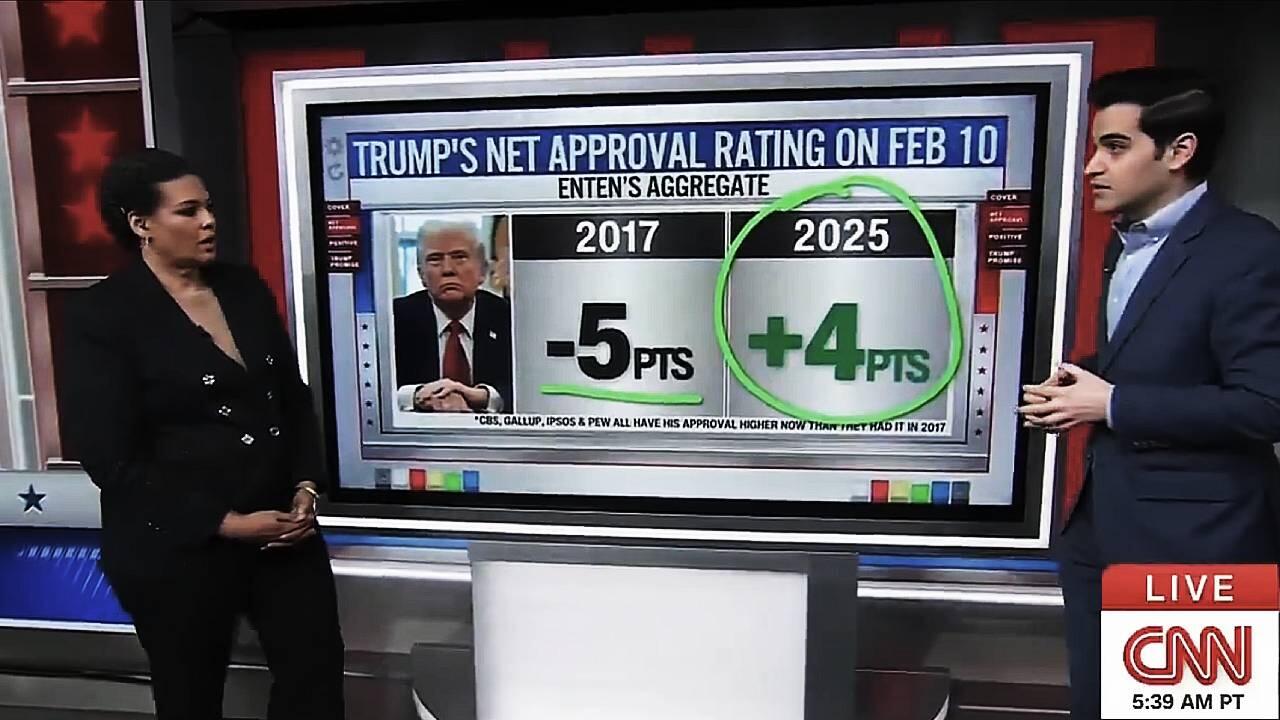
CNN’s resident data reporter Harry Enten highlighted Monday how President Trump has experienced a huge surge in popularity this time around compared to his first term, noting “Trump’s doing what he promised to do.”

Several polls have found Trump has a net positive approval rating, with a CBS News poll putting him at 53 percent approval, his highest across both terms.

“It’s not just CBS … I like to take an average of the polls. And holy smokes. I mean, look at what the difference is between now versus eight years ago during the first Trump term, right?” Enten stated, looking at the numbers.

“This is Trump’s net approval rating on February 10th,” Enten said, explaining “You go back to 2017, Trump was already underwater at minus five points in the net approval rating, that’s approval minus disapproval. What a difference eight years makes. He’s on the positive side of the ledger at plus four points.”

He continued, “And again it’s not just the CBS News poll. We’re talking about the Gallup poll. We’re talking about the Ipsos poll. We are talking about the Pew poll. All of these respective pollsters have Trump in a better position now than they did eight years ago.”

“The bottom line is, Americans are far more likely to say they like what they’re seeing now versus what they felt during Trump‘s first term,” the number cruncher emphasised.

Enten also specified how rare it was for Trump to hold a net positive rating throughout his first term.

“I want you to take a look at this plus sign, right? Compare that to the negative sign, being on the plus side of the ledger, right. In positive net approval territory. A positive net approval rating for Donald Trump. Again, whoa whoa whoa whoa,” the data reporter said. 

“Entire first term. Just 11 days. Just 11 days Donald Trump had a net positive approval rating. Compare that to the second term just so far. Just so far,” he urged.

“Every single day of Trump’s second term so far, he has been on the positive side of the ledger, 21 days, all three weeks. That’s already 10 more days than he was in his entire first term,” he stressed.

When asked to explain why Trump is so much more popular, Enten replied “I think one of the things that’s so important for politicians is for folks to believe what they‘re saying and that they’re keeping their campaign promises. So I think this gives you a pretty gosh darn good idea of what may be going on, Trump’s doing what he promised to do.”

 “You go back to April of 2017. It was just 46 percent of all Americans who said that Trump was doing what he promised to do. Compare that now to February of 2025,” he added.

“We’re living in a different world,” Enten reasoned, noting that “70 percent of Americans say Trump is doing what he promised to do.”

He added that “When Americans are 24 points more likely to say that you‘re doing what you promised to do, it’s no wonder that your net approval rating is much more likely to be on the positive side of the ledger than on the negative side.”

“And so far, what we’re seeing again is Americans 21 days so far versus just 11 days during his entire first term that Trump has a positive net approval rating. Quite a different world,” Enten concluded.

Leftists can’t cope with it and are eager to point out that ‘Hitler was popular too’.

*  *  *

Your support is crucial in helping us defeat mass censorship. Please consider donating via Locals or check out our unique merch. Follow us on X @ModernityNews.

Tyler Durden
Tue, 02/11/2025 – 17:40

DOGE Investigating Feds Whose Net Worths Have Exploded After Samantha Power Bombshell

0
DOGE Investigating Feds Whose Net Worths Have Exploded After Samantha Power Bombshell

DOGE head Elon Musk said on Tuesday that DOGE is going to investigate federal employees whose net worths have exploded despite their comparatively low pay.

Elon Musk, with his son X, speaks with President Donald Trump and reporters in the Oval Office at the White House on Tuesday. (Jabin Botsford/The Washington Post)

The announcement – which came after President Donald Trump signed an executive order calling on federal agencies to work with DOGE, follows a bombshell report that Samantha Power, former head of USAID, saw her net worth explode to $30 million despite an annual salary under $250,000.

“We don’t know why. Where did it come from? I think the reality is that they’re getting wealthy at the taxpayer expense,” Musk said on Tuesday.

Power, a former ambassador to the United Nations under President Obama, and was sworn in as head of USAID in May of 2021, reported a net worth between $6.7 million-$16.5 million in January of 2021 on a disclosure form. Her net worth is now estimated as high as $30 million, according to the website Biden’s Basement.

According to various reports, Power’s sources of income have varied over the years. After serving as UN Ambassador, she reportedly made $471,000 per year as a Harvard professor, and made $351,000 from speaking engagements with major firmst such as Nestle, Google and UBS, along with $1 million in book royalties.

Most notably, however, was an $11.73 million gain in her investment holdings.

If we had to venture a guess, DOGE’s access to information from the Treasury, USAID, and the Office of Personnel Management (OPM), run through Palantir’s intelligence apparatus (including AI), will quickly unravel graft hidden through multiple layers of organizational fog.

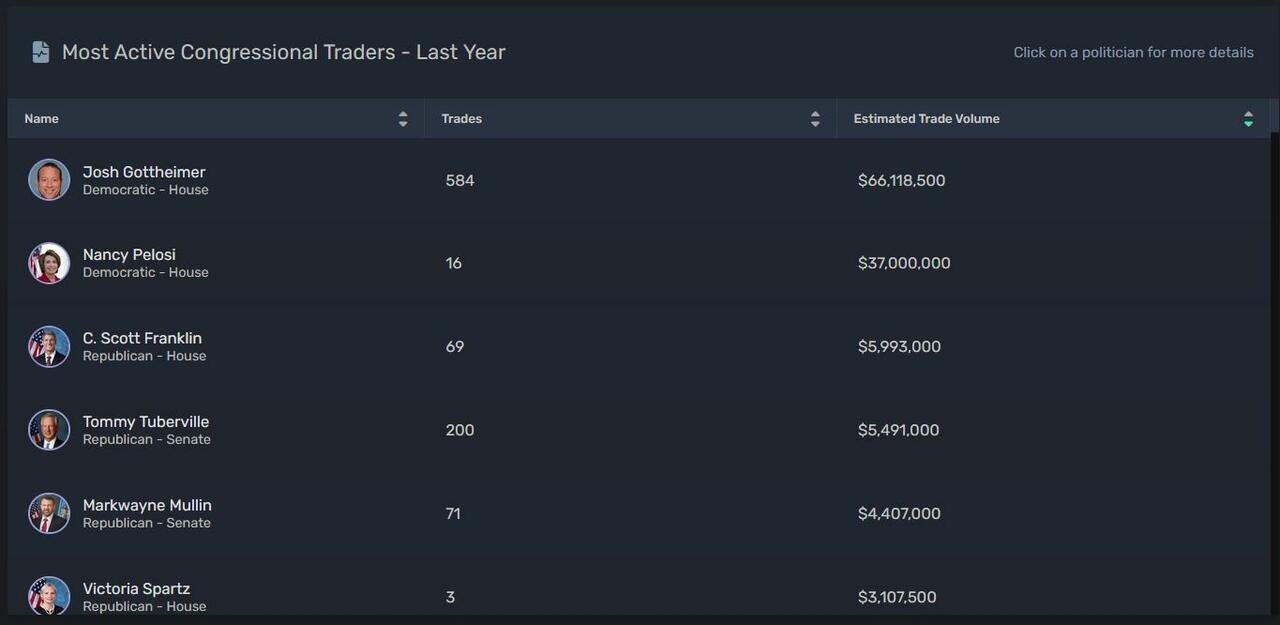
Meanwhile, there’s the issue of lawmakers who have become unbelievably ‘lucky’ when it comes to growing their net worth via insider trading.

Screenshot via Quiver Quant

In July, a bipartisan group of senators including Josh Hawley (R-MO) came to an agreement on a renewed effort to ban members of Congress from trading stock.

“Congress should not be here to make a buck,” Hawley said at the time. “There is no reason why members of Congress ought to be profiting off of the information that only they get.“

*  *  *

Meanwhile, with ad revenues dwindling thanks to the censorship industrial complex, ZeroHedge relies on your support to keep the lights on. If you haven’t already, please consider subscribing or buying something from our store. Our Multitool is particularly awesome – solid in the hand, and makes a great gift! Thank you for your support.

Tyler Durden
Tue, 02/11/2025 – 17:20

U.S. Marine Corps: Put Me In Coach

0
U.S. Marine Corps: Put Me In Coach

Authored by Stephen Baird via RealClearDefense,

In some ways the U.S. military is like an NFL team.  We have an owner, the American people, represented by the U.S. Congress.  We have General Managers, the Chief of Staff of the Army, the Chief of Naval Operations, the Chief of Staff of the Air Force, the Commandant of the Marine Corps (CMC), the Chief of the National Guard Bureau, and the Chief of Space Operations who man, train, and equip their Service for employment by a coach.  The military has several coaches, the geographic Combatant Commanders (U.S. Northern Command, U.S. Southern Command, U.S. European Command, U.S. Africa Command, U.S. Central Command, and U.S. Indo-Pacific Command).  The Combatant Commanders develop game plans (campaign, contingency, and crisis plans) to support the National Security Strategy in their respective geographical areas of responsibility.

The Combatant Commanders have planning staffs.  They invite their Service Components (Army, Navy, Marine Corps, Air Force, Space Force, and National Guard) to planning meetings where each Service Component planner identifies their capabilities that can support the Combatant Commander’s plan.  Based on the mission requirements for the plan, the Combatant Commander selects the capabilities from each Service required for mission success.

Prior to 2020, the Marine Corps were on the first team.  The Marine Corps had three robust combined arms Marine Expeditionary Forces (MEFs).  Each MEF was comprised of a Marine Division, a Marine Air Wing, and a Marine Logistics Group.  The operational capabilities of the MEFs enabled Marine Service Component planners to offer operational support to the Combatant Commanders across the spectrum of conflict.

With the implementation of Force Design 2030 in March 2020 (now called Force Design), the Marine Corps’ General Manager (CMC), General Berger, divested (cut) 21% of the personnel in infantry battalions, 100% of the tanks, 67% of the cannon artillery batteries, 33% of the assault amphibious companies, more than 25% of Marine aviation (since the initial FD divestments, the Marines have/will bring back almost 100 of the 200 aircraft divested, the percentage loss in the active force is now only about 17 percent), and almost all assault breaching equipment in the active forces.  This action when coupled with the Marine Corps’ abdication of its amphibious ship lift requirement neutered the Service Component planners’ ability to offer operational support across the spectrum of conflict and has relegated the Marine Corps to second team status.  Simply put, the “United States Marines are no longer capable of responding to global crises and contingencies quickly and ­effectively, and in some cases, at all”.

These “divestments” were made to “invest” in reorganizing and restructuring the Marine Corps to focus primarily on one geographic theater (Indo-Pacific) and one enemy, the Chinese People’s Liberation Army Navy (PLAN).  Today, one infantry and one artillery regiment, have been reorganized and redesignated as Marine Littoral Regiments (MLRs).  The MLRs conduct Expeditionary Advanced Base Operations and employ Stand-In-Force (SIF) missile units on pacific island chains to engage/deter the PLAN.  A second infantry regiment is scheduled to be redesignated in 2027.  One must assume that this new team capability supports the Indo-Pacific Commander’s warfighting requirements. 

But how about the support of the other geographic Combatant Commanders?  Did the Corps’ GM, General Berger, consult with the other coaches to assess the impact of his actions and how it affects their plans and warfighting requirements?  Was General Berger upfront with team’s owner, the American people, represented by the U.S Congress, on the impact of his actions to the Marine Corps Title X requirements (Title 10 USC 8063)?

We are now almost five years into the implementation of Force Design and the current General Manager (CMC), General Smith, has not changed course but instead doubled down.  In his statement on the posture of the Marine Corps before the Senate Appropriations Committee on 16 April 2024, he wrote: “I remain fully committed to Force Design and all its supporting efforts.”  Today, not one Stand-In-Force is operational and forward deployed on a pacific island.  Not one missile has been procured.  And, the Navy has postponed the procurement of the Landing Ship Medium (which will transport and resupply the SIFs).  

In the NFL, when the General Manager fails to effectively “man” his team with the right talent (capabilities) for the coach to employ, he is fired.  Once confirmed, the Secretary of the Navy, John Phelan, should consider bringing in a new General Manager (Marine Corps Commandant) who can begin the process of restoring the Marine Corps’ global response capability and restoring its ability to be the nation’s 911 force.  This will move the Marine Corps from the bench with the second team, to the bench with the first team.

Stephen Baird is a retired Marine Colonel. He served as the G-5 for 1 Marine Expeditionary Force, the Chief of Staff for the 1st Marine Division followed by his last assignment as the Chief of Staff for U.S. Marine Corps Forces Central Command during Operation Enduring Freedom and Operation Iraqi Freedom.  

Tyler Durden
Tue, 02/11/2025 – 17:00

The One Chart That May Boost MAGA In 2026: End Of The Migrant Invasion

0
The One Chart That May Boost MAGA In 2026: End Of The Migrant Invasion

Goldman Sachs analysts Elsie Peng, David Mericle, Alec Phillips, and others published a note on Sunday titled “The End of the Immigration Surge,” outlining how President Trump’s border policies are ending the migrant border invasion that spiraled out of control under globalist rule via the Biden-Harris regime. The note highlights significant shifts in immigration policy and includes a key chart illustrating this end. 

Net immigration surged above pre-pandemic levels between 2022 and 2024, peaking at an annualized rate of 3.5-4 million in late 2023 before sliding to about 1.7 million by December 2024, the analysts noted. This surge was largely due to open border policies and a complex network of taxpayer-funded NGOs that acted as conveyor belts, funneling migrants into the US, with industrial-size staffing companies domestically taking care of the logistics of bussing and flying the migrants around the country. 

Peng and the analysts noted that Trump administration officials are attempting to reverse migration trends in three ways: 

  • First, it has aimed to reduce new immigrant inflows by increasing border security, reinstating “Remain in Mexico,” and ending several humanitarian parole programs.

  • Second, it has sought to roll back legal protections for some immigrants already in the US, which could cause some to lose their work permits.

  • Third, it has sought to increase deportations.

Here are the latest executive orders Trump has signed to secure the border – all in an effort to restore national security. 

On Truth Social, Trump already posted deportation success.

Screenshot, Truth Social

“We expect net immigration to slow further to 750k per year, well below the pace of the last three years but only moderately below the normal pre-pandemic pace,” the analysts noted, adding, “This would consist of 750k net authorized immigrants per year and zero net unauthorized immigrants, with roughly 500k deportations per year offsetting a similar number of asylum seekers and other entrants.” 

Chart of the day…

Deportations are expected to run above average through 2028: 

The macroeconomic impact of the deportations is expected to be limited. Migrant-driven labor force growth is forecasted to normalize in the first half of 2026, resulting in only a modest effect on GDP growth and inflation.

Here’s more from the analyst about the macroeconomic impacts of deportations:

  • Under our baseline, the macroeconomic consequences of the immigration slowdown should be limited. The boost from immigration to labor force growth was 100k above normal at the peak, is about 40k above normal at present, and should return to normal by early 2026. The slower 750k per year pace of immigration would contribute 30-40bp less to potential GDP growth than the 2023-2024 pace but just 5bp less than the pre-pandemic pace. And the impact on wage growth and inflation should be modest now that the US labor market is back in balance.

  • In a more extreme risk scenario where the immigration crackdown creates a climate in which unauthorized immigrants are afraid to go to work or employers are afraid to employ them, the economic consequences would be more serious because unauthorized immigrants already in the US account for 4-5% of the total workforce and 15-20% in some industries. Abruptly losing these workers could be very disruptive for many of these industries and have a larger inflation impact.

  • How will we know if the baseline or risk scenario is playing out? We can use both immigration and labor market data to monitor the latest developments. We construct real-time trackers of authorized immigration and of gross inflows and outflows of unauthorized immigrants using immigration court cases, data from government agencies, and daily arrest data. We have not yet seen dramatic changes since the election, though there is a roughly 1.5-month lag in these data.

  • Labor market data might prove more useful than immigration data in real time for monitoring the risk of workers staying home and avoiding workplaces or of large-scale voluntary departures. Specifically, we use the household survey micro data to track recent immigrants’ participation, unemployment, job-finding, and survey response rates, and use the establishment survey to track employment and average wages in industries that employ many unauthorized immigrants. While the job-finding rate has dipped recently, the other indicators have been fairly stable so far.

The industries where illegals are primarily working. 

The migrant boost to the labor force is set to end by the end of this year. 

The importance of the net migration graph will demonstrate to the American people that Trump’s border policies are fulfilling the mandates voters gave him to boost border security and restore national security—bolstering public confidence in MAGA ahead of the 2026 midterm elections.

Recall the graph that saved Trump’s life in the assassination attempt in Butler… 

Democrats have already started their 2026 campaign this week by yelling on the streets of DC that DOGE is causing a “constitutional crisis.” Dems are doubling and tripling down on woke and illegals in an era where their ability to control narratives dwindles – this is very dangerous for the party as the Overton Window has shifted from Marxist left to center-right.

Tyler Durden
Tue, 02/11/2025 – 16:40