72.2 F
Chicago
Wednesday, September 30, 2026
Home Blog Page 1817

“Swindler”: Musk And Altman Throw Punches After Musk-Led Group Leads $97.4 Billion Bid For Control Of OpenAI

0
“Swindler”: Musk And Altman Throw Punches After Musk-Led Group Leads $97.4 Billion Bid For Control Of OpenAI

Elon Musk is leading a group of investors in a $97.4 billion offer to purchase the nonprofit that controls OpenAI – the makers of ChatGPT, – and which Musk was an original investor in.

On Monday, Musk’s attorney Marc Toberoff said he submitted the bid to OpenAI’s board of directors in an unsolicited offer that could upend OpenAI CEO Sam Altman’s plans to convert it into a for-profit company, as well as plans to spend up to $500 billion on AI infrastructure through the so-called ‘Stargate’ joint venture, WSJ reports.

“It’s time for OpenAI to return to the open-source, safety-focused force for good it once was,” Musk said in a statement provided by Toberoff. “We will make sure that happens.”

Altman and Musk co-founded OpenAI in 2015 as a charity. In 2019, after Musk left the company and Altman became chief executive, OpenAI created a for-profit subsidiary that has served as a vehicle for it to raise money from Microsoft and other investors. Altman is in the process of turning the subsidiary into a traditional company and spinning out the nonprofit, which would own equity in the new for-profit.

One of the thorniest questions in the conversion has been how the nonprofit will be valued. Musk’s bid sets a high bar and may mean that he, or whoever runs the nonprofit, would end up with a large and possibly controlling stake in the new OpenAI.

The bid is being backed by xAI – Musk’s own artificial intelligence company, which could end up merging with OpenAI following a deal. Other investors in the potential deal include; Valor Equity Partners, Baron Capital, Atreides Management, Vy Capital and 8VC, a venture firm led by Palantir co-founder Joe Lonsdale. And who else? Ari Emanuel – CEO of Hollywood company Endeavor (and the brother of Democrat operative Rahm Emanuel) – who was portrayed in Entourage.

Altman responded to the offer with a “no thank you,” adding “but we will buy Twitter for $9.74 billion if you want.”

To which Musk replied…

It’s not over…

Musk has filed several legal complaints against OpenAI, accusing the company of betraying its original mission as a nonprofit by creating the for-profit arm, as well as colluding with Microsoft, its biggest investor, to dominate AI development.

On Jan. 7, Toberoff sent a letter to the attorneys general in California, where OpenAI is based, and Delaware, where it is incorporated, asking that they open up bidding for the company to determine the fair market value of its charitable assets. Musk and other critics have said they believe OpenAI may undervalue the nonprofit when they spin it out.

OpenAI has called Musk’s legal claims baseless and overreaching and said the nonprofit will receive full value in its ownership stake of the for-profit. The company released documents in December that it said showed Musk previously supported turning OpenAI into a for-profit but walked away because he couldn’t get control of it. -WSJ

What’s more, Toberoff says Musk and team is prepared to match or exceed any bids higher than their own.

“If Sam Altman and the present OpenAI Inc. Board of Directors are intent on becoming a fully for-profit corporation, it is vital that the charity be fairly compensated for what its leadership is taking away from it: control over the most transformative technology of our time,” he said.

A thought…

The move to buy OpenAI comes weeks after Altman appeared next to newly inaugurated President Donald Trump and other business leaders to announce a plan called “Stargate,” which would invest up to $500 billion over the next four years in US data centers – a plan which Musk talked mad shit about, claiming that the project’s backers didn’t have the cash for, and calling Altman “a swindler.”

According to the report, OpenAI was already facing several hurdles on their path to converting from a charity to a for-profit company, with rival firm Meta Platforms sending a letter to California’s attorney general in December expressing opposition to the plan, and OpenAI remaining stuck in negotiations with Microsoft and other stakeholders over how much equity should be allocated to whom.

The original plan was to complete the transition by later 2026, with a $6.6 billion funding round in October which valued the company at $157 billion. Separately, the company has been in talks to raise up to $40 billion in new funding at a $300 billion valuation in a round led by Japanese conglomerate SoftBank, which would invest between $15 and $25 billion itself.


Tyler Durden
Mon, 02/10/2025 – 15:47

Gold Tops $2900 As China Pushes Insurance Companies Into Precious Metals

0
Gold Tops $2900 As China Pushes Insurance Companies Into Precious Metals

Hot on the heels of the People’s Bank of China’s (PBOC) recent resumption of official gold purchases (after a six-month pause), and amid ongoing economic turmoil domestically and trade-war threats geopolitically, Beijing has launched a pilot program  that allows insurers to buy gold for the first time could free up billions of dollars of investment in the metal, adding further impetus to a record-setting rally, hitting a new high (in USD) above $2900 this morning…

As Bloomberg reports, ten insurance firms – including PICC Property & Casualty Co. and China Life Insurance Co., two of China’s biggest – will be able to invest as much as 1% of their assets in bullion, in a program that became effective last Friday. 

That would translate into a potential 200 billion yuan ($27.4 billion) of funds, Minsheng Securities Co. said in a note.

The shift in policy in China could be a signal that authorities recognize the dearth of investment options in Asia’s largest economy, and the need for alternatives amid a property downturn and an economic slump.

“Insurance companies lack options for mid- and long-term assets with stable yields,” Guotai Junan Securities analysts led by Liu Xinqi said in a note, even though bullion typically doesn’t offer that.

The policy tweak makes gold the first commodity that Chinese insurers have been explicitly permitted to invest in. 

China has restricted insurance funds from taking positions in assets without “stable cash returns,” and limits the amount they can put into bonds and stocks.

As Jesse Colombo concluded earlier, all signs point to the potential for another explosive gold rally driven by Chinese demand, much like what unfolded last spring. With SHFE gold futures breaking out, the possibility of rising trading volumes, and the return of a Chinese gold price premium, the conditions for another bullish episode are falling into place. China’s economic crisis, record-low bond yields, and the looming prospect of massive stimulus only strengthen the case for gold’s continued ascent. Meanwhile, the PBOC’s renewed gold purchases, alongside this new insurance-gold-purchasing pilot program reinforce the broader shift toward gold as a preferred asset

If these factors align as expected, the next phase of this bull market could be even more dramatic than what we saw in 2024.

Tyler Durden
Mon, 02/10/2025 – 15:00

Hamas Suspends Further Hostage Releases As Trump Says No ‘Right Of Return’ Under His Plan

0
Hamas Suspends Further Hostage Releases As Trump Says No ‘Right Of Return’ Under His Plan

Hamas has announced Monday it is suspending the release of hostages planned for Saturday until further notice due to “Israeli violations” and amid international backlash at Trump’s proposed plan to “take over” Gaza which would block a Palestinian ‘right of return’.

The last three emaciated-looking Israeli hostages were freed on Saturday in exchange for over 180 Palestinians released from Israeli jails. The Israeli captives have been held for over 490 days. Since the ceasefire took effect last month 21 people have freed by Hamas and Islamic Jihad – 16 of them Israelis and five Thai citizens. Victims’ families in Israel are desperately hoping more will be freed according to plan.

Until now the truce was looking promising, and is on the brink of entering a second phase of the deal, given the Israeli military this weekend withdrew from from the Netzarim Corridor, which cuts Gaza in half, allowing tens of thousands of Gazans to return to the north and move more freely.

Via Associated Press

Hamas has announced the next round of release of captives is postponed “until further notice” while accusing Israel of  violating the terms of the ceasefire deal. Israel has put its military on ‘high alert’.

Several Palestinians have been shot by IDF forces in Gaza City, but Israel in turn has blamed Hamas for violating agreements, including parading hostages in front of propaganda posters before they are handed over to the Red Cross.

Hamas has also been fiercely condemning Trump’s plan which would see Gazan’s leave the strip en masse. He’s been pressuring Egypt and Jordan to take in over one million Palestinians. His latest statements have inflamed tensions further. According to Fox, CNN and other outlets on Monday, Trump has expressly said his plan would not support a right of return:

President Donald Trump said explicitly in an interview this weekend that Palestinians would not have a right to return to Gaza under his plan to take US ownership of the strip and rebuild it.

“No, they wouldn’t,” Trump said in an interview on Fox News when asked whether the Palestinians would have a right to return. “Because they will have much better housing. Much better – in other words, I’m talking about building a permanent place for them.”

Hamas has responded by saying the US President tackling the “Palestinian issue with the mentality of a real estate dealer” and this is “a recipe for failure.”

Many analysts have warned that this White House rhetoric could collapse an already fragile ceasefire deal, and this is precisely what appears to be happening now, also given PM Netanyahu has hailed Trump’s words as “creative” and “revolutionary”. 

Trump and his top foreign policy officials haven’t been fully on the same page, it appears:

Afterward, some Trump aides sought to soften or clarify aspects of the plan. Karoline Leavitt, the White House press secretary, said Trump was proposing only a temporary relocation of Palestinians while Gaza was being rebuilt.

Secretary of State Marco Rubio, who was traveling in Latin America when Trump revealed his idea, suggested the resettlements from Gaza would be only on an interim basis.

“What he very generously has offered is the ability of the United States to go in and help with debris removal, help with munitions removal, help with reconstruction — the rebuilding of homes and businesses and things of this nature, so that then people can move back in,” Rubio said last week.

But a stance of ‘no right of return’ means that Palestinians would not be allowed back to their homes or communities. Already tens of thousands are returning, and it remains unlikely that Trump’s plan could be practically achievable. 

The reality is that hardliners within Netanyahu’s government don’t want to see a truce deal stick, as they prefer a military solution. Trump’s words give them an incentive to ‘cleanse’ Gaza of Palestinians, continuing the IDF air and ground operation.

Tyler Durden
Mon, 02/10/2025 – 14:40

Democrats Threaten ‘Checkmate’ Over DOGE Govt. Shutdowns With… Government Shutdown

0
Democrats Threaten ‘Checkmate’ Over DOGE Govt. Shutdowns With… Government Shutdown

Democrats aren’t sending their best.

In response to the Trump administration’s efforts to shut down various government agencies and slash waste, fraud and abuse, Democrats are threatening a government shutdown.

Sen. Andy Kim (D-NJ)

On Sunday, Sen. Andy Kim (D-NJ) suggested that Republicans looking to continue government spending past March 14 are going to withhold support, leaving Speaker Mike Johnson without allies against fiscally conservative Republican lawmakers who have repeatedly voiced strenuous opposition to out-of-control spending.

“Look, if we have to take steps to be able to hold them accountable, use the leverage that we have to force it, I cannot support efforts that will continue this lawlessness that we’re seeing when it comes to this administration’s actions,” Kim said during an appearance on NBC News‘s “Meet the Press.”

“And for us to be able to support government funding in that way only for them to turn it around to dismantle the government, that is not something that should be allowed,” Kim continued, adding “This is on them.“

As Jonathan Turley notes, this is like “threatening vegans with a beef ban.”

According to the Washington Post, Kim is one of several Democratic senators freaking out over the effective shutdown of the US Agency for International Development (USAID) after Elon Musk’s DOGE team showed up at the agency’s headquarters and identified billions of dollars in waste, fraud and abuse.

Of note, Trump and Musk have made deep cuts and sweeping changes to 15 government agencies, including USAID, the Department of the Treasury, and the Office of Personnel Management.

“I’ve worked through multiple government shutdowns; I would be the last person to want to get to that stage,” said Kim. “But we are at a point where we are basically on the cusp of a constitutional crisis, seeing this administration taking steps that are so clearly illegal. And until we see a change in that behavior, we should not allow and condone that, nor should we assist in that.”

Joining Kim in crying harder was Sen. Chris Murphy (D-CT), another critic of the ‘assault’ on USAID – telling ABC News‘s “This Week” that “This is a fundamental corruption. And democracies don’t last forever,” adding “We see this as a crisis of epic proportions. We were watching the billionaires try to steal government from the people. And I think the broad cross-section of the American public, as you’ve seen in the last week, is going to rise up and say, enough.”

Of course, neither of them weighed in on the actual waste, fraud or abuse found.

Given the shutdown deadline in a little over a month, Republicans – who hold a slim congressional majority, will need 60 votes in the Senate to pass funding deals.

On Thursday, Speaker Johnson blamed Democrats for a failure to reach a top-line number in negotiations, telling reporters that they “seem to be trying to set up some sort of government shutdown,” after House Minority Leader Hakeem Jeffries (D-NY) said funding freezes implemented by Trump must be “choked off” if Republicans want any bipartisan support for a government funding bill.

Taking things one step further, Senate Minority Leader Chuck Schumer (D-NY) has established a whistleblower complaint portal for federal workers to submit claims of allegedly unlawful activities in their respective agencies.

In a letter sent to public servants and obtained by The Washington Post, Senate Democrats said they are ready to support any whistleblower seeking to share information about “wrongdoing, abuse of power, and threats to public safety.” Democrats emphasized the role of the Whistleblower Protection Act in prohibiting retaliation against federal employees who disclose evidence of possible wrongdoing, and they vowed to investigate the Trump administration’s actions through oversight requests, hearings and inquiries. -WaPo

“As Senate Republicans refuse to fulfill their constitutional duty to provide a check on the Executive Branch, Senate Democrats remain steadfast in our commitment to uncovering the truth,” wrote Democrats. “We are prepared to issue demand letters, preserve public records, conduct public hearings, and pursue legal action where necessary.”

Tyler Durden
Mon, 02/10/2025 – 14:20

The Silver Squeeze: Market Manipulation & The Coming Storm

0
The Silver Squeeze: Market Manipulation & The Coming Storm

Authored by Kevin Bambrough via DailyReckoning.com,

The silver market has always fascinated me, particularly because of its dual role as both a precious and industrial metal. What many don’t realize is that we’re heading into what could be the most significant silver bull market in history – one that could make the 1970s look like a mere preview. Let me tell you why, but first, let me share a revealing story from my time at Sprott that exposed just how fragile the silver market really is.

The Sprott Silver Saga

During my tenure at Sprott (2002-2013), we had accumulated a significant position in silver in the 2005-2007 period. This was done via top tier bullion bank certificates that promised 5-day delivery. These weren’t small positions – we’re talking about substantial tonnage that was supposedly safely stored and readily available. What unfolded next exposed a troubling reality about the paper silver market and I believe led to the huge run in silver that followed as it ultimately ran to its all-time high in nominal terms.

When we decided to take delivery, what should have been a routine 5-day process turned into a nine-month odyssey of excuses and misdirection. We had strategically contracted to store our silver in Canada’s government mint refinery and storage facility – ironically, the same facility that had been emptied when Canada foolishly sold off all its gold and silver reserves. The vaults were empty, waiting for our silver.

At first, our counterparties claimed it was merely a logistical issue. Then the excuses began:

  • First, they said the silver would come from New York and weeks went by

  • When that didn’t materialize, it was supposedly coming from Chicago and months passed

  • Then England became the source, with a “couple of more months” shipping estimate assurances

  • Finally, they claimed it would come from China, requiring cross-Canada rail transport as a way of explaining a few months of delay

When I demanded bar numbers for our inventory purposes, we were met with weeks of silence and more excuses. Our legal position was frustrating – our lawyers advised that we couldn’t effectively sue because what damages could we claim? Missing out on “the enjoyment of looking at our silver bars” wasn’t exactly a compelling legal argument. Meanwhile, silver prices kept climbing.

The truth became clear: our counterparties had taken our money and likely just bought futures contracts.

They never had the physical silver. This situation likely triggered the 2006-2010 silver rally and foretells what will likely occur again soon.

The reality is over many decades bullion banks have been caught repeatedly manipulating commodity markets. When squeezes start due to actual physical demand they engage in unethical conduct delaying their deliveries to buy themselves time. They likely get aggressive in outer month futures contracts to cover their asses and probably even ultimately profit from the rise they expect they will be causing as they slow walk their promised deliveries of material. Along the way they rely on margin requirements to be increased and profit taking to occur by speculators that don’t have the market insights the banks do. Finally, after they’ve positioned themselves net long via the futures market they let the price rip.

The Modern Silver Market

Today’s silver market is facing unprecedented pressures. Beyond traditional industrial uses, we’re seeing explosive growth in:

  • Medical applications leveraging silver’s antimicrobial properties

  • High-tech electronics and semiconductor manufacturing

  • Solar panel production

  • Electric vehicle infrastructure

  • Emerging solid-state battery technology

But here’s what makes this time different: we’re on the cusp of a robotics revolution. From home cleaning robots to industrial automation and autonomous mining equipment, the coming wave of automation will require massive amounts of silver for solid state batteries and electronics. Add in the growing energy storage needs for wind and solar power, and we’re looking at structural demand that dwarfs anything we’ve seen before.

Historical Perspective

Silver has always been considered “poor man’s gold,” but history shows its potential for explosive moves. The French learned this lesson the hard way when silver left their country and their currency was no longer backed – leading to economic chaos. The inflation-adjusted highs from the 1970s would equate to over $200/oz today, and I believe we’ll not only test but exceed those levels.

Why This Time Is Different

The coming silver bull market will be unprecedented for several reasons:

  • Global silver inventories and central bank holdings have been depleted to record levels vs the huge inventories present in the 1970’s

  • Mining projects face unprecedented permitting challenge and delays

  • Industrial demand is structural and growing

  • Major exchanges have shown a history of failure to deliver in other commodities

  • Physical premiums are expanding

  • The monetary system is more fragile than ever

When the market finally breaks, we’ll likely see exchanges failing to deliver physical silver, forcing cash settlements. This will drive people to seek physical metal, creating a self-reinforcing cycle. Just like in the 1970s, we’ll see panic buying silver coins and bars. But, this cycle people won’t be lining up in the streets. We will see the “sold out” signs appear globally on bullion selling websites.

The Perfect Storm

Unlike previous bull markets, today we have:

  • Depleted strategic stockpiles

  • Higher industrial demand already in a structural deficit

  • Greater dependency on silver for new technologies

  • A more interconnected global financial system

  • Larger money supply relative to available physical silver

  • New tech emerging requiring unprecedented amounts of silver

The Bottom Line

The lesson from my Sprott days remains crystal clear – when you really need delivery, paper promises can prove worthless. In a market this tight, physical possession isn’t just nine-tenths of the law – it’s everything. The coming silver squeeze will likely make our previous delivery issues look minor in comparison.

We’re heading toward a perfect storm where industrial demand, monetary instability, and physical market tightness converge. When people realize how poor a store of value cash and bonds have become, just as in the 1970s, they’ll flood into precious metals. But this time, with silver’s critical industrial role and the structural supply deficit, the upside could be truly historic.

The Coming Silver Default

The trigger for the next silver delivery failure could come from anywhere, but history suggests it will likely be a major player – perhaps a sovereign wealth fund or a forward-thinking large investor akin to the Mississippi Bubble era.

When Richard Cantillon converted his paper wealth to silver and moved it out of France, it exposed the fragility of the paper money system and triggered a currency collapse where silver went up ~900% in the decade that followed.

Today, we’re seeing similar warning signs: major government mints regularly running out of stock, retail premiums at historic highs, and unprecedented industrial demand.

The London Metal Exchange’s recent nickel crisis showed how quickly commodity exchanges can break under pressure. Whether it’s a physically-backed ETF failing to source metal, a hedge fund demanding delivery, or a nation-state deciding to secure strategic supplies, the outcome will be the same – a cascading effect of delivery defaults that exposes the paper silver market’s hollow promises.

Just as in my Sprott days when our request for delivery revealed the emperor had no clothes, the next major delivery demand could expose that there are dozens of claims on each physical ounce. The difference is that this time, with industrial demand at record highs and mining supply constraints, there won’t be nine months to play games – the physical market will break, and break hard. The only question is: will you be positioned in physical metal before or after it happens?

Tyler Durden
Mon, 02/10/2025 – 14:00

Lawfare 2.0: A New York Judge Launches A Coup

0
Lawfare 2.0: A New York Judge Launches A Coup

Authored by S. David Sultzer via AmericanThinker.com,

During his campaign, Donald Trump promised to use Elon Musk to improve government efficiency, partly by ending the incredible graft and corruption permeating the bureaucracy. 

Since Trump’s inauguration, Musk and his youthful four-man crew, using the power of AI, have identified a host of fundamental problems in the Treasury Dept.

As Musk explained:

To be clear, what the @DOGE team and @USTreasury  have jointly agreed makes sense is the following:

– Require that all outgoing government payments have a payment categorization code, which is necessary in order to pass financial audits. This is frequently left blank, making audits almost impossible.

– All payments must also include a rationale for the payment in the comment field, which is currently left blank. Importantly, we are not yet applying any judgment to this rationale, but simply requiring that some attempt be made to explain the payment more than nothing!

– The do-not-pay list of entities known to be fraudulent or people who are dead or are probable fronts for terrorist organizations or do not match Congressional appropriations must actually be implemented and not ignored. Also, it can currently take up to a year to get on this list, which is far too long. This list should be updated at least weekly, if not daily.

The above super obvious and necessary changes are being implemented by existing, long-time career government employees, not anyone from @DOGE It is ridiculous that these changes didn’t exist already!

Yesterday, I was told that there are currently over $100 billion a year of entitlements payments to individuals with no Social Security number or even a temporary ID number. If accurate, this is extremely suspicious.

When I asked if anyone at Treasury had a rough guess for what percentage of that number is unequivocal and obvious fraud, the consensus in the room was about half, so $50 billion a year or $1 billion a week!

This is utterly insane and must be addressed immediately.

There can be no justifiable reason for any American to contest these actions. Nevertheless, on Feb. 8, a federal district court judge, Paul Engelmayer, sitting in the Southern District of New York, committed the most grotesque act of lawfare this nation has yet seen.

After an ex parte hearing at which no one from Trump’s administration was present, Engelmayer exceeded his constitutional power with an order usurping the president’s executive authority.

In the order, Engelmayer held that President Trump’s political appointees have no access to the Treasury Department, which means that the president has no access.

He also held that DOGE’s actions are so patently unlawful that DOGE must destroy all information it already gleaned from examining the Treasury computer system. To add further outrage, he ordered DOGE to comply with his order even before there is an actual hearing on this matter.

As one attorney commenting as @amuse on X wrote:

The implications are staggering. By stripping the executive branch of access to its own financial data, this ruling effectively transfers control of the federal purse to the permanent bureaucracy…

This is lawfare at its most brazen: a raw, partisan power grab dressed up in legalese. If allowed to stand, this decision sets the precedent that any left-wing judge can unilaterally strip the President of his authority and hand it to the administrative state. That is not democracy. It is not law. It is judicial dictatorship.

A little primer in the Constitution will help explain just how foul Englemayer’s decision is.

Most have heard that the Constitution creates a separation of powers, though given the sorry state of civics education today, probably few fully understand it. Separation of Powers was Montesquieu’s great contribution to 18th-century political thought. He realized that to prevent tyranny, a government’s power needs to be diffused by breaking it into several branches.

Tyrannical governments were the great evil of the 17th- and 18th-century world. When our Founders wrote the Constitution, our Revolution, which fought to end tyranny, had ended only four years earlier. They were also 97 years from the last English revolution launched to replace a tyranny and 139 years removed from the English Civil War, another attack on tyranny. Our Founders knew that separation of powers was critical to creating a functioning Republic.

Our Founders accomplished this goal in two ways.

First, they divided general powers, and second, they gave the three branches some overlapping functions, such as the president nominating officers subject to the Senate’s power to confirm them (Art. II, Sec. 2), or placing control of the military in the president (Art. II, Sec. 2) while the sole power to declare war rests with Congress (Art. I, Sec. 8).

As to the three general power powers of all governments, the Constitution mandates that “all legislative powers are vested in Congress” (Art. I, Sec. 1); “all executive powers [the power to enforce the laws] are vested” in the president (Art. II, Sec 1); and all judicial power “shall be vested in one Supreme Court” (Art. III, Sec. 1).

There was good reason for dividing up these powers. 

If a tyrant could make the laws and then enforce them through the state’s police power and the courts, that was the very definition of an autocratic state, whether it be called an autocracy, a police state, or a tyranny. In this regard, it should be noted that the tyrant need not be an individual. The Soviets proved this.

Under the Constitution’s organization, regulatory and administrative bodies are all part of the Executive Branch. And as Art. II, Sec 1 explicitly states, “The executive Power shall be vested in a President…”

The president has plenary (i.e., absolute) power over all executive branch bodies, including the Treasury. This means neither Congress nor the judiciary may interfere. Additionally, as commander in chief, the president has plenary authority to classify or declassify documents and to authorize or remove security clearances.

Where an authority is plenary, no judge may substitute his judgment for the president’s. And yet that is precisely what Judge Engelmayer has done. This is a coup by lawfare.

If allowed to stand, Judge Engelmayer’s order will amend our Constitution by fiat. This is as great an assault on the fabric of our constitutional Republic as our nation has seen since 1776.

Trump’s response must be aggressive and resolute. To vindicate the Constitution, he must declare that the judge’s order is null and void, and he should send a message to the House asking it to impeach Judge Engelmayer.

Tyler Durden
Mon, 02/10/2025 – 13:40

NY Fed Survey Shows 1 Year Inflation Expectations Unchanged, Makes Mockery Of UMich Propaganda

0
NY Fed Survey Shows 1 Year Inflation Expectations Unchanged, Makes Mockery Of UMich Propaganda

In a surprising twist, last Friday’s disappointing – and massively revised – jobs data was unexpectedly upstaged by the inflation expectation prints in the February UMichigan consumer sentiment survey (where the presence of socialist “economist” Justin Wolfers seems to be increasingly skewing the numbers) and which indicated an absolutely ridiculous surge in 1Yr inflation expectations (from 3.3% to 4.3%), but not because everyone expects more inflation but because Democrats now expect something approaching hyperinflation at 5.1%, even as Republicans expect 0.0% inflation in 1 year (and how the average of these two adds up to 4.3%, maybe Justin Wolfers can tell us). Yet despite the clearly political, and thus unreliable, nature of the print the market moved dramatically, and hundreds of billions of market cap was wiped out as stocks sold off on fear of more Fed tightening in coming months.

And just because the number was so galactically stupid, we said that when the NY Fed’s inflation expectations print at 11am ET today, they would show an unchanged print and “dunk on the UMich idiocy.”

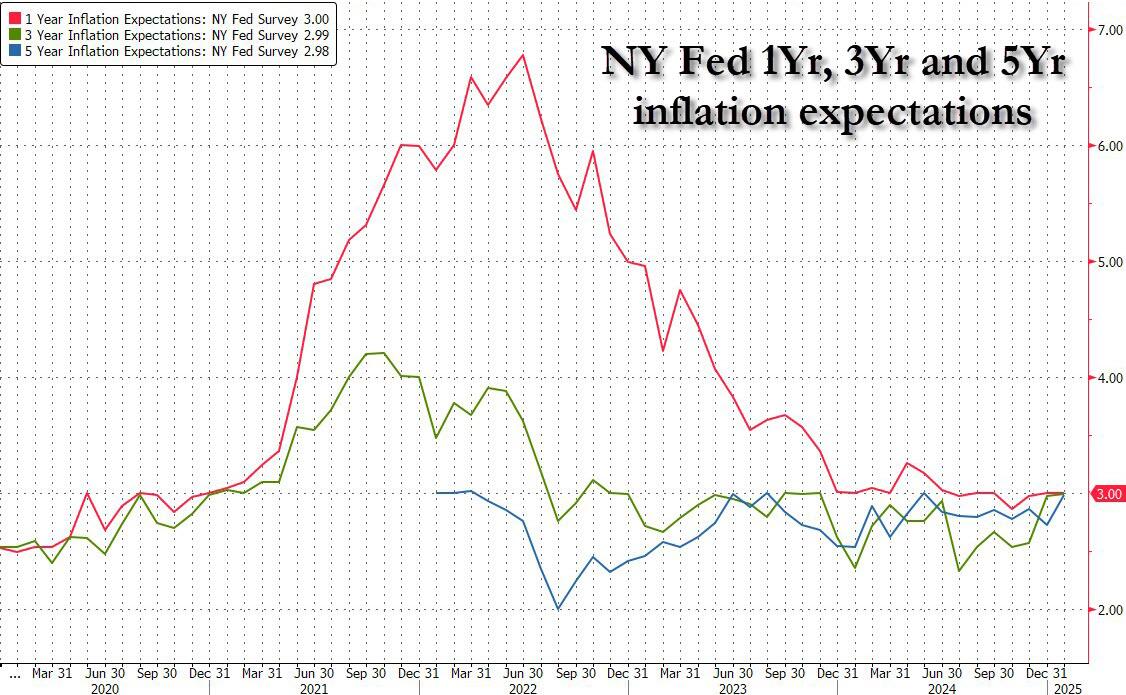
And that’s precisely what the Fed revealed moments ago, when it confirmed that far from soaring, 1-Year inflation expectations were not only unchanged at 3.00% – as we said they would be – but they came in below the median analyst estimate of 3.1%.

As a result, the gap in 1 Year inflation expectations between the NY Fed survey and the UMich survey, has exploded so wide…

… even WSJ Fed mouthpiece Nikileaks Timiraos was compelled to comment on it.

3 year ahead inflation expectations were also unchanged at 3%, while the longer-dated, 5 Year, bucket rose to 3%, the highest since May 2024, although this is a series that has been capped at 3% for the past three years and which tend to track 5Yr breakevens closely.

And for those who claim that this is all due to confusion by the respondents, the NY Fed dunked on that as well, reporting that the median inflation uncertainty was unchanged at the one-year horizon, declined at the three-year horizon, and increased at the five-year horizon.

As Bloomberg notes, inflation expectations have taken on a new importance in the debate over next steps for monetary policy amid President Donald Trump’s moves to impose tariffs on the country’s biggest trading partners. On Feb. 1, Trump announced tariffs against goods imported from China, Mexico and Canada, though he subsequently delayed the Mexico and Canada decisions.

Several Fed officials have said in recent weeks that the central bank’s response to higher prices resulting from tariffs will depend on whether inflation expectations remain well anchored, and this is where Democrats are doing everything in their power to indicate that at least their expectations are becoming unanchored to the upside, while Republicans are seeing deflation!

The New York Fed survey showed a rise in inflation expectations for various items over the next year, including gas, food, medical care, college tuition and rent. It also revealed a growing divergence among respondents over estimated inflation in the year ahead, with the gap between the 25th- and 75th-percentile respondents widening to the largest since mid-2023.

Median home price growth expectations rose by 0.1 percentage point to 3.2%. This increase was driven by respondents in the West census region. This series has been moving in a narrow range between 3.0% and 3.3% since August 2023.

Other indicators in the New York Fed survey were more mixed. Expectations for growth in household spending fell in January to a four-year low and respondents reported more pessimism about their financial situations (which is hardly inflationary). 

Paradoxically, the perceived probability that the unemployment rate would be higher a year from now also fell, to the lowest level since July 2021.

And if that wasn’t confusing enough, the survey found that the mean perceived probability of losing one’s job in the next 12 months increased by 2.3% to 14.2%, the highest since July

Meanwhile, adding to the confusion, results from a separate survey published Monday by the Cleveland Fed indicated chief executives and other business leaders polled in January said they expect the consumer price index to rise 3.2% over the next 12 months, down from 3.8% in October.

  • Here are some more observations from the latest survey, first looking at the Labor Market:
  • Median one-year-ahead earnings growth expectations increased by 0.2 percentage point to 3.0% in January. This series has been moving within a narrow range between 2.7% and 3.0% since January 2024.
  • Mean unemployment expectations—or the mean probability that the U.S. unemployment rate will be higher one year from now—decreased by 0.6 percentage point to 34.0%, the measure’s lowest reading since July 2021. The decline was driven by respondents with no college degree, those with an annual income below $100,000, and those above age 40.
  • The mean perceived probability of losing one’s job in the next 12 months increased by 2.3 percentage points to 14.2%. This increase was broad based across demographic groups, but most pronounced for those over the age of 60. The mean probability of leaving one’s job voluntarily in the next 12 months also increased by 1.7 percentage points to 19.9%. This increase was most pronounced for those with an annual household income below $50,000.
  • The mean perceived probability of finding a job in the next three months if one’s current job was lost increased by 1.3 percentage points to 51.5%. This increase was driven by those with an annual household income below $100,000.

… and Household Finance

  • The median expected growth in household income increased by 0.2 percentage point to 3.0% in January. The series has been moving in a narrow range between 2.8% and 3.1% since August 2023.
  • Median household spending growth expectations declined by 0.4 percentage point to 4.4%, its lowest reading since January 2021, but remains above pre-pandemic levels. The decline was broad-based across age, income, and education groups.
  • Perceptions of credit access compared to a year ago improved in January, with the net share of households reporting it is easier versus harder to obtain credit than one year ago increasing. Expectations for future credit availability also improved.
  • The average perceived probability of missing a minimum debt payment over the next three months decreased by 0.9 percentage point to 13.3%. This series remains above its 12-month trailing average of 13.0%.
  • The median expected year-ahead change in taxes at current income level increased by 0.2 percentage point to 3.2%, but remains well below its 12-month trailing average of 3.9%.
  • Median year-ahead expected growth in government debt increased by 0.1 percentage point to 6.0%. This reading is well below the series 12-month trailing average of 8.6%.
  • The mean perceived probability that the average interest rate on saving accounts will be higher in 12 months decreased by 0.2 percentage point to 25.0%.
  • Perceptions about households’ current financial situations compared to a year ago deteriorated in January, with the net share of households reporting a worse versus better situation compared to a year ago rising. Similarly, year-ahead expectations about households’ financial situations also deteriorated in January.
  • The mean perceived probability that U.S. stock prices will be higher 12 months from now increased by 0.5 percentage point to 40.3%.

More in the full survey available here.

Tyler Durden
Mon, 02/10/2025 – 12:03

London’s Gold Shortage: A Symptom Of Global Economic Anxiety

0
London’s Gold Shortage: A Symptom Of Global Economic Anxiety

Via SchiffGold.com,

The world of finance is witnessing a significant shift as a massive transfer of gold makes it way from London to the United States. This isn’t merely a shuffling of bullion, it’s a symptom of worldwide economic anxieties.

London is encountering a gold shortage as many major gold holders are transferring their gold to the U.S. 

This is no minor exchange. 

London companies have sent an estimated 134 billion dollars worth of gold recently to the United States. 

This has led to a significant backlog in gold retrieval waiting times in the United Kingdom, with some investors having to wait nearly two months for the process to complete. 

Economists have speculated that this is due to the perception of America as both an investment “safe haven.” 

Specifically, the threat of major global tariffs on the horizon has foreign businessmen seeking to get their goods into America before the price of doing so becomes much more steep. This trend has been intensified by President Trump’s recent imposition of tariffs on Canada, Mexico, and China. 

The tariffs have created significant market uncertainty and heightened inflationary concerns, further boosting gold’s appeal as a hedge against economic instability. 

Another factor behind this shift is the continued effort by certain countries to increase their store of physical bullion instead of the dollar within their region, with Poland being a notable example. The value of gold is typically inversely correlated with the value of the dollar, as exemplified by its steep valuation rise during the dollar’s precipitous fall. As more countries become less dependent on the dollar, the currency could take a further valuation hit, bolstering gold’s worth all the more.

While America is reaping the rewards of the transfer, the sudden shift has revealed the fragility of the United Kingdom’s gold market. 

The London Bullion Market Association (LBMA) has long argued for the city’s gold liquidity. However, the current crisis suggests much of the vaulted gold is either “pledged to central banks, ETFs, or foreign governments.”

As this golden tide shifts, it serves to demonstrate the world’s economic anxieties and aspirations. The movement of gold from London to the U.S. is more than a simple relocation of assets; it’s a testament to the global forces which are currently shaping our financial landscape. In particular, investors and nations alike are seeking stability in an increasingly unpredictable world. 

Looking ahead, the repercussions of this gold shift will likely extend far beyond the immediate market impacts. It may prompt a reevaluation of gold’s role in the global financial system, influence international monetary policies, and even affect geopolitical relationships. Even after thousands of years of progress, the glitter of gold continues to captivate and shape our economic world, reminding us that even in the digital age, this ancient store of value remains a powerful force in global finance. The coming years will reveal whether this shift marks a temporary fluctuation or a more permanent realignment in the world’s gold distribution.

Tyler Durden
Mon, 02/10/2025 – 11:40

McDonald’s Global Sales Rise, But Gloom Plagues US Low-Income Customer

0
McDonald’s Global Sales Rise, But Gloom Plagues US Low-Income Customer

McDonald’s global same-store sales increased by .4% in the fourth quarter (this snapped two consecutive negative quarters), offsetting a 1.4% decline in the US, where cash-strapped consumers and an E. coli outbreak weighed on Big Mac demand. Shares in New York jumped on Monday as executives forecasted an improving sales trend for 2025. 

Here’s a summary of the quick-service restaurant’s fourth-quarter earnings, as reported by Goldman’s Christine Cho, Teddy Farley, and Samantha Chiang: 

MCD reported global SSSG of +0.4% that beat GS/Visible Alpha Consensus Data estimates of +0.0%/-0.4% driven by a beat in the IOM and IDLM segments, partially offset by weaker performance in the US segment. US SSSG of -1.4% was below both GS/VA (+0.5%/-0.2%) driven by a decline in average check, partly offset by slightly positive comparable guest counts.

More color on fourth-quarter earnings:

  • IOM SSSG of +0.1% came in ahead of GS/VA estimates of -0.5%/-0.8% driven by mixed results across markets, including negative comparable sales in the UK. IDLM SSSG of +4.1% beat GS/VA of +0.0%/-0.3% as the Middle East and Japan posted positive comparable sales.

  • Total revenues of $6.39bn came in 1.4%/1.3% behind GS/VA of $6.48bn/$6.47bn, with the miss driven primarily by US total revenues that fell short of GS/VA by -3.3%/-2.7% and IDLM total revenues that fell short of GS/VA by -2.3%/-4.8%, while IOM was roughly in line with consensus. Company restaurant margins of 14.4% were below GS/VA (16%) due to the top line pressures in the US and IOM segments.

  • Adj. EPS of $2.83 missed GS/VA estimates of $2.88/$2.87, driven primarily by the top line miss, as well as elevated other operating expense (note that adj. EPS excludes $74mn in pre-tax restructuring charges and $71mn in pre-tax property sale gains from the sale of the South Korea business).

MCD’s earnings call provided more color on cash-strapped customers weighing down sales in the US (courtesy of Bloomberg): 

The low-income consumer in the US was still down double-digits in Q4, and this segment is overweighted in the industry relative to the US in total.

Bernstein analyst Danilo Gargiulo told clients that MCD’s results showed the recovery might be faster than anticipated for international markets, especially in emerging licensed markets pressured by months of Middle East-related boycotts over Gaza.

Gargiulo noted, “The persistence of negative same-store sales growth in the US is worrisome.” 

Citi and Wall Street expectations see “encouraging signs” in MCD’s full-year forecast (courtesy of Bloomberg): 

  • Sees net restaurant unit expansion contributing slightly over 2% to systemwide sales growth, in constant currencies

  • Sees operating margin percent in the mid-to-high 40% range

  • Sees capital expenditures $3.0 billion to $3.2 billion, estimate $2.8 billion

  • Sees the effective income tax rate between 20% and 22%

  • Sees nearly 1,800 net restaurant additions

  • Sees free cash flow conversion rate in the low-to-mid 80% range

The improving outlook sent shares in New York up 5% – the largest intra-day advancement in five years. 

Goldman has a “Neutral” rating on MCD with a $313 12-month price target. 

While global sales helped offset weakness in the US, low-income consumers—who make up a large portion of the QSR’s customer base—remain under pressure. This suggests these US customers are not as responsive to meal deals amid a multi-year inflation storm.   

Tyler Durden
Mon, 02/10/2025 – 11:25

Conor McGregor Blasts Mass Migration After Slasher Knife Attack In Ireland

0
Conor McGregor Blasts Mass Migration After Slasher Knife Attack In Ireland

Authored by Steve Watson via Modernity.news,

UFC legend Conor McGregor has once again spoken out against mass migration in the wake of yet another attack perpetrated, reportedly, by a South American migrant who slashed three people seemingly at random, causing serious injuries.

Police in Dublin have said the the man, who is homeless, was arrested after he started attacking people with a Stanley knife in Stoneybatter in the north of the city on Sunday. One man was attacked outside the front door of his own house.

Two men sustained serious but not life-threatening injuries, while a third man suffered a less serious injury, according to reports.

The Irish Times reports that police have “dismissed unfounded rumours that were circulating widely that the suspect was an asylum seeker and that other attackers were still at large,” yet the man has been identified as South American.

The media uniformly described the attacker as simply “a man.”

McGregor shared an image purported to be one of the victims displaying a large gash on his neck where the suspect slashed him.

Reports state the man was attacked from behind, and is therefore lucky to be alive.

McGregor posted another image of the same man after he had the wound stitched up and went to the pub for a pint.

McGregor wrote “The aul rinse and repeat statements ring out again from government officials across social media as 4 people had their necks cut at their homes by a homeless South American man with mental health issues.”

He added, “Nothing more after that ever. Zero action but the same statement over and over. Till the next one to dust off the aul paragraph again. “Sorry to hear/thank you swift response/get better soon.”

The MMA fighter continued, “For me, even just one of these instances occurring (and there have been MANY) is enough to realize we need a full overhaul of multiple systems currently in place in Ireland. The growing homeless figures, coupled with the constant rising cost of living in Ireland is a NATIONAL EMERGENCY! Mental health services in Ireland are non existent. Couple that with a blasé, right this way border, and a disgruntled native population, and you have a real recipe for disaster. Which make no mistake, from all visible actions we see, is EXACTLY WHAT THIS GOVERNMENT WANT.”

“We have been ushered unwillingly into terrible times in Ireland,” McGregor continued, adding “From a martial arts/self defense perspective all I can say to the people of Ireland is, keep your eyes peeled at all times. Stay ready.”

He again emphasised his opposition to mass migration, noting “Record homeless, and rising. Cost of living rising. Mass immigration a greed ridden racket. Zero mental health services. We have no infrastructure or systems in place to handle this mass influx.”

“We are witnessing the destruction of Ireland in live time,” McGregor urged, adding “As rotating Taoiseachs (whatever that even is! Who decided this? never in the history of the state have we had rotating taoiseachs) I lay the blame squarely on Michael Martin and Simon Harris. The two cling ons. The days of FF/FG rule over Irish affairs must end!”

“Party politics does not serve the people. It serves the party,” he continued before once again touting himself as a potential political candidate.

“WE ARE FED UP! Put me in office and I will be on them heavy and daily. I am of NO PARTY. Ireland you will decide this. The 20 serving members of the Dail will decide and then we will let the people of Ireland decide,” McGregor asserted.

He concluded, “My honest heart, I’d rather more time but we do not have that luxury. I volunteer my life for Ireland. I care about the future of my country and its children. I envision prosperity for the people of Ireland. I envision an end to rapid inflation. I envision housing our homeless. Fixing our medical services. ENDING CORRUPTION AND THE ABUSE OF OUR MONEY. Ireland it is time. Vote McGregor”

McGregor ended his statement with a shout out to President Trump, noting “Donald I will see you for St Patrick’s Day.”

As we have previously highlighted, the UFC star has persistently spoken out against mass migration, and has been made a target for it by the authorities.

*  *  *

Your support is crucial in helping us defeat mass censorship. Please consider donating via Locals or check out our unique merch. Follow us on X @ModernityNews.

Tyler Durden
Mon, 02/10/2025 – 11:10