45.2 F
Chicago
Sunday, November 8, 2026
Home Blog Page 1823

Why OPEC+ Is Supporting A Potentially Disastrous Rise In Oil Production

Why OPEC+ Is Supporting A Potentially Disastrous Rise In Oil Production

By Simon Watkins of OilPrice.com

Oil prices have fallen fast since the 3 March announcement from OPEC+ that it will go ahead with a planned rise in its collective oil production. The prospect of increased supply from the group has added to the bearish tone created by rising supply from other key producers and from uncertain demand projections from the world’s biggest importer of oil, China. Lower oil and gas prices is precisely what Donald Trump wants to see in his second term as U.S. president, but with budget breakeven oil prices much higher than even current levels, many may wonder why OPEC+ members are supporting such a potentially financially disastrous production rise.

So economically vital is it to most OPEC+ members that oil prices are kept at the higher end of recent historical levels that the organization has not increased production since 2022. In fact, at that point it had begun a series of collective oil production cuts to support oil prices, totaling around 5.85 million barrels per day (bpd), or around 5.7% of global supply. As recently as December, the cartel extended its previous round of 2.2 million bpd in output reductions to the end of this quarter. Industry estimates are that the first phase of the removal of these production cuts will total about 138,000 bpd in April, with much more to come. “Part of this move [OPEC+ oil production increases] results from repeated overproduction from some of its members, most recently from Kazakhstan [following the Tengiz expansion project], Iraq, and Russia, although Moscow has been doing a lot of it as dark inventory [unofficial output] to sidestep sanctions,” a senior source in the European Union’s (E.U.) energy security complex exclusively told OilPrice.com last week. “Another part comes from the group wanting to protect its market share, given the major shift in the supply-demand balance that’s unfolding,” he added. “And the final part of it is the fact that OPEC+ doesn’t think it can win an oil price war against the U.S. with Trump in his second presidency, given how badly it did in the last two [oil price wars],” he concluded.

Indeed, over the course of the 2014-2016 Oil Price War, de facto OPEC leader Saudi Arabia spend over 34% of its precious US$737 billion foreign exchange reserves and swung from a budget surplus to a then-record high deficit of US$98 billion, as analyzed in full in my latest book on the new global oil market order. So bad was Saudi Arabia’s economic and political situation back towards the end of the Second Oil Price War in 2016 (the first being the 1973-1974 Oil Crisis) that the country’s deputy economic minister, Mohamed Al Tuwaijri, stated in an unprecedentedly unequivocal way for a senior Saudi in October 2016 that: “If we [Saudi Arabia] don’t take any reform measures, and if the global economy stays the same, then we’re doomed to bankruptcy in three to four years.” 

Although the 2014-2016 Oil Price War had been launched by Saudi Arabia with the intention of destroying or significantly disabling the U.S.’s then-nascent shale oil industry, it only succeeded in destroying the finances of OPEC’s members and undermining the reputation of the group – and Saudi Arabia — in the global oil market. Aside from the damage to its own economy, Saudi Arabia had cost the OPEC member states collectively at least US$450 billion in revenues during the 2014-2016 Oil Price War, according to International Energy Agency (IEA) estimates.

So badly had OPEC and its effective leader Saudi Arabia been hit by their own actions that Donald Trump was able to exploit this weakness to maintain a tight oil price range during his first term as president through the occasional incentive but many more threats. The lower part of the ‘Trum Oil Price Range’ is US$40-45 per barrel of the Brent benchmark, which is the price at which the bulk of U.S. shale oil producers can breakeven and make a good profit on top. The upper part of it is US$75-80 per barrel, which ties into historical data showing that a gasoline price of under US$2 per gallon has been most advantageous for U.S. economic growth. This US$2 per gallon level has historically equated to a West Texas Intermediate (WTI) oil price of around US$70 per barrel. And as WTI has also historically traded at a discount of between US$5-10 per barrel to the Brent oil benchmark, this US$70 per barrel of WTI price equates to around US$75-80 per barrel of Brent. Judging from Trump’s comments on the campaign trail and in his ‘Agenda47’ blueprint for a second term, his view that oil prices should continue to be heavily influenced by the U.S. in such a way has not changed. He will also be aware of the dramatic political consequences for U.S. presidents of oil prices rising beyond the top of the Range, as also fully detailed in my latest book on the new global oil market order. Specifically, since 1896 the sitting U.S. president has won re-election 11 times out of 11 if the economy was not in recession within two years of an upcoming election. However, sitting U.S. presidents who went into a re-election campaign with the economy in recession won only one time out of seven.

Adding to their troubles in this regard, the Saudis know that Trump has much greater power in this term than he did in his first, with Republican majorities in the Senate and the House of Representatives, and his nominees dominating the Supreme Court. They also know his attitude to OPEC and the Russia-enhanced OPEC+ groups, which was marked early in his first term. More specifically, when Saudi Arabia was still trying desperately to repair the appalling damage its 2014-2016 Oil Price War had done to its own finances and to those of its OPEC brothers, it embarked on coordinated production cuts (with Russia as the new-found member of the expanded ‘OPEC+’ cartel) to push the oil price higher. Trump’s reaction was quick and unequivocal: “OPEC and OPEC nations are, as usual, ripping off the rest of the world, and I don’t like it. Nobody should like it,” he said. He added: “We defend many of these nations for nothing, and then they take advantage of us by giving us high oil prices. Not good. We want them to stop raising prices. We want them to start lowering prices and they must contribute substantially to military protection from now on.” Following Trump’s clear warnings to Saudi Arabia’s Royal Family in the third quarter of 2018 of the catastrophic consequences if the Kingdom continued to keep oil prices higher than the US$80 per barrel Brent price ceiling – analysed in full in my latest book on the new global oil market order — Saudi Arabia was instrumental in keeping oil prices lower by orchestrating coordinated OPEC production increases. That brief period was the only part of Trump’s presidency that saw his Oil Price Trading Range breached to the upside.

This no-nonsense approach from Trump was a function of a broader shift in U.S. policy towards Saudi Arabia following its 2014-2016 Oil Price War that continues to this day and of which the Saudis are fully aware. Before that War, the foundation relationship agreement between Saudi Arabia and the U.S. was the deal that had been struck on 14 February 1945 between the then-U.S. President, Franklin D. Roosevelt, and the then-Saudi King, Abdulaziz bin Abdul Rahman Al Saud. This deal was simply that the U.S. would receive all the oil supplies it needed for as long as Saudi Arabia had oil in place and, in return for this, that the U.S. would guarantee the security both of Saudi Arabia and its ruling House of Saud. The implication of this – and clearly delineated at the time of the 1945 agreement by the U.S. side – was that the oil Saudi Arabia supplied to the U.S. would be at a reasonable price based on previous historical levels. 

However, after the end of the Oil Price War in 2016, a hugely significant change occurred in the U.S.-Saudi Arabia agreement. It effectively changed to one in which the U.S. would receive all the oil supplies it needed for as long as Saudi Arabia has oil in place and in return would guarantee the security of Saudi Arabia and the ruling House of Saud, but it included the proviso that Saudi Arabia did not jeopardise the economic well-being of the U.S. Or to put it more simply as one senior White House official commented off-the-record to OilPrice.com at the end of 2016: “We’re not going to put up with any more crap from the Saudis.”

Tyler Durden
Tue, 03/18/2025 – 11:05

The Autopen And The Sword

The Autopen And The Sword

By Michael Every of Rabobank

This week already saw President Trump announce that as President Biden used an autopen on controversial blanket pardons, these are now void. That starts a political firestorm, could prompt an investigation into the process around those pardons and, again, may end up with the Supreme Court. But from the autopen to the sword – which remains pointed at markets.

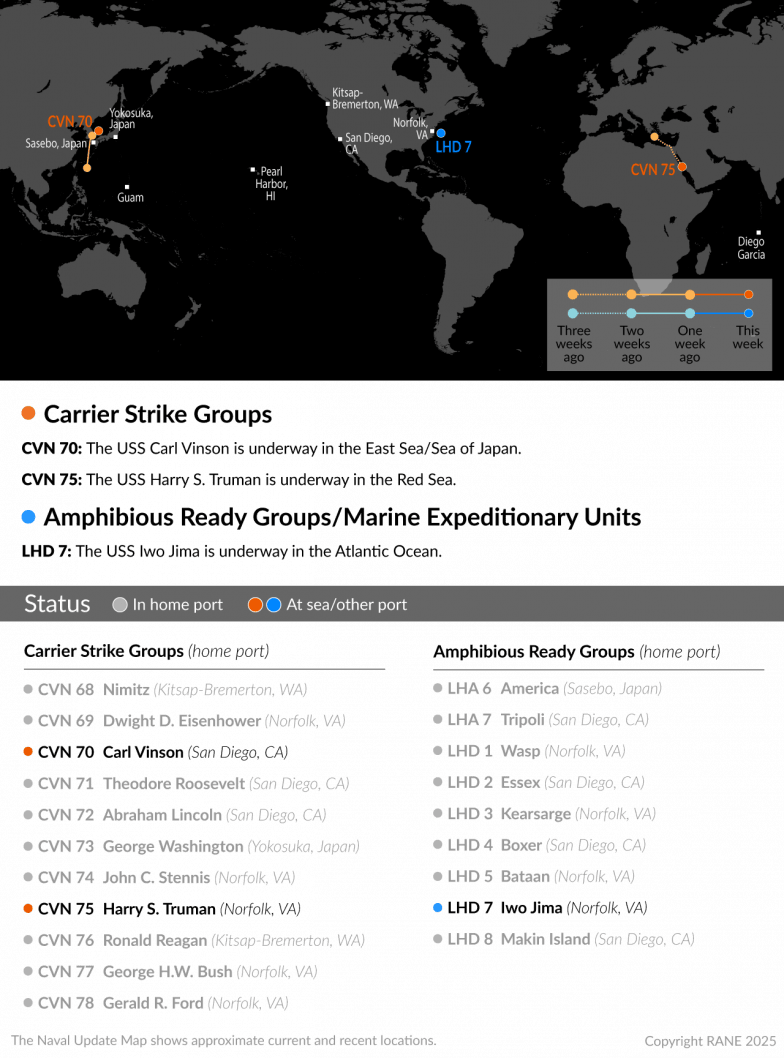
President Trump has warned Iran further attacks by the Houthis could mean attacks on it too. There are now unconfirmed rumours three US carrier strike groups and up to 35 ships in total will head to the Middle East – though actual deployment has yet to happen.

If so, it ups the ante there massively, just as Israel restarts attacks on Hamas after its refusal to hand over remaining hostages (and, in the background, the US reportedly agreed to an Egyptian proposal to rebuild Gaza without Hamas, with a local price tag of $50bn). A direct US attack on Iran is still a tail risk for now, but the Houthis may be about to find out what an operation to guard prosperity really looks like.

Presidents Trump and Putin will speak today about a ceasefire in Ukraine. Moreover, a Trump-Xi summit in the US is being floated. And when does ‘Rocket Man’ get another call?

Can you spot a pattern here? If not, you should. The US, pen in one hand and sword in the other, is looking for a new modus vivendi with the axis of Russia, China, Iran, and North Korea – on its terms. How they hold respond remains to be seen. That highest-stakes, highest-risk, highest-reward Great Game is the defining feature of our present, and future, global environment. Everything else is just a sub-set of it.   

On Ukraine, the UK is promising to send peacekeepers for “as long as it takes.” Critics point out its traditionally naval-based armed forces are in no condition to sustain deployment in size for any length of time, nor to scale up should they *not* be able to keep the peace. The cost of being able to do entails far more than cost-cutting via closing a quango, curtailing some civil servants’ state credit cards, and cutting disability benefits.

In Europe, today should see Germany’s debt brake come off so it can rearm, as the European Commission considers a fresh €40bn arms package for Ukraine. While there is no guarantee Europe is about to rearm itself appropriately for the geopolitical environment it is in, what might be needed is clear: the leader of the European People’s Party in the EU parliament is calling for a “war economy” –which Russia has– where civilian production is converted across to the military.

Focusing only on near-term news like the German IFO Institute now expecting GDP growth of just 0.2% in 2025, down from 0.4% in January, tells you nothing at all about what next year might bring. Or, looking at the Middle East, next month.

Indeed, swords, wielded or rattled, are also deep in trade news, an area we delude ourselves is only about the pen:

  • The EU, opposed to US tariffs, may impose its own tariffs on aluminium the US won’t take to protect the EU industries needed for rearmament – which is also the US argument;
  • US Trade Representative Greer is to take greater charge of the tariff process, with a return to asking firms for input before announcing them via social media… but the 2 April big reciprocal tariff day still looms;
  • US-EU trade tensions are likely to rise as Trump backs “BEAUTIFUL, CLEAN COAL”, putting the US, Chinese, and Indian economies –and Germany’s when it has to– in the coal camp;
  • Germany’s BMW will integrate Huawei’s tech into its locally produced new models in 2026. For some, that’s an equally critical with-us-or-against-us political choice;
  • Ukraine is warning the EU, “If you won’t sort out our trade relationship, there will be consequences.” Its duty-free access to the EU market expires in June but its goods have been blocked by Hungary, Poland, and Slovakia. The weaker Ukraine’s agri economy is, the less money it has to spend on its military, and so the more it ends up costing Europe (alone) to support it; and
  • New Zealand started FTA discussions with India, as the Kiwi PM also agreed to deepen political, cultural, and defence and security ties, showing economic prosperity and national security are now linked and pure FTAs are out.

Broader aspects of the economy and markets than ubiquitous cries of ‘tariffs!’ are also being sucked into this geopolitical vortex.

Elon Musk tells Senator Cruz there are 14 government “magic money computers” that “just send money” automatically. That sounds like a crash course in the Cantillon effect and/or MMT; and on what crashes can occur when you suddenly stop both.

The US is proposing changing how it measures GDP to exclude state spending. That worries markets who ‘need to know what’s going on in the economy’. The same markets who don’t have an issue with very questionable GDP from some other sources; nor with GDP not capturing the key issue Western economies now face (i.e., what is supplied, not consumed); and who don’t ask the key question, “What is GDP *for*?”

Foreign Policy magazine asks, ‘Will Trump Use the Federal Reserve as Leverage, Too?’, and warns, “When the next crisis hits, global markets may not be able to count on America’s financial backstop.” The argument is that Fed swaplines will be weaponised for geopolitical ends: and, indeed, why wouldn’t that current Fed autopen be used as a sword? “Because markets?” Please!

Those who take White House anti-establishment arguments seriously can join the dots to see something no Fed Dot Plot does. For example, how the US might instate a 30% withholding tax on interest for foreign holders of US securities to dissuade capital inflows, forcing a narrowing of its trade deficit in tandem; or use its new Sovereign Wealth Fund to push US capital into other economies, also meaning the US current account narrows (and then tariffing those who refuse US capital inflows).

Some ignore or dismiss these ideas because such things won’t happen or aren’t worth thinking about in advance: as was heard in advance of the Global Financial Crisis, negative interest rates, Brexit, Trump’s first win, a US-China Cold War, the Russian invasion of Ukraine, the effective closure of the Suez Canal, the end of the US security guarantee for Europe, and sudden European rearmament.

It’s the start of a two-day Fed meeting today. One wonders how much of this backdrop they are paying attention to.

Of course, the simple answer is rates on hold for now –see our Fed preview— and many could write that with an autopen at the moment; the Fed probably will.

However, where the sword is pointing to later is arguably of far greater importance.

Tyler Durden
Tue, 03/18/2025 – 10:25

White House Releases Savage Video Directed At Deported Criminals

White House Releases Savage Video Directed At Deported Criminals

Authored by Steve Watson via Modernity.news,

Following the successful deportation of hundreds of violent Tren De Agua gang members, Trump’s White House shared a video of the shackled illegal aliens being sent to a mega prison in El Salvador, set to a fitting theme song.

The footage shows the criminals being patted down and packed on planes all to the tune of 1998 song “Closing Time” by Semisonic.

The song features the lyrics “Closing time…You don’t have to go home, but you can’t stay here. ”

The deportation flights were carried out despite a rabid leftist federal judge attempting to block Trump’s invocation of the Alien Enemies Act to expedite the removal of the violent Venezuelans.

The Obama appointed Judge James Boasberg even issued an emergency order to turn around the flights in mid air and bring back the gang members to the US.

The flights were already over international waters due to the quick thinking of Deputy Chief of Staff Stephen Miller.

How much does one have to hate America to order flights full of the worst murderers and rapists to be turned around and brought back?

El Salvadoran President Nayib Bukele mocked the judge and later posted video of the gang members being taken off the flights and to the mega prison.

Secretary of State Marco Rubio noted that MS-13 gang members we’re also on the flights, including two leaders of the notorious gang.

Pam Bondi also released a statement, stating, “Tonight, a DC trial judge supported Tren de Aragua terrorists over the safety of Americans.”

Border Czar Tom Homan also noted that the judge was literally asking for terrorists to be brought back to the country.

*  *  *

Your support is crucial in helping us defeat mass censorship. Please consider donating via Locals or check out our unique merch. Follow us on X @ModernityNews.

Tyler Durden
Tue, 03/18/2025 – 09:51

Recession Canceled: US Industrial Production Jumps To Record High

Recession Canceled: US Industrial Production Jumps To Record High

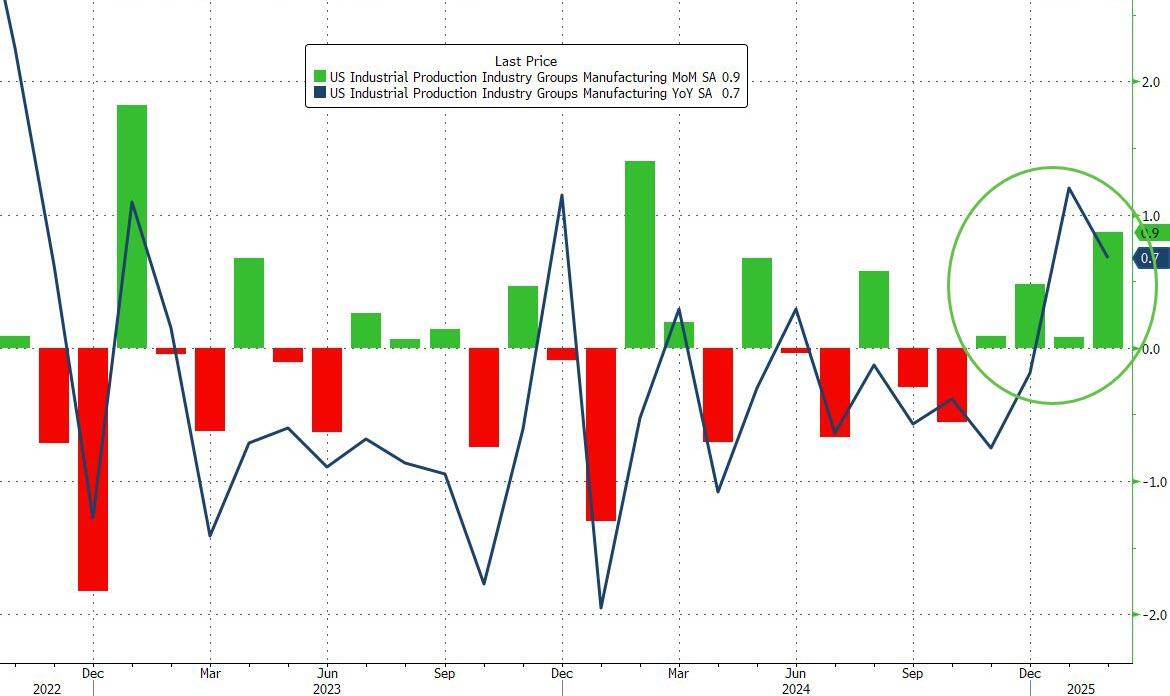
With a recession-narrative-crushing gain of 0.7% MoM (better than the 0.2% MoM expected)…

Source: Bloomberg

…US Industrial production rose to an all-time record high in February…

Source: Bloomberg

Mfg output rose 0.9 percent, boosted by a jump of 8.5% in the index for motor vehicles and parts. The output of manufacturing excluding motor vehicles and parts increased 0.4% .

Source: Bloomberg

Manufacturing output rose 0.9% in February. The durable manufacturing index increased 1.6%; while the growth of durables output was led by the index for motor vehicles and parts, gains were also seen in most other categories of durable manufacturing.

Source: Bloomberg

The nondurable manufacturing index stepped up 0.2%, with growth in chemicals offsetting a decline in food, beverage, and tobacco products. 

The index for other manufacturing (publishing and logging) decreased 0.1%. 

Mining output grew 2.8% in February after falling 3.2% in January. 

The index for utilities decreased 2.5%, as the output for electric utilities and for natural gas utilities decreased 1.2% and 11.1%, respectively.

Capacity Utilization also continued to surge, shrugging off recessionary signals…

Source: Bloomberg

This won’t help the doves… or Bessent and Trump who want long-term yields lower.

Tyler Durden
Tue, 03/18/2025 – 09:42

Fired Boss Of US Institute of Peace Throws Tantrum As DOGE Arrives

Fired Boss Of US Institute of Peace Throws Tantrum As DOGE Arrives

Leftist corporate media outlets have been running news headlines suggesting that Elon Musk’s DOGE “broke” into the U.S. Institute of Peace. In reality, however, fired and unhinged President and CEO George Moose denied access to Acting President Kenneth Jackson, a State Department official involved in neutering rogue U.S. Agency for International Development. 

The DOGE team wrote on X, “Mr. Moose denied lawful access to Kenneth Jackson, the Acting USIP President (as approved by the USIP Board). @DCPoliceDept arrived onsite and escorted Mr. Jackson into the building.  The only unlawful individual was Mr. Moose, who refused to comply, and even tried to fire USIP’s private security team when said security team went to give access to Mr. Jackson.” 

That’s certainly a stark contrast to the conspiracy-driven narratives pushed by leftist corporate news networks.

Another unhinged Deep State politician… 

Rep. Don Beyer (D-VA) pushed misinformation and information on X, indicating Moose was the “Acting President & CEO.” He was fired last week. Beyer called Jackson’s lawful access with help from DC Metro Police an “illegal power grab.” 

Seems a little dishonest, eh? 

Trump targeted USIP and a few others last month in a Feb. 19 executive order aimed at reducing the size of the bloated federal government. The administration has since moved to wind down several federal agencies and organizations, particularly neutering the Deep State’s slush fund: the U.S. Agency for International Development. 

White House spokesperson Anna Kelly told the AP News about USIP’s “noncompliance” with Trump’s order. 

After that, “11 board members were lawfully removed, and remaining board members appointed Kenneth Jackson acting president,” Kelly said, adding, “Rogue bureaucrats will not be allowed to hold agencies hostage. The Trump administration will enforce the President’s executive authority and ensure his agencies remain accountable to the American people.”

Pretty much. 

USIP’s corporate structure…

And the endowment connected to USIP has one familiar face. 

Robert F. Kennedy Jr.’s deranged leftist sister. 

How many of you knew the USIP existed—and that it’s funded with our tax dollars? How many can explain in a sentence or two what USIP actually does with that money? And finally, how many in the media could have answered either of those questions two weeks ago?

Tyler Durden
Tue, 03/18/2025 – 09:30

US Could Recognize Crimea As Part Of Russia, Urge UN To Follow

US Could Recognize Crimea As Part Of Russia, Urge UN To Follow

The Trump administration is mulling giving recognition of Russian sovereignty over the Crimea region as part of any future agreement to end the Ukraine war, according to a report in Semafor.

“Administration officials have also discussed the possibility of having the US urge the United Nations to do the same, according to both people,” the report says. “Such a request would align the Trump administration with the position of Russian President Vladimir Putin, who has long seen Crimea as his nation’s territory.”

Google Maps

Semafor emphasizes, however, that no official decision has been made, with National Security Council spokesman Brian Hughes telling the outlet that the White House has “made no such commitments and we will not negotiate this deal through the media.”

“Just two weeks ago, both Ukraine and Russia were miles apart on a ceasefire agreement, and we are now closer to a deal thanks to the leadership of President Trump. The goal remains the same: stop the killing and find a peaceful resolution to this conflict,” Hughes described.

Recognition of Crimea should in reality be the easiest concession, as historically Russia’s Black Sea naval fleet has always been positioned there, and the population is overwhelmingly Russian-speaking, as the 2014 popular referendum to join the Russian Federation demonstrated.

Ukraine’s President Zelensky has at various times throughout the conflict said Ukraine will never give it up, and there have been somewhat regular waves of drone and missile on Sevastopol – but Kiev is likely to let it go permanently before it gives up the Donbass. 

In November of 2024 Fox journalist Trey Yingst had pressed Zelensky on the Crimea question in an interview.

Yingst had asked: “President Vladimir Putin has been very clear Crimea will never return to Ukrainian hands. Are you willing to give up Crimea in pursuit of a peace deal to end this war and stop the bloodshed in Europe?” 

“I was already mentioning that we are ready to bring Crimea back diplomatically,” Zelensky responded. “We cannot spend dozens of thousands of our people so that they perish for the sake of Crimea coming back … We understand that Crimea can be brought back diplomatically.”

So Kiev may yet cling to the hope that Crimea won’t be permanently lost; however, Russia is clearly never going to entertain anything short of full recognition of the key peninsula as Russian.

CNN in 2014: “There’s overwhelming support for the territory to rejoin the Russian Federation, as thousands of people turned out to vote in the referendum. This city has extremely close historical and cultural ties with what people call the motherland.”

Meanwhile, White House Press Secretary Karoline Leavitt told reporters on Monday, “I won’t get ahead of those negotiations (between Trump and Putin) but I can say we are on the 10th yard line of peace. We’ve never been closer to a peace deal than we are in this moment and the president is determined to get one done.”

Much more will be known after the highly anticipated Trump-Putin phone call on Tuesday, upon which the two sides could move closer to the goal line.

Tyler Durden
Tue, 03/18/2025 – 09:15

‘Bolt From The Blue’ – Indonesian Stocks Halted Overnight After Biggest Loss Since 9/11

‘Bolt From The Blue’ – Indonesian Stocks Halted Overnight After Biggest Loss Since 9/11

The opening of the Jakarta stock exchange for trading overnight was ugly… and they it got worse… fast.

Selling intensified into the late morning Tuesday, pushing Indonesia’s benchmark Jakarta Composite Index down by as much as 7.1%, the steepest intraday decline since 2011.

On a day when the rest of Asian equity markets rallied, circuit-breakers triggered trading halts in Jakarta.

Traders said the selloff wasn’t driven by any single catalyst, but rather a combination of factors including concerns over President Prabowo Subianto’s populist measures, forced liquidations and uncertainties over the finance ministry’s leadership.

“The selloff has been a bolt from the blue in many ways — the suddenness has caught the market by surprise,” said Nirgunan Tiruchelvam, an analyst at Aletheia Capital in Singapore.

“Prabowo’s anti-business measures could have escalated this situation, but now it seems like it was already loaded with a lot of negatives.”

The stock selloff triggered a 30-minute temporary suspension after losses in the benchmark index exceeded 5% for the first time since 2020.

“Foreign investors are clearly rattled by Prabowo’s troubling signals on budget reallocation and the Finance Ministry’s ability to maintain the overall fiscal discipline,” said Homin Lee, a senior macro strategist at Lombard Odier Ltd. in Singapore. 

“The recent weakening of the government revenue collection and the resulting early deficit appear to be reviving the market’s worry about the future in the cabinet.”

Factoring in Tuesday’s plunge, the nation’s stock market has tumbled 12% this year, the second-worst major equity index in the world after Thailand. Overseas investors have sold a net $1.6 billion of the nation’s shares this quarter, more than erasing all of last year’s inflows.

As Bloomberg reports, what makes international investors worry most about Indonesia, the region’s largest economy, is the largely unanticipated accumulation of power by Prabowo.

The new president has sought to divert funds into his priority projects, while cutting back on expenditure elsewhere, rattling investor confidence. As an example, the newly launched sovereign wealth fund Danantara — which has a direct reporting line to the president — said last month it would take over management of seven state-owned enterprises.

“Markets hate uncertainty, but they do like direction — now it’s up to policymakers to set the tone,” said Mohit Mirpuri, a fund manager at SGMC Capital Pte in Singapore.

Also sapping investor confidence Tuesday was speculation that widely-respected Finance Minister Sri Mulyani Indrawati had decided to resign.

Tyler Durden
Tue, 03/18/2025 – 09:00

Stranded Astronauts Depart ISS As SpaceX Rescue Mission Begins Trip Home

Stranded Astronauts Depart ISS As SpaceX Rescue Mission Begins Trip Home

NASA astronauts Suni Williams and Butch Wilmore are finally returning home after what was supposed to be a week-long mission in a Boeing Starliner spacecraft left them stranded on the International Space Station for nine months. The toxic political environment further prolonged their extended stay under the Biden-Harris regime.

NASA astronauts Nick Hague and Roscosmos cosmonaut Aleksandr Gorbunov also joined Williams and Wilmore aboard a SpaceX Dragon spacecraft that undocked from the ISS early Tuesday morning.

 “NASA’s Crew-9 return coverage will resume at 4:45 p.m. Tuesday on NASA+ until Dragon splashes down at approximately 5:57 p.m. off the coast of Florida, and crew members are safely recovered,” the space agency wrote in a statement.

Days ago, Williams and Wilmore thanked Elon Musk for deploying a Dragon capsule to rescue them after their Boeing Starliner spacecraft malfunctioned last summer.

Due to Musk’s DOGE efforts, the rescue mission has been widely ignored by the leftist conspiracy networks on corporate television. 

Tyler Durden
Tue, 03/18/2025 – 06:55

Professors Claim Musk’s Cybertruck Reminiscent Of Apartheid-Enforcing Vehicle In South Africa

Professors Claim Musk’s Cybertruck Reminiscent Of Apartheid-Enforcing Vehicle In South Africa

Via The College Fix,

A pair of Rice University professors say Elon Musk’s Tesla Cybertruck is reminiscent of a vehicle that “patrolled and terrorized” black townships in apartheid South Africa.

As such, Professors Vivian Chenxue Lu and Nana Osei-Opare write in Slate that the Cybertruck’s similarities to the Casspir military vehicle (pictured, below) — intentional or not — “blur the boundaries between the battlefield and the public street.”

“[T]he Cybertruck’s harsh, sharp edges remind us […] of something from the past: the larger armored personnel vehicles that patrolled streets throughout Musk’s youth in apartheid South Africa,” the professors write.

“By the 1990s, the Casspir had become an iconic global symbol of apartheid oppression.”

Lu and Osei-Opare do their very best to link Musk to the Casspir, noting he “likely” would have seen the vehicle in his youth … around the time of the Soweto uprising.

However, Musk never had to travel in the Casspir, as he departed South Africa a year before he could be conscripted into the South African Defence Force.

Still, the Casspir was used by the United States military during the second Gulf War and invasions of Iraq and Afghanistan, and is now utilized by various police departments in the U.S.

Lu and Osei-Opare note the Casspir was part of the “spectacular use of force” shown in Ferguson, Missouri during Black Lives Matter protests.

Although the Cybertruck is “not designed for actual combat,” the professors further claim the vehicle capitalizes on the “romanticized frontier violence and militarism” of American pop culture:

Its marketing, for example, explicitly taps into the current apocalyptic visions pervading both right- and left-wing political imaginaries—from climate disaster to nuclear, civil, and class warfare. Heralded as being “built for any planet,” it showcases a Bioweapon Defense Mode and a “built-in hospital grade HEPA filter” that “helps provide protection from 99.97% of airborne particles.” One third-party Tesla modification company, aimed at civilian and government clients, sells Cybertruck upgrades so it can run on jet fuel, diesel, biodiesel, and electricity.

The idea that a Cybertruck could become an artillery vehicle is not just hypothetical. Unsanctioned by Tesla, various users, ranging from a YouTuber to Chechen forces fighting for Russia in Ukraine, have modified a Cybertruck by mounting machine guns to its bed, turning it into a lightly armored weaponized machine.

“Whether or not Musk or the Cybertruck’s designers made a conscious decision to draw inspiration from the Casspir,” the authors conclude, the vehicle’s “pseudo-futuristic vision is militaristic, stainless-steel fortified, masculinist, individualistic, and unforgiving.

“Whether through Casspirs or the Cybertruck, apartheid’s militarized, cultural, and psychological legacy roams our streets.”

According to her faculty page, Lu’s (pictured) work focuses on the “cultural politics of profit, transnational commerce, ethnonationalism, and diaspora.”

Osei-Opare has written about “black radicals’ relationship to Marxist-Leninism,” “labor and labor agitation in postcolonial Africa,” and “the insertion of white supremacy and racism as an analytical category into the Cold War theoretical paradigm.”

Tyler Durden
Tue, 03/18/2025 – 06:30

Visualizing The Religious Landscape Of The US

Visualizing The Religious Landscape Of The US

Key Takeaways

  • Christian Majority – 63% of U.S. adults identify as Christian, with Evangelical Protestants (23%) and Catholics (19%) as the largest groups.

  • Growing Unaffiliated – Nearly 1 in 3 Americans (30%) are religiously unaffiliated.

  • Despite its dominance, the share of Christians has decreased from 78% in 2007 to 63% in 2024.

The Religious Landscape Study (RLS) was conducted by the Pew Research Center in 2007, 2014, and 2023–24. The study, visualized below by Visual Capitalist’s Bruno Venditti, surveys more than 35,000 Americans across all 50 states about their religious affiliations.

Christianity in the U.S.

After many years of steady decline, the share of Americans who identify as Christian shows signs of leveling off—at least temporarily.

According to the study, the percentage of U.S. adults identifying as Christian declined from 78% in 2007 to 63% in 2023-24. Since 2020, the percentage has remained relatively stable, fluctuating between 62% and 64%.

The largest Christian subgroups in the United States are Protestants, who now make up 40% of U.S. adults, and Catholics at 19%. An additional 3% identify with other Christian groups, including the Greek and Russian Orthodox Churches, the Church of Jesus Christ of Latter-day Saints, Jehovah’s Witnesses, and others.

Both Protestant and Catholic numbers have declined significantly since 2007. However, the Protestant share of the population has remained relatively steady since 2019, while the Catholic share has stabilized since 2014.

Meanwhile, the percentage of Americans identifying with a religion other than Christianity has been gradually increasing, though it remains in the single digits.

Religiously unaffiliated adults—those who identify as atheists, agnostics or as “nothing in particular” when asked about their religion—account for 30% of the population.

The world’s three largest religions have a combined 5 billion followers. To learn more about this topic, check out this graphic on the world’s most popular religions.

Tyler Durden
Tue, 03/18/2025 – 05:45