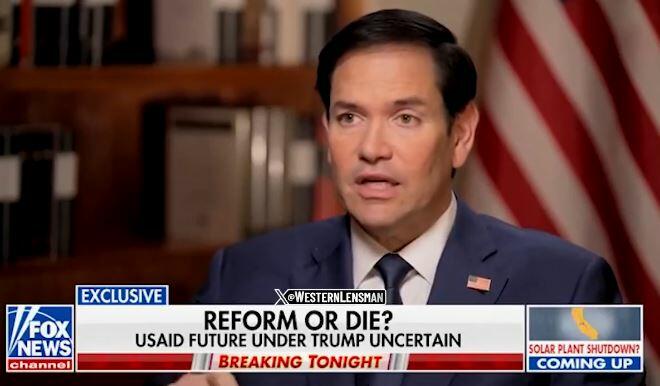
“Rank Insubordination”: Rubio Says USAID Full Of Rogue Employees
Secretary of State Marco Rubio slammed the US Agency for International Development (USAID) for what he called “rank insubordination,” and is full of rogue employees who do whatever the hell they want.
“Well, that was always the goal was to reform it, but now we have rank insubordination,” Rubio told Fox News, in comments just one day after President Trump announced that Rubio would serve as the acting head of USAID – which itself came after Elon Musk’s DOGE team descended upon the agency and revealed that “USAID is a ball of worms. There is no apple. And when there is no apple you just need to get rid of the whole thing. That’s why it’s got to go. It’s beyond repair.“
According to Rubio, “Now we have basically an active effort — their basic attitude is, ‘We don’t work for anyone, we work for ourselves, no agency of government can tell us what to do.”
“So the president made me the acting administrator,” he added. “I’ve delegated that power to someone who is there full-time, and we’re going to go through the same process at USAID as we’re going through now at the State Department.”
According to Rubio, USAID has lost its focus and abandoned the “national interest” – telling Fox: “They have basically evolved into an agency that believes that they’re not even a U.S. government agency, that they are out — they’re a global charity, that they take the taxpayer money, and they spend it as a global charity irrespective of whether it is in the national interest or not in the national interest.”
🚨RUBIO: USAID rife with “rank insubordination” — “we had no choice but to take dramatic steps to bring this thing under control.”
“They have basically evolved into an agency that believes that they’re not even a U.S. government agency…they’re completely unresponsive. They… pic.twitter.com/LQOKRDUlBk
“One of the most common complaints you will get if you go to embassies around the world from State Department officials and ambassadors and the like is USAID is not only not cooperative — they undermine the work that we’re doing in that country, they are supporting programs that upset the host government for whom we’re trying to work with on a broader scale, and so forth,” Rubio added.
On Monday, deep state crusaders Ilhan Omar (D-MN) and Jamie Raskin (D-MD) staged a dramatic protest outside the USAID headquarters, with Omar suggesting that Trump’s move to fold the agency into the State Department was “what the beginning of dictatorship looks like!” – and Raskin suggesting that Elon Musk had “illegally seized power over the financial payment systems of the United States Department of Treasury,” adding “Elon Musk, you didn’t create USAID,” and that Musk “doesn’t have the power to destroy it.”
What Raskin actually means is that he wants his kickbacks and bribes to continue.
US lobbying/law firms who launder foreign donations (which are actually US taxpayer foreign aid coming full circle!) need to be investigated and shut down. https://t.co/5yVDqfZOtY
Anita Ghazarian and Simon Penny live in a house on the westernmost edge of Altadena—missed by the flames from the catastrophic Eaton Fire, but still close enough to be blanketed in ash. Farther east, in the burn zone, they own a house they rent out, which was minimally damaged.
As soon as the electricity comes back on, Ghazarian’s insurance adjuster told her, the rental house is considered habitable.
“How can I tell my tenants to move back into a house where the entire backyard is filled with ash and broken stuff and the houses around it are all burn zones? Are the kids going to play in that backyard?” Ghazarian asked.
In a maze of online maps, residents can find themselves in an uncertain space: Their house might be in an EPA “normal” zone, meaning it has been repopulated after evacuations, and also marked green on a county map (showing no or minimal damage), and yet surrounded by obliterated structures and covered in ash.
Such intact structures risk being cross-contaminated by nearby burned structures, according to research from the University of Colorado at Boulder that looked at health impacts from smoke in homes after the Marshall Fire, which destroyed more than 1,000 buildings in 2021.
After Colorado’s Marshall Fire, more than half of the hundreds of people surveyed experienced symptoms from wildfire smoke six months after the fire, and continue to report symptoms even after extensive remediation.
Homes untouched by the fires had high levels of volatile organic compounds (VOCs), including benzene and toluene, carried in by ash and smoke from the homes that did burn.
In scope and scale, the Los Angeles disaster dwarfs the tragic Marshall Fire, and threatens a commensurate environmental crisis.
Los Angeles County’s two major fires, in the Pacific Palisades and Altadena, burned through 40,000 acres, about 60 square miles, and killed 25 people, destroying more than 16,000 structures and reducing whole neighborhoods to rubble.
In total, five concurrent fires burned more than 55,000 acres—around three times the size of Manhattan.
“We’re now in the disaster after the disaster,” said Jane Williams, executive director of the nonprofit California Communities Against Toxics.
“And exactly the same thing that happened at 9/11 is happening here, where everyone just wants to return to normal, and they put pressure on public officials to say everything is safe, and everybody goes back to drinking the water and breathing the air,” she told The Epoch Times.
At the same time, nearly three weeks in, some residents had not been allowed back to see the ruins of their homes, search for memorabilia or fully process what had happened.
That tension—between the need to rebuild, and the untold hazards left by the fires—will shape the largest disaster recovery in California history.
Williams, who has worked with governments and communities in the aftermath of some of the largest disasters in recent memory, including the 2023 Maui fires in Hawaii, expects that even in environmentally conscious California, advocating for caution will be difficult.
“You’re going to see workers in scuba gear with Tyvek suits and booties over their shoes and gloves, removing hazardous waste. And across the street, you’re going to see kids playing in a playground,” she said.
Federal agencies in charge of the cleanup have outlined enhanced safety protocols for collection and disposal of hazardous waste and debris, but there are critical blind spots.
In particular, questions remain about the habitability of structures left intact by the fires, and the safety of air, soil, and water in impacted areas.
This issue is likely to take center stage in areas impacted by the Eaton Fire, where destroyed homes are surrounded by thousands left intact but saturated with smoke and ash.
Appetites for risk vary. Some residents whose homes survived never left; others want to return immediately. But a lack of clear guidance or standards in the federally led cleanup has left many more in limbo.
As displaced residents face the challenges ahead, many are wondering who is ultimately responsible for protecting their health and safety—and why the burden of proof appears to be on their shoulders.
As for the ash-covered soil, Ghazarian wonders if she’ll need to remove it herself.
The Army Corps of Engineers, in the second phase of a two-part federal cleanup plan, will remove six inches of soil from damaged and destroyed properties. That process may take up to a year or longer, and it is unclear if it will apply to intact structures like Ghazarian’s rental property. The first phase, currently underway, involves mandatory hazardous material removal by the EPA.
At a recent town hall meeting for the Eaton Fire recovery, the county Department of Public Works (DPW) said it has no plans to test soil. The EPA has said that testing air, soil, and water is the responsibility of local agencies.
Insurance companies are not lining up to spend thousands of dollars on the effort, either, Ghazarian said. “They say, no, that’s not our problem.”
Her partner, Penny, who grew up accustomed to wildfires in Australia, said he was amazed there was no organized response from authorities to test ash for a baseline before the expected rains came.
“There’s no county, state, or apparently federal agency that has the responsibility for testing toxic ash fallout from fires. There’s no one who is responsible,” Penny said. “The Army Corps of Engineers is telling us it’s L.A. County DPW [Department of Public Works], and DPW is saying it’s [L.A. County Board of Supervisors Chair Kathryn] Barger’s responsibility, and Barger is saying it’s the EPA. They’re backing this thing around and it’s like, where is the regulation?”
Penny spoke with an industrial hygienist about doing work on the house, and the hygienist told him, “It’s the wild, wild West out here.”
The Los Angeles County Department of Public Health and its Department of Public Works did not respond to requests for comment.
In this vacuum, exiled neighbors have turned to social media to organize. In Facebook pages, group emails, Zoom meetings, and text messages, they are posting results of heavy metal tests from private contractors and thinking about how to map their data.
They also share tips—for example, if you request soil testing and your insurance denies it, go ask FEMA in person.
In a Reddit forum on the subject, one Altadena resident posted results from an inspector who tested dust samples in her home for lead and asbestos. The results showed lead up to 33 times federal and state regulated levels—in areas where there was no visible dust, in a house outside the burn zone.
“While I know I can get the interior cleaned up, what worries me is that all of this stuff is also on the street, in the soil, on our yards,” the resident wrote.
Altadena residents have reason to be concerned about asbestos, which is blamed for much of the post-9/11 public health crisis.
In the case of the Eaton Fire, the vast majority—35,543 out of 41,128—of structures in the burn zone were built before 1979. That means they are more likely to contain asbestos, the cheap, fire-resistant material that was used widely in construction starting in the 1930s before being phased out in the late 1970s and early 1980s.
“This is the largest cleanup in California’s history,” Williams said.
The largest before it, created by decades of contamination from the former lead-battery giant Exide in Los Angeles, was a fraction of the size and had third-party monitors, air monitoring, extensive worker safety, and community safety protocols, Williams said.
“All those protections we already have in place are going to go by the wayside here. And you’re talking about 50 square miles of ash and debris and toxic waste that have to be removed.”
Even at Ghazarian’s home outside the burn zone, there is heavy ash residue.
“Can you garden? Can you eat off it? Can you have kids play in that backyard?” Ghazarian asks. “What is going to happen in three, five, 10, 20 years to people who inhabit that house?”
She is having a hard time finding companies equipped to test for a long list of contaminants known to be in play after the fires.
“We’re just going to be left to our own devices and we’re not sure when we can move back. Is it safe? What about our tenants? And who is going to be in charge of all this?”
Residents grappling with these questions have created a petition to demand clear standards for remediation and testing, claiming the lack of guidance is putting them at risk.
“The goal here is not to keep people from their homes. Instead we demand official guidelines clarifying for homeowners and insurers what is safe when,” the petition reads.
“Choice ultimately should lie with the homeowner if they want to return early, but we don’t want homeowners to be forced home sooner than is safe.”
Nearly a quarter-century after 9/11, more than twice the number of people have died of exposure to contaminants released in the fall of the Twin Towers than in the attack itself—of respiratory, cardiac, and digestive disorders, as well as cancers.
In the days immediately after 9/11, the former director of the U.S. Environmental Protection Agency (EPA) told the public the air was safe to breathe—a statement for which she later apologized. Subsequent investigations revealed officials intentionally downplayed dangers amid insufficient data.
As of 2021, 24,000 people have been diagnosed with a 9/11-related cancer, including mesothelioma, a rare and aggressive malignancy caused by asbestos exposure that can take decades to manifest.
Trump Suspends Dozens In Education Department As DOGE Devises Plan To Dismantle Agency
Dozens of employees at the US Department of Education were placed on paid leave after refusing to adhere to President Trump’s executive order banning DEI programs in the federal government, according to AP, citing a labor union that represents the employees.
At least 55 Education Department employees received an email Friday notifying them that they were being placed on paid leave effective immediately, pursuant to Trump’s executive order. Those placed on leave have lost access to their government email accounts and were told not to report to the office. While the exact reasons for the paid leave are unknown, most of the affected workers appear to have taken a voluntary diversity training seminar offered by the department.
Expelling the DOE?
Meanwhile, according to the Wall Street Journal, Trump administration officials are weighing an executive order to dismantle theDepartment of Education – with DOGE head Elon Musk leading the charge as part of his mission to shrink federal agencies and shrink the government.
The officials have discussed an executive order that would shut down all functions of the agency that aren’t written explicitly into statute or move certain functions to other departments, according to people familiar with the matter. The order would call for developing a legislative proposal to abolish the department, the people said. Trump’s advisers are debating the specifics of the order and the timing, the people said. -WSJ
Trump’s team is reportedly hashing out when and how to pull the trigger, with some advisors urging patience until Education Secretary nominee Linda McMahon gets through her Senate confirmation – with the White House’s recent freeze on federal assistance causing headaches for other nominations, officials are treading carefully.
According to the report, DOGE employees have been working out of the department’s headquarters in Washington
While Trump may be able to pare down the Department of Education, completely abolishing it would require an act of Congress – so no chance that will happen anytime soon. During his first term, Trump unsuccessfully tried to merge the departments of education and labor.
Last week Rep. Thomas Massie (R-KY) introduced a bill toabolish the Education Department by 2026, arguing that “Unelected bureaucrats in Washington, D.C., should not be in charge of our children’s intellectual and moral development,” adding “States and local communities are best positioned to shape curricula that meet the needs of their students.”
Trump’s aides could replicate the approach they used to disassemble the core functions of the U.S. Agency for International Development. In recent days, Musk’s representatives have gained access to sensitive documents at the agency, shut down its website, deactivated email addresses and told employees not to come to the office. -WSJ
The Department of Education was created in 1979 under former President Jimmy Carter, after urging by the country’s largest teachers union, the National Education Association. Key activities include providing grants for low-income students, administering the federal student-loan program, and regulating how schools serve students with disabilities.
The U.S. Department of Justice (DOJ) has asked for the names of thousands of FBI employees who worked on investigations into the Jan. 6, 2021, breach of the U.S. Capitol.
Acting Deputy Attorney General Emil Bove in a Jan. 31 missive to Acting FBI Director Brian Driscoll directed the FBI to provide the names of all bureau personnel who investigated Jan. 6 and an unrelated terrorism case, Senate Democrats said in a Feb. 3 letter.
Driscoll told FBI workers in a separate message to the FBI workforce that the request encompasses thousands of employees across the country, including himself, “who have supported these investigative efforts.”
Bove warned that “additional personnel actions” could follow, Senate Judiciary Committee Ranking Member Dick Durbin (D-Ill.) said.
The DOJ did not respond to requests for comment.
An FBI spokesperson confirmed that Bove has requested information about FBI personnel.
“The FBI is currently working to respond to a request for information from the Acting Deputy Attorney General about current and former FBI personnel assigned to certain investigations or prosecutions, including the events that occurred at or near the United States Capitol on January 6, 2021,” the spokesperson told The Epoch Times in an email.
“The FBI will work within the law and policy to respond to official requests for information from the Department of Justice. To be clear, the FBI does not view anyone’s identification on one of these lists as an indicator of misconduct,” the bureau added.
Ed Martin, interim U.S. attorney for the District of Columbia, previously launched an investigation into why federal prosecutors brought a felony obstruction charge against hundreds of Jan. 6 defendants. Trump, after taking office, pardoned many people who had been charged over Jan. 6.
The new request for information comes after acting Department of Justice leadership terminated officials, including prosecutors involved in prosecuting Trump before he was elected, and six FBI executive assistant directors.
“I do not believe the current leadership of the Justice Department can trust these FBI employees to assist in implementing the President’s agenda faithfully,” Bove stated in his letter to Driscoll, Senate Democrats said.
Durbin and the other senators told Acting Attorney General James McHenry and Driscoll that the terminations, and reassignments that have also taken place, “deprive DOJ and the FBI of experienced, senior leadership and decades of experience fighting violent crime, espionage, and terrorism.” They asked for details about the actions.
Leaders of the Federal Bureau of Investigation Agents Association told members of Congress on Feb. 3 that the Department of Justice’s actions are threatening the jobs of thousands of FBI agents and “risk disrupting the bureau’s essential work.”
“Any review of Special Agents should follow established disciplinary procedures that provide the necessary due process and transparency to our nation’s law enforcement officers,” the group said.
McHenry and Driscoll are serving in acting positions as the Senate considers the nominations of Pam Bondi and Kash Patel to become, respectively, the attorney general and FBI director.
Patel said during his confirmation hearing that he would not act against FBI employees solely due to their work on probes into Trump.
“All FBI employees will be protected against political retribution,” he said.
“I will not politicize that office,“ Bondi said during her confirmation hearing. ”I will not target people simply because of their political affiliation.”
The leader of the Left Party in Germany has suggested that the country could grant asylum to a million migrants a year in order to protect them from “the consequences of climate change.”
During an interview with Funke Media Group, Jan van Aken said that Germany accepting a million new migrants every year was “a completely manageable number.”
Asserting that tens of millions will have to flee their homes over the next few decades due to global warming, Van Aken said Germany should be a safe haven for those “who are feeling the consequences of climate change.”
“The climate catastrophe is already making entire regions uninhabitable – for example in Pakistan or Bangladesh,” he added, two countries which have a combined population of 200 million people.
Van Aken made the call despite Germany suffering ongoing problems with soaring migrant crime, an economy in meltdown and a housing crisis.
As we document in the video below, the basic safety of women walking the streets has also been placed in dire jeopardy.
As we previously highlighted, foreign migrant suspects are responsible for nearly 6 in 10 violent crimes in Germany according to new figures released by the federal government.
Despite comprising roughly 14.6 per cent of the population, foreign migrants were responsible for 58.5 per cent of all violent crimes.
“Among the biggest complaints is a serious lack of housing across the country, which is most acutely felt in large cities,” reports Remix News.
“In Berlin, for example, the state is paying half a billion euros per for migrant accommodations while freezing the education budget due to a spiraling cycle of debt.”
“At the same time, statistics in Berlin which show that nearly half the gang rape suspects are foreigners, and a significant but unknown percentage likely with a migration background, have revealed that many of the newcomers are fueling a crime crisis that is traumatizing women across the country.”
Meanwhile, during an interview with German television, AfD leader Alice Weidel defended Elon Musk’s support for her party, while the host suggested that it was wrong for Germans to be proud of being German.
🚨🇩🇪 TV SHOW HOST SAYS ELON MUSK CANNOT TELL GERMANS TO BE PROUD!
The insufferable mainstream TV show host Miosga is appalled by Elon Musk‘s comments on German history.
She claims he has no historical connections and expertise, therefore it is wrong to be proud to be German. pic.twitter.com/vIr3Mpn7dc
Your support is crucial in helping us defeat mass censorship. Please consider donating via Locals or check out our unique merch. Follow us on X @ModernityNews.
Futures Rise On Muted Chinese Response To Trade War
US equity futures are flat, recovering from earlier losses after China’s restrained response to US tariffs, and a last-minute reprieve for Canada and Mexico. As of 8:00am ET, S&P futures are flat, having dropped 0.5% earlier after China tariffs went into effect at midnight and China retaliated; Nasdaq futures rose 0.2% thanks to a bid for parts of the Mag7/semis complex (GOOGL +0.7%, AMZN +0.5%, AAPL -0.5%, MSFT flat, META +0.6%, NVDA +0.4% and TSLA +0.5%). Unlike yesterday, USD is weaker to start the session, dropping 0.2% as some traders flagged relief that the worst-case scenarios seem to be avoided. The bond market reaction is muted, with the yield curve bear steepening 1-2bps; the 10Y yield rose 2bps to 4.58%. Commodities are lower with energy getting hit and WTI crude oil futures falling more than 2% to YTD low. Today’s macro focus is on JOLTS and Factory Orders
In premarket trading, Chinese stocks listed in the US are broadly higher as analysts say Beijing’s retaliatation to Donald Trump’s tariffs is relatively measured and appears to be aimed at increasing its bargaining power at trade talks (Alibaba +1.5%, Nio +1%, PDD +2%). Palantir shares soared as much as 20% after the software company gave a forecast that is stronger than expected, citing demand for its AI products. For context, PLTR raised its 2025 revenue guidance by $200MM and its market cap grew by $30BN. Just don’t call it a bubble. Elsewhere, Merck, PepsiCo and Estée Lauder all declined on disappointing outlooks. PayPal tumbled 6% after posting fourth quarter results. Here are some other notable movers:
Fabrinet (FN) declines 6% after the engineering and manufacturing services company reported its second-quarter results that showed weakness in the company’s datacom business.
Grab (GRAB) climbs 6% as the company is weighing a takeover of rival GoTo Group.
Illumina and Calvin Klein owner PVH Corp. decline after China placed the companies on a so-called blacklist of entities, among a series of retaliatory actions after new tariffs ordered by Trump took effect Tuesday. Illumina (ILMN) -5%, PVH (PVH) -4%
Merck (MRK) falls 7% as the company is halting shipments of its cancer-preventing Gardasil vaccine to China, which is expected to last at least through mid-year.
Palantir (PLTR) rises 21% after the software company gave a forecast that is stronger than expected. The company touted the demand it is seeing for AI products.
PepsiCo (PEP) slips 2% after reporting sales that missed expectations and forecast sluggish growth for 2025 as North American shoppers pull back on purchases of snacks from the maker of Cheetos and Mountain Dew.
Pfizer (PFE) climbs 1% as its fourth quarter beat expectations on strong sales of its Covid vaccine and pill.
Silicon Labs (SLAB) rises 2% after providing a 1Q forecast.
Sirius XM (SIRI) rises 3% after Berkshire Hathaway reported insider transactions in the firm worth $54 million.
Spotify (SPOT) advances 8% after the audio-streaming company’s first-quarter forecasts for monthly active users, revenue and operating income topped estimates.
Super Micro Computer (SMCI) rises 5% after the company said that it will give a business update on Feb. 11 following the market close.
A mixed bag of corporate results, meanwhile, did little to give the market direction. “The tariff issue is not going away as fast as one could have hoped for,” said Andrea Tueni, head of sales trading at Saxo Banque France SAS. “Sure, earnings are providing some oxygen but there’s a bigger game at play here. We’re only at the beginning of a long process so my advice is to proceed cautiously.” Traders are also awaiting results Tuesday from Alphabet, as well as data on US factory- and durable-goods orders.
The Stoxx 600 trimmed declines and traded up 0.1% last, revering a 0.4% loss, as traders point to China’s restrained response to US tariffs and as investors juggle the risk of a global trade war with a slew of positive earning reports from the region. Financial services and telecommunications shares are the biggest laggards, while technology and banking shares lead the outperforming sectors. UBS shares dropped as concern over a potential increase in capital requirements outweighed better-than-expected results. Vodafone fell after the communications firm noted worsening conditions in Germany. BNP Paribas rose on a surge in trading revenue, while Infineon Technologies AG jumped after the chipmaker forecast revenue that beat analyst estimates. Here are the biggest movers Tuesday:
Infineon shares soar as much as 13%, the most since May, after the chipmaker raised FY revenue guidance, citing currency gains
BNP Paribas shares advanced as much as 3.7%, the best performer on the Stoxx 600 Banks Index, after it reported what analysts say are a reasonable set of results
Coloplast shares climb as much as 4%, the most since Nov. 14, after the medical-products maker reported results for the first quarter that were in line with expectations, which analysts found reassuring
UBS shares reverse initial gains and trade about 6% lower as concern persists over a potentially substantial increase in capital requirements, outweighing better-than-expected results and a $3b buyback
Vodafone shares fall as much as 6.5% as the telecommunications firm says Germany, which accounts for some 38% of its revenue, is expected to see weaker earnings in the second half of year
Diageo shares fall as much as 3.8% before trimming the drop after the distiller withdrew its medium-term guidance due to geopolitical uncertainty, a move which analysts said showed that a recovery would take longer than expected
Reckitt Benckiser shares drop as much as 2.5% after Barclays downgraded the household and personal care products maker to equal-weight, saying the stock is “not as cheap as it seems”
Earlier in the session, Asian equities pared gains in afternoon trading Tuesday, as the US imposed a 10% tariff on all Chinese imports and China retaliated to the new levies. The MSCI Asia Pacific Index was up 1.2%, trimming an earlier rise of about 1.5%. President Donald Trump’s earlier deals to delay 25% tariffs on Canada and Mexico for a month had given the market hope for a similar pause on the China duties, sending Hong Kong shares higher in the morning. China announced an investigation into Google and put new levies on a range of US products in an apparent retaliatory move, moments after the US tariffs of 10% kicked in. The Hang Seng China Enterprises Index was up 3.5%, after earlier having trimmed gains to 1.7%, as traders saw the measures as positioning for trade talks.
In FX, the greenback was up against all its Group-of-10 peers during the Asia session, yet lost traction after the Tokyo fix; China proxies like the Australian and New Zealand dollars lead declines. the Mexican peso and Canadian dollar are both little changed after Monday’s tariff reprieve boosted both currencies. The Swiss franc and Swedish krona are the best performing G-10 currencies. The yen falls 0.4%, pushing USD/JPY to 155.30.
In rates, treasuries hold small, long-end-led losses as the US trading day begins, steepening the yield curve. 10-year TSY yields are ~2bps cheaper on the day at ~4.58%, outperforming bunds and gilts in the sector by 1.5bp and 4bp; Canadian bonds extend Monday’s outperformance of Treasuries with 10-year sector richer by around 2bp on vs US 10-year. The 30-year yield is higher by nearly 3bp at about 4.82%, approaching Friday’s high, and 2s10s and 5s30s spreads also top Monday’s wides. Gilts lead a selloff in European government bonds as UK 10-year yields climb ~6 bps to 4.54%. French bonds spreads narrow for a third day. Focal points of US session also include JOLTS job openings data at 10am New York time.
On today’s calendar, we get the December JOLTS and factory orders (10am). Fed speaker slate includes Bostic (11am), Daly (2pm) and Jefferson (7:30pm).
Market Snapshot
S&P 500 futures down 0.2% to 6,007.50
STOXX Europe 600 down 0.3% to 533.29
MXAP up 1.3% to 182.26
MXAPJ up 1.6% to 573.53
Nikkei up 0.7% to 38,798.37
Topix up 0.6% to 2,738.02
Hang Seng Index up 2.8% to 20,789.96
Shanghai Composite little changed at 3,250.60
Sensex up 1.9% to 78,641.72
Australia S&P/ASX 200 little changed at 8,373.98
Kospi up 1.1% to 2,481.69
German 10Y yield little changed at 2.41%
Euro little changed at $1.0347
Brent Futures down 1.4% to $74.89/bbl
Gold spot up 0.1% to $2,818.05
US Dollar Index down 0.50% to 108.45
Top Overnight News
China on Tuesday imposed targeted tariffs on American imports and put several U.S. companies, including Google, on notice for possible sanctions, in a measured response to the sweeping duties on Chinese imports imposed by President Donald Trump. Beijing’s limited counter to Trump’s imposition of a 10% tariff on all Chinese imports underscored the attempt by Chinese policymakers to engage Trump in talks that could avert an outright trade war between the world’s two largest economies. RTRS
Fed’s Goolsbee (voter) said uncertainties likely mean that the Fed needs to be a little more careful and prudent on cutting rates, while he added there are risks that inflation could tick back up and if fiscal choices affect prices or employment, they have to think it through. Goolsbee also said there are concerns about inflation and the Fed might have to slow the pace of rate cuts amid uncertainty.
El Salvador offered to accept US criminal deportees of any nationality “for a fee.” Bukele also offered to house in his jails criminals, including those with US citizenship or legal residency. Marco Rubio praised the offer as unprecedented without saying whether the Trump administration would accept it — or whether it would even be legal in the case of US citizens.
US President Trump’s nominee Chris Wright was confirmed by the Senate as Energy Secretary through 59-38 votes.
Narendra Modi has been invited to the White House for a meeting next week. The Indian PM has been swiftly making concessions to appease Trump and avoid a trade war. BBG
Singapore’s top diplomat said he doesn’t expect the nation to be a target for US tariffs. Thailand may increase imports of American goods to cut its trade gap. BBG
European leaders, bracing for a fight with President Trump over the world’s most valuable trading relationship, said they are ready to strike back but prefer cooperation. The EU has for months been preparing potential responses to Trump tariffs. WSJ
France’s budget deficit narrowed by €17 billion in 2024 from the year earlier, providing the government with some relief as it clings to power after recent battles over public finances. BBG
The Fed’s Austan Goolsbee said the central bank should be cautious in lowering rates due to mounting uncertainty introduced by Trump, echoing calls from two of his colleagues yesterday. BBG
UBS shares dropped as concern about a potentially substantial increase in capital requirements outweighed a $3 billion buyback and strong earnings beat. Pretax profit at the investment bank was about seven times estimates. BBG
Crypto is emerging as a key tariff pain trade, offering a risk sentiment proxy any time Trump speaks, even if stock markets are closed — as happened over the weekend. Ether shed more than a quarter of its value yesterday before staging a near-full recovery. BBG
Tariffs
The new 10% tariff on all China exports to the US took effect after the deadline passed.
China is to levy countermeasures on some US imported products with 15% tariffs on coal and LNG, as well as 10% tariff on oil, agricultural machines and some autos from the US, while China’s Finance Ministry said tariffs imposed are to counter 10% Trump tariff and will take effect on February 10th. China is also to probe Google (GOOGL) over alleged anti-trust law breaches and it imposed export controls on tungsten, tellurium, ruthenium, molybdenum, and ruthenium-related items.
US President Trump said on Truth that Canada agreed to ensure the US has a secure Northern Border and the tariffs announced on Saturday will be paused for a 30-day period to see whether or not a final economic deal with Canada can be structured.
Canadian PM Trudeau said he had a good call with President Trump who will pause the tariffs for at least 30 days and Canada will send almost 10,000 troops to protect the border, while Canada will also name a fentanyl czar.
EU Commission President von der Leyen said that when targeted with unfairly or arbitrarily tariffs, the EU will respond firmly.
Palantir Technologies (PLTR) +18.6% pre-market: Q4 beat on AI growth. Q1 & FY guides strong.
Nintendo (7974 JT) : 9-month lower Y/Y, cut FY guidance.
A more detailed look at global markets courtesy of Newsquawk
APAC stocks traded higher as the region reacted to US President Trump’s delay of tariffs against Canada and Mexico for a month, while the additional 10% tariffs on China took effect and prompted an immediate retaliation by China. ASX 200 was initially led higher by strength in tech and miners but ultimately settled flat owing to the US-China tariff frictions. Nikkei 225 briefly climbed back above the 39,000 level with the biggest gainers and losers dictated by earnings releases. Hang Seng surged amid hopes that China would also reach a tariff deal with the US after President Trump stated that he would probably speak with China within 24 hours, but then briefly wobbled after China announced tit-for-tat tariffs against the US.
Top Asian News
US President Trump commented on Truth “GREAT INTEREST IN TIKTOK! Would be wonderful for China, and all concerned”.
European bourses (Stoxx 600 -0.3%) began the day mixed, and traded modestly on either side of the unchanged mark, despite a mostly positive APAC session. Price action today has been very choppy, with sentiment initially slipping into the morning, before bouncing back to display a mixed picture in Europe. European sectors hold a slight negative bias, with only a handful of industries holding in the green. Tech is outperforming today, as it pares back some of the significant Trump-induced losses seen in the prior day. The sector has been propped up by strength in Infineon (+11.2%), which soared at the open after it reported strong headline metrics and lifted its Q1 guidance above expectations. Financial Services underperforms today, weighed on by losses in UBS (-5.7%); the Swiss bank reported a Q4 profit beat and a USD 3bln share buyback.
Top European News
Polish PM Tusk said all 27 EU leaders confirmed readiness to minimise the negative effects of Brexit for both sides, while he noted EU leaders’ unanimity in support of Denmark’s territorial integrity was very important.
Kantar Grocery Update, 12 weeks to Jan 26th: UK grocery inflation 3.3% (Prev. 3.7%).
Riksbank Minutes: December policy guidance (possibly at terminal) holds but members stress the need to see a recovery over the coming months.
FX
DXY is flat. Once again, trade is continuing to dominate the narrative for the US. To recap, Trump was able to strike a deal yesterday with Canada and Mexico to delay the implementation of tariffs by one month. However, optimism on the trade front was dealt a blow overnight after the new 10% tariff on all China exports to the US took effect after the deadline passed. In response, China is to levy countermeasures on some US imported products. Today’s data docket sees the latest JOLTS report ahead of Friday’s NFP print. DXY currently sits towards the lower end of Monday’s 108.33-109.88 range.
EUR is resilient vs. the USD after yesterday bouncing off a 1.0209 low to close at 1.0343 alongside relief that Trump was able to strike a deal with Canada and Mexico. That being said, the EU is far from out of the woods with the Telegraph reporting that Trump is reportedly considering plans to impose a 10% tariff on the EU.
JPY is a touch softer vs. the USD after a choppy session yesterday which saw initial haven demand for the JPY unwound as Trump struck deals with Mexico and Canada. In terms of Japanese-specific updates, BoJ Governor Ueda said the BoJ is aiming to achieve 2% inflation as measured by overall CPI, on a sustainable basis. USD/JPY is currently tucked within Monday’s 154.01-155.88 range.
GBP is softer vs. the USD but once again to a lesser extent than most peers on account of the UK not being directly in the firing line of Trump tariffs (for now) on account of the UK’s small trade exposure to the US. Furthermore, some positivity is also being attributed to the overtures of the Starmer government to develop a closer relationship with the EU. Cable is currently towards the top end of yesterday’s 1.2250-1.2455 range.
Antipodeans are both softer vs. the USD as the latest retaliatory trade measures by China act as a drag. On Monday, NZD/USD managed to pick itself up from a 0.5516 trough which was the lowest level since October 2022 but is back in the red today.
Fixed Income
USTs are essentially flat. Has a very mild bearish bias but this is minimal in nature with USTs at the mid-point of a slim 108-23 to 109-00 band; one which is entirely within Monday’s much more expansive 108-21+ to 109-15+ parameters. Treasuries picked up as US tariffs on China came into force, at which point China almost immediately retaliated with measures of its own on the US and an investigation into Alphabet’s Google. Amidst this, USTs lifted by around six ticks to print the above session high. Traders will keep a keen eye out for the readout from Trump-Xi’s call; US JOLTS Job Openings and Fed speak also due.
Bunds are pressured, as the region awaits any update on potential US tariffs on the EU. As a reminder, Trump described the EU as an “atrocity” on trade in remarks over the weekend. Bunds are off lows and holding just under 133.00 in a 132.72-133.16 band.
Gilts are softer and currently marginally underperforming with the potential inflationary-impacts of Trump’s already announced tariffs and the possibility of measures on the EU and/or the UK lifting yields in the region. At a 92.67 low, with support below at Monday’s 92.53 trough. Additionally, and another possible driver of yields, are reports in Politico that the Treasury and OBR have been having some heated conversations over how much of the government’s growth policies can be “scored” (i.e. accounted for in OBR forecasts) in the 26th March update.
OATs are on the backfoot, but to a lesser degree vs peers. PM Bayrou triggered Article 49.3 twice for two components of the budget on Monday, the debate on it was brief and immediately, but unsurprisingly, overshadowed by La France Insoumise (LFI) and the Democratic and Republican (GDR) each tabling no-confidence (censure) motions against Bayrou’s government.
Commodities
Softer trade across crude after the US reached a deal with Mexico and Canada to delay tariffs. WTI sees deeper losses after experiencing larger gains on the initial US tariff announcement. Elsewhere, the new 10% tariff on all Chinese exports to the US took effect after the deadline passed. In response, China imposed 15% tariffs on US coal & LNG, and 10% tariffs on US oil, agricultural machines, and some autos. WTI Mar resides between USD 71.54-72.48/bbl.
Precious Metals are taking a breather following the prior day’s price action, which saw spot gold hit a record high, whilst a deal delaying US tariffs on Canada and Mexico by at least a month provided some relief but did not erase uncertainty.
Mostly lower trade across base metals after the aforementioned Chinese retaliation against the US tariffs. 3M LME copper awaits the Trump-Xi call and resides in a narrow USD 9,107.65-9,177.30/t range.
Equinor’s (EQNR NO) Sverdrup (755k/bpd) oil field shut due to power outage; earlier estimates had the outage lasting for eight hours.
Kazakhstan said it will fulfil its OPEC+ obligations in 2025-2026 and will compensate for overproduction in 2024.
Fire reported at the waste warehouse of Iran’s Marun Petrochemical Refinery, according to IRNA.
South Africa petrol pump prices to rise 82 cents/L, diesel price to rise by 105 cents/L from Feb 5th.
Geopolitics: Middle East
US President Trump is to host a bilateral meeting with Israeli PM Netanyahu on Tuesday, according to the White House.
US reportedly readied a new USD 1bln arms sale to Israel, according to WSJ.
Geopolitics: Ukraine
US shipments of arms to Ukraine were briefly paused last week but resumed on the weekend, according to Reuters citing sources.
Geopolitics: Other
US Secretary of State Rubio said there are no talks to recognise Maduro as the legitimate leader of Venezuela and commented that they cannot continue to have the Chinese exercising control of the Panama Canal area.
Philippine Air Force spokesperson said Philippines and US joint air patrol exercises were underway in the South China Sea.
US Event Calendar
10:00: Dec. Durable Goods Orders, est. -2.2%, prior -2.2%
Dec. Durables-Less Transportation, est. 0.3%, prior 0.3%
10:00: Dec. Cap Goods Ship Nondef Ex Air, est. 0.6%, prior 0.6%
Dec. Cap Goods Orders Nondef Ex Air, est. 0.5%, prior 0.5%
10:00: Dec. Factory Orders, est. -0.8%, prior -0.4%
Dec. Factory Orders Ex Trans, prior 0.2%
10:00: Dec. JOLTs Job Openings, est. 8m, prior 8.1m
Dec. JOLTS Layoffs Level, est. 1.74m, prior 1.77m
Dec. JOLTS Quits Level, est. 3.11m, prior 3.07m
DB’s Jim Reid concludes the overnight wrap
If you’re feeling dizzy this morning I can’t blame you as the past 24 hours have seen a big roundtrip for many assets classes as strongly negative sentiment gave way to a relief rally on news that the planned 25% tariffs against Mexico and Canada would be delayed.
That turnaround started shortly after the US open, as it was confirmed that the tariffs on Mexico would be delayed by a month, with a similar step then confirmed for Canada shortly after the US equity close. The S&P 500 had been down as much as -1.93% before comments on the Mexico tariff delay, but the index rose about 1% immediately after and finished the day down -0.76%. This morning in Asia, S&P (-0.27%) and NASDAQ 100 (-0.40%) futures have reversed initial gains as tariffs on China have gone ahead with China already announcing retaliation (more below).
The swings have been much more extreme for the likes of the Mexican Peso, which surged from almost -3% at the session’s lows to close +1.03% stronger on the day, and Canadian 10yr yields, which went from trading -18bps lower to close +1.1bps higher at 3.07%.
The tariff delays came as leaders of Canada and Mexico announced new border measures, following calls with Trump. The Mexican President had agreed to supply 10,000 soldiers to the US border, which Trump posted “will be specifically designated to stop the flow of fentanyl, and illegal migrants into our Country.” Towards the end of the post, he also said that there would be negotiations, saying “I look forward to participating in those negotiations, with President Sheinbaum, as we attempt to achieve a “deal” between our two Countries.” Similarly, Canada’s PM Trudeau announced several security steps on top of a recent $1.3bn border plan, including appointment of a Fentanyl Czar, a new US-Canada joint strike force and $200m on a “new intelligence directive on organized crime and fentanyl”. Again, Trump posted that the delay would be used “to see whether or not a final Economic deal with Canada can be structured”. New executive orders formally delay the tariffs until March 4th.
Although US futures have dipped, along with the rest of Asia after China’s immediate retaliation came though, markets remain higher and are rebounding from yesterday’s sell off. The Hang Seng (+1.80%) is leading the way even after trimming its opening gains of almost +4.00%. Elsewhere, the Nikkei (+0.76%) and the KOSPI (+1.13%) are also higher with the S&P/ASX 200 flat. Meanwhile, Chinese markets remain closed due to the Lunar New Year holiday and will reopen tomorrow. Headlines are coming through as I type but China’s countermeasures include an investigation against Google for alleged anti-trust violations, imposing export controls on Tungsten related materials, and a 10% tariff on many US goods. It seems they will start on February 10th so there may be time for negotiation.
While markets are generally breathing a sigh of relief, relative to where we were over the weekend, the past few days have raised ongoing questions over Trump’s tariff policy plans. Some immediate concessions on the border issues have avoided immediate severe escalation, but Trump’s comments suggest that he will look to use the delay to leverage broader economic concessions. Indeed, with tariffs being arguably the strongest economic tool that is almost fully at the President’s discretion, we should surely expect that these will continue to be used to both create negotiating leverage and pursue different objectives such as supply security, revenue generation and trade deficit reduction. And some of these, notably using tariff revenue to help fund offset tax cuts, would require actual implementation of new tariffs. So there are reasons to expect lingering uncertainty in markets, and we are seeing this to some extent. Notably, while the Mexican Peso and Canadian Dollar are now virtually in line with their levels before the more firm tariff news started to break last Friday, S&P 500 futures are still more than -1.5% lower than they were at the time. It’s unlikely that this is the end of the story.
Recapping some of the broader moves from yesterday now and there were still sizable declines for the headline indices, including the S&P 500 (-0.76%) and the STOXX 600 (-0.87%), but it was the trade-exposed sectors where the biggest losses occurred. For instance, European automakers slumped, with the STOXX Automobiles & Parts Index down -2.22%, with major losses for the likes of Volkswagen (-4.03%). To be fair, some of the more defensive sectors fared relatively better, with gains for healthcare (+0.40%), energy (+0.42%) and consumer staples (+0.68%) in the S&P 500.
When it came to FX there were also some pretty clear moves, with the dollar index initially surging by as much as +1.2%, but then paring back those gains almost all the way back to Friday’s close levels. In addition to swings for the Mexican peso and Canadian dollar, the US dollar strength came as the Euro weakened by -0.79% on the day to $1.0280 at the European close yesterday, though it is now back up to $1.0313. That came in part as markets were anticipating future tariffs against the EU as well, with The Telegraph reporting that among the Trump administration “some want to put a 10 per cent tariff” on all EU imports though there’s no broad agreement on this yet.
For US Treasuries, there was a sizeable curve flattening yesterday, which came as investors priced in stronger near-term inflation and dialed back their expectations for Fed rate cuts, with the move partially reversing as the tariff delay news came through. The 1yr inflation swap jumped from 2.65% on Friday to as high as 2.82% before retreating to 2.73% by the close. And fed funds futures are now pricing 41bps of cuts by the December meeting, down from 47bps before the weekend. In turn, that led to a notable rise in front-end Treasury yields yesterday, with the 2yr yield up +5.1bps to 4.25%. The 10yr yield was up +1.6bps to 4.56% after falling as low as 4.46% intra-day.
Whilst the tariff news dominated the agenda yesterday, there was some positive data from the US with the ISM manufacturing print for January. That moved up to 50.9 (vs. 50.0 expected), marking its highest level since September 2022. The subcomponents were also fairly good, with employment back in expansionary territory at 50.3, whilst new orders moved up to the highest since May 2022, at 55.1.
The other main data print yesterday was the flash Euro Area CPI for January, which was a bit higher than the consensus expected. It showed headline inflation coming in at +2.5% (vs. +2.4% expected), whilst core inflation remained at +2.7% (vs. +2.6% expected). However, when it came to European sovereign bonds, the tariff news dominated the agenda, meaning that yields on 10yr bunds (-7.6bps), OATs (-9.5bps) and BTPs (-5.1bps) all fell back.
Finally in France, the Prime Minister François Bayrou used article 49.3 of the constitution in order to force through the budget without a vote. The far-left France Unbowed have said they’d file a no-confidence motion, but the Socialists said they wouldn’t support it.
To the day ahead now, and data releases from the US include the JOLTS report of job openings for December, along with factory orders for December. From central banks, we’ll hear from the ECB’s Villeroy, along with the Fed’s Bostic and Daly. Finally, today’s earnings releases include Alphabet, Pfizer and PayPal.
Palantir Erupts On Big Earnings Beat; Next Phase Of AI Is Application Layer
First came advanced Nividia chips, followed by the “Powering Up America” theme and a surge in data center investments. So what’s next? The focus shifts to the application layer.
Now that Deepseek AI is behind us, investors are beginning to focus on the software application layer that may further the AI bubble.
Take Palantir Technologies, for example. Shares surged Monday evening after the AI software company delivered a strong fourth-quarter beat, issued a full-year revenue forecast above Bloomberg Consensus, and its CEO touted “untamed organic growth” for its AI products.
Palantir CEO Alex Karp
Palantir is best known for its national security work, providing the US government and federal agencies, including the Department of Defense, with high-tech AI products. The company reported a massive fourth-quarter revenue beat, up 36% to $827.5 million, surpassing the Bloomberg-tracked average consensus of $775.9 million. Profit also exceeded expectations, coming in at 14 cents per share, compared with an estimated 11 cents.
Here’s a snapshot of fourth-quarter results (courtesy of Bloomberg):
Revenue $827.5 million, +36% y/y, estimate $775.9 million
Operating profit $11.0 million, -83% y/y, estimate $84.8 million
EPS 3.0c vs. 4.0c y/y
Cash and cash equivalents $2.10 billion vs. $831.0 million y/y, estimate $1.18 billion
Adjusted operating profit $372.5 million, +78% y/y, estimate $309.6 million
Adjusted EPS 14c vs. 8.0c y/y, estimate 11c
Adjusted Ebitda $379.5 million, +75% y/y, estimate $314.3 million
Adjusted free cash flow $517.4 million, +70% y/y
Adjusted operating margin 45% vs. 34% y/y, estimate 39.6%
The Denver-based company reported a 2025 full-year forecast that exceeded the Bloomberg Consensus estimates as it rides the next evolution of the AI bubble, that being the application layer…
Full-Year Forecast (courtesy of Bloomberg):
Sees revenue $3.74 billion to $3.76 billion, estimate $3.54 billion
Sees adjusted operating profit $1.55 billion to $1.57 billion, estimate $1.37 billion
Sees adjusted free cash flow $1.5 billion to $1.7 billion
Sees US Commercial revenue above $1.08 billion
First Quarter Forecast:
Sees revenue $858 million to $862 million, estimate $802.9 million (Bloomberg Consensus)
Sees adjusted operating profit $354 million to $358 million, estimate $300.4 million
Here’s what Wall Street had to say (courtesy of Bloomberg):
Morgan Stanley analyst Sanjit Singh (raised to equal-weight from underweight)
Palantir’s fundamentals are getting better and there’s a lack of a clear downside catalyst despite the stock’s expensive valuation
Results were driven by demand in the company’s US commercial and US government units
PT set to $95 from $60, new target implies a 13% increase from last close
Bloomberg Intelligence analyst Mandeep Singh
While sales gains outside the US may remain muted, Palantir’s strong 4Q government segment growth could be the result of increased geopolitical tensions
“International’s contribution to total sales may decline by at least 10 percentage points”
Jefferies analyst Brent Thill (underperform, PT to $60 from $28)
Palantir reported an exceptional 4Q “with a record rev beat, growth acceleration across most top-line metrics”
“Fundamentals have been strong and we are constructive on the accelerating US momentum”
William Blair (underperform)
The outlook “was a shortfall of $750 million from when CEO Alex Karp stated, ‘I am driving the company to get to $4.5 billion in 2025,'” on an August 2022 earnings call
“Although the company missed its three-year target, the company’s Foundry and Gotham software is experiencing significant momentum in the market”
Shares trade at “a $100 billion-plus premium to peers with similar fundamentals”
RBC Capital Markets (underperform, PT $11)
“Palantir reported a solid quarter, and 2025 guidance came in ahead of consensus”
The acceleration in US commercial growth is notable
Vital Knowledge
The results show “solid upside” on sales and operating margins
The outlook is positive and the company’s commentary “remains as bullish as ever”
Shares of Palantir surged 21% in premarket trading in New York, reaching a new record high of $101 per share.
Back to the broader view, Goldman’s Kash Rangan explained to clients this week that “the Application layer of AI development is poised to benefit in CY25 as revenue shifts from the Infrastructure layer.”
And we’ll end the note with Palantir CTO Shyam Sankar’s comments on China…
NEW – Palantir CTO says the United States “is at war with China” and “the time to mobilize has come.”pic.twitter.com/QHr10QpGLm
Russia Is Militarily Dominating The Arctic, Working With China, As US Slips Behind: Study
Russia is winning the race to dominate the Arctic region, growing its footprint at the top of the world, and with China’s help to boot… That’s the conclusion of a new investigative Wall Street Journal report, which features interactive graphics and maps.
The Arctic has long been understood by international powers as a politically neutral part of the globe, and in the years following the collapse of the Soviet Union, there was even some cooperation between the United States and Russia on things like developing and regulating Arctic fisheries, as well as environmental preservation concerns.
But as we’ve long documented, a new ‘race’ for Artic dominance has heated up simultaneous to the Russia-Ukraine war, and accompanying US sanctions targeting Moscow, as well as Chinese entities willing help skirt Washington’s punitive measures. Thrown into the mix, and likely to complicate ratcheting geopolitical tensions, is President Trump’s declaration that he wants to buy Greenland.
Russia already has a distinct advantage which comes by way of geography, given it has always possessed the largest Arctic population of any of the nations bordering the Arctic Ocean.
Russia’s Arctic bastion and territorial claims – it has geography on its side, which could be part of the motivating factor in Trump’s eyeing Greenland for US control:
NATO actually currently has five more military sites in total than Russia, but the Russian military’s bases are far larger. The Simons Foundation Canada has documented in a fresh study that Russia has 32 “continuously attended military sites” in the Arctic region as of 2024.
Notably the outposts located Franz Josef Land, Kotelny Island, and Wrangel Island are able to house up to 150 ground troops each.
One of NATO’s founding members, Norway, maintains 15 “continuously attended military sites”. And per The Simons Foundation report, other NATO members have as follows:
United States: 10 Arctic sites
Canada: 8 Arctic sites
Denmark: 3 Arctic sites, which are in Greenland
Iceland: 1 Arctic site
Still, Russia’s military has warned that “the Arctic is a region for potential future conflict” amid the global build-up there, according to Russia’s Commander of the Northern Fleet, Aleksandr Moiseyev.
The spread of Arctic bases over time, screenshot via Wall Street Journal:
As for China-Russian cooperation in the far north, the fresh WSJ report observes in the following:
That support has been prominent in the Arctic, where Chinese companies are significant investors and equipment suppliers in Russian energy projects including the Yamal LNG and Arctic 2 LNG projects.
Russia, in return, has been shipping fuel to China using its so-called shadow fleet, by which sanctioned vessels make illicit deliveries of Russian oil to markets in Asia. Last year saw a record volume for transit cargo through the Northern Sea Route from northwestern Russia to the Bering Strait, according to Rosatom, the Russian agency that oversees the waterway. Almost all of that cargo went from Russia to China, and more than half was crude oil. The total volume remains a fraction of crude-oil traffic through the Suez Canal: While the northern route’s shorter distance can cut transit times by two weeks, sea ice remains a treacherous obstacle despite shrinking ice cover.
How Russia is winning the race to dominate the Arctichttps://t.co/7QzCY8h9F9
Sea-ice cover in the #Arctic has lost an area the size of Argentina in under 50 years, increasing the number of high-latitude ship voyages through a region where #Russia has built military dominance pic.twitter.com/t4gTaMg2PD
Hopefully, under the new Trump administration, Russia and the US can go back to some level of friendly cooperation and keep the territory ‘neutral’ – rather than a ground of competition which could see eventual military confrontation over Arctic turf.
President Donald Trump withdrew from the Paris Agreement. Cue the leftwing meltdown.
Though everyone knew the withdrawal was coming, the left and the “international community” are still decrying America’s alleged abdication of leadership on climate.
But toothless agreements window dressed with international summits and photo ops are not the same as leadership. The truth is America has led the world in reducing emissions for years not because of the Paris Agreement, but because innovation and the free market facilitate the deployment of cheaper and cleaner energy.
Let’s review the record.
In recent decades, America has achieved unprecedented — and unexpected — energy production thanks to fracking and horizontal drilling. Since the early 2000s when these twin technologies began to be deployed much more expansively, U.S. natural gas production has more than doubled. By 2016, hydraulically fractured gas wells accessed through horizontal drilling accounted for nearly 70% of all oil and natural gas wells.
While the left may clutch its pearls at the increased production of a fossil fuel like natural gas, this clean energy source has been a main driver of U.S. emissions reductions.
Over the past 15 years when America has massively increased natural gas output, the U.S. reduced carbon emissions more than any other country. We can see this year by year.
For example, from 2022 to 2023, America offset dirtier coal energy generation with natural gas. As coal declined by 121.9 terawatt hours of electric generation over that time, natural gas increased by 118.9 terawatt hours. At the same time, U.S. greenhouse gas emissions declined 1.9%. Notably, 80% of the U.S. carbon emissions reductions were driven by the electric power sector — precisely where natural gas has an outsized impact.
Notice what didn’t cause those emissions reductions? The Paris Agreement. The American energy sector — powered by innovation and good-old-fashioned free market economics — has been driving down carbon emissions cheaply and effectively before the Paris Agreement was a twinkle in climate activists’ eyes. And it will continue to reduce carbon emissions long after President Trump’s decision to withdraw.
The Paris Agreement is far from the panacea some activists claim it is. It isn’t even a particularly effective tool to rally nations toward greater climate success. In the middle of the allegedly climate-conscious Biden administration, none of the world’s biggest emitters — America included — had reduced their emissions in accordance with the Paris goals. Apparently, the $1 trillion regulatory and subsidy regime erected by President Biden’s Inflation Reduction Act had little bang for the buck. What Agreement supporters forget is that no number of high-profile international accords can make command-control tactics work — or instill other nations with the ambition to fulfill their empty promises.
The Paris Agreement is the definition of bureaucratic failure, conflating meetings, busyness, and lofty goals as success. Its only achievement is to make climate ideologues and green jetsetters feel good about themselves as they fly to international conferences.
It’s no wonder President Trump withdrew. Talk is cheap. What matters is success. On that metric, the Trump administration is set to actually achieve what Paris Agreement signatories only write on paper.
Trump entered office promising to deregulate the fossil fuel industry, increase permitting for natural gas extraction, approve the construction of energy facilities like natural gas export terminals, and re-establish American energy dominance.
By leaning into America’s carbon advantage and exporting clean American energy abroad, he will boost the U.S. economy, supplant dirty energy from nations like Russia and Venezuela with a clean American alternative, and lower emissions both at home and abroad, all without the jaw-dropping price tag of the failed Biden-era green agenda. We should combine these steps with efforts to actually hold the biggest polluters accountable (which are being discussed by President Trump’s cabinet). This approach would be the antithesis of the Paris Accords’ America-last strategy.
Of course, some are urging President Trump to go further and not just withdraw from the Paris Agreement, but also back out of the UN Framework Convention on Climate Change (UNFCCC). This may seem like an easy choice, seeing as the UNFCCC, like so many UN bodies, acts contrary to American interests. But that’s exactly why America must remain in the UNFCCC.
Climate treaties will be formed whether or not the U.S. is involved, and the UNFCCC will continue to operate as a forum for those negotiations. Staying in the UNFCCC costs America nothing while allowing Trump and his appointees to keep a seat at the table, hold the UN accountable, and counter any deal that would put America at a disadvantage. While the UNFCCC can be harmful, it’s only the Paris Agreement that’s impotent.
The breathless alarm over the withdrawal from the Paris Agreement is overwrought. When President Trump withdrew from the Paris Climate Accord during his first administration, America went on to cut carbon emissions to the lowest level in 25 years. Re-embracing the power of natural gas in his second term, he’ll do it again.
So instead of the UN and international climate activists judging the U.S., we should remind everyone that if you want to put climate first, you should actually put America first.
Chris Johnson is a GOP strategist who organizes the next generation of conservative leaders. He also serves as a senior advisor to the National Federation of College Republicans, focusing on energy issues.
Kremlin Mulls Saudi Arabia, UAE As Possible Venues For Putin-Trump Summit
Russian officials have cited Saudi Arabia and the UAE as possible venues for a summit between US President Donald Trump and Russian President Vladimir Putin, according to a Monday Reuters report.
The report comes after Trump confirmed on Sunday that his administration had “meetings and talks scheduled with various parties, including Ukraine and Russia.”
Additionally, senior Russian diplomatic officials recently made trips to Saudi Arabia and the UAE, but the Kremlin is reportedly concerned about hosting a meeting there, given both Gulf states’ close ties to American miliary and intelligence services.
But Moscow has recently ruled out the possibility of European nations hosting such a summit, given the arrest warrant previously issued by the International Criminal Court (ICC). The Russian side will also seek out a more ‘neutral’ venue.
“Almost the entire west is involved on the side of Ukraine. Therefore, all the traditional venues where such things used to take place, like Helsinki, Geneva, and Vienna, are not suitable,” Russian analyst Fyodor Lukyanov was previously quoted in TASS as saying.
But these potential Gulf venues remain a strong possibility given that Saudi Crown Prince Mohammed bin Salman (MbS) and UAE President Mohammed bin Zayed Al-Nahyan (MbZ) have generally good relations with both Presidents Putin and Zelensky. Neither country has weighed in strongly on either side of the Ukraine war.
Additionally, neither country is a member of the International Criminal Court or signatory of its Rome Statute requiring enforcement, as are many European countries.
Interestingly, Russia has already ruled out NATO member Turkey as a potential summit venue, despite Istanbul playing a large role in the earlier Black Sea Grain Initiative, citing later failures to uphold peace, and given it is a NATO member.
President Putin had personally visited both Saudi Arabia and the UAE in the latter half of 2023, a first such Gulf tour since the invasion of Ukraine.
US wants Ukraine to hold elections after potential ceasefire with Russia, Trump envoy sayshttps://t.co/aa1lpkXwe5
Meanwhile, Zelensky has been warning that Washington must talk with Moscow about Ukraine peace with Kiev’s direct participation and input in such talks. But at this point the international spotlight seems focused exclusively on whether Trump and Putin will directly engage, with or without Zelensky. The White House has indicated a meeting with Putin will likely happen ‘soon’.