70.8 F
Chicago
Thursday, October 1, 2026
Home Blog Page 1872

Lower 48 Polar Blast Coldest “Since 1994” As Global Warming Alarmists Go Silent

0
Lower 48 Polar Blast Coldest “Since 1994” As Global Warming Alarmists Go Silent

After years of “unprecedented man-made global boiling” propaganda pushed by woke scientists, far-left corporate media outlets, grifting ‘green’ billionaires, and climate change warrior non-profits, Al Gore and Greta Thunberg have a lot of explaining to do after this January across the Lower 48 could shape up to be one of the coldest in years if not decades. 

“With an average temperature running 3.6 degrees below normal, this is currently the coldest January nationally (lower 48) since 1994,” meteorologist Kevin Williams and founder of private weather forecasting firm Weather-Track, wrote on X. 

Meteorologist Joe Bastardi wrote on X, “The nation for Jan is now the coldest max temps since 1988 at – 4.2.  Still lagging 94 for average).” 

“This month will end up finishing in the top 5 coldest JANs since 1990. Currently should finish 3rd right behind 1994 and 1991. Historically cold top 5 coldest JANs roll into this look for FEB on the right. Still some winter left in the tank we believe,” private weather forecaster BAMWX said on X. 

We’ve also been closely following the polar vortex blast and its impact on the economy and energy markets this winter season: 

Despite billions of tons of emissions released by fossil fuel energy plants, factories, jumbo jets, cow farts, gas stoves, and vehicles over the years, and Greta’s claim about the world ending in a firey death by 2023…

… somehow, January is shaping up to be one of the coldest in years. 

Ahead of the Northern Hemisphere winter, climate crisis warriors were out spreading propaganda with the intent of causing climate anxieties amongst the population by warning about the “hottest ever” conditions while completely ignoring the warming effects of the Hunga Tonga undersea volcano. Instead, Taylor Swift’s private jet and cow farts were blamed on warming conditions. 

At the start of last week, President Trump officially ended America’s involvement in the Paris Climate Agreement, citing its de-growth and inflationary policies that have strangled the US economy.

Climate grifters were put on notice by the president.

Al Gore

Michael Bloomberg

Al Gore will just blame the cold weather on global warming. No accountability. That must change in the era of Trump 2.0. 

Tyler Durden
Sat, 01/25/2025 – 15:45

Rubio To Visit Panama Amid Rising Tensions Over Canal

0
Rubio To Visit Panama Amid Rising Tensions Over Canal

Authored by Darlene McCormick Sanchez via The Epoch Times (emphasis ours),

Secretary of State Marco Rubio is set to make his first trip abroad next week, which will include a stop in Panama amid rising tensions over President Donald Trump’s vow to take back the Panama Canal.

Secretary of State Marco Rubio at the State Department in Washington on Jan. 21, 2025. Andrew Caballero-Reynolds/AFP via Getty Images

“China is operating the Panama Canal. And we didn’t give it to China. We gave it to Panama, and we’re taking it back,” Trump said during his inaugural speech.

Panamanian President José Raúl Mulino has denied that China is running the canal and stated it won’t be returned to the United States.

Tammy Bruce, department spokeswoman, said Rubio—a Florida Senator with Cuban roots—also planned to visit El Salvador, Guatemala, Costa Rica, and the Dominican Republic.

Bruce said the visit stemmed from Rubio’s interest in the region and his desire to strengthen ties with Central American countries, in particular to battle illegal immigration.

Rubio may have his work cut out during his visit to Panama as tensions over Trump’s comments have escalated.

During his confirmation hearing, Rubio characterized the Panamanian government as “very friendly to the United States and very cooperative.”

“We want that to continue,” he said.

One bright spot during the visit could include working with Panama to curtail mass migration.

Mulino campaigned on shutting down illegal immigration through Panama’s Darien Gap.

However, the focus on the Panama Canal could overshadow immigration talks.

Rubio noted during his hearing that Chinese companies controlling port facilities on both ends of the canal have been a concern for a decade.

During a 2017 trip to Panama, Rubio said he discussed China’s influence along the waterway, which is a choke point with military value. It’s a critical pathway for U.S. warships in both the Atlantic and Pacific.

Rubio said military and security officials in Panama said during his visit that Beijing could potentially use its commercial ports during a military conflict.

There are “no independent Chinese companies,” Rubio said. “They all exist because they’ve been identified as national champions. They’re supported by the Chinese government.”

The Chinese Communist Party (CCP) mandates that Chinese companies cooperate with state intelligence agencies.

China began to invest in Panama around 2016 and 2017, and the money had strings attached, Rubio said.

The China-based Landbridge struck a $900 million deal in 2016 to control Margarita Island, Panama’s largest port on the Atlantic side, to build a deepwater port.

In 2017, Panama signed on to China’s ambitious Belt and Road Initiative (BRI), dubbed a modern Silk Road, after publicly recognizing Taiwan as part of China, much to the surprise and concern of the United States.

In 2018, during Trump’s first term in office, U.S. and domestic Panamanian pressure was credited with ending China’s plan to construct a large embassy at the mouth of the canal, according to the Center for Strategic and International Studies.

That same year, a Chinese consortium headed by China Harbor Engineering Company (CHEC) and state-owned China Communications Construction Company (CCCC) was awarded a $1.4 billion contract for the canal’s fourth bridge.

The CCCC was involved in constructing China’s man-made islands in the disputed South China Sea.

On the Pacific side of the canal, in the spring of 2024, Chinese companies completed work on the enormous Amador Pacific Coast cruise terminal built by the CHEC.

Who Has De Facto Control?

This month, in an interview with The Associated Press, canal administrator Ricaurte Vásquez rejected claims that the canal was controlled by China while noting that American and Taiwanese businesses also operate ports along the canal.

The Panama Canal Authority manages the administration and maintenance of the waterway’s resources and security. It operates independently of the Panamanian government.

“I mean, that’s one of those things that is factual but not truthful,” said Joshua Trevino, a former vice president of policy at the Pacific Research Institute and current policy analyst for the Texas Public Policy Foundation.

The canal authority may technically control the waterway, but Chinese companies also have functional control over the ports and pay the bills, he told The Epoch Times.

“If you have the financial and operational control—which they do—the titular government is a lot less important than those two things,” he said.

Eva Fu, Ryan Morgan, and The Associated Press contributed to this report.

Tyler Durden
Sat, 01/25/2025 – 15:10

As Four Israeli Hostages Released, Hamas Displays It Has Entire Well-Armed Battalion

0
As Four Israeli Hostages Released, Hamas Displays It Has Entire Well-Armed Battalion

Israel, Palestinians, and the United States are all celebrating after on Saturday the second big hostage exchange went off successfully. Four female Israeli soldiers were released and have been reunited with their families in Israel.

On the other side, 200 Palestinian prisoners were freed from Israeli jails under the terms of the ceasefire. The International Committee of the Red Cross (ICRC) oversaw the transfer of the prisoners, which was done with much ceremony and propaganda optics on the Hamas side.

Via Reuters

The Trump White House spiked the football, following its campaign promises to negotiate peace in conflict hot spots around the world. The White House statement upon the release of the four Israelis said “Today the world celebrates as President Trump secured the release of four more Israeli hostages who were, for far too long, held against their will by Hamas in horrific conditions.”

“The United States will continue with its great partner Israel to push for the release of all remaining hostages and the pursuit of peace throughout the region,” it added.

The hostages spent 475 days in captivity as war ensued all around them. The newly released have been identified as Karina Ariev, Daniella Gilboa, Naama Levy and Liri Albag.

There have been some severe disagreements concerning some of the details about the release of the Israelis. First, the four women were dressed in Israeli military uniforms in order for Hamas to underscore that they were combatants. The Israeli negotiators had insisted they be dressed in civilian clothing.

Celebrations ensue in Gaza as 200 Palestinians released from Israeli jails…

Via Anadolu

Second, the hostages just before they were handed over to the Red Cross were paraded in front of banners denouncing the ‘terrorist Zionists’ and other propaganda displays.

Still, it proceeded without major incident, and there have been large celebrations in Gaza as the ceasefire continues to hold, and as the 200 Palestinian prisoners were returned.

Huge numbers of well-armed, uniformed Hamas militants filled up a town square, displaying continued existence of significant Hamas forces despite about a year-and-half of the major IDF ground and air offensive in the Strip…

“While the exchange of another four hostages under the deal is a positive step forward in the continued ceasefire, it also could be in direct violation of the agreement as female civilians were supposed to be released ahead of all female soldiers, followed by the elderly and wounded men,” Fox News observes.

Tyler Durden
Sat, 01/25/2025 – 14:35

Did Hedge Funds Steal Half Their Investors’ Money?

0
Did Hedge Funds Steal Half Their Investors’ Money?

Authored by Aaron Brown via RealClearMarkets,

A report released by LCH Research got widespread coverage with the Wall Street Journal making its headline, “Hedge-Fund Fees Eat Up Half of Clients’ Profits,” and Bloomberg chimed in with, “Hedge Funds Kept $1.8 Trillion as Fees, or Half Their Gains.” The coverage used words like “staggering” and “exploitation,” but I think this is an innumerate reaction.

Before getting to the right way to think about these numbers, I want to address the idea of forming estimates to the nearest hundred million dollars of the total return and total fees of all hedge funds since Alfred Winslow Jones invented them in 1949. It’s difficult even to define all hedge funds, and few of them disclose results to the public. The disclosures some make to databases are not complete enough to make accurate calculations. But LCH has access to a lot of non-public information and a solid reputation for accurate research. I don’t think they know the numbers to the nearest hundred million dollars, but there’s no reason to think their numbers are wildly wrong. Moreover the ratio of fees to investor returns is easier to estimate than the absolute dollar totals of either one.

Let’s start with the numbers for 20 large hedge funds, which I think are more reliable than the totals for all hedge funds. Here we have a defined universe of funds, all very well known, and few enough that each can be examined in detail. According to LCH these 20 funds have generated $1,301.1 billion in total gains since inception, and taken $446.6 billion of that, 34.3%, in fees.

If you think about it, this is not meaningful information. What matters is whether the net investor returns beat the market. If the money invested in the 20 hedge funds had instead been in index funds, the fees would likely have been around $15 billion, one-thirtieth of what the hedge funds charged. But the index funds would not have beaten the market for their investors, only matched it before fees were subtracted. Traditional asset managers might have charged $100 billion, then lost to index funds on average.

Unfortunately, the 20 hedge funds represent a wide range of strategies with different benchmarks and fee structures, so we have no way of estimating the amount of excess return or alpha they delivered to investors. But we can still make sense of the numbers by assuming they were from a single fund that charged a 2% management fee and 20% of profits beyond a 3% hurdle rate (3% is about the weighted average one-month treasury bill rate over the period of operation). This is a reasonable guess for either a low-risk or market-neutral hedge fund.

In that case, the hedge funds’ gross return of $1,301.1 billion represented about 13% per year, and delivered $994.1 billion above the hurdle rate. The hypothetical fund took a performance fee of $241.9 billion, or 24% of the profit above hurdle. 24% is higher than the stated 20% performance fee because investors do not all redeem at high-water mark—both because investors cannot time peaks perfectly and also because they tend to redeem after losses.

But what if we treat this like a high-risk hedge fund run to a Beta of 0.5 to the S&P500. Based on weighted average stock returns over the period, that would suggest a hurdle rate of 6% rather than 3%. In turn, that would reduce the hypothetical excess return to $687.0 billion, and the performance fee would represent 35% of excess profits.

Since the actual funds are mix of high and low risk funds, with different correlations to major financial markets and different fee arrangements, all we can say is it seems these 20 hedge funds are taking something like 30% of excess profits as performance fees.

But this is a biased number because none of the 20 successful funds blew up, and in fact they all posted above-average returns which is why they grew to be successful. If we perform the same calculations for the remaining hedge funds we find they seem to have averaged about a 6% annual return, and taken between 44% and 100% of excess returns as performance fees, say 75% as a ballpark guess for the average.

I understand these are highly oversimplified calculations. If we had fund-by-fund and investor-by-investor numbers we might have very different values. I only maintain that if we’re guessing from the numbers we do have, a 30% effective performance fee for top hedge funds and 75% for other hedge funds are not unreasonable.

Now comes the question of what effective performance fees should be. If a manager has unique and certain alpha, then he or she is in a position to charge any amount that leaves investors better off than not taking the deal. Even with a 99.9% performance fee, it would make sense for someone to invest.

However, there is a behavioral economics literature called “ultimatum games” that suggest empirically investors would reject wildly unbalanced splits, even though turning them down results in lower overall returns. The literature suggests even the unique and certain alpha manager could not take more than, say, 75% of excess performance to gain traction with investors.

Of course, no real manager has unique and certain alpha. At the other extreme is a “hedge fund Beta” manager who offers well-known, inexpensive-to-run strategies that beat index funds over the medium-term, but which are essentially identical to competitors’ funds. These funds do not have certain outperformance, they have periods of doing better and worse than the benchmark. Economics argues that fees for these funds should be competed down to cost. Since cost is unrelated to performance, this means a zero performance fee, and a management fee only large enough to cover expenses—including the manager’s time and effort.

I think the numbers reinforce two things I think most investors already know. If you can get into good hedge funds, like the top 20 in the study but also lots of other funds, they offer great advantages for investors both in diversification and excess return. Institutions that carefully select from good funds have better long-term investment returns with large allocations to alternatives than small allocations to alternatives. But if you pick hedge funds at random, or if you can only get your money into the less desirable funds, you will probably do more good for the managers than yourself, and could easily do worse than you would have from index funds.

Aaron Brown is the author of many books, including The Poker Face of Wall Street.  He’s a long-time risk manager in the hedge fund space.  

Tyler Durden
Sat, 01/25/2025 – 14:00

Noem Confirmed As DHS Secretary

0
Noem Confirmed As DHS Secretary

The Senate on Saturday confirmed Kristi Noem as President Donald Trump’s Secretary of Homeland Security, meaning that the South Dakota governor will be in charge of a massive agency established after the September 11, 2001 attacks, and has since had a long record of civil liberties and civil rights abuses.

Noem was confirmed by a final vote of 59-34. Of note, the Trump ally who is in her second term as governor received support from several Democrats on the Senate Homeland Security and Governmental Affairs Committee when it voted 13-2 to advance her nomination earlier in the week. Republicans have also expressed confidence in Noem’s ability to lead border security and immigration enforcement, AP reports.

Meanwhile back at the swamp:

“Fixing this crisis and restoring respect for the rule of law is one of President Trump and Republicans’ top priorities,” sid Senate Majority Leader John Thune (R-SD) on Friday. “And it’s going to require a decisive and committed leader at the Department of Homeland Security. I believe Kristi has everything it takes to undertake this task.”

Democrats’ primary opposition to Noem revolved around how to handle border enforcement and immigration under Trump – with figures like Senate Democratic Leader Chuck Schumer (NY) vowing to vote against Noem, suggesting instead “bipartisan solutions to fix the mess at our border” vs Noem, who he said “seems headed in the wrong direction.”

The homeland security secretary oversees U.S. Customs and Border Protection, Immigration and Customs Enforcement and Citizenship and Immigration Services. Beyond those agencies, the department is also responsible for securing airline transportation, protecting dignitaries, responding to natural disasters and more.

Trump is planning major changes to how the department functions, including involving the military in immigration enforcement and reshaping the Federal Emergency Management Agency. Those plans could immediately put Noem in the spotlight after the new president visited recent disaster sites in North Carolina and California on Friday. -AP

Noem was repeatedly asked by Senators during her confirmation hearing whether she would administer disaster aid to states even if Trump asked her not to, to which she replied that she would “deliver the programs according to the law and that it will be done with no political bias.”

Noem was notably a state House Rep. for eight years before becoming governor in 2019.

Tyler Durden
Sat, 01/25/2025 – 13:25

Face First

0
Face First

Submitted by QTR’s Fringe Finance

In a couple of my previous articles, I pointed out that I thought cryptocurrency would wind up being the canary in the coal mine as it relates to the next stock market crash.

And by the looks of things, the warning signals may not be as difficult to take notice of as I once thought. I wish that was because more people were simply paying attention, but it’s not. It’s because the United States seems to be heading face-first into the crypto business, so it’ll be on every single person’s radar.

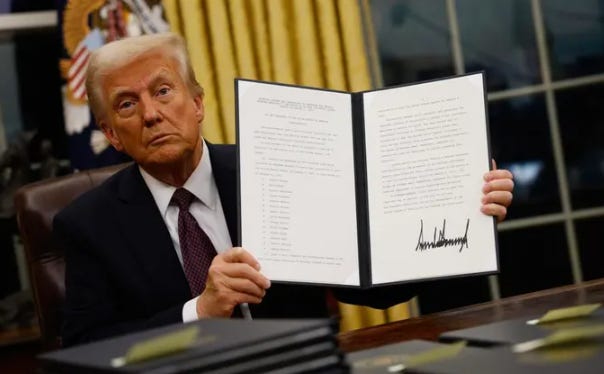
Since his inauguration, President Donald Trump has taken bold steps to position the United States as a leader in the cryptocurrency industry. One of his first actions was signing an executive order titled “Strengthening American Leadership in Digital Financial Technology,” aimed at fostering innovation while ensuring regulatory clarity in the crypto space. The order outlines protections for public blockchain networks, encourages the development of U.S. dollar-backed stablecoins, and explicitly prohibits the creation of a central bank digital currency (CBDC). To support this effort, a Presidential Task Force on Digital Asset Markets, led by venture capitalist David Sacks, has been established to draft regulatory proposals.

In addition to regulatory measures, President Trump has introduced a strategic initiative to create a national Bitcoin reserve. This plan involves the U.S. government accumulating Bitcoin, either through direct acquisitions or by utilizing cryptocurrency seized from criminal enterprises. The reserve is intended to strengthen the nation’s financial standing in a global economy increasingly influenced by digital assets.

Trump has also repeatedly called for the U.S. to embrace its role as the “crypto capital of the world,” emphasizing the importance of fostering innovation and providing a clear regulatory environment to attract investment and talent.

And now, the only question is whether or not this is an asset class that will actually serve a purpose over the long haul. As a result, will we just have to wait for the poor investments in the space to be flushed out—or, in the event that crypto turns out to be a big nothing—will we have to wait for the entire asset class to implode?

No matter which of these two scenarios occurs, I’m fairly certain one is going to take place. It’s only fitting that for a brand-new asset class, we have an unprecedented, brand-new market correction. I don’t think there has been an asset in the history of the world that hasn’t gotten out over its skis and eventually hit major turmoil. Everything from housing to metals to equities have crashed at some point, and crypto won’t be any different. The only question is to what extent, and when — and I’m not really interested in speculating enough to know, or care, when.

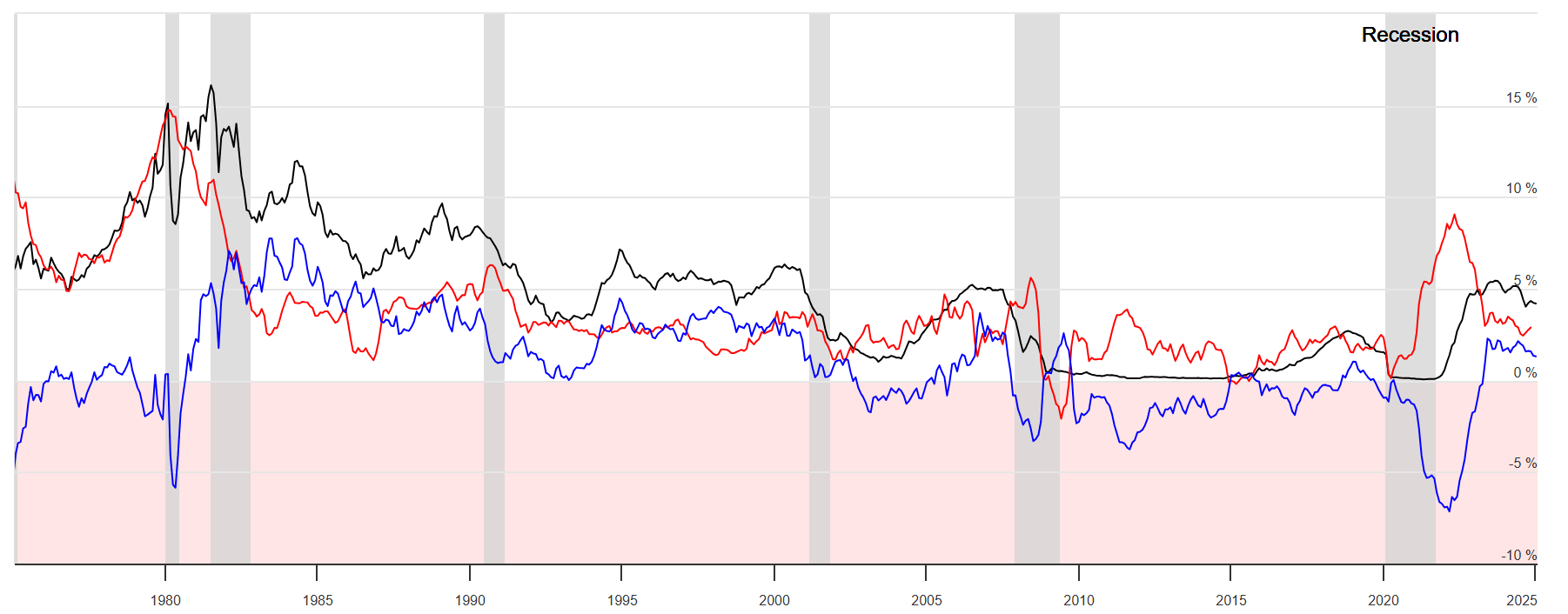
Here’s what I do know. My long-term readers know I believe it to be a mathematical certainty that the market is eventually going to grind to a halt at some point due to positive real interest rates.

Black: Nominal 1 year treasury, Red: Inflation rate (LTM), Blue: Real 1 year rate

Very slowly, these positive rates are slowing down the economy and will eventually grind its gears to a halt—the only question is how the stock market and prices will react. Stagflation seems to be the likely scenario heading forward, if I had to guess.

All the speculation around crypto—and equities—is complicated by the fact that President Trump now believes interest rates should be lower. Trump announced on Thursday plans to push for lower U.S. interest rates, challenging the Federal Reserve’s tradition of political independence. Speaking at the World Economic Forum, he linked the need for rate cuts to anticipated lower oil prices, which he said would ease inflationary pressures.

Whether or not he’s going to have an effect on the Fed’s Jerome Powell remains to be seen.

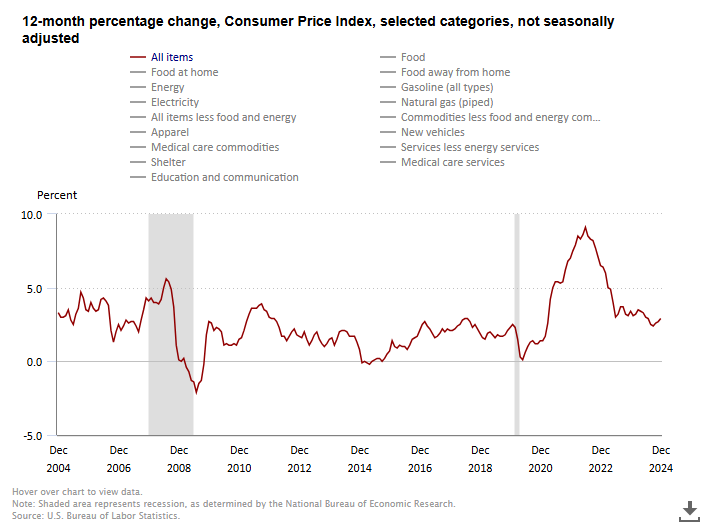
I think I understand his mindset, though: to blow the asset bubble bigger during his presidency and ensure that asset prices continue to rise under his watch. This is all good and well, except for the fact that the Federal Reserve is in an unprecedented position between a rock and a hard place. Inflation is still around 3%, not anywhere near the Fed’s 2% target, and lowering rates now would almost ensure that the Fed’s fight against rising prices will become more difficult. As you can see, inflation is once again ticking higher:

But as I’ve said for years, this was never a fight the Fed was going to win. I said a couple of years ago on Palisades Gold Radio that I was certain the Fed would have to settle for a higher inflation target, and I think that’s what’s going to happen. The result may prop up the nominal price of financial assets a little further, but sadly, cost of living will also stay high for working-class Americans. This is a serious step further toward the nation losing its creditworthiness and descending into a hyperinflationary spiral. It is letting the “inflation genie” out of the bottle further.

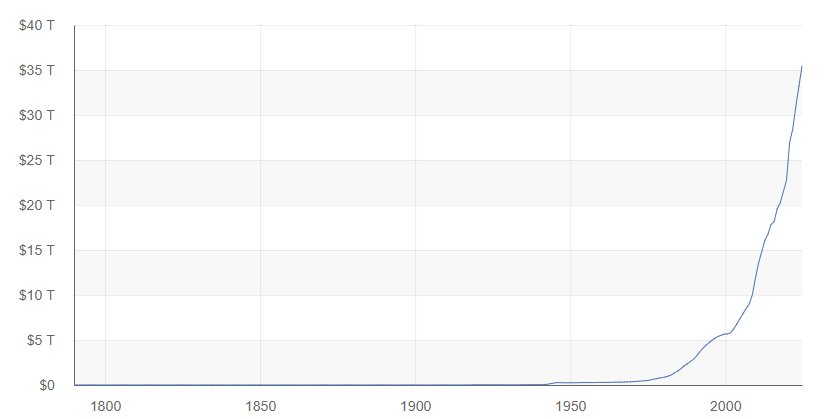
Gimmicks aside, nothing changes the fact that spending is going to need to be cut if we want to attack the national debt, as Trump says he wants to.

The only way crypto helps us attack the national debt is if we stake our claim in a bunch of bitcoin before many other global parties do the same and it becomes a good investment. Theoretically, other buyers in the market would then move the price higher, increasing the value of the bitcoin we’ve already acquired. At some point, we’d have to exit the investment (or use it as collateral) and use the gains to square up the debt—or at least part of it—if that’s what President Trump really wants to do.

Nobody is talking about the other scenario: what happens if other countries don’t follow our lead and decide the world is not going to adopt a bitcoin standard despite our attempts to lead the way? Then all we’ve done is make another bad investment.

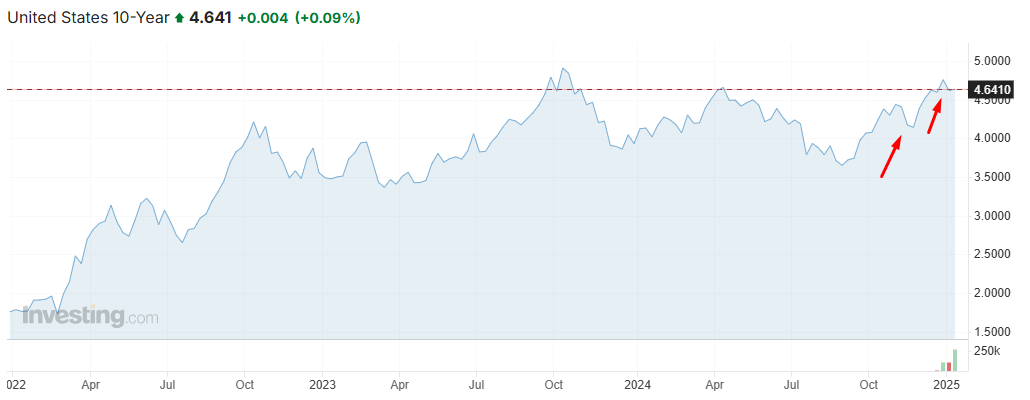
Meanwhile, the bond market continues to send signals that rates need to be higher, not lower.

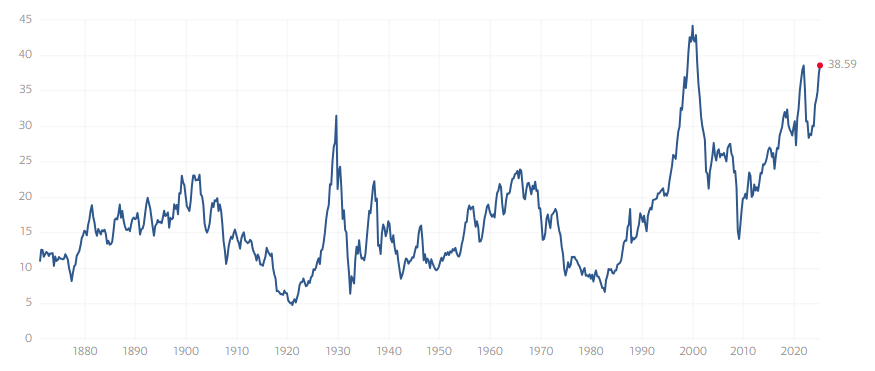
At the same time, equities are on a historic run, pushing valuations into territory only touched once before—during the tech bubble of 2000.

Shiller PE

If we continue along this trajectory, the market will soon be the most overvalued it has ever been in history. At some point, buying stocks will become a bet that they can continue to be the most aggressively valued they’ve ever been in the history of our stock market.

Look: eventually, this turns into a losing bet. I don’t know when, why, or how it will occur, but it will.


🔥 2025 SALE – 50% OFF FOR LIFE: Using this coupon entitles you to 50% off an annual subscription to Fringe Finance for life: Get 50% off forever


And make no mistake, we’re not treading cautiously toward the next market correction. We’re ramming the accelerator to the floor, redlining the engine, and taking on whatever comes next face-first, simply hoping that through some sort of financial alchemy, everything works itself out.

On the positive side, the new administration seems to be making progress with foreign relations, both with our allies and with adversaries of the last administration. Crucial to getting our financial trajectory on a steady path is achieving some type of homeostasis with the rest of the world. Even if it boils down to the United States needing to engineer some type of debt jubilee, we would need the rest of the world to buy in. If we only have our allies, the BRICS nations could call our bluff by labeling any debt restructuring or jubilee for what it really is: a default.

However, if we achieve buy-in from the other side of the global financial aisle, there’s a chance for four more years of perceived financial prosperity—and at least avoiding total chaos.

In summary:

  1. Trump is fighting the bond market (and the Fed) on interest rates

  2. Crypto and 0DTE equity options are the tail wagging the stock market dog

  3. Said dog is nearing all time highs for valuation

  4. Real rates have the economy’s balls in a slowly constricting vice grip

  5. Spending cuts need to happen to slow the national debt and return to surplus

  6. Modest gains are being made on the foreign policy front

What a f*cking mess. Be careful out there.

QTR’s Disclaimer: Please read my full legal disclaimer on my About page here. This post represents my opinions only. In addition, please understand I am an idiot and often get things wrong and lose money. I may own or transact in any names mentioned in this piece at any time without warning. Contributor posts and aggregated posts have been hand selected by me, have not been fact checked and are the opinions of their authors. They are either submitted to QTR by their author, reprinted under a Creative Commons license with my best effort to uphold what the license asks, or with the permission of the author.

This is not a recommendation to buy or sell any stocks or securities, just my opinions. I often lose money on positions I trade/invest in. I may add any name mentioned in this article and sell any name mentioned in this piece at any time, without further warning. None of this is a solicitation to buy or sell securities. I may or may not own names I write about and are watching. Sometimes I’m bullish without owning things, sometimes I’m bearish and do own things. Just assume my positions could be exactly the opposite of what you think they are just in case. If I’m long I could quickly be short and vice versa. I won’t update my positions. All positions can change immediately as soon as I publish this, with or without notice and at any point I can be long, short or neutral on any position. You are on your own. Do not make decisions based on my blog. I exist on the fringe. The publisher does not guarantee the accuracy or completeness of the information provided in this page. These are not the opinions of any of my employers, partners, or associates. I did my best to be honest about my disclosures but can’t guarantee I am right; I write these posts after a couple beers sometimes. I edit after my posts are published because I’m impatient and lazy, so if you see a typo, check back in a half hour. Also, I just straight up get shit wrong a lot. I mention it twice because it’s that important.


Tyler Durden
Sat, 01/25/2025 – 12:50

CBP One App Shutdown As Mass Deportations Of Illegal Aliens Begins

0
CBP One App Shutdown As Mass Deportations Of Illegal Aliens Begins

For four years the Biden Administration and Democrats flooded the US with tens-of-millions of illegal aliens from third-world nations.  And, for the majority of that time they gaslit the American people, lying consistently about the border crisis they created.  Not only did they enable and encourage illegal immigration through government subsidies and incentives, they streamlined the process with an online app. 

The administration also acted to sabotage any border state that tried to take matters into their own hands.  Texas, for example, faced lawsuits and interference from the National Guard because their border barriers were proving too effective.  Governor Greg Abbott managed to reduce border encounters in Texas by 70% despite Biden’s attempts at sabotage.  Biden would later try to claim credit for that reduction in illegal crossings.

Democrat controlled sanctuary cities worked in tandem with Biden to ensure that ICE agents would be unable to detain and deport migrants arrested or convicted of violent crimes.  This led to dangerous drug dealers, rapists and murderers wandering the streets despite having arrest records a mile long.  The leftists care more about “sticking it to conservatives” than keeping their communities safe from psychopaths.   

In a just world Joe Biden and his associates would all be thrown in prison today, but at least we have the pleasure of seeing the Democrats squirm as their agenda to saturate the US with illegals falls apart.

Donald Trump has wasted no time and the mass deportations of migrants have begun.  First and foremost, Trump has shut down the notorious CBP One app – This is the same app that Biden denied as being a factor in the surge of illegals applying for asylum.  In reality, the app was perhaps the single most important tool used by migrants to game the system and gain entry into the US.  Biden’s revamped app streamlined the process like people were ordering amnesty on Amazon. 

After the app was shut down, border agents reported encounters with illegals dropped by nearly 50%.  The establishment media has tried to paint the event as a travesty with tens of thousands of migrants stuck at the border.  What they don’t seem to understand is, this is exactly what the American public wanted to see.  No more easy access to the US. 

Trump is reportedly sending at least 10,000 US military personnel to secure the border.  All agencies involved have been given a free hand to arrest and deport illegals quickly and the “catch and release” policies of the Biden era are over. 

While the border situation is being rectified, ICE agents under the direction of “Iceman” Border Czar Tom Homan are now actively rounding up illegals already in the US, starting first with migrants that have criminal records and then working their way down to migrants that simply entered the US illegally.  Skeptics that claimed Trump wouldn’t follow through on his promise of mass deportations were wrong yet again, and the results so far have been glorious.

Tom Homan’s response to the criminal migrant who said he’s “not going back to Haiti”?

ICE agents report at least 500 arrests in their first day of operations.  What is shocking is how many of these illegal aliens were set loose by Democrats despite their nature of their criminal records.  Most are gang members, or they have committed sexual assaults and murders.  Any illegals in the vicinity during these arrests are also being detained and deported.  No criminal record is necessary; eventually they are all going away.

The positive effects the deportations will have on the US are too many to count.  Reduced crime is a given, but there is also the collateral benefit of less people taking up American homes and driving up housing prices.  Not to mention, less migrant workers driving down wages and taking jobs from US citizens.  To be sure, the Trump Administration has a long way to go to reverse the damage already done by Democrats, but with border laws finally being implemented there is a good chance that most illegals will self deport rather than wait around to be arrested.   

Tyler Durden
Sat, 01/25/2025 – 11:05

Trump 2.0 & The “Sanctions Industrial Complex”

0
Trump 2.0 & The “Sanctions Industrial Complex”

Authored by Hekmat Aboukhater via The Mises Institute,

As the Washington drawbridge lowers for a second Trump administration, the world attempts to glean any insights that might indicate the direction of his second term. At the top of the list of concerns is the topic of sanctions.

As of 2024, the US is actively sanctioning a third of all nations on earth. As the American populace grew more wary of military entanglements and forever wars, consecutive administrations have exponentially escalated the use of the economic weapon. The Obama administration averaged a total of 500 new sanctions a year, while the first Trump administration doubled it to 1,000 a year, and the Biden administration sextupled the figure—imposing more than 12,000 sanctions in 4 years. Now, many wonder whether a second Trump admin will continue or curb this trend.

US Sanctions: Past and Present

Leading a nascent nation, Thomas Jefferson pushed the US congress to pass the Embargo Act of 1807 to punish the United Kingdom for harassing US ships, and impressing American sailors. A century later, shortly after the conclusion of the first world war—in his failed attempt to whip up support for the League of Nations—Woodrow Wilson advocated for its ability to sanction intransigent global actors by stating, “A nation that is boycotted is a nation that is in sight of surrender.” However, the unilateral coercive measures—or financial sanctions, as we know them in the modern era—trace to a much more recent origin.

The story of modern-day sanctions starts—as with many of our modern American experiences—with the USA Patriot Act of 2001. Title III of the act—concerned with money laundering used for the financing of terrorist organizations—gave the Treasury Department a swath of options to dig into the links between domestic and international financial institutions. Borne out of this new mandate, the Office of Foreign Assets Control (OFAC), got its first win by severing BDA Bank—a Macau-based bank that was suspected of facilitating North Korean money laundering operations—from the global financial market. The office was able to destroy the bank’s operations with a simple notice of incoming sanctions.

Today, the list of sanctioned nations includes Cuba, Iran, North Korea, Russia, Syria, Afghanistan, Balkans, Belarus, Myanmar, Central African Republic, the DRC, Ethiopia, Hong Kong, Iraq, Lebanon, Libya, Mali, Nicaragua, Somalia, South Sudan, Sudan, Venezuela, and Yemen among others.

While some are targeted against specific entities or persons, many sanctions indiscriminately target broad sectors of a nation’s economy. Such is the case in Russia, Venezuela, and Iran. Similarly, while some sanctions target heads of states and specific government individuals, others like the ones imposed on Syria target any and all government ministers regardless of complicity in any given crime.

As for their merit, sanctions have rarely, if ever, achieved their stated aims. Cuba and Venezuela remain socialist and Bolivarian socialist regimes; Iran and North Korea have yet to denuclearize; and the Syrian and Yemeni regimes have not yet been ejected from or willingly abdicated power. The sanctions have, however, succeeded in three alternative ways.

Sanctions have become a convenient tool to destroy the middle classes of targeted countries. Venezuela, Syria, and Iran were hit by inflation rates so high that they decimated savings and brought an end to the possibility of upward mobility within the respective civil societies. Sanctions have also successfully entrenched authoritarian leaders by giving them a convenient enemy, in the form of American imperialism, to hide from their populace behind. Finally, sanctions have succeeded in draining American good will, cultural prowess, and diplomatic soft power for billions across the globe.

Other than being felt in the empty stomachs of children across the developing world, the sanctions boom has also brought about policy and financial reverberations closer to home. A new Washington behemoth has sprung up over the last two decades. The Sanctions Industrial Complex—a collective of law firms specialized in sanctions, lobbyist firms rife with revolving door appointees from the treasury department, and consultancies offering solutions in compliance has metastasized in the Washington Beltway.

Mixed Signals from Trump 2.0

Trump is partially responsible for the sprawl of the complex. He famously levied unprecedented sanctions against Russia, targeted the Nord Stream 2 Pipeline, enacted the CAESAR Act of 2019 against Syria, and imposed a whole swath of additional sanctions against the Venezuelan Maduro government in 2017.

Trump has also tapped Mike Walz as his National Security Advisor nominee. Early November, Walz stated that Trump’s plan to end the Ukraine war should consist of “intensifying sanctions against Russia” and “taking the handcuffs off,” implying that the Biden administration’s support of Ukraine has been in some way restrained.

Trump also picked Marco Rubio as his Secretary of State nominee. Rubio is an avowed neocon who has yet to see a sanctions bill he didn’t approve of. He is deeply committed to imposing continued sanctions regimes on Cuba and Venezuela. Rubio also famously lamented Brazil and China’s deal to settle trade deals in Reals and Yuans stating that “they are creating a secondary economy totally independent of the United States…there will be so many countries transacting in currencies other than the dollar that we won’t have the ability to sanction them.”

Yet, Trump has also tapped Tulsi Gabbard as his Director of National Intelligence. Tulsi has been derided by the Clinton establishment, and its mouthpieces like Nikki Haley, for prioritizing diplomacy and advocating against the use of economic sanctions. One of her last acts as a Democratic congresswoman was a bill that would prohibit taxpayer funds or government resources from being used to enact sanctions that inflict suffering on civilian populations anywhere in the world.

As for Trump himself, he is showing an inclination away from the use of the coercive tool in his second term. While fielding questions at the Economic Club of New York in September, he stated that, “the problem…with sanctions is that it ultimately kills your dollar. It has to continue being the world currency.” He added that he “used sanctions but took them off quickly… China is trying to get their currency to be the dominant currency.” He concluded by stating that he wants to use sanctions “as little as possible.”

Cautious Optimism

Trump’s remarks provide solid grounds for optimism among those who consider sanctions as illegitimate and illegal tools of warfare. His statement indicates his understanding that economic engagement with adversaries is ultimately more beneficial for long term US interests than economic coercion.

Yet, the system of sanctions is not one that can be reformed overnight. A mere cessation of the imposition of new sanctions won’t go far. Sanctions, secondary sanctions, and asset seizures are pervasively in use by Washington’s empire. Adam Szubin, the former director of OFAC, in a Christmas office karaoke party, sang “every little thing we do is sanctions” to the tune of the Police’s “Every Little Thing She Does is Magic.” The consensus in Washington is deeply in favor of sanctions. And, with sanctions seen by Washington as the happy medium between tax-funded drone strikes and tomahawks and empty diplomatic condemnations, that consensus has ossified over time.

A second Trump administration could remedy this by taking a proactive approach and providing further transparency regarding the sunsets of previously established sanctions regimes. Similarly, he could lower the compliance threshold for sanctioned entities and third parties potentially in danger of falling foul to secondary sanctions.

Ultimately, whether Trump pulls the reins on this novel complex, as of now, remains a decision purely for Washington. However, with a nascent China trying its hand in the practice by sanctioning the US, the Japanese, and even NBA officials, and other economic players like Saudi Arabia dabbling with the tool, our exclusivity in precedent-setting won’t last for long.

Tyler Durden
Sat, 01/25/2025 – 10:30

Hegseth Confirmed As Defense Secretary After VP Vance Casts Tie-Breaking Vote

0
Hegseth Confirmed As Defense Secretary After VP Vance Casts Tie-Breaking Vote

Vice President J.D. Vance cast a tie-breaking vote in the Senate on Friday night to confirm Pete Hegseth as President Trump’s Secretary of Defense. This marks only the second time in U.S. history that a vice president’s vote was required to confirm a Cabinet official.

VP Vance cast the 51-50 tie-breaking vote to confirm Hegseth late Friday night after three Republicans, Sens. Lisa Murkowski (Alaska), Susan Collins (Maine), and Mitch McConnell (Kentucky), joined Democrats and independents in opposing the Princeton- and Harvard-educated former combat veteran and former Fox News host.

“I thought I was done voting in the Senate,” the vice president wrote on X.

On Truth Social, President Trump congratulated Hegseth shortly after his confirmation: “Congratulations to Pete Hegseth. He will make a great Secretary of Defense!” 

There has been a lot of controversy surrounding Hegseth’s nomination and attempts by the Deep State to derail it:

Why the pushback? Hegseth has expressed an urgent need to restore lethality to a military he described as “woke” due to toxic diversity, equity, and inclusion programs. He has pledged to reinstate meritocracy in the armed forces, arguing that Marxist-inspired DEI initiatives are undermining national security. 

He has recently criticized woke senior Pentagon leaders and the Deep State on the Shawn Ryan Show: “First of all, you got to fire the chairman of the Joint Chiefs. Any general that was involved, general, admiral, whatever, that was involved in any of the DEI woke s*** has got to go.” 

Hegseth’s confirmation paves the way for his planned elimination of Marxist-inspired DEI initiatives in the military. This is all part of a broader strategy by Trump:

The great purge has begun:

There is no need for Marxist DEI leadership to undermine the nation at a time when the world has dangerously crept closer and closer to the next major conflict. Russia and China aren’t undermining their militaries with wokeism.  

Next week, senators will face Trump’s other Cabinet nominations, including Kash Patel for FBI head, Tulsi Gabbard for Office of National Intelligence, and Robert F. Kennedy Jr. for Health and Human Services.

Tyler Durden
Sat, 01/25/2025 – 09:55

Silk Road Founder Ross Ulbricht Thanks Trump For Full Pardon

0
Silk Road Founder Ross Ulbricht Thanks Trump For Full Pardon

Authored by Mehab Qureshi via CoinTelegraph.com,

Silk Road founder Ross Ulbricht, who had been serving a double life sentence without parole, publicly thanked US President Donald Trump after receiving a full pardon. 

This marked the first time Ulbricht had spoken publicly since being released from a maximum-security prison in Arizona, where he was held for more than 11 years.

“Last night, Donald Trump granted me a full pardon. I was doing life without parole, and I was locked up for more than 11 years. But he let me out. I’m a free man now. So let it be known that Donald Trump is a man of his word,” Ulbricht said in a video shared on X on Jan. 23.

Ulbricht expressed gratitude, calling the pardon “an amazing blessing.” He added: 

“Thank you so much, President Trump, for giving me this amazing blessing. I am so, so grateful to have my life back, to have my future back, to have this second chance. This is such an important moment for me and for my whole family.”

Since his release, a page dedicated to supporting Ulbricht on X, Free_Ross, shared:

“Thanks to Donald Trump’s pardon, Ross got to hug his wife, mom, dad & sister outside the walls of prison. The past 36 hours have been a complete whirlwind and we keep pinching ourselves to make sure we’re not dreaming.”

Source: Free_Ross

Life after prison

Ulbricht, 40, was convicted in 2015 for his role in creating and operating Silk Road, a darknet marketplace that facilitated the anonymous trade of illicit goods using Bitcoin.

Since the pardon, supporters have rallied to help him transition into life outside prison. A wallet linked to the Free Ross campaign has received over $270,000 in Bitcoin donations. Among the contributors is the crypto exchange Kraken, which donated $111,111. Other donations included $2,400 in Ether, $900 in Solana, $200 in Cardano, and smaller amounts in BNB and Dogecoin.

“It feels amazing to be free, to say the least,” Ulbricht said, adding that he plans to spend time with his family and heal from his years of incarceration. “This is a victory […] for everybody everywhere who loves freedom and who cares about second chances.”

Millions in dormant Bitcoin wallets

While supporters have donated generously, Ulbricht may already have millions of dollars in Bitcoin.

Conor Grogan, a director at Coinbase, revealed that 430 BTC worth about $47 million remain untouched in wallets likely linked to Ulbricht. These wallets, dormant for more than 13 years, were not confiscated by authorities.

“I found ~430 BTC across dozens of wallets associated with Ross Ulbricht that were not confiscated by the [US government] and have been untouched for 13+ years,” Grogan posted on X.

Arkham Intelligence corroborated Grogan’s findings, identifying 14 Bitcoin addresses linked to Silk Road, including one wallet containing over $9 million in BTC.

Tyler Durden
Sat, 01/25/2025 – 09:20