61.8 F
Chicago
Monday, October 5, 2026
Home Blog Page 1929

Futures Fall As Jittery Traders Take Cover Ahead Of Payrolls

0
Futures Fall As Jittery Traders Take Cover Ahead Of Payrolls

US equity futures are lower as traders took a cautious stance ahead of US jobs data that will offer fresh insight on the state of the economy. As of 8:00am, S&P 500 and Nasdaq 100 futures fell 0.2%, while in China stocks pushed toward a fresh bear market. Europe’s Stoxx 600 was little changed. Bond yields are largely unchanged, with the 10Y trading at 4.69%; while the week’s broad pullback in European government bonds persisted, pushing the yield on 10-year gilts remaining stuck near the highest level since 2008. Commodities are higher led by 2.3% gain in oil and 1.6% gain in aluminum. All eyes on NFP release today as equities continue to weigh on bond markets reaction. Consensus expects 165k jobs being added, with the unemployment rate unchanged at 4.2% (average hourly earnings are expected to rise +0.3% MoM and +4.0% YoY). In addition, Q4 earnings will begin today with DAL, STZ and WBA all reporting today. We will also receive the decision on TikTok’s SCOTUS hearing. Power utility Edison International and major US insurers slid in premarket trading as estimates of wildfire-related damages in Los Angeles soared.

In premarket trading, magnificent seven are trading modestly lower: Apple (AAPL) -0.2%, Nvidia (NVDA) -1%, Microsoft (MSFT) -0.1%, Alphabet (GOOGL) -0.3%, Amazon (AMZN) -0.3%, Meta Platforms (META) -0.4% and Tesla (TSLA) +0.1%. Allstate (ALL) falls 5%, down with insurance stocks, as analyst estimates of potential damages tied to the LA wild fires soar. Travelers (TRV) -4%, AIG (AIG) -3%. Southern California utility firm Edison International (EIX) slips 2% as the company is asked to preserve evidence in connection with the fires. Constellation Energy (CEG) climbs 6% after agreeing to acquire closely held Calpine Corp. for $16.4 billion to add scores of power generation assets across the US as the nation’s electricity demand is forecast to surge. Here are some more premarket movers:

  • Delta Air Lines (DAL) rises 6% after beating Wall Street’s profit estimates for the final months of 2024, buoyed by gains in international and corporate travel.
  • IGM Biosciences (IGMS) slumps 67% after the biotech halted the development of its Imvotamab and IGM-2644 treatments for autoimmune diseases.
  • Joby Aviation (JOBY) slips 6% and Archer Aviation (ACHR) falls 3% as JPMorgan cut its rating on the pair, saying eVTOL stocks have been vastly outperforming the broader market.
  • Microvast (MVST) rises 34% after announcing a milestone in the development of its true all-solid-state battery.
  • Walgreens Boots Alliance (WBA) rises 11% after posting quarterly results that surpassed Wall Street’s expectations, easing pressure on the pharmacy chain as it mulls strategic options, including a sale.

Friday’s US nonfarm payrolls data is expected to show a slowdown in hiring (full preview here). Median estimates for the figures forecast that 165,000 jobs were added to the economy in December, which would mark a step down from November’s 227,000 advance, although the whisper number is at 183,000 while economists see a gain of 165,000. The unemployment rate is forecast to hold steady at 4.2% and average hourly earnings growth is seen cooling a touch from a month earlier.

“Given how quickly the Fed hawks have gained ground in recent weeks — and how much more investors are excited by dovish signals — the market’s reaction to soft data could outweigh its response to strong figures,” said Ipek Ozkardeskaya, senior analyst at Swissquote Bank.

Several Fed officials confirmed Thursday that the central bank will likely hold rates at current levels for an extended period and only cut when inflation meaningfully cools.

“The Fed is worried about the incoming administration,” Skyler Weinand, chief investment officer for Regan Capital, said on Bloomberg Television. The combination of the growing US fiscal deficit and a strong consumer could result in “higher interest rates for the next five to ten years,” he said.

A hectic week for UK assets is coming to an end with the pound close to its weakest since late 2023, falling 0.1% to $1.2291. UK 10- and 30-year bond yields jumped more than 20 basis points over the past five sessions, the most in a year. Concerns over the state of the UK’s stretched public finances combined with persistent inflation have fueled the week’s selloff and drew comparisons with a market meltdown two years ago that toppled Liz Truss’ administration.

European stocks are little changed, with utilities and retail stocks dropping the most while energy and auto stocks outperform. Here are the biggest movers Friday:

  • Novo Nordisk shares climb as much as 1.1% after Goldman Sachs and Deutsche Bank analysts reaffirm their buy ratings on the stock — though trim their price targets following last month’s disappointing trial results
  • Ambu shares rise as much as 18%, the most since February 2023, after the Danish medical equipment company reported better-than-expected preliminary revenue for the first quarter and boosted its outlook for the year
  • Deutsche Telekom rises as much as 2.1% as UBS upgrades the stock to buy in a sector review  on account of its defensive qualities related to US expsure, calls recent pull-back a “buying opportunity”
  • Clarkson shares rise as much as 9.3%, the most since November, after the shipping company said its annual results for 2024 will be slightly ahead of current market expectations
  • Alliance Pharma shares rise as much as 39% after the consumer health care firm agrees to be bought by its largest shareholder in a deal valuing it at about £349.7 million
  • E.ON falls as much as 3.6%, to the lowest level since October 2023, after BofA cut the stock to neutral from buy, saying December’s adverse court ruling in Germany undermined the potential for growth upgrades
  • Traton shares fall as much as 6.4% in Frankfurt. Jefferies and BNP Paribas Exane analysts write that the German truckmaker hosted a pre-close call on Thursday
  • Sainsbury shares drop as much as 2.8% after the supermarket chain reported third-quarter results. While analysts viewed the company’s grocery performance as solid, Citi noted that general merchandise was disappointing
  • Ubisoft shares slide as much as 11% to the lowest levels since October, after the French video-game maker reduced guidance for fiscal 3Q net bookings, citing lower-than-expected sales from Star Wars Outlaws
  • Serco shares drop as much as 3.1% after Jefferies downgrades the outsourcing services firm that is facing headwinds from immigration contracts and UK national insurance, with earnings momentum muted

Earlier in the session, Asian stocks headed for a weekly loss as cautious sentiment took hold with traders mulling the prospect of slower interest rate cuts by the Federal Reserve. Chinese shares were set for a bear market. The MSCI Asia Pacific Index dropped as much as 0.9%, with Fast Retailing among the biggest drags after results from the Japanese fashion retailer raised concern over a slowdown in its China business. Benchmarks in China and Japan led declines in the region. The MSCI China Index fell more than 1%, extending its decline from an October high to around 20%, as investors continued to stay on alert for the nation’s mounting deflationary pressure as well as external risks. “This year will actually be a pivotal year for stress testing China’s policy commitments,” Christy Tan, an investment strategist at Franklin Templeton said in a Bloomberg TV interview. At the same time, there are external headwinds ranging from potential risks of tariffs and sanctions on tech firms, which “set the stage for a lot more volatility.” Elsewhere, sentiment was cautious as Treasury yields rose further amid a dialing back of bets on the Fed’s monetary easing this year. A slowdown in Chinese growth and rising geopolitical risks are also keeping a lid on sentiment. The regional stock benchmark was set for an almost 2% drop this week.

In FX, the Bloomberg Dollar Spot Index hovered near the highest level in over two years, while the broader FX market traded in a tight range. The yen is the best performing G-10 currency, rising 0.2% against the greenback after a report that said the Bank of Japan is likely to discuss raising their inflation outlook. The kiwi dollar is the weakest, falling 0.4%.  “Given the persistent strength of the USD lately, and heavy long positioning, I think the NFP’s impact will be asymmetric,” said Alvin T Tan, head of Asia FX strategy at RBC Capital Markets. “We will likely get a bigger downside reaction to weak US employment data than an upside reaction to strong data.”

In rates, treasuries held small losses in early US trading, trailing steeper declines in most European bond markets as crude oil holds a weather-related surge to three-month highs. US yields remain inside weekly ranges ahead of US December jobs report release at 8:30am New York time.  Front-end Treasury yields are higher by ~2bp with longer maturities little changed on the day, flattening the yield curve; 2s10s spread reached widest level since 2022 this week; 10-year is little changed around 4.695% with bunds and gilts in the sector cheaper by 1bp and 2bp.  UK government bond yields rose although not with the same velocity observed earlier this week and are still some distance below Thursday’s extremes –  30-year borrowing costs climb 2 bps to 5.40% having topped 5.47% at yesterday’s open. The pound also steadies around $1.23.

In commodities, oil rose to a three-month high after another contraction in US crude stockpiles, driven by frigid winter weather, reflected a tighter global market and helped push WTI crude oil as much as 3.8% higher.

On today’s economic calendar we get the December jobs report (8:30am) and January preliminary University of Michigan sentiment (10am). The Fed speaker slate includes Goolsbee at 10:04am, appearing on CNBC.

Market Snapshot

  • S&P 500 futures down 0.3% to 5,940.25
  • STOXX Europe 600 down 0.1% to 515.15
  • MXAP down 0.8% to 177.97
  • MXAPJ down 0.8% to 560.31
  • Nikkei down 1.0% to 39,190.40
  • Topix down 0.8% to 2,714.12
  • Hang Seng Index down 0.9% to 19,064.29
  • Shanghai Composite down 1.3% to 3,168.52
  • Sensex down 0.4% to 77,291.45
  • Australia S&P/ASX 200 down 0.4% to 8,294.07
  • Kospi down 0.2% to 2,515.78
  • German 10Y yield little changed at 2.59%
  • Euro little changed at $1.0301
  • Brent Futures up 2.1% to $78.56/bbl
  • Gold spot up 0.5% to $2,680.31
  • US Dollar Index little changed at 109.14

Top Overnight News

  • US President Biden said the federal government will cover 100% of the disaster response costs for 180 days for California and noted that three major fires are still burning, while he added Congress will have to step up when they ask for more help on LA fires and that they will go back to Congress for more help on this.
  • President-elect Donald Trump has pushed back his campaign pledge to end the war in Ukraine “24 hours” to several months, in a shift European partners have interpreted as a sign that his administration will not immediately abandon support for Kyiv. FT
  • Kremlin says a meeting with Russian President Putin and US President-Elect Trump is being set up; no details yet.
  • The PBOC will suspend buying government bonds, its latest attempt to temper investor bets on weak economic growth that have undermined the currency and sapped confidence among businesses and consumers. BBG
  • China will adopt a proactive fiscal policy and speed up the implementation of pro-growth measures, Vice Finance Minister Liao Min said. BBG
  • BOJ policymakers will probably discuss raising their inflation outlook at their meeting later this month, people familiar said. That’s mainly due to surging rice prices and the depreciation of the yen since the last outlook report in October. BBG
  • The ECB is considering pushing banks to use loan data from the region’s historic banking crisis when predicting future credit defaults, which may result in lower capital strength for some lenders. BBG
  • Fed’s Bowman said the December rate cut should be the final one for the cycle as policy is near neutral while the disinflationary process seems to have stalled. NBC. Fed’s Schmid said the current policy rate is “near” neutral, signaling a reluctance to ease further. RTRS
  • Scott Bessent’s confirmation hearing (scheduled for Thurs 1/16) will be a critical event for Treasuries as Trump’s Treasury Sec nominee is asked on the spending, tax, and tariff plans of the incoming administration. Politico
  • December Payrolls Preview: Goldman estimates nonfarm payrolls rose by 125k in December, below consensus of +165k and the three-month average of +173k. Alternative measures of employment growth generally indicated a sequentially slower pace of job creation, and seasonal headwinds amount to roughly 50k. Goldman
  • Apollo may take a $9.5 billion stake in the planned management buyout of Seven & i, people familiar said. The firm would join the Ito family and Itochu as key investors in what would be one of the largest buyouts on record, with total equity of ¥4 trillion ($25 billion). Seven & i shares rose. BBG

A more detailed look at global markets courtesy of Newsquawk

APAC stocks were mostly subdued in the absence of a lead from Wall St owing to the National Day of Mourning and as participants braced for US jobs data. ASX 200 was dragged lower by weakness in financials and consumer stocks, while Australian Household Spending data disappointed. Nikkei 225 retreated with heavy losses seen in index heavyweight Fast Retailing, despite a jump in Q1 profit, as its China operations suffered a decline in revenue and a sharp contraction in profits, while the better-than-expected Household Spending from Japan did little to spur risk appetite. Hang Seng and Shanghai Comp conformed to the downbeat mood but with further downside stemmed after the announcement that the PBoC and China’s FX regulator will hold a briefing on financial support for the economy on January 14th, while heavy losses were seen in property developer Sunac China after it received a liquidation petition in Hong Kong.

Top Asian News

  • BoJ said to be mulling the rate decision for January, according to Bloomberg sources; mulls upgrading core-core inflation forecasts for FY24 and FY25; said to be mulling raising inflation forecast amid JPY; no decision made on raising rates. Intends to wait until the very last moment before deciding on increasing rates.
  • Chinese Finance Ministry official says will firmly ban new hidden debt and speed up the reform and transformation of LGFVs. Will extend policies of reducing social insurance rates and one-off employment subsidies for some people in 2025. Will roll out new measures to boost employment in sectors including culture, tourism and foreign trade.
  • PBoC is to temporarily suspend purchases of government bonds in the market during January and may resume government bond trading depending on supply and demand, while the decision was made due to short supply of treasury bonds.
  • China’s Vice Finance Minister says can expect more proactive fiscal policy in 2025, in terms of its strength, efficiency, and timing. Adds, fiscal policy has abundant policy room and tools. Will speed up fiscal spending in a bid to formulate actual spending and drive up more social investment. In front of new conditions and problems both domestically and externally, fiscal policy has abundant policy room and tools. Has relatively big room for the raising of debt and the deficit. To step up coordinated efforts between fiscal and monetary policy in 2025.
  • Chinese economist warned against aggressive easing bets and said should avoid over-interpretation of moderately loose monetary policy in China, according to PBoC-backed Financial News.

European bourses opened with a slight negative bias, continuing the mostly subdued mood in APAC trade overnight. Since, trade has been choppy, briefly climbing into positive territory before once again dipping lower. European sectors hold a slight negative bias, and with the breadth of the market fairly narrow. Basic Resources tops the pile, propped by the continued strength in metals prices. Telecoms follows behind, with Media completing the top 3. Retail is underperforming today, hampered by post-earning losses in Sainsbury’s.

Top European News

  • UK Chancellor Reeves is, according to The Times, planning a significant speech on growth in January and has asked ministers to draft concrete measures to bolster activity and to “cease anti-growth measures”.

FX

  • USD is broadly steady vs. peers after advances in the JPY dragged DXY lower (see JPY section for details). Attention today is on the December US jobs report which is expected to see a slowdown in jobs growth to 160k from 227k and the unemployment rate hold steady at 4.2%. For now, DXY is tucked within yesterday’s 108.94-109.37 range with focus to the upside on the current YTD peak at 109.57.
  • EUR is flat vs. the USD with fresh EZ-specific drivers on the light side and a 25bps rate cut by the ECB later this month near-enough fully priced by the market. EUR/USD has pivoted around the 1.03 mark in early trade in a 1.0282-1.0311 range.
  • JPY the best performer across the majors following source reporting via Bloomberg suggesting that the BoJ is still mulling its rate decision for January and is mulling raising its inflation forecasts on account of JPY softening. As it stands, odds of a 25bps hike for the 24th January meeting are seen as a near coin-flip. The source reporting knocked USD/JPY back below the 158 mark with a current session trough at 157.63 which is just a touch above yesterday’s 157.57 base.
  • GBP is unable to launch much of a recovery vs. the USD as traders remain wary over the UK’s fiscal position and recent rise in yields. On which, reporting via The Times suggests that UK Chancellor Reeves is planning a significant speech on growth in January and has asked ministers to draft concrete measures to bolster activity and to “cease anti-growth measures”; details remain light at this stage. For now, Cable has stabilised above yesterday’s 1.2239 low.
  • Antipodeans are both at the foot of the G10 leaderboard. AUD/USD failed to capitalise on the upside overnight triggered by news that the PBoC is to temporarily halt bond purchases and has returned to a 0.61 handle but is thus far managing to hold above yesterday’s 0.6171 base which was the lowest level since October 2022.
  • CAD is a touch softer vs. the Greenback in the run up to the Canadian and US labour market reports. For now, USD/CAD sits just above the 1.44 mark with focus on the 2024, multi-year peak at 1.4467.
  • PBoC set USD/CNY mid-point at 7.1891 vs exp. 7.3138 (prev. 7.1886).

Fixed Income

  • USTs are softer, but lifting back towards the unchanged mark as the European risk tone deteriorates a touch. The benchmark came under modest pressure on the BoJ sources (see JGB section) this morning but otherwise action has been relatively minimal thus far as participants return from the Federal Holiday; in a slim 108-02+ to 108-09 band. The main event today is December’s jobs report, where the pace of payroll growth is seen easing for the month.
  • JGBs are softer, hit by a Bloomberg sources piece that the BoJ is said to be considering increasing the inflation forecast for FY25 and intends to wait until the very last moment before deciding on increasing rates. An article which weighed on fixed generally and pushed JGBs below the 141.00 handle to a 140.84 session trough.
  • Gilts gapped lower by 28 ticks and then slipped a touch further to an 89.53 base and has remained in proximity to the trough since. While pressured, the benchmark is comfortably above Thursday’s 89.00 contract low but significantly shy of the 92.02 open from Monday.
  • Bunds are in the red, with general fixed price action. Though, as the European risk tone deteriorates, EGBs have lifted off lows with Bunds attempting to return to the upper-end of a 131.07-131.37 band.
  • OATs are the relative EGBs outperformer after a Politico piece on Thursday around potential pension reforms as a way of getting support from left-wing parties.

Commodities

  • Overall, an upbeat Friday thus far for the crude oil complex on the back of some jawboning from China in early hours coupled with geopolitical updates. Significant upside was seen following reports that Israeli Defence Minister Katz said he has ordered the IDF to present him with a plan “for the complete defeat of Hamas in Gaza,”. Brent Mar sits at the upper end of a USD 77.03-78.65/bbl.
  • Firm trade across precious metals but to varying degrees. Palladium outperforms alongside a strong performance in the Auto stocks, whilst gold and silver are underpinned by the softer Dollar and recent geopolitical updates.
  • The base metal complex hold an upward bias amid broader strength in industrial commodities following commentary from China ahead of next week’s GDP release. 3M LME copper found resistance at USD 9,150.00/t to trade in a current USD 9,098.50-9,150.00/t parameter.
  • Shanghai Warehouse Stocks: Aluminium -11.07k/T (prev. -7.9k/T), via the exchange.
  • India’s Gas Exchange exec. says they intend to launch 3-6month gas contracts.
  • Slovakian PM Fico says Russian President Putin guaranteed Russia will meet its gas supply commitments. Says he spoke to Russian President Putin about the gas contract which Gazprom must deliver gas to Slovakia; says some Russian gas can be delivered through the southern corridor.

Geopolitics: Middle East

  • Israeli Defence Minister Katz says he has ordered the IDF to present him with a plan “for the complete defeat of Hamas in Gaza,” if there is no hostage deal by the time incoming US president Trump takes office (Jan 20th), according to ToI journalist.
  • US President Biden said they are making progress on a Gaza deal and he is still hopeful there will be a prisoner exchange.

Geopolitics: Russia-Ukraine

  • US President-elect Trump said Russian President Putin wants to meet and ‘we’ are setting it up.
  • Japan is to impose additional sanctions against Russia-related individuals and entities.
  • French President Macron said he and UK PM Starmer reaffirmed commitment to supporting Ukraine, while they also discussed the situation in the Middle East and the UK-EU relationship.

Geopolitics: Other

  • Venezuelan opposition leader Maria Corina Machado was arrested after leaving a march in her first public appearance in months but was later freed after a brief detention, while a White House spokesperson said the US calls for the right of Venezuela’s Machado to speak freely and for President Maduro and representatives to cease harassment of the opposition.

US Event Calendar

  • 08:30: Dec. Change in Nonfarm Payrolls, est. 165,000, prior 227,000
    • Dec. Change in Manufact. Payrolls, est. 5,000, prior 22,000
    • Dec. Change in Private Payrolls, est. 140,000, prior 194,000
    • Dec. Unemployment Rate, est. 4.2%, prior 4.2%
    • Dec. Labor Force Participation Rate, est. 62.5%, prior 62.5%
    • Dec. Underemployment Rate, prior 7.8%
    • Dec. Average Weekly Hours All Emplo, est. 34.3, prior 34.3
    • Dec. Average Hourly Earnings YoY, est. 4.0%, prior 4.0%
    • Dec. Average Hourly Earnings MoM, est. 0.3%, prior 0.4%
  • 10:00: Jan. U. of Mich. Sentiment, est. 74.0, prior 74.0
    • Jan. U. of Mich. 1 Yr Inflation, est. 2.8%, prior 2.8%
    • Jan. U. of Mich. 5-10 Yr Inflation, est. 3.0%, prior 3.0%
    • Jan. U. of Mich. Current Conditions, est. 75.1, prior 75.1
    • Jan. U. of Mich. Expectations, est. 72.7, prior 73.3

DB’s Jim Reid concludes the overnight wrap

The global bond selloff showed few signs of letting up over the last 24 hours, with long-term borrowing costs continuing to move higher across the board. The UK was particularly in the spotlight, as its 10yr gilt yield (+1.5bps) hit another post-2008 high of 4.81%, whilst the 30yr yield (+2.2bps) hit a post-1998 high of 5.37%. But even though the UK might appear the most striking in terms of when yields last traded at these levels, other countries have experienced a similar pattern too. For instance, the French 10yr yield hit its highest since October 2023, whilst the German 10yr bund yield hit its highest since July. In the meantime, US Treasuries showed some signs of stabilising, but even there the 10yr yield is still at 4.69% this morning, on track to close at its highest level since April, and Japan’s 10yr yield is at its highest since 2011.

That focus on the UK was clear from several angles, as the pound sterling fell to its weakest level against the US Dollar since November 2023, at $1.2308. That made it the worst-performing G10 currency for a second day running, and that closing value was actually a recovery from the morning, when it fell as low as $1.2239. What makes the current situation particularly noteworthy is that higher interest rates normally help strengthen the currency, so the fact we’re seeing the pound weaken even as gilt yields rise goes to demonstrate how nervous investors are right now.

There’s been some debate as to why the UK has found itself the centre of attention in global markets. But a key point is that its twin deficits are the second-largest in the G7, only behind the US, who have the benefit of the world’s reserve currency. So the UK is reliant on overseas investors, with around 30% of gilts held abroad. On top of that, the combination of sluggish growth and above-target inflation are adding to investors’ nerves, and the current pattern of market moves (with yields up and sterling down) is reminiscent of previous episodes of turmoil. So that’s drawn parallels to periods like the 2022 LDI crisis when Liz Truss was PM, along with the sterling crisis of 1976 that culminated in an IMF bailout. Nevertheless, the size of the moves are nowhere near the scale of what happened in 2022, when the 10yr gilt yield moved up by more than 100bps in the three sessions after the mini-budget took place.

Elsewhere in Europe, the bond losses continued, albeit without the sharp currency declines seen in the UK, with the Euro only down -0.17% against the US Dollar. For instance, yields on 10yr bunds (+1.9bps) were up to 2.56%, their highest level since July. In fact, barring a sharp decline in yields today, the 10yr bund yield is on track to post its 6th consecutive weekly increase for the first time since 2022, back when inflation was raging and the ECB were hiking by 75bps per meeting. Meanwhile in France, the 10yr yield was up +3.9bps to 3.39%, the highest since October 2023.

Whilst bonds were selling off, European equities actually put in a much stronger performance, with the STOXX 600 paring back its opening losses to close up +0.42%. The advances were fairly broad, with other indices including the FTSE 100 (+0.83%), the CAC 40 (+0.51%) and the FTSE MIB (+0.59%) all moving higher, although German equities struggled with the DAX (-0.06%) posting a marginal loss.

The next test for markets will now be the US jobs report for December, which is out at 13:30 London time. Indeed, it’s worth noting that one of the catalysts for this week’s selloff was the upside surprise in the “prices paid” component of the ISM services index on Tuesday. So another upside surprise in payrolls would give further momentum to the idea that the Fed should be cautious about cutting rates from here.

In terms of what to expect, our US economists are looking for nonfarm payrolls to come in at +150k in December. That would be beneath the +227k print in November, but that gain was boosted by a bounce back from previous weather disruption and the end of strikes. So a +150k gain would actually be almost in line with the 6-month average, which is currently running at +143k. Otherwise, they see the unemployment rate ticking up a tenth to 4.3%, and if you look to more decimal places, last month it was very close to rounding up already, with a 4.246% reading in November. Click here for our US economists’ full preview and how to subscribe to their subsequent webinar.

Ahead of the jobs report, there wasn’t much to report from US markets yesterday, as the stock market was closed for the funeral of former President Jimmy Carter. Elsewhere, bond markets were open but with an early close, and Treasury yields saw muted moves across the curve. 10yr yields held steady, but the 2yr yield (-1.9bps) fell to 4.26%, leading the 2s10s slope to its steepest since May 2022 at 42bps. In terms of Fed speakers yesterday, a tone of caution on further rate cuts continued to dominate. Philadelphia Fed President Harker did say that “I still see us on a downward policy rate path”. But Kansas City Fed President Schmid noted that rates may already be “very close” to the neutral level, and Fed Governor Bowman said that she continued to “prefer a cautious and gradual approach”, also mentioning that she could’ve supported keeping rates on hold in December.

Overnight in Asia, both equities and bonds are struggling ahead of the US jobs report today. For equities, that’s been led by the Nikkei (-0.90%), but other indices including the Hang Seng (-0.51%), the CSI 300 (-0.52%) and the Shanghai Comp (-0.52%) are also lower. The main exception is South Korea’s KOSPI, which has held steady with a +0.04% gain. Looking forward, US equity futures are negative as well, with those on the S&P 500 pointing to a -0.24% loss as they reopen after Thursday’s closure.

Elsewhere overnight, the People’s Bank of China said they would suspend purchases of government bonds, which has prompted a rise in yields this morning, with China’s 10yr yield up +1.0bps to 1.64%, whilst the 2yr yield is up +6.6bps to 1.19%. Bond yields have risen elsewhere too, with Japan’s 10yr yield trading at its highest level since 2011 this morning.

To the day ahead now, and the main data highlight will be the US jobs report for December. Otherwise, we’ll get the University of Michigan’s preliminary consumer sentiment index for January, along with French industrial production and Italian retail sales for November.

Tyler Durden
Fri, 01/10/2025 – 07:48

Tokenized Bank Deposits Will Not Be A Thing

0
Tokenized Bank Deposits Will Not Be A Thing

Authored by Omid Malekan,

Or at least not a desirable thing…

There’s a growing belief that regulatory clarity in the US will lead to a lot more tokenization, including for bank deposits. I agree with the first half of that thesis. Tokens are a superior form factor for a digital economy. But just because you can tokenize something doesn’t mean that you should. For too long, people have treated tokenization like it’s a supply side problem. If you tokenize it, they will come. What actually matters is demand, and that’s where tokenized bank deposits will fall short.

The success of stablecoins has proven the demand for tokenized dollars. Most of the legacy stablecoins (Tether, USDC, etc) are based on a narrow bank design. The newer yield bearing stablecoins are closer to tokenized money market funds (MMFs). But aside from a few legal and regulator considerations, they are effectively the same thing — a liability against a corporate entity that holds a basket of Treasuries. My guess is that competition will eventually force every coin to pass on most of the yield. I also anticipate a new class of issuers willing to lose money on the stablecoin to use it as a loss leader for some other activity.

The theory behind tokenized deposits goes something like this: like stablecoins, bank accounts are just dollar liabilities people use for savings and payments. Since tokens are superior to accounts, we should have banks tokenize their deposits so people could use this on-chain, too.

The problem is that a tokenized bank deposit, from a traditional levered bank, is inferior along 3 crucial axes.

To wit:

Yield: Traditional deposits are a relatively cheap source of funding for banks, but tokenized deposits can’t be.

Most banks pay relatively little interest to most depositors. They can get away with this because people and companies have to use banks for savings and payments regardless. MMFs usually pay more interest, but you can’t use them for payments and there’s usually a delay in getting in and out. As a general rule of thumb, the more utility a bank account has (e.g., unlimited withdrawals from a checking account) the less interest it pays.

This means that deposits are a cheap source of funding for banks. Despite rates being near multi-decade highs, the average interest paid on a dollar bank account is still near 1%. MMFs (and their tokenized counterparts) pay close to 4%. Pretty good deal if you can get it!

Tokenization changes this dynamic because tokenized MMFs have the same utility of a tokenized deposit. They both offer 24/7 real-time payments, instant liquidity via DeFi, and so on. But the MMF pays more interest, making it a clearly superior product.

Of course a bank could always pay up to compete, but that sort of defeats the point of deposits for the bank. Depending on the rate environment they might get cheaper financing elsewhere. The other option is for the bank to start taking more risks on the asset side of its balance sheet, but now users are holding a riskier token that offers the same yield and utility.

Speaking of which:

Risk: Fractional reserve banks are fragile, making a tokenized claim against them less desirable.

Levered banks (and their tokens) are more dangerous than FinTechs, narrow banks, or money market funds, because they have run risk. There are protections like deposit insurance but the $250k limit is too low to matter for large institutions. Approximately half of all US bank deposits are uninsured.

It’s also unclear how the limit would be enforced if deposit tokens are permissionless. Users can split their holdings into multiple addresses. A bank could restrict access to whitelisted or KYC’d users but that, once again, diminishes the utility. Why would a large institution for whom the insurance is negligible to begin with opt for a token that both pays less yield and is more restricted?

The caveat to this argument is a tokenized deposit from a Too Big to Fail bank. As I’ve argued before, deposits at banks like JPM are implicit CBDCs from a safety point of view. There’s no plausible scenario under which the government would allow depositors at major banks to lose money — they wouldn’t even entertain the idea of a tiny haircut for large deposits at SVB. So the safety issue for tokens issued by some banks might be moot.

But this logic also applies to any sufficiently large MMF, bringing us back to the basic point that narrow banks are always safer, ceteris paribus.

Reg Arb: All tokenized dollars require greater regulatory accommodation to go mainstream, but tokenized bank deposits need a ton more

Banks are among the most regulated entities on the planet, and tokenization challenges how they are regulated. From AML supervision to macroprudential management, the framework falls apart on chain. This isn’t an argument against updating the rules: I think all regulatory frameworks should be reinvented periodically. But doing so is going to be a lot harder for levered banks because any discrepancy with how things are done today opens the door to regulatory arbitrage.

There are also open questions about what the greater transparency and 24/7 real-time operation of a token means for the always fragile public perception of a bank. Every stablecoin depegs slightly from time to time, if for no other reason than short term liquidity. But any kind of depeg, even if measured in basis points, is problematic for a bank. The negative signal could cause a run.

Narrow banks and tokenized MMFs don’t have this issue because they can be unwound to zero. Tether famously withstood billions of redemptions post FTX without a hitch. A bank couldn’t tolerate that.

In Conclusion

Tokenized bank deposits make sense if we take the current architecture of finance and project it on chain. But disruption seldom works that neatly. Today, we rely heavily on levered banking because we have no other choice. When it comes to important activity like making payroll or buying stuff, they are often the only option. Public blockchains change the paradigm, exposing banks to new competition.

Compared to other types of dollar liabilities, a tokenized bank account is inferior in almost every way. It will pay less interest, be more restricted, and carry more risk. This doesn’t mean that no bank will have success with them — I’m sure there will be smaller ones that figure out some novel way to use them as a loss leader. But the big money center type banks are really going to struggle to make this work. As I’ve joked before, banks like JPM and Citi are “the poor man’s Ethereum.” Their entire claim to fame (as stated in their own marketing docs) is their ability to let clients move money all over the world. But the user experience and cost is abysmal compared to what’s possible with tokenized MMFs on a public blockchain. If you are a big bank that relies on deposits, you are on the wrong side of history.

Tyler Durden
Fri, 01/10/2025 – 06:30

UK Father Whose Daughter Was Gang-Raped: “Police Told Me To Let It Go”

0
UK Father Whose Daughter Was Gang-Raped: “Police Told Me To Let It Go”

Authored by Steve Watson via Modernity.news,

As the pedophile Muslim gang scandal has exploded into the mainstream this week in the UK, horrible accounts are being shared by fathers of some of the victims, with one relating how the police did nothing when he told them his daughter had been raped and advised him to “let it go” or he would “get arrested for being racist.”

The following account was shared on X by Elon Musk, who continues to blast the left wing Labour government and Prime Minister Kier Starmer as complicit.

The man tells Talk TV anchor Jeremy Kyle that Pakistani Muslims from the Oldham area travelled 18 miles to get to his daughter after grooming her online, and then gang raped her.

The man notes that police told him that his then 13-year-old daughter could choose whatever boyfriend she liked, despite the main suspect being 20.

He then recalls how police did nothing even when “four guys came up in a van to look for me, to do me.”

He states that this occurred many years ago, a reminder of how deep and systemic this issue is.

In another account, a father of a Rotherham grooming gang victim recounts how he was arrested twice when trying to rescue his daughter from a gang of rapists.

Just these two accounts alone are appalling, but sadly only the tip of the iceberg.

On Wednesday evening, MPs voted 364-111 against an effort to to set up a national inquiry into the situation, after The Labour Party ordered ministers to vote it down.

Starmer himself abstained from the vote, but only after imposing a three-line whip against it.

Conservative leader Kemi Badenoch earlier accused Starmer of blocking a national inquiry to prevent Labour politicians “who may be complicit” being implicated.

*  *  *

Your support is crucial in helping us defeat mass censorship. Please consider donating via Locals or check out our unique merch. Follow us on X @ModernityNews.

Tyler Durden
Fri, 01/10/2025 – 05:00

End Of An Era: Biden Announces His Final $500M Ukraine Package

0
End Of An Era: Biden Announces His Final $500M Ukraine Package

It’s the end of an era. After nearly three years of war in Ukraine, and with the Biden administration having handed Kiev well over $100 billion in economic and military aid throughout that time, the White House has just announced its very last package.

US Secretary of State Antony Blinken announced Thursday that Washington is providing a $500 million military aid package which is the last of the Biden administration, to include air defense missiles, air-to-ground munitions and support equipment for F-16 fighter jets.

Ukrainian Presidential Press Office via AP

And Defense Lloyd J. Austin III on the same day announced in the presence of Zelensky at the 25th Ukraine Defense Contact Group meeting in Germany:

“I am announcing today another Presidential Drawdown Authority package, valued at approximately $500 million. It includes additional missiles for Ukrainian air defense, more ammunition, more air-to-ground munitions, and other equipment to support Ukraine’s F-16s.”

So despite the Biden weapons ‘surge’ and spending spree, billions in authorized funds have still been left on the table.

Newsweek has pointed out, “That leaves about $3.8 billion in PDA funds unused, despite the White House’s promise to spend the entire amount by the end of Biden’s term. The funds will become available to Donald Trump after his inauguration on January 20, the Pentagon said.”

Interestingly Trump has not indicated he immediately plans to cut aid, but is expected to use it as leverage for near-future negotiations with Moscow.

President-elect Trump stirred controversy when back in September he mocked Zelensky as the world’s “greatest salesman”.

“Every time Zelensky comes to the United States he walks away with $100 billion, I think he’s the greatest salesman on Earth,” Trump had said at a campaign event.

And just last month…

Trump has also repeatedly voiced serious doubts as to whether Ukraine can win the war. At the same time he’s said of Russia, “They beat Hitler, they beat Napoleon—that’s what they do, they fight.”

Even if Trump initially finds use for the remnant $3.8 in authorized funds for Ukraine, the tap is not expected to flow for very long, or instead could be geared toward reconstruction and civil services.

Tyler Durden
Fri, 01/10/2025 – 02:45

The Grooming Gangs Of The United Kingdom: An Explainer

0
The Grooming Gangs Of The United Kingdom: An Explainer

Authored by Owen Evans via The Epoch Times (emphasis ours),

A graphic court transcript of a rape victim from a notorious Pakistani-heritage grooming gang operating in the north of England caught the eye of U.S. readers on social media platform X recently.

Illustration by The Epoch Times, Getty Images, Greater Manchester Police, National Crime Agency

Billionaire Elon Musk quickly jumped onto the subject, attacking Prime Minister Keir Starmer’s Labour government, and rekindling a long-smoldering debate in the United Kingdom on what is often called the “Grooming Gangs” scandal.

But what exactly is the scandal? Why did it take so long for the systematic exploitation and rape of thousands of girls to be exposed?

Why are Musk and others taking aim at the current prime minister, given the scandal emerged more than a decade ago? And what have investigations revealed?

For decades, children, specifically poor white girls in various towns in northern England, were targeted and groomed by Pakistani-heritage men, while—as later investigations, court cases, and reporters revealed—local officials turned a blind eye to the abuse due to fears of being labeled racist or destabilizing community relations.

But it took decades to come to light.

In the 1990s, rumors began to emerge that men of Pakistani descent living in northern England towns were involved in raping children.

For example, the parents involved in the Coalition for the Removal of Pimping (CROP), later renamed Parents Against Child Exploitation (PACE), participated in a 2004 documentary that claimed white schoolgirls were being groomed for sex by Asian men in Bradford.

The result was “Edge of the City,” which was due to be screened on Channel 4.

However, it was pulled hours before airing, after claims the British National Party wanted to exploit the situation and the Chief Constable of West Yorkshire Police saying it might trigger race riots.

Groups such as The National Assembly Against Racism also lobbied against the documentary.

Member of Parliament Ann Cryer, representing Keighley, publicly raised concerns about the abuse of two girls in her constituency in 2002.

In doing so, she became the first public figure in Britain to speak out about allegations of “young Asian lads” grooming underage white girls in West Yorkshire.

She was shunned by her party, which ran the country from 1997 to 2010, and she said no one wanted to know, despite holding “constant” meetings with West Yorkshire Police and social services.

Children walk along a street in the Eastwood area of Rotherham, England, on Oct. 6, 2014. An inquiry revealed on Aug. 26, 2014, that some 1,400 minors were sexually abused in Rotherham over a 16-year period. The inquiry followed the 2010 conviction of five men who were found guilty of grooming teenage girls for sex. Oli Scarff/AFP via Getty Images

In 2014, Cryer said in The Guardian that she believed other politicians had heard similar stories but chose to ignore them.

Cryer added that she asked a Muslim councillor of Pakistani heritage to approach mosque elders with a list of 35 alleged perpetrators.

The imams reportedly dismissed the matter, saying: “It’s nothing to do with us.”

In 2007, the women and children’s rights campaigner and journalist Julie Bindel was one of the first to report in The Times of London that many northern towns in Lancashire and Yorkshire were experiencing a significant rise in “pimping” within the Asian community.

“It was a very uncomfortable scenario, not least because many of these crimes had an identifiable racial element: the gangs were Asian and the girls were white,” Bindel wrote.

“The authorities, in the shape of politicians and the police, seemed reluctant to acknowledge this aspect of the crimes; it has been left to the mothers of the victims to speak out.”

Andrew Norfolk 2012: The Times Investigates

Although there were prosecutions the patterns didn’t come to light until a journalist joined the dots further.

Andrew Norfolk, a The Times of London journalist, was instrumental in breaking the Rotherham grooming scandal.

At least 1,400 children, girls as young as 11, had been raped by multiple attackers and sexually exploited in the South Yorkshire market town.

Norfolk’s series of investigations on grooming gangs resulted in many articles from 2011 onwards.

One investigation revealed a confidential 2010 police report that warned thousands of such crimes were being committed in South Yorkshire each year by networks of Pakistani-heritage men.

Offenders were identified to police but not prosecuted.

One of the alleged crimes—for which no one was prosecuted—included a 13-year-old girl who was found at 3 a.m. with disrupted clothing in a house with a large group of Asian men who had fed her vodka.

A teenage girl, who claims to be a victim of sexual abuse and alleged grooming, poses in Rotherham in Rotherham, England, on Sept. 3, 2014. Christopher Furlong/Getty Images

Despite a neighbor reporting the girl’s screams to police, authorities arrested the child for being drunk and disorderly and did not question the men.

Norfolk’s reporting won him prestigious journalistic accolades, including such as the Paul Foot Award in 2012, the Orwell Prize in 2013, and the Journalist of the Year at the British Journalism Awards in 2014.

Speaking to the BBC in 2024, Norfolk said that even he “massively underestimated” the scale of the abuse.

“They were treated like sub-human species for the pleasure of these men,” he said.

Norfolk said he came up against a “conspiracy of silence” when he tried to elicit responses from police forces and councils.

A 2012 Office of Children’s Commissioner study under a Conservative government was the first to set out the scale of the sexual exploitation of children and young people in Britain.

It identified 16,500 children who were at “high risk of sexual exploitation” between 2010 and 2011.

However, Norfolk criticized the report on the BBC at the time as a “missed opportunity,” saying it generalized the issue to all men and failed to address the racial and cultural factors central to the crimes.

“In a country which has a 7 percent Asian population, 35 percent of the identified abusers were Asian. And if you break that down further, less than 2 percent of the population of this country is Pakistani, and overwhelmingly, the men doing this are of Pakistani origin,” he said.

“And there was a chance to venture into sensitive areas here to try to begin the process of understanding why this crime model has put down such deep roots, and it’s been missed, and that’s a great shame,” he said.

There have been reports of grooming gangs in towns and cities, including Rochdale, Telford, Oxford, Huddersfield, Newcastle, Bradford, Keighley, and more.

GB News said that it identified 50 towns and cities where child exploitation gangs have operated or are operating.

The gangs often operate through takeaway restaurants and taxi drivers, using these locations to groom and abuse children, according to a government report.

The outside play area for a children’s center in Rotherham, England, on Oct. 6, 2014. Oli Scarff/AFP via Getty Images

Reports and Investigations

Numerous reports and investigations have been conducted into the grooming gangs scandal, including those in Rochdale, Oxford, and Huddersfield, among others.

Professor Alexis Jay released a 2013 report that was commissioned by Rotherham Metropolitan Borough Council into the scale of abuse of 1,400 children, in Rotherham, from 1997 to 2013.

“In just over a third of cases, children affected by sexual exploitation were previously known to services because of child protection and neglect,” Jay said in the report.

“It is hard to describe the appalling nature of the abuse that child victims suffered,” she said, adding that children had been doused in petrol and threatened with being set alight, threatened with guns, made to witness violent rapes, and threatened they would be next if they told anyone.

Jay said agencies relied too heavily on traditional community leaders such as elected members and imams as the “primary conduit of communication with the Pakistani-heritage community.”

In 2022, she chaired a national inquiry into various forms of child sexual abuse, which did not extensively address the racial elements of grooming gangs.

Some of her recommendations included setting up a national child protection authority and making not reporting abuse a criminal offense.

Political Correctness and Fear of Racist Label

Several investigations said that political correctness influenced authorities’ inaction and failure to make decisive interventions.

Commenting on Jay’s Rotherham report, former Conservative leader Theresa May said there was “inadequate scrutiny by councillors, institutionalised political correctness, the covering up of information, and the failure to take action against gross misconduct.”

British Prime Minister Theresa May attends a Serious Youth Violence Summit in Downing Street, London on April 1, 2019. Adrian Dennis/Pool via Reuters

A government review covering 2004 to 2013 found that Greater Manchester Police and children’s social care failed to protect vulnerable children in Rochdale and said that they were “left at the mercy of their abusers.”

One senior investigating officer told the review investigators that at one point the issue was so widespread that they wanted “any Pakistani-looking taxi driver” carrying a female child passenger to be “stopped by division from tomorrow until further notice.”

“If the driver can’t account for the fare … snatch them, arrest the driver, impound the car, let’s go into it big style and disrupt it,” the officer said. However, the officer said that none of these drivers were ever stopped.

The officer explained that there are “huge Pakistani, Indian communities up there, and a large proportion of the taxi drivers are from that background.”

“I can only guess that [Greater Manchester Police] patrols were frightened of being tarnished with a race brush for doing it,” the officer said.

The Telford Inquiry found that more than 1,000 children who had been groomed with child sexual exploitation were ignored because of “nervousness about race.”

The six men convicted of sexually abusing under age girls, (Top L–R) Salah Ahmed El-Hakam, Mohammed Imran Ali Akhtar, and Asif Ali and (Bottom L–R) Nabeel Kurshid, Iqlak Yousaf, and Tanweer Ali. The men were sentenced in November 2018. National Crime Agency

In one case, the Inquiry heard about a school where attempts to raise concerns about the involvement of a Pakistani heritage grooming gang led to overt allegations of racism on the part of school staff from council personnel.

“It is difficult to conceive of a more wrong-headed response or one more designed to discourage complaint,” the report found.

In 2023, former Conservative Prime Minister Rishi Sunak set up a Grooming Gangs Task Force comprised of specialist officers.

Read the rest here…

Tyler Durden
Fri, 01/10/2025 – 02:00

Supreme Court Rejects Trump’s Request To Stop Sentencing In Hush Money Case After Justice Barrett Sides With Liberals

0
Supreme Court Rejects Trump’s Request To Stop Sentencing In Hush Money Case After Justice Barrett Sides With Liberals

The Supreme Court on Jan. 9 rejected President-elect Donald Trump’s request to halt proceedings in his New York business records case, removing a potential barrier to sentencing scheduled for Jan. 10, The Epoch Times reports.

The brief order – which ensures Trump will be branded a “convicted felon” at his inauguration in 10 days – noted that Justices Samuel Alito, Clarence Thomas, Neil Gorsuch, and Brett Kavanaugh would have granted the application. In other words, Trump appointee Amy Coney Barrett sided with the liberals on the bench. In retrospect, CNN belief that Justice Barrett might be the “last best hope for Supreme Court liberals” proved to be accurate.

Thanks to Barrett’s defection, the Supreme Court will stand by as Judge Juan Merchan sentences Donald Trump over felony offenses that many legal analysts consider to be a sham.

The Supreme Court offered two reasons it said it refused to grant the application. “First, the alleged evidentiary violations at President-elect Trump’s state-court trial can be addressed in the ordinary course on appeal. Second, the burden that sentencing will impose on the President-Elect’s responsibilities is relatively insubstantial in light of the trial court’s stated intent to impose a sentence of ‘unconditional discharge’ after a brief virtual hearing,” a note on the Supreme Court’s docket read.

After the Supreme Court’s decision, Trump wrote on TruthSocial that he appreciated the “time and effort of the United States Supreme Court in trying to remedy the great injustice done to me.”

He went on to say that he was innocent and would appeal the case.

“For the sake and sanctity of the Presidency, I will be appealing this case, and am confident that JUSTICE WILL PREVAIL,” Trump wrote.

Trump’s application for a stay was submitted on Jan. 8 and argued that “the prospect of imposing sentence on President Trump just before he assumes Office as the 47th President raises the specter of other possible restrictions on liberty, such as travel, reporting requirements, registration, probationary requirements, and others—all of which would be constitutionally intolerable under the doctrine of Presidential immunity.”

New York Supreme Court Justice Juan Merchan has indicated that he wouldn’t impose a punishment including incarceration. He denied Trump’s request to halt proceedings as did two state appeals courts this week.

Trump told the U.S. Supreme Court that Merchan had erroneously admitted certain evidence of his official acts as president and failed to acknowledge a form of immunity for presidents-elect. He asked the court to take up his case and consider those issues, as well as whether he was entitled to an automatic stay due to an appeal on presidential immunity.

Trump was found guilty in May on 34 felony counts of falsifying records in relation to an alleged payments to adult film actress Stephanie Clifford. Merchan is expected to enter a judgment of conviction on Jan. 10 and potentially offer a statement criticizing Trump’s behavior.

Manhattan District Attorney Alvin Bragg, who brought the indictment against Trump in 2023, told the U.S. Supreme Court on Jan. 9 that it should reject Trump’s application and allow the state courts to continue handling the issue. Bragg said Trump was asking for an extraordinary intervention by the justices and that Trump had not yet exhausted his state-court remedies.

“Any stay here risks delaying the sentencing until after January 20, when defendant is inaugurated and his status as the sitting President will pose much more severe and potentially insuperable obstacles to sentencing and finality,” Bragg’s brief read.

The president-elect said that the opinion written by Merchan “goes against our Constitution, and, if allowed to stand, would be the end of the Presidency as we know it.”

Tyler Durden
Fri, 01/10/2025 – 01:13

“…Nothing Less Than The Ongoing Collapse Of The World’s Globalist Order”

0
“…Nothing Less Than The Ongoing Collapse Of The World’s Globalist Order”

Authored by Vasko Kohlmayer via LewRockwell.com,

There is something epoch-changing happening across the planet.

What seems to be unfolding around us is nothing less than an ongoing collapse of the world’s globalist regime.

The first clear sign that something truly big may be happening was the historic comeback and victory of Donald Trump in last November’s election.

Eight weeks later the Canadian Prime Minister Justin Trudeau announced his resignation.

It now appears increasingly likely that in the coming weeks we will see the fall of ruling governments and coalitions in Austria, Germany, France, and Britain. Others, such as Romania, are likely to follow.

The globalist puppets and technocrats that run these western governments are losing their grip even as we speak. The pool of popular discontent filled to the brim by the self-serving actions of the globalist elite is boiling over. And now they are being roundly booted out by the populist movements across the world.

Here are some of the sufferings and depredations the global elites have inflicted upon the masses in recent years:

  • Covid lockdowns

  • Covid vaccine mandates

  • Unfettered immigration

  • Cronyism and government corruption

  • Inflation

  • Out-of-control government spending

  • Falling real wages

  • Endless warmongering

  • Imposition of LGBT and transexual agendas

  • Racism against native populations

  • Widening wealth disparities

  • Attacks on traditional western values and Christianity

  • Political correctness

  • Widespread censorship

  • Demonization and cancellation of those seeking redress of rightful grievance

Up until now the global elitists have been largely successful in keeping the lid on popular discontent stemming from the above. This they managed by demonization and cancellation of objectors and by imposition of a highly efficient censorship regime by means of which they controlled mainstream discourse.

But now, largely through Elon Musk’s uncensored platform X, the pain and resentment of the masses are being brought into the open and aired in the public square.

As a result, the elites are being swept away by the resurgent populist movements that are becoming empowered and quickened by their access to free speech.

The panicked elites predictably blame Elon Musk for their loss of control.

“European leaders unite in sharp rebuke of Elon Musk,” reads a recent news headline.

Further down we read:

“[H]highlighting growing tensions between European leadership and tech giant Elon Musk’s political activities, French President Emmanuel Macron has emerged as the latest prominent voice opposing the billionaire’s involvement in continental politics… The French leader’s stance comes amid a broader pushback from European officials, including the prime ministers of Norway and Britain.”

These leaders are not incorrect, just not in the way they think.

Because Musk has made certain political comments, they accuse him of meddling in elections.

It is not his statements, however, that have accelerated a shift in the political dynamic. After all, Musk’s pronouncements are neither revolutionary nor particularly remarkable.

The things that Musk has said are simple truths, which is apparent to anyone with common sense. The problem was that those truths were not allowed to be brought up in public discourse under the strict censorship regime that the globalists have imposed on societies.

Because Musk’s widely popular X can reach large swathes of the world’s population, he was able to bring discussion of these forbidden truths back into the public square. And once enough people see the obvious truths articulated out in the open, they join in en masse and something powerful begins to stir.

The global populist revolution now underway has been accelerated by the whiff of free speech that Elon Musk allowed to blow through X rather than by his opinions per say.

The corrupt, fragile, and sclerotic regimes that globalists erected in Western nations – the regimes based on lies, corruption, and suppression of truth – are being brought down by freedom of expression.

As they scramble, the globalists are being exposed for who they truly are: undemocratic totalitarians whose rule rests on merciless across-the-board censorship. These people are the true heirs of the totalitarians of the past – such as communists and fascists – with whom they share a deeply-ingrained reflexive desire to silence opposing voices.

It is the pinnacle of paradox that these censoring totalitarians call those whom they censor and cancel the “enemies of democracy.” The truth is the exact opposite of what they claim. They cannot withstand the truth, which is why they suppress – in true totalitarian fashion – those whose views differ from their own.

Elon Musk may not be perfect, but the fact remains that he has done more for the cause of free speech and democracy than any other man today.

This is why the failing censorious globalist totalitarians hate him so.

Needless to say, Elon Musk deserves to be applauded for his effort. After all, free speech is the foundational western value. Without free speech it is not possible to have real freedom or democracy.

On this we should all be able to agree.

Tyler Durden
Thu, 01/09/2025 – 23:30

These Are The US States With The Most Guns

0
These Are The US States With The Most Guns

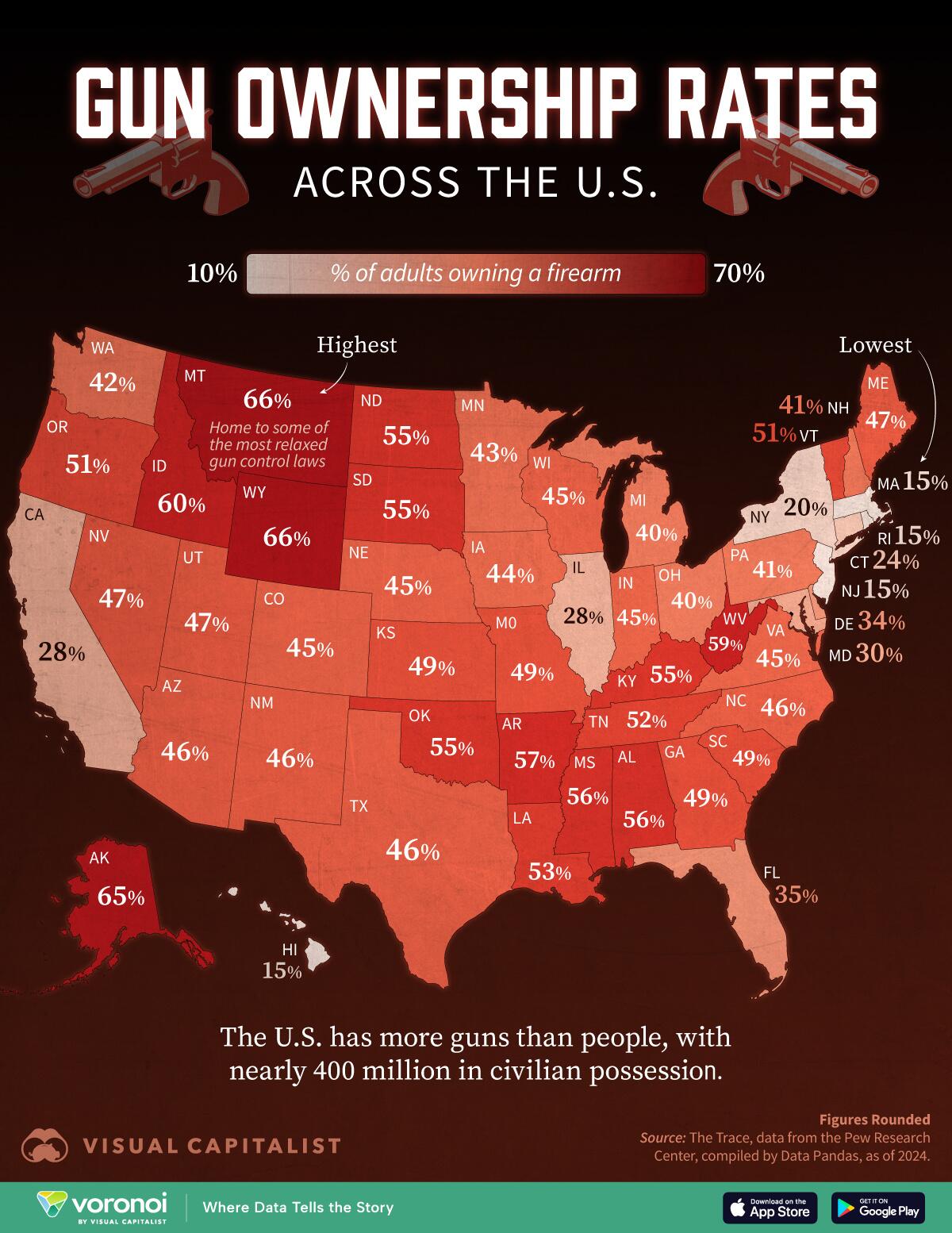
The U.S. has more guns than people, with nearly 400 million in civilian possession.

In this map, Visual Capitalist’s Bruno Venditti ranks states by the highest percentage of gun ownership for adults, based on data from the Pew Research Center compiled by Data Pandas as of 2024.

High Gun Ownership in Northwestern America

Montana tops the ranking of the states with the highest percentage of gun ownership, with 66.3% of the adult population owning firearms. The state has some of the most relaxed gun control laws in America. No state permit is required to purchase or possess a rifle, shotgun, or handgun.

The state is followed on our list by its neighbor, Wyoming, where 66.2% of adults own a firearm. Alaska comes in third, with 64.5%.

State Gun Ownership Rate ↕
Montana 66.3%
Wyoming 66.2%
Alaska 64.5%
Idaho 60.1%
West Virginia 58.5%
Arkansas 57.2%
Mississippi 55.8%
Alabama 55.5%
South Dakota 55.3%
North Dakota 55.1%
Oklahoma 54.7%
Kentucky 54.6%
Louisiana 53.1%
Tennessee 51.6%
Oregon 50.8%
Vermont 50.5%
South Carolina 49.4%
Georgia 49.2%
Kansas 48.9%
Missouri 48.8%
Nevada 47.3%
Maine 46.8%
Utah 46.8%
Arizona 46.3%
New Mexico 46.2%
North Carolina 45.8%
Texas 45.7%
Wisconsin 45.3%
Nebraska 45.2%
Colorado 45.1%
Indiana 44.8%
Virginia 44.6%
Iowa 43.6%
Minnesota 42.8%
Washington 42.1%
New Hampshire 41.1%
Pennsylvania 40.7%
Michigan 40.2%
Ohio 40.0%
Florida 35.3%
Delaware 34.4%
Maryland 30.2%
California 28.3%
Illinois 27.8%
Connecticut 23.6%
New York 19.9%
Hawaii 14.9%
Rhode Island 14.8%
New Jersey 14.7%
Massachusetts 14.7%

On the other side of the spectrum, New Jersey and Massachusetts share the lowest gun ownership rate in the country, both at 14.7%.

Two other states with very low ownership rates include Hawaii (14.9%) and Rhode Island (14.8%).

The Number of Firearms is Increasing

According to the Bureau of Alcohol, Tobacco, Firearms, and Explosives (ATF), U.S. gun manufacturing and imports have increased by about 10% annually over the last decade.

In 2020, when the COVID-19 pandemic spurred record demand for firearms, 17 million guns entered the domestic market.

If you enjoyed this post, check out Which U.S. States Have the Most Gun Manufacturers? on Voronoi, the new app from Visual Capitalist.

Tyler Durden
Thu, 01/09/2025 – 23:00

Alaska Sues Federal Government Over Curbs To Oil And Gas Leases

0
Alaska Sues Federal Government Over Curbs To Oil And Gas Leases

Authored by John Haughey via The Epoch Times,

The state of Alaska is suing the federal government over the Department of Interior’s (DOI) alleged “unlawful detour” in restricting oil and gas lease auctions to about 400,000 acres within the 19.6-million acre Arctic National Wildlife Refuge.

Alaska Attorney General Treg Taylor filed the lawsuit on Jan. 7 in anticipation of the DOI’s Jan. 8 announcement that the Bureau of Land Management had received “no interest” from oil companies in bidding for leases within the Arctic National Wildlife Refuge (ANWR) coastal plain.

Alaska maintains that by restricting leases to 400,000 acres, the administration violated the 2017 Tax Cuts and Jobs Act, which required the DOI to conduct two lease auctions within Section 1002—a 1.5-million acre expanse opened for potential oil and gas development by Congress in 1980.

The state argues that the DOI essentially sabotaged bidding by imposing “new severe restrictions on surface use and occupancy” in November that made “any development economically and practically impossible” when implemented in December as the lease auction opened. When the auction closed on Jan. 6, no bids were submitted.

Taylor alleged in a statement announcing the lawsuit, filed in the U.S. District Court in Anchorage, that the agencies “ignored the law and took this unlawful detour without even presenting their final decision to the public for comment.”

The Jan. 8 legal challenge follows Alaska’s July 2, 2024, lawsuit over what it said was “billions in lost revenue” from nine canceled federal oil and gas leases in the ANWR’s coastal plain. That action is pending.

In 2023, the DOI suspended already-issued Section 1002 leases, citing insufficient legal analyses and commissioning another study to reassess the potential environmental impacts of the ANWR oil and gas leasing program.

The expired Jan. 6 bid deadline concluded the second Congressionally mandated sale required by the 2017 Tax Cuts and Jobs Act, which directed the Bureau of Land Management to hold two lease sales within seven years of enactment.

The first sale, held during the Trump administration, “similarly demonstrated low interest, yielding a total of $14.4 million in high bids on 11 tracts,” the DOI said, noting that Congress grossly overvalued the revenues from the two lease sales, projecting they would generate approximately $2 billion over 10 years.

Alaska officials said they are concerned that the “last-minute actions to restrict and complicate” oil and gas development with ANWR’s Section 1002 dissuaded bidding.

Alaska Department of Natural Resources Commissioner John Boyle said the November restrictions have created “total dysfunction.”

Alaska Gov. Mike Dunleavy said “Interior’s continued and irrational opposition under the Biden administration to responsible energy development in the Arctic continues America on a path of energy dependence instead of utilizing the vast resources we have available,”

In December, the Republican governor called on President-elect Donald Trump to scuttle the existing restrictions and create a cabinet-level task force specifically to address Alaska oil and gas development.

Trump has vowed to do away with the ANWR restrictions with a “Day One” executive order. Dunleavy said the lawsuit is still necessary.

“We have already heard comments from the incoming president that his administration will, thankfully, take a different tack and open up those areas that are meant to be developed,” he said. “But unfortunately, we can’t wait for that—we have to challenge this unlawful action now.”

Tyler Durden
Thu, 01/09/2025 – 22:30

Indoctrination: Washington Courts Employees Raise Alarm After Being Forced To Watch Documentary On White Supremacy

0
Indoctrination: Washington Courts Employees Raise Alarm After Being Forced To Watch Documentary On White Supremacy

Washington’s Administrative Office of the Courts (AOC) is mandating staff attend a four-hour, in-person training featuring the documentary *Who We Are: A Chronicle of Racism in America,* which argues the U.S. was founded on white supremacy.

Some employees have criticized the requirement, claiming it amounts to indoctrination, according to 770 KTTH.

The training, held on January 9, includes a screening of the film followed by a Q&A and dialogue with its producer, Jeffery Robinson, a lawyer and founder of the left-leaning “Who We Are Project.” The AOC describes the nonprofit as promoting awareness of historical anti-Black racism and white supremacy in the U.S. The event costs $5,000.

The KTTH report said that the AOC’s decision aligns with a June 2020 letter from the Democrat-led Washington State Supreme Court, issued during the Black Lives Matter movement.

In it, the Justices acknowledged their role in “devaluing Black lives” and called on the legal community to take responsibility for systemic injustices.

Some staff, however, object to the politically charged nature of the mandatory training, which the AOC defends. The training features the documentary *Who We Are* and a lecture by producer Jeffery Robinson, who claims the U.S. Constitution was designed to uphold white supremacy and slavery.

Robinson likens police to slave owners and defends the Black Lives Matter movement, comparing its critics to detractors of Martin Luther King Jr. in the 1960s. He also advocates for reparations.

Critics argue the training forces staff to accept far-left views, with one anonymous employee expressing concern over potential retribution for speaking out.

One employee told KTTH: “We are all educated and are aware of racism/slavery in our nation, we don’t need a history lesson from someone who presents it with a particular bias of their own.”

“We are not getting applicable training directly related to our job.”

And the employee is right. The AOC’s mandatory training pushes a left-wing political narrative, forcing employees to accept views like the U.S. Constitution being rooted in white supremacy and systemic racism as indisputable truths.

Promoting ideas like reparations, the training leaves no room for dissenting perspectives, stifling open dialogue and alienating staff. Critics argue this isn’t about fostering diversity but about imposing partisan ideology under the guise of professional development, effectively transforming Washington Courts into tools of far-left social justice activism.

Tyler Durden
Thu, 01/09/2025 – 22:00