54.1 F
Chicago
Monday, October 5, 2026
Home Blog Page 1936

Labor Market Miasma: Jobless Claims Best In 10 Months, ADP Worst In 4 Months

0
Labor Market Miasma: Jobless Claims Best In 10 Months, ADP Worst In 4 Months

Jobs, jobs, jobs…

ADP‘s employment report showed a disappointing addition of just 122k jobs in December (worse than the +140k exp) – its lowest since August…

Source: Bloomberg

Only 3 of the 23 forecasters were lower…

Source: Bloomberg

Manufacturing saw the biggest drop in jobs (the 7th monthly decline in manufacturing jobs in the last 8 months)…

…as small- and mid-sized firms cut employees (which is odd since NFIB Small Business sentiment literally exploded higher after Trump’s election).

The West was the biggest driver of job gains by region.

It seems the labor market ”downshifted” right after Trump was elected?

“The labor market downshifted to a more modest pace of growth in the final month of 2024, with a slowdown in both hiring and pay gains,” said Nela Richardson Chief Economist, ADP.

“Health care stood out in the second half of the year, creating more jobs than any other sector. “

As a reminder, yesterday JOLTS had the biggest two month jump in professional/business service job openings on record and now this?

The ADP report showed wage growth cooled further.

Workers who changed jobs saw a 7.1% increase in pay, while those who stayed put saw a 4.6% gain, the slowest since mid-2021.

ADP looks even more ridiculous as initial jobless claims plunged to 201k last week – the lowest since Feb 2024…

Source: Bloomberg

Notably the unadjusted claims soared near one year highs.

Continuing claims ticked up but remain below the 1.9mm Maginot Line…

Source: Bloomberg

Are we really back in baffle ’em with bullshit macro data mode?

Tyler Durden
Wed, 01/08/2025 – 08:38

“Smells Like A ‘Truss Moment'” – UK Gilt Yields Hit 16 Year High, Stocks & Cable Tumble

0
“Smells Like A ‘Truss Moment'” – UK Gilt Yields Hit 16 Year High, Stocks & Cable Tumble

UK Gilt yields topped 4.80% for the first time since 2008 this morning (up 12bps on the day) having blasted higher since The Fed started on its rate-cutting cycle…

This is not (yet) a Truss-style repudiation of the UK bond market... but it’s getting there.

“While the speed and extent of the move higher in bond yields has not been anywhere near as violent as that witnessed following the Truss budget in 2022, the impact of higher rates on the economy, particularly via higher mortgage rates, is not to be underestimated,” said Matthew Ryan, head of market strategy at Ebury.

A number of factors are weighing on gilts: supply concerns, sticky inflation and uncertainty whether the new Labour government are enacting the right policies to bring the country back on track.

While the latest increases don’t yet mirror the scope of those seen two years ago when Liz Truss’s disastrous mini-budget prompted a buyers’ strike, the spreading discomfort has investors nervous and risks complicating the calculus for the government as it looks to finance its spending plans.

The inflation outlook prompted traders to pull back their expectations for the Bank of England to cut interest rates this year, and came as yields globally soar as markets weigh the impact of potential tariffs from US President-elect Donald Trump on prices.

“This isn’t a healthy move,” said Megum Muhic, a strategist at RBC.

“General concerns surrounding debt sustainability, resurgence of inflation and potentially inflationary Trump policies are all contributing to the narrative.”

But such a rout is always a possibility when you are heavily reliant on the kindness of strangers – as Bloomberg’s Simon White notes, almost a third of UK sovereign debt is owned by foreigners. 

And unlike UK entities such as pension funds, they have no obligation to own any of it.

UK yields have been outpacing US ones as foreigners own an increasing share of the gilt market – in effect, overseas investors want a greater discount to hold more UK debt.

As Bloomberg reports, Thursday’s price action is particularly concerning for traders because a slump in the pound accompanied the rise in UK rates.

Cable was also clubbed like a baby seal, back to its weakest since the April 2024 lows…

Meanwhile, UK domestic shares tumbled, with the FTSE 250 mid-cap stock index heading for its worst two-day slump since August.

“The rise in yields is a painful blow, and it looks like, rather than being given new funds to help drive growth, government departments will have to make further cuts,” said Chris Beauchamp, chief market analyst at IG Group.

“UK stocks remain cheap, and for all the wrong reasons.”

The slide in bonds Wednesday was exacerbated by positioning as long positions in gilt futures were stopped out, according to traders. The gilt market has proved more volatile than other major bond markets in recent years, with investors often citing periods of poor liquidity.

“It looks like a small ‘Truss moment’ that could be amplified if investors start to price a more dovish BOE,” said Roberto Cobo Garcia, head of G10 FX strategy at BBVA.

However, much has changed since the 2022 crisis. The liability-driven investment strategies at the heart of the crisis must now hold larger cash buffers in order to reduce the chance of another liquidity crisis after an international regulatory effort. The BOE is also developing a repo facility which will allow these funds to raise cash in the event of future turbulence.

Tyler Durden
Wed, 01/08/2025 – 08:21

Futures Slump As Yields, Dollar Soar

0
Futures Slump As Yields, Dollar Soar

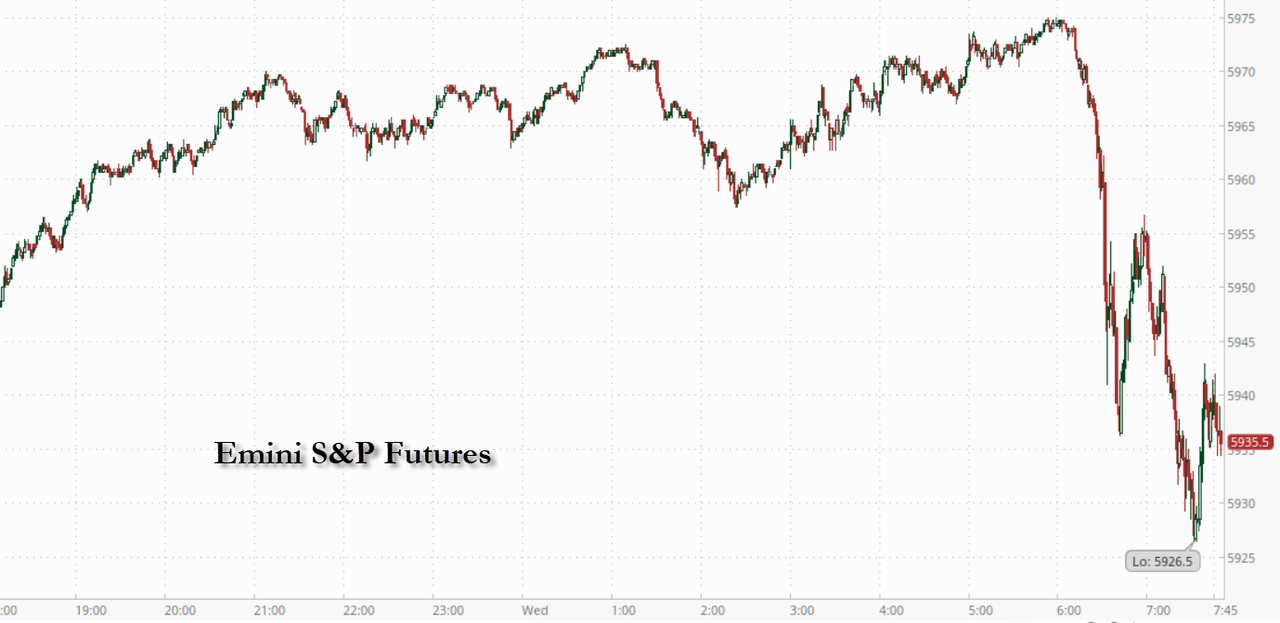
US equity futures were already rolling over following yesterday’s momentum-driven rout, when a the latest report out of CNN (a polar opposite to the just as fake news from WaPo earlier this week, but fake nonetheless) claiming that Trump was “considering declaring a national economic emergency to provide legal justification for a large swath of universal tariffs on allies and adversaries” sent the dollar surging, all other G-20 currencies plunging, and sparked a broad selloff across risk assets. As of 8:00am ET, S&P futures were down 0.2%, bouncing from session lows of -0.4%, and reversing a gain of 0.4% earlier in the session; Nasdaq futures were hurting more, sliding 0.6% as many of the recent best performers were sold off hard, and none more so than quantum computers which were down about 20% as a group in premarket trading; the Mag7 was also largely red )Apple -0.5%, Nvidia +0.1%, Microsoft -0.09%, Alphabet -1%, Amazon -0.07%, Meta Platforms -0.9% and Tesla -1%). Europe’s Stoxx 600 Index lost 0.4% and Asian stocks slumped, with China tumbling as usual. Meanwhile, bonds extended their ongoing selloff, with the 10Y rising to 4.72% and triggering Goldman’s VaR shock threshold of a 60bps increase in 1 month. In the UK, 10-year bond yields rose to their highest since 2008 and the 30-year inflation-linked note is now yielding more than 2%, the most since the Truss crisis of 2022 as fears spread that Keir’s spending plans will spark a fiscal disaster.

In premarket trading Quantum stocks tumbled after Nvidia CEO Jensen Huang said that “very useful” quantum computers are likely decades away. Quantum Computing (QUBT) -20%, D-Wave Quantum (QBTS) -21%, Rigetti Computing (RGTI) -23%, IonQ (IONQ) -13%. Sana Biotechnology (SANA) soars 232% after the company reported positive data from a study of its treatment of type 1 diabetes. Here are some other notable premarket movers:

  • AAR (AIR) rises 3% after the provider of aviation services and parts posted fiscal 2Q sales that soared past estimates.
  • Flutter (FLUT) slips 2% after the gambling firm cut its guidance for US preliminary revenue 2024 due to the impact of US sports results in the fourth quarter.
  • Health Catalyst (HCAT) climbs 5% as KeyBanc turned bullish, saying the stock’s valuation is deeply discounted.
  • Jasper Therapeutics (JSPR) falls 41% after posting data from the Beacon study of briquilimab.
  • Olo (OLO) slips 5% after Piper Sandler downgraded the restaurant software firm, flagging concern about the 2025 outlook amid executive changes and workforce cuts.
  • Palo Alto Networks (PANW) declines 2% after the security software received a pair of analyst downgrades.

S&P 500 figures started spiking lower just after 6 a.m. New York time following a report from CNN that Trump is considering declaring a national economic emergency to push through his tariff plans. Europe’s Stoxx 600 Index lost 0.4% and bond yields increased.

“Higher Treasury yields are a cause for concern for equity investors, especially when combined with speculation on what Trump may do,” said Lilian Chovin, head of asset allocation at Coutts & Co. in London. “Our view is that markets can digest higher yields, provided they are driven by stronger growth rather than inflation. In the near term it will be a challenge for risk assets.”

Amundi SA, Europe’s largest asset manager, sees a “reasonable” chance that the yield on 10-year Treasuries will again test the key level of 5%, a milestone only reached a handful of times over the past two decades. Citigroup’s wealth division also said a return to 5% — while not its base case — would offer a “really appealing” level at which to add. The yield was just under 4.70% on Wednesday.

Meanwhile, equity traders are bracing for further volatility over the coming weeks. “These first trading days have been a good overview of what could happen this year,” said Mabrouk Chetouane, head of global market strategy at Natixis Investment Managers. “Inflation, tariffs, Trump, growth, monetary policy — all these concerns could bring uncertainty.” Credit supply is also continuing after corporations and banks globally have raised roughly $111 billion this year through Tuesday. Spreads of corporate bonds remain near their lowest post-financial crisis level, despite the volatility in government debt.

In Europe stocks also reversed earlier gains, and what was a 0.4% rise has reversed into a 0.4% loss for the Stoxx 600 with financial services and banks leading gains. Here are the biggest movers Wednesday:

  • Novo Nordisk gains as much as 2.4% after being upgraded to buy from neutral at UBS, which said shares in the Danish drugmaker are at an “attractive entry point” following an “overdone” selloff
  • LSEG rises as much as 3.2% after making it on the list BofA’s “25 stocks for 2025” and the bank is adding it to a European list of top ideas, say analysts
  • Vallourec jumps as much as 7.4%, after the French tube manufacturer announced it hit a target of zero net debt one year ahead of plan and is now ready to return capital to shareholders starting in 2025
  • BCP shares advance 5.3%, rising to the highest level since May 2016, after JP Morgan raised the recommendation on the Portuguese lender to overweight from neutral on positive earnings momentum and generous payout
  • Heidelberg Materials rally as much as 3.4% after analysts at BofA Global Research raised their price target on the building materials company, naming it one of its “25 stocks for 2025”
  • Pluxee surges as much as 14% to the highest in four months after the employee benefits and motivation solutions firm beat analyst expectations for the first quarter
  • European wind power-related stocks fall on Wednesday after President-elect Donald Trump said he would seek to prevent the construction of wind farms during his second term, threatening billions of dollars in planned projects
  • Shell shares decline as much as 2% after 4Q trading update shows weakness across several divisions and may cause cuts in consensus expectations, RBC says in a note
  • InterContinental Hotels Group slips as much as 1.6%, to trade at the lowest in six weeks, after Morgan Stanley downgraded the stock to underweight from equalweight
  • Trigano falls as much as 7.9% in Paris, the most in about seven months, after the leisure-vehicle manufacturer reported a year-on-year revenue decline

Asian stocks dropped as concerns over a delay in further Federal Reserve interest-rate cuts weighed on sentiment. Tech shares tracked their US peers lower.
The MSCI Asia Pacific Index fell as much as 0.8%, with TSMC and Tencent among the biggest drags. A drop in US big tech after Nvidia’s product presentation failed to lift near-term prospects weighed on Asian chipmakers. Samsung Electronics bucked the trend after Nvidia’s founder expressed confidence in the Korean company.

In FX, the Bloomberg Dollar Spot Index rises 0.3% while the Swedish krona sits at the bottom of the G-10 FX leader board, falling 0.4% against the greenback after CPI surprised to the downside.

In rates, treasury futures saw continued downside pressure into early US session, reaching day’s lows amid bigger selloff in core European rates and after CNN reported that Trump was seeking an emergency declaration to push through tariffs. UK gilts led losses, with 10-year yields reaching highest level since 2008. US yields are cheaper by 1bp-3bp across maturities near session highs; 10-year, higher by 2.5bp near 4.71%, outperforms UK 10-year by about 7bp as persistent inflationary pressure continues to rattle UK markets; UK 10-year yield climbed more than 10bp to 4.789%. This week’s Treasury auction cycle concludes at 1pm New York time with $22 billion 30-year bond reopening; Tuesday’s 10-year note sale tailed slightly, by 0.2bp, as it drew highest yield since 2007. Corporate new-issue calendar is empty so far and expected to remain muted for the rest of the week after 33 offerings were priced on the past two days, topping dealers’ full-week forecasts for about $50 billion. Potential issuers today include refiner HF Sinclair, which held fixed-income investor calls Tuesday. US session includes December ADP employment change, weekly jobless claims and 30-year bond reopening poised to draw highest yield since 2007.

In commodities, oil prices advance, with WTI rising 0.8% to $74.80 a barrel. Spot gold adds $6 to $2,655/oz. Bitcoin falls below $96,000.

US economic data calendar includes December ADP employment change (8:15am), jobless claims (8:30am), November wholesale inventories (10am) and consumer credit (3pm). Fed speaker slate includes Waller at 8am; FOMC releases minutes from Dec. 18 meeting at 2pm

Market Snapshot

  • S&P 500 futures up 0.2% to 5,968.50
  • STOXX Europe 600 up 0.2% to 515.48
  • MXAP down 0.6% to 180.83
  • MXAPJ down 0.6% to 568.23
  • Nikkei down 0.3% to 39,981.06
  • Topix down 0.6% to 2,770.00
  • Hang Seng Index down 0.9% to 19,279.84
  • Shanghai Composite little changed at 3,230.17
  • Sensex down 0.1% to 78,107.00
  • Australia S&P/ASX 200 up 0.8% to 8,349.15
  • Kospi up 1.2% to 2,521.05
  • German 10Y yield up 3 bps at 2.51%
  • Euro down 0.2% to $1.0322
  • Brent Futures up 0.8% to $77.67/bbl
  • Gold spot up 0.2% to $2,654.04
  • US Dollar Index up 0.29% to 108.86

Top Overnight News

  • China will subsidize more consumer products and boost funding for industrial equipment upgrades to boost domestic consumption. Meantime, the PBOC set its yuan reference rate at the strongest compared to estimates since April. BBG
  • Yields on China’s 10-year sovereign debt hit record lows despite Beijing’s recent stimulus announcements, suggesting growing concern the nation will fail to avoid a deflationary spiral mirroring 1990s Japan. BBG
  • The Bank of Japan will likely keep raising interest rates in the coming years as inflation appears on track to sustainably hit its 2% target, said former governor Haruhiko Kuroda. RTRS
  • Samsung shares rose after Nvidia CEO Jensen Huang expressed confidence in the company’s ability to resolve technical issues producing a new type of memory chip for AI systems. BBG
  • Europe is pushing back against Trump. Describing Greenland as European territory, French Foreign Minister Jean-Noel Barrot warned him against threatening the EU’s sovereign borders. And the EU’s industry chief called on the bloc to defend itself against protectionist measures. BBG
  • German economic data for Nov falls short of expectations, including retail sales (-0.6% M/M vs. the Street +0.5%) and factory orders (-5.4% M/M vs. the Street -0.2%). BBG
  • President-elect Donald Trump is considering declaring a national economic emergency to provide legal justification for a large swath of universal tariffs on allies and adversaries, four sources familiar with the matter told CNN, as Trump seeks to reset the global balance of trade in his second term. CNN
  • Oil gained as an industry report pointed to a seventh weekly draw in US stockpiles. Inventories at the key hub in Cushing also slumped — by 3.1 million barrels — the API is said to have reported. That would be the biggest drop since August 2023 if confirmed by the EIA today. BBG
  • Microsoft plans job cuts across the company soon, targeting underperforming employees. Business Insider

A more detailed look at global markets courtesy of Newsquawk

APAC stocks traded mixed following the weak handover from Wall St where tech underperformed as yields climbed after the hot ISM Services and strong JOLTS data. ASX 200 gained amid strength in mining stocks and the top-weighted financial sector, while participants digested mixed monthly inflation data in which the Weighted CPI reading topped forecasts, but the annual trimmed mean figure softened. Capital Economics suggested would provide greater confidence the RBA is on track to meet its inflation mandate if it the result is replicated in the quarterly figures due later this month. Nikkei 225 gradually nursed the majority of its opening losses and reclaimed the key 40,000 level. Hang Seng and Shanghai Comp were pressured with market participants underwhelmed by the latest press briefing in Beijing where the NDRC announced to expand the scope of home appliance trade-ins eligible for subsidies, while frictions lingered with China’s MOFCOM voicing criticism over recent US restrictions on Chinese companies.

Top Asian News

  • NDRC Vice Chairman announces loan discounts for equipment upgrades and expansion of trade-in program to include more consumer goods, while the number of types of household appliances eligible for recycling subsidies to increase from 8 to 12 with a maximum subsidy of 20% of the sales price for each item. NDRC said it will allocate special funds to support the recycling and treatment of waste electrical and electronic products, as well as include microwaves, water purifiers, dish-washing machines and rice cookers in the consumer goods trade-in subsidy scope. Furthermore, it will subsidise smartphones for up to 15% of the price and will support equipment upgrades of information technology, safe production and agriculture equipment.
  • Chinese Finance Ministry official said the government has allocated CNY 81bln for consumer goods trade-ins so far this year, while a PBoC official stated they will step up financial support for private and small firms in equipment upgrades with the central bank allocating CNY 100bln of loans for select small technology firms.
  • China condemned the US military blacklisting of Chinese companies and called on the US to immediately address its misconduct, while it said the US is endangering the stability of the global supply chain.
  • China PCA December Prelim Retail Passenger Vehicle Sales +9% M/M (prev. +7.1%); +11% Y/Y (prev. 16.5%)

European bourses initially opened with a slight negative bias, taking impetus from a mostly negative APAC session. Soon after the cash open, sentiment improved in Europe, to currently display a modestly firmer picture, with only a couple of indices residing in the red. European sectors are mixed, with no clear out/underperformer in the session thus far. Financial Services lead, followed closely by Banks. Energy is found at the foot of the pile, with losses fuelled by Shell after it trimmed its Q4 production guidance. US equity futures are modestly firmer across the board, in an attempt to recoup some of the hefty losses seen in the prior session, which were sparked by hotter-than-expected US ISM Services and JOLTS Job Openings figures.

Top European News


  • Banca Ifis Bids for Illimity Amid Italian Consolidation Wave
  • UK Prepares to Sell New Five-Year Bonds as Borrowing Costs Surge
  • IPT: Indonesia EUR Benchmark; 8Y MS+170 Area, 12Y MS+195 Area
  • Novo Nordisk Gains After UBS Upgrade on ‘Attractive’ Entry Point

FX

  • USD is continuing the strength from Tuesday which was facilitated by the hot ISM Services PMI data and as JOLTS data topped analysts’ forecast range. DXY re-approaches 109.00 to the upside (in a current 108.55-96 range). Attention now turns to the FOMC Minutes, ADP Employment and Initial Jobless Claims data.
  • EUR attempted to regain some composure overnight after its slide beneath the 1.0400 level before feeling more pressure from the continued rebound in the USD. German Retail Sales were mixed, whilst Industrial Orders were downbeat, but did have some caveats (details in the data section below). EUR/USD resides in a 1.0311-57 range with downside levels including the 6th Jan low (1.0294).
  • JPY traded indecisively overnight with USD/JPY on both sides of the 158.00 level amid a quiet data calendar for Japan and the mixed risk tone. Similar price action in Europe with the current intraday parameter between 157.91-158.32, with the pair eyeing yesterday’s highs (158.42).
  • GBP is subdued in tandem with G10 counterparts on the back of the stronger USD. GBP/USD resides in a current 1.2441-94 range with the next downside level the 6th Jan low (1.2410).
  • Antipodeans are feeling pressure from the firmer greenback and in the absence of major newsflow this morning. AUD/USD was choppy following the latest monthly inflation data from Australia in which the Weighted CPI printed firmer than expected but the annual trimmed mean CPI softened from the previous. AUD/USD trades within 0.6213-42 and NZD/USD within 0.5613-41.
  • SEK is modestly weaker after softer-than-expected consumer inflation metrics across the board. Following December’s CPIF (cooler than expected) and the Minutes from the December meeting CapEco now expects the Riksbank to cut by 25bps in January (prev. exp. March).
  • PBoC set USD/CNY mid-point at 7.1887 vs exp. 7.3435 (prev. 7.1879).

Fixed Income

  • USTs are contained into a front-loaded US session on account of the Federal Holiday for Carter on Thursday. As such, we get ADP, Jobless Claims, FOMC Minutes and 30yr supply in today’s session. Into those events, USTs trade within a slim 108-04 to 108-09+ band which is entirely and comfortably within Tuesday’s 108-01 to 108-20 parameters. Ahead, US ADP, Jobless Claims ahead of speak from Fed’s Waller and then the release of the FOMC Minutes. Additionally, we await a 30yr supply which follows a tepid 3yr tap on Monday and a relatively soft 10yr outing last night.
  • Bunds are similarly contained but with a slightly larger 131.90-132.14 range thus far with modest but ultimately fleeting action spurred by data this morning. A particularly soft Industrial Orders release and a mixed but largely weak Retail Sales report out of Germany sparked upside in Bunds early doors, to a retest of the above overnight peak; however, the move proved fleeting given large-order caveats to the Industrial Orders series. A 2035 outing had limited impact on Bunds.
  • BTPs are the relative outperformers today after lagging yesterday on the announcement of two new syndications; this morning, we have seen marketing commence for a new 10yr BTP and a new 20yr Green BTP with orders in excess of EUR 125bln and EUR 110bln respectively.
  • Gilts traded off highs in a 91.29-58 range ahead of a new 2030 auction; an outing which was mixed, with the b/c printing bang on 3.0 whilst the avg. yield is relatively high and a modestly wider tail, but ultimately had little impact on Gilts.
  • UK sells GBP 4.25bln 4.375% 2030 Gilt Auction: b/c 3.0x, average yield 4.490% & tail 0.5bps.
  • Germany sells EUR 3.781bln vs exp. EUR 5bln 2.00% 2035 Bund Auction: b/c 2.1x, average yield 2.51% & retention 24.38%
  • Orders for Italy’s new 10yr BTP bond over EUR 125bln, for 20yr Green BTP over EUR 110bln, via Reuters citing leads; spread for 10yr +7bps, for 20yr +5bps.

Commodities

  • Firmer trade in the crude complex despite the stronger Dollar, and extended on the prior day’s gains with upside seen after the latest private sector inventory data showed a larger-than-expected draw in headline crude. The complex saw additional upside in the European morning after reports that Ukraine had hit a Russian oil depot which served a military airfield, according to Ukraine’s Presidential Advisor. Brent Mar is currently just off highs in a USD 77.23-77.89/bbl parameter.
  • Mixed trade across precious metals with spot gold and silver firmer whilst palladium trades flat/subdued. Spot gold trades in a current USD 2,645.40-2,654.90/oz range.
  • Copper is on a firmer footing despite the stronger Dollar after the red metal lacked firm direction amid the mixed risk appetite in Asia and the subdued mood in China. 3M LME copper currently resides in a USD 8,983.00-9,056.00/t range.
  • Private inventory data (bbls): Crude -4.0mln (exp. -0.2mln), Distillate +3.2mln (exp. +0.6mln), Gasoline +7.3mln (exp. +1.5mln), Cushing -3.1mln.
  • Qatar set February Marine Crude OSP at Oman/Dubai + USD 0.45/bbl and Land Crude OSP at Oman/Dubai + USD 0.30/bbl.
  • Shell (SHEL LN) Cuts Q4 Integrated Gas Production 880-820k boepd (prev. guided 900-960k boepd), LNG Volumes 6.8-7.2Mt (prev. guided 6.9-7.5Mt); optimisation results are exp. to be significantly lower than Q3’24. Guides Q4 Upstream: Production 1.79-1.89mln boepd, Underlying Opex USD 2.2-2.8bln. Guides Q4 Chemicals and Products: Refining Utilisation 74-78%.
  • India has cut November gold imports by USD 5bln in the biggest revision, via Reuters citing sources; revised to USD 9.84bln (prev. estimated 14.86bln)
  • China may trim fuel imports amid the 2025 tax hike, according to Reuters sources.
  • India are looking at 2 new blocks in Jammu and Kashmir for Lithium exploration, according to Govt. sources.

Geopol

  • Venezuelan President Maduro said two US nationals were arrested as part of a group of seven mercenaries. It was separately reported that the Biden administration is set to roll out new sanctions against Venezuelan President Maduro’s regime this week ahead of the Venezuelan Presidential Inauguration, according to an Axios reporter.

US Event Calendar

  • 07:00: Jan. MBA Mortgage Applications
  • 08:15: Dec. ADP Employment Change, est. 139,000, prior 146,000
  • 08:30: Dec. Continuing Claims, est. 1.86m, prior 1.84m
  • 08:30: Jan. Initial Jobless Claims, est. 215,000, prior 211,000
  • 10:00: Nov. Wholesale Trade Sales MoM, est. 0.2%, prior -0.1%
  • 10:00: Nov. Wholesale Inventories MoM, est. -0.2%, prior -0.2%
  • 14:00: Dec. FOMC Meeting Minutes
  • 15:00: Nov. Consumer Credit, est. $10.5b, prior $19.2b

DB’s Jim Reid concludes the overnight wrap

Morning from Copenhagen at an interesting time to be in Denmark, with the Danes currently in the crosshairs of Mr Trump as he vowed yesterday to “tariff Denmark at a very high level” if it didn’t give up control of Greenland. Asked if he would exclude the use of military force to obtain Greenland or separately take control of the Panama Canal he said “No, I can’t assure you on either of those two. But I can say this, we need them for economic security. We need Greenland for national security reasons.” So it will be interesting to hear the views of the locals today on this fascinating story. In fact in the unlikely event anyone is reading this in Greenland please feel free to get in touch! More from a remarkable Trump press conference later.

However, for wider markets it’s all about yields at the moment with some big or landmark moves again yesterday in a period where there continue to be doubts about whether the Fed can cut rates in 2025. A reminder that the DB house view post the election two months ago was that the Fed would have to be on hold for the whole of this year. Market pricing is catching that view up. The latest repricing had a few factors behind it, but the biggest was the ISM services print for December, where the prices paid indicator surged to its highest in almost two years, at 64.4. It’s true that the prices paid might not have the same impact as a CPI report, but it’s worth noting that a similar spike last January came right before some very strong US inflation prints in Q1 2024. And in turn, that led to a big reassessment of how quickly the Fed would cut rates, hence we saw such a big market reaction yesterday.

In terms of that reaction, Fed funds futures pushed back the likely timing of the next rate cut, with the probability of another cut by the March meeting falling from 44% on Monday to 41% by the close. And looking further out, the total amount of cuts priced by December’s meeting came down -1.6bps on the day to 37.5bps. But the bigger sell off came at the long end, with the 10yr Treasury yield (+5.5bps) closing at its highest since April, at 4.69%. In fact, yesterday’s Treasury auction saw the highest issue yield for a 10yr auction since 2007, at 4.68%. With the fresh steepening of the yield curve, the 2s10s curve moved up another +3.8bps to 39.0bps, which is the steepest it’s been since May 2022. And at the very long end, 30yr US yields (4.91%) have only been above 5% for six trading days in October 2023 since 2007 so we are in rarified air.

To be fair, it wasn’t just the prices paid indicator that led to that market reaction. For instance, the headline ISM services index was also stronger than expected at 54.1 (vs. 53.5 expected). On top of that, the JOLTS report for November showed job openings were up to a 6-month high of 8.098m (vs. 7.74m expected), so that helped to alleviate fears that labour demand was weakening. And in the background, oil prices were continuing to move higher, with Brent Crude closing at $77.05/bbl, which is the highest it’s been since October. So there were quite a few headlines that collectively pointed in a more hawkish direction.

The effects of that bond selloff were felt globally, and European yields also saw a significant rise in response to the US data. That included 10yr bunds (+3.4bps) which were up to 2.48%, and remaining on track for a 6th consecutive weekly rise. On the fiscal topic, this morning our economists published a blog (here) discussing the challenge Europe faces this year in plotting a course between ensuring fiscal stability and investing enough in growth and security.

In the meantime, gilts experienced some of the biggest losses, with 10yr gilt yields (+7.3bps) rising to their highest since October 2023, at 4.68%. And significantly, the 30yr gilt yield (+6.8bps) was up to 5.25%, which is its highest level since 1998. The problem for the UK government is that with yields where they currently are, they are close to breaching their own fiscal rules and as such may require additional tax rises.

The moves in European yields were mostly driven by the US data, as the European releases yesterday were much less eventful. Admittedly, we did get the Euro Area flash CPI print for December, but both headline and core CPI were in line with expectations, at 2.4% and 2.7% respectively. So there was little reaction in markets given they were in line with expectations, and the ECB is still widely expected to cut by another 25bps at their next meeting in just over three weeks’ time. However, one piece of news came from the German number, which was corrected to show a 2.8% inflation print on the EU-harmonised measure, not the 2.9% number that was reported the previous day. Imagine the potential market pandamonium if US CPI got corrected the day after a higher than expected print.

With bonds struggling across the board, equities also took a hit amid higher rates as well as a negative turn in tech sentiment. That saw the S&P 500 give up its opening gain to close -1.11% lower, its worst day since the rout that followed the hawkish Fed rate cut in December. The decline was led by steep losses for the Magnificent 7 (-2.53%), which came as Nvidia (-6.22%) was the second-worst performer in the S&P 500 following the announcement of new chips the previous evening. The product launch was impressive but left the market seemingly wanting more. Tesla (-4.06%) and Palantir (-7.81%), two of the tech companies that have gained since Trump’s election, were also among the five worst performers in the S&P 500. Outside of tech, the losses were more moderate, with the equal-weighted S&P down -0.33%. And over in Europe, there was a stronger performance, with the STOXX 600 up +0.32%.

Turning back to Trump’s press conference, his other headline-grabbing comments included demanding NATO countries spend 5% of GDP on defence, suggesting that the US could use “economic force” to absorb Canada and saying that he plans to rename the Gulf of Mexico to the Gulf of America. So plenty of US foreign policy uncertainty for investors to digest, especially on trade as the theme of tariffs again made a repeated appearance. On the economy front, Trump said that the outgoing administration had left a situation where “inflation is continuing to rage and interest rates are far too high”.

Asian equity markets are mostly trading lower this morning with Chinese stocks leading losses with the Hang Seng (-1.59%) trading notably lower while the CSI (-1.49%) and the Shanghai Composite (-1.46%) are extending their previous session losses after the US blacklisted major Chinese tech firms allegedly aiding Beijing’s military. Elsewhere, the Nikkei (-0.24%) is also seeing minor losses after clocking strong gains in the previous session. Elsewhere, the KOSPI (+1.11%) is outperforming as Samsung Electronics, the index heavyweight, has climbed over 3% as NVIDIA provided a vote of confidence in its ability to deliver through its current technical problems. This has offset disappointing results overnight.

Additionally, the S&P/ASX 200 (+0.93%) is also edging higher as trimmed mean inflation rate continues to fall, renewing hopes for a rate cut by the RBA. S&P 500 and NASDAQ futures are rebounding a bit, up +0.21% and +0.22% respectively.

Coming back to Australia, trimmed mean inflation for November came in at +3.2%, down from +3.5% in October. While this is still above the RBA’s inflation target of 2 to 3%, it is moving towards the range the central bank needs to cut rates and is softer than their quarterly projections from December. However, headline inflation rose from +2.1% to +2.3%. Meanwhile, yields on the policy sensitive 3yr government bonds fell -1.7bps to settle at 3.93%.

To the day ahead now, and data releases from the US include the ADP’s report of private payrolls for December, along with the weekly initial jobless claims. Meanwhile in Germany, we’ll get factory orders and retail sales for November. From central banks, we’ll get the minutes from the FOMC’s December meeting, and also hear from the Fed’s Waller and the ECB’s Villeroy.


Tyler Durden
Wed, 01/08/2025 – 08:13

Trump Reportedly Mulls Executive Order Protecting Gas Stoves From Radical Left’s Green Crusade

0
Trump Reportedly Mulls Executive Order Protecting Gas Stoves From Radical Left’s Green Crusade

Nearly two weeks after the Biden administration quietly finalized new climate rules targeting natural gas-powered water heaters—following years of far-left politicians and shady “green” nonprofits waging war against NatGas stoves under the guise of improving “indoor air quality”—President-elect Donald Trump has reportedly had enough of these games. He plans to issue an executive order to protect NatGas-powered appliances.

Reuters cites two sources familiar with Trump’s executive order protecting NatGas-powered appliances, including water heaters, furnaces, ovens, cooktops, and dryers, from federal and state regulators who have been on a green crusade to eliminate them from new home construction, businesses, and/or new multi-family buildings. 

Details of the executive order are still under discussion but are likely to mirror Congressional efforts to limit federal dollars for state and local initiatives that restrict gas-powered appliances or impose regulations that would increase their cost, the sources said.-RTRS

“It speaks volumes when an order from the White House is needed to stop our own government from banning natural gas furnaces and water heaters,” Karen Harbert, president of the American Gas Association, an industry trade group, wrote in a statement to Reuters. 

Harbert said, “Despite the illegal efforts to ban access and use of natural gas, our industry is hard at work to keep life essential energy affordable and reliable, especially during the extreme cold we are experiencing right now.”

One day after Christmas, the Biden administration finalized new climate rules targeting NatGas water heaters. These new rules aim to reduce carbon dioxide emissions, aligned with broader climate change mitigation efforts. 

While the war on NatGas-powered appliances appears to be part of a sinister de-growth climate change agenda, Kit Knightly, via Off-Guardian, recently explained there’s a lot more to the story; in fact, he said the move is by an overreaching government to regulate indoor air quality that will eventually mean more mandatory “smart” technology devices will be put in homes for monitoring. 

The World Economic Forum recently published a note titled “Indoor air pollution: What causes it and how to tackle it,” which claims:

indoor air pollutants can now be detected with more precise, efficient, and compact sensors thanks to advances in environmental sensing technology. As a result, intelligent home systems may soon use sensors like these to keep track of indoor air quality and notify the ventilation system before dangerous levels are reached.

Become ungovernable with a NatGas-powered stove, water heater, and cooktop.

Trump has four more years.

Tyler Durden
Wed, 01/08/2025 – 07:45

WHO Says Bird Flu Risk Low After 1st H5N1 Death In US

0
WHO Says Bird Flu Risk Low After 1st H5N1 Death In US

The World Health Organization (WHO) says that the risk from H5N1 avian influenza remains low after the first H5N1 death was recorded in Louisiana on Monday.

This colorized electron microscope image released by the National Institute of Allergy and Infectious Diseases on March 26, 2024, shows avian influenza A H5N1 virus particles (yellow), grown in Madin-Darby Canine Kidney (MDCK) epithelial cells (blue). CDC/NIAID via AP

“We are concerned, of course, but we look at the risk to the general population, and … it still remains low,” said WHO spokeswoman Margaret Harris in a statement to reporters at a Geneva press briefing.

When asked if monitoring of the virus was sufficient in the US, she said “They are doing a lot of surveillance. That’s why we’re hearing about it.”

Over 60 people in the US have contracted bird flu since April, most of whom were farm workers and dairy facility employees, after the virus was found circulating among dairy cattle herds and poultry flocks.

The person who died in Louisiana had contracted H5N1 after exposure to wild birds, and a “non-commercial backyard flock,” officials reported, adding that it’s the only confirmed human case of H5N1 in the state.

There has been no recorded person-to-person transmission of the virus, which was first detected in US dairy cattle in March 2024. It has since been confirmed in at least 80 herds in 16 states.

In November, a teen in British Columbia, Canada was hospitalized with a severe case of bird flu.

As the Epoch Times notes further, health officials have stressed that bird flu is still mainly an animal health issue and that the risk to the public remains low.

On Dec. 18, California Gov. Gavin Newsom declared an emergency over H5N1, saying the decision was precautionary and because of cases found in dairy cattle. That declaration followed official confirmation that the Louisiana person who developed bird flu was hospitalized.

Several days ago, the CDC announced that it analyzed samples from the Louisiana case suggesting the H5N1 strain mutated and said that the risk of an outbreak in the United States is still low.

“The detection of a severe human case with genetic changes in a clinical specimen underscores the importance of ongoing genomic surveillance in people and animals, containment of avian influenza outbreaks in dairy cattle and poultry, and prevention measures among people with exposure to infected animals or environments,” the agency said.

Federal and state health officials have recommended people stay away from sick or dead animals, avoid contact with wild birds or domestic birds that appear ill or have died, and refrain from consuming raw milk or products containing raw milk.

Tyler Durden
Wed, 01/08/2025 – 05:45

The Race Is On Between West And East For Control In Syria

0
The Race Is On Between West And East For Control In Syria

Authored by Simon Watkins via OilPrice.com,

  • The removal of Bashar al-Assad has reignited Western and Eastern plans to control Syria’s oil and gas resources.

  • Syria’s strategic position plays a pivotal role in Russian and Chinese plans, including Russia’s “Shia Crescent” strategy and China’s Belt and Road Initiative.

  • The U.S., Turkey, and other players are positioning themselves to rebuild Syria’s energy infrastructure.

Following the surprise removal on 8 December of President Bashar al-Assad after 53 years of his family’s rule in Syria, long-dormant plans in the U.S. are being dusted off about what will happen next there and who will control it. The plans were drawn up in anticipation that Bashar al-Assad would fall soon after July 2011, a senior energy security source who worked closely with the administration of then-U.S. President Barack Obama exclusively told OilPrice.com.

“At that point [when defectors from the Syrian army formed the Free Syrian Army and began an armed conflict across the country], Washington was certain that he [al-Assad] would fall in a matter of weeks, so they expedited the existing planning for that contingency, as did Russia and Iran, and the European Union too,” he said. “The plans for each included options to support its [Syria’s] production of oil and gas as this was a key source of its revenues,” he said.

“These were to run in parallel with, and support, whichever group finally came out on top after he [al-Assad] was removed from the picture,” he added.

At the time of the outbreak of hostilities in 2011, Syria had been producing around 400,000 barrels per day (bpd) of crude oil from proved reserves of 2.5 billion barrels. For a long period before that – prior to the recovery rate dropping off due to a lack of enhanced oil recovery techniques being employed at the major fields — it had been producing nearly 600,000 bpd. Europe imported at least US$3 billion worth of oil per year from Syria up to the beginning of 2011, and many European refineries were configured to process the heavy, sour ‘Souedie’ crude oil that makes up much of Syria’s output, with the remainder being the sweet and lighter ‘Syrian Light’ grade.

Most of this – some 150,000-bpd combined – went to Germany, Italy, and France, from one of Syria’s three Mediterranean export terminals: Banias, Tartus, and Latakia. As an adjunct to this, a multitude of international oil companies were operating in Syria’s energy sector, including the UK’s Shell, Petrofac and Gulfsands Petroleum, France’s then-Total, the China National Petroleum Corporation, India’s Oil and Natural Gas Corp, Canada’s Suncor Energy, and Russia’s Tatneft and Stroytransgaz. Syria’s gas sector was at least as vibrant as its oil one, with proved reserves of 8.5 trillion cubic feet (tcf) of natural gas, and around 316 billion cubic feet per day (bcf/d) of dry natural gas produced.

After the fighting began in earnest in 2011, the first of the three major options to support the Syrian energy and financial infrastructure for whichever group took over was from the U.S.

This involved moving gas from Qatar through Saudi Arabia and Jordan, then through Syria whereupon it could be moved into Turkey and sold on in the rest of Europe, if resources allowed. The European option involved United Nations peace-keeping monitors in Syria, bringing in hydrocarbons industry experts from the UN Security Council member states, and letting the Qatar-Syria-Turkey, and Iran-Iraq-Syria-Turkey, pipelines develop organically over time. The Russian option focused on resuscitating the Iran-Iraq-Syria pipeline, moving Iranian, and later Iraqi and Syrian gas into Europe.

However, as al-Assad survived the initial phases of the uprising – crucially supported by the Russian military — he went with the Russian energy and financial option focusing long term on the Iran-Iraq-Syria pipeline plans shorter-term on the build-out of Syria’s oil and gas infrastructure.

In 2017 this was formalised in a memorandum of understanding that encompassed 40 energy projects, plus the full reconstruction and rehabilitation of the Aleppo thermal plant, the installation of the Deir Ezzor power plant, and the expansion of capacity of the Mharda and Tishreen plants, with a view to re-energising Syria’s power grid and restoring the main control centre for the grid back to Damascus.

Consequently, it was little surprise that early on after al-Assad fled to Moscow a month ago, Russian Deputy Foreign Minister Mikhail Bogdanov confirmed that his country had been in direct contact with the radical Islamist group, Hayat Tahrir al-Sham (HTS), about the future of its energy projects, and of its key military bases across Syria as well. These comprise the naval base at Tartus – Russia’s only Mediterranean port, its Khmeimim air force base near Latakia, and its huge listening station nearby. Aside from these prized assets, there are three other reasons why Syria remains so crucial to Russia’s core geopolitical strategy in the Middle East and globally, as fully analysed in my latest book on the new global oil market order.

  • First, it is the biggest country on the western side of the Shia Crescent of Power that Russia had been meticulously developing for years as a counterpoint to the U.S.’s own sphere of influence centred then on Saudi Arabia (for hydrocarbons supplies) and Israel (for military and intelligence assets).

  • Second, it offers a long Mediterranean coastline from which Russia can send oil and gas products – or anything else it wanted – from itself or from its allies (notably Iran) for export into major oil and gas hubs in Turkey, Greece and Italy or into Africa.

  • And third, it highlighted to other countries in the Middle East and beyond Russia’s willingness and ability to act decisively on the side of the autocratic dynasties across the region.

Aside from denying Russia all these direct benefits (and doing the same for China indirectly) – which has enormous value in itself — the U.S. and its allies also understand the key role that Syria was to play logistically for Russia’s plans to expedite Iran’s long-desired ‘Land Bridge’ and for China’s broader ambitions for its ‘Belt and Road Initiative’ (BRI).

The Land Bridge – running from Iran across Iraq, and into Syria — was close to being operational by the time al-Assad was removed and would have provided and Russia to exponentially increase weapons delivery into southern Lebanon and the Golan Heights area of Syria. This would have dramatically increased the ability of Iran and its proxies to launch attacks on Israel as part of a broader rolling plan to further destabilise the Middle East. China would also have benefited from the same advantages inherent in a Syrian presence as Russia, particularly as the two countries include the dual-use of airports and seaports by both its civilians and its militaries as part of their standard cooperation agreements across the Middle East, most notably for Iran, Iraq and al-Assad’s Syria.

Additionally complementary to Russia’s previous plans for Syria was the recent announcement of the China-backed US$17 billion Strategic Development Road (SDR) which will create a major transport corridor from Basra in Iraq to southern Turkey (close to the Syrian border), and link in with China’s BRI. The planned linkages between the SDR and China’s BRI would allow Beijing to further build up its own ‘security’ presence across the region and also open the way for synergies with plans for the Land Bridge.

That said, shortly after Russia established contact with the HTS rebel group after al-Assad was removed last month, NATO member Turkey sent its own delegation to Damascus to discuss supplying Syria with electricity and rebuilding its oil and gas sector. Turkish Energy Minister Alparslan Bayraktar said his country is studying how to use Syria’s oil and natural gas resources for reconstruction. Given the country’s huge geopolitical importance, it is not surprising that several formerly impeccable senior security and energy sources in Washington, London, and Brussels exclusively told OilPrice.com just after al-Assad’s removal that the sudden – and otherwise inexplicable – success of the Syrian rebels led by HTS was in no small part connected to a massive surge in U.S. and U.K. support for them in the run-up to the coup.

“The U.S. wanted to put Moscow’s and Tehran’s leadership on notice that Washington can easily redraw and restructure borders and regimes in not just the Middle East but also in Eastern Europe, if it wants to,” a senior security source in the European Union (E.U.) told OilPrice.com.

“As he’s [al-Assad] gone now, I can’t see either Washington sitting back and allowing anyone to benefit from this other than the U.S., and if the reconstruction is done in a gradual and inclusive [with Syria’s principal former rebel groups], the outcome may be better than seen elsewhere in the region,” he concluded.

Tyler Durden
Wed, 01/08/2025 – 05:00

Elon Musk’s New Ambition – Sports Team Owner?

0
Elon Musk’s New Ambition – Sports Team Owner?

Elon Musk, the world’s richest man, may have his sights set on a new title: sports franchise owner, according to his father.

In an interview with Times Radio, the outspoken and flamboyant Errol Musk confirmed growing rumors that his son – worth a staggering $400 billion – is interested in buying Premier League club Liverpool.

“I can’t comment on that. They’ll raise the price,” Errol replied when asked by Times Radio about the unconfirmed report. When pressed again, the elder spilled the beans.

“Oh, yes. But that doesn’t mean he’s buying it,” he replied. “He would like to yes, obviously. Anybody would want to – so would I!” he said. “His grandmother was born in Liverpool, and we have relatives in Liverpool, and we were fortunate to know quite a lot of the Beatles because they grew up with some of my family. So, we are attached to Liverpool, you know.”

Liverpool is presently owned by Fenway Sports Group, an American sports investment firm that acquired the Merseyside club in 2010 for an estimated £300m. Since then, the Reds have thrived under their ownership, clinching both the Premier League and Champions League trophies.

Meanwhile, the $400 billion man has yet to comment on the matter.

Musk has previously spoken glowingly of his grandmother, describing nana Cora Amelia Robinson as an important part of his upbringing in South Africa. Cora was born in 1923 and passed away in 2011 at the age of 87 years old.

“My Nana was one of the poor working-class girls with no one to protect her who might have been abducted in present-day Britain,” Musk wrote on X of his grandmother. “She was very strict, but also kind and I could always count on her. She grew up very poor in England during the Great Depression only to be bombed in WW2,” he added. 

According to Musk, his nana didn’t have it easy. “To earn money for food, she cleaned houses, leaving me with a lasting respect for those who do so,” he said.

Upon the death of former British Prime Minister Margaret Thatcher in 2013, Musk paid tribute to the “Iron Lady,” referring to her as “tough but sensible and fair like my English Nana.”

Tyler Durden
Wed, 01/08/2025 – 04:15

CEO Of UK Non-Profit Forced To Apologize For ‘Accidentally’ Following Tommy Robinson On X

0
CEO Of UK Non-Profit Forced To Apologize For ‘Accidentally’ Following Tommy Robinson On X

Authored by Steve Watson via Modernity.news,

The CEO of a professional body of therapists in the UK has been forced to issue a grovelling apology after it was discovered that he was following Tommy Robinson on X.

James Esses notes that the Royal College of Speech and Language Therapists were informed back in August that its Chief Executive Steve Jamieson’s personal X account was following Robinson, who the organisation describes as a “far–right activist.”

The non-profit organisation conducted a five month investigation into the matter led by trustees and even appointed a barrister as an independent investigator.

The rest of the post reads…

Not that he praised Tommy Robinson. Not that he amplified or re-posted Tommy Robinson. But that he was ‘following’ Tommy Robinson, from his own personal X account.

A sub-committee was established with a barrister appointed to investigate, in order to reflect the ‘gravity of the situation’.

Even more ludicrous, the investigation found that ‘on the balance of probabilities it was deemed that this was an accidental follow’.

The outcome? The CEO has been forced to issue a ‘personal apology for his actions’. In this apology, he has apologised for the ‘hurt, distress, fear and anger that this caused’.

This is utter madness, from a body of therapists.

In a statement, the RCSLT announced “Our response to the incident was slower than it should have been,” and that “Our responses to the incident lacked objectivity, empathy, and compassion, and failed to align with the values of the organisation.”

Jamieson was instructed to issue his own statement apologising for ‘accidentally’ following Robinson on X, in which he stated ” I am deeply sorry for the hurt, upset, distress, fear and anger that this caused members, colleagues and staff,” adding that “For members to see this, at a time of racial hatred and riots, must have been deeply shocking.”

He added, “Whilst I cannot turn back the clock, I have learnt from this and want members, staff and other RCSLT stakeholders to know that I recognise I have let you down and I am truly sorry.”

Apparently accidentally and unintentionally following someone on X whose views some members of the organisation disagree with is completely unacceptable.

You’re not even allowed to ‘accidentally’ see what the unperson is saying on X, even if you also might disagree with them.

Whatever your opinion of Tommy Robinson is, this is just nuts.

*  *  *

Your support is crucial in helping us defeat mass censorship. Please consider donating via Locals or check out our unique merch. Follow us on X @ModernityNews.

Tyler Durden
Wed, 01/08/2025 – 03:30

US Sanctions Top Hungarian Official Close To Orban For Alleged Corruption

0
US Sanctions Top Hungarian Official Close To Orban For Alleged Corruption

The United States is now in the business of sanctioning NATO allies, apparently. The Department of the Treasury’s Office of Foreign Assets Control on Tuesday hit a top official of the Hungarian government, who is close to Prime Minister Viktor Orban, with punitive sanctions for alleged corruption.

Antal Rogán, who is head of Orban’s cabinet office, is alleged to have facilitated favorable business deals with government-aligned businesspeople. Critics and the opposition have dubbed him “Orban’s propaganda machine”.

US Ambassador to Hungary David Pressman at news a conference from Budapest called Rogán “a primary architect, implementer and beneficiary” of systemic corruption in Hungary, a system slammed by the American diplomat as a “kleptocratic ecosystem”.

“For too long, senior government officials in Hungary have used positions of power to enrich themselves and their families, moving significant funds from the public purse into private pockets,” Pressman said. But he also noted Rogan is not the only Hungarian official involved in corruption.

State Department spokesman Matthew Miller stated Tuesday that Rogan’s activity “is emblematic of the broader climate of impunity in Hungary where key elements of the state have been captured by oligarchs and undemocratic actors.”

Hungarian Foreign Minister Péter Szijjártó hit back by blasting the sanctions as but “personal revenge” on the part of Biden’s outgoing US ambassador.

As for Rogán himself, his office said Hungary is waiting on Trump to improve the relationship and set things aright:

“After January 20, the United States of America will have a new government and a new president. We will take the necessary legal steps after their inauguration.”

Currently, Hungary is locked in a long-running battle with the European Commission (EC) over the release of EU funding. 

A week ago the EC said Hungary lost its ability to receive European Union aid worth some €1 billion over alleged rule of law breaches. European officials had demanded significant ‘democratic reforms’ by close of 2024, which didn’t happen to their satisfaction.

Brussels and Washington have charged Orban also with cozying up to Russia and China, as part of his alleged shedding of democratic principles.

Tyler Durden
Wed, 01/08/2025 – 02:45

“The Firewall Will Not Last!” — Weidel Defiant As AfD Hits Highest Polling In A Year Ahead Of Germany’s Election

0
“The Firewall Will Not Last!” — Weidel Defiant As AfD Hits Highest Polling In A Year Ahead Of Germany’s Election

Authored by Thomas Brooke via Remix News,

A fresh Insa survey reveals that the Alternative for Germany (AfD) has made significant gains in voter support as Germany braces for a snap federal election in February. Collected in the first days of the new year, the poll suggests the AfD would capture 21.5 percent if the vote were held next Sunday — the party’s highest polling figure in a year.

The conservative Union bloc (CDU/CSU), led by Chancellor candidate Friedrich Merz, maintains its December share at 31 percent, while the ruling Social Democratic Party (SPD) experiences a mild setback, falling by one percentage point to 15.5 percent.

The Greens, under Robert Habeck, climbed by 1.5 points to 13.5 percent, while the BSW party slipped by one percentage point to 6.5 percent.

Meanwhile, the Free Democratic Party (FDP) which was co-governing until recently, currently falls below the initial five-percent threshold required for Bundestag representation at 4 percent, as does the Left Party on 3 percent.

The survey also examined how voter intentions evolved over the holiday period. One in two respondents said they discussed politics with relatives and friends, and one in ten reported changing their voting preference afterward — a potentially decisive factor shaping the hotly-contested ballot next month.

Speaking to Bild, Insa chief Hermann Binkert noted that the Union could “choose between three parties” to form a governing majority — the SPD, Greens, and the AfD — though Merz has repeatedly dismissed any prospect of collaborating with the right-wing party.

Despite this stance, AfD co-chair Alice Weidel on Monday urged Merz to abandon the so-called cordon sanitaire against her party, invoking the Austrian example where right-wing FPÖ leader Herbert Kickl is now on track to become chancellor.

“The firewall against the AfD will not last,” Weidel insisted.

The poll results come shortly after the Magdeburg Christmas market terror attack, in which a Saudi national drove his vehicle into a festive crowd in late December. Six people were killed and nearly 300 injured in the attack, which has spurred renewed debate over national security and immigration policy. Calls for tighter border controls and stronger vetting processes have become a central theme in the campaign discourse of both right-leaning and mainstream parties.

Tech billionaire Elon Musk recently stirred further controversy by endorsing the AfD. In a post on social media platform X, Musk stated, “Only the AfD can save Germany” and has announced an interview featuring Weidel is set for release on Jan. 9, potentially amplifying the AfD’s media coverage at a critical time.

Germany’s legacy parties have shifted noticeably rightward on immigration, a trend accelerated by the terrorist attack in Magdeburg. Interior Minister Nancy Faeser announced on Sunday that the government might revoke protection status for certain Syrian refugees who have failed to integrate into Western society. This comes a month after the fall of former Syrian President Bashar Assad, which prompted a temporary pause in processing new Syrian asylum claims.

“As our law stipulates, the Federal Office for Migration and Refugees will review and revoke protection grants if people no longer need this protection in Germany because the situation in Syria has stabilized,” Faeser told the Funke Media Group on Sunday. Individuals not enrolled in work or training may be required to return to Syria.

CDU candidate Merz has warned that Germany “cannot accept more Syrians” from the war-torn country and that those who are not integrated should return.

Meanwhile, senior CDU members are backing a proposal to deport asylum seekers after two criminal convictions, a policy the AfD has dismissed as insufficient. Critics argue this measure does little to stem rising crime. AfD officials suggest even tighter restrictions on foreigners convicted of crimes, reemphasizing a core election theme that has propelled the party in recent polls.

Read more here…

Tyler Durden
Wed, 01/08/2025 – 02:00