Futures are higher with both tech and small caps outperforming as Trump points to a deal/advanded discussions with Iran (which Iran is naturally denying), which is helping push energy prices and bond yields lower as the USD depreciates. As of 8:00am ET, S&P futures are up 0.5% while Nasdaq futures rise 0.4% led by Mag 7 stocks higher with Semis lagging. Energy is lower with the remaining sectors seeing a bid pre-mkt as the lower oil / bond yields are creating what JPM hopes will be an ‘Everything Rally’. Though the Kospi against tumbled overnight, EWY is +1% pre-market. Samsung Electronics and SK Hynix plunged nearly 9% each, while TSMC fell more than 2%, following their record surge on Friday. The yen rallied sharply before paring most of the gain amid speculation that authorities may have intervened to prop up the currency again after coordinated action between the US and Japan last week. Bloomberg’s gauge of the dollar fell 0.1%. WTI is under $80/bbl dragging the Energy complex lower as we see this move boosting both Base and Precious Metals with Ags lower. Today’s macro data focus is opn the final July reading of S&P Global manufacturing PMI due at 9:45 a.m. ET, followed by ISM manufacturing for July and construction spending for June at 10 a.m. Omdia total vehicle sales are due through the day.

In premarket trading, Mag 7 stocks are mostly higher: Amazon (AMZN) rises 1.6% as the e-commerce and cloud-computing company is set to extend gains after reporting cloud revenue acceleration for a fifth straight quarter (Alphabet +1.7%, Microsoft +1.8%, Meta +1.6%, Tesla +0.6%, Apple +0.6%, Nvidia -0.3%)
- Atkore (ATKR) jumps 27% after Prysmian agreed to buy the electrical-infrastructure products maker for $95 a share in cash, valuing the firm at $3.8 billion, including debt.
- Bristol-Myers Squibb (BMY) gains 5% as AstraZeneca Plc has explored an acquisition of the company, according to people familiar with the matter.
- Circle Internet Group (CRCL) shares fall 5.7% after Morgan Stanley cut its recommendation to underweight, citing lower expectations for the circulation of the company’s stablecoins in the future.
- CNH Industrial (CNH) rises 5% after the manufacturer of tractors and harvesters boosted its adjusted earnings per share forecast for the full year.
- Ferguson Enterprises (FERG) rises 8% as the plumbing and HVAC supplies company is set to replace Electronic Arts in the S&P 500 prior to the opening of trading Aug. 5.
- Marriott International (MAR) falls 3% after the hotel operator posted disappoingint second-quarter revenue.
- Krystal Biotech (KRYS) falls 7% after biopharmaceutical company reported net product revenues for the second quarter that missed the average analyst estimate
- Supernus Pharmaceuticals (SUPN) and Indivior Pharmaceuticals (INDV) rise after the companies agreed to combine in a tax-free all-stock merger of equals. Supernus jumps 17% while Indivior is up 8%.
- Sportradar Group (SRAD) falls 14% after the sports data provider cut its revenue guidance for the full year.
In other AI news, Alibaba released its biggest ever AI model, Qwen3.8-Max, claiming performance on par with global leader Anthropic and ranking higher on several benchmarks than the headline-grabbing Kimi K3 from Moonshot. More than 90% of companies, meanwhile, are blowing through their AI budgets, according to a recent McKinsey survey.
Middle East hostilities, AI stock valuations and inflation fears continue to dominate markets, but traders are also looking ahead to the key US July jobs report on Friday for guidance on the Federal Reserve’s policy path. SpaceX’s first earnings release since its record-breaking IPO is on Tuesday, while European heavyweights including HSBC Holdings Plc and Novo Nordisk A/S are also reporting.
Currency markets are front and center in terms of drama today, with news that the US and Japan took joint action to help lift the yen from its four-decade low, and Bessent vowing that the US “will not hesitate” to do more if needed, although it appears that after $100BN or so in FX intervention in the past two days, the USDJPY is once again moving higher, as it should as no amount of one-time intervention can stop its inevitable collapse.
It’s a busy week for calendar events, with a slew of labor market data leading up to Friday’s payrolls report, and more big earnings including SpaceX’s inaugural report as a public company. In deals, the weekend brought news that AstraZeneca has explored an acquisition of Bristol Myers Squibb. That combination would create one of the world’s largest drugmakers, though it’s unclear if discussions are still ongoing.
Brent crude tumbled after Trump reversed his Friday (after the close of course) threat of massive attacks, instead saying fresh US-Iran talks would begin Monday, boosting optimism the two sides may reach a deal to reopen the Strait of Hormuz, despite Iranian officials saying there were no ongoing talks with Washington. What really happened is that Trump called off a planned attack on Iran in response to pleas from allies in the Middle East, including Saudi Arabia. Adding to the positive sentiment, Iranian Foreign Minister Abbas Araghchi said talks between his country and Oman were in the final stages of agreeing on a new route through Hormuz.
“Geopolitical news is helping out with oil prices going down and easing pressure on yields,” said Alexandre Baradez, chief market analyst at IG in Paris. “There is, however, a real lingering issue on bond yields, on leverage, on Fed policy: until there’s clarity on these fronts, it’s hard to say that the stock market is all clear.”
Morgan Stanley’s Michael Wilson said that the momentum selloff in AI stocks is likely over, and he expects US stock market leadership to rotate toward companies with stable earnings and strong margins. Deutsche Bank’s Parag Thatte, meanwhile, reckons the rotation back into tech stocks that started last week has further to run.

That said, volatility remains top of mind. The growing popularity of leveraged ETFs has led to a surge in demand for “crash puts” and other exotic derivatives, which allow banks to hedge against potential losses. The SOX Index had intraday swings of at least 2% every trading day last month, something that hasn’t happened since 2020.

The shakiness of the tech trade, and an underwhelming response to big tech earnings, means that the S&P 500 has gone nowhere since the start of the earnings season. That’s despite US firms being on track to post a 29% surge in quarterly EPS, among the highest on record outside of post-crisis recovery years, according to Bloomberg Intelligence. Earnings revisions have seen net upgrades for 15 weeks in a row, the longest streak since 2022, according to a Citigroup index.
In other assets, bond investors say the risk of a deeper Treasury rout is rising as Fed Chair Warsh keeps investors in the dark about how officials will respond to the evolving economy. One explanation for why rates went higher after the Fed presentation, according to Apollo Chief Economist Torsten Slok, is that markets understand the Fed’s commitment to 2% inflation, but with no forward guidance, don’t understand how it will get there.
Marriott International, Loews and Tyson Foods are among companies scheduled to report before the market open. Worldwide RevPar at Marriott is expected to grow about 3% in constant-currency, according to estimates compiled by Bloomberg. Earnings from Palantir and Vertex Pharma are due later in the day.
European stocks advance, with travel and auto shares in the lead, as signs of progress between the US and Iran spurred a retreat in oil prices. Energy as well as food and beverage stocks are the biggest laggards. The Stoxx 600 rises 0.3% to 651.26. Here are the biggest movers Monday:
- A UBS basket of European airline stocks rises as much as 3.5% on Monday as a slide in Brent crude futures soothed concerns of higher jet fuel prices
- Clarkson shares jump as much as 16% to an all-time high after the British shipping group reported first-half results way ahead of expectations and said it expected similar outturn for full-year
- PostNL gains as much as 10%, the most since September, after the Dutch mail firm delivers what KBC Securities describes as a “resilient set” of first-half results
- Corbion rallies as much as 5.9%, the most since mid-June, as Oddo BHF upgrades the Dutch food ingredients firm to outperform, saying Friday’s guidance reset de-risks the investment case
- Mersen rallies as much as 14% in Paris, after Berenberg upgraded to buy, noting a first-half earnings beat and upgraded guidance at the electronics manufacturer, driven by growth in its power division
- RWS shares rise as much as 15%, their steepest climb since April, after the AI solutions company said it had entered into a binding agreement to buy Acolad
- Ipsen shares fall as much as 3.8% after Jefferies downgraded its rating on the drugmaker to underperform from hold, saying investors are underestimating the long-term competitive threat to its key drug Somatuline from Camurus’ CAM2029
- AstraZeneca shares fall as much as 7.8% to the lowest intraday since October, as analysts questioned the strategic rationale of a possible deal between the British drugmaker and Bristol-Myers Squibb
- Swedish Orphan Biovitrum (Sobi) falls as much as 5.1%, the most since December, after the company announced that CEO Guido Oelkers has decided to step down to take up another position outside the company
Asian stocks retreated at the start of a new month, with South Korea’s heavyweight chipmakers sliding again after a dizzying rally on Friday. The MSCI Asia Pacific Index was down 0.7%, paring an earlier loss of 1.3%. Samsung Electronics and SK Hynix plunged nearly 9% each, while TSMC fell more than 2%. The Kospi slumped 5.1% following an unprecedented 18% surge on Friday. Alibaba’s Hong Kong-listed stock jumped the most since early July after releasing its latest flagship AI model, lending some support to the regional gauge. Stocks in Japan also declined as automakers and other exporters dropped amid concerns about a stronger yen, following joint currency intervention with the US. Traders remain on high alert for further moves by the authorities. Benchmarks in India and the Philippines were among gainers.
In FX, the Japanese yen remains in focus after strengthening overnight following reports that around $34 billion was spent in Friday’s intervention to support the currency. Still, showing just how powerless such interventions are, the yen erased most of its earlier upside although is still outperforming G-10 peers, rising 0.2% against the greenback despite and nearly $100BN in joint US-Japan interventions on Thursday and Friday. The dollar fell as much as 1.4% to 155.23 yen in Monday trading, the fourth-straight day of lower USD/JPY, before paring losses at 156.92. The greenback gained against other G10 currencies.
“This intervention does not change the fundamentals of a Fed close to hiking and Tokyo running a loose set of monetary and fiscal policies, which are weighing on the yen,” said Chris Turner, head of markets at ING. “We struggle to see this bilateral action driving USD/JPY sustainably below 155,” he says; but it limits investors “from chasing USD/JPY through 160 and buys time for Tokyo to introduce more yen-positive policies”
In rates, treasuries are extending gains into the early US session amid tumbling oil prices after President Donald Trump over the weekend called off a threatened major attack on Iran, while Tehran suggested that talks to get ships moving through the Strait of Hormuz are making progress. US 10-year yields fall 6 bps to 4.68% after rising to a year-to-date high on Friday. Gilts lead gains in European government bonds, with UK 10-year borrowing costs falling 9 bps and back below 5%. Treasury yields richer by 4bp to 6bp across the curve with long-end lagging slightly, steepening 5s30s and 10s30s spreads by more than 1bp; 10-year yields is around 4.68% with bunds and gilts in the sector outperforming by 1bp and 3bp. IG dollar issuance slate empty so far. This week’s dealer forecasts call for a sharp pickup vs last week, with about $50 billion of new US investment-grade transactions projected. Dealers forecast about $130 billion of new US investment-grade debt offerings in August vs $99.55 billion in August 2025
In commodities, Brent crude futures drop 4.8% to near $84 a barrel after Trump said new talks with Iran would begin on Monday after calling off a planned attack. Precious metals rise with spot silver up about 1%. Bitcoin falls 1.3%.
Today’s US economic data calendar includes July final S&P Global US manufacturing PMI (9:45am), July ISM manufacturing and June construction spending (10am). Ahead this week are JOLTS job openings, ISM services and July jobs report. No Fed speakers are scheduled for Monday; appearances are scheduled later this week by Schmid, Cook, Daly, Musalem, Barkin and Bowman.
Market Snapshot

Top Overnight News
- A private gauge showed China’s manufacturing activity expanded at a slower pace in July, remaining in expansion territory and broadly echoing the official factory survey, which signaled a contraction. The RatingDog general manufacturing purchasing managers index fell to 50.9 in last month, down from 51.7 in June, according to a statement released Monday. WSJ
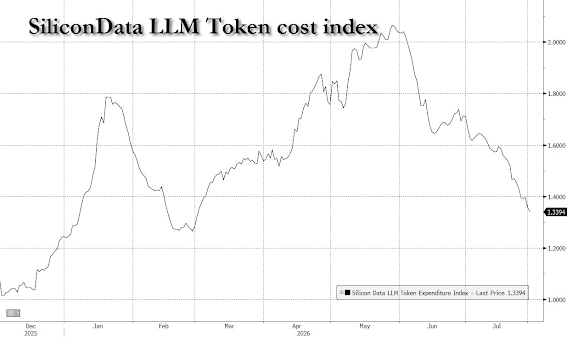
- A version of Chinese startup DeepSeek’s flagship AI model is by far the least expensive to run on benchmark tests among well-known models globally and more than 100 times cheaper to run than Anthropic’s Claude Fable 5, according to a research firm. RTRS
- The yen rallied on talk of fresh intervention after last week’s coordinated US-Japan campaign. The two governments said they would not hesitate to move again after their first joint yen action in 15 years. Japan likely spent around $34 billion on Friday’s FX intervention. BBG
- OPEC and its allies pressed ahead with another oil production increase, a move that would complete the group’s planned return of voluntarily withheld barrels to the market while setting the stage for potentially difficult talks over future quotas. WSJ
- The US Senate unveiled a bipartisan stopgap funding bill to keep the government funded through Dec. 11 and avert a shutdown this fall. BBG
- Oil slumped and futures rose as Donald Trump called off strikes on Iran and said talks on a deal would begin today. Iran denied it’s currently negotiating with the US but suggested an agreement with Oman on routes through the Strait of Hormuz may be close. BBG
- Federal Reserve Chairman Kevin Warsh this week floated to colleagues the prospect of meeting less often, which would mark a substantial shift in its operations, according to people familiar with the matter. WSJ
- AstraZeneca and Bristol Myers Squibb held merger talks, people familiar said. The megadeal would create one of the world’s biggest pharmaceutical groups, valued at almost $400 billion. FT
- California’s Democratic Party has endorsed the state’s proposed billionaire tax, marking a win for its advocates three months before Californians vote on the measure. WSJ
Top Iran News
- US President Trump said the US is locked and loaded and ready to go against Iran, but they “have just been asked by Iran, and other Middle Eastern Countries, to hold off any attack in that the perimeters of a deal have been agreed to. This would include the Immediate, Complete, and Total OPENING OF THE HORMUZ STRAIT, and an end to Iran’s nuclear threat. Based on this request, I have agreed, for the future benefit of the WORLD and, likewise, the survival of a successful and prosperous Iran, to cancel the attack, subject to being able to rapidly make a DEAL.”
- In further comments, US President Trump said the Iran attack would have been a massive one if not paused, adding there’s a deal on Hormuz and there will be a deal on denuclearisation. He added that he was asked very strongly by Iran to hold off the attack. On negotiations, he said they will begin tomorrow afternoon.
- US CENTCOM was reported on Friday to have prepared a large-scale operation in the form of a decisive two-week bombing campaign should President Trump choose escalation to break the deadlock in the Middle East, according to The Hill reports, citing sources.
- US Central Command intelligence official wrote in an email that they are seeking new and unconventional ways to increase pressure on and punish Iran, according to an internal message circulated among military analysts, according to CNN
- Iran’s Foreign Ministry spokesperson said negotiations with Oman are progressing, with the two sides holding constructive talks on a new framework and exchanging maps over the past seven to eight days for review, IRNA reported.
- Iran’s Foreign Ministry spokesman Baghaei said Iran is working with Oman to establish a temporary security corridor in the Strait of Hormuz, adding that Tehran is not currently in dialogue with the US and is holding talks with Oman on the waterway. Baghaei added that issues with the US should be addressed at a later stage and that there are no plans to receive a US delegation or send an Iranian delegation in the coming days.
- Iranian Foreign Minister Araghchi told a cabinet meeting on Sunday that the negotiations with Oman to manage shipping through the Strait of Hormuz “were in the final stages”, according to FT. It was separately reported that Araghchi held phone calls with Saudi, Pakistan and Iraqi counterparts and exchanged views on the latest developments in the region, while he warned on Saturday against any adventurous action by the US and stressed Iran’s readiness to respond decisively to any aggression.
- Iranian lawmaker Qashqawi said there are no discussions with the US or talks on the nuclear issue, adding that US sanctions amount to war; lasting peace can only be pursued once the military, economic and media conflict ends, SNN reported.
- Iran’s Mehr News Agency rejected US President Trump’s claim that he halted attacks at the request of Iran and Middle East countries, while it called it “a new lie” and emphasised that Iran’s forces are on full alert.
- UKMTO said on Saturday it received a report of an incident 21 nautical miles northeast of Oman’s Khasab, where the master of the tanker saw a large splash and explosion in close proximity to the vessel, although no damage to the vessel was reported.
- Israel told the White House it has significant security concerns over a proposed Hamas disarmament agreement, saying intelligence suggests Hamas intends to rebuild its military capabilities rather than genuinely disarm. Israel added that it will not withdraw from most of Gaza until Hamas has fully completed the disarmament process.
- Palestinian civil defence said Israeli drone and airstrikes hit multiple locations across the Gaza Strip, killing at least 18 people, including two women and four children, with residential apartments, tents sheltering displaced people and civilian areas among the reported targets.
- Kpler shipping data showed 18 vessels passed through the Bab al-Mandeb on Sunday, compared to the 27 vessels on Saturday.
A more detailed look at global markets courtesy of Newsquawk
APAC stocks were mostly lower despite the geopolitical relief from Trump’s cancellation of Iran strikes, with a mixed performance in the tech sector, while markets also digested weak Chinese PMI data and confirmation of joint US-Japan intervention on the yen. ASX 200 was ultimately flat, with underperformance in energy, real estate and financials offset by resilience in defensives. Nikkei 225 retreated amid increased rate hike bets following last week’s hawkish comments from BoJ Governor Ueda at the post-meeting press conference, while there were also headwinds from a firmer currency after the US and Japan confirmed they jointly intervened to support the yen on Friday. KOSPI underperformed amid weakness in its tech heavyweights and with participants digesting earnings. Hang Seng and Shanghai Comp were mixed amid divergences in the tech sector as hyperscalers advanced with Alibaba shares among today’s best performers after launching its Qwen 3.8 Max AI model, while chipmakers were pressured. Meanwhile, the mainland was subdued following disappointing Chinese RatingDog Manufacturing PMI data and as US-China frictions lingered, with MOFCOM criticising the US addition of Chinese companies to its forced labour entities list.
Top Asian News
- US Treasury Secretary Bessent posted “Friday’s coordinated foreign exchange actions countered disorderly yen movements.Treasury remains attentive and in close communication with our counterparts at MOF and BOJ. We will not hesitate to participate in further joint intervention.”
- Japan’s Finance Ministry said it conducted coordinated yen buying intervention with the US on Friday and won’t hesitate to conduct further forex intervention with the US, adding intervention was to address recent excessive and disorderly moves in the yen.
- Japan top currency diplomat Mimura said they will not hesitate to conduct further joint intervention, adding joint intervention could be seen as the culmination of US-Japan currency alliance, and will continue to work closely with the BoJ.
- US President Trump, when asked regarding US intervening in the yen, said the US is intervening because the US has a good relationship with Japan, and we’re always there for Japan, adding the US is getting financial benefit out of the arrangement.
- BoJ data suggested Japan conducted around JPY 5.3tln of currency intervention on Friday; July’s money market conditions account shows a shortfall of around 11.4tln.
- PBoC will continue to implement a moderately loose monetary policy throughout H2 2026, with a focus on interest rate supervision, according to CCTV.
European bourses start the week broadly higher across the board, helped by the announcement by US President Trump over the weekend that he cancelled strikes on Iran at the request of Tehran and other Middle East countries, subject to the immediate opening of the Strait of Hormuz. Energy benchmarks have dropped as a result, with the broader Energy sector lower by 1.4%. Elsewhere, EZ and UK Manufacturing PMIs were ticked lower. Within the broader EZ release, S&P stated that new work inflows remain worryingly weak and that the manufacturing economy is not quite as healthy as the headline figure (51.9) suggests. Sectors highlight the positive bias. Autos is the clear outperformer, followed by Travel & Leisure and Consumer Products & Services. Outside of Energy, Food, Beverages & Tobacco and Health Care are the sector laggards. On a quiet day of European earnings, there have been a lot of M&A stories. Starting with the biggest story of the day, the FT reported that AstraZeneca have been in talks with Bristol Myers Squibb on a potential merger, which would be the biggest pharma deal of all time. Shares of Astra have slumped by over 7% at one point, with BMY shares up over 7% pre-market. However, the merger will come under tough antitrust scrutiny, according to analysts at BMO, due to the significant business overlap between the Co.’s cancer drug portfolios. In other M&A moves: Prysmian (-1.8%), acquires Atkore (+26% pre-market) for USD 3.8bln; BMPS (+0.2%), considering the acquisition of Banco BPM according to the FT; Ageas (+2.4%), sells its minority stake in Eqita for c. USD 1.2bln; Holcim (-1.7%), sells its Philippines business for at least USD 807mln.
Top European News
- UK S&P Global Manufacturing PMI Final (Jul) 51.9 vs. Exp. 52.8 (Prev. 52.5).
- EU S&P Global Manufacturing PMI Final (Jul) 51.9 vs. Exp. 52.0 (Prev. 51.4).
- German S&P Global Manufacturing PMI Final (Jul) 52.2 vs. Exp. 52.2 (Prev. 50.3).
- French S&P Global Manufacturing PMI Final (Jul) 49.8 vs. Exp. 50.0 (Prev. 51.2).
- Italian S&P Global Manufacturing PMI (Jul) 51.3 vs Exp. 52.3 (Prev. 52.2).
- Spanish S&P Global Manufacturing PMI (Jul) 50.2 vs Exp. 50.5 (Prev. 49.7).
- German Retail Sales MoM (Jun) M/M -1.1% vs. Exp. -0.5% (Prev. 1.1%).
- German Retail Sales YoY (Jun) Y/Y -0.2% (Prev. 1.8%).
- Swiss Inflation Rate YoY (Jul) Y/Y 0.4% (Prev. 0.5%).
- Swiss Inflation Rate MoM (Jul) M/M -0.1% vs. Exp. -0.1% (Prev. 0%).
FX
- G10s are mostly weaker against the Buck bar EUR (-0.1%) and JPY (+0.3%). NOK (-0.9%) underperforms amid sharply lower oil prices.
- USD is firmer against most G10 peers except the Yen, whose gains are sufficient to keep DXY unchanged. A lot of moving parts, including geopolitics and Treasury action in FX markets. Geopolitics remain bearish for the USD, with Brent Oct’26 down ~7% after the US cancelled planned strikes on Iran and anticipates negotiations to resume today. Aside from this (and geopolitics) is incoming negotiations commentary and some US data, including the July ISM manufacturing release. DXY found buyers below 99.50 and the 100 DMA at 99.70. The next region to watch is around 100, which has proven sticky throughout the last few sessions.
- No real move seen in the EUR to the final EZ manufacturing PMI read, where revised metrics were broadly unchanged despite the revision period coinciding with energy upside related to the breakdown of the US-Iran MoU. Within the EZ-wide release, commentary downplayed the strong figure, noting “factories continue to reduce headcounts…. the manufacturing economy is not quite as healthy as the headline numbers might suggest.” EUR/USD gradually weakened throughout the morning to a 1.1520 base; the 50 DMA is likely to be supported at 1.1480. EUR/JPY gradually moved higher amid profit-taking around 180. Elsewhere, FT reported that the US Treasury intervened in the market by buying JPY for EUR.
- Several factors continue to buoy the JPY after roughly 5% gains against the Buck over the past three sessions. Remarks from top FX diplomat Mimura coincided with USD/JPY downside overnight. He noted “they will not hesitate to conduct further joint intervention” and “will respond to FX in coordination with monetary policy”, implying the BoJ should continue policy normalisation in reflection of the currency; remarks which pushed the pair to a 155.26 base, a level not seen since May where the low was 155.03. JPMorgan sees little chance coordinated intervention would drive a sustained rally that pushes the pair below 150, while ING said it struggles to see the action driving USD/JPY sustainably below 155.
Fixed Income
- The marked pullback in energy has weighed on yields, with fixed benchmarks firmer (ex-JGBs) across the board. No substantial move to Final PMIs or the morning’s other data points. Instead, we await details from the new round of US-Iran negotiations from this afternoon, and look back on themes from last week and the weekend; namely, JPY intervention & Fed reports/commentary.
- Bunds as high as 124.80, firmer by 40 ticks, but shy of the 124.94 peak from Friday and then a handful of levels from early last week between 125.04-25. Fleeting upside on a particularly poor German retail sales series this morning. Thereafter, Germany’s final Manufacturing PMI was unrevised, and showed an “impressive start” to Q3. However, caveats apply to this and were neatly surmised in the downwardly-revised EZ series, with new work inflows weak and as such headcounts continue to be reduced.
- Gilts, as is usually the case amid energy-driven moves, outperform. Firmer by over 60 ticks, but also shy of levels from early last week, with a double-top at 87.24 the first point vs today’s 87.12 high. Thereafter, 87.32 and 87.51 come into view. For the UK, specifics light, focus on energy as alluded to, no move to the Final Manufacturing PMI which saw a downward revision and somewhat mixed commentary. While the broader focus remains the global policy backdrop, after Bailey pushed back on edging toward a hike (keeping the extended hold narrative in play) vs commentary from and reporting around the Fed.
- USTs at a 108-16 peak, yet to test the 108-20+ to 108-30 highs from last week. Ahead, the space looks to its own Final Manufacturing PMI before the ISM print and then an AtlantaFed update, in addition to Treasury financing estimates. Looking back, the late-Friday & weekend focus was on geopolitics which has driven the bulk of action (see Commodities), alongside commentary from and reporting around the Fed. Musalem said the UST sell off sent a signal that credibility must be earned via communication and action. Additionally, the NYT reported that Chair Warsh is considering, and raised at the last meeting, reducing the number of policy meetings from the current eight. The latter points are potentially keeping US yields somewhat bid, and perhaps explain why USTs are yet to test the highs from last week, in contrast to peers.
- Finally, JGBs are under pressure. The benchmark opened higher and climbed to a 126.96 peak early on, before reversing and falling to 126.74 and since a 126.63 low, with downside of just under 10 ticks at most. A reversal that came as the US and Japan formally confirmed the joint JPY action last week, and kept open the possibility of further intervention. Amidst this, and driving JGBs lower, FX Chief Mimura added that there is a “shared understanding with the BoJ” on the topic. Following this, Japanese short-end yields have climbed and the odds of a hike in September have increased to c. 50%, while October is over 90% implied for a hike.
Commodities
- Over the weekend, President Trump said the US had been fully prepared to launch a major military strike against Iran but agreed to pause the operation after requests from Iran, Saudi Arabia, Qatar and the UAE, claiming that the outline of a deal had been reached involving the reopening of the Strait of Hormuz and progress toward ending Iran’s nuclear programme, with negotiations expected to begin on Monday. Reports indicated that US CENTCOM had prepared a large-scale two-week bombing campaign if diplomacy failed. However, Iranian officials have since rejected the suggestion that direct US-Iran talks are underway.
- Since then, the Iranian Foreign Ministry spokesperson Baghaei said Iran is negotiating only with Oman, with no plans to receive a US delegation or send an Iranian delegation in the coming days, while an Iranian lawmaker said there are no discussions with Washington or negotiations on the nuclear issue. Talks with Oman are reportedly progressing constructively on a new framework for safe shipping through the Strait of Hormuz, including the exchange of maps over the past seven to eight days and plans for a temporary security corridor. Iranian officials have also continued consultations with Saudi and Pakistani counterparts, while warning the US against military action and stressing that Iranian forces remain on full alert. Meanwhile, two explosions were reported near commercial vessels off Oman’s Khasab without causing damage or casualties.
- WTI and Brent futures slumped some 6% at the open following Trump’s conditional cancellation of strikes on Iran. Prices have remained weak, with WTI Sep’26 sliding from Friday’s near-USD 87/bbl to open at USD 80.10/bbl this morning and then to a current Monday trough at USD 78.78/bbl. Brent Oct’26 hit a peak of USD 91.36/bbl on Friday, before opening today at USD 82.80/bbl, whilst the intraday low print currently resides at USD 81.55/bbl.
- Metals are mostly firmer as the slump in oil prices provides some reprieve for the space, although the USD has since clambered off lows and risen back above its 100 DMA (99.72). As such, spot gold resides towards the bottom end of a USD 4,047.35-4,079.19/oz range but above Friday’s USD 4,045.17/oz close. Spot silver oscillates in a USD 57.59/oz to USD 58.63/oz range at the time of writing, above Friday’s USD 57.63/oz close.
- 3M LME copper trades within a narrow 13,800.60- 13,903.00/t range, with gains capped as participants also digested disappointing Chinese RatingDog Manufacturing PMI data.
- BoK reportedly plans to purchase domestically refined gold bars for the first time in 13 years due to geopolitical risks, Korea Economic Daily reported.
Geopolitics: Ukraine
- Russia struck three ships carrying military goods in the Black Sea.
- Russian Transport Ministry said it is taking measures to ensure the safety of navigation and to protect ships in the Azov-Black Sea basin due to drone attacks, RIA reported.
US Event Calendar
DB’s Jim Reid concludes the overnight wrap
We start August with the biggest story in macro markets at the moment being the Yen. It started with the suspected FX intervention on Thursday, which helped the yen to a +4.09% weekly gain against the dollar, its biggest in almost two years. That intervention was coordinated with the US, with Treasury Secretary Bessent saying the yen seemed “very undervalued”, while on Friday we saw reporting that the NY Fed carried out a rate check on the yen against the euro. This coordinated intervention has now been confirmed. The Yen is another +0.6% stronger this morning but was +1.4% stronger earlier in the session after a spike higher that could have been more intervention. Remember in our 2026 Mapping the World’s Prices (link here) published in mid-July we highlighted how astonishingly cheap Japan was on a global basis. While no guarantee of when this would change, it felt like one of the most obvious medium-term trades in markets and still does. We’ll see how this story develops.
Meanwhile the latest around Iran is that hopes have risen over the weekend of a diplomatic off-ramp. President Trump said he had cancelled a planned US strike on Iran—described as potentially the largest American attack since World War II—following appeals from key Gulf allies, particularly Saudi Arabia, and announced that fresh US-Iran talks would begin today. At the same time, Iranian officials indicated that negotiations with Oman over arrangements relating to the Strait of Hormuz are in their final stages. Markets have reacted positively, with Brent crude falling -5.2% this morning to $83.38/bbl. US Treasury yields are 3-5bps lower across the curve.
S&P (+0.61%), Nasdaq (+0.96%) and Stoxx (+0.93%) futures have also rallied this morning although the ongoing tech volatility is holding back the KOSPI (-4.92%) and the Nikkei (-0.93%). The Hang Seng is flat and mainland Chinese markets are down a few tenths of a percent.
The week ahead will be dominated by the US labour market, with the JOLTS report tomorrow, the ADP employment survey on Wednesday, and building up to Friday’s July employment report. Beyond the US, investors will be watching Swiss inflation today, Swedish inflation on Thursday, German activity data throughout the week (culminating in trade and industrial production figures on Friday), Chinese PMI releases on Wednesday ahead of trade data on Friday, and Japanese wage data and BoJ communications on Wednesday before household spending figures on Friday. Meanwhile, earnings season remains in full swing.
Looking at the US and then the rest of the world in more detail, attention will centre on whether incoming data reinforce the view that the US labour market remains resilient. Our economists expect Friday’s July payrolls report to show employment growth of +65k, modestly above June’s +57k reading, while private payrolls are also expected to rise by +65k after +49k previously. The unemployment rate is forecast to remain at 4.2%, although risks are skewed towards a rounding up to 4.3% if labour force participation rebounds after last month’s sharp decline. Average hourly earnings are expected to increase by +0.3% month-on-month, unchanged from June, while average hours worked are forecast to hold at 34.3 hours. If realised, those outcomes would leave our economists’ payroll proxy for nominal income growth unchanged at 4.4% year-on-year.
Before Friday’s report, several labour market indicators will help shape expectations. The JOLTS report (tomorrow) and the ADP employment survey (Wednesday) will be closely watched, with our economists expecting ADP employment growth of +60k after +98k previously. Activity indicators will also feature prominently. The ISM manufacturing index (today) is expected to improve to 54.1 from 53.3, while the ISM services index (Wednesday) is forecast at 54.3, little changed from June’s 54.0. Productivity data (Thursday) should provide another read on underlying economic momentum, with our economists forecasting Q2 nonfarm productivity growth of +3.0% and unit labour costs rising by +0.5%.
The policy backdrop remains important. The Fed left rates unchanged last week, but three officials dissented in favour of a hike, highlighting continuing concerns about inflation. Investors will therefore pay close attention to remarks from Governor Cook (Wednesday), as well as speeches from Schmid (Tuesday), Musalem (Thursday) and Barkin (Friday), for any indication of how officials are interpreting the latest data. Our economists continue to expect two further 25bp rate increases this year, in September and December.
Outside the US, Europe’s focus will be split between inflation and activity data. Switzerland releases July CPI today, while Sweden follows with its July inflation report on Thursday. Germany will publish a series of key June indicators throughout the week, including retail sales (today), factory orders (Thursday), and trade and industrial production figures (Friday). Elsewhere, France releases Q2 wage data on Thursday, while euro area producer prices (Wednesday) and retail sales (Thursday) are also upcoming.
In Asia, after China’s private PMI surveys began with manufacturing data today, this continues with services on Wednesday, before attention turns to July trade figures and foreign reserves on Friday. In Japan, investors will monitor labour cash earnings (Wednesday) and household spending (Friday) for evidence on domestic demand and wage momentum. The Bank of Japan will also publish the minutes of its June meeting on Wednesday.
Corporate earnings remain another major theme. In the US, reports are due from Palantir (today), SpaceX, AMD, Caterpillar, McDonald’s and Toyota (tomorrow), before attention shifts to Eli Lilly, Walt Disney and Uber (Wednesday). European highlights include Novo Nordisk and Siemens Energy (Wednesday), followed by Siemens and Rheinmetall (Thursday), while Japan’s reporting calendar includes SoftBank and Nintendo (Thursday).
Recapping last week now, and rates saw a sharp steepening in the aftermath of the latest central bank decisions, with long-dated yields reaching multi-year highs. The main trigger was the FOMC meeting as Chair Warsh offered little detail on the Fed’s reaction function to accompany the on hold decision. The 2yr Treasury yield fell -4.1bps (+4.5bps Friday) to 4.29% as fed funds futures dialed back pricing of rate hikes by year-end to 37bps (from 44bps the week before). However, the 10yr yield rose +5.8bps (+6.2bps Friday) to 4.74%, while the 30yr yield rose +11.5bps (+5.9bps Friday) to a post-2007 high of 5.27%. This marked the sharpest weekly steepening of the 2s10s slope since the post-Liberation Day sell off last April.
In Europe, the rates moves were more modest as the ECB held rates steady but signalled that a September hike was probable. 2yr bund yields inched down -0.8bps (+5.7bps Friday) but 10yr bund yields rose +3.4bps following a +5.1bps sell-off on Friday to reach a post-2011 high of 3.20%. Meanwhile, 10yr gilts saw a milder weekly sell off (+1.8bps) as the steady BoE decision was accompanied by rhetoric that the bank wasn’t “edging towards a hike”. A September BoE hike is now 30% priced (down from 61% the week before), while ECB September hike pricing was little changed at near 90%.
Equities saw a solid gain in aggregate, with the S&P 500 advancing +1.05% (+0.70% Friday). But the standout theme was continued volatility around the AI trade, with the Philly semiconductor index ending the week -4.30% lower despite a +8.19% spike on Thursday. The Mag-7 (+4.16%) had a strong but varied week, with Microsoft (+21.75%) and Amazon (+17.00%) surging after their earnings, but Apple (-7.24%) and Meta (-6.47%) losing ground after theirs.
Internationally, the volatility was most extreme for Korea’s KOSPI index, with a +17.91% surge on Friday still leaving the index -1.42% lower on the week after it plunged across Tuesday-Wednesday. European equities outperformed as Brent crude fell by -6.88% to $90.12/bbl in the absence of new material escalation between the US and Iran. A solid Eurozone Q2 real GDP print (+0.4% qoq) also helped, sending the DAX (+2.11%), CAC (+1.64%) and FTSE 100 (+1.23%) to strong advances, though the STOXX 600 (+0.73%) was weighed down by a -8.24% decline for ASML.
Amid the stronger yen (+4.09%) and an on hold BoJ decision, the Nikkei climbed by +4.03% on Friday (-0.39% on the week), while 10yr JGBs (-1.1bps on the week to 2.81%) outperformed global peers.