71.8 F
Chicago
Thursday, October 8, 2026
Home Blog Page 2000

Santa Claus Rally Or Did The Fed Steal Christmas?

0
Santa Claus Rally Or Did The Fed Steal Christmas?

Authored by Lance Roberts via RealInvestmentAdvice.com,

Powell & A Government Shutdown Hits Stocks

Last week, we noted the ongoing market churn that could last into this week’s Fed meeting. To wit:

“That certainly seemed the case this past week, with the market trading being fairly sloppy. Attempts to push the market higher were repeatedly met with sellers, and we saw a rotation from over-owned to under-owned assets. Notably, that selling pressure arrived as expected, and while such could persist until early next week, we should be getting close to the end of the distribution and rebalancing process. The good news is that the recent consolidation paves the way for ‘Santa Claus to visit Broad and Wall.”

That process continued as expected this past week but became violent on Wednesday following the Federal Reserve meeting. While the Fed cut rates as expected, the market shock came from the lift in its outlook for interest rates in 2025 by a half percentage point. The market is assuming that the Fed is giving up on the idea that inflation will return to the 2% target next year, an idea that they had confidence in as recently as September. That more hawkish outlook undermined the view that elevated valuations were justified by easier monetary conditions, which now seems to be reversing. We suspect that this view is rather short-sighted, and given the economic dynamics both abroad and in the U.S., slower economic growth will lead to a “dovish” pivot by the Fed in the first half of 2025.

The markets also struggled with concerns about a Government shutdown. As we discussed in October 2023, shutdowns are NOT a threat to the market in the long term. To wit:

“What is critical to understand about Government shutdowns is that mandatory spending (social security, welfare, interest on the debt) continues as needed. Shutdowns are primarily about discretionary spending. Such is why it mainly involves Government employment and the shuttering of national parks and monuments. According to Goldman Sachs, the shutdown would have only impacted about 2% of Federal spending overall. Notice that the vast majority of Government spending is directly a function of the social welfare system and interest on the debt.”

Please note that during a Government shutdown, all MANDATORY spending continues. In other words, the government WILL NOT default on its debt, and social security payments will continue, despite rhetoric to the contrary.

Furthermore, market reactions to government shutdowns have become increasingly muted. The reason is that the markets have learned that funding typically arrives at the 11th hour via a ‘continuing resolution’ to provide temporary funding through the next political event, such as midterm elections, inauguration, etc. While these short-term spending bills eventually translate into longer-term spending bills, the real problem is that continuing resolutions (CRs) increase spending by 8% annually. Such is why debt has exploded since Congress stopped passing budgets in 2009 under President Obama and opted for CRs. The debt surge is the direct result of automatically compounding 8% annual spending increases plus additional spending.

However, as shown, government shutdowns, if they occur, can temporarily impact markets, but the event tends to be mild and short-lived.

Nonetheless, the market has triggered a short-term MACD sell signal, which warned investors that some “event” could exert downward pressure on stocks. As noted, the Fed and “Government Shutdown” drama sufficiently triggered sellers as portfolio rebalancing and distributions concluded. With relative strength oversold on Friday, the setup for a reflexive rally into year-end has become a much higher-probability event. However, the ongoing sell signal is deep enough to limit whatever reflexive rally does arrive. Such is particularly true as money flows have deteriorated over the last few weeks.

While we still expect a rally into year-end, as we will discuss, there is a not-so-insignificant possibility of further turmoil. We suggest continuing to manage risk, and with significant gains already booked for this year, there is little need to stretch for further returns at this juncture.

Will Santa Claus Visit Broad And Wall?

Will “Santa still visit Broad and Wall?” That is the question on everyone’s mind. As we will discuss, there are certainly reasons to be concerned, but let’s start with the market statistics and reasons behind the fabled year-end rally.

The actual Wall Street saying is, “If Santa Claus should fail to call, bears may come to Broad & Wall.” The Santa Claus Rally, also known as the December effect, is a term for more frequent than average stock market gains as the year winds down. However, as is always the case with data, average returns sometimes differ from reality.

Stock Trader’s Almanac explored why end-of-year trading has a directional tendency. The Santa Claus indicator is pretty simple. It looks at market performance over a seven-day trading period – the last five trading days of the current trading year and the first two trading days of the New Year. The stats are compelling.

“The stock market has risen 1.48% on average during the 7 trading days in question since both 1950 and 1969. Over the 7 trading days in question, stock prices have historically risen 76% of the time, which is far more than the average performance over a 7-day period.“

The end of the year tends to be strong for a couple of reasons. First, professional managers tend to “window dress” portfolios for year-end reporting purposes. Secondly, given that many professional funds make year-end distributions, there tends to be a need to rebalance portfolios. The following graph in orange shows aggregate cumulative returns by day count for the December months we analyzed. In the graph, we plotted returns alongside daily aggregated average returns by day. Unsurprisingly, the recent sloppy trading and correction this past week all coincide with the historical norms of December.

Visually, one notices the “sweet spot” in the two graphs between the 10th and 14th trading days. The 14th trading day, in most cases, falls within a few days of Christmas.

However, there is always a risk.

Did The Fed Steal Christmas?

While there is a decently high probability that stock prices will climb heading into year-end, there is a not-so-insignificant 24% chance they won’t. With the substantial November advance and new highs into early December, the question is whether anyone is “left to buy?” As noted, not every December has a “Santa Claus Rally.” 2018, as shown, is a good reminder that once in a while, investors receive a lump of coal in their stockings. At that time, the Federal Reserve was on a rate hiking campaign and insisted that it was “nowhere near the neutral rate” on monetary policy. Furthermore, since the market had declined steeply since early September, sentiment and investor positioning were very negative.

Interestingly, December 2024 has some of the same backdrops as September 2018.

First, the S&P 500 rallied strongly this year, approaching our year-end target of 6000. That rally has led to a sharp increase in bullish sentiment between retail and professional investors. As shown, U.S. equity allocations are at record highs among professional investors.

Furthermore, like in 2018, when retail equity allocations and valuations were elevated, investor allocations are at the highest on record, coinciding with the second-highest valuation levels.

There is also an abundance of optimism about future stock prices, just like in 2018.

What is important to remember about 2018 is that investor optimism was fine until the Fed said it “was nowhere near the neutral rate.” Of course, following a 20% decline and two months later, the Fed was magically at that neutral rate.

Today, investor exuberance is tied to a further accommodative easing in 2025. However, like in 2018, the Fed suggested it isn’t near its “neutral rate,” as shown in its latest projections. While the “long-run” projections are still for economic growth of 1.8% (down from 2.0% and 1.9% previously) and inflation of 2%, the short-term outlooks for 2025 were adjusted modestly higher. That uptick disappointed investors even though the end goals remain the same, which will require Fed funds to adjust lower. (Side note: The Fed’s projections are almost always too optimistic, which suggests the recent bout of hawkishness will give way to a dovish reversal next year.)

The adjustment to the Fed’s view was minimal from an investing perspective. However, the market reacted violently because the combination of exuberance and overbought factors created the perfect environment for a reversal.

Technically Speaking

First, while the market rallied into year-end on many optimistic assumptions, breadth has been deteriorating noticeably. From the NYSE Advance-Decline line to the percentage of stocks trading above their respective 50 and 200-DMA, overall participation has declined rapidly. While such does not mean a market crash is imminent, such previous deterioration has eventually coincided with short-term corrections and consolidations. Unsurprisingly, that is exactly what happened as the collision of the Fed and a looming shutdown gave sellers the push they needed.

Secondly, the market was, and is, technically extended on many levels after the past two years of excess returns. The monthly market analysis shows the S&P 500 is significantly overbought on a relative strength basis, deviated from the long-term mean, and pushing well into the top of its bullish trend from the 2009 lows. While we discussed the same factors in the middle of 2021, it took several months before the market gave way and corrected the excesses in 2022. Given the market’s current momentum, we suspect the bullish run will likely last into the first half of next year but could be sooner if earnings expectations decline.

What is crucial to understand is that these technical extremes are just the “kindling” for a correction. To “ignite” the correction, some event must provide the catalyst. In this case, it was the more hawkish pivot by the Fed and the threat of a shutdown. As is always the case, the event that causes a sharp unwinding of the market, like we saw on Wednesday, is always unexpected. The “surprise factor” causes the sudden shift in market expectations for earnings growth and outlooks. The risk going forward is “if” the Fed is correct in its outlook, the more optimistic outlook for earnings expectations will need to be reassessed. If that is the case, the market will decline to reduce valuations for a new reality.

Given that current valuations are at the second-highest level on record, such an event would seem more likely. Notably, short-term valuations are solely a function of sentiment. Investors are paying well above the earnings growth that is occurring. Historically, earnings have disappointed those expectations.

Does any of this mean that “Santa Won’t Visit Broad And Wall?” Of course not. However, I would not completely dismiss the risk of “getting a lump of coal” this year.

Given the uncertainty, both into year-end and 2025, how should we approach it?

Calculating The Madness

Let me repeat something that seems apropos:

Sir Isaac Newton once said:

“I can calculate the motions of the heavenly bodies, but not the madness of the people..” 

As we head into year-end, we will navigate the risk of overly extended and bullish markets against the seasonally strong end-of-year period. 

We believe that capital preservation and risk management lead to better outcomes over the long term. However, managing risk can be frustrating in the short run as the “Fear Of Missing Out” overrides common sense and logic. 

If you disagree, that is okay.

When the opportunity presents itself and the “madness has subsided,” these are the questions we will ask ourselves before we add exposure to portfolios:

  1. What is the expected return from current valuation levels?  (___%)
  2. If I am wrong, what is my potential downside, given my current risk exposure?  (___%)
  3. What actions should I take now if #2 exceeds #1?  (#2 – #1 = ___%)

How you answer those questions is entirely up to you.

What you do with the answers is also up to you.

We are all trying to answer the question, “How much of the ‘narrative’ already got priced into the market?”

By looking at the data, it would be easy to assume the answer is “much.”

While bullishness prevails, this is a great time to set aside the narratives and return our focus to the basic portfolio management rules.

How We Are Trading It

Since we have our “stockings hung by the chimney with care,” we can stuff them with a few essential investment guidelines to follow as we approach year-end.

  • Investing is not a competition. There are no prizes for winning but severe penalties for losing.
  • Emotions have no place in investing. You are generally better off doing the opposite of what you “feel” you should be doing.
  • The ONLY investments you can “buy and hold” provide an income stream with a return of principal function.
  • Market valuations (except at extremes) are very poor market timing devices.
  • Fundamentals and Economics drive long-term investment decisions – “Greed and Fear” drive short-term trading. Knowing what type of investor you are determines the basis of your strategy.
  • “Market timing” is impossible– managing risk exposure is logical and possible.
  • Investment is about discipline and patience. Lacking either one can be destructive to your investment goals.
  • There is no value in daily media commentary– turn off the television and save yourself the mental capital.
  • Investing is no different from gambling—both are “guesses” about future outcomes based on probabilities. The winner is the one who knows when to “fold” and when to go “all in.”
  • No investment strategy works all the time. The trick is knowing the difference between a bad investment strategy and one temporarily out of favor.

While anxiously anticipating the arrival of the “Santa Claus Rally,” we must also remember the lesson of 2018.

Nothing is guaranteed.

Tyler Durden
Sat, 12/21/2024 – 15:10

Ukrainian Drones Pummel Russian City Over 600 Miles From Front Line

0
Ukrainian Drones Pummel Russian City Over 600 Miles From Front Line

Ukraine’s drone and missile attacks deep inside Russia have already been a near daily occurrence, but now these projectiles are reaching further and further into Russia, often utilize Western-supplied weapon systems.

“Ukraine brought the war into the heart of Russia Saturday morning with drone attacks that local authorities said damaged residential buildings in the city of Kazan in the Tatarstan region, over 600 miles (1,000 kilometers) from the front line,” The Associated Press reports Saturday.

Aftermath of suicide drone attack by Ukraine in the Russian city of Kazan, via ABC.

The regional governor said that eight drones attacked the city, with anti-air defenses only able to shoot down one. The others hit residential buildings and an industrial facility. 

No casualties were indicated by emergency services, but the attacks halted flights at Kazan’s airport, and all public gatherings were canceled due to the threat of more possible inbound drones.

The last several days have seen deadly attacks on Rostov and Kursk regions. The several waves of assaults involved US-provided ATACMS, UK-provided Storm Shadow missiles, as well as a HIMARS attack which occurred Friday.

The Russian Defense Ministry said: “These actions by the Kiev regime supported by Western handlers won’t be left unanswered.”

Dramatic video shows one drone smashing into the upper floors of high-rise building. The footage was verified by the AP:

President Putin has previously warned that “decision-making centers” in Kiev could be hit, but it appears that has yet to happen on any large-scale, even nearly three years into the war.

There’s also the looming threat that Moscow could launch more Oreshnik hypersonic missiles armed with conventional warheads, which could do major damage. Clearly these ‘options’ have been largely held back thus far.

Tyler Durden
Sat, 12/21/2024 – 14:35

Dem Rep. Crockett: Hispanic Voters Have “Slave Mentality” And “Can Barely Vote”

0
Dem Rep. Crockett: Hispanic Voters Have “Slave Mentality” And “Can Barely Vote”

Authored by Jonathan Turley,

One of the most consistent elements of the identity politics practiced by the left is its selectivity. Whether in politics or higher education, the outrage that comes from allegedly racist or insensitive comments is confined to targets on the right.

A case in point is the deafening silence after a diatribe by Rep. Jasmine Crockett, D-Texas, during which she accused Hispanic voters of having a “slave mentality” and said that they “can barely vote.”

There was no vaporous segment on The View or condemnations on the floor from members.

Crockett has been celebrated in left-wing publications such as Vanity Fair for schooling her colleagues, which she describes as “old as sh*t.”

She offered Vanity Fair her “distilled summary of what happens within the Latino community.” Not surprisingly, it is identity politics with a race edge:

“I’ve not run into that with the Asian community. I’ve not run into that with the African community. I’ve not run into that with the Caribbean community. I’ve only run into it with Hispanics. When they think of ‘illegals,’ they think of, you know, maybe people that came out of the cartels and that kind of, like, the criminal-type book or whatever. It’s insane.”

“It almost reminds me of what people would talk about when they would talk about kind of like ‘slave mentality’ and the hate that some slaves would have for themselves. It’s almost like a slave mentality that they have. It is wild to me when I hear how anti-immigrant they are as immigrants, many of them. I’m talking about people that literally just got here and can barely vote that are having this kind of attitude.”

The attack on Hispanic voters as including people who “literally just got here and can barely vote” did not even generate objections from many Democratic Hispanic groups. Imagine if Trump or a conservative commentator made this comment.

Ironically, just before the election, I wrote how recent immigrants seemed to have a particularly strong connection to our defining and collective values. That does not appear a view shared by the congresswoman.

Crockett was, if anything, inclusive in her attacks based on gender and race. She also attacked black men and women for voting for Trump. She just dismissed black men as hating women: “I’m going to chalk up to misogyny.”

What is unimaginable is that any woman or person of color could vote on the merits against the Democrats.

Notably, after her loss, Hillary Clinton offered the same attacks on women as voting against her only because they are weak and self-loathing.

She claimed that Kamala, who notoriously avoided interviews and could not think of “a thing she would do differently” from Biden, “ran a flawless campaign.” The problem is again self-hating women and minorities, adding, “I don’t trust White women. I said, I’m just telling you, and I think you need to have conversations with your sisters, because they are the group that failed Hillary Clinton.”

The claim that Hispanics “can barely vote” would not be tolerated from someone on the right. It is reminiscent of the controversy involving Democratic lawyer and former Clinton campaign general counsel Marc Elias over what some called inherently racist comments about Georgia voters. Elias argued that Georgia voters could not be expected to be able to read their driver’s licenses correctly — a statement that seemed to refer to minority voters who would be disproportionately impacted by such a requirement.

What is striking about the Vanity Fair article is that Democrats continued to rely on identity politics despite every indication that it was not working. Now, after losing both houses and the White House, they are doubling down on identity politics.

Outgoing Democratic National Committee (DNC) Chair Jaime Harrison used his farewell address to warn Democrats not to abandon identity politics as the touchstone of future campaigns.

Tyler Durden
Sat, 12/21/2024 – 14:00

Chinese Ship Suspected Of Undersea Baltic Cable Sabotage Sails Off 

0
Chinese Ship Suspected Of Undersea Baltic Cable Sabotage Sails Off 

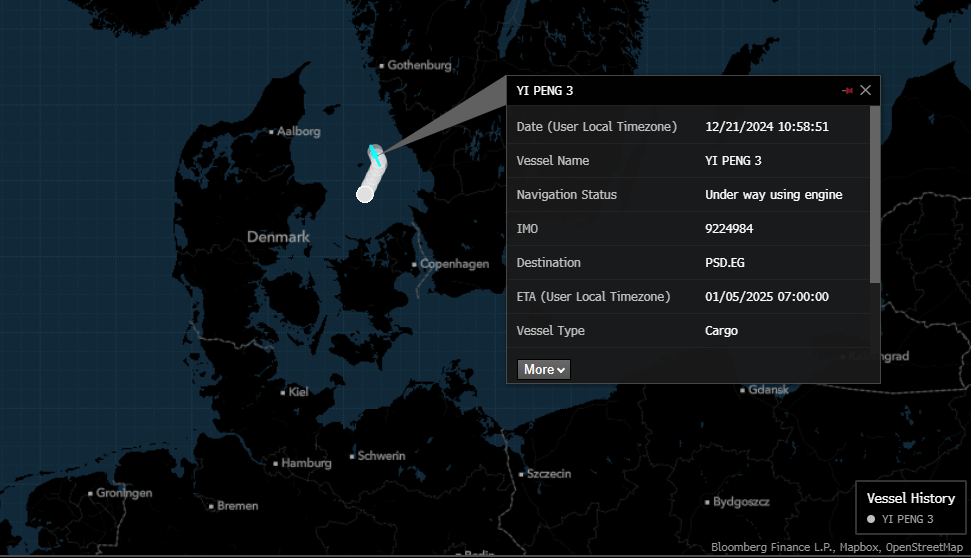
Two days after Swedish police and Chinese authorities boarded the Yi Peng 3, a 225-meter bulk carrier suspected of sabotaging undersea fiber optic cables in the Baltic Sea last month, the vessel restarted engines early Saturday morning and resumed transiting the Danish Straits.

Sal Mercogliano, a professor at Campbell University and the host of the What Is Going On With Shipping? show on YouTube, stated on X that Yi Peng “is underway and heading out of the Kattegat toward the North Sea toward the Suez.” 

Data compiled by Bloomberg confirms Yi Peng has been underway since early Saturday morning. 

Mercogliano noted that Swedish police and Chinese investigators boarded the vessel earlier last week.

He said, “The Swedes were allowed to observe the questioning,” adding, “They have not released any findings from their investigation.” 

Also, Mercogliano cited ship tracking data that shows Yi Peng 3 is being escorted by at least one Danish warship. 

Here’s our reporting on the ongoing situation:

One X user suggested, “Hmmm…. Perhaps it should have an escort so it takes the deep water route, rather than heading towards all those cables in the English Channel…” 

Tyler Durden
Sat, 12/21/2024 – 13:25

In Latest Threat To German Democracy, Dangerous Fascist Elon Musk Tweets Six Words About AfD

0
In Latest Threat To German Democracy, Dangerous Fascist Elon Musk Tweets Six Words About AfD

Authored by Eugyppius via eugyppius.com,

German democracy, which has existed undeterred since 1949 but is somehow always shaken to its foundations whenever anybody sings the wrong song or holds a televised debate with the wrong person, is once again on life support.

Christian Lindner, head of the market-liberal Free Democrats, did much to trigger the present catastrophe on December 1st, when he said that the Free Republic should “dare more Milei and more Musk”. Because there is little distinction between praising Milei and Musk and demanding the return of National Socialism, there ensued a brief period of establishment hyperventilation.

Less than a week later, CDU chief and probable future German Chancellor Friedrich Merz did his part to denounce Lindner’s political wrongthink in a statement to Deutschlandfunk:

So neither the Argentinian President nor, how shall I put it, the American entrepreneur Elon Musk – let’s put it plainly – are role models for German politics in my view. I don’t see where we can find similarities in German politics. What Christian Lindner meant will probably remain his secret.

The next day, Merz repeated the same denunciations, only more harshly, explaining to one of our extremely adult and far-sighted pantsuit talkshow hosts that “To be honest, I was completely appalled that Christian Lindner made that comparison.” Milei, Merz said, is “really trampling on the people there”.

Yesterday, all of this came to the notice of the (honestly rather tiresome) influencer Naomi Seibt, who posted a video statement to X rehearsing all of this old news to her largely American audience.

Elon Musk then brought down the hammer on the German democratic order, retweeting Seibt’s video and remarking that “Only the AfD can save Germany”.

Today a lot of very important and influential people got out of bed and took to their keyboards to denounce Musk’s election interference. His statement might be illegal, at any rate it is very likely fascist and certainly it is beyond the pale for an American to voice an opinion about German politics. Germans absolutely never, ever, utter the slightest word about American politics and certainly would never advance negative opinions about the American President in the middle of an election campaign. Our Foreign Office would never try to fact-check an American presidential debate! Our journalists would never depict President Donald Trump dressed as a Ku Klux Klan member or offering the Hitler salute or decapitating the Statue of Liberty! That’s just not done!

Like a great stream of green diarrhoea, the outrage is pouring forth. Matthias Gebauer, who writes for Der Spiegel, observes that “Elon Musk… is openly promoting the AfD” and concludes that “Putin is not the only one who loves this party”. Erik Marquardt, head of the Green faction in the European Parliament, says that “The EU Commission and EU member states should no longer stand by and watch as billionaires misuse media and algorithms to influence elections and strengthen and normalise Right-wing extremists”. This “is an attack on democracy”, and “has nothing to do with freedom of expression”. Dennis Radtke, CDU representative in the European Parliament, concludes that “Musk… is declaring war on democracy” and that “the man is a menace”. We are also under siege via “interference from Putin”; “the erosion of our democracy is being fuelled from both within and without”. Julian Röpcke, who writes for BILD, believes that “This is interference in the German election campaign by a tech billionaire who uses algorithms to decide what gets heard”. If Germany does not “respond with penalties, there will be no help for our eroding democracy”.

Jonas Koch, at Die Zeit, complains that “the richest man in the world is now campaigning for Right-wing populists in Germany”.

Tech billionaire Elon Musk has spoken out in favour of the Alternative for Germany party in the German Parliamentary election campaign. “Only the AfD can save Germany,” he wrote on his online service X.

You can almost see Mr. Koch before you, clasping his pearls. He notes that the Government is doing its best to weather this unprecedented assault on the German republic. He quotes longsuffering Government spokesperson Christian Hoffmann saying that “It’s not the first time that Elon Musk has commented on German politics”. Olaf Scholz, he notes, “has been concerned about… X since Musk assumed control of it”, but he has inexplicably not yet decided to delete Government X accounts.

Nor is this Musk’s only sin against all that is right, free and good:

Musk is not only increasingly involved in politics in the U.S., where he is advising U.S. President-elect Donald Trump and is to head a commission to reduce Government spending. He is also exerting influence in the U.K. He recently announced a donation of up to $100 million to the Right-wing populists around Brexit pioneer Nigel Farage.

As early as the summer, Musk had praised the AfD after the European elections. The party was labelled as Right-wing extremist, “but the political positions of the AfD that I have read about do not sound extremist”, he wrote on X.

Der Spiegel agrees that this is “Not the first time that this super-rich man has interfered in German politics”.

Musk “repeatedly takes potshots at Germany”, he has “insulted” such national saints as “the former Chancellor Angela Merkel”, he has “criticised Chancellor Olaf Scholz”, and most ominously of all he has “even responded to tweets from the far-Right Thuringian AfD leader Björn Höcke”.

He responded to Höcke! Imagine that! It is just the height of political depravity, all that responding.

Now the billionaire and confidant of U.S. President-elect Donald Trump has tweeted again…

Tweeted again! The absolute madman! Will he never stop?

…and made a barely concealed election recommendation for the AfD. “Only the AfD can save Germany,” Musk claimed in a tweet. …

Under Trump, Musk is set to become co-head of the newly created Department of Government Efficiency. The goal of the institution: to reduce bureaucracy, eliminate regulations and cut spending. This could result in Musk weakening or even abolishing those rules that personally limit him.

That’s right, Musk wants to make American Government more efficient so that he can suspend elections and establish himself as American dictator. It takes truly perceptive journalists, like whoever wrote this unsigned Spiegel screed, to see through his clever lies.

Musk constantly uses X for political influence. He not only interferes in German politics from there, but also tries to exert pressure on U.S. Congressmen. … Since Wednesday, he has fired off various tweets to fuel the U.S. budget dispute. He also recently received representatives of the British far-Right [sic] party Reform U.K. at Trump’s private residence Mar-a-Lago in Florida.

He is like a little antidemocratic Hitler, is Elon Musk, just tweeting whatever he wants, receiving guests, influencing… things.

But the gold medal for most outrageous reaction must go to Florian Harms, Editor-in-Chief of t-online. Harms writes for a slightly downmarket publication and so he has to enact more indignation than everybody else.

“This sentence is an outrage,” Harms declares.

There’s always a lot going on on the big-shot platform X. Since Ober-Big-Shot Elon Musk bought the social media company and reprogrammed its algorithms to inject poison, most posts there have devolved into unfounded claims, wild insults or outrageous nonsense. You can safely ignore it.

Unfortunately, what the “Grökraz” himself posts on X cannot be ignored. This Friday, our “greatest Croesus of all time” felt compelled to intervene in the German federal election campaign with a one-liner: “Only the AfD can save Germany.” … That’s his prerogative; after all, anyone can now post nonsense on his platform.

Harms is clearly highly opposed to platforms where anyone can just post anything. People should only be allowed to post things of which Harms approves. Particularly someone like Musk should not be allowed to just post whatever he wants, because Musk is “a global entrepreneur” and therefore “bears special responsibility”:

His words carry weight because they influence international politics, stock markets and social moods. More than 208 million people follow Musk on X; he has configured the digital machines so that his posts are displayed more often than others. This gives his radical views a disproportionate amount of attention, which is how he makes politics – without democratic legitimisation.

Vast swathes of the German corporate sector denounce the AfD all the time without the slightest “democratic legitimisation”, and as far as I know Harms has never complained about that even once. If Musk were attacking AfD, of course, Harms would be totally thrilled with it.

The so-called Alternative for Germany is a crazy party… [A] growing number of its officials are Right-wing radicals and enemies of democracy. This is well known and can be read in in the various reports by the Office for the Protection of the Constitution.

German political discourse is so insane, I always feel slightly ashamed translating this stuff for you. It feels like dishing out embarrassing family secrets.

Only someone who is either clueless or maliciously intent on spreading misinformation would think that this party alone could contribute something constructive for the good of Germany.

Unfortunately, based on everything we’ve heard from Elon Musk in recent months, we have to assume the latter. This man wants to undermine constitutional and democratic institutions, abolish the welfare state and create a Darwinian world in which the law of the jungle applies. It’s bad enough that he is now gaining so much influence in the USA. This must not happen in Germany. …

Democratic politicians should… refute Musk’s claim. And… they should take a particularly critical look at future investments by Musk’s companies in this country. Consumers also bear a responsibility: Anyone who is still considering buying a Tesla must accept the accusation of supporting a destroyer of democracy. [emphasis mine]

This is all so boundlessly ridiculous, it’s like the entire country is suffering from borderline personality disorder.

If any of these people sincerely believe that Musk’s tweet will have any influence on the German elections in February, they are clinically insane. The only thing here that might influence something is the unceasing hysteria of German establishment discourse, which seems intent on alienating powerful figures at the centre of empire, all for the indecent and passing thrill of a cheap moral orgasm. Any political order that is truly threatened by a six-word remark from anybody – even should it come from the wealthiest, most antidemocratic, fascistic and powerful man in the world – is not a political order worth having.

Tyler Durden
Sat, 12/21/2024 – 12:50

Cocoa Biggest Commodity Winner Of Year As Food Inflation “Enters Dangerous Territory”

0
Cocoa Biggest Commodity Winner Of Year As Food Inflation “Enters Dangerous Territory”

One theme we’ve harped on this year has been the reignition of global food prices, which show little sign of abating as the new year quickly approaches. Among the most impressive rallies has been in the cocoa market, outpacing all major commodities in 2024 amid tightening global supplies. Prices for orange juice and coffee have also surged, highlighting sticky food price inflation.

Source: Bloomberg

The dire situation in West Africa — home to the world’s largest cocoa farms — has pressured bean prices to record highs as crop disease and adverse weather conditions sparked a global supply crunch.

Last week, Goldman analysts told clients to go long cocoa (more about the trade here) for “another rally” driven by “structural supply deficits, under-hedged consumers, and historically low warehouse stocks.” 

Supply concerns pushed cocoa futures in New York to nearly $13,000 per ton last week. This surge has driven prices by almost 200% this year, making cocoa a top commodity performer. 

Next is orange juice; futures in New York soared 73% on the year amid imploding citrus production in Florida. 

After OJ, Arabic coffee futures in New York are up 72% this year, driven by ongoing fears of a global supply crunch. Prices have hit a record high.

Broad food price trends via the Food and Agriculture Organization of the United Nations’ Food Price Index, which tracks international prices of a basket of globally traded foods, show that prices have alarmingly re-accelerated this year. 

We warned the other week that food price inflation has “entered very dangerous territory and expect the trends that have been pushing up food prices to accelerate even more in 2025.”

Separately, we penned two notes in the last week on retail egg prices zooming to new highs and beef prices in record territory.

Tyler Durden
Sat, 12/21/2024 – 12:15

US Had Foreknowledge Of HTS Offensive To Topple Assad, Prepped Its Proxies To Join

0
US Had Foreknowledge Of HTS Offensive To Topple Assad, Prepped Its Proxies To Join

Authored by Dave DeCamp via AntiWar.com,

The US had foreknowledge of the offensive led by the al-Qaeda-linked Hayat Tahrir al-Sham that ousted former Syrian President Bashar al-Assad and helped another rebel group join the fight, The Telegraph reported this week.

The report said the US notified the Revolutionary Commando Army (RCA), a US-funded militia based out of a US base at Al Tanf in southern Syria, to “be ready” for an attack that could lead to the end of Assad’s rule.

US training proxies in Syria (Tanf), via US Army

“They did not tell us how it would happen,” Bashar al-Mashadani, an RCA commander, told The Telegraph. “We were just told: ‘Everything is about to change. This is your moment. Either Assad will fall, or you will fall.’ But they did not say when or where, they just told us to be ready.”

In October, the US brought several other Sunni Muslim militias under the command of the RCA, swelling the force from 800 fighters to about 3,000. All of the fighters are armed by the US, and the US pays their salaries of $400 per month. The US also backs the Kurdish-led SDF in eastern Syria, but the RCA is a separate force.

When the HTS-led force began its offensive from Syria’s northwest Idlib province and advanced south toward Damascus, the RCA headed north.

According to The Telegraph, the US-funded group now controls about one-fifth of Syria’s territory. Mashadani spoke to the paper from a former Syrian government air base that was used by Russia outside of the city of Palmyra.

Mashadani said RCA and HTS were cooperating during the offensive and that the US coordinated the communication between the two groups from Al Tanf. The US has celebrated the overthrow of Assad and made clear it’s willing to work with HTS despite the fact that the group is an offshoot of al-Qaeda and designated by the State Department as a foreign terrorist organization.

The Telegraph report makes clear that the US was aware of the planned HTS offensive. RCA members said the US told them about the opportunity to overthrow Assad in early November, about three weeks before the offensive started. Mashadani said the US wanted his group to capture territory to keep it out of the hands of ISIS, which RCA has helped the US fight in the past.

ISIS flag spotted on militants’ car in Syrian city of Homs within a day after the HTS takeover…

The Biden administration on Friday sent a high-level State Department official to Damascus to meet with HTS’s leader Mohammad Abu al-Julani, who has long had a $10 million US bounty on his head (which is subsequent to Friday’s meeting being removed). Julani founded the al-Qaeda affiliate in Syria, known as al-Nusra Front. In 2016, Julani changed the name of Nusra as part of a rebranding campaign to gain support from the West and merged the group with several other Islamist factions to form HTS in 2017.

Tyler Durden
Sat, 12/21/2024 – 11:40

Government Shutdown Averted As Biden Signs Stopgap Spending Bill

0
Government Shutdown Averted As Biden Signs Stopgap Spending Bill

Update (1120ET): President Joe Biden signed funding legislation to keep the US government operating until mid-March, avoiding a year-end shutdown and kicking future spending decisions into Donald Trump’s presidency.

The legislation went to Biden early Saturday morning after the Senate voted 85 to 11 to approve the measure, which sailed through the House hours earlier.

“The Speaker did a good job here, given the circumstances,” Musk said on his social media platform X.

“It went from a bill that weighed pounds to a bill that weighed ounces.”

Biden’s signature extends government funding to March 14 and includes more than $100 billion in aid for natural disaster victims and farmers, the White House said in a statement.

*  *  *

As Joseph Lord and Arjun Singh detailed earlier via The Epoch Times, both chambers of Congress on Dec. 21 passed a last-minute funding package that would extend government funding to March 14, sending it to President Joe Biden’s desk.

The legislation, dubbed the American Relief Act, passed the Senate in a late-night 85-11 vote that wrapped up not long after the midnight shutdown deadline on Saturday. The House of Representatives passed the same bill in a 366–34 vote earlier in the afternoon on Dec. 20.

The passage of the legislation by both chambers of Congress caps off a week of uncertainty as lawmakers sought to reorganize following the collapse of a previous funding agreement due to opposition from President-elect Donald Trump and other Republicans.

Aside from punting government funding into next year, the 118-page bill approves $110 billion in emergency hurricane relief and $30 billion in farm aid, extends the farm bill for one year, and includes a series of other minor provisions.

“This is America First legislation, because it allows us to be set up to deliver for the American people in January,” House Speaker Mike Johnson (R-La.) said following the lower chamber’s passage of the legislation.

Senate Majority Leader Chuck Schumer (D-N.Y.) indicated that although he wasn’t thrilled about the package, he was happy an agreement had been reached.

“We got some major things we wanted in the bill, particularly the disaster relief. … we kept the government open, and we didn’t get the debt ceiling,” Schumer said. “So there were three major victories. We didn’t get everything we wanted, but I think if you look at the vote in the House, people felt pretty good it was virtually unanimous.”

Biden is expected to sign the bill, according to the White House.

“President Biden supports moving this legislation forward and ensuring that the vital services the government provides for hardworking Americans—from issuing Social Security checks to processing benefits for veterans—can continue as well as to grant assistance for communities that were impacted by devastating hurricanes,” White House Press Secretary Karine Jean-Pierre said in a statement.

Absent from the proposal is any mention of the debt ceiling. Trump previously called on Johnson to use the lame duck session to suspend or raise the debt ceiling, which could give Democrats policy leverage in the next Congress.

However, both House Minority Leader Hakeem Jeffries (D-N.Y.) and Senate Majority Leader Chuck Schumer (D-N.Y.) expressed opposition to such a move.

“This would have been a very unfortunate time to add the debt limit to any agreement, any [Continuing Resolution], and I’m very glad we didn’t,” Schumer told reporters ahead of the vote.

Trump made the debt ceiling issue a pillar of his opposition to the original funding proposal released Tuesday.

Coming in at 1,547 pages, that proposal ignited a social media firestorm. Elon Musk, a close political ally of Trump, waged a crusade against the legislation on X, vowing to fund primary challenges against any Republican who supported it.

It later culminated in Trump’s announcing in a joint statement with Vice President JD Vance that he opposed the legislation, which effectively left the deal—the product of months of backroom negotiations between both chambers of Congress—dead on arrival in the lower chamber.

On Dec. 19, the House overwhelmingly rejected a scaled-down, 116-page draft of the funding plan that included a suspension of the debt ceiling until January 2027.

Democrats, who have historically backed government funding measures, objected to the withdrawal of the original proposal and the suspension of the debt ceiling—an issue that promises Democrats a rare piece of leverage in the upcoming Republican-dominated government.

Several Republicans objected to the inclusion of a provision to raise the debt ceiling as well as new spending in the bill.

The draft of the bill that ultimately passed on Friday was similar to the rejected proposal, though it didn’t include provisions on the debt ceiling.

Trump has not weighed in since the House introduced the Plan C legislation on Dec. 20.

Sen. John Fetterman (D-Pa.) offered colorful words for the piece of legislation after it passed the House.

“This whole situation is, it would be the [expletive] Christmas movie on ‘Lifetime,’ except we don’t find true love, and we didn’t get to save the cookie factory in the small town,” Fetterman told The Epoch Times.

Sen. Ron Johnson (R-Wis.), frustrated with the cost of the funding package, said he would be voting “no.”

“I don’t care about the pages” removed from the original bill, Johnson told The Epoch Times. “They didn’t pay for it, so I’m not voting for it.”

Tyler Durden
Sat, 12/21/2024 – 10:30

Houthi Hypersonic Missile Renders Iron Dome Useless, Slams Into Tel Aviv Area

0
Houthi Hypersonic Missile Renders Iron Dome Useless, Slams Into Tel Aviv Area

Yemen’s Houthi rebels launched its second hypersonic missile attack on Israel in just days, striking the Tel Aviv area early Saturday morning. The attack marked a rare instance where a hypersonic weapon overwhelmed Israel’s Iron Dome missile defense system, underscoring the challenges posed by these new ultra-fast missiles. 

“Between the Yemeni Armed Forces regarding the implementation of a military operation targeting a military target of the Israeli enemy in the occupied Jaffa area with a hypersonic ballistic missile Palestine 2,” Houthi military spokesman Yahya Saree announced on X. 

Footage post on X shows the failed interception of the hypersonic missile by the Iron Dome system. 

Here’s another view. 

And another. 

No fatalities were reported, but The Jerusalem Post stated that emergency services treated 16 people who were injured by glass shards following the missile impact. Israeli police confirmed that property damage had also occurred.

According to Reuters, Israeli airstrikes killed at least 25 people in Gaza on Friday. This hypersonic attack on Israel via Houthis could be in response to those airstrikes. Also, earlier in the week, Houthis launched two hypersonic missiles targeting military sites in the Jaffa region. 

This week’s exchange of strikes between the Iranian-backed Houthis and Israel shows how exactly the next major conflict will play out, especially with the use of hypersonic weapons. 

“Future wars are all about drones & hypersonic missiles,” Elon Musk wrote on X last month, while commenting on a Joe Rogan podcast with Marc Andreessen. 

The Free Press’ Jay Solomon recently asked: “Is World War III Already Here?”  

Tyler Durden
Sat, 12/21/2024 – 09:55

Strange Narrative Emerging In Horrific Christmas Market Attack…

0
Strange Narrative Emerging In Horrific Christmas Market Attack…

Authored by Steve Watson via Modernity.news,

Following the horrific terrorist attack at a Christmas market in Magdeburg, an odd narrative is emerging in the German media.

Saudi Arabia has claimed that they repeatedly warned the German government about the perpetrator, yet he was still roaming free and able to plough a car into hundreds of people Friday night.

Latest reports say that 200 people have been injured and five people, including a small child, tragically killed in the attack, footage of which was caught on CCTV and quickly spread online.

The murderer who drive the vehicle was arrested and it quickly emerged that he is a fugitive from Saudi who has remarkably been living in asylum in Germany with citizenship for 18 years.

German outlet Der Spiegel reports that 50-year-old Taleb Al-Abdulmohsen, reportedly a specialist in psychiatry and psychotherapy, was allowed to stay in Germany despite repeated requests for extradition by the Saudi authorities and at least three warnings that he was a dangerous criminal.

The German government cited concerns over human rights and freedom of expression as the cause for not agreeing to send the man back to Saudi.

In addition to these warnings, people who knew the man also apparently tried to warn the German authorities he was dangerous and intended to kill.

Little more is known about the terrorist at this point, but Der Spiegel is claiming that the man no longer identifies as an Islamist, writing that “He appears on the Internet as an ex-Muslim and opponent of Islam. The background to the incident is still completely unclear – as is the possible motive.”

The outlet claims that the man “had been threatened with death for turning away from Islam.”

The report also claims that “SPIEGEL research has shown that Taleb A. openly sympathized with the AfD online.”

The AfD is the right wing populist party in Germany that is gaining massive support owing to its anti-immigration/pro deportation stance.

Der Spiegel claims that the perpetrator “had been an activist for years, advising mainly women from Saudi Arabia about ways to escape from their country and running a website with information on the German asylum system.”

It’s completely unclear at this time why any of this, if true, would lead him to plough a car into innocent German people at a Christmas market.

The market looks to have been left completely unprotected, despite several past attacks of this sort at these exact events.

As we highlighted just a couple of days ago, German police at one Christmas market were filmed interrogating an elderly lady and ultimately confiscating a pocket knife from her.

They are clearly aware that there is a threat at these markets, but chose to indiscriminately target those attending, rather than using common sense to gauge exactly who the threats are coming from.

*  *  *

Your support is crucial in helping us defeat mass censorship. Please consider donating via Locals or check out our unique merch. Follow us on X @ModernityNews.

Tyler Durden
Sat, 12/21/2024 – 09:20