59.5 F
Chicago
Friday, October 9, 2026
Home Blog Page 2014

Biden-Harris Supplies Record $15 Billion Low-Interest Loan To PG&E For Combating “Climate Change” 

0
Biden-Harris Supplies Record $15 Billion Low-Interest Loan To PG&E For Combating “Climate Change” 

The Biden-Harris administration has provided a low-interest loan commitment to California utility giant PG&E to tackle “climate change” and bolster its power grid. The move reflects the administration’s broader push over the first term: out-of-control compulsion to spend taxpayer funds like a drunken sailor on endless wars, climate change, wokeism, and more.

The Wall Street Journal reports the Energy Department’s Loan Programs Office has provided PG&E with a record $15 billion low-interest loan commitment, allowing the utility company to revamp hydroelectric infrastructure, support green projects, and improve the power grid.

Sources familiar with the matter said the Energy Department was initially set to provide PG&E with a $30 billion loan, but that figure was halved due to concerns about the utility’s large upfront payments.

The Biden-Harris team’s uncontrolled spending spree comes just days after they provided the Energy Department’s second-largest loan—$9.6 billion—to a joint venture between Ford Motor Company and South Korean battery maker SK On to help finance battery plants in Tennessee and Kentucky.

Last month, the Energy Department announced a $6.6 billion loan to Rivian Automotive to build a factory in Georgia, which was previously shelved amid financial turmoil at the EV startup.

Another joint venture, between Stellantis and Samsung SDI, secured a $7.5 billion loan commitment this month to construct EV battery plants in Indiana.

Biden-Harris’ 2022 Inflation Reduction Act has turbocharged the Energy Department’s lending capacity, funneling hundreds of billions into green projects. However, there are growing concerns that this unchecked spending continues to stoke elevated inflation.

Meanwhile, utility giant Duke Energy has pulled back from the Energy Department’s lending facility ahead of the next administration, citing uncertainties surrounding the program.

This uncontrolled spending spree by the Biden-Harris team comes as the US deficit exploded to a staggering $624.2 billion for October and November. This marks the highest deficit on record for the first two months of the fiscal year.

As for Elon’s Department for Government Efficiency (DOGE) somehow managing to trim federal spending…

… all we have to say is: good luck with that one. 

Tyler Durden
Tue, 12/17/2024 – 15:25

2025’s Best (And Worst) US States For Sound Money

0
2025’s Best (And Worst) US States For Sound Money

Authored by Jp Cortez via The Mises Institute,

The newly-released 2025 Sound Money Index has identified Wyoming, South Dakota, and Alaska as the states with the most favorable policies toward constitutional sound money, while Vermont, Maine, and California take the most hostile stances.

Released annually by the Sound Money Defense League and Money Metals Exchange, the Sound Money Index is a comprehensive scorecard evaluating how each US state promotes or impedes sound money policies. Ranked policies include sales, income, and gross revenue taxes connected with precious metals, state affirmation of gold and silver as money, strengthening protections of gold and silver clause contracts, and state precious metals depositories.

Additional criteria include issuing or investing in gold bonds, inclusion of physical gold or silver in state pension or reserve funds, state mechanisms to accept and remit taxes and other payments in gold and silver, and crippling regulatory burdens imposed on precious metals dealers and investors.

The 2025 Index saw several states improve their rankings dramatically after having enacted pro-sound money tax legislation in 2024. Nebraska’s elimination of capital gains taxes on precious metals propelled it from 22nd to 8th place, while Alabama leapt almost twenty spots from 28th to 9th place. Both of these states had already eliminated their state sales tax on purchases of gold and silver coins, bars, and rounds, so removing income taxes on sales was the next logical step. 

Louisiana jumped from 17th to 12th place after Governor Jeff Landry signed a bill reaffirming gold and silver as legal tender in the state. Wisconsin and New Jersey also saw major improvements from their previous year’s ranking after repealing sales taxes on precious metals. Wisconsin climbed from 44th to 26th place, and New Jersey moved from 49th to 39th.

“Money Metals has spent a full decade promoting state-level sound money reforms, and I’m proud to say these bills tend to be among the most popular proposals considered in recent legislative seasons,” said Stefan Gleason, CEO of Money Metals.

“For example, today there are 45 states that have partially or fully exempted sales taxes on precious metals.”

Only five states – Kentucky, Maine, Vermont, New Mexico, and Hawaii – continue to tax precious metals purchases, despite the impact on individuals, businesses, and families seeking a vehicle through which to preserve the purchasing power of their savings. However, not all precious metals sales tax exemptions are created equal.

Wisconsin Governor Tony Evers signed a full exemption on purchases of gold and silver from the state sales tax without any restrictions. The measure did not include an exemption for platinum and palladium. 

The New Jersey bill ultimately signed by the governor does not exempt purchases of “investment coin,” defined as,

…any numismatic coin manufactured of gold, silver, platinum, palladium, or any other metal, including non-precious metals, and having a fair market value of not less than $1,000. ‘Investment coin’ shall not include jewelry or works of art made of coins, nor shall it include commemorative medallions.

Inclusion of these two limited exemptions earned New Jersey only 13 points out of a possible 18 in the sales tax categories of the 2025 Sound Money Index, while Wisconsin’s partial exemption earned the state only 14 points.

Several other states also considered capital gains exemptions on precious metals this year, setting the stage for more sound money reforms in the coming years.

“The Sound Money Index continues to hold states accountable for policies that impact Americans’ ability to protect themselves from inflation and financial instability,” said Jp Cortez, Executive Director of the Sound Money Defense League. Cortez continued, “as the Federal Reserve note’s purchasing power continues to fall, Americans need more options to protect their savings. The Sound Money Index tracks the sound money movement, calling attention to states that still shackle gold and silver with regulation and taxes, and highlights the forward-thinking states that enable the metals to function as savings and money.”

Tyler Durden
Tue, 12/17/2024 – 15:05

Trump Might Reverse ‘Very Stupid’ Long-Range Strikes On Russia

0
Trump Might Reverse ‘Very Stupid’ Long-Range Strikes On Russia

Authored by Dave DeCamp via AntiWar.com,

President-elect Donald Trump suggested at a press conference at Mar-a-Lago on Monday that he could reverse President Biden’s decision to support long-range missile strikes on Russian territory.

Trump said it was a “big mistake” for the Biden administration to greenlight the escalation without asking him what he thought. When asked if he might reverse the decision, the president-elect said, “I might, yeah. I thought it was a very stupid thing to do.”

The comments mark the second time in recent days that Trump expressed his concern over the long-range strikes that Ukraine has launched using US ATACMS missiles and British Storm Shadow missiles.

In an interview with Time Magazine that was published last week, Trump said that he “vehemently” disagreed with Biden’s decision. The Kremlin noted Trump’s comments and said Russia agreed with the president-elect.

“The statement in itself is fully in harmony with our position. That is, our visions of reasons behind the escalation coincide. And, of course, we like that,” said Kremlin spokesman Dmitry Peskov.

Biden signed off on long-range strikes in Russia despite Moscow making it clear the escalation would risk nuclear war. In response to the step, Russian President Vladimir Putin formally changed Russia’s nuclear doctrine, which lowered the threshold for the use of nuclear weapons.

At his press conference, Trump also said that Ukrainian President Volodymyr Zelensky should be ready to make a deal with Russia to end the war. “He should be prepared to make a deal. That’s all. Too many people being killed,” he said.

Trump campaigned on ending the proxy war but hasn’t articulated how he will do that. When asked if he would pressure Ukraine to cede territory, Trump wouldn’t give a direct answer.

Tyler Durden
Tue, 12/17/2024 – 14:45

Some Honesty About Inflation

0
Some Honesty About Inflation

Authored by Jeffrey Tucker via The Epoch Times,

Inflation numbers came out last week. For once, we got some honesty from the mainstream media.

“Growing inflation poses challenges for the Fed,” said the WSJ.

“Progress on inflation stalled, complicating Republicans’ plans,” said the NYT.

That’s a major change in the tune from “it’s just transitory.”

That was Janet Yellen, four years ago!

It was a grim number, an annualized increase of 2.7 percent, which is still far over the target rate.

Those of us who watch real-time numbers knew it was coming. We’ve seen a heating up for three months. Right now, those numbers are showing a 3 percent rate of annualized inflation.

It’s been a four-year trend now toward ever higher prices, resulting in a dramatic loss of purchasing power in terms of goods and services. In this time, the dollar has lost a minimum of 25 cents of value or as much as double and triple that depending on the purchase. The result has been a loss of real income, hitting the working class and poor the hardest.

At last we are getting some honesty, probably now that it is a problem that Trump will inherit. Plenty of people out there are happy about this and have hopes that the problem with vex him as it did Biden.

We did not hear this on the campaign trail but there is not much a president can do about inflation in the short term. The usual lag between cause and effect on inflation is 12 to 18 months.

Unplugging the money-printing machine is a fix down the line. But in the short term, it has a potentially deleterious effect on macroeconomic stability that can result in obvious recession. And right now, we see all the signs of a reacceleration taking place.

The money stock as measured by M2 bottomed out in October 2023 but has since increased by $1.9 trillion. That’s a dramatic turn that only adds fuel to the inflationary fire. It’s not just the deliberate policy to loosen up via interest rate cuts but also a change in velocity combined with more bank lending. None of it looks good for stabilizing the dollar in terms of domestic purchases.

(Data: Federal Reserve Economic Data (FRED), St. Louis Fed; Chart: Jeffrey A. Tucker)

The sticky price index has never shown much in the way of victory over the worst inflation in nearly half a century. Certainly there has never been a reason to relax, much less change posture from a restrictive policy to a more liberal one. It currently stands at 3.9 percent, which is nearly double the target rate. That’s an incredibly bad rate of inflation to start a new presidential term.

(Data: Federal Reserve Economic Data (FRED), St. Louis Fed; Chart: Jeffrey A. Tucker)

That the central bank is primarily responsible for inflation is not unknown. The trouble with putting an end to it—which would actually be very easy—is mainly a political one. Every president wants lower interest rates in order to drive national output. They don’t like a central bank policy that is restrained with higher rates. So they typically push for lower rates.

Lower rates create conditions for more credit expansion and that adds to the money stock and fuels inflationary pressure for which the president is held responsible. However, he is also held responsible for recessions. That creates a terrible dilemma for an incoming administration that had made two grand promises: to boost economic growth and end inflation.

Absent huge structural changes in regulation and spending, it is not likely both can happen at once.

When this dilemma confronted Ronald Reagan upon taking office in 1981, the answer was to endure a recession for 18-24 months to create the conditions for future economic growth. But it was a true war against the clock, with a huge scramble to boost growth while stopping inflation. They didn’t quite make it in time and lost substantially in the midterm elections of 1982. The recovery finally arrived in time for Reagan to win a second term.

In those days, officials were much more honest with the public. It was frankly admitted that a recession was a necessary condition for renewed growth. But it has been 40 years since anyone in a position of official influence has said anything remotely like that.

We have an added problem now that full recovery from the economic calamity of 2020 has never really happened. Job openings soared after reopening but those days are over, and we’ve been on a two-year slide. Moreover, the Philadelphia Fed is dropping some truth about jobs numbers from earlier this year. To summarize: they were fake.

Looking back at output numbers with a realistic estimate of inflation reduces GDP growth in real terms to recessionary levels, though it has not been widely admitted.

Where does that put the incoming Trump administration in relation to Fed policy? It’s a genuine dilemma. Despite all the pretenses from the top that the Fed is using informed science and access to granulated data to guide its decision-making, the reality is that Fed chairman Jerome Powell has no idea what to do now. He can continue the rate-cutting and reignite inflation or freeze rates now and risk the ire of the incoming administration.

Regional presidents of Federal Reserve banks around the country are divided on what should happen. It’s a balancing act because the labor market is weak and getting worse even as inflation is worsening too. Typically, the old models on which they used to rely posited that labor markets operate in an inverse relationship with price pressure. That pattern is not part of the present reality.

One possibility is that dramatic spending cuts of the federal budget could dampen inflationary pressure. That is because a reduced rate of debt creation takes pressure off the Federal Reserve to enter the bond market to support dollar-denominated debt. Part of the job of the Department of Government Efficiency (DOGE), which is not an official agency, is to create public support for dramatic spending cuts.

Maybe that works but will it be enough? Cutting $2 trillion out of the federal budget might sound easy but nothing like this has happened in a century of government policy. Is the public sufficiently alarmed about a fiscal crisis that it can endure extreme cuts in public services?

There is no way that cuts on that level will not be felt. The Washington bureaucracies backed by the press will scream about impending disaster, starving widows and orphans, slowed down passports, cuts in staff at monuments and federal parks, and all the other usual tropes. DOGE will need to be prepared to call out all the propaganda as nothing but flimflam designed to preserve the status quo.

What we really need is a return to honesty in economics, along with an admission that we cannot defeat the inflation we despise without a period of pain. I’m aware that no one likes to speak this way and that the political culture is hyper-intolerant toward long-term solutions. The expectations for the incoming Trump administration is that it will deploy some magic cure to lower real incomes, deep indebtedness, and a failing job market. Nothing like that exists.

Economics is about wealth creation but it is also about accounting. Optimism and political exuberance are wonderful but they cannot substitute for hard choices. And that includes some measure of pain before we can get on track toward renewed economic growth. That is a lesson that the incoming Trump administration can learn from Reagan’s experience in 1981.

*  *  *

Views expressed in this article are opinions of the author and do not necessarily reflect the views of The Epoch Times or ZeroHedge.


Tyler Durden
Tue, 12/17/2024 – 14:25

Russia Says Ukraine Allies Are ‘Accomplices’ In Moscow Assassination Of A Top General

0
Russia Says Ukraine Allies Are ‘Accomplices’ In Moscow Assassination Of A Top General

Update(1405): Russia has blasted the West for staying quiet after Ukraine openly boasted of assassinating a top Russian general earlier in the day, identified as Lieutenant General Igor Kirillov, who was killed when a scooter bomb detonated remotely upon his leaving his apartment in the early morning hours:

Russia on Tuesday criticised Ukraine’s allies over what it called insufficient reactions to the assassination in Moscow of the Russian army’s chemical weapons chief, an attack claimed by Kyiv.

Foreign ministry spokeswoman Maria Zakharova accused the West in a Telegram post of “approval for war crimes by fighters of the Kyiv regime” and said “all those who welcome terrorist attacks or deliberately hush them up are accomplices“.

This also brings up questions of past reports exposing a CIA program to train and assist Ukraine’s special forces and intelligence in sabotage and cross-border targeting…

American media consumers might have a short memory span, but the Russians sure don’t. The Kremlin is now calling Ukraine’s NATO backers ‘accomplices’ in a clear escalation of rhetoric.

President Putin had just this week warned that the West is going ‘beyond’ Russia’s red line in its support to Ukraine, and said things are escalating at a dangerous pace. As for this latest ‘scooter bomb’ assassination, the Kremlin is likely to immediately suspect that CIA and Western intelligence services may have assisted.

The bomb which was detonated remotely had a large blast radius (see video below) and was clearly a very sophisticated device, given the smallness of what was a literal children’s scooter apparently used in the plot.

* * *

In another scary escalation which will lead to unpredictable consequences, a top military general and head of the Russian military’s chemical weapons forces was killed in Moscow in a targeted blast which Ukraine quickly owned up to. Lieutenant General Igor Kirillov has been confirmed killed in an assassination bombing, and is the most senior Russian official killed since the start of the Ukraine war in 2022.

According to emerging details confirmed in state TASS news agency, citing Russia’s emergency services, a bomb was hidden in an electric scooter parked outside Gen. Kirillov’s apartment. As he and his assistant walked by, the explosive was remotely detonated. The assistant was also immediately killed. Footage showed a large blast outside the residential building.

Chief of Russia’s Radiation, Chemical and Biological Protection Troops Lieutenant General Igor Kirillov, via TASS.

The 54-year old oversaw Russia’s radiation, chemical and biological protection troops – and Kiev and Western sources have accused him of ordering deployment of chemical weapons in the conflict.

An official Kremlin statement reads: “On the morning of December 17, an explosive device planted in a scooter went off near a residential building entrance on Ryazansky Avenue in Moscow, the investigation showed. Chief of Russia’s Radiation, Chemical and Biological Protection Troops Lieutenant General Igor Kirillov and his aide were killed in the explosion.”

The Security Service of Ukraine (SBU) is openly boasting to being behind the killing and Ukrainian sources have acknowledged this to American media.

“Kirillov was a war criminal and an entirely legitimate target, as he issued orders to use prohibited chemical weapons against Ukrainian troops,” an SBU source told ABC. “Such an inglorious end awaits all those who kill Ukrainians. Retribution for war crimes is inevitable.”

“By order of Kirillov, more than 4,800 cases of the enemy’s use of chemical munitions have been recorded since the beginning of the full-scale war,” the SBU added, but only cited that grenades equipped with substances like CS and other riot control type irritants have been used.

Video of the bombing has also been released by the SBU. Clearly the hit was carefully planned an choreographed as the attack seems to have been filmed with a ground view from a nearby vehicle.

“The footage shows Gen. Kirillov and his aide exiting a building, with the infamous scooter standing nearby,” an unnamed Ukrainian source has described. “The moment they enter the blast zone of the explosive device, the scooter is blown into the air, delivering a ‘verdict’ to the war criminal.”

Moscow is vowing that Ukraine will pay dearly, with Russian Security Council Deputy Chairman and former president Dmitry Medvedev warning in a fresh statement in the aftermath of Kirillov’s death, “Attempts to intimidate our nation, stop the Russian offensive or sow fear are doomed. Certain punishment awaits Banderite Nazis, including the top military and political leaders of a crumbling country.”

Medvedev characterized the assassination it as done in desperation given that Kiev forces are steadily being beaten back on the Donbas. Indeed such cross-border acts have only gotten more brazen of late.

Medvedev continued: “This terrorist attack demonstrates the agony of the Banderite regime, which is struggling to justify its shaky existence in the eyes of its Western patrons and prolong the deadly hostilities while delivering cowardly attacks on civilians in cities and towns.”

Tyler Durden
Tue, 12/17/2024 – 14:05

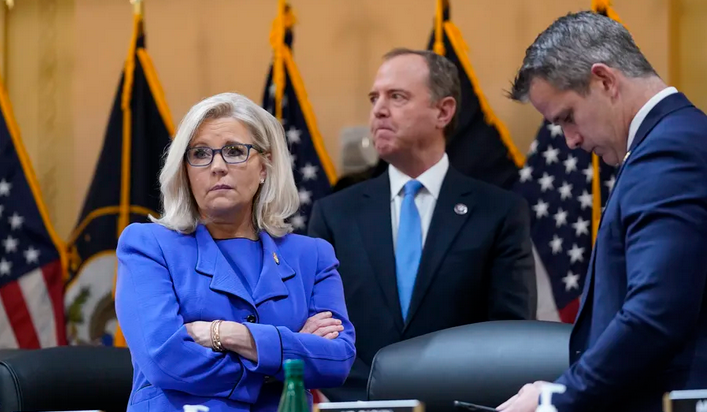
GOP Report: Liz Cheney Should Be Investigated By FBI Over Jan. 6 Investigation

0
GOP Report: Liz Cheney Should Be Investigated By FBI Over Jan. 6 Investigation

Authored by Casey Harper via The Center Square,

A new Republican oversight report accuses former Congresswoman Liz Cheney of colluding with witnesses in the Jan. 6 Select Committee investigation that she oversaw.

The bombshell report released Tuesday said Cheney should be investigated by the FBI for possible criminal activity for her role in the first committee, which was led by Democrats in the immediate aftermath of the conflict at the Capitol after now President-elect Donald Trump left office in 2021.

The Committee on House Administration’s Subcommittee on Oversight Chairman Barry Loudermilk, R-Ga., released the report, his second major report on the Jan. 6 storming of the Capitol.

From the report:

Based on the evidence obtained by this Subcommittee, numerous federal laws were likely broken by Liz Cheney, the former Vice Chair of the January 6 Select Committee, and these violations should be investigated by the Federal Bureau of Investigation. Evidence uncovered by the Subcommittee revealed that former Congresswoman Liz Cheney tampered with at least one witness, Cassidy Hutchinson, by secretly communicating with Hutchinson without Hutchinson’s attorney’s knowledge. This secret communication with a witness is improper and likely violates 18 U.S.C. 1512. Such action is outside the due functioning of the legislative process and therefore not protected by the Speech and Debate clause.

The Federal Bureau of Investigation must also investigate Representative Cheney for violating 18 U.S.C. 1622, which prohibits any person from procuring another person to commit perjury. Based on the evidence obtained by this Subcommittee, Hutchinson committed perjury when she lied under oath to the Select Committee. Additionally, Hutchinson was interviewed by the FBI as part of its investigation into President Trump. This Subcommittee sought a copy of the FBI report 302, documenting this interview and Hutchinson’s statements, but the FBI has refused to produce this vital document. The FBI must immediately review the testimony given by Hutchinson in this interview to determine if she also lied in her FBI interview, and, if so, the role former Representative Cheney played in instigating Hutchinson to radically change her testimony.

Cheney has yet to publicly responded to the report.

Trump recently suggested some committee members should face jail time. 

Sen. Bernie Sanders, I-Vt., told media outlets this week that President Joe Biden should issue preemptive pardons for those members, something he is reportedly considering.

In a statement first reported by The Hill responding to Trump’s jail threat, Cheney focused on Trump’s role in the Jan. 6 storming of the Capitol, not her own defense.

The report raised a litany of concerns and questions about how the Jan. 6 investigation was carried out, how witnesses may have been pressured or influenced, and how records, files and other evidence was handled.

“Over the past twenty-four months of this investigation, my subcommittee staff have faced incredible obstacles in pursuit of the truth; missing and deleted documents, hidden evidence, unaccounted for video footage, and uncooperative bureaucrats,” the report said.

Loudermilk’s first report examined the security lapses at the Capitol.

After Loudermilk and his team examining thousands of hours of video and millions of pages of documents, interviewing dozens of witnesses and multiple hearings, the report found the Jan. 6 event was a result of security lapses and bad decision-making at several levels of government.

“This report reveals that there was not just one single cause for what happened at the U.S. Capitol on January 6; but it was a series of intelligence, security, and leadership failures at several levels and numerous entities,” the report said. “Even amid multiple failures, there were two common elements that significantly contributed to the security issues: an excessive amount of political influence on critical decisions, and a greater concern over the optics than for protecting life and property.”

Tyler Durden
Tue, 12/17/2024 – 12:40

Asking Rents Fall 0.7% To Lowest Level Since March 2022

0
Asking Rents Fall 0.7% To Lowest Level Since March 2022

By Mark Worley of Redfin

The median U.S. asking rent fell 0.7% year over year in November to $1,595, the lowest level since March 2022. Rents were down 1.1% on a month-over-month basis.

The median rent is now 6.2% lower than when it hit an all-time high of $1,700 in August 2022.

Highlighting improved rental affordability, November marked the 19th consecutive month where the median asking rent price per square foot (PPSF) fell year over year, down 2.2% to $1.79. That’s the first time the median PPSF has been below $1.80 since November 2021. 

While the rental market has remained essentially flat over the past two years, rents have started to tick down slightly in recent months, thanks in part to the record number of new apartments that have been completed this year. 

Nationally, apartment completions rose 22.6% year over year to the highest level in over 12 years in the second quarter. As a result, the vacancy rate for buildings with five or more units rose to 8% in the third quarter, the highest level since early 2021.

“Renters in areas where construction has boomed are in a sweet spot right now. Affordability is improving as rents fall and wages rise, and there is increased choice with more and more new apartment buildings opening,” said Redfin Senior Economist Sheharyar Bokhari. “As construction starts to slow, rents will eventually tick back up, but 2025 is shaping up as a renter’s market with potential for the affordability gap between buying and renting to widen.”

Rents for 0-1 bedroom apartments fall to three-year low

With a major boost in supply, November marked the fifth consecutive month that asking rents fell across all bedroom counts.

Median asking rents for 0-1 bedroom apartments fell 1.7% year over year to $1,450 a month, the lowest level since November 2021. Rents for 2 bedroom apartments fell 1.1% (to $1,671) and 3+ bedroom apartments fell 2.3% (to $1,955).

On a price per square foot basis, the decline was more apparent, with 0-1 bedroom apartments falling the most (-2.5%), followed by 3+ bedroom apartments (-2.4%) and 2 bedroom apartments (-1.2%).

Austin rents drop 12%, leading a number of Sun Belt metros seeing significant declines

As has been the case for most of 2024, of the 44 major metros Redfin analyzes, Sun Belt metros saw the most significant declines in median rents, led by Austin, TX (-12.4%), Tampa, FL (-11.3%), Raleigh, NC (-8.4%), Jacksonville, FL (-7.5%) and Nashville, TN (-7%). 

Major Metros With Highest Rent Decreases

Rents rose the most in Midwest and on the East Coast metros, where there has been less new construction compared to the Sun Belt. 

Cleveland posted the biggest increase (10.6%), followed by Louisville, KY (10.2%), Baltimore (9.4%), Washington D.C. (9.4%), and Providence, RI (9.3%).

Major Metros With Highest Rent Increases


Tyler Durden
Tue, 12/17/2024 – 12:25

Turley To Debate Liberal Professor On ZeroHedge: Free Speech, Musk, And X

0
Turley To Debate Liberal Professor On ZeroHedge: Free Speech, Musk, And X

Elon Musk’s purchase of Twitter in late 2022 caused a media shit storm with calls for imminent bankruptcy, the infamous ADL shakedown, and disinformation alarm bells in the beltway think tank community.

Duking it out two years after the acquisition will be George Washington Professors Jonathan Turley and David Karpf. Each will join moderator Gene Epstein, director of The SoHo Forum, for a 90-minute debate broadcast live to the ZeroHedge homepage.

On the docket will be free speech, censorship, disinformation, and the government’s proper role in all this. The resolution: Elon Musk’s purchase of Twitter was a net positive for society. 

Turley for the affirmative will be making the free speech absolutist’s case in favor of Musk’s management style. The professor has lauded Musk as “the most consequential figure in free speech of our generation”:

A long-time 1A bull, Turley recently authored The Indispensable Right: Free Speech in an Age of Rage.

The Anti-Elon case:

Karpf — no longer on X — posted to “Substack Notes” that Musk had broken election law and committed “glaring violations” of Federal Trade Commission (FTC) consent law. Karpf referred to him as a “ketamine-addled chump” and predicted in March of 2023 that X/Twitter would be bankrupt within 6 months.

“Musk offered to buy Twitter on a (drug-addled) lark… Zombie Twitter will stumble along at a financial loss until Elon can find a villain to hang its failure on. “

FTC head Lina Khan was accused by Rep. Jim Jordan and the House Judiciary Committee of “blatant political harassment of Musk and Twitter” when Khan’s agency appeared to fast-track a probe into the billionaire and his new company immediately following his acquisition.

In this evening’s debate, Karpf will be arguing that Musk’s purchase and management style of Twitter has been a net negative for society.

Tune in live on the top of the ZeroHedge homepage and our X, YouTube, and Rumble accounts tonight at 7pm ET.

Tyler Durden
Tue, 12/17/2024 – 12:05

“We’re Almost There”: Congress Scrambles To Pass Stopgap Funding Bill Before Friday

0
“We’re Almost There”: Congress Scrambles To Pass Stopgap Funding Bill Before Friday

With less than four days to avoid a government shutdown, House Speaker Mike Johnson, (R-LA), and congressional leaders are working to finalize a bipartisan short-term funding bill, though delays and mounting frustrations within the House Republican caucus are complicating the effort.

Johnson, who initially expected to release the text of the bill over the weekend, then on Monday, said Tuesday that it would be unveiled by the end of the day.

“We’re almost there,” Johnson told reporters Tuesday following a press conference. “We do expect text today.”

The proposed legislation would keep the government funded through March 14 while addressing specific priorities, including disaster relief and $10 billion in assistance to farmers. Johnson emphasized that he intends to honor the House’s 72-hour rule, which requires time for lawmakers to review the bill before a vote. However, this would push the process close to the Friday midnight deadline for avoiding a shutdown.

Johnson said he remains focused on securing broad Republican support for the measure – which we’re sure will contain more pork than a barbecue pit.

Senate Leaders Echo Urgency

In the Senate, Majority Leader Chuck Schumer, (D-NY), struck a cautiously optimistic tone but stressed the need to finalize the agreement quickly.

“There continues to be good progress, but appropriators are still working on finalizing an agreement,” Schumer said Tuesday on the Senate floor. “Obviously, we’re getting closer to the December 20 deadline, so time is of the essence for Republicans to reach an agreement with us that we can act on quickly.”

Both chambers of Congress are facing pressure to wrap up funding negotiations before they adjourn for the Christmas, Hanukkah, and New Year holidays.

Frustration Grows Among House Conservatives

While negotiations continue, conservative House Republicans are growing increasingly critical of Johnson’s handling of the bill and its timeline.

“This is not the way to do things,” Rep. Chip Roy, (R-TX), said in a post on X.

Rep. Eric Burlison, R-Mo., delivered a scathing critique, calling the emerging legislation “a total dumpster fire” and expressing deep disappointment in Johnson’s leadership.

“I think it’s garbage,” Burlison told reporters. “This is why I ran for Congress, to try to stop this. And sadly, this is happening again… I’m disappointed. I think that he can do better. He can communicate better. The fact that we haven’t seen the language today and we’re supposed to vote on it this week is unacceptable.”

When asked if the situation makes him hesitant to support Johnson in the upcoming January 3rd vote for House speaker, Burlison deflected, saying, “That I won’t say.”

Johnson, however, brushed aside concerns about his leadership.

“I’m not worried about the speaker vote,” Johnson told reporters. “We’re governing. Everybody knows we have difficult circumstances. We’re doing the very best we can under those circumstances.“

Leadership Focused on Farmers, Disaster Relief

House Majority Leader Steve Scalise, (R-LA), offered support for Johnson’s efforts, underscoring the bill’s priorities while projecting optimism about the path forward.

“We plan to pass a bill to get the government funded,” Scalise said, “and ensure that we take care of disasters and our farmers here in America.”

Looking ahead, Scalise emphasized the urgency of finishing the week’s work while expressing hopes for a smoother 2024.

“We have a lot to do the rest of this week, but we all look forward to getting back home to our families and enjoying a great Christmas as we get ready for what will be a very busy and productive New Year,” Scalise said, standing alongside Johnson.

Stay tuned for updates…

Tyler Durden
Tue, 12/17/2024 – 11:45

Trump’s Return To The World Stage Is Already Claiming Numerous Victims

0
Trump’s Return To The World Stage Is Already Claiming Numerous Victims

By Elwin de Groot, head of macro strategy at Rabobank

Trump’s return to the world stage – even though his official inauguration is on January 20 – is already claiming numerous victims. Arguably, even the fall of both the French and German government in recent months have been given some impetus by the political events in the US. But one of the clearest victims appears to be Canadian Finance Minister Chrystia Freeland, who resigned yesterday, citing differences with PM Trudeau’s Cabinet over how to prepare for a looming trade war with its big neighbour. Observers say her comments in her resignation letter on “eschewing political gimmicks” likely refer to the temporary tax cuts and pay-checks planned by the government to support consumption. She sees handing out money as fiscally imprudent. Given that she announced her decision just hours before she was due to speak in Parliament on the fiscal and economic outlook, markets reacted with a fall in the Canadian dollar (depreciating some 0.4% vis-à-vis the US dollar) and rising bond yields (some 7bp on the 10y note).

Meanwhile, data this morning showed that UK regular wages increased by 5.2% annually in the three months to October, up from 4.9% previously and surpassing the consensus forecast of 5%. Regular pay growth in the private sector, which is more sensitive to the business cycle and therefore tracked more closely by the Bank of England, even rose to 5.4% during that same period. This significant wage inflation underscores the Bank of England’s dilemma, as economic growth is slowing, as indicated by Friday’s production figures and yesterday’s PMI. Job growth remains weak as well. Vacancies have declined to pre-pandemic levels, while payroll employment stagnant. We remain cautious about the official employment and unemployment data, as even the ONS acknowledges that its current estimates are essentially random. Our base scenario is that the central bank will continue easing in quarterly steps. We expect rates to remain unchanged at Thursday’s meeting and to decrease by 100 basis points over the course of 2025.

Turning back to Europe then, where – to no one’s surprise – German Chancellor Scholz lost yesterday’s confidence vote, putting the country on track for snap elections on February 23. The debate in the run-up to the vote was heated and was first and foremost about the dire state of the economy and the threats from the East (and arguably from the ‘West’ as well). Of course the debate was largely a show for parties to set out their key campaign themes. Scholz said “It’s high time to invest forcefully into our country. […] we must turn the switch and this means now.” Yet one may wonder whether Scholz’ call for more public spending and investment resonated with lawmakers and voters, given that his Cabinet largely failed to do exactly just that under his reign. Indeed, CDU’s Merz responded: “Were you on another planet?” Yet, here too (as well as in France) the core of the issue is whether fiscal policy can and should play a role to support sustainable growth and, if so, how?

As long as this debate is not settled, Europe is likely to remain a playball of the markets, as it has been of late; negative sentiment has driven an wedge between US and European equity prices and has driven Eurodollar near its lowest level since late 2022, when the currency union was still reeling from the energy shock. Indeed, European industry is in a difficult position. Energy-intensive and/or low-added value industries are either closing or moving location to other parts of the world. A renewed decline in the German manufacturing PMI to 42.5 and an eyewatering 41.6 (a fresh cyclical low) in France for December once again drove home that message. The overall Eurozone index stayed put at 45.2, a level normally associated with (mild) recession. 

The manufacturing sector again produced less than a month earlier, and the decline in activity was even the largest so far this year. Production is clearly being scaled back due to declining demand, which is reflected in the subpar inflow of new orders. Especially new export orders continued to decline, and this does not seem to be entirely a Trump effect. Although the fear of import tariffs may make American companies more cautious about placing international orders, the contraction in new orders was less severe than in previous months. The empty order books thus seem more a reflection of the poor competitive position of European industry in the global market. The lower demand and emptying order books are now also forcing more companies to shrink their workforce. According to the purchasing managers’ survey, the number of layoffs has not been this high in the past four years as this month, particularly in Germany and France. However, that sounds worse than it is: the number of job losses is still quite limited. As far as companies were still “hoarding” staff after the earlier experience with staff shortages around the Covid pandemic, some of these layoffs will be a ‘rationalization’ of the number of employees. After all, keeping more employees than necessary is not cheap.

Moreover, structural and cyclical issues are often mixed up and it seems fair to say that US industry isn’t in a great state either. For example, the US manufacturing PMI for December also fell decisively below the boom-bust mark of 50. At 48.4 it is more or less the same level as the November-reading for the much longer-running ISM manufacturing index. In statistical terms the European and US manufacturing indices are actually not very different right now, the normalized difference  is currently less than 0.5 standard-deviations (to the disadvantage of the Eurozone). 

Meanwhile, the Eurozone Services PMI data seemed to confirm what we have been saying for some time, namely that these indices tend to paint too-negative picture of economic activity in the autumn, only to paint too-positive a picture during the spring. This is a ‘seasonal pattern’ where the services sector PMI peaks around mid-year and then weakens between July and November/December appears to have slipped in since 2021 (when the world was slowly recovering from the pandemic). In any case, the December readings were better than the consensus estimate, and this compensated for the weakness in industry, even though the overall picture remains one of (very) moderate growth of activity.

Despite the sluggish activity, respondents of the PMI survey report higher costs and selling prices once again. Prices are no longer rising as sharply as in 2022, but companies have increased their selling prices for the third consecutive month. This price pressure remains particularly problematic in the services sector, suggesting that costs are largely related to salaries.

This underscores the challenge for the European Central Bank once again. Just last week, President Lagarde stated that domestically-driven inflation remains high. This measure of inflation, which tries to exclude the effects of imports, was still 4.2% in October. This inflation is closely related to services inflation and labor costs, which are also decreasing very slowly. The ECB still assumes that the high wage increases and high services inflation are the result of the high inflation in recent years, leading to higher collective labor agreements now. The ECB expects this to decrease next year. The PMI survey did not provide reassurance in this regard yesterday.

Tyler Durden
Tue, 12/17/2024 – 11:25