59.1 F
Chicago
Friday, October 9, 2026
Home Blog Page 2021

20 (Or So) Obvious Questions About January 6

0
20 (Or So) Obvious Questions About January 6

Authored by Jack Cashill via American Thinker,

Even before Donald Trump ascends to the presidency on January 20, his appointees should ask themselves the questions that follow — all of them simple and straightforward.  With Christopher Wray stepping down from the FBI directorship, they will have a much better chance of getting straight answers quickly.

Trump’s team should then share those answers widely.  This information will make President Trump’s pardon of more than 1,500 Americans much more comprehensible to the American public and much less controversial.

–Although now the FBI admits to having 26 confidential human sources in the crowd on January 6, how many total “assets” did the FBI and other entities plant, and what roles did they play?

–Was Ray Epps working for an entity? And if so, under what terms?

–Who planted the pipe bombs outside the DNC and near the RNC headquarters?

–Who instructed Kamala Harris to conceal the fact that she was at the DNC when the bomb was found and why?

–Why did Harris allow hundreds of J6ers to be prosecuted for threatening her designated space at the Capitol when she wasn’t at the Capitol?

–Who were the “two law enforcement officials” who told the New York Times that “pro-Trump rioters” fatally struck Capitol Police officer Brian Sicknick with a fire extinguisher, inflicting “a bloody gash in his head”?

–Who orchestrated the 100-day-plus suppression of Sicknick’s autopsy report?

–If Sicknick was not murdered, as the DOJ finally conceded, why did a federal judge give Julian Khater an 80-month prison sentence for spritzing Sicknick with an over-the-counter pepper spray?

–Has there been an official inquiry into the subsequent suicide deaths of four USCP officers, and if not, why has the DOJ routinely blamed the J6ers for causing those deaths?

–Why was there no crime scene investigation in the likely homicide of Rosanne Boyland?

–Who chose to ignore the obvious video evidence of Boyland being suffocated as a result of a police action and to falsely blame her death on an amphetamine overdose?

–Who suppressed the Boyland autopsy report for 90 days and stonewalled her family at every turn?

–Why was Lila Morris, the Metropolitan P.D. officer caught on video repeatedly bashing the unconscious Boyland over the head with a tree branch, not even disciplined?

–Why was Metropolitan P.D. lieutenant Jason Bagshaw promoted despite having been caught on video bashing the defenseless Victoria White bloody?

–Why did the DOJ not interview the eyewitnesses to the shooting death of Ashli Babbitt?

–Why did the USCP coddle and promote Babbitt’s killer, Michael Byrd, despite a shooting that, according to use-of-force expert Stan Kephart, “violated not only the law but his oath”?

–Who ordered the “shock and awe” raids on the homes of hundreds of non-violent protesters and why?

–Why has the so-called “Scaffold Commander” not been arrested despite multiple clear images of his face?

–Why has the man who constructed the mock gallows on the Capitol grounds not been arrested despite multiple clear images of his face?

–Why did the USCP allow the gallows to stand unmolested on Capitol grounds for more than four hours before the crowds gathered?

–Why was Emanuel Jackson quickly set free despite having been caught on video swinging a baseball bat at police officers over a two-hour period?

–If there was no insurrection, as the DOJ conceded, why were the sentences given to the J6ers so much more severe than the $30–50 fines given to the protesters who physically obstructed the Kavanaugh hearings?

These are the simple questions, the ones off the top.  I am sure readers will think of others I may have overlooked.  To be sure, more probing questions need to be asked about the January 6 Select Committee report as well as the charging documents for the J6ers.

Having read through much of this material, I am impressed by how casually — and routinely — our elected officials and federal jurists distort the facts to protect the party line.  In short, they lie, and some have done so under oath.

I am impressed, too, by the shamelessness of a DOJ that can boast of its success rate in securing convictions, knowing that the accused were allowed no change of venue and faced juries pulled from a pool 95 percent anti-Trump.  This needs to change.

More questions need to be asked as well about the security failures at all levels on January 6.  In his otherwise worthy book, Government Gangsters, Kash Patel more or less exonerates the Pentagon.  He should not have.  Incompetence explains much of what went wrong on January 6, but so does treason.

Nearly 1,600 American citizens were arrested for exercising their First Amendment rights on January 6, and roughly half of them have been incarcerated.  Save for the insurrectionists among them — if there were any — the rest deserve not just commutation of their sentences, but a full pardon.  Many may deserve compensation.  And all deserve the truth.

To learn more, see Jack Cashill’s newest book, Ashli: The Untold Story of the Women of January 6.

Tyler Durden
Sun, 12/15/2024 – 11:40

Russian Forces Destroy More US Patriot Launchers & Advance Closer To Pokrovsk

0
Russian Forces Destroy More US Patriot Launchers & Advance Closer To Pokrovsk

Amid the continued rapid advance of Russian forces in Ukraine’s east, and with the Donetsk villages of Vesely Gai and Pushkino (15km south of Pokrovsk) having been captured, Russia is also going after US-made Patriot batteries.

“Russian forces have destroyed four Patriot anti-aircraft missile launchers provided to Ukraine by Western nations,” the Defense Ministry announced Saturday.

Ministerie van Defensie/Moscow Times

The statement said that air force jets along with with drones and artillery groups, “destroyed a combat control vehicle, an AN/MPQ-65 radar station and four launchers of the Patriot anti-aircraft missile system made in the US.”

Zelensky has pleaded with the West to hand Ukraine at least 25 Patriot batteries, and some European countries have recently donated theirs to Ukrainian forces.

This isn’t the first time that Russia has taken out Patriots. Back in October the defense ministry said its forces struck “two Patriot launcher stations made in the US” along with a control station and radar set part of the Patriot defensive network.

At that time a Ukrainian member of parliament had revealed that at least one Patriot battery was damaged in the October attack, but Kiev typically doesn’t comment on the extent of damage to its Western-supplied weapons systems.

Early last summer the Biden administration took the drastic step of pausing all Patriot deliveries to allies, instead announcing that they would be redirected to Ukraine.

“We’re going to reprioritize the deliveries of these exports so that those missiles rolling off the production line will now be provided to Ukraine,” Biden said at the time, with these first shipments having rolled out by late summer and into fall.

Patriot missile batteries have also been sent to to Ukraine from US bases of operations in neighboring Poland. All of this has been controversial as it impacts Europe’s home defense.

President Biden at the start of that prior initiative had announced that “everything we have is going to go to Ukraine until their needs are met” amid the broader push to get more European countries to donate weapons.

Meanwhile there are more indicators that Ukraine’s front lines are crumbling:

Ukraine’s military leadership has replaced the commander overseeing defenses in the eastern Donetsk region where Russian forces are making swift advances, a military official said on Saturday.

General Oleksandr Tarnavskiy, 54, was appointed to head the operational and tactical group Donetsk, replacing General Oleksandr Lutsenko, the official at the General Staff told Reuters.

The weekend report further said, “Lutsenko was criticized by Ukrainian military bloggers and some lawmakers for failing to stop Russian troops’ relentless push toward the strategic Ukrainian city of Pokrovsk.”

Tyler Durden
Sun, 12/15/2024 – 11:05

New Theory: NJ Drone Sightings May Be “Nuclear Sniffers” Following Elevated NYC Radiation Levels

0
New Theory: NJ Drone Sightings May Be “Nuclear Sniffers” Following Elevated NYC Radiation Levels

The founder of an aerospace company specializing in military-grade drones published a video on the Chinese social media platform TikTok, sharing his thoughts on the mystery drone sightings in New Jersey. His expert opinion is alarming, leaving many wishing that Paul Krugman’s theory about an alien invasion was true instead.

Source: Fox News

“I spoke to a gentleman a few months ago, who was trying to raise the alarm to the highest levels of our government … about this one particular nuclear warhead that he physically put his hands on … that was left over from Ukraine … and he knew this thing was headed towards the United States,” Saxon Aerospace’s John Ferguson stated in the video.

He continued: “Everyone knows that this administration is pushing to get into war with Russia.”

“Let’s back up a few years … remember when those drones were mysteriously flying across I-70 from Colorado to Nebraska to Kansas and then to Missouri? Well, it was believed that those drones were looking for radioactive material that came up missing in the US,” Ferguson noted. 

Ferguson then explained the various payloads drones can support, such as laser sensors and optics, and he added, “Drones have no reason to fly at night… Because they don’t see shit. Unless you have thermal optics – drones really don’t see stuff at night – mapping must be done during the day.” 

Ferguson then segued into the purported drone sightings in New Jersey, noting, “These drones are not nefarious in intent … but if they’re drones – the only reason they would be flying – and flying that low at night – is because they’re trying to smell something on the ground.” 

“My belief is that these drones are trying to smell something on the ground – if that’s gas leaks or radioactive material – or whatever.” 

Ferguson’s theory was also shared with X user JerseyFutures (account now deleted), a self-proclaimed RF engineer, who speculated, “What you’re seeing is American-made HPGe nuclear detector drones…” 

Simultaneously, the website Geiger Counter World Map shows counts per minute between 222 and 278 in New York City. 

Radiation Exposure Scale… 

Google searches for “real-time radiation map” have erupted.

Searches for “dirty bombs” have also erupted. 

Meanwhile, these purported drone sightings are happening around Congressional action on counter-drone authorities and expansion… We explained this on Saturday:

The mass hysteria surrounding drone sightings appears to have been exaggerated by MSM (Covid-style propaganda) and some on social media for multiple reasons: 

  • Perhaps as a cover for drones with nuclear sniffer sensors seeking to find a potential threat. 

  • Or, could this be a deliberate attempt to scare the nation with a drone psyop in order to push through H.R.8610, the Counter-UAS Authority Security, Safety, and Reauthorization Act of 2024?

On Saturday, NJ State Senator Jon Bramnick told NewsNation, “There must be something going on that they can’t tell us because they’re so fearful of what the public is going to do when they hear what the drones are doing.”

Bramnick emphasized: “The Department of Defense has to come clean with the American public.” 

Tyler Durden
Sun, 12/15/2024 – 10:30

Come Hell Or Hyperinflation

0
Come Hell Or Hyperinflation

Submitted by QTR’s Fringe Finance

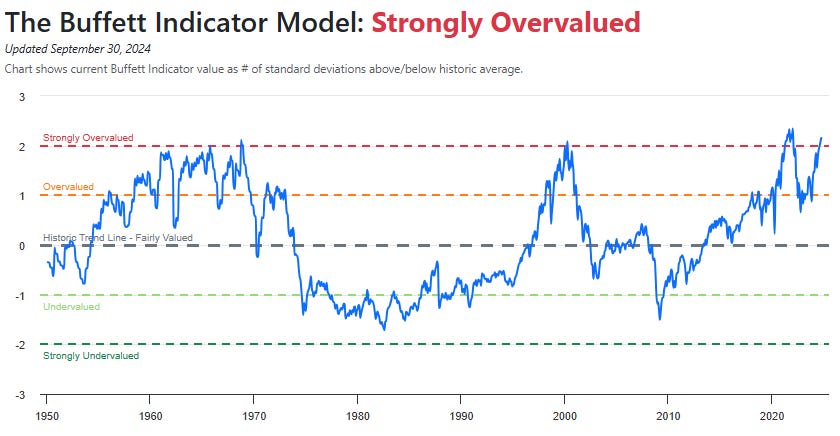
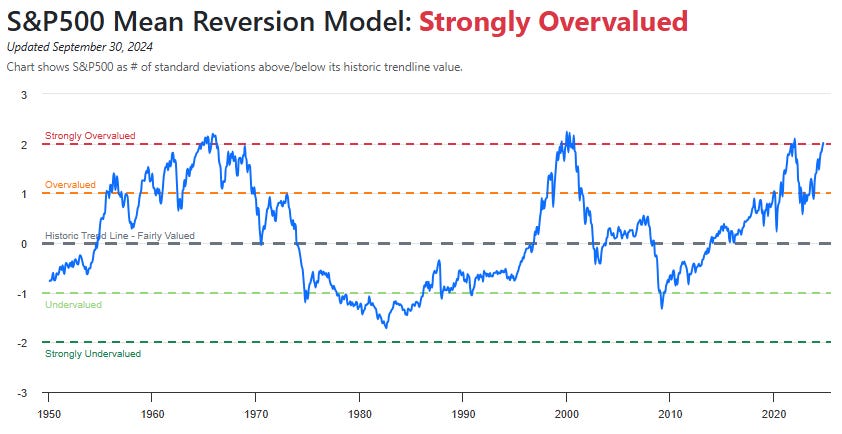
I can’t imagine how any sane person would take a look at this article I published last week and conclude anything other than that the stock market is extremely overvalued.

And I mean, heading into nosebleed, unprecedented territory.

Yet the market continues to rage higher, and nobody seems concerned. To me, this means there is only one legitimate question investors should ask themselves heading into 2025.

To put it simply, that question is: “Is it different this time?”

Investors often joke about the phrase “it’s different this time” as a way to ironically note that it is never different and the market always winds up puking back bad investments and healing itself of speculation, euphoria, frauds, and all the other wonderful things that come with perpetual bull markets fueled by money printing.

But I think that’s the legitimate question investors need to meditate on heading into the new year. Because if it really isn’t different this time, and all the laws of economics and historical market norms of the past apply, we’re undoubtedly due for a catastrophic crash in the stock market at some point. I can’t pinpoint which hole on which balance sheet will catalyze it, but I’m certain there is more than enough detritus and buildup floating around out there to light multiple crash fuses at once.

I’ve often said on this blog that institutions are panicking, businesses are imploding, frauds are running out of runway, and massive write-downs are being pushed off for just one more quarter right now, as you read this very sentence. We just won’t find out about them until further down the road.

Not unlike monetary policy and the effect of interest rates, there is always a lag in reality making its way to the surface in financial markets. The trillion-dollar question is how long it’ll take, what means it will rear its head through, and what the public reaction will be.

Let’s take a step back and examine a couple of the historical indicators that were pointed out last week.

How about the Buffett Indicator (market cap/GDP) nearing all time highs?

How about the S&P deviations from its historic value also nearing all time highs?

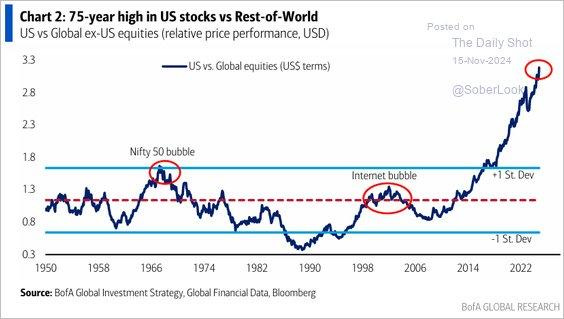
How about the U.S. at 75 year highs against the rest of the world?

Image

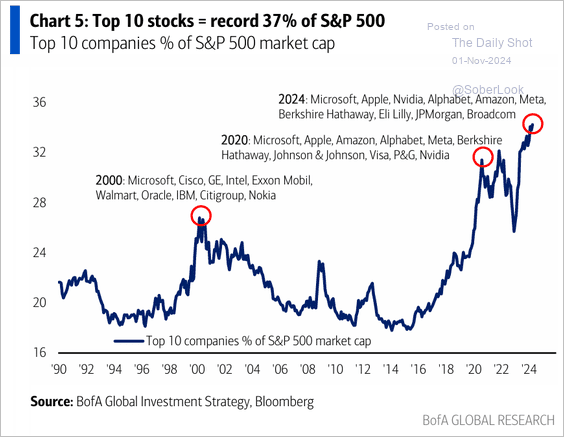
How about all time highs in stock concentration in the Top 10 S&P 500 names?

Image

Now, looking at these figures, how can anybody conclude that valuations will stay where they are in perpetuity?

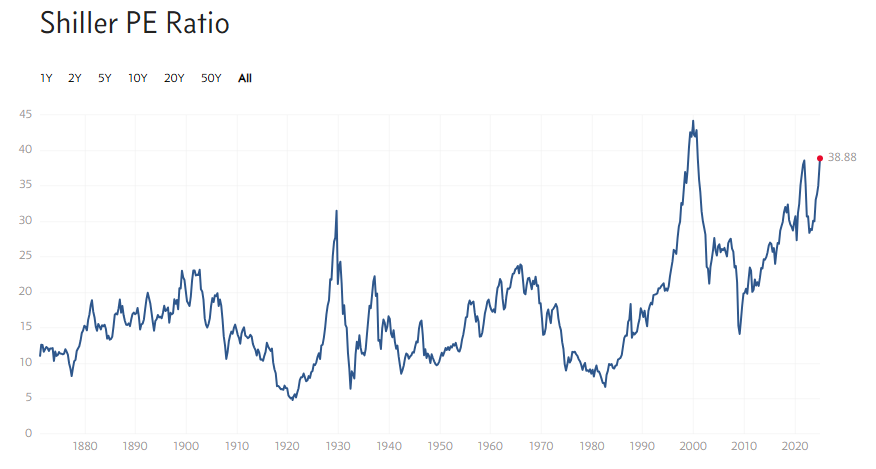
After all, if you are bleeding bullishness at this point and throwing money hand over fist at a market with a Shiller price-to-earnings ratio of 38x (second highest in history, second only to the dot com bubble), you essentially are voting with your capital that valuations will stay this extended—or get more extended—over time.

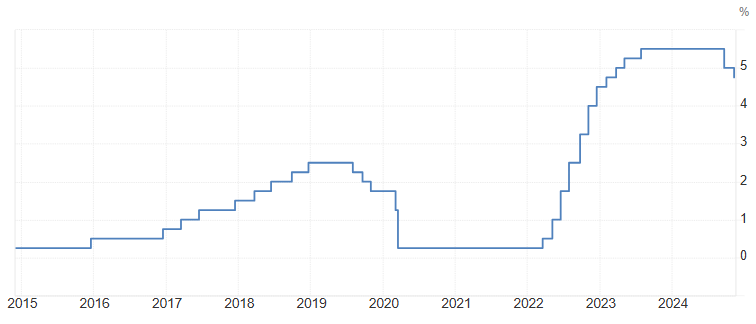
Certainly, one could theorize that earnings growth over time will make up the difference, but that’s a really tough scenario to seriously entertain with positive real rates and interest rates still near historical highs.

There is the unrelenting reality that high rates are going to continue to slowly and steadily chip away at the American consumer’s discretionary cash, and this is starting to be reflected in macroeconomic data like dwindling savings and increasing delinquencies across all types of credit. There’s still no doubt in my mind that the math underlying the entire economic picture guarantees we are going to have a larger hiccup down the road and significantly more volatility for markets at some point before the Fed reacts.

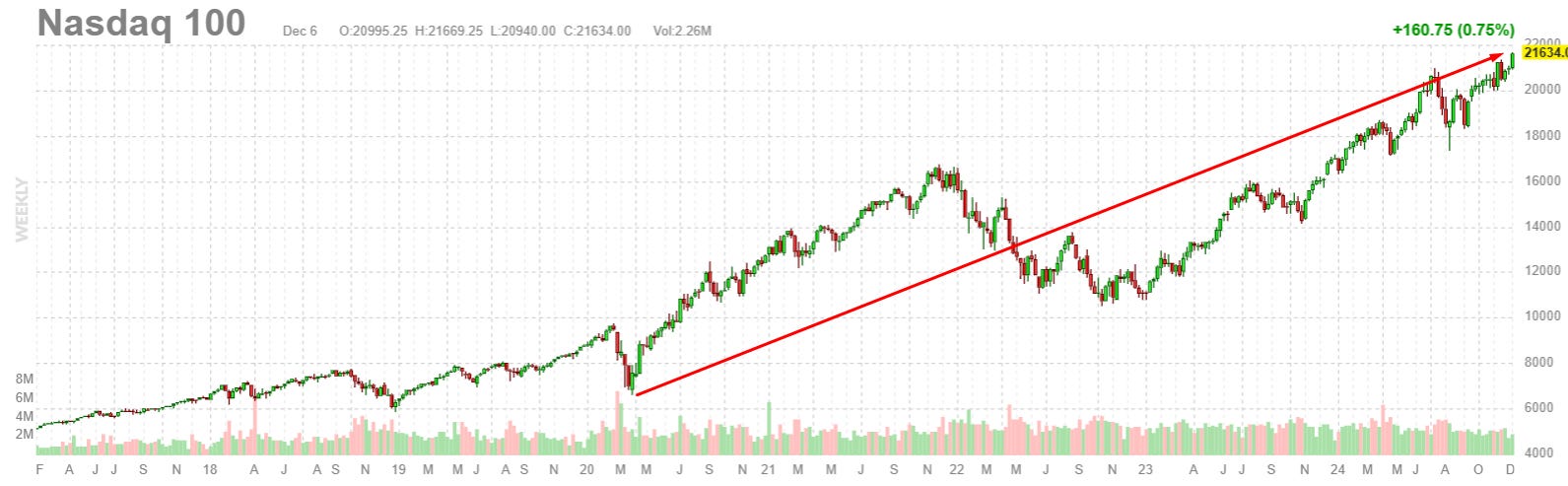
So what could the bull case possibly be if I still believe that? Well, take a look at what happened heading into COVID. We essentially shut down the entire economy, and while the market crashed temporarily, the Fed quickly threw $5 trillion+ on its balance sheet and printed enough money to paper over the actual economy with a fake fiat substitute, disguised as “economic stimulus.” A ton of this money then poured into capital markets and continues to do so. As everybody witnessed, stock indexes—let alone innumerable individual stock examples — increased by multiples off their lows hit back in 2020. GDP increased less than 20% since 2020 lows, yet the NASDAQ – an index – fucking tripled in 5 years. Louder for people in the back.

The NASDAQ – an index – has f*cking TRIPLED in just 5 years.

Not. Normal.

It has been a straight-up, full-force gale rocket launch into the stratosphere, without any rhyme or reason, in stock markets over the last five years, and we have our insane, flawed monetary policy to thank for it.

The point I’m trying to make is not whether or not we should be comparing fundamental crash apples to fundamental healthy economy and consumer oranges; it’s simply a broader question of whether our stock market is permanently broken as a result of a backhanded embrace of hyperinflation or if we will ever return to historical norms.

The real fly in the ointment is going to be when inflation does not come back to expected norms—or if it does and then immediately skyrockets higher once the Fed starts printing again. At the risk of sounding like a broken record, I think the market will eventually correct at some point, and the only question then is how the Federal Reserve reacts to it.


🔥 50% OFF FOR LIFE: Using this coupon entitles you to 50% off an annual subscription to Fringe Finance for life: Get 50% off forever


If inflation is still at 2.7%, how is the Fed going to justify a return to quantitative easing and lower rates? They’ll need a public PR campaign that essentially convinces the American public that more inflation—say, a 3% target for “temporary” purposes—is acceptable. This is essentially the public accepting another step toward hyperinflation.

If the Fed chooses not to immediately jump to the rescue of markets during a correction, the issues are going to compound, and all of the economic filth that has been swept under the rug over the last five years is going to start rearing its ugly head. And instead of a rocket ship heading to the stratosphere, we’ll have a snowball made of economic dog shit rolling down a hill, forcing more fraud and bad investments out of the woodwork as it picks up steam until it eventually starts to look like something out of the Book of Revelation. The Fed’s hands are going to be tied in this instance.

I think we all know that the heavy favorite in a situation like this is the Fed trying to calm markets and thereby embracing more inflation. If that happens, and they somehow get the public to acquiesce to the idea that more inflation is OK, or is going to be the norm, or is necessary to prevent the collapse of the economy, then there really will be a case for stocks trading at insane historical valuations. The case will essentially be that the entire United States economic system as we’ve known it over the last hundred years is now fundamentally broken.

If I’m right, there’s a greater than 0% chance that we may never seen 2% inflation again.

In other words, we will have gone from a normal, rational market with sound money and consequences for bad investments to a central-bank-socialized fiat money inflation machine. In circumstances like that, why would anybody worry about valuations? Why would anybody worry about how much a company returns to shareholders in net income? Not trying to be hyperbolic, but why would anybody worry about anything? For all intents and purposes, if the markets become a full-on socialized subsidiary of central banks—even more so than they already are—there will be no guardrails or fundamentals left to even cling to. We’ll talk about P/E ratios and generating profits the way people talk about the phonograph nowadays.

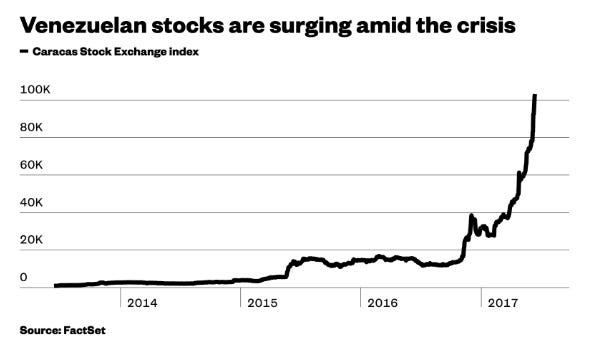
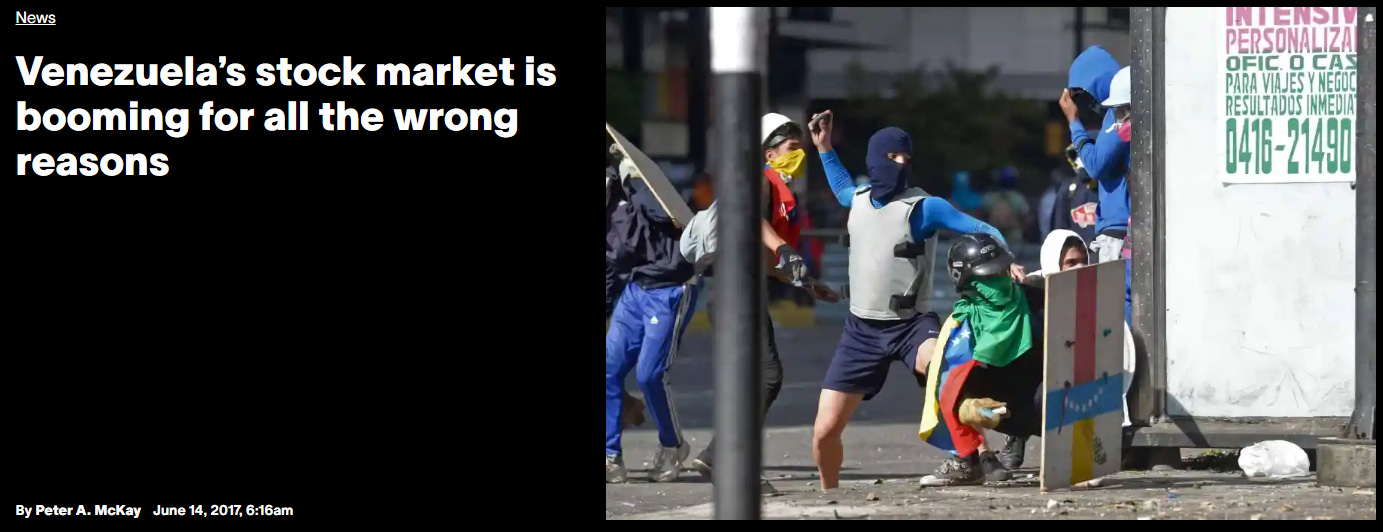
One thing that’s fun to do is look back at countries that have experienced hyperinflation and see what their stock markets have done. Take a look at Venezuela’s stock market as the country suffered from inflation: it’s done nothing but rage higher.

Holy sh*t, we’re all rich!

Of course, these gains have all come in nominal terms and mean nothing because each country’s entire respective economy has entered into full collapse, completely destroying its middle and lower classes while barely allowing its upper class to maintain some semblance of wealth.

For the love of God, won’t someone tell this kid he’s a trillionaire?

At that point, nothing will matter because society will be in such disarray that stock valuations will be very low on the pecking order of priorities for most Americans.

I see these signs out there now for the U.S.

There is endless hubris and arrogance on social media as it relates to the stock market. I have watched dozens of obvious frauds called out over the last few years with little or no consequences. We have an entirely new, perplexing asset class in cryptocurrency, which has amassed a multi-trillion-dollar market cap, despite continued questions about what most of it will ever be used for. The introduction of a new generation of retail stock market investors over the last 10 years has diluted the pool of market participants, who once, on average, at least had a shred of sophistication about what they were investing in and why. Now, our stock market has become nothing more than a glorified, digital roulette wheel, with clueless teens and 20-somethings placing bets and simply hoping that they score big – then posting their wins and losses on r/WallStreetBets.

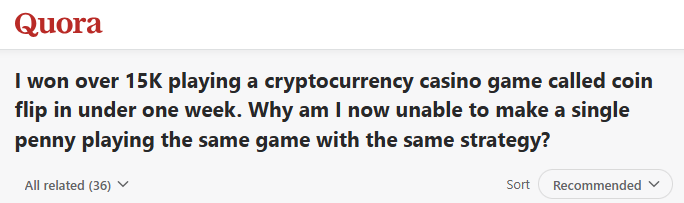
Similarly, as investing has evolved, so has online gambling. On my Instagram feed, I frequently see people live-streaming their gambling on online casinos. Many of them aren’t playing slots or online poker; instead, they’re literally playing games that simulate coin flips, repeatedly mashing a button until their account balance goes up or down. As the gambling industry has devolved, so has the stock market, which isn’t far removed from the coin-flip game I’m describing.

These investors are the highly volatile super short chain hydrocarbon gasoline fueling much of the euphoria in markets now. The kind of gasoline that catches fire when you just look at it the wrong way. People feel like they cannot lose and they’re dumbfounded when they do:

And when you don’t consider nominal gains (Venezuelan stock market) versus real ones, and when you have a Federal Reserve whose unwritten third mandate is to protect equity markets, the people who feel like they “cannot lose” might be “right” all the way to hyperinflation.

The question I’ll be trying to handicap going into the new year is whether or not this time really is different. Because the difference between reverting to historical averages on stock indexes or multiple expansion into the 40x to 50x territory is the $100 trillion question. And while I don’t have the answer today, I will be doing nothing but looking for clues as to which direction we are heading in as time progresses. Spotting these waypoints before the rest of the market will be the name of the game in 2025, if you ask me.

As always, I’d welcome your thoughts over at Fringe Finance in the comments.

QTR’s Disclaimer: Please read my full legal disclaimer on my About page here. This post represents my opinions only. In addition, please understand I am an idiot and often get things wrong and lose money. I may own or transact in any names mentioned in this piece at any time without warning. Contributor posts and aggregated posts have been hand selected by me, have not been fact checked and are the opinions of their authors. They are either submitted to QTR by their author, reprinted under a Creative Commons license with my best effort to uphold what the license asks, or with the permission of the author.

This is not a recommendation to buy or sell any stocks or securities, just my opinions. I often lose money on positions I trade/invest in. I may add any name mentioned in this article and sell any name mentioned in this piece at any time, without further warning. None of this is a solicitation to buy or sell securities. I may or may not own names I write about and are watching. Sometimes I’m bullish without owning things, sometimes I’m bearish and do own things. Just assume my positions could be exactly the opposite of what you think they are just in case. If I’m long I could quickly be short and vice versa. I won’t update my positions. All positions can change immediately as soon as I publish this, with or without notice and at any point I can be long, short or neutral on any position. You are on your own. Do not make decisions based on my blog. I exist on the fringe. The publisher does not guarantee the accuracy or completeness of the information provided in this page. These are not the opinions of any of my employers, partners, or associates. I did my best to be honest about my disclosures but can’t guarantee I am right; I write these posts after a couple beers sometimes. I edit after my posts are published because I’m impatient and lazy, so if you see a typo, check back in a half hour. Also, I just straight up get shit wrong a lot. I mention it twice because it’s that important.


Tyler Durden
Sun, 12/15/2024 – 09:20

NATO Head Says “Wartime Mindset” Needed; Redirect “Pensions, Health, Social Security” To Military Spending

0
NATO Head Says “Wartime Mindset” Needed; Redirect “Pensions, Health, Social Security” To Military Spending

Authored by Steve Watson via Modernity.news,

Former Dutch Prime Minister Mark Rutte, who was this year selected as the Secretary General of NATO, has stated that Europeans need to “shift to a wartime mindset” and that military spending must be increased, likely at the expense of things like health care.

Rutte made the remarks at, ironically, a meeting of The Carnegie Endowment for International Peace in Brussels, declaring that Russia is trying to “crush our freedom and way of life.”

“Hostile actions against Allied countries are real and accelerating… These attacks are not just isolated incidents. They are the result of a coordinated campaign to destabilise our societies and discourage us from supporting Ukraine,” he added.

Rutte further asserted that Russia is using unconventional “hybrid warfare” attacks against Europe, circumventing NATO’s traditional defence and bringing “the front line to our front doors. Even into our homes”.

“Ukrainians are fighting against Russian swarms of drones. That’s what we need to be prepared for”, Rutte told the conference.

“I know spending more on defence means spending less on other priorities. But it is only a little less,” he continued, adding that “On average, European countries easily spend up to a quarter of their national income on pensions, health and social security systems.”

“We need a small fraction of that money to make our defences much stronger, and to preserve our way of life,” he proclaimed, reasoning that “freedom does not come for free.”

Hundreds of billions have been sent to Ukraine, and for what? How much more do they want?

Rutte’s call to institute a wartime mindset among Europeans was also recently echoed by Admiral Rob Bauer, the most senior military officer at NATO who said that “luxuries” will have to be sacrificed for freedom.

“If you ramp up your deterrence and if you ramp up support to Ukraine, there will be less money to spend on other things. It will take away some of our luxuries, it will require sacrifice,” Bauer stated.

The free world desperately needs leader who is committed to peace and not endless warmongering.

* * *

Your support is crucial in helping us defeat mass censorship. Please consider donating via Locals or check out our unique merch. Follow us on X @ModernityNews.

Tyler Durden
Sun, 12/15/2024 – 08:10

These Are The Countries With The Highest Food Inflation In 2024

0
These Are The Countries With The Highest Food Inflation In 2024

Rising food inflation impacts global food security and disproportionately affects vulnerable populations.

But from South America to Africa and the Middle East, which countries are the hardest hit by increasing food prices in 2024?

This bar chart, via Visual Capitalist’s Selin Oğuz, sponsored by Brazil Potash, uses the latest data from Trading Economics to show which countries have the highest food inflation.

Food Inflation Trends by Country and Region

Leading all countries, Argentina is grappling with a 183% year-over-year increase in food prices. The country also has the highest forecasted food inflation in the world, at 120%, for next year’s second quarter.

Argentina’s high food inflation stems from a mix of its currency devaluation, severe droughts, reliance on exports, economic instability, and political unrest.

Palestine is the runner-up for the highest food inflation with 115%. However, it is forecasted to lower dramatically to 12% halfway through 2025.

Meanwhile, six of the next eight countries are all in Africa. The African countries with the highest food inflation are Zimbabwe at 105% and South Sudan at 96%.

At the same time, other African nations, like Malawi, Nigeria, and Angola, face rates between 34% and 44%, highlighting the broader food inflation trend across the continent.

Tyler Durden
Sun, 12/15/2024 – 07:35

Peace In Ukraine

0
Peace In Ukraine

Authored by Tumoas Malinen via substack,

The conflict in Ukraine, having passed the 1000-day mark, is approaching a very unpleasant stalemate, for all. Russian forces are pushing through the lines of the Armed Forces of Ukraine (AFU), which in some places seem to be in almost chaotic retreat. The situation calls for rapid actions to stop the conflict from spiraling out of control and escalating into World War III.

The war in Ukraine has also become highly emotionalized, due to the relentless war propaganda spewed especially by the European mainstream media. This has created something of an emotional blockade among politicians, making it difficult for them to engage in negotiations that would require both sides to compromise. The dominant narrative is that Ukraine must win, leaving little room for exploring other solutions to the conflict.

Regardless, the path to peace lies in return to realpolitik in Europe, that is, a return to political principles based on practical, not value-based or ideological, considerations. 

Essentially, there are six facts successful peace negotiations in Ukraine need to be based on:

  1. In all non-nuclear military scenarios Russia will emerge as the victor in the Ukraine conflict.

  2. Russia is unlikely to seek occupation of all of Ukraine.

  3. Negotiations will have to fulfil (almost) all of Kremlin’s publicly declared goals, i.e. neutrality, limited military, territorial loss, non-membership in NATO but perhaps membership of the EU.

  4. A credible force must be assigned to establish and monitor the line of ceasefire.

  5. Due to a lack of mutual trust, all parties must commit to pre-agreement acts of de-escalation.

  6. Post-war collapse of Ukraine must be prevented to avoid widespread and well-armed terrorism/banditry in the surrounding areas. Collapse will commence unless all parties commit to support Ukraine pre-agreement.

Pre-conditions for negotiations

Russia in Ukraine

There’s no denying that Russia is obliterating not just the AFU, but also Ukrainian society. Russian troops are advancing rapidly, and the air raids over the weekend of 16-17th of November 2024, implied that the Kremlin is ready to push Ukraine into darkness. Moreover, Russia struck the Ukrainian city of Dnipro with new hypersonic intermediate-range ballistic missile (IRBM) “Oreshnik” carrying a non-nuclear payload on early morning of 21st November. These entail that there is only one (non-nuclear) endgame in Ukraine: capitulation of the AFU, either through negotiated peace or surrender.

For these reasons, the path to peace needs to be sought from the original aims of Kremlin. The publicly stated aims of the Special Military Operation (SMO), which commenced on February 24, 2022, were four:

  1. Defending the people of the Donetsk and Luhansk People’s Republics under the Article 51 of the United Nations Charter.

  2. To clear “neo-Nazis” from Ukrainian leadership.

  3. To stop the nuclear weapons program of Ukraine.

  4. To stop and remove the NATO infrastructure being build, threatening Russia, from Ukraine.

In simplified terms, and as is widely known, the aim was a “demilitarization and denazification” of Ukraine. The term denazification is very elusive and it was probably used to draw sympathy from Russian citizens, by linking the SMO into the Great Patriotic War. It is quite unclear, whether there was a nuclear weapons program in Ukraine. This claim was likely aimed at Russian populace to provide further justification for the war. So, #1 and #4 can be considered as the actual aims of the Kremlin. There is where the path to peace lies.

It can also be assumed that the full collapse and occupation of Ukraine is not something the Kremlin is seeking either. The costs of the annexation of Crimea in early 2014 to Russia’s fiscal balance were staggering. The economic foundations, including tourism and private businesses, on the Peninsula collapsed and Russia emptied her Sovereign Reserve Fund to pay for the costs of annexation. The second military phase of the conflict has close to halved the size of the National Wealth Fund, with its value falling by $79 billion since February 2022, despite rising energy prices. The Kremlin simply cannot first destroy most of Ukraine in a war and then hold and rebuild it, because this would collapse Russian state finances.

Goals of Kreml and the line of ceasefire

The stated aims of the SMO listed above imply that Russia is seeking for the neutrality of Ukraine (from NATO), its limited military capacity and territorial annexation of Eastern Ukraine, more specifically Donetsk, Kherson, Luhansk and Zaporizhzhia oblast, mostly inhabited by ethnic Russians. Russia unilaterally declared an annexation of these areas, but did not set their exact boundaries, which would be “defined later”, on September 30, 2022. This implies that the area-concession were not carved in stone and would most likely depend on a set of other factors, including how strong the Kremlin sees the commitment of the U.S. to the neutrality of Ukraine to be.

Because Russia is dominating the developments on the battlefield, peace needs to be made on the terms of Kremlin. If this is not accepted, Kreml can push the AFU to unconditional surrender effectively leading to the same end-result, but with more dire implications for the West.

The stability of the cease-fire and establishing the buffer-zone between the AFU and Russian forces is paramount. The OSCE (Organization for Security and Co-operation) mission to eastern Ukraine, between March 2014 and March 2022, was a failure with the mission failing to objectively report on developments on the ground and to stop the war from escalating. Both the current Russian and the forthcoming U.S. administration have had serious reservations towards the United Nations. Yet, mostly due to this, it’s likely to be the only entity in the world that can effectively establish and control the buffer-zone and ceasefire. This is because under the U.N. neither side, the U.S./NATO or Russia, would have any direct control on the mission, which would report to the Security Council, where all major nuclear nations would monitor the ceasefire and creation of the buffer-zone. This would be the best shot for establishing an objective oversight of the line of ceasefire.

Rebuilding trust through pre-agreement acts of de-escalation

The Russo-Ukrainian war sowed division within Europe and between Russia and NATO/U.S. The war propaganda in Europe created hostilities towards Russia and Russians. In the propaganda of the Kremlin, this was used to justify the aggression towards Ukraine and question the motives of the West.

The deepening involvement of NATO in Ukraine has been a driving force of escalation. It was a generally held view, prior the Russo-Ukrainian war, that no country involved to an armed conflict could be taken as a member of NATO. Yet, with Ukraine something changed, with the NATO leadership effectively “annexing” Ukraine. On February 24, 2024, the former Secretary General of NATO, Jens Stoltenberg, even stated that “Ukraine will join NATO. It is not a question of if, but of when”. The new Secretary General, Mark Rutte, has continued on the same line of argumentation.

The strikes of the AFU on Russian early-warning systems (over-the-horizon radars) operating in Krasnodar Krai near Ukraine, and in Orenburg region near Orsk some 1500 km from Ukraine, during this year, were extremely sinister actions of escalation. The radars had no role in the conflict of Ukraine, with the radar in Orsk not even looking in the direction of Ukraine. The strikes of the AFU were conventional strikes on nuclear forces and command and control systems, which Russia listed as one of the conditions for nuclear weapons usage. Fortunately, Kreml did not react.

The fact also is that the war in Ukraine should have stopped in late spring of 2022. At that point the Kremlin had reached most of its stated goals of the SMO. Peace negotiations held in Istanbul, Turkey, in March/April 2022 were reported to have reached an agreement of truce before the U.S. and the U.K. allegedly stepped in and effectively stopped the peace process. During the summer of 2024, Ukraine and the West were also signaling willingness for a peaceful resolution, which were cautiously welcomed by the Kremlin. Then, in August 2024, the AFU invaded the Kursk region in Russia. Moreover, the Minsk agreements, signed in September 2014 and February 2015 officially aimed at ending the conflict in Ukraine, were actually used just to buy time to arm Ukraine against Russia.

For these reasons, trust between the parties needs to be re-built. Pre-agreement acts of de-escalation should include:

  1. Russia limiting her military presence to ceded areas and evacuates attack systems to sufficient distance from borders (established line of ceasefire) of the remaining Ukraine. Russia also commits to avoid further use of arms in Europe, to participate in the rebuilding of Ukraine and declares willingness to renewed trade if sanctions are lifted.

  2. The EU and the US stop all deliveries of weapons and volunteers to Ukraine immediately and declare willingness to deactivate economic sanctions.

  3. The U.S. and Russia announce their commitment on the independence and neutrality of (remaining) Ukraine.

  4. The EU and the U.S. agree on an emergency economic support package for the (remaining) Ukraine.

  5. The U.S. informs that the current leadership of NATO will be changed, and that NATO will go through a rigorous audit concerning its actions and policies.

Prevention of post-war collapse of Ukraine

The economy and society of Ukraine has become severely damaged. The war has eaten through whole age cohorts, while the infrastructure of Ukraine has taken a serious hit (which is worsening by the day). As a result, living standards will be low for an extended time and powerful weapons will be easily available for the inhabitants. If the Ukrainian economy and society would be allowed to collapse, Europe would see another wave of migration, with many of the refugees carrying deadly weapons. For this reason, both the U.S. but especially the EU needs to commit to economic support and rebuilding.

Most importantly, also for the peace process, the situation in post-war Ukraine must be prevented from becoming chaotic (causing severe problems in the surrounding areas). The keys to this would be:

  1. The US and the EU need to undertake food, shelter and healthcare provisions in any needed quantities immediately on conclusion of the hostilities. A foreign run police or a paramilitary force needs to be established to keep order and collect unregistered arms.

  2. The US and the EU take responsibility for repairing and rebuilding Ukraine housing and infrastructure. During the peace negotiations plans should be drawn up on the timing and distribution of work. Russia naturally takes care of rebuilding the parts of Ukraine it annexed, but could take a part in the re-building of western Ukraine as a sign of good-will.

  3. Ukraine itself needs to establish new, neutral/accepted authorities as well as routines and policies for the new government. General elections need to be held as soon as possible.

  4. The International Monetary Fund and the World Bank need to agree on long-term structural loans and restructuring of the current debt load of the federal government of Ukraine.

Conclusions

Conflict in Ukraine has been very destructive to Ukraine, but also to the European security structure. European leaders should have been able to stop the escalation already in 2013 and 2014, but they failed. The ‘void’ of European leadership became epitomized in the peace negotiations during the March and April 2022 torpedoed, reportedly, by the U.S. and U.K. War should have ended during the Spring of 2022, but it was let to continue and even escalate on reasons mostly unclear. Due to the failures of our leaders, we are at the brink of yet another continental war.

Peace in Ukraine and strengthening the European security structure can be achieved without pushing our continent into a cycle a re-armament, which has always presided a continental war. Realities on the ground need to be acknowledged alongside meeting the demands of Kremlin. Peace in Ukraine will not be easy, but we need it now more than ever.

*  *  *

Tuomas Malinen on Geopolitics and the Economy is a reader-supported publication. To receive new posts and support my work, consider becoming a free or paid subscriber.

Tyler Durden
Sun, 12/15/2024 – 07:00

Online Shopping: Charting The Holiday Surge

0
Online Shopping: Charting The Holiday Surge

In the fourth quarter of 2023, online shopping was a record-breaking 17% of all retail sales. Put another way, one out of every six dollars was spent online.

This graphic from Visual Capitalist’s Jenna Ross, in partnership with BGO, highlights the spike in ecommerce that occurs every year during the holiday season.

The Growing Popularity of Online Shopping

Over the last 15 years, the percentage of money consumers are spending online has more than tripled. The most online shopping always occurs in the fourth quarter due to Black Friday and holiday spending.

In the table below, we show online shopping as a percentage of total retail sales over time.

Source: U.S. Census Bureau. Data accessed November 19, 2024.

With people stretched for time during the busy holiday season, many opt for quick online orders and home deliveries. 

Beyond convenience, deals also draw people to their screens. For instance, Amazon’s October Prime Day and Cyber Monday both offer deals catered to online shoppers. In 2024, Cyber Monday drew over 64 million U.S. shoppers—nearly three times higher than the 23 million people who shopped in stores.

To handle the increase in online shopping orders, U.S. retailers will need to have a plan for storing their products and transporting them to customers.

The Logistics of Online Orders

Free and fast shipping are top priorities for online shoppers. Nearly 40% would abandon a retailer with high shipping costs, while 32% would stop buying because of late deliveries. These high expectations, and the increase in ecommerce, is driving demand for real estate that can process online orders.

BGO’s industrial warehouse and logistics properties are strategically located to help reduce expenses and transport goods to consumers more quickly. During the busy holiday period, these properties run at full efficiency to meet the surging demand.

Learn what’s moving markets in BGO’s The Chief Economist newsletter.

Tyler Durden
Sat, 12/14/2024 – 22:45

Possible Foreign Policy Shifts In The New Administration

0
Possible Foreign Policy Shifts In The New Administration

Authored by Christian Milord via The Epoch Times,

With an incoming administration that will be installed on Jan. 20, 2025, will there be shifts in America’s foreign policies for the next four years that could affect the security of California and the other states?

It’s likely that some of the positions in the Biden administration will be maintained, but President-elect Donald Trump’s stamp on future policies could reflect stances taken during his first term. How will Trump, 47th president, compare with Trump, 45th president?

Trump, similar to Teddy Roosevelt, will likely often speak softly and carry a big stick. He will get along with our adversaries to gain leverage but will also inform authoritarian leaders in no uncertain terms that aggressions against America and its global partners will not stand.

During Trump’s first term, China, Iran, North Korea, and Russia were limited to routine saber-rattling on the world stage. However, during President Joe Biden’s tenure, China’s bullying became more overt, Iran greenlighted the invasion of Israel, Russia invaded Ukraine for the second time, and North Korea launched more test missiles than ever and sent troops to Ukraine. These brazen activities will be difficult to halt, but Trump has indicated he will strive to mitigate them.

First, Trump will enhance border security to a much greater degree than the prior administration. He might have to cut off funding to sanctuary cities and states that oppose his deportation plan for criminals. In addition, it shouldn’t take the threat of tariffs against Canada and Mexico for those two nations to carry out the legwork to secure their sides of the border with the United States.

Trump will also likely persuade Panama to shutter the Darien Gap, a lawless migration hub. The Department of Homeland Security also urgently needs more Border Patrol agents, and the border wall with Mexico must be completed to maintain an orderly immigration process. Moreover, additional immigration judges will be required to expedite the process of immigration for genuine asylum cases and legal immigration cases.

Border security is a critical part of the overall national security strategy in order to vet immigrants and prevent criminal gangs and terrorists from entering the country. Many of these criminals are involved in arms, drugs, and human trafficking that are devastating to vulnerable minors, while our social services are stretched to the breaking point.

Unlawful immigrants who seek to game the system and take advantage of tax-funded social services should be turned back at the border. If an immigrant breaks the initial law of entering the country illegally, what is to stop them from circumventing other laws in an attempt to take shortcuts to permanent residency?

Next, Trump will continue to support Israel and Ukraine in their fight against tyranny to a certain extent, but he will also work to bring the hostile parties together to negotiate for cease-fires or a cessation of conflict. Moscow promised Kyiv in the Budapest Memorandum of 1994 that if Ukraine’s nuclear weapons were turned over to Russia, there would be no invasion. Ukraine complied, but Vladimir Putin broke the pact and invaded twice. That is why any treaties with Russia must be assessed with a trust-but-verify posture.

Trump will likely sign off on greater sanctions against Iranian and Russian assets in order to wind down the wars and curtail the flow of weapons to nefarious actors within reach of the combat zones. He will concur with Benjamin Netanyahu that Hamas must never again govern in the Gaza Strip. Trump might also apply leverage to North Korea’s Kim Jong Un to persuade him to withdraw his troops from the Russian battle-space adjacent to Ukraine.

Third, America’s national security could be enhanced if Trump shores up our freedom-loving global partners and also reaches out to developing nations in Africa, Asia, and Latin America.

This cultural and commercial outreach can provide a counterweight to China’s malign activities in those continents. The European Union could also contribute to Europe’s’ security and stability abroad.

Fourth, Trump will likely adopt foreign policy that utilizes both the carrot and stick of diplomacy and military power.

Building a strong military force can actually mitigate the need to apply armed power as it projects peace through strength, according to President Ronald Reagan. It is highly critical that our armed forces stay ahead of the curve vis a vis our adversaries in the spheres of training and weapons platforms.

Fifth, hopefully Trump will allow Congress to appropriate adequate resources to the armed forces in order to maintain capability, capacity, and readiness to deter China’s potential blockade or invasion of Taiwan. It would take an entire book to catalog the atrocities carried out by the Chinese Communist Party (CCP) on a daily basis as it conducts unrestricted warfare against its own people and the West. Trump ought to approach the CCP and its predatory practices from the perspective of cold, hard reality.

Any trade with China should involve reciprocity, and if China doubles down on trade barriers, tariffs can be imposed. If Beijing wants to enter foreign markets, buy land, and set up shop, then it should allow Western companies to do the same in China. Moreover, the United States ought to decouple from any Chinese goods or services that adversely affect national security.

Finally, Trump will pursue an America First agenda in foreign policy by using both arm-twisting and horse-trading. He will place the interests of the U.S. above the demands of other nations in order to advance free markets, liberty, peace, and an accepted rules-based order.

Views expressed in this article are opinions of the author and do not necessarily reflect the views of The Epoch Times or ZeroHedge.

Tyler Durden
Sat, 12/14/2024 – 22:10

American Citizen Flown Out Of Syria By US Military 

0
American Citizen Flown Out Of Syria By US Military 

An American man has been flown out of Syria by the US military from an undisclosed location, after he was handed over by Syria’s new governing authorities, HTS.

The US citizen has been identified as Travis Timmerman, who had been held in a Syrian prison since his arrest under the Assad government seven months ago. Several international reports said he had walked into Syria from Lebanon, presumably with no visa and not utilizing a customs or proper border checkpoint. 

Via NBC

AP and Reuters confirmed Friday Timmerman was handed over to “the American side” and flown out of Syria. Timmerman is from Missouri, but was last seen in Hungary but his family hadn’t heard from him since. 

He said he had entered Syria on a spiritual “pilgrimage” and it appears his arrest resulted from entering Syria by illegal means and without an issued visa. Americans and Westerners have frequently traveled in Syria, even over the last few years, but they have gotten valid visas typically from the Syrian Embassy in Beirut, or at the border of entry.

He has described in Western media interviews that he was treated well in prison, and he is in good health. BBC describes of the past days:

On Monday, a day after rebels took control of Damascus and toppled Assad, Mr Timmerman said two men armed with a hammer broke open his prison door. It was “busted down, it woke me up”, he said.

“I thought the guards were still there, so I thought the warfare could have been more active than it ended up being… Once we got out, there was no resistance, there was no real fighting.”

The 30-year-old said he left prison with a large group of people and had been attempting to make his way to Jordan.

Since Assad’s fall people have clamored to break open prison doors and set all prisoners free. Currently there’s a search for American journalist Austin Tice, who disappeared in Syria in 2012 after embedding with anti-Assad militants.

Despite his being in an area with al-Qaeda jihadists and armed gangs at the time, the US government has always blamed the Assad side for his disappearance, which Damascus always vehemently denied. The search across the country is still on for any clues of what might have happened to him.

Tyler Durden
Sat, 12/14/2024 – 21:35