80.8 F
Chicago
Saturday, October 10, 2026
Home Blog Page 2067

Thanksgiving 5-Day US Box Office Sets Record At $420M; AMC CEO Calls Moviegoer Surge A “National Phenomenon” 

0
Thanksgiving 5-Day US Box Office Sets Record At $420M; AMC CEO Calls Moviegoer Surge A “National Phenomenon” 

Paul Dergarabedian, a media analyst for Comscore, revealed on X on Sunday afternoon that US domestic box offices set a record, raking in $420 million over the five-day Thanksgiving holiday period. According to Deadline, Disney’s Moana sequel was the most popular movie, attracting 17.4 million admissions,  Universal’s Wicked with 8.7 million viewers, and Paramount’s Gladiator II drew 3.3 million from Wednesday through Sunday. 

Dergarabedian said Comscore reports “a monumental Thanksgiving weekend (and week) for movie theatres!”

He noted that “this weekend’s overall total estimated 3-day Domestic box office is around $272M (5-day at an estimated $420M) & YTD 2024 (now at $7.781B through Sunday) is down now just 6.4% vs. 2023, Note: a week ago Sunday the YTD deficit was at 10.6%!” 

X user Tony Denaro posted that the top ten grossing flicks for the five-day period hit new records.

“Press reporting that Americans are pouring into movie theatres this holiday weekend for Moana 2, Wicked and Gladiator II,” AMC Entertainment Holdings CEO Adam Aron wrote on X. 

He noted, “So many appealing movies in theatres. Smaller titles too like Red One, Conclave and Juror #2. Be part of a national phenomenon.” 

For nearly a week, we have reported on the surge of moviegoers attending AMC’s theaters nationwide…

Shares of AMC closed around the $5 handle on Friday. 

Bloomberg data shows 13.3% of the float is short, or about 49.8 million shares. 

Going to the theaters is apparently back. 

Any AMC rally on this news should be approached with caution, as the company is burdened by $4 billion in long-term debt and hefty interest payments. This may only suggest that CEO Aron might hit equity markets on any significant pop.

Tyler Durden
Sun, 12/01/2024 – 18:05

Death Toll From Islamist Assault On Aleppo Nears 500 As Iran Says ‘Firmly Supports’ Assad

0
Death Toll From Islamist Assault On Aleppo Nears 500 As Iran Says ‘Firmly Supports’ Assad

President Bashar al-Assad has reportedly sent large reinforcements to the southern Aleppo area after Al-Qaeda linked insurgents’ shock offensive which captured the city. Assad said he will defend Syria’s stability and territorial integrity.

The London-based political opposition group Syrian Observatory for Human Rights said Sunday that the total death toll from the fighting is over 400 people on both sides. The tally includes the deaths of 214 members of Hayat Tahrir al-Sham and allied factions which launched the assault.

Associated Press: Islamist insurgents captured a Syrian army tank in the town of Maarat al-Numan, southwest from Aleppo, Syria, Saturday.

And at least 137 pro-government forces and 61 civilians have been killed. The AFP has described that the military campaign launched out of Idlib is being coordinated from an operations room in Turkey.

AFP wrote on Friday that “Opposition sources in touch with Turkish intelligence said Turkey had given a green light to the offensive.” AFPs correspondent in HTS/AQ-held Idlib additionally reported that “The jihadists and their Turkey-backed allies took orders from a joint operations command.”

A fresh report in Israeli media has acknowledged that this is all about weakening the ‘Iran axis’:

But the primary reason for the success of the rebel offensive and the collapse of the regime forces is the effectiveness of Israel’s military operations against Hezbollah and Iran since October 8, 2023.

HTS had been building up its military capabilities for years in preparation for such an offensive.

“The group operates a professionally staffed military academy run by defectors from the Syrian military, and it has restructured its armed wing into a conventional armed force structure,” wrote Charles Lister, Syria expert at the Middle East Institute. “In recent years, it has also developed ‘special forces’ units dedicated to covert operations, lightning raids behind enemy lines, and nighttime operations.”

In prior years, any time an air and artillery campaign against Al-Qaeda held Idlib would ramp up, there would be an outcry from the West, and more condemnation of Damascus and Moscow, urging their militaries to halt efforts to take back Idlib.

According to more on the Israeli and Sunni Islamists’ efforts to roll back the pro-Tehran axis:

“The timing is not coincidental,” Carmit Valensi, head of the Northern Arena Program at the Institute for National Security Studies in Tel Aviv, told The Times of Israel.

“They identify well the critical, even historical, weakness that the ‘Resistance Axis,’ primarily Hezbollah and Iran, find themselves in,” she continued.

As for Iran, it says that it firmly supports Assad in a new statement. Iran’s top diplomat Abbas Araghchi said Sunday he will soon arrive in Damascus to deliver a strong message of support for Syria’s government and military, Iranian state media has said.

“I am going to Damascus to convey the message of the Islamic Republic to the Syrian government,” Iranian Foreign Minister Abbas Araghchi said. He pledged that Iran will “firmly support the Syrian government and army,” IRNA news agency said.

Iran is pointing the finger at Washington and Tel Aviv for this new jihadist offensive:

Araghchi again called the surprise rebel offensive a plot by the United States and Israel.

“The Syrian army will once again beat these terrorist groups as in the past,” the foreign minister added.

In the past couple days of Aleppo fighting, not only has the Islamic Republic’s consulate in the major northern city come under attack, but there have been reports that an Iranian general may have been killed.

The HTS-led coalition is attacking Kurdish groups in the environs of northern Aleppo as well. Currently there are reports the militants are reinforcing their positions near Hama, possibly poised to attack the central city next.

After years and years of crippling sanctions, the Syrian Army remains in a precarious position in terms of resources and logistics. “Outside the city of Hama, Syrian government military vehicles could be seen all over the roads, apparently abandoned by fleeing government troops after they ran out of fuel,” The New York Times writes Sunday.

* * *

As a reminder, amid this renewed conflict the United States still occupied large portions of Syria, and curiously the HTS/AQ militant groups are not attacking these US-occupied areas…

Tyler Durden
Sun, 12/01/2024 – 16:55

Cruising Into Year End?

0
Cruising Into Year End?

By Peter Tchir, chief strategist of Academy Securities

For the record, I am not advocating cruising into year-end. I think there will be potential opportunities to be captured by diligent asset managers and corporations. We will focus on yields and credit spreads today. But let’s start by hoping that you all had a great Thanksgiving! Last weekend’s An Amazing Country (with some questions) hopefully helped you navigate through some holiday meal discussions (or more likely, work discussions), and it remains relevant today, as does 3D Chess or 52-Card Pickup.

In fact, now that “consensus” has become that everything President-elect Trump does is “just a start” to his bargaining, I’m a little concerned that the market has become a little too complacent. Yes, we were arguing for this view, but it is surprising how quickly it seems to have morphed into a consensus trade.

Around the World with Academy Securities

In case you missed our Around The World report on Wednesday, it covers the usual suspects, but with some different twists and turns.

Sierpinski Triangle

As there is a lot of chatter about “chaos” (along with our analysis of 3D Chess versus 52-Card Pickup), I’ve been thinking a lot about the Sierpinski Triangle. You start with any type of triangle. Then, you start rolling the dice and moving from your current position in the triangle to one halfway to the corner “selected” by the die. Once you’ve gone a couple of turns to “seed” the solution, you mark the points and repeat ad infinitum. What seems random, creates, with 100% certainty, an elaborate pattern that I cannot believe many people would have guessed to be the output of this exercise (it is often one of the early chapters on anything about chaos theory).

So, as we watch the machinations coming out of D.C., we are still left wondering whether an elaborate pattern will emerge from the current selection process.

It does seem that the market went from doubting all the moves out of D.C. (which seemed too pessimistic) to suddenly seeing order (or at least no major stumbling blocks) from D.C. – which might be too optimistic.

Expect Some Chaos

Okay, chaos is probably too strong of a word, but I do think that the market should be prepared for some setbacks, as not every negotiation or appointment will go smoothly. It is the nature of President-elect Trump’s style – from his old real estate days to his first term as president – he will push, he will be aggressive, and there will be some confusion.

Inflation

Inflation might be the trickiest variable to estimate right now. Over time, we could see the economy turn one way or the other, and we could see the jobs situation change, but inflation, in my view, has  the widest range of possible outcomes in the coming months.

  • Tariffs, as discussed last week, could push inflation higher. That is not our base case (and is not consensus), but there is some risk here.

  • Immigration issues could impact inflation quite dramatically. Again, we covered this last week, and our base case is that Trump will go after some high profile wins and listen to some of his constituents, who don’t want wholesale deportations that would disrupt the labor force. Again, consensus seems to have moved in this direction as well, but our conviction on this base case is medium (at best) and there could be risks that are not being priced in appropriately.

  • The natural ebbs and flows of supply and demand. We were in the camp that believed inflation was under control, but not tamed (call it, settling into a 1.75% to 2.75% range). As businesses are allegedly pulling forward purchases to avoid potential tariffs, as China continues to try to stimulate its economy, and as we see policy to promote “onshoring,” there are some risks of inflation moving back to the high end of our range, which would likely make the Fed (and bond markets) uncomfortable.

  • Commodity prices should help the inflation story if we really are going to see a “Drill Baby Drill” mentality. Or, as discussed in detail last weekend (yes, I’m referring to that fairly often, but it forms the building blocks for much of our current work), we could see a pushback against “Not In My Backyard”, but commodity prices should remain under control (while commodity related companies can do very well with increased production).

Rates

Positioning has been and will continue to be a factor.

I’ve been pointed to the “Commitment of Traders” report: there is a lot of short interest by speculators, especially in the 10-year part of the curve. It apparently has been coming down, but if traders remain short, it will continue to help support bond prices. TLT, a 20+ year ETF, has been seeing outflows even as yields went higher – another potential indicator that positioning remains “underweight” bonds.

The negative buzz around the deficit and bond yields seems to have dissipated. In a quick note on Friday to our capital markets team and via Bloomberg to the clients I’m in IB chats with, we reduced our bullish outlook on bonds at 4.19% on 10s.
We actually saw buying right up to the last minute on Friday’s trading, but I think with the “index extension” trade over and back to full days to trade bonds, it will be difficult for the rally to continue Our target was 4.1% to 4.2%, and while we are at the high end of our range, the rally has been almost too ferocious of late to be truly believable. The fears around tariffs, immigration, and the deficit (which were overdone), have now been replaced with a degree of complacency that doesn’t seem deserved.

China TIC data showed China holding $772 billion of Treasuries at the end of September. That number has been between $780 billion and $767 billion (a very narrow range) since February. There is no obvious reason for China to grow their holdings, and if anything, as they continue their efforts to stimulate their economy and gird for potential tough negotiations with Trump, we could see them lowering the amount held in the coming months. Not a big problem for markets, but not helpful as we have a lot of bonds to auction in the coming months.

The Fed:

  • 1 cut in the next two meetings, probably this one.

  • A terminal rate of 3.875% next year, a bit above the 3.45% priced in for December 2025 (according to the Bloomberg WIRP function).

Bond Yields:

  • Expect the 10-year to inch a touch higher, pushing back towards 4.3%, with a lot of difficulty getting back to 4%.

Should be a good “range trading” environment, with a much greater risk of 50 bps higher than 50 bps lower from here, for the long end.

Credit

It has been almost six months since we devoted serious attention to the credit markets.

Back in June, we published How Tight Can Credit Spreads Go?, and were unequivocally and unapologetically bullish on credit. We listed trends like private credit, banks competing for lending (to grow their net interest margin), and how much the high yield bond market has changed as reasons why fretting over old charts makes little sense. We dragged out our old standbys – Maslow’s Hierarchy of a Credit Bubble, The 5 Circles of Bond Investor Hell, and a picture of one of the remaining IG 200 hats! If you lived through the GFC and traded CDX indices, you likely remember the hats.

While CDX didn’t get to 20 bps, it has traded very well, as has any measure of corporate bond spreads.

While I remain very comfortable with credit, it is more difficult to sit here near the lows and continue to add to credit. It might not take much to “upset” the apple cart here, at least a little. While the arguments for liking credit so much (at what already seemed like tight levels back in June) largely remain in place, they are all a bit worn here. Just like that favorite shirt that is still up there on your list, but you can tell that it is getting dated.

If you go back two years, we are still at, or near, the lowest average yield for the corporate bond index (it varies with time, depending on the type of issuance, maturity, rating, etc.). We’ve seen a brief reprieve on the rates side, but even though I’m bullish credit (kind of) and bullish rates (but not really at this moment), the Bloomberg League Tables show $1.58 trillion issued this year and $1.2 trillion issued last year.

The number of scenarios that are likely to play out, ending with higher average yields on this index, are more numerous and plausible than those scenarios that drive this average yield lower.

  • Much lower Treasury yields. I don’t see how we get to much lower Treasury yields from here, without some sort of a problem facing the economy. Something that we’re trying to do could backfire, but I find it difficult to believe that credit spreads will remain tight if we see Treasuries rally significantly from here. Sure, we can get back to 4%, but the scenario for a “benign” move back to 3.7% doesn’t seem plausible to me. I’m recalling a longtime client once telling me that the best interest rate hedge, if you own high-yield bonds, is to own Treasuries. It sounds backwards, but works surprising well in times of stress – which is what would have to be occurring to push yields lower now.

  • Much higher Treasury yields. This risk seems much greater than getting much lower yields (especially as the opposite view becomes consensus). It is extremely difficult for spreads to keep up with bond yields. It just becomes difficult for spreads to move even 10 bps tighter from these levels, if bond yields move 25 bps higher. So yes, higher Treasury yields will likely be accompanied by tighter spreads, but all-in yields will be higher.

Sure, Goldilocks could make an appearance and let overall yields go lower, but Goldilocks tends to be a better acquaintance of equity traders than fixed income traders!

Bottom Line

If you are a fixed income asset manager, you can switch to moderately underweight duration here. If you are a corporate bond manager, I think it’s time to get back down to a normal, rather than overweight, position. Maybe even inch towards underweight/short. While it is anathema for hedge funds to think about running IG credit without rate hedges, I think betting on overall yields going higher is the right move, as scenarios with significantly lower overall yields seem unlikely.

If you are an issuer, do the opposite and look for opportunities to sell debt at reasonable yields. While some people will be on vacation, coupon payments, maturing debt, and the pressure to match indices do not take time off in December. There will be cash coming into the market, and in this day and age, even desks that are half-staffed can process a LOT of bonds! I’d rather take advantage of what I think will turn out to be a decent overall yield, relative to what we might see in January.

If you are an equity investor, nothing has really changed – be nimble, trade the ranges, and be overweight sectors that are catching up. Seasonality should still be helpful, but since people have been talking about (and presumably positioning for) seasonality since September, I’m a bit skeptical it will be overwhelmingly strong, at least at the start of the month.

Be long on risks that benefit from a push to extract and refine commodities, if not domestically, much closer to home (and further away from China). Be wary of big tech at these valuations and watch carefully for China’s attempts to push their brands globally, especially into emerging markets – that is a risk that still seems largely dismissed, even as it is occurring.

Everything that comes across my stream in terms of CRE scares me, which the contrarian in me finds even more tempting. The exact opposite is occurring with crypto, but watch out for a rug pull there. Hopefully you all had a great Thanksgiving weekend and a fun holiday season, but I suspect that the market will create multiple opportunities to adjust portfolios as D.C. will remain front and center.

Tyler Durden
Sun, 12/01/2024 – 16:20

“It’s Illegal”: Canadian Media Sues OpenAI For ‘Scraping Large Swaths Of Content’ To Train Chatbot

0
“It’s Illegal”: Canadian Media Sues OpenAI For ‘Scraping Large Swaths Of Content’ To Train Chatbot

Five Canadian media companies are suing OpenAI, alleging that the ChatGPT creator has breached copyright and online terms of use in order to train the popular chatbot.

The joint lawsuit, filed on Friday in the Ontario Superior Court of Justice, follows similar suits brought against OpenAI and Microsoft in 2023 by the New York Times, which claimed copyright infringement of news content related to AI systems.

The Canadian outlets – which include the Globe and Mail, the Toronto Star and the Canadian Broadcasting Corporation (CBC), are seeking what could amount to billions of dollars in damages, as they have demanded 20,000 Canadian dollars (US$14,700) for each article they claim was illegally scraped and used to train ChatGPT.

“OpenAI is capitalizing and profiting from the use of this content, without getting permission or compensating content owners,” the group said in a Friday statement, adding that they’re responsible for the “bulk of Canada’s journalistic content.”

The plaintiffs are also seeking a share of OpenAI’s profits, as well as a halt to the use of future content.

“OpenAI regularly breaches copyright and online terms of use by scraping large swaths of content from Canadian media to help develop its products, such as ChatGPT,” the group said in a statement.

“OpenAI’s public statements that it is somehow fair or in the public interest for them to use other companies’ intellectual property for their own commercial gain is wrong,” they added. “Journalism is in the public interest. OpenAI using other companies’ journalism for their own commercial gain is not. It’s illegal.”

The lawsuit claims that OpenAI circumvented specific technological and legal tools – such as the Robot Exclusion Protocol, copyright disclaimers and paywalls, which exist in part to prevent scraping or other types of unauthorized use of their published content.

In the NYT vs. OpenAI and Microsoft case, which is currently in discovery, the Times claims the company similarly broke laws to train ChatGPT, as well as provide search results.

The Canadian case has a narrower focus – scraping data for training – not search results, and does not name Microsoft.

“We believe we have a strong case related to the training of the models. The training of the models is the core of the problem,” said Sana Halwani, a partner at the Canadian law firm Lenczner Slaght, which represents the media organizations in the lawsuit, in a statement to the NYT.

The Canadian publishers could find some of their claims easier to prove than others, with copyright infringement being the toughest, according to Lisa Macklem, a lecturer King’s University College at Western University in Ontario, who is an expert in copyright and media law. -NYT

“While it seems obvious that OpenAI is infringing copyright, it is technically very difficult to prove, and this underscores the immediate and pressing need to have regulations put in place, demanding, at the very least, transparency on what is in the training data of generative AI,” said Macklem.

OpenAI’s problems don’t end there. Over the summer, Elon Musk – who co-founded OpenAI in 2015 but left in 2018 under bad circumstances, sued OpenAI, claiming that two of its founders, Sam Altman and Greg Brockman, breached the company’s founding contract by putting commercial interests ahead of the public good.

Tyler Durden
Sun, 12/01/2024 – 15:45

America’s First 24-Hour Stock Exchange Gets Operational Approval

0
America’s First 24-Hour Stock Exchange Gets Operational Approval

Authored by Naveen Athrappully via The Epoch Times (emphasis ours),

U.S. regulators have approved a nonstop stock exchange to begin operations in the country, which is expected to boost overnight liquidity available to traders.

The U.S. Securities and Exchange Commission in Washington on Sept. 18, 2008. Chip Somodevilla/Getty Images

“24 Exchange announced today that it has received approval from the U.S. Securities and Exchange Commission to operate 24X National Exchange as the first national securities exchange in the U.S. that allows trading of U.S. securities 23 hours each workday,” the company said in a Nov. 27 statement.

The exchange will be launched in two steps. In the first stage, it will operate between 4 a.m. ET and 7 p.m. ET on weekdays beginning in the second half of next year.

In the second stage, trading will be offered between 8 p.m. ET on Sunday through 7 p.m. ET on Friday. Every trading day will have a one-hour operational pause aimed at allowing the company to conduct tests and upgrades.

Dmitri Galinov, the founder and CEO of 24 Exchange, called the SEC approval a “thrilling development.”

“With this historic SEC approval in place, we will build and operate a customer-driven Exchange that can rapidly align with market demands and adapt quickly to client feedback,” he said.

Galinov pointed out that traders are often at risk when markets remain closed at their geographical location. Traders are not able to quit positions when major and sudden events unfold.

The 24X National Exchange seeks to solve this issue by offering around-the-clock trading, he noted. Initially, the exchange will seek to boost overnight liquidity for American equities by tapping into trading volumes from the Asia Pacific region.

Some procedures are pending, including making additional filings with the SEC, before the 24-hour trading is activated, the company said.

Benjamin Schiffrin, the director of securities policy at market advocacy group Better Markets, criticized the SEC approval of 24X National Exchange, warning that this harms investors and damages markets.

Allowing overnight trading subjects retail investors to new risks, he said. “Retail investors trading during an overnight session will be trading in a market where there are few buyers and sellers, and where prices will be more volatile and less favorable than during normal hours.”

“This means that, during overnight sessions, retail investors will only get the best prices in a bad market, thereby losing money if they had traded during normal business hours,” he said.

Risky Behaviors

Schiffrin noted that people tend to engage in “riskier behaviors” during nighttime.

Trading platforms may send notifications and prompts at night when traders are “particularly susceptible” to inducements and allow people to easily trade with just a simple push of a button.

He provided an example of legalized sports betting that entices people to bet with ease, thus leading to a “gambling addiction crisis.” The financial industry could use similar tactics to hook investors into trading that can have “potentially serious consequences,” Schiffrin said.

In comments submitted to the SEC, two researchers from the University of Washington and Stanford University suggested that increasing trading hours could reduce net gains made by retail investors.

They said that during pre-market and post-market sessions, liquidity tends to be low, volatility high, and prices “arguably less informationally efficient.”

“Our research indicates that retail investors systematically underperform during these types of conditions,” they said.

“While attracting more volume to these sessions is presumably the intention of 24X Exchange, the majority of trading activity will likely remain in the daily market session, meaning these issues will remain salient for out-of-hours retail traders.”

24X National Exchange’s approval comes as the NYSE revealed in October that it plans on extending weekday trading time at its Arca equities exchange to 22 hours per day.

With this update, trading during weekdays will operate between 1:30 a.m. and 11:30 p.m. ET. The fully electronic exchange will offer all stocks, ETFs, and closed-end funds listed in the United States for trading.

Tyler Durden
Sun, 12/01/2024 – 15:10

Northern Druzhba Pipeline Springs Possible ‘Leak’, While Terror Threats Plague Southern Stretch

0
Northern Druzhba Pipeline Springs Possible ‘Leak’, While Terror Threats Plague Southern Stretch

The Druzhba Pipeline, also known as the “Friendship Pipeline,” is one of the world’s largest and most critical oil pipeline systems. It transports crude oil from Russia to several European nations, including Germany, Poland, Hungary, Slovakia, and the Czech Republic.

A report of a potential leak along the northern stretch (in Poland) of the pipeline emerged from Bloomberg on Sunday morning. At the same time, in a separate report, concerns are mounting over terrorist attempts to sabotage the southern part of the pipeline.

Bloomberg provides additional details on the unfolding incident:

Emergency workers secured the area around the pipeline near Pniewy, western Poland, after receiving information about a possible leak at around 7:30 a.m. on Sunday, Martin Halasz, a spokesman for the firefighters, said by phone. He was confirming an earlier report by the PAP newswire.

Representatives of pipeline operator PERN SA are on site and closed crude flows from east to west, according to Halasz. The pipeline supplies the Leuna and Schwedt refineries in Germany, which buy oil via the Polish Baltic Sea port of Gdansk. Schwedt also buys from Kazakhstan.

Russian crude on the northern stretch of the pipeline supplies Leuna and Schwedt refineries in Germany, and the southern stretch supplies Hungary, Slovakia, and the Czech Republic refineries. 

Separate from Bloomberg’s reporting, Russian media agency Tass News cited Slovakian interior minister Matus Sutaj Estok, who warned that an organized group in the area could be preparing for possible terrorist acts in the area where the Druzhba oil pipeline runs. 

“The activity that can be associated with the possible preparation of a terrorist act against the critical infrastructure [of the republic] was registered in the east of Slovakia,” Estok said, adding, activity of the group was observed in Slovakia and Hungary. 

Several weeks ago, S&P Global Commodity Insight analysts noted, “Although most European refiners supplied by the 1 million b/d Druzhba network have already stopped buying Russian crude in response to the Ukraine war, the southern branch had still been pumping around 300,000 b/d of Urals crude to three plants.”

Tyler Durden
Sun, 12/01/2024 – 14:35

Doc Drops COVID Truth Bombs: “Everything Was A Lie From The Beginning…”

0
Doc Drops COVID Truth Bombs: “Everything Was A Lie From The Beginning…”

Via The Burning Platform,

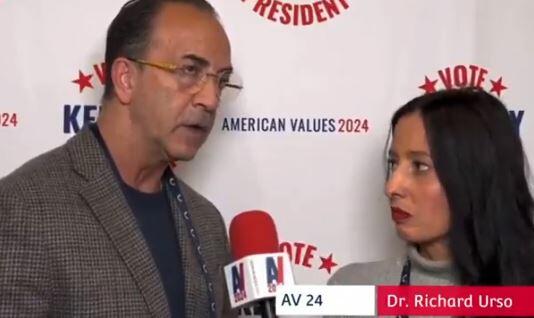
Dr. Richard Urso shares some truth bombs about COVID-19, vaccines, lockdowns, masks…

“Everything was a lie from the beginning. The asymptomatic people don’t transmit. Kids were not harbingers of the disease. They don’t actually, they’re like a break on the disease. Lockdowns were a farce. Masks don’t work.”

“I tell people, I joke sometimes I say masks do work. A lot like bathing suits work to keep pee out of the pool. They’re not very effective. So that’s one of those things that, you know, it was a farce. Pretty much everything they said was a farce. I know we’re still recovering from it. Just yesterday we walked into a pharmacy and they were advertising COVID-19 vaccines.”

“Well if you want to destroy your immune system, take a COVID-19 vaccine. It will destroy your immune system. It distributes widely in your body. It can’t be broken down because it’s a genetically modified RNA. There are contaminants, process related impurities, what I usually call them, but contaminants for most people, that they haven’t gotten out of the vaccines.”

“The drug that I invented took eight years for us to get the process related impurities out. It’s hard to do and I knew this would be a problem early on when they were trying to push this so fast because nobody had ever made these vaccines in anything bigger than a blender. What we had is found is even worse.”

“They put an SV40 promoter in the vaccine, Pfizer did, that actually well known for the last five decades to bind P53 to Guardian the genome and cause cancers. They know that. We just kept them in the head of the Human Genome Project did this discovery with a few other molecular biologists.”

“This is really big news because the contaminants and the impurities in the vaccine are very dangerous and there’s design flaws like I just pointed out. Wide distribution to the brain, the bone marrow, the ovaries, the testes and long term production six months or more in the last study that we did. So there’s a lot to talk about. Do not get the vaccines unless you just want a crummy immune system. ”

“I think the main thing is these vaccines are dangerous. They have process related impurities. They cause cancer, strokes, heart attacks. The data is in 40% more deaths in 2021 between 18 to 64. This is just data we can’t ignore, so please stay away from the vaccines.”


Tyler Durden
Sun, 12/01/2024 – 14:00

Trudeau Bends The Knee To Trump At Mar-a-Lago After Tariff Pledge

0
Trudeau Bends The Knee To Trump At Mar-a-Lago After Tariff Pledge

Authored by Steve Watson via Modernity.news,

Canadian Prime Minister Justin Trudeau Was pictured meeting with president-elect Trump and his team at Mar-a-Lago over Thanksgiving, as it emerged that he has made an agreement to crack down on drug trafficking.

The meeting came following Trump’s announcement of a 25% tariff on all products coming from Mexico and Canada until they agree to secure their borders.

In a Truth Social post earlier this week, Trump wrote “On January 20th, as one of my many first Executive Orders, I will sign all necessary documents to charge Mexico and Canada a 25% Tariff on ALL products coming into the United States, and its ridiculous Open Borders.”

“This Tariff will remain in effect until such time as Drugs, in particular Fentanyl, and all Illegal Aliens stop this Invasion of our Country!” Trump added.

He continued, “Both Mexico and Canada have the absolute right and power to easily solve this long simmering problem. We hereby demand that they use this power, and until such time that they do, it is time for them to pay a very big price!”

Fast forward four days and Trudeau was seen sitting with Trump, Elon Musk, and the rest of his team.

In a further post after the meeting, Trump explained, “I just had a very productive meeting with Prime Minister Justin Trudeau of Canada, where we discussed many important topics that will require both Countries to work together to address, like the Fentanyl and Drug Crisis that has decimated so many lives as a result of Illegal Immigration, Fair Trade Deals that do not jeopardize American Workers, and the massive Trade Deficit the U.S. has with Canada.”

“I made it very clear that the United States will no longer sit idly by as our Citizens become victims to the scourge of this Drug Epidemic, caused mainly by the Drug Cartels, and Fentanyl pouring in from China. Too much death and hardship!” Trump continued.

“Prime Minister Trudeau has made a commitment to work with us to end this terrible devastation of U.S. Families,” Trump further added, noting “We also spoke about many other important topics like Energy, Trade, and the Arctic. All are vital issues that I will be addressing on my first days back in Office, and before.”

*  *  *

Your support is crucial in helping us defeat mass censorship. Please consider donating via Locals or check out our unique merch. Follow us on X @ModernityNews.

Tyler Durden
Sun, 12/01/2024 – 13:25

Australian Broadcasting Boss Attacks Joe Rogan As ‘Malevolent Figure Preying On The Public’

0
Australian Broadcasting Boss Attacks Joe Rogan As ‘Malevolent Figure Preying On The Public’

The far flung nation of Australia and its close neighbor New Zealand were widely considered two of the worst examples of authoritarian western response to the covid pandemic.  The Australian public was locked down and under house arrest in the larger cities.  In some cases only one person would be allowed to leave home at a time and could only travel a short distance to shop for necessities.  People who went to public parks or beaches were fined or arrested.  Covid camps were created to detain not only people who had traveled overseas, but also people who simply tested positive.

Most disturbing of all, Australian officials had people arrested who dared to criticize the lockdowns on social media. Australian news organizations widely defended such measures in lockstep with the government narrative.  With the exception of a few minor complaints, journalists from the land down under acted as propagandists for the government and for Big Pharma.

It was these Orwellian conditions and similar attempts across the west that led to many personalities in the alternative media to speak out and become decidedly anti-establishment.  One of those figures was podcaster Joe Rogan.  

Rogan attracted the full fury of the corporate media for engaging in interviews with lockdown critics who debunked many of the narratives put forward by government authorities.  As it turns out, in the majority of cases Rogan and his guests were right.  The fearmongering over covid was overblown.  The lockdowns were ineffective.  Social distancing was ineffective.  The masks were ineffective.  The vaccines were suspiciously experimental and proven less effective than natural immunity.  Death numbers were inflated by comorbidities.  

The virus itself only has an average Infection Fatality Rate (IFR) of 0.23%, meaning 99.8% of all people regardless of vaccination status were under no threat (the original false claims from the WHO and others was that the virus was deadly for 3% of people).     

The lockdowns were pointless in terms of public health, but very useful in terms of public control.

To this day, many in the media still despise Joe Rogan and the alternative media for revealing the inconsistencies within the covid theater.  Not to mention, they hate the fact that their elitist ivory tower is being torn down by civilian journalists.  This was the motivation behind a recent attack on Rogan by the head of the Australian Broadcasting Corporation, Kim Williams, at the Australian Press Club (Williams took over the position at ABC at the start of 2024).  Williams described Rogan as ‘malevolent’ – a person that ‘preys on the fears of the public’.

Many would refer to the venomous comments spit by Kim Williams as gaslighting and projection.  Joe Rogan is popular because of his sincerity, a quality which is severely lacking in modern journalism.  It’s the establishment media that commonly exploits fear and disinformation to set the public into a frenzy; it’s this very behavior that caused millions of consumers to abandon mainstream outlets in the first place. 

The ABC reported in 2023 that public trust in corporate media and the government was in steep decline post-covid.  Instead of asking why this is the case and having the courage to participate in some self examination, media elites have instead chosen to blame podcasters like Joe Rogan (and the supposed ignorance of the public) for their fall from grace.

When ABC radio host Raf Epstein (an employee) asked Williams to speak further about his views on Mr Rogan and expand on his broad-brush attack, the ABC boss dredged up old covid-era accusations with no validity. 

Epstein:  “Are you worried that podcasts that don’t provide the scrutiny that you might get on the ABC, that they are the future, and that we really are going out of fashion?”

Williams:  “Well, I would hope that we’re the best antidote to misinformation and, more alarmingly, disinformation…I mean, Joe Rogan did an enormous, in my view, an enormous amount of damage back in 2020 and 2021, when he was particularly virulent in many of his remarks about vaccinations…I don’t think people have unlimited license to say what they want, simply because they believe something to be so…”

It’s important to note that covid cases and deaths plunged in 2021 well before the experimental mRNA vaccines were widely released to the public.  It should also be noted that the vaccines did not prevent transmission as officials originally claimed.

Williams then turned to gaslighting.  Angry that he had received so much criticism online for his comments, he accused Rogan fans of being “made of glass” and unable to handle critique. 

Williams:  “What fascinates me is you say something negative about Joe Rogan – and I have been swarmed with the most unbelievably vicious responses. I got one this morning that said that I should stay in my lane and watch out, and you read it and you think, ‘What are you saying to me?’”

Epstein:  “Do you think they’ve got glass jaws?”

Williams:  “Their whole body is made of glass. How can people react in such a, frankly, demonic fashion? I really stand back in disbelief…”

Keep in mind, ABC news has shut off comments on the Youtube video of Williams’ Press Club interview.  Exactly the kind of behavior you would expect from a mainstream propagandist with a glass jaw. 

Asked whether podcasts were “a threat” to the ABC, Willaims answered in the affirmative.

“Of course they’re a threat to the ABC. I think they’re a threat to all views that are contrary into their own…If they represent the newfound mainstream, our society has deep troubles, and the only response that is available is to back education and knowledge…Knowledge is the is the antidote to this kind of hysterical rubbish.”

Considering the reality that the alternative media has been consistently proven right while the corporate media has been consistently exposed as dishonest, this kind of rhetoric from Williams rings rather humorous.  The attacks on alternative personalities like Rogan stink of desperation.  The last gasps of a dying institution long bereft of honor or honesty.   

Tyler Durden
Sun, 12/01/2024 – 11:05

Extreme Speculation Has Returned

0
Extreme Speculation Has Returned

Authored by Lance Roberts via RealInvestmentAdvice.com,

A Holiday-Shortened Week

Last week, we discussed the increasingly bullish market forecasts for next year. We also noted that the market tends to trade positively heading into the Thanksgiving holiday, to which the market did not disappoint.

For the week, while there was a bit of sloppy trading along the way, the market finished at new highs, eclipsing the 6000 level on Friday. Technically, the market remains in a very bullish setup, holding support at the 20-DMA and then breaking out to new highs. That rally reversed the short-term “sell signal,” which gives the market room to trade higher into the first week of December. The rising trend line from the August lows remains the likely peak to any rally in December, and as noted last week, expect some weakness in the second and third week of December as mutual funds make annual distributions. For now, any corrective action in early December should be bought in anticipation for a rally into year end.

As we discussed previously, the key drivers for December will be continued share repurchases, portfolio manager rebalancing, and window dressing for year-end reporting. These supports will continue into year-end, and with the Federal Reserve likely to cut rates in mid-December, we expect market participants to remain on the “bull train” for now. As suggested last week:

“If you are underweight equities, consider minor pullbacks and consolidations to add exposure as needed to bring portfolios to target weights. Pullbacks will likely be shallow, but being ready to deploy capital will be beneficial. Once we pass the inauguration, we can assess what policies will likely be enacted and adjust portfolios accordingly.”

While there is no reason to be bearish, this does not mean you should abandon risk management. As we will discuss this week, investors are becoming exceedingly optimistic once again.

Investors Are Very Optimistic

I recently wrote an article on how investors have rarely been so “exuberant” in the markets. To wit:

“Consumer confidence in higher stock prices in the next year remains at the highest since 2018, following the 2017 “Trump” tax cuts.“

We also discussed households’ allocations to equities, which, according to Federal Reserve data, have reached the highest levels on record.

But we also see exuberance in overall equity allocations in the markets climbing higher with the market.

Professional investors are ramping up exposure to chase the market into year-end. The chart below of the NAAIM Index highlights when professional investor allocations exceed 97%. Such has historically been at or near short-term market peaks. In other words, professional investors are no different than retail investors who ” buy tops” and “sell bottoms.”

While allocation levels and optimism are certainly signs of market bullishness, those levels are more of a function of a massive flow of liquidity. In other words, there is “too much money chasing too few assets.” However, it is crucial to understand that “exuberance” is a necessary ingredient for pushing asset prices higher. This is why “sellers live higher, and buyers live lower.” In every market and asset class, the price is determined by supply and demand. If there are more buyers than sellers, then prices rise, and vice-versa. While economic, geopolitical, or financial data points may temporarily affect and shift the balance between those wanting to buy or sell, in the end, the price is solely determined by asset flows.

Currently, rising liquidity levels support investor optimism as asset prices continue to rise. However, as we will discuss, such activity does not necessarily equate to more “extreme speculation,” which often precedes significant market corrections. While optimism can drive short-term gains, history shows that extreme speculation detaches valuations from fundamentals, leaving the market vulnerable to larger declines.

As we noted in that previous article:

“Risk isn’t always what it seems. When the market feels the safest, that’s often when it’s often the riskiest. Think about it — when everything is going smoothly, people tend to take more risks, which can lead to market bubbles and crashes.”

However, when investor optimism morphs into more extreme speculative behaviors, investors should consider a more cautious outlook.

Signs Of Extreme Speculation

Following the 2020 pandemic shutdown, the Government and Federal Reserve went into overdrive, providing round after round of fiscal and monetary support. Money flooded into the economy, from PPP Loans to rent moratoriums, $1500 checks directly to consumers, debt forgiveness, zero interest rates, and quantitative easing. Unsurprisingly, much of that money entered the financial markets, and retail investors plowed nearly $900 billion in market-related ETFs. Interestingly, in 2024, most of those supports are gone, interest rates have risen sharply, and the Federal Reserve is reducing its balance sheet. Yet, somehow, investors figured out a way to push $913 billion (YTD) into ETFs, which is a record inflow.

That surge of capital into ETFs has contributed to the outsized performance of large capitalization companies, primarily the “Magnificent 7,” relative to the rest of the index.

However, it is not just U.S. investors dumping money into the financial markets. Foreign investors have also been shifting capital to the U.S. financial markets versus other countries.

As noted above, there is nothing wrong with investor optimism, which moves markets higher. However, when markets continually rise, even in an environment where they shouldn’t (high interest rates), such leads investors to throw caution to the wind by taking on additional risk. As that risk-taking builds and is rewarded by higher prices, risk-taking morphs into more extreme speculation. For example, the surge of capital into 3x Leveraged S&P 500 ETFs has been remarkable.

However, it isn’t just that one ETF that investors are aggressively piling funds into. The chart below shows the surge in all levered ETFs.

In addition to the two examples of growing leverage and market speculation, Michael Lebowitz noted in our Daily Market Commentary:

“We see surging volume in leveraged single-stock ETFs. An example of such an ETF is Granite Shares NVDL. The ETF offers a 2x leveraged holding of Nvidia shares. If Nvidia falls by 3%, the ETF will decline by 6%. Conversely, if Nvidia rises by 5%, the ETF will climb 10%. Accordingly, leveraged single-stock ETFs can be incredibly speculative. Furthermore, the massive surge in volume in such ETFs, as we share below, further confirms speculative behaviors are growing.

Leverage and extreme speculation can drive markets higher than most investors forecast. However, in the process, they create a divergence between fundamentals and valuations, thus exposing the markets to risk. Increased leverage and speculation are not reasons to sell immediately, but they indicate that markets are getting frothy, warranting our close attention.“

As he notes, the problem with taking on leverage is that while leverage works to your benefit on the way up, it will crush investors on the way down. A good example is the levered 2x Long ETF (MSTU) for Microstrategy (MSTR), the 5th most traded ETF on November 20th.

The problem is that MicroStrategy peaked the following day and has since wiped out a large chunk of that more extreme speculation.

However, such is always the consequence of speculation, and the end results are always poor. While speculation can last for some time, it always does end. Unfortunately, what causes it to end is a failure of the underlying fundamentals to keep up with the fantasy.

Signs To Watch To Signal The End Of Extreme Speculation

This brings us to the obvious question, “What should I be watching for to signal a shift in investor sentiment?”

Part of that answer falls into forward earnings expectations. Forward earnings estimates are optimistic and well above their long-term historical logarithmic growth trend. While such deviations existed previously, they were usually close to the point where such optimism ended. The ends of those exuberant periods of earnings growth generally coincided with a recession or a mean-reverting event. However, while estimates are currently very elevated, they can remain that way longer than you think possible.

The timing of an event that reverses extreme speculation is always the most challenging part. However, as discussed this past week, credit spreads can provide us vital clues as to a shift in sentiment that has not yet become apparent in the equity markets. To wit:

“Watching spreads provide insights into the health of the corporate sector, which is a major driver of equity performance. When credit spreads widen, they often lead to lower corporate earnings, economic contraction, and stock market downturns. Widening credit spreads are commonly associated with increased risk aversion among investors. Historically, significant widening of credit spreads has foreshadowed recessions and major market sell-offs. Here’s why:”

  1. Corporate Financial Health: Credit spreads reflect investor views on corporate solvency. A rising spread suggests a growing concern over companies’ ability to service their debt. Particularly if the economy slows or interest rates rise.

  2. Risk Sentiment Shift: Credit markets tend to be more sensitive to economic shocks than equity markets. When credit spreads widen, it typically indicates that the fixed-income market is pricing in higher risks. This is often a leading indicator of equity market stress.

  3. Liquidity Drain: As investors become more risk-averse, they shift capital from corporate bonds to safer assets like Treasuries. The flight to safety reduces liquidity in the corporate bond market. Less liquidity potentially leads to tighter credit conditions that affect businesses’ ability to invest and grow, weighing on stock prices.

Given the exceptionally low spread between corporate and treasury bonds, the bull market remains healthy, so extreme speculation is being rewarded. However, as shown below, such periods ALWAYS end.

“While there are several credit spreads to monitor, the high-yield (or junk bond) spread versus Treasury yields is considered the most reliable. That spread has been a reliable predictor of market corrections and bear markets. The high-yield bond market consists of debt issued by companies with lower credit ratings. Such makes them more vulnerable to economic slowdowns. As such, when investors become concerned about economic prospects, they demand significantly higher returns to hold these riskier bonds. When that happens, the spreads widen warning of increasing risks.

Historically, sharp increases in the high-yield spread have preceded economic recessions and significant market downturns, giving it a high degree of predictive power. According to research by the Federal Reserve and other financial institutions, the high-yield spread has successfully anticipated every U.S. recession since the 1970s. Typically, a widening of this spread by more than 300 basis points (3%) from its recent low has been a strong signal of an impending market correction.”

As investors, we suggest monitoring the high-yield spread closely because it tends to be one of the earliest signals that credit markets are beginning to price in higher risks. Unlike stock markets, which can often remain buoyant due to short-term optimism or speculative trading, the credit market is more sensitive to fundamental shifts in economic conditions.

The current bullish sentiment will continue to push asset markets higher in the near term. However, extreme speculation like we are seeing in various areas of the market will eventually end, and likely end badly for most. The timing of the event is the most difficult part.

*  *  *

Are you looking for complete financial, insurance, and estate planning? Need a risk-managed portfolio management strategy to grow and protect your savings? Whatever your needs are, we are here to help.


Tyler Durden
Sun, 12/01/2024 – 10:30