64.9 F
Chicago
Sunday, October 11, 2026
Home Blog Page 2074

Boris Johnson Calls For NATO Troops On The Ground In Ukraine Yet Again

0
Boris Johnson Calls For NATO Troops On The Ground In Ukraine Yet Again

After months of rumors surrounding possible peace talks in Turkey that might have ended the war in Ukraine not long after it reignited in 2022, multiple sources confirmed that British Politician and former PM Boris Johnson showed up in Kyiv to dismiss the negotiations and told the Ukrainians “let’s just fight”.  These sources include David Arahamiya, the leader of Ukraine’s ruling party, Tory MP Nadine Dorries and Vladimir Putin himself.

Johnson continues to deny the peace deal claims and “fact checkers” engage in extensive mental gymnastics to argue that there was no “official deal” put to paper, therefore Johnson didn’t sabotage anything.  In other words, if a politician ruins a peace deal in its infancy before it is drafted then he’s not culpable for the war that follows. 

The bottom line? Johnson, a prominent British official with ties to NATO, showed up in the middle of early negotiations and told the Ukrainians to fight instead of pursuing peace.  This alone would have given the Ukrainians a false sense of security that NATO forces would intervene and fight for them.

Boris Johnson would go on to promote a surge in military recruitment in the UK, and supported calls for conscription from military officials.  He has also suggested NATO boots on the ground in the region on multiple occasions – A move that would immediately be seen by Russia as an escalation to world war.

In a recent interview with the Daily Telegraph, the former British PM promoted the idea of British forces entering Ukraine as a part of a “peacekeeping plan.”  The presence of any NATO country’s troops in Ukraine, even those not on the front line, would be seen as a tip-toe towards direct confrontation by the Kremlin.  

In early November, Johnson argued that if Donald Trump pulled US support for Ukraine in order to force a peace deal, Britain might send troops into the fray.  The argument sounds like a thinly veiled threat:  If the US tries to force a peace deal, then Britain will send troops, escalate the war and ensure that no peace is possible.   

Johnson also asserted that if Russia gets the upper hand in the conflict then Britain may deploy it’s forces regardless in order to “defend Europe.”  Ukraine’s eastern defenses are currently being overrun by ongoing Russian attrition tactics.  This reality in combination with Trump’s avalanche election win seems to have triggered establishment ghouls into a frenzy of escalation with Joe Biden giving the greenlight on long range missile strikes coordinated directly by NATO forces.   

To be clear, Ukraine is not part of the EU nor is it a member of NATO.  NATO warhawks like Johnson have consistently claimed that Russia’s intent is to invade greater Europe (domino effect propaganda similar to the Vietnam War), yet there is still no evidence to support this.  The western media has spent the better part of the conflagration claiming that Russian forces have been chewed up beyond repair in Ukraine; at the same time they suggest Russia somehow has the strength to invade the EU. 

The majority of the US and European public have confirmed time and time again that they will not support direct conflict with Russia.  They will not volunteer to fight in such a war and will not submit to military conscription.  Around 70% of Americans say they prefer negotiations to end the war.  Only 10% of Europeans believe Ukraine can win and 52% of Ukrainians say they want negotiations and a quick end to the war.   Despite this, establishment politicians continue to ignore the overwhelming calls for peace in Ukraine.        

Tyler Durden
Fri, 11/29/2024 – 11:05

Epps Loses Defamation Case Against Fox News

0
Epps Loses Defamation Case Against Fox News

Authored by Jonathan Turley via jonathanturley.org,

Just months after a judge dismissed Nina Jankowicz’s much-hyped defamation lawsuit against Fox, a federal district court judge in Delaware, Judge Jennifer L. Hall, has dismissed Ray Epps’s defamation lawsuit. The Jan. 6 rioter said the network falsely identified him as an FBI informant.

U.S. District Court Judge Jennifer L. Hall granted Fox News’ motion to dismiss the suit.

In the original complaint, Epps made a defamation per se claim and a false light claim.

Epps and his wife have clearly been through a nightmare of threats and innuendo. However, this public controversy was discussed by various networks and the Jan. 6th  Committee. It was also a matter of legitimate public debate and commentary, with people on both sides expressing their views on the evidence and underlying allegations.

The problem for the court was trying to draw a line when coverage and commentary becomes defamation on such subjects. The chilling effect on free speech can be immense. The Supreme Court has repeatedly ruled that tort law could not be used to overcome First Amendment protections for free speech or the free press. The Court sought to create “breathing space” for the media by articulating that standard that now applies to both public officials and public figures. The status imposes the higher standard first imposed in New York Times v. Sullivan for public officials, requiring a showing of “actual malice” where media had actual knowledge of the falsity of a statement or showed reckless disregard whether it was true or false.

Now based in Utah, Epps alleged his life was upended after former Fox host Tucker Carlson repeatedly described him as a federal agent who helped instigate the attack on the Capitol, which was an attempt to stop the certification of the election of Joe Biden.

The breathing space cuts both ways. In reporting on the dismissal of the Epps lawsuit, it is notable that the Associated Press is still referring to Jan. 6 as an “insurrection” rather than a riot. Curiously, when you hit the link on “insurrection,” it goes to an article on the dropping of the Smith case, which notably did not charge Trump or anyone else with insurrection or even incitement. Yet, the AP is still reporting “the insurrection” as a fact.

The dismissal of Jankowicz directly addressed the dangers of using the courts to try to silence your critics. The case backfired on Jankowicz in prompting a court to expressly state that what she has been advocating is censorship. After holding that people are allowed to criticize Jankowicz as protected opinion, the court added:

“I agree that Jankowicz has not pleaded facts from which it could plausibly be inferred that the challenged statements regarding intended censorship by Jankowicz are not substantially true. On the contrary … censorship is commonly understood to encompass efforts to scrutinize and examine speech in order to suppress certain communications.

“The Disinformation Governance Board was formed precisely to examine citizens’ speech and, in coordination with the private sector, identify ‘misinformation,’ ‘disinformation,’ and ‘malinformation.’ … that objective is fairly characterized as a form of censorship.”

Jankowicz previously solicited significant contributions on the promise of this ill-conceived lawsuit. Nevertheless, Jankowicz is still being touted as a hero and enlisted to explain who to combat “disinformation.”

The calls for greater censorship are likely to only increase after the election. However, we have seen figures like Hillary Clinton call on Europeans to force the censorship of Americans.

Tyler Durden
Fri, 11/29/2024 – 10:45

Ukraine Not In Strong Position To Negotiate With Putin, NATO Chief Admits

0
Ukraine Not In Strong Position To Negotiate With Putin, NATO Chief Admits

The last six months has seen more and more Western officials and mainstream media outlets acknowledge reality in Ukraine – that Russian forces are on the advance, with Kiev forces outgunned and most importantly outmanned.

NATO Secretary-General Mark Rutte in fresh comments this week admitted the same. He said in a Fox News interview that Ukraine is not in a strong enough position to negotiate an end to the war. At this moment, Rutte explained, there is not enough battlefield leverage to “prevent the Russians from getting what they want.”

Image source: NATO

He still expressed a wishful thinking that things might change, though without offering any explanation as to how this will be possible.

“I think that’s crucial that we have a good deal because the whole world will be watching what type of deal will be struck between Russia and Ukraine when it comes to it,” Rutte said.

“We have to make sure that Ukraine is in a position of more strength than they are at the moment,” Rutte continued, “so that a deal can be struck which is favorable not to the Russians — and therefore to China, North Korea and Iran — because they all will be watching.”

Rutte at that point referenced China as watching closely. He said President Xi Jinping in particular is awaiting the outcome. “He’ll be very much interested who comes out on top of this,” Rutte said.

“And if it is the Russians, that will pose a threat long term, so we have to make sure that Ukraine is in a position where they can start these talks, and obviously then we have to take it step by step, make sure that Putin comes on board.”

But again he expressed that “We have to make sure … that Ukrainians can discuss the future of their country from this position of strength, so that has to be Ukraine to the table.”

“But they will only do that when they feel that they can get something out of that,” Rutte added, but then admitted, “At this moment, they are really on the back foot.”

“We will be able to get Putin to the table because he will sense that, ultimately, it is in his interest not to continue the fight,” the NATO chief said, anticipating the incoming Trump administration.

Tyler Durden
Fri, 11/29/2024 – 10:25

Watch: Billionaire Eats Banana ‘Art’ He Just Paid $6.2 Million For

0
Watch: Billionaire Eats Banana ‘Art’ He Just Paid $6.2 Million For

Authored by Paul Joseph Watson via Modernity.news,

Billionaire Justin Sun, who paid $6.2 million for a banana duct taped to a wall, followed through on his promise by eating the fruit.

Yes, really.

The crypto entrepreneur bought the piece of ‘art’ – ‘Comedian’ by Italian artist Maurizio Cattelan, during an auction at Sotherby’s in New York where he outbid six other people.

And if you think Sun consuming the banana was some kind of sardonic troll of the vacuity of the modern art world, think again.

After buying the banana, Sun pretentiously stated, “This is not just a piece of art: it represents a cultural phenomenon that bridges the worlds of art, memes, and the cryptocurrency community.”

While devouring the supposed masterpiece, Sun proclaimed, “It’s much better than other bananas. “It’s really quite good.”

Not to worry, after purchasing the piece of fruit, he was given a certificate of authenticity that instructs him on how to replace the banana given that what remains of it now probably reside in the nearest sewerage plant.

As we highlight in the video below, Sun could have bought about 500 kidney dialysis machines for kids for the same price.

Maurizio Cattelan must be laughing all the way to the bank, given that he can just keep re-producing the ‘art’ and make millions every time.

Listen to the way he described it.

“To me, Comedian was not a joke; it was a sincere commentary and a reflection on what we value. At art fairs, speed and business reign, so I saw it like this: if I had to be at a fair, I could sell a banana like others sell their paintings. I could play within the system, but with my rules. I can’t say how people will react, but I hope these new works will break up the normal viewing habits and open a discussion on what really matters. We are surrounded by conversations based on immaterial structures, social values and hierarchies that we created, but usually we prefer to forget this; it’s like being anaesthetised.”

That’ll be $6.2 million dollars, please.

*  *  *

Your support is crucial in helping us defeat mass censorship. Please consider donating via Locals or check out our unique merch. Follow us on X @ModernityNews.

Tyler Durden
Fri, 11/29/2024 – 10:05

French Govt Collapse Imminent As Le Pen Piles On Pressure Over Budget Vote

0
French Govt Collapse Imminent As Le Pen Piles On Pressure Over Budget Vote

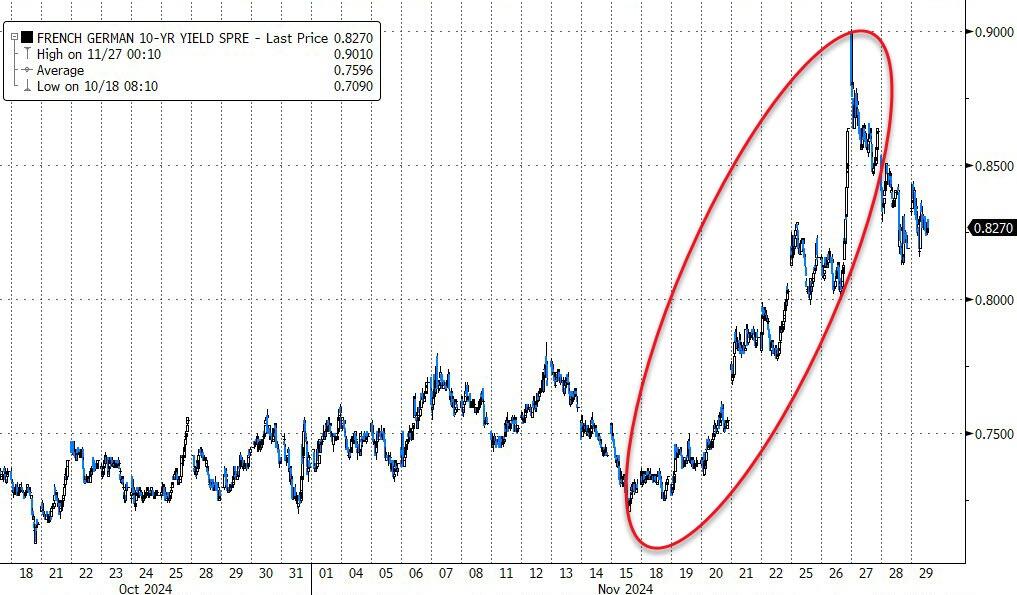
While French bond spreads have compressed modestly overnight (as French Finance Minister Antoine Armand announced that he is ready to amend the 2025 budget proposal to avoid a government collapse), they remain extremely elevated (at their highest since the European financial crisis in 2012) as rising tensions threaten the country’s economic stability.

Source: Bloomberg

As Remix News reports, Armand, warned before the upcoming budget debate that the government must make compromises regarding the 2025 budget proposal. The political situation is constantly deteriorating, because the opposition parties in the National Assembly, led by Marine Le Pen of the National Rally, have called for a no-confidence vote if the government does not accept amendments that make a tangible difference to the proposed tax increases.

Armand made headlines in September for asserting that the National Rally party was not a party he would deal with, as it was not part of what he called “the republican arc,” instigating French Prime Minister Michel Barnier to even phone Le Pen to apologize for the comment.

Le Pen, meanwhile, has insisted her budget demands have been long cast aside. 

The budget crisis may have serious consequences for the French economy, with market investors reacting with increased concern, as a result of which the yields on the French bond market have risen. 

Armand has said that the government should avoid unnecessary risk and that the adoption of the budget is now vital for the future of the country.

The discussion of the budget proposal will continue in the National Assembly on Dec. 18, with the outcome of the new amendments still unclear. Armand stated that the government is open to remedying the situation by cutting spending instead of implementing the planned tax increases.

Le Pen has called on the government to institute some €60 billion of adjustments, including a tax moratorium, indexed pensions, and more action to counter migration.

In a post on X, National Party leader Jordan Bardella wrote, “The National Rally has just won a victory by obtaining from Michel Barnier the cancelation of the 3 billion euro tax on electricity. Thanks to our determined action, energy prices would not increase for the French in 2025, if this promise is respected and if it is not financed by other tax increases. We will be vigilant. But we cannot stop there. Other red lines remain.”

Bardella goes on to write that Barnier must abandon demands to have the French pay more for medication, especially when medical costs are covered for illegal migrants. He also wants a moratorium on new taxes and a return to the old pension system.

“A serious crackdown on migration and criminal law must be undertaken, without paying lip service to words and promises: our country can no longer accommodate mass immigration which disrupts its identity and weighs heavily on its public finances. These common sense measures are realistic, quickly applicable and expected by an immense majority of French people. The Prime Minister cannot remain deaf to them. He has a few days left,” wrote Bardella.

But, despite some optimism that Armand and his ‘amis’ are moving to Le Pen’s pals’ position, French asset-swap spreads are diverging from those of Europe, indicating that assets in France are increasingly disfavored as fiscal risks persist.

Asset-swap spreads are what you receive if you want to hedge out the funding risk from owning a bond. They therefore capture the non-interest rate risk from a bond, i.e. supply and demand factors and credit risk. French asset swaps have become much more negative as the market factors in more supply and increased credit risk as the country deals with bigger fiscal deficits and political volatility.

But swap spreads in general have been declining in Europe as well as the US for a variety of reasons, such as QT and rising fiscal deficits. Euro swap spreads have generally fallen with French ASW spreads, but they have seen two big divergences: in June after Macron’s surprise election announcement, and now.

A narrowing in the spread differential would be a key sign the market is becoming less skittish on the budgetary outlook.

Le Pen gave PM Barnier until Monday to accede to her budget demands before she decides whether to topple the government.

How do you say “Tick tock!” in French?

Tyler Durden
Fri, 11/29/2024 – 09:45

European Federation Of Journalists Announces They Are Leaving Elon Musk’s X

0
European Federation Of Journalists Announces They Are Leaving Elon Musk’s X

European news organizations really seem to hate free speech. The European Federation of Journalists (which claims to represent over 320,000 members) has followed The Guardian and the German Journalists Association in an announcement that they will stop publishing on Elon Musk’s X social media platform staring on January 20, 2025 – The inauguration for Donald Trump’s second term as President.  The EFJ is the European regional organization for the International Federation of Journalists.

While the EFJ is a group that the vast majority of people have probably never heard of, their announcement tracks a rising tide of disdain among governments and establishment news outlets in the EU and UK over the new freedom of speech standards on X (formerly Twitter).  The EFJ president, Maja Sever, argued in a statement on the “X-odus”:

“We cannot continue to participate in feeding the social network of a man who proclaims the death of the media and therefore of journalists…The social media site X has become the preferred vector for conspiracy theories, racism, far-right ideas and misogynistic rhetoric. X is a platform that no longer serves the public interest at all, but the particular ideological and financial interests of its owner and his political allies.”

In other words, Elon Musk has lifted the suffocating wet blanket of online censorship from a single website and the European media are losing their minds.  The organization also claimed that their president had received “misogynistic cyber harassment and death threats”, though they did not produce any evidence to support the accusation.

Woke buzzwords like “racism” and “misogyny” no longer have any effect on the general public and the real reason corporate journalists are running away from X is because now they can be challenged on their false information and biased reporting on fair ground and in a fair debate.  Under the previous progressive Twitter regime, leftist journalists and activists could simply contact their friends at the company and have their critics flagged or even banned.  

Far from being a “vector for conspiracy theories”, X has become the only major social media outlet on the internet where any views to the right of Karl Marx and the World Economic Forum are allowed to be published.  The cultural elitism and cheerleading for censorship displayed by corporate news sites in recent years is the exact reason why they have lost the respect of the vast majority of the public.  

When Musk says that the media is dead, he’s not wrong.  The ivory tower of the old media gatekeepers has long since crumbled into insignificance.  Journalism today is synonymous with disinformation and indoctrination, and the more academically exposed a journalist is the less they can be trusted to tell the truth in most cases. 

So far, no American-based media organization has opted to leave X but individual news representatives have.  The announcement from EFJ reflects a disturbing trend of far-left authoritarianism and censorship within the EU and the UK.  As the US quickly abandons the chains of woke ideology and globalism, Europe appears to be falling ever deeper into the dark.       

Tyler Durden
Fri, 11/29/2024 – 09:05

Futures Rise As Dollar Slides, Ending 8-Week Winning Streak

0
Futures Rise As Dollar Slides, Ending 8-Week Winning Streak

US equity futures gained for the second day ahead of a shortened trading session after the Thanksgiving holiday, with Treasuries also rising and the dollar slipping amid mounting (if naive) speculation that president-elect Donald Trump will temper his most extreme trade policies drove the dollar to its biggest weekly loss in three months. As of 8:00am ET, S&P 500 and Nasdaq 100 futures both rose 0.2%, pointing to modest gains in Friday’s post-holiday trading session on Wall Street. The 10-year Treasury yield fell four basis points to 4.22%, the lowest in more than a month, as cash trading resumed after the Thanksgiving holiday. The Bloomberg Dollar Spot Index fell 0.2%, ending an 8 week winning streak and heading for its biggest weekly loss in three months. Oil prices oil prices reverse an earlier loss and trade near session highs with WTI now at $69.20, while gold adds $25 to $2660. Bitcoin rises above $96,000. There is nothing on today’s macro calendar.

In premarket trading, US semiconductor equipment makers climb after Bloomberg reported that additional US curbs on sales of chip technology to China may stop short of some stricter measures previously considered. Applied Materials shares rise 2.8% and Lam Research climb 3.3% in premarket trading. KLA is also gaining. Japanese and European chip-related stocks mostly gained on Thursday, when the US was closed. Some other notable movers:

  • Applied Therapeutics (APLT) shares sink 73% after the biopharmaceutical company’s new drug application for govorestat, a galactosemia treatment, was rejected by the US FDA. RBC Capital Markets downgraded the stock to sector perform from outperform, saying the rejection was disappointing.
  • Voyager Therapeutics (VYGR) rise 9% after Wedbush analyst Yun Zhong upgraded and assumed the coverage of the biotech firm, giving it an outperform rating while citing additional value of the drug developer’s programs.

Trump’s pick for his Treasury secretary has fueled optimism that tariffs will be measured, boosting US stocks and bonds, and sapping dollar strength. The Bloomberg Dollar Spot Index extended a weekly decline to more than 1%, snapping eight weeks of gains. The S&P 500 has already risen 5% in November, on course for its best month since February, and its best year this century…

… as investors plowed $141 billion into US equities, the heaviest inflows for a four-week period on record, according to EPFR data. A handful of tech titans have led 26% year-to-date gains in US stocks on the prospect of Federal Reserve rate cuts while the American economy continues to chalk up growth.

“We were talking day in and day out about trade tensions in 2019. What happened? The Nasdaq was on a tear. What mattered was the Fed was making a U-turn, real rates went down, and that drove equities,” Max Kettner, multi-asset chief strategist at HSBC Holdings Plc, said in an interview with Bloomberg TV. “That’s very similar to now — this is still a cutting cycle. It’s a fantastic set-up.”

European stocks were little changed, although miners including Anglo American Plc outperformed, boosted by optimism that China will adopt further measures to stimulate its economy. The Stoxx 600 rose 0.1% as telecoms and utilities sectors were the biggest laggards. Miners outperform, gaining on the back of strong iron ore prices that received a boost from new China stimulus hopes. Here are the most notable movers:

  • Anglo American shares rise as much as 3.3% after Jefferies upgraded the mining firm to buy from hold, citing that shares are trading at a discount and its mergers and acquisitions potential.
  • FLSmidth and Aalberts shares gain after both stocks were double-upgraded at Bank of America to buy in a review of the European industrials sector.
  • Delivery Hero shares gain as much as 1.6% after the food delivery firm set the price for its Middle Eastern unit’s initial public offering at the top of the range.
  • Spire Healthcare shares jump as much as 10% after Economic Times reported that Narayana Health is in talks with some Spire shareholders about buying a controlling stake.
  • Elior and Accor shares rise as both stocks are upgraded to overweight at JPMorgan in a review of the broker’s leisure coverage.
  • Norma shares surge as much as 23%, the most on record, after its management board announced plans to initiate a sale process for the global business activities of its Water Management unit.
  • L’Oreal shares fall as much as 1.1% as Deutsche Bank cuts its price target on the cosmetics maker to a Street low.
  • Telefonica and Santander shares fall, leading losses among Brazil-exposed Spanish companies fall after the Brazilian real tumbled to record lows.
  • Swiss Life shares fall as much as 1.5% after ZKB cut its rating on the Swiss insurer to market perform from overweight after a “massive outperformance” in share price.
  • Bank Pekao shares drop as much as 2.5%, after a report that it may buy a 31.9% stake in Alior Bank from PZU. Such a purchase would be detrimental for Pekao’s dividend potential, analysts say.
  • Elia shares climbs 3% after the Belgian electricity company upgraded some of its earnings guidance for the full year.
  • Enea shares drops as much as 5.7% as Poland’s 3rd-largest utility plans significant increase in spending in its new strategy for 2025-2035.

Earlier in the session, Asian stocks also edged higher as gauges in China rallied on expectations of greater economic support at a key policy meeting in December. The MSCI Asia Pacific Index rose as much as 0.6%. Speculation that authorities will release further stimulus is growing ahead of the Central Economic Work Conference, where the nation’s top leaders will lay out economic priorities for the coming year. Indian stocks also rose. Elsewhere, Korea’s Kospi Index fell 2% after the central bank’s surprise interest-rate cut on Thursday spurred concerns about economic growth. Japanese benchmarks also dropped as the yen strengthened on stronger-than-expected inflation reading out of Tokyo.

“The market is evaluating the CPI data as making the possibility of a BOJ rate hike in December slightly higher than before,” pushing up the yen and weighing on export-oriented stocks, said Tomo Kinoshita, global market strategist at Invesco Asset Management.

In FX, the Bloomberg Dollar Spot Index fell 0.2%, heading for its biggest weekly loss in three months.  The yen tops the G-10 FX leader board, rising 1% against the greenback and pulling USD/JPY down to around 150 after Tokyo inflation rose more than expected.

In rates, Treasury yields also declined at the start of a shortened US trading session that includes month-end index rebalancing at 1 p.m. New York time, estimated to extend its duration by 0.11 year. Yields are 3bp-6bp lower across the curve, 5- to 30-year at weekly lows, 10-year at 4.21%; 10- and 30-year fell below 200-day average levels for first time since late October. The US treasury market is headed for a monthly gain as benchmark yields have retreated from multimonth highs reached in the days following the US presidential election on Nov. 5; market-implied odds of a Federal Reserve interest-rate cut in December have rebounded to nearly 60%. As US markets reopen after Thursday’s holiday, yields also are lower in most euro-zone bond markets for second-straight day. German 10-year bonds hold higher after euro-area inflation rose in line with forecasts although shorter-dated maturities underperform. French bond spreads widen slightly after far-right leader Le Pen gave PM Barnier until Monday to accede to her budget demands before she decides whether to topple the government.

In commodities, oil prices reverse an earlier loss and trade near session highs with WTI now at $69.20, while gold adds $25 to $2660. Bitcoin rises above $96,000.

Friday’s early close times include Sifma’s recommendation of a 2 p.m. halt for trading of USD-denominated cash bonds, while Bloomberg index pricing is slated for 1 p.m. (vs 4 p.m. normally), aligning with early close for US stocks. Looking at today’s calendar, there is are no US economic data or speeches by Fed officials are scheduled, and no new corporate bond offerings are expected

Market Snapshot

  • S&P 500 futures up 0.3% to 6,033.00
  • STOXX Europe 600 down 0.1% to 506.73
  • MXAP up 0.2% to 183.45
  • MXAPJ little changed at 576.49
  • Nikkei down 0.4% to 38,208.03
  • Topix down 0.2% to 2,680.71
  • Hang Seng Index up 0.3% to 19,423.61
  • Shanghai Composite up 0.9% to 3,326.46
  • Sensex up 1.0% to 79,862.53
  • Australia S&P/ASX 200 little changed at 8,436.23
  • Kospi down 1.9% to 2,455.91
  • German 10Y yield little changed at 2.12%
  • Euro up 0.1% to $1.0567
  • Brent Futures down 0.5% to $72.89/bbl
  • Gold spot up 0.8% to $2,660.17
  • US Dollar Index down 0.13% to 105.91

Top Overnight News

  • Mexico’s president spoke to Trump Wed afternoon, and both characterized the conversation as positive, suggesting a significant easing in tensions just days after Trump’s tariff threat (Trump used words like “wonderful” and “productive” to describe the talk). NYT
  • Canada’s government is to bolster its investment in border security after Donald Trump threatened to impose steep tariffs over illegal immigration and drug smuggling across the US-Canada frontier. FT
  • Trump could name a tough enforcer, Gail Slater, to lead the DOJ’s antitrust team, the latest indication that the incoming administration might not be as aggressive with its approach to deregulation as some hope. FT
  • Japan’s Tokyo CPI for Nov spikes to +2.6% on a headline basis (up from +1.8% in Oct and above the Street’s +2.2% forecast) while the core number ticked up to +1.9% (vs. +1.8% in Oct and inline w/the Street). RTRS
  • South Korea’s central bank surprised markets Wed evening with a 25bp rate cut (the expectation was it would leave rates unchanged) and lowered its growth outlook for the country. WSJ
  • China has purged a senior admiral in the latest example of an anticorruption campaign being carried out in the country’s military. WSJ
  • China’s bond market grapples with signs of “Japanification” as entrenched deflation sparks concerns about an extended period of tepid growth. FT
  • Eurozone’s Nov CPI is inline w/the Street on a headline basis at +2.3% (up from +2% in Oct) while core runs a bit cooler than anticipated at +2.7% (flat vs. Oct and below vs. the Street’s +2.8% forecast). BBG
  • ECB’s Lagarde urges the EU to negotiate w/the incoming Trump administration over tariffs rather than engage in a destructive trade war. FT

Thanksgiving News Recap

  • OPEC+ reportedly discussing delaying oil output hike for Q1 2025, is to hold further talks on policy in coming days after delaying the meeting, according to Reuters citing sources. Prior to this, the meeting was delayed to the 5th from the 1st of December.
  • RBA Governor Bullock says policy needs to remain restrictive. Expects it will take a little longer for inflation to settle at target in Australia. At present, we judge that conditions in the labour market remain tighter than what would be consistent with low and stable inflation.
  • ECB’s Knot says they must take a close look at supply shocks to the economy and react forcefully if there is a risk of expectations de-anchoring.
  • ECB’s Villeroy says negative rates should remain in the ECB’s toolkit. Interest rates should clearly go to the neutral rate, would not exclude going below neutral rate in the future.
  • ECB’s Wunsch in an interview with Nikkei says he sees the possibility of continuing to cut rates in a gradual manner; would not send good signal to accelerate pace of rate cuts.
  • French Finance Minister Armand reaffirms France may make concession on electricity taxes to avoid any ensuing “storm” that could hit financial markets; says better to have a modified budget than no budget. Just prior to this remark the French 10yr yield briefly matched its Greek counterpart

A more detailed look at global markets courtesy of Newsquawk

APAC stocks traded mixed albeit with a slightly positive bias in the absence of a lead from Wall Street owing to the Thanksgiving Day holiday and as participants digested a slew of data releases into month-end. ASX 200 was lacklustre amid weakness in defensives, finance and tech with the latter not helped after the Australian Senate passed the social media ban for under-16s, while ANZ Bank also pushed back its forecast for the first RBA rate cut to May next year from February and only sees two 25bp cuts vs a prior view of three cuts. Nikkei 225 mildly declined with headwinds from recent currency strength after firmer-than-expected Tokyo inflation, while participants also digested the latest Industrial Production and Retail Sales figures which both fell short of estimates. Hang Seng and Shanghai Comp were underpinned despite the lack of obvious catalysts and shrugged off the PBoC’s net daily liquidity drain, while participants await tomorrow’s official PMI data in which the headline Manufacturing PMI is expected to show a further improvement.

Top Asian News

  • China’s Finance Ministry said tariffs imposed by China on some US goods will continue to be exempted until 28th February 2025.
  • Australian Treasurer Chalmers said RBA reforms are expected to apply after the February meeting.
  • RBNZ Deputy Governor Hawkesby said they clearly signalled another 50bps cut in February and the New Zealand economy is turning a corner.
  • Japan FX intervention amounted to 0 from Oct 30 – Nov 27.
  • German Foreign Minister will visit China from Dec 2-3rd, according to China’s Foreign Ministry.

European bourses trade around the unchanged mark, Stoxx 600 U/C; specifics light aside from Flash EZ HICP. Sectors mostly in the red with Autos & Parts lagging to end a bruising week. Basic Resources bucks the trend given metals and Anglo American (+3.4%) amid speculation in the FT that BHP could come back with a fresh bid. Stateside, futures firmer ES +0.3% with the RTY +0.9% outperforming. Specifics light and the docket sparse on a limited post-Thanksgiving session, as such the macro narrative may not change significantly. MSFT -0.5% after the FTC launched an antitrust investigation while unconfirmed reports indicate MSTR +4.5% could join the Nasdaq 100.

Top European News

  • German government plans about EUR 2bln in new chip subsidies, according to Bloomberg.
  • ECB announces changes to the Eurosystem collateral framework to foster greater harmonization.
  • BoE says the CCyB is held at 2%.

FX

  • USD was knocked lower by the stronger JPY. Today’s US macro narrative is likely to remain unaltered due to the early close. DXY has been as low as 105.61 with the next potential level of support via the 12th low @ 105.48.
  • EUR trivially firmer vs. the USD. Headline EZ inflation in-line, super-core a touch softer than Exp. ECB pricing was little changed; 25bps seen at 84% for Dec. EUR/USD went as high as 1.0597 in early trade before running out of steam ahead of the 1.06 mark.
  • JPY leading on account of firmer Tokyo inflation metrics. BoJ Dec hike priced at 56%. USD/JPY briefly crossed below 150 for the first time since October 21st with a session low @ 149.55.
  • GBP briefly made its way back onto a 1.27 handle vs. the USD; UK macro drivers light. Cable has been as high as 1.2749 with the next upside target coming via the 13th November peak @ 1.2769.
  • NZD outpacing its antipodean peer; has been gaining since RBNZ on Wednesday. NZD/USD has moved back onto a 0.59 handle and above its 21DMA @ 0.5909. AUD/USD is holding above the 0.65 mark.

Fixed Income

  • Benchmarks generally firmer with specifics outside the EZ light and expected to be limited ahead given the partial post-Thanksgiving closures. Stateside, cash trade has resumed but, unsurprisingly, is limited with yields softer across the curve and a modest flattening bias in play.
  • Bunds firmer by around 15 ticks, unreactive to Flash EZ HICP which printed broadly as expected while the super core and services Y/Y came in slightly cooler; pricing points to an 85% chance of a 25bps Dec. cut.
  • OATs in focus, though the OAT-Bund yield spread remains shy of the 90bps multi-year peak from earlier in the week. As it stands, we are largely waiting for a decision from Le Pen on French budget as a whole.
  • A morning of gains for Gilts which opened in the green and extended to a 96.10 peak shortly after with specifics light and fundamentals behind the move limited. Thereafter, Gilts settled slightly but have since surpassed the above peak by six ticks.

Commodities

  • Crude benchmarks are diverging, on account of the lack of settlement due to Thanksgiving. Specifics today have been somewhat light in European hours, with the docket ahead also limited.
  • For the most part, we are awaiting updates on OPEC+ and the Lebanon ceasefire. Benchmarks towards the lower-end of c. USD 1/bbl parameters but, as has been the case throughout all of the week, remain in proximity to familiar ranges.
  • Spot gold is in the green, benefitted this morning on overnight punchy geopolitical rhetoric around the ceasefire and as the USD was under pressure.
  • Base metals firmer but with action modest, as has been the case for much of the week. Chinese PMIs on the weekend the next major catalyst.

Geopolitics: Middle East

  • Israeli PM Netanyahu said he asked the army to prepare for a strong war in Lebanon if it violates the agreement, according to Al Arabiya. It was also reported that Israel’s Chief of Staff said they must implement the agreement strongly so that residents of the north can return to their homes, while IDF said they detected suspicious operations that posed a threat to Israel on the part of Hezbollah in what is considered a violation of the ceasefire.
  • Israeli military said Lebanese residents are forbidden to move south to a line of several southern villages, according to Reuters.
  • Iran informed the IAEA it intends to feed uranium feedstock into the eight IR-6 centrifuge cascades recently installed at Fordow to enrich to up to 5% purity, while the agency shared with Iran the changes required to the intensity of inspection activities following the commission of those cascades. Furthermore, IAEA verified that Iran had completed the installation of the last two IR-2M centrifuge cascades in a batch of 18 at its underground Natanz plant and intends to install one cascade of up to 1,152 IR-6 centrifuges at Natanz PFEP to enrich up to 5% purity, according to the IAEA report seen by Reuters.
  • Senior Iranian official says Tehran expects “tough and serious” talks with E3 in Geneva.

Geopolitics: Other

  • Russian air defences downed 30 Ukrainian drones in the southern Rostov region with some damage on the ground reported, according to the regional Governor.
  • Ukrainian President Zelensky said Russian President Putin’s promotion of the Oreshnik missile shows he does not want to end the war or allow others to try, while he added that Putin’s actions are intended to boost tension and disrupt moves by Trump on the war after his inauguration.
  • US President Biden said on Thursday that Russia’s overnight aerial attack against Ukraine was outrageous and that Russian attacks serve as a reminder of the urgency and importance of supporting Ukrainian people in their defence, according to Reuters.
  • Russian Defence Ministry said Defence Minister Belousov is visiting North Korea, according to agencies cited by Reuters.
  • Chinese and Russian militaries conducted a ninth joint strategic air patrol in relevant airspace over the Sea of Japan on Friday, according to Chinese state media.
  • Eleven Chinese and Russian military aircraft intruded South Korea’s air defence zone and South Korea launched air force jets in a tactical manoeuvre against the intrusion, according to Yonhap.

US Event Calendar

  • Nothing scheduled

DB’s Jim Reid concludes the overnight wrap

Morning from Amsterdam and welcome to Black Friday, although I can’t help think Black Friday starts in July these days! Whilst US markets were closed for the Thanksgiving holiday, there was still plenty happening over the last 24 hours, with European markets bouncing back after their recent slide. Several factors were supportive, including some lower-than-expected inflation numbers out of Germany, which led to growing confidence that the ECB would keep cutting rates. Moreover, there were also promising signs on the French budget situation, as the government sounded open to concessions in order to pass the bill, so that helped French assets to recover too. Overall, that meant it was a fairly positive day, with the STOXX 600 up +0.46%, whilst 10yr bund yields (-3.4bps) fell to an 8-week low.

In terms of the French situation, the day had started off pretty negatively, as yields on 10yr French debt briefly exceeded the 10yr Greek yield for the first time on record. But they then started to recover, as Finance minister Antoine Armand sounded open to concessions possibly in order to avoid the government being toppled. He said that “it’s better to work on a budget that is not exactly the same, otherwise we leap into the unknown.” Later in the day, Prime Minister Barnier then said that he wouldn’t raise taxes on electricity, which is something that Marine Le Pen’ had criticised. So that was seen as positive for the chances that the government would survive, and the Franco-German 10yr spread ended the day down -4.1bps at 82bps. Even so, Marine Le Pen’s National Rally have made further budget demands, so the situation is far from resolved just yet.

The bond rally then got further support from the latest German inflation data, which surprised on the downside of consensus. That showed HICP inflation remaining at +2.4% in November (vs. +2.6% expected), so that was seen as positive for the prospects of ECB rate cuts and investors dialled up the likelihood of a 50bp ECB rate in December, with the probability moving up from 15% on Wednesday to 18% by the close yesterday. Moreover, there were also comments from the ECB’s Villeroy that sounded open to a larger 50bp cut at the December meeting. He said that “Optionality should remain open on the size of the cut”, so clearly not ruling out a larger move. And in turn, that helped sovereign bond yields move lower across the continent, with those on 10yr bunds (-3.4bps) and BTPs (-6.3bps) both falling back.

This backdrop was also supportive for equities across Europe, with all the major indices moving higher on the day. By the close, the STOXX 600 was up +0.46%, with tech stocks leading the way. Germany’s DAX (+0.85%) was another outperformer, whilst other indices including France’s CAC 40 (+0.51%) and Italy’s FTSE MIB (+0.51%) posted a solid advance of their own. By contrast, the main underperformer was the UK’s FTSE 100 (+0.08%). Meanwhile in the US, markets were closed for the day, but equity futures were consistently positive throughout the European session as well.

Asian equity markets are seeing reasonable divergence with the KOSPI (-1.24%) the biggest underperformer led by declines in large-cap tech companies following yesterday’s surprise 25bps rate cut by the BOK as the economy stalled and inflation slowed more rapidly than policymakers predicted. Meanwhile, the Nikkei (-0.44%) is also trading lower after Yen strength on strong inflation data. Chinese stocks are outperforming with the CSI (+2.01%) leading gains followed by the Shanghai Composite (+1.59%) and the CSI (+1.29%) after China extended tariff waivers on some US goods, indicating that China likely isn’t ready to escalate ahead of Trump. S&P 500 (+0.31%) and NASDAQ 100 (+0.54%) futures are higher and 10yr US yields are around -3bps lower after reopening post the holiday.

Early morning data showed that Tokyo inflation accelerated more than expected in November, rising +2.6% y/y (v/s +2.2% expected), picking up sharply from the +1.8% seen last month. At the same time, core CPI climbed +2.2% from a year earlier (+2.0% expected) in November, as against a +1.8% increase last month, largely on a winding down of energy subsidies. Core-core was in line at 1.9% which is the most important for the BoJ but the firmer slant to the overall data increases the chances of a hike in December.

Following the data release, the yen appreciated +1.05%, to trade at 149.97 against the dollar, hitting its strongest level in 5 weeks. Separate data showed Japanese retail sales rose +1.6% in October YoY, missing expectations for growth of +2.0%, up from an upwardly revised +0.7% gain in September.

Looking at yesterday’s other data, the European Commission’s economic sentiment indicator remained broadly stagnant at 95.8 in November (vs. 95.2 expected), remaining in a similar zone where it’s spent the entirety of 2024. We also had the Euro Area M3 money supply data for October, which showed a pickup to +3.4% year-on-year as expected, the highest since December 2022.

To the day ahead now, and data releases include the Euro Area flash CPI release for November, UK mortgage approvals for October, German unemployment for November and retail sales for October, and Canada’s Q3 GDP. From central banks, we’ll get the Bank of England’s Financial Stability Review, and also hear from ECB Vice President de Guindos and the ECB’s Nagel. Finally, a general election is being held in Ireland.


Tyler Durden
Fri, 11/29/2024 – 08:34

Elon Musk Says DOGE Will Audit The IRS

0
Elon Musk Says DOGE Will Audit The IRS

Authored by Steve Watson via Modernity.news,

Elon Musk, new co-head of the Department of Government Efficiency declared this week that the new outfit will seek to audit the IRS.

It started with Musk asking X users what they think should happen to the IRS budget, given that it just asked for an increase of $20 billion.

Musk then responded to a post imagining the IRS being audited.

Is Musk serious? Probably.

Cue the memes.

Remember when they hired 87,000 armed agents and bought 5 million rounds of ammunition?

Elon has some beef with the IRS!

DOGE is set to scrap entire government agencies, according to co-head Vivek Ramaswarmy.

The new outfit is already compiling lists of the most egregious examples of government waste.

* * *

Your support is crucial in helping us defeat mass censorship. Please consider donating via Locals or check out our unique merch. Follow us on X @ModernityNews.

Tyler Durden
Fri, 11/29/2024 – 08:19

US Chip Equipment Makers Rise Amid Reports of “Watered-Down” China Curbs

0
US Chip Equipment Makers Rise Amid Reports of “Watered-Down” China Curbs

US semiconductor equipment makers rose in premarket trading following a Bloomberg News report indicating that an additional round of US restrictions on semiconductor equipment sales to China might be less severe than previously anticipated. 

People familiar with trade policy said the new restrictions could debut as soon as next week. The measures were part of a multi-month deliberation by top US officials, negotiations with allies in Japan and the Netherlands, and lobbying by US chip equipment makers who’ve cautioned that stricter measures would harm the industry. 

Here are the key differences between the latest proposal and earlier drafts, according to Bloomberg, citing those familiar with trade policy:

The first is which Chinese companies the US would add to a trade restriction list. The US had previously considered sanctioning six suppliers to Huawei Technologies Co. — the telecom giant at the center of China’s tech industry — and officials are aware of at least a half dozen more, the people said. But they now plan to add only some of those Huawei suppliers to the entity list, with the notable omission of ChangXin Memory Technologies Inc., which is trying to develop AI memory chip technology.

As a result of the report, Japanese and European chip-related stocks gained on the news on Thursday, while US markets closed for Thanksgiving.

In premarket trading in New York, Applied Materials rose 2.5%, Lam Research increased 3%, and KLA moved higher by 4.3%. 

“The watered-down rules are a partial win for the three firms, which have argued against unilateral US restrictions on key Chinese companies, saying this would put them at an unfair disadvantage to Tokyo Electron and ASML, whose governments have not yet agreed to the toughest restrictions on sales to China,” Bloomberg said. 

On Thursday, Citi analyst Kevin Chen told clients that the news report was a “near-term positive relief to investor concerns of escalating export controls.” 

Chen continued, “Still, there could be future restrictions under the Trump administration next year and we expect China’s semiconductor localization to continue to positively impact supply chain companies’ share prices.” 

Also, watch other chip stocks, including Nvidia, Intel, Qualcomm, ARM Holdings, Broadcom, Micron Technology, Super Micro Computer, and AMD. 

Tyler Durden
Fri, 11/29/2024 – 07:45

Whitney Tilson Announces He’s Running For Mayor Of NYC

0
Whitney Tilson Announces He’s Running For Mayor Of NYC

Whitney Tilson, famous for blowing up two hedge funds before becoming a newsletter writer, has announced he is running for mayor of New York City.

Tilson fired off an email and press campaign last week where that led with him complimenting himself for running a Tough Mudder: “I just filed to run for mayor of NYC. Why? Those who know me well might think I’m a glutton for punishment and, because I wasn’t able to run my annual 24-hour World’s Toughest Mudder sufferfest earlier this month, I’m doing this instead!”

The email eventually got to the point, stating: “But seriously, I’m deeply concerned – and a majority of New Yorkers agree – that our beloved city is headed in the wrong direction. I am committed to turning our city around and have many bold ideas for how to do so.”

Tilson says his 5 biggest priorities are:

1. Cut violent crime by 50%;
2. Address the cost-of-living crisis, much of it driven by housing costs and unnecessary regulation, and put more money in working people’s pockets;
3. Rein in out-of-control spending by eliminating corruption, reducing inefficiency and delivering better services for less;
4. Improve our public schools; and
5. Prioritize citizens (and permanent legal residents) in the allocation of city resources.

And of course, Tilson also introduced the news by releasing a 16 page letter and posting a 32-minute interview with none other than Don Lemon, which you can watch above. No word yet on whether either included ruminations about his recent colonoscopy. 

Last time we checked in on Tilson people on social media were scrambling to try and figure out ways to get off his mailing list…

As a reminder, Tilson famously blew up closed Kase Capital Management in 2017 (5 years after shuttering its predecessor T2) after getting his ass handed to him by the market “sustained underperformance”. 

“Reporting sustained underperformance to you was making me miserable,” Tilson wrote to his investors in 2017. He continued: “I couldn’t in good conscience continue to manage your money unless I had a high degree of confidence that I could turn things around within a reasonable time frame.”

Recall, Tilson had relaunched his first fund, T2 Partners, as Kase Capital in 2012 after losing 24.9% in 2011.

And so if you thought financial newsletter spam and political ad spam on their own were each forces to be reckoned with, imagine when they combine…

Tyler Durden
Fri, 11/29/2024 – 06:55