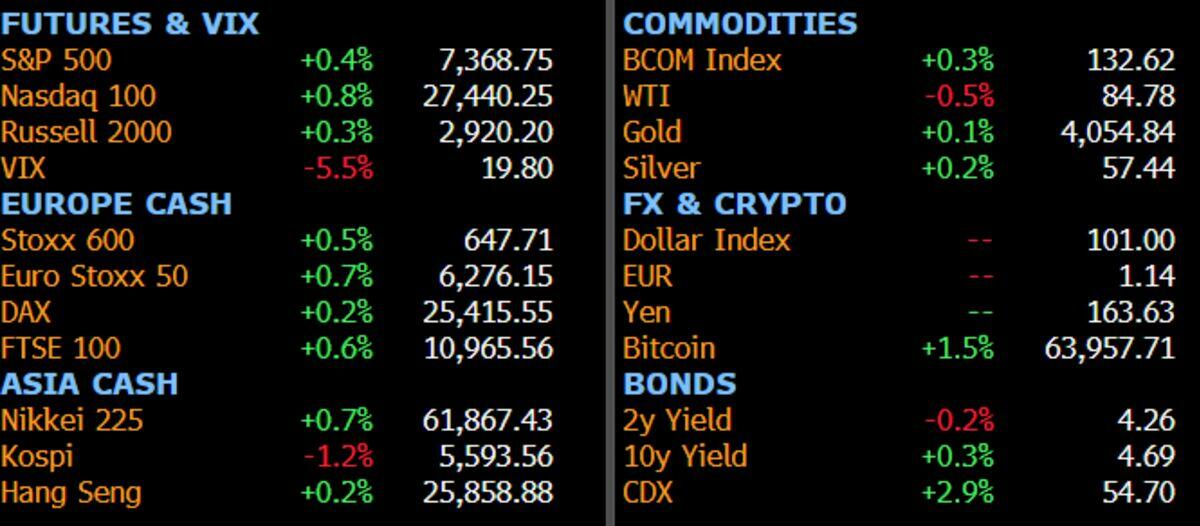
Futures rebound (for now) following yesterday’s Fed-induced meltdown as the market is clearly questioning Warsh’s credibility and potential usage of non-standard tools to fight inflation, pushing the yield curve to twist steeper and sending 30Y yields to 2 decade highs (last at 5.22%). Pre-mkt, the yield curve is seeing further twist-steepening with 10s and 30s up 1 and 3bp with 2s down 1bp. USD deterioration continues following its worst day in 4 weeks. Commodities are so confused, they are not even responding to the latest MidEast escalation with Energy and Metals lower while Ags remain bid. As of 8:00am ET, S&P futures are 0.6% higher and Nasdaq futs gain 1.3% led by a 9% jump in Microsoft whose cloud unit grew at the fastest clip in four years and the company held the line on spending; while Meta slumps after disappointing revenue guidance failed to offset another capex projection increase. Semis are higher, Memory are lower, and Mag7 is mixed but net higher (MSFT +8.4%, META -8.3%). Cyclicals are leading Defensives with AI boosting both Industrials and Utilities. While the Global MegaCap earnings releases may not have revived their names, price action suggests a bottom is forming, a view espoused (daily) by JPM which sees the deleveraging as completed (narrator: it is far from completed). Bulls will want to see this pre-mkt behavior extend into the weekend to build confidence while Bears will bank on further bond vol and Semis de-risking to maintain the status quo. US economic data calendar includes June personal income/spending and PCE price index, weekly jobless claims and 2Q advance GDP (8:30am); no Fed speakers are scheduled.

In premarket trading, Mag 7 stocks are mostly higher with the exception of Meta Platforms which slides 8% after the Facebook parent gave a revenue outlook that is seen as disappointing. The company also raised the low end of its full-year forecasts for both capital expenditures and total expenses, adding to concerns about when spending on AI will translate into better growth. On the other end, Microsoft jumps 9% after the software company’s cloud unit grew at the fastest clip in four years and the pace is accelerating, suggesting the company’s AI and computing services are making inroads with customers. Others are mostly higher (Amazon +3%, Nvidia +1.7%, Tesla +1.6%, Alphabet +0.2, Apple -0.6%)
- Altria (MO) slips 3% after weakness in the tobacco company’s oral segment pressured earnings. The midpoint of its tweaked annual adjusted EPS forecast is also below the consensus estimate, with a boost in its capex expectations.
- Carvana (CVNA) falls 9% after the company said full-year earnings may fall short of Wall Street’s expectations as the used-car retailer’s rapid growth slowed and per-car profit slipped in the most recent quarter.
- Chipotle (CMG) rises 6% after the restaurant chain reported comparable sales for the second quarter that beat the average analyst estimate. The company also boosted its annual guidance after bringing back its popular honey chicken.
- Corcept Therapeutics (CORT) jumps 19% after the drugmaker boosted its revenue guidance for the full year, following better than expected sales in the second quarter. Analysts note a strong launch for the recently approved drug for ovarian cancer, Lifyorli.
- Crocs (CROX) slumps 10% after a soft outlook for earnings this quarter overshadowed the company posting solid results and raising its annual forecast.
- Fair Isaac (FICO) falls 9% after the company’s improved revenue guidance for the full year fell short of the average analyst estimate.
- FormFactor (FORM) gains 16% after the semiconductor manufacturing company reported second-quarter results that beat expectations and gave an outlook that is seen as positive. Gross margin was singled out as strong in the quarter.
- Fortinet (FTNT) jumps 10% after the cybersecurity company forecast adjusted earnings per share for the third quarter that beat the average analyst estimate. The company also boosted its full-year revenue outlook.
- FTAI Aviation (FTAI) slides 12% after the company reported second-quarter results, with adjusted Ebitda and earnings per share that fell short of analyst estimates.
- Lam Research (LRCX) is up 8% after the semiconductor capital equipment company reported fourth-quarter results that beat expectations. It also gave an outlook for adjusted earnings that is above the consensus estimate.
- Norwegian Cruise (NCLH) falls 7% after the company cut its annual forecasts and said bookings for the next 12 months are weak.
- Nscale (NBIS) gains 6% after agreeing to acquire software startup Anyscale to help customers use AI computing power more efficiently.
- Porch Group (PRCH) soars 21% after the home-services software company reported second-quarter revenue that was stronger than expected on key metrics. The company also boosted its full-year revenue forecast.
- Qualcomm Inc. (QCOM) is down 5% after the largest maker of smartphone processors gave a weak profit forecast for the current quarter, signaling that component shortages and rising costs are taking a toll on its main market.
- Quanta Services (PWR) rises 13% after the infrastructure-services company boosted its revenue guidance for the full year to a range above the average analyst estimate.
- Regeneron (REGN) gains 3% after the drugmaker posted revenue and adjusted profit for the second quarter that was ahead of
- Starbucks (SBUX) rises 6% after the coffee-chain operator boosted its adjusted earnings per share guidance for the full year that beat the average analyst estimate. Analysts are positive about the company same-store sales and Bloomberg Intelligence flags menu innovations.
- Stellantis (STLA) is down 3% after the carmaker’s second-quarter results disappointed analysts, who noted the lack of meaningful progress in the company’s turnaround plans.
- Teladoc (TDOC) tumbles 17% after the virtual health-care provider cut its revenue guidance for the full year, citing pressures in itsBetterHelp business. Citi calls it “another tough quarter” for Teladoc.
In other corporate news The Pentagon awarded General Dynamics and Huntington Ingalls contracts worth as much as $76.6 billion to expand construction of the US’s top nuclear submarines and make shipyard infrastructure improvements. Johnson & Johnson has entered a binding agreement with Sail Biomedicines, granting J&J an exclusive option to acquire Sail for $2.58 billion, alongside an initial $785 million payment package. OpenAI’s ChatGPT and video game company Roblox will be subject to stricter scrutiny and monitoring requirements under the European Union’s content moderation rules after surpassing a threshold of 45 million monthly users in the bloc.
Another day of heavy global earnings and key economic data will test traders already navigating market gyrations and diverging performances in Big Tech, following another puzzling Fed announcement. In early trading, hyperscalers are seeing contrasting fortunes, with Microsoft rallying after earnings suggested that its AI investments are starting to generate returns. Azure cloud revenue grew a better-than-expected 43% year-on-year, while its capital expenditures were lower than expected. On the flip side, Meta Platforms fell as it gave a disappointing quarterly revenue forecast and reported the lowest free cash flow in years — a sign of ballooning expenses for AI bets.
While Microsoft’s results were well received, Meta Platforms Inc. dropped 9.8% after a disappointing revenue forecast. Markets will get another look at the health of Big Tech when Amazon.com Inc. and Apple Inc. report after the close.
“We’ve seen the hyperscalers that have been wanting to spend more, without backing up with profits, getting penalized,” said Rory McPherson at Magnus Financial Discretionary Management. “But then you have Microsoft, which isn’t spending any more than it forecast and is growing its cloud business. That’ll remain key, particularly for Amazon.”
The SOX ETF tracking the Philadelphia Stock Exchange Semiconductor Index rose 3.2%, signaling a selloff totaling 16% over five days may have found a floor. “The earnings season is broadly good for US tech, but there’s clearly a rotation ongoing from chips to hyperscalers,” said Claudia Panseri, chief investment officer at UBS Wealth Management in France. “Semiconductor stocks, even if they beat expectations, rarely manage to rise.”
After split outcomes by MSFT and META, investors will remain focused on the tech sector as two more heavyweights — Apple and Amazon — report after the close. For Apple, the key question is whether the anti-capex AI trade has further to run. For Amazon, investors will be watching both capital spending and AWS, which is expected to report 31% revenue growth. Elsewhere in tech, Qualcomm and Arm Holdings cautioned on the smartphone market. Qualcomm, the largest maker of smartphone processors, gave a weak profit forecast for the current quarter, signaling that component shortages and rising costs are taking a toll on its main market. Arm shares are lower in premarket after the company pointed to sluggishness in the smartphone industry.
Apollo’s Torsten Slok said the Fed’s abandonment of forward guidance is fueling historic bond market volatility, sending Treasury yields swinging “up and down like a yo-yo.” Bloomberg’s John Authers describes the set-up into the Fed meeting as a non-event, “yet a non-event it was not.” Markets rewarded him with the sharpest steepening of the yield curve in a year, and a late selloff for stocks that brought the Nasdaq 100 more than 10% below its peak. “Explaining quite what happened and why is tricky, ” observes Authers, failing to explain it.
Money markets are fully pricing in a Fed rate hike only by December. Katharine Neiss, chief European economist at PGIM, warned officials may be left with little choice but to begin raising rates earlier.
“That hawkish tilt is going to come in September, with three sequential hikes,” Neiss told Bloomberg TV. “Clearly there is a big risk here, because its got a whiff of discretionary monetary policy which we know doesn’t work. The markets could bully him into perhaps even a 50 basis-point hike.”
In the UK, the Bank of England held its key rate at 3.75%, with three out of nine policymakers voting for a quarter-point hike. While the decision was widely expected, markets dialed down their expectations for a raise in September. Two-year gilt yields fell eight basis points as short-dated bonds rallied.
European stocks also advance, with lower oil prices and stronger-than-expected euro-area GDP both providing tailwinds.The Stoxx 600 rises 0.4% to 647.62 as investors parse a mixed bag of corporate earnings, with Schneider Electric rising on a better outlook while Adidas sinks after disappointing profit. Construction and chemicals are the best performing sectors while health care and financial services fall the most. Here are some of the biggest movers on Thursday:
- L’Oreal shares rise as much as 4.6% after the beauty company reported second-quarter like-for-like revenue that beat consensus estimates.
- Air France-KLM gains as much as 3.3% after the company reported its latest earnings, which analysts describe as a strong beat thanks to high fuel recapture rates as well as strong performance for its Cargo division.
- Symrise gains 6.7% after the German chemical manufacturer reaffirmed its organic sales forecast for the full year.
- DSM-Firmenich shares rise as much as 12% after the company reported second-quarter organic sales growth ahead of consensus, with a beat across all divisions.
- Schneider Electric gains as much as 7.5% after a second-quarter beat and raised guidance was welcomed by analysts, who say the report is a strong print from the French electrification and automation group, particularly for its data-center offerings, while also noting particular strength in China.
- Campari shares rise as much as 8% after the Italian spirits maker’s first-half profit and sales surpassed estimates.
- Adidas shares fall as much as 18%, their biggest intraday drop on record, after the German sportswear maker posted weak profits for the second quarter amid a jump in marketing-related spending for the FIFA World Cup.
- Stellantis shares fall as much as 8.9% in Milan after the carmaker’s second-quarter results disappointed analysts, who noted the lack of meaningful progress in the company’s turnaround plans.
- Airbus drops as much as 3% despite delivering a beat on profit and revenue for the second quarter. However, the airplane manufacturer didn’t raise its full-year forecast for either metric.
- Rentokil shares plunge as much as 19% after the pest control company warned of weakening lead flow in North America’s residential markets toward the end of the second quarter and into July.
- UCB falls as much as 10% after the Belgian drugmaker reported disappointing sales for its key growth drug Bimzelx. While sales were in line, analysts say the market expected more, and attribute today’s beat to the company’s legacy products, such as Briviact.
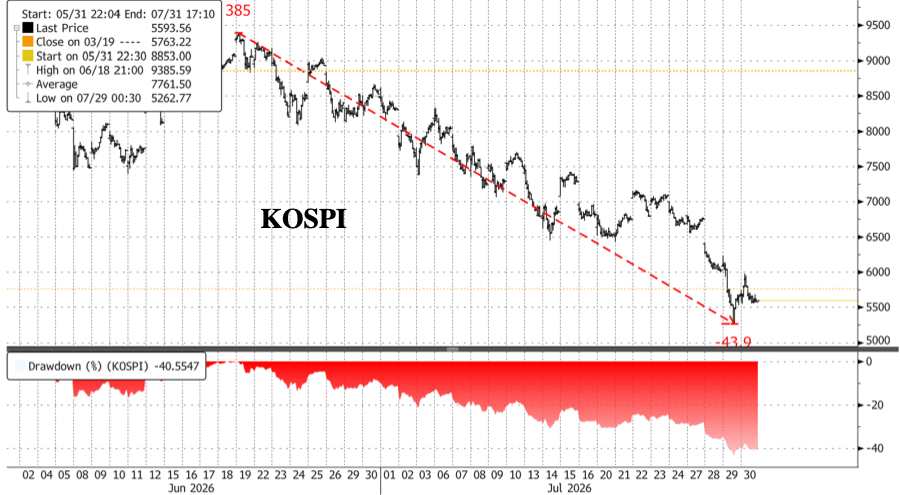
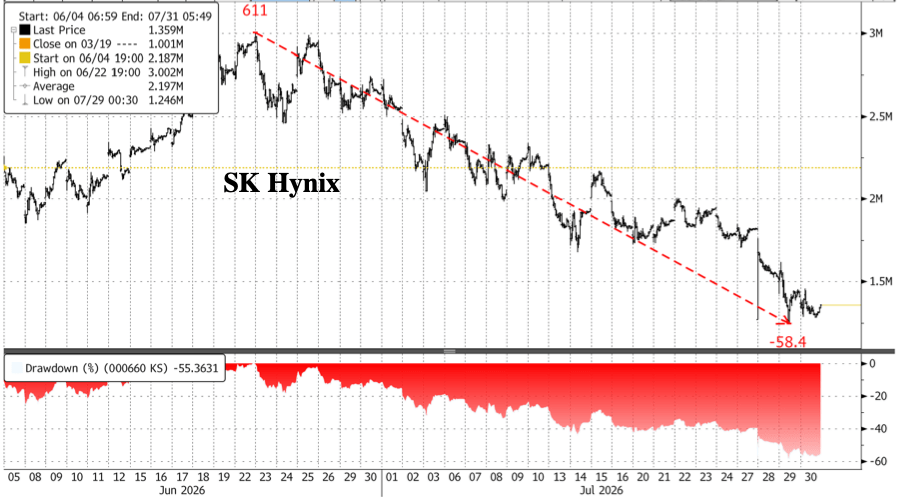
Asian stocks fell amid an extremely volatile session on Thursday as investors parsed a mixed set of Big Tech results, monetary policy signals and geopolitical tensions. The MSCI Asia Pacific Index declined 0.3%, heading for a third day of declines. South Korea’s SK Hynix was once again among the biggest drags as its shares slumped more than 5%. Peer Samsung Electronics also finished lower, giving up gains seen earlier after the chipmaker reported a more than 250-fold jump in profit. The Kospi closed lower for a third day though losses eased from the previous two days (there was no third consecutive market wide halt) as investors digested new government measures to stabilize the market. Chinese tech stocks slumped, led by high-flying semiconductor names, as concerns over stretched valuations and crowded positioning intensified a rotation out of some of this year’s best-performing sectors. China’s market showed little response to the readout from the Communist Party’s decision-making Politburo meeting, which was released just about 30 minutes before the close of trading. The nation’s top officials struck a more supportive tone on the economy but stopped short of announcing fresh stimulus at the key meeting.
In FX, The Bloomberg Dollar Spot Index falls 0.1%. The kiwi is the strongest of the G-10 currencies, rising 0.5% against the greenback. The pound adds a couple of pips ahead of the BOE decision. Precious metals are little changed. Bitcoin rises 1.5%.
In rates, treasuries extend the curve-steepening shift sparked by Wednesday’s Fed decision in early US session, pushing 2s10s and 5s30s spreads back toward weekly highs as investors continue to digest the central bank’s strategy to rein in inflation. Treasury yields are richer by around 2bp across front-end of the curve and cheaper by 2bp in the long-end, with 2s10s and 5s30s spreads steeper by 2.7bp and 3.3bp on the day. 10-year is little changed vs. Wednesday’s close near 4.69% while the 30Y rises as high as 5.24% before reversing; gilts outperform by around 3bp in the sector after the BOE kept rates on hold in a 6-3 decision. Thursday’s session brings June personal income and spending data with PCE price indexes, the Fed’s preferred inflation gauge, as a next step to evaluate the outlook for inflation. Gilts outperform after Bank of England left policy unchanged in a 6-3 split vote. IG dollar issuance slate empty so far, follows a light issuance calendar on Wednesday due to the Fed rate decision. European bond curves follow suit with UK and German 2-year borrowing costs falling 5 bps and 2 bps, respectively.
In commodities, WTI crude oil futures are slightly lower on the day, unwinding an early bid after the US conducted a fresh wave of strikes on Iranian military targets. Brent crude futures for October fall 0.4% to around $87.70.
US economic data calendar includes June personal income/spending and PCE price index, weekly jobless claims and 2Q advance GDP (8:30am); no Fed speakers are scheduled.
Market Snapshot

Top Overnight News
- As Trump moves to strike back after Iran’s surprise missile attack Tuesday, the president will decide how far to go. He could greenlight the option of 10 to 14 days of intensive airstrikes intended to cripple Iran’s missile capability despite warnings that the U.S. is running low on air-defensive munitions. Or, he could opt for a more limited military strike in the hopes diplomacy could be pursued. WSJ
- A drone strike on gas vessels in Egypt’s Mediterranean port of Damietta signaled a potential new front in the U.S.-Iran war, raising the prospect of threats to navigation through the Suez Canal, a last remaining safe export route for Saudi oil. RTRS
- Longer-maturity Treasuries extended declines as investors grew increasingly concerned the Fed’s Kevin Warsh won’t rein in inflation. Some investors are shifting toward bonds in Australia and Europe. BBG
- China’s top leaders signaled little appetite for major stimulus in the second half of the year, with the world’s second-largest economy still on track to meet a reduced annual growth target despite mounting domestic headwinds. WSJ
- The euro-area economy unexpectedly rose 0.4% in the second quarter, its strongest in more than a year. Germany, France, Italy and Spain all recorded growth. BBG
- GDP figures due today are expected to show second-quarter growth broadly matching the previous three months, with consumer spending strengthening. BBG
- The Bank of England kept interest rates steady at 3.75%, as UK officials sought to balance the threat from resurgent US-Iran tensions against signs that domestic price pressures are easing more quickly than predicted. BBG
- The BOJ is expected to keep interest rates unchanged tomorrow as it assesses the impact of last month’s hike to 1%, the highest in 31 years. BBG
- A Russian missile probably crashed in Poland overnight, PM Donald Tusk said. Poland’s air defense radar had seen several rockets over western Ukraine, while Russia said it had carried out a mass strike in the region. BBG
- The hyperscalers are seeing contrasting fortunes, with Microsoft rallying after earnings suggested that its AI investments are starting to generate returns. Azure cloud revenue grew a better-than-expected 43% year-on-year, while its capital expenditures were lower than expected. On the flip side, Meta Platforms fell as it gave a disappointing quarterly revenue forecast and reported the lowest free cash flow in years — a sign of ballooning expenses for AI bets. BBG
- US Senator Cotton (R) urged the US government to ban federal agencies and contractors from using Chinese AI models in a letter sent this week to Commerce Secretary Lutnick: Semafor
- US Senators Thune (R), Cruz (R) and Klobuchar (D) were close to proposing a bill to deal with the risks of advanced AI, though disagreements with Anthropic put the agreement on hold: Punchbowl.
A more detailed look at global markets courtesy of Newsquawk
APAC stocks were mostly lower in somewhat mixed trade as participants reflected on the FOMC and mega-cap earnings, while geopolitics was also in focus after the US conducted retaliatory strikes on Iran. ASX 200 traded lower with gold miners and the consumer sectors leading the declines, although downside was stemmed by resilience in tech, Nikkei 225 was positive with tech stocks front-running the advances in the index, while participants also look ahead to the BoJ, which began its two-day conclave and is expected to pause after hiking rates at the last meeting. KOSPI swung between gains and losses despite early momentum driven by Samsung Electronics earnings. Hang Seng and Shanghai Comp were subdued with Hong Kong range-bound after the HKMA kept rates unchanged in lockstep with the Fed, while the mainland was pressured amid ongoing US-China frictions, with MOFCOM criticising the US robot ban and threatening to retaliate if the US insists on acting unilaterally.
Top Asian news
- Japanese PM Takaichi said the plan to cut the food sales tax to 1% will be from April 2027 and be effective for 2 years. They aim to get approval by early August. Further comments by Japanese PM Takaichi, stating that she will keep market trust by not resorting to debt issuance to fund temporary tax cuts.
European bourses trade entirely in the green following a busy morning of earnings (see more below) and constructive rhetoric by the Pakistani Foreign Ministry. Al Jazeera reported comments by the spokesperson stating that discussions between Tehran and Washington are ongoing regarding the situation in the Strait of Hormuz and de-escalation; however, Al Arabiya added that there have been no tangible results. On the data front, flash GDP figures across the EZ came in broadly stronger than expected (outside of France); however, Spanish inflation came in hotter than expected, with German state CPIs also rising Y/Y. Sectors highlight the positive bias. Construction tops the pile, with Chemicals and Basic Resources rounding out the sector outperformers. Health Care, Financial Services and Telecoms are the only sectors in the red. A typical busy Thursday of earnings, with L’Oreal, Adidas and Stellantis in focus. L’Oreal LFL sales beat estimates, and it announced a 50-year exclusive deal with Kering. Adidas Q2 operating profit missed estimates while its H1 gross margin ticked lower. The Co. highlighted higher US tariffs and unfavourable currency developments as key reasons for the softer figures. In other news, Adidas’ Board appointed a new CFO. Finally, for Stellantis, its H1 adj. operating profit missed estimates while analysts at Bernstein also highlighted that margins for both Europe and North America missed.
Top European news
- G10s are mostly weaker against the Buck. Antipodeans outperform, European EMs benefit from softer TTF and other majors are quiet.
- USD is firmer against most G10 peers and resides in a 100.77-101.07 range as it attempts to claw back some FOMC-induced losses from Wednesday. To recap, the treasury curve steepened aggressively, and USD saw broad weakness as markets unwound a c. 33% probability of tightening. The driver today will likely be the PCE and GDP metrics due at 13:30 BST, alongside the familiar geopolitics (which will likely have less of an impact today). Support is below at 100.50 (alongside the 50DMA).
- EUR/USD is a touch weaker, but off worst levels as the dust settles post-FOMC; the pair currently residing at the top of yesterday’s range around 1.1450. German prelim GDP was released alongside State CPIs, the latter which indicates the mainland figure will likely be in line with expectations. German GDP surpassed expectations, before the EZ figure also printed firmer. EUR saw a modest bounce on the German data points, sufficient to lift the pair above 1.1450. EUR will likely be dictated by the Buck once again this afternoon, into tier-1 US data (see above). Levels include the 21DMA below @1.1418, and the 50DMA above at 1.1483.
- Focus for GBP today on the BoE meeting and MPR. The bank is widely expected to keep rates unchanged at 3.75%, justified as the BoE retains policy space and neither the energy or second-round effect criteria are met beyond scenario A. A 7-2 vote split is the consensus, though there is a possibility Mann could also join the hawks. Into the meeting, markets imply just 2bps, or an 8% probability of tightening. Should the hawkish risks materialise, Cable could push towards 21-DMA at 1.3380.
- Antipodeans are the clear outperformers against the Buck, with encouraging Australian Building Approvals and New Zealand Business Confidence likely giving a hand. Kiwi is the outperformer after finding a bid above 0.58, while Aussie fails to benefit to the same extent, but remains supported at 0.6950.
FIXED INCOME
- Fixed income is lower across the board as the space focuses on Chair Warsh over the statement itself, though the complex is off worst amid a Pakistan-driven pullback in energy benchmarks.
- USTs reached a 108-06 low this morning, but remains clear of 108-01 and 108-00+ from last week; the latter is also the contract low, for reference. Amidst this, the 10yr yield has been up to 4.71%, near-enough matching the YTD peak from last week. A move that is more pronounced the further out the curve you go, with steepening still very much in play, evidenced by the 30yr yield hitting a YTD peak on Wednesday, and eclipsing it this morning at 5.24%, now looking to 2007’s 5.39% high. The 2yr retreated following Warsh, despite knee-jerking higher on the Fed holding, and has since remained around the mid-point of Wednesday’s 4.21-4.39% band.
- Heading into the Fed, around a 30% chance of a hike was implied. Now looking to September’s meeting, which will come a few weeks after the Jackson Hole Symposium, the odds of a 25bps hike have increased from around a 55% implied probability to c. 57%, though the main move has been a paring of the odds of it target rate being at 4.00-4.25% (i.e. a July and September hike) to just 1% vs 20% pre-July’s hold; in-fitting with the pullback in short-term rates and curve steepening. Finally, the odds of a September hold now stand at 41% from 24%, as the mentioned 4.00-4.25% pricing reallocates.
- Bunds softer, down by 30 ticks as it stands but around 20 ticks clear of the 124.30 base. Broadly, following USTs lower before then finding respite as energy pulled back on the morning’s updates (see Commodities). No move to the morning’s data, with the regional German CPIs in-line with consensus for an uptick in the 13:00BST mainland print, while Q2’s 1st GDP print surpassed expectations at 0.2% Q/Q, benefitting from exports and seemingly indicative of other nations getting hit harder than Germany. Thereafter, the EZ-wide 1st read also surpassed consensus, though once again Ireland may be distorting it.
- Gilts in-fitting with the above, are lower by 25 ticks and the same amount clear of the 86.31 trough. Attention today on the BoE, where a hold is expected but the risks are hawkish, and this may be reflected in the number of dissenters ticking up, with Mann the one to watch; full Newsquawk preview available.
- JGBs, briefly, were in-fitting overnight, though with additional pressure seen after a soft 2yr tap and as participants now look to the Friday policy announcement.
- Italy sells EUR 6.0bln vs. exp EUR 4.75-6.0bln 3.15% 2031, 3.80% 2036, and 1.45% 2036 BTP.
- Japan sells JPY 2.13tln 2-year JGBs b/c 3.63 (prev. 4.82), average yield 1.483% (prev. 1.407%).
COMMODITIES
- In US-Iran geopolitics, US CENTCOM announced that its forces successfully completed a heavy wave of strikes against Iran in response to the previous day’s attempted missile attacks on US forces. The strikes hit dozens of IRGC targets in Iran, including military command centres, missile and drone facilities, coastal surveillance and defence sites, and maritime capabilities. According to the WSJ, CENTCOM Commander Cooper proposed a two-week plan to escalate strikes in Iran. Arab sources reported that explosions were heard in Jordan, according to Nour News. It was later reported that Jordan intercepted five missiles launched by Iran and that there were no casualties, according to local media. Meanwhile, this morning, a Pakistani Foreign Ministry spokesperson said discussions between Tehran and Washington are ongoing regarding the situation in the Strait of Hormuz and de-escalation. Al Arabiya sources later suggested that no tangible results are yet seen in halting the escalation. On the flip side, Iran’s IRGC said it will “punish aggressors today” following recent attacks.
- Elsewhere, it is worth keeping the Russia-Ukraine conflict on the radar, as heavy explosions were reported in Ukraine’s capital, Kyiv, and in other areas, including Lviv, as Russia launched ballistic missiles. Poland also scrambled fighter jets amid Russian airstrikes on Ukraine. Polish PM Tusk said a missile fell inside Poland in an uninhabited area; it appears to be a Russian missile, but this is not 100% certain.
- WTI Sep’26 and Brent Oct’26 futures are on a firmer footing as geopolitics escalate, but gains are capped by ongoing mediation and diplomacy efforts. WTI resides in a current USD 83.21-85.94/bbl range while Brent sits in a USD 86.70-89.50/bbl range at the time of writing, with both contracts towards the top end of the parameters. Dutch TTF meanwhile is softer and back under the EUR 60/MWh mark for the front-month contract, which found early support near EUR 59/MWh. No clear reason for the dichotomy between gas and oil, although a Qatari ship carrying LNG passed the Strait of Hormuz with Iran’s permission.
- Metals are mixed, choppy, and within recent ranges. Precious metals spiked on the FOMC yesterday before waning overnight as the Dollar recovered against the backdrop of escalating geopolitics. The yellow metal trades within a relatively narrow USD 4,028-4,100/oz range at the time of writing, within yesterday’s USD 3,996.05-4,116.42/oz. Spot silver resides in a USD 56.93-58.65/oz range at the time of writing, within yesterday’s 56.74-59.26/oz range.
- Base metals are on a firmer footing despite the firmer oil prices and escalating geopolitics, but possibly amid the Chinese Politburo meeting, which said the nation is to boost domestic demand and stabilise the property market. 3M LME copper trades towards the top end of a USD 13,636.00-13,752.83/t range at the time of writing.
- US oil firms trying to get into Venezuela are reportedly facing difficulties, WSJ reported citing sources.
- Caspian Pipeline Consortium reported drone attacks on two more tankers near its Black Sea terminal. Oil loading at the terminal has been suspended, and the pipeline facilities are operating normally, Kommersant reported.
- Shipping data showed that tankers which were intending to load at the CPC terminal are departing the Black Sea,according to sources.
- Jordan is looking to acquire Egypt’s stake in the Fajr gas pipeline, Al Arabiya reported citing sources.
NOTABLE EUROPEAN HEADLINES
- EU launched AI Gigafactories call to establish up to seven AI Gigafactories across Europe, unlocking more than EUR 30bln in investments.
NOTABLE EUROPEAN DATA RECAP
- EU GDP Growth Rate QoQ Flash (Q2) Q/Q 0.4% vs. Exp. 0.2% (Prev. -0.2%).
- EU GDP Growth Rate YoY Flash (Q2) Y/Y 1% vs. Exp. 0.5% (Prev. 0.3%).
- German GDP Growth Rate QoQ Flash (Q2) Q/Q 0.2% vs. Exp. 0.1% (Prev. 0.3%).
- German GDP Growth Rate YoY Flash (Q2) Y/Y 0.9% vs. Exp. 0.6% (Prev. 0.4%).
- Italian GDP Growth Rate QoQ Adv (Q2) Q/Q 0.2% vs. Exp. 0.1% (Prev. 0.3%).
- Italian GDP Growth Rate YoY Adv (Q2) Y/Y 1.0% vs. Exp. 0.7% (Prev. 0.8%).
- French GDP Growth Rate QoQ Prel (Q2) Q/Q 0.2% vs. Exp. 0.2% (Prev. -0.1%).
- French GDP Growth Rate YoY Prel (Q2) Y/Y 0.7% vs. Exp. 0.8% (Prev. 0.9%).
- Spanish GDP Growth Rate QoQ Flash (Q2) Q/Q 0.7% vs. Exp. 0.6% (Prev. 0.6%).
- Spanish GDP Growth Rate YoY Flash (Q2) Y/Y 2.7% vs. Exp. 2.5% (Prev. 2.7%).
- Spanish Inflation Rate YoY Prel (Jul) Y/Y 3.5% vs. Exp. 3.4% (Prev. 3.2%); Core 3.0% (Prev. 2.9%).
- Spanish HICP (Jul) Y/Y 3.8% vs Exp. 3.7% (Prev. 3.7%); M/M -0.1% vs Exp. -0.2% (Prev. 0.6%).
- Spanish Inflation Rate MoM Prel (Jul) M/M 0.2% vs. Exp. 0.2% (Prev. 0.6%).
CENTRAL BANKS
- RBA’s Hunter said she won’t speculate on the August policy meeting, adding that Q2 inflation was slightly softer than expected.
Geopolitics: Middle East
- US President Trump said that we’ve hit Iran very hard and we’ll finish off Iran pretty soon.
- US CENTCOM announced its forces successfully completed a heavy wave of strikes against Iran, in response to the prior day’s attempted missile attacks on US forces, while they struck dozens of Islamic IRGC targets in Iran, including military command centres, missile and drone facilities, coastal surveillance and defence sites, and maritime capabilities.
- US CENTCOM commander Cooper proposed a 2-week plan to escalate strikes in Iran, according to WSJ.
- US source said the overnight strike was extensive and had a significant impact, while it was about twice as large in intensity and scope as previous operations, according to i24’s Stein.
- Pakistani Foreign Ministry Spokesperson said discussions between Tehran and Washington are ongoing regarding the situation in the Strait of Hormuz and de-escalation, Al Jazeera reported. Additionally, Al Arabiya reported, citing sources, that tangible results have not yet yielded results.
- Iran’s IRGC said they will “punish aggressors today” following recent attacks.
- Arab sources reported that explosions were heard in Jordan, according to Nour News. It was later reported that Jordan intercepted five missiles launched by Iran and said there were no casualties, according to local media.
- A US-owned and operated, Marshall Islands-flagged LNG floating storage facility was struck by at least one UAV while at Egypt’s Mediterranean port of Damietta, according to Ambrey. The Egyptian Cabinet later noted that an initial investigation found that the fires on two vessels at the Damietta port was caused by a drone and that no party has claimed responsibility for the attack.
- Riyadh Airport suspended activities after reports of two explosions heard in Saudi Arabia’s capital.
- Saudi Arabia is seeking to build an international coalition to protect Red Sea shipping from Houthi attacks, according to reports, citing sources.
- Talks are progressing for Hamas to declare disarmament, sources say. The sources added that talks are also underway to hold a signing ceremony for the understandings in Egypt in the coming days.
- Israel reportedly conducted an airstrike on Gaza City, according to Al Araby.
Geopolitics: Ukraine
- Heavy explosions were reported in Ukraine’s capital of Kyiv and in other areas including Lviv as Russia launched ballistic missiles, while Poland scrambled fighter jets amid Russian airstrikes on Ukraine.
- Russian press noted a drone attack on Taman port in Russia’s Krasnodar region. Additionally, sources reported that the Ukrainian drone attack struck a grain export terminal at Russia’s Taman Port, causing significant damage.
- Polish PM Tusk said a missile fell inside Poland in an uninhabited area and that it appears to be a Russian missile but not 100% certain. This came following earlier sirens in cities across eastern Poland after possible reports of Russian cruise missiles having crossed into Polish airspace.
US Event calendar
- 8:30 am: Jun Personal Income, est. 0.3%, prior 0.68%
- 8:30 am: Jun Personal Spending, est. 0.4%, prior 0.71%
- 8:30 am: Jun PCE Price Index YoY, est. 3.7%, prior 4.07%
- 8:30 am: Jun Core PCE Price Index MoM, est. 0.2%, prior 0.3%
- 8:30 am: Jun Core PCE Price Index YoY, est. 3.3%, prior 3.41%
- 8:30 am: Jul 25 Initial Jobless Claims, est. 200k, prior 187k
- 8:30 am: Jul 18 Continuing Claims, est. 1795k, prior 1796k
- 8:30 am: 2Q A GDP Annualized QoQ, est. 2%, prior 2.1%
- 8:30 am: Q A Personal Consumption, est. 2.3%, prior 0.5%
- 8:30 am: 2Q A GDP Price Index, est. 4%, prior 3.6%
- 8:30 am: 2Q A Core PCE Price Index QoQ, est. 3.5%, prior 4.4%
DB’s Jim Ried concludes the overnight wrap
Last night’s on-hold Fed decision combined with a relative lack of detail from Chair Warsh triggered a sharp steepening in the Treasury curve, with the 30yr yield (+11.2bps) reaching a post-2007 high of 5.20% while a late sell-off left the S&P 500 (-1.52%) posting its worst day in seven weeks. Market sentiment also wasn’t helped by a new rise in oil, with Brent crude spiking +7.91% yesterday amid renewed escalation between the US and Iran, as well as a -5.33% fall in the Philly semiconductor index. Strong results from Microsoft have improved the mood a bit with NASDAQ 100 futures +0.57% higher overnight after the index fell into correction territory yesterday, but Asian markets are mixed this morning.
Starting with the Fed decision, as largely expected the FOMC kept fed funds steady at 3.50%-3.75%, though there were three hawkish dissents in favour of a 25bps hike from regional Fed presidents Hammack, Kashkari and Logan. There were no substantive changes to the policy statement and, consistent with his recent stance, Fed Chair Warsh once again avoided forward guidance. Warsh reiterated a commitment to get inflation under control but offered little colour on the details of the FOMC discussion. This might make the Fed minutes release on August 19 more of a market-moving event. The Chair also insisted that the discussion “was the furthest thing from inertia imaginable” despite the on-hold decision. And there were a few hints that rate hikes were still on the horizon, with Warsh noting that despite the 9-3 vote, there was “a lot of agreement on the hard questions” and mentioning “all of the action we’re going to have between September and December”.
With a hike having been more than 30% priced for yesterday’s meeting, the on-hold decision triggered dovish Fed repricing, which solidified during Warsh’s press conference. By the close, fed funds futures priced 16bps of tightening by the September meeting, down from 25bps the day before. And 33bps of hikes were priced by year-end (-8.4bps on the day). The Treasury curve steepened sharply in response. The rates-sensitive 2yr yield fell -1.4bps, but the 10yr yield rose by +7.2bps and the 30yr yield (+11.2bps) reached a post-2007 high of 5.20%. This marked the sharpest steepening in the 2s30s slope in almost a year. And the Treasury sell-off has extended overnight, with 10yr yields up +2.6bps to 4.70% as I type.
Our US economists’ baseline remains that the Fed raises rates by 50bps this year (25bps hikes in September and December). But they think the FOMC is unlikely to take much comfort in yesterday’s market reaction (see their reaction note here), with the rise in long-end rates coupled with the decline in forward real yields suggesting doubts about an imminent return of price stability. I would also add that while aggregate US credit conditions are far from restrictive, aggressive curve steepening could exacerbate existing pockets of vulnerability, such as the lacklustre housing market, as highlighted in my money and credit update earlier this week (see here).
This rise in yields ended up weighing on equities after some big intra-day swings. The S&P 500 went from trading more than half a percent down pre-FOMC to higher on the day during Warsh’s press conference but then saw a sharp drop in the final hour of trading to close -1.52% lower. Equities were also weighed down by another rout in chip stocks, with the Philly semiconductor index slumping by -5.33%. The tech declines also brought the NASDAQ 100 (-2.06%) into technical correction territory with the index now down -11.3% from its early June peak.
The market mood also wasn’t helped by yesterday’s rise in oil prices, with Brent crude settling +7.91% higher at $90.74/bbl. While a good chunk of that increase had come during Asian hours yesterday, prices jumped further after Trump’s comments that “we’ll be hitting them hard” in response to Iranian strikes against a US base in Jordan. The situation remains tense and overnight the US launched a new wave of strikes against Iran. These were apparently limited to IRGC targets (rather than escalating to targeting civilian infrastructure), and Brent crude (-1.16%) has pulled back a bit of yesterday’s spike this morning.
Yesterday evening we also got earnings from Microsoft and Meta. Microsoft delivered stronger-than-expected +43% yoy growth in cloud revenue (vs +39.6% est.), the fastest growth since early 2022, and expects this to accelerate to +45% in the current quarter as cloud demand outstrips supply. Microsoft’s shares rose by almost +9% in extended trading. By contrast, Meta’s shares fell by more than -7% after-hours as the company offered underwhelming revenue guidance for Q3 ($61-64bn vs $63.17bn est.). At the same time, Meta’s 2026 capex forecast was revised marginally higher. With investors questioning the company’s competitiveness in the AI race, its stock was already down -11% so far this year. Next in focus will be results from Apple and Amazon this evening.
Microsoft’s results have supported a recovery in the tech mood overnight, with NASDAQ futures up +0.57% as I type. However, the equity mood is mixed across Asia this morning. The Nikkei (+0.75%) is recovering after declines over the previous two sessions, but the KOSPI (-1.30%) is moving lower following on yesterday’s steep -5.98% decline. Korea’s index had climbed as much as +5.50% early in today’s session before giving up the gains, with index heavyweight Samsung down about -2% after its Q2 earnings, which included a more than 250-fold year-on-year rise in semiconductor profits. The KOSPI remains on course for a weekly decline of around -15% amid mounting concerns around the AI trade, prompting Finance Minister Koo Yun-cheol to apologise for the rollout of single-stock leveraged ETFs. Elsewhere in Asia, market performance is subdued, with the CSI 300 (-2.18%) and Shanghai Composite (-1.15%) declining, while the Hang Seng (-0.03%) is little changed.
Looking ahead to today, we will see the latest Bank of England decision, which is widely expected to keep rates on hold at 3.75%. Our UK economists expect a 7-2 vote split with Chief Economist Huw Pill and external MPC member Megan Greene opting for a 25bps hike. Markets will focus on the chances of a rate hike at the upcoming meetings, with a hike by September currently 60% priced. Our economists currently expect the BoE to stay on hold this year, though they do see risks of a hike in the event of a more persistent energy price shock or a pickup in wage growth.
On the data front, today’s attention in the US will be on the June PCE report and Q2 GDP data. Our US economists expect a +0.19% monthly reading on June core PCE and a +1.9% annualized rise in Q2 real GDP. We will also see the Q2 GDP release for the euro area, with our economists seeing upside risks to the +0.2% qoq consensus expectation (see here), as well as July CPI releases in Germany and Spain. You can see our European economists’ inflation preview here.
Ahead of these releases, European bonds slumped yesterday as the rise in oil pushed up inflation expectations, with 10yr bund yields up +5.7bps to 3.16%, while OATs (+7.8bps), BTPs (+8.9bps) and gilts (+9.2bps) posted even larger rises. European equities were mostly weaker, with the Stoxx 600 (-0.29%), CAC (-0.60%) and FTSEMIB (-0.49%) all lower, though the UK’s FTSE 100 advanced (+0.34%).
Across other asset classes, the dollar index (-0.52%) was the main underperformer in the FX space yesterday following the Fed decision, while in credit US HY spreads widened by +7bps to their highest level since early April.
To the day ahead now, the macro focus will be on the Bank of England policy decision as well as a heavy slate of data releases. These include Q2 GDP from the US, Eurozone, and Germany, as well as the US June PCE report, personal income and spending figures, and the latest weekly jobless claims data. We also get July Eurozone confidence and flash CPI releases for Germany and Spain. On the earnings front, highlights are results from Apple and Amazon after the US close, while other notable releases include Mastercard, Shell, Schneider Electric, Rolls-Royce, and BAE.