65.1 F
Chicago
Sunday, October 11, 2026
Home Blog Page 2084

Ben & Jerry’s Sues Parent Company Over Censorship Of Leftist Ideology

0
Ben & Jerry’s Sues Parent Company Over Censorship Of Leftist Ideology

Authored by Dmytro “Henry” Aleksandrov via Headline USA

Infamous leftist ice cream brand Ben & Jerry’s recently sued its parent company, Unilever, for allegedly censoring the woke company’s pro-Palestinian and anti-Israel rhetoric.

The Daily Wire reported that the company constantly pushed far-left talking points. This time, Unilever allegedly pushed back against Ben & Jerry’s supporting anti-Semitic protests on American college and university campuses, with the students urging the U.S. government to stop sending military aid to Israel.

According to the Wire, the fact that the woke Unilever decided to stop Ben & Jerry’s from spreading its leftist ideology shows that the culture and political status quo in this country is changing.

“That says a lot. In case you forgot, Unilever is the leftist company that brings you Dove — the wokest wash around — and Axe, which is now trying to encourage men to forgo macho stereotypes and take on a more progressive version of masculinity instead. The London-based corporation also supports ‘Pride events across the UK and Ireland [and] partners with LGBTQI+ charities,’” the Wire wrote.

Ben & Jerry’s has always opposed Israel, but the mainstream media exposed the company’s anti-Semitism only three years ago. In 2021, Ben & Jerry’s stopped selling its ice cream in Israel‘s territory of the “West Bank” of the Jordan River and east Jerusalem, saying the sales in the territories sought by the Palestinians are “inconsistent with [their] values.”

After that, many American politicians, like former Rep. Lee Zeldin, R-N.Y., Israel, and many states, like Florida, Arizona and North Carolina, opposed the company’s anti-Israel decision, and Unilever distanced itself from Ben & Jerry’s at the time of the scandal.

As a result, the woke company lost $111 million in pension funds. Even multiple state attorneys called the company to stop its anti-Israel boycott.

“We, the attorneys general of our respective states, write today to express our grave concerns about Unilever’s decision to engage in a boycott of the State of Israel,” the attorneys general wrote in a letter to Unilever.

“Not only is Israel one of our nation’s closest and most reliable allies, but it is also the only democratic nation in the region and has long been a force for peace and stability.”

However, after that, Ben & Jerry’s only doubled down on its anti-Semitic rhetoric, subjecting its employees to anti-Semitic propaganda and suing Unilever to prevent Israelis from eating the company’s ice cream.

Ben & Jerry’s also pushed the ‘Defund the Police” movement and anti-American propaganda. As a result, the company that didn’t learn from its mistakes lost $2 billion.

Next year, Unilever cut ties with the company, stating that “simplifying [their] portfolio and driving greater productivity will allow [them] to further unlock the potential of this business.”

Tyler Durden
Tue, 11/26/2024 – 14:25

FOMC Minutes Show “Many” Members Suddenly Favor More Gradual Rate-Cutting-Cycle

0
FOMC Minutes Show “Many” Members Suddenly Favor More Gradual Rate-Cutting-Cycle

In summary: all of a sudden we go from basically no dissents about slashing rates (pre-election) to “many” thinking slow-down and some thinking “pause” the cutting cycle completely?

*  *  *

Since the last FOMC meeting – just days after the election on November 7th – bonds, the dollar,m and stocks have rallied (excluding the election reaction before the Fed) and crude oil and gold have been dumped (hit most recently amid ‘peace’ headlines and Bessent’s appointment)…

Source: Bloomberg

And while that has been going on, US Macro data has serially un-impressed… having soared higher since before the big cut in September…

Source: Bloomberg

…interesting that the data started to disappoint right after Trump’s Red Sweep was confirmed.

Rate-cut expectations have continued to slide since the last FOMC with less than three full cuts now priced in by the end of 2025…

Source: Bloomberg

But, the odds of a December cut have jumped in the last couple of days…

Source: Bloomberg

Additionally, since The Fed began cutting, the Reverse Repo facility has been dramatically drained…

Source: Bloomberg

Recent remarks from Fed officials have seen many echo the line in the statement that risks to the Fed’s mandate are roughly in balance. However, Governor Bowman, the most hawkish on the Fed, sees greater risks to the price stability mandate. Many are also keeping their options open, in fitting with Powell, as they wait to see all the data available before acting. Powell acknowledged that inflation is on a “sometimes bumpy” path back to 2%, but he does expect inflation to continue to come down towards the 2% goal.

Nonetheless, after recent inflation data he had said the economy is not sending signals the Fed needs to be in a hurry to lower interest rates.

So what does The Fed want us to hear from the Minutes?

Key highlights from the FOMC Minutes:

  • Some say Fed could pause easing and hold rates at restrictive levels if inflation remains elevated

  • Many said uncertainty over the neutral rate level makes it appropriate to reduce restraint gradually

  • Some said easing could be accelerated if labor market weakened or activity faltered

  • Some judged downside risks to jobs market and economy had diminished

  • Participants anticipated it would be appropriate to move gradually towards a more neutral stance

  • Almost all agreed that risks to achieving dual mandate goals remain roughly in balance

  • Some said it might be appropriate in the future to consider setting the overnight reverse repo rate to the bottom of the Fed Funds Rate target

  • Many saw excessive cooling in the jobs market as having diminished somewhat since September

  • Fed staff forecast called for economic conditions to remain solid, as in its previous assessment: 2024 GDP growth projection seen higher

Some more specifics:

“Many” senior Federal Reserve officials said uncertainty about the so-called neutral level of interest rates supported a more gradual approach in reducing U.S. borrowing costs.

“Many participants observed that uncertainties concerning the level of the neutral rate of interest complicated the assessment of the degree of restrictiveness of monetary policy and, in their view, made it appropriate to reduce policy restraint more gradually,” the minutes of the November meeting said.

And suddenly, post-Trump-victory, “some” Fed members think a “pause” is necesary:

“In discussing the positioning of monetary policy in response to potential changes in the balance of risks, some participants noted that the Committee could pause its easing of the policy rate and hold it at a restrictive level if inflation remained elevated, and some remarked that policy easing could be accelerated if the labor market turned down or economic activity faltered.”

Chairman Jerome Powell and other senior officials called the elevated readings of inflation a “bump” and they predict more bumps in the future. Still, they continue to believe inflation will slow toward their 2% goal by 2026.

“Incoming data generally remained consistent with inflation returning sustainably to 2%,” the minutes said.

Read the full Minutes below:

Tyler Durden
Tue, 11/26/2024 – 14:05

Biden Throws Struggling Rivian $6 Billion Lifeline For EV Factory 

0
Biden Throws Struggling Rivian $6 Billion Lifeline For EV Factory 

The Biden-Harris administration is rushing to spend taxpayer funds before President-elect Trump takes office. To start the week, the administration directed nearly $8 billion to Intel and now billions more to save struggling electric vehicle manufacturer Rivian Automotive.

On Tuesday, the US Department of Energy announced it would offer a direct loan of up to $6.57 billion (including $5.975 billion of principal and $592 million of capitalized interest) to finance Rivian’s EV factory in Stanton Springs North, near the City of Social Circle, Georgia. The project was shelved in early March over the urgent need to reduce costs. 

“Today’s announcement reinforces the Biden-Harris Administration’s commitment to strengthen the nation’s manufacturing competitiveness, helping ensure American businesses remain global leaders in the rapidly expanding EV industry,” the DoE wrote in a statement. 

Democrats in the White House are spending taxpayer funds like a drunken sailor ahead of Trump entering the White House in less than two months. The Trump administration may claw back the money the Biden team is dishing out as lifelines to struggling companies. 

We view the DoE loan as a lifeline for Rivian, considering it has been unable to meet production and sales targets and has burned through $19 billion since going public in 2021. The cash crunch forced the startup to pause construction of the Georgia plant in March. 

The new Georgia plant could help Rivian boost the production capacity of more affordable models. The R1 vehicle costs $70,000 or more, which is unaffordable for the typical consumer because of high interest rates and elevated inflation.

“This loan would enable Rivian to more aggressively scale our US manufacturing footprint for our competitively priced R2 and R3 vehicles that emphasize both capability and affordability. A robust ecosystem of US companies developing and manufacturing EVs is critical for the US to maintain its long-term leadership in transportation,” Rivian CEO RJ Scaringe wrote in a statement.

Rivian noted:

Rivian intends to build the facility in two phases, each resulting in 200,000 units of annual production capacity, for a total of 400,000 units of annual capacity–supporting the sale of American EVs in international markets. Phase 1 of the project is expected to start production in 2028. Rivian is expected to create approximately 7,500 operations jobs through 2030 at the company’s future manufacturing facility in Georgia. This is in addition to 2,000 expected full-time construction jobs that will utilize the region’s significant talent and workforce to further strengthen the domestic EV ecosystem. These jobs complement the thousands Rivian has already created and plans to maintain at its current plant in Normal, Illinois, which have bolstered the local and regional economy.

In June, German automaker Volkswagen provided Rivian with a $5 billion investment lifeline in the form of a joint venture, which helped to stem its cash hemorrhaging. 

Multiple lifelines have been thrown at Rivian ahead of Trump’s expected elimination of the EV tax credit, worth up to $7,500 for new EVs and $4,000 for used ones. Tesla CEO Elon Musk has applauded Trump’s move to roll back EV tax credits because it will bankrupt his competitors. 

In markets, Rivian shares are up 8% in premarket trading at around $12.56. As of Monday’s close, shares were down 50% year-to-date, with about 18% of the float short, equal to about 135 million shares. 

The Biden-Harris team continues to spend taxpayer funds like drunken sailors. This creates terrible optics, as voters have made it very clear that the era of reckless spending should be over.

Tyler Durden
Tue, 11/26/2024 – 13:45

Solid 5Y Auction Sees Highest Direct Bid In A Decade

0
Solid 5Y Auction Sees Highest Direct Bid In A Decade

After yesterday’s stellar 2Y auction, many expected today’s sale of 5Y paper to be similarly solid especially with yields flattish on the session after yesterday’s massive flattening which pushed the 2s10s back into inversion. And they were not disappointed.

Starting at the top, the auction priced at a high yield of 4.197%, up from 4.138% in October and the highest since Jun. It also stopped through the When Issued 4.199% by 0.2bps. This was the first non-tailing auction since June.

The bid to cover was also solid: at 2.43, it was up from 2.39 last month and above the 2.38 six-auction average.

The internals were uglier: indirects were awarded 64.12%, down from 76.35% and the lowest since February. But while foreign buyers were leery, local Direct bidders were not and at 24.58%, Directs took down the biggest chunk of the auction since July 2014. This meant that Dealers were left with just 11.3% of the auction, the lowest since September 2023.

Overall, a decent, if hardly spectacular auction and one which did little to move yields in the secondary market.

Tyler Durden
Tue, 11/26/2024 – 13:33

Judge In Daniel Penny Trial Rejects Defense Motion For Dismissal

0
Judge In Daniel Penny Trial Rejects Defense Motion For Dismissal

Authored by Michael Washburn via The Epoch Times,

Judge Maxwell Wiley on Nov. 25 declined to dismiss the case against former U.S. Marine Daniel Penny after hearing defense lawyers’ and prosecutors’ arguments without the jury present.

Penny is on trial for manslaughter and criminally negligent homicide related to the death of Jordan Neely on May 1, 2023.

The judge did agree to include a limiting instruction regarding witness testimony in his final instructions to the jury, which is set to begin deliberating on the controversial case next week after closing arguments set for Dec. 2.

The limiting instruction will tell the jury not to take into consideration any subjective opinions that witnesses may have let slip about the guilt or innocence of the defendant.

During oral arguments on Nov. 25, defense lawyer Thomas Kenniff sought to persuade the judge that legal precedent existed for dismissing the case against Penny, who simply exercised a lawful right to defend himself and others when Neely entered an uptown F train at Manhattan’s Second Avenue stop.

Citing a transcript of the police interview, Kenniff said: “So, on page 18, Mr. Penny tells the officers that Mr. Neely says, in some substance, ‘If I don’t get this and this, I’m going to go to jail forever.’

“After throwing his jacket, Mr. Neely says, ‘If I don’t get this and this, I’ll kill everyone, I am prepared to go to jail for life.’”

Kenniff also cited portions of the interview with Penny and described Neely “getting in people’s faces, and people getting out of the way.”

Later in the transcript, Penny states his frank concern that Neely would have harmed women and children on the subway.

Under direct examination from prosecutors on Nov. 8, one of those passengers, Lori Sitro, described the fear she felt for herself and her small son in the face of Neely’s aggressive and menacing conduct.

Sitro said she moved the little boy’s stroller in front of him to keep him safe.

Kenniff also cited the testimony of witness Derrick Clay, who had testified that he wondered what Neely might have in his pockets.

The defense lawyer also brought up the testimony of yet another witness, Yvette Rosario, who described feeling such terror as the scene unfolded that she thought she might pass out.

“I would submit that it’s overwhelming, from a subjective and an objective standpoint, that Mr. Neely was attempting to carry out a robbery.”

Kenniff then attempted to counter prosecution claims that Neely simply wanted food and water.

He said that, when someone demands food, that person does not actually expect others to pull a sandwich from a bag and offer it; rather, the demand is clearly for money to purchase whatever the person making the demand may be in need of.

Judge Wiley asked Kenniff for case law to support his arguments.

Kenniff cited the 1980 case of People v. Davis, which concerned a December 1978 incident where a court officer driving a bus in Brooklyn shot a man who got onto the bus, refused to pay the fare, behaved aggressively and menacingly, and attempted to rob the driver.

Kenniff acknowledged that there was “not a wealth of case law” in this area, but added: “I think what we have here with Mr. Neely is light years more immediate, more direct, more obvious than anything like that,” he said.

Jordan Neely in New York on May 12, 2023. Courtesy Mills & Edwards, LLP via AP

The Prosecution Responds

Prosecutor Dafna Yoran attempted to refute Kenniff’s characterization of what happened on May 1, 2023.

She acknowledged that Neely had larcenous intent and that his conduct made passengers fear for their safety.

But Yoran portrayed Neely as someone in the grip of mental illness and addiction, who needed help, and wasn’t a robber of the type that Kenniff had described in his invocations of earlier case law.

“Most people talked about ‘I’m hungry, I’m thirsty,’ and it was an expression of his frustration. We’re talking about a man who is having a psychotic attack, who is on K-2, who is unhinged,” she said.

“No reasonable person would think that the solution was to give him what he wants. If they gave him water, if they gave him food, if they gave him $100, nothing was going to stop” the menacing conduct, she said.

Kenniff then tried to use the prosecutor’s admission against her, saying that the train ride between Second Avenue, where Neely got on, and Broadway-Lafayette, the next station, was about 30 seconds at most.

“The notion that there was an opportunity here for de-escalation—‘Here, let me give you $5,’ or whatever it is—is just not a reality. The fact that [he] is mentally unstable does not make him incapable of a robbery,” he said.

It was incumbent on the court to view the evidence in the light most favorable to the defense, Kenniff argued.

The judge appeared largely unmoved by the legal arguments and case law he invoked.

“I’m skeptical about giving a discharge,” the judge said.

“I anticipated you asking for it, but I’m still skeptical that it’s there.”

The judge made a small concession to the defense, agreeing to include the limiting instruction to the jury excluding witnesses’ opinions from consideration.

Closing statements in the trial are scheduled to begin on Dec. 2.

Tyler Durden
Tue, 11/26/2024 – 11:25

Amgen Crashes As Anti-Obesity Drug Results Disappoint; Novo & Lilly Surge On Proposed Biden Coverage Rule

0
Amgen Crashes As Anti-Obesity Drug Results Disappoint; Novo & Lilly Surge On Proposed Biden Coverage Rule

Shares of Eli Lilly and Novo Nordisk surged on Tuesday following news that the Biden administration plans to propose a rule allowing the federal government to cover a significant portion of the tab of “miracle” weight-loss drugs. However, news from Amgen about clinical trial results of its weight-loss drug, while meeting Wall Street expectations, failed to outperform Eli Lilly’s blockbuster treatment, Zepbound.

Let’s begin with Amgen shares crashing 12% after the Phase 2 study with MariTide showed only a 20% average weight loss at 52 weeks in 592 obese patients. 

Wall Street analysts forecasted MariTide would be able to shed about 25% of the patient’s body weight on average over the course of one year and exceed the performance of existing drugs offered by Lilly and Novo. About 11% of patients discontinued MariTide during the trial, a much higher discontinuation rate versus the other medications on the market.

“Given already excellent efficacy with both Lilly and Novo, difficult to know how MariTide fits in the market other than as a niche player for patients adamant about taking an injection less often than weekly,” Mizuho’s Jared Holz told Bloomberg via email. 

Amgen wrote in a press release, “Nausea and vomiting were predominately mild, transient and primarily associated with the first dose,” adding, “The incidence of nausea and vomiting was substantially reduced with dose escalation.”

Other Wall Street analysts commented on MariTide’s results (courtesy of Bloomberg):

Jefferies (Buy, $294)

  • “The results are on the lower end of the expectations of 20-25% and the company noted there was no plateau of weight loss so there is more pot’l weight loss beyond 52 weeks,” analysts led by Michael J. Yee wrote in a note
  • Says there will be some “relative investor disappointment on the overall topline efficacy at 20% appreciating that we do not know the individual arms and more to be disclosed”
  • “Bulls will be a little disappointed today – while bears will say AMGN is no longer a major player here to be concerned on”

Citi (Neutral, PT to $310 from $335)

  • Says data on monthly dosing was not reported, and “will likely weigh on shares until more is disclosed,” analysts led by Geoff Meacham wrote
  • “Without monthly dosing, there could be headwinds in MariTide carving a long-acting injectable niche in the market”
  • “We anticipate AMGN trading downwards of $25+ on these data and take our TP to $310 (-$25)”

Amgen shares crashed 12% – the largest daily decline since the October 2000 DotCom bust…

Meanwhile, Lilly and Novo shares moved higher after the Biden administration proposed a rule that would require the Medicare insurance program—already footing the bill for weight loss drugs for health conditions such as diabetes—to expand coverage to an estimated 3.4 million older Americans on Medicare and four million more adults in Medicaid programs.

Bloomberg cited a White House official who said the plan would “slash out-of-pocket costs by as much as 95% for the drugs that can carry a price tag of $1,000 a month.”

This new proposed coverage would cost taxpayers $25 billion over ten years, adding $11 billion in federal Medicaid costs and $4 billion in state costs. The goal of the incoming Trump administration will be to slash spending, not increase handouts to big pharma. 

Trump’s pick of Robert F. Kennedy Jr. to lead the Department of Health and Human Services would ensure that healthy food would be the most affordable solution to “solve the obesity and diabetes crisis” instead of big pharma’s GLP-1 drugs.

Tracking the GLP-1 craze in markets, Goldman’s index of companies with high exposure to GLP-1s reversed much of the gains before and after the election on RFK Jr. risks. As a result, companies at risk from GLP-1s’ success are now outpacing on the year. 

The key takeaway is that competition in the GLP-1 market is heating up. Meanwhile, RFK Jr.’s move to solve the obesity and diabetes crisis won’t be with pharma drugs, but through a focus on clean, healthy food.

Tyler Durden
Tue, 11/26/2024 – 11:05

A Note Of Caution For Those Who View Bessent As A Return To Orthodoxy

0
A Note Of Caution For Those Who View Bessent As A Return To Orthodoxy

By Benjamin Picton, Senior Macro Strategist at Rabobank

Bessent Into Orthodoxy?

Markets extended recent gains yesterday in apparent reaction to Donald Trump’s decision to nominate hedge fund manager Scott Bessent as Treasury Secretary. The S&P500 closed 0.30% higher at 5987, the DOW gained almost 1% to close at 44,736 and the NASDAQ was up 0.27% to 19,055. The EuroStoxx 50 rose 0.23%, the FTSE100 was up 0.36% and the ASX200 gained 0.28% to close at a fresh all-time high of 8,417.

The Treasury curve bull flattened as 2-year yields fell 10.4bps to 4.27% and 10-year yields dropped by 12.7bps to 4.27%. As you have no-doubt deduced, this means that the 2s10s Treasury spread is now completely flat and poised to drift back into inversion if the recent flattening momentum continues. Curiously, this puts us back into a similar position as the one that prevailed immediately before the FOMC cut the Fed Funds rate by 50bps on September 18th. RaboResearch views this as a short-term cyclical move and our expectation for longer-term bear-steepening of the Treasury curve remains.

The Bloomberg Dollar Spot Index was 0.61% lower on the day as EUR, JPY and GBP all squeezed out gains. High-beta currencies like the AUD, NZD and CAD were notable laggards, with the Loonie actually losing ground against the big Dollar. The Loonie is falling further this morning after Donald Trump suggested that he would impose tariffs of 25% on all products from Canada and Mexico. The EUR, AUD and NZD are also being heavily offered in early trade.

The relative underperformance in CAD and AUD yesterday might have had something to do with the sharp fall in energy prices that accompanied rumours that Israel and Hezbollah are poised to agree a ceasefire deal in Lebanon. The intuition behind this move being that a pause in hostilities between Israel and Iran’s favourite proxy perhaps lessens the probability of escalation against Iran itself, which might have impacted oil supplies flowing out of the Hormuz Strait. Brent crude fell 2.69% to $73.15/bbl.

The appointment of Bessent might have also had some influence on energy prices. Markets are clearly breathing a sigh of relief at the nomination of a Wall Street insider who has a CV that includes a stint working for George Soros when the latter famously “broke the Bank of England” by shorting Sterling against the Deutsche Mark in the 1990s. More than a few commentators are suggesting that Bessent might act as a “voice of reason” within the Trump cabinet, and act to temper some of the more hawkish policy predilections of the Administration. Bessent has previously indicated his support of policies to substantially expand US oil production and cut the fiscal deficit, which would be disinflationary on both the supply and demand side.

Aside from a long career as a successful macro fund manager, Bessent has also lectured in economic history at Yale and, as reported in the Wall Street Journal, wants to be involved in the “grand global economic reordering” that he sees taking place. Perhaps contrary to the narrative implied by the price action yesterday, Bessent is not opposed to the use of tariffs and his advocacy for the appointment of a ‘Shadow Fed Chair’ as a form of forward guidance (initiated by executive government) suggests that he is open to policy actions that would curtail the independence of the Fed and give the President more control over the full suite of economic policy levers.

This might sound familiar to regular readers of this publication. RaboResearch’s Global Strategist, Michael Every, has written extensively since 2016 on the re-ordering of the global economy and the re-emergence of Great Power competition.

The reform of institutional settings adopted during the unipolar period of increased trade liberalization and globalization to better support state aims is a logical consequence of a paradigm shift in the way that the global system works. A more mercantilist approach that favors state aims and control of strategic supply chains over efficiency of production and low inflation implies a different infrastructure of government to what currently prevails.

As a student of economic history, Bessent seems to understand this. Perhaps that should raise a note of caution for market participants hurriedly interpreting the appointment of a “Wall Street insider” as a step back towards the orthodoxy of the last 30 years.

Tyler Durden
Tue, 11/26/2024 – 10:45

Trump Win Sparks Surge In Consumer Confidence; Stock Market Expectations Hit Record High

0
Trump Win Sparks Surge In Consumer Confidence; Stock Market Expectations Hit Record High

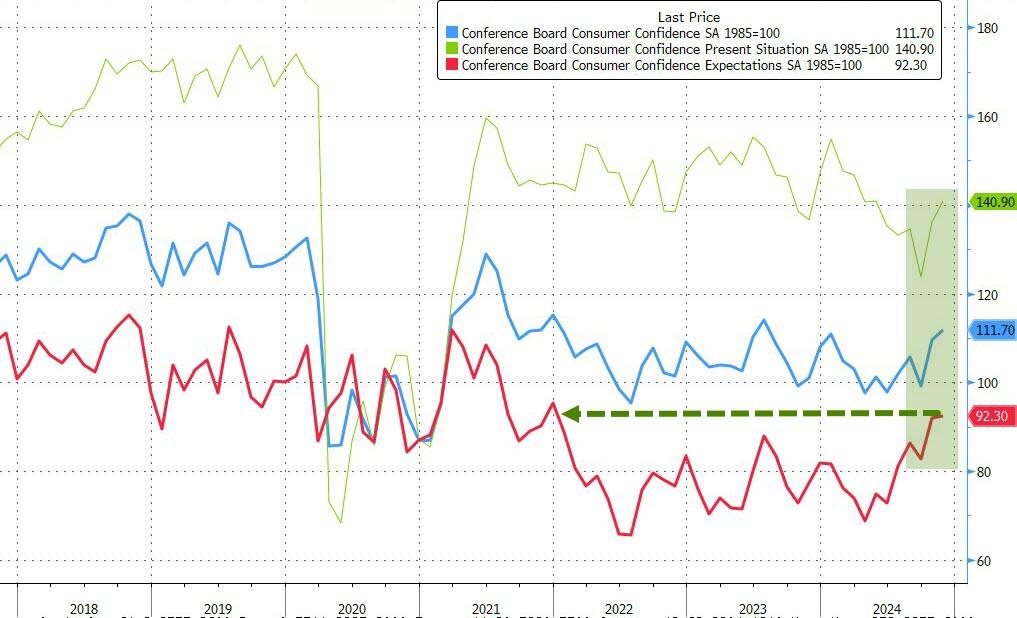
Consumer confidence among Americans soared in November, building on October’s gains, as trump’ election victory sparked a surge in both the Present Situation and the Expectations sub-index…

Source: Bloomberg

That is the biggest percentage jump in the Present Situation Index since summer 2021 as vaccines rolled out and ‘saved the world’…

Source: Bloomberg

Rather oddly, amid the improved optimism., expectation for purchases (for cars, homes, and durables) all fell modestly in November…

Source: Bloomberg

But, The Board’s labor market indicator showed the jobs situation improve considerably after an ugly few months…

Source: Bloomberg

…and expectations for stock market gains continued to surge while inflation (and interest rate) expectations fell to post-COVID lows…

Source: Bloomberg

Does any of this seem like American consumers need another 25bps rate cut?

Tyler Durden
Tue, 11/26/2024 – 10:35

Mexico Threatens Trump With Counter-Tariffs, China Cries Foul

0
Mexico Threatens Trump With Counter-Tariffs, China Cries Foul

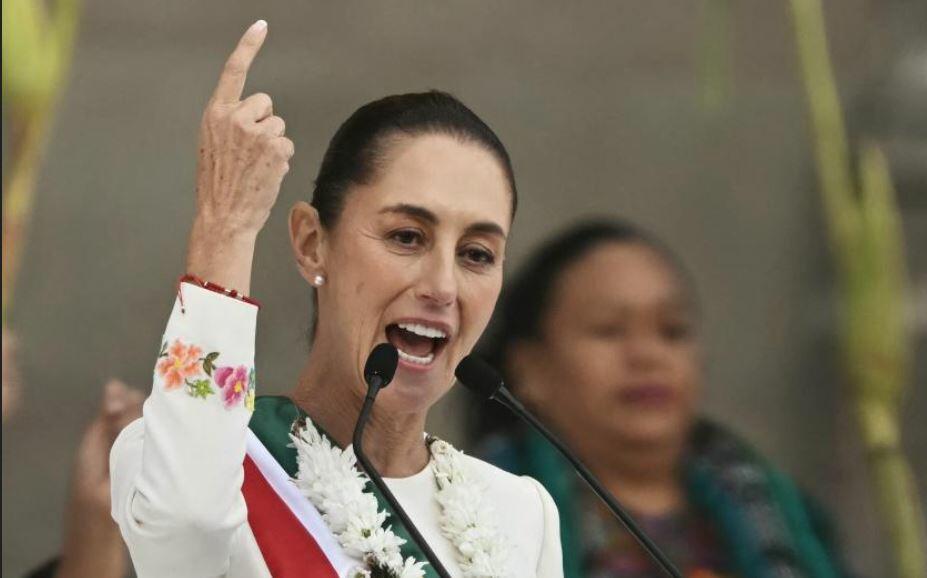
One day after President-elect Trump pledged to slap a 25% tariff on all goods coming from Mexico and Canada until they tighten border security, and an extra 10% on China until the CCP cracks down on fentanyl smuggling, Mexican President Claudia Sheinbaum – a leftist ideologue trained in radical student protest movements – lashed out.

First, she threatened counter-tariffs…

“One tariff would be followed by another in response, and so on until we put at risk common businesses,.” Sheinbaum said, referring to US automakers operating plants on both sides of the border.

But then she said Mexico had made progress stemming the flow of migrants, insisting that “caravans of migrants no longer reach the border,” (though was that really due to Mexico, or Trump’s election?) before blaming American culture for the drug epidemic – calling it “a problem of public health and consumption in your country’s society.”

“It is unacceptable and would cause inflation and job losses in Mexico and the United States,” Sheinbaum continued, before criticizing US spending on weapons – suggesting that the money should instead be spent regionally to address the migration problem.

“If a percentage of what the United States spends on war were dedicated to peace and development, that would address the underlying causes of migration,” she said.

Of note, Mexico leads in total percentage of goods imported into the United States, followed by China and Canada.

We assume ‘underlying causes of migration’ = bribing Guatemala, Honduras and Colombia – the thing Kamala Harris was sent down to negotiate. 

Chinese spokesperson for the Chinese embassy in Washington, Liu Pengyu, responded as well – saying “No one will win a trade war or a tariff war,” adding “the idea of China knowingly allowing fentanyl precursors to flow into the United States runs completely counter to facts and reality.”

On Monday, Trump took to Truth Social to blast Mexico, Canada and China over drug smuggling and border security, writing:

As everyone is aware, thousands of people are pouring through Mexico and Canada, bringing Crime and Drugs at levels never seen before. Right now a Caravan coming from Mexico, composed of thousands of people, seems to be unstoppable in its quest to come through our currently Open Border. On January 20th, as one of my many first Executive Orders, I will sign all necessary documents to charge Mexico and Canada a 25% Tariff on ALL products coming into the United States, and its ridiculous Open Borders. This Tariff will remain in effect until such time as Drugs, in particular Fentanyl, and all Illegal Aliens stop this Invasion of our Country! Both Mexico and Canada have the absolute right and power to easily solve this long simmering problem. We hereby demand that they use this power, and until such time that they do, it is time for them to pay a very big price!

Trump then ‘truthed’ about China… writing:

I have had many talks with China about the massive amounts of drugs, in particular Fentanyl, being sent into the United States – But to no avail. Representatives of China told me that they would institute their maximum penalty, that of death, for any drug dealers caught doing this but, unfortunately, they never followed through, and drugs are pouring into our Country, mostly through Mexico, at levels never seen before. Until such time as they stop, we will be charging China an additional 10% Tariff, above any additional Tariffs, on all of their many products coming into the United States of America. Thank you for your attention to this matter.

Trump has previously threatened tariffs of up to 60% on Chinese exports to the US, stirring concerns over international trade.

“Many companies will completely halt their trade with the U.S.,” said Tu Xinquan, director of the China Institute for WTO Studies at the University of International Business and Economics in Beijing.

“If the tariffs were not that huge, larger companies could cope better with the situation than medium and small companies. But if it’s 60%, no one can face that.“

Among the industries expected to be hit hardest by new tariffs are light manufacturing and textiles, as well as steel and computers, according to Chinese brokerage Caicong Securities.

During Trump’s first term in office, he imposed tariffs on more than $360 billion worth of Chinese products – of which the Biden administration maintained the vast majority, and layered on new tariffs on products such as steel, solar cells, and electric vehicles.

Trump also wants to end an exemption for Chinese goods valued at under $800 – many of which are offered through Amazon’s third-party marketplace as well as Chinese platforms Temu and Shein.

“This would be a crushing blow to Chinese exporters who have built business models around those low-value exports,” said Eswar Prasad, a professor of trade policy at Cornell University and a former head of the China division at the International Monetary Fund, AP reports.

As ING noted on Tuesday:

Whilst most in the market assume that Trump will be using tariffs as a large bargaining stick – in this case to tighten US border controls – we would be careful of dismissing their market impact as some grandstanding. If 25% tariffs came close to seeing the light of day in Mexico, USD/MXN would be a 24/25 story, not just 21. We already think the currencies of Mexico and Canada will have a tougher Trump 2.0 than they did during his first term.

In response to Trump’s tariff threat, the Mexican peso slumped more than 2%, paring losses to trade 1.4% lower later in Tuesday morning trade.

Tyler Durden
Tue, 11/26/2024 – 10:20

Futures Rebound To Trade At Session Highs After Trump Vows New Tariffs

0
Futures Rebound To Trade At Session Highs After Trump Vows New Tariffs

In a rollercoaster session of reversals, US equity futures at first slumped only to rise to session highs, while the dollar initially spiked only to slide after Donald Trump vowed to place 10% tariffs on goods from China and 25% on all imports from Mexico and Canada, a move which at first spooked the market but was subsequently viewed as “not as bad as some had expected.” As of 8:00am, S&P 500 futures were higher by 0.2%, while Nasdaq 100 futs rose 0.3% adding to gains in early US session while remaining inside Monday’s range; European and Asian stocks fell, reflecting worries that Trump’s policies will hurt US exporters.  Bond yields are unchanged and the USD – a beneficiary of isolationist policies – gave up early gains only to trade at session lows. The Mexican peso and Canadian dollar weakened. Commodities are higher led by base metals; oil is +0.9% higher. Bitcoin retreated from the $100,000 level after a failed run at the “nice round number” with Standard Chartered suggesting that the catalyst for the pullback yesterday was a post Bessent announcement (for Treasury) reduction in US Treasury term premium.The biggest headlines post Monday close was Trump’s tariff threat on Mexico, Canada and China. Today, the key macro focus will be New Home Sales and FOMC Minutes.

In the premarket, Eli Lilly rose after the Biden administration proposed a rule that would require the US government to cover weight-loss drugs through the Medicare and Medicaid systems. Leslie’s shares tumbled after the outdoor supplies and sporting goods company’s fourth-quarter sales that missed estimates. Zoom Video Communications shares fell on disappointing third-quarter results. Here are the notable premarket movers:

  • Amgen Inc. (AMGN) slips 7% after its experimental obesity shot helped patients lose up to 20% of their body weight in a yearlong trial, disappointing investors who had hoped the highly anticipated trial would produce more weight loss.
  • Best Buy Co. (BBY) falls 7% after cutting its full-year guidance on sluggish demand for electronics and other appliances, a sign of trouble for the retailer looking to pull off a turnaround.
  • Blue Bird Corp. (BLBD) falls 6% as the school bus manufacturer’s fiscal 4Q beat and 2025 guidance wasn’t enough to extend a six-session runup in the share price
  • Eli Lilly (LLY) climbs 4.5% after the Biden administration proposed a rule that would require the US government to cover weight-loss drugs through the Medicare and Medicaid systems.
  • General Motors (GM) falls 4% and Ford (F) falls about 2% as President-elect Trump vowed vowed additional tariffs on China as well as US neighbors Canada and Mexico. The automakers import vehicles to the US from China and have factories in Canada and Mexico.
  • Intel (INTC) rose after the Biden administration finalized a deal to give struggling chipmaker Intel almost $7.9b in federal grants to boost semiconductor manufacturing.
  • Kohl’s (KSS) drops 17% after the company trimmed its full-year sales outlook, citing weakness in its apparel and footwear businesses.
  • Leslie’s (LESL) plummets 17% after the outdoor supplies and sporting goods company reported fourth-quarter sales that missed consensus estimates.
  • Semtech (SMTC) gains 17% as the semiconductor device company beat earnings estimates driven by growth in data centers and revenue from active copper cables.
  • Woodward (WWD) climbs 11% after the aircraft parts manufacturer’s fourth-quarter revenue and adjusted earnings per share beat consensus estimates.
  • Zoom Video (ZM) drops 11% after the communications software company reported its third-quarter results that didn’t match lofty expectations.

Late on Monday Trump vowed on TruthSocial to place an extra 10% tariffs on Chinese imports and 25% levies on all products from Mexico and Canada as soon as he is inaugurated. The measures are needed to clamp down on migrants and illegal drugs flowing across the US border, he said on his Truth Social Network.

“We’re just seeing the start of the volatility and the volatility is going to continue as the rhetoric continues,” said Justin Onuekwusi, CIO at St. James’s Place. “It is very difficult to assess if it is a threat, promise or negotiation tool.”

Tuesday’s market moves marked an unwind of the relief rally in the previous session on Trump’s nomination of Scott Bessent as his Treasury Secretary, a hedge fund manager with a Wall Street mindset. While Bessent has at times suggested that Trump’s maximalist approach is a negotiation tactic, he signaled strong support for tariffs in an op-ed for Fox News on Nov. 15.

While markets wait for more clarity on Trump’s policies, traders also await FOMC minutes due later to gauge how inflation expectations are reading across to Fed policy. Policymakers cut the interest rate by 25 basis points at the meeting, a widely expected move that reflected perceived lower downside risks to activity and employment. The account of the Nov. 6-7 policy meeting, which took place a day after the US election, may disappoint those seeking enlightenment from policymakers on how they view rates under Trump, as it’s unlikely they discussed election results, according to Bloomberg Economics.

“One thing that will be a big hurdle to tariffs being imposed is if inflation expectations are starting to move up in the short term,” Onuekwusi said.

All sectors and major indexes in European stocks declined due to concerns about global trade after US President-elect Trump threatened tariffs. The Stoxx 600 fell 0.6%, and the Europe’s Estoxx 50 down 0.4% with losses led by energy and consumer staples sectors; exporters such as carmarkers were hardest hit in early trading, with shares in Stellantis and Volkswagen declining and the autos sub-index the morning’s worst performer. Telecom stocks, seen as a defensive sector, outperform. Here are the most notable news:

  • Melrose Industries shares rise as much as 10% as JPMorgan sets a new Street-high target for the aerospace technology provider and opens a positive catalyst watch ahead of full-year results in March.
  • Givaudan shares rise as much as 0.7% after Baader upgraded the Swiss flavor and fragrance company, saying recent negative performance of consumer and luxury goods is reflected in the price.
  • AAK shares gain as much as 7.8% after the Swedish vegetable fats and oils firm raised its profitability aspiration to SEK3+ per kilo by 2030, ahead of its capital markets day on Tuesday.
  • Trigano shares gain as much as 7.5% after the motorhome maker’s operating income beat estimates. Analysts await further information on the Habitat deal.
  • MAS shares rise as much as 6.5% in Johannesburg after the retail property company said it has entered talks with Prime Kapital regarding the purchase of its 60% interest in their joint venture PKM Development.
  • JSW shares rise as much as 8.3% after Poland’s state-controlled coking coal producer outlined cost savings measures and plans to boost output. Analysts warn that the targets look ambitious.
  • Roche shares fall 1.2% after the pharma giant’s phase III lung-cancer drug missed the primary overall survival endpoint in the final analysis.
  • Compass Group shares drop as much as 3.8%, retreating from Monday’s record high, after the catering company posted earnings guidance that was below expectations.
  • Shares in automakers Stellantis and Volkswagen slide, leading losses among Mexico-exposed European stocks after President-elect Donald Trump vowed additional trade tariffs on the country.
  • Amundi shares fall as much as 3.6% after both Exane and JPMorgan cut to neutral on earnings risks in Italy based on uncertainty over the investment manager’s distribution agreement with UniCredit.
  • Ariston and Nibe shares drop after Morgan Stanley downgrades heat-pump manufacturers to underweight from equal-weight, citing greater risks to a demand recovery alongside a supply overhang.
  • Dustin shares plunge as much as 31% to hit a record low after the Swedish IT retailer projected a 20% slide in group sales in the first quarter.

Earlier in the session, Asian stocks fell as traders mulled the potential impact of additional US tariffs on China as well as Mexico and Canada. The MSCI Asia Pacific Index dropped as much as 1%, with benchmarks in Japan, Taiwan and South Korea leading declines. Tech hardware and financials were the biggest drags among industry groups on the regional gauge. Chinese shares extended a recent selloff. Tuesday’s risk-off moves in Asia followed Donald Trump’s remarks that he will impose additional 10% tariffs on Chinese goods due to the influx of illegal drugs. He also said he will enact a 25% tariff on all goods from Canada and Mexico.

“The devil is in the details; how it gets implemented, over what time frame, and whether there’s room for negotiation,” said Vey-Sern Ling, managing director at Union Bancaire Privee. “In the short term, there could be some knee-jerk reactions, especially on export-driven companies.”

In FX, the Bloomberg Dollar Spot Index initially spiked on tariff fears but has since pared all gains and is now near session lows. The Canadian dollar falls 0.8% against the US currency, the worst performer among the G-10 currencies while the Mexican peso drops 1.2%.

In rates, treasury yields also initially spiked, with 10-year yields rising 3 bps to 4.30%, but have since reversed, unwinding a small portion of Monday’s strong rally on Trump’s nomination of Scott Bessent for Treasury secretary along with a well-received 2-year auction. As Bloomberg notes, treasuries so far offer muted reaction to Trump’s latest threat of additional tariffs on Mexico, Canada and China. US yields cheaper by up to 1bp across intermediates with front-end outperforming slightly; 10-year is higher by ~1bp at 4.28%, with bunds in the sector outperforming by 1.5bp and gilts lagging by 1.5bp. The 2s10s curve reverts to positive slope of about 3bp as the 2-year auctioned Monday becomes the benchmark, with lower yield than the previous one; Monday’s 2s10s inversion was first since October. The treasury auction cycle continues with $70b 5-year at 1pm, concludes Wednesday with $44b 7-year. Demand was strong for Monday’s 2-year note sale, which stopped through by 1.8bp. WI 5-year yield at around 4.17% is ~3bp cheaper than October’s, which tailed by 1.6bp.

In commodities, oil prices rebounded from Monday’s slump, with WTI rising 1% to $69.60 a barrel. Spot gold is up $5 at $2,630/oz. Bitcoin falls below $93,000.

Looking at today’s US economic data calendar we have the November Philadelphia Fed non-manufacturing activity (8:30am), September FHFA house price index, 3Q house price purchase index and September S&P CoreLogic home prices (9am), October new home sales, November consumer confidence, and Richmond Fed manufacturing index (10am) and Dallas Fed services activity (10:30am). The Fed speaker slate blank; minutes of Nov. 6-7 FOMC meeting are to be released at 2pm.

Market Snapshot

  • S&P 500 futures little changed at 6,003.25
  • STOXX Europe 600 down 0.6% to 505.69
  • MXAP down 0.7% to 182.26
  • MXAPJ down 0.6% to 576.99
  • Nikkei down 0.9% to 38,442.00
  • Topix down 1.0% to 2,689.55
  • Hang Seng Index little changed at 19,159.20
  • Shanghai Composite down 0.1% to 3,259.76
  • Sensex down 0.1% to 80,002.44
  • Australia S&P/ASX 200 down 0.7% to 8,359.45
  • Kospi down 0.6% to 2,520.36
  • German 10Y yield little changed at 2.21%
  • Euro little changed at $1.0494
  • Brent Futures up 0.6% to $73.42/bbl
  • Gold spot down 0.1% to $2,623.31
  • US Dollar Index up 0.18% to 107.00

Top Overnight News

  • Hong Kong exports fall short of expectations for Oct, coming in +3.5% Y/Y (vs. the Steet +6.7%). BBG
  • Japan’s services PPI for October runs hot, coming in at +2.9% Y/Y, up from +2.8% in Sept and ahead of the consensus forecast of +2.5%. The increase was driven by services ranging from machinery repair, accommodation and construction work, reinforcing the central bank’s view that rising wages are prodding more firms to pass on higher labor costs through price hikes. Reuters
  • Russian forces are advancing in Ukraine at the fastest rate since the early days of the 2022 invasion, taking an area half the size of London over the past month, analysts and war bloggers say. Reuters
  • Israel and Lebanon/Hezbollah are likely to imminently agree to a ceasefire agreement. NYT
  • ECB Vice President Luis de Guindos said that more reductions in interest rates are on the way if policymakers’ forecasts for inflation hold. Policymaker Mario Centeno described Europe’s economy as “stagnant.” BBG
  • Donald Trump vowed an additional 10% tariff on goods from China and 25% on all products from Canada and Mexico, countering expectations he’d take a more measured stance with Scott Bessent as Treasury secretary. BBG
  • US President-elect Trump spoke with Canadian PM Trudeau about trade and border security, while they had a good discussion and agreed to stay in touch. It was also reported that Canadian Deputy PM Freeland noted in a statement that Canada places the highest priority on border security and the integrity of the shared border with the US, while she added the relationship today is balanced and mutually beneficial, particularly for American workers. Reuters.
  • US President-elect Trump is considering AI Czar: Axios.
  • Qualcomm’s takeover interest in Intel has cooled due to complexities associated with any deal, people familiar said. Separately, Intel secured $7.9 billion in US federal chip grants — $635 million less than an earlier proposed award. BBG
  • Weight-loss drugs would be covered by the US government under a Biden administration proposal, potentially extending access of the drugs to millions of Americans. Novo and Lilly shares rose ~1.65% in the premarket. BBG
  • Apple is facing an uphill battle to release its own AI models for iPhones and other products in China, with a top Beijing official warning that foreign companies will confront a “difficult and long process” to win approval unless they partner with local groups. FT

A more detailed look at global markets courtesy of Newsquawk

APAC stocks were ultimately mixed but with early jitters seen following Trump’s tariff remarks against Canada, Mexico and China in which he announced to charge Mexico and Canada a 25% tariff on all products and will charge China ‘an additional 10% Tariff, above any additional Tariffs’. ASX 200 declined with weakness seen in energy, gold stocks and financials after the recent drop in underlying commodity prices and yields. Nikkei 225 underperformed as firmer-than-expected Services PPI data supports the case for the BoJ to resume policy normalisation. Hang Seng and Shanghai Comp kept afloat in rangebound trade amid the latest Trump tariff threat but with the downside cushioned as increased tariffs would also likely be met with further policy support measures by China, while the PBoC recently pledged measures to promote tech including prioritising policy support for private, small and medium firms.

Top Asian News

  • China’s Embassy in Washington said China believes China-US economic and trade cooperation is mutually beneficial in nature and said no one will win a trade war or a tariff war.
  • China’s Ambassador to Australia Xiao Qian said US policy on trade with China and other countries will have an impact, while he expects China and the US to engage with each other to talk about each other’s policies on how to manage the relationship. Furthermore, he said he looks forward to a constructive relationship with Australia irrespective of what happens elsewhere.
  • Shanghai Securities News cited analysts stating that the reduction in the MLF operation raises the possibility of a RRR cut and a 25bps-50bps RRR cut is expected in December.

European bourses are lower across the board, Stoxx 600 -0.6%, pressure which comes after US President-elect Trump vowed to impose new tariffs on Mexico, Canada, and China on the first day of his Presidency.
Pressure is broadbased given the above; stock specifics include Banco BPM/UniCredit/Credit Agricole updates while Roche is pressured after a Phase III trial failed to meet the primary endpoint.
European sectors in the red, Autos & Parts at the bottom of the pile given exposure to the above and Autos general sensitivity to the global trade environment. Pharma. names lifting on recent reports of Biden proposing Medicare coverage of obesity drugs, via Bloomberg; Novo Nordisk +2%.
Stateside, futures retreated overnight after Trump’s announcement but have been gradually recovering and made their way back modestly into the green, ES +0.1%; updates incl. Qualcomm’s (-0.1% pre-market) interest in acquiring Intel (+0.7% pre-market) cooling – later was initially pressured on this but has since recovered on the US finalising a 7bln award to Intel.

Top European News

  • ECB’s de Guindos says developments point to growth remaining fragile, via Helsingin Sanomat. Concerns about high inflation have shifted to economic growth. Adds, geopolitical risks are increasing.
  • ECB’s Villeroy says impact from Trump economic policies on inflation are likely to be limited but interest rates could be impacted.
  • ECB’s Centeno says Europe must avoid inflation returning to levels well below target as in recent past.
  • ECB’s Rehn says salary and services inflation remain persistent, maintain risk of inflation moderating more slowly than expected. Should continue to cut rates if fresh data and forecasts support the current inflation and growth view. Assessment is that Europe is moving towards neutral rates during early spring.
  • Riksbank’s Seim says the long-term neutral rate is likely between 1.5-3.0%. The neutral interest rate is thus assumed to remain at historically low levels. One cannot rule out the possibility of the rate periodically going to near-0%. During an economic slowdown/deep recession, when inflation is far below target, cuts in the order of 1.5-3pps is not particularly exceptional.

FX

  • DXY began on the front foot, given Trump’s tariff announcement on Canada, China and Mexico with respective currencies pressured. However, USD strength has waned with broader macro updates light. Month-end flows potentially exerting influence.
  • DXY back below the 107.00 mark, down to a 106.73 base with Monday’s trough in proximity at 106.58.
  • EUR ultimately a touch firmer after a shaky start against the USD. Slew of ECB speak thus far and more scheduled, though nothing that has changed the narrative. EUR/USD back above 1.05 (1.0426 trough), but shy of Monday’s 1.0530 best.
  • JPY has been faring better than peers for much of the session given the risk environment while from a macro perspective digested firmer-than-expected Services PPI data which supports the case for the BoJ to resume policy normalisation. USD/JPY choppy around 154.00 and just within yesterday’s 153.55-154.72 band.
  • CAD the major laggard across G10 FX, with MXN lagging more broadly, given the tariff announcements; USD/CAD hit 1.4177 overnight while USD/MXN got to 20.75.
  • GBP just about firmer against the USD but softer against the EUR, action modest vs both. Specifics thus far light with the docket limited into BoE’s Pill.
  • Deutsche Bank month-end FX rebalancing model shows USD selling with demand seen for EUR/USD and selling in USD/SEK and USD/CHF
  • PBoC set USD/CNY mid-point at 7.1910 vs exp. 7.2357 (prev. 7.1918)

Fixed Income

  • Benchmarks in the red, pulling back modestly from the rally seen on Monday after Trump’s Treasury Secretary nominee. Stateside, the curve is yield curve is bear-steepening (vs bull-flattening on Monday) though there is some way to go for yields to recoup lost ground.
  • Benchmarks saw a jump higher overnight on Trump’s tariff update, but this proved shortlived with fixed fading across the board, modestly in the red and toward session lows.
  • While pressured, USTs remain closer to the 110-18 WTD peak than the 109-27 trough from Monday, with today’s base at 110-09 thus far.
  • Bunds and Gilts both softer on the session, narrative the same as the above; EGBs unreactive to a handful of ECB speakers thus far with the docket ahead containing more while Gilts await BoE’s Pill.
  • Books opened and have since closed on a 1.25% 2054 Gilt syndication, opening saw some modest Gilt pressure (Gilts currently underperform, -24 ticks) though updates since have had no discernible impact.
  • Germany sells EUR 3.35bln vs exp. EUR 4bln 2.5% 2029 Bobl: b/c 1.7x (prev. 2.1x), avg. yield 2.04% (prev. 2.13%) & retention 16.25% (prev. 17.73%)
  • Italy sells EUR 2bln vs exp. EUR 1.5 – 2.0bln 3.1% 2026 BTP and EUR 1.75bln vs exp. EUR 1.25 – 1.75bln 1.5% 2029 & 0.10% 2033 BTPei

Commodities

  • Crude benchmarks are firmer, but with action modest when compared to Monday’s ceasefire-related pressure. As it stands, it appears a ceasefire will be agreed today with Israel’s Cabinet set to meet at 15:30GMT/10:30EST to discuss this.
  • Into this meeting, WTI and Brent are firmer by around USD 0.70/bbl having lifted from USD 68.57/bbl and USD 72.70/bbl respective lows. Action which leaves them markedly shy of Monday’s USD 71.48/bbl and USD 75.38/bbl respective peaks.
  • Gold is essentially flat, saw some modest two-way action overnight as markets generally but particularly the USD reacted to Trump’s tariff announcements. Currently holding just shy of the USD 2632/oz peak, having benefited from a more concerted pullback in the DXY during the European session.
  • Base metals generally pressured overnight given sentiment around Trump and China performance though equity benchmarks in the region closed off lows. Given this, while base metals are in the red they have recovered from worst levels with 3M LME Copper back just above the USD 9k handle
  • JPMorgan (JPM) maintains its multi year-bullish outlook on gold, forecasting prices to rise towards USD 3000/oz next year.
  • IEA’s Birol says “this year and next year we expect comfortable oil markets unless major geopolitical escalation happens”.
  • Exxon (XOM) Head of Upstream says it is “unlikely” there will be a radical change in US oil production and not going to see anyone in “drill baby drill” mode; US companies will maintain capital discipline.
  • Iraqi PM, Saudi Energy Minister and Russian Deputy PM stress the importance of maintaining the stability of global oil markets.

Geopolitics

  • Israel Broadcasting Corporation quoted an Israeli political official stating the agreement with Lebanon is not an end to the war, but a ceasefire that will be evaluated daily, according to Sky News Arabia.
  • Israeli Channel 12 reported rocket shelling from southern Lebanon on Nahariya, according to Sky News Arabia. There were also reports of two Israeli raids on Lebanon’s southern city of Nabatieh, according to Al Jazeera
  • Israeli Broadcasting Authority said discussions on demarcating the border with Lebanon will take place 60 days after the ceasefire, according to Al Arabiya.
  • Heavy Israeli strikes hit the southern suburb of Beirut, according to Guy Elster citing local reports.
  • Ukraine’s Kyiv was under multi-wave Russian drone attacks, according to the Mayor, while it was separately reported that Russian air defences destroyed 39 Ukrainian drones overnight, according to Russian news agencies.
  • Russia’s Kremlin says the possibility of western countries giving Ukraine nuclear weapons is “Absolutely irresponsible”; the west should carefully listen to Putin. Elsewhere, Russia’s Spy Chief says Russia are completely against a freeze in the conflict, need a long lasting peace, according to IFAX.

US Event Calendar

  • 08:30: Nov. Philadelphia Fed Non-Manufactu, prior 6.0
  • 09:00: Sept. S&P Case Shiller Composite-20 YoY, est. 4.70%, prior 5.20%
    • Sept. S&P Case Shiller 20 City MoM SA, est. 0.30%, prior 0.35%
  • 09:00: Sept. FHFA House Price Index MoM, est. 0.3%, prior 0.3%
  • 10:00: Nov. Conf. Board Consumer Confidenc, est. 111.4, prior 108.7
    • Nov. Conf. Board Expectations, prior 89.1
    • Nov. Conf. Board Present Situation, prior 138.0
  • 10:00: Nov. Richmond Fed Index, est. -11, prior -14
  • 10:00: Oct. New Home Sales MoM, est. -1.8%, prior 4.1%
    • Oct. New Home Sales, est. 725,000, prior 738,000
  • 10:30: Nov. Dallas Fed Services Activity, prior 2.0
  • 14:00: Nov. FOMC Meeting Minutes

DB’s Jim Reid concludes the overnight wrap

Yesterday we published our World Outlook for 2025, which is called “Navigating Trump 2.025” (link here). It includes all our global economic and asset price forecasts for the year ahead. Given the US election result, our view is we can forget “business as usual”, as a wider range of outcomes have now opened up. These span from a potentially much more positive US outlook on the one hand, to a much more negative European outlook on the other. How President-elect Trump weights his potentially conflicting economic policy goals will influence growth and markets into next year and beyond.

If the primary focus of the new administration is boosting growth, there’s every chance that this can be very positive for the US, with spillovers elsewhere across the globe. But that would likely require less of a focus on campaign promises like the deportation of undocumented immigrants and on tariffs. On the other hand, if greater weight is put on aggressive trade and immigration policies, that could be more negative for growth and push up inflation. A maximalist Trump trade agenda and a Europe constrained to act because of fragmentation is a huge but realistic risk for the continent. The German election (likely in February) could become a pivotal event.

Our base case for 2025 is stronger US growth and inflation, and a higher Fed terminal rate than previously expected, with the opposite conditions for Europe. This is driven by the assumption of modest US tax cuts, a strong deregulation push, and more supportive financial conditions. On trade, we assume a 10 percentage point increase in the tariff rate on imports from China in H1 (ratcheting up a further 10pp in H2) and an equalisation of tariff rates on motor vehicles with Europe. The forecast also assumes a 5% universal baseline tariff, though that is more likely to be implemented late 2025/early 2026. See the report for the full forecast details across different regions and asset classes.

Speaking of tariffs, the main news overnight is that President-elect Trump said on his Truth Social network that one of his first executive orders on January 20 would be to charge Mexico and Canada a 25% tariff on all products, and in a separate post, he said that China would face an additional 10% tariff, above additional tariffs. That’s led to an immediate market reaction, and the Canadian dollar has weakened by -0.86% against the US Dollar this morning, pushing it down to a four-and-a-half year low, whilst the Mexican Peso is down -1.20% against the Dollar. Moreover, several markets in Asia have moved lower, including the Nikkei (-1.54%), the KOSPI (-0.63%), and the S&P/ASX 200 (-0.69%). That said, the main Chinese indices have recovered their initial losses from the open, with the CSI 300 (+0.30%) and the Shanghai Comp (+0.36%) both up this morning.

Ahead of that news overnight, the 10yr Treasury rally (-12.7bps) was the main story yesterday, carrying on from the initial rally in Asia we discussed yesterday after Scott Bessent’s nomination as the new US Treasury Secretary late on Friday. But markets were also helped by reports suggesting that Israel and Hezbollah were close to agreeing a ceasefire, with Israel’s ambassador to the US saying that a deal “could happen within days”. So that led to a noticeable pullback in Brent crude oil prices (-2.87%), which also helped to ease investors’ fears about inflationary risks.

In terms of Scott Bessent’s nomination, we mentioned yesterday how markets were already reacting constructively in Asia, but that was evident across the US session as well. That’s because Bessent is seen as market-friendly and has supported a gradualist approach on tariffs, so his nomination is seen as a less aggressive option than some of the others would have been. In addition, Bessent has consistently argued in favour of cutting the federal budget deficit, so that was viewed as positive for Treasuries as well. Lower yields meant the dollar index (-0.69%) saw its biggest daily decline since August.

The positive reaction was clearest in Treasury markets, where yields saw a clear decline across the curve. For instance, the 2yr yield was down -10.4bps to 4.27%, whilst the 10yr yield fell -12.7bps to 4.27%. There was also a particularly strong decline among real yields, with the 30yr real yield (-7.0bps) seeing its biggest daily decline since August. Nevertheless, after the US close, Minneapolis Fed President Kashkari said that, “knowing what I know today…considering a 25-basis-point cut in December — it’s a reasonable debate for us to have.” So that added to the questions about whether the Fed would cut at all next month, and the 2yr yield is up +1.7bps overnight to 4.29%. At the same time, Kashkari acknowledged “some confidence that (inflation) is gently trending down.”

Whilst that was happening, the other main story yesterday came from the Middle East, where reports suggested that Israel and Hezbollah were moving closer to a ceasefire deal. That led to a direct reaction amongst several assets, and the Israeli shekel strengthened +1.66% against the US Dollar, which is its biggest daily move up in four weeks. Moreover, oil prices saw an immediate move lower as the reports came through, with Brent crude falling -2.87% to close at $73.01/bbl. Overnight however, oil prices have stabilised, with Brent up +0.40% higher to $73.30/bbl as we go to press.

This backdrop proved favourable to equities on both sides of the Atlantic, with the S&P 500 (+0.30%) advancing for a 6th consecutive session, whilst the STOXX 600 (+0.06%) was (just) up for a 3rd day running. The US gains were pretty broad, with 77% of the index higher and the equal-weighted S&P 500 up by +0.88%, whilst the small-cap Russell 2000 surged by +1.47% to an all-time high, so a lot of companies did very well yesterday. However, energy stocks struggled given the oil price moves, whilst Nvidia (-4.18%) fell back for a second day running and is now -6.77% since its results last week.

Over in Europe, there were a few headlines out of Germany yesterday, as Chancellor Scholz won the support of top SPD officials to be their chancellor candidate in the election. Separately, we also had the Ifo’s latest business climate indicator for November, which ticked down a bit more than expected to 85.7 (vs. 86.0 expected), whilst the current assessment reading fell to its lowest since July 2020, at just 84.3. In the meantime, sovereign bonds rallied across the continent, with yields on 10yr bunds (-3.2bps), OATs (-1.9bps) and BTPs (-2.8bps) all moving lower.

Notably, there was also another uptick in the Franco-German 10yr spread, which closed at 81.4bps, which is its highest level since June, shortly before the first round of the snap legislative election. For further insight into France’s upcoming budget negotiations this week, see our European economists’ primer here. The note takes you through the upcoming stages of the budget approval process and the routes the budget could take. Their most likely path is using Article 49.3 to bypass a National Assembly vote, but this would very likely trigger a no-confidence vote in the government. See more in the report.

To the day ahead now, and data releases from the US include the Conference Board’s consumer confidence for November, new home sales for October, and the FHFA’s house price index for September. From central banks, we’ll get the FOMC minutes from the November meeting, and we’ll hear from the ECB’s Villeroy, Centeno, Rehn and Muller, along with the BoE’s Pill.

 

Tyler Durden
Tue, 11/26/2024 – 08:23