65.1 F
Chicago
Sunday, October 11, 2026
Home Blog Page 2086

To Cut, Or Not To Cut?

0
To Cut, Or Not To Cut?

Health organizations are currently divided on whether male circumcision is beneficial or not.

Some research suggests it can lower the rates of urinary tract infections and improve overall penile health, but the procedure can also lead to infection and can be seen as unnecessary.

And as Visual Capitalist’s Pallavi Rao details below, culturally as well, regions of the world are starkly divided on the practice and we visualize this by mapping out the rates by country.
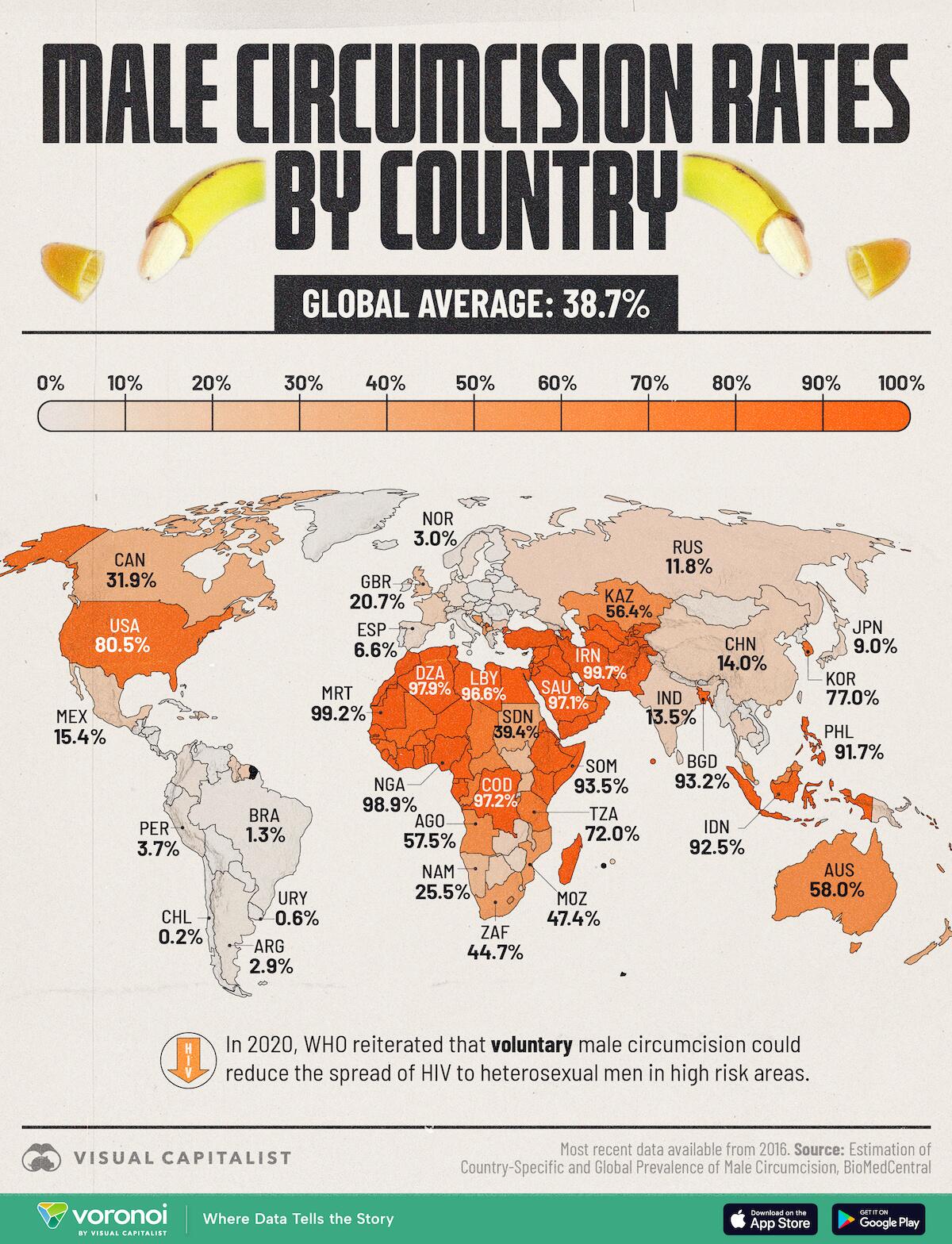
Data for this map is sourced from the “Estimation of Country-Specific and Global Prevalence of Male Circumcision”, a paper published on BioMedCentral in 2016. It is the latest complete data available on this topic.

A Regional Breakdown of Circumcision Rates

Male circumcision is more common in countries where Islam and Judaism emphasize it as a religious practice.

Consequently, in North Africa and the Middle East, 99% of men aged 15 and older are circumcised.

Country ISO Code Male Circumcision
Rate (Men Aged 15+)
🇦🇫 Afghanistan AFG 99.8%
🇦🇱 Albania ALB 47.7%
🇩🇿 Algeria DZA 97.9%
🇦🇴 Angola AGO 57.5%
🇦🇷 Argentina ARG 2.9%
🇦🇲 Armenia ARM 0.1%
🇦🇺 Australia AUS 58.0%
🇦🇹 Austria AUT 5.8%
🇦🇿 Azerbaijan AZE 98.5%
🇧🇭 Bahrain BHR 81.2%
🇧🇩 Bangladesh BGD 93.2%
🇧🇾 Belarus BLR 0.3%
🇧🇪 Belgium BEL 22.6%
🇧🇿 Belize BLZ 0.1%
🇧🇯 Benin BEN 92.9%
🇧🇹 Bhutan BTN 1.0%
🇧🇴 Bolivia BOL 0.1%
🇧🇦 Bosnia &
Herzegovina
BIH 41.6%
🇧🇼 Botswana BWA 15.1%
🇧🇷 Brazil BRA 1.3%
🇧🇳 Brunei BRN 51.9%
🇧🇬 Bulgaria BGR 13.4%
🇧🇫 Burkina Faso BFA 88.3%
🇧🇮 Burundi BDI 61.7%
🇰🇭 Cambodia KHM 3.5%
🇨🇲 Cameroon CMR 94.0%
🇨🇦 Canada CAN 31.9%
🇨🇫 Central African
Republic
CAF 63.0%
🇹🇩 Chad TCD 73.5%
🇨🇱 Chile CHL 0.2%
🇨🇳 China CHN 14.0%
🇨🇴 Colombia COL 4.2%
🇨🇷 Costa Rica CRI 0.1%
🇭🇷 Croatia HRV 1.3%
🇨🇺 Cuba CUB 0.1%
🇨🇾 Cyprus CYP 22.7%
🇨🇿 Czechia CZE 0.1%
🇨🇩 DRC COD 97.2%
🇩🇰 Denmark DNK 5.3%
🇩🇯 Djibouti DJI 96.5%
🇩🇴 Dominican Republic DOM 13.7%
🇹🇱 East Timor TLS 6.4%
🇪🇨 Ecuador ECU 0.1%
🇪🇬 Egypt EGY 94.7%
🇸🇻 El Salvador SLV 0.1%
🇬🇶 Equatorial Guinea GNQ 87.0%
🇪🇷 Eritrea ERI 97.2%
🇪🇪 Estonia EST 0.3%
🇸🇿 eSwatini SWZ 8.2%
🇪🇹 Ethiopia ETH 92.2%
🇫🇰 Falkland Islands FLK 0.1%
🇫🇯 Fiji FJI 55.0%
🇫🇮 Finland FIN 0.8%
🇫🇷 France FRA 14.0%
🇬🇦 Gabon GAB 99.2%
🇬🇲 Gambia GMB 94.5%
🇬🇪 Georgia GEO 10.6%
🇩🇪 Germany DEU 6.7%
🇬🇭 Ghana GHA 91.6%
🇬🇷 Greece GRC 4.7%
🇬🇱 Greenland GRL 0.1%
🇬🇹 Guatemala GTM 0.1%
🇬🇳 Guinea GIN 84.2%
🇬🇼 Guinea-Bissau GNB 93.3%
🇬🇾 Guyana GUY 12.0%
🇭🇹 Haiti HTI 6.2%
🇭🇳 Honduras HND 0.1%
🇭🇰 Hong Kong HKG 28.0%
🇭🇺 Hungary HUN 0.8%
🇮🇸 Iceland ISL 0.1%
🇮🇳 India IND 13.5%
🇮🇩 Indonesia IDN 92.5%
🇮🇷 Iran IRN 99.7%
🇮🇶 Iraq IRQ 98.9%
🇮🇪 Ireland IRL 0.9%
🇮🇱 Israel ISR 91.7%
🇮🇹 Italy ITA 2.6%
🇨🇮 Ivory Coast CIV 96.7%
🇯🇲 Jamaica JAM 14.0%
🇯🇵 Japan JPN 9.0%
🇯🇴 Jordan JOR 98.8%
🇰🇿 Kazakhstan KAZ 56.4%
🇰🇪 Kenya KEN 91.2%
🇽🇰 Kosovo KOS 91.7%
🇰🇼 Kuwait KWT 86.4%
🇰🇬 Kyrgyzstan KGZ 91.9%
🇱🇦 Laos LAO 0.1%
🇱🇻 Latvia LVA 0.4%
🇱🇧 Lebanon LBN 59.7%
🇱🇸 Lesotho LSO 52.0%
🇱🇷 Liberia LBR 97.7%
🇱🇾 Libya LBY 96.6%
🇱🇹 Lithuania LTU 0.2%
🇱🇺 Luxembourg LUX 2.4%
🇲🇬 Madagascar MDG 94.7%
🇲🇼 Malawi MWI 21.6%
🇲🇾 Malaysia MYS 61.4%
🇲🇻 Maldives MDV 98.4%
🇲🇱 Mali MLI 86.0%
🇲🇹 Malta MLT 0.3%
🇲🇷 Mauritania MRT 99.2%
🇲🇺 Mauritius MUS 16.6%
🇲🇽 Mexico MEX 15.4%
🇲🇩 Moldova MDA 0.5%
🇲🇳 Mongolia MNG 4.4%
🇲🇪 Montenegro MNE 18.5%
🇲🇦 Morocco MAR 99.9%
🇲🇿 Mozambique MOZ 47.4%
🇲🇲 Myanmar MMR 3.5%
🇳🇦 Namibia NAM 25.5%
🇳🇵 Nepal NPL 4.2%
🇳🇱 Netherlands NLD 5.7%
🇳🇨 New Caledonia NCL 50.0%
🇳🇿 New Zealand NZL 33.0%
🇳🇮 Nicaragua NIC 0.1%
🇳🇪 Niger NER 95.5%
🇳🇬 Nigeria NGA 98.9%
🇰🇵 North Korea PRK 0.1%
🇲🇰 North Macedonia MKD 33.9%
🇳🇴 Norway NOR 3.0%
🇴🇲 Oman OMN 87.7%
🇵🇰 Pakistan PAK 96.4%
🇵🇸 Palestine PSX 99.9%
🇵🇦 Panama PAN 0.9%
🇵🇬 Papua New Guinea PNG 10.1%
🇵🇾 Paraguay PRY 0.1%
🇵🇪 Peru PER 3.7%
🇵🇭 Philippines PHL 91.7%
🇵🇱 Poland POL 0.1%
🇵🇹 Portugal PRT 0.6%
🇵🇷 Puerto Rico PRI 0.1%
🇶🇦 Qatar QAT 77.5%
🇷🇸 Serbia SRB 3.7%
🇨🇬 Congo COG 70.0%
🇷🇴 Romania ROU 0.3%
🇷🇺 Russia RUS 11.8%
🇷🇼 Rwanda RWA 13.3%
🇸🇦 Saudi Arabia SAU 97.1%
🇸🇳 Senegal SEN 93.5%
🇸🇱 Sierra Leone SLE 96.1%
🇸🇬 Singapore SGP 14.9%
🇸🇰 Slovakia SVK 0.1%
🇸🇮 Slovenia SVN 8.5%
🇸🇧 Solomon Islands SLB 95.0%
🇸🇴 Somalia SOM 93.5%
🇿🇦 South Africa ZAF 44.7%
🇰🇷 South Korea KOR 77.0%
🇸🇸 South Sudan SDS 23.6%
🇪🇸 Spain ESP 6.6%
🇱🇰 Sri Lanka LKA 8.5%
🇸🇩 Sudan SDN 39.4%
🇸🇷 Suriname SUR 15.9%
🇸🇪 Sweden SWE 5.1%
🇨🇭 Switzerland CHE 5.9%
🇸🇾 Syria SYR 92.8%
🇹🇼 Taiwan TWN 8.3%
🇹🇯 Tajikistan TJK 99.0%
🇹🇭 Thailand THA 11.9%
🇧🇸 The Bahamas BHS 0.2%
🇹🇬 Togo TGO 95.2%
🇹🇹 Trinidad & Tobago TTO 5.8%
🇹🇳 Tunisia TUN 99.8%
🇹🇷 Turkey TUR 98.6%
🇹🇲 Turkmenistan TKM 93.4%
🇺🇬 Uganda UGA 26.7%
🇺🇦 Ukraine UKR 2.3%
🇦🇪 UAE ARE 76.0%
🇬🇧 UK GBR 20.7%
🇹🇿 Tanzania TZA 72.0%
🇺🇸 U.S. USA 80.5%
🇺🇾 Uruguay URY 0.6%
🇺🇿 Uzbekistan UZB 96.5%
🇻🇺 Vanuatu VUT 95.0%
🇻🇪 Venezuela VEN 0.3%
🇻🇳 Vietnam VNM 0.2%
🇪🇭 Western Sahara SAH 99.6%
🇾🇪 Yemen YEM 99.0%
🇿🇲 Zambia ZMB 12.8%
🇿🇼 Zimbabwe ZWE 9.2%
🌎 World Average N/A 38.7%

Meanwhile, South America and Europe have low rates, as do parts of Asia where Islam is not a majority religion.

However, there are some interesting standouts in this map. For example, South Korea, the U.S., and Australia have male circumcision rates above 50%, but all have combined Muslim and Jewish populations under 5% of the overall total.

Finally, it’s worth noting that the WHO recommends voluntary medical male circumcision (VMMC) to reduce HIV risk for heterosexual men in high-incidence areas like Eastern Africa. However, it also states it is one of many prevention methods, alongside condom use and post-exposure treatment.

Islam is the second-largest religion in the world with nearly 1.8 billion followers. Check out Charted: The World’s Largest Religions to see where Judaism ranks.

Tyler Durden
Mon, 11/25/2024 – 23:00

Utah Culls More Than 100,000 Turkeys After Detecting Bird Flu

0
Utah Culls More Than 100,000 Turkeys After Detecting Bird Flu

Authored by Naveen Athrappully via The Epoch Times,

Utah culled a large number of turkeys recently after confirming the presence of the highly pathogenic avian influenza (HPAI) and is taking action to prevent the infection from spreading, according to the state’s Department of Agriculture and Food.

“Between November 10 to 19, 2024, three turkey farms in Piute County totaling 107,800 turkeys and one backyard flock of 253 birds in Salt Lake County were confirmed positive for HPAI,” a Nov. 22 update from the agency stated.

Officials are currently conducting genetic sequencing of the strains involved in these outbreaks, it said.

“Though the overall risk to public health remains low, HPAI is a serious disease, requiring rapid response, including depopulation of affected flocks as it is highly contagious and fatal to poultry,” the agency said.

“Affected birds were depopulated within 24 hours of diagnosis at each site to limit further disease spread. Overall impacts to the food supply are anticipated to be limited at this time.”

Authorities have decided on an on-site burial for disposing of the culled poultry at Piute County.

All personnel attending the site are required to wear personal protective equipment and all equipment is disinfected to contain the virus within the site.

“Poultry owners should practice strong biosecurity and monitor flocks for signs of illness and report any sick birds immediately to the State Veterinarian’s Office,” the agency said.

“Individuals who work in close contact with infected animals may be at higher risk for contracting HPAI/H5N1 and should take precautions including using recommended personal protective equipment.”

The state saw another outbreak last month in which more than 1.85 million birds in Cache County were affected. At present, five poultry farms operating in Utah are in quarantine, the department said.

The current HPAI outbreak in the United States began in February 2022. Over the past 30 days, infections have been confirmed in 47 flocks nationwide that together account for 6.05 million birds, according to data from the Animal and Plant Health Inspection Service.

Many of the cases are in California, which alone accounted for 25 flocks totaling more than 5.21 million birds. Infections among flocks have been reported in other states including Arizona, Minnesota, Washington, Oregon, South Dakota, and Illinois.

Avian Flu in Humans

There have been 55 confirmed avian flu cases among U.S. citizens, according to the latest data from the U.S. Centers for Disease Control and Prevention.

Again, California accounted for most of the infections, with 29 cases, followed by Washington with 11 and 10 in Colorado. Michigan reported two incidents, while Missouri, Oregon, and Texas registered one case each.

The largest source of exposure of these infections was cattle, accounting for 32 cases. Poultry was responsible for 21 incidents.

The agency said in a Nov. 18 update that the immediate risk posed by avian flu to the general public is low. However, “people with exposure to infected animals are at higher risk of infection,” it said.

“All recent cases have occurred in workers on affected farms. All available data so far suggest sporadic instances of animal-to-human spread. These farm workers all described mild symptoms, many with eye redness or discharge (conjunctivitis),” it said.

The CDC also recently confirmed a case of bird flu infection in a child, the first incident in a minor. The child, from California, exhibited mild symptoms and was in recovery, according to a Nov. 22 update from the agency. None of the family members tested positive for the virus.

“To date, there has been no person-to-person spread identified associated with any of the H5N1 bird flu cases reported in the United States,” the CDC noted.

Meanwhile, the first case of avian flu in a pig was confirmed recently by the U.S. Department of Agriculture. The pig, from Oregon, had previously shared space with infected poultry. Officials euthanized five pigs on the property and put the place under quarantine.

Tyler Durden
Mon, 11/25/2024 – 22:35

Trump Announces 25% Tariff For Canada, Mexico; Ramps Up Promised Tariffs On “Drug-Pushing” China

0
Trump Announces 25% Tariff For Canada, Mexico; Ramps Up Promised Tariffs On “Drug-Pushing” China

Just when you thought his choice of Scott Bessent as Treasury Secretary had tamped down the market’s “tariff tensions”, President-Elect Trump reminded everyone who is in charge tonight with drugs and open borders as his main focus.

In a statement on his Truth Social account, Trump swung the hammer against Mexico, Canada…

“As everyone is aware, thousands of people are pouring through Mexico and Canada, bringing Crime and Drugs at levels never seen before.

Right now a Caravan coming from Mexico, composed of thousands of people, seems to be unstoppable in its quest to come through our currently Open Border.

On January 20th, as one of my many first Executive Orders, I will sign all necessary documents to charge Mexico and Canada a 25% Tariff on ALL products coming into the United States, and its ridiculous Open Borders.

This Tariff will remain in effect until such time as Drugs, in particular Fentanyl, and all Illegal Aliens stop this Invasion of our Country! Both Mexico and Canada have the absolute right and power to easily solve this long simmering problem.

We hereby demand that they use this power, and until such time that they do, it is time for them to pay a very big price!”

…and of course China…

“I have had many talks with China about the massive amounts of drugs, in particular Fentanyl, being sent into the United States – But to no avail.

Representatives of China told me that they would institute their maximum penalty, that of death, for any drug dealers caught doing this but, unfortunately, they never followed through, and drugs are pouring into our Country, mostly through Mexico, at levels never seen before.

Until such time as they stop, we will be charging China an additional 10% Tariff, above any additional Tariffs, on all of their many products coming into the United States of America.

Thank you for your attention to this matter.”

As a reminder, Fentanyl, the powerful synthetic opioid, has been linked to around 100,000 deaths annually in the United States, with much of the flow of the deadly drug coming from south of the border.

A damning report released earlier this year by the U.S. House Select Committee on Strategic Competition between the United States and the Chinese Communist Party found that the Chinese regime was facilitating the proliferation of fentanyl in the United States.

Additionally, Trump has previously vowed to end China’s most-favored-nation trading status and impose tariffs in excess of 60 percent on China-made goods.

The initial reaction to Trump’s threatening posts was a surge higher in the dollar, erasing the weekend’s losses (following Bessent’s appointment) with the peso and loonie both tumbling along with the offshore yuan…

Stocks also dropped in Japan, Australia and SouthKorea, with US futures modestly higher. Goldman’s research team suggests this FX reaction is perhaps a little overdone:

This seems to be more eased vs. what market has generally expected… and the less hawkish pick of Treasury head also said to roll out the tariffs in layers (which means the 10% mentioned by Trump just now is indeed a beginning but still more gentle than market expectation).

Their baseline expectation remains (via Goldman’s Hui/Lisheng/Xinquan):

  1. Assume that 20% additional US tariffs on Chinese goods in 2025, expect USDCNY to rise to 7.4/7.5 in 3/6 months, continued RRR/policy rate cuts and augmented fiscal deficit to widen by 1.8pp of GDP in 2025 vs. 2024;
  2. While our 2025 growth forecast (4.5%) is in line with the consensus, our inflation projections are notably below (CPI 0.8%; PPI 0.0%);
  3. Expect exports to be relatively stable, declines in property investment to continue, and consumption (especially goods consumption) to outperform. Growth of government consumption and investment is likely to accelerate.

The Goldman analysts estimate that the impact on MSCI China earnings would be as follows:

However while they state that this seems softer than expected the lack of details means the actual impact remains uncertain.

Tyler Durden
Mon, 11/25/2024 – 22:33

Where Child Marriage Is Still Common

0
Where Child Marriage Is Still Common

An often overlooked form of violence against women is child marriage, which is considered a fundamental violation of human rights.

As Statista’ Felx Richter reports, the right to ‘free and full’ consent to marriage is recognized in the Universal Declaration of Human Rights, whereby it is widely agreed that consent cannot be ‘free and full’ when one of the parties involved is not sufficiently mature to make an informed decision about a life partner. According to UNICEF, child marriage often has long-lasting, mostly adverse effects on a girl’s development, including teen pregnancy, early exit from education and social isolation.

Globally, roughly one in five women aged 20 to 24 was married by the time she turned 18 and 4 percent were married before the age of 15.

That’s according to the latest estimates from UNICEF, which found stark regional differences in the prevalence of child marriage.

Infographic: Where Child Marriage Is Still Common | Statista

You will find more infographics at Statista

In Sub-Saharan Africa, almost one in three girls gets married or enters a cohabiting relationship before the age of 18. 9 percent of Sub-Saharan women who are now 20 to 24 years old even entered such a union before the age of 15.

In South Asia, one in four young women were married by the age of 15, while it was one in five in Latin America and the Caribbean.

According to UNICEF, the term “child marriage” is used to refer to both formal marriages and informal unions in which a person lives with a partner for some time before 18 years old.

Child marriage often takes place through an informal union, in which girls live with a partner rather than marry, oftentimes because laws prohibit an official union. Child marriage is tied to poverty, school dropouts, teenage pregnancy and violence.

Tyler Durden
Mon, 11/25/2024 – 22:10

“We Can Forget Business As Usual”: One Bank’s Forecast For The US Economy Under Trump 2.025

0
“We Can Forget Business As Usual”: One Bank’s Forecast For The US Economy Under Trump 2.025

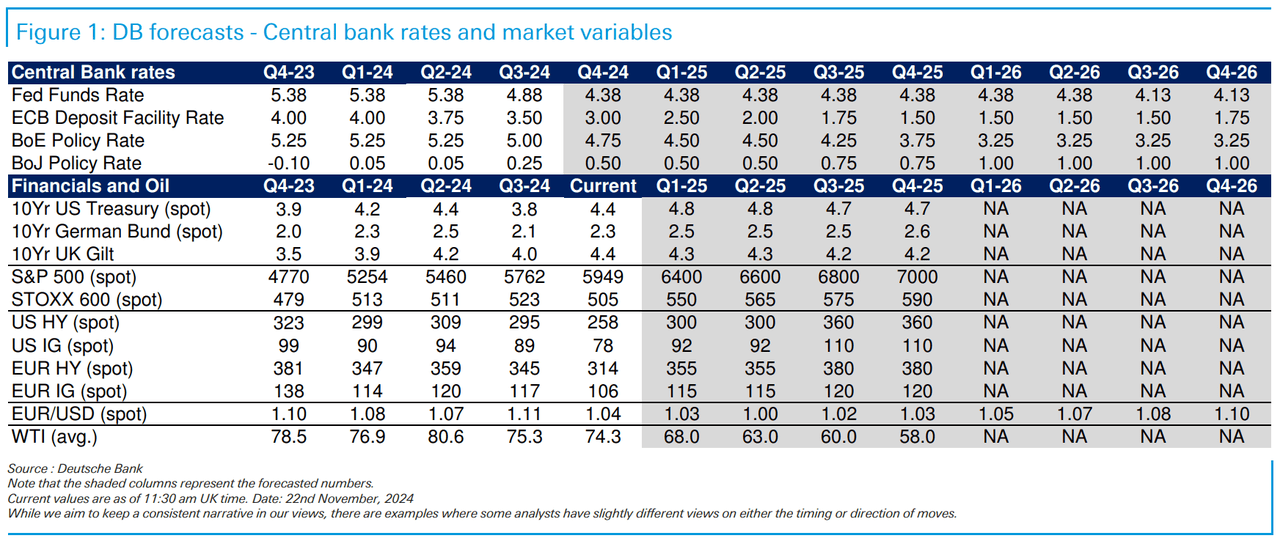
This morning, Deutsche Bank published its World Outlook for next year entitled “Navigating Trump 2.025” (available to pro subscribers in the usual place). It includes all of the German bank’s global economic and asset price forecasts for 2025.

As summarized by Jim Reid, the bank’s head of thematic research, the election result means we can forget “business as usual” and a wider range of outcomes has opened up for the global economy and financial markets. These span from a potentially much more positive US outlook on the one hand, to a much more negative European outlook on the other. President-elect Trump has several potentially conflicting economic policy goals, and how he weights them in office will influence global growth and asset prices in 2025 and beyond.

If the primary focus of the new administration is boosting growth, there’s every chance that this can be very positive for the US, with spillovers elsewhere across the globe. But that would likely require less of a focus on campaign promises like the deportation of undocumented immigrants and on tariffs.

The main downside risks are more likely to emerge if greater weight is put on aggressive trade and immigration policies. This could be more negative for growth and push up inflation. That would lead the Fed to cease the cutting cycle and possibly even contemplate restarting rate increases which would likely put upward pressure on bond yields. This would have implications for the US and even more so to the rest of the world. A maximalist Trump trade agenda and a Europe constrained to act because of fragmentation is a huge but realistic risk for the continent. Looking ahead, the German election in February will be a pivotal event.

DB’s base case for 2025 is stronger US growth and inflation and a higher Fed terminal rate than previously expected with the opposite conditions for Europe. This is driven by the assumption of modest US tax cuts, a strong deregulation push, and more supportive financial conditions. On trade the German bank assumes a 10% increase in the tariff rate on imports from China in the first half of the year (ratcheting up a further 10% in H2) and an equalization of tariff rates on motor vehicles with Europe. The forecast also assumes a 5% universal baseline tariff, though that is more likely to be implemented late 2025/early 2026.

More in the full DB note “Navigating Trump 2.025”, available to pro subscribers in the usual place

Tyler Durden
Mon, 11/25/2024 – 21:20

Trump Could Prompt Supreme Court Ruling On Birthright Citizenship

0
Trump Could Prompt Supreme Court Ruling On Birthright Citizenship

Authored by Sam Dorman via The Epoch Times (emphasis ours),

Among President-elect Donald Trump’s plans for immigration is a move to end a longstanding practice of granting something known as “birthright citizenship” to children whose parents are illegally present in the United States.

The U.S. Supreme Court in Washington on July 1, 2024. Drew Angerer/AFP via Getty Images

Last year, he vowed to sign an executive order directing agencies to abandon that practice, if reelected.

How exactly Trump will change policies within agencies is unclear, but experts indicate he has options.

Regardless, revoking birthright citizenship could impact waves of new illegal immigrants and change the incentives for so-called birth tourism, wherein an expectant mother arrives in the United States just before giving birth.

During his first term, Trump attempted to combat the phenomenon through a policy targeting the country’s temporary visa program.

However Trump chooses to end birthright citizenship will likely provoke a legal battle of constitutional proportions and with a case that could reach the Supreme Court, as Trump predicted during his first term.

The concept of birthright citizenship stems from the 14th Amendment, which states in part: “All persons born or naturalized in the United States, and subject to the jurisdiction thereof, are citizens of the United States and of the state wherein they reside.”

Lora Ries, who serves as director of the Border Security and Immigration Center at the Heritage Foundation, told The Epoch Times that Trump could start by directing the State Department and Department of Homeland Security (DHS) to interpret the 14th Amendment in a particular way.

“I don’t believe that a statute is necessary” or that a “constitutional amendment is necessary,” said Ries, who also served as the deputy chief of staff for DHS during Trump’s first administration.

Illegal immigrants, including a pregnant Haitian woman seeking to give birth in the United States, are apprehended by a U.S. Border Patrol agent in Yuma, Ariz., on Dec. 7, 2021. John Moore/Getty Images

Sen. Lindsey Graham (R-S.C.) has introduced legislation that would end birthright citizenship for children of illegal immigrants.

Immigration Reform Law Institute director of litigation Chris Hajec indicated, however, that a Supreme Court decision will be necessary to effect long-term change.

“A law from Congress wouldn’t be enough,” he told The Epoch Times, noting that Trump’s executive policies and any act of Congress would likely end in the courts.

It’s unclear how many individuals will seek validation of birthright citizenship in the future but the Pew Research Center estimated in 2016 that around 4 million children in the United States had illegal immigrant parents.

The Federation for American Immigration Reform, which seeks to “reduce the negative impact of uncontrolled immigration,” said last year that taxpayers annually spend “approximately $182 billion to cover the costs incurred from the presence of more than 15.5 million illegal aliens and about 5.4 million citizen children of illegal aliens.”

While Hajec expects a Supreme Court decision on the issue, he doubts the court would somehow retroactively revoke birthright citizenship for individuals who already have it.

“I think the court would just say whether this prospective, forward-looking regulation of the Trump administration was lawful,” he said.

The court could allow Trump’s birthright citizenship policy by dismissing a challenge that arises from a lower court’s approval of it.

It could also agree to take up the lower court’s decision, likely prompting a re-examination of a longstanding precedent from the 19th century.

Supreme Court Precedent

In United States v. Wong Kim Ark, a majority of the court held that the 14th Amendment granted birthright citizenship to a Chinese man whose parents were legally present in the United States.

Some have questioned whether the reasoning in that decision applies to children of the illegal immigrants who have crossed the southern border.

“The court only held that a child born of lawful, permanent residents was a U.S. citizen,” former Federal Election Commission member Hans von Spakovsky said in 2018.

A draft of the 14th Amendment of the U.S. Constitution in 1866. The concept of birthright citizenship stems from the 14th Amendment. MPI/Getty Images

“That is a far cry from saying that a child born of individuals who are here illegally must be considered a U.S. citizen.”

Many other groups disagreed, including the American Civil Liberties Union (ACLU), which has vowed to combat Trump’s agenda.

The organization said earlier this year: “Theories that attempt to carve children out of this guarantee [of citizenship] based on the immigration status of their parents are legally wrong, morally repugnant, and dangerous attacks on a core civil right.”

The finer points of interpreting that decision could be determined by whoever sits on the Supreme Court when Trump’s policy lands there.

Read the rest here…

Tyler Durden
Mon, 11/25/2024 – 20:55

Russia May Deploy New Missile Units In Asia If US Missiles Appear There

0
Russia May Deploy New Missile Units In Asia If US Missiles Appear There

The Pentagon has been engaged in recent discussions involving the potential for deploying missile units to southeast Asia, and specifically Japan, as a contingency in the scenario that China moves militarily against Taiwan. Japan’s Kyodo News reported Sunday that this would involve the US Marine Corps’ multiple-launch High Mobility Artillery Rocket System.

Russian Deputy Foreign Minister Sergei Ryabkov has responded to these reports, outlining Monday that Moscow has not ruled out sending medium- and shorter-range missiles in the Asia-Pacific region in order to mirror the United States. 

HIMARS system, US Army/Wiki Commons

It’s also the case that earlier this year Washington deployed a new intermediate-range land-based missile system to the Philippines. The system, called Typhon, is able to fire nuclear-capable Tomahawk missiles – and has gotten both Russia’s and China’s attention.

Such a Russian deployment would be in retaliation, and would likely have the blessing of Beijing in such an escalation scenario. “Of course, this is one of the options that has also been repeatedly mentioned,” Ryabkov explained. 

“The appearance of such US systems in any region of the world will determine our next steps, including in the field of organizing a military and military-technical response.”

Ryabkov then stressed in the remarks to reporters that all of this depends entirely on the US policy. He urged against the expansion of missile systems to the Pacific region.

“[Russian] President [Vladimir Putin] said what he said. The issue of placement is exhaustively reflected in his statement,” he said.

“As before, what is happening depends entirely on the choice that our opponents will make at this extremely alarming, very dangerous moment, and on the line that they will pursue,” the deputy foreign minister added.

Ryabkov further noted that at the moment there are no restrictions on the deployment of Russia’s new Oreshnik medium-range ballistic missile, which have been touted as hypersonic and capable of reaching over Mach 10, under existing international obligations.

Source: www.middlebury.com, CIA 2003

Moscow has also long warned that the US pullout of the Intermediate-Range Nuclear Forces Treaty (INF Treaty) was a major mistake, and will lead to bigger proliferation of dangerous and provocative missile systems globally among nuclear-armed powers.

Tyler Durden
Mon, 11/25/2024 – 20:30

Lott: Illegal Migrants Less Likely To Commit Crime? Guess Again…

0
Lott: Illegal Migrants Less Likely To Commit Crime? Guess Again…

Authored by John R. Lott Jr. via RealClearInvestigations,

In June, Victor Martinez-Hernandez was charged with the murder of Rachel Morin, a mother of five in Maryland. Police in Oklahoma tracked the accused repeat offender down with a sample of his DNA recovered from a Los Angeles home invasion in which a nine-year-old girl and her mother were assaulted. Police say he came to the U.S. illegally to escape prosecution for at least one other murder in his native El Salvador in December 2022. 

“That should never have been allowed to happen,” said Sheriff Jeffrey Gahler, referring to the numerous missed red flags the case presented. His office apprehended Hernandez in Tulsa, Oklahoma.

Like the member of the Venezuelan gang Tren de Aragua sentenced to life in prison last week for the murder of Laken Riley in Georgia, Hernandez’s case is shining a light on the federal government’s failure to properly vet and keep track of lawless migrants.

These gaps have led to broad claims that illegal immigrants have less involvement with the criminal justice system than native-born Americans. A review of the available data, however, shows that the criminal records of millions of migrants – the ones President-elect Trump vows to prioritize for deportation – remain unknown due to illegal crossings, lax enforcement, and lax data collection by federal and “sanctuary” jurisdictions. 

In addition, an analysis of the available statistics by RealClearInvestigations suggests that the crime rate of noncitizens is vastly understated. A separate RCI analysis based on estimates developed by the U.S. Department of Justice’s National Institute of Justice (NIJ) suggests that crime by illegal aliens who entered the U.S. by July 21, 2024 cost the country some $166.5 billion. These criminals disproportionately entered the U.S. during the Biden administration.

The problem begins with incomplete initial vetting by the U.S. Immigration and Customs Enforcement (ICE). The criminal histories of migrants from far-flung countries with often shoddy record-keeping are somewhat hard to determine. It is also impractical to hold each person until they have passed a rigorous background check. As a result, ICE routinely releases many illegals into the country on their own recognizance and then discovers afterward that many had criminal records in their home countries. 

In response to a request from Republican Rep. Tony Gonzales of Texas, ICE reported this summer that it has released  7.4 million such “non-detained” noncitizens into the U.S. during the last four decades or so. ICE reports that these include 662,566 noncitizens with criminal histories –  435,719 individuals with criminal convictions in their home countries and another 226,847 with pending criminal charges. These precise figures, however, do not say whether the crimes of the latter group were committed in the accused’s home country or the U.S. 

In the July 21 letter to Rep. Gonzales, ICE reported that 13,099 of these non-detained individuals have convictions for homicide, with 1,845 facing criminal homicide charges. Another 9,461 have convictions for sex offenses (not including assault or commercialized sex), and 2,659 face pending charges. The convictions include other crimes such as assault (62,231), robbery (10,031), sexual assault (15,811), weapons offenses (13,423), and dangerous drugs (56,533). 

These figures are only suggestive of the extent of crime because they only list the most serious crime committed by each individual. A murderer, for example, who also committed a sex offense, is only counted as a murderer. It does not include the fact that millions of migrants are violating the law because of their presence in the U.S. It also does not account for the lawbreaking involved in working without proper authorization or the widespread use of stolen Social Security numbers to secure employment. 

The 662,566 convicted and likely criminals make up 9% of the 7.4 million released noncitizens. 

The statistics miss much of the relationship between crime and illegal aliens. Noncitizens in the “national docket data” either surrendered to border agents or were apprehended at the border. Those who avoid surrender likely have reasons to evade authorities, such as a criminal background. But there are others who avoided being caught and won’t be in these numbers. That group includes “gotaways” – individuals observed crossing the U.S. border illegally but not apprehended or turned back. With up to 38% of border agents shifted from monitoring to processing duties and 30% of surveillance cameras not functioning, millions more likely entered the U.S. undetected, potentially including the most dangerous individuals.

The Customs and Border Protection Agency estimates that some two million such “gotaways” have entered the country since 2021.

The data on migrants who have been processed also understates the problem. Criminals rarely commit just one crime. For example, from 1990 to 2002, in the 75 most populous U.S. counties, 70% of those convicted of a violent felony had a prior arrest, and 56% had a prior criminal conviction. In 2023 in Washington, D.C., the average homicide suspect had been arrested 11 times before committing a homicide. Data for 30 states shows that 60.1% of criminals released from prison in 2005 had been arrested again within two years, and 73.5% had been arrested within four years. The ICE data set provides a single entry for each individual.

Most violent crimes don’t result in an arrest, so looking at arrests or convictions in these other countries will underestimate whether illegal aliens are criminals. Across all U.S. cities in 2022, only 35.2% of violent crimes resulted in an arrest. While 50.6% of murders resulted in an arrest, just 24.1% of rapes produced an arrest, 22.7% of robberies, and 39.9% of aggravated assaults. 

As the Laken Riley and Rachel Morin murder cases make clear, it is difficult to calculate all the victimization costs of crime to families and society.

Using tools developed by the National Institute of Justice (NIJ), RCI did estimate what is likely the bare minimum economic costs of illegal alien crime. It arrived at its estimated cost to victims in dollar terms by assuming that each of the 662,566 “non-detained” noncitizen offenders on ICE’s list committed just once in the U.S. the crime for which they have been previously accused.

ICE presented Rep. Gonzales with numbers on 42 different types of crime, but the NIJ only calculated the cost to victims for eight types of crime. Professor Mark Cohen at Vanderbilt University, who co-authored the original NIJ report, updated the list with 15 of the crime categories reported by ICE: murder, sexual assault, sexual offenses, robbery, assault, arson, burglary, larceny, motor vehicle theft, weapon offenses, drugs, fraud, liquor offenses, gambling, and stolen property. Cohen’s updated numbers provide estimates for the damage from child abuse, drunk driving, and vandalism, but ICE did not collect numbers on those crimes.

NIJ’s estimated losses from crime victimization include: medical care/ambulances, mental health care, police/fire service costs, social/victim services, property loss/damage, reduced productivity (at work, home, and school), and nonmonetary losses (fear, pain, suffering, and lost quality of life). 

Murders account for almost $153.8 billion of the $166.5 billion in estimated criminal victimization costs (a breakdown of the costs of crime for each type of crime is available here). Another $6 billion involves sexual assaults/offenses, and an additional $5.2 billion comes from sexual assaults and sexual offenses.

Half of the crimes these non-detained individuals commit don’t have cost estimates. These crimes include kidnapping, embezzlement, extortion, smuggling, traffic offenses, and weapon offenses.

These criminal illegal aliens entered the U.S. under multiple administrations, but the size of the problem was likely larger under the Biden administration. That isn’t just because so many more illegal aliens were entering the country. Under the Trump administration’s remain-in-Mexico policy, the U.S. Citizenship and Immigration Services (USCIS) performed background checks on immigrants. That included contacting immigrants’ countries of origin. 

ICE agents cannot access the same databases to check on the immigrants, and they don’t contact the immigrant’s home country. Plus, the massive inflow of immigrants has overwhelmed the system. The Deputy Director for ICE blames the “enormous workload”  agents face, so they haven’t been able to do even the limited background checks they are doing. There are so many coming in that the government can’t house these immigrants until their backgrounds are properly checked.

ICE has been processing criminals as they enter the country, but without identifying them as criminals. So, under the Biden administration, they have simply been released into the country. Now, they are walking freely in the United States, and no one knows where they are.

As bad as these numbers are, the reality may be even worse. The Biden-Harris administration is accused of presenting the border crisis so that it does not look as bad as it is. In mid-September, retired San Diego Border Patrol Chief Aaron Heitk testified how the Biden administration ordered him not to publicize the arrests of illegal border crossers who they identified as having terrorist ties.

The American Immigration Council, which strongly opposes President-elect Donald Trump’s deportation policies, estimates that it could cost $88 billion to deport one million illegal immigrants. But if we accept its estimate and ignore the various government benefits that these individuals might be receiving, ICE’s number of 662,556 illegal criminal immigrants implies a cost of $58.3 billion to remove them – just over one-third of the conservative estimate given here of the cost of the crimes by these criminals.

The estimate of over $160 billion in costs from criminal illegal aliens is very likely an underestimate of the true costs. It assumes the average criminal coming into the country commits only one offense similar to what he committed in his home country. We are also not counting the costs of half of criminal illegal aliens.

John R. Lott Jr. is a contributor to RealClearInvestigations, focusing on voting and gun rights. His articles have appeared in publications such as the Wall Street Journal, New York Times, Los Angeles Times, New York Post, USA Today, and Chicago Tribune. Lott is an economist who has held research and/or teaching positions at the University of Chicago, Yale University, Stanford, UCLA, Wharton, and Rice.

Tyler Durden
Mon, 11/25/2024 – 20:05

These Are The Countries That Triggered Democrats Are Moving To After Trump’s Resounding Victory

0
These Are The Countries That Triggered Democrats Are Moving To After Trump’s Resounding Victory

As triggered Democrats sought to deal with the PTSD of a Trump election victory, Visa website La Vida reported a dramatic 2,300 percent increase in U.S. site traffic on election day, according to Newsweek.

This figure was more than five times the increase observed after the 2020 election, which itself saw a 4.5-fold rise in visitor numbers.

And we know where residents from Democratic-leaning states are most likely to consider moving. A study using Google analyzed search trends over the past 12 months to examine how political inclinations influence relocation interests.

Google Trends data revealed a 400 percent increase in searches for “how to move to Canada” by 8 p.m. ET on election night, with a 200 percent rise in searches for legal migration methods to Canada.

The Newsweek report said that Canada ranks as the top relocation destination for residents in blue-majority states, with 89.47% of the 19 states studied favoring it in searches.

It said that in Colorado, searches for “move to Canada” and similar terms average 693.33 per month, while Connecticut logs 327.50 searches, far outpacing second-place Brazil at 205.83. Even smaller states like Maine show strong interest, with 230.83 searches monthly for Canada.

Japan is the second most-searched destination, appealing with its modern cities and rich cultural heritage. It ranks first in Hawaii and California, where it averages 378.33 and 4,821.67 searches per month, respectively.

Regional preferences also emerge in the data. Vermont favors Ireland as a second choice after Canada, with 89.17 and 131.67 monthly searches, respectively.

In Washington state, New Zealand takes third place with 483.33 searches. Illinois also prioritizes Canada, leading with 1,086.67 searches, followed by Japan and Brazil with 676.67 and 556.67 searches. Unique trends appear in Minnesota, where Kenya ranks second, highlighting distinct preferences among state

Marc Porcar, CEO of QR Code Generator PRO S.L. commented: “With its proximity and cultural similarities, Canada has emerged as the clear favorite for Americans considering a move abroad.”

Tyler Durden
Mon, 11/25/2024 – 19:40

New York To Close 12 Migrant Shelters Ahead Of Trump Deportation Agenda

0
New York To Close 12 Migrant Shelters Ahead Of Trump Deportation Agenda

New York is set to shutter 12 migrant shelters before the end of the year, marking a significant shift in its response to the city’s ongoing migrant crisis. The closures, announced just weeks before President-elect Donald Trump takes office for a second term, highlight the strain on resources and the political tensions surrounding immigration policies.

As Mike Shedlock of MishTalk.com noted in June, 20% of NYC hotels have become migrant shelters, driving up the cost of hotel rooms elsewhere for paying customers.

Two hotel-based shelters, the Hotel Merit in Manhattan and the Quality Inn JFK in Queens, have already been closed. An additional 10 facilities across the state – including in Albany, Dutchess, Erie, Orange, and Westchester counties – will cease operations by December 31, according to New York City Mayor Eric Adams’ office. The sprawling Randall’s Island shelter, which was designed to accommodate up to 3,000 migrants, is slated to close by February 2025, shortly after Trump’s inauguration.

A Crisis of Scale and Cost

Since the spring of 2022, more than 223,000 migrants and asylum seekers have arrived in New York City – roughly half the population of Albany. The city has struggled to house and support this influx, operating 210 city-run shelter sites across the five boroughs. Currently, 58,000 migrants remain in taxpayer-funded shelters, costing the city an estimated $352 per migrant per night. Only $130 of that amount goes directly to housing costs, with the rest allocated to social services, food, and cleaning.

Row NYC is a luxury hotel housing illegal migrants

The NYPD has spent $21 million on public safety and security related to the migrants.

The eye-popping figures, listed on the city’s online asylum-seeker funding tracker, shows the city overall spent $4.88 billion combined through fiscal years 2023 and ‘24. Based on the rate of spending, the city likely exceeded more than $112 million since the start of the new fiscal year beginning July 1, or will soon, cracking $5 billion.

Mayor Eric Adams’ administration has even projected the cost could double, hitting $10 billion over the three year period ending June 30, 2025. -NY Post

Without policy changes, the crisis is projected to cost New York taxpayers $12 billion over the next three fiscal years, according to city estimates. Mayor Adams praised efforts to consolidate shelter operations and reduce costs, noting a 19-week decline in the migrant census.

“Over the past two years, our teams have accomplished the Herculean task of providing compassionate care for a population twice the size of Albany and saving taxpayers billions of dollars,” Adams said. “The new policies we’re implementing today will build on our successes, save taxpayers millions, and help even more migrants take their next steps towards fulfilling their American Dream.”

Meanwhile, an audit released in August found that NYC overpaid upstate hotels by millions of dollars for sheltering illegal immigrants.

Of the questionable payments, $2.5 million were for unauthorized security, medical, and social services, $1.7 million for vacant rooms, and $230,000 for inflated food bills, according to the audit.

In another example, a Newburgh hotel billed a total of $57,000 for hundreds of unoccupied rooms in early May, for which DocGo got an additional $40,000 in commissions.

Tensions Over Shelter Evictions

Despite efforts to ease the burden on the system, the city’s shelter eviction policies have sparked controversy. Families issued a second 60-day eviction notice are now allowed to stay in their assigned shelters if they need more time, a move Adams touted as cost-saving and beneficial for children’s schooling continuity.

Hundreds of illegal immigrants or asylum seekers lined up outside of the Jacob K. Javits Federal Building in New York City on June 6, 2023. (David Dee Delgado/Getty Images)

However, adult migrants face stricter rules, with a policy permanently evicting them from city shelters after 30 days. The policy has drawn criticism from activist groups, including Jews For Racial & Economic Justice, which staged a protest at City Hall during a hearing on the issue.

“Immigrants are welcome here – Trumpian policy is not!” protesters chanted, accusing the city of violating its decades-old right-to-shelter rule, originally established to address homelessness. Activists called the eviction policy “cruel and destabilizing” before being removed from the chamber.

A Changing National Landscape

While the flow of migrants into New York has slowed, with fewer arrivals and a reported 101,790 encounters at the U.S.-Mexico border in September—the lowest since February 2021—concerns persist about potential surges before Trump’s border policies take effect. A caravan of 1,500 migrants in southern Mexico, near the Guatemala border, is reportedly attempting to cross before Trump’s inauguration.

Trump has pledged to implement strict immigration measures, including sealing the southern border, carrying out a large-scale deportation operation, and ending Biden administration parole programs and the CBP One app. South Dakota Governor Kristi Noem has been appointed as secretary of the Department of Homeland Security, with former ICE Director Tom Homan named “border czar.”

As New York City consolidates its migrant operations, Adams has a tough road ahead. The closures signal a pivot in the city’s approach but also underscore the broader national debate on immigration policy.

Tyler Durden
Mon, 11/25/2024 – 18:00