75.7 F
Chicago
Sunday, October 11, 2026
Home Blog Page 2092

Researchers Find Unknown Chemical In Drinking Water Posing “Potential Human Health Concern”

0
Researchers Find Unknown Chemical In Drinking Water Posing “Potential Human Health Concern”

Authored by George Citroner via The Epoch Times (emphasis ours),

Scientists have uncovered a new chemical compound lurking in U.S. drinking water, potentially exposing one in five Americans to an unidentified health risk.

Water from a tap fills a glass in San Anselmo, Calif., on July 6, 2023. Justin Sullivan/Getty Images

Researchers at the University of Arkansas have identified chloronitramide anion, a previously unknown byproduct of water disinfection that could have implications for public health, according to a new study published Thursday in Science.

Toxicity Still Unknown

The newly identified compound, chloronitramide anion (chemically expressed as Cl–N–NO2−), is an end product of inorganic chloramine decomposition. ​While its toxicity remains unknown, researchers are concerned about its prevalence and similarity to other toxic compounds, necessitating further study to assess its public health risk, the researchers wrote.

Chloramines, chemical compounds containing chlorine and ammonia used to kill bacteria, viruses, and other organisms that can cause illness, have been used by water utilities since the 1930s. Over 20 percent of Americans consume drinking water treated with chloramines, according to the U.S. Environmental Protection Agency (EPA).

Challenges in Identification

While researchers have been aware of the compound for decades, its identification posed significant challenges, according to Julian Fairey, an associate professor of civil engineering at the University of Arkansas and first co-author of the paper detailing this discovery.

“It’s a very stable chemical with a low molecular weight,” Fairey said in a press statement. “It’s a very difficult chemical to find. The hardest part was identifying it and proving it was the structure we were saying it was.”

The identification of chloronitramide anion involved synthesizing the compound in Fairey’s lab. Samples of the synthesized compound were then analyzed.

Potential Health Risks Yet to Be Investigated

As with any newly discovered compound, questions arise regarding the potential health risks associated with chloronitramide anion, as it has not yet been evaluated in toxicity studies.

The study authors emphasized that this newly discovered substance “is a potential human health concern and is therefore an immediate candidate for quantitation in source waters, finished drinking waters, and wastewater effluents.” They also wrote that these findings warrant an assessment of chloronitramide anion’s carcinogenicity and reproductive and developmental toxicities.

“It’s well recognized that when we disinfect drinking water, there is some toxicity that’s created,” Fairey, who studies the chemistry of drinking water disinfectants, said in the press release. “Chronic toxicity, really.”

Possible Link to Cancer

A certain percentage of people may develop cancer from drinking water over several decades, according to Fairey. “But we haven’t identified what chemicals are driving that toxicity. A major goal of our work is to identify these chemicals and the reaction pathways through which they form.”

Identifying chloronitramide anion is a step toward understanding these complex chemical processes. While it remains to be seen whether this compound will be linked to any cancers or other adverse health risks, future research by academics and regulatory agencies, including the EPA, will assess its implications.

“Even if it is not toxic,” Fairey said, “finding it can help us understand the pathways for how other compounds are formed, including toxins.” Knowledge of a compound’s origins can lead to its control, he noted.

Tyler Durden
Sun, 11/24/2024 – 08:10

Navy’s Indo-Pacific Commander Warns Ukraine Aid Is Draining US Missile Stocks

0
Navy’s Indo-Pacific Commander Warns Ukraine Aid Is Draining US Missile Stocks

A top US Navy admiral has warned this week that the recent move of Washington to give advanced long-range weapons to Ukraine is depleting US missile stocks.

Adm. Sam Paparo, Commander of US Indo-Pacific Command, told a Brookings Institution audience earlier this week that earlier in the war the US was shipping less valuable weaponry to Ukraine, which didn’t deeply impact readiness for big global threats like China. More advanced defense tech is currently being shipped, and this presents a serious problem for the United States’ long-term defense needs.

Adm. Samuel Paparo, commander, U.S. Pacific Fleet. Image: US Navy

“But now with some of the Patriots that have been employed, some of the air-to-air missiles that have been employed, it’s now eating into stocks,” Paparo said.

“And to say otherwise would be dishonest,” the naval commander continued. Given he’s in charge of the Pacific region, he underscored that this could weaken America’s defense posture in the region for the long term, at a moment Beijing is vying for military primacy.

Paparo emphasized that “none” of these weapons “are preserved for any particular theater, but none can move with alacrity to any theater.”

“Inherently, it imposes costs on the readiness of America to respond in the Indo-Pacific region, which is the most stressing theater for the quantity and quality of munitions because the [China] is the most capable potential adversary in the world,” he continued, as cited in Washington Times report Friday.

He called for the depleted weaponry to be restored “and then some” – and that this must be an urgent priority.

Among the missile systems being given by the Biden administration to Kiev are Patriot air defense batteries, and the Army’s ATACMS.

European countries have also suffered the same problem of depleted domestic stockpiles. Ukraine’s Western backers are at the same time trying to assist Kiev in jump-starting and expanding its own defense manufacturing sector.

Tyler Durden
Sun, 11/24/2024 – 07:35

Escobar: G20 Knocks Out G7 Agenda

0
Escobar: G20 Knocks Out G7 Agenda

Authored by Pepe Escobar via The Cradle,

This G20 in Rio was all about the power of the Global South, with poverty eradication and genuine economic progress trumping the old G7 agendas of war, profit, and arm-twisting…

The G20 summit in Rio earlier this week offered the quite intriguing spectacle of a deeply divided world, geopolitically and geoeconomically, trying to put on a brave ‘holiday in the sun’ face. 

There was plenty of fluff to amuse attentive audiences. French President Emmanuel Macron surrounded by a beefy security detail strolling on Copacabana beach near midnight; European Commission President Ursula von der Leyen barefoot in the sand, stunned by the lapping waves; the White House lodger, US President Joe Biden – with his expiry date in less than two months – missing the G20 family pic because he was talking to a palm tree. 

Right before the summit, Biden posed on a soundstage in the rainforest, complete with two giant teleprompters, pledging to save the Amazon just as his handlers in Washington let leak the “authorization” for Ukraine to attack targets inside the Russian Federation with ATACMS; a qualified preamble for a possible WWIII. 

With Rio providing the ultimately gorgeous set, at the very least, tempers at the renovated Museum of Modern Art, the G20 venue with the Sugarloaf in the background, were bound to mellow out. This even allowed for a short, tense handshake between Brazil’s President Luiz Inácio Lula da Silva, a true leader of the Global South, and Argentina’s President Javier Milei, a US asset who hates Lula’s guts. 

China steals the show

The populist Brazilian head of state, whose political capital transcends all barriers, was, of course, an impeccable master of ceremonies, but the real star of the show was Chinese President Xi Jinping – fresh from his previous triumph, when he was for all practical purposes coronated King of Peru during the Asia-Pacific Economic Cooperation (APEC) summit in Lima – complete with the inauguration of the $1.3 billion port of Chancay, the new South American node of the Pacific Maritime Silk Road. 

As China is all about global connectivity corridors, Chancay-Shanghai became an instant new motto ringing all across the Global South. 

Beijing’s prime role as an engine and cooperation propeller across Asia–Pacific also applies to most of the G20 members. China is the largest trading partner of the 13 APEC economies, and is responsible for 64.2 percent of Asia-Pacific’s economic growth. 

This prime role extrapolates to China’s BRICS colleagues among the G20, as well as brand-new BRICS partner-nations such as Indonesia and Turkiye. Compare that with the G7/NATOstan contingent of the G20, starting with the United States, whose main global offerings range from Forever Wars and color revolutions to weaponizing of news and culture, trade wars, a tsunami of sanctions, and confiscation/theft of assets.    

So, predictably, there was some serious underlying tension permeating the G20, especially when it came to the face-off between the G7 and the Russia-China strategic partnership. Russian President Vladimir Putin didn’t even bother to attend, sending his uber-competent Foreign Minister Sergey Lavrov instead. 

As for Beijing, after 7 years of combined Trump-Biden trade and tech war, the Chinese economy continues to grow by 5.2 percent a year. Exports now account for only 16 percent of China’s GDP, so the economic powerhouse is far less vulnerable to foreign trade machinations. And the US share of that 16 percent is now only 15 percent; that is, trade with the US represents only 2.4 percent of Chinese GDP. 

Even under what can be described as NATOstan’s all-out tech sanctions, Chinese tech firms are growing at warp speed. As a result, all western tech companies are in deep trouble: massive retrenchment, factory downsizes, and shutdowns. 

Meanwhile, China’s trade surplus with the rest of the world has expanded to a record one trillion US dollars. That’s what horrified Western economists qualify as China on a “collision course” with some of the world’s biggest – yet dwindling – economies.   

Efforts to ‘Ukrainize’ the G20 agenda

The Brazilians had to dodge quite a few precision bullets to extract some success out of this G20 summit. US Think Tankland, on the eve of the summit, went on an all-out propaganda campaign, accusing BRICS nations of doing nothing but posture and complain. The G20, on the contrary, with “all major creditors on the table,” might be able to redress “financial grievances” and development deficits. 

The Brazilians were clever enough to understand that an indebted NATO bloc exhibiting less than zero political leadership would do nothing under the G20 framework to redress “financial grievances,” not to mention contribute to “enfranchise” Global South nations. 

The only thing that would interest the Hegemon’s financial elites out of a G20 meeting is to “deepen partnerships,” a euphemism for further co-option and vassalization with an eye on 2026, when the US will host the G20.  

China, just like Brazil, had other ideas. Enter the campaign to fight hunger and poverty, officially launched in Rio. The Global Times has re-emphasized how China “has lifted all 800 million people out of poverty and achieved the poverty reduction goals of the UN 2030 Agenda for Sustainable Development ahead of schedule.”

In his G20 speech, Xi called all members to “make a fresh start from Rio,” by practicing “inclusive globalization” and “true multilateralism.” NATOstan, as every grain of sand in the Sahel desert knows, simply abhors multilateralism. 

The official theme of the Rio G20 was “Building a Just World and a Sustainable Planet.” The Hegemon’s ruling classes, irrespective of who sits in the White House, are not interested in a “just world,” only in maintaining unilateral privilege. As for “sustainable planet,” it is code for what the Davos Gang wants: the toxic imbrication of interests of the UN, the World Economic Forum (WEF), and NATO. 

The G7/NATOstan did try by all means to hijack the agenda of the Rio G20, as confirmed by diplomatic sources. Yet the Brazilians stood firm in the defense of Global South-led multipolarity, negotiating a compromise agenda that, for all practical purposes, evaded getting deeper into the Hegemon’s latest Forever Wars, Ukraine and Gaza. 

With NATOstan as a whole de facto supporting the Gaza genocide, the G20 85-point Final Declaration could, at best, offer a few consensual generalities, at least calling for a ceasefire in Gaza – which was promptly vetoed by the US at the UN Security Council immediately after the G20 summit’s conclusion.  

Lavrov, at his G20 press conference, offered some extra nuggets. He said that while the west did “try to ‘Ukrainize’ the G20 agenda, other members insisted that other conflicts be included in the final declaration … Those countries reluctantly agreed to discuss the points of the G20 final declaration on the Middle East [West Asia].” 

Indonesia, India, Brazil, South Africa

Lula’s personal imprint at the G20 represented a Global South move: to establish an alliance against hunger, poverty, and social inequality, and at the same time impose extra taxation on the super-wealthy. The devil will be in the details, even as over 80 nations have already subscribed, plus the EU and the African Union (AU), along with several financial institutions and a series of NGOs.   

The alliance should, in principle, benefit 500 million people up to 2030, including the expansion of quality school meals for over 150 million children. It remains to be seen, for instance, how the AU will make it happen in practice. 

In the end, to a certain auspicious extent, the Rio G20 worked as a sort of complement to the BRICS summit in Kazan, trying to pave the way towards an inclusive multi-nodal world framed by social justice. 

Lula significantly stressed the key connection linking the latest G20s: the Global South – ranging from Indonesia, India, and now Brazil to South Africa, which will host the G20 next year, bringing “perspectives that interest the vast majority of the world’s population.” Incidentally, that, right there, includes three BRICS and one BRICS partner. 

On a personal level, it was quite an experience to observe the G20 fresh from a series of rich dialogues in South Africa itself, centered on the construction of African unity in a multipolar world. 

South African President Cyril Ramaphosa reiterated it when he said in Rio that this passing of the baton from Brazil is the “concrete expression of the historical, economic, social and cultural links that unite Latin America and Africa.” And unite, hopefully, the whole Global Majority.   

The views expressed in this article do not necessarily reflect those of The Cradle or ZeroHedge.

Tyler Durden
Sun, 11/24/2024 – 07:00

Taxpayer Funded Censorship: How Government Is Using Your Tax Dollars To Silence Your Voice

0
Taxpayer Funded Censorship: How Government Is Using Your Tax Dollars To Silence Your Voice

Submitted by Open the Books

Campaign season brought with it a steady stream of accusations that various parties and platforms were spreading misinformation and disinformation.

Most recently, the scandals at FEMA over avoiding homes with Trump signs was quickly slapped with a “misinformation” label…until FEMA itself admitted it had happened. MSNBC anchor Jen Psaki suggested “laws have to change” to combat the scourge.

With the misinformation category being weaponized across the political spectrum, we took a look at how invested government has become in studying and “combatting” it using your tax dollars. That research can provide the intellectual ammunition to censor people online.

Since 2021, the Biden-Harris administration has spent $267 million on research grants with the term “misinformation” in the proposal.

Of course, the Covid pandemic was the driving force behind so much of the misinformation debate. Sure enough, the feds have spent at least $127 million in grants specifically targeted to study the spread of “misinformation” — or to help people “overcome” it, so to speak — by persuading them to go along with Covid-related public health recommendations and mandates.

In one particularly brazen instance, $200,000 was spent slandering President-elect Trump himself. The grant resulted in a paper suggesting populist leaders and movements in various countries kept people from coming together in “solidarity” and public officials need to have the “main say” on health guidance next time.

In other words, it would be better if your voice were silenced in favor of the “expert” class.

BACKGROUND

The COVID-19 pandemic instigated a rush of funding for research and projects addressing misinformation. At the time bureaucrats like Anthony Fauci contended that false information spread online undermined scientific recommendations coming from the government. Many of those government recommendations—vaccines for children, masking and double masking, and six feet for social distancing—have since been found to have dubious scientific basis.

The federal government used both carrots and sticks, in the form of grants and censorious pressure campaigns, in the name of combating COVID misinformation. At the same time, it was working hand in glove with social media companies to silence critics of repressive COVID-19 policies.

There is robust documentation by now proving that the Biden-Harris administration worked closely with social media companies to censor content deemed “misinformation,” which often included cases where people simply questioned or disagreed with the Administration’s COVID policies.

Earlier this year the Supreme Court ruled that such activities did not violate the First Amendment, but Meta CEO Mark Zuckerberg admitted such pressure was “wrong;” Tesla CEO Elon Musk purchased Twitter (now X) in part because of the company’s extreme restrictions on speech during COVID.

In February the U.S. House Committee on the Judiciary and the Select Subcommittee on the Weaponization of the Federal Government issued a scathing report against the National Science Foundation (NSF) for funding grants supporting tools and processes that censor online speech.

The report said, “the purpose of these taxpayer-funded projects is to develop artificial intelligence (AI)-powered censorship and propaganda tools that can be used by governments and Big Tech to shape public opinion by restricting certain viewpoints or promoting others.” $13 million was spent on the censorious technologies profiled in the report.

While the NSF was singled out for particularly egregious ideology-driven behavior, the full universe of misinformation-related spending in the federal government is much larger and goes far beyond colluding with the tech sector to restrict opinions online.

Federal spending records show at least $127 million tax dollars funding anti-misinformation efforts directly related to COVID-19 for a variety of activities, from on-the-ground advocacy working to dispel vaccine misinformation, to scientific studies on how supposed misinformation is spread online.

The result of all this was a record loss of trust in science and government and compounding economic and social disasters that may never be able to be fully quantified.

Learning to think critically and discern truth from lies is an important life skill, but the federal government has proven it is not capable of addressing that need responsibly. It’s the worst possible arbiter of truth, as it were, because it makes the state a gatekeeper of speech.

BY THE NUMBERS

Misinformation-related grants actually stretch back to FY2017 during the first Trump presidency. $273 million has been awarded for grant proposals containing the term since then—but there was an explosion of cash during the years-long Covid malaise. The vast majority of that figure ($267 million) was for grants that began in 2021 or later.

METHODOLOGY NOTE: This likely does not cover all grants given to combat misinformation, because transaction descriptions may not include this keyword, but the trend in spending illustrates a sudden explosion of interest in misinformation starting in 2021.

An enormous year-over-year jump in new grants occurred between 2020 and 2021—from $2.2 million to $126 million as the federal government poured money out to address COVID-related “misinformation,” among other projects.

While spending has since slowed down, it is still far higher than it was pre-pandemic in 2020: $18.3 million in new grants began in FY 2024.

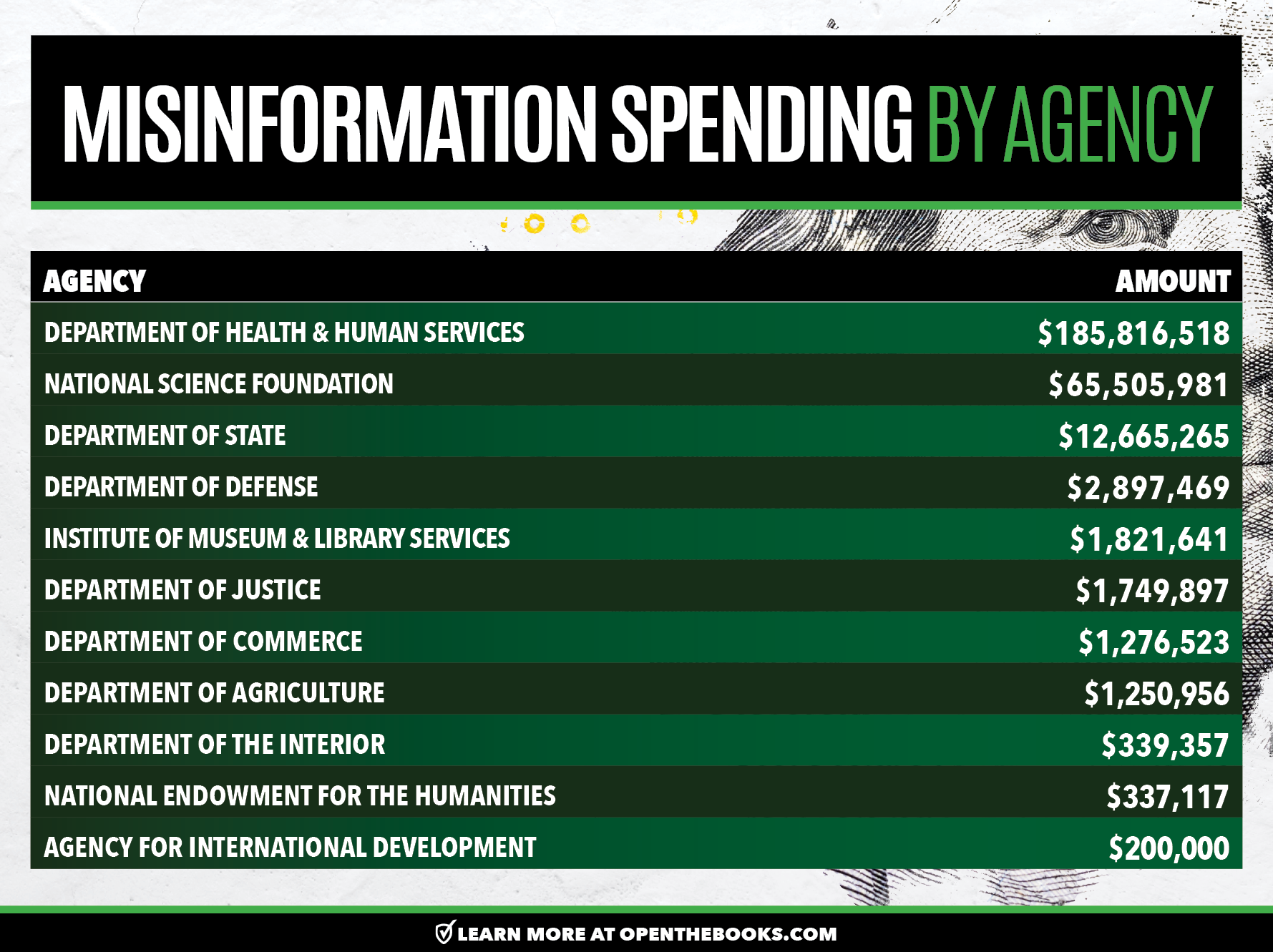
Grants mostly came from the Department of Health and Human Services ($185 million), followed by the National Science Foundation ($65 million), with the Department of State ($12 million) in a distant third. CHART: Click here for a breakdown of misinformation spending by agency.

An additional $17 million has awarded to misinformation-related contracts since 2020, and again, most of it ($12.5 million) was in FY 2021.

WHAT IS MISINFORMATION, ANYWAY?

According to the Department of Health and Human Services website:

“Misinformation is information that is false, inaccurate, or misleading according to the best available evidence at the time.”

The website goes on to detail supposed issues with COVID-19 related misinformation:

“During the pandemic, health misinformation has led people to decline vaccines, reject public health measures, and use unproven treatments. Health misinformation has also led to harassment and violence against health workers, airline staff, and other frontline workers tasked with communicating evolving public health measures.”

These definitions leave a lot of room for interpretation and abuse—who decides what the “best available evidence” is at any given time? And who decides which experts should be considered authoritative or not?

Famously, then-National Institute of Allergies and Infectious Disease director Anthony Fauci promoted the notion that people should stand six feet apart from each other to achieve “social distancing” to reduce COVID transmission.

In January of 2024 Fauci would admit to Congress that this recommendation had no scientific basis and “sort of just appeared.”

The six feet social distancing rule was used to justify extended school and business closures, wreaking economic havoc and leading to tremendous learning losses for children.

BACK TO THE START: MISINFO SPENDING UNDER TRUMP

Before most of the furor, the Trump administration granted about $6.7 million in funding related to misinformation, the bulk of which were awarded in FY 2019 and 2020. Most of these grants—12 of the 16 total—funded technological developments to monitor social media and flag misinformation.

The earliest one of these was awarded in 2017: $316,000 from National Science Foundation for “training computers and humans to detect misinformation by combining computational and theoretical analysis.”

No such grants were given out domestically in 2018, but in 2019 over $2 million were awarded for projects with titles like “Online Dynamics of Misinformation” and “Social Media and Mass Communication: Curriculum Development to Combat Misinformation.”

Spending stayed about the same at $1.7 million in FY 2020 for six projects, including two that directly address COVID:

  • $149,858 from National Science Foundation for “tracking and network analysis of the spread of misinformation regarding COVID-19.”

  • $104,491 from National Science Foundation for “countering COVID-19 misinformation via situation-aware visually informed treatment.”

While this spending is a drop in the bucket for what was to come, the censorious ideology behind “misinformation” grants which were abused during the Biden-Harris administration first got traction under Trump.

NEXT STEPS: CASH TO FIGHT COVID MISINFO

When examining the number of projects on misinformation, most did not specifically relate to the COVID-19 pandemic. Many involved misinformation concerning HIV, the HPV vaccine, or the opioid epidemic, for instance. Multiple projects also addressed more obscure topics, like this $234,401 grant to “combat misinformation that negatively impacts public perception of crabbing and the commercial fishing industry.”

But dollar for dollar, $127 million was directly related to COVID.

Projects receiving funding generally comprised two categories:

  • Public-interfacing programs meant to mitigate the supposed impact of misinformation through on-the-ground advocacy

  • Scientific studies or conferences on how misinformation is spread

ON-THE-GROUND ADVOCACY

The federal government pumped millions of dollars into on-the-ground campaigns to “dispel” misinformation and convince people to take COVID-19 vaccines or otherwise comply with COVID policies. Some examples include:

  • $80,092,486, Department of Health and Human Services, National Foundation for the Centers for Disease Control & Prevention, to build a network of nonprofits through which to disperse materials about COVID and flu vaccines. Project goals include “the design, development, and management of a searchable repository platform to house a multi-lingual inventory of communication materials and tools to support collaborative efforts to increase adult immunization.”

  • $2,000,000, Department of Health and Human Services, Durham County, NC. Proposed activities include “a mass media campaign, SMS distribution of health messaging, out-of-home advertising within targeted geofencing, coordinating existing networks of community health workers, expanding peer advocacy programs to address vaccine hesitancy, outreach to address health-related misinformation, mini-grants for native content development with accurate health messages, and a digital learning community to advance organizational health literacy.”

  • $1,293,614, Department of Health and Human Services, University of Iowa. To leverage trusted community members to address “disparities in COVID testing and vaccine uptake.”

Other grants were revised to add an anti-misinformation component. For example, $150,000 was added to a $1.2 million grant from the Corporation for National and Community Service (also known as AmeriCorps) to nonprofit Seeds 4 Success.

The original grant was to connect “foster grandparents” to children to serve as tutors and mentors. The revision stated the foster grandparent program will instead “dispel misinformation about COVID vaccination and help [the target community] see the benefits, especially vaccinating children when eligible, and help maximize contract tracing resources to ensure safety of the families we serve.”

MISINFORMATION STUDIES

Other funding went to researchers seeking to understand how supposed misinformation is shared online and how it can be combatted or mitigated using social or technological tools. Universities were often the recipient of such research spending.

Although much of this research is academic, it is often intended to lay the groundwork for public interventions.

Examples include:

  • $2,356,413, Department of Health and Human Services, University of Pennsylvania, for “investigating and identifying the heterogeneity in COVID-19 misinformation exposure on social media among black and rural communities to inform precision public health messaging” because “misinformation contributes to confusion, distrust, and distress around health behaviors such as vaccination, mask wearing, and social distancing.” In other words, they wanted to find the different messages and media various communities were receiving in order to tailor the government’s rebuttal.

  • $2,175,835, Department of Health and Human Services, University of Texas Health Science Center at Houston, for research on the “social processes and cognitive factors underlying misinformation comprehension” in social media. By developing an algorithm to automatically detect “intent and belief attributes underlying COVID-19 misinformation” researchers can develop computational infrastructure to mitigate the spread of that misinformation “easing public health burden and informing policy regulations as needed.”

  • $348,310, Department of Health and Human Services, Michigan State University, “to counteract the negative impact of misinformation on digital platforms that threatens public health.” The overall goal of the project is “to develop a publicly accessible vaccine informatics system to track vaccine debate, and to test the impact of vaccine debate… during the onset of a global pandemic.”

OTHER GRANT EXAMPLES

$200,000 to Slander a Political Opponent

One notable research grant awarded to George Washington University in FY 2022 targeted former president Donald Trump. The study, called “Pandemic Communication in Time of Populism: Building Resilient Media and Ensuring Effective Pandemic Communication in Divided Societies” received a $199,516 grant from the National Science Foundation.

Researchers on this Biden-era grant examined how so-called “populist” leaders supposedly prevented society from coming together in “solidarity” during the COVID pandemic. Trump’s presidency was a focus of the research, along with the leaders of three other countries.

One researcher said in a video interview:

“What went wrong in different ways in all these countries and in a lot of countries around the world that had populist governments…there was just this very high level of polarization and politicization of the pandemic response…and it really interfered with the ability of society to pull together in a consistent way and to get through the pandemic.”

The research also concluded that “experts” should have the “main say” during the next public health crisis, with another investigator saying:

“One of the recommendations stemming from our strand is related to who is in charge of disseminating information related to the public health crisis, in our view based on the data that we have, it’s obvious that governments should allow the experts to have the main say in how society should respond to public health crisis.”

At the end of the video “climate change” is the next crisis these experts suggest requires strong public solidarity that populist leaders are incapable of creating.

WILL THE NATIONAL ACADEMIES THEMSELVES SPREAD MISINFORMATION?

In a similar vein, $994,950 was awarded from the National Science Foundation to the National Academies of Science on “Understanding and Addressing Misinformation about Science.” This report was needed because, according to the grant description, “concern about the spread of misinformation and its role in undermining scientific expertise and facts in civic dialogue has grown significantly, especially over the last 5-10 years.”

The report has yet to be published, but there is reason to suspect it will also lack introspection from its supposed expert panel of researchers.

The chair of the research committee, Kasisomayajula Viswanath also worked on the report “Communication Strategies for Building October Confidence in COVID-19 Vaccines: Addressing 2021 Variants and Childhood Vaccinations.”

Viswanath said at the time to “continue to emphasize [to parents] how safe the vaccines are and how they are effective in preventing serious disease. More than 6 billion doses of vaccines have been given globally so far with very few serious adverse effects.”

But as the New York Times reported in February 2024, many other countries no longer recommend or even offer COVID-19 vaccinations or boosters for children.

The New York Times article suggested that U.S. Center for Disease Control’s recommendation for childhood vaccination diminishes the agency’s credibility, because, as other countries have concluded, the benefits of childhood COVID vaccines do not outweigh the costs.

It remains to be seen if this misstep in COVID policy will be a part of the new $1 million report on how misinformation erodes public faith in “scientific expertise.”

MISINFORMATION CONTRACT SPENDING

As we’ve illustrated, public grants focused on “dispelling” misinformation with supposedly accurate information in order to coerce people into compliance with health policy directives.

But beginning in 2020, contracts were often concerned with monitoring or eliminating supposed misinformation at its source.

Because contract descriptions are frequently vague, it is unclear how many are directly related to COVID-19. Only one explicitly mentioned the pandemic in its contract transaction description.

Examples of these misinformation contracts include:

  • $300,000, Department of Health and Human Services, Innov8AI, “capturing medical misinformation in social media for targeted interdiction using an advanced AI solution set.” [Interdiction means “to forbid in a usually formal or authoritative manner,” according to Merriam-Webster Dictionary.]
  • $300,000, Department of Health and Human Services, Melax Technologies, “real-time surveillance of vaccine misinformation from social media platforms using ontology and natural language processing technologies.” In other words, Melax would sort posts it deemed “misinformation” into categories to analyze.
  • $299,964, Department of Health and Human Services, Gryphon Scientific, “systematic understanding and elimination of misinformation online.”

Other contracts raised eyebrows for different reasons:

  • $1,205,826 from Department of Homeland Security went to defense contractor  Guidehouse for “misinformation, disinformation, and malinformation analysis.”

NOTE: Malinformation is a controversial term for information that is true, but presented without sufficient context in a way that could mislead or harm. The opportunity to use this word to censor political or ideological opponents should be obvious.

  • As first reported in the Daily Caller, Meedan Inc received $749,974 from the National Science Foundation’s Convergence Accelerator in 2022 for “FACT CHAMP: fact-checker, academic, and community collaboration tools combating hate, abuse, and misinformation with minority led partnerships,” later re-branded as Co-Insights.

The non-profit went on to receive $5 million more from NSF for the same project a year later.

A press release states the project will “narrow the gap between research into misinformation and responses designed to curb it.”

CONCLUSION

In October the House Committee on Energy & Commerce’s Subcommittee on Oversight and Investigations published a report outlining nearly $1 billion in spending on a vaccine promotional campaign. Despite this huge expenditure, the report notes that “the Campaign and the Biden Harris administration’s response to the pandemic resulted in a collapse of the public’s trust in public health messaging.” Report authors blamed flawed messaging about the effectiveness of masks, overstating the risk of COVID to children, and recommending vaccinations for all Americans over the age of 6 months.

It appears the administration most concerned with “misinformation” itself trafficked in misinformation: on masks, on risks to children, on social distancing, and on the need to vaccinate even infants. At least one grant specifically targeted the sitting president’s main political rival.

Americans simply cannot trust that continued grant and contract spending and various bureaucratic programmatic activities involved in “misinformation” will not be ideologically motivated to silence critics.

Case in point: a $249,691 grant from the federal Institute of Museum and Library Services to the University of Washington to build and deploy an “online escape room hosted by librarians” to address misinformation. The grant also included a co-design camp around the far-left Black Lives Matter movement to “demonstrate use of the design kit for creating interest-driven escape rooms.” (Play the escape room here.)

How much more misinformation spending is purely ideological or promoting contested or even false information?

No doubt the internet is awash with patently false information that can confuse and needlessly alarm readers. So far it has been proven, however, that the federal government is not capable of addressing this issue objectively. It would be better to stop entirely than further undermine federal credibility with accusations of partisanship and First Amendment rights violations.

The incoming Trump administration must end the government’s involvement in managing so-called misinformation, and Congress must keep the purse strings closed on this spending.

Otherwise, taxpayers remain at risk of underwriting their own censorship.

Tyler Durden
Sat, 11/23/2024 – 23:20

Young Americans Are Turning Off The TV

0
Young Americans Are Turning Off The TV

As streaming services such as Netflix, Amazon Prime Video and Disney+ have taken over a huge chunk of TV consumption in the United States, traditional TV is finding itself under increased pressure to defend its place as the go-to medium for entertainment, distraction and information.

And while people still spend a lot of time watching live and timeshifted TV on average, Statista’s Felix Richter notes that’s largely due to heavy TV usage by Americans aged 65 and above, who watch roughly 10 times as much traditional TV as young adults do.

Infographic: Young Americans Are Turning Off the TV | Statista

You will find more infographics at Statista

According to Nielsen, Americans aged 18 to 34 watch less than five hours of live and timeshifted TV per week.

At the other end of the scale, those aged 65 and older watch more than 40 hours on average.

Making this worse for the TV industry, there’s a growing share of young adults who don’t watch TV at all, as they get all they need from digital sources.

According to Statista Consumer Insights, 50 percent of 18 to 24-year-olds in the U.S. say that they don’t watch any traditional TV, compared to just 29 percent of 55 to 64-year-olds.

That share would likely be even lower for those aged 65 and older, but they have not been surveyed in this case.

Tyler Durden
Sat, 11/23/2024 – 22:45

China’s New Port In Peru: A Strategic Threat To US Security

0
China’s New Port In Peru: A Strategic Threat To US Security

Authored by Antonio Graceffo via The Epoch Times,

The new Chinese-controlled port in Peru is part of Chinese leader Xi Jinping’s strategy to outflank the United States by establishing a maritime and land corridor linking China to Latin America.

As the Biden administration winds to a close, the Chinese Communist Party (CCP) is aggressively expanding its influence in South America. On Nov. 14, Xi Jinping and Peruvian President Dina Boluarte inaugurated a $3.6 billion port in Chancay, Peru, marking another major step in China’s economic foothold in the region.

Earlier this year, Boluarte traveled to Beijing to strengthen Sino–Peruvian ties, cementing Peru’s position as the second-largest recipient of Chinese foreign direct investment in Latin America. Notably, this includes China Southern Power Grid’s acquisition of Peru’s electricity distribution, placing 100 percent of this critical infrastructure under CCP control.

In stark contrast, the White House failed to engage Boluarte during her 2023 visit to Washington, missing a key opportunity to counter Beijing’s growing influence. The port inauguration coincided with the Asia-Pacific Economic Cooperation (APEC) summit in Lima, where U.S. President Joe Biden and leaders from 21 member economies convened. The timing underscores a stark reality: while the United States watched from the sidelines, the CCP was actively drawing Latin America deeper into its orbit, delivering a clear and humiliating message to the United States about its waning influence in the region.

The Chinese shipping giant COSCO owns a 60 percent stake in Peru’s Chancay port, which will serve as a critical node in China’s Belt and Road Initiative and its first logistics hub in the Americas. Strategically positioned, the port grants China access to Peru’s abundant copper reserves—essential for dominating global markets in electric vehicles and data centers. Equipped with cutting-edge technology, including automated cranes and driverless electric trucks, the port’s scale and proximity to the United States have raised serious concerns about potential military use by the Chinese People’s Liberation Navy.

Gen. Laura J. Richardson, then-commander of U.S. Southern Command, warned Congress that while the port is officially designated for commercial purposes, its size and capabilities could accommodate military assets, including combat vessels. She emphasized that China, as a strategic competitor, undermines international norms and democratic values in Latin America and the Caribbean. Through corruption, disinformation, cybercrime, and human rights abuses, the CCP bolsters authoritarian regimes in countries like Cuba, Nicaragua, and Venezuela to further its geopolitical agenda.

While China deepens its regional foothold, the United States has pressured Boluarte on human rights abuses and democratic violations, contrasting with Beijing’s hands-off approach. Beijing openly supported Venezuela’s Nicolás Maduro after his contested election victory in July, despite widespread allegations of fraud by international observers. The fraudulent election sparked massive protests across Venezuela, met with a violent crackdown by Maduro’s regime. Security forces used tear gas, rubber bullets, and live ammunition to suppress dissent, resulting in at least 23 deaths and more than 2,200 arrests. The brutal suppression drew international condemnation, further isolating Maduro’s regime, yet China’s backing reinforced its alignment with authoritarian leaders in the region.

China’s investments in dual-use infrastructure, such as ports, telecommunications, and space facilities, extend well beyond commercial purposes. Deep-water ports like the proposed maritime facilities in Argentina could serve as future naval access points for the People’s Liberation Army. These strategic installations, including projects near the Panama Canal and Antarctica, create chokepoints that enhance Beijing’s global power projection capabilities.

These ports also enable the CCP to monitor U.S. naval and commercial ships, with the potential to restrict their access to vital waterways. Additionally, Chinese state-owned enterprises like Nuctech and ZPMC, which operate in Chancay and other Latin American and Caribbean ports, could leverage port scanning equipment and cargo cranes to gather sensitive commercial data from allies and adversaries alike. Similar concerns have been raised regarding Chinese-built ports in Africa, the Middle East, and Southeast Asia, underscoring the broader risks of China’s expanding infrastructure network.

In the Western Hemisphere, Chinese state-owned companies have financed, built, or now operate several key ports along strategic waterways, including the Panama Canal and the Caribbean Sea. In Argentina, China recently attempted to develop a naval base near the Strait of Magellan and Antarctica, but President Javier Milei opted in April to partner with the United States for the project instead.

These Chinese-controlled ports pose significant challenges for U.S. military operations. In a potential conflict, such as one in the Taiwan Strait or South China Sea, the U.S. Navy may need to quickly move ships between the Atlantic and Pacific through critical chokepoints like the Panama Canal or the Strait of Magellan. Chinese companies managing these infrastructures could delay or obstruct U.S. movements.

Major Chinese shipping and port management companies, including COSCO, operate under heavy influence from the CCP. With many top executives holding CCP membership and China’s 2017 National Security Law requiring companies to prioritize national security interests, the CCP wields significant control over these operations. This allows Beijing to strategically leverage these assets to support its geopolitical objectives.

Telecommunications is another key area in which China has established a stronghold in Latin America. Companies like Huawei and ZTE have implemented network infrastructure across nearly every country in the region, raising serious cybersecurity concerns. Meanwhile, China has also expanded its presence in space, building at least 10 facilities in Latin America—the largest concentration outside its mainland. These installations bolster the People’s Liberation Army’s global surveillance and military capabilities, presenting a direct threat to U.S. security.

Numerous Republicans, including former presidential candidate Vivek Ramaswamy, Florida Gov. Ron DeSantis, and Sen. Jim Risch (R-Idaho), highlighted the urgent need to revive the Monroe Doctrine—a U.S. policy established in 1823 to oppose foreign interference in the Western Hemisphere—in response to mounting threats from the CCP. They warn that the Chinese regime is aggressively expanding its influence in Latin America, backing authoritarian regimes, infiltrating markets, and undermining regional sovereignty, posing a direct challenge to U.S. security.

Risch called on the White House to recognize the stakes, as failure to act will leave the United States increasingly vulnerable. In his view, reviving the Monroe Doctrine isn’t just historical—it’s essential for modern security.

Views expressed in this article are opinions of the author and do not necessarily reflect the views of The Epoch Times or ZeroHedge.

Tyler Durden
Sat, 11/23/2024 – 22:10

Making America Great Again Means Fixing Its Dystopian Cities

0
Making America Great Again Means Fixing Its Dystopian Cities

Authored by Stephen Soukup via American Greatness,

Of all the celebrities promising to leave the country if Donald Trump won this month’s election, at least one has already kept that promise and decamped to supposedly greener pastures. The actress and filmmaker Eva Longoria recently told Marie Claire that she, her husband, and her son now split their time between Spain and Mexico.

“It just feels like this chapter in my life” – the chapter in which she is an American, apparently – “is done now.”

On the one hand, it’s a bit surprising that one of the big-talking Hollywood leftists actually kept her promise and allowed politics to rule her life. On the other hand, if any of the Glitteratti were going to run from Donald Trump’s America, Longoria would be the one. She doesn’t just support Democratic politicians, after all. She has dedicated much of her adult life to their cause:

In 2016, Longoria took to her bed after Trump prevailed. “I’ve never been depressed in my life,” she recalls…. Longoria spent the better part of this past summer campaigning for Kamala Harris. She rallied volunteers with Tim Walz. Countless celebrities endorsed the Democratic ticket, but Longoria is more than a famous surrogate. The Washington Post has called her a genuine “political power broker” for the “fierce and productive” work she has done to organize women and Latinos. The Texas Tribune profiled her efforts to recruit and support Hispanic Democratic candidates up and down the ballot.

Needless to say, Longoria is all in on Democratic politics—which makes her reasons for leaving the United States all the more interesting. Although she tells Marie Claire that Trump was an issue for her, he wasn’t the only issue. Indeed, she and her family had moved out of the country before Trump even won the election on November 4. She gave up on this country for far different reasons. It’s “dystopian,” she says, and it’s been getting worse for some time: “I had my whole adult life here…But even before [the pandemic], it was changing. The vibe was different. And then COVID happened, and it pushed it over the edge. Whether it’s the homelessness or the taxes, not that I want to sh*t on California….”

I’m not one to kick a gal when she’s down, but Longoria’s complaints about the United States—dystopian, homelessness, excessive taxes, etc.—have a familiar ring to them. Indeed, they sound a lot like the complaints registered by that other leftist icon…<>…Tucker Carlson?

As you may recall, not quite nine months ago, Carlson won the enmity of both liberals and conservatives for saying that Moscow is “so much nicer than any city in my country.” Like Longoria, Carlson lamented the dystopian nature of much American life, complaining that “If you can’t use your subway, for example, as many people are afraid to in New York City because it’s too dangerous, you have to sort of wonder like, isn’t that the ultimate measure of leadership?” Unlike Longoria, however, Carlson didn’t give up on his country and exercised his “privilege” (her word, not mine) to abandon it. What he did was say that visiting other large cities in the world was “radicalizing” for an American because those cities, “no matter how we’re told they’re run and on what principles they’re run, are wonderful places to live….”

As I say, Carlson was roundly criticized for his comments. Some of that criticism was entirely justified, although much of it was not. And in any case, Longoria will not be criticized at all for her statements, in part because she’s a leftist and, thus, above criticism, and in part because she, like Carlson, has a point. Public spaces in American cities are, in most cases, grotesque. That’s almost inarguable. Among other things, Tucker was bashed because he made what seemed to be a partisan argument. He was clearly and undeniably criticizing urban Democratic politics and policies. The irony here is that Longoria was too, although neither she nor any of her supporters and fans understand that.

As Democrats continue their soul-searching, and as media and other analysts try to dissect the causes of the enormous Republican victory not quite two weeks ago, one lesson will likely go unlearned. The American people really do want their country to be great again. To them, that doesn’t mean that the United States should be an omnipotent global colossus, striding the globe, enforcing its will on everyone and everything. And it doesn’t mean that Americans should win every gold medal at every Olympics or every Nobel Prize or anything like that. Americans just want their country to work again. They just want their cities to function. They want to be able to build homes or power plants or new factories without having to spend countless months and endless resources complying with arcane and ridiculous regulations. They want their country to look and feel and operate like a normal place again.

For at least the last 60 years, American cities have been governed not for the benefit of their residents but for the benefit of political power consolidation. Cities are managed specifically to ensure the application of ideological principles and the maintenance of the partisan status quo. In other words, New York, Chicago, and San Francisco (and practically every city in between) are experiments in liberal-left policies and Democratic machine politics. They are run of, by, and for the machines and their ideological solons, not for the people who live there.

Sometimes, on very rare occasions, cities can break out of this politicized rut, electing new leaders with new ideas—Rudy Giuliani, for example—who change the entire spirit of the metropolis. In time, however, even these breakout efforts fall victim to ideological sniping and partisan grift, leaving the city polarized, politicized, and further degraded.

Eva Longoria doesn’t know this, but she’s not leaving the United States because of Donald Trump. She’s leaving because of Gavin Newsom, Karen Bass, London Breed, and all the rest of the party-machine politicians, who see this nation’s cities and states not as places where people live and desire to live well but as opportunities to ply their ideological biases and fulfill their personal ambitions.

Donald Trump is not the dictator his detractors want us all to believe he is. But even if he were, there is nothing he could do to the people of San Francisco that is worse than what London Breed, Edwin Lee, and Gavin Newsom have done to them. There is nothing he could do to the people of Chicago that is worse than what Brandon Johnson and Lori Lightfoot have done to them. There is nothing he could do to the people of New York that is worse than what Eric Adams and Bill DeBlasio have done to them.

So go, Ms. Longoria. Go use your privilege to start the next “chapter” in your life. Go use your privilege to escape the dystopian nightmare of American cities. But as you go, understand that the problems with America and its cities are less about Donald Trump and his indiscretions than about people, like you, who abhor the outcomes of certain ideologies and policies and yet vote for them—and even campaign aggressively for them—time and time again.

Tyler Durden
Sat, 11/23/2024 – 21:35

Terror To The South: Hezbollah In Latin America

0
Terror To The South: Hezbollah In Latin America

Authored by Matias Ahrensdorf & Santiago Vidal Calvo via RealClearDefense,

The reelection of Donald Trump has sent ripples across terror-supporting and anti-Israel regimes. In the Middle East, Qatar claimed it would rescind its longtime asylum for Hamas leadership, and Iran is reportedly recalibrating its retaliation for Israel’s recent airstrikes. But the new Trump Administration should also be focusing on Latin America, where complicit nations have enabled Hezbollah to thrive. The U.S. must curtail Hezbollah’s active regional fundraising which not only supports attacks against Israel but transnational criminal activity, including bringing drugs and potential terrorists across America’s southern border. 

Both Luis Arce, socialist president of Bolivia, and Nicolas Maduro, the authoritarian president of Venezuela, have not only made horrifically antisemitic comments, but completely severed diplomatic ties with Israel. Maduro mourned the death of terrorist and Hezbollah founding member, Hassan Nasrallah, expressing support for the terror group while condemning Israel.    

In the early 90’s, Hezbollah bombed the Israeli embassy in Buenos Aires and two years later the Asociación Mutual Israelita Argentina (AMIA) Jewish cultural center. In November of 2023, police in Brazil foiled plans for a major terrorist attack on multiple Jewish targets in the country—home of Latin America’s second largest Jewish population second only to Argentina.     

Hezbollah’s patron, the Islamic Republic of Iran, facilitates Hezbollah’s presence in Latin America by building advantageous relationships with authoritarian-leaning countries in the region.    

In July of 2023, the BBC reported that Iran and Bolivia signed a bilateral agreement to expand “cooperation in the fields of security and defense.” The Iranian defense minister, Mohamed Reza Ashtiani, acknowledged that the deal involved “the sale of equipment and the training of personnel,” including the purchase of Iranian drones by Bolivia. Iran and Venezuela signed a 20-year cooperation agreement in 2022 to increase ties in the oil, petrochemical, economic, and military sectors.     

Bolivia and Venezuela are rich in uranium and other resources. In 2009, Iran helped Venezuelan engineers with “geophysical aerial probes and geochemical analyses (to find) uranium deposits” as reported by EcoAmericas. By contrast, while the presence of uranium deposits is known in Bolivia, the government has labeled information on the topic as ”reserved”, meaning the location, size, and potential for mining are not publicly disclosed. Around the same time Venezuela and Bolivia had discovered uranium deposits in their regions, a secret Israeli government report obtained by AP news found that: “Venezuela and Bolivia are supplying Iran with uranium for its nuclear program.” In fact, in late October 2024, Bolivia produced its first nuclear fuel for a research reactor.

Furthermore, both countries are linked with narcotrafficking markets, in which Hezbollah and other terrorist groups are involved. Historically, Bolivia is one of the largest producers of the coca leaf. Due to its abundance, Bolivia naturally played a large role in the Latin America drug trade and supplied an estimated 15% of the cocaine market in the United States during the 1980’s. According to a 2022 White House press release, Bolivia’s steadily growing cocaine production poses a public health threat to the U.S. due to increasing cocaine related overdoses. As of 2009, Bolivia’s president at the time Evo Morales, expelled the U.S. Drug Enforcement Agency (DEA) from the country after nearly three decades of maintaining a presence.

Venezuela is also involved in the cocaine market. Through collaboration with the Revolutionary Armed Forces of Colombia (FARC), a known Hezbollah ally, Venezuela serves as a main export hub for cocaine into the United States and Europe. Early in the Biden Administration, the U.S. Department of Justice announced several narcoterrorism indictments against the Maduro regime, including Nicolás Maduro himself, for conspiring with FARC to facilitate and profit from the cocaine trade.     

In March of 2020, former Venezuelan-Syrian politician, Adel El Zabayar, was indicted by the Justice Department for conspiring with Nicolas Maduro and other regime leaders in a narcoterrorism plot involving Colombian FARC dissidents, Mexican drug cartels, and operatives from Iran, Syria, Hamas, and Hezbollah to carry out planned attacks on the United States. Last month, Mijal Gur Aryeh, Israel’s Ambassador to Costa Rica, condemned Venezuela and Bolivia for hosting Hezbollah and Iranian terrorists. Earlier this year, Patricia Bullrich, the Security Minister of Argentina, also made the claim that “Bolivia hosts hundreds of members of the Quds Force,” a branch of Iran’s Islamic Revolutionary Guard Corps (IRGC).

People on terrorist watchlists have been apprehended at the southern border of the United States, and at least one Hezbollah operative attempting to enter the country illegally. Since the October 7th attack on Israel, Hezbollah has launched over 8,000 rockets at the Jewish state, causing “over 70,000” Israeli’s to evacuate their homes.    

Hezbollah’s presence in Latin America should alarm Western defense officials. While the terrorist organization continues to volley missiles at Israel daily, it is also increasing its involvement in transnational criminal activity, as its financiers the Islamic Republic of Iran increases its influence in the region. The incoming Trump Administration, with newly appointed Secretary of State Marco Rubio—an unyielding opponent of repressive regimes—should work closely with its Latin American allies and Israel to destroy Hezbollah’s fundraising in the region  which not only enables terrorist activity in the Middle East, but also threatens the southern border with illicit drugs and potential terrorism.  

Matias Ahrensdorf – Data Analyst for Policy and Research in New York City.

Santiago Vidal Calvo– Tech and Public Policy Scholar and master’s student at Georgetown University.

Tyler Durden
Sat, 11/23/2024 – 21:00

‘Terminator’ Robot Dog Now Equipped With Amphibious Capabilities 

0
‘Terminator’ Robot Dog Now Equipped With Amphibious Capabilities 

The use of robotic dogs on modern battlefields in Eastern Europe and the Middle East has expanded rapidly. Over the past decade, we have thoroughly documented their growing presence and proliferation.

The latest quadruped robot designed for modern warfare is the Ghost Robotics V60. However, this is far from a typical robotic dog. A separate defense firm, Onyx Industries, has equipped the V60 with an autonomous maritime mobility system, enabling it to navigate rough terrain and traverse bodies of water—all while carrying a machine gun.

Last month, Onyx shared a short video on YouTube showcasing the V60’s maritime mobility system in action.

“We’re incredibly excited to share the next evolution of our systems—NAUT amphibious capabilities with SENTRY kinetic and ISR payloads. This integration on the Ghost Robotics V60 is just one example of the many options available,” Onyx stated in the video’s description.

On a separate note, we recently highlighted the terrifying capabilities of Deep Robotics’ quadruped robot, which is equipped with wheels. Its mobility is nothing short of alarming.

The ever-increasing capabilities of these robotic dogs are becoming deeply concerning.

Tyler Durden
Sat, 11/23/2024 – 20:25

Maddow Hit With $5 Million Pay-Cut As Musk, Trump Jr Joke About Buying MSNBC

0
Maddow Hit With $5 Million Pay-Cut As Musk, Trump Jr Joke About Buying MSNBC

The left-wing cable news channel MSNBC has reportedly cut the salary of one of its top hosts, Rachel Maddow, by a staggering $5 million as the network suffers from ongoing financial problems and a steep decline in ratings.

As reported by the New York Post, Maddow saw her salary fall from $30 million to $25 million during her contract renegotiations this month. Her show, “The Rachel Maddow Show,” airs weekly on Mondays. Her show has been highlighted as one of the few on the network that is still doing well with viewership in the weeks since the 2024 election.

“This is a difficult time and they needed to keep her,” said one anonymous executive. “No one else can do what she does. You can’t build a brand like it overnight.”

As Eric Lendrum writes at American Greatness, the report comes after the news that MSNBC’s parent company Comcast has decided to spin off all of its cable news channels by the end of 2025, as the cable news sector struggles to earn money in comparison to Comcast’s other properties. As such, MSNBC will be split off from NBC News, a move that could force MSNBC to change its name, logo, and headquarters, as well as lay off many employees.

As part of Maddow’s new deal, she will be allowed to continue producing podcasts and documentaries in addition to her weekly show every Monday. She will also be utilized for breaking news segments during other shows, due to her popularity with MSNBC’s shrinking audience.

In the period of just over two weeks since the 2024 election on November 5th, MSNBC’s ratings have plunged by 54%. Their Nielsen ratings are down 40% year-over-year.

“We were so Harris propaganda that when she lost, viewers were shocked,” said one anonymous MSNBC commentator.

“It turned into one giant echo chamber. If MSNBC wants to be of service to its viewers, they can’t keep them in fantasy land.”

But the story has a risible ending, as Donald Trump Jr. and Tesla owner Elon Musk joked around on social media about potentially purchasing MSNBC.

“Hey @elonmusk I have the funniest idea ever!!!” Trump Jr. tweeted in response to the news of Comcast spinning off its news units (including MSNBC). 

“How much does it cost?” Musk said in response.

Later Musk said that the outcome would be very “entertaining” if he actually purchased the outlet. 

Popular podcaster Joe Rogan later chimed into the banter, saying he would like to replace news host Rachel Maddow. 

“If you buy MSNBC I would like Rachael [sic] Maddow’s job. I will wear the same outfit and glasses, and I will tell the same lies,” Rogan said.

“Deal,” Musk responded.

Elsewhere on MSNBC, “Morning Joe” co-hosts Joe Scarborough and Mika Brzezinski have faced backlash from the far-left for their recent decision to meet with President-elect Donald Trump at his Mar-a-Lago estate in Florida.

They expressed an interest in restoring communications with the 45th and soon-to-be 47th President, even despite their ideological disagreements.

Tyler Durden
Sat, 11/23/2024 – 19:15