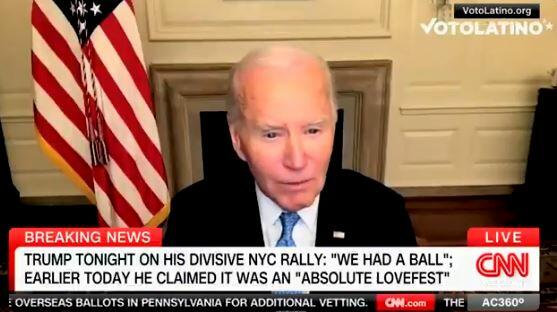
“A Breach Of Protocol”: White House Overrode Stenographers, Altered “Garbage” Transcript
In a mad scramble to cover for President Biden calling half of the country “garbage,” White House press officials altered the official transcript, overriding official stenographers who objected to the alterations, the Associated Press reports.
According to the pre-altered transcript, Biden said “The only garbage I see floating out there is his supporters — his — his demonization of Latinos is unconscionable, and it’s un-American.”
However White House press office added an apostrophe, reading “supporter’s” rather than “supporters,” in order to peddle the falsehood that Biden was criticizing comic Tony Hinchcliffe, who referred to the US island territory of Puerto Rico as a “floating island of garbage.”
The change was made after the press office “conferred with the president,” according to an internal email from the head of the stenographers’ office that was obtained by The AP. The authenticity of the email was confirmed by two government officials who spoke on condition of anonymity to discuss internal matters.
The supervisor, in the email, called the press office’s handling of the matter “a breach of protocol and spoliation of transcript integrity between the Stenography and Press Offices.” -AP
According to the email, the press office demanded that stenographers quickly produce a transcript of Biden’s call with Latino activists to discuss Hinchicliffe’s comments, while Biden’s social media team posted on X that he was not calling all Trump supporters garbage – and that he was specifically referring to the “hateful rhetoric about Puerto Rico spewed by Trump’s supporter at his Madison Square Garden rally.”
The two-person stenography team on duty that evening, a “typer” and a “proofer” said that any edits to the official transcript would have to be approved by their supervisor, the head of the stenographer’s office – who was unavailable. Because of this, the White House press office went ahead and published an altered transcript on the White House website and distributed it to the press and social media in a mad scramble.
The supervisor did not like that…
“If there is a difference in interpretation, the Press Office may choose to withhold the transcript but cannot edit it independently,” wrote the supervisor, adding “Our Stenography Office transcript — released to our distro, which includes the National Archives — is now different than the version edited and released to the public by Press Office staff.“
The supervisor, a career White House employee, raised concerns about the alteration in an email to White House communications director Ben LaBolt, press secretary Karine Jean-Pierre, and other officials.
“Regardless of urgency, it is essential to our transcripts’ authenticity and legitimacy that we adhere to consistent protocol for requesting edits, approval, and release,” he wrote.
The alteration was done as the White House scrambled to respond to a cascade of press inquiries over Biden’s comments – which completely upstaged Kamala Harris’ closing argument speech outside the White House.
As journalist Michael Shellenberger points out, it was likely illegal.
The Presidential Records Act prohibits altering official transcripts, which is what the White House did. And the alteration makes no sense. The White House is now claiming Biden was referring to the racism of Trump’s supporters, but the transcript refers to “his supporter’s.” pic.twitter.com/XaTFXowY2t
Biden’s comment was a gift to the Trump campaign, which immediately capitalized on it – fundraising off the quote, while Trump himself held a photo op inside a garbage truck on Wednesday.
Harris also moved to quickly distance herself from Biden’s comments, telling reporters “I strongly disagree with any criticism of people based on who they vote for.”
Meanwhile, House Republicans have been discussing launching an investigation into the fabrication – with House Republican Conference Chairwoman Elise Stefanik, R-(NY), and House Oversight and Accountability Chairman James Comer, R-(KY), on Wednesday accusing the White House of “releasing a false transcript” of Biden’s remarks, and called on White House counsel Ed Siskel to retain documents and internal communications related to Biden’s remarks and the transcript.
“White House staff cannot rewrite the words of the President of the United States to be more politically on message,” the lawmakers wrote, noting that it may have been a violation of the Presidential Records Act of 1978.
Wow.
The AP just admitted that the Biden regime altered the “garbage” transcript. They added the apostrophe and overrode the stenographer.
This is Orwellian. They WITTINGLY deceived the public in order to impact the result of the election.
Apart from getting booed by Beyoncé fans and heckled by Hamas supporters, nothing could have been more pathetic than the Kamala Harris campaign’s pivot back to Bidenesque fearmongering in the desperate final stretch of the 2024 election.
The Adolf Hitler trope now being deployed by Democrats is so overwrought that, since 1991, it has had its own special name in online culture: Godwin’s law.
And yes, the eponymous law’s creator, Mike Godwin—a former senior fellow at the R Street Institute and contributing editor at Reason magazine— has often addressed, in response to media inquiries, whether former President Donald Trump deserves a special-exception rider.
“My name gets cited in a lot of these discussions. And of course my ears are burning,” Godwin explained in a 2018 op-ed for the newly neutralLos Angeles Times.
“It hasn’t mattered that I’ve explained GL countless times,” Godwin continued. “Some critics on the left have blamed me for (supposedly) having shut down valid comparisons to the Holocaust or previous atrocities.”
The problem the Democrats have is that they sought precisely the same carve-out for many other Republicans: Ronald Reagan, John McCain, Mitt Romney, George W. Bush and, of course, Dick Cheney. Four have since become staunch Trump critics, and one is now actively campaigning for the Democrats.
“They’ve been saying that about Trump for years,” observed conservative pundit Megyn Kelly during a recent interview with Bill Maher. “They’ve been saying that about Republican candidates for years. … If you are at all center or center-right, you are used to having your candidate of choice completely demonized.”
As Godwin clarified, his law was never intended to suggest that all comparisons to Hitler and the Nazi regime were spurious—only that most were.
Republicans have countered the constant barrage of ad hominem attacks by pointing to the very valid ways in which the Democrats have, themselves, become the party of anti-liberal, authoritarian values, using their Trump Derangement Syndrome as justification to act on their worst impulses by shutting down all criticism and debate, while pursuing a Stalin-inspired “ends justifies the means” approach to politics.
“I saw the party that used to have courageous voices and leaders, calling for peace, now becoming the party of warmongers,” said newly red-pilled Republican Tulsi Gabbard at a rally Saturday in Charlotte, N.C.
“It has become the party of war,” the one-time Democratic presidential candidate added. “It used to be the party of working people.”
INCOMPATIBLE WITH DEMOCRACY
The resulting death spiral has left the Democratic Party in a condition where, without significant reform, it is no longer compatible with the precepts of democracy because its ideas, when it bothers presenting any, are so far on the fringe that they are rejected by the public.
They have, instead, fallen back on astroturfing, gaslighting and importing new voters through a complex ploy that involves simultaneously undermining U.S. border security and election-integrity laws, while actively attacking any efforts by the states to address their negligence.
Although they have set themselves up with the capabilities to steal any election, relying on both traditional ballot-harvesting methods and technological manipulation of equipment, their one vulnerability could be a landslide election in which, given the loss of credibility in the media and many government institutions, the American public outright fails to accept a fraudulent outcome.
While polls still suggest a tight race, many other bellwethers now indicate a potential Trump blowout, at least in the Electoral College.
With Trump notably leading polls in the critical battleground of Pennsylvania, even Sen. John Fetterman, D-Pa., recently acknowledged the GOP nominee’s strong position to hold the Keystone State, according to a New York Times interview.
Trump need only secure his 2020 states, along with Pennsylvania and Georgia, to reclaim the presidency, with four additional “swing states”—Arizona, Michigan, Wisconsin and Nevada—only bolstering his advantage.
By contrast, on Oct. 27, 2020, President Joe Biden reflected a 7.4% lead nationally. Hillary Clinton, who lost to Trump in 2016, had a 5.6% advantage.
IMPLAUSIBLE DENIABILITY
Trump’s success, moreover, in clinching key minority demographics creates an optical problem for Democrats, who can no longer use the fig leaf of “voting rights” as a pretense to undermine election integrity.
Democrats who disfranchise voters in the black and Hispanic communities now risk losing them permanently and incurring the same level of minority-driven anger and outrage against them that they weaponized against Trump during the 2020 Black Lives Matter riots.
Most worrisome of all for Democrats may be that in Arizona, Nevada and North Carolina, early voting indicated that more Republicans had turned out as of Friday, Oct. 25, according to Bloomberg.
Early Voting Results In Swing States:
Arizona – 1.3 Millions votes casted – 🔴41.9% GOP – 🔵35.1% Dem
Three other battleground states—Georgia, Michigan and Wisconsin—do not track party registration for early voting, suggesting Trump may be leading there, as well.
This trend could further explode the narrative pushed during recent election cycles that Republicans simply waited until Election Day and were bested by Democrats’ early get-out-the-vote initiatives.
If Trump is leading by a notable margin even going into Nov. 5 and Republicans continue to turn out at higher levels, there will be no plausible deniability for Democrats (and some corrupt GOP election officials) to delay releasing the results as they continue to scrounge up late-surfacing ballots in blue enclaves such as Arizona’s Maricopa County and Nevada’s Clark County, both of which have previously pulled last-minute reversals in 2020 and 2022.
Having already tipped their hand to their tactics, all eyes will be watching to see whether they have the temerity to engage in what could be deemed nothing less than a seditious conspiracy.
DESPERATE MEASURES
With all other options exhausted, Democrats’ only hope now may be to drive massive turnout on Election Day itself. But that is a task not easily accomplished. Undoubtedly, they would need some sort of precipitating event to rally any remaining voters to the polls.
What could it be? Here are a few possibilities that they might still pull off with just over a week remaining.
Escalation of war/act of terrorism:
“I have not permitted myself, gentlemen, to conclude that I am the best man in the country; but I am reminded, in this connection, of a story of an old Dutch farmer, who remarked to a companion once that ‘it was not best to swap horses when crossing streams,”’ wrote Abraham Lincoln in a June 1864 letter making his case for reelection.
The axiom has led other presidents, while politically flailing, to try to “wag the dog” by using war as a means to drive patriotic sentiment. In the Biden–Harris regime, while the patriotism may not be present, the anxiety of a foreign attack is still a powerful tool for manipulation.
Both China and Iran have made clear their preference for the current administration—of which Kamala Harris would be, at best, an extension—over Trump’s “America First” presidency. A false flag attack on Ukraine to stir up anti-Russian sentiment is another possibility. Trump has pledged to end the war there even before taking office.
Intel psy-op
We are all too familiar with the intelligence community’s role in fomenting violence at events like the 2017 Charlottesville “Unite the Right” protest and the Jan. 6, 2021 “Save America” rally. Perhaps the Harris campaign’s decision to feature them as a focal point in its closing argument is not so much an act of desperation but portention.
There are several signals indicating that there may be a heightened presence of election-meddling FBI operatives and others on-site at polling places, who are specifically tasked with monitoring MAGA. Might the goal be to instigate some sort of unrest during the election as a weapon of mass distraction?
Executive Order 14019
The Biden administration has been abjectly dishonest about many things, but its unusually opaque approach to President Joe Biden’s March 2021 edict has long raised suspicions that it could weaponize the entire federal bureaucracy as a de-facto ballot-harvesting operation for Democrats.
In keeping with the blueprints of anti-American subversive Saul Alinsky, the Left has sought to pre-emptively accuse the Trump campaign of a nefarious plot to reshape the government through talking points about the Heritage Foundation’s Project 2025. Yet, Executive Order 14019 could be everything that it accuses Project 2025 of being and then some. The only problem is that the lack of transparency makes it impossible to tell just how Democrats intend to use this.
Presidential death/health crisis
The Democrats and their deep-state allies have failed, thus far, in killing Trump, and to do so now would undoubtedly turn him into one of the greatest martyrs in U.S. history. JD Vance would coast to victory in a landslide, and with trusted college pal Vivek Ramaswamy at his side, he would set up the GOP for generations of political dominance.
Yet, assuming Biden hasn’t been actively trying to torpedo the Harris campaign, he might be persuaded to step aside early due to a health emergency, installing the current veep as the incumbent, which would allow her to finish the final stretch with images being sworn in by Justice Ketanji Brown Jackson, shoring up the identity politics vote. It would, of course, leave little time for her to actually implement any policies that would sour voters further against her.
Although Biden has recently indicated the need to “lock up” Trump—politically, he claims—Trump shrewdly hinted that he might be open to considering a presidential pardon for Hunter Biden, which could prove to be a powerful bargaining chip.
Nonetheless, there is another president who could similarly stir up superficial sentiment at the last minute. Centenarian Jimmy Carter may, in fact, already be dead.
The MSM wants you to believe that 100-year-old Jimmy Carter is ‘excited to vote for Kamala Harris’
His grandson Jason Carter said, ‘When we asked him if he was excited about his 100th birthday, he said:
Barring further proof of life, one might be hard-pressed to believe that Carter—his mouth agape, and his skin appearing jaundiced or discolored as he lay in state at his 100th birthday celebration—still inhabits this mortal plane.
However, maintaining the illusion is necessary, for now, since Carter already cast an early ballot for Kamala Harris, which would be invalidated, in theory, if he were to die before Election Day.
Carter’s passing, followed by a prompt cremation, could be announced next Tuesday as voters in Georgia are heading to the polls, throwing in to disarray a must-win state that Trump appears to have locked in.
Literally locking Trump up
This risky move may backfire, as all the earlier lawfare actions taken against Trump only helped to further bolster his popular support due to backlash. Nonetheless, the psychological impact of having their candidate in detention could cast enough doubt to keep some Republicans home, and would certainly motivate Democrats.
As it stands, corrupt New York Judge Juan Merchan has pushed back Trump’s sentencing in his porn-star case to Nov. 26. The GOP leader also still remains under gag order in the D.C. trial led by dubiously appointed special counsel Jack Smith, whom Trump recently called a “scoundrel.”
Smith and his accomplice, D.C. District Judge Tanya Chutkan, might unseal additional accusations to bait Trump into a response of some kind that could violate the order and land him in the gulag with countless other Jan. 6 detainees.
South Korea’s Chip Output Drops For First Time In 14 Months Amid Slowdown At Samsung
Concerns over the stability of the artificial intelligence bubble intensified this week.
Advanced Micro Devices released a disappointing earnings report on Tuesday, revealing slower-than-expected growth in AI sales. Adding to the uncertainty, Samsung Electronics, the world’s largest smartphone manufacturer, reported overnight about uninspiring demand for advanced chips in mobile devices and PCs.
The largest takeaway from Samsung’s third-quarter earnings report was an underwhelming performance in the company’s chip division, posting a surprise drop from the previous quarter. At the same time, overall profit was marginally higher than Wall Street estimates. Also, it saw smartphone sales slowing by the end of the year and only increasing by about 1% in 2025, despite the hype surrounding AI-enabled smartphones and other handheld devices.
In addition to company-level developments, new data from South Korea’s chip manufacturing base shows that production fell in September for the first time in 14 months—yet more troubling signs showing the AI boom cools.
Nationwide semiconductor production slid 3% in September, a sharp reversal after they gained 11% a month earlier, according to data released Thursday by the government statistical office. The growth in shipments also slowed to 0.7% from 17% in August.
Still, inventory levels showed stockpiles continue to be worked through at a rapid clip, as they declined 41.5% from a year earlier in September. The numbers paint a picture of an industry that may be cooling gradually as demand for memory chips peaks out.
South Korea’s chip production is viewed as a proxy for global chip demand because these components are used in a wide range of electronics, from smartphones to servers to automobiles. Given the hype around AI adoption from phones to computers, this week’s news from AMD, Samsung, and now South Korea’s chip base could be symptoms of a cooling bubble. Certainly not the headlines chip bulls want to see.
The United States is days away from a portentous presidential election that, however it turns out, promises to leave around half the nation believing that catastrophe has been narrowly averted and the rest believing that all is lost. Desperate hopes and apocalyptic fears suffuse the electorate. Significant swathes of the right and left – especially among the intellectual class – believe that the other side is dishonest, wicked, and bent on overthrowing democracy in America. This tendency to loathe those in the rival political camp presents an overriding threat to the nation.
To endure, a rights-protecting or liberal democracy needs citizens who regard themselves as engaged in a common enterprise. They must share a language. They must respect basic moral and political principles. They must take pride in their nation’s accomplishments while facing up to and correcting their country’s flaws by upholding the best in the nation’s traditions and heeding justice’s enduring imperatives. They must trust that as they generally follow society’s written and unwritten rules, so too will others. And they must partake of a broad commitment – that receives expression in the exercise of toleration and civility – to securing a freedom for each consistent with a like freedom for all. Otherwise, democracy will dissolve into authoritarianism as citizens lose the ability to cooperate in nurturing their communities, maintaining a prosperous economy, and protecting their equal rights.
Seeing themselves as engaged in a common enterprise can be a challenge for citizens of a rights-protecting democracy. That’s because rights and democracy encourage individuals – and the groups to which they belong – to go their own ways. Endowed with differing abilities and dispositions, free citizens develop distinctive interests, hold a diversity of opinions, and pursue happiness in their own manner.
To preserve unity within this diversity, rights-protecting democracies must educate citizens about their common enterprise. That common enterprise consists in large measure, citizens must learn, in maintaining a political order that enables individuals and families – and the associations they form – to disagree peacefully and even productively not only about ordinary public policy but also about ultimate questions concerning moral excellence and the path to salvation.
A rising challenge to America’s common enterprise stems from adamant calls to discard the Constitution. The formal crystallization of the country’s dedication to equal liberty under law, the Constitution – its premises, operations, and goals – is permanently open to discussion. But instead of arguing about the interpretation of this or that constitutional provision and rather than debating schools of constitutional jurisprudence, prominent progressive voices increasingly condemn the Constitution as a whole. To take one conspicuous example, Harvard Law School Professor Ryan D. Doerfler and Yale Law School Professor Samuel Moyn argued in the New York Times in “The Constitution Is Broken and Should Not Be Reclaimed” that to save democracy we must “reclaim America from constitutionalism.”
Leading members of the so-called “new right” – a loose association of national conservatives and common-good conservatives – join, in effect if not intent, progressives in repudiating the Constitution. Self-styled “postliberal” conservatives identify classical liberalism as the root cause of America’s moral, political, cultural, economic, and national-security woes. But the Constitution – which seeks to secure the unalienable rights affirmed by the Declaration of Independence through limited government grounded in the consent of the governed – is steeped in classical liberalism. Consequently, the new right’s attacks on classical liberalism make common cause with progressives who wish to rid the country of the Constitution.
Against the enthusiasms for overcoming the Constitution, eminent conservatives maintain that recovery of the Constitution’s underlying political theory and its judicious design of primary political institutions can avert the crisis of democracy in America. These conservatives tend to be steeped in history and political philosophy, ancient and modern. They are disposed to support former president Donald Trump without disregarding his shortcomings. And they are well represented in “Democracy in America: a symposium,” which appears in the New Criterion’s October issue.
Embracing its responsibility as a journal of arts, letters, and the larger public interest – and as a leading publication of thoughtful conservatism – The New Criterion addresses head-on the central issues. In his introduction to the symposium, magazine editor Roger Kimball argues that democracy in America confronts a “siege” that has been gathering momentum for more than 15 years. “Barack Obama’s victory in 2008, followed by the incomprehensible victory of Donald Trump,” writes Kimball, “has radicalized and emboldened the Left.”
In its emboldened radicalism, Kimball argues, the left has combined in a single indictment the contention that Trump aims to institute despotism and the accusation that the Constitution undermines democracy and subverts the common good. The proof that our Constitution is anti-democratic and dysfunctional, progressive intellectuals contend, is that it allowed Trump to win election as president once and may do so again.
In contrast, the contributors to The New Criterion symposium maintain that a principal source of the nation’s ills is the disparagement of, and departures from, the Constitution. The contributors highlight the spirit of liberty under law that animates the Constitution and the structure of government by which it maintains freedom. Inspired by Tocqueville’s 19th-century masterpiece, “Democracy in America,” they also stress such non-governmental supports of freedom as family, faith, civic association, liberal education, and the moral and intellectual virtues.
In “Our Athenian American democracy” my Hoover Institution colleague Victor Davis Hanson argues that contrary to the Constitution’s design – and notwithstanding progressive complaints about democracy’s demise – the United States has embraced, to the detriment of freedom, a purer form of democracy. In its classical form – direct rule of the people – democracy lacked checks on majority will. Indeed, “there was never an Athenian effort to guarantee the rights of the individual against the state,” writes Hanson. “That idea only arrived in the Middle Ages, when it was embodied in Magna Carta, and it later figured prominently in the European Enlightenment and the foundation of the American Republic.” While members of America’s founding generation quarreled vociferously about proper constitutional limits, they were all but unanimous in believing that formal constraints on legislation, executive action, and judicial authority were crucial to the protection of individual rights. Hence, argues Hanson, “the greatest threat to the republican system of the United States may well be the efforts of Washington bureaucrats and agencies to destroy some 236 years of constitutional checks and balances and the political customs that have evolved along with them.”
In “Tocqueville vs. progressive democracy” Daniel Mahoney, professor emeritus at Assumption University, agrees with Hanson that progressive conceptions of democracy subvert the basic rights and fundamental freedoms on which the American experiment in ordered liberty rests. That’s in part, argues Mahoney, because progressive conceptions of democracy incorporate highly partisan positions that erode the habits of heart and mind necessary for self-government. These include antipathy to tradition, particularly traditional views about religion and sex; preference for cosmopolitanism mixed with distaste for patriotic nationalism; and celebration of self-creation combined with disparagement of self-restraint, honor, and duty.
Manhattan Institute senior fellow James Piereson contends in “The Washington octopus” that the current strife between the people and the elites in American reflects the old “conflict between ‘country’ and ‘court’ parties” that marked 18th-century politics in Britain and America. Like the court party, contemporary progressives endeavor to direct citizens’ lives from the capital city. Like the country party, many on the right today want to preserve, consistent with basic rights and fundamental freedoms, local control over local affairs. Reformers, argues Piereson, must reverse the concentration of power in Washington built up over decades owing to FDR’s New Deal, post-World War II national-security demands, and LBJ’s Great Society. For starters, he proposes transferring elements of the federal bureaucracy out of Washington – relocating, say, the Department of the Interior to “Montana, Idaho, Utah, or the Dakotas” and the FBI or the Department of Education to “Kansas City, Wichita, Dallas, or any number of other cities.”
In “Tocqueville’s limitations” Claremont Institute Fellow Glenn Elmers offers a friendly corrective to the great Frenchman, who understood equality as primarily a “sociological force” fueled by a passion to level human affairs. In contrast, America’s founders viewed equality in terms of formal rights that must be institutionalized. A return to equal rights under law, argues Elmers, would limit contemporary managerial elites’ schemes to shift power from the people to federal bureaucrats in Washington. This would hinder the capital city’s imposition on the nation of versions of equity and social justice that seem to many ordinary people neither equitable nor just.
Confronting what he regards as the progressive juggernaut, Kimball concludes “that conservatism has three main choices.” The first, “outright surrender,” is dishonorable. So is the second – “the dhimmitude of the well-pressed but housebroken Right that exchanges its pampered place on the plantation for political irrelevance.” Accordingly, Kimball opts for the third – “the perhaps paradoxical option of what we might call Alinskyite conservatism, after the canny left-wing activist Saul Alinsky.” It “eschews the quietism of surrender for the activism of what Donald Trump calls ‘winning.’”
The activist option aimed at winning is preferable provided two conditions are met. Activism must revolve around the energetic defense of constitutional essentials. And winning must signify the restoration of a common enterprise to secure the liberty under law that is the enduring promise of rights-protecting democracy in America.
Peter Berkowitz is the Tad and Dianne Taube senior fellow at the Hoover Institution, Stanford University. From 2019 to 2021, he served as director of the Policy Planning Staff at the U.S. State Department. His writings are posted at PeterBerkowitz.com and he can be followed on X @BerkowitzPeter.
LOS ANGELES—As police across California crack down on illegal street racing, takeovers, and sideshows, technology companies are marketing new surveillance tools to meet the demand—prompting questions about the implications for privacy rights and Fourth Amendment protections.
In the Bay Area and Los Angeles, where incidents have become increasingly brazen and violent in recent years, often drawing hundreds of attendees and overwhelming police, agencies already rely on planes, drones, and automatic license plate reader (ALPR) cameras as they aim to reduce the risk to first responders.
And they’ve begun to see results.
On Oct. 25 in the Bay Area, the California Highway Patrol (CHP) reported the seizure of 16 vehicles that had been involved in two separate takeovers a month prior. Officers couldn’t reach the center of the sideshow before it moved to another location, but they collected video evidence from cameras placed around the Bay Bridge. That led investigators to a list of vehicles, allowing them to request seizures orders from a judge.
Armed with these technologies, CHP officers sent to Oakland to crack down on illegal sideshows and rising violent and retail crime have seized more than 2,000 stolen vehicles since February.
And a controversial surveillance system used by police to detect gunshots and fireworks is now being remarketed as a tool to listen for the sounds of illegal street racing, takeovers and sideshows—like screeching tires—according to an Oct. 23 announcement from Flock Safety, an Atlanta-based company that leases surveillance systems to thousands of law enforcement agencies across the United States.
Audio detection offers an additional angle that can be integrated with existing camera networks and analytics, which Flock said in its announcement will provide a “deeper layer of insight, enabling [police] to track repeat offenders and analyze patterns linked to sideshows.”
When the cameras mounted at intersections are used in conjunction with audio detectors, the analytics system generates a report that lists vehicles, ranked by frequency, near confirmed shootings, fireworks, sideshows or takeovers, according to the company.
The selling point is that the AI-powered system identifies patterns nearly instantly that would typically take hours or days for humans.
The newly reconfigured technology raises old questions about the balance between privacy and public safety, which civil rights groups have already been litigating—in the courts and in the public sphere—for years.
For critics, the deployment of such technologies is part of a long march, a stealth encroachment on constitutional rights that has accelerated in the years since 9/11.
“Some of these are mass surveillance technologies that shouldn’t be permitted to operate in a democratic society,” Jay Stanley, a senior policy analyst with the American Civil Liberties Union, told The Epoch Times. “We don’t watch everybody all the time, just in case somebody does something wrong somewhere.”
Technologies like Flock’s cameras and audio detection devices, mounted at public intersections throughout the country in an increasingly dense network, raise questions about the “boundary between what can be done in today’s technology and what should be done,” Stanley said.
According to a February 2020 report by the state auditor, nearly all of California’s law enforcement agencies already use surveillance cameras that automatically read and report license plate data along with other details of the vehicle, time, and location.
These typically use infrared cameras to read license numbers and feed them into databases, but some cameras, like Flock’s, can capture more than license plates—things like car color and make, as well as small identifying details.
According to Flock’s website, police departments in New York, California, Illinois, Texas, and Louisiana are among those already using the company’s Raven system for gunshot detection, which the company claims is 90 percent accurate in identifying gunshots.
Accuracy Claims
Various reports have called such claims into question—including a May annual review by the City of San Jose, which initially found around half of alerts were confirmed to be gunshots, with around a third being false positives. After some adjustments to the system, the confirmed number went up to nearly 80 percent.
Critics argue the tendency of acoustic gunshot detection toward false positives can put people at risk, for example by sending police to a location expecting gunfire where there are innocent people. Such technologies can also record human voices, which law enforcement agencies have used in court.
“As is so often the case with police surveillance technologies, a device initially deployed for one purpose (here, to detect gunshots) has been expanded to another purpose (to spy on conversations with sensitive microphones),” said the Electronic Frontier Foundation, a nonprofit focused on the intersection of civil rights and digital technology.
Some cities have canceled contracts with Flock or similar providers after analysis revealed disappointing results.
A 2021 investigation of Flock competitor ShotSpotter found the acoustic gunshot detection system generated more than 40,000 dead-end deployments in Chicago in less than two years, with the vast majority of alerts turning up no evidence of gunfire or related crime.
The Champaign Police Department in Illinois last year opted not to renew its contract with Flock after results fell short of marketing claims. Data obtained by local journalists showed 59 out of 64 alerts were “unfounded,” with 21 of those likely caused by fireworks.
“To date, the system has not yet lived up to performance expectations, including misidentifying some sounds—such as fireworks or a vehicle backfire—as possible gunfire,” a police official told CU Citizen Access.
Flock did not offer an estimate of accuracy in its announcement of the Raven systems repurposed to listen for vehicular chaos, nor did it respond to an inquiry about how many communities use Raven to detect the sounds of street takeovers. But other media have reported at least two Bay Area law enforcement agencies are already using it.
Cameras that read license plates and microphones that listen for gunshots have been around for decades, but in recent years, California municipalities have expanded their surveillance networks—and rapidly developing AI-powered technology is adding an unprecedented accelerant.
On Oct. 22, the San Diego Sheriff’s Department announced plans to install 60 additional cameras in unincorporated areas, adding to five cities that have already used them with “significant investigative success,” including solving homicides, kidnappings, vehicle theft, burglaries, and assaults.
Nodding to privacy and data security concerns, the Department said it has implemented “strict protocols,” including adherence to Senate Bill 34, state legislation from 2015 that regulates how data is used, stored, and shared, and requires regular audits to ensure compliance. San Diego keeps ALPR data for a maximum of one year unless it is being used in ongoing investigations.
Earlier this year, San Francisco installed 400 ALPR cameras, and Oakland, in partnership with the California Highway Patrol, installed 480 Flock cameras that read license plates and other identifying details.
“When we’re talking about car break-ins and car theft … when we’re talking about sideshows and some of the other issues that have happened in our city, automatic license plate readers can play an invaluable role in helping us to track some of the perpetrators of these crimes and hold them accountable,” San Francisco Mayor London Breed said at the time.
In some California cities, police can now also access private security camera networks if neighbors grant them permission.
For example, Sacramento currently has 809 cameras registered in a program that allows people to register their cameras with the police department, which lets investigators know where the camera is and request video evidence in case of an incident. Businesses and residents can also choose to “integrate” their cameras, giving the police department direct, live access to the feed.
And “real-time crime centers” in major cities across the United States already combine these modalities. Last month, the Los Angeles Sheriff’s Department opened its first center in Agoura Hills, and LAPD plans to open multiple in the coming months.
These centers can tap into license plate readers and existing cameras at intersections, as well as footage from private cameras if businesses or residents allow it.
Citing low staffing levels and rising crime—including 50 car burglaries across the course of a single weekend in one L.A. City Council District—an LAPD report to the Board of Police Commissioners cited “an acute need to explore new measures, like the use of technology, to mitigate these impacts and improve the department’s response to crime.”
Privacy Regulations
In an April memo, Gov. Gavin Newsom’s office said the “crime-fighting cameras” installed at Oakland intersections would protect privacy by limiting data storage to 28 days and not disclosing footage to third parties beyond other law enforcement agencies, while complying with recent bulletins from the California Attorney General’s office outlining state law that governs data collection, storage and use, including SB 34.
Police can use ALPRs to match license plates with those on a “hot list” of known offenders. But even if they don’t match, the data is still stored in a database, prompting questions about how it is protected and used.
The ACLU raised this issue in a 2013 report titled “You Are Being Tracked,” noting that the readers “would pose few civil liberties risks if they only checked plates against hot lists and these hot lists were implemented soundly.” But the networked systems store the compiled data, not just license plates of vehicles that generate hits.
The “enormous databases” of motorists’ location information that are created as a result, and often pooled among regional systems, are often retained permanently and shared with little to no restriction, the report argued.
The 2020 state auditor report found that while most California law enforcement agencies use the technology, “few have appropriate usage and privacy policies in place.”
The report looked at four agencies—the Fresno and Los Angeles police departments, and the Sacramento and Marin County sheriff’s offices. All of them accumulated a large number of images in their ALPR systems, but most of those did not relate to criminal investigations.
For example, 99.9 percent of the 320 million images Los Angeles stored at the time were for vehicles that were not on a hot list when the photo was taken.
And according to a Sacramento grand jury investigation, a vast ALPR system deployed by the county’s sheriffs department and city’s police departments couldn’t distinguish between cars used for criminal activities and those operated legally.
“And we subsequently learned that both the Sheriff’s Office and Sacramento Police Department have been lax in following state law regarding how ALPR data is shared with other law enforcement entities,” the report said.
In fact, the investigation found that those departments regularly shared license plate data out of state, which is prohibited by SB 34.
In an emailed statement, the California attorney general’s office told The Epoch Times such technological tools “are helpful in deterring and investigating crime, serving both to prevent wrongdoing and ensure accountability for those who violate the law,” but that they must be used with “the utmost respect for ethical and legal standards.”
The attorney general’s office said that recently it has been working with local agencies “to ensure that they are using ALPR systems for their intended use.”
4th Amendment Concerns
A federal lawsuit filed Oct. 21 against the use of Flock’s surveillance network in Norfolk, Virginia, alleges the city is violating Fourth Amendment rights by tracking “the whole of a person’s public movements,” thus amounting to a search.
The City of Norfolk gathers information about “everyone who drives past any of its 172 cameras to facilitate investigating crimes,“ and in doing so, ”violates the long-standing societal expectation that people’s movements and associations over an extended period are their business alone,” the complaint states.
With all of this done without a warrant, the complaint continues, “This is exactly the type of ‘too permeating police surveillance’ the Fourth Amendment was adopted to prevent.”
Flock released a statement to media countering that Fourth Amendment case law shows license plate readers don’t constitute a warrantless search because they photograph cars in public, where there is no reasonable expectation of privacy, and case precedent in numerous states has upheld the use of evidence from ALPRs as constitutional without requiring a warrant.
Jay Stanley, the ACLU policy analyst, noted courts are still in the relatively early stages of grappling with these technologies.
“But courts have also made a number of rulings that sweeping surveillance technology is not consistent with the Fourth Amendment. … I think that automatic license plate readers raise a lot of the same concerns that the Supreme Court addressed in some of the big privacy cases in recent years,” he said.
Among those are United States v. Jones, in which the government tracked someone’s vehicle with a GPS tracker without a warrant for 28 days, subsequently securing a conviction with the resulting data; the court held that such constituted a search under the Fourth Amendment. Previously a lower court had ruled the data was admissible because the suspect had no reasonable expectation of privacy when his car was on public streets.
And in Carpenter v. United States, the court held that acquisition of a suspect’s cell-site records—historical location data from cell phone providers, obtained without a warrant—constituted a Fourth Amendment search.
“When you have enough license plate readers out there, it becomes tantamount to being tracked with a GPS. And so it raises the same issues that the court has already ruled on,” Stanley said.
He suggested that communities need time to digest these technologies and their potential consequences before adopting them at such speed and scale.
“Communities need to decide whether they want to allow the police departments that serve them to have the new powers these technologies convey and whether they’re even effective at reducing crime and ultimately making communities a better place—which is the whole point of law enforcement and government,” he said.
Watch: DC Begins Boarding Up Ahead Of Election Over Social Unrest Fears
Washington, DC authorities are hardening security for potential social unrest after next week’s presidential election. With four days remaining, workers have been busy boarding up government buildings and retail stores with plywood.
“Work crews have begun covering up the windows of buildings and stores near the White House as the election comes down to the final week,” DC resident Andrew Leyden wrote on X.
Work crews have begun covering up the windows of buildings and stores near the White House as the election comes down to the final week. pic.twitter.com/d29CAEq0QS
Leyden posted a video on YouTube of himself riding around on a bike near the White House complex, showing the various buildings being boarded up.
In the video’s description, he wrote, “When there is a threat of civil unrest, these landlords cover their windows, much like you do when a hurricane is coming.”
“We do expect the Capitol complex to be much more hardened,” DC Mayor Muriel Bowser said last week, who was quoted by Axios. She told residents to be “flexible” as demonstrations and detours emerge.
The ultra-hardening of security around and near the White House might be preparation for a possible Trump victory. With far-left corporate media outlets pushing ‘Trump Nazi,’ ‘Trump Hitler,’ and ‘Trump fascist’ rhetoric nonstop ahead of the election, this hate speech propaganda could certainly fuel leftist radicals to become violently unhinged if Trump wins next week.
Rosie O’Donnell has completely lost her mind and says she needs more meds to deal with the election. pic.twitter.com/GQ5eNIsnXi
A new Associated Press-NORC Center for Public Affairs Research survey showed that most Americans are somewhat worried about social unrest after or during next Tuesday night’s election results.
Ohio Rep. (D) Greg Landsman told Axios that even as September approached, security was “preparing in a way that is very different from what has happened in the past,” adding, “I had never seen anything like it.”
Artificial Intelligence (AI) is more than the latest buzzword. It’s rising rapidly, permeating across industries, and is already present in our daily lives. Netflix uses AI to personalize recommendations to users, 50% of global organizations reported adopting AI in at least one business area in 2022, and more than half of Americans use voice assistants to receive information.
Behind this tech revolution are electricity-thirsty data centers dotting America’s landscape, processing AI, crypto, e-commerce, and cloud computing. The collective rise in demand to our power grid is something not seen in decades.
An AI Google search, for example, needs 10 times the amount of energy as a normal Google search, and all of the current data centers worldwide combined consume more power than all but 16 countries.
AI alone is expected to add 20% more to US electricity demand by 2030 and Goldman Sachs projects natural gas will cover 60% of demand. Our grid is bound to hit a limit in its current state, according to Microsoft leadership. To provide the steady, reliable, and affordable power these facilities need, natural gas-powered electricity is increasingly the obvious choice.
As the second-largest natural gas production state, Pennsylvania is uniquely positioned to capitalize on this opportunity quickly, benefit from new job creation and investment, and power our high-tech future if we collectively embrace natural gas as part of that solution. Doing so would be welcome news for trade unions and high-tech professionals alike, alongside local communities who benefit from new tax revenues.
It’s clear Vice President Kamala Harris’ thinking has evolved on energy, along with other Democrats across the country.
Harris had a front row seat as American natural gas rapidly secured our allies abroad against the fallout of Russia’s invasion of Ukraine. And she understands how critical natural gas is in achieving her Administration’s goals of reshoring critical manufacturing jobs, alongside renewables, that benefit America’s heartland in states like Pennsylvania. Notably natural gas, more than renewables, is the primary source of America’s world-leading carbon reductions over the last two decades and will continue to be a low-carbon solution deployed abroad to replace coal and fight climate change.
It is this debate on natural gas: balancing economic strength, technology, global competitiveness, staying ahead of China, and fighting climate change, where Harris can cement her political position as a sensible Democrat who uniquely understands Pennsylvania.
The Keystone State is already home to 71 data centers, with hubs in Pittsburgh and Philadelphia, and has potential to attract even more given its proximity to the Marcellus Shale gas formations that have led Pennsylvania’s energy revolution in recent years. Democratic Governor Josh Shapiro has taken notice of this potential, speaking at an AI forum at Carnegie Mellon this month.
Data centers that power AI are so energy-intensive and desperate to meet these power demands that a mothballed nuclear plant once set for decommissioning, Three Mile Island Unit 1 near Harrisburg, will be restarted as part of a 20-year power purchase agreement with Microsoft. This is a positive development, but its potential to be replicated is limited. Natural gas is abundant, flexible, and affordable.
Some will say to build renewables only instead, but that is simplistic thinking.
We’re already far behind the massive and costly 60% expansion of America’s power grid that Princeton University says is needed just to transition our existing grid to a net-zero future. While solar and wind are vital to a clean energy future, their weather dependence cannot fulfill 24/7 power needs.
Harris has a track record on aligning natural gas with opportunity. Under her Administration, the U.S. became the global leader of liquefied natural gas (LNG) exports, and was the largest LNG supplier to Europe in 2022 and 2023, stabilizing the economies of our Allies after Russia’s Ukraine invasion.
Pennsylvania workers were part of that victory.
Other statewide Democrats get it. Senators Bob Casey (D-PA) and John Fetterman (D-PA) have stood up to their Party and supported the natural gas industry, and Governor Shapiro has laid out plans for a diverse, resilient electricity grid. Pennsylvanians agree: 74% support building more natural gas infrastructure and 79% said natural gas drilling is important to the state’s economy.
Pennsylvania has the natural resources, the infrastructure, and the know-how to power the AI boom and benefit so many across the Commonwealth. Natural gas remains the obvious choice to scale up fast to meet new demands, protect our environment, and support Pennsylvania jobs. Balance is key. AI is the future, and the United States can only lead on it with practical energy policy that starts in key states like Pennsylvania.
Presidential candidate Harris would be smart to embrace it.
Tim Ryan served ten terms in the U.S. House of Representatives from 2003 to 2023. He serves as the co-chair of the Natural Allies for a Clean Energy Future Leadership Council.
“It Did Occur” – Kentucky County Clerk Confirms Voting Booth ‘Glitch’ Shifted Trump Votes To Kamala
Earlier in the day, a video went viral of voters in Kentucky having ‘issues’ with an electronic voting machine that selected “Kamala Harris” when the voter had pressed on “Donald Trump”…
🚨 NEW: Some voting machines in Kentucky are NOT ALLOWING voters to select President Trump.
Instead, when they tap “Trump,” Kamala Harris ends up being selected.
Add it to the list of reasons to switch to paper ballots.
According to the Laurel County Clerk Tony Brown, the machine was taken out of service while waiting for a rep from the AG’s Office.
The Attorney General’s office has been to the vote center to check the device that has been shown across social media today.In full disclosure, after several minutes of attempting to recreate the scenario, it did occur. This was accomplished by hitting some area in between the boxes. After that we tried for several minutes to do it again and could not.
Since this is going out across the USA and the world, I want to explain to everyone that this is a ballot marking device. You insert your blank ballot into it to vote your specific ballot for your precinct. It shows you who you have chosen for each race and notifies you if you didn’t make a selection in a race before it allows the voter to continue to the next page. When you come to the end of the ballot it shows you how you voted in every race and issue.
It confirms with each voter that they are satisfied with their selections twice before printing the ballot. Once you receive your ballot back from the ballot marking device you can review your choices again before placing it into the scanner. If you made a mistake, you may spoil that ballot and receive another one, Kentucky Law allows two spoiled ballots only. Once you are satisfied with your ballot you may place it into the scanner, and it verifies that it has been counted.
These ballot marking devices are set for a voter to touch Inside the whole box with the name of the candidates. In the video posted you can see us going back and forth through the names with no issues. This is the same machine used by the voter in the video. It remained at its location in the vote center and was set face down until the representative from the Attorney General’s Office arrived to investigate. There were no claims of any issues with the device prior, and none since it went back into service. The voter who posted the video did cast her ballot which she said was correct.
I hate that this has occurred here in Laurel County.
We strive to have accurate, secure and safe elections that we are proud to provide to our citizens. I hope all can get to the polls and make your voice heard November 5th. If you read through this entire post, thank you very much for your time.
…isn’t it ‘funny’ how these ‘glitches’ are never in Trump’s favor?
A Pennsylvania court ruled on Oct. 30 that the state’s requirement for mail-in ballots to be correctly dated in order to be counted is unconstitutional, though the 3–2 decision, according to the judge’s opinion, applies only to a past special election.
A Commonwealth Court panel upheld a ruling by a Philadelphia judge stating that 69 ballots from the special election, submitted on time but lacking handwritten dates, must be counted.
While Pennsylvania law requires those voting by mail to date the envelope in which the ballot is returned, “multiple state and federal courts have determined that the dating provisions are meaningless, as they do not establish voter eligibility, timely ballot receipt, or fraud,” Commonwealth Court Judge Ellen Ceisler wrote for the majority.
“We cannot countenance any law governing elections, determined to be mandatory or otherwise, that has the practical effect in its application of impermissibly infringing on certain individuals’ fundamental right to vote,” she said later. “We are not being asked to make changes with respect to the impending 2024 General Election.”
In a dissenting opinion, Commonwealth Court Judge Patricia McCullough said the court should not have decided on the matter now because it “surely will confuse the expectations of both voters and county boards of elections alike.”
“The only reason that either the trial court or the Majority would rule on this question now is precisely to change the rules for the already underway general election,” she said, referring to the Nov. 5 election in which some voters are casting early or absentee ballots.
The timing of the decision deprives the Pennsylvania Supreme Court of a reasonable opportunity to review before the Nov. 5 election, Commonwealth Court Judge Matthew Wolf said in another dissent.
“Pennsylvania voters cannot be disenfranchised for trivial reasons,” Stephen Loney, senior supervising attorney of the American Civil Liberties Union of Pennsylvania, which is representing plaintiffs in the case, said in a statement. “The dates written on return envelopes are completely meaningless, and everyone agrees that these ballots are from eligible voters and were timely received. Disqualifying voters for minor errors is a violation of the state constitution, which errs on the side of the voter.”
The ruling went against the Republican National Committee and the Republican Party of Pennsylvania, which, as intervenors, had asked the appeals court to overturn an earlier ruling by Court of Common Pleas Judge James Crumlish III. Crumlish’s ruling required the counting of the 69 ballots after finding that the date requirement violated the Pennsylvania Constitution.
The Republicans have not yet reacted to the ruling.
The Philadelphia Board of Elections, the defendant in the case, and which also appealed Crumlish’s ruling, did not respond to a request for comment by publication time.
Pennsylvania’s Department of State said in an Aug. 30 social media post that writing the date on ballot envelopes “provides no purpose to election administration.”
Earlier this year, the Commonwealth Court also found the date requirement unconstitutional for voters who returned their ballots on time. The Pennsylvania Supreme Court vacated this decision, stating that the Commonwealth Court lacked the authority to review the case due to the involvement of county election boards as defendants.
McCullough said that the new ruling suffered from some of the same problems as the ruling that was vacated.
Mimi McKenzie, legal director of the Public Interest Law Center, said after the latest ruling that the date requirement may be adjudicated further in the future and encouraged voters to still date the envelope in which a ballot is returned.
North Korea Test Launches ICBM, Capable of Hitting US, With Record-Setting Flight
North Korea is increasingly back in the news amid soaring tensions on multiple fronts, especially following accusations that it sent some 10,000 of its troops to Russia to prepare for possible deployment to fight in Ukraine.
Pyongyang on Thursday test-fired an intercontinental ballistic missile (ICBM) for the first time in almost a year. What’s more is that the flight is widely being described as a North Korean rocket’s longest ever flight time.
Given that nuclear warhead-capable ICBMs can reach several thousands of miles away, such a missile would have the capability of hitting the continental United States. And the timing has not been lost on anyone, coming a mere days before the US presidential election.
“I affirm that the DPRK will never change its line of bolstering up its nuclear forces,” Kim Jong Un declared.
The following detailed description and analysis of the launch’s implications was provided by NBC:
The missile was launched from a site near the North Korean capital, Pyongyang, at 7:10 a.m. local time (6:10 p.m. Wednesday ET), South Korea’s Joint Chiefs of Staff said. Spokesperson Lee Sung-joon said the missile was fired “at a very high altitude” and traveled more than 600 miles before it landed in the sea off North Korea’s east coast.
The launch might have been held so close to the U.S. election to strengthen North Korea’s negotiating leverage and grab attention, Lee said.
He said the weapon might have been fueled by solid propellants, which allow missiles to be launched faster and move more discreetly than liquid-fueled ones, and that it might have been fired from a 12-axle launch vehicle, which was revealed last month and is North Korea’s biggest mobile launch platform.
This might also be response to recent threatening language and warnings issued by US, NATO, and Ukrainian officials related to reports of North Korean troops in Ukraine.
For example the US warned a UN security council meeting on Wednesday that North Korean troops will “come home in body bags”.
Washington is also busy reaffirming the South Korea that it calls under America’s nuclear umbrella, according to treaties:
“I assured Minister Kim today that the United States remains fully committed to the defense of the ROK and our extended deterrence commitment remains ironclad,” Austin said. “That commitment is backed by the full range of America’s conventional missile defense, nuclear and advanced non-nuclear capabilities.”
He added that the US and South Korea will be returning “to large scale exercises” and “strengthening [their] combined readiness and our interoperability.”
North Korea successfully tested its longest-ever intercontinental ballistic missile, with a potential range of 15,000 km, that could bring the entire mainland of the United States within range https://t.co/SL1xbwdmcnpic.twitter.com/XzLYDblsdx
And yet it is drills just like these which Kim Jong Un has cited over and over again as being justification enough to expand his nuclear arsenal.
Pyongyang and Moscow are also in parallel deepening their defense ties, having inked their own pact this summer, and the Kremlin has cited this as the legal basis for North Korean troops being hosted in Russia.