60.2 F
Chicago
Thursday, October 15, 2026
Home Blog Page 2196

Arizona Officials: It Will Take Nearly 2 Weeks To Tabulate 2024 Election In Maricopa

0
Arizona Officials: It Will Take Nearly 2 Weeks To Tabulate 2024 Election In Maricopa

Authored by Jack Phillips via The Epoch Times (emphasis ours),

Officials in Arizona’s most populous county warned on Oct. 22 that it may take between 10 and 13 days to tabulate the results of the Nov. 5 election.

County officials are asking “for the community’s patience,” Maricopa County Deputy Elections Director Jennifer Liewer said in a press conference on Oct. 22.

An election worker scans mail in ballots at the Maricopa County Tabulation and Election Center in Phoenix on Nov. 7, 2022. Justin Sullivan/Getty Images

“This year, we do expect that it will take between 10 and 13 days to complete tabulation of all of the ballots that come in,” she said.

“We want to make sure that this is a secure process, but we also want to make sure that it is an accurate process.”

Assistant Maricopa County Manager Zach Schira said at the press conference, “If I have one message for voters here today, it is this: that the longer ballots and higher interest in this 2024 general election will create longer lines on Election Day, and that’s okay.”

Schira said that if people want to avoid the long lines, they are advised to vote by mail or early in person.

Maricopa County Supervisor Bill Gates said the tabulation may take so long because the ballot is two pages, there are dozens of contests per ballot, and there is heightened interest in the presidential election. He said more than 2.1 million Maricopa voters are expected to cast their ballot for the Nov. 5 contest, noting that 400,000 people so far have voted.

The “top message for voters” on Oct. 22 is “if you want to save time and avoid lines, vote early,” the county wrote on social media platform X. Voters have until Oct. 25 to request an early ballot, it noted.

Early voting data compiled by the University of Florida show that Republicans have a 38,000-vote advantage in terms of early voting in Arizona. Only mail-in ballots have been returned so far, but the data show that 41.9 percent of early ballots have been submitted by Republicans, compared with 36.3 by Democrats. Independent or third-party voters make up about 21.8 percent of the total.

Arizona, considered a battleground state, is again expected to be a close race during the 2024 election. State election officials in 2020 certified the race in Arizona for Joe Biden over President Donald Trump by a margin of about 11,000 votes.

In the aftermath of the 2020 contest, Trump and other Republicans alleged that Arizona’s election was marred by voter fraud, sparking a number of lawsuits against Arizona and Maricopa County officials that were all ultimately dismissed.

For that election, county officials certified the results 17 days after Election Day, according to a statement issued on Nov. 20, 2020. A significant number of voters cast ballots early in person or by mail in the midst of the COVID-19 pandemic and associated stay-at-home and lockdown orders and rules.

Maricopa County, which encompasses the city of Phoenix, is by far the most populous area in Arizona. As of March, it had more than 4.5 million residents, which is more than half the state’s entire population.

Trump is expected to campaign in Arizona on Oct. 24, holding a rally at Arizona State University’s arena in Tempe. Harris visited Arizona near the U.S.–Mexico border in late September.

Before his trip to Arizona, Trump is scheduled to headline a rally in Duluth, Georgia, on Oct. 23 with guests Tucker Carlson and Robert F. Kennedy Jr.

Vice President Kamala Harris is also focusing on battleground states and will be traveling to the outskirts of Philadelphia to participate in a live CNN town hall event with undecided voters from Pennsylvania. An interview she recorded with Telemundo, a Spanish language network, on Oct. 22 is also due to air.

Reuters contributed to this report.

Tyler Durden
Fri, 10/25/2024 – 10:15

Dems Lose Faith As UMich Sentiment Expectations Dip In October

0
Dems Lose Faith As UMich Sentiment Expectations Dip In October

The final data for the UMich Sentiment survey in October surprised bigly to the upside (70.5 vs 69.0 exp vs 70.1 prior), notably above the 68.9 preliminary print as both current conditions and expectations sub-indexes both jumped significantly from their flash prints (but the latter dipped on a MoM basis)…

Source: Bloomberg

Inflation expectations tumbled to 2.7%…

Source: Bloomberg

…more or less in line with the general trend from the Conference Board’s inflation expectations…

Source: Bloomberg

The upcoming election looms large over consumer expectations.

Overall, the share of consumers expecting a Harris presidency fell from 63% last month to 57% in October.

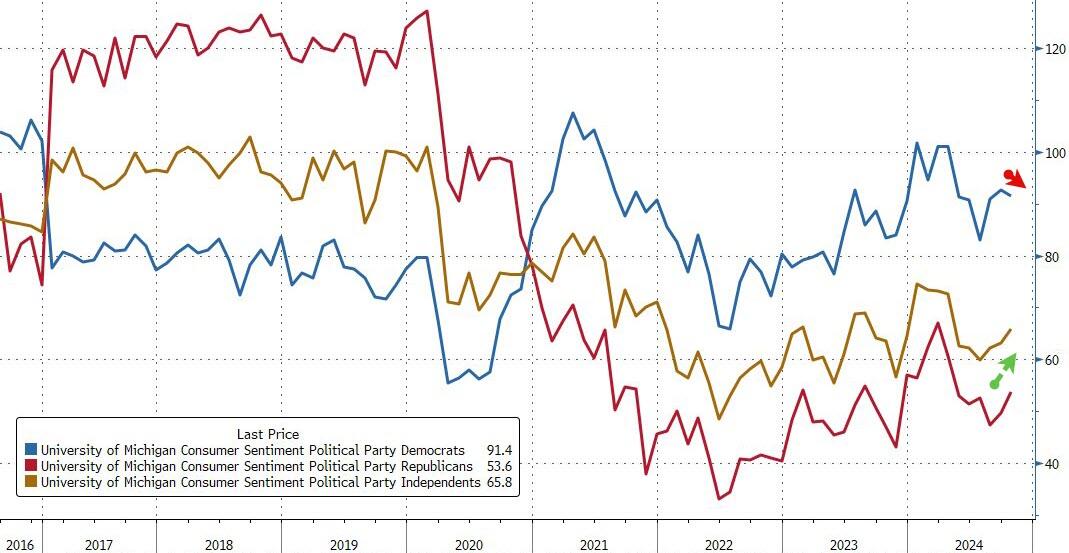
Sentiment of Republicans, who believe that a Trump presidency would be better for the economy, rose 8% on growing confidence that their preferred candidate would be the next president.

In contrast, sentiment declined 1% for Democrats.

As usual, Independents remain in between, with a 4% gain in sentiment this month.

Source: Bloomberg

Regardless of the eventual winner, a sizable share of consumers will likely update their economic expectations based on the results of the election.

Tyler Durden
Fri, 10/25/2024 – 10:08

Third-Quarter iPhone Sales In China Fall As Huawei Competition Heats Up 

0
Third-Quarter iPhone Sales In China Fall As Huawei Competition Heats Up 

The International Data Corporation released a report Friday morning showing that China’s smartphone shipments increased 3.2% year-over-year to 68.8 million units in Q3 2024, marking the fourth consecutive quarter of growth. However, there’s more to the story.

Let’s begin with the good news for Apple: 

“Apple re-enters the Top 5 smartphone companies at second place with the launch of its new iPhone 16 series. Initial sales figures are on par with its predecessor, and the company anticipates that upcoming promotions and the anticipated launch of Apple Intelligence will drive future demand.” 

Turning to less favorable details in the report—and confirming our earlier note (read here) on Apple Intelligence’s dud in the world’s largest handset market—IDC showed Apple’s market share in the country fell to 15.6% in the quarter, down from 16.1% in the same quarter one year ago. This indicates that local brands, such as Huawei, are chipping away at CEO Tim Cook’s global smartphone empire.

In market share terms, Huawei is third behind Apple, commanding about 15.3% of the country’s market share. The domestic brand’s smartphone shipments in the country surged 42% year-on-year in the quarter, as its competition with Apple dramatically increased. 

“Huawei has staged an impressive comeback, recording four consecutive quarters of at least double-digit growth. The launch of the world’s first tri-foldable phone is expected to further drive the foldable market development,” IDC wrote in the report.

Huawei’s resurgence puts pressure on Apple in China and other international markets. With Apple Intelligence absent in China, consumers will gravitate more towards Oppo, Huawei, and Honor handsets already equipped with AI features. 

In a separate report earlier today by Canalys, Apple’s China shipments in the third quarter slid 6% year over year compared to the same quarter one year ago. Canalys placed Apple number five in terms of market share. It showed Huawei had the second largest market share, with smartphone shipments in the quarter jumping 24% year over year.

The biggest takeaway is that Apple Intelligence did not unlock what many analysts on Wall Street believed would be an upgrade ‘supercycle’ for the world’s most valuable company. 

Apple’s market capitalization commands $3.5 trillion…

Meanwhile, a new report suggests that weak demand for the Apple Vision Pro mixed-reality headset in US markets could result in a winding down of series production as soon as next month.  

Maybe Apple’s problem is that it charges too damn much for its products in a period of elevated inflation and high interest rates. 

Tyler Durden
Fri, 10/25/2024 – 09:50

New IRS Unit Begins Targeting Pass-Through Businesses

0
New IRS Unit Begins Targeting Pass-Through Businesses

Authored by Naveen Athrappully via The Epoch Times (emphasis ours),

The IRS has officially launched a new unit that it states will “more efficiently conduct audits” of entities known as pass-through businesses.

The initiative targets businesses that pay no taxes on their revenue. Instead, the income generated is passed on to owners who then file taxes based on their individual taxation rates. Pass-through businesses include sole proprietorships, partnerships, limited liability companies, and S-corporations. [Which the Bidens used to avoid up to $500k in taxes]

People walking near the IRS building in Washington on Jan. 4, 2024. Madalina Vasiliu/The Epoch Times

In September, the IRS stated that it is establishing a unit within the agency’s Large Business and International (LB&I) division focusing on large or complex pass-through entities.

On Oct. 22, the agency announced that the unit “has officially started work.”

The new department will seek to ensure compliance from pass-through entities of every size and form, including S-corporations, partnerships, and trusts. The agency stated that these businesses are being used to evade taxes.

“The establishment of pass-through field operations is a significant step in our goal to increase fairness in enforcement while improving service,” IRS Commissioner Danny Werfel said.

“By using Inflation Reduction Act funding and enhancing our expertise in this area, we will be able to reverse our historically low audit rates for complex arrangements employed by certain high-wealth individuals and large entities.”

Pass-through examinations had been divided between two IRS divisions—LB&I and the Small Business/Self-Employed. The cases were assigned on the basis of entity size.

Revenue agents from the new pass-through unit will be grouped into teams based on geography. They will be tasked with primary examination of returns related to pass-through businesses.

While the IRS claims that funds from the Inflation Reduction Act will be used to go after high-income groups, it earlier admitted that lower-income groups could be targeted if there was a funding crunch.

In such a situation, the agency will be forced to cut down enforcement staff by more than 50 percent in fiscal year 2030, the IRS stated in May. This would “severely” affect the agency’s ability to carry out complex audits.

“Since lower-income taxpayers are more likely to have simple tax returns, this lack of funding will likely translate into a higher share of audits falling on low- and middle-income taxpayers, while examination coverage rates for high-income and large corporate taxpayers will severely decline,” the agency stated.

Pass-Through Deductions

The IRS unit targeting pass-through entities has been set up just as a key tax deduction available to these businesses has come under threat.

In 2017, President Donald Trump signed into law certain tax cuts, including a provision that allows pass-through entity owners to deduct 20 percent of their qualified business income when calculating taxes. The law is set to end in 2025.

That deduction has generated some criticism. A report by the left-leaning Center for American Progress concluded that the measure has “disproportionately benefited the wealthy and has encouraged businesses to game the tax code to maximize qualifying income.”

More than half of all pass-through deductions in 2021 were claimed by tax filers with adjusted gross incomes (AGI) of $500,000 or more, according to the report.

“Moreover, wealthy filers claimed substantially larger average deductions—$1,024,246 for those with AGI of $10 million or more. By contrast, filers with AGI below $100,000 with the deduction—who accounted for 51 percent of claimants—claimed, on average, $1,997,” the organization stated.

The U.S. Chamber of Commerce is arguing for retaining the tax deduction. It points out that Congress permanently reduced the tax rate on corporate income from 35 percent to 21 percent in 2017, according to a Feb. 14 statement.

The 20 percent deduction for pass-through entities was enacted to ensure that these businesses “weren’t put at a tax disadvantage” against corporations, the chamber stated.

Making this deduction available only to business owners with less than $500,000 in annual income will “result in a tax increase on one of the major sources of jobs in our nation, directly hurting workers and the economy,” it stated.

The chamber urged Congress to make the 20 percent deduction permanent for pass-throughs.

Tyler Durden
Fri, 10/25/2024 – 09:30

These Are The Cities With The Most Centi-Millionaires

0
These Are The Cities With The Most Centi-Millionaires

According to estimates from New World Wealth, there are 29,350 individuals worldwide with fortunes exceeding $100 million.

This graphic, via Visual Capitalist’s Bruno Venditti, highlights the top 10 cities ranked by their number of centi-millionaires, based on data compiled by Henley & Partners as of December 2023.

New World Wealth monitored the wealth of over 150,000 high-net-worth individuals, using sources like LinkedIn and other business platforms to verify city locations. Some of the cities in this graphic represent urban areas that include the major city and its surrounding regions.

Where Centi-Millionaires Live

In the last decade, the threshold for “super-wealthy” status has skyrocketed, rising from $30 million in the late 1990s to $100 million today. The number of centi-millionaires has surged by over 50% in the past decade.

New York leads with 744 individuals holding wealth of $100 million or more. Following closely is the Bay Area (including San Francisco and Silicon Valley) with 675. Both cities are projected to see continued growth of over 50% in their ultra-wealthy populations over the next 10 years.

The U.S. dominates the list with four cities featured. Additionally, the ranking includes Paris and London in Europe, and Shanghai, Singapore, Hong Kong, and Beijing in Asia.

If you liked this graphic, be sure to check out Ranked: Countries With the Highest GDP Per Capita in 2024, which compares countries and regions with the highest nominal GDP per capita in 2024 to those in 2014.

Tyler Durden
Fri, 10/25/2024 – 05:45

The US Vs BRICS In Africa

0
The US Vs BRICS In Africa

Authored by Andrew Korybko via Substack,

Africa is increasingly figuring into major countries’ and organizations’ discussions due to its growing importance in global affairs. The UN expects that more than half of the world’s population growth by the 2050 will occur on that continent, with the number of people in sub-Saharan Africa doubling by then. This will open up new market and labor opportunities alongside the existing resource ones that have already attracted international interest, but it’ll also lead to developmental and humanitarian challenges.  

The Kazan Declaration that was just agreed to during the last BRICS Summit speaks highly about helping and empowering Africa during this transformational period, but these countries – whether as a whole, through minilaterals, or bilaterally – will inevitably have to compete with the US there. The latter’s grand strategy takes several forms that’ll be briefly described in this analysis, but it altogether aims to impede others’ efforts to mutually benefit from these processes while exploiting Africa as much as possible.

The most visible manifestation of this strategy is the continued provisioning of humanitarian aid, which sounds noble at first glance but is actually driven by ulterior motives. This form of support has been weaponized over the decades to cultivate and co-opt corrupt elites in order to institutionalize relationships of dependence that are difficult for recipient countries to liberate themselves from. The purpose is to create levers of influence that can be wielded to legitimize lopsided deals with the West.

BRICS – which from here on out refers to either the group as a whole, minilaterals therein, or individual members – can counteract this by assisting their African partners with agricultural development so that they eventually become less reliant on American aid. Major grain producers like Russia can also provide more of their own no-strings-attached aid during the interim. A balance must be struck between meeting immediate needs and moving countries closer to self-sufficiency over the long term.

The next way in which US strategy towards Africa manifests itself is through the “Africa Growth and Opportunity Act” (AGOA) that allows for duty-free trade between them. The downside to this arrangement is that the US has removed countries like Ethiopia and Mali from it as punishment for them refusing to comply with its political demands. In other words, while there are certainly some economic benefits to be had from this arrangement, they can be cut off if countries don’t do what the US wants.

BRICS’ response has been to liberalize trade and investment with Africa as a whole, which is easier than ever due to the creation of the “Africa Continental Free Trade Area” (AfCFTA). China leads the way in this respect due to its much larger and more developed economy relative to other BRICS members, but Russia, India, and the UAE are also making important strides in this direction too. The goal is to diversify these countries’ trade partnerships so that they’re not destabilized if the US kicks them out of AGOA.

Building upon the trade dimension of this strategy is the financial one wherein the US takes advantage of the West’s leading role in global financial institutions like the IMF and World Bank to offer strings-attached loans to desperate countries. These are then weaponized to further entrench their lopsided trade and investment ties while also coercing their leaders into making certain political concessions. The end result is that recipient countries lose more of their sovereignty and risk socio-political unrest.

China has taken the lead among BRICS countries in providing no-strings-attached loans through its Belt & Road Initiative (BRI) to finance mutually beneficial megaprojects and help struggling countries avoid Western debt traps of the sort described above. BRICS’ rising role as a financial actor in its own right, particularly with regard to the New Development Bank that it created, could complement these efforts to counteract claims that African states are just trading Western dependence for Chinese dependence.

Moving along, the US wants to guide Africa’s journey through the “Fourth Industrial Revolution”/“Great Reset” (4IR/GR) by bringing the entire continent online through December 2022’s “Digital Transformation with Africa” (DTA) initiative. The Carnegie Endowment’s report from March 2024 noted that not much had been done with its promised $800 million by then, but if any progress is made and this isn’t just a slush fund or PR stunt, then it would likely lead to continental-wide digital surveillance.

African countries could take a page out of Russia’s and some other BRICS members’ playbooks by passing laws about data localization, which prohibits sending users’ data abroad. That’s not a silver-bullet solution to digital surveillance but it provides the best balance possible between much-needed foreign digital investment into (in this case developing) economies and national security.  In parallel, Africa countries should court such investment from BRICS states, with China already being a prime partner.

Resource extraction is another element of the US’ grand strategy towards Africa, which is being prioritized through the Lobito Corridor that was unveiled by the US and the EU in September 2023 for facilitating the export of Southern African minerals to the Western market. This region is rich in copper, lithium, and other resources that are indispensable for the 4IR/GR in which the US and China are fiercely competing to shape the contours of the future global economy.

The most surefire way to ensure that mineral-rich African countries aren’t exploited is to emulate Tanzania’s 2017 “National Wealth And Resources (Permanent Sovereignty) Act” that forbade the export of raw materials for processing. This is meant to encourage the construction of a domestic processing industry to add value to these exports and provide jobs for its burgeoning population. Global costs will rise if enough countries copy this policy, but it would be for the betterment of their own people.

Segueing into the more nefarious forms of US grand strategy towards Africa, observers can’t forget about the numerous information warfare campaigns that it’s waging across the continent. These are aimed at discrediting its rivals like Russia, stoking inter-state discord such as between BRICS members Ethiopia and Egypt for instance, and exacerbating preexisting internal (usually identity-centric) differences in order to destabilize fragile states through Hybrid Warfare as punishment for not capitulating to the US’ demands.

Better “Pre-Bunking, Media Literacy, & Democratic Security” policies are the only way to enhance the defenses of targeted states and societies, but they’ll take time to be applied even in the best-case scenario so some trouble is bound to follow these campaigns. Reputational damage to BRICS countries can be mitigated through counteroperations, inter-state discord can be managed through BRICS mediation, while internal conflicts might require security assistance from some BRICS states.

The last point directly leads to the next form in which the US’ grand strategy towards Africa manifests itself, namely through the waging of proxy wars like what’s happening in the Sahel. Mali, Burkina Faso, and Niger expelled French and US forces over the past few years, formed an alliance prior to exploring a confederation, and were then targeted by more foreign-backed terrorist and separatist attacks. France and the US are working hand-in-hand together with Ukraine to punish those three countries for this.

Russia has taken the lead in helping its new regional partners through the deployment of military advisors and PMCs via a strategy that was elaborated on here for those who’d like to learn about it. Other BRICS countries can help with arms exports and intelligence support if they have the capabilities and will to do so, though most don’t and are instead expected to sit on the sidelines of these proxy wars. If they intensify, then it can’t be ruled out that some formal Western military intervention might follow.

Therein lies the final form of US grand strategy, direct military action against African countries, which is employed on a case-by-case basis whose motives widely vary from Somalia to Libya. The infamous AFRICOM organizes such activities that are greatly facilitated by the archipelago of American bases, including unofficial ones, that spread across the continent since 2001. The current focus on the Sahel might lead to new drone bases in the Ivory Coast from which to “surgically strike” targets in the north.

Once again, Russia is the only BRICS state that has the capabilities and will to counteract these threats, which it could do by empowering its partners (including non-state ones) to retaliate against those states that host US bases and/or target those facilities directly. The NATO-Russian proxy war in Ukraine could also be intensified as an asymmetrical response to throw the West off balance, but the West could do the same to Russia as revenge for foiling its plans in Africa, thus linking these two New Cold War fronts.

The takeaway from this analysis is that BRICS has a key role to play in helping Africa defend itself from the US’ hegemonic plots, but only Russia will do so in a security sense while China’s economic support will remain unmatched. Accordingly, this emerging front of the New Cold War will likely see the Sino–Russo Entente more closely coordinate against the US-led West there, which’ll provide opportunities for other BRICS states like India to present themselves to African countries as reliable balancers.

Tyler Durden
Fri, 10/25/2024 – 05:00

Visualizing The EU’s Critical Minerals Gap By 2030

0
Visualizing The EU’s Critical Minerals Gap By 2030

The European Union’s Critical Raw Material Act sets out several ambitious goals to enhance the resilience of its critical mineral supply chains.

As Visual Capitalist’s Bruno Venditti details below, the Act includes non-binding targets for the EU to build sufficient mining capacity so that mines within the bloc can meet 10% of its critical mineral demand.

Additionally, the Act establishes a goal for 40% of demand to be met by processing within the bloc, and 25% through recycling.

Several months after the Act’s passage in May 2024, this graphic highlights the scale of the challenge the EU aims to overcome. This data comes exclusively from Benchmark Mineral Intelligence, as of July 2024. The graphic excludes synthetic graphite.

Securing Europe’s Supply of Critical Materials

With the exception of nickel mining, none of the battery minerals deemed strategic by the EU are on track to meet these goals.

Graphite, the largest mineral component used in batteries, is of particular concern. There is no EU-mined supply of manganese ore or coke, the precursor to synthetic graphite.

By 2030, the European Union is expected to supply 16,000 tonnes of flake graphite locally, compared to a domestic mining target of 45,000 tonnes.

The bloc is projected to produce 29,000 tonnes of lithium carbonate equivalent (LCE), compared to a 46,000 tonnes target.

In terms of mineral processing, the bloc is expected to process 25% of its lithium requirements, 76% of nickel, 51% of cobalt, 36% of manganese, and 20% of flake graphite.

The EU is expected to recycle only 22% of its lithium needs, 25% of nickel, 26% of cobalt, and 14% of manganese. Graphite, meanwhile, is not widely recycled on a commercial scale.

If you enjoyed this post, be sure to check out this graphic, which visualizes the total cobalt supply from the top 10 producers in 2030.

Tyler Durden
Fri, 10/25/2024 – 04:15

Hand Grenade Attacks In Sweden Have More Than Doubled In 2024

0
Hand Grenade Attacks In Sweden Have More Than Doubled In 2024

Authored by Thomas Brooke via Remix News,

Sweden is witnessing an alarming rise in the use of hand grenades by criminal gangs, with the number of explosions more than doubling in 2024 compared to last year. By mid-October, there had been 22 recorded grenade attacks, up from nine in 2023, according to figures from the Police National Bomb Data Centre.

The Swedish Customs Administration has also reported a spike in the number of hand grenades seized at the border — 30 so far this year, compared to zero last year.

Officials say gangs have turned to grenades as an alternative to stolen commercial explosives, which have become harder to obtain.

“A hand grenade is already ready in its construction. It does not need to be manufactured but comes complete,” explained Malin Nygren, head of the National Bomb Data Centre, highlighting the ease of use for criminals seeking to cause explosions.

Customs authorities are seeing hand grenades become a significant contraband item, a shift from previous years. “In the past, hand grenades have been a completely non-existent contraband item from our perspective,” said Stefan Granath, deputy head of control at the Swedish Customs Administration.

This uptick in grenade use reflects broader concerns about rising gang violence across Sweden. Violence involving explosives, once rare, has become an increasing threat, with attacks regularly targeting residential areas and public spaces as migrant gangs conduct turf wars in the suburbs of the Scandinavian country’s major cities.

Hand grenades have been used by criminal networks to settle disputes, intimidate rivals, or retaliate against authorities. Earlier this year, in one of the most notable incidents, a hand grenade exploded outside a residential building in Uppsala, damaging cars and windows. Fortunately, no one was injured, but the incident raised concerns about public safety.

Authorities are now focused on preventing these weapons from entering the country.

While efforts to crack down on explosive materials like dynamite have been effective, criminals have turned to simpler and more accessible weapons like hand grenades, often smuggled in from the Balkans, where they are more readily available.

Last year, Ardavan Khoshnood, a guest lecturer at Malmö University and senior fellow at Lund University, warned that Sweden had become the bombing capital of Europe and was second only to Mexico as the top country in the world not currently at war to experience the most bombings on its territory.

Earlier this month, a teenager was arrested in Sweden accused of shooting dead a man in his 50s in Malmö in what police believed to be a case of mistaken identity amid escalating gang warfare.

Several hand grenades were also found at the scene and the suspect’s residence.

Read more here…

Tyler Durden
Fri, 10/25/2024 – 03:30

Africa Dominates The World’s Child Poverty Hotspots

0
Africa Dominates The World’s Child Poverty Hotspots

Child poverty continues to be most prevalent in Sub-Saharan Africa, as the region accounted for more than 70 percent of the world’s children in extreme poverty in 2022.

As Statista’s Felix Richter details below, a joint paper from the World Bank and UNICEF estimates that the share of children living on less than $2.15 per day stood at 40 percent in the region in 2022, which is four times as high as it is for South Asia, the region home to the second highest number of children in extremely poor households.

Infographic: The World's Child Poverty Hotspots | Statista

You will find more infographics at Statista

According to the paper, extreme child poverty is increasingly concentrated in Sub-Saharan Africa, as the share of affected children living in the region has increased from 55 percent in 2013 to 71 percent in 2022.

This is due to the fact that other regions have seen faster improvements over the past decade compared to Sub-Saharan Africa.

For example the share of children living in extreme poverty in South Asia has decreased from 22 to 10 percent between 2013 and 2022, whereas the child poverty rate only dropped from 45 to 40 percent in Sub-Saharan Africa.

Within the region, differences in the prevalence of child poverty are quite substantial, however, with poverty rates ranging from above 70 percent in countries like Burundi, South Sudan and Somalia to less than 20 percent in countries like Mali, Côte d’Ivoire and Botswana.

Several factors contribute to the high prevalence of child poverty in Africa, including ongoing economic challenges, political instability and the impact of armed conflicts in many countries.

High birth rates, coupled with insufficient healthcare, education and social services, exacerbate the situation, leaving many families unable to meet their children’s basic needs.

Tyler Durden
Fri, 10/25/2024 – 02:45

Turkey Bombs US Proxies In Northeast Syria Following Ankara Terror Attack

0
Turkey Bombs US Proxies In Northeast Syria Following Ankara Terror Attack

Via The Cradle

Turkey conducted several airstrikes and artillery shelling across US-controlled north and east Syria late on Wednesday, targeting positions held by the Kurdish Syrian Democratic Forces (SDF).

The attacks targeted several villages and sites in the Syrian provinces of Aleppo, Raqqa, and Hasakah. One of the attacks hit an SDF military outpost in the countryside of the city of Al-Malikiyah, at the Syrian–Turkish–Iraqi tri-border region. Turkish artillery also hit SDF sites in the village of Umm al-Kaif in the countryside of the town of Tal Tamr, northwest of Hasakah.

Illustrative via Anadolu Agency

According to field sources who spoke with Sputnik, Turkish artillery shelling hit the villages of Al-Sayyada, Aoun Al-Dadat, Al-Tukhar, and Al-Daraj.

On Thursday, the UK-based Syrian Observatory for Human Rights (SOHR) reported that the attacks killed at least “27 members of military formations operating in SDF-controlled areas,” three soldiers from the Syrian Arab Army (SAA), and at least four civilians. 

For its part, Turkiye’s Ministry of National Defense said 32 targets in Syria and Iraq were “destroyed” in the aerial offensive without providing details on the locations that were hit. Officials added that “all kinds of precautions” were taken to prevent harm to civilians.

The intense attacks were launched hours after armed assailants set off explosives and opened fire at the headquarters of the Turkish Aerospace Industries (TUSAS) in Ankara, which designs, manufactures, and assembles civilian and military aircraft, unmanned aerial vehicles (UAVs), and other defense industry and space systems.

Turkish Interior Minister Ali Yerlikaya and Defense Minister Yasar Guler accused the Kurdistan Workers’ Party (PKK) of being behind the attack. 

“We give these PKK scoundrels the punishment they deserve every time. But they never come to their senses,” Guler said. “We will pursue them until the last terrorist is eliminated.”

At least five people were killed and 22 injured in the Ankara attack. Two attackers – a man and a woman – were also killed.

Turkey regularly conducts air strikes against the PKK in Iraq and against the SDF in Syria. In 2014, the US military began partnering with the Kurdish People’s Protection Units (YPG), an offshoot of the PKK. The YPG later changed its name to the SDF.

Together, the US and its Kurdish proxies occupy Syria’s northeast, including Hasakah, Raqqa, and parts of Deir Ezzor, denying Syria access to its oil resources and wheat-producing agricultural land.

Wednesday’s attack in Ankara came as Turkish President Recep Tayyip Erdogan was in the Russian city of Kazan to attend the annual BRICS summit. He condemned the “hateful attack” alongside Russian President Vladimir Putin.

Tyler Durden
Fri, 10/25/2024 – 02:00