These Are All The US States Paying More Than The Federal Minimum-Wage
The real value of the federal minimum wage ($7.25/hour) has declined steadily since it was last raised 15 years ago.
As discussions around increasing it continue, several states have taken matters into their own hands – by implementing and raising state minimum wages.
Data for this graphic is sourced from the Federal Reserve, as of 2024.
Ranked: State Minimum Wages
Thirty states have a minimum wage that’s higher than the federal minimum of $7.25/hour.
Of them, Washington ($16.28/hr) and California ($16.00/hr ) are the highest. Both states are expensive to live in, as evidenced by how far $100 will take you (not very) in each.
However, the country-wide crown goes to Washington D.C., ($17.50/hr) where the minimum is tied to inflation.
Eighteen states either match the federal benchmark, or don’t have a state minimum at all (which makes the federal minimum applicable).
Two states—Wyoming and Georgia—have a state minimum wage that’s below $7.25/hour but in this case the federal wage takes effect.
What is the Minimum Wage Discourse?
The minimum wage debate in the U.S. involves two main opposing viewpoints. Proponents argue that raising the minimum wage is necessary to boost living standards for low-wage workers, reduce poverty, and narrow income inequality. They say that moderate increases have minimal impact on employment and can stimulate consumer spending.
Key to their argument is that this is also the longest time the federal minimum has not seen an increase, since its inception in 1938.
Year
Nominal value
($/hour)
1940
0.30
1945
0.40
1950
0.75
1955
0.75
1960
1.00
1965
1.25
1970
1.60
1975
2.10
1980
3.10
1985
3.35
1990
3.80
1995
4.25
2000
5.15
2005
5.15
2010
7.25
2015
7.25
2018
7.25
2019
7.25
2020
7.25
2021
7.25
2022
7.25
2023
7.25
On the other hand, opponents claim that significant minimum wage hikes could lead to job losses, particularly for low-skilled and young workers. This could potentially increasing poverty rates for some groups.
They argue that it may price low-skilled workers out of the job market and harm small businesses with slim profit margins. Both sides cite economic studies to support their positions, but the debate ultimately reflects deeper societal values about fairness, opportunity, and the role of government in the economy.
Since 2017, the Raise the Wage Act has been introduced to Congress every year in an effort to increase the federal minimum. All the bills have not passed the legislature so far.
Current “Raise the Wage” proposals look to increase the minimum to $17/hour. In the Share of Workers Earning Less Than $17/Hour we map out which states would see the most changes.
Hey Pilots, FAA Issues Final Rule For “Powered-Lift” Rating, Paves Way For Air Taxis Over US Cities
The Federal Aviation Administration (FAA) introduced a new rule establishing a “powered-lift” aircraft category for pilot training, marking the first new category for pilot certification since helicopters were introduced in the 1940s. This new category paves the way for aircraft that take off and land vertically like helicopters but fly like fixed-wing planes, commonly known as electric vertical take-off and landing (eVTOL) aircraft, to fly in controlled airspace across America.
Here’s more from the FAA:
The agency today issued a final rule for the qualifications and training that instructors and pilots must have to fly aircraft in this “powered-lift” category, which have characteristics of both airplanes and helicopters. The rule also addresses their operational requirements, including minimum safe altitudes and required visibility. The rule is the final piece in the puzzle for safely introducing these aircraft in the near term.
On X, FAA Administrator Mike Whitaker wrote, “An extraordinary moment for aviation! Our rule for training and certificating pilots to fly powered lift is the final piece of the puzzle to get these revolutionary aircraft flying safely in our skies”
An extraordinary moment for aviation! Our rule for training and certificating pilots to fly powered lift is the final piece of the puzzle to get these revolutionary aircraft flying safely in our skies. https://t.co/96Q7TQZfkMpic.twitter.com/7RvSqbdGT8
Makes changes to numerous existing regulations and establishes a Special Federal Aviation Regulation (SFAR) with new requirements to facilitate instructor and pilot certification and training.
Applies helicopter operating requirements to some phases of flight and adopts a performance-based approach to certain operating rules.
Allows pilots to train in powered-lift with a single set of flight controls; legacy rules require two flight controls – one for the student and one for the instructor.
“The regulation published today will ensure the U.S. continues to play a global leadership role in the development and adoption of clean flight,” JoeBen Bevirt, founder and CEO of air taxi company Joby Aviation, told Fast Company, adding, “Delivering the rules ahead of schedule is a testament to the dedication, coordination, and hard work of the rulemaking team.”
It’s not hard to figure out that flying cars must be done under the FAA’s Visual Flight Rules (VRF) or Instrument Flight Rules (IFR). In other words, the pilot in control will need a pilot license and be rated in the powered lift category.
Gone are the days where the biggest concern is students drawing alien ears on their science teacher or printing images of a friend’s face connected to a four-legged body with scales and a tail.
That was 30-something years ago. Now, schools are being forced to develop emergency response plans in case sexually explicit images of students or teachers generated by artificial intelligence (AI) pop up on social media.
In two separate cases, school principals were seen or heard spewing racist, violent language against black students. Both were AI-generated deepfakes—one was produced by students and the other was made by a disgruntled athletic director who later was arrested.
Deepfakes are defined as “non-consensually AI-generated voices, images, or videos that are created to produce sexual imagery, commit fraud, or spread misinformation,” according to a nonprofit group focused on AI regulation.
As education leaders scramble to set policy to mitigate the damage of deepfakes—and as state legislators work to criminalize such malicious acts specific to schools or children—the technology to combat AI tools that can replicate a person’s image and voice doesn’t yet exist, says Andrew Buher, founder and managing director of the Opportunity Labs nonprofit research organization.
“There is a lot of work to do, both with prevention and incident response,” he said during a virtual panel discussion held by Education Week last month on teaching digital and media literacy in the age of AI. “This is about social norming [because] the technical mitigation is quite a ways away.”
Legislation Targets Deepfakes
On Sept. 29, California Gov. Gavin Newsom signed into law a bill criminalizing AI-generated child porn. It’s now a felony in the Golden State to possess, publish, or pass along images of individuals under the age of 18 simulating sexual conduct.
At the national level, Sen. Ted Cruz (R-Texas) has proposed the Take It Down Act, which would criminalize the “intentional disclosure of nonconsensual intimate visual depictions.”
The federal bill defines a deepfake as “a video or image that is generated or substantially modified using machine-learning techniques or any other computer-generated or machine-generated means to falsely depict an individual’s appearance or conduct within an intimate visual depiction.”
School districts, meanwhile, seek guidance on an emerging problem that threatens not just students, but also staff.
At Maryland’s Pikesville High School in January, a fake audio recording was made of the principal. School officials enlisted the help of local police agencies and the FBI.
The suspect, Dazhon Darien, 31, an athletic director, was charged with theft, stalking, disruption of school operations, and retaliation against a witness.
He allegedly made the recording to retaliate against the principal, who was investigating Darien’s alleged mishandling of school funds, according to an April 25 news release on the Baltimore County Government website.
Jim Siegl, a senior technologist with the Future of Privacy Forum, said during the Education Week panel discussion that investigators in the Baltimore case were able to link the suspect to the crime by reviewing “old school computer access logs.”
But as AI technology continues to evolve, he said, it may be necessary to develop a watermarking system for generated audio or video to replace outdated systems for monitoring and safeguarding school computer use.
In February 2023, high school students in Carmel, New York, used AI to impersonate a middle school principal. The deepfakes were posted on TikTok. Investigators were able to link the students’ activities to their accounts. They were disciplined under school code of conduct guidelines but not charged criminally, according to a statement released on the district’s Facebook page.
“As an organization committed to diversity and inclusion,” the statement said, “the Carmel Central School District Board of Education is appalled at, and condemns, these recent videos, along with the blatant racism, hatred, and disregard for humanity displayed in some of them.”
A parent, Abigail Lyons, said a co-worker who also has children in the district showed her a text containing seven different videos.
“I basically fell to the floor,” said Lyons, who is biracial. “It was horrific. It looked so real.”
They re-watched the videos and noticed that the lip movement and body language were a bit off from the sound. Lyons said most parents in the district had already seen or heard about the videos and probably knew they were deepfakes before Carmel school officials publicly acknowledged the incident and declared there “was no threat.”
Lyons said the event scared her daughter, and that events like school lockdowns or emergency drills still trigger anxiety and fear stemming from the 2023 deepfake.
“Seventh graders should not have to worry about these things,” she told The Epoch Times.
Lyons said she is unaware of any deepfake incidents so far this semester, but students have threatened each other on social media, including one threat that led to a two-hour building lockdown.
“We still don’t know what it [lockdown] was for,” she said. “The transparency still isn’t there.”
The Epoch Times reached out to the district offices in Carmel, New York, and Baltimore County, Maryland, but didn’t receive a response.
California’s new law was prompted by several deepfake incidents that victimized students.
Open Border Backlash As NYC ‘Deports’ Thousands Of Migrants To Texas, Illinois, And Florida
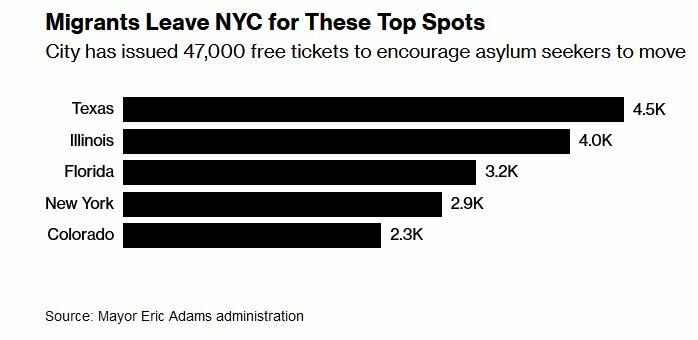
After Texas bussed over 45,000 migrants to New York City amid an influx of more than 200,000, the Big Apple is sending some of them back.
According to a new report from Bloomberg, NYC has issued over 47,000 one-way tickets – 4,500 of them to Texas – through a voluntary program that transfers asylum seekers out of the city.
Top destinations also include Illinois, Florida, other parts of New York and Colorado.
The ticketing program has helped slash the number of asylum seekers reliant on the city, as have application assistance for work authorization and a policy limiting shelter stays, Adams said earlier this month. The top destinations for migrants asking to leave the Big Apple also include Illinois, Florida and Colorado, as well as other parts of New York. Most travel on planes.
According to city official Fabien Levy, “These are not chartered buses,” but are instead “individual tickets we are purchasing after sitting down with migrants and hearing what they want to do.”
Since April 2022, Texas has bused around 120,000 migrants to cities around the country, according to a statement from Gov. Greg Abbott’s office.
• Over 12,500 migrants to Washington, D.C. since April 2022
• Over 45,900 migrants to New York City since August 2022
• Over 36,900 migrants to Chicago since August 2022
• Over 3,400 migrants to Philadelphia since November 2022
• Over 19,200 migrants to Denver since May 2023
• Over 1,500 migrants to Los Angeles since June 2023
“Our latest battle has been against Tren de Aragua. They’re notorious for brutal violence, kidnapping, extortion, and bribery,” said Abbott, adding “Texas law enforcement has already begun making arrests of known and suspected Tren de Aragua members. Together, we will secure our border, defend our communities, and keep Texas safe.”
Imagine this scenario: You have just arrived home from work. You sit down to watch the news and see that a massive storm with torrential rains is heading your way. The authorities advise everyone to stay indoors and off the roads for the next 72 hours because of high winds and the risk of flooding.
Situations like these occur more frequently than most people realize. While no one likes pondering worst-case scenarios, advance preparation can save your life—and significantly ease your stress during emergencies.
Whether facing natural disasters like flooding, hurricanes, earthquakes, tornadoes, fires, or chemical spills—or personal emergencies—such as illnesses, accidents, or losing your job, having food, cash, and other necessities tucked away can mean the difference between thriving and surviving.
Considerations When Preparing for Emergencies
Most of us have become accustomed to conveniences like running water and grocery stores for our basic needs. However, in an emergency, these conveniences may disappear. Planning ahead can significantly increase your resilience and may be vital to your survival if things go sideways.
While everyone’s needs during an emergency differ, food and water are universal necessities. Most experts advise having at least three days’ worth of food and water for everyone in your household, including pets. This should be enough for you to survive until the emergency has passed and help can get to you. Be prepared for extended emergencies by gathering enough food and water to last up to two weeks or even a month if your budget and storage allow.
The American Red Cross recommends maintaining a three-day emergency supply for evacuation and a two-week supply at home.
When preparing, consider the following:
The number of people and pets in your household who need food and water.
Dietary restrictions (allergies, diabetics), preferences, and whether certain foods require cooking or water.
The shelf life of the food you choose, ensuring you rotate supplies every few months for freshness.
Your ability to cook without power, such as having a camp stove or gas barbeque.
Make sure you have the necessary utensils and storage options, such as cool, dry areas for keeping food and water. Disposable plates and cutlery don’t require water for washing.
Because you may not have electricity, plan meals in single portions as you may be unable to refrigerate leftovers.
Make sure you have lighters, matches, candles, flashlights, batteries, knives, zip lock bags, bleach (to disinfect and purify water), and other essentials that you keep in sealed plastic bags.
Water Needs
Conventional wisdom suggests people can live for about three weeks without food. However, they can only survive for three days without water—making it essential to have plenty in your emergency stores.
The Prepared, a highly regarded resource focused on practical prepping, recommends at least one gallon of water per day for each person. Remember to consider additional water for cooking, cleaning, and your pets.
They also suggest including a way to treat dirty water, like a portable water filter or countertop filter.
One way to keep the water aside for emergencies is in a deep freezer, Nellie Oehler, a food safety specialist and coordinator with Oregon State University Extension Service, a statewide outreach program, told The Epoch Times.
“I keep my deep freezes full,” she said. “Number one, if it’s not full of food, it’s full of bottled water. Then I’ve got an emergency water supply, plus it keeps my freezer cold. It cuts down on the cost of running your freezer, and I’ve got water,” she added.
Food Selection
A key rule of storing food for emergencies is to “store what you eat” and “eat what you store.” One of the easiest ways to build up your survival food supply is to buy extra non-perishable, shelf-stable items every time you buy groceries. This practice will also ensure that you have food you enjoy.
You can also buy pre-packaged emergency foods like MREs (Meals-Ready-to-Eat), which need little to no preparation and last extended periods. Survival food tends to be more compact and lasts longer than the food you buy at the supermarket, but it is typically more expensive. A combination of both works well for a robust emergency food pantry.
Preserving your food at home through canning, pickling, curing, fermenting, or dehydrating is also an option.
You still have options if you don’t know how to preserve your own food, Oehler said. Inexpensive options are plentiful at supermarkets. Waiting until items go on sale to stock up can help you save money and collect the food you need to be prepared when the time comes.
Be aware of expiration dates on foods you buy, and choose foods that have a long shelf life and come in sturdy packaging. Look for nutrient-dense, shelf-stable foods like dried beans, canned meat and fish, peanut butter, and grains, as they take up the least amount of space. Also, when buying food, consider if it needs cooking, reheating, or can be eaten right out of the package.
Recommended Emergency Food Items
While not exhaustive, the list below will give you an idea of foods that store well and make an excellent addition to your emergency food pantry.
Protein Sources
Peanut butter and other nut butters
Canned meat and fish (spam, chicken, tuna, salmon, sardines)
Beef jerky and dried meats
Canned beans and legumes (including refried beans)
Ready-to-Eat Meals
Canned soups, stews, and chili
Instant meals (macaroni and cheese, ramen)
Instant mashed potatoes
Grains and Staples
Rice and pasta
Oatmeal and breakfast cereals
Crackers and chips
Dried beans, lentils, and chickpeas
Fruits and Vegetables
Canned fruits and vegetables
Dried fruits
Canned tomatoes and tomato sauce
Beverages and Condiments
Powdered milk
Fruit juice (bottled, canned, or powdered)
Coffee, tea, hot chocolate
Salt, pepper, spices, hot sauce
Comfort Foods
Honey and jam
Trail mix and granola bars
Chocolate, candies, and other favorite snacks (to improve morale)
Some foods are not ideal for storing in an emergency, Tracey Brigman, associate director of the National Center for Home Food Preservation, told The Epoch Times via email.
“Foods that should be avoided are foods that are overly salty (they can make you more thirsty and can thus deplete your water supply), caffeinated sodas (they offer little nutrients and can contribute to dehydration), and fresh items like fruits, vegetables, meats, dairy and leftovers since they spoil rapidly without proper refrigeration,” she said.
Storage Strategies
Oehler suggests diversifying for effective food storage.
“Don’t put all your stuff in freeze-dried foods or dry foods because then you have to have a ton of water—so have a variety of foods on hand,” she said.
For convenience and minimal effort, commercially canned foods from the grocery store are a great option. Make sure your emergency food is well-packaged, sealed, and has a date to prevent spoilage. If you have the budget, consider storing dry goods like beans, rice, and flour in food-grade buckets with oxygen absorbers to make them last longer. This can extend their shelf life for up to 25 years, Oehler said.
“Home-preserved foods only last in proper storage for up to 1 year, so they need to be inspected and replaced in a timely manner,” she said. “Additionally, a home-canned food that is damaged, shows signs of swelling, rust, dents, or leaks, or has been exposed to floodwater should not be consumed. If there are any doubts about your home canned foods after a disaster, throw them out,” Oehler added.
Improperly preserved food, especially if it has moisture, can lead to foodborne illness. Learn proper food preservation techniques from reputable sources like the National Center for Home Food Preservation, which has resources on preserving foods safely.
Where to Store It
Store food in a cool, dry place, ideally between 32 and 70 degrees F, as food will last longer in colder temperatures. Ideally, the space should be well-ventilated, clean, isolated from other items such as cleaning products or chemicals, and kept off the floor.
If you live in a city with limited space, consider using under-the-bed storage, as it’s dark, and the bedroom is usually one of the coldest rooms in the house, according to Oehler.
Don’t keep all supplies in one location—diversifying storage places can protect your food from emergencies. If a fire destroys your house, having some food in a shed or barn can be life-saving, Oehler said. She also recommends having containers with wheels on hand, like coolers or garbage cans, so you can take some supplies with you if you have to leave.
Keeping food, water, and other emergency supplies in your car is advisable, as you never know where you will be when trouble strikes (being mindful that cars get very hot in summer months), she added.
Cooking Without Electricity
If you’re facing a power outage, you’ll need to think about how to cook or warm up your food without electricity. Keep this in mind when choosing foods, especially if you don’t have an alternative cooking source.
Alternative Cooking Sources
If you have a camping stove or barbeque, make sure you have the right fuel and extra water. Always cook outside for safety. A butane stove is a great, portable option for cooking and boiling water, especially indoors during severe weather, according to Oehler. It’s efficient, safe, and affordable.
If you don’t have an alternative cooking source, stock up on ready-to-eat foods. Don’t forget a can opener!
For warming up food indoors, candles, fondue pots, or chafing dishes can be used. Try to use a well-ventilated area if possible.
Food Spoilage
Stored food can deteriorate over time, losing its color, texture, taste, and smell. Some nutrients, like vitamin C, are also lost over time. If not stored correctly, insects and rodents can get into stored food, making it inedible. Use food-grade buckets, glass jars, or other airtight containers to keep food fresh and safe.
Don’t get too caught up in expiration dates. Commercial foods’ “use by” and “sell by” dates should be taken with a grain of salt, Oehler said, adding that the dates have nothing to do with food safety. “You know, if you have a can of green beans that’s two years old that you bought in the store—if it’s not bulging, if it’s not leaking on the seams, it’s perfectly safe to eat. If it’s five years old, it’s safe to eat,” she said.
A lot of the quality of your food will depend on how you store it, Oehler said. Keeping the temperature from fluctuating, preventing light and moisture from getting to food so cans don’t rust, and ensuring things don’t freeze are ways to ensure your emergency stores last, she noted.
Before eating, check for any signs of damage, like cracks, holes, or broken seals. Throw away anything that looks suspicious.
Common Mistakes
Mistakes made when preparing for an emergency can be costly when the emergency arrives. Brigman shares some common pitfalls:
Storing foods that are difficult to prepare or are not well-liked
Not closing foods tightly after each use
Not placing them in airtight food containers to protect them from spoilage
Not checking the dates and having expired/bad food in your emergency kit
Storing too many comfort foods and not enough nutrient-dense foods
“Your body’s nutritional needs don’t change during an emergency so you still need to plan for nutritional adequacy,” Brigman said.
Resources
Extension services are an excellent resource for emergency preparedness and are available in every state. Extension services were established in 1914 to provide research-based education to the public. They offer a wide range of programs on topics that include farming, livestock management, gardening, and food production.
Many universities also have extension programs, which “extend” the university and its resources to members of the community through educational programs.
Resources from the University of Georgia and the Extension Disaster Education Network can provide vital information and assistance.
Final Thoughts
Emergency preparedness can feel daunting, but taking small steps can make a difference. By adding extra groceries and assessing your current supplies, you’ll be better equipped for any situation. Planning calmly for potential emergencies safeguards you and your loved ones. While preparation requires time and effort, it could be key to navigating future challenges.
“Once You Know, You Cannot Unknow”: Whistleblower Reveals Fed-Funded Industrial-Sized Staffing Firm Shipping Migrant Kids Around US
A contract specialist from the General Services Administration (GSA) spoke with investigative reporter James O’Keefe about the federal government awarding a massive contract to an industrial-sized staffing agency to transport unaccompanied migrant kids across the country.
“My line in the sand moment was when I found out that GSA had awarded a contract to a company to transport unaccompanied minors,” GSA Senior Contract Specialist Clarissa Rippee told O’Keefe in a sitdown interview shared on X.
Rippee explained GSA, on behalf of the federal government, awarded MVM, a private security contractor with ties to the CIA, NSA, FBI, and Homeland Security, with a massive $347 million contract for the transportation services of unaccompanied minors across the United States.
She said the contract made her feel “like someone kicked me in the gut.”
Rippee described the federal gov’t treated unaccompanied migrant children like “commodities… like potato chips on a truck.” She noted this MVM contract highlights the “big money business” in the migrant crisis.
“Once you know, you cannot unknow,” Rippee stated, warning that the horrifying conditions she witnessed inspired her to speak out: “It’s about the children, and it’s my duty now to speak up.”
BREAKING: Federal Government Whistleblower Exposes $347M Contract for Transporting Unaccompanied Minors – “What You Know, You Cannot Unknow,”
“My line in the sand moment was when I found out that GSA had awarded a contract to a company to transport unaccompanied minors,” shared… pic.twitter.com/FVvMJg7kmK
At the core of this taxpayer-funded invasion machine of new future Democratic voters are staffing agencies, the same ones that profited off the endless wars in the Middle East, retooled their business models from assisting the federal gov’t in foreign wars to providing domestic services to support the migrant invasion.
These staffing firms have been awarded big contracts to provide private security, transportation, and many other services to ensure the smooth operation of the invasion domestically.
Earlier this month, Real America’s Voice host Ben Bergquam posted on X, “More breaking footage of the Democrats harboring illegals in Chicago. Now using unmarked brand new hotels like this Holiday Inn at [XXXXXXX] to disguise Kamala and Biden’s illegal invasion operations.”
Bergquam’s video of the Holiday Inn filled-migrant hotel in the Chicago metro area is very intriguing. First, the security guards appear to be sourced from staffing firm GardaWorld.
More breaking footage of the Democrats harboring illegals in Chicago. Now using unmarked brand new hotels like this Holiday Inn at 7353 South Cicero to disguise Kamala and Biden’s illegal invasion operations.
In 2012, the head of GardaWorld told Reuters that Middle East conflicts had kept the staffing firm “busier than ever and has never been greater,” adding, “I don’t want to say it’s a gold rush, but business is very good.”
The American people need to understand the same industrial-sized staffing firms that profited off the Deep State’s endless wars in the Middle East are profiting off the Biden-Harris migrant invasion – a government-created crisis.
Denny’s needs to close about a tenth of its stores before it can fully harness a comprehensive comeback plan that’s yielded encouraging early results, management informed Wall Street during the 71-year-old chain’s investor’s conference Tuesday.
Executives said they’ve tagged about 150 stores whose weak financial performance is sapping the whole system’s vitality. About half those units will be shut by the end of this year, with the rest slated to fire down their grills for good in 2025.
“We believe this is absolutely the right thing to do to make our system stronger,” company CEO Kelli Valade said in opening the daylong meeting with investors.
She spoke after the franchisor reported a 0.1% decrease in same-store sales for the Denny’s brand in the third quarter. Included in the results was an indication that Denny’s franchisees shut 18 units during the period, leaving the 1,590-unit system 53 restaurants smaller than it was at the end of the year-ago quarter.
Valade said the closings were necessary to realize headquarters’ goals of raising Denny’s average annual unit volume to $2.2 million and putting a fresh face on the brand.
She did not reveal how pricing or traffic levels figured into the quarterly results, though she acknowledged that guest counts were down. “Everyone has lost traffic. Everyone,” Valade commented.
She cited research showing sales for all of family dining are down about 20%, the steepest decline for any major industry segment.
The presentation from management also touched on how many of the chains in family dining, one of the restaurant business’ oldest sectors, are similarly shutting stores.
“We’ve contracted most since Covid, that’s a fact,” Valade said.
Steve Dunn, Denny’s chief development officer, said the home office had reviewed every domestic unit of the chain to assess its financial strength. It found that the fifth of the system with the weakest performance was hurting the rest of the system because the stores were often old and located in markets whose consumer dynamics had changed. The decision was made, he said, to prune those stores for the benefit of the survivors.
Valade said the systemwide evaluation also revealed the brand’s “Achilles heel,” a significant variation in the look of units from market to market.
Dunn indicated the inconsistency and aged look of some stores will be addressed in a comprehensive renovation program called Diner 2.0. It includes several financial incentives for franchisees to make the needed investments, including a grant of $100,000 to operators who opt to update. In exchange for the cash, participants agree to pay what management characterized as a slightly higher royalty fee, though it did not specify how much of an increase there would be.
In addition, management has worked with a third party to create a $25 million loan pool to fund the updates.
Restaurants given a facelift tend to see a $400,000 uplift in sales, according to Dunn. Experience has shown that the rejuvenated stores can expect a sales boost of 6.4% and a traffic upswing of 6.5%.
A signature Denny’s feature that could be dropped from those stores is a requirement that they remain open around the clock. Valade revealed that about 25% of the system has opted not to operate through the night and suggested the chain will not aim for its pre-pandemic goal of every unit being open 24/7.
Executives of the company reviewed their previously disclosed plan for reinvigorating Denny’s operations and sharpening the brand’s appeal to new and lapsed customers. That strategy pivots on value.
Valade revealed that some customers are bringing down their tabs in part by ordering Denny’s kids meals more regularly.
Other executives stressed that virtual concepts will remain a key part of the strategy. Denny’s currently boasts three digital brands: Burger Den, the Meltdown and its newest venture, Banda Burritos, which is now available featured in 1,000 Denny’s units. The three have generated $77 million in sales to date, according to Patty Trevino, the diner chain’s new chief brand officer.
She revealed that Banda Burritos intends to steal a trick from its parent company’s playbook. The venture is currently eying the rollout of a product called the Grand Slam Burrito, a clear reference to Denny’s signature breakfast platter.
Trevino stressed that Denny’s will continue to evolve its menu, not only through additions but by upgrading what’s already on the bill of fare. She noted, for instance, that the company has spent $8 million to improve its bacon.
Keke’s gets some attention
Management focused more on Denny’s young sister brand, Keke’s Breakfast Café, than executives typically have during their quarterly calls with financial analysts.
Same-store sales for the still-regional operation slid 1% during the third quarter, said concept President Dave Schmidt.
He revealed that the concept has been and will continue to be tweaked in preparation for rapid expansion. Development agreements have been signed for 140 stores, off the current base of 61 units. Much of that commitment has come from Denny’s franchisees, Schmidt indicated.
Apple “Might Wind Down” Vision Pro Production Next Month Due To “Weak Demand”
A new report from The Information suggests Apple might suspend production of its Vision Pro mixed-reality headset as early as next month due to very weak demand. Some Asian suppliers have already reduced or stopped producing headset components since the summer. Additionally, the development of the next Vision Pro model has been delayed, while a more affordable headset is slated for the retail market by the end of 2025.
The first version has met weak demand, a result of its high price and the lack of apps available on it. Employees at three Vision Pro suppliers that supply a range of electrical and mechanical components told The Information they have so far built enough components for between 500,000 and 600,000 headsets.
One of the employees said their factory suspended production of Vision Pro components in May based on Apple’s weak forecasts, and their warehouse remains filled with tens of thousands of undelivered parts.
. . .
In recent weeks, Apple has told Luxshare, which is responsible for the Vision Pro’s final assembly, that it might need to wind down its manufacturing in November, according to an employee at the Chinese manufacturer. Luxshare is making around 1,000 Vision Pro units a day, down from a peak of around 2,000 units a day, the employee said. It has assembled a total of between 500,000 and 600,000 headsets since production began last year ahead of its February release in the U.S., the employee said.
Apple’s move into the mixed-reality headset market with its $3,500 Vision Pro seems poorly timed, given the financial strain on many low- to mid-tier consumers. High inflation and elevated interest rates, primarily attributed to failed Bidenomics, have left millions of cash-strapped Americans in financial misery as they struggle to cover basic expenses like rent, groceries, car payments, insurance, and phone bills.
The Vision Pro flop is nothing new to readers. We commented on a WSJ note earlier this month that showed the dismal demand for the headset means no ‘killer app’ anytime soon:
There has been a significant slowdown in new apps coming to the Vision Pro every month. Only 10 apps were introduced to the Vision App Store in September, down from the hundreds released in the first two months of the device’s launch, according to analytics firm Appfigures.
It has counted around 1,770 apps available for the Vision Pro in the App Store as of September. Only 34% of those apps are built specifically for the Vision Pro, while the rest are versions of existing Apple apps that have additional Vision Pro functionality, Appfigures said.
Apple said in August that there are more than 2,500 apps built for the Vision Pro. Appfigures said the discrepancy between these two figures could be, in part, because some apps aren’t used enough to register on usage charts, making them difficult for the analytics firm to detect.
A visualization from WSJ shows a considerable decline in the number of new apps released for Vision Pro every month since its launch.
Two years on from COVID, the agency noticed sparse HQ attendance.
Someday, it may end up being one of those hoary old philosophical saws: “If the lease on a government agency’s headquarters expires, but nobody actually works there, do the taxpayers’ sighs of relief make a sound?”
The National Aeronautics and Space Administration (NASA) may have the honor of being the first federal agency to find out. Heavily redacted communications obtained by the Functional Government Initiative (FGI) show that the lease on NASA’s headquarters expires in 2028. An email from an official at the General Services Administration, which manages offices and properties for the federal government, said, “The agency is starting the process of evaluating options including leasing, buying a different building, or construction of a new headquarters building, all within the Washington area and close to public transportation.” There was one big problem: knowing how many workers a new HQ will have to house, because nobody at the agency seems to know how many workers show up at the office now.
NASA email chains reflect the confusion. One staffer involved in the discussion asked, “Are enterprise organizations on remote work agreements counted in their analysis of under 50% work being performed on-site?” Another had to explain that “100% telework … that is not a thing!” Apparently “Telework Coordinators” are doing a review of each pay period to determine who coded to 100% telework, the reason why, and conducting education and counseling when needed. The last alternative is the employee is not reporting onsite on a regular basis without approval and in contradiction to the regulation.
(Ironically, we know of two NASA employees who would dearly love to work from home but can’t. Rest assured, NASA’s doing everything that can be done while in PJs and bunny slippers to get its astronauts home. In the meantime, it’s good to know the SpaceX offices are rocking.)
Of course, it’s not only NASA. In spring 2023, the House Subcommittee on Government Operations and the Federal Workforce asked 25 agencies to report on the status of their telework arrangements. On November 29, 2023, Subcommittee Chairman Pete Sessions told a hearing, “I want to be clear, of the 25 agencies we wrote last spring, many responses were not, in fact, responsive. Eleven of the 25 did not include any figures at all regarding how many of their employees were currently teleworking—either in the Washington, D.C. area or agency-wide.” On the other side of the Capitol, Senator Joni Ernst (Iowa) has been aggressive in her push for transparency in telework and waste from mostly empty federal buildings.
Federal workers don’t much seem to miss the watercooler banter of yesteryear. They haven’t exactly been sprinting back to their offices in the two-plus years since the COVID-19 pandemic ended, and getting them back in hasn’t been a priority for the Biden-Harris administration. Despite demands from Congress and an order from President Biden, the trickle of returning workers hasn’t become a flood.
At NASA, with its “analysis of under 50% work being performed on-site,” it apparently took until February of 2024 to finally notice the tumbleweeds rolling through HQ and announce to staff it would significantly condense its space: “With daily occupancy in the building so low, people are spread out, which is a waste of space, can be tough on employees and is not the best use of taxpayer dollars.”
It’s nice that somebody’s thinking of the taxpayers. But while HQ was being rehabbed, NASA was going to 100% telework until “perhaps May.” And if the agency does move to a new building, the goal seems to be to have people in the office 90% of the time. So that “close to public transportation” feature will be handy. Some day.
To recap: the agency is considering a shiny new HQ building but can’t confidently say how many workers it will need to house, and managers don’t seem to know where everyone is. And their only answer is more telework. Meanwhile, the agency is conspicuously failing in the “Aeronautics and Space” mission it was created for and being bailed out by private enterprise. This is classic government dysfunction.
But it’s worse. It’s more proof – as though more were needed – that in the federal bureaucracy there’s little accountability and even less concern about what the people who pay the bills think about it.
Pete McGinnis is director of communications at the Functional Government Initiative.
While the Biden-Harris DOJ has been silent over allegations that Democrat fundraising platform ActBlue is using illegal straw donors, they sure seem to have a problem with Elon Musk’s super PAC – and has issued a warning in an alleged letter that its $1 million daily giveaway in battleground states may violate federal law, NBC News reports (based on an anonymous source, so who knows).
According to the report, the letter follows mounting pressure to stop the program.
The letter, which was earlier reported by CNN, follows mounting pressure on state and federal authorities to investigate Musk’s lottery as a potential violation of election laws, including a ban on paying people to register to vote. On Monday, a group of ex-prosecutors and other former government officials sent a letter to the Justice Department requesting an investigation.
News of the letter come on the same day that left-wing public advocacy group Public Citizen filed a complaint with the Federal Elections Commission alleging that the contest violates campaign finance law because “the purpose of the $1 million reward for signing the petition appears to be to motivate voter registration and voting at the polls by those sympathetic with the candidacy of Donald Trump in the key swing states for the 2024 presidential election.”
According to the complaint, because the contest is only available to registered voters, it may constitute an illegal financial incentive to get people to register to vote.
On the other hand, Musk’s PAC, the America PAC, is asking people to sign a petition for the chance to win $1 million – not explicitly rewarding them for registering to vote.
On Sunday, Pennsylvania Gov. Josh Shapiro (D) told Meet the Press that the contest was “concerning,” and “something that law enforcement could take a look at.”
While we don’t know the contents of the alleged DOJ letter – or if it exists, it’s likely to be a cease-and-desist letter, similar to what Ben & Jerry’s Ice Cream received in 2008 when they offered everyone with an “I Voted” sticker a free ice cream cone on election day.
According to NBC News legal experts, the giveaway falls into a legal gray area that may or may not violate election law.
“I can see what people are saying when they argue this violates the law, but I don’t think it does,” said election law expert Matthew Sanderson.
Musk announced the giveaway last Saturday at a town hall event in Harrisburg, Pennsylvania.