44.5 F
Chicago
Saturday, October 17, 2026
Home Blog Page 2239

Why We Shouldn’t Expect Peace In 2025

0
Why We Shouldn’t Expect Peace In 2025

Submitted by Vincenzo Lorusso,

With a likely victory of Donald Trump in a month’s time, one may be forgiven for expecting that he will be true to his promise to end the Ukraine war “in 24 hours”. 

Logic and facts on the ground suggest that this outcome is highly unlikely.

First, next year Moscow will increase military spending by 22.6% compared to this year and by 54% compared to the original project for 2025, drawn up at the end of 2023. Defense spending will exceed 8% of GDP and will amount to a staggering 40% of all federal spending.

Do you think that this spending is related to the fact that the war ends next year?

The Kremlin will enter the path of negotiations only when it achieves the main military-political goal of the campaign: Ukraine’s non-participation in NATO.

At the moment, the situation around the special military operation can hardly be considered concluded for negotiations to begin.

The Russian armed forces are facing the fall of Pokrovsk, Mirnograd, Chasov Yar. The complete liberation of Donbass and access to the Dnepropetrovsk region are already a preliminary sign of Russia’s victory. Before that happens, talking about Moscow’s participation in the negotiations is empty talk.

However, with the whole of NATO technological fire power aligned against it, accomplishing this goal will take Russia a lot of time and money. Military experts from both camps have been consistently wrong since the outset.

Secondly, the end of the conflict is not beneficial to the United States. No matter how much Trump and other Republicans complain about the Ukrainian issue and link all America’s problems to it, the Ukrainian war is the most successful investment in US foreign policy in recent decades.

You have to be a complete idiot to believe that Americans are sorry for the $150-200 billion spent that will impoverish Russia.

In 20 years, America has spent more than a trillion dollars on Afghanistan. But is it possible to compare Afghanistan’s dividends with Ukraine’s? The EU economy is destroyed and totally dependent on the United States, Russian gas and oil are being withdrawn from the European market, Russia is spending enormous resources on victory in the Ukrainian steppes.

And now the question is: how many tens of thousands of American soldiers would have to die with the direct participation of the United States in the conflict with the Russian Federation to achieve such indicators? Incredible results are achieved at the cost of the lives of Ukrainians, which no one cares about.

Any sane person in the place of the US President would in no case limit the Ukrainian conflict, but would continue it. If there had been any pressure to resolve the conflict, it should by now have come from Europe. Alas, for reasons that will be poured over by historians for decades to come, there is no such sign. Quite  the contrary.

Thirdly, premature peace is not beneficial for China. The warming of the “Korean” and “Taiwanese” cards is coming. Beijing would prefer that by the time conflicts in the Asian region resume, the United States would be “in trouble” and forced to be distracted by other local conflicts. In addition, peace in Ukraine in the current conditions is a complete geopolitical triumph for the United States. On such a victorious wave, all the centrifugal forces of the world will accept the will of the White House, depriving Beijing of room for maneuver. Many countries currently “sitting on the fence” or at least keeping their options open would have to conclude that Russia does not have the force to shape a future world order.

China will contribute in every possible way to the prolongation of the conflict until: a) Russia enforces its conditions and humiliates the West; b) China does not deem it necessary to be ready for an acute phase of confrontation with the United States.

The dream of the West in the war in Ukraine is the destruction of Russia, or to make it a vassal state like any “little Italy” or all other European countries.

The White House will do everything to force the Kremlin to abandon the alliance with Beijing, the main competitor of the United States.

They dream of the maximum impoverishment of the Russian Federation, after which they will try to impose the “rules of the 1990s”, when Moscow was an absolutely amorphous and non-independent actor.

Neither Donald Trump nor Kamala Harris will change this strategic logic, since it is fully consistent with the interests of the deep state and the largest global financial institutions.

Tyler Durden
Mon, 10/14/2024 – 02:00

Violence Has Been Normalized

0
Violence Has Been Normalized

Authored by Jeffrey Tucker via DailyReckoning.com,

During the misnamed and mostly preposterous debate between Kamala Harris and Donald Trump, a moderator fact-checked Trump’s claim that crime is up.

In contrast to Trump’s claim, moderator David Muir said that the FBI reports that crime is down, a claim that likely struck every viewer as obviously wrong.

Shoplifting was not a way of life before lockdowns. Most cities were not demographic minefields of danger around every corner. There was no such thing as a drugstore with nearly all products behind locked Plexiglas.

We weren’t warned of spots in cities, even medium-sized ones, where carjacking was a real risk.

It is wildly obvious that high crime in the U.S. is endemic, with ever less respect for person and property. As for the FBI’s statistics, they’re worth about as much as most data coming from federal agencies these days.

They’re there for purposes of propaganda, manipulated to present the most favorable picture possible to help the regime.

Lies, Damn Lies and Government Statistics

This is certainly true of the Bureau of Labor Statistics and the Commerce Department, which have been shoveling out obvious nonsense for years.

Professionals in the field know it but go along for reasons of professional survival. In truth, we’ve never had a real economic recovery since lockdowns.

Crime is up. Literacy is down. Trust has collapsed. Societies were shattered and remain so.

Only a few weeks following the officious fact-check at the debate, we now have new data from the National Crime Victimization Survey.

The Wall Street Journal reports:

“The urban violent-crime rate increased 40% from 2019–2023. Excluding simple assault, the urban violent-crime rate rose 54% over that span. From 2022–2023, the urban violent-crime rate didn’t change to a statistically significant degree, so these higher crime rates appear to be the new norm in America’s cities.”

But the FBI tries to tell you that crime is down. Sure, whatever they say.

The report isolates the “post-George Floyd protests” because no media source wants to mention the lockdowns. It is still a taboo subject.

We somehow cannot say, even now, that the worst abuses of rights in U.S. history in terms of scale and depth were a disaster, simply because saying so implicates the whole of the media, both parties, all government agencies, academia and all the upper reaches of the social and political order.

Politics Has Become Life and Death

The problem of political division is getting alarmingly serious. It’s no longer just about competing yard signs and loud rallies. We now have regular assassination attempts, plus even an extremely strange appearance of a bounty put on a candidate’s head by an official agency.

Surveys have shown that 26 million people in the U.S. believe that violence is fine to keep Trump from regaining the presidency. Where might people have gotten that idea?

Probably from many Hollywood movies that fantasize about having killed Hitler before he accomplished his evil plus the nonstop likening of Trump to Hitler, and hence one follows from another.

Liken Trump to Hitler and that is the result you produce.

There’s private violence, public violence and many forms in between including vigilante violence. Rights violations against person and property are now normalized.

This springs from the culture of our times which has been heavily informed and even defined by the deployment of state violence in service of policy goals, at a scale, scope and depth never before seen.

The Role of Censorship

Censorship is a major part of it. Censorship is the deployment of force in service of state power, and other institutions connected to state power, for purposes of culture planning.

It’s exercised by the shallow state, in response to the middle state, and on behalf of the deep state. It’s a form of violence that interrupts the free flow of information: the ability to speak, and the ability to learn.

Censorship trains the population to be quiet, afraid and constantly stressed, and it sorts people by the compliant versus the dissidents. Censorship is designed to shape the public mind toward the end of shoring up regime stability. Once it starts, there’s no limit to it.

I’ve mentioned to people that Substack, Rumble and X could be banned by the spring of next year, and people respond with incredulity. Why? Four years ago, we were locked in our homes and locked out of churches, and the schools for which people pay all year were shut down by government force.

If they can do that, they can do anything.

Remember Free Speech?

Censorship has been so effective that it’s changed the way we engage with each other even in private. Brownstone Institute, which I founded, recently held a private retreat for scholars, fellows and special guests.

One very special guest wrote me that she was completely shocked at the freedom of thought and speech that was present in the room. As a mover in the highest circles, she had forgotten what that was like.

This censorship coincides with a strange valorization of violence that we are presented with from all over the world: Ukraine, the Middle East, London, Paris and many American cities. Never have so many held video cameras in their pockets and never have there been so many platforms on which to post the results.

One does wonder how all these relentless presentations of destruction and killing affect public culture.

Why They’re Doing It

What purpose are all these soft, hard, public and private exercises of violence serving? The standard of living is suffering, lives are shortening, despair and ill health are main features of the population and illiteracy has swept through an entire generation.

The decision to deploy violence to master the microbial kingdom did not turn out well. Worse, it unleashed violence as a way of life.

“When plunder becomes a way of life for a group of men in a society,” wrote Frederic Bastiat, “over the course of time they create for themselves a legal system that authorizes it and a moral code that glorifies it.”

That is precisely where we are. It’s time we talk about it and name the culprit. Liberty, privacy and property were already unsafe before 2020 but it was the lockdowns that unleashed Pandora’s box of evils.

We cannot live this way. The only arguments worth having are those that name the reason for the suffering and offer a viable path back to civilized living.

Tyler Durden
Sun, 10/13/2024 – 23:20

UMich Chinese Grads Criminally Charged For Military-Base Photos

0
UMich Chinese Grads Criminally Charged For Military-Base Photos

Via The College Fix,

Federal law enforcement has charged five recent University of Michigan graduates who were found taking photos near a military base hundreds of miles from campus.

The recent grads are accused of “lying and trying to cover their tracks, more than a year after they were confronted in the dark near a remote Michigan military site where thousands of people had gathered for summer drills,” according to the Associated Press.

“The five, who were University of Michigan students at the time, were not charged for what happened at Camp Grayling in August 2023,” the AP reported. “Rather they are accused of misleading investigators about the trip and conspiring to clear their phones of photos, according to a criminal complaint filed in federal court.”

“The defendants are not in custody,” the U.S. Attorney’s office said. “Should they come into contact with U.S. authorities, they will be arrested and face these charges.”

“We are media,” the students said when “confronted” by a National Guard member, the AP reported.

The students graduated in spring as part of a “joint program between the university and the Shanghai Jiao Tong University in Shanghai, China,” the AP reported.

“They have been identified as Zhekai Xu, Renxiang Guan, Haoming Zhu, Jingzhe Tao, and Yi Liang,” Just the News reported.

A Michigan congressman said the charges highlight the need to be “vigilant” about spying from the Chinese Communist Party.

Michigan Republicans have been critical of plans for a Chinese Communist Party-linked battery company to build a plant just 88 miles from the military base.

Congressman John Moolenar stated in his news release:

This case shows once again that CCP espionage can happen anywhere in America and we must be vigilant. The CCP obviously has an interest in Camp Grayling and this is further evidence it would be a mistake for Michigan leaders to allow Gotion to build in our state. State funding for Gotion’s plan to bring Chinese nationals to Mecosta County is an open invitation for further spying on Camp Grayling.

“For national security reasons, Governor Whitmer and the legislature must revoke state funding for Gotion immediately,” the Republican Congressman stated, linking the charges against the students to the battery plant.

Tyler Durden
Sun, 10/13/2024 – 22:10

Whitmer Apologizes For Lesbian Hagmaxxing Dorito Stunt After Catholic Backlash

0
Whitmer Apologizes For Lesbian Hagmaxxing Dorito Stunt After Catholic Backlash

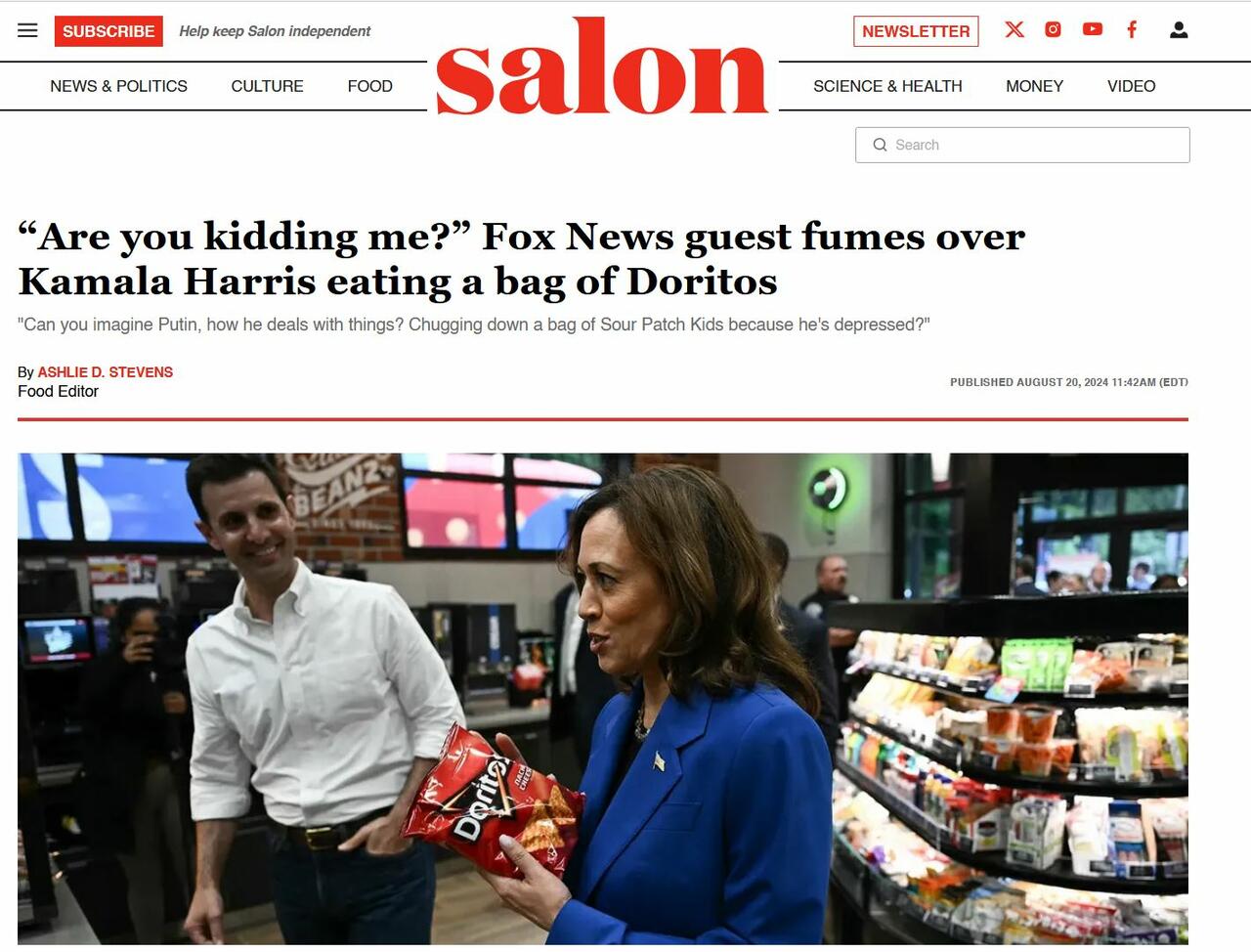
Michigan Governor Gretchen Whitmer has apologized for a video in which she feeds a social media influencer a Dorito chip – a stunt widely slammed by Catholic organizations as mocking the sacrament of communion.

In the video, influencer Liz Plank kneels before Whitmer, who feeds her the chip. Whitmer then gazes at the camera while wearing a Harriz-Walz hat.

“I would never do something to denigrate someone’s faith,” Whitmer said in a statement provided to Michigan’s WJBK, adding that the stunt was meant to promote legislation signed by President Joe Biden in 2022 known as the “Chips Act,” which provides $280 billion to research and manufacture semiconductors.

According to Whitmer, it was “construed as something it was never intended to be, and I apologize for that.”

A likely story… more like a blasphemous lesbian hagmaxxing fetish.

Whitmer’s stunt was slammed by the Michigan Catholic Conference, which accused Whitmer and Plank of “specifically imitating the posture and gestures of Catholics receiving the Eucharist.”

Paul Long, the conference’s CEO, said of Whitmer’s apology: “While dialogue on this issue with the governor’s office is appreciated, whether or not insulting Catholics and the Eucharist was the intent, it has had an offensive impact.”

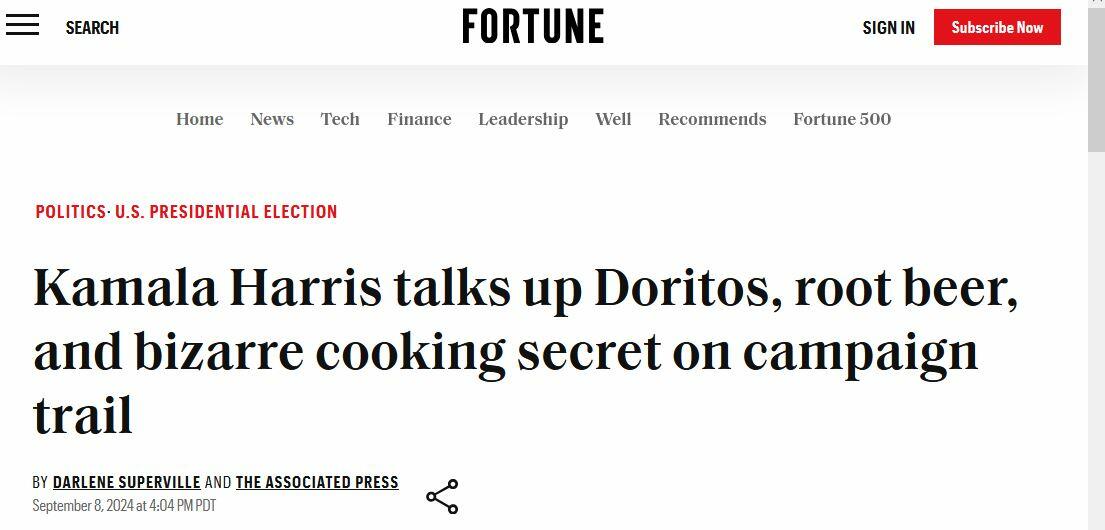
Also, what’s this weird Dorito thing going on with Democrats? #Doritogate?

Tyler Durden
Sun, 10/13/2024 – 21:35

Hedge Fund CIO: “After The Last Disillusioned Gold Bulls Sold Their Final Ounce, Gold Started Rallying… And Has Not Looked Back”

0
Hedge Fund CIO: “After The Last Disillusioned Gold Bulls Sold Their Final Ounce, Gold Started Rallying… And Has Not Looked Back”

By Eric Peters, CIO of One River Asset Management

“Let me start with the psychology that governed the gold market for years,” I said. It was our IC meeting and the topic of gold’s recent outperformance versus bitcoin came up. “When Bernanke unleashed QE during the GFC, a lot of very smart people rushed to hedge themselves against a massive monetary inflation. Gold was an obvious hedge, and the Baby Boomers were in their investing prime back then. They felt highly exposed to an inflating-away of their life savings. They already owned homes. Many bought gold. Some bought far too much.”

“Republicans prevented Obama from the wild stimulus spending he sought. And China’s deflation-exporting economy was still being brought online in the aftermath of its WTO ascendance. Plus, Beijing pumped it up through massive subsidies/stimulus. There were surely other reasons why inflation didn’t take off back then. Expectations remained generally stable. And despite Europe’s response to an existential sovereign debt crisis, and Draghi’s 2012 commitment to do “whatever it takes”, the Germans never let spending get out of control.

“Gold peaked in the summer of 2011 at over $2500/oz and turned lower. By 2015, it had fallen roughly 40%, back to the $1400 level it hit in March 2008. All these Baby Boomers with gold buried in their backyards were gutted. They prayed that if they ever got back to the highs, they’d sell. We’ve all prayed like that. Every one of us. Those who held until July 2020 got the chance to sell again near the 2011 highs at $2400. Covid stimulus sparked that rally. Some sold. Gold fell. The holders begged forgiveness. Then sold. Gold fell 30% over 2yrs.

“Baby Boomer bulls eventually lost faith. Many needed cash, they were retiring. Some got bearish gold and pointed to the EU’s confiscation of Russia’s foreign reserves following the Ukraine invasion. “If gold couldn’t rally on that, then would it ever,” they asked. The last disillusioned bulls sold their final ounce. Then gold started rallying. It has not looked back. That’s what can happen to a market once you clean out the remaining stale positions. A clean market can really move, given a clear fundamental catalyst; gold has at least two.

“The confiscation of Russian assets means governments will increasingly diversify their foreign reserves into non-sovereign assets. Gold is one. And now that China is committing to stimulus, every major economic zone appears to be doing the opposite of austerity. So, in a world of potentially infinite fiat, scarce assets should appreciate. Gold has. It’s +40% over the past 12mths. Bitcoin is +134% over that period. But for the past 7mths, Bitcoin has chopped around in a 30% range (13% below all-time highs), while gold continued upward. Why?

When Bitcoin hit $59k in Apr 2021, the bullishness was insane. It fell nearly 50% through that summer and made new highs around $65k in Nov 2021. Then it collapsed to the $15k area on the FTX failure. A material portion of bulls who endured that net worth crash prayed to God that they’d sell some, most, maybe even all (probably not all, this is crypto) if they ever got back to the highs. Bitcoin hit $72.75k this Mar. There’s been selling into every market rally since, even as clear fundamental catalysts appear (the same ones as for gold). And as this happens, market positioning gets cleaner. 

Tyler Durden
Sun, 10/13/2024 – 21:00

Number Of Apple Vision Pro Apps Hit By “Significant Slowdown” As Demand Plunges

0
Number Of Apple Vision Pro Apps Hit By “Significant Slowdown” As Demand Plunges

The number of new apps released for Apple Vision Pro has slid since the mixed-reality headset became available for purchase on February 2. Without killer apps, the success of the over-priced goggles will flounder.

Wall Street Journal reports that the Vision Pro app ecosystem has experienced a significant slowdown in growth since the launch. Demand for the base $3,499 Vision Pro has been out of reach for many consumers struggling to survive in an era of elevated inflation and high interest rates. The glasses were likely mispriced, hence sluggish demand. 

More from WSJ: 

There has been a significant slowdown in new apps coming to the Vision Pro every month. Only 10 apps were introduced to the Vision App Store in September, down from the hundreds released in the first two months of the device’s launch, according to analytics firm Appfigures.

It has counted around 1,770 apps available for the Vision Pro in the App Store as of September. Only 34% of those apps are built specifically for the Vision Pro, while the rest are versions of existing Apple apps that have additional Vision Pro functionality, Appfigures said.

Apple said in August that there are more than 2,500 apps built for the Vision Pro. Appfigures said the discrepancy between these two figures could be, in part, because some apps aren’t used enough to register on usage charts, making them difficult for the analytics firm to detect.

A visualization from the Journal shows a large decline in the number of new apps released for Vision Pro every month since its launch.

Source: WSJ

App growth for Vision Pro has fallen off a cliff, and that’s mostly because demand for the futuristic ski goggles costs too damn much for the consumer. It’s literally worth a couple of months of rent or three months of car payments for many average consumers. 

Even though Apple hasn’t officially released Vision Pro sales figures, TF International Securities analyst Ming-Chi Kuo (best known for gathering intelligence from his contacts in Apple’s Asian supply chain) wrote in a note in late April that shipments for the goggles will be around 400k and 450k units for the year, down from earlier estimates of 700k and 800k.

Separately, Counterpoint Research wrote in a report that Vision Pro’s second-quarter sales figures imploded 80% from the first quarter.

“To catch on, the Vision Pro would need killer apps, which helped turn the iPhone into one of the most popular consumer products in history,” WSJ noted. 

However, as we previously noted… 

Just like the AI-enabled iPhone 16, another bust for Apple. 

Yet, Apple’s market capitalization is somehow at $3.5 trillion.

Moar buybacks, Tim Cook. 

Tyler Durden
Sun, 10/13/2024 – 20:25

Private Equity Firms Are Now Acquiring Skilled Trade Small Businesses

0
Private Equity Firms Are Now Acquiring Skilled Trade Small Businesses

Turns out those years at vocational school and going into business instead of going to college are starting to pay off. 

Other than having the benefit of learning a trade, private equity has now taken a keen interest in buying skilled trade small businesses, according to a new report from the Wall Street Journal. 

Private equity firms nationwide are acquiring home services companies, such as HVAC, plumbing, and electrical businesses, aiming to create larger, more profitable operations.

This trend moves these companies away from family ownership, offering mom-and-pop businesses significant payouts, unlike previous generations where firms were typically passed down to children or employees.

Brian Rassel, a partner at the Detroit-based Huron Capital told WSJ: “You don’t need to go to Silicon Valley to have a successful career and entrepreneurial opportunities.”

Rite Way owner Aaron Rice / Photo: WSJ

 Adam Hanover, chairman of Redwood Services, added: “Everybody and their uncle owns an HVAC business in the private-equity space today.”

The Journal report says that Redwood has acquired 35 companies in the past four years, from smaller businesses, typically bought for around $1 million, to larger firms like Rite Way, valued at about $20 million, where it takes majority stakes.

Rite Way, has thrived under Redwood, growing annual revenue from $30 million to $70 million. The company expanded beyond HVAC into plumbing and electrical services, benefiting from increased capital, more service trucks, higher staffing, and new apprenticeship and sales training programs.

Redwood also brought in accountants to focus on profitability. According to Redwood CEO Richard Lewis, small business owners often struggle to manage these tasks or fail to update pricing. Redwood reviews pricing quarterly to stay competitive.

The trades offer good wages for workers without college degrees and can serve as stepping stones for aspiring entrepreneurs. HVAC worker Aaron Rice, who co-founded his plumbing business in 2012 after overcoming addiction and prison time, sold the company when it had 18 employees and $3 million in annual revenue.

He said the sale has given him peace of mind, telling WSJ: “I want to hunt, fish, drink beer and cook meat.” 

You can read the Journal’s full report here. 

Tyler Durden
Sun, 10/13/2024 – 19:15

Voters See A Choice Between “Leadership” And “Likability”: Gallup

0
Voters See A Choice Between “Leadership” And “Likability”: Gallup

By Lidia Saad of Gallup.

Recent ratings of the 2024 presidential candidates’ personal qualities show Vice President Kamala Harris with a strong advantage over former President Donald Trump in U.S. voter perceptions of being likable, while holding smaller leads for having strong moral character and being honest and trustworthy. Trump outpaces Harris in perceptions of being a strong and decisive leader and being able to get things done.

Despite this clear image distinction — Harris credited with character, Trump with leadership — neither candidate has a perceptual edge in voters’ beliefs that each possesses five other presidential competencies: managing the government effectively, displaying good judgment in a crisis, having a vision for the country’s future, caring about the needs of people, and being someone people would be proud to have as president.

These findings are from a Sept. 16-28 Gallup survey, conducted after the Sept. 10 presidential debate that gave Americans their one opportunity of the campaign to see the candidates interact.

Perceptions of Trump are similar to what Gallup found at the same time in 2020, except voters are now slightly more likely to believe he would display good judgment in a crisis, up six percentage points to 52%.

Trump’s rating for being honest and trustworthy is higher now than his 38% rating in 2016 when he won the election. However, even at that lower level, Trump’s honesty rating exceeded Hillary Clinton’s, at 31%. This changed in 2020 when, despite seeing his “honest” score improve to 41%, Trump trailed Joe Biden by 11 points on this character dimension.

In fact, in the three presidential election cycles since 2012, when Gallup first measured presidential qualities this way, the candidate with the higher honest/trustworthy score has won. Other characteristics have not been asked frequently enough to observe their track record.

Summary Assessments Show Mixed Results

Harris leads Trump by 51% to 45% on a different question that asks, more broadly, whether each candidate has “the personality and leadership qualities a president should have.” Thus, although Trump separately does better on the “strong and decisive leader” item, Harris’ higher ratings for being likable and of strong moral character may count more in voters’ answers to this question.

At the same time, the two are tied in Americans’ views of each on the issues. About half (49%) say they agree with Trump “on the issues that matter most to you,” and 47% agree with Harris.

Democrats See Harris in Better Terms Than Republicans See Trump

Most partisans believe their own candidate possesses the positive characteristics tested in the poll, but Democrats are more convinced than Republicans about certain ones.

Between 89% and 95% of Democrats say each characteristic applies to Harris. And while Republicans show similarly high regard for Trump on most of the traits, fewer than nine in 10 agree he is honest and trustworthy (84%), has strong moral character (82%) or is likable (74%).

Independents’ views are similar to those of all voters nationally on most of the qualities. Still, they are slightly less positive than Americans as a whole about Harris being caring, honest and trustworthy, or a strong and decisive leader. Independents are also less likely than the national average to say Trump has strong moral character, but they show slightly above-average belief that he is a strong leader.

More Voters Credit Harris Than Trump With Running an Effective Campaign

While Trump is tied with Harris in perceptions of being able to manage the federal government, he trails his Democratic opponent by 10 points in ratings of how they are running their campaigns. Whereas 56% of registered voters say Harris is doing an excellent or good job at this, 46% rate Trump as highly. The timing of the poll, coming soon after the presidential debate, could have influenced this result.

Trump’s deficit on this measure is due mainly to political independents, whose 41% excellent/good rating of his campaign is much closer to the 15% he receives from Democrats than to his 86% from Republicans. At the same time, independents’ 53% rating of Harris’ campaign falls squarely between the two partisan groups (90% from Democrats and 21% from Republicans).

Neither Candidate Viewed as More Politically Extreme

Even as Trump attempts to define Harris by some of the more liberal aspects of her record while Harris links Trump to the conservative Heritage Foundation’s Project 2025, the candidates appear to be at a draw in terms of painting each other as extremist. Close to half of voters, 48%, say Trump’s political views are “too conservative,” while a statistically equivalent 51% call Harris “too liberal.” Most others see each as about right.

Notably, Harris is less likely to be branded “too liberal” than Biden was before he exited the race in June, when 58% said this of him. However, slightly more voters view Harris as too liberal than recent Democratic nominees Barack Obama in both 2008 (45%) and 2012 (47%) and John Kerry in 2004 (47%). She is also more likely to be called too liberal than Al Gore was in 2000 (35%), as well as Bill Clinton in 1992 (33%) and 1996 (36%). The question wasn’t asked about Hillary Clinton in 2016.

At 48%, Trump is more likely to be rated “too conservative” than were the Republicans who ran for president before him, including Mitt Romney (43% in 2012), John McCain (35% in 2008) and George W. Bush (40% in 2004).

Democrats More Satisfied With Harris Than Republicans Are With Trump

More Democrats, including independents who lean Democratic, say they are generally pleased with Harris as their party’s presidential nominee than Republicans and Republican leaners say they are pleased with Trump as theirs, 85% vs. 73%.

Democrats’ enthusiasm for Harris is in stark contrast to how they felt about Biden when he was still their party’s presumptive nominee in June. At that point, barely a third of Democrats (34%) were pleased with Biden, while 65% wished someone else were the nominee.

Today’s broad Democratic support for Harris being the nominee also contrasts with how Democrats felt in September 2016 after Hillary Clinton was nominated. Then, just over half (55%) said they were pleased, while 43% would rather have had someone else.

Republicans are about as pleased today to have Trump as their presidential nominee as they were in 2020 (74%), but they are happier now than when he first ran in 2016. In September of that year, barely half of Republicans (52%) were pleased with having Trump lead the GOP ticket.

Trump Hasn’t Inherited Biden’s Age Problem

The age of the candidates was a potential campaign liability for the Democrats earlier this year, when two-thirds of Americans in June thought the 81-year-old Biden was too old to be president. Far fewer, 37%, said the same about 78-year-old Trump.

Yet, despite Trump now being the older candidate by nearly 20 years, the percentage saying he’s too old hasn’t changed much since facing Harris, with 41% expressing that view today.

As the oldest Republican nominee, Trump is still more likely to be viewed as too old than John McCain was at age 72 in 2008 (20%) and Bob Dole was at age 73 in 1996 (32%).

Harris Compares Favorably With Biden

In addition to Democrats viewing her far more favorably as a candidate and ideologically than they did Biden, Harris is performing significantly better nationally on two other metrics than Biden was before he withdrew from the race.

  • Voters are more likely to say they agree with her on the issues than did so for Biden in June (47% vs. 37%, respectively).
  • Voters are more likely to say Harris has the leadership qualities needed in a president than thought Biden did (51% vs. 38%).

Biden’s readings are from a June 3-23 poll when his presidential approval rating was 38%. Following his withdrawal on July 21, the president’s job approval rating rose to 43% in an August Gallup poll. It dipped back to 39% in early September but is 45% in the latest poll. That’s his highest approval rating since August 2021, just before the United States’ troubled pullout of military forces from Afghanistan.

Bottom Line

Trump and Harris look evenly matched overall, with neither possessing knockout advantages in voters’ ratings of their images, perceptions of their ideology, agreement on issues, ratings for how they are conducting their campaigns, or perceptions that one or the other is too old. If the race comes down to which candidate can get better results in the Oval Office, Trump may have the upper hand. But if voters perceive leadership more holistically, factoring in their perceptions of each candidate’s personality and character, Harris may have the edge.

Tyler Durden
Sun, 10/13/2024 – 18:40

Top Cushman & Wakefield Real Estate Broker Has Phone Seized By NY Prosecutors In Adams Probe

0
Top Cushman & Wakefield Real Estate Broker Has Phone Seized By NY Prosecutors In Adams Probe

As if commercial real estate in New York didn’t have enough problems…

It was reported at the end of last week that the office of Manhattan District Attorney Alvin Bragg has seized the phone of a broker working for Cushman & Wakefield, one of the world’s largest commercial real estate services firms, according to Bisnow.

Investigators from Bragg’s office have seized electronic devices from a Cushman & Wakefield broker linked to the city’s office leases and a close friend of Mayor Adams’ top adviser, according to The New York Times.

On September 27, investigators confiscated the phones of Cushman & Wakefield Vice Chair Diana Boutross, Mayor’s Chief Advisor Ingrid Lewis-Martin, and Jesse Hamilton, head of the city’s real estate department, at JFK Airport after their trip to Japan. Lewis-Martin and Boutross have been longtime friends, her attorney, Arthur Aidala, told Bisnow.

Aidala commented: “There were eight friends who decided to go to one of the biggest tourist countries in the world to just explore on a long-planned friendship trip.” 

A spokesperson for Cushman & Wakefield said: “We have a longstanding, 15-year relationship with the city that spans across multiple mayoral administrations and we are proud of the important work we’ve done for DCAS.”

The Bisnow report says that Boutross oversees Cushman & Wakefield’s account with the Department of Citywide Administrative Services, the agency responsible for leasing government office space.

Her resume includes work with The Durst Organization and The Trump Organization. Cushman & Wakefield has held a $40M contract with the city since 2014, linked to a Bronx 911 facility, Crain’s reported.

The firm also handled major city office leases, including a 640K SF deal at 110 William St. last year. Investigators seized devices from Lewis-Martin and Hamilton and searched Lewis-Martin’s home, issuing her a subpoena related to Adams’ recent indictment.

“These searches and any negative connotations associated with them or this preplanned vacation are baseless. In due time, all the facts will come out and will be supported by evidence and demonstrate everything was done properly,” Aidala concluded. 


Tyler Durden
Sun, 10/13/2024 – 18:05

Why Silver Investors Should Pay Close Attention To Copper

0
Why Silver Investors Should Pay Close Attention To Copper

Authored by Jesse Colombo via Substack

For most investors, gold and silver are inseparable, like peanut butter and jelly or two peas in a pod. This mindset leads them to look at gold for signals on silver’s future price movements, and vice versa. Although silver’s price is indeed strongly influenced by gold, few realize the significant role that copper also plays in shaping silver’s price movements. In this article, I’ll examine how copper prices impact silver and show how bullish trends in copper should help drive silver prices higher in the coming years.

To understand the price relationship between two assets, examining their correlations can be highly insightful. Not surprisingly, gold and silver exhibit a strong correlation—.771 over the past five years and an even higher .917 over the past year. What’s particularly striking, however, is the strong correlation between copper and silver—.725 over the past five years and an impressive .878 over the past year. This strong correlation is a compelling reason for silver investors to monitor copper as closely as they do gold.

The strong price relationship between silver and copper is clearly reflected in long-term charts of the silver-to-copper ratio, which has remained remarkably consistent over time, despite periodic fluctuations around the average of 6:

The close relationship between silver and copper can be attributed to factors influencing both supply and demand. From a supply standpoint, silver is seldom mined on its own. Instead, it is typically a byproduct of copper and other metal mining, such as lead, zinc, and gold. On the demand side, both silver and copper have substantial industrial applications, driving significant industrial demand for both metals.

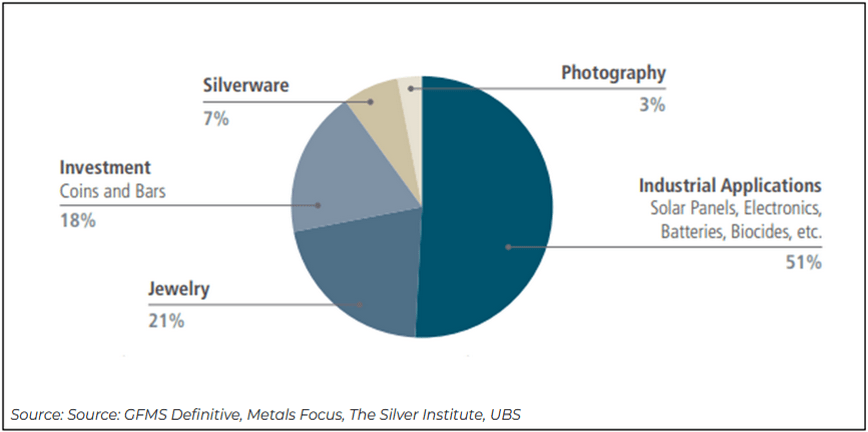
While silver is often grouped with gold, it differs significantly in its demand profile. The majority of silver demand (51%) comes from industrial use, compared to just 18% from investment. Furthermore, the rapid growth in industrial demand for silver likely explains the rising correlation between silver and copper in recent years. In contrast, gold demand is largely fueled by investment (44.57%) and jewelry (48.74%)—with much of that jewelry also serving as a form of investment, especially in developing countries like India and China.

Both copper and silver are far more sensitive to the economic cycle compared to gold. For instance, when a recession looms, both copper and silver prices tend to decline in anticipation of reduced industrial demand. Conversely, when the economic cycle is on an upswing, both copper and silver prices typically rise in anticipation of increased industrial demand. Gold, by contrast, is traditionally viewed as a safe-haven asset that investors turn to during times of crisis.

The strong price relationship between silver and copper is likely amplified by trading algorithms that predict movements in one metal based on the price of the other, often creating a self-fulfilling prophecy. For instance, when copper begins to rally, certain algorithms will buy silver, causing both metals to rise in tandem. Although anecdotal, I’ve often observed silver track copper even more closely than gold, both on intraday movements and over longer timeframes. For instance, I’ve often seen silver rise with copper while gold stayed flat or declined, and at other times, I’ve observed silver dropping along with copper even as gold rallied. I’ll highlight a recent noteworthy example of this phenomenon using the charts below.

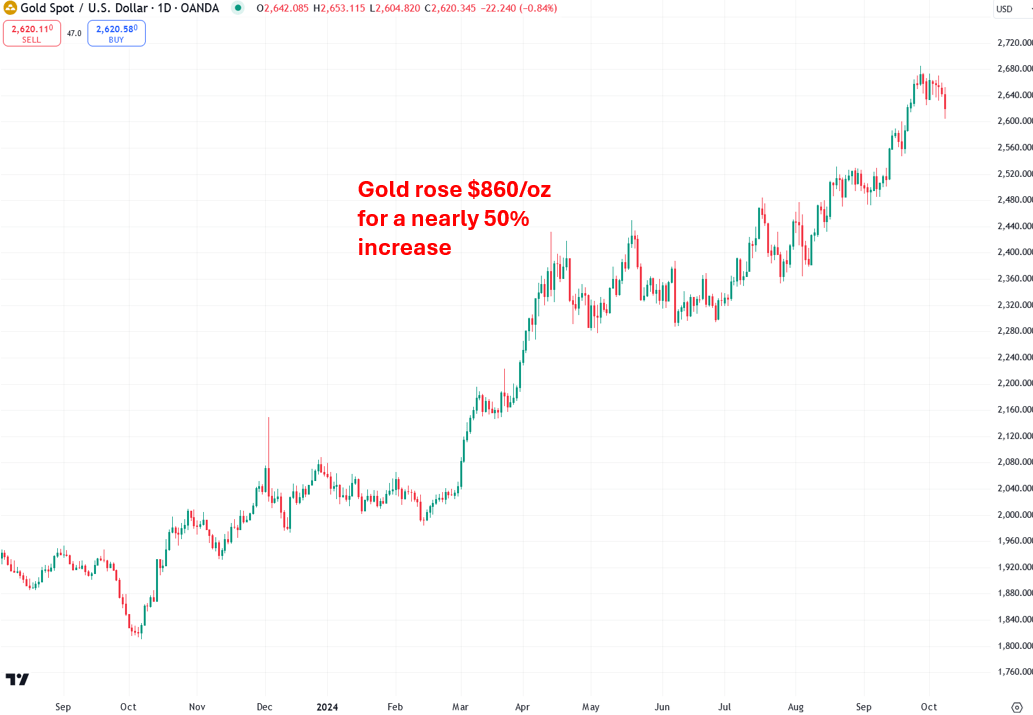
As you are probably aware, gold has experienced a remarkable surge over the past year, climbing by $860 per ounce—a nearly 50% increase:

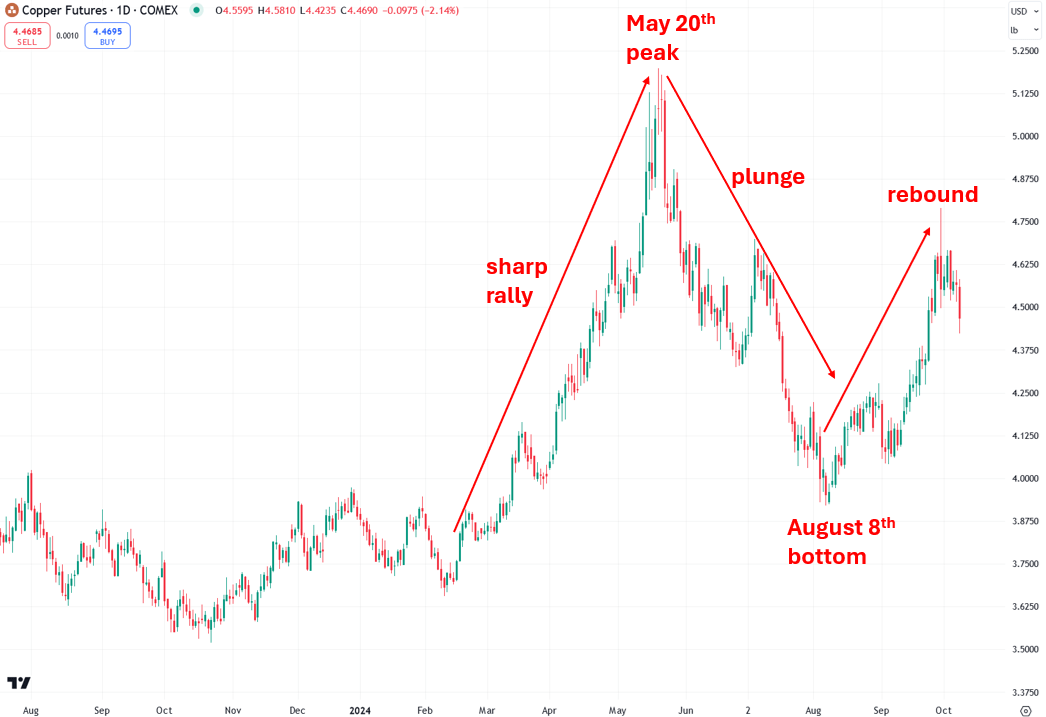
Like gold, copper experienced a strong rally in the spring, but it peaked on May 20th and quickly reversed, wiping out most of its gains—unlike gold, which continued to rise. Copper bottomed on August 8th and has rebounded quite a bit since then and is now in a confirmed uptrend once again:

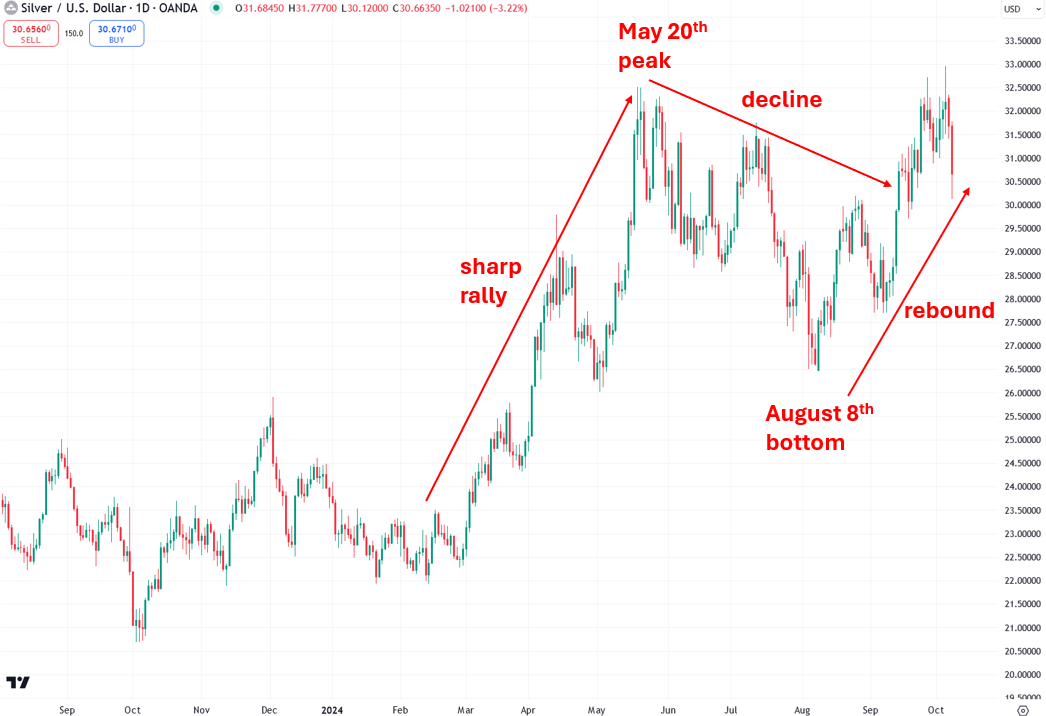
Finally, we come to silver, which, like gold and copper, saw a sharp rally in the spring. Like copper, silver peaked on May 20th and experienced a sharp decline, though not as severe as copper’s drop. While silver and copper suffered throughout the summer, gold steadily continued its ascent. Silver, like copper, bottomed on August 8th and has been staging an impressive recovery ever since.

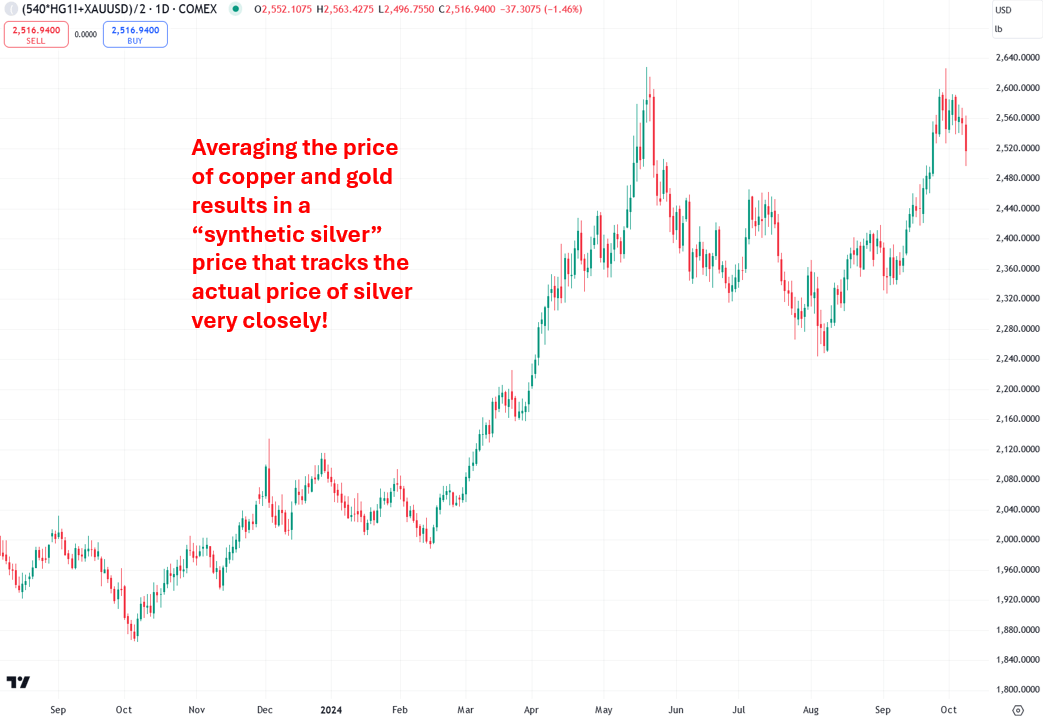
Silver’s price movements are essentially a hybrid of both gold and copper’s market trends. To test this theory, I averaged the prices of gold and copper, adjusting copper’s price (by multiplying by 540) to prevent gold’s higher price from exerting undue influence. Then, I created a chart based on that adjusted average. Sure enough, the resulting chart bears a striking resemblance to silver’s price chart:

Moreover, the five-year correlation with silver stands at a solid 0.842, while the one-year correlation is an even more impressive 0.956. This is higher than the correlation between gold and silver (0.771 over five years and 0.917 over the past year) and even stronger than the correlation between copper and silver (0.725 over five years and 0.878 over the past year). This analysis highlights the importance of monitoring both gold and copper to gain a clearer understanding of silver’s price movements. In addition, performing technical analysis on the chart of the copper-gold average seems to be a useful tool for confirming and anticipating silver’s price movements

Along with bullish technicals, copper’s fundamentals also point to a positive outlook. As the world increasingly embraces AI and “green” technologies such as electric vehicles, solar energy, and wind farms, demand for copper is expected to surge due to its essential role in wiring and other electrical applications.

For example, copper demand in the transport sector is expected to rise 11.1 times by 2050 compared to 2022, thanks to electric vehicles that contain over a mile of copper wiring. Additionally, demand for copper to expand the global electricity grid is projected to increase 4.8 times by 2050. By 2030, a copper supply gap nearing 10 million tonnes is forecasted. French billionaire and commodities trader Pierre Andurand recently predicted that copper prices could soar to $40,000 per tonne in the coming years—a more than fourfold increase from the current price of $9,308 per tonne. All of these factors should be bullish for both silver and copper.

In conclusion, the overlooked relationship between copper and silver plays a critical role in understanding silver’s price movements, alongside the more commonly recognized influence of gold. As copper continues to rebound, both technical and fundamental factors suggest that silver is poised to benefit as well. With increasing industrial demand, especially in sectors like electric vehicles and renewable energy, copper’s expected boom is likely to drive silver prices higher as well. Investors would do well to monitor copper closely, as its future movements may signal the next major leg up in silver’s bull market.

Also watch the video presentation about this concept:

If you enjoyed this article, please visit Jesse’s Substack for more content like this

Tyler Durden
Sun, 10/13/2024 – 17:30