54.3 F
Chicago
Saturday, October 17, 2026
Home Blog Page 2249

UN Accuses Israel Of Firing On Its Peacekeeping Force In Lebanon, Wounding Two 

0
UN Accuses Israel Of Firing On Its Peacekeeping Force In Lebanon, Wounding Two 

Amid ongoing heavy fighting between Israeli forces and Hezbollah in south Lebanon, the only external troops which have long been present on the ground are a group of UN peacekeeping troops. They are a mainly Irish contingency, called the United Nations Interim Force in Lebanon (UNIFIL), and have remained near the Israel-Lebanon border since the 2006 war.

The UN peacekeepers have been increasingly alarmed over the Israeli army setting up forward bases in areas near their operations, and this week the Israeli government alerted the UN troops they must move positions or risk coming under fire. 

That appears to have happened this week. On Thursday the UNIFIL force said its headquarters came under fire by the Israeli army and that two of its troops were wounded. The UN team had refused Israeli army (IDF) demands to evacuate its position further north, setting up for a bloody standoff as tanks moved in.

Source: AFP

“The injuries are fortunately, this time, not serious, but they remain in hospital,” said UNIFIL in its statement. UNIFIL is further calling the fresh incident “very serious” given the IDF “deliberately fired” on its positions.

The UN HQ is located in the village of Labbouneh, and its team said IDF fire hit “the entrance to the bunker where peacekeepers were sheltering, and damaging vehicles and a communications system.”

The statement warned that “targeting peacekeepers is a very serious violation, not only of Resolution 1701 but also of international humanitarian law.” Monitoring cameras have also been destroyed. The Israeli action reportedly involved several tanks.

“If the situation becomes impossible for the mission to operate in the south of Lebanon … it will be up to the Security Council to decide how to move forward,” the UN said. Israel’s military did not issue immediate comment.

Days prior, UNIFIL said it is “deeply concerned by recent activities by the IDF immediately adjacent to the Mission’s position 6-52, southeast of Maroun al-Ras… inside Lebanese territory.”

Italy is among countries contributing to the UN mission who are outraged, and its government summoned the Israeli ambassador in Rome. “The shooting at the UNIFIL headquarters” which involved “small arms fire” is “intolerable, they must be carefully and decisively avoided,” Italian Defense Minister Guido Crosetto Crosetto said in a statement.

Source Al Jazeera

 Ireland too has issued formal protest and is livid:

Two United Nations (UN) peacekeepers in southern Lebanon have been wounded after an Israeli tank directly hit a UN observation tower, prompting outrage from troop-contributing nations.

Italy, which leads the 10,000-strong peacekeeping force along the Lebanon-Israel border, said firing on UN bases broke international law, and summoned the Israeli ambassador. 

Ireland, which contributes several hundred soldiers to the force, said targeting peacekeepers was “reprehensible and unacceptable”.

Typically in any UN Security Council vote which seeks to censure Israel for military actions, the United States is among the lone vetoes. Washington has rarely spoken up in defense or support of the UN peacekeeping mission in south Lebanon. The UNIFIL force was establish all the way back in 1978, in connection with Israeli incursions into Lebanon, and related to the events of the Lebanese civil war of the latter part of the 20th century.

Tyler Durden
Thu, 10/10/2024 – 22:10

Watch Live: Elon Musk Unveils Tesla’s Robotaxi

0
Watch Live: Elon Musk Unveils Tesla’s Robotaxi

“The Most Important Tesla Event Ever”

Tesla’s much awaited Robotaxi event, “We, Robot,” is set for tonight, live from Warner Bros. Discovery Studios in Hollywood, Los Angeles. The event starts at 7 p.m. and will be livestreamed on Tesla’s social media platforms, including X and YouTube.

It’s widely rumored that the event will feature prototypes of Tesla’s upcoming autonomous vehicle, which has been spotted around the studio grounds and key locations in San Francisco and LA.

Tesla has been actively collecting Full Self-Driving (FSD) data in these areas ahead of the event, fueling speculation about new advancements like Robotaxi sanitization and wireless EV charging. As we noted weeks ago, invites were sent to winners of a shareholder raffle, with tickets arriving just days before the event.

“Join us for We, Robot — our official unveiling of the future of autonomy,” the invitation read. 

Wedbush’s Dan Ives has said of the event: “We believe this is a pivotal time for Tesla as the company prepares to release its years of Robotaxi R&D shadowed behind the curtains, while Musk & Co. lay out the company’s vision for the future.”

Some enthusiasts are calling it “the most important Tesla event ever.”

Cybercab Expectations

The folks at NotTeslaApp expect: “Tesla to deliver a small, two-door sedan with two seats. The car is expected to have four wheels, although there was some speculation of three wheels at one point”. They write  that it’ll “likely include a good amount of trunk space for luggage as well”

They write that Tesla’s Robotaxi is expected to be smaller than current models, resembling a compact version of the Model 3 with a simplified interior focused on autonomy and low-cost production. It will likely feature a single central screen like the Model 3, but with a stripped-down UI displaying key information such as ETA and fare price.

While Tesla may not reveal much about FSD hardware, the Robotaxi will probably include the upcoming Hardware 5 FSD suite or new hardware designed for redundancy and safety, essential for autonomous fleet operations.

According to Electrek, the robotaxi is rumored to be “Cybertruck-like” in design, without a steering wheel or pedals, and potentially smaller in size. A prototype was spotted testing at the Warner Bros. lot. Tesla may also showcase its latest Optimus humanoid robots with a focus on autonomous features.

Inside EVs Prototype Rendering

Gene Munster with Deepwater Asset Management tells MarketWatch he expects “at least a robotaxi prototype, and talk of a ‘Model 2’ cheaper EV”.

“What will most likely be on display is a demonstration of the latest iteration of FSD [full self-driving] software and a demonstration of a fully autonomous ‘cybercab’ in a closed or semi-closed course,” Morgan Stanley’s Adam Jonas wrote last month, per Yahoo Finance. 

He believes the robotaxi will come from the preexisting fleet of Tesla vehicles already on the road:

While the cybercab — a vehicle envisioned as one without a steering wheel or pedals — may be the natural fit for a robotaxi, Jonas believes it is the preexisting fleet of Teslas out on the road that, when combined with FSD and Tesla’s upcoming rideshare mobility app, will allow owners of those Tesla EVs to put those vehicles on Tesla’s rideshare service. The true game changer would be unlocking the potential of those vehicles, he said.

“It is our expectation that Tesla will offer a ‘dual’ approach with respect to autonomous ridesharing: (1) the fully autonomous app-based cybercab and (2) a ‘supervised’ autonomous/FSD rideshare service. We think the latter of these may get the most attention or have the greatest room to surprise investors, at least near term,” he said.

Deutsche Bank’s Edison Yu added his expectations: “For Robotaxi Day on Oct 10th, we expect an unveiling of the ‘CyberCab’ at the venue, [and] some type of robotaxi demo … Moreover, Tesla should unveil the new lower cost vehicle slated for SOP [start of production] next year (“Model 2” or cheaper/smaller Model 3 variant).”

Expectations For Release Timeline And Final Product

Expectations for a final or near-final working product seem low. “Few observers, if any, expect a fully functioning product,” Reuters wrote. 

“We believe the robotaxi event will be long on vision, and short on immediate deliverables or incremental revenue drivers,” Bernstein analyst Toni Sacconaghi said. 

Tesla executives will need to “reinforce to consumers and investors that they continue to be innovators,” Gene Munster with Deepwater Asset Management told MarketWatch. “The bar on the robotaxi is is pretty high, but the rest of the stuff is pretty easy, they don’t need to roll a vehicle out there. They can just talk about it,” he added.

Sam Fiorani, vice president of global vehicle forecasting at AutoForecast Solutions LLC, added: “Tesla’s history is overpromise and underdeliver, so whatever timing is put on this vehicle, it’s going to be pushed back. We are still considering what promises will make it to production and what won’t”.

Longtime Tesla bull and Morgan Stanley analyst Adam Jonas says to “keep expectations well managed” for the event. 

“We think this [robotaxi fleet] is still several years away and numerous technological hurdles, safety tests, and regulatory approvals are still standing in the way,” Garrett Nelson of CFRA told Yahoo Finance.

Impact On Tesla Stock Price

As far as impact on the stock price, Elliot Johnson, chief investment officer at Evolve ETFs, which manages investments in Tesla, told Reuters: “They need to get going because this has been sort of discussed, rumored, talked about and announced in various forms for a while.”

He says nothing announced this week will have a financial impact for one to two years, the report says. Barron’s has also speculated that the event could be a “sell the news” event. Columnist Al Root wrote that “Robotaxi Day may be Elon Musk’s last chance to convince investors that Tesla still has it”. 

Edison Yu has been telling his clients to be “tactically cautious” with the stock. 

Reaction By Other Autonomous Driving Companies

Elsewhere in autonomous driving, Investing.com did a good job laying out what competitors and the rest of the industry may be watching.

The U.S. rideshare market, currently just 1% of total miles driven, could expand significantly with the introduction of autonomous vehicles (AVs), according to Morgan Stanley. While Tesla’s technological advancements may drive faster AV adoption, the transition faces challenges in scaling and regulation.

Tesla’s potential to launch a Level 4 (L4) autonomous service could yield a 41% cost advantage over Uber and Lyft, and 21% over Waymo, thanks to its camera-based approach versus Waymo’s sensor-heavy system. Market trends in cities like Austin and Phoenix will indicate whether AVs can integrate effectively with rideshare platforms, a key concern for Uber’s hybrid model strategy.

We’ll know more in just hours…

Tyler Durden
Thu, 10/10/2024 – 21:50

Visualizing The Severity And Prevalence Of Addictive Substances

0
Visualizing The Severity And Prevalence Of Addictive Substances

Addiction is a complex subject, much of our understanding of which is incomplete, as many common and rewarding substances have the potential to be “addictive.” Still, the relative harm associated with that addiction is not linear, nor are the consequences of the addiction.

For this graphic, Visual Capitalist partnered with the Global Kratom Coalition to explore the landscape of addictive substances and investigate why some substances have more risk than others.


How Common Are Substance Use Disorders?

The 2023 United States National Survey on Drug Use and Health (NSDUH) reported that nearly 50 million Americans believed they had some form of substance use disorder (SUD).  

SUDs are characterized using 11 criteria, including how dependent a person becomes on a substance and whether the person continues to use it despite adverse effects.

However, a person does not need to meet all 11 criteria to be considered to have an SUD. Instead, the more criteria a person meets, the more severe the SUD is. 

It’s worth noting that not everyone reacts to a substance in the same way. People may develop use disorders depending on their genetic predisposition, family history, socioeconomic status, mental disorders, trauma, and, importantly, the substance involved.


How Severe are Addictive Substances?


A substance can impact a person in various ways. However, the impact is determined by how many of the 11 criteria a person endorses.

So, a person is considered to have ‘mild symptoms’ if they endorse 2-3 criteria, moderate 4-5, and severe would be the endorsement of 6 or more criteria.

When analyzing the symptoms people describe after using certain substances, the severity of these symptoms is heavily dependent on the substance in question. For example, Kratom and caffeine users are more likely to experience mild symptoms, while severe symptoms are more common with substances such as heroin.


How Many Adverse Events are Caused by Substances?


While substances do impact people in different ways, it’s important to note when this impact becomes an adverse event—a harmful or undesirable outcome resulting from exposure to a toxic substance. 

But, the volume of adverse events is also often tied to how many people use the substance in question, with the most common substances like alcohol and cannabis generating the most adverse events—despite their relatively mild symptom profiles.


Kratom: A Misunderstood Leaf


Millions of people battle against substance abuse every year. However, the severity of symptoms and the impact those symptoms can have on a person vary. But, substance use disorders are common, underscoring the urgent need for a deeper understanding of the complex nature of addiction and substances in general.

Are you interested in continuing the vital conversation around addiction?

Tyler Durden
Thu, 10/10/2024 – 21:20

Harris Proposes Medicare Coverage For Senior Home Care

0
Harris Proposes Medicare Coverage For Senior Home Care

Authored by Emel Akan via The Epoch Times (emphasis ours),

Vice President Kamala Harris proposed a new plan on Oct. 8 that would require Medicare to cover the cost of long-term home care.

With the election only 27 days away, the Democratic nominee made the announcement first on ABC’s “The View.”

US Vice President Kamla Harris delivers remarks on the first anniversary of the Hamas attack on Israel at the Naval Observatory in Washington, DC, on October 7, 2024. (Photo by Ting Shen / AFP) Photo by TING SHEN/AFP via Getty Images

Harris said that caregivers are facing challenges in balancing their lives, particularly when they are working while also needing to care for their aging parent and their children.

“We’re finding so many are them having to leave their jobs, which means losing a source of income, not to mention the emotional stress,” she said during the show.

Almost one in five Americans over the age of 65 require assistance with basic daily tasks such as bathing, dressing, eating, and toileting, according to a 2023 study published in medical journal Epidemiologia.

Medicare generally does not cover home health care services. Medicaid offers a long-term care safety net but to qualify for coverage, people “must meet state-specific eligibility requirements regarding their levels of income, wealth, and functional limitations,” a Brookings report said.

A worker assists an elderly woman during an activity session in a Day Care center in California on Feb. 10, 2011. Justin Sullivan/Getty Images

An estimated 105 million people provide unpaid care across the country, according to studies.

Harris said her plan would require Medicare to provide better wages to care workers and improve the quality of care for seniors and those with disabilities.

Any plan would need Congressional approval to take effect.

It is uncertain how much her home care proposal will add to the national debt.

In response to Harris’s announcement, the Trump campaign drew attention to his plan to remove tax on seniors’ social security and other measures for seniors receiving at-home care.

“Trump will prioritize home care benefits by shifting resources back to at-home senior care, overturning disincentives that lead to care worker shortages, and supporting unpaid family caregivers through tax credits and reduced red tape,” the campaign said in a statement.

During an interview with CBS’ “60 Minutes” on Oct. 7, Harris faced several questions regarding the funding of her economic plan, which included the expansion of the child tax credit.

In September, Harris announced new economic proposals, including permanent restoration of the COVID-19-era increase in the Child Tax Credit to as high as $3,600 per child up from $2,000 currently, and a $6,000 one-time tax cut for families with newborns.

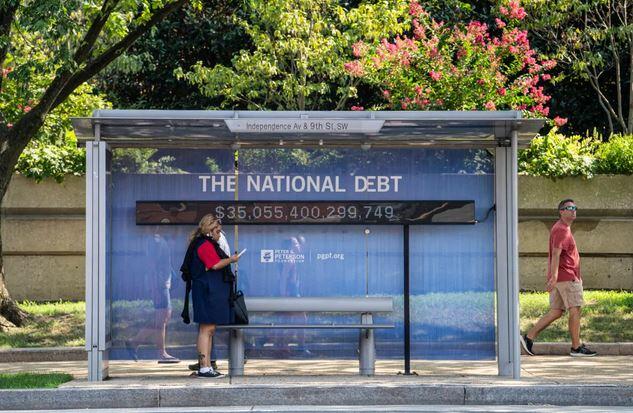
The national debt clock at a bus station in Washington on Aug. 6, 2024. Madalina Vasiliu/The Epoch Times

According to the Committee for a Responsible Federal Budget, the vice president’s previous proposals were projected to raise the debt by $3.5 trillion over the next decade.

Harris maintained her position that she would increase taxes on the wealthy.

When questioned about Congress’s lack of willingness to raise taxes and how she would achieve consensus on the matter, Harris disagreed and said there are “a lot of folks in Congress” who agreed with her plans to raise taxes.

Tyler Durden
Thu, 10/10/2024 – 20:55

“Wow, Absolutely Speechless!”: Northern Lights Visible Across DC, NYC, Boston  

0
“Wow, Absolutely Speechless!”: Northern Lights Visible Across DC, NYC, Boston  

A solar storm classified as “severe” (ranked 4 out of 5 in severity) hit Earth on Thursday and brought stunning displays of the northern lights. 

Look up! 

Whoa. 

Here’s what X users are seeing:

*Developing…

Tyler Durden
Thu, 10/10/2024 – 20:06

Is Gavin Newsom Hoping That Kamala Harris Loses The Election?

0
Is Gavin Newsom Hoping That Kamala Harris Loses The Election?

Authored by Richard Truesdell and Keith Lehmann via American Greatness,

Two minutes of airtime during the Democrat National Convention in Chicago gave California Governor Gavin Newsom his latest opportunity to build his national stature. As part of the announcement of Kamala Harris’s clinching of the Democrat presidential nomination during a symbolic roll call of state delegates, Newsom portrayed Harris as a “star” who “has always done the right thing” for civil rights, LGBTQ rights, social justice, racial justice, and on just about every pet cause on the left.

It says something unspoken that this was Newsom’s only official speaking role at the four-day DNC. It put his high-energy delivery on display, lionizing Harris as the future of the Democrat Party but it seemed to us that he was choking on those words as he spoke them. The contrast between his support for Harris and his thinly veiled presidential ambitions was hard to ignore.

Newsom repeatedly denied that he was ever in the running for the 2024 nomination, yet his high-profile nationwide travels and meetings with government officials in Israel and China demonstrated otherwise. He bought ads in Florida alongside a debate with Florida Governor Ron DeSantis, further adding to the speculation of Newsom’s real intentions.

His passionately vocal support for Joe Biden after Biden’s June 27 debate disaster seemed tailor-made for Biden to hand his post-campaign withdrawal endorsement to Newsom, and perhaps that was Newsom’s intention all along. All he had to do was stay as close as possible to Biden, keep shouting his praises, and the endorsement would surely be Newsom’s.

It wasn’t meant to be. Biden, upon announcing his re-election withdrawal, endorsed Kamala Harris as the Democrat nominee for president within hours, forestalling any attempt at an open convention to nominate Biden’s successor. As we have previously suggested, Biden’s move was intentional as a form of revenge for being shoved out of his re-election efforts by Democrat Party bosses (Obama, Pelosi, and Schumer especially, but there were many Democrats who greased the skids for Biden’s exit after his disastrous debate performance).

Would Newsom have been a better Democrat presidential candidate than Harris? Absolutely.

Now that Harris is the nominee, does Newsom hope that she wins? Absolutely not.

Newsom had everything to gain by supporting Biden at his bleakest moment. Even with missing out on Biden’s endorsement, which we believe caught Governor Hair Gel off guard, Newsom has positioned himself well among Democrats as a dynamic campaigner, a capable fundraiser, and having a strong appeal among Democrat base voters. His purported loyalty to Biden only gave him more visibility and differentiation from other leading Democrats who publicly called for Biden to stand down from his re-election effort. But in the larger scheme of things, was this a political miscalculation on Newsom’s part or a calculated move to best position himself for a 2028 run should Harris lose in four weeks? Time will tell.

With Kamala Harris as the presidential nominee, Gavin Newsom has only to keep his Harris support superficial and work to repair his record at home, letting Harris and others take a majority of the blame for California’s problems. This will be much easier for Newsom if Trump defeats Harris while Newsom makes a token effort to support her.

This also provides Newsom with four convenient years of runway toward a potential presidential run in 2028. His term as California governor expires in 2026, providing an opportunity to shed much of his poor reputation of contributing to California’s demise and to create a new persona. We’re not sure if it will work, but we are sure it will be tried.

And it will require Kamala Harris to lose to Donald Trump. Newsom could pull off this trick in 2028 after a Trump presidency while facing a new Republican candidate, likely JD Vance, who had a great night last week in crushing Tiananmen Tim Walz. But he can’t pull this off in 2028 against an incumbent Harris presidency or in 2032 after two Harris terms in office. That window of opportunity will have closed by then.

A lot of planets will align in 2028 for a Gavin Newsom presidential run, including the entire world’s attention on California for the 2028 Los Angeles Summer Olympics. His state will be glamorized, his failures will be sanitized, and his presidential run will be romanticized in a way only Hollywood can produce. But not if Kamala Harris is the incumbent president, no matter how much she screws things up. That’s what’s called Democrat Political Inertia.

With so many of the serial failures of the Biden-Harris administration piling up and having no capability to convince voters that their misery is simply not happening, Democrats are probably thinking the same thing as Newsom: Take the loss to Trump, unleash more chaos, and hang their lousy economy and the world on fire around Trump’s neck. Then it’s Gavin Newsom to the rescue in 2026! Most Democrats are too stupid and misguided to believe otherwise. We know; we both live here in California and have seen the damage that Newsom has wrought during his two terms as governor.

That is why it is utterly critical to Newsom that Harris loses to Trump this year. Gavin Newsom’s presidential ambitions—and they are significant—rest solely on a Harris defeat. Given his naked ambition and historical disdain for Harris, don’t be surprised to see Newsom torpedo his California rival in some below-the-radar manner to save his political future. We don’t call him Governor Hair Gel without reason. He gives new meaning to the definition of the word “slimy.”

Tyler Durden
Thu, 10/10/2024 – 19:15

Wars Abroad, Natural Disasters At Home… And Biden Said What?

0
Wars Abroad, Natural Disasters At Home… And Biden Said What?

On Thursday Joe Biden mumbled his way through a White House update on Hurricane Milton and the ongoing emergency response, and federal help in Florida. But at one point through the awkward, meandering presser the president was asked the following:

“What did Prime Minister Netanyahu tell you about his plans related to retaliation?” a reporter posed.

“He’s coming over to help with the storm,” Biden said.

Some media outlets are trying to pass off this disturbing exchange as Biden making a “joke”… but really?

After all, Biden has already had a litany of “senior moments” and even the Democrats have long quietly questioned behind closed doors his current fitness to lead as Commander-in-Chief at a moment several flashpoints unfold across the seas (and one of those involves NATO showdown with nuclear-armed Russia).

Only the day prior he held a “direct” 30-minute phone call with the Israeli leader as the Mideast region is on the brink of witnessing a possibly major war between Iran and Israel.

Little has been said in the aftermath of the phone call, only that the two sides are closing the gap and coming to an understanding of how Israel will respond militarily. But what remains is that the region is certainly on the brink, and thousands are dying in Lebanon, Gaza, and Israel as missiles fly across borders – and ground fighting expands.

There was another strange moment, at a time Americans are dying in natural disasters at home and at a moment US troops are in harm’s way in the Middle East…

 “Mr. President Trump, former President Trump – get a life man, help these people.”

As one conservative X account pointed out… Reminder: Trump is a private citizen who is helping people affected by Hurricane Helene and Milton.

What is clear from from Thursday’s strange public hurricane response update is that somebody is running things over at the White House and it ain’t Joe Biden.

Tyler Durden
Thu, 10/10/2024 – 18:50

Disinformation Isn’t The Problem… Government Coverups And Censorship Are The Problem

0
Disinformation Isn’t The Problem… Government Coverups And Censorship Are The Problem

Authored by John & Nisha Whitehead via The Rurtherford Institute,

“What makes it possible for a totalitarian or any other dictatorship to rule is that people are not informed; how can you have an opinion if you are not informed? If everybody always lies to you, the consequence is not that you believe the lies, but rather that nobody believes anything any longer… And a people that no longer can believe anything cannot make up its mind. It is deprived not only of its capacity to act but also of its capacity to think and to judge. And with such a people you can then do what you please.”

– Hannah Arendt

In a perfect example of the Nanny State mindset at work, Hillary Clinton insists that the powers-that-be need “total control” in order to make the internet a safer place for users and protect us harm.

Clinton is not alone in her distaste for unregulated, free speech online.

A bipartisan chorus that includes both presidential candidates Kamala Harris and Donald Trump has long clamored to weaken or do away with Section 230 of the Communications Decency Act, which essentially acts as a bulwark against online censorship.

It’s a complicated legal issue that involves debates over immunity, liability, net neutrality and whether or not internet sites are publishers with editorial responsibility for the content posted to their sites, but really, it comes down to the tug-of-war over where censorship (corporate and government) begins and free speech ends.

As Elizabeth Nolan Brown writes for Reason, “What both the right and left attacks on the provision share is a willingness to use whatever excuses resonate – saving children, stopping bias, preventing terrorism, misogyny, and religious intolerance – to ensure more centralized control of online speech. They may couch these in partisan terms that play well with their respective bases, but their aim is essentially the same.”

In other words, the government will use any excuse to suppress dissent and control the narrative.

The internet may well be the final frontier where free speech still flourishes, especially for politically incorrect speech and disinformation, which test the limits of our so-called egalitarian commitment to the First Amendment’s broad-minded principles.

On the internet, falsehoods and lies abound, misdirection and misinformation dominate, and conspiracy theories go viral.

This is to be expected, and the response should be more speech, not less.

As Justice Brandeis wrote nearly a century ago: “If there be time to expose through discussion, the falsehoods and fallacies, to avert the evil by the processes of education, the remedy to be applied is more speech, not enforced silence.”

Yet to the government, these forms of “disinformation” rank right up there with terrorism, drugs, violence, and disease: societal evils so threatening that “we the people” should be willing to relinquish a little of our freedoms for the sake of national security.

Of course, it never works out that way.

The war on terror, the war on drugs, the war on illegal immigration, the war on COVID-19: all of these programs started out as legitimate responses to pressing concerns only to become weapons of compliance and control in the government’s hands.

Indeed, in the face of the government’s own authoritarian power-grabs, coverups, and conspiracies, a relatively unfettered internet may be our sole hope of speaking truth to power.

The right to criticize the government and speak out against government wrongdoing is the quintessential freedom.

You see, disinformation isn’t the problem. Government coverups and censorship are the problem.

Unfortunately, the government has become increasingly intolerant of speech that challenges its power, reveals its corruption, exposes its lies, and encourages the citizenry to push back against the government’s many injustices. Every day in this country, those who dare to speak their truth to the powers-that-be find themselves censored, silenced or fired.

While there are all kinds of labels being put on so-called “unacceptable” speech today, the real message being conveyed by those in power is that Americans don’t have a right to express themselves if what they are saying is unpopular, controversial or at odds with what the government determines to be acceptable.

Where the problem arises is when you put the power to determine who is a potential danger in the hands of government agencies, the courts and the police.

Remember, this is the same government that uses the words “anti-government,” “extremist” and “terrorist” interchangeably.

This is the same government whose agents are spinning a sticky spider-web of threat assessments, behavioral sensing warnings, flagged “words,” and “suspicious” activity reports using automated eyes and ears, social media, behavior sensing software, and citizen spies to identify potential threats.

This is the same government that keeps re-upping the National Defense Authorization Act (NDAA), which allows the military to detain American citizens with no access to friends, family or the courts if the government believes them to be a threat.

This is the same government that has a growing list—shared with fusion centers and law enforcement agencies—of ideologies, behaviors, affiliations and other characteristics that could flag someone as suspicious and result in their being labeled potential enemies of the state.

For instance, if you believe in and exercise your rights under the Constitution (namely, your right to speak freely, worship freely, associate with like-minded individuals who share your political views, criticize the government, own a weapon, demand a warrant before being questioned or searched, or any other activity viewed as potentially anti-government, racist, bigoted, anarchic or sovereign), you could be at the top of the government’s terrorism watch list.

Thus, no matter how well-meaning the politicians make these encroachments on our rights appear, in the right (or wrong) hands, benevolent plans can easily be put to malevolent purposes.

Even the most well-intentioned government law or program can be—and has been—perverted, corrupted and used to advance illegitimate purposes once profit and power are added to the equation. For instance, the very same mass surveillance technologies that were supposedly so necessary to fight the spread of COVID-19 are now being used to stifle dissent, persecute activists, harass marginalized communities, and link people’s health information to other surveillance and law enforcement tools.

We are moving fast down that slippery slope to an authoritarian society in which the only opinions, ideas and speech expressed are the ones permitted by the government and its corporate cohorts.

The next phase of the government’s war on anti-government speech and so-called thought crimes could well be mental health round-ups and involuntary detentions.

Under the guise of public health and safety, the government could use mental health care as a pretext for targeting and locking up dissidents, activists and anyone unfortunate enough to be placed on a government watch list.

This is how it begins.

In communities across the nation, police are already being empowered to forcibly detain individuals they believe might be mentally ill, based solely on their own judgment, even if those individuals pose no danger to others.

In New York City, for example, you could find yourself forcibly hospitalized for suspected mental illness if you carry “firmly held beliefs not congruent with cultural ideas,” exhibit a “willingness to engage in meaningful discussion,” have “excessive fears of specific stimuli,” or refuse “voluntary treatment recommendations.”

While these programs are ostensibly aimed at getting the homeless off the streets, when combined with advances in mass surveillance technologies, artificial intelligence-powered programs that can track people by their biometrics and behavior, mental health sensor data (tracked by wearable data and monitored by government agencies such as HARPA), threat assessments, behavioral sensing warnings, precrime initiatives, red flag gun laws, and mental health first-aid programs aimed at training gatekeepers to identify who might pose a threat to public safety, they could well signal a tipping point in the government’s efforts to penalize those engaging in so-called “thought crimes.”

As the Associated Press reports, federal officials are already looking into how to add “‘identifiable patient data,’ such as mental health, substance use and behavioral health information from group homes, shelters, jails, detox facilities and schools,” to its surveillance toolkit.

Make no mistake: these are the building blocks for an American gulag no less sinister than that of the gulags of the Cold War-era Soviet Union.

The word “gulag” refers to a labor or concentration camp where prisoners (oftentimes political prisoners or so-called “enemies of the state,” real or imagined) were imprisoned as punishment for their crimes against the state.

The gulag, according to historian Anne Applebaum, used as a form of “administrative exile—which required no trial and no sentencing procedure—was an ideal punishment not only for troublemakers as such, but also for political opponents of the regime.”

This age-old practice by which despotic regimes eliminate their critics or potential adversaries by making them disappear—or forcing them to flee—or exiling them literally or figuratively or virtually from their fellow citizens—is happening with increasing frequency in America.

Now, through the use of red flag laws, behavioral threat assessments, and pre-crime policing prevention programs, the groundwork is being laid that would allow the government to weaponize the label of mental illness as a means of exiling those whistleblowers, dissidents and freedom fighters who refuse to march in lockstep with its dictates.

Each state has its own set of civil, or involuntary, commitment laws. These laws are extensions of two legal principles: parens patriae Parens patriae (Latin for “parent of the country”), which allows the government to intervene on behalf of citizens who cannot act in their own best interest, and police power, which requires a state to protect the interests of its citizens.

The fusion of these two principles, coupled with a shift towards a dangerousness standard, has resulted in a Nanny State mindset carried out with the militant force of the Police State.

The problem, of course, is that the diagnosis of mental illness, while a legitimate concern for some Americans, has over time become a convenient means by which the government and its corporate partners can penalize certain “unacceptable” social behaviors.

In fact, in recent years, we have witnessed the pathologizing of individuals who resist authority as suffering from oppositional defiant disorder (ODD), defined as “a pattern of disobedient, hostile, and defiant behavior toward authority figures.”

Under such a definition, every activist of note throughout our history—from Mahatma Gandhi to Martin Luther King Jr. to John Lennon—could be classified as suffering from an ODD mental disorder.

Of course, this is all part of a larger trend in American governance whereby dissent is criminalized and pathologized, and dissenters are censored, silenced, declared unfit for society, labelled dangerous or extremist, or turned into outcasts and exiled.

As I make clear in my book Battlefield America: The War on the American People and in its fictional counterpart The Erik Blair Diaries, this is how you subdue a populace.

The ensuing silence in the face of government-sponsored tyranny, terror, brutality and injustice is deafening.


Tyler Durden
Thu, 10/10/2024 – 18:25

Israel Arrests US Journalist Who Documented Damage From Iran Missile Strike

0
Israel Arrests US Journalist Who Documented Damage From Iran Missile Strike

According to alternative media outlet The Grayzone, the State of Israel has arrested US citizen and Grayzone investigative reporter Jeremy Loffredo just days after he defied censors by posting a report on Iran’s ballistic missile strike, to include documenting the precise location of an apparent impact close to the headquarters of the country’s principal intelligence agency, the Mossad. 

Grayzone journalist Jeremy Loffredo, seen in his last report before being arrested by Israeli authorities 

“I’ve just learned that @loffredojeremy was among the journalists arrested by the Israeli military and is still in jail,” said Grayzone founder and editor-in-chief Max Blumenthal via social media. “His phone has been confiscated. That is all I’m able to say for now.” On Wednesday at midday, Grayzone journalist Aaron Maté wrote that Loffredo had already been held for more than 24 hours.

Russian independent journalist Andrey X said he and Loffredo were among five journalists grabbed by Israeli security forces, with all but Loffredo having been released. No details have yet surfaced about where or why they were arrested.   

On Oct. 1, Iran unleashed multiple waves of ballistic missiles on Israel in retaliation for Israel’s assassination of Hassan Nasrallah, the secretary-general of the Lebanese political and military organization Hezbollah, and Iranian Revolutionary Guards commander Abbas Nilforoushan, among others. Despite compelling video evidence that many of those missiles found their targets, Israel downplayed the effect of the Iranian strike while simultaneously declaring it illegal to report on where missiles hit. 

Undaunted, Loffredo set out to find missile impact sites, and filed a 6-minute video report to The Grayzone‘s YouTube channel, which has nearly 400,000 followers, and to its Rumble channel. In addition to showing the remains of an Iranian missile near Israel’s Nevatim Airbase in the Negev desert, Loffredo was able to find what is almost certainly a huge missile blast site less than a thousand feet from Mossad headquarters.

“This information is missing from all Israeli media reports, due to the fact it’s been officially censored,” said Loffredo in his report, before showing the precise longitude and latitude of the impact site.  

Loffredo found heavily damaged vehicles, caked with concrete, near a 30-foot wide crater less than a thousand feet from Mossad headquarters (Screenshot from Grayzone’s report)

When it comes to challenging Israeli government narratives, The Grayzone has been among the most intrepid outlets in journalism. It was among the first to report on evidence that many Israeli deaths during the Oct 7, 2023 Hamas invasion of Israel were inflicted by the Israeli Defense Forces. The Grayzone was also quick to credibly challenge near-universally-accepted claims that Hamas militants beheaded babies, burned babies in ovens, cut a fetus from its mother, and engaged in mass rape. On this Oct. 7, the outlet released a 44-minute documentary titled, “Atrocity Inc: How Israel Sells the Destruction of Gaza.”

Loffredo’s previous reporting from Israel included a set of candid and, to some, disturbing interviews with nationalist Israelis who were blocking humanitarian aid for war-ravaged Gaza. While it’s not clear why, it’s currently not possible to link directly to Loffredo’s posts on X/Twitter or to embed them.

President Biden claims to stand for press freedom around the world. Let’s see if his administration takes a stand against Israel on behalf of this American journalist…or instead shrugs and redistributes a few more billion dollars of American wealth to the perpetrators. In the meantime, watch Loffredo’s last report before he was seized and locked up: 

Tyler Durden
Thu, 10/10/2024 – 18:00

The Gold Bull Cycle Has Just Begun

0
The Gold Bull Cycle Has Just Begun

Authored by Adam Sharp via DailyReckoning.com,

Cycles surround us. In markets, astronomy, and our lives.

Every day is a circadian cycle for us all. Our bodies move through phases based on our exposure to light or darkness.

Markets are also remarkably cyclical, responding to the environment around them. Interest rates, regulation, monetary policy and investor psychology all play important roles.

Precious metals are no different. The sector’s performance ebbs and flows over time.

From 2000 to 2011, gold crushed the S&P 500:

Source: Charlie Bilello

An even better example is from 1972 to 1980 when gold returned 1,256% to the S&P 500’s 97%.

Of course, stocks take their turn in the spotlight too.

From 2012 to 2021, stocks returned 336% vs gold’s 16%. And from 1980 to 1999, stocks were absolutely dominant as gold went dormant for nearly two decades.

Over the past few years, both have done well.

The point here is that it’s a cycle.

Just take a look at the chart below. It shows the ratio of S&P 500 performance vs gold through 2021.

Source: Charlie Bilello

I believe we switched back to precious metals mode at the beginning of this year. And if this is the beginning of a fresh cycle, we may be in for another 7-plus years of precious metals outperforming stocks.

Given the magnitude of what we’re facing, it could go on longer than that.

Catalysts and Causes

Periods where gold outperforms tend to be chaotic.

Past catalysts have included a crash at the end of a major bull market (1971 and 2000), and an inflationary shift in monetary policy (1971 and 2000).

Wars often play a part as well, as they did in the 1970s (Vietnam and others), and the early 2000s (War on Terror). Wars spike deficits and increase the monetary supply. They also drive safe-haven demand from both central banks and investors.

I believe our situation today fits the bill.

Stocks are still doing well, for now, but markets look expensive. The chart below, from Longview Economics, shows that 90% of U.S. stock sectors are in their top quartile (25%) of historical valuations.

Source: Longview Economics on X

Stocks are richly valued across almost the entire board. This tends to happen near market peaks. And I don’t see any positive catalysts hiding around the corner to drive sustainable real growth.

Of course, the broad bubble in U.S. stocks could go on for longer than we expect, but at this point, I’m more focused on precious metals and even certain foreign markets.

To be clear, I do own U.S. stocks and will continue to.

But during times like these, I lower that exposure and boost my allocation to alternatives, particularly gold and silver.

Macro Looks Bullish for Gold

The U.S. and many other countries are reaching a tipping point with debt. Total global debt just reached $315 trillion, which is 333% of global GDP.

The Federal Reserve just switched into easy-money mode and is likely to fire up formal QE in the near future. China’s central bank just injected massive liquidity to boost its sluggish economy. More countries will follow suit, and global liquidity is poised to surge.

In addition, we have multiple wars and conflicts raging in Yemen, Ukraine, Israel, Iran and beyond. Nascent proxy wars between the US and Russia are quietly breaking out in multiple African countries.

Military spending is booming, with Russia increasing its annual defense spending to 40% of its total budget. And China’s defense spending now rivals the U.S. in terms of purchasing power parity (PPP). Naturally, the U.S. is no slouch in this area and is also ramping up spending and production.

Durable Catalysts

The stage is set for a powerful precious metals bull market cycle. The problems facing the world are not going away anytime soon. Even if all the conflicts end tomorrow, and they won’t, we’re still facing a structural debt problem of unprecedented magnitude.

Further conflict and spending will just add gas to the fire.

For now, markets seem complacent that all is well with the economy. It won’t last forever.  If we get a nice pullback in gold and silver here, and we may well, it’ll be an amazing opportunity to stack up. I will continue to buy on pullbacks.

Tyler Durden
Thu, 10/10/2024 – 17:45