72 F
Chicago
Sunday, October 4, 2026
Home Blog Page 2273

Israel Says 10 Commanders Of Elite Hezbollah Unit Eliminated In Beirut Airstrike

0
Israel Says 10 Commanders Of Elite Hezbollah Unit Eliminated In Beirut Airstrike

Update(1305ET): The Israeli military has announced its air strike in Beirut Friday afternoon which killed Ibrahim Aqil, the chief of Hezbollah’s elite Radwan unit, additionally killed in total some ten commanders of the Shia paramilitary group.

“We targeted those responsible for the daily rocket fire, Ibrahim Aqil along with senior commanders from the Radwan force. About 10 commanders were killed there,” Rear Admiral Daniel Hagari, spokesman for the IDF, told a media briefing.

Lebanese sources have yet to confirm this, but have instead focused on the mounting civilian casualties. Lebanon has in its latest update said 12 total have been killed, without identifying who they were. Official tallies stand at 66+ wounded. “Removing the rubble is still ongoing until this moment,” emergency workers said.

* * *

Update(1240ET): The death toll has continued to grow following the Friday after Israeli aerial strike on a southern suburb of Beirut. Lebanon’s Health Ministry says nine people have been killed and at least 59 injured, as emergency crews continue picking though the rubble of a leveled residential building.

Authorities say children are also among the victims in the neighborhood of Dahiyeh, which is densely populated. The Israeli Army says it has killed a top Hezbollah commander, identified as Ibrahim Akil; however, Hezbollah has yet to confirm or deny. He’s said to have served as head of the group’s elite special forces. The state-run Lebanese National News Agency has said five children are among the dead.

Currently some big claims are coming out of Israeli leadership, though these statements remains unconfirmed on the ground… if true it will be a huge blow to Hezbollah:

The Iranian Embassy in Beirut has meanwhile condemned what it called the “Israeli madness” of targeting residential buildings.

* * *

Many international headlines are claiming that this is not yet ‘all-out war’ between Israel and Hezbollah, but it is sure looking like a full-fledged war at this point, especially given on Friday Israeli aircraft carried out a major strike on Beirut.

Huge explosions could be seen and heard for miles, in an apparent “targeted strike” on a southern suburb of the capital city. Reports say that senior Hezbollah commander Ibrahim Akil was killed in the attack. An official has told AFP he was killed in the strike.

Videos and images from the scene show entire blocks and buildings decimated in the heavily-populated area known as Dahiyeh.

Beirut-based Al-Mayadeen TV is saying that a drone fired several missiles on the area in a very rare and brazen attack on the capital. But a Lebanese national broadcaster has said it was Israeli Air Force Jets:

Lebanon’s National News Agency (NNA) is reporting that five children are among victims of a strike on a building in the area of Jamous Street, southern Beirut.

The agency added that an F35 jet targeted the residential area with two strikes.

Earlier in the day Friday Hezbollah launched at least 140 rockets on northern Israel, in a steady uptick of attacks since Thursday in the wake of Hezbollah Secretary-General Hassan Nasrallah’s speech vowing not to stop the attacks in the wake of Israeli intelligence’s pager attack.

And regional media is reporting further on this major escalation: “It is not the first time that Beirut’s southern suburb is targeted, but images emerging from the scene show a building almost totally destroyed, so it is likely there will be civilian casualties,” an Al Jazeera correspondent writes.

In the wake of this new Beirut action, Israel’s President Isaac Herzog has said on X the Gaza war and new operations in Lebanon are necessary to bring “the displaced citizens from north and south to their homes, schools, and businesses.” Some 80,000 or more have been evacuated from their homes since Oct. 2023.

The scene below suggests the attack was carried out by several missiles, likely launched from a jet which can carry heavier munitions.

“I repeat again and again – we did not want this war. We do not want war – not today, not ever,” President Herzog wrote further. “Last night, we saw the precise and impressive actions of Israel’s Air Force against Hezbollah. We salute them, along with all our security forces, for their tremendous efforts in this difficult war,” he added.

Aqil has also long been wanted by the United States:

developing…

Tyler Durden
Fri, 09/20/2024 – 13:05

NY COVID Czar Attended Drug-Fueled ‘Lockdown Sex Parties’ While Crafting Policy To ‘Force’ Vaccinations

0
NY COVID Czar Attended Drug-Fueled ‘Lockdown Sex Parties’ While Crafting Policy To ‘Force’ Vaccinations

Dr. Jay K. Varma, New York City’s former top public health advisor during the pandemic, was caught on camera bragging about attending drug-fueled sex parties and dance events, even as he instructed millions of New Yorkers to stay home and socially distance. The bombshell revelations have sparked outrage across the city, with politicians and residents alike accusing the former official of blatant hypocrisy.

The footage, released Thursday by conservative podcaster Steven Crowder, shows Varma, who served under then-Mayor Bill de Blasio, detailing his pandemic escapades, which included hosting a sex party in a hotel room and attending a massive underground dance party beneath a Wall Street bank.

“I had to be kind of sneaky about it,” Varma admits in the video, speaking casually to a woman off-camera. “I was running the entire Covid response for the city.”

At the time, public health officials in New York, like those in cities and countries around the world, were frantically seeking to contain the virus and Covid’s rising death toll by encouraging people to wear masks and avoid large gatherings. New York City schools were abruptly closed beginning in March 2020. Indoor dining in restaurants was forbidden. Masking indoors in public places was mandatory. –NYT

“I’m gonna make it really fu*king hard to be unvaccinated,” Varma told his undercover date. “I actually was the one who convinced the Mayor to make it a mandate[vaccine].”

In a statement, Varma didn’t dispute the authenticity of the recordings but claimed they had been “spliced, diced and taken out of context.” He admitted attending three gatherings between August 2020 and June 2021, while advising millions to limit their interactions.

“I take responsibility for not using the best judgment at the time,” Varma said, attempting to downplay the scandal. But the damage was done. The video shows Varma casually describing the events, including a sex party he and his wife hosted with up to 10 people — technically within legal limits for indoor gatherings at the time — and a dance party with over 200 people in a hidden Wall Street venue.

Critics Slam

“This was the public health expert for the city while it was shut down – he was busy having sex parties,” fumed City Councilman Robert Holden, a Democrat from Queens, calling for an investigation. “It’s alarming, especially with so many first responders, city workers, and everyday New Yorkers losing their jobs.”

Joseph Borelli, the Republican minority leader of the City Council, echoed the outrage: “I recall being treated like a pariah for pointing out the obvious at the time — that so many of our so-called leaders were just making up illogical rules as they went along,” Borelli told the Times. “Still, even I couldn’t have predicted how full of it they actually were.”

Several lawmakers fumed over the newly released footage, with Councilmember Joann Ariola (R-Queens) telling The Post it showed the “perverse corruption” of the de Blasio administration.

“This guy was running around living like a drug-fueled Caligula, mandating that ordinary New Yorkers suffer in lockdown and lose their livelihoods while he throws himself parties that could make a rock star blush,” Ariola said.

“Dr. Varma’s pathetic attempt to impress a date further revealed what we all knew — that the ‘leaders’ who shut down businesses, told us not to celebrate Thanksgiving, and fired workers for not taking the vaccine, have always been absolutely full of s–t,” added Councilmember Joe Borelli (R-Staten Island). –NY Post

Varma’s outings have drawn comparisons to other high-profile cases of political hypocrisy during the pandemic, such as Boris Johnson’s infamous lockdown parties in the UK and California Governor Gavin Newsom’s elite dinner at the French Laundry. But in New York, where Covid-19 hit harder than almost anywhere else in the world, Varma’s transgressions are being seen as especially egregious.

A spokesman for Varma, Chris Vlasto, sought to defend the disgraced doctor, claiming that the Wall Street dance party took place in June 2021, after Varma had left his official position at City Hall and transitioned to a part-time consultancy role. Vlasto was mum on the August 2020 hotel party, however, where Varma said he and his wife hosted eight to 10 guests.

“I stand by my efforts to get New Yorkers vaccinated against Covid-19,” Varma said in his statement, pushing back against what he described as a smear campaign from “right-wing extremists” aimed at discrediting public health.

The scandal couldn’t come at a worse time for the city’s already embattled public health apparatus. Varma, who had played a key role in shaping the city’s vaccine policies — including barring Brooklyn Nets star Kyrie Irving from playing in New York for refusing the shot – is now being accused of living by a different set of rules during the pandemic.

Some city workers, fired for refusing to comply with vaccine mandates, are now demanding that their cases be reexamined in light of Varma’s behavior.

Varma has since moved on to the private sector, taking up a role as a professor at Weill Cornell Medical College and serving as the executive vice president at SIGA Technologies, a pharmaceutical company. De Blasio, who had previously praised Varma’s pandemic leadership, remained silent, declining to respond to multiple requests for comment.

Tyler Durden
Fri, 09/20/2024 – 13:05

Oklahoma Removes Over 450,000 Ineligible Voters From Rolls

0
Oklahoma Removes Over 450,000 Ineligible Voters From Rolls

Authored by Caden Pearson via The Epoch Times,

Gov. Kevin Stitt (R-Okla.) said on Wednesday that Oklahoma has removed over 453,000 ineligible and inactive voter registrations as part of a process to keep voter lists accurate.

State officials said the law requires Oklahoma to update voter lists to ensure only eligible voters participate in elections. The audit and removal of names began in early 2021 to keep voter lists up-to-date, according to the governor’s office.

Since then, almost 100,000 deceased people, over 140,000 who moved out of state, more than 5,000 convicted felons, and nearly 200,000 inactive voters have been removed from voter rolls.

Inactive voters are those who did not respond during the address checks.

“Voting is our most sacred duty as Americans— and every Oklahoman wants to know their vote is securely cast and properly counted,” Stitt said in a Sept. 18 statement.

Just over 2 million people were registered to vote in Oklahoma as of the end of August, half of whom are registered as Republicans, according to data from the state Election Board. Oklahoma has over 534,000 registered Democrats, over 363,000 Independents, and more than 18,000 Libertarians.

The governor said state officials have gone above and beyond to ensure only eligible Oklahomans can vote in the state’s elections.

“All this is going to do is discourage people who are already less inclined to show up to the polls anyway in a deeply red state,” said Democratic state lawmaker Rep. Mauree Turner, who represents Oklahoma City, in comments to Oklahoma Voice.

“My first thought is how many people are in there that have been purged and don’t know that they’ve been purged.”

Secretary of State Josh Cockroft said the steps were necessary and taken in collaboration with the governor’s office, state election officials, and lawmakers.

“We’ve aggressively pursued policies to ensure voting is secure and accurate, and we’re innovating to protect our elections from emerging technology like AI,” Croft said.

“In Oklahoma, every eligible citizen will have their vote counted and their voice heard.”

In recent years, Oklahoma has implemented a range of election integrity measures. The state continues to use hand-marked paper ballots, which are counted by e-scan machines that are not connected to the internet.

Election officials also work closely with Oklahoma Cyber Command to protect the system from potential hackers.

Paul Ziriax, secretary of the bipartisan State Election Board, said the state’s election security is among the best in the nation.

“Oklahoma has a long tradition of doing elections right,” Ziriax said.

“Recounts and post-election audits have consistently proven the accuracy of Oklahoma’s voting system, and our laws and procedures are designed to ensure the integrity and security of our elections.”

Oklahoma residents have until Oct. 11 to register to vote in the Nov. 5 general election.

Tyler Durden
Fri, 09/20/2024 – 12:45

No Gaza Ceasefire Before Biden’s Term Ends: Admin’s Drastic Narrative Shift

0
No Gaza Ceasefire Before Biden’s Term Ends: Admin’s Drastic Narrative Shift

“No deal is imminent,” a US official has said of Gaza talks in Doha and Cairo. “I’m not sure it ever gets done.” A new Wall Street Journal report says the consensus among White House, State Dept, and Pentagon officials is that a deal is unlikely to happen.

These officials naturally laid sole blame on Hamas; however, Israeli opposition officials have charged that Prime Minister Netanyahu has sabotaged efforts at reaching ceasefire at every turn, in order to prioritize the ultimate drawn-out goal of eradicating Hamas, and assuring it can never return to power in the Gaza Strip again.

White House

The same above-mentioned US official asserted that no deal will happen at least until after the US election: “Everyone is in a wait-and-see mode until after the election. The outcome will determine what can happen in the next administration,” the person said.

In the White House briefing room this week there’s been a stark narrative shift, given only a couple of months ago Secretary Blinken was still claiming the sides were at the ‘goal line’ and ever so close to achieving an agreement for the exchange of hostages.

National Security Council spokesman John Kirby, for example said Wednesday that a deal now looks “daunting” while describing that “we aren’t any closer to that now than we were even a week ago.” He still claimed US officials are working hard on getting closer.

It’s proving a huge embarrassment for the Biden administration, also as war is flaring up in Lebanon in tandem with Gaza. WSJ details:

National security adviser Jake Sullivan met Wednesday with the relatives of the remaining seven American hostages held in Gaza, telling them that securing their release was a top priority for the president. But a statement from the families said they “expressed frustration with the lack of tangible progress” to Sullivan, urging the administration to make a deal as soon as possible.

Meanwhile, from talk of “goal line” to “not giving up hope”…

KIRBY: NOBODY HAS GIVEN UP HOPE ON ISRAEL-HAMAS CEASE-FIRE

The US officials who spoke to the WSJ described that the Israeli operation in Lebanon which blew up thousands of pagers and walkie-talkies Tuesday and Wednesday has also served to make an Israel-Hamas deal much more elusive.

They further pointed out the other obvious – that a major regional war centered in southern Lebanon is much more likely at this point. As for the US election, it looks assure that either a future Trump administration or future Harris administration is about to inherit a huge mess in the Middle East. 

But it must be remembered it is also in part a mess of Washington’s own making, given the billions in US weaponry to Israel which has fueled the war, and lack of real US pressure on the sides to do another hostage exchange. So the US is not merely ‘on the sidelines’ in all of this.

Tyler Durden
Fri, 09/20/2024 – 12:25

China’s Collapsing Economy Adds To Headwinds For Japanese Automakers

0
China’s Collapsing Economy Adds To Headwinds For Japanese Automakers

By Momoka Yokoyama, Bloomberg Markets Live reporter and strategist

Shares of Japanese automakers are finding no respite as China’s deepening economic woes damp sentiment already weighed down by concerns over a US slowdown and a rebound in the yen.

The three biggest in Japan — Toyota Motor Corp., Honda Motor Co. and Nissan Motor Co. — slashed production in China as they lose market share to local manufacturers of electric vehicles and a slumping housing market weighs on domestic consumption. The companies relied on the world’s largest automobile market for more than 16% of their sales in July.

Automakers worldwide are seeing sales slump in China amid a sluggish economy and concerns the nation’s producers will pose a competitive threat to incumbent names. A slight improvement in China’s consumption during a major holiday this week from its pre-pandemic level did little to lift sentiment.

“China’s weak domestic demand will have a global impact, and that will be quite a terrible story for Japan too,” said Tetsuo Seshimo a portfolio manager at Saison Asset Management in Tokyo.

Automakers are trying to adapt to the new landscape. Honda has cut jobs and paused production at plants in China amid an effort to trim inventories and work on a broader shift in strategy. Nissan said in June that it ceased production at a plant in Changzhou. That was preceded by Mitsubishi Motors Corp.’s move last year to suspend local operations as car sales slumped and China shifted to electric vehicles.

The effort may be too little, too late. Japan’s automobile-related shares are down 17% this quarter, the second-worst performer of the Topix’s 33 industry groups. Their index is headed for a sixth month of declines after Japan’s auto exports to China plunged almost 31% in August from a year earlier.

But growing optimism that the US will avoid a recession may help stem future losses after the Federal Reserve cut interest rates by 50 basis points in a push to preserve the strength of the world’s largest economy.  

An overwhelming majority in a survey of Bloomberg Terminal subscribers expect a soft landing for the US economy, with 75% forecasting that it will avoid a technical recession by the end of next year.

Japan’s three largest automaker get at least 39% of their revenue from North America, making it their biggest overseas market, according to data compiled by Bloomberg.  

However, an economic slump in China isn’t the only concern for automakers, said Saison Asset’s Seshimo. China’s growing auto industry may gradually take market share away from Japan’s carmakers, causing them to suffer the same fate as the nation’s appliance makers, he said.

Chinese automaker BYD Co. already has 40% of total EV volume in Thailand compared with Japanese brands at under 1%, according to Bloomberg Intelligence analysts Steve Man and Joanna Chen.

“Chinese companies are likely to go on offense with a pricing war abroad, potentially intensifying competition with the Japanese names,” said Mamoru Shimode, chief strategist at Resona Asset Management.

Tyler Durden
Fri, 09/20/2024 – 12:05

“If Someone Breaks In My House, They’re Getting Shot” – Kamala & Oprah’s Celebrity Lovefest Almost Ignored By Legacy Media

0
“If Someone Breaks In My House, They’re Getting Shot” – Kamala & Oprah’s Celebrity Lovefest Almost Ignored By Legacy Media

In an effort to unite voters and surge turnout for the 2024 election, Vice President Kamala Harris and media mogul Oprah Winfrey hosted a virtual event in battleground Michigan on Sept. 19.

It has been 61 days since President Joe Biden announced his withdrawal from the race and anointed his VP; in that time, she has yet to hold a press conference.

Filmed from a studio in Farmington Hills and live-streamed online, their “Unite for America” featured personal stories related to the issues Harris champions, including abortion access and ending gun violence. She also fielded questions on immigration and the rising cost of living.

Every candidate can look calm, relaxed, and in control when they know that no difficult questions or thorny issues are headed their way.

As Ms. Harris notches up a string of friendly encounters, the public is left wondering whether she has the capability to deal with anything more challenging.

And these concerns are beginning to reverberate beyond the electorate.

As Jacob Burg reports via The Epoch Times, the 90-minute event showcased more than 140 pro-Harris grassroots groups appearing virtually to appeal to undecided voters in key battleground states and throughout the country.

“Tonight is all about leaving this moment here and figuring out what it is you can do in your own home in your own community, in your own district to spread the word and spread the vote,” Winfrey told the audience.

Harris campaign manager Jen O’Malley Dillon said her team sees the 2024 election as a “margin of error race” statistically.

Many national and swing state polls show that Harris and former President Donald Trump remain neck and neck, even as both candidates crawl toward marginal leads in key states.

“It’s tied right here in Michigan. It’s tied in all the battleground states. So it’s going to take all of us to build a pathway, many pathways, to 270 electoral votes. That’s what we’re focused on,” O’Malley Dillon said.

Tracey Ly, a regional organizing director for the Nevada Democratic Party, appeared by video and said the evening was about getting as many voters active as possible in what is still a razor-thin election.

By the end of the stream, more than 300,000 viewers were watching from home.

Attendees in studio included actors Bryan Cranston, Chris Rock, Julia Roberts, Jennifer Aniston, and Meryl Streep appearing via webcam.

Along with the grassroots organizations, the celebrities were stumping for Harris and urging any remaining undecided voters to support the vice president.

“I do know that I’m in a position to do something about it, so I felt a great responsibility and the incredible power of the people,” Harris said.

“We’re all leaders in this. This is so much bigger than me. It’s about who we are as Americans, and it’s about making clear what we stand for,” Harris added.

Harris answered questions on immigration and the rising cost of living.

When asked how she would solve the country’s illegal immigration crisis, Harris blamed Trump for telling congressional Republicans to vote against the failed bipartisan border bill and reiterated her intention to pursue the legislation if elected.

While discussing her stance on guns, Harris pushed for gun control laws and confirmed that she supports the Second Amendment.

Winfrey said she was surprised when Harris revealed during the ABC debate with Trump that she owned a gun.

“If somebody breaks in my house, they’re getting shot,” Harris joked in response.

“I probably should not have said that; my staff will deal with that later.”

Michigan Gov. Gretchen Whitmer also appeared and underscored the state’s critical battleground status in the race for the Electoral College.

“I think we’ve got to do the hard work. In 2016, we were short 11,000 votes. That’s two votes per precinct, which tells you that a conversation you have with a loved one or a neighbor or a fellow parishioner, whomever in your life you can talk to, we’ve got to do it,” the governor said.

But, as Mark Angelides reports for LibertyNation.com, each topic was an opportunity to emote and display compassion. It was televisual schmaltz of the highest order, failing to demonstrate depth or substance.

Despite the streaming audience numbers, Angelides does point out one fact that is likely worrying the Harris campaign team – the fraying support of the fourth estate.

It is no secret that Kamala Harris is the current darling of the legacy media establishment – as was Joe Biden until about ten minutes after his disastrous debate performance exposed said media as aiding and abetting in his cognitive decline coverup. And yet, what should have been the event of the election season, Oprah Winfrey, in conversation with the potential POTUS, received scant attention from those who relish such celebrity connections.

DC’s most prominent news outlet posted just a single story on its digital front page concerning the event – and this was way below the fold. The New York Times also posted only one story – again, well below the fold. CBS had one; ABC had none. In fact, the only major outlet that headlined the campaign showcase was CNN.

This is not to suggest that the Fourth Estate’s infatuation with whichever candidate has a “D” next to his or her name is over – far from it. But tensions are mounting. A former Los Angeles bureau chief for The Times, Todd Purdum, published a guest piece in his former paper lamenting Harris’ lack of substance in dealing directly with questions. He declared:

“Writing about politicians for decades has convinced me that direct, succinct answers and explanations from Ms. Harris would go a long way – perhaps longer than she realizes – toward persuading voters that they know enough about her and her plans.”

This was not a condemnation, however, but a plea for substance.

He continued, “[I]n a campaign in which Donald Trump fills our days with arrant nonsense and dominates the national discussion … the vice president can’t afford to stick only to rehearsed answers and stump speeches that might not persuade voters or shape what America is talking about.”

Watch the full lovefest below (we dare you!!!)

For decades, the Wolverine State has been part of the “blue wall” of northern states—along with Wisconsin and Pennsylvania – that has leaned toward Democrats in presidential races. Trump broke the “blue wall” in 2016 and won Michigan by less than half a percent of the vote, but Biden clinched the state in 2020 with a margin of more than 2 percent.

Trump and his running mate, Sen. JD Vance (R-Ohio), have made repeat campaign stops in Michigan since the Republican National Convention in July, underscoring the state’s importance in winning the White House.

Tyler Durden
Fri, 09/20/2024 – 09:45

Yen Plunges After Ueda Sees Little Urgency To Hike Rates As “Upside Risks To Inflation Are Easing”

0
Yen Plunges After Ueda Sees Little Urgency To Hike Rates As “Upside Risks To Inflation Are Easing”

After a week full of central bank fireworks, at least there were no surprises from the Bank of Japan last night, which was in focus as it kept policy unchanged, as expected However, after initially rising, the yen tumbled more than 1% after Governor Kazuo Ueda proved less hawkish than many traders expected, especially after his dramatic hawkish pivot back in July when he not only hike rates but signaled an aggressive tightening campaign, crushing the yen carry trade in the process and sparking the biggest Japanese stock market crash since Black Monday. Ueda signaled little urgency to hike rates, and said that upside risks to inflation are easing, pushing the likelihood of an October rate hike further to the sidelines Friday with a cautious message that pointed to ongoing concern over the market meltdown that followed July’s rate increase.

As Bloomberg notes, following a decision to leave the policy rate unchanged at around 0.25%, the BOJ chief appeared to pour cold water on the already slim chances of an early move next month. Then again, this was to be expected after BOJ Deputy Governor Shinichi Uchida already capitulated more than a month ago, signaling that the BOJ would pick stock market stability over inflation control after the August 5 crash.

“The upside risk to prices does appear to be easing given the recent yen strength,” said Ueda, in a remark that sent the currency in the opposite direction to its weakest level against the dollar for the day, plunging more than 1% at one point as it confirmed the BOJ is done tightening.

“There’s some time to confirm certain points when making policy decisions,” he added, referring to the importance of checking on financial markets and the state of overseas economies. Indeed, with Japan’s core CPI already dropping more than 50% from its 2023 high and back to 2%, it is only a matter of time before the recent yen surge sends both CPI – and wage gains – back to zero if not negative.

The BOJ’s two-day meeting kicked off hours after the Fed conducted a long-awaited policy pivot with an outsized interest rate cut. In doing so, the US central bank joined developed market peers including the Bank of England and European Central Bank in launching an easing cycle, a development underscoring the BOJ’s outlier status as the only major central bank on an upward course.  

The yen was down as much as 1.3% versus the greenback, making it the worst-performer among Group-of-10 currencies on Friday, before recovering some losses. Futures contracts for 10-year government bonds rose while overnight-indexed swaps pointed to little chance of the BOJ hiking rates by its October meeting. Swaps suggested just 30% odds of an increase by the December policy gathering.

In a busy week for central banking that saw the Federal Reserve finally embark on rate cuts, the focus of Friday’s events was on the timing of Japan’s next rate hike given an overwhelming consensus the BOJ would stand pat this time. The central bank was seen wanting to monitor the impact of July’s move and to avoid spooking markets again with a surprise.

A hold also keeps the bank out of the spotlight as Japan’s Liberal Democratic Party chooses a new leader on Sept. 27 to take on the role of prime minister. Meanwhile, according to Goldman, Sanae Takaichi may be the next LDP leader and PM. She is a strong supporter of Abenomics and will likely end the BOJ’s hawkish pivot (JPY negative).

Around 70% of economists surveyed before the meeting saw the BOJ on track to raise borrowing costs again by the end of the year with a risk of an early move in October. The governor’s remarks tilted the odds further in favor of December or even January.

“Ueda’s remarks take an October rate hike off the table,” said Hideo Kumano, an economist at Dai-Ichi Life Research Institute and a former BOJ official.

And since by December, Japan’s inflation will be long gone as the country slides into its next recession, the question should be not when the BOJ will hike rates again but rather when it will go NIRP again.

“It’s likely that Ueda intentionally avoided mentioning that the LDP election and a possible national election to follow are adding to uncertainties”, Kumano added; Indeed, the central bank may also want to check on how markets respond to the result of the US election.

And speaking of the coming election, among the nine candidates running to lead Japan’s ruling party, Sanae Takaichi would be the one most likely to complicate the BOJ’s policy normalization plans, as she is known to be an advocate of monetary easing, according to 86% of 36 economists. She’s currently one of the frontrunners alongside Shinjiro Koizumi and Shigeru Ishiba, who are both seen giving the BOJ more free rein to raise rates.

In other words, yet another reason to short the yen, as we told our premium subscribers yesterday.

With the Fed’s move Wednesday intensifying momentum for a global easing campaign, views among BOJ watchers are divided on what sort of trajectory to expect in Japan.

The August market meltdown in the wake of tdoinghe BOJ’s July move triggered the biggest plunge by the Nikkei 225 index in its history, wiping out $1.1 trillion from Japan’s stock market over the course of three trading days. While stock prices have since pared losses, volatility in the market has stayed at the highest among major global indexes.

“I think that the timing of next rate hike will depend on the economic conditions overseas in the coming months, especially in the US,” said Chotaro Morita, chief strategist at All Nippon Asset Management Co. “I see this as rather delaying the BOJ’s policy decisions.”

The BOJ still has plenty of reasons to favor raising rates over the medium term. The bank has repeatedly indicated that real interest rates are still deeply negative and supportive of the economy, but ultimately it all comes down to the wealth effect, and as Japan’s economy slows down, the central bank will have no choice but to boost the stock market through the only means it can: a weaker yen.

Ahead of the Ueda press conference, the bank had raised its assessment of consumer spending, a key engine of economic growth, and cited the need to monitor financial markets. Following another uptick in the inflation rate, it also reiterated that it expects price growth to continue in line with its goal in the latter half of its projection period. The statement earlier in the day had led to some yen strengthening against the dollar that was quickly reversed as Ueda spoke. Having strengthened to 141.74 against the dollar, the yen then reversed course as market players concluded that the wait for the next rate hike might be longer than expected.

“There’s a lack of clarity for the global economy, especially around the US economy,” Ueda said. “Overall, we’re not at a stage where we should immediately hike rates even if certainly rises for our outlook.”

Tyler Durden
Fri, 09/20/2024 – 09:29

Hedge Fund Billionaire: Sell Stocks, Buy Gold If Kamala Wins

0
Hedge Fund Billionaire: Sell Stocks, Buy Gold If Kamala Wins

Hedge fund billionaire John Paulson said he would pull his money out of the stock market and go into cash and gold if Kamala Harris wins the election…

As Mike Maharrey writes at MoneyMetals.com, the Paulson and Co. founder and CEO has been called “one of the most prominent names in high finance.” He’s best known for making billions by betting against the subprime mortgage lending market in 2007.

Paulson appeared on Fox Business’s Claman Countdown and told Liz Claman that he would be “very concerned” if Harris wins the White House and pursues the tax plans and economic policies she’s outlined.

Harris has floated several economic policies on the campaign trail, including raising the corporate tax rate from 21 to 28 percent, taxing unrealized capital gains, and banning grocery “price gouging.”

“I think the uncertainty regarding the plans they outlined would create a lot of uncertainty in the markets and likely lower markets.”

Paulson said the proposed tax on unrealized capital gains on individuals making $100 million or more was particularly troubling and “would cause mass selling of almost everything – stocks, bonds, homes, art – I think it would result in a crash in the markets and an immediate, pretty quick recession.“

When Claman pressed him, Paulson reiterated that he would pull money from the liquid assets from the market and go heavy into gold.

“I think if Harris was elected, I would pull my money from the market. I’d go into cash, and I’d go into gold.”

Paulson is a prominent fundraiser for the Trump campaign, and there is speculation that would be a candidate for Secretary of the Treasury in a Trump administration.

Watch the full interview here…

* * *

Tyler Durden
Fri, 09/20/2024 – 09:20

Nuclear Names Surge After Three Mile Island Planned Restart To Power Microsoft Data Centers

0
Nuclear Names Surge After Three Mile Island Planned Restart To Power Microsoft Data Centers

In what is going to be seen as a major tailwind for up and coming nuclear projects, the owner of Three Mile Island is investing $1.6 billion to revive the plant and has agreed to sell all of its output to Microsoft, which is seeking power for its data centers. 

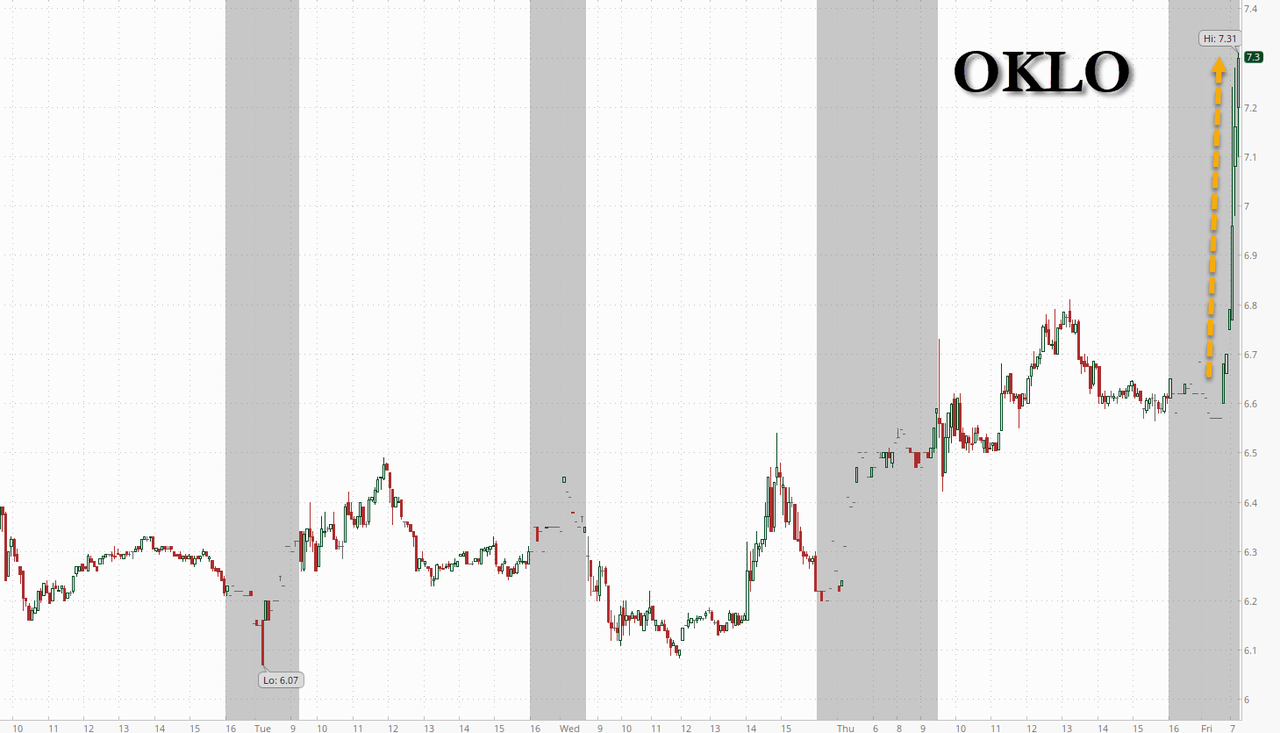
Nuclear startup company Oklo, backed by OpenAI’s Sam Altman, is surging pre-market, up over 10% as investors get their first taste of what will likely be the primary source of power for AI in the decades to come. 

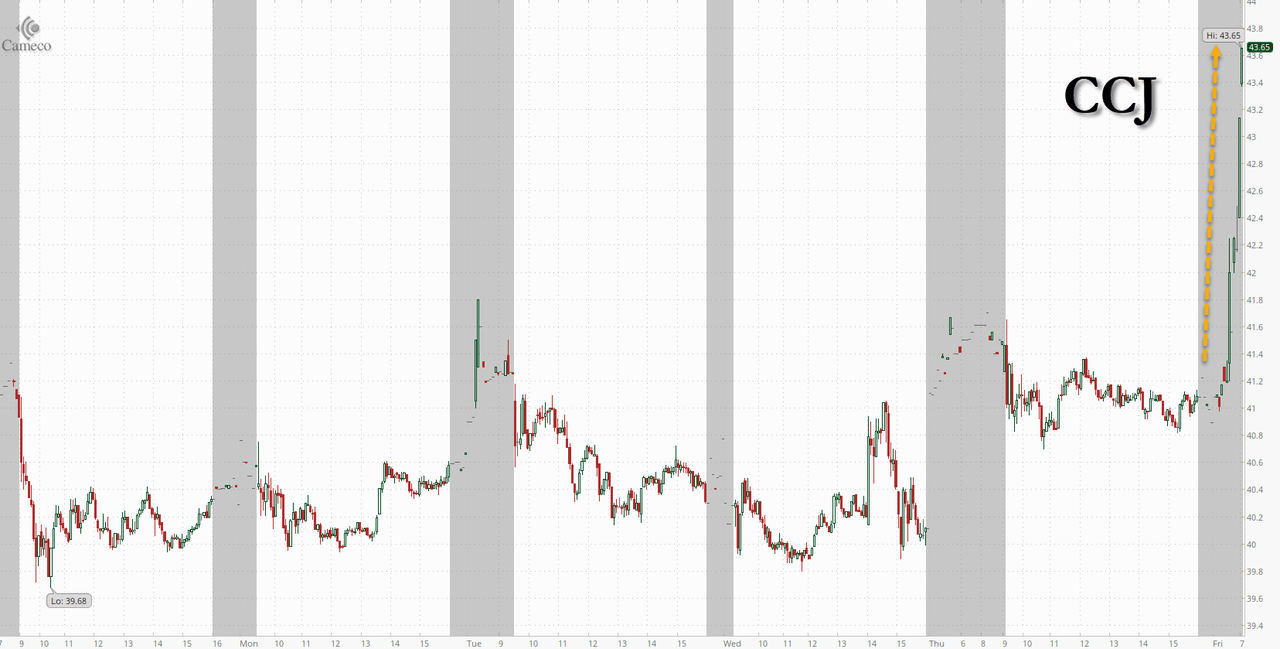
Nuclear names like Cameco are also popping on the news before the cash open Friday morning.

This momentum continues our “Next AI Trade” that we pointed out in April of this year, where we outlined various investment opportunities for powering up America, playing out.

The restart of Three Mile Island, specifically to sell energy to Microsoft to power its data centers, will be the most material advancement in the nuclear/AI thesis since we first outlined it.

Constellation Energy Corp. plans to restart the Three Mile Island reactor by 2028, according to a Friday statement. The reactor, closed in 2019 due to economic challenges, will reopen despite the site’s other unit being shut down nearly 50 years ago after a major nuclear accident, according to Bloomberg.

The Bloomberg report noted that Microsoft has committed to a 20-year energy purchase from a nuclear facility, its first dedicated 100% nuclear energy deal. Financial details were not disclosed.

Constellation Chief Executive Officer Joe Dominguez said: “Policymakers and the market have received a huge wake-up call. There’s no version of the future of this country that doesn’t rely on these nuclear assets.”

An Oklo SMR reactor prototype

Constellation began exploring a restart of the reactor in early 2023 and decided to move forward, attracting Microsoft’s interest, the report says.

Microsoft’s nuclear energy purchase supports its goal to power its global data centers with clean energy by 2025, focusing on regions like Chicago, Virginia, Pennsylvania, and Ohio. The company’s shift to AI is increasing demand for cloud computing, challenging its goal of becoming carbon negative by 2030. Microsoft spent over $50 billion on data-center expansion last fiscal year and expects to surpass that this year.

Recall just days ago it was reported that the two industry giants are prepping the launch of a $30 billion AI investment fund that’ll see Microsoft build data centers and energy projects to meet the demands of AI, according to the Financial Times.

BlackRock’s new infrastructure investment unit, Global Infrastructure Partners, is launching a major investment fund with Microsoft and Abu Dhabi’s MGX as general partners. Nvidia will provide advisory on factory design and integration.

The FT wrote that the partnership aims to tackle the massive power and infrastructure needs of AI development, which is expected to strain current energy systems. AI’s computing demands far exceed past technologies.

The partnership seeks to raise up to $30bn in equity, with plans to leverage an additional $70bn in debt.In a statement, Larry Fink said: “Mobilizing private capital to build AI infrastructure like data centers and power will unlock a multitrillion-dollar long-term investment opportunity.”

Brad Smith, Microsoft’s president, added: “The country and the world are going to need more capital investment to accelerate the development of the AI infrastructure needed. This kind of effort is an important step.”

Jensen Huang of Nvidia added: “Accelerated computing and generative AI are driving a growing need for AI infrastructure for the next industrial revolution.”

So Microsoft is on board…Larry Fink is on board…Jensen Huang is on board…and we’re guessing nuclear names haven’t even left the starting gate yet…

Tyler Durden
Fri, 09/20/2024 – 09:00

Futures Fall As Fed Frenzy Fades And Traders Brace For $4.5 Trillion Quad Witch OpEx

0
Futures Fall As Fed Frenzy Fades And Traders Brace For $4.5 Trillion Quad Witch OpEx

After yesterday’s delayed (and technically-driven) post-rate cut meltup, futures are set to close the week on a downbeat note as they slide across the board, following European stocks lower, but still just shy of the all time high they hit yesterday. As of 8:00am S&P futures are down 0.3% as disappointing earnings (FDX cratered -13% after missing and cutting guidance, dragging UPS -2.4% and logistics names lower) tempered the euphoria around the trajectory for interest rates; Nasdaq futures were down 0.4% with most MegaCap Tech names lower: TSLA (-3.6%) is the top mover, followed by META (-1.8%) and AAPL (-1.7%). The yen plunged more than 1% after the BOJ announced no hike to its policy rate, in line with expectation, and further signaled the gradualist approach to its rate hikes. USDJPY +0.8% to 143.8; NKY +1.5%. PBOC left loan prime rates unchanged. Throwing a potential wrench in what may have been a quiet end to the week is that today brings the ninth option expiry of 2024, and the last “quad witch” before the US election, where a record for September $4.5 trillion in notional will expire between now and 4pm ($2.6 trillion of this is SPX Sep regular / the remaining is split across etf and single stock at end of day) potentially triggering volatility, although market implied vol is low enough to rent delta in either direction. Yields are mostly higher, and USD is largely unchanged; 5-, 10-yr yields are 5bp, 10bp higher. Commodities are mixed with oil and metals higher, while ags are mostly lower. There is nothing on the macro calendar.

In premarket trading, FedEx plunged 14% after the parcel carrier lowed its annual outlook for adjusted earnings per share and revenue growth, while posting a worse-than-expected quarterly profit. Morgan Stanley downgraded the stock and warned Fedex could be facing structural risks. Nike shares rise 6.8% Friday after the company announced Elliott Hill will return to the company as CEO and president effective Oct. 14, replacing John Donahoe, who will retire. Analysts were positive about the announcement as Hill is an industry and company veteran. Here are some other notable premarket movers:

  • Apellis Pharmaceuticals shares drop 7.5% after the drugmaker said a committee of the European Medicines Agency has upheld its negative opinion on the marketing authorization for the company’s eye drug, Syfovre.
  • Assembly Biosciences shares rise 5.4% after Jefferies upgraded the stock to buy from hold ahead of data for the firm’s Herpes simplex virus (HSV) anti-viral drug.
  • Snap shares edge lower, falling 1.2% as B Riley Securities initiated coverage on the social media company with a neutral recommendation. Analyst Naved Khan says the stock is trading at a premium to its peers with a “full” valuation.

The Fed’s bld half-point rate cut this week boosted confidence that it will be able to engineer a soft landing, but warnings such as the one from FedEx underscore lingering risks to the economy. Fed policymakers have projected a further half point of reductions this year.

“For all the optimism in markets right now, it’s clear that a few concerns still lie under the surface,” said Jim Reid, a strategist at Deutsche Bank AG. “In particular, futures are continuing to price in a more aggressive pace of cuts than was implied by the Fed’s dot plot on Wednesday, so investors think they might need to accelerate those rate cuts if downside risks materialize.”

For BofA’s resident bear, Michael Hartnett, the optimism in equity markets following the Fed’s move is stoking the risk of a bubble, making bonds and gold an attractive hedge against any recession or renewed inflation. In his latest Flow Show, he said stocks are now pricing in more Fed easing and about 18% earnings growth for the S&P 500 by end-2025. It doesn’t “get much better than that for risk, so investors are forced to chase” the rally, Hartnett wrote in a note. He also said stocks outside the US and commodities, especially gold, were a good way to play a possible soft economic landing, with the latter being an inflation hedge. And sure enough, gold just hit a fresh record above $2,600 an ounce as the Fed’s aggressive start to policy easing continued to ripple through markets.

Traders are also braced for the quarterly “quad witching,” when about $4.5 trillion in options and derivatives and futures are set to mature according to Goldman, making it the largest September expiry of all time. The options expiry coincides with the rebalancing of benchmark indexes. The event has a reputation for causing sudden price moves as contracts disappear and traders roll over their existing positions or start new ones (full preview here).

Elsewhere, the Bank of Japan was in focus as it kept policy unchanged, with the yen sliding 1.2% as Governor Kazuo Ueda proved less hawkish than some traders expected. Ueda signaled little urgency to hike rates, and said that upside risks to inflation are easing.

European stocks slumped, with the Estoxx 50 falling almost 1% as Mercedes-Benz Group tumbled as much as 8.4% after cutting its financial forecast because of sluggish China sales; besides autos, info tech and consumer discretionary sectors underperformed while utilities and telecommunications stocks are the biggest outperformers. Here are the biggest European movers:

  • Mercedes shares fall as much as 8.4% to nearly a two-year low after the German carmaker cut its 2024 financial forecast in a profit warning that RBC called both surprising and ambiguous
  • Atoss Software gains as much as 2.3% after Deutsche Bank initiated coverage of the German software firm with a buy recommendation, calling it a “leader” in the German-speaking workforce management market
  • Card Factory advances as much as 8.3% and Moonpig +6.8% as UBS recommends buying shares of the UK-listed greetings-card retailers
  • Volution Group shares rise as much as 12% to hit a record high after the maker of indoor air quality products agreed to buy the Fantech Group of companies for up to a total of AUD280 million
  • ASML shares fall as much as 2.7% after Morgan Stanley downgraded the chip-equipment maker to equal-weight from overweight, seeing earnings growth at risk of uncertain demand from memory chipmakers, Intel and China
  • Hexpol falls as much as 7.8%, the most sinceJanuary 2023, after Kepler Cheuvreux reiterated its hold rating ahead of the Swedish polymer and rubber firm’s 3Q report on Oct. 25
  • JDE Peet’s shares fall as much as 8.3% after a shareholder sold about 3.5 million shares in the Dutch coffee maker at a discounted price of €19 per share, according to terms seen by Bloomberg
  • Burberry falls as much as 5.1%, extending yearly losses to 58% and among the worst performers on the Stoxx 600, after Jefferies cut its recommendation on the firm to underperform in a bearish review on the sector, advising investor caution
  • Dr. Martens shares slide as much as 18%, hitting a fresh record low, after an unnamed investor sells around 70 million shares via Goldman Sachs at a 9.8% discount versus Thursday’s close

Earlier in the session,  Asian stocks set its best week in a month as the Federal Reserve’s larger-than-expected rate reduction and hopes of China’s stimulus rekindled appetite for riskier assets. The MSCI Asia Pacific Index rose 0.7% to a two-month high on Friday, taking this week’s advance to 2%. Most benchmarks gained with the Hang Seng China Enterprises Index up for a sixth session. Japanese shares held onto gains as the Bank of Japan kept its monetary policy steady, signaling it’s in no rush to raise interest rates. Financial markets across the region have been upbeat, with a gauge of the region’s currencies reaching a 16-month high this week. The Malaysian ringgit and the Indonesian rupiah have strengthened against the dollar this week.

In FX, the Bloomberg Dollar Spot Index traded in a narrow range against most of its other Group-of-10 peers and swung from losses to gains as the yen first gained then tumbled. And speaking of the yen, it plunged more than 1% after Governor Kazuo Ueda indicated the Bank of Japan isn’t in a hurry to increase interest rates again. The pound outperformed its peers after UK retail sales grew at a faster pace than expected

In rates, treasuries were cheaper across the curve and yields rose in a mild bear-flattening move that partially unwinds the steepening trend advanced by Wednesday’s half-point Fed rate cut. Front-end yields are cheaper by more than 2bp, narrowing 2s10s and 5s30s curve spreads; 10-year around 3.73% is less than 2bp cheaper on the day with bunds and gilts outperforming by 1bp and 2bp.  Treasury coupon auctions ahead next week include 2-, 5- and 7-year note sales Tuesday, Wednesday and Thursday

In commodities, oil was on track for the biggest weekly advance since February. Gold hit a fresh record above $2,600 an ounce as the Fed’s aggressive start to policy easing continued to ripple through markets. 

US economic data calendar is blank; Fed speaker slate includes Philadelphia Fed President Harker at 2pm as well as ECB President Lagarde.

Market Snapshot

  • S&P 500 futures down 0.2% to 5,703.75
  • STOXX Europe 600 down 0.7% to 518.09
  • MXAP up 0.7% to 186.70
  • MXAPJ up 0.7% to 583.56
  • Nikkei up 1.5% to 37,723.91
  • Topix up 1.0% to 2,642.35
  • Hang Seng Index up 1.4% to 18,258.57
  • Shanghai Composite little changed at 2,736.81
  • Sensex up 0.9% to 83,965.54
  • Australia S&P/ASX 200 up 0.2% to 8,209.47
  • Kospi up 0.5% to 2,593.37
  • German 10Y yield little changed at 2.18%
  • Euro little changed at $1.1165
  • Brent Futures down 0.5% to $74.49/bbl
  • Gold spot up 0.9% to $2,610.23
  • US Dollar Index little changed at 100.70

Top Overnight news

  • Japan’s BOJ left rates unchanged, as was widely expected, but said the economy was progressing in a manner consistent with its expectations (the view on consumption was tweaked higher), reinforcing expectations that another hike could occur this year. Nikkei
  • China disappoints markets by leaving its Loan Prime Rates unchanged (some felt the country’s weakening growth outlook, coupled with the Fed’s outsized move, would spur a reduction in the LPR). WSJ  
  • China is working on a proposal to remove home purchase restrictions as the gov’t scrambles to support an economy that continues to cool. BBG
  • The European Central Bank’s rate cutting cycle could accelerate over coming months, governing council member Fabio Panetta said on Thursday. RTRS
  • After months of saying a cease-fire and a hostage-release deal was close at hand, senior U.S. officials are now privately acknowledging they don’t expect Israel and Hamas to reach an agreement before the end of President Biden’s term. WSJ
  • Port of New York/New Jersey executives have begun preparations for a potential complete work stoppage by the International Longshoreman’s Association which is the largest union in North America: CNBC
  • Warren Buffett’s disposals of BofA shares have covered his investment cost of $14.6 billion, leaving him with a stake worth more than $34 billion that’s pure profit. Berkshire Hathaway sold about $900 million of the stock in the latest tranche. BBG
  • OpenAI’s latest fundraising is nearing completion, with prospective investors set to find out Friday whether they’ll be part of the deal, according to people familiar with the matter. The $6.5 billion funding round for the artificial intelligence startup is oversubscribed, meaning investors were hoping to put in more money than the company was ready to take on. BBG
  • Nike (+7% pre mkt) announced that Elliott Hill will become President and CEO, effective October 14, 2024. WSJ
  • FedEx (-14% pre mkt) reported a miss on EPS, margins, and sales due to weak volumes and a mix shift to lower-priced products, and the full-year guidance was trimmed. RTRS

A more detailed look at global markets courtesy of Newsquawk

APAC stocks mostly gained following the rally stateside where the S&P 500 and the Dow surged to fresh record highs as the dust settled after the Fed over-delivered in its first rate cut in four years and US data topped forecasts. ASX 200 followed suit to its US counterparts as tech led the advances and the index printed a new all-time high. Nikkei 225 outperformed again and approached closer to the 38,000 level, while the BoJ policy announcement provided no major fireworks in which the central bank kept its short-term rates unchanged at 0.25%, as unanimously forecast. Hang Seng and Shanghai Comp were mixed with the former joining in on the optimism in the region owing to the recent central bank activity and with EV makers finding some encouragement from recent China-EU EV tariff talks. Conversely, the mainland lagged despite the recent pledge by the NDRC to roll out a batch of incremental measures and reports that China is mulling removing major homebuying curbs, while the PBoC also announced China’s latest Loan Prime Rates which were unsurprisingly maintained at their current levels.

Top Asian news

  • China weighs removing major homebuying curbs to boost demand and may end distinctions between first and second home purchases, while it may also ease restrictions on non-local homebuyers in Beijing and Shanghai, according to Bloomberg. People familiar with the matter also said authorities are mulling measures to shore up the sluggish stock market but didn’t provide specifics.
  • China and EU both aim to resolve differences via consultations over the EU investigation into Chinese EVs, while China’s Commerce Minister and EU’s Trade Commissioner are to continue pushing forward negotiations on price commitments and the sides are to spare no effort to reach a mutually acceptable solution through dialogue, according to Xinhua. This followed a previous report that no deal was reached in EU-China talks on EV tariffs and EU’s Dombrovskis said both sides agreed to intensify efforts to find an effective, enforceable and WTO-compatible solution.
  • USTR office said it will accept public comments from Monday on plans for steep tariff increases on Chinese polysilicon, silicon wafers and tungsten products, according to Reuters.
  • Republican Senator Rubio is introducing a bill to prevent Chinese companies from benefiting from favourable US trade rules by operating in other countries.
  • China’s NDRC will cut retail gasoline and diesel prices by CNH 365/ton and CNH 350/ton respectively, starting September 21, via Bloomberg

European bourses, Stoxx 600 (-0.6%) are entirely in the red, but to varying degrees; price action today has been fairly lacklustre, with indices generally slowly drifting lower as the morning progressed. European sectors hold a strong negative bias; Utilities takes the top spot alongside Telecoms. Autos is by far the clear underperformer, dragged down by Mercedes-Benz (-7.1%) after it cut guidance citing China weakness. Consumer Products and Tech also lag, with the latter hampered by ASML (-2%) after it was downgraded at Morgan Stanley.

Top European news

  • ECB’s Rehn says they have progressed well towards the inflation target, easing pace is data-dependent.
  • ECB’s de Guindos says they have left the door totally open and in December they will have more information than in October.
  • BoE’s Mann says she agrees with investors who think inflation could stay above target for an extended period of time. It is better, under inflation uncertainty, to remain restrictive for longer, until right tail risks to the inflation process dissipate, and then to cut more aggressively. Has a guarded view on initiating a cutting cycle despite agreeing with the majority for a hold at the meeting just concluded. Policy needs to remain restrictive to purge inflationary behaviours. Risk of inflation expectations de-anchoring have subsdided. Did consider voting to cut rates in August but wanted to avoid a “boogie-dance” with policy rates.

BOJ Decision

  • BoJ kept its short-term policy rate unchanged at 0.25%, as expected with the decision made by unanimous vote, while it said Japan’s economy is recovering moderately albeit with some weaknesses and inflation expectations are heightening moderately. BoJ also stated that inflation is likely to be at a level generally consistent with the BoJ’s price target in the second half of its 3-year projection period through fiscal 2026 and it sees medium and long-term inflation expectations increasing. Furthermore, it sees exchange rate trends as having a greater influence on prices and said Japan’s economy is likely to achieve growth above potential but also stated that they must be vigilant to the impact of financial and FX market moves on Japan’s economy and prices.

Ueda press conference

  • Outlook for overseas economies, incl. the US and markets, remains unstable. When asked about remarks from Uchida, says markets remain unstable. Remarks which sparked USD/JPY upside.
  • Upside price risks have decreased given recent FX moves; risks of an inflation overshoot have somewhat diminished.
  • No change to the thinking that they will continue to lift rates if the economy develops as expected; will take the next policy step when there is enough evidence.
  • Aware that more efforts are needed to change market expectations as policy rates have shifted in earnest to positive territory from zero or negative over long period.
  • Need to watch to see if the US economy attains a soft landing, making a judgement on the US is difficult.

FX

  • DXY is steady vs. peers (ex-JPY) in what has been an eventful week for the USD after the Fed delivered an outsized 50bps rate cut and sent DXY to a fresh YTD trough at 100.21.
  • EUR is flat vs. the USD but in close proximity to recent highs. EUR/USD is sitting just below the WTD peak set on Wednesday at 1.1189 with focus on a test of 1.12.
  • GBP is the marginal outperformer across the majors on account of better-than-expected UK retail sales and yesterday’s “hawkish hold” by the BoE which led markets to no longer fully price a 25bps reduction at the November meeting. Cable is off best levels, however, printed another multi-year high earlier in the session at 1.3340.
  • JPY is the laggard across the majors, initially unreactive to the BoJ policy announcement, which kept rates unchanged. However, follow-up remarks from BoJ Governor Ueda gave the impression that the Bank was not in a rush to hike rates further as policymakers assess the impact of prior tightening. Accordingly, USD/JPY rose from a 141.75 base to a 143.75 peak but is yet to eclipse yesterday’s 143.94 peak.
  • AUD/USD’s recent run of gains since Monday has paused for breath with the USD a touch firmer vs. AUD. NZD/USD is seeing uneventful trade with the pair contained within yesterday’s 0.6181-0.6268 band.
  • PBoC set USD/CNY mid-point at 7.0644 vs exp. 7.0637 (prev. 7.0983).
  • Chinese major state-owned banks are seen buying dollars in the onshore currency market to prevent the yuan from strengthening too fast, according to sources cited by Reuters.

Fixed Income

  • USTs are slightly firmer with specifics light thus far for the US but with action coming from the BoJ; while the decision itself was largely uneventful the presser saw a particularly dovish Ueda. Thus far, USTs have probed but failed to breach 115-00 or, by extension, test yesterday’s 115-02+ top. Fed’s Bowman (who dissented at the most recent meeting) is set speak about her decision later.
  • JGBs climbed by almost 30 ticks during Ueda’s speech and potentially driving the broader modest move higher in USTs/EGBs/Gilts across the morning.
  • Gilts gapped lower by nine ticks as the benchmark reaction to UK data points from earlier in the morning with strong Retail Sales (buoyed by good weather) sparking a hawkish reaction in GBP at the time a modest but fleeting move in market pricing. The move ultimately proved fleeting, broadly a factor of the JGB upside.
  • Bunds are towards the top end of a sub-30 tick range with European specifics relatively light aside from a handful of ECB speakers, though commentary was in-fitting with the data-dependent tone and as such did not merit any reaction. At a 134.53 peak, someway shy of Wednesday’s 134.86 best.

Commodities

  • Crude complex is slightly softer largely a factor of today’s subdued market sentiment. Brent’Nov sits near the lower end of a USD 74.40-74.87/bbl parameter.
  • Precious metals are firmer but to varying degrees with spot silver the outperformer, spot gold printing fresh record highs, and spot palladium relatively flat. XAU rose from a USD 2,584.87/oz APAC low to a high of USD 2,612.60/oz in early European hours.
  • Overall a mixed session for base metals amid the cautious tone elsewhere, but industrials are seemingly still supported by the Fed’s 50bps rate cut alongside reports that China weighs removing major homebuying curbs to boost demand, according to Bloomberg.
  • Operator of Kazakhstan’s Karachaganak field says it cut oil output on Sept 9-5 due to maintenance; says it will run another round of maintenance on Sept 23-28.

Geopolitics: Middle East

  • Israel conducted dozens of strikes in south Lebanon in a major intensification of bombing, according to Reuters citing security sources, while Israeli military later said that their fighter jets struck hundreds of rocket launcher barrels in southern Lebanon that were ready to be used immediately to fire toward Israeli territory, according to Reuters.
  • “Senior adviser to (Israeli PM) Netanyahu presented the Biden administration with a new proposal for a ceasefire and the liberation of hostages”, via Al Jazeera citing CNN
  • Hamas source told Al-Arabiya that they are keen to reach an agreement in Gaza.
  • The US doesn’t expect an Israel-Hamas deal before the end of US President Biden’s term, according to WSJ
  • “Russia warns of ‘dire consequences’ if Israel launches large-scale military operation in Lebanon”, according to Al Arabiya.

Geopolitics: Other

  • Russia says it is concerned by increasingly “provocative” NATO activity on the border with Belarus. Russia notes that it has tactical nuclear weapons in Belarus, says Kyiv and the West risk “disastrous consequences” if they pursue provocative scenarios.
  • Russian Foreign Minister Lavrov said they see how NATO is increasing its manoeuvres near the North Pole and that Russia is ready to defend its interests militarily, according to Asharq News.
  • China Defence Ministry spokesperson said US arms sales to Taiwan seriously violated the One-China principle and provisions of China-US joint communiques.

US Event Calendar

  • Nothing major scheduled

DB’s Jim Reid concludes the overnight wrap

Markets put in a buoyant performance over the last 24 hours, as growing optimism about a soft landing and the Fed’s 50bp rate cut pushed risk assets up to new highs. In particular, the S&P 500 (+1.70%) surged to a fresh record, marking its 39th all-time high of 2024 so far, and taking it above its previous peak from mid-July. That was echoed across the board, with credit spreads tightening and oil prices rising, alongside a mounting belief that this economic cycle could still have some way to run.

This belief in the US soft landing got fresh support yesterday from the weekly initial jobless claims. Bear in mind that these are one of the timeliest indicators we have on the US labour market, and they showed claims were down to 219k (vs. 230k expected) in the week ending September 14. That’s the lowest number since May, and there are growing signs that isn’t just a blip, because the 4-week moving average was also down to 227.5k, which is the lowest since early June. The decline may have been boosted by residual seasonality, with strong September declines visible the previous two years. But the release comes on top of other strong data earlier in the week, including the retail sales and industrial production releases for August. Indeed, the Atlanta Fed’s GDPNow forecast is currently at an annualised +2.9% for Q3, almost in line with the +3.0% number in Q2, which doesn’t look like a recession at all.

Obviously it’s early days in this cycle of rate cuts, but so far at least, we appear to be in the benign scenario where the Fed are cutting rates outside of a recession. Historically, that has been a very good combination for equities, as Jim pointed out in his chart of the day earlier this week (link here). Moreover, with the Fed’s decision to cut on Wednesday, that’s adding to the global synchronicity of this monetary policy easing, as many of the developed world central banks are now cutting rates again.

That said, for all the optimism in markets right now, it’s clear that a few concerns still lie under the surface. In particular, futures are continuing to price in a more aggressive pace of cuts than was implied by the Fed’s dot plot on Wednesday, so investors think they might need to accelerate those rate cuts if downside risks materialise. For instance, the median dot signalled a further 50bps of cuts by year-end, with just one member opting for more than that at 75bps. But futures are pricing in 73bps of cuts by the December meeting, so by implication they think it’s more-likely-than-not that the Fed will cut faster than the dot plot.

The other interesting feature of recent sessions has been the recovery in near-term inflation swaps. As recently as September 6, the 2yr inflation swap fell to just 1.98%, which was the lowest it had been since 2020, before the inflation spike began. But over recent sessions, that has recovered back to 2.23%, which is the highest since July 19, before the market turmoil really kicked off in earnest at the start of August. Now clearly that’s pretty low by the standards of recent years. But with fears of a downturn falling back, it’s a sign that markets have become a little bit more cognisant of inflation risk over recent sessions, and gold prices (a classic inflation hedge) closed at another all-time nominal high yesterday of $2,587/oz.

Whilst many central banks have begun to ease policy again, one exception to this pattern of course is the Bank of Japan (BOJ), and their rate hike in July was a contributing factor to the market turmoil in early August. However, in their latest decision overnight, they’ve left their policy rate unchanged, in line with expectations. Their statement warned of “high uncertainties surrounding Japan’s economic activity and prices” and said that “it is necessary to pay due attention to developments in financial and foreign exchange markets”. Separately, data also showed that Japanese inflation picked up as expected, with headline inflation up to a 10-month high of +3.0% in August, having been at +2.8% in July. Against this backdrop, the Japanese Yen has strengthened +0.32% this morning, and is currently trading at 142.18 per US Dollar.

Otherwise in Asia, the region’s equity markets have built on the global rally overnight, with sizeable advances for the Nikkei (+1.90%), the Hang Seng (+1.45%) and the KOSPI (+0.94%). The exception to this have been equities in mainland China, where the CSI 300 (-0.27%) and the Shanghai Comp (-0.23%) are both lower this morning. That comes as the People’s Bank of China left their key lending rates unchanged, with the 1yr loan prime rate staying at 3.35%, and the 5yr loan prime rate at 3.85%.

Those moves in Asia follow a very strong performance in the US and Europe yesterday, with equities surging on both sides of the Atlantic. In the US, this saw the S&P 500 (+1.70%) hit a new record after its best session since early August, with tech stocks leading the way. That meant the NASDAQ was up +2.51%, and the Magnificent 7 saw an even larger gain of +3.44%. Small-cap stocks were another beneficiary, and the Russell 2000 (+2.10%) posted a 7th consecutive advance for the first time since March 2021. Meanwhile in Europe, it was a similar story of tech stocks leading the way, supporting gains for the STOXX 600 (+1.38%), whilst the DAX (+1.55%) hit a new record as well. However, futures are pointing to a pullback again this morning, with those on the S&P 500 (-0.12%) and the DAX (-0.33%) both lower.

Otherwise yesterday, the Bank of England announced their latest policy decision, where they kept their policy rate unchanged at 5%, in line with expectations. That follows their first rate cut of this cycle at the previous meeting, but Governor Bailey warned in a statement that “we need to be careful not to cut too fast or by too much”, even as he said they “should be able to reduce rates gradually over time”. At the meeting, they also voted to reduce their stock of gilts by £100bn over the next 12 months, maintaining the same pace as the previous year.

Against this backdrop, sterling strengthened to its highest level against the US Dollar since March 2022, at $1.3284 by the close yesterday. Similarly against the Euro, it was up to €1.1901. Gilts also underperformed their counterparts elsewhere, with the 10yr yield up +4.5bps, in contrast to yields on 10yr bunds (+0.7bps) and OATs (+1.5bps), which saw smaller rises.

When it came to US Treasuries, there was a fresh bout of curve steepening yesterday, which left the 2s10s at 13bps, the steepest it’s been since June 2022. That steepening has been seen across the yield curve, with the 5s30s up +3.2bps yesterday to 57bps, the steepest since January 2022. That came as the 10yr yield was up +0.9bps to 3.71%, whilst the 2yr yield fell back -3.6bps to 3.58%.

Looking at yesterday’s other data, US existing home sales fell to an annualised rate of 3.86m in August (vs. 3.90m expected), their lowest in 10 months. Separately, the Conference Board’s leading index fell -0.2% (vs. -0.3% expected).

To the day ahead now, and data releases include UK retail sales and German PPI for August. Otherwise, central bank speakers include ECB President Lagarde and the Fed’s Harker.


Tyler Durden
Fri, 09/20/2024 – 08:27