54.4 F
Chicago
Sunday, October 4, 2026
Home Blog Page 2277

US Existing Home Sales Tumble Back Near 14-Year Lows In August

0
US Existing Home Sales Tumble Back Near 14-Year Lows In August

With Housing Starts and Building Permits jumping exuberantly on the heels of declining mortgage rates (and mortgage applications spiking), today’s existing home sales data for August should be an interesting barometer for just how crazy The Fed’s decision to slash rates by 50bps was (with home prices at record highs and rising fast).

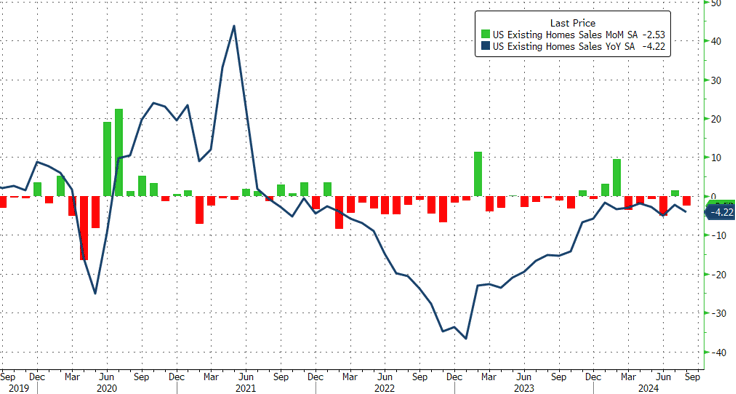
Perhaps shocking to some, existing home sales disappointed in August, dropping 2.5% MoM (vs -1.3% MoM exp) leaving sales down 4.22% YoY.

Source: Bloomberg

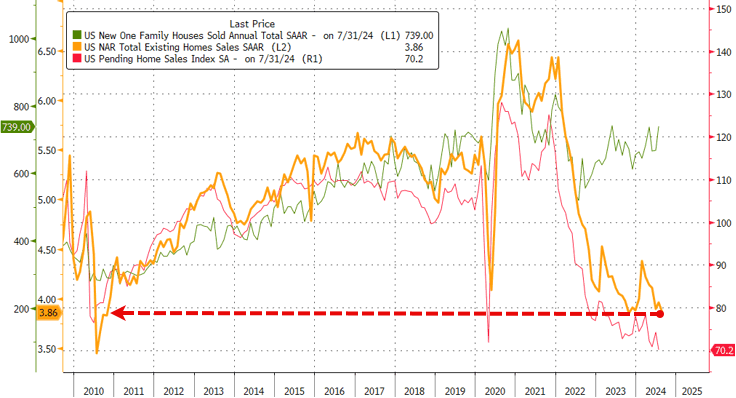
There hasn’t been a positive YoY sales comp since July 2021 as the existing home sales SAAR dropped to its lowest since Oct 2023 (just a smidge above the weakest since 2010)…

Source: Bloomberg

“Home sales were disappointing again in August, but the recent development of lower mortgage rates coupled with increasing inventory is a powerful combination that will provide the environment for sales to move higher in future months,” NAR chief economist Lawrence Yun said in a statement.

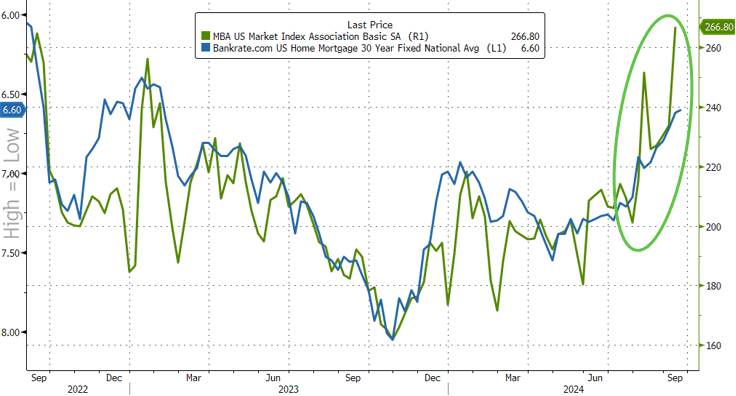
Interestingly , mortgage applications are soaring higher on the back of tumbling mortgage rates (at their lowest since Sept 2022)…

Source: Bloomberg

Which were enabled by The Fed jawboning the new rate-cutting cycle (and now actuating its crisis-level 50bps cut).

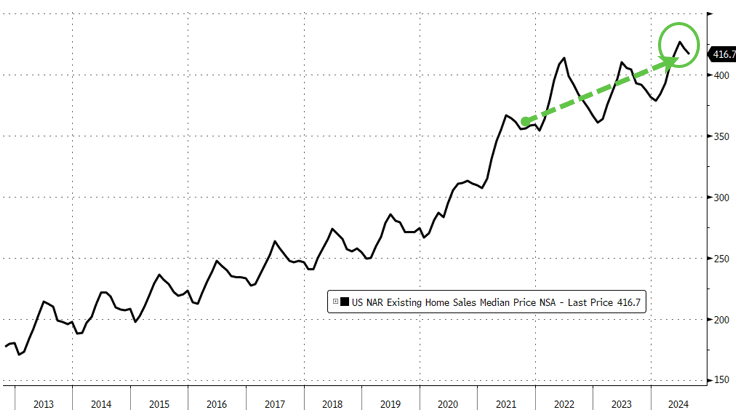
The trouble is, home prices are already at record highs as the rate-cutting cycle begins. The median sales price, meantime, increased 3.1% in the year through August, to $416,700. That was the highest for any August in NAR data.

Source: Bloomberg

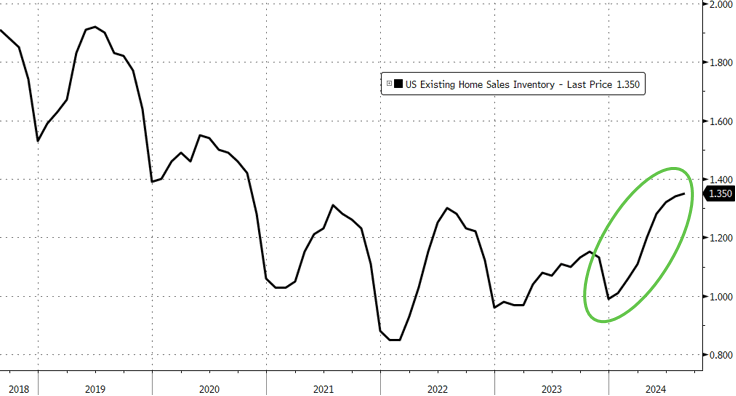
A lack of inventory had been a notable headwind, with many would-be sellers unwilling to put their homes on the market and give up their sub-3% mortgage rates. This so-called lock-in effect has reduced sales by about a million homes a year, Yun has said.

“The rise in inventory – and, more technically, the accompanying months’ supply – implies home buyers are in a much-improved  position to find the right home and at more favorable prices,” Yun added.

“However, in areas where supply remains limited, like many markets in the Northeast, sellers still appear to hold the upper hand.”

In August, NAR’s figures showed 60% of homes sold were on the market for less than a month, compared with 62% in July.

And 20% sold above the list price, compared with 24% a month earlier.

First-time buyers made up 26% of purchases, matching an all-time low.

Individual investors or second-home buyers purchased 19% of homes, compared with 16% a year ago.

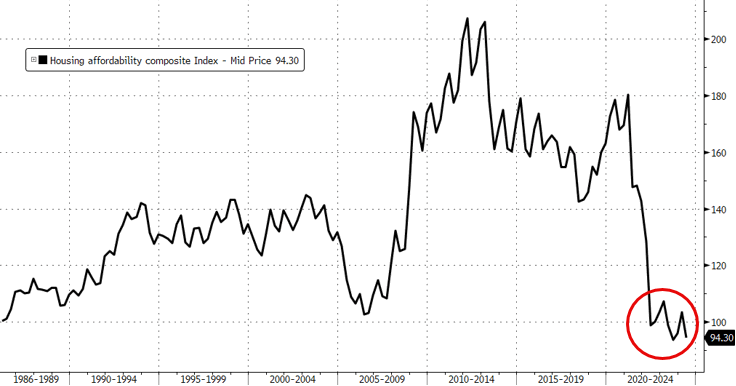
Who will get the blame for lack of affordability now?

Source: Bloomberg

If Trump wins, the answer to that is easy. If Kamala wins, it is corporate greed, durr (and on a side note, prices are soaring alongside inventories… not exactly helping the case for Kamala’s ‘Make Housing Affordable Again’ plan!)

Tyler Durden
Thu, 09/19/2024 – 10:12

Track Live: UPS Jumbo Jets Loaded With iPhone 16s Head To America 

0
Track Live: UPS Jumbo Jets Loaded With iPhone 16s Head To America 

The iPhone 16 is set to hit Apple stores this Friday. Ahead of the launch, the flight tracking website FlightAware is tracking a fleet of UPS air freighters loaded to the brim with new iPhones. This mode of rapid delivery from China to US distribution centers is aimed at meeting the preorder surge, given the time-sensitive nature of these shipments. However, Apple’s decision to rely on fuel-guzzling jumbo jets instead of more eco-friendly container ships raises serious questions about its commitment to sustainability. 

“Once you’ve received your UPS tracking number from Apple, use this page to figure out what flight is carrying your iPhone or Apple Watch. The “departure scan” in your UPS tracking should match the departure time for a flight listed below,” FlightAware wrote on its website. 

FlightAware’s live tracking map shows a fleet of UPS jets loaded with iPhones taking off from Shenzhen Bao’an International Airport—formerly Shenzhen Huangtian Airport—located in the city of Shenzhen in South Central China’s Guangdong province and Hong Kong International Airport. The final destinations are Anchorage International Airport in Alaska and Louisville International Airport in Kentucky. 

In light of this week’s incidents involving exploding pagers, it’s time to ask the question:

FlightAware’s activity log of the UPS jets.

Two reports this week…

… suggest soft demand for more expensive iPhone models. 

Tyler Durden
Thu, 09/19/2024 – 09:50

Key Battle On Election-Betting Market Heads To Appeals Court

0
Key Battle On Election-Betting Market Heads To Appeals Court

Authored by John Haughey via The Epoch Times,

A legal battle over the future of a website’s election prediction market is set to continue on Sept. 19, when an appeals court hears the case of Kalshi v. CFTC, a decision that could reshape how Americans engage in political discourse.

The three-judge U.S. Court of Appeals for the District of Columbia Circuit will be considering whether individuals should be permitted to purchase contracts to participate in predictive markets that trade on the outcome of elections. If so, should these markets be regulated like other financial exchanges and commodity markets or as a form of gambling?

New York-based KalshiEx LLC argues that the elections market section of its website is a derivatives trading platform where participants buy and sell contracts based on projected outcomes of events, such as elections, and should be regulated no differently than grain futures that investors purchase as hedges against price fluctuations.

These markets provide a “public benefit” by gauging public sentiment in real-time, Kalshi maintains, a valuable guide for policymakers, politicians, and pundits in charting the public pulse.

The Commodity Futures Trading Commission (CFTC), which regulates the U.S. derivatives markets, argues that Kalshi’s platform blurs the line between commodity trading and gambling, and should not be viewed the same as futures contracts.

The commission maintains that Kalshi’s market puts it in a position to be a de facto elections regulator, which it is not designed to be. Such contracts provide no “public interest” and, in fact, pose a risk to electoral integrity and could potentially incentivize manipulation and fraud, the CFTC argues.

Those conflicting contentions are the core of what the appellate panel will deliberate on before it decides to lift or sustain its stay on U.S. District Judge Jia Cobb’s Sept. 6 ruling in favor of the platform. Judge Cobbs found that the defendant, CFTC, exceeded its statutory authority as a Wall Street regulator when it issued a September 2023 order stopping Kalshi from going online with its market because it is a “prohibited gambling activity.”

Judge Cobbs on Sept. 12 also denied CFTC’s motion for a stay while it mounts an appeal.

After the initial stay request was rejected, Kalshi wasted little time getting its market online. Attorneys for the CFTC were also busy, and within hours secured a stay from the appeals court, setting the stage for the 2 p.m. Sept. 19 hearing.

In the brief time before trading was paused “pending court process” late Sept. 12, more than 65,000 contracts had been sold on the questions, “Which party will control the House?” and “Which party will control the Senate?”

The appellate panel will essentially be engaged in a technical legal debate over the definition of “gaming” and “gambling,” and how they would apply, in this case, to any potential regulation.

In its Sept. 13 filing calling for the stay to be lifted, Kalshi rejected CFTC’s definition that trading on election prediction markets is “gaming.”

“An election is not a game. It is not staged for entertainment or for sport. And, unlike the outcome of a game, the outcome of an election carries vast extrinsic and economic consequences,” it maintains.

The CFTC said in its Sept. 14 filing that because “Kalshi’s contracts involve staking something of value on the outcome of elections, they fall within the ordinary definition of ‘gaming.’”

‘Horse Has Left the Barn’

Regardless of how the panel rules, “The horse has left the barn,” said data consultant Mick Bransfield, of Pittsburgh, Pennsylvania, who trades on Kalshi’s website and purchased a “Senate control” contract.

There are ample opportunities to place election wagers on offshore websites such as New Zealand-based PredictIt, which imposes strict spending limits; on websites such as Polymarket, a New York-based platform that cannot legally accept wagers from within the United States; or the American Civics Exchange, where businesses and high net worth individuals can purchase “binary derivative contracts” through proxies tied to policy and electoral outcomes as hedges against “unpredictable electoral, legislative, and regulatory events.”

Predictit.org/Screenshot via The Epoch Times

“Elections predictive markets have been around since 1988 in the United States,” Bransfield told The Epoch Times, adding that the issue is “more nuanced than people realize.”

That nuance, said Carl Allen, author of The Polls Weren’t Wrong, is that Kalshi’s platform would be the first federally regulated U.S.-based predictive elections market open to all individuals without spending limits.

“To me, the question is not should it be regulated, the question is how? I think that is where we are,” Allen, who writes about predictive markets on substack, told The Epoch Times.

“It’s challenging to get your arms around this because there are so many organizations involved with it,” he said. “We’re reaching a really interesting point with sports betting going from totally disallowed, except for in Vegas and a few brick-and-mortar [stores], to being everywhere; crypto currency drastically growing; ETFs [Exchange-Traded Funds] getting big;” and Kashi attempting to open a predictive market on election outcomes.

Prediction market trader and Kalshi community manager Jonathan Zubkoff, who also writes about predictive markets and wagering, said the CFTC’s claim that elections markets are betting websites is mistaken.

“It’s not the same as sports betting” where there is “a line posted and billions of dollars are traded against it across different time zones,” prompting the odds to fluctuate, he told The Epoch Times.

“If you are looking at a line [to bet] on a Friday night for a Sunday game, there’s no hedge whatsoever.”

In elections markets, “there actually is a hedge” that gives people an opportunity to put money where “their bias is,” Zubkoff said.

Coalition For Political Forecasting Executive Director Pratik Chougule said another difference between sports betting and other types of gambling and predictive elections markets is that “unlike many other forms of speculation, the wagering here has a real public interest benefit. These markets inform in a way that is very beneficial.”

In October 2023, Chougule told The Epoch Times that elections markets reflect predictive science, citing numerous studies documenting that political betting websites are better indicators of public sentiment than any other measure except the election results themselves, including a study by Professor David Rothschild of the University of Pennsylvania’s Wharton School of Business.

“Polling is very unreliable,” he said. “And so we basically believe that, in order to promote good forecasting for the public interest, we believe that political betting is one solution to that because, at the end of the day when you have people wagering their own money on the line, that creates incentives that are very hard to replicate through other ways.”

Chougule, who hosts the podcast Star Spangled Gamblers, believes that, while not always accurate, election predictive markets are the best gauge of public sentiment in real-time.

“When they make a prediction, they are putting their money on the line,” he said. “It’s a pretty clear barometer of how an election is going.”

‘Gray Area’ Needs Rules

Chougule said he was “pessimistic” that Kalshi’s elections market would be online by Nov. 5.

“I think when you look at the landscape at the federal and state level, at Congress, at federal agencies, [there is] fear and skepticism and concern about what widespread elections betting could mean for our democratic institutions,” he said. “I don’t agree but it’s a fact.”

Bransfield said he was surprised by Cobb’s ruling against the regulators. “It did not seem the district court would side with Kalshi after the oral arguments in May,” he said. “The judge referred to elections contracts as ‘icky.’ That gave me the assumption that it would be unpalatable to her.”

But there is reason to be deliberative, Bransfield said.

“We should always be concerned about the integrity of our elections but these elections contracts have been around for so long,” he said, noting that more than $1 billion in 2024 U.S. elections contracts have already been purchased in the United Kingdom alone. “All those concerns already exist and have for a long time.”

Certainly, Allen said, “there are a lot of downstream effects that we are going to see from this,” but some fears are unfounded.

Unlike a sports contest where one player can affect the outcome, it would take a widespread concerted effort to “fix” an election, he said. Nevertheless, there is “potential for unscrupulous actors to release a hot tip” that could affect predictive markets.

Allen cited speculation about when former South Carolina Gov. Nikki Haley would end her presidential campaign during the Republican primaries, whether Robert F. Kennedy would pull the plug on his independent presidential campaign, and who both parties would pick as their vice presidential candidates as examples.

“A handful of people knew about [vice president picks] before it was public. It would be financially beneficial for someone to throw a couple [of] thousand dollars into that market,” he said.

Prime Minister Rishi Sunak (C) and his wife Akshata Murty (in yellow) at the launch of the Conservative Party general election manifesto at Silverstone race track in Northamptonshire, England, on June 11, 2024. James Manning/PA

The CFTC, in its challenge, noted that bets had been placed on the July 4 British general election date before Prime Minister Rishi Sunak officially announced it in May.

“It is very hard to see this gray area without some rules,” Allen said.

“Claiming that betting in elections is going to lead to issues with democracy and election integrity is one of the most ridiculous things I ever heard,” Zubkoff said, calling them “elections integrity dog whistles.”

Critics “are sort of lashing out,” he continued.

“It is a total misunderstanding. As someone who has traded in these markets, I haven’t seen anything that remotely constitutes a threat” to election integrity.

Zubkoff said Kalshi “very clearly has the better arguments” and cited the Supreme Court’s Chevron repeal as momentum that “bodes well for the future” of predictive elections markets.

He believes the appellate court will deny CFTC’s motion to extend the stay, and placed the odds of Kalshi getting a “yes” to go online before November’s elections at 60 percent.

Zubkoff noted that just like predictive elections markets, those odds could change in real-time during the hearing. “I could give you much better odds while listening to the hearing just based on the questions the judges ask,” he said.

Allen said the odds are “better than 60-40” that Kalshi will win its case, before qualifying that prediction with the ultimate hedge: “I don’t know how much money I would put on that.”


Tyler Durden
Thu, 09/19/2024 – 09:30

Intel Reveals “No Plans To Divest Majority Interest” In Mobileye, Shares Rebound

0
Intel Reveals “No Plans To Divest Majority Interest” In Mobileye, Shares Rebound

Rumors from Bloomberg reporters earlier this month about Intel considering a divestment in Israeli autonomous driving firm Mobileye Global has been debunked by the chipmaker this morning. 

“As the majority shareholder in Mobileye (MBLY), Intel has an unwavering focus on value creation and are excited about the future of its business,” Intel wrote in a statement. 

Intel said, “We currently do not have any plans to divest a majority interest in the company,” adding, “By providing Mobileye with separation and autonomy, we have enhanced its ability to capitalize on growth opportunities and accelerate its path to creating even greater value. We believe in the future of autonomous driving technology and in Mobileye’s unique role as a leader in the development and deployment of advanced driver assistance systems (ADAS).” 

In 2017, Intel bought the Israeli firm for a little more than $15 billion. By 2022, Mobileye debuted on the public markets via an initial public offering in New York. Shares are down 73% on the year, and down 45% from the IPO price.  

Mobileye shares are up 7.5% in premarket trading following the news from Intel. 

Mobileye’s float is 12.7% short, equivalent to about 11.7 million shares. Traders have been unwinding bearish positions since late April.

About a week ago, Goldman’s Mark Delaney told clients, “We are buy-rated on MBLY shares. Our 12-month price target is $24, which is based on 30X applied to our Q5-Q8 EBITDA estimate (ex. SBC).” 

Earlier this week, Intel CEO Pat Gelsinger informed employees about the chipmaker’s next steps in an ambitious turnaround plan, including a deal with Amazon, a pause in European plant expansion, and thousands of more layoffs. 

Tyler Durden
Thu, 09/19/2024 – 09:10

Visualizing Maxed-Out Credit-Cards By Generation

0
Visualizing Maxed-Out Credit-Cards By Generation

In the first quarter of 2024, the nationwide aggregate credit card utilization rate in the U.S. was about 23%, similar to previous quarters, according to the Federal Reserve Bank of New York.

However, as Visual Capitalist’s Kayla Zhu details below, utilization rates vary widely between individuals. About 52% of credit card users were using less than 20% of their available credit in the beginning of 2024, while 18% were using at least 90% of their available credit, which the Federal Reserve sees as being “maxed-out.”

This chart uses data from the Federal Reserve Bank of New York to show the share of U.S. adults in each generation (Gen Z, Millennials, Gen X, and Baby Boomers) that have maxed-out credit cards as of Q1 2024, along with each generation’s median credit limit and median balance as of Q1 2024.

Methodology: Credit Card Utilization and Generations Defined

Credit card utilization is defined by the Federal Reserve as the share of the borrower’s aggregate credit limit being used. When borrowers are using 90% or more of their credit limit, the Federal Reserve considers them “maxed-out borrowers”.

Generations are defined by the Federal Reserve as having been born in the following years:

  • Baby Boomers: 1946 to 1964

  • Gen X: 1965 to 1979

  • Millennials: 1980 to 1994

  • Gen Z: 1995 to 2011

Which Generation Maxes Out Their Credit Card The Most?

Below, we show the percentage of U.S. adults in each generation that have maxed-out credit cards, as well as the median balance and credit limit of each generation.

Younger credit card users typically have higher utilization rates, with this trend decreasing among older generations. Over 1 in 7 Gen Z credit card users were maxed-out borrowers in the first quarter of 2024.

On the other end, fewer than 5% of Baby Boomers have maxed out their credit cards.

However, it’s important to note that Gen Z borrowers have lower median credit limits, averaging $4,500, compared to $16,300 for Millennials and $22,000 for Baby Boomers. Borrowers with lower limits generally have higher utilization rates.

This disparity is largely due to Gen Z’s shorter credit histories and generally lower income, which result in lower credit scores.

While Gen Z has the highest share of credit card delinquency (when payments are at least 30 days late) at 3.1%, Millennials aren’t far behind at 2.9% and as of Q3 2023 were the only generation exceeding their pre-pandemic delinquency levels.

To learn more about the state of debt in the United States, check out this graphic that shows the household debt of OECD countries.

Tyler Durden
Thu, 09/19/2024 – 06:55

Hunger Games Is Fiction No More

0
Hunger Games Is Fiction No More

Authored by Jeffrey A. Tucker via The Epoch Times (emphasis ours),

When “The Hunger Games” first came out more than a decade ago, the dystopia it presented was compelling and sophisticated but also implausible. Lately I wondered how it held up and rewatched the first three films (I don’t know about the others).

My goodness, it was more prescient than it seemed at the time, including the stratification of wealth, the decadence of privilege, the abuse of power, and the complications of resistance. This series exists on many levels, but strikes me as one of the more revealing fictional stories that forecast the overlapping of material decadence, desperate poverty, and the use of fear as a propaganda device.

As a political allegory, it covers the same intellectual terrain as Aristotle’s “Politics,” Machiavelli’s “The Prince,” and de Jouvenel’s “On Power,” but in a way that is more penetrating for readers and viewers, and particularly relevant for our times.

The entire series deals with the greatest conflict in history, that between liberty and power. Those fortunate enough to live in District One, the center of the empire, and socialize with the best, eat well, dress in increasingly preposterous ways (hair dyed in unnatural colors), follow all the trends, go to the right parties, and try to keep with the social scene.

Each of the districts below perform their assigned economic function of keeping the center living in luxury. Borders between them are strictly enforced. Your place in the socio-political order is determined by accidents of birth with no broad economic mobility.

In order to maintain the order and keep rebellion at bay, the leaders in District One hold an annual extravaganza that combines fashion, violent games, and intense political messaging of the dangers of rebellion. Each district is required to send two randomly assigned tributes to the games where they face off in an arena in a battle for their lives with only one winner, as the people at the top watch with intense fascination.

The sheer spectator power of the event is what psychologically ties the elites to the social and political structure, while the fear of being called up as tribute for the games is what impresses upon the population the need for compliance. The scenario is consistent with Carl Schmitt’s principle of the friend/enemy distinction in his “Concept of the Political,” which, he argues, must finally be made real by the shedding of blood.

Those who have followed the story until the final installment might have supposed that the problem was rather stark. One man, President Snow, held all the power. He was a cruel man and he used every means to keep his power. He sat at the center of a capital city that pillaged the districts of resources and held power through fear.

If that is all there is to the problem, the solution would be clear: President Snow has to go. With the source of the problem out of the way, all will be well. This was the thinking of District 12 heroine Katniss Everdeen for most of the series. And one can see why she would believe this. Snow is a ghastly figure, and he was personally responsible for vast cruelty and crimes. He deserves to be overthrown and for justice to prevail.

Plus, she supposes that everyone she knows shares her vision of the final goal: a normal life without oppression, without violence, without pillaging, without rigid geographic and caste classifications, and without televised death matches orchestrated to instill fear in the population.

There was more going on beneath the surface. The capital city of Panem was an autocracy but also the center of a nation-state, which is to say that the bureaucracy, the administrative apparatus, a standing military, a media enterprise, and its methods of rule could survive the death of the leader. This is the difference between a personal state and a nation state. The power apparatus of the nation state seeks immortality, a continuing life regardless who happens to head it.

President Snow is the paranoid autocrat who, Katniss comes to discover, is himself entrapped in a system that he must maintain while seeking a successor. There are masses in the capital to keep entertained, potential betrayers within his own ranks, and rebellions constantly brewing. He knows for certain that his rule is fragile and that an iron hand is the only way to maintain this unstable system.

Another problem is that the system itself is attractive to competitors who long not for freedom as such but rather to inhabit the commanding heights. The problem of creating a world without power, then, becomes more complicated than the overthrow of the existing autocrat.

In every revolutionary situation, those who are most motivated to achieve the aim are those who seek to hold power themselves. So long as the machinery of legal violence exists, there will be those who seek to control it—and, as Hayek said, it is usually the worst who make it to the top and spend their lives seeking to get there. Therefore, it is not just those who rule but also those who seek to rule who constitute a threat to liberty. This is how the existence of powerful nation-states ends up creating multiple layers of dangers.

This is the story of how Rousseau became Robespierre, how Russian liberalism became Bolshevism, and how so many meritorious movements against colonialism and corporatism have ended in dictatorship, tyranny, and famine.

Anyone who seeks to end oppression has to keep his or her eye out for those who would use the chaos and confusion of political upheavals to seize and exercise power in the future. This is what Katniss learns, as she gradually discovers that her one-time allies had become skilled in the conduct of war, appreciative of the status that comes with leadership, and lust for exercising state power themselves.

She comes to discover this dark truth about the rebel armies when the leader herself admits that she has every intention of retaining the Hunger Games as a mechanism of control following a successful coup.

Through this shocking revelation, Katniss learns that great lesson of history: It is not just despots who need to be kept at bay, but also those who most passionately seek to overthrow despots too. In order to realize liberty, you need more than just loathing of those in charge; you need the ascendance of the love of true liberty itself and a system in place that guards that liberty against every attempt to overthrow it.

Once Katniss catches on to what is happening around her, she has to make a decision. Does she comply with the dictates of the increasingly centralized revolutionary forces or take a different turn and go her own way? The urgency of this decision is what turns “The Hunger Games” from being a simple Manichean struggle between one good and one evil into a real-life version of a Massive Multiplayer Online game.

There are many applications to this principle in history but one might pertain to U.S. foreign policy. In the 1980s, the United States sought to drive the Soviets out of Afghanistan by supporting Islamic fundamentalists, who were then called “freedom fighters,” and they were given weapons and massive logistical support. After the Soviets left, the rebellion gradually metastasized into the Taliban, who ruled with an iron hand, and were then overthrown after 9/11, leading to 20 years of U.S. occupation, which stirred resentment among the population, and a final deal that put the Taliban back in charge, who enforce their rule with the weaponry that the United States left behind in a chaotic withdrawal.

That’s a one-paragraph summary of three decades of incredible folly.

This saga coincided with a similar situation in Iraq after 2003, following a decade of embargoes, intermittent bombing, and harsh sanctions. The overthrow of the once-allied dictator Saddam Hussein brought to power not liberty-loving constitutionalists, but rather a Shiite majority that oppressed in turn the Sunni minority that Hussein had represented. The Sunni insurgency against the Iraqi state caused a bloody civil war in Iraq that eventually spilled over into the rebellion against Syrian dictator Bashar al-Assad and mutated into the Islamic State. Over the course of 25 years, Iraq went from a defeated and relatively quiescent state to a seething hotbed of poverty, violence, and hatred.

Fast forward to the Libyan case where the overthrow of another dictator, Muammar Gaddafi, sparked what seemed like a populist blowback, but was really part of a series of “color revolutions” that manipulated social media and the mainstream press into following U.S. foreign policy priorities. Combined with all the other interventions, and alongside a surreptitious attempt to boot the Syrian overlord, the next stage saw the spread of ISIS into a region-wide insurgency that intended regional rule through bloodshed, which was finally put down by the Trump administration.

The point is that attempts to purge the world of an existing evil raise the very risky prospect of creating even more. And it’s not just about foreign regimes. A famous trait of democracy is that the urge to kick out one group of leaders is necessarily tied to bringing another group into power. The latter are often no better and sometimes worse than the former. This is one of the reasons for so much political nostalgia in U.S. politics: a look back almost always provides a better picture than a look at the present.

The simple lesson of “The Hunger Games” is that powerful people can do terrible things. We must resist in order to stop them. The more complicated lesson is that powerful institutions themselves are corrupt, and that there will always be those lacking in moral scruples who are willing to assume the mantle of power.

That is precisely why the Founding Fathers struggled so hard to put in place a framework for rule that guaranteed, as a first priority, the rights and liberties of the people: a Republic if the people can keep it.

There is general agreement today that the United States does stand at the precipice of something huge because the existing disequilibrium is simply not sustainable on multiple levels. The key question is always: what kind of society do we want to live in? Everyone needs a clear and compelling answer to that question today. There is no more standing on the sidelines to watch the action from the outside, like spectators in the Hunger Games.

At the end of the movie, we see Katniss out of battle gear, sitting in the grass, at her home, being bathed by sunlight, tending to her own life, cultivating her own personal vision of freedom, out of the limelight. Ruling herself, not others, and having regained a normal life. Perhaps that scene offers the best lesson of all.

Views expressed in this article are opinions of the author and do not necessarily reflect the views of The Epoch Times or ZeroHedge.

Tyler Durden
Thu, 09/19/2024 – 06:30

These Are The World’s Top 10 Tax Havens

0
These Are The World’s Top 10 Tax Havens

Individuals and corporations use tax havens to minimize their tax burdens and protect their wealth in low-tax or no-tax jurisdictions.

This graphic, via Visual Capitalist’s Bruno Venditti, shows the top 10 countries hosting the most offshore financial wealth, according to 2022 data from the Atlas of the Offshore World.

What Is a Tax Haven?

A tax haven offers foreign businesses and individuals minimal or no tax liability, along with a politically and economically stable environment.

Entities may legally use tax havens to store money earned abroad while avoiding higher taxes in the U.S. and other countries.

For this purpose, companies often establish a shell corporation – a corporation without active business operations or significant assets in the country where it is located.

Hong Kong tops the list with over $2.8 trillion in offshore wealth. The territory boasts a robust banking infrastructure and a business-friendly environment. Additionally, its Offshore Profit Tax Claim allows offshore owners to pay 0% tax on offshore income.

That said, it remains to be seen how China’s more tight-knit control of the special administration region will affect offshore tax treatment in the long term.

After Hong Kong, Switzerland hosts the most offshore financial wealth. The country has long served as a safe haven for wealth, particularly from Western European countries.

To learn more about this topic, check out this graphic that shows where corporate taxation rates are the lowest in the world as of 2023.

Tyler Durden
Thu, 09/19/2024 – 05:45

German Train Conductors Given Power Not To Check Migrants’ Tickets In Order To Avoid Trouble

0
German Train Conductors Given Power Not To Check Migrants’ Tickets In Order To Avoid Trouble

Authored by Paul Joseph Watson via Modernity.news,

German train conductors in the state of Thuringia have been given permission not to check the tickets of foreign migrant passengers in an effort to reduce intimidating and violent behavior from asylum seekers.

A married couple who had recently traveled on a Süd-Thüringen-Bahn contacted the Thüringer Allgemeine newspaper to report that they had witnessed individuals who didn’t appear to be German not having their tickets checked while German citizens still had theirs scrutinized.

After the newspaper contacted the railway service provider, they initially denied the claim, insisting that all tickets were being checked.

However, after further enquiries, the company admitted that train conductors had been given powers not to check the tickets of passengers who posed a risk of being troublesome in order to de-escalate tensions.

If the conductors feel threatened or intimidated by approaching such individuals, they can bypass the ticket check and the individual effectively gets to travel for free.

The same company recently complained to Thurinigia’s left-wing Minister-President Bodo Ramelow that its staff were increasingly on the receiving end of unprecedented abuse from foreigners on public transport.

“State and federal politics repeatedly talk about “integration” and tolerance of/towards migrants/refugees. We ask you seriously, how can you expect citizens of this country to be open to the refugee policy being practiced when they have to witness – practically every day, and not just on public transport! – such violence, brutality, and absolute contempt and mockery of our laws and society, including its so-called “values”? asked the letter.

As Remix News highlights, mass migration has also heightened violence and disorder on the train network in neighboring France.

“Annual figures provided by the French interior ministry’s statistics bureau, the SSMSI, in September last year revealed that 69 percent of violent robberies and other violent crimes, including sexual assaults, on public transport in the greater Paris region of Île-de-France were perpetrated by foreign nationals.”

“A closer look at the data showed Africans alone were responsible for 52 percent of such crimes while only representing 3.2 percent of the population of France.”

“Across the whole of France, 55 percent of suspects pertaining to offenses on public transport are foreign nationals, the data indicated.”

Earlier this month, the anti-mass migration right-wing AfD party won a significant victory in the state of Thuringia’s regional election.

The German political establishment has been busy trying to outlaw the AfD, laughably, in the name of ‘protecting democracy’, despite it now being the second most popular party in Germany.

*  *  *

Your support is crucial in helping us defeat mass censorship. Please consider donating via Locals or check out our unique merch. Follow us on X @ModernityNews.

Tyler Durden
Thu, 09/19/2024 – 05:00

Healthcare: How Long Do Patients Have To Wait?

0
Healthcare: How Long Do Patients Have To Wait?

According to a recent study by the Consumer Choice Center, the average wait for a GP appointment in the United States in 2023 was around three weeks, two to ten times longer than in Europe.

For example, in that year, the average waiting time for a medical consultation was two days in Switzerland, six days in France and ten days in the United Kingdom and Italy.

Additionally, as Statista’s Anna Fleck shows in the following chart, waiting times for non-emergency surgeries also varied widely from one country to another.

Infographic: Healthcare: How Long Do Patients Have To Wait? | Statista

You will find more infographics at Statista

In 2023, the average waiting time was lowest in the U.S. and Switzerland (28 days), while it was highest in Spain (77 days) and France (63 days).

Tyler Durden
Thu, 09/19/2024 – 04:15

Russia’s Shadow Fleet Is A Ticking Geopolitical Timebomb

0
Russia’s Shadow Fleet Is A Ticking Geopolitical Timebomb

Authored by Antonio Garcia via OilPrice.com,

  • Despite Western sanctions and oil price caps, Russia continues to use an aging “shadow fleet” of tankers to circumvent restrictions, allowing for stable oil exports.

  • Russian oil is now primarily heading to ‘friendly markets’ like China, India, and Turkey.

In response to Russia’s full-scale invasion of Ukraine in February 2022, the European Union and several other Western countries imposed extensive sanctions on Russia, attempting to stop the trade of Russian oil. In December 2022, the G7 countries decided on an oil price cap. However, Russia has found ways to circumvent these sanctions, primarily through the creation of a “shadow fleet” of oil tankers.

Despite robust US Treasury sanctions targeting the shadow fleet, Russia continues to expand it by incorporating new tankers, allowing for stable exports and further evasion of oil price caps. Only 36% of Russian oil exports were shipped by IG-insured tankers. For other shipments, Russia utilized its shadow fleet, which was responsible for exports of ~2.8 mb/d of crude and 1.1 mb/d of oil products in March 2024.

Kpler data shows that in April 2024, 83% of crude oil and 46% of petroleum products were shipped on shadow tankers. The shrinking role of the mainstream fleet fundamentally undermines the leverage of the price cap.

The shadow fleet is a collection of aging and often poorly maintained vessels with unclear ownership structures and lack of insurance. The number of old, outdated ships departing from Russia has increased dramatically. The EU has recently introduced legislation aimed at cracking down on the sale of mainstream tankers into the Russian shadow trade, but the problem persists. Russia managed to expand its shadow tanker fleet, adding 35 new tankers to replace 41 tankers added to OFAC’s SDN list since December 2023. These tankers, all over 15 years old, are managed outside the EU/G7. With 85% of the tankers aged over 15 years, the risk of oil spills at sea is heightened.

The shadow fleet poses a significant and rising threat to the environment. The aging and underinsured vessels increase the risk of oil spills, a potential catastrophe for which Russia would likely refuse to pay. The vessels can cause collisions, leak oil, malfunction, or even sink, posing a threat to other ships, water, and marine life. With estimates suggesting over 1,400 ships have defected to the dark side serving Russia, the potential for environmental damage is substantial. For instance, since the beginning of 2022, 230 shadow fleet tankers have transported Russian crude oil through the Danish straits on 741 occasions. Also, a shadow fleet tanker on its way to load crude in Russia collided with another ship in the strait between Denmark and Sweden. Last year, a fully loaded oil tanker lost propulsion and drifted off the Danish island of Langeland for six hours. Recovery after any potential oil spill could take decades.

Added to the environmental issue, seaborne Russian oil is almost entirely heading to the Asian markets, with India, China, and Turkey being the biggest buyers. In 2023, 86% of oil exports went to friendly countries compared to 40% in 2021, and 84% of petroleum product exports compared to 30% in 2021. This shift in export destinations highlights the changing geopolitical landscape of the oil market due to the sanctions and the rise of the shadow fleet.

Several measures have been proposed to address the challenges posed by the shadow fleet. These include stricter sanctions on individual vessels, increased scrutiny of financial institutions involved in Russian oil deals, and fines that would limit sales or decommission tankers. The G7 countries are taking measures to tighten control over the price cap and further pressure Russia. The US has introduced a series of sanctions against ships and shipowners suspected of violating the price cap. However, concerns remain that these measures could lead to higher energy prices and escalate tensions with Russia. The Danish foreign ministry has stated that “The Russian shadow fleet is an international problem that requires international solutions.”

The shadow fleet has allowed Russia to circumvent Western sanctions and continue profiting from its oil exports, but it has come at a significant cost. The environmental risks posed by these aging and poorly maintained vessels are alarming, and the shift in oil trade patterns is reshaping the geopolitical landscape. Addressing this complex issue will require concerted international efforts and a delicate balance between maintaining sanctions and ensuring stable energy markets. The situation is unsustainable, and the need for action is becoming increasingly urgent.

Tyler Durden
Thu, 09/19/2024 – 03:30