58.2 F
Chicago
Sunday, October 4, 2026
Home Blog Page 2282

“It Changes The Math”: Biden’s Tariff Crackdown Throws Amazon And Walmart’s Sneaky China Plans Into Chaos

0
“It Changes The Math”: Biden’s Tariff Crackdown Throws Amazon And Walmart’s Sneaky China Plans Into Chaos

Under mounting pressure from Chinese retail giants like Shein and Temu, American behemoths Amazon and Walmart have been cooking up a scheme to dodge tariffs and slash costs – but a new move by the Biden administration might just rain on their parade.

For months, these U.S. retailers have been quietly plotting to overhaul their business models, aiming to ship more goods directly from Chinese factories straight to your doorstep. By doing so, they’d cut out pricey U.S. warehouses and stores, all while skirting hefty tariffs using a little-known loophole in a century-old trade law.

Amazon has been preparing a new discount service that would ship products directly to consumers, allowing those goods to bypass tariffs.Credit…Octavio Jones for The New York Times

This loophole, known as “de minimis,” lets importers bypass U.S. taxes and tariffs on shipments valued under $800. The result? Chinese platforms like Shein and Temu have been flooding the market with dirt-cheap products, leaving American companies scrambling to keep up.

But on Friday, the Biden administration threw a wrench in the works. In a surprise announcement, officials declared plans to slam the door on many Chinese imports exploiting the de minimis rule—especially clothing items. The crackdown aims to curb the tsunami of duty-free packages pouring into the country, predominantly from China.

While the changes won’t happen overnight – the proposal will undergo industry scrutiny before finalization – the message is clear: The free ride is coming to an end, the NY Times reports.

Amazon had been gearing up to launch a discount service capitalizing on direct-to-consumer shipments from China, insiders revealed. Walmart, even if reluctant to shake up its model, felt the heat to consider similar tactics to stay competitive.

“It’s get on board or get left behind,” said Steve Story, executive vice president for customs and international trade at Apex Logistics International. “If you don’t get online and embrace this, you’re going to be overshadowed by Shein, Temu, and Alibaba.“

Story admitted he’s assisted Chinese sellers in dodging tariffs by shipping through Amazon’s fulfillment centers, thanks to a 2020 customs ruling allowing Chinese firms to act as “non-resident importers.” Essentially, they can send products tariff-free to themselves via Amazon warehouses scattered across the U.S.

Traditionally, retailers hauled shipping containers loaded with goods from China to U.S. ports, then trucked them to warehouses and stores before reaching consumers. Now, many are bypassing this route, opting to individually package and ship items directly from China under the de minimis rule. This method not only avoids tariffs but also skirts the need for extensive warehousing.

The numbers are staggering. Packages entering the U.S. under the de minimis rule have skyrocketed to over one billion in 2023, up from a mere 140 million a decade ago. China is the chief contributor, sending more packages than all other countries combined.

American businesses are pissed – saying that the rules create an uneven playing field since brands with U.S. stores and warehouses are subject to more in tariffs compared to those shipping directly to consumers.

“De minimis is like a big tax incentive the U.S. is giving you to take the job somewhere else,” lamented Peter Bragdon, general counsel at Columbia Sportswear. “It changes the math.“

Mike Hesse, CEO of Nebraska-based Blue Ox, which manufactures tow bars for RVs, discovered Chinese knockoffs of his products being sold on Amazon and slipping into the country via de minimis.

“They’re a safety issue, plus consumers are duped into thinking they’re buying an American-made product,” Hesse fumed. “That’s how de minimis is affecting me.”

Traditionally, to bring goods into the country, retailers would arrange for a shipping container of products to be brought into U.S. ports from overseas.Credit…Kristen Zeis for The New York Times

Some companies have accused Chinese firms of dirty tricks, like falsifying invoices to sneak pricier items under the $800 threshold or faking shipping documents to send bulk goods duty-free.

Meanwhile, some retailers have shifted warehouses to Canada or Mexico. From there, they can swiftly and legally ship items duty-free into the U.S. when orders roll in – taking more American jobs with them.

As the Biden administration tightens the screws on de minimis shipments from China, fears are mounting that imports from our neighbors might surge as companies look for new loopholes.

Even Chinese giants are bracing for impact. Shein says it’s open to reforming the tariff exemption and will adapt to keep customers happy. Temu has started highlighting products from “local warehouses,” a move seen as hedging against regulatory changes.

“This is clearly a strategic move to limit exposure to any regulatory shifts,” noted Juozas Kaziukenas, founder of e-commerce intelligence firm Marketplace Pulse.

All eyes are now on Washington. While lawmakers on both sides of the aisle have floated proposals to narrow the de minimis exemption, it’s uncertain whether they’ll rally behind a unified plan.

“The reason we really would like to see certainty is so everybody can plan business accordingly,” said Donald Tang, executive chairman of Shein, just a day before the administration’s bombshell announcement. “If everything is hanging in the middle… it’s not good for the business planning process.”

For Amazon, Walmart, and countless others, the race is on to adapt—or risk being left in the dust.

Tyler Durden
Tue, 09/17/2024 – 20:30

Constitution Day Reflections On America’s Founding Documents

0
Constitution Day Reflections On America’s Founding Documents

Authored by Matthew Riffe via RealClearWire.com,

When it comes to celebrating Constitution Day, it may be considered atypical to think of the Declaration of Independence.

After all, the Constitution and the Declaration of Independence were two separate documents authored 11 years apart, written for two very distinct reasons, and penned by different authors.

Yet both documents were integral in creating the political philosophy of the United States of America. Both feature famous phrases that are studied and memorized by each rising generation of Americans in classrooms and on naturalization tests. Both documents have been invoked by politicians, activists, and leaders to strengthen arguments or to solidify a point.

Presidents, too, have used the Declaration and the Constitution in their speeches and writings. Abraham Lincoln once described the fundamental principles of the Declaration as an “apple of gold” that was framed by the Constitution, a “picture of silver.”

Before Lincoln, however, no figure tied the Declaration of Independence and the Constitution more closely together than James Wilson, an immigrant with a Scottish upbringing and education. Wilson was quite familiar with the founding texts, as he was only one of six men to sign both documents.

A student of the Scottish Enlightenment, Wilson was committed to the idea that government existed to secure the natural rights of individuals. Two years before the Declaration of Independence, he published a pamphlet titled “Considerations on the Nature and Extent of the Legislative Authority of the British Parliament.” In it, Wilson denied the legislative authority of Parliament and laid out an important teaching on political theory that would be echoed by Thomas Jefferson in the Declaration:

All men, are by nature, equal and free: no one has a right to any authority over another without his consent: all lawful government is founded in the consent of those who are subject to it: such consent was given with a view to ensure and to increase the happiness of the governed, above what they would enjoy in an independent and unconnected state of nature. The consequence is, that the happiness of the society is the first law of every government.

Noted historian Carl Becker argued that Wilson’s pamphlet laid the foundation “for the general theory which Jefferson was later able to take for granted as the common sense of the matter.”

In 1787, as a Pennsylvania delegate to the Constitutional Convention, James Wilson penned the first draft of the Constitution, including its famous opening “We the People.” More than any other delegate, he stressed the importance of citizens having a voice and representation in government.

Toward that end, Wilson used the Declaration for his constitutional arguments. In fact, he even commissioned a special copy of the Declaration to be made for the proceedings.

On June 19, 1787, Wilson read the Declaration, “observing thereon that the United Colonies were declared to be free & independent States; and inferring that they were independent, not Individually but Unitedly and that they were confederated as they were independent, States.”

On September 17, 1787, the delegates to the Constitutional Convention met for the last time to sign the document they had created.

During the ratification debates in Pennsylvania, Wilson once again used the Declaration as a device to further his argument for ratification.

In his speech on November 26, 1787, he claimed that the Constitution was the means to “the great end” the Founding Fathers hoped to accomplish.

It was a constitution that would produce the advantages of good, and prevent the inconveniences of bad government – a constitution, whose beneficence and energy would pervade the whole union, and bind and embrace the interests of every part—a constitution that would ensure peace, freedom, and happiness, to the states and people of America.

On December 4, 1787, he quoted Jefferson’s famous second paragraph of the Declaration and announced:

“This is the broad basis on which our independence was placed: on the same certain and solid foundation [the Constitution] is erected.”

The following July, the country celebrated its first Fourth of July under the new “supreme law of the land.”

In Philadelphia, James Wilson was the keynote speaker for the city’s celebration of independence.

With over ten thousand people in attendance, Wilson could not help but tie the Constitution to the day’s festivities. He closed his oration with a vision for the United States under its new Constitution:

“Peace walks serene and unalarmed over all the unmolested regions – while liberty, virtue, and religion go hand in hand, harmoniously, protecting, enlivening, and exalting all! Happy country! May thy happiness be perpetual!”

As we celebrate Constitution Day amid a presidential election filled with heated rhetoric, Americans should reflect on the political philosophy that is the bedrock of our nation: that both the Declaration of Independence and the Constitution ensure that “We the People” live out the true meaning of our creed that “all men are created equal.”

Tyler Durden
Tue, 09/17/2024 – 20:05

Sudden Infant Death Syndrome Linked To Unusual Metabolite Levels: Study

0
Sudden Infant Death Syndrome Linked To Unusual Metabolite Levels: Study

Authored by Marina Zhang via The Epoch Times (emphasis ours),

Researchers have identified 14 biomarkers that, if atypical at birth, may increase an infant’s risk of sudden infant death syndrome, or SIDS—a condition that has long puzzled doctors.

morrowlight/Shutterstock

The study evaluated over 350 infants who died from SIDS and compared them to over 1,400 babies who did not die of SIDS.

“We may be able to identify infants at increased risk for SIDS soon after birth,” the researchers at the University of California San Francisco wrote in their study. This would help with prevention.

They also found that infants born to Hispanic and Asian mothers were at lowest risk of SIDS.

SIDS is the sudden unexplained death of a newborn under one year of age. It usually occurs during sleep. Though the cause of SIDS is unknown, babies who die of SIDS are thought to have problems in the way they respond to stress and how they regulate their heart rate, breathing, and temperature.

Babies that are male, are born prematurely, and have a genetic history of SIDS tend to be at a greater risk of SIDS, Dr. Joel “Gator” Warsh, a board-certified pediatrician who was not involved in the study, told The Epoch Times.

14 Metabolites Identified

The 14 biomarkers identified are metabolites, which are chemicals produced during metabolism. The metabolites are detected in newborn screening, which is done before the baby leaves the hospital.

Infants who developed SIDS tend to have lower levels of these metabolites than infants that did not develop SIDS.

These metabolites include:

  • 17-hydroxyprogesterone, a hormone and precursor to cortisol, the stress hormone.
  • Five amino acids, which are needed to make proteins.
  • Eight acylcarnitines, which are key players in cell energy metabolism.

“These metabolites may point to metabolic, endocrine, and neurological abnormalities that could make infants more vulnerable to SIDS,” Warsh told The Epoch Times.

“The most noteworthy metabolic pattern revealed by our study was the significance of acylcarnitines to identification of the likelihood of SIDS,” the authors wrote.

Acylcarnitines are involved in transporting fatty acids for energy metabolism. Atypical levels of acylcarnitines may indicate “systemic dysfunction” of fatty acid metabolism, the authors said.

“Abnormalities in energy metabolism might lead to a lack of energy in critical tissues, including the brain and heart, which could contribute to sudden death,” Warsh said.

Warsh said that two more metabolites stood out to him. One was the hormone 17-hydroxyprogesterone and the other was the amino acid tyrosine. Having abnormal levels of 17-hydroxyprogesterone in SIDS may indicate a disrupted endocrine system, which can affect breathing and stress responses, Warsh said.

Tyrosine is involved in the production of neurotransmitters like dopamine and norepinephrine, which regulate stress and emotional responses.

“Disruptions in neurotransmitter production could lead to improper stress responses or autonomic dysregulation, both of which are factors associated with SIDS,” Warsh said.

Preventing Sudden Infant Death Syndrome

“There is no foolproof method to entirely eliminate the risk of sudden infant death syndrome,” Warsh said.

However, there are some ways that can lower the risk of SIDS:

  • Proper sleep positioning: Infants should be positioned on their backs during sleep, whether for naps or overnight, Warsh said. This practice promotes airway openness and reduces the chances of suffocation.
  • Using firm mattresses: Soft bedding, pillows, or stuffed animals should be avoided as they can impede breathing.
  • Sharing room with parents: Infants should sleep in the same room as their parents for the first six months but should be placed in their own crib or bassinet to avoid accidental suffocation from bed sharing.
  • Breastfeeding: Research has found that those who are breastfed have reduced chances of developing SIDS. One study showed that two months of breastfeeding reduced the chance of SIDS by nearly half. Breastfed babies are more easily aroused from deep sleep than formula-fed babies.
  • Temperature control: Infants should be dressed in lightweight clothing and the room temperature should be maintained at a comfortable level. Overheating caused by excessive layers or elevated room temperatures can raise SIDS risk.
  • Avoiding tobacco smoke: Tobacco smoke during pregnancy and after birth increases SIDS risks.
  • Introduce pacifiers: Providing a pacifier at nap times and bedtime has been linked with lower risk of SIDS. However, pacifiers should not be mandated if the infant declines it.

Tyler Durden
Tue, 09/17/2024 – 19:15

“End Of An Era”: Steve Cohen Steps Back From Trading At Point72 Hedge Fund

0
“End Of An Era”: Steve Cohen Steps Back From Trading At Point72 Hedge Fund

Back in November 2020, when Steve Cohen completed his $2.4 billion purchase of the NY Mets, some joked that the purchase of the dismal baseball team, which according to many is the worst in the league, would eventually bring down the iconic hedge fund manager himself. In the end, while it may not have quite played out that way, the cynics were not that far off: As Bloomberg first reported, Cohen, who was the inspiration for the show Billions and an entire generation of “information arbitrage” investors, has stepped away from everyday trading duties at the firm he founded a decade ago.

While the 68-year-old billionaire and founder of Point72 Asset Management’s remains the funds co-CIO along with Harry Schwefel, he will no longer be investing clients’ capital. Cohen will be “taking a break from trading his own book and he feels he can have a greater impact by focusing on running the firm, driving strategic initiatives, and mentoring and coaching to the next generation of talent,” a spokesperson for Point72 said in an emailed statement.

Through thick and thin, Cohen had been one of the most iconic faces in the industry, successfully rebuilt his hedge fund into one of the world’s biggest after a costly insider-trading scandal, which we sniffed out several months in advance back in 2010. Yet even as he grew his firm into a $35 billion behemoth with more than 185 trading teams, and branched out into other interests, including his 2020 purchase of the New York Mets, he retained his own book that he traded regularly.

“There’s huge value in having Steve as an impactful mentor for our investment professionals,” Point72 spokesperson Tiffany Galvin-Cohen said in the statement. “He’s been doing this for 40 years, and he’s seen a lot. That’s what gives him the most satisfaction these days — helping people succeed and seeing it make a difference — and where he feels he can add the most value.”

Along with Millennium and Citadel, Cohen’s Point72, which started off as SAC Capital, was viewed as one of the original multi-strategy funds, and yet Cohen was always at the center of the trading floor, and could kill any trade he disapproved of. However, over time, the decentralization of Point72 accelerated, and now that its teams run a diverse range of strategies across equity long/short, macro and quant investment, no single trader, including Cohen, is material to the fund’s ability to generate profits. Yet, as Bloomberg notes, his move away from day to day trading will be a litmus test to determine whether multistrategy firms can thrive beyond their legendary founders such as Cohen, Englander and Griffin.

Cohen’s original claim to fame was a 30% annualized return atop his previous firm, then called SAC Capital Advisors, that paid a record $1.8 billion fine to settle a seven-year federal insider-trading probe. SAC pleaded guilty in 2013 to reaping hundreds of millions of dollars in illegal profits and allowing a culture of criminality that rewarded brazen insider trading. That however did not prevent his current firm from being a blowout success.

After SAC’s guilty plea, Cohen changed the firm’s name to Point72, returned client capital and traded using his own billions. However, by early 2018, he was back to managing money for outside investors who forgot about Cohen’s checkered past as they invested $12.8 billion in Point72 since 2020 and managed a record $35.2 billion as of July 1, showing that investors are still keen to back a hedge fund that’s driven by teams of traders. Point72 gained about 10% this year through August and is considering returning profits to clients in 2025, Bloomberg has reported previously.

Tyler Durden
Tue, 09/17/2024 – 18:50

The Ruling Elites Create An Orwellian Reinterpretation Of Human Rights

0
The Ruling Elites Create An Orwellian Reinterpretation Of Human Rights

Authored by Wanjiru Njoya via The Mises Institute,

Ludwig von Mises depicts the aim of revolutionary socialism as: “to clear the ground for building up a new civilization by liquidating the old one.” One of the main strategies in liquidating a civilization involves dismantling its legal and philosophical foundations. This role is fulfilled by activists who embark upon “sabotage and revolution” by subverting the meaning of words: “The socialists have engineered a semantic revolution in converting the meaning of terms into their opposite.”

George Orwell famously called this subversive language “Newspeak.” Peter Foster describes Newspeak as “a sort of totalitarian Esperanto that sought gradually to diminish the range of what was thinkable by eliminating, contracting, and manufacturing words.” 

Mises explains that dictators express their ideas in Newspeak precisely because, if they did not, nobody would support their schemes:

This reversal of the traditional connotation of all words of the political terminology is not merely a peculiarity of the language of the Russian Communists and their Fascist and Nazi disciples. The social order that in abolishing private property deprives the consumers of their autonomy and independence, and thereby subjects every man to the arbitrary discretion of the central planning board, could not win the support of the masses if they were not to camouflage its main character. The socialists would have never duped the voters if they had openly told them that their ultimate end is to cast them into bondage. (emphasis added)

In the proliferation of Newspeak, the reinterpretation of “human rights” has proved to be one of the most powerful weapons of sabotage and revolution. Activists have seized control of a vast empire of international law, NGOs, and human rights charities with a global network of staff who monitor respect for “human rights.” They wield their significant influence in the human rights industry to undermine human liberty by redefining the meaning of “human rights” to denote the antidiscrimination principle. Under the banner of equality and nondiscrimination, they restrict free speech and other human liberties. In other words, the doctrine of “human rights” now denotes the precise opposite: the destruction of human liberty.

The “human right” to non-discrimination

Human rights no longer mean what many might suppose: the right to life, liberty, and property. The vast corpus of human rights in international law has been categorized by Karel Vašák into three: civil-political, socio-economic, and collective-developmental. These categories are said to encompass negative rights (things the state must not do, such interfering with life, liberty, or property), positive rights (things the state must do, for example, provide citizens with food, shelter, education, healthcare, etc.), and rights of solidarity between citizens such as wealth redistribution through social welfare schemes and equal participation in economic progress through measures such as the minimum wage or equal pay.

Human rights organizations monitor progress against these categories and ensure that the legal system works in favor of socialist goals and against liberty. For example, the United Nations human rights program educates the public on the need to eradicate “hate speech” and interprets “equal protection” of the law, as a fundamental human right, to mean protection from hate speech. The UN says:

Addressing hate speech does not mean limiting or prohibiting freedom of speech. It means keeping hate speech from escalating into more something more dangerous, particularly incitement to discrimination, hostility and violence, which is prohibited under international law.

From that description, it can be seen that the UN takes a concept which is well-established in the criminal law, namely, prohibiting incitement to violence, and links it to notions of incitement to discrimination and incitement to hostility, which have never before been recognized as crimes. They annex discrimination and hostility to the charge of inciting violence because, if they did not, it would be immediately clear to everyone that criminalizing “discrimination” or “hostility” amounts to nothing less than Newspeakian crimethink.

The meaning of human rights

In his article, “There’s no such thing as Human Rights,” the British journalist Peter Hitchens argues that,

Human rights do not exist. They are an invention, made out of pure wind. If you are seriously interested in staying free, you should not rely on these flatulent, vague phrases to help you.

They are in fact a weapon in the hands of those who wish to remove your liberty and transform society, though this is probably an accident. It is only in the past 50 years or so that radical judges have realised these baseless declarations can be used (for example) to abolish national frontiers or give criminals the right to vote.

In that context, Hitchens is referring not to the ancient liberties protected by Magna Carta, but to the Newspeakian rights now enshrined in human rights instruments, such as the UN Declaration of Human Rights and the European Convention on Human Rights. Human rights have been transformed into wooly concepts which merely reflect political and partisan demands.

Murray Rothbard avoids the ambiguity surrounding the meaning of human rights by defining them as property rights. In the Ethics of Liberty, he explains:

…the concept of “rights” only makes sense as property rights. For not only are there no human rights which are not also property rights, but the former rights lose their absoluteness and clarity and become fuzzy and vulnerable when property rights are not used as the standard.

In the first place, there are two senses in which property rights are identical with human rights: one, that property can only accrue to humans, so that their rights to property are rights that belong to human beings; and two, that the person’s right to his own body, his personal liberty, is a property right in his own person as well as a “human right.” But more importantly for our discussion, human rights, when not put in terms of property rights, turn out to be vague and contradictory, causing liberals to weaken those rights on behalf of “public policy” or the “public good.”

Thus, the Rothbardian interpretation of human rights denotes the universal right to self-ownership and private property that vests in all human beings.

Bureaucratic reinterpretation

In practice, the meaning of human rights is subject to interpretation by courts or other law enforcement officials. Therefore, human rights ultimately mean only what they are interpreted to mean by law enforcement, not what they may theoretically, politically, or philosophically. Lowell B. Mason, an attorney and former chair of the Federal Trade Commission explains the significance of bureaucratic interpretation by observing wryly that:

When in private practice I never told clients what the law was; I always told them what the bureaucrats thought the law was… The legality or illegality of what you do often depends not on the words of a statute enacted by your elected representatives, but on the state of the collective liver of a dozen anonymous bureaucrats.

Being well aware of this, the goal of activists is to ensure that “human rights” are interpreted so as to advance their goals. This explains the concerted efforts to depict “hate speech” as a human rights violation. In this way the commitment of states to protecting “human rights” is transformed, through the prism of the antidiscrimination principle, into an edict to prohibit hate speech. The word “hate” is interpreted to mean having the temerity to disagree with socialists, and similarly, the word “equality” is interpreted to mean wealth redistribution to achieve equality of material conditions.

Mason explains how it is possible for bureaucrats, charged with law enforcement, to reinterpret the Constitution to suit whatever they think the law ought to achieve. No matter how carefully a law is drafted, it will always require interpretation, and this is where the bureaucrats strike as they purport to be applying the “evolving” meaning of the Constitution. Mason explains:

“Of course,” he will reassure you, “the Constitution still stands as a bulwark to liberty but it is a growing instrument that adapts itself to the times, and while it has not been repealed or amended, it has necessarily been reinterpreted so that due process (as it was known in the past) no longer unduly encumbers the administration of the law.”

Through Newspeak, the Constitution itself has been reinterpreted, enabling socialists to claim that they support free speech and also support the prohibition of “hate speech.” Mises explains that this subverts the concept of freedom into its very opposite: “Freedom implies the right to choose between assent and dissent. But in Newspeak it means the duty to assent unconditionally and strict interdiction of dissent.” In that sense, the concept of “hate speech” is not compatible with free speech. In denoting any dissent as “hate,” it is the very negation of free speech and freedom of thought. Through Orwellian Newspeak, ordinary words like “liberty,” “justice,” and “equality”—values that most people would support—have been subverted and harnessed to promote socialism.

Tyler Durden
Tue, 09/17/2024 – 18:25

Secret Service Director Makes Cryptic Reference To Coming ‘Geopolitical Event, Kinetic Conflict’ That Could Endanger US Leaders

0
Secret Service Director Makes Cryptic Reference To Coming ‘Geopolitical Event, Kinetic Conflict’ That Could Endanger US Leaders

What did the Secret Service chief mean by the below comments?

Ronald Rowe Jr., the Secret Service’s acting director, when giving a briefing Monday from West Palm Beach, described the challenges of protecting Trump and lessons learned going forward. While critics have pointed out the glaring failures that would allow two near-miss assassination attempts on the former president and Republican nominee carried out a mere two months apart, he defended his agency, saying it had put in place the “highest levels of protection” as directed by Biden, which consisted of “counter sniper team elements” and “local tactical assets.”

The Acting Secret Service Director then said: “There could be another geopolitical event that could put the United States into a kinetic conflict or some other– uh- some other issue, that may result in additional responsibilities and protectees of the Secret Service.”

The comment raised eyebrows among pundits who wondered if this means the Secret Service is expecting more such violent attacks on Trump or other high-profile American political leaders. He spoke of the recent assassination attempts as highlighting the need for a ‘paradigm shift’. With conflict now growing even hotter in Gaza, Lebanon, the broader Mideast region, and in Ukraine-Russia… was Director Rowe signaling there’s likely more such assassination attempts to come? Does he have intelligence which suggests so? Or was he just speculating? Watch below:

Tyler Durden
Tue, 09/17/2024 – 18:00

Election Interference? Elizabeth Warren Urges Fed To Cut Rates By 75bps…

0
Election Interference? Elizabeth Warren Urges Fed To Cut Rates By 75bps…

Authored by Mike Shedlock via MishTalk.com,

A trio of Democrat Senators wrote Jerome Powell begging for a three-quarter point cut.

Letter to Powell

Here is the Letter to Powell from Sens. Elizabeth Warren (D-MA), John Hickenlooper (D-CO) and Sheldon Whitehouse (D-RI).

We write today to urge the Federal Reserve (Fed) to cut the federal funds rate, currently at a twodecade-high of 5.3 percent, by 75 basis points (bps) at the Federal Open Market Committee (FOMC) meeting on September 17 and 18, 2024. Given the Fed’s confidence in inflation moving towards its target of 2 percent and data indicating slower job growth, now is the time to swiftly move forward with rate cuts.

For months we have been calling upon you to cut the federal funds rate. As we wrote in June, the Fed’s elevated interest rates are not successfully addressing the remaining drivers of inflation, including housing costs—and might even be making them worse. We were encouraged to hear your remarks this past month when you acknowledged that “[t]he time has come for policy to adjust.” It is clearly the time for the Fed to cut rates.

In fact, it may be too late: your delays have threatened the economy and left the Fed behind the curve. Inflation has fallen to 2.5 percent, well below the mid-2022 peak of 7 percent and just above the Fed’s target of 2 percent. You have stated that the central bank is looking for “greater confidence” that inflation is moving to the 2 percent target, and it is clear that the inflation data is pointing in that direction.5 Indeed, one columnist warned investors to “adjust to the notion that inflation could soon undershoot the Federal Reserve’s 2% target.” At the same time, the unemployment rate has ticked up to 4.2 percent, from 3.5 percent in July 2023.7 In a Senate Banking, Housing, and Urban Affairs Committee hearing in July you noted that “[]in light of the progress we’ve made [] in lowering inflation…elevated inflation is not the only risk we face,” stating that cutting interest rates “too late or too little could unduly weaken economic activity and employment.” Employment numbers adjust slowly, so the Fed should frontload rate cuts to avoid sliding towards a potential crisis.

Last month you emphasized that the Fed “[does] not seek or welcome further cooling in labor market conditions,” but there is a real risk that that is happening.9 At the end of August 2024, the Bureau of Labor Statistics released their preliminary benchmark annual review of employment data, which revealed that there were 818,000 fewer jobs in the 12 months that ended in March of this year than were initially estimated. While these are not job losses, they do indicate that job growth has been much slower than the data previously indicated. Some conservative economists believe that job growth has been even weaker since then. The Economic Policy Institute (EPI) stated: “there is no reason why the Fed should be looking to generate a weaker labor market, but recent months have seen signs of a slight softening at the labor markets on the margin.” While the economy remains strong overall, this softening of the labor market offers further justification for lowering rates.

If the Fed is too cautious in cutting rates, it would needlessly risk our economy heading towards a recession. A number of economists have warned of this risk since July. Former president of the Federal Reserve Bank of New York, Bill Dudley, wrote, “dawdling now unnecessarily increases the risk.” The Committee must consider implementing rate cuts more aggressively upfront to mitigate potential risks to the labor market.

Thank you for your attention to this matter.

No Case, No Case, No Case

  • There is no legitimate case for a three-quarter point cut.

  • There is no case for political meddling with the Fed.

  • There is no legitimate case for the Fed at all.

However, the one thing worse than the Fed would be to put Congress in control of money supply and interest rates.

This is why it was ridiculous for Trump to claim he could do a better job than the Fed.

When Trump made that statement I warned Democrats would do the same. Today they just did.

What’s Warren’s Angle?

  • Help Kamala Harris

  • Ask for 75 basis points to make 50 basis points look like the middle ground.

Understanding the Dual Mandate

July 31: Fed is Attentive to the Risks to Both Sides of its Dual Mandate

The Fed is concerned about inflation and jobs. It’s the latter that will be the bigger problem in the near-term.

August 23: Fed Does Not Seek or Welcome Further Labor Market Cooling

The market is cheering the Jerome Powell’s self congratulatory and market friendly speech at Jackson Hole. “Your mileage may vary,” said Powell. Indeed.

Undoubtedly, “Your mileage may vary,” is the most accurate thing Powell said today.

Two Fed studies have debunked the myth of inflation expectations, and so does common sense. ….

September 6: Payroll Report: Manufacturing Sheds 24,000 Jobs, Government Adds 24,000, Big Negative Revisions

Full Time Employment is -1,021,000 from a year ago!

Suddenly, there’s a 59 Percent Chance of Half-Point Interest Rate Cut by the Fed

This morning, I noted Suddenly, there’s a 59 Percent Chance of Half-Point Interest Rate Cut by the Fed

Reflections on the Fed’s Dual Mandate

I do not believe there should be a dual mandate.

Heck, I don’t think there should be a Fed. Nor do I think a goal of 2 percent inflation is a good idea, even if accurately measured.

But I didn’t create the mandate, Congress did. And that mandate gives the Fed cover to do whatever it wants.

A month ago I predicted a 50 basis point cut this month. Many people thought I was crazy.

Bear in mind that a prediction does not indicate support for the policy. It’s only a reflection of what I think is likely.

To understand the problem with big rate cuts, look ahead.

Looking Ahead

Deficits are massive, tariff hikes are inflationary, just-in-time manufacturing has been replaced by just-in-case stockpiling, demographics put upward pressure on wages while dramatically increasing the need for Medicare, and both Trump and Biden want more production in the US.

Every point in the above paragraph is inflationary.

Underlying inflation pressures are huge. Given neither party’s willingness to do anything to fix out of control spending, it’s the recent decline in the rate of inflation that’s transitory, not the increase in inflation.

Tyler Durden
Tue, 09/17/2024 – 17:40

Stocks & Bonds Sold Ahead Of Fed Decision; Crypto & Crude Surge

0
Stocks & Bonds Sold Ahead Of Fed Decision; Crypto & Crude Surge

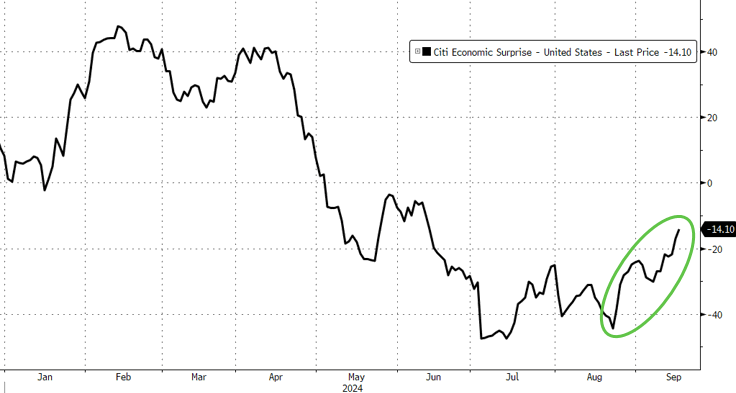
Hot retail sales print and better than expected Industrial production data are not exactly what the doves wanted to see ahead of tomorrow’s big decision (25 or 50bps). Does this look like an economy that needs rate-cuts?

Source: Bloomberg

To complicate things further for traders, NikiLeaks (WSJ’s Nick Timiraos) said withholding a larger cut could raise awkward questions (and Goldman’s trading desk reminded that going back to Bernanke, the Fed typically delivers close to what the market is pricing in)… which is currently around 42bps of cuts tomorrow (70% odds of 50bps cut)…

Source: Bloomberg

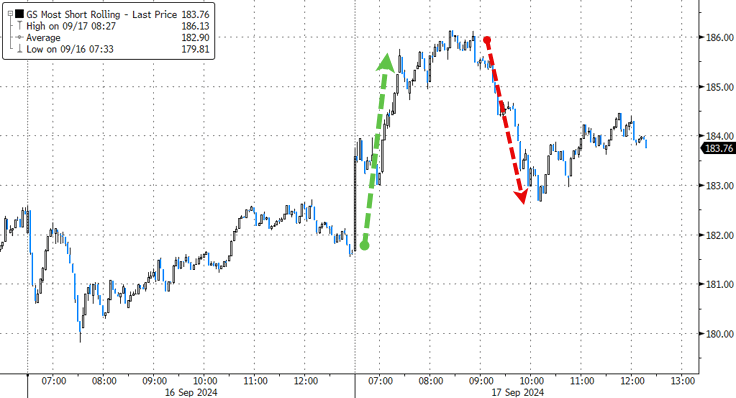
Trading was ‘squeezy’ out of the gate with Small Caps soaring on the back of “most shorted” stocks. But that faded around the European close and ‘most shorted’ fell back to unchanged…

Source: Bloomberg

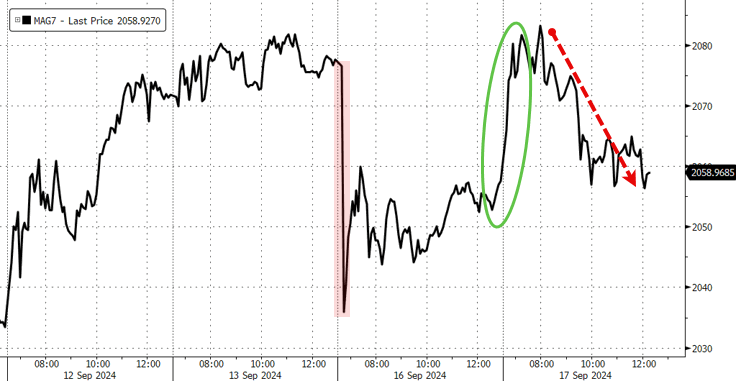
A similar picture occurred for Mag7 stocks, a big gap-up open quickly reverted lower, back to unchanged…

Source: Bloomberg

Goldman’s trading desk noted that volumes were muted and S&P top of book (liquidity) tracking significantly lower as most investors in wait and see mode.

  • HFs much better for sale, selling macro products (short ratios elevated to 75%) .

  • LOs are much better buys, though activity very light, with buy skews across macros, discretionary, and tech. 

By the close, only Small Caps held on to gains with the rest of the majors all languishing around unchanged…

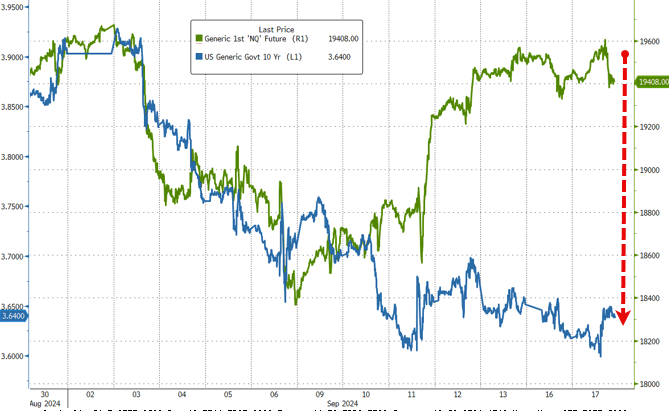
Stocks and bonds remain in their own worlds… for now…

Source: Bloomberg

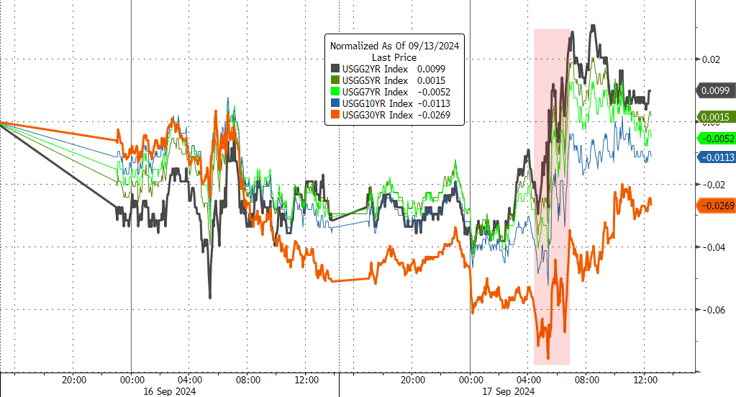
Treasury yields were higher on the day with the short-end lagging (2Y +4bps, 30Y +2bps). That left the long-end still lower in yield on the week, but the rest of the curve higher in yield…

Source: Bloomberg

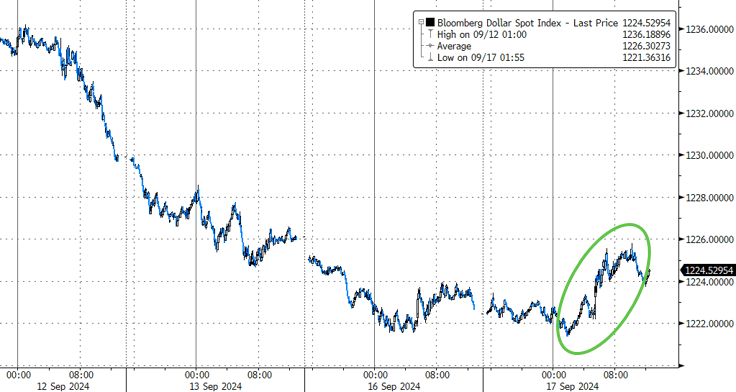
The dollar rallied modestly on the day, ending a three-day down-streak…

Source: Bloomberg

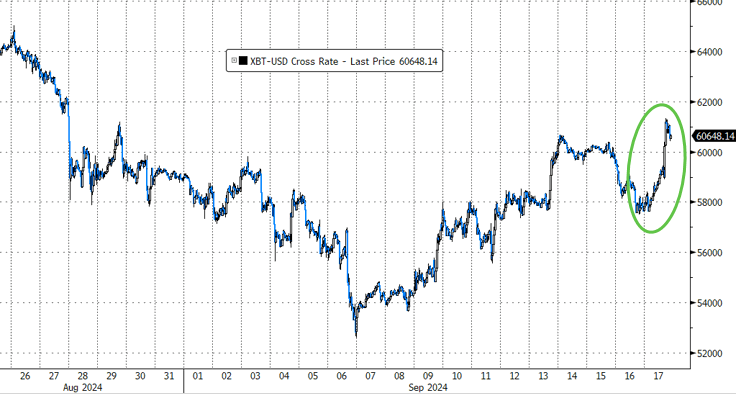
Bitcoin surged back above $61,000 intraday today, erasing yesterday’s dump back below $58,000…

Source: Bloomberg

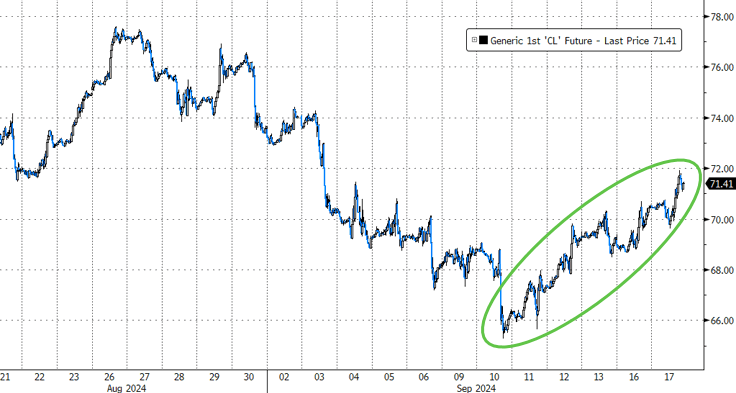
Oil prices continued their rebound, with WTI testing $72 intraday…

Source: Bloomberg

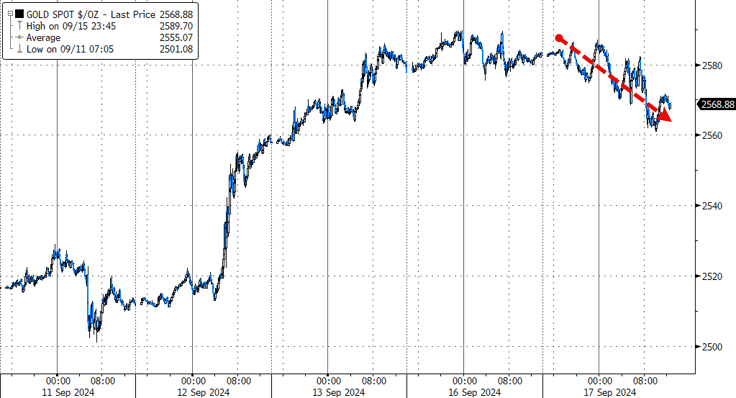
Gold leaked lower on the day, but held above $2560…

Source: Bloomberg

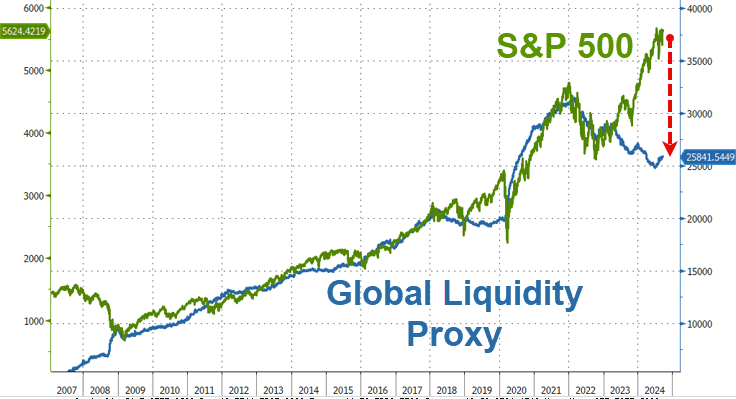
Finally, is it time for global liquidity to catch up to the equity market’s hope…

Source: Bloomberg

…or will tomorrow be the sell-the-news event as The Fed can’t hide its fear of a hard-landing?

Tyler Durden
Tue, 09/17/2024 – 16:00

Minnesota Test Scores Remain Low Despite Walz Spending Billions

0
Minnesota Test Scores Remain Low Despite Walz Spending Billions

Authored by Eric Lundrum via American Greatness,

The Democratic Party’s vice presidential nominee, Governor Tim Walz (D-Minn.), has failed to improve average test scores in his state of Minnesota despite spending billions of dollars to try to improve the state’s education system.

As the Daily Caller reports, Walz previously signed a bill in 2023 that aimed to spend $2.3 billion on improving the academic performance of students in the state. Although it marked the single largest investment in education in Minnesota’s history, the latest data shows that test scores have not improved after the bill’s implementation.

In the report from the Minnesota Reformer, test scores in 2019, when Walz first took office, showed that about 60% of Minnesota students were proficient in reading while 55% were proficient in math. In 2024, those rates have declined further, to only about half of students being proficient readers and just 45% being proficient in math.

Although the Chinese Coronavirus pandemic played a major role in the sharp decline, Minnesota saw a steeper drop in test scores compared to most states. Moreover, scores have not improved even two years after all lockdown measures were lifted. By contrast, in 2015 and 2017, the average math scores of Minnesota’s fourth grade students were about 10 points higher than the national average. In 2022, that rate dropped to just 4 points above the national average.

In a press release at the end of August, the Minnesota Department of Education made multiple excuses for the $2.3 billion bill’s failure to improve education standards.

“Long-term key investments from the 2023 legislative session are currently being implemented, including the largest funding increase for K-12 education in state history,” the statement read.

“Once fully implemented, these investments will positively impact students for many years to come.”

Marketed by Walz as the “Minnesota Miracle 2.0,” much of the funds were given directly to the school districts themselves.

Despite this, many districts continued to find themselves in debt, with the Minneapolis Public Schools (MPS) district facing a budget deficit of $116 million.

As the party’s nominee for vice president, Walz will face off against the Republican vice presidential nominee, Senator J.D. Vance (R-Ohio), in the first and only scheduled debate between the two on October 1st.

Tyler Durden
Tue, 09/17/2024 – 15:40

Age Of Rage: 26 Million Americans Believe Political Violence Is Justified

0
Age Of Rage: 26 Million Americans Believe Political Violence Is Justified

Authored by Jonathan Turley,

A poll released by the University of Chicago via the Chicago Project on Security and Threats offers a chilling account of the growing radicalism in America, particularly after the second foiled assassination attempt of former president Donald Trump, the poll found that 26 million Americans believe “the use of force” is justified to keep Trump from regaining the presidency.

As discussed in my book, “The Indispensable Right: Free Speech in an Age of Rage,” we have seen an increasing level of rage rhetoric in our political system. For some, violent language can become violent action. There is a normalization that can occur as extreme actions become more acceptable to more and more citizens:

“We are living in an age of rage. It permeates every aspect of our society and politics. Rage is liberating, even addictive. It allows us to say and do things that we would ordinarily avoid, even denounce in others. Rage is often found at the farthest extreme of reason. For those who agree with the underlying message, it is righteous and passionate. For those who disagree, it is dangerous and destabilizing.”

With the unrelenting claims of President Joe Biden, Vice President Kamala Harris, and others that democracy is about to die in America, some now feel a license to commit criminal acts in the name of “saving democracy.”

It is the ultimate form of self-delusion that one saves democracy by committing political violence against those with whom you disagree.

We have seen this radicalism spread in past years from higher education into society at large.

Years ago, many of us were shocked by the conduct of University of Missouri communications professor Melissa Click who directed a mob against a student journalist covering a Black Lives Matter event. Yet, Click was hired by Gonzaga University. Since that time, we have seen a steady stream of professors joining students in shouting down, committing property damage, participating in riots, verbally attacking students, or even taking violent action in protests.

It is now common to hear inflammatory language from professors advocating “detonating white people,” denouncing police, calling for Republicans to suffer,  strangling police officers, celebrating the death of conservatives, calling for the killing of Trump supporters, supporting the murder of conservative protesters and other outrageous statements.

At the University of Rhode Island, professor Erik Loomis defended the murder of a conservative protester and said that he saw “nothing wrong” with such acts of violence.

At the University of California Santa Barbara, professors actually rallied around feminist studies associate professor Mireille Miller-Young, who physically assaulted pro-life advocates and tore down their display.  Despite pleading guilty to criminal assault, she was not fired and received overwhelming support from the students and faculty. She was later honored as a model for women advocates.

At Hunter College in New York, Professor Shellyne Rodríguez was shown trashing a pro-life display of students.

She was captured on a videotape telling the students that “you’re not educating s–t […] This is f–king propaganda. What are you going to do, like, anti-trans next? This is bulls–t. This is violent. You’re triggering my students.”

Unlike the professor, the students remained calm and respectful. One even said “sorry” to the accusation that being pro-life was triggering for her students.

Rodríguez continued to rave, stating, “No you’re not — because you can’t even have a f–king baby. So you don’t even know what that is. Get this s–t the f–k out of here.” In an Instagram post, she is then shown trashing the table.

Hunter College, however, did not consider this unhinged attack to be sufficient to terminate Rodríguez.

It was only after she later chased reporters with a machete that the college fired Rodríguez. She was then hired by another college.

Another recent example comes from the State University of New York at Albany, where sociology professor Renee Overdyke shut down a pro-life display and then resisted arrest. One student is heard screaming, “She’s a [expletive] professor.” That of course is the point.

While Democratic leaders have condemned the second assassination attempt on Trump, they have continued the unhinged rhetoric of how this may be our last election and democracy is about to die in America.

At the same time, some leaders have allied themselves with violent groups.

We have continued to follow the attacks and arrests of Antifa followers across the country, including attacks on journalists.

Some Democrats have played a dangerous game in supporting or excusing the work of Antifa, one of the most violent anti-free speech groups in the world. Former Democratic National Committee deputy chair Keith Ellison, now the Minnesota attorney general, once said Antifa would “strike fear in the heart” of Trump. This was after Antifa had been involved in numerous acts of violence and its website was banned in Germany.

Ellison’s son, Minneapolis City Council member Jeremiah Ellison, declared his allegiance to Antifa in the heat of violent protests. During a prior hearing, Democratic senators refused to clearly denounce Antifa and falsely suggested that the far right was the primary cause of recent violence. Likewise, Joe Biden has dismissed objections to Antifa as just “an idea.”

These politicians are playing a dangerous game in toying with groups like Antifa, which will not stop at threatening their opponents. Politicians like Ellison could easily find themselves the next target as groups seek to “strike fear in the heart” of the establishment.

*  *  *

Jonathan Turley is the Shapiro Professor of Public Interest Law at George Washington University. He is the author of “The Indispensable Right: Free Speech in an Age of Rage” (Simon & Schuster).

Tyler Durden
Tue, 09/17/2024 – 15:20