60.5 F
Chicago
Sunday, October 4, 2026
Home Blog Page 2284

Burning Oil Tanker “Successfully Towed To Safe Area” Amid Urgent Red Sea Salvage Operation 

0
Burning Oil Tanker “Successfully Towed To Safe Area” Amid Urgent Red Sea Salvage Operation 

The European Union’s Operation Aspides naval force began an urgent salvage operation to tow the burning oil tanker Sounion in the southern Red Sea to safety, with hopes of preventing an environmental disaster. 

“The salvage of the MV SOUNION is a complex operation and consists of various phases. The tug boats have successfully connected to the vessel and the towing of the MV SOUNION to a safe location is in progress,” EU’s naval mission in the Red Sea, Aspides, wrote in an X post on Sunday. 

By Monday, Aspides declared the Greek-flagged ship Sounion “has been successfully towed to a safe area without any oil spill,” adding that private stakeholders will complete the salvage operation while warships “will continue to monitor the situation.” 

Sounion was hit by projectiles launched by Iran-backed Houthis four weeks ago in the southern Red Sea. The crew was evacuated a day later, and the ship caught fire, which has burned ever since. There have been concerns about an environmental disaster, considering the tanker carries one million barrels of Iraqi crude. 

The attack on Sounion and the attacks on other commercial ships in the critical maritime chokepoint resulted from the West’s failed missions, such as Biden-Harris’ Operation Prosperity Guardian, that did not ensure freedom of navigation and maritime security in the shipping lane. Since October, Houthi rebels have launched over 80 attacks on vessels in the region. 

Former Navy Seal and Blackwater founder Erik Prince said this failure shows America’s “credibility and deterrence” has quickly eroded. 

Tyler Durden
Tue, 09/17/2024 – 09:45

“All Been Hoaxes” – Ohio Governor Debunks Claims Of Bomb Threats Against Haitians

0
“All Been Hoaxes” – Ohio Governor Debunks Claims Of Bomb Threats Against Haitians

Authored by Luis Cornelio via HeadlineUSA.com,

Remember the claims that Haitian nationals in Springfield, Ohio were facing bomb threats due to national scrutiny over rampant illegal immigration? It turns out it was all a hoax. 

Ohio Gov. Mike DeWine announced Monday that the state has received zero credible bomb threats against schools in Springfield—the same community affected by 20,000 Haitian nationals paroled into the U.S. by the Biden-Harris administration.

“These threats have all been hoaxes, none of them have panned out,” DeWine said during a press conference with law enforcement officials on Monday. 

“We have people unfortunately overseas, who are taking these actions,” the Republican governor added.

“Some of them are coming from one particular country. We think that this is one more opportunity to mess with the United States and they’re continuing to do that.”

DeWine said that state law enforcement officials will continue to patrol schools to ensure parents feel safe even in the light of non-credible threats. 

DeWine’s comments debunked conspiracy theories spread by the legacy media in the aftermath of national criticism over the arrival of foreign nationals under the current administration. 

NBC News anchor Lester Holt and correspondent Maggie Vespa suggested on Sunday that comments from Trump and Sen. JD Vance against Haitian nationals led to the bomb threats. 

Neither Vespa nor Holt immediately responded to Headline USA’s email request for comment on Monday evening. The inquiries focused on whether they intended to issue an apology to Trump or Vance or to provide a correction to NBC News viewers. 

Independent journalist Nick Sortor confronted Vespa directly for spreading unsubstantiated claims about threats against Haitian nationals. 

Video footage of the confrontation has since gone viral on X, garnering over 6 million views. 

Finally, Tom Elliott explains how these lies are perpetuated by the Dem/MSM complex…

Tyler Durden
Tue, 09/17/2024 – 09:30

Grocery Rationing Within Four Years

0
Grocery Rationing Within Four Years

Authored by Jeffrey Tucker via The Brownstone Institute,

There is a lack of public comment and debate about Kamala Harris’s call for price controls on groceries and rents, the most stunning and frightening policy proposal made in my lifetime. 

Immediately, of course, people will reply that she is not for price controls as such. It is only a limit on “gouging” (which she variously calls “gauging”) on grocery prices. As for rents, it’s only for larger-scale corporations with many units. 

This is nonsense. If there really are national price-gouging police running around, every single seller of groceries, from small convenience stores to farmers’ markets to chain stores, will be vulnerable. No one wants the investigation so they will comply with de facto controls. No one knows for sure what gouging is. 

Don Boudreaux is correct:

“A government that threatens to punish merchants for selling at nominal prices higher than deemed appropriate by government clearly intends to control prices. It’s no surprise, therefore, that economists routinely analyze prohibitions against so-called ‘price gouging’ using exactly the same tools they use to analyze other forms of price controls.”

As for rental units, the only result will be fewer amenities, new charges, new fees for what used to be free, less service, and a dramatically reduced incentive to build new units. That will only lead to a pretext for more subsidies, more public housing, and more government provision generally. We have experience with that and it is not good. 

The next step is nationalizing housing and rationing of groceries because there will be ever fewer available. 

The more the betting odds favor Kamala, the stronger the incentive to raise prices as high as possible now in anticipation of price controls come next year. That will provide even more seeming evidence for the need for more controls and a genuine crackdown. 

Price controls lead to shortages of anything they touch, especially in inflationary times. With the Federal Reserve seemingly on the verge of cutting rates for no good reason – rates are very low in real terms by any historical standard – we might see wave two of inflation later next year. 

Here are real interest rates historically considered as they stand. Do you see a case here for lowering them?

Next time, however, merchants will not be in a position to respond rationally. Instead, they will confront federal price investigators and prosecutors. 

Kamala is wrong that this will be the “first-ever” ban on price gouging. We had that in World War II, along with rationing tickets on meat, animal fats, foil, sugar, flour, foil, coffee, and more. It was a time of extreme austerity, and people put up with it because they believed it was saving resources for the war effort. It was enforced the same as we saw with covid lockdowns: a huge network enlisting state and local institutions, media, and private zealots ready to rat out the rebels.

Franklin Roosevelt issued Executive Order 8875 on August 28, 1941. It claimed broad powers to manage all production and consumption in the US. On January 30, 1942, the Emergency Price Control Act granted the Office of Price Administration (OPA) the authority to set price limits and ration food and other commodities. Products were added as shortages intensified.

And yes, all of this was heavily enforced.

In case you are doing the math, that’s a $200,000 fine today for noncompliance. In other words, this was very serious and highly coercive. 

Technology limited enforcement, however, and black markets sprung up everywhere. The so-called Meatleggers were the most famous and most demonized by government propaganda. 

In a nation with more agriculture in demographic proximity, people relied on local farmers and various methods of bartering goods and services. 

Years went by and somehow people got through it but production for civilian purposes came to a near standstill. The GDP for the period looked like growth but the reality was a continuation and intensification of the Great Depression that began more than a decade earlier. 

There are fewer people alive now that recall these days but I’ve known some. They adopted habits of extreme conservation. I once had a neighbor who simply could not bear to throw away tin-foil pie pans because she had lived through rationing. After she died, her kids discovered her vast collection and it shocked them. She was not crazy, just traumatized. 

How would such a thing transpire today?

Look at the program SNAP, the new name for food stamps. For those who qualify, the money goes into a special account managed by the federal government. The recipient is sent an EBT (Electronic Benefits Transfer) card, which is used like a credit card in stores. It costs taxpayers some $114 billion a year, and works out as a huge subsidy to Big Agriculture, which is why the program is administered by the Department of Agriculture. 

Transitioning that program to the general population would not be difficult. It would be a simple matter of expansion of eligibility. As shortages grow, so too could the program until the entire population would be on it and it would be mandatory. It could also be converted into a mobile app instead of a piece of plastic as a fraud-prevention measure. With everyone carrying cell phones, this would be an easy step. 

And where could people spend the money? Only at participating institutions. Would non-participation institutions be entitled to sell food, for example, at local farmers’ co-ops? Maybe at first but that’s before the media demonization campaigns come along to decry the rich who are eating more than their fair share and the sellers who are exploiting the national emergency. 

You can see how this all unfolds, and none of it is implausible. Only a few years ago, governments around the country canceled gatherings for religious holidays, limited the numbers of people who could gather in homes, and banned public weddings and funerals. If they can do that, they can do anything, including the rationing of all food. 

The program that Harris has proposed is not like other matters that she has flip-flopped on. She is serious and repeats it. She spoke about it even during the debate with Trump but there was no followup or critique of the scheme offered. Nor does such a crazy plan require some legislation and a vote by Congress. It could come in the form of an executive order. Yes, it would be tested by the Supreme Court but, if recent history holds, the program would be long in effect before the Court weighed in. Nor is it clear how it would rule. 

The Supreme Court in 1942 heard the case of Albert Yakus, a Boston-based meat seller who was criminally prosecuted for violating the wholesale beef price ceiling. In Yakus vs. United States, the Supreme Court ruled for the government and against the meat-selling criminal. That’s the existing precedent. 

Nor does all this have to unfold immediately following the inauguration. It can happen as matters become ever worse following anti-gouging edicts and when inflation worsens. After all, a presidency that believes in central planning and forced economic austerity would last a full four years, and the coercion could grow month after month until we have comprehensively enforced deprivation by the end, and no one remembers what it was like to buy groceries at market prices with their own money. 

I wish I could say that this is an outlandish and fear-mongering warning. It is not. It is a very realistic scenario based on repeated statements and promises plus the recent history of government management of the population. There is likely another wave of inflation coming. This time it will meet with a promise to use every coercive power of government to prevent increases in prices on groceries and rents. 

What if voters actually understood this? What then? 

Keep in mind the main legacy of the Covid years: governments learned the fullness of what they could do under the right circumstances. That’s the worst possible lesson but that is what has stuck. The implications for the future are grim. 

Tyler Durden
Tue, 09/17/2024 – 07:20

How Do Sectors Perform After The First Interest Rate Cut?

0
How Do Sectors Perform After The First Interest Rate Cut?

Fed chair Jerome Powell has signaled that interest rate cuts are on the horizon, amid a cooling labor market marked by fewer job additions and rising unemployment.

Today, the benchmark interest rate stands at 5.25- 5.50%, up from near-zero levels in 2022. Historically, equities have performed better after gradual rate cuts compared to swift reductions typically seen during economic crises. Sectors of the economy are also impacted in different ways, due to shifting consumer demand and interest rate sensitivity.

This graphic, via Visual Capitalist’s Dorothy Neufeld, breaks down sector performance after the first interest rate cut, based on data from PinPoint Macro Analytics.

Ranked: Sector Performance During Rate Cut Cycles

Below, we show the average performance of each sector relative to the broad equity market 12 months after the first rate cut between 1973 and 2024:

Average historical data of rate cycles from 1973 to present day.

Consumer non-cyclicals see the strongest returns after the first rate cut, particularly during recessions, thanks to steady demand for staple goods.

This traditionally defensive sector includes companies such as Procter & Gamble, Walmart, and Coca-Cola. Notably, consumer staples are the only S&P 500 sector that have produced positive returns on average, during the recession stage of the business cycle since 1960. During the slowdown phase, it also outperformed the vast majority of sectors, averaging 15% returns over these periods.

Meanwhile, the tech sector underperforms the market six months after the first rate cut, but performance bounces back over a 12 month period since lower interest rates generally benefit growth stocks by reducing borrowing costs. However, some of today’s largest tech companies have been more resilient to higher rates due to large cash reserves and heightened investor interest in AI-related stocks.

On the other hand, financials historically experience the weakest performance. This is due to the fact that interest rate cuts often signal that the economy is slowing, putting pressure on loan growth, credit losses, and default risk.

To learn more about this topic from a sector-composition perspective, check out this graphic on the largest company in each S&P 500 sector in 2024.

Tyler Durden
Tue, 09/17/2024 – 06:55

Why Kamala’s Planned Corporate Tax Hike Is Deeply Flawed

0
Why Kamala’s Planned Corporate Tax Hike Is Deeply Flawed

Authored by Jeff Carlson & Hans Mahncke via Truth Over News,

One of the more important policy issues for markets in the US election may be corporate tax rates. Kamala Harris has said she wants to raise corporate taxes from the current rate of 21% up to a lofty 28%. During her 2020 primary campaign Kamala said she wanted to raise corporate taxes all the way to 35% – and this may still be her real target. By contrast, President Trump has said he wants to cut the corporate tax rate to at least 20% but would prefer to drop the corporate tax rate to 15% if possible.

How much revenue is generated from corporate taxes?

The answer to this question may surprise some people. In 2023 the federal government collected just under $420 billion in corporate taxes. This compares to the approximately $2.18 trillion in individual taxes and $1.6 trillion in payroll taxes. The amount paid in corporate taxes is not as large as many intuitively expect – a little more than double the total amount of aid that we’ve allocated to the Ukraine war. 

Corporate tax revenue has actually been declining on a percentage basis for decades. The reasons for the decline have everything to do with incentives and competition – incentives for businesses to invest, locate and produce in the United States and competitiveness of American companies in a global environment. And it’s all intrinsically tied into economic activity, productivity, wages and employment. We as a nation have stymied business activity through a combination of high taxes and excessive regulations.

Who actually pays corporate taxes? Hint: it isn’t the corporations.

Corporations are actually just tax collectors – legal entities that serve to collect taxes on behalf of the corporation’s owners. The true taxpayers are primarily the company’s shareholders – and to some degree, labor and customers – not the corporations that Kamala tries to vilify. When Kamala says she’s going to raise taxes on corporations, what she’s really saying is she’s going to raise taxes on you and me.

As our system stands now, shareholders’ dividends and capital gains are reduced by taxes collected by the corporation. Dividends are profits that a corporation distributes amongst its shareholders. Capital gains come from an increase in the value of a corporation’s assets. If the corporation did not pay corporate taxes on “behalf” of the shareholder these extra dollars would flow through to shareholders in the form of increased profits and dividends, reinvestment in the business (which generates additional profits) and share repurchases. These increased cash flows to shareholders would then be taxed at the shareholder level.

If this argument is not sitting well, consider this example. A corporation could, in theory, give year-end bonuses to its workers such that the amount exactly equaled the corporation’s taxable income. After the payment to workers, the corporation would have zero taxable income. Because the corporation would record no profits in this case, shareholders would pay no tax as they too would receive no profits. But workers would now have a significantly increased tax bill – and in all likelihood be taxed at a higher overall rate than the corporation would have been. The corporation merely serves as the vehicle or conduit – the legal structure – for tax payments.

What about customers and labor – don’t they shoulder much of the corporate tax bill through higher prices for goods or lower wages? 

As it turns out, there is some material debate about these two groups. In a normalized market environment, customers probably don’t pay much in corporate tax as it is very hard to pass this cost through. The ultimate price of the corporation’s end product or service is determined by market forces – not tax rates. And corporations have many differing competitors – including sole proprietorships and foreign corporations with differing tax structures. Market competition determines the final selling price – not taxes.

The amount of corporate taxation that labor bears is less clear – the arguments center around the availability and flexibility of capital – the ability to shift production to lower cost areas, etc. The Tax Policy Center has concluded – fairly close to Treasury estimates – that labor bears about 25% of the corporate tax burden. Some estimates have labor bearing as much as 70% of the cost.

In our opinion, the amount of corporate taxes that are borne by labor is probably north of the 25% figure – but likely well shy of the 70% estimates. The reason for this lies primarily in the mobility of capital. Money is far more fungible and easily moved than labor. If returns are higher abroad due to lower foreign tax rates, investors will quickly move capital to those places. Labor has a more difficult time taking advantage of higher wages elsewhere.

When corporations are burdened with a higher tax rate, their return on capital falls, making them less attractive for investment. In order to attract capital, companies are forced to reduce costs in an attempt to boost returns. And, in general, labor is the largest cost component for most corporations, making it a prime target for cost cutting. The accelerating shift towards the use of AI may lead to an even greater amount of the tax burden being shouldered by labor.

Think of it in simple terms. If corporations were hit with a tax hike tomorrow, which group could more quickly adjust. Investors who could quickly sell and redeploy their capital overseas – or labor with their families and homes? The matter becomes a bit more complicated in real terms because if such a tax was enacted, share prices would be impacted immediately, but hopefully you get our point.

So the answer to who really pays corporate taxes appears to be primarily shareholders with labor sharing in some material percentage of the cost. What should be clear is that corporations do not truly pay taxes – they merely collect them on behalf of third parties for payment.

Why are tax rates different at the corporate level versus the shareholder level?

At the heart of the matter, the tax rate is lower for capital gains and dividends paid to shareholders to reduce the impact of double-taxation – profits used to pay dividends have already been taxed at the corporate tax rate. The capital gains and dividend tax rates are arbitrary but the intent has been to pick a number that was not so high as to completely discourage investment into companies by investors.

Why do we have differing corporate and individual taxation systems in the first place?

Our nation’s tax system evolved in fits and starts with various taxes being implemented and then repealed – some ruled unconstitutional. Our modern tax era began in 1909 – in response to rising political pressure to tax the rich – when Congress enacted an excise tax on corporations at the urging of President William Howard Taft. In a concurrent move, President Taft proposed the 16th Amendment to establish a personal income tax.

The excise tax on corporations did not require a constitutional amendment and was originally intended to be a temporary measure until the passage of the 16th Amendment which occurred in 1913. Like all things government, legislation once enacted does not die and so the two concurrent tax systems – corporate and individual were born. And they have been creating inefficiencies and needless complexities for our nation ever since.

We should consider abolishing the Corporate Tax – not raising it.

Reducing or eliminating the corporate tax rate would go a long way towards drawing businesses and business activity back to the United States. Our corporate tax structure creates countless unnecessary complexities and conflicts with our individual tax code. Do away with that structure – even if shareholder taxes are adjusted in a manner that is revenue neutral to the Treasury – and you have gained significant economic efficiencies.

Some other reasons to abolish the corporate tax:

Removal of political gamesmanship – An entire lobbying force working to get tax breaks for corporations is gone overnight. Gone too are the incentives for politicians to grant their corporate constituencies favors via the tax code. Kill the corporate tax code and you immediately remove a big motivation for corporate money being involved in the political arena – along with special interests.

Legal & Tax Departments – Tax compliance and tax strategy related departments would be rendered obsolete and would result in the saving of literally billions of dollars and countless man-hours. Tax lawyers and consultants would need to find another avenue for work. And smaller businesses would be placed on a more equal footing.

Tax status – There would be no need for non-profit distinction – and the associated games being engaged in by both companies and the IRS.

The entire tax system would be vastly simpler. Any corporate tax burden borne by labor would be removed. The increased level of investment by corporations – along with higher dividends – would re-invigorate our entire economy. Corporations would run their companies based on underlying economics without the distorting influence of tax strategy behavior.

Corporate CEOs would focus on what are now pre-tax profits. Foreign investment would flood back into the United States. International tax problems and distortions would disappear. U.S. corporate cash held overseas could be repatriated for use domestically.

Lowering (or removing) the corporate tax does not mean that taxation of corporate income is avoided. Instead, taxes would now be paid at the individual versus corporate level. Corporations could stop focusing on tax strategies and could instead place their full focus on generating profits. And Labor would see their corporate tax burden lifted.

Subscribe to Truth Over News here…

Tyler Durden
Tue, 09/17/2024 – 06:30

Goldman Slashes Iron Ore Price Forecast As Supply Cuts Desperately Needed Amid China Slowdown

0
Goldman Slashes Iron Ore Price Forecast As Supply Cuts Desperately Needed Amid China Slowdown

The short-cover rally Goldman analysts forecasted early last week in Chinese iron ore prices has completely reversed. After all, analysts from the bank said the rally should be sold. Now, analysts have revised their Q4 2024 iron ore price forecast to $85/t, down from $100, based on strong global supply and soft demand in the world’s second largest economy. They add that the buildup in Chinese port stocks suggests prices will be pressured lower unless lower-cost producers cut production. 

Last week, ahead of Goldman’s iron ore note telling clients, “desk expect short cover rally,” prices in Singapore sank to the $90/t level, the lowest level since 2022, on concern that global supply is running ahead of demand. Prices jumped shortly to the $95/t level, where Goldman told clients: “Be ready to sell at the $95-100” level, noting that iron ore’s “fundamental outlook remains bleak.” 

One week later, on Monday, Goldman analysts Aurelia Waltham, Daan Struyven, and Samantha Dart pointed out that iron ore prices recently hit a nearly two-year low of $90/t, driven by strong global supply despite stabilizing Chinese demand. 

They said prices of the industrial metal have plunged by around 20% since July, but shipments remain 2% higher than last year, with similar arrivals into China. They added that India has reduced exports, but without a significant demand recovery, further production cuts from lower-cost producers are needed to rebalance the market and shore up prices.

Due to the supply imbalance, the analysts revised their Q4 2024 price forecast down to $85/t, noting that restocking before China’s Golden Week could provide short-term support. However, they said prices are expected to drop further in October on rising stocks. 

The most important chart from the analyst’s chart pack is that elevated iron ore stocks in China due to a faltering economy have driven down prices. In other words, stocks must come down to experience a meaningful price recovery. 

Here’s more color on the depressing iron ore market from the analysts: 

Following soft China macro data in July, activity came in broadly below market expectations, and our China economists have downgraded their 2024 GDP growth forecast to 4.7% from 4.9% previously. Year-on-year industrial production growth fell, fixed asset investment growth improved less than expected, although export growth was stronger. After two months of decline, the volume of steel exports increased by 21% MoM to 9.5Mt in August, bringing YTD YoY growth to +19%. This likely helped to limit the extent of the drop in flat steel production last month (-4.6% MoM in August) and iron ore consumption as Mysteel data showed sluggish domestic demand.

Looking ahead, we maintain the view that the potential for falling exports is a key risk to steel production in China over the coming year and could result in a further decline in Chinese iron ore demand, given that we see increased support from domestic demand as unlikely.

Following a substantial fall in the iron ore price over the past three months, China’s approaching Golden Week holiday (beginning October 1st) could bring some price stabilisation over the next two weeks as mills restock raw materials, creating a demand pull on port stocks. Indeed, last week’s data showed a 2.6% WoW increase in mills’ in-plant stocks, marking the largest jump since the pre-Lunar New Year restock. There is also a near-term risk of a short covering rally due to substantial short positioning in both iron ore and Chinese steel markets.

However, while the build in port stocks came to a halt last week, they remain ~30Mt above the 2016-2023 September average. Meanwhile, total Chinese iron ore stocks (including tonnes held at mills) continue to rise, counter-seasonally, and despite Indian iron ore shipments having declined in response to lower prices. Furthermore, even with India’s decline, high frequency vessel tracking data shows that global iron ore seaborne shipments in the first two weeks of September were 3% higher than the same period in 2023, and Vale has raised guidance for this year to 323-330Mt.

As a result, we believe that another leg lower in prices towards the 95th percentile (~$80/t on a grade adjusted basis) would be needed to (1) completely remove new Indian tonnes from the seaborne market and (2) pressure supply further down the cost curve in order to rebalance fundamentals. We therefore revise down our 2024Q4 price forecast to $85/t (previously $100/t).

In a separate note, a team of Goldman analysts led by Aurelia Waltham and Daan Struyven said that iron ore’s “fundamental outlook remains bleak” as prices traded at a two-year low. 

This was the most stunning chart from the analysts’ report: Only 1% of steel mills are profitable in the world’s second-largest economy. As profitability collapses, hot metal output declines.

Earlier this month, Goldman’s Rich Privorotsky told clients, “Iron ore is dropping to 90, China will continue to struggle, and commodities as a whole, I think, are reflecting the downgrade to growth expectations in the geography.” 

China’s steel industry has been under pressure amid a severe property market downturn and weak economic recovery.

Last month, Baowu Steel Group Chairman Hu Wangming warned that economic conditions in the world’s second-largest economy felt like a “harsh winter.”

As the world’s largest steel producer, Baowu Steel’s chairman said the steel industry’s downturn could be “longer, colder, and more difficult to endure than expected,” potentially mirroring the severe downturns of 2008 and 2015.

Another team of Goldman analysts, led by Yuting Yang and Lisheng Wang, recently published high-frequency economic indicators, including consumption and mobility; production and investment; other macro activity, and markets and policy, that revealed there was no imminent recovery in China.

Meanwhile, JPM Global Manufacturing PMI has slid (<50) into a contraction. 

Besides cutting iron ore price targets, Goldman Daan Struyven recently slashed his expected range for Brent oil prices by $5 to $70-$85 per barrel, citing weaker Chinese oil demand, high inventories, and rising US shale production.  

None of this is new to the market, where sentiment is downright apocalyptic. As noted several weeks ago, bullish positioning in oil just hit an all-time low.

China’s rapid deceleration and signs of a US slowdown have capped further upside for commodity prices. Whether US interest rate cuts that begin this week will boost economic growth remains uncertain. At the same time, more clarity on Chinese economic policies is expected to emerge after the US elections in November. 

Tyler Durden
Tue, 09/17/2024 – 05:45

The Number Of ‘Earths’ Needed For Different Countries’ Lifestyles

0
The Number Of ‘Earths’ Needed For Different Countries’ Lifestyles

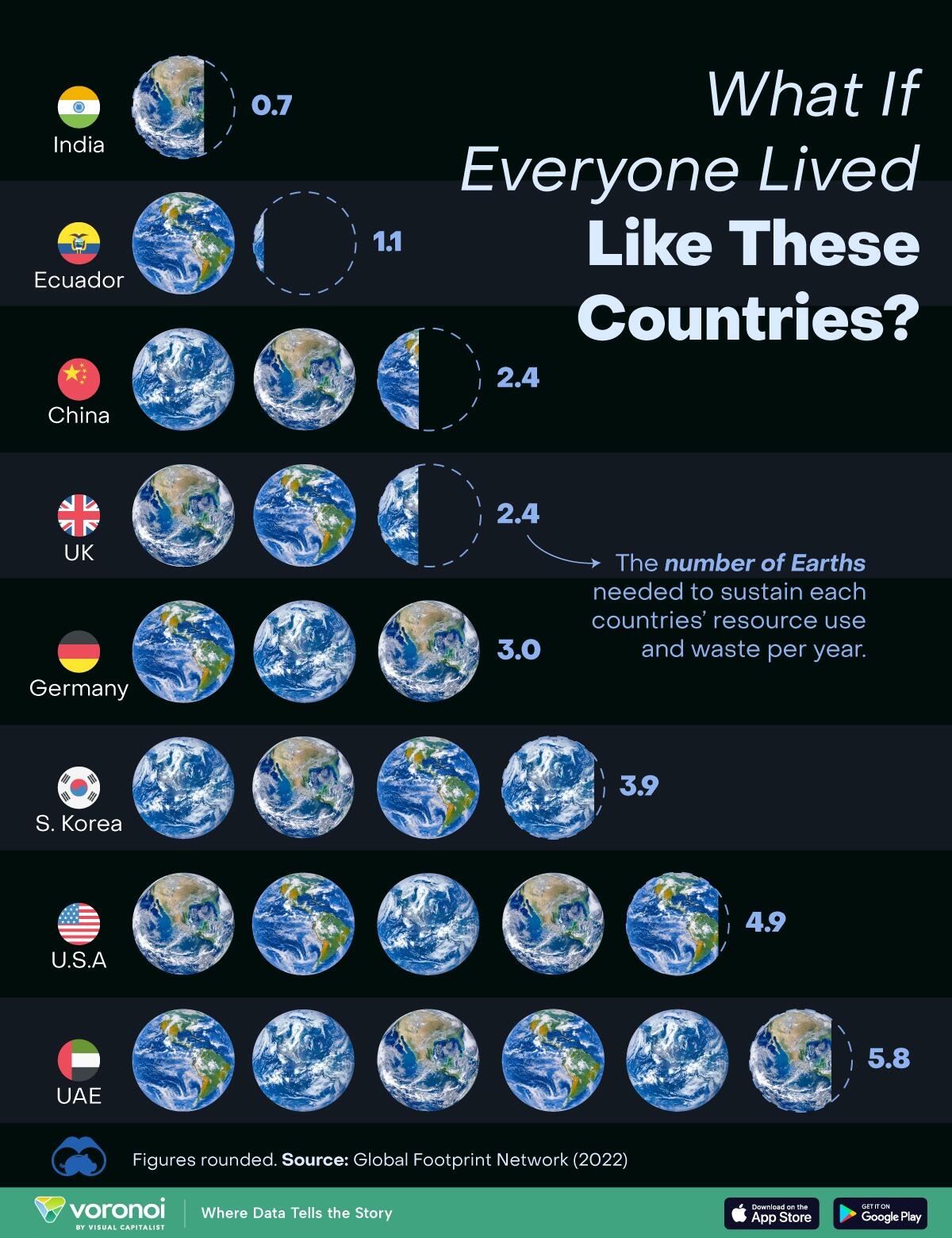
How many Earths would we need if the entire global population lived like one country?

In this graphic, Visual Capitalist’s Marcus Lu visualized data from the Global Footprint Network to see the number Earths required to sustain a world population that lived like Americans, Germans, and more.

Data and Methodology

The data we used to create this graphic is listed in the table below. Figures were published in 2022 (with data as of 2018).

These estimates are based on each country’s ecological footprint, which is measured in global hectares (gha).

It represents the amount of biologically productive land and water a population requires to produce all of the resources it consumes and to absorb the waste it generates, using prevailing technologies.

Key Takeaways From This Data

The data shown in this graphic sheds light on how different countries impact the planet.

Countries that exceed their respective biocapacity are known as biocapacity debtors. This means that the country is net-importing biocapacity through trade, liquidating national ecological assets or emitting more carbon dioxide waste into the atmosphere than its own ecosystems absorb.

Countries that have an ecological surplus, on the other hand, are known as biocapacity creditors. If everyone on the planet lived like these countries, we would need fewer Earths rather than more Earths.

Earth Overshoot Day

Another interesting concept is Earth Overshoot Day, which marks when humanity’s demand for ecological resources in a given year exceeds what the planet can regenerate in that year. For 2024, overshoot day fell on Aug. 1.

If you enjoyed this post, check out The Countries With No Earth Overshoot Day, from featured creator Statista.

Tyler Durden
Tue, 09/17/2024 – 04:15

3 Americans Sentenced To Death in Congo Over Failed Coup

0
3 Americans Sentenced To Death in Congo Over Failed Coup

Authored by Tom Ozimek via The Epoch Times (emphasis ours),

A military court in Congo sentenced three U.S. citizens to death on Sept. 13 for their alleged involvement in a failed coup attempt targeting the government of Congolese President Félix Tshisekedi.

Benjamin Reuben Zalman-Polun (L), Marcel Malanga (C), and Tyler Thompson (R), all U.S. citizens, attend a court verdict in Congo, Kinshasa, on Sept. 13, 2024. AP Photo/Samy Ntumba Shambuyi

Benjamin Reuben Zalman-Polun, 36, Marcel Malanga, 21, and Tyler Thompson, 21, were among 37 individuals who received the death penalty on Friday after being convicted on charges of conspiracy, terrorism, and attempted coup.

The verdict was handed down in an open-air court session in the yard of a military prison on the outskirts of Kinshasa, the capital of the Congo, on Friday, and read out on live TV.

Most of the defendants were Congolese but, besides the three Americans, there was also a Briton, a Belgian, and a Canadian. The defendants, who wore blue and yellow prison-issued tops as they sat before the judge, were given five days to appeal their sentences.

Richard Bondo, a lawyer who defended the six foreigners, argued that the investigation was flawed because his clients were given inadequate interpreters. He vowed to appeal the verdict.

The coup attempt, led by Christian Malanga, a U.S.-based Congolese politician, unfolded on May 19, 2023, when armed men briefly occupied a presidential office. The Congolese military quickly intervened, and Malanga was killed while resisting arrest. Five others also died in the botched takeover attempt.

Malanga’s son, Marcel Malanga, is one of the three Americans sentenced to death. He previously told the court that his father had threatened to kill him unless he took part in the coup attempt. His mother, Brittany Sawyer, maintains that her son was innocent and was simply following his father, who considered himself to be president of a shadow Congolese government in exile.

Thompson, who was Marcel’s friend and played high school football with him in Utah, had traveled to Congo on vacation to explore the world, according to his family, who maintain he had no knowledge of the elder Malanga’s coup plans. The Thompsons’ lawyer in Utah, Skye Lazaro, told The Associated Press that the family is heartbroken over the verdict.

Zalman-Polun, the third American to receive the death penalty, was a business associate of Christian Malanga.

American Marcel Malanga, fourth right, stands with others during a court verdict in Congo, Kinshasa, on Sept. 13, 2024. Samy Ntumba Shambuyi/AP Photo

In Washington, U.S. State Department spokesperson Matthew Miller said at a press briefing on Sept. 13 that embassy staff had attended the proceedings and will continue to monitor the situation closely.

“We understand that the legal process in the DRC allows for defendants to appeal the court’s decision,” he said.

Asked if he believes the proceedings involving the three Americans have been fair, Miller said he didn’t want to pass judgment yet but that the department will be following developments closely as the appeals process plays out.

Utah Sens. Mitt Romney and Mike Lee, both Republicans, expressed sympathy for the families of the three Americans but they have not publicly called on the U.S. government to push for their release.

“My thoughts are with the families during this difficult time,” Lee said on Friday. “We will continue to work with the State Department to receive updates on this case.”

Romney spokesperson Dilan Maxfield called it “an extremely difficult and frightening situation for the families involved,“ adding that Romney’s office has ”consistently engaged with the State Department and will continue to do so.”

Some 50 people were charged in connection with the botched coup, with around two dozen acquitted and the remaining 37 sentenced to death.

Congo reinstated the death penalty earlier this year, ending a more than two-decade moratorium. Under the country’s penal code, the president determines the method of execution. In the past, militants have been executed by firing squad.

Reuters and The Associated Press contributed to this report.

Tyler Durden
Tue, 09/17/2024 – 03:30

Putin Orders Third Troop Expansion Of War, Making Army 2nd Largest After China’s

0
Putin Orders Third Troop Expansion Of War, Making Army 2nd Largest After China’s

For the third time since the Ukraine war began in February 2022, President Putin has approved an expansion of Russia’s military, on Monday signing a decree to boost the number of soldiers by 180,000.

This means Russia’s armed forces will include 1.5 million active servicemen going into winter. It is also a clear signal that Russia doesn’t plan on reducing the intensity of the fight in the Donbass anytime soon. This will bring the overall number of military personnel within Russia’s army, including all reserve forces, to over 2,300,000. 

Getty Images

Putin had previously sign-off on two prior expansion waves: an increase of 137,000 in August 2022 and another expanse of 170,000 in December 2023.

In the fall of 2022, when Ukraine’s much-hyped counteroffensive was in full swing, Putin had called up some 300,000 reservists to join the fight.

With this latest troop increase, Putin could also be signaling NATO that Russia will not back down, at a moment the US and UK are mulling approving Ukraine’s use of long-range missiles to attack inside Russian territory.

The Associated Press summarizes of current estimated battlefield numbers:

The most capable Russian troops have been pressing an offensive in eastern Ukraine, where they have made incremental but steady gains in the past few months.

In June, Putin put the number of troops involved in what the Kremlin calls the “special military operation” in Ukraine at nearly 700,000.

And Reuters has highlighted that this makes Russia’s army second in manpower size only to China’s PLA military:

President Vladimir Putin on Monday ordered the regular size of the Russian army to be increased by 180,000 troops to 1.5 million active servicemen in a move that would make it the second largest in the world after China’s.

In a decree published on the Kremlin’s website, Putin ordered the overall size of the armed forces to be increased to 2.38 million people, of which he said 1.5 million should be active servicemen.

This new expanse might also be the result of Ukraine’s Kursk offensive. Kiev officials hoped that the invasion of southern Russia might force the relocation of regular troops from Donetsk to defend and take back villages on Russian soil.

But so far that calculation appears to have failed. Moscow has denied that it was forced to relocate significant amounts of troops. A Russian counteroffensive is underway, confirmed to be intensifying starting days ago, while at the same time Russian troops in Ukraine’s east are making steady gains.

Tyler Durden
Tue, 09/17/2024 – 02:45

India Won’t Capitulate To American Demands To Ban RT & Sputnik’s National Hubs

0
India Won’t Capitulate To American Demands To Ban RT & Sputnik’s National Hubs

Authored by Andrew Korybko via Substack,

Compliance would amount to damaging its own soft power and grand strategic interests…

The Hindu cited unnamed government sources to report that “U.S. officials have spoken to the Ministry of External Affairs about joining their actions against what they call ‘Russian disinformation’, by revoking accreditations and designating their journalists under the ‘Foreign Missions Act’. However, while the Ministry has been silent on the issue, government officials said that the debate on sanctions is not relevant to India.” The US should have known that India wouldn’t ever capitulate to its demands.

The decades-long Russian-Indian Strategic Partnership has been rejuvenated over the past two and a half years since the special operation began after India stepped up to preemptively avert Russia’s potentially disproportionate dependence on China. Time and again, India has responded to American pressure to distance itself from Russia by redoubling their relations, which is predicated on accelerating tri-multipolarity processes with a view towards jointly midwifing complex multipolarity (“multiplexity”).

On the soft power front, a survey carried out by India’s prestigious Observer Research Foundation in late 2022 showed that their country’s youth regarded Russia as their most reliable partner. Meanwhile, a US-based global business intel company confirmed two months later that adults view Russia as the country most allied to their own. This backdrop explains why so many were confused over the summer when it was discovered that RT and Sputnik had shared inconsistent depictions of India’s territorial integrity.

That scandal was analyzed here, which drew attention to how both publicly financed international media flagships are editorially autonomous but were influenced in those examples by what can be described as Russia’s pro-BRI policymaking faction. This incident discredits the US’ subsequent allegation that those two operate as instruments of Russian intelligence since Moscow would never order them to doubt its Indian strategic partner’s territorial integrity and had nothing to do with those inconsistent depictions.

Prime Minister Modi’s trip to Moscow soon thereafter presumably addressed this “rogue” activity and will likely ensure that it’s not repeated now that Russian officials are probably aware of this scandal. RT and Sputnik are publicly financed, after all, and must therefore abide by their patron’s guidelines. This doesn’t mean that they’re “state-run”, let alone intelligence fronts, but just that they have an obligation to ensure that this doesn’t happen again considering that they’re supposed to advance state interests.

About those, not only do they concern full support for the entirety of India’s territorial claims, but they also involve analyzing and articulating a multipolar perspective on International Relations. It was explained here in spring 2022 that this worldview isn’t the product of “Russian propaganda” since the Global Majority’s interests align naturally align with it. This includes India’s, which appreciates the role that RT and Sputnik play in promoting their country’s geostrategic balancing act (“multi–alignment”).

Banning their national hubs like the US demanded would therefore have amounted to damaging its own interests, both in the soft power realm as was explained as well as in the grand strategic one by backstabbing Russia and thus forcing it more into China’s arms at India’s possible expense. As the self-declared Voice of the Global South, the world’s most populous country, and its fifth-largest economy, India is now a trendsetter, so others might be emboldened by its defiance of the US to follow its lead.

Tyler Durden
Tue, 09/17/2024 – 02:00