61.4 F
Chicago
Friday, October 2, 2026
Home Blog Page 2315

Jobless Claims Data Refuses To Accept ‘Hard Landing’ Scenario…

0
Jobless Claims Data Refuses To Accept ‘Hard Landing’ Scenario…

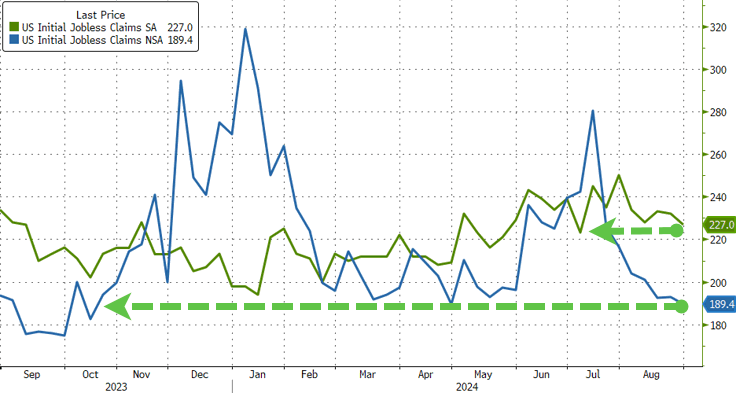
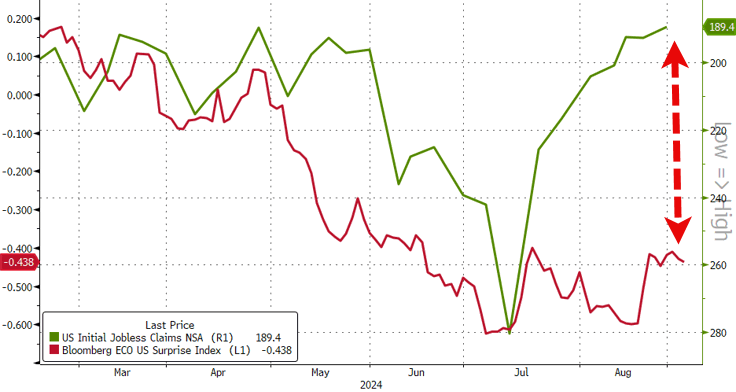
Initial jobless claims continues to ignore the ‘other crappy data’, printing 227k (in line with 230k exp) and basically unchanged at two-month lows…

Source: Bloomberg

On a non-seasonally-adjusted basis, initial claims are at their lowest in 10 months!! Of course! Why not.

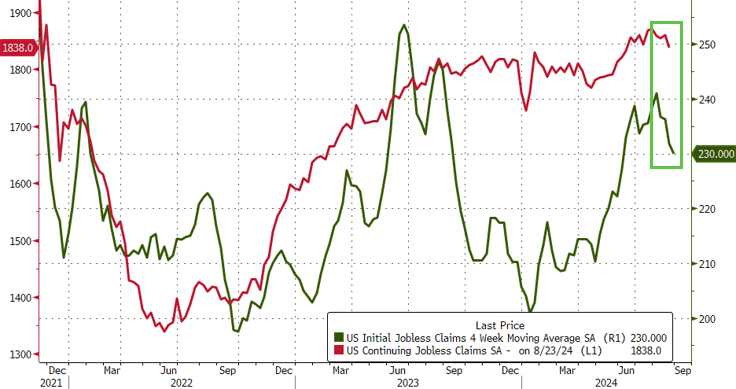
Continuing claims also dropped (to three month lows)…

Source: Bloomberg

So, everything is awesome!

Your government-supplied data tells you so!

Tyler Durden
Thu, 09/05/2024 – 08:38

ADP Employment Report Weakest Since Jan 2021

0
ADP Employment Report Weakest Since Jan 2021

Ahead of tomorrow’s “most important data point in history” payrolls print, this morning we get the ADP employment report and jobless claims (and ISM Services) as an aperitif to tease the day traders and test the reaction functions of the algos.

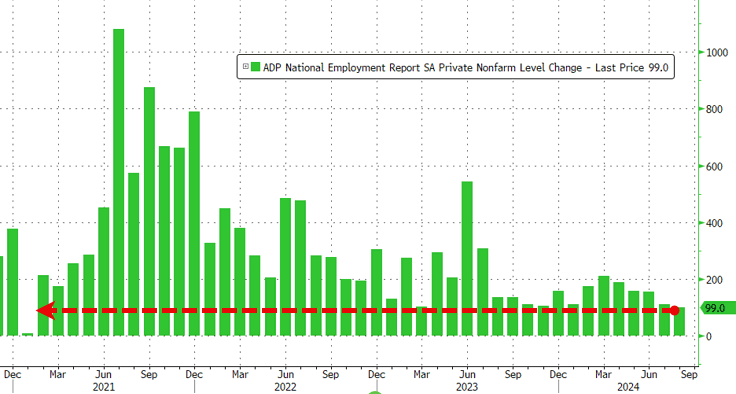
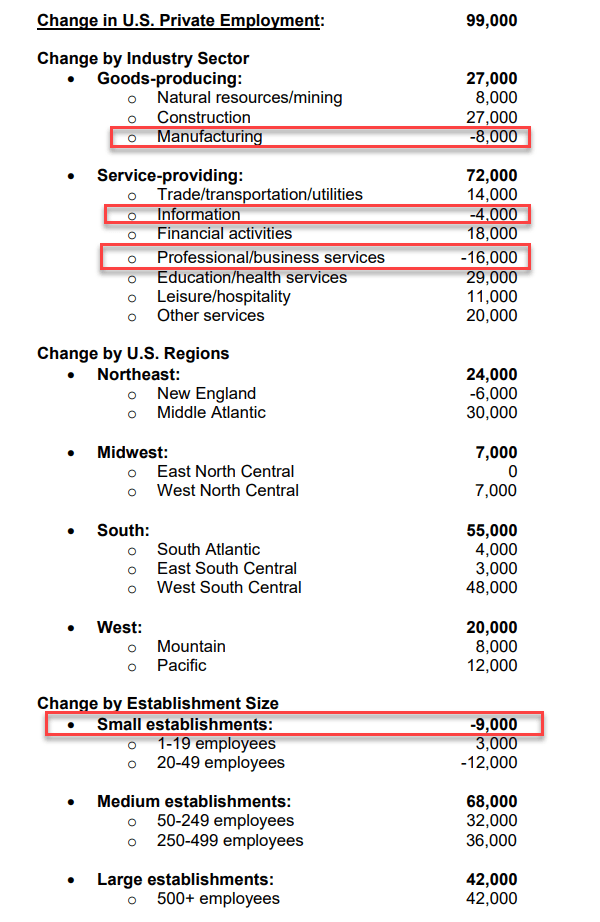
Against expectations of adding 145k jobs (a slight improvement over July’s 122k), ADP’s Employment report printed a dismal +99k for August – the weakest print since January 2021 (and July’s +122k was revised down to +111k)…

Source: Bloomberg

That is also the fifth straight monthly decline in the ADP employment report’s jobs additions.

The highest-paying jobs segments including Manufacturing and Professional Services saw the largest job declines…

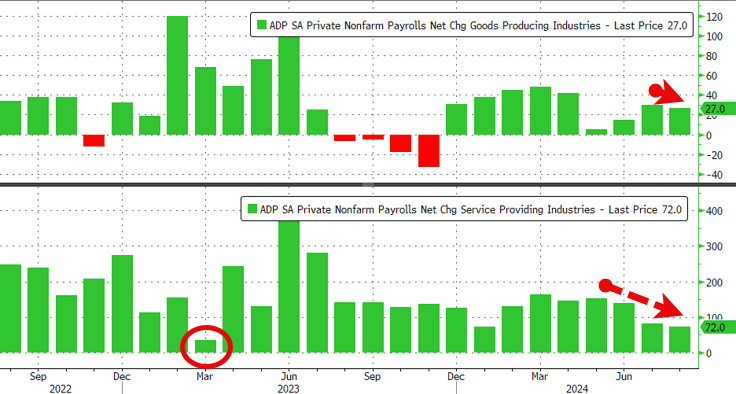
This was the weakest Services job growth since March 2023 as Manufacturing job growth also slowed…

“The job market’s downward drift brought us to slower-than-normal hiring after two years of outsized growth,” said Nela Richardson, chief economist, ADP.

“The next indicator to watch is wage growth, which is stabilizing after a dramatic post-pandemic slowdown.”

Source: Bloomberg

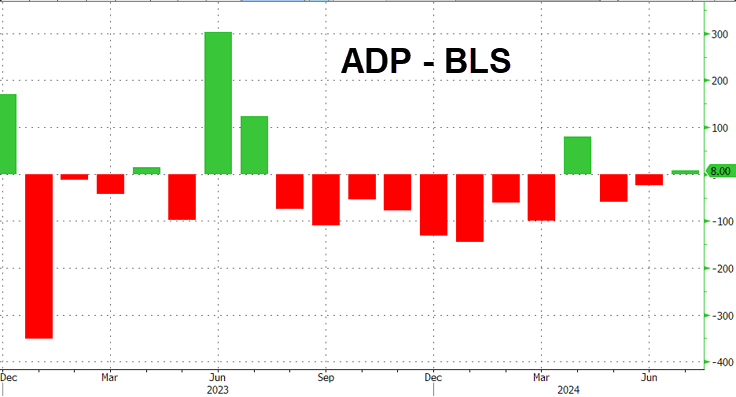
Finally, as a reminder, ADP has underestimated the official BLS data for 10 of the last 12 months…

Source: Bloomberg

So jobs growth weak (great news for the doves) but wage growth has stopped is disinflatinary trend (not a great picture).

Stagflation anyone?

Tyler Durden
Thu, 09/05/2024 – 08:23

Worst Finally Over? Intel To Move Forward With Assessing Strategic Transactions This Month

0
Worst Finally Over? Intel To Move Forward With Assessing Strategic Transactions This Month

The dumpster fire at Intel under the direction of CEO Pat Gelsinger, who is doing his best to replace Marissa Mayer as most overpaid and useless ‘turnaround’ CEO in tech history, looks like it could finally wind up being put out as a result of the company assessing strategic alternatives.

But the damage has surely been done. Intel stock has fallen about -56% this year so far while competitor Nvidia has soared more than 141% over the same period. Over a 5 year period, it gets even uglier: Intel has plunged -53.4% while Nvidia is up an astounding 2,750%. 

However, past performance is not indicative of future results, and CEO Gelsinger is looking to finally try and claw some value back into Intel shares by proposing a number of strategic transactions to the board later this month, Reuters reported last week. 

Gelsinger and top executives plan to propose a strategy to the board later this month to cut non-essential businesses and reduce capital spending, aiming to revitalize the chipmaker, the report says, mimicking a lot of ‘turn around’ talk we’ve heard from Intel during Gelsinger’s tenure over the last 3 years. 

The plan includes cost-cutting measures like selling businesses, such as the programmable chip unit Altera, which Intel can no longer support from its dwindling profits, according to a source.

Gelsinger and senior executives are set to present a plan to the board in mid-September to cut costs and streamline operations, the report says.

This plan does not propose splitting Intel or selling its foundry business to a company like Taiwan Semiconductor Manufacturing Co. However, the details are still being finalized and could change before the meeting.

As Reuters notes, Intel has already separated its foundry and design businesses and reports their financials separately to protect client confidentiality. The company is struggling as it lags behind competitors like Nvidia in the AI chip market.

Intel’s market cap has fallen below $100 billion after a poor second-quarter earnings report, while Nvidia’s exceeds $3 trillion.

The new proposal is likely to suggest further cuts in capital spending, possibly halting the $32 billion factory project in Germany, which has faced delays. In August, Intel announced plans to reduce capital spending to $21.5 billion by 2025, down 17% from this year, and issued a weaker-than-expected third-quarter forecast.

Tyler Durden
Thu, 09/05/2024 – 06:55

Poland Scrambles Fighter Jets As Russia Strikes Far Western Ukraine

0
Poland Scrambles Fighter Jets As Russia Strikes Far Western Ukraine

Another overnight Russian missile and drone attack on Ukraine included major strikes on the far western city of Lviv, which lies hundreds of miles from the front lines, which resulted in seven people killed, according to Ukrainian authorities.

These stepped-up strikes are widely viewed as retaliation for Kiev forces’ ongoing Kursk cross-border offensive. But given that missiles rained down so close in proximity to Ukraine’s border with Poland, Polish aerial forces were scrambled during the attack.

Reuters reports that Polish and allied aircraft were scrambled for the third time in eight days to closely monitor the inbound projectiles, and were ready to intercept them in the event the missiles approached Polish airspace.

File image: Anadolu Agency 

The incident shows how easily NATO aircraft could jump into the fight against Russian airpower on Ukraine’s behalf. Warsaw has complained of recent airspace violations by Russian projectiles, including a drone that went down in its territory on Aug.26.

Earlier this week Poland’s foreign minister sparked fresh controversy within the NATO military alliance by saying that member states have a ‘duty’ to shoot down incoming Russian missiles when they are in Ukraine’s skies threatening the population below.

“Membership in Nato does not trump each country’s responsibility for the protection of its own airspace – it’s our own constitutional duty,” FM Radosław Sikorski told the Financial Times. The comments showed little concern over the possibility that such action risks major escalation with Russia.

“I’m personally of the view that, when hostile missiles are on course of entering our airspace, it would be legitimate self-defense [to strike them] because once they do cross into our airspace, the risk of debris injuring someone is significant,” the Polish top diplomat had said.

Without doubt, Poland constitutes ground zero for NATO’s ‘eastern flank’ and has been engaged in a massive defense spending drive and military build-up since the Feb.2022 Russian invasion began. 

Below are some stats and recent defense spending developments via Al Jazeera:

  • On Tuesday, Warsaw announced new military deals worth $520m, the latest move in a drive to beef up its defence prompted by Russia’s invasion of Ukraine in 2022.
  • Poland currently spends 4 percent of its gross domestic product (GDP) on defense – the highest ratio of any NATO member – and hopes to boost the number to 4.7 percent next year.
  • Last month, Warsaw signed a $10bn deal to buy 96 Apache attack helicopters from US manufacturer Boeing. They will replace outdated Russian Mi-24 helicopters.
  • Warsaw has also announced a deal to buy hundreds of AIM-120C AMRAAM air-to-air missiles, as well as a contract for 48 launchers for US-designed Patriot air defence systems.
  • Poland’s army has 200,000 soldiers, making it NATO’s third largest after the United States and Turkey, and the biggest in the European Union.

As for Poland’s push to get NATO leadership to sign on to new rules of engagement regarding Russian strikes, NATO Secretary General Jens Stoltenberg, who is soon expected to retire from the top post, has issued some pushback.

Prior Russian aerial assaults have targeted a military base just tens of kilometers from the Polish border…

Stoltenberg rejected the Polish proposal and asserted that it presents too much risk of NATO “becoming part of the conflict.” Of course, at this point this seems to be exactly what Zelensky wants–to drag the West deeper into the war on Ukraine’s behalf.

Tyler Durden
Thu, 09/05/2024 – 05:45

Top UK North Sea Oil Firm Sees Rising Windfall Tax Hitting Investments

0
Top UK North Sea Oil Firm Sees Rising Windfall Tax Hitting Investments

Authored by Tsvetana Paraskova via OilPrice.com,

The UK government’s plan to further raise the windfall tax on North Sea oil and gas producers will drive investments away from the region while Britain still needs oil and gas for the foreseeable future, the chief executive of Harbour Energy, the largest UKCS producer, told the Financial Times.

The Labour Party, which came to power in the UK after a landslide victory in the July general election, said in July that it intends to raise the rate of the Energy Profits Levy (EPL) to 38% from 1 November 2024, from 35% now, bringing the headline rate of tax on upstream oil and gas activities to 78%, up from 75% currently. The levy will be further extended by a year to 2030.

Harbour Energy’s CEO Linda Cook has criticized the levy ever since it was first introduced by the previous UK government in 2022.

Now Cook told FT that a rise in the windfall tax would lift the barrier to attract investment in the UK even higher.

“The fiscal regime in a lot of the other countries — in all of the other countries — in which we will have a presence will be more attractive” than the UK North Sea, she added.

Earlier this week, UK offshore industry group OEUK warned that not only viable capital investment would be reduced from $18.5 billion (£14.1 billion) to just $3 billion (£2.3 billion) in the period 2025 to 2029, but the tax hike would also lead to $16 billion (£12 billion) lower tax receipts for the country compared to the current tax regime.

Last week, Equinor, the operator of one of the major new field developments in recent years, Rosebank, said it awaits clarity on the UK tax regime by the Labour government before strategizing and committing to investments in the UK North Sea.

As a result of the planned hike in the windfall tax, UK North Sea producers have already warned they are considering moving to more fiscally stable jurisdictions such as Norway.

Neo Energy said this week it was slowing down investment in light of “fiscal and regulatory uncertainty”.

Tyler Durden
Thu, 09/05/2024 – 05:00

Who Drinks The Most Beer In The World?

0
Who Drinks The Most Beer In The World?

The global beer industry is not only a cultural phenomenon but also a massive economic engine, contributing over half a trillion dollars to the global GDP.

From the fertile barley fields of France and Argentina to the vast manufacturing hubs of Brazil and China, the beer sector is deeply interconnected, yet it remains profoundly localized – in fact, 89% of supplies used in beer production are sourced from within the domestic markets where the beer is ultimately sold.

The Largest Beer Markets Worldwide

Recent data from Kirin Holdings offers insight into the global thirst for beer, revealing which countries dominate the market in terms of sheer volume consumed. Here are the top 10 beer-drinking countries by total consumption in 2022:

As these figures demonstrate, China, the United States, and Brazil lead the pack, together accounting for more than 40% of global beer consumption.

China: The Reigning Beer Giant

China has maintained its status as the world’s top beer consumer for an astounding 20 consecutive years. The country’s beer market is not only the largest but also one of the most dynamic. In 2023 alone, 7,000 new beer-related businesses were launched in China, reflecting the growing demand. Impressively, 90% of the Chinese beer market is dominated by domestic brands, with Snow Beer and Tsingtao leading the charge. As the fastest-growing beer market globally, China’s beer revenues are expected to hit $124.2 billion in 2024.

United States: A Shifting Beer Landscape

Ranking second globally, the United States consumes about half as much beer as China. Yet, the U.S. beer market remains robust, valued at $116.9 billion. Interestingly, the market saw a significant shift recently when Modelo Especial overtook Bud Light as the top-selling beer in the country. The American market is largely driven by domestic beers, which make up 63.6% of total sales, followed by imported beers at 23.2% and craft beers at 13.3% in 2023. This diversity reflects the varied tastes of American consumers and the evolving dynamics of the beer market.

Brazil: A Major Player in Beer Consumption

Brazil comes in third on the global list, responsible for 7.8% of worldwide beer consumption. The Brazilian beer market is poised to generate $49.3 billion in revenue by 2024. Within this market, Brahma, known for its pale lagers, stands as the most valuable beer brand. The country’s love for beer is evident in its substantial share of global consumption, cementing Brazil as a key player in the industry.

Beer Dominates the Americas

Overall, beer is the most consumed alcoholic beverage across the Americas, comprising 54% of recorded alcohol consumption. This dominance reflects the beverage’s cultural significance and economic impact in the region, underscoring beer’s unique ability to bring people together across different societies.

As the global beer industry continues to grow and evolve, it remains a fascinating example of how local traditions can shape and drive a global marketplace, creating a dynamic and ever-changing landscape. The major players—China, the United States, and Brazil—are not just consuming beer but are also influencing global trends, setting the stage for what the future of this beloved beverage might hold.

And as illustrated by Voronoi and Visual Capitalist:

Tyler Durden
Thu, 09/05/2024 – 04:15

Germany’s AfD Party Calls For End To Mail-In Ballots, Launches Probe Into Suspicious Software Error

0
Germany’s AfD Party Calls For End To Mail-In Ballots, Launches Probe Into Suspicious Software Error

Via Remix News,

Although the Alternative for Germany (AfD) party secured a first-place finish in the Saxony elections on Sunday, the party is still launching an investigation into an alleged computer error that cost them a seat in parliament and is also calling for an end to mail-in votes, citing security concerns and shady practices.

The first issue is the alleged software glitch that resulted in the AfD and the Christian Democrats (CDU) both losing a seat, while the Greens and Social Democrats (SPD) both gained one seat. The party says that it is launching an investigation into this.

“We want to know exactly what went wrong,” said the AfD’s state and parliamentary group leader Jörg Urban in a statement. He is demanding an exact error analysis. “If there are any irregularities, we will take legal action.”

Notably, the loss of one seat resulted in the AfD losing its blocking majority, which would have allowed the party, for example, to block the appointment of certain judges in the state.

The error initially gave the AfD and CDU an incorrect number of seats. After a review, “the state election management corrected the allocation of seats,” according to the German news outlet Leipziger Volkzeitung.

Urban said that nobody is being accused of manipulating the vote, but, “in this case, it is about the AfD’s political options in the Saxon state parliament. Any doubt about the final election result must therefore be ruled out,” he said.

Regardless of why the error came about, Saxony’s election commission suffered a serious black eye, casting doubt on the election results during an already polarized election.

Mail-in ballots

Following the results in Thuringia and Saxony, AfD co-leader, Tino Chrupalla, is calling for an end to mail-in ballots. He discussed his concerns about this form of voting during a conference with top AfD officials.

“It is also the task of the opposition to always doubt what a government is doing or what happened in an election. That is also a legitimate right and that is a good thing. And I just really want to point out, and we will also question this, for example, the entire security for the legal storage of ballot boxes, some of which are not stored in a legally secure manner, where in some cases only one person or two have access to these ballot boxes,” he said.

He went on to say that postal voting has been a concern in other elections and that these issues keep coming up. However, he also pointed to a problem plaguing other countries like the United States, which instituted mass mail-in ballots in the wake of the Covid-19 crisis, which involves activists entering retirement homes and potentially manipulating vulnerable elderly voters.

In the case of Germany, Chrupalla stated, “We have also seen this in old and other election campaigns, such as the current campaigning in retirement and nursing homes, especially when the CDU and SPD campaign in these old people’s homes, which are run by Diakonie or Caritas, or go in and out there, and the Afd does not even get access to present their programs to the elderly. These are also things of influence that are not democratic in my opinion.”

Nortably, both Diakonie and Caritas are run by the Protestant and Catholic churches, both of which have come out against the AfD, including expelling members of the party from the Church and calling for Germans to vote against them.

Chrupalla is calling for an end to postal voting, saying: “Personally, I would ban postal voting again. It has only been introduced as an exception or initiated in the Federal Republic of Germany. It is not the rule, it should not become the rule and it is not regulated by law in such a way that it is made the rule.”


Tyler Durden
Thu, 09/05/2024 – 03:30

Hungary Rejects EU ‘Hysteria’ Over Work Visas For Russians

0
Hungary Rejects EU ‘Hysteria’ Over Work Visas For Russians

Hungary and its leader Viktor Orban are once again at the center of an EU firestorm of controversy over a new work visa and residency permit policy which will allow easier access to the country for Russian and Belarusian nationals.

The central European country has long had a national card system which previously was only available to Ukrainian and Serbian citizens, which both have EU candidacy status but are not yet part of the bloc. The permit scheme was just extended to eight more countries, including Russia and Belarus.

European officials have blasted their inclusion in the visa program as essentially an open invitation for more Russian spies to come into the heart of Europe and given the ongoing Ukraine war.

Image source: Bloomberg

Days ago a series of statements from EU officials raised “security concerns”:

“Such a mechanism is highly questionable and raises very serious security concerns,” Manfred Weber, chairman of the conservative European People’s Party (EPP) wrote in a letter sent to European Council head Charles Michel on Monday.

He argued the new visa rules could create “grave loopholes for espionage activities,” warning that the policy could “make it easier for Russians to move around” the EU’s borderless Schengen area.

Weber further described “The lack of a clear need for such a broad and unregulated entry mechanism for Russian and Belarusian workers, combined with the possibility of inadequate security screening poses questions over the consequences for Hungary and the wider Schengen area.”

He and others are demanding a formal explanation and discussion from Budapest. Critics of the policy change have said this is tantamount to handing out “easy visas” for Russians and Belarussians. 

However, Hungary has rejected what it calls “political hysteria” among EU leaders. The West has long denounced Orban’s personal closeness with Russia’s Putin and generally cooperative policies, and refusal to curtail Russian gas imports.

“There is no legal and security issue whatsoever when it comes to the national card,” Hungary’s minister for European Union affairs, Janos Boka, explained to reporters in Brussels Wednesday.

“However there is… a clear political hysteria which is created by the majority of the European parliament and certain member states,” he added.

Hungary’s change in its work permit system has been in effect since July. The controversy unleashed in its wake is yet the latest example of Orban being viewed as a ‘pariah’ within the EU. But he’s always vowed to put Hungary and its interests first.

Tyler Durden
Thu, 09/05/2024 – 02:45

Facts & Speculation About The State Of Russo-Indo Financial Ties

0
Facts & Speculation About The State Of Russo-Indo Financial Ties

Authored by Andrew Korybko via Substack,

The financial dimension of the Russian-Indian Strategic Partnership is qualitatively evolving as a result of the fast-moving multipolar processes that were unleashed across the world by the Ukrainian Conflict.

Russia and India are decades-long strategic partners whose contemporary relations are driven by the shared desire to accelerate tri-multipolarity processes amidst the global systemic transition, which readers can learn more about here, here, and here. This role explains the importance of their ties in today’s world, especially their financial ones, of which there are some facts but plenty of speculation. Here are three relevant reports from earlier this week that’ll then be analyzed in this piece:

* “Exclusive: Russia’s Sberbank says India business booming despite Western sanctions”

* “India weighs Russia’s ‘doable’ proposal on `SWIFT’ alternative”

* “Russia built covert trade channel with India, leaks reveal”

The first revealed that Sberbank handled 70% of Russia’s $65 billion worth of trade with India last year (mostly Russian energy exports) and opened rupee accounts for Russian clients as a means of payment and savings. Its Indian staff has surged by 150% this year alone and “There are no restrictions on its operations” inside the country. Transactions only take several hours to complete, growing Indian exports solved the prior problem of Russia’s enormous rupee stockpile, and more real-sector trade is expected.  

As for the second, this concerned Business Line’s report citing unnamed sources that India is seriously considering using Russia’s System for Transfer of Financial Messages (SPFS per its Russian abbreviation). That would facilitate expanding the use of national currencies in trade according to them. In their source’s own words, “Direct settlements in national currencies will not only help in de-dollarisation but also lead to cheaper, quicker and more efficient transactions.”

The third report is the most scandalous since it involves allegedly leaked documents that purport to prove that India has clandestinely become a major source of dual-use technologies for Russia that are paid for in part using digital financial assets. It’s possible that Russia reinvested some of its enormous rupee surplus into such projects, which is its right and India’s to do per their status as sovereign states. If true, then this would make India among Russia’s most important partners anywhere in the world, ever.

Reflecting on these three reports, it can be said with confidence that the financial dimension of the Russian-Indian Strategic Partnership is qualitatively evolving as a result of the fast-moving multipolar processes that were unleashed across the world by the Ukrainian Conflict. They’ve sought to make such progress for years already but hadn’t hitherto been able to do so, yet they’re now finally making up for lost time and at an astronomical pace at that, which speaks to their shared interests in this respect.

India conceptualizes its support of the Russian economy to not only be a friendly gesture that aligns with its own self-explanatory interests, but also as a means of preemptively averting Russia’s potentially disproportionate dependence on China, which the three analyses hyperlinked in the introduction elaborate upon. Russia feels the same way, plus India has reportedly proven itself to be more reliable than China with regards to dual-use technology, at least if that last report is even only partially true.

Considering the strength of Russo-Indo financial ties, including speculation that India is defying the US’ unilateral restrictions on dual-use technology exports to Russia, there’s reason to believe that Russia might make progress on negotiating a gas swap with Iran for supplying India as explained here. If that comes to pass, then those three can supercharge tri-multipolarity processes by pioneering their own pole of influence that could expand to include Afghanistan, Azerbaijan, and the Central Asian Republics.

Tyler Durden
Thu, 09/05/2024 – 02:00

These Are The World’s Largest Megaprojects

0
These Are The World’s Largest Megaprojects

Megaprojects have been growing larger globally and many of them have recently centered on the Arab Gulf Region.

Construction software company 1Build estimates that before the end of the decade, the world will see the first construction megaproject with a cost estimation exceeding $1 trillion. Right now, there are several projects underway that exceed the size of $100 billion – despite the fact that $10 billion construction proposals were considered to be megaproject just some years ago.

As Statista’s Katharina Buchholz reports, out of all nine ongoing megaprojects identified by 1Build, International Construction Magazine and Construction Review to cost $100 billion or more, four were being built in Arab Gulf States.

Infographic: The World's Megaprojects | Statista

You will find more infographics at Statista

This includes the ambitious project of Neom City, actually a collection of futuristic towns and cities which are being built in Northwestern Saudi Arabia.

One of the developments, The Line, has received the most attention for being planned as a completely enclosed, linear city. The project was recently scaled back to a length of just 2.4 kilometers/1.5 miles (and a width of 200 meters/height of 500 meters). It is projected to house around 300,000 people by 2030 – just a fractions of its original length. Other ongoing megaprojects on the Gulf are King Abdullah Economic City North of Jeddah in Saudi Arabia and Silk City in Northern Kuwait, which will be home to the world’s future tallest building.

More expensive than Neom City is the EU’s Trans-European Transport Network. The large-scale infrastructure upgrade estimated to cost $600 billion includes the building of railway lines, roads, shipping routes and related structures in EU member countries to improve long-distance transport.

Projects on the peninsular have also suffered a setbacks, like the $250 billion, 2,000 km project to connecting GCC member countries by rail. Initially to be completed by 2018, it was halted, but planning has since resumed. A megaproject in the region that was partially canceled is entertainment and tourism complex Dubailand, initially scheduled to cost $64 billion.

Tyler Durden
Wed, 09/04/2024 – 23:40