61.6 F
Chicago
Wednesday, September 30, 2026
Home Blog Page 2359

Harris’ Unrealized Gains Tax Would Obliterate The U.S. Economy

0
Harris’ Unrealized Gains Tax Would Obliterate The U.S. Economy

Submitted by QTR’s Fringe Finance

On Tuesday, it was announced that Presidential candidate Kamala Harris would be supporting President Joe Biden’s tax proposals for 2025, which include a 44.6% capital gains rate and a 25% tax on unrealized gains.

Having used up all of the rest of the batshit, insane, counterintuitive economic dirty tricks left in the “we’ll literally do anything but cut spending” bag, the Biden administration began pushing this tax idea in April 2024 when I first wrote about it. Unrealized gains taxation could be the most destructive idea for our country since prohibition, I joked at the time.

As part of its budget proposal for the 2025 fiscal year, the Biden administration was trying to raise an addition $4.3 trillion over 10 years in the worst way possible: imposing a minimum tax equal to 25 percent of a taxpayer’s taxable income and unrealized capital gains less the sum of their regular tax, for taxpayers with wealth over $100 million.

Putting aside the fact that this high-risk idea only amounts to a pittance, $430 billion per year, the introduction of taxing unrealized gains could be one of the worst slippery slopes we ever dare to roll our country’s economy down.

I mean, shit, we could save $1 trillion just by not sending $100 billion a year to other nations for starters. But I digress. For an outline of exactly what an unrealized gains tax is, here’s the American Institute on Economic Research:

A tax on unrealized capital gains means that individuals are penalized for owning appreciating assets, regardless of whether they have realized any actual income from selling them. 

If you purchased a stock for $100 this year, for example, and it increased to $110 next year, you would pay the assigned tax rate on the $10 capital gain. You didn’t sell the asset, so you don’t realize the $10 appreciation, but must pay the tax regardless.

Taxing unrealized capital gains contradicts the basic principles of fairness and property rights essential for a free and prosperous society. Taxation, if we’re going to have it on income, should be based on actual income earned, not on paper gains that may never materialize.

AIER notes that implementing such a tax not only deeply infringes upon personal liberty and private property rights — but I can’t help but think about how it also sets a destructive wrecking ball rolling down a slippery slope for the first time in our nation’s history.

And, given the precarious state of our nation’s finances, it doesn’t seem like the best time to start spitballing about new risky ideas that may or may not catch on only because they sound like they are addressing the problem of a widening wealth gap that Federal Reserve policies created and continue to exacerbate to begin with.

If the administration really wanted to address the problem of wealth inequality, it would be setting its sights on the central bank that sacrificed price stability so it could spray trillions of dollars in “stimulus” toward financial assets, while cutting American families paltry checks of just $600, during COVID. When I did the math during COVID, the total amount spent to bail out the country when we decided to shut down the economy and have the Federal Reserve replace it with a fiat house of cards amounted to something like $17,500 per every citizen in the United States.

Except, again, only $600 of that went to each individual. The rest went to the financial sector, in turn widening the inequality gap further as billionaires like Mark Zuckerberg, Elon Musk, and Jeff Bezos saw tens of billions of dollars added to their net worth in a matter of months.

And so now, rather than take tangible, decisive action to actually address the problem, the Harris administration is putting forth a plan that won’t just be negative for the country, it could very well be the hill that our country’s economy dies on. And to be honest, I’m not being hyperbolic.

Over the last few years, we have seen an extraordinary exodus from places like New York and California, to places like Florida and Texas, because the former states were essentially taxing far too much relative to the benefits of what they were providing for citizens.

California and NY exodus - a MILLION residents have left since July 2020 |  Daily Mail Online

Source: Daily Mail

Ergo, places like California have seen people like Joe Rogan and Elon Musk move to Texas, while states like New York have seen businesses like Ken Griffin’s Citadel move to Florida. There’s nothing to read between the lines about when it comes to this capital flight out of one state and into another. It is simple cause and effect: at some point, people simply don’t think it is worth living in these states due to the taxes being too high.

It’s a quintessential example of the Laffer Curve. Tax too much, people are disincentivized to generate productivity, or in this case, live in your state.
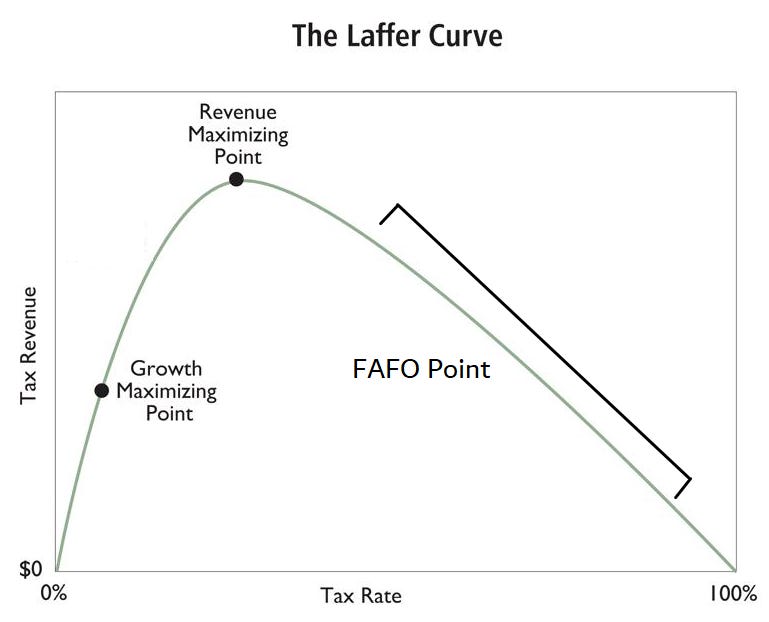
Harris’ proposal to raise regular capital gains taxes is one thing, albeit still egregious; it is far lesser noxious of the two proposals. Taxing unrealized gains is an exponentially worse type of taxation that introduces not just a higher tax rate and a 3rd type of income tax, but a completely new system for taxation – one that taxes people’s assets as they appreciate, not just when they realize the gains of said appreciation.

“But it will only be against people worth more than $100 million,” proponents of the idea will exclaim. Hell, I’m not worth 1% of that, so why should I even care?

First off, it can’t be understated how earth-shattering it is to put this terrible idea into motion, regardless of who it is going to affect. You can’t justify a stunning overreach on people’s constitutional rights and civil liberties just because they sit in a certain tax bracket. And it is a line that, once crossed, the government won’t backtrack on. Once taxing unrealized gains makes its way into the zeitgeist, it sticks around for good. And, if it sticks around, it’ll only be another meaningful step moving the U.S. economy closer to an anemic corpse of a state-planned economy.

A tax of this nature creates a vacuum that does nothing but suck the vibrancy out of an economy. In addition to setting a new moral hazard standard, the tax directly targets the people with the most capital at work in our country. By specifically targeting the people that have the means to create new enterprises and invest using this capital, and then driving them out of the country, the tax is a surefire way to suck the lifeblood out of what’s left of the United States economy.

Make no mistake: it will be a clarion call for billionaires to simply move out of the United States and into tax havens. And think about it — these are the people that have the means to up and simply leave the country and relocate anytime they want. For them, if it makes financial sense, they will do it. Implementing this unrealized gains tax will set the ball in motion, you can mark my words. The rich will be as good as gone.


🔥 40% off FOR LIFE: Use this special coupon link and get 40% off an annual subscription, good for as long as you wish to remain a subscriber.


And when billionaires decide to up and leave the United States, all of the tax revenue they were generating otherwise — not just the unrealized gains tax — leaves with them. In other words, an unrealized gains tax will push them past their limit and result in catastrophic consequences for the country’s tax revenue as a whole. It’ll literally do far more harm than good. If I can understand why, a fifth grader can. That means the ultra-rich, who are much smarter than I am, definitely understand it. They’re not going to be interested in hanging around and forking over this much more cash “for the good of the cause”. They already likely have a plan in such case this tax is passed, and — as a hint — it isn’t to happily hand over a check to the Harris administration and say “thanks for being such great stewards of my capital, keep up the good work”.

In reality, it likely involves yachts, dual passports, “investments” in places like Bermuda and Mauritius, attending F1 races and tennis matches, expensive champagne and Eastern European escorts (hereinafter referred to as: “The Hunter Biden Experience”).

But seriously, setting aside the billionaires for a moment, the tax is going to dampen everybody’s incentive to try and earn and invest to begin with. Who wants to invest in the market if they’re going to be taxed on their gains the very next day?

Possibly the worst part of this idea is its timing. The country is running a massive deficit now that looks to continue to widen because of our government’s refusal to cut spending on both sides of the aisle. As a reminder, you can only push the tax base so far before they turn tail and run. I know I’ve made jokes in the past (read: yesterday) about our government going through all of the solutions mandatory before arriving at any solution that works in the slightest, but this would be the granddaddy of all examples if implemented.

The timing of this proposed solution couldn’t be worse. We are at a point in our country’s fiscal history where we need balance more than ever.

We have the largest deficit and the most debt relative to GDP we have had in recent history.

The BRICS nations, including Russia, China, and India, are actively pursuing ways to break off of the Western banking system and challenge the U.S. dollar.

Inflation is running rampant and high interest rates are more than likely to cause our economy to slow down in marked fashion.

We’re running deficits, but we need the tax revenue we are currently bringing in if we have any hope of cutting spending to balance our budget and right the country’s ship economically. The loss of tax revenue as a result of capital flight from the United States responding to this proposed unrealized gains tax would be catastrophic and would accelerate the country’s financial and monetary demise, not help it.


Share this post on social media if you enjoyed.

Now read: 


QTR’s Disclaimer: I am an idiot and often get things wrong and lose money. I may own or transact in any names mentioned in this piece at any time without warning. Contributor posts and aggregated posts have not been fact checked and are the opinions of their authors. They are either submitted to QTR, reprinted under a Creative Commons license or with the permission of the author. This is not a recommendation to buy or sell any stocks or securities, just my opinions. I often lose money on positions I trade/invest in. I may add any name mentioned in this article and sell any name mentioned in this piece at any time, without further warning. None of this is a solicitation to buy or sell securities. These positions can change immediately as soon as I publish this, with or without notice. You are on your own. Do not make decisions based on my blog. I exist on the fringe. The publisher does not guarantee the accuracy or completeness of the information provided in this page. These are not the opinions of any of my employers, partners, or associates. I did my best to be honest about my disclosures but can’t guarantee I am right; I write these posts after a couple beers sometimes. Also, I just straight up get shit wrong a lot. I mention it twice because it’s that important.

Tyler Durden
Tue, 08/20/2024 – 19:40

Putin Opens Russia As Haven For Westerners Fleeing ‘Destructive Neoliberal Ideas’

0
Putin Opens Russia As Haven For Westerners Fleeing ‘Destructive Neoliberal Ideas’

Under a decree signed by President Vladimir Putin, Russia is relaxing temporary residence requirements for foreign citizens wishing to escape “destructive neoliberal ideas...which run counter to traditional Russian spiritual and moral values,” state news agency TASS has reported. 

Under the terms of the decree, foreigners will have the privilege of applying for temporary residence “outside the quota approved by the Russian government and without providing documents confirming their knowledge of the Russian language, Russian history and basic laws.”

The stated aim of President Putin’s decree is to provide “humanitarian support to persons sharing traditional Russian spiritual and moral values”

The Russian foreign ministry has been directed to initiate the new, expedited process for obtaining three-month visas as early as September. In support of the initiative, the foreign ministry will, within 30 days, publish a list of countries that are imposing destructive ideals on their citizens in conflict with traditional values embraced in Russia. 

Those determinations will be driven by Putin’s November 2022 executive order regarding “Fundamentals of State Policy to Preserve and Strengthen Traditional Russian Spiritual and Moral Values.” In part, that document states:  

Traditional values include life, dignity, human rights and freedoms, patriotism, civic consciousness, service to the Fatherland and responsibility for its destiny, high moral ideals, strong families, productive labour, the primacy of the spiritual over corporeal, humanism, charity, justice, collectivism, mutual assistance and mutual respect, historical memory and the continuity of generations, as well as the unity of Russia’s peoples.

TASS notes that, in February, Putin commented approvingly on Italian student Irene Cecchini’s proposal that Russia relax its residency rules for foreigners who embrace traditional values. In June, Cecchini was a panelist at the St. Petersburg International Economic Forum, at a session titled “Time to Live in Russia.” She studied at the Moscow State Institute of International Relations. 

Putin’s new policy may have been inspired by a suggestion from Italian Irene Cecchini, a student at a Moscow university

In May 2023, Russia announced it would build a village near Moscow to accommodate immigrating conservative Americans and Canadians. At the time, Russian immigration lawyer Timur Beslangurov told RIA Novosti that such people were eager to emigrate because of the “propaganda of radical values: Today they have 70 genders, and who knows what will come next. Many normal people emigrate and are considering Russia, but they’re faced with huge bureaucratic problems with Russia’s migration law.” Putin’s new decree is apparently a first step in cutting that red tape. 

As for Putin’s suggestion that Western values are eroding, could he be referring to the routine appearance of creatures like this at school board meetings and at the front of classrooms?

…or maybe President Biden’s appointment of luggage-stealing, dress-wearing, puppy-play freak Sam Brinton (left) to a high post managing nuclear waste?  

…or perhaps VP candidate and Minnesota Governor Tim Walz’s mandate that schools stock boys’ bathrooms with tampons?

We could go on for days, but we’ll leave you with this depiction of a Russian family that chose the reverse path of relocation: 

Tyler Durden
Tue, 08/20/2024 – 19:15

Numbers Don’t Lie: Women Thrived Under Trump, Suffered Under Harris

0
Numbers Don’t Lie: Women Thrived Under Trump, Suffered Under Harris

Authored by Elise Stafanik via RealClearPolitics,

Of the countless lies about Kamala Harris perpetuated by Democrats and their loyal stenographers in the mainstream media, one of the most egregious is that a Kamala Harris presidency will deliver historic economic opportunity for working women. Unfortunately for these desperate Democrats attempting to erase publicly available data, numbers tell the exact opposite story. Kamala Harris and Joe Biden saddled women with the largest pay cut, inflation crisis, tax hike, and economic crash so far this century, whereas President Trump delivered the greatest economic boost for American women of any modern day president. 

The median income for women increased every year during the Trump administration, reaching the highest on record in 2020. Real average weekly earnings increased 8.2% under President Trump yet decreased 3.9% under Joe Biden and Kamala Harris.  The unemployment rate for women overall and for black women in particular reached a record low during President Trump’s term. In 2019, the workforce participation gap between men and women shrank to the narrowest in history. President Trump’s economy made history with the most women in the workforce ever. 

This wasn’t by accident. Understanding that working women are also balancing families, President Trump delivered a pro-family economic agenda that included doubling the child tax credit from $1,000 to $2,000 per child and expanding eligibility. Nearly 40 million families received an average benefit of $2,200 under his leadership, totaling credits of approximately $88 billion. 

He then created the first-ever paid family leave tax credit for employees earning $72,000 or less and signed into law 12 weeks of paid parental leave for federal workers. He also signed the largest-ever increase in child care and development block grants – expanding access to quality, affordable childcare for more than 800,000 low-income families. President Trump signed into law a provision that enabled new parents to withdraw up to $5,000 from their retirement accounts without penalty when they give birth to or adopt a child.  

The oft-asked question about balancing work and family life is: Can women have it all? Under President Trump’s leadership, the answer was a resounding yes. 

Under Joe Biden and Kamala Harris, not so much. 

Biden and Harris’ failed economic policies hurt every American but hit women hardest of all. Women are bearing the brunt of Kamala Harris’ tie-breaking vote for Biden’s comically named “Inflation Reduction Act,” which turbocharged inflation with a glut of ridiculous climate spending. Women are working longer hours and delaying retirement as a result. 

Talk to any woman in America and there is no question that inflation is a women’s issue. Since Kamala Harris was sworn in as vice president, prices have risen by 19.4% – making it increasingly difficult for women to provide for their families. Women are the majority of grocery shoppers, and grocery bills have skyrocketed, forcing many Americans to cut back on essentials. A single mother of two in Nevada had to sell her car to afford groceries under Biden. A mother of two in Michigan had “to think about putting gasoline prices before buying my kids clothes” because of Kamala Harris’ tie-breaking vote for Biden’s radical green energy agenda.

Families now need an extra $12,590 annually just to maintain the same standard of living they enjoyed three years ago, according to Congress’ Joint Economic Committee—and 67% of parents say inflation has impacted their ability to pay for their children’s education, school supplies, and extracurricular activities this past school year. The cost of childcare has increased 32% for the average family since 2019, and nearly two-thirds are spending 20% or more of their annual income on childcare. The average price for a pack of disposable diapers has increased 32% since 2019, and 47% of families reported struggling to afford them. In 2022, Joe Biden and Kamala Harris’ incompetence created a baby formula shortage, causing the price to soar to an all-time high. Some 44 million people were living in food insecure households in 2022, a 31% annual increase and the largest one-year increase since 2008. 

Women make up the majority of voters in America, so it’s no wonder the Harris propaganda machine is in overdrive attempting to gaslight them into thinking they’ve never had it better. But as much as Democrats may lie, numbers never do. They show that President Trump not only cares deeply about women and all Americans but also knows what it takes to stimulate the economy to create historic opportunities on our behalf. Kamala Harris, meanwhile, sees women as a convenient voting block to pander to, deceive, and then abandon in favor of an economically poisonous, radically liberal agenda. 

To my fellow women voters: Don’t be fooled. 

Rep. Elise M. Stefanik represents New York’s 21st congressional district. She is the House Republican Conference chair, and chair of Women for Trump.

Tyler Durden
Tue, 08/20/2024 – 18:50

US, Allies Condemn China’s Actions Against Philippine Vessels In South China Sea

0
US, Allies Condemn China’s Actions Against Philippine Vessels In South China Sea

Authored by Frank Fang via The Epoch Times (emphasis ours),

The United States and several of its allies condemned China over what they said were dangerous actions by Chinese coast guard vessels after they collided with Philippine coast guard vessels in the South China Sea.

Photos provided by the Philippine coast guard show damage in the auxiliary room on the port side near the port auxiliary engine of Philippine coast guard vessel BRP Bagacay/MRRV-4410 (L) and on the coast guard vessel BRP Cape Engano/MRRV-4411 (R), following collisions with Chinese coast guard vessels in the disputed South China Sea, on Aug. 19, 2024. Philippine Coast Guard via AP

The incident happened in the early hours of Aug. 19 near the Sabina Shoal, with Beijing and Manila accusing each other of being responsible for the collisions.

U.S. State Department spokesperson Vedant Patel criticized China for its actions against “lawful Philippine maritime operations” in an Aug. 19 statement.

“PRC [People’s Republic of China] ships employed reckless maneuvers, deliberately colliding with two Philippine Coast Guard ships, causing structural damage and jeopardizing the safety of the crew onboard,” Patel said.

The collision occurred about 20 nautical miles southeast of the Escoda Shoal, which is a part of the South China Sea that the Philippines refers to as the West Philippine Sea. The Sabina Shaol is located near the Second Thomas Shoal.

The latest incident marks renewed geopolitical tension between China and the Philippines, following a short reprieve since the two sides inked a provisional agreement at the Second Thomas Shoal in July. Earlier this month, the Philippines announced it would lodge a diplomatic protest with China after two Chinese fighter jets deployed fares in the path of a Philippine patrol plane.

Jonathan Malaya, assistant director general at the National Security Council of the Philippines, said on Monday that the two Philippine coast guard patrol boats, BRP Bagacay (MRRV-4410) and BRP Cape Engaño (MRRV-441), were on a resupply mission for the Philippine outposts at Patag and Lawak islands in the Spratly Islands. The two boats were rammed by Chinese coast guard vessels and suffered structural damage, he said.

“These actions are the latest examples of the PRC using dangerous and escalatory measures to enforce its expansive and unlawful South China Sea maritime claims,” Patel said. He called on China to abide by international law and desist from “dangerous and destabilizing conduct.”

Malaya said the United States reaffirms that Article IV of the 1951 U.S.–Philippines Mutual Defense Treaty “extends to armed attacks on Philippine armed forces, public vessels, or aircraft—including those of its Coast Guard—anywhere in the South China Sea.”

International Condemnation

Australia, Canada, the European Union, France, Germany, Japan, New Zealand, and the UK condemned China’s latest maritime actions.

Australia’s ambassador to the Philippines, HK Yu, wrote in a post on social media platform X that China’s actions undermine efforts to de-escalate tensions.

David Hartman, Canada’s ambassador to the Philippines, condemned the “irresponsible and dangerous maneuvers of the China Coast Guard” in an X post.

“These actions are inconsistent with China’s obligations under international law and undermine efforts to de-escalate tensions in the South China Sea,” Hartman wrote.

Japan’s ambassador to the Philippines, Endo Kazuya, said in an X post that Tokyo does not tolerate harassment and actions that “increase tensions or disturb navigational rights.”

Kazuya added that Japan “stands with [the Philiphines] by upholding rules-based order and peaceful settlement of disputes based on [international] law.”

Earlier this month, Australia, Canada, the Philippines, and the United States held a two-day “multilateral maritime cooperative activity” within Manila’s exclusive economic zones. The drill was aimed at showing the four nations’ “collective commitment to strengthen regional and international cooperation in support of a free and open Indo-Pacific,” according to a statement from the U.S. Indo-Pacific Command.

Manila continued its criticism of Beijing over the collision on Tuesday. Alexander Lopez, a spokesperson for the country’s maritime council, expressed “serious concern over the deliberate harassment and infringement by China” on the Philippines’ sovereignty and sovereign rights in the South China Sea.

In July, Sen. Jim Risch (R-Idaho), ranking member of the Senate Foreign Relations Committee, and Sen. Roger Wicker (R-Miss.), ranking member of the Senate Armed Services Committee, sent a letter to President Joe Biden over their concerns regarding China’s use of force against the Philippines in the South China Sea.

The lawmakers asked Biden to provide a “full list of military, diplomatic, and economic options developed by the Departments of State and Defense to support the Philippines and deter further escalation by the PRC.”

Reuters contributed to this report.

Tyler Durden
Tue, 08/20/2024 – 18:25

What’s Really Happening With Monkeypox

0
What’s Really Happening With Monkeypox

Authored by David Bell via the Brownstone Institute,

The World Health Organization (WHO) acted as expected this week and declared Mpox a Public Health Emergency of International Concern (PHEIC). So, a problem in a small number of African countries that has killed about the same number of people this year as die every four hours from tuberculosis has come to dominate international headlines. This is raising a lot of angst from some circles against the WHO.

While angst is warranted, it is mostly misdirected. The WHO and the IHR emergency committee they convened had little real power – they are simply following a script written by their sponsors. The African CDC, which declared an emergency a day earlier, is in a similar position. Mpox is a real disease and needs local and proportionate solutions. But the problem it is highlighting is much bigger than Mpox or the WHO, and understanding this is essential if we are to fix it.

Mpox, previously called Monkeypox, is caused by a virus thought to normally infect African rodents such as rats and squirrels. It fairly frequently passes to, and between, humans. In humans, its effects range from very mild illness to fever and muscle pains to severe illness with its characteristic skin rash, and sometimes death. Different variants, called ‘clades,’ produce slightly different symptoms. It is passed by close body contact including sexual activity, and the WHO declared a PHEIC two years ago for a clade that was mostly passed by men having sex with men. 

The current outbreaks involve sexual transmission but also other close contact such as within households, expanding its potential for harm. Children are affected and suffer the most severe outcomes, perhaps due to issues of lower prior immunity and the effects of malnutrition and other illnesses.

Reality in DRC

The current PHEIC was mainly precipitated by the ongoing outbreak in the Democratic Republic of Congo (DRC), though there are known outbreaks in nearby countries covering a number of clades. About 500 people have died from Mpox in DRC this year, over 80% of them under 15 years of age. In that same period, about 40,000 people in DRC, mostly children under 5 years, died from malaria. The malaria deaths were mainly due to lack of access to very basic commodities like diagnostic tests, antimalarial drugs, and insecticidal bed nets, as malaria control is chronically underfunded globally. Malaria is nearly always preventable or treatable if sufficiently resourced.

During this same period in which 500 people died from Mpox in DRC, hundreds of thousands also died in DRC and surrounding African countries from tuberculosis, HIV/AIDS, and the impacts of malnutrition and unsafe water. Tuberculosis alone kills about 1.3 million people globally each year, which is a rate about 1,500 times higher than Mpox in 2024.

The population of DRC is also facing increasing instability characterized by mass rape and massacres, in part due to a scramble by warlords to service the appetite of richer countries for the components of batteries. These in turn are needed to support the Green Agenda of Europe and North America. This is the context in which the people of DRC and nearby populations, which obviously should be the primary decision-makers regarding the Mpox outbreak, currently live.

An Industry Produces What It Is Paid for

For the WHO and the international public health industry, Mpox presents a very different picture. They now work for a pandemic industrial complex, built by private and political interests on the ashes of international public health. Forty years ago, Mpox would have been viewed in context, proportional to the diseases that are shortening overall life expectancy and the poverty and civil disorder that allows them to continue. The media would barely have mentioned the disease, as they were basing much of their coverage on impact and attempting to offer independent analysis.

Now the public health industry is dependent on emergencies. They have spent the past 20 years building agencies such as CEPI, inaugurated at the 2017 World Economic Forum meeting and solely focused on developing vaccines for pandemic, and on expanding capacity to detect and distinguish ever more viruses and variants. This is supported by the recently passed amendments to the International Health Regulations (IHR). 

While improving nutrition, sanitation, and living conditions provided the path to longer lifespans in Western countries, such measures sit poorly with a colonial approach to world affairs in which the wealth and dominance of some countries are seen as being dependent on the continued poverty of others. This requires a paradigm in which decision-making is in the hands of distant bureaucratic and corporate masters. Public health has an unfortunate history of supporting this, with restriction of local decision-making and the pushing of commodities as key interventions.

Thus, we now have thousands of public health functionaries, from the WHO to research institutes to non-government organizations, commercial companies, and private foundations, primarily dedicated to finding targets for Pharma, purloining public funding, and then developing and selling the cure. The entire newly minted pandemic agenda, demonstrated successfully through the Covid-19 response, is based on this approach. Justification for the salaries involved requires detection of outbreaks, an exaggeration of their likely impact, and the institution of a commodity-heavy and usually vaccine-based response. 

The sponsors of this entire process – countries with large Pharma industries, Pharma investors, and Pharma companies themselves – have established power through media and political sponsorship to ensure the approach works. Evidence of the intent of the model and the harms it is wreaking can be effectively hidden from public view by a subservient media and publishing industry. But in DRC, people who have long suffered the exploitation of war and the mineral extractors, who replaced a particularly brutal colonial regime, must now also deal with the wealth extractors of Pharma.

Dealing with the Cause

While Mpox is concentrated in Africa, the effects of corrupted public health are global. Bird flu will likely follow the same course as Mpox in the near future. The army of researchers paid to find more outbreaks will do so. While the risk from pandemics is not significantly different than decades ago, there is an industry dependent on making you think otherwise. 

As the Covid-19 playbook showed, this is about money and power on a scale only matched by similar fascist regimes of the past. Current efforts across Western countries to denigrate the concept of free speech, to criminalize dissent, and to institute health passports to control movement are not new and are in no way disconnected from the inevitability of the WHO declaring the Mpox PHEIC. We are not in the world we knew twenty years ago.

Poverty and the external forces that benefit from war, and the diseases these enable, will continue to hammer the people of DRC. If a mass vaccination campaign is instituted, which is highly likely, financial and human resources will be diverted from far greater threats. This is why decision-making must now be centralized far from the communities affected. Local priorities will never match those that expansion of the pandemic industry depends on.

In the West, we must move on from blaming the WHO and address the reality unfolding around us. Censorship is being promoted by journalists, courts are serving political agendas, and the very concept of nationhood, on which democracy depends, is being demonized. A fascist agenda is openly promoted by corporate clubs such as the World Economic Forum and echoed by the international institutions set up after the Second World War specifically to oppose it. If we cannot see this and if we do not refuse to participate, then we will have only ourselves to blame. We are voting for these governments and accepting obvious fraud, and we can choose not to do so.

For the people of DRC, children will continue to tragically die from Mpox, from malaria, and from all the diseases that ensure return on investment for distant companies making pharmaceuticals and batteries. They can ignore the pleading of the servants of the White Men of Davos who will wish to inject them, but they cannot ignore their poverty or the disinterest in their opinions. As with Covid-19, they will now become poorer because Google, the Guardian, and the WHO were bought a long time back, and now serve others.

The one real hope is that we ignore lies and empty pronouncements, refusing to bow to unfounded fear. In public health and in society, censorship protects falsehoods and dictates reflect greed for power. Once we refuse to accept either, we can begin to address the problems at the WHO and the inequity it is promoting. Until that time, we will live in this increasingly vicious circus.

David Bell, Senior Scholar at Brownstone Institute, is a public health physician and biotech consultant in global health. He is a former medical officer and scientist at the World Health Organization (WHO), Programme Head for malaria and febrile diseases at the Foundation for Innovative New Diagnostics (FIND) in Geneva, Switzerland, and Director of Global Health Technologies at Intellectual Ventures Global Good Fund in Bellevue, WA, USA.

Tyler Durden
Tue, 08/20/2024 – 17:40

China On The Verge: Welfare State Crumbles, Explosion In Social Unrest As Youth Unemployment Soars, Strikes Surge

0
China On The Verge: Welfare State Crumbles, Explosion In Social Unrest As Youth Unemployment Soars, Strikes Surge

In retrospect, it was clear that the bottom was falling out of China’s economy (the real economy, not the fake “as reported” one) last August when shortly after we learned that youth unemployment in the country hit a record 21.3%, Beijing unexpectedly stopped reporting this data entirely, because as Stalin would probably say today if he were still alive, “No data – no problem”!

Since then, largely as a result of Xi Jinping’s insistence not to stimulate the economy no matter the severity of the deterioration, China’s economy has accelerated down its perilous slowdown. And while Wall Street has gladly assumed that Beijing will be able to get away without a forceful stimulus for the foreseeable future even as GDP ticks down from 5% to 4% to 3% to… you get the picture, a far more credible – and unpleasant – argument for a bazooka stimulus is rearing its ugly head: social cohesion is about to crack.

We start where we left off last August, with China’s surging youth unemployment rate. Here, as the South China Morning Post reports, China’s revised youth unemployment surged to 17.2% in July (this would be the equivalent of about 23% according to the old series), the highest level since the National Bureau of Statistics adopted a new method of counting.

The jobless rate for 16- to 24-year-olds (excluding students) was up from 13.2% a month earlier and ended three months of declines, according to the latest NBS data. The rate for December was 14.9%.

As we reported last year, Beijing introduced the revised method for December after suspending the release of youth unemployment data from July. Under the previous approach, the jobless rate for the 16-24 age group, including students, peaked at 21.3 per cent in June.

Student numbers were then stripped out of the calculation, a change that the NBS said was to “more accurately” reflect that job-hunting was not a priority for students in China. That, however, is a major problem, as it does not account for the relentless firehose of new entrants that enter the labor market every year when millions of Chinese students graduate and start looking for a job.

Indeed, as SCMP reports, the rise in unemployment among young jobseekers comes as a record 11.79 million tertiary graduates enter the labor market of the world’s second-largest economy!

As a result, many fresh graduates have had to scale back salary expectations by about a third as the economy has struggled to gather momentum, according to analysts. One day before the youth jobless reading, the NBS reported that the country’s overall unemployment rate was 5.2%, up for the first time since February.

“The employment situation has remained generally stable so far this year,” NBS spokeswoman Liu Aihua said, “but we should also see at the same time that pressure … still exists. The structural contradiction of difficulties in both job seeking and recruitment is still prominent.”

Realizing that tens of millions of unemployed yutes is recipe for revolution, China’s ruling elites have put far more emphasis on dealing with youth joblessness this year – starting with adjusting how it is misreported of course to prevent all out chaos  – in part because of the risks it poses to social stability as well as the pressure lower incomes would put on plans for consumer spending to lead the way to a sustainable recovery.

At a meeting of the State Council, the country’s cabinet, last Friday, Premier Li Qiang called for more efforts to “stabilize employment for key groups”.  The Communist Party’s Politburo, the main decision-making body in China, had a similar message two weeks earlier, saying priority should be given to university graduates looking for jobs.

And last month the party’s Central Committee said it would “improve the system of employment support for key groups such as college graduates, rural migrant workers and ex-service members”.

Which brings us to even more data fudging: since the release of the December data, the Chinese authorities have split the 25-59 age group into two parts – 25-29 and 30-59 – and applied the new statistical method to both.

The jobless rate for the 25-29 age group, also excluding students, was 6.5% in July, up by 0.1% from June, inching back up after three consecutive months of decline. The rate for the 30-59 age group was 3.9%, just down from 4% reported in June.

Unfortunately for Beijing, literally nobody believes these numbers, because instead of a picture of economic stability, China now exudes an unprecedented slowdown, one where labor disputes in China’s property and manufacturing sectors have surged as economic growth decelerates, underlining blue-collar workers’ concerns over the country’s social safety net.

As Nikkei reported last week, while “unrest is rarely reported by the country’s media due to strict government control, signs of public discontent and hardship emerge nonetheless.”

Recent incidents include a protest by an ex-soldier who sat atop a building in Beijing’s famed Wangfujing shopping street on the evening of Aug. 1. In a video uploaded on the social media platform X, the man in full army uniform unveils a white banner accusing a government office in the city of Kunming, Yunnan province, of “strangling a retired serviceman who had served for 12 years.”

Two days earlier, another protester displayed a banner on an overpass in the county of Xinhua, Hunan province, demanding freedom and elections. In an accompanying video that spread on X, the protester identified himself as Fang Yirong and claimed to have been targeted by authorities since last summer for supporting democracy. He said he took part in the “white paper” protests in 2022 against China’s harsh COVID-19 restrictions.

Meanwhile, labor strikes in China increased 3% on the year to 719 incidents in the first half of 2024, according to the China Labor Bulletin (CLB), a Hong Kong-based workers advocacy group.

Incidents involving the all-important property and manufacturing sectors were up 12%, accounting for 80% of the total.

“The uptick in strikes is a reflection of the increasing social pressure as the economy struggles to improve,” said Max J. Zenglein, chief economist at the Mercator Institute for China Studies in Germany.

China’s economic growth slowed to 4.7% in the second quarter, from 5.3% in the first, stifled by a persistent downturn in the property sector, which is going from bad to worse seemingly every single month as we will discuss in a subsequent post, and subdued household demand. Sluggish domestic growth has pushed some industries, including solar panels and automobiles, to step up exports and price dumping, sparking howls of outrage from domestic producers in export markets, while those hit by trade tensions with the U.S. have sought to shift production abroad.

Worker unrest appears to reflect the growing pressures. Among the incidents highlighted in the CLB report was a dispute at solar panel maker Akcome Technology over pay cuts and withdrawal of social security contributions. The Shenzhen-listed Akcome filed for bankruptcy at one of its subsidiaries on July 29, citing an inability to repay debts.

While there was no indication of the number of protesters at Akcome, CLB in a separate report profiled a strike involving over 1,000 workers at a shoe factory in Jiangsu province that counts Nike, Adidas, Asics, New Balance, Timberland and Salomon among its clients. The dispute at Yangzhou Baoyi Shoe Manufacturing in November took place over compensation issues affecting laid-off workers after the company moved its production to Indonesia.

“So far in 2024 there has been no notable improvement of the economy, with a weak labor market being a key source of household insecurity that is weighing down on consumption,” said Zenglein.

The largest proportion of protests — 344 incidents — were carried out by construction workers demanding wages, according to CLB. This is no surprise, said Zenglein, given the growing number of property developers that have run into financial trouble who are unable to pay their employees, resulting in chaos and ripple effects through the economy.

China’s strikes are usually by workers who face long working hours and low wages, CLB said. This also casts a light on the disparity in social security coverage between urban and migrant workers. Unlike people with a registered household in a city, many laborers from rural areas work without formal contracts despite forming the economic backbone of their adopted cities.

“It is difficult for migrant workers to find jobs that pay for social security for 15 years, the prerequisite for getting pension when retired,” the report said.

This scene from a video posted on X shows a banner criticizing Chinese President Xi Jinping in Xinhua, Hunan province.

As migrant workers are largely excluded from such welfare coverage altogether, “work becomes the hedge against an extremely porous social safety net,” said Yun Zhou, a social demographer and family sociologist at the University of Michigan. These workers “are confronting a harsh, discriminatory labor landscape where work availability is highly susceptible to China’s economic downturn and restructuring, working conditions are often at the will of capricious management, and workers’ productivity and worth are tightly managed by technology and algorithms.”

In a key socioeconomic planning meeting concluded last month, the government vowed to improve the social security system by addressing the restrictions faced by migration workers. In response to the country’s aging population, it added that the statutory retirement age — currently 60 years for men and between 50 and 55 for women — would be raised gradually and voluntarily. Of course, there has been no centrally-planned civilization in history that managed to raise the retirement age either “voluntarily” and without clashes, violence, and collapse in social cohesion, precisely the three things that Beijing fears the most.

“For China’s urban workers, the talk of raising retirement ages is felt as a delayed, if not broken, promise of social welfare coverage,” said Zhou.

Which is precisely why Beijing will have no choice but to blink in the end, and that will mean unleashing a much delayed stimulus bazooka that likes of which have not been seen yet.

Tyler Durden
Tue, 08/20/2024 – 16:40

Have You Seen Kamala’s Proposed Radical Cabinet? Eric Holder, Rahm Emanuel, And More…

0
Have You Seen Kamala’s Proposed Radical Cabinet? Eric Holder, Rahm Emanuel, And More…

Via Revolver.news,

It seems Obama is angling for a fourth term, which is why he’s sidelined Biden in favor of Kamala Harris—the unpopular, inexperienced DEI diva who reportedly used her “womanly ways” to get ahead.

Why do we know this? We got a sneak peek at Kamala’s proposed cabinet, and it’s a who’s who of Obama-era radicals, starting with head Marxist Eric Holder and the progressive disaster who torched Chicago, Rahm Emanuel. If this scary group of radicals doesn’t light a fire in you to ensure President Trump gets reelected, nothing will.

What’s truly frightening is that these names represent a return to some of the most broken aspects of America.

Many people believe the Harris/Walz campaign is the biggest astroturf psyop in US political history, which says a lot considering what they pulled off with Basement Biden. At least Biden was well-known and liked by some clueless voters. Harris doesn’t even have that going for her, and as for Tim Walz, no one knows who he is unless you call him “Tampon Tim.”

We also know that the Harris/Walz duo is the most radical duo to ever grace the campaign trail, and Kamala’s cabinet list tells you that this crazy train isn’t slowing down.

The radical connections—from the trans agenda to backing Hitler-supporting terrorists—are flooding the internet, and the campaign is reeling, even if they won’t admit it.

A Harris/Walz presidency would be the final nail in America’s coffin. Not to be too hyperbolic, but with the level of extremism and liberal insanity that this administration would bring, especially with the likes of Eric Holder, Jake Sullivan, and Rahm Emanuel, there’s no way America could withstand another four years under such extremism.

You can watch the entire Glenn Beck video here:

A Harris/Walz presidency would be the final nail in America’s coffin. Without being too hyperbolic, the level of extremism and liberal insanity this administration would bring—especially with figures like Eric Holder, Jake Sullivan, and Rahm Emanuel—would be more than America could withstand. We can’t afford another four years of such extremism.

It’s time to take a stand and ensure this doesn’t happen. Get out there, make your voice heard, and fight for the future of this country before it’s too late. This is our last stand.

Tyler Durden
Tue, 08/20/2024 – 16:20

Gold Hits New Record High As Kamu-nism/Growth-Scare Spoils Stocks’ Party

0
Gold Hits New Record High As Kamu-nism/Growth-Scare Spoils Stocks’ Party

The S&P 500 has not had a nine-day win-streak since 2004 and it appears Kamu-nism was enough to stop stocks doing it again today as Harris unveiled her cunning plan, including 28% corporate tax, price-controls, 44.6% capital-gains tax, and last but not least, a tax on unrealized gains.

Small Caps were the ugliest horse in the glue factory today as the algos tried their hardest to maintain the win-streak.

The NYSE Composite Index did make a new record high at this morning’s open, but then faded back…

Source: Bloomberg

The Mag7 basket managed another day of (marginal) gains (but we do note that it stalled intraday at a key resistance level)…

Source: Bloomberg

But ‘most shorted’ stocks were puked out of the gate…

Source: Bloomberg

And this occurred as growth-surprise data slumped back to multi-year lows (not helped by the crash in Philly Fed’s survey today)…

Source: Bloomberg

…which lifted rate-cut expectations modestly…

Source: Bloomberg

Are we back in Goldilocks-land – just enough growth-scare to enable the Fed doves support for stocks but not enough growth-scare to terrify investors’ guesses at future earnings.

The dollar doesn’t care – it’s riding the dovish path lower no matter what…

Source: Bloomberg

And despite the best efforts of Benoit and his BIS buddies to tamp down enthusiasm for alternatives, gold surged to a new record high today…

Source: Bloomberg

But, we do note that Treasury yields did plunge today (6-7bps across the curve) – a little more growth-scare than equity bulls might have liked to see…

Source: Bloomberg

As the chart above shows, the long-end (10Y and 30Y) has erased all of the CPI-spike from last week.

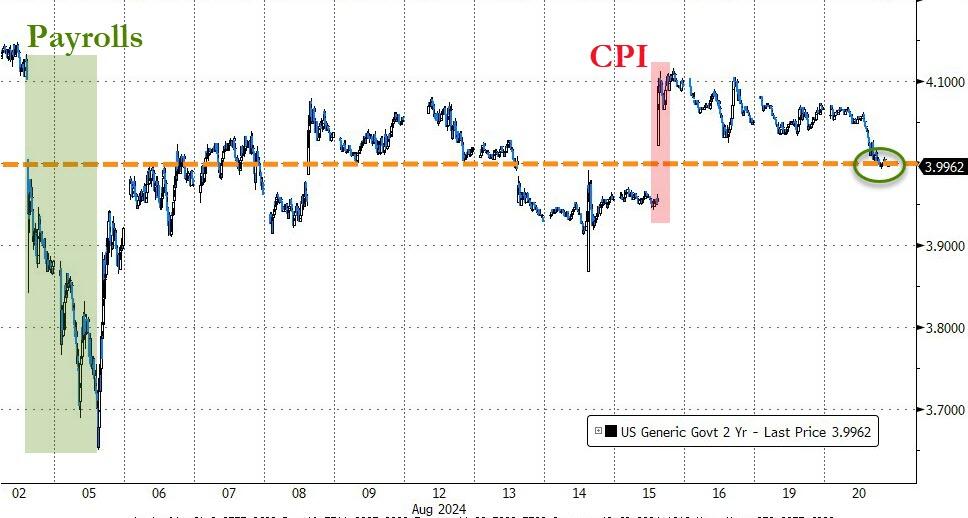
Most notably, the 2Y yield tumbled back below 4.00% (after CPI sent yields back up to pre-payrolls levels)…

Source: Bloomberg

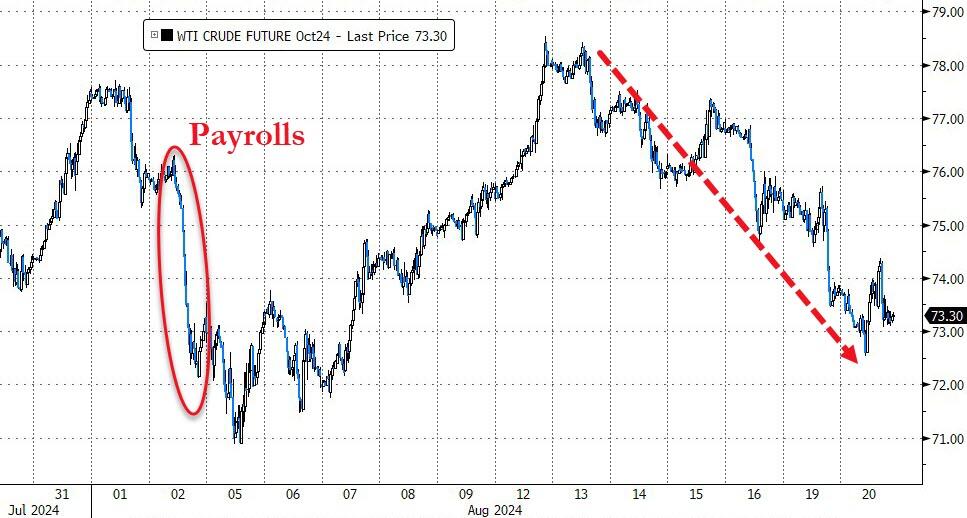
Oil prices limped lower once again (5th day of the last 6) as growth-scares weighed on commods…

Source: Bloomberg

Bitcoin ripped up above $61,000 overnight during the Asia session, then was punched lower during the US session…

Source: Bloomberg

Bear in mind, that pattern of trading should come as no surprise at all…

Finally, while markets have recovered, Deutsche Bank warned this morning in a note to clients that catalysts behind the retreat haven’t necessarily evaporated. The firm outlined five key risks that remain that investors should watch:

  • First, equity valuations are still at historic highs, with the market trading in moderately overweight territory, the bank said. This made some on Wall Street uneasy even before August’s sell-off and continues to be a point of anxiety as investments pile in.

  • Second, economic data remains vulnerable. Part of the reason equities dropped dramatically in August was a softer-than-expected nonfarm payrolls print, which disappointed estimates of 194,000. This was an unwelcome sign of weakness, but not a recessionary reading, DB said. That leaves room for even more disappointing data, which could bring larger consequences to investors if it were to happen.

  • Third, monetary policy is getting increasingly tight on real terms, with DB noting that the real Fed funds rate recently hit its highest since 2007.

  • Fourth, September has been a seasonally bad month for stocks over the past few years. The S&P 500 has fallen during the period for four straight years, and in seven of the past 10. DB says it’s also been a bad month for fixed income, with the Bloomberg global bond aggregate falling during the past seven Septembers.

  • Fifth, geopolitical tensions are still high. DB notes that Middle East conflicts contributed to an equity sell-off in April, while oil prices also hit their highs for the year around the same time. More recently, in August, oil saw their biggest single-day spike of the year on reports of further escalation, the firm said.

And under the hood, options markets are still pricing in the potential for short-term chaos amid a heavy calendar of risk catalysts including Powell’s address at Jackson Hole, NVDA earnings, NFP, CPI, and OpEx…

Source: Bloomberg

As VIX rose notably on the day and VVIX rejected the Maginot Line at 100…

Source: Bloomberg

Was today’s dip a sign that the momo-chase is over… for now?

Tyler Durden
Tue, 08/20/2024 – 16:00

U. Illinois Has 42 “Illegal” Race-, Sex-Based Scholarships: Federal Complaint

0
U. Illinois Has 42 “Illegal” Race-, Sex-Based Scholarships: Federal Complaint

Authored by Matt Lamb via The College Fix,

The University of Illinois at Urbana-Champaign has 42 “illegal” scholarships that discriminate against applicants on the basis of race, sex, or both, a federal complaint alleges.

The Equal Protection Project of the Legal Insurrection Foundation filed the complaint today with the Office for Civil Rights within the Department of Education.

It identifies 19 scholarships that discriminate on the basis of sex in violation of Title IX.

“Eight scholarships are offered exclusively to female students, eight state a preference for female students, two are offered exclusively to male students, and one states a preference for male students,” the complaint states.

Another 19 scholarships discriminate on the basis of race, in violation of Title VI of the Civil Rights Act of 1964, according to the federal complaint.

The complaint states:

These 19 scholarships are all offered exclusively or with a stated preference for various groups based on race, color, or national origin including students from underrepresented populations, students who are historically underrepresented, students from minority groups, and students from various ethnic groups or national origins including Czech, Lithuanian, Japanese, Latina/Latino, Iranian.

Another four discriminate on both the basis of race and sex, according to the complaint.

The 2023 Supreme Court decision banning affirmative action makes clear the scholarships are illegal, according to William Jacobson, a law professor at Cornell University.

“After the Supreme Court’s 2023 decision in Students For Fair Admission, it is clear that discriminating on the basis of race to achieve diversity is not lawful,” Jacobson, the founder of the Equal Protection Project, told The College Fix via a media statement.

“As Chief Justice Roberts wrote in the majority opinion, ‘[e]liminating racial discrimination means eliminating all of it.’”

“The vast number of discriminatory scholarships reflects a pervasive and systemic failure to comply with constitutional and statutory requirements at UIUC, warranting expedited investigation by the Office for Civil Rights,” Professor Jacobson said.

“The eligibility requirements for these scholarships are openly discriminatory,” Jacobson also said. “Regardless of the purpose of the discrimination, it is wrong and unlawful.”

“It does society no good to inject more racism and sexism into the educational system through discriminatory college scholarships,” the civil rights activist said.

He wants the university to create a “remedial plan to compensate students shut out of these scholarships due to discrimination.”

It is not just blue state universities that offer scholarships based on race and sex.

The University of Alabama offers at least $200K in scholarships based on race or sex, a May College Fix analysis found.

The public university told The Fix it is reviewing its scholarships due to legal developments.

Tyler Durden
Tue, 08/20/2024 – 15:45

Harris Proposes Raising Corporate Tax Rate To 28 Percent

0
Harris Proposes Raising Corporate Tax Rate To 28 Percent

Authored by Stephen Katte via The Epoch Times (emphasis ours),

Democratic Presidential candidate Kamala Harris is proposing to increase the corporate tax rate as part of her economic agenda if she wins the presidency in November.

Democratic presidential nominee Vice President Kamala Harris speaks during the first day of the Democratic National Convention in Chicago on Aug. 19, 2024. Madalina Vasiliu/The Epoch Times

Harris campaign spokesperson James Singer confirmed in a statement on Aug. 19 that Harris is backing an increase in the corporate tax rate from 21 percent, to 28 percent, the same policy put forward by President Joe Biden in his administration’s fiscal year 2025 budget. Changes to the U.S. tax code require approval by Congress before they can be enacted.

Singer says Harris is in favor of rate rise because it’s the most “fiscally responsible way to put money back in the pockets of working people and ensure billionaires and big corporations pay their fair share.”

“As president, Kamala Harris will focus on creating an opportunity economy for the middle class that advances their economic security, stability, and dignity,” he said.

Days earlier at a campaign event in North Carolina on Aug. 16, Harris outlined her economic agenda, which included a pledge to offer housing assistance through government subsidies, to take on price gouging concerns following a period of heightened inflation, and increase child tax credits, among other promises.

According to the Congressional Budget Office, any increase in the corporate tax rate could raise billions in taxes. In its estimates, the federal agency found that a 1 percent increase in the corporate tax rate would generate an additional $96 billion in taxes from 2019 to 2028.

However, critics of increasing corporate tax rates argue it would only encourage businesses to leave American shores for countries with lower rates. In the process, it could see a decrease in available jobs in the United States.

“Tax rate differences among countries can influence businesses’ choices about how and where to invest,” the Congressional Budget Office said.

“To the extent that firms shift their investment and activities to countries with low taxes with the goal of reducing their tax liability at home, economic efficiency declines because firms are not allocating resources to their most productive use.”

Under Republican Presidential candidate former President Donald Trump, the federal government’s 2017 Tax Cuts and Jobs Act slashed corporate tax from 35 percent to 21 percent in an effort to help boost the economy by making it attractive for businesses to operate in the United States. Many of the tax reforms in the bill expire in 2025; whoever wins the upcoming election will have the opportunity to either extend the Trump-era tax cut or let it lapse.

Trump has voiced his intention to make the tax model permanent or even cut the rate further. In an Aug. 8 news conference at the Mar-a-Lago resort in Florida, he argued that he‘d “never seen people get elected by saying, ’We’re going to give you a tax increase.’”

Jacob Burg contributed to this report.

Tyler Durden
Tue, 08/20/2024 – 15:25