66.3 F
Chicago
Wednesday, September 30, 2026
Home Blog Page 2362

Manhattan DA Defers To Judge On Delaying Trump’s Sentencing Date

0
Manhattan DA Defers To Judge On Delaying Trump’s Sentencing Date

Authored by Jack Phillips via The Epoch Times,

Manhattan District Attorney Alvin Bragg’s office said it will defer to a New York judge on former President Donald Trump’s request to delay his criminal case sentencing until after the presidential election this year.

Bragg’s office, in a letter received by the court on Aug. 19, wrote that prosecutors will leave it up to Judge Juan Merchan to decide whether Trump’s sentencing in his New York case should be delayed beyond the current Sept. 18 hearing date.

Trump’s attorneys last week asked the judge to postpone his sentencing until after the November election, where he is the leading Republican candidate for president. Prosecutors did not specifically oppose the former president’s request for a delay.

Prosecutors wrote in their letter, “Given the defense’s newly-stated position, we defer to the Court on whether an adjournment is warranted to allow for orderly appellate litigation of that question, or to reduce the risk of a disruptive stay from an appellate court pending consideration of that question.”

“The People are prepared to appear for sentencing on any future date the Court sets,” the letter continued.

In their request for a delay, Trump’s lawyers last week wrote to the judge that the sentencing should take place after the start of early voting for the election, saying the timing would harm the proceedings.

“Sentencing is currently scheduled to occur after the commencement of early voting in the Presidential election,” attorney Todd Blanche wrote.

“By adjourning the sentencing until after that election—which is of paramount importance to the entire Nation, including tens of millions of people who do not share the views of Authentic, its executives, and its clients—the Court would reduce, even if not eliminate, issues regarding the integrity of any future proceedings.”

They also argued there was not enough time before the sentencing for the defense to potentially appeal Merchan’s ruling on Trump’s request to overturn the conviction due to the Supreme Court’s landmark ruling on presidential immunity.

The Supreme Court’s 6–3 decision, which related to a separate criminal case Trump faces, found that presidents cannot be criminally prosecuted for their official acts, and that evidence of presidents’ official actions cannot be used to help prove criminal cases involving unofficial actions.

Bragg’s office responded by saying that prosecutors will also not take a position, leaving it to Merchan to decide.

In their letter, prosecutors said the prospect that Trump immediately appeals the judge’s decision on immunity may mean a potential Sept. 18 sentencing would be delayed anyway after “significant public safety and logistical steps” were already taken to prepare for Trump’s court appearance.

In May, a Manhattan jury found Trump guilty on 34 counts of falsifying business records before Merchan set a July 11 sentencing date. The judge later postponed it to Sept. 18 and last month said he would rule on Trump’s immunity claim on Sept. 16.

During the six-week-long trial, prosecutors said that Trump criminally concealed payments to prevent an adult performer, Stephanie Clifford, from going public about an alleged affair she said occurred in 2006, which the former president has categorically denied. They further argued that the concealing of the payments was designed to impact the 2016 election with the intent to violate election laws.

Trump faces criminal charges in two other jurisdictions—one in Fulton County, Georgia, and the other in Washington—for alleged election interference after the 2020 election. His classified records case was dismissed by a federal judge last month, although Jack Smith, the special counsel who brought that case and the Washington one, has vowed to appeal the judge’s decision.

The Fulton County election case, meanwhile, has been postponed as Trump and several co-defendants have appealed a Fulton County judge’s decision that allowed District Attorney Fani Willis to remain on the case amid allegations of impropriety. His Washington case restarted several weeks ago after the Supreme Court’s immunity decision.

Trump pleaded not guilty to all the charges, repeatedly saying they’re politically motivated and designed to harm his 2024 candidacy.

The May conviction was the first time in U.S. history that a current or former president was convicted of a felony crime. Earlier in August, Trump again attempted to have Merchan recuse himself from the case, which the judge denied.

Tyler Durden
Mon, 08/19/2024 – 22:35

Which US States Have The Highest Violent-Crime Rates?

0
Which US States Have The Highest Violent-Crime Rates?

In 2022, there were about 1.2 million violent crimes reported to the Federal Bureau of Investigation (FBI).

Violent crimes comprise of four offenses: homicide (murder and nonnegligent manslaughter), rape, robbery, and aggravated assault.

The national violent crime rate has seen a gradual decrease over the last couple of years. In 2020, it sat at 398 incidents per 100,000 people, and as of 2022 the nationwide number sits at 381 incidents per 100,000 people.

This map, via Visual Capitalist’s Kayla Zhu, visualizes the rate of violent crime per 100,000 individuals by U.S. state in 2022, with the figures from the FBI. The data is current as of October 2023.

The FBI national crime statistics for 2022 are based on data received from 16,100 of 18,930 participating law enforcement agencies in the country that year.

Nation’s Capital Leads in Violent Crime

DC recorded the highest violent crime rate in 2022, at 812 incidents per 100,000 residents. The district also saw the highest homicide rate in the country, at 29 homicides per 100,000.

State Violent crime rate (incidents per 100,000 individuals)
District of Columbia 812
New Mexico 780
Alaska 759
Arkansas 645
Louisiana 629
Tennessee 622
California 499
Colorado 492
South Carolina 491
Missouri 488
Michigan 461
Nevada 454
Texas 432
Arizona 431
New York 429
Oklahoma 420
Montana 418
Kansas 415
Alabama 409
North Carolina 405
Maryland 398
Delaware 384
South Dakota 377
Washington 376
Georgia 367
Oregon 342
Massachusetts 322
Indiana 306
Wisconsin 297
Ohio 294
Illinois 287
Iowa 287
Nebraska 283
Minnesota 281
Pennsylvania 280
North Dakota 280
West Virginia 278
Hawaii 260
Florida 259
Mississippi 245
Utah 242
Idaho 241
Virginia 234
Vermont 222
Kentucky 214
New Jersey 203
Wyoming 202
Rhode Island 172
Connecticut 150
New Hampshire 126
Maine 103

This trend is continuing to rise in DC, with a 39% increase in violent crime reported in 2023.

Armed carjackings, particularly involving youth, have become a significant issue in recent years, with cases doubling from 2022 to 2023.

Some experts attribute the rise in violent crime to DC’s lack of statehood and its complex network of overlapping law enforcement agencies, such as the Metropolitan Police Department, FBI, U.S. Park Police, and Capitol Police, which makes coordination and communication challenging.

In second-ranked New Mexico, violent crime has seen a steady rise in the past 10 years, with around 11,660 incidents in 2012 to 16,494 in 2022.

According to data from the Centers for Disease Control and Prevention (CDC), from 2011 to 2022, there was an 84% increase in the firearm-related death rate in the state.

To see how the U.S. homicide rate compares with that of Europe and the UK over time, check out this graphic.

Tyler Durden
Mon, 08/19/2024 – 22:10

RNC Asks Supreme Court To Block 41,000 Arizona Voters From Voting In November

0
RNC Asks Supreme Court To Block 41,000 Arizona Voters From Voting In November

Authored by Matthew Vadum via The Epoch Times,

The Republican National Committee (RNC) asked the Supreme Court on Aug. 19 to prevent 41,000 registered voters from voting in the November presidential election because they allegedly did not provide proof of U.S. citizenship.

Arizona is a hotly contested battleground that could help determine who wins the election. In 2020, President Joe Biden won Arizona by 10,457 votes.

The new filing in RNC v. Mi Familia Vota came after the RNC filed an emergency application with the court on Aug. 8. Respondent Mi Familia Vota is a nonprofit group active in Arizona and several other states.

The application is pending before Justice Elena Kagan.

At issue in the case are the Arizona laws, H.B. 2492 and H.B. 2243, which the state Legislature approved in 2022.

The statutes require people registering to vote in the state to present “satisfactory” proof of citizenship, such as a birth certificate, to provide proof of eligibility to vote. The laws also require registrants to provide their state or country of birth and require counties to carry out citizenship verifications and purge noncitizens from the voter rolls. U.S. District Judge Susan Bolton halted enforcement of the proof of citizenship mandate on May 2, citing the National Voter Registration Act of 1993 (NVRA), also known as the Motor Voter Law, and a prior state court order.

U.S. District Judge Susan Bolton halted enforcement of the proof of citizenship mandate on May 2, citing the federal so-called Motor Voter Law and a prior state court order.

A divided panel of the U.S. Court of Appeals for the Ninth Circuit affirmed Bolton’s order by a vote of 2-1 on Aug. 1.

Although Congress has made it easier for Americans to register to vote, federal rules should not be allowed to supersede “the Arizona Legislature’s sovereign authority to determine the qualifications of voters and structure participation in its elections,” the RNC said in the application it originally filed on Aug. 8.

In the Aug. 19 filing, the RNC referenced the other side’s invocation of the so-called Purcell Principle, which is a judicial doctrine that courts should not change rules close to an election because doing so creates a risk of causing confusion.

But this approach is wrong because it would require “courts to make a freestanding assessment of whether enforcement or nonenforcement of state election law is more likely to cause confusion.”

The respondents’ argument would impose an unfair standard because it directs federal courts to look at state enforcement policy and “find that the status quo weighs in favor of an injunction if enforcement has not been vigorous enough,” the brief says.

This refashioning of the Purcell Principle would also make federal courts “weigh Purcell in favor of an injunction if enough state election officials would prefer that result—even when other state officials would enforce state law.”

This approach to Purcell would allow federal authorities to interfere with state lawmaking processes.

“Allowing the Ninth Circuit’s weaponization of Purcell against state election law to stand will only encourage more last-minute injunctions by federal courts,” the brief says.

Arizona Secretary of State Adrian Fontes urged the Supreme Court to reject the application in a brief filed on Aug. 16.

It is already too close to the election for the Supreme Court to act in this time-sensitive case, he said.

“In just a mere 7 weeks, early voting in Arizona will begin. To be sure, at this juncture in Arizona elections, time is not only of the essence, but it is in short supply. “

“Last minute statewide policy changes like those requested in the Application, no matter how small they may seem to some, can (and Secretary Fontes believes will) drastically impact how affected votes are collected and processed.”

The U.S. Department of Justice urged the Supreme Court to deny the application.

Solicitor General Elizabeth Prelogar said in a brief filed Aug. 16 that because the NVRA “preempts” the Arizona laws’ requirement that voters file “documentary proof in order to vote for President or vote by mail,” the RNC was “unlikely to prevail” in the case.

Federal preemption means that a state law that conflicts with federal law is invalid.

It is unclear when the Supreme Court will act on the RNC’s application.

Tyler Durden
Mon, 08/19/2024 – 21:45

IRS Launches Initiative To Combat Growing Number Of Tax Scams

0
IRS Launches Initiative To Combat Growing Number Of Tax Scams

Authored by Naveen Athrappully via The Epoch Times (emphasis ours),

The Internal Revenue Service (IRS) announced a new coalition with members of the tax industry on Friday seeking to counter the growth of scams threatening tax systems and taxpayers.

The new “Coalition Against Scam and Scheme Threats” (CASST) initiative was convened at the request of IRS Commissioner Danny Werfel.

The Internal Revenue Service (IRS) building in Washington on Jan. 4, 2024. (Madalina Vasiliu/The Epoch Times)

It will “work to expand outreach and education about emerging scams, develop new approaches to identify potentially fraudulent returns at the point of filing and create infrastructure improvements to protect taxpayers as well as federal, state and industry tax systems,” the IRS said in an Aug. 16 press release.

The agency has reported a rising number of identity theft cases. In the 2024 filing season, the IRS confirmed 15,242 instances of fraudulent returns, indicating they were filed by scammers to claim refunds owed to other people. The agency prevented the issuance of more than $180 million in refunds related to these returns.

The 2024 number was more than 20 percent higher than the confirmed identity theft cases during the 2023 season.

Additionally, the IRS’s Identity Theft Victims Assistance unit received 294,138 reports of identity theft in fiscal year 2023, according to a report by the Taxpayer Advocate Service. This is the second highest in five years and more than 217 percent up compared to fiscal year 2019.

The CASST task force will “better protect taxpayers from falling prey to unscrupulous actors by leveraging multilateral relationships across the tax ecosystem to minimize the filing of fraudulent tax returns,” the IRS stated.

In addition to the IRS, other members of the joint effort include the Federation of Tax Administrators which represents state tax agencies, national tax professional organizations, and leading tech firms operating in the tax industry.

Groups like the American Coalition for Taxpayer Rights and the National Association of Computerized Tax Processors have announced their support for the program. In total, the joint effort has the backing of more than 60 different groups from the private sector.

The joint effort aims to put in new protections by the 2025 filing season to prevent taxpayers from being scammed. The group will work to make structural changes to improve the ability to spot and stop the scams.

This includes improving PTIN and EFIN validation as well as steps to counter “ghost preparers,” referring to fake tax preparers who encourage people to claim credits and benefits for which they don’t qualify. They charge a hefty fee from taxpayers and then disappear after the return is prepared, leaving taxpayers to deal with the consequences of incorrect claims.

Scamming Taxpayers

Over the past months, the IRS has issued warnings about several scams targeting taxpayers. In April, the agency issued an alert over fake charities seeking donations from unsuspecting people.

“We see repeated instances of scammers using major disasters as a way to prey on well-meaning taxpayers. In these tragic situations, many people want to help, but con artists too frequently come in posing as charitable groups to take advantage of the situation, stealing money and personal information,” said Werfel.

“People should remember it’s important to never feel pressured to give donations immediately. They should do some research and only donate to clearly established charities that help victims.”

Some scammers make use of the IRS’s offer in compromise (OIC) program to mislead taxpayers. OIC is an initiative aimed at helping taxpayers who cannot pay federal tax debts.

Many taxpayers are applying for the program after being pushed into it by scamsters who charged excessive fees for their services, the IRS stated.

Earlier in March, the IRS warned taxpayers about phishing scams designed to steal their personal information. Identity thieves are attempting to trick taxpayers into clicking online links that entice them to submit private info or download malware to their systems.

IRS warned people not to click any unsolicited communication claiming to be from the agency as it could load malware onto their computers and steal information.

Then, there were scams that encouraged taxpayers to apply for refunds for which they are not eligible. For instance, some taxpayers were found claiming fuel tax credits that are only applicable for certain business activities such as running a farm or purchasing aviation gasoline. Taxpayers were found to have created fictional household employees to claim refunds.

“The IRS has seen hundreds of thousands of dubious claims come in where it appears taxpayers are claiming credits for which they are not eligible, leading to refunds being delayed and the need for taxpayers to show they have legitimate documentation to support these claims,” the agency said.

Tyler Durden
Mon, 08/19/2024 – 20:55

Democratic D.C Councilman Arrested & Charged With Bribery, Faces 15 Years In Jail

0
Democratic D.C Councilman Arrested & Charged With Bribery, Faces 15 Years In Jail

Washington, D.C., Councilman Trayon White Sr. has been charged with bribery, according to court filings unsealed on Aug. 19.

White was arrested on Sunday by federal authorities.

As Zachary Stieber reports at The Epoch Times, according to an affidavit from an FBI agent, White agreed to accept $156,000 in cash in exchange for using his position as a member of Washington’s District Council to pressure government employees to extend contracts valued at $5 million.

White indeed took payment of $35,000 in cash across four separate occasions—the most recent on Aug. 9—from the owner of the companies that were given the contracts, according to the affidavit.

City code bars public officials from accepting any gifts from people or entities that have or are seeking to obtain contractual or other business with Washington’s government.

White and the owner met on June 26 to discuss a scheme that involved the owner paying White money to ascertain whether contracts for the owner’s companies with the District of Columbia Office of Neighborhood Safety and Engagement would be extended, according to charging documents. White accepted $15,000 at the meeting and said he would discuss with a certain government employee what would happen with the contracts.

In a meeting about three weeks later, the pair met again and White gave the owner updates on the contracts and received $5,000, the FBI agent said.

During another meeting in July, the owner allegedly gave White $10,000 and they talked about his ongoing efforts to extend the contracts the companies had with the neighborhood office and the D.C. Department of Youth Rehabilitation Services, which he oversees as chairman of the District Council’s Committee on Recreation, Libraries, and Youth Affairs. White was also working on helping secure new contracts for the companies.

“I feel good energy about what we embarking on, what we trying to do. I want to bring you up to speed before we go in here about stuff I’ve been working on, trying to get you where you need to be,” White was quoted as saying.

In the last meeting, in August, White received $5,000, according to the affidavit, which included images of White holding white envelopes that were said to be full of money. He said local officials had told him the contracts were poised to be extended.

The owner of the companies provided information to federal officials as part of a plea agreement he reached in which he pleaded guilty to conspiracy to commit bank fraud and bribery related to how he fraudulently obtained loans from the federal government and bribed White.

“Because the investigation into the alleged bribery scheme involved contracts that could soon be awarded and other potential official acts that could be taken, our Office took swift steps to address the alleged crimes we were investigating,” U.S. Attorney for the District of Columbia Matthew Graves said in a statement.

A query to a spokesperson for White returned an away message. White has not appeared to comment on his arrest and the charge. He did not have an attorney listed on the court docket.

White, a Democrat, first joined the District Council in January 2017 and was reelected to another term in 2020.

The law that White is accused of violating bars officials from demanding, seeking, receiving, accepting, or agreeing to receive or accept anything of value in return for “being influenced in the performance of any official act; being influenced to commit or aid in committing, or to collude in, or allow, any fraud, or make opportunity for the commission of any fraud, on the United States; or being induced to do or omit to do any act in violation of the official duty of such official or person.”

White faces up to 15 years in prison as well as a fine of up to three times the money he agreed to accept.

Tyler Durden
Mon, 08/19/2024 – 20:30

Into The Great Depression, Part 1: The Roaring ’20s & The Creation Of The Fed

0
Into The Great Depression, Part 1: The Roaring ’20s & The Creation Of The Fed

Authored by Tumoas Malinen via substack,

Something that has been a particular interest of mine is the Great Depression of the 1930s. It continues to be the deepest global economic malaise of modern times, which preceded the most destructive war in human history. The extreme nature of the economic contraction has intrigued me, in addition to the path that led to it. The latter mostly because of the role of the newly created central bank, the Federal Reserve, in it.

I’ve written extensively on the Great Depression in a book I am writing about forecasting financial crises. I think that the similarities between now and the era leading into the Depression are strikingly similar. This is why I decided to publish a series mapping the path of the U.S., and the world, into the deep global economic collapse. I start by mapping the route to the ‘Great Crash’, that is, to the collapse of the U.S. stock market at the end of October 1929.

In just four trading bays between 23 and 29 October 1929, the Dow Jones Industrial Average (DJIA) collapsed by 29% wiping out massive amounts of financial wealth. While the 1929 crash did not start the Great Depression, it laid the groundwork for it. Worryingly we seem to be on a similar road that led to the Great Crash, which I will map in this first entry to the series. I will also detail the creation of the Federal Reserve, which played a major role in the financial mania that led to the crash.

What is notable with the period, which preceded the Great Depression, is that many leading nations across the world experienced an economic decline at the same time, which manifested into a global banking crisis. We are seeing signs of the same kind of global slowdown now.

Before we dig deeper, let me inform that I decided to the make my piece on the Systemic Meltdown free to read. This is because, I think that everyone should understand what such an event would entail for the world, and how we could be able to manage it.

Now, let’s enter the ‘history lane’.

The Roaring Twenties

During the 1920’s, the United States became a dominant global power. She was the world’s leading exporter and second as an importer. Also, between 1924 and 1931, the US was responsible for around 60 percent of global international lending, making her the world’s banker.

High levels of imports and overseas investments from the US provided ample dollar liquidity to other countries, which were used to service international debts and to import goods and services. A high portion of this debt was short-term, but that did not bother the recipient countries.

The re-established global gold standard also acted in a pro-cyclical manner. Many countries were worried about their currencies appreciating due to capital inflows, and fixed their exchange rates to gold. This included, for example, Finland, France and Italy. But, because real appreciation through consumer price inflation was generally not allowed either, capital inflows were transformed into credit booms. Some countries, like the United Kingdom, fixed their exchange rate too high and were forced constantly to maintain restrictive credit conditions to support the overvalued currency. So, contrary to its original aim, the gold standard and fixed exchange rates actually fed the asset and credit booms or, alternatively, pushed countries to credit contraction.

The ‘Roaring Twenties’ was thus not a continuous economic boom, with for example the U.S. experiencing three recessions: from January 1920 to July 1921, from May 1923 to July 1924 and from October 1926 to November 1927, according to the NBER. However, it was a relentless financial asset boom with, for example, the DJIA pushing through two recessions without even flinching.

The role of the newly formed central bank, the Federal Reserve, behind the credit boom of the 1920’s and subsequent crash is undeniable. The creation of the “Fed” was also mired with worries it would end up socializing the economy. As we now know, these fears were not unfounded.

The creation of the Federal Reserve

There had been several attempts to create a national or central bank in the U.S. during the 1800s, but those efforts had failed. The Panic of 1907, the first financial crisis of the twentieth century, was a game changer. The crisis started after several investors suffered crippling losses on their speculative bets. This started runs in the banks these investors were associated with. Runs spread to trust companies, which were unregulated financial intermediaries outside the banking system, providing liquidity (loans) to stockbrokers. They were the “shadow banks” of the time, loosely tied to commercial banks but a crucial part of the financial ecosystem. To stem the panic, banker J.P. Morgan personally guaranteed parts of the US banking system and solicited cash from large financial institution and industries to the exchange to support brokers. He also created a group of financiers to support ailing institutions and to buy plummeting stocks of sound companies. Yet, the Panic evolved into a deep economic contraction surpassed only by the Great Depression. Moreover, it gave more power to demands that the US banking system required a “liquidity backstopper”, i.e. a central bank.

In 1908, a Republican controlled Congress passed the Aldrich-Vreeland Act creating the National Monetary Commission, led by Senator Nelson Aldrich. The Commission introduced a public-private consortium entitled the National Reserve Association, to serve as a central bank. In the proposed institution, the decision-making leaned heavily towards the private sector. For example, out of the 46 proposed directors, 42 were to be appointed, indirectly and directly, by banks. The 1912 elections turned both the Congress and the White House to Democrats, which then made their own efforts for the monetary reform. In 1912, legislation known as the Glass-Willis proposal was introduced. The legislation aimed at creating a central bank through a compromise, which eventually led to the passing of the Federal Reserve Act on 23 December, 1913.

The “socialization” of the economy, by the Federal Reserve, was especially worrisome to  the Republicans highlighted in the proposition for the National Reserve Association. A German-American banker, Paul Warburg, noted on the situation that “The view was generally held that centralization of banking would inevitably result in one of two alternatives: either complete governmental control, which meant politics in banking, or control by ‘Wall Street’, which meant banking in politics”. Efforts to establish a compromise between these two alternatives took many forms.

First of all, the power of the Fed to issue legal tender (currency) was restricted by both the ‘real bills doctrine’ and the gold standard. The regional privately-owned Reserve Banks, not the government-controlled Federal Reserve Board, were given the control for the creation of central bank credit, or money. That is, regional Reserve Banks lend to banks in accordance with their needs, and the Federal Reserve Board holds just a supervisory role. The Reserve Board did not conduct independent open-market operations, nor did it have any national interest rate policy. The “monetary policy” was conducted through Reserve Banks, who mostly responded to the needs of commercial banks.

The real bills doctrine stated that the Fed could only extend credit and thus increase the supply of money against collateral that already had established value through a “commercial transaction”. This meant that the value of the collateral could not be in the future and that it needed to have a price set in the markets. This, effectively, banned the monetization of the federal debt by the central bank, where the central bank buys debt directly from the Treasury. Yet, it was difficult to assess what constituted a “real bill”, which meant that different regional Reserve Banks had differing policies concerning the collateral they received from their loans.1

It was assumed that such a ‘two-tier system’ would ensure that neither the banks nor the government could take an upper hand in this newly created, “centralized” monetary system. This assumption failed.

The Fed started to takeover the economy, or to “socialize” it, effectively right after its inception. The real bills doctrine slowly faded away in the 1920s, and the Fed started its open-market operations, where it buys or sells securities of the US treasury to the banks to manipulate the short-term interest rate. Moreover, also in the 1920s, the Fed started to develop the federal funds market, where deposits or ‘reserves’,  obliged and voluntary savings by commercial banks at the Reserve Banks, would be transferred nationally to banks in need, overnight. Yet, the Board did not control it, neither did the Fed have a target rate to manipulate banking lending in the economy through the interest rate set on the reserves. Now, the Fed Funds Rate, set by the Federal Open Market Committee (FOMC) used in the overnight lending activities between banks and the Fed, effectively dictates the price (interest) of bank credit in the economy. This was never the idea.

The Banking Act of 1935 ended the autonomy of the Reserve Banks, and the Board received the authority over open-market operations. The government-side of the Fed started to take over, which meant that the fears regarding the socialization of the economy started to materialize. Yet, there was one factor standing in between the socialization of the economy by the Fed, and the still-somewhat-free monetary system: The gold standard.

The Gold Standard

In a gold standard, which had been returned somewhat forcefully after the First World War, the stock of gold of a nation and its demand affects the availability of money and inflation. This meant that the Federal Reserve had only a limited control over money in circulation in the economy. It could not print it at will.

In a gold standard, the flow of gold into a country through, e.g., international trade increases the gold reserves and thus the supply of money (credit) in the economy. To sterilize, the central bank can let the ratio of gold reserves to notes in circulation to increase or it can rise the interest rate to tighten the supply of short-term credit. Outflows of gold naturally has an opposite effect diminishing the amount of money in circulation, unless interest rates are lowered or ratio of gold reserves to notes lowered.

In the 1920’s, the Fed let the share of gold reserves to notes rise effectively sterilizing all gold inflows from abroad. This was seen as the main factor keeping the consumer price inflation at bay. However, the flow of gold to the US and its sterilization also “exported” deflation to other countries, who were forced to cut back the supply of domestic credit due to falling gold reserves. So, while the money stock of the US was kept at bay by letting the share of gold reserves to rise this also meant that the interest rates were kept relatively low from around 1922 till 1928, which fed the speculation in the asset and real estate markets. The credit boom intensified peaking in 1925 and again in 1927. In the absence of signs of inflation, the Fed had little motives to rise short term interest rates even there were rather clear signs of a real estate and consumer booms. The 1920’s kept on “roaring”.

Regardless of its flaws, the gold standard was a crucial element in the playbook of those, who tried stop the socialization of the economy by the Federal Reserve, because it restricted the creation of money by the central bank. This was removed in early 1970s by the dissolution of Bretton-Woods, unleashing the money printing and economy-manipulation ability of the Fed in its totality. We can also argue that, at that point, the government-side of the Fed totally took over.

During the Spring of 2020, at the wake of the Corona-shock, we wittnessed the full socialization of the financial market of the U.S. Durign that Spring, the Fed backstopped U.S. Treasury markets, intervened in corporate commercial-paper and municipal bond markets and short-term money-markets. Alas, the socialization of the U.S. economy, feared by those who objected the creation of the Federal Reserve over 100 years ago was complete, and I fear that the Fed will not stop there. More on that later. Now, back to the 1920s.

Feeding the speculation

A change in the mindset of the Federal Reserve arrived in January 1928, when a consensus was reached that the era of easy money (cheap credit) should end. The Reserve Banks began to sell their government securities, diminishing the supply of money, and gradually raised the discount rate, which determines the interest rate banks are charged on their loans from the Fed, to five percent from 3.5 percent. The Fed was afraid that a sudden change in monetary policy and tighter credit conditions might be destabilizing for business and the asset markets and tried to gently deflate the bubble on Wall Street by making the bank borrowing for speculation gradually more expensive. However, the policy had unintended and major domestic and international consequences.

A noticeable industry of non-bank lenders developed during the 1920’s, and higher rates made more funds available for stock market speculation from these non-bank sources. Stockbrokers’ loans were usually funded by the large balance sheets of corporations, which made them a viable option for investors as rates at money markets rose. For example, during 1929, Standard Oil of New Jersey contributed $69 million to call market per day, on average. As investors had looked overseas for funds, their sudden turn to domestic funds drew dollar liquidity from international markets. Although other foreign lenders stepped up to cover at least some of these flows, the withdrawal of dollar liquidity, e.g., drove Germany into a recession and the UK to the brink of a recession already before the crash in Wall Street. Moreover, as call rates for margin loans rose in the US, it became profitable for banks to borrow cheaply from the Fed and lend the money to speculators with a very good margin. During the last weeks of 1928, the call market rate rose to 12%, while the Fed funds rate was 5%. A window for a great arbitrage trading opened to all banks feeding the stock market frenzy. The prices of stocks increased three-fold between 1927 and August 1929.

There was a one major innovation in the stock markets during the 1920’s that fed the speculation. Trading at the margin enabled the buyer of the stock to greatly increase his/her leverage. The idea of buying a security at the margin is that the security is left with the broker as a collateral for the loan used to buy the asset, while the investor pays only a small cash deposit (the margin). The invention of margin trading thus greatly amplified the speculation in the stock market. In the 1920’s, earnings were also generally much less than the interest of the margin lending. Therefore, the buyer on margin was betting mostly on the rise of the stock price in question. Notably, broker’s loans, which define the collateral used to buy assets at the margin, started to rise strongly in 1928. In the same year, credit growth accelerated clearly above its long-term trend. A convincing case can therefore be made that the speculative bubble in the stock market started only as late as 1928.

Troubles emerge

On December 4, 1928, President Coolidge noted in his state of the union address that:

No Congress of the United States ever assembled, on surveying the state of the Union, has met with a more pleasing prospects than that which appears at present time. In the domestic field there is tranquility and contentment […] and the highest record of years of prosperity.

There definitely were reasons for joy. The US economy had grown by close to 40 percent from the dismal year of 1921. The Federal Reserve index of industrial production had almost doubled (it did double when reaching its peak in June 1929). Wages had not risen so much, but prices were stable. Business earnings rose rapidly. There, of course, were also some problems. Most notably, the rich were getting richer much faster than the poor were able to escape from their impoverished state. Income inequality grew rapidly basically all though the 1920’s.

The first half of 1929 was marked with increasing market volatility and some close calls. The stock market kept on rising and the economic boom continued, but the Fed was becoming ever more nervous about the speculation and the flow of funds from corporations and individuals to feed it. The Board of the Fed did not want to address the issue directly, but it also kept on pondering how to respond. In early February 1929, the Federal Reserve Board issued two statements, from which the first was aimed to individual Federal Reserve banks and the latter for the general public, with one clear message: the Federal Reserve facilities were not to be used to aid the growth in speculation. At almost exactly the same time, the Bank of England raised its bank rate from 4.5 to 5.5%. Stock markets dropped, but soon recovered.

In March 1929, the Federal Reserve Board was meeting constantly in Washington. Because no statements were given from the meetings, it started to make investors nervous. On March 25, the selling in the highly over-valued stock market began. Banks also began to curb their loans to the call market and the rate of brokers’ loans rose strongly. On March 26, it looked like a selling panic could form, but one banker, Charles E. Mitchell, acted to stem the flow. He stated that his bank, the National City, would loan money as necessary to prevent a market liquidation. His bank also borrowed from the New York Fed and thus did what the Board of the Fed had explicitly warned against. Money rates eased and markets rallied. Charles E. Mitchell had single-handedly saved the stock market, and while he faced some grilling from the Senate there were no legal or other actions against him. There was a sense of relief, which was short-lived.

During the latter stages of the boom, it was a common belief that earning and dividends would continue to grow rapidly because of systematic application of science to industry, development of modern management technologies and business mergers. These were, in practice, the same ones that historians have used to explain the ‘Roaring Twenties’, and which have been used many times after the 1920’s to explain booms. As always, during the boom, they seem totally valid arguments. Like many times after the 1920’s, high stock prices and high price-earnings ratios were also a consequence of expected rapid growth in earnings.

So, while dark clouds gathered, the twenties kept on roaring, until suddenly they did not.

Tyler Durden
Mon, 08/19/2024 – 20:05

Harley-Davidson Hits Brakes On Woke Activism Amid Boycotts & Bud Light Treatment At Sturgis

0
Harley-Davidson Hits Brakes On Woke Activism Amid Boycotts & Bud Light Treatment At Sturgis

Commentator and filmmaker Robby Starbuck’s strategy to expose all the insane woke activism within mega-corporations with large conservative customer bases logged another win today. This comes on the heels of his successful campaign to pressure Tractor Supply into scrapping its diversity, equity, and inclusion program and forcing John Deere to scale back its DEI policies. 

Nearly a month after Starbuck launched the anti-woke crusade against iconic motorcycle brand Harley-Davidson in an X post titled “It’s time to expose Harley Davidson,” Harley issued a press release explaining earlier today, “We are saddened by the negativity on social media over the last few weeks, designed to divide the Harley-Davidson community.” 

In response to mounting social media backlash and boycotts at the 84th annual Sturgis Motorcycle Rally earlier this month, Harley succumbed to Starbuck’s pressure by eliminating DEI functions at the company and woke spending goals. This is a victory for Harley riders, as the company now pledges to focus its sponsorships on motorcycling, first responders, active military, and veterans. Also, it said there would be no more woke training for employees.

Some X users suggested that the boycott at the 84th annual Sturgis Motorcycle Rally in South Dakota earlier this month was a wake-up call for management. The event is the largest motorcycle rally in the world. As Starbuck pointed earlier this month, the Harley tent at Sturgis received the ‘Bud Light treatment’. 

Add Harley to the list. 

Not all X users were satisfied with Starbuck’s win. They said until the CEO and other leftist activists in management are fired, these folks are just going to rebrand wokeism. 

Which major American brand will Starbuck target next?

Tyler Durden
Mon, 08/19/2024 – 19:40

1,307 Days

0
1,307 Days

Submitted by QTR’s Fringe Finance

One thousand, three hundred and seven. That’s how many days Kamala Harris has been Vice President of the United States, effective this Monday.

Now let’s do a thought experiment. Put aside the fact that Harris was arbitrarily made the Democratic nominee without ever receiving a delegate or winning a primary.

And put aside the fact that, after usurping power via an in-party coup, she has continued as its candidate for nearly a month without giving an unscripted press conference or taking questions.

Let’s focus on the fact that this candidate, who has been part and parcel of the well-being of the state of the nation for the better part of four years, is not only completely blind to the damage her current administration’s policies have caused but is publicly calling them out. And then, as if that wasn’t bad enough, she’s proposing policy solutions that are going to make the problems created by her policies worse.

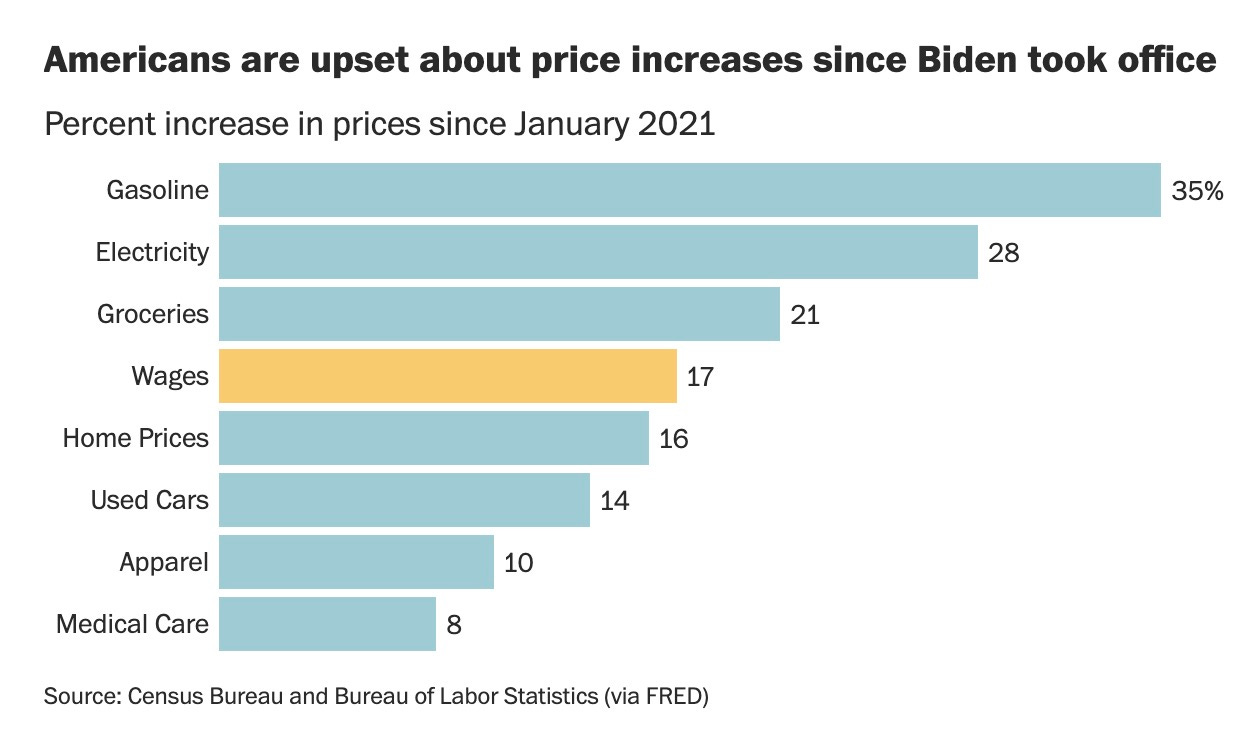
Last week, taking a break from reading the same thing from a teleprompter every day, somebody on Harris’s strategy team thought it would be a good idea to begin trashing the economy of the country over the last three years.

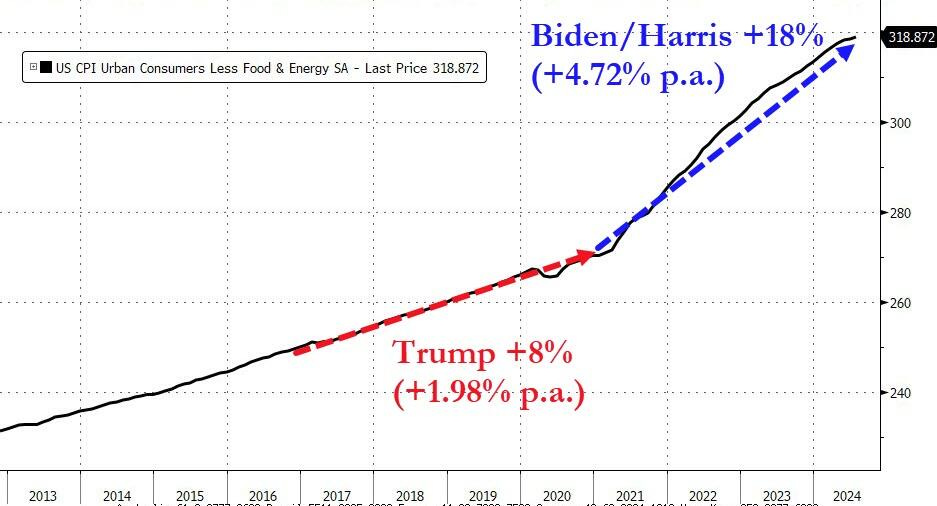
The problems are well known: the country has been suffering from ridiculous inflation, and prices are through the roof, placing a burden on many low- and middle-class families.

Image

Chart: Zero Hedge

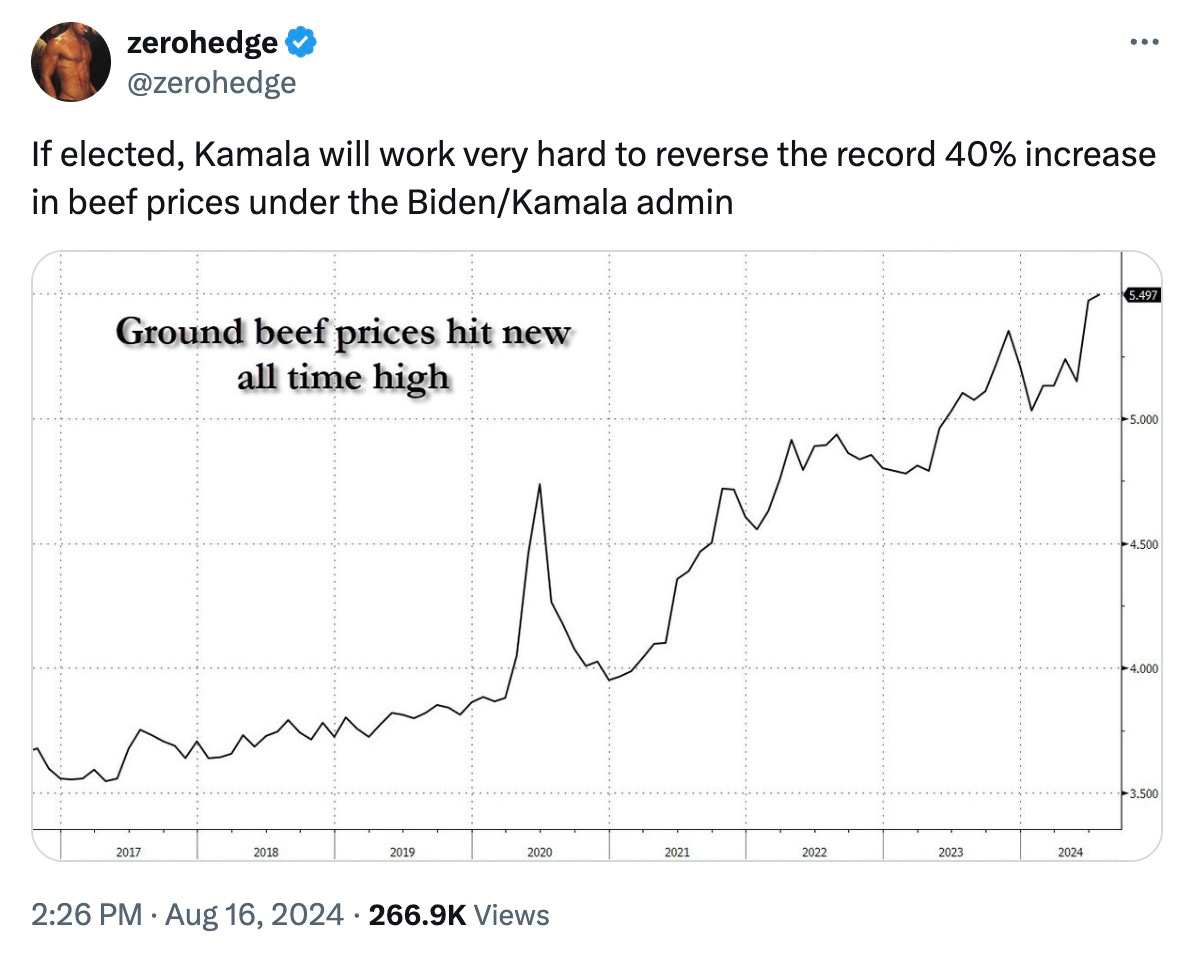
“We all know that prices went up during the pandemic when the supply chains shut down and failed, but our supply chains have now improved and prices are still too high,” she said on Friday. “A loaf of bread costs 50% more today than it did before the pandemic. Ground beef is up almost 50%.”

But the alarm is coming from inside the house.

“Under the Biden-Harris administration, grocery prices have shot up 21%, part of an inflation surge that has raised overall costs by about 19% and soured many Americans on the economy, even as unemployment fell to historic lows. Wages have also risen sharply since the pandemic, and have outpaced prices for more than a year. Still, surveys find Americans continue to struggle with higher costs,” ABC wrote last week.

The same report makes it clear that grocery prices are now only rising in-line with pre-pandemic rates of change: “Grocery prices are still painfully high compared to four years ago, but they increased just 1.1% in July compared with a year earlier, according to the most recent inflation report. That is in line with pre-pandemic increases.”

In other words, the price gouging boogeyman doesn’t seem to exist.

The stunning thing is Kamala Harris is now campaigning on being able to fix these problems when her administration oversaw them to begin with. I mean, I knew a lot of the Democratic Party base was essentially the voting equivalent of trained circus seals and that they are going to vote for whatever candidate the state stuffs down their throat as the solution to racism and climate change anyway, but this is far more egregious.

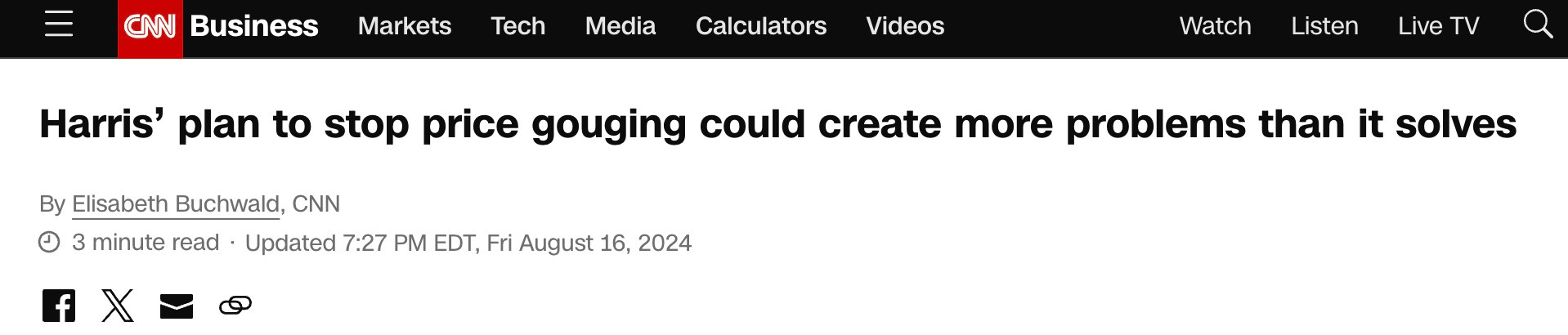
When CNN is running headlines like this and you’re a Democrat, you know your policy has to really be horrific:

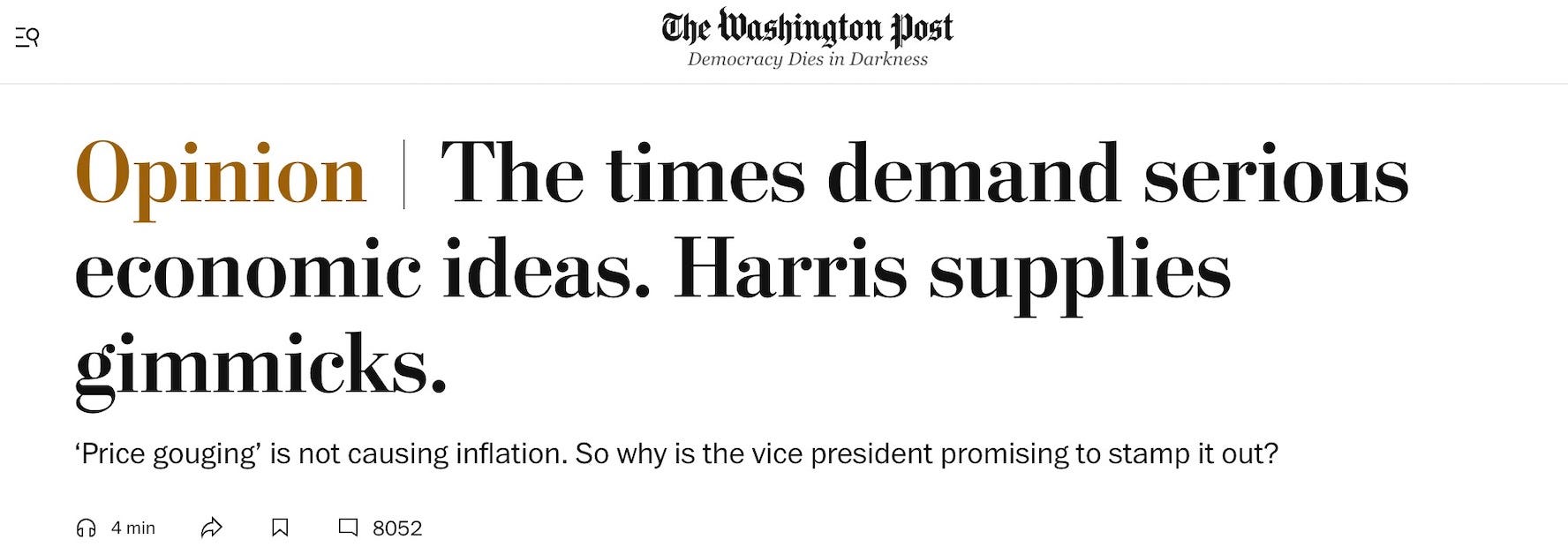
Same with The Washington Post running opinion columns like this one:

Think of the hubris necessary to run on a platform of fixing the policies of the last administration when you are the last administration.

Source: WaPo

Now, let’s take that destructive idiocy and square it: the proposed “solutions” Harris is coming up with are all extraordinarily inflationary. Harris has proposed cancelling medical debt, a $6,000 child tax credit for families within a newborn child, $25,000 in downpayment assistance for 400,000 first-generation home buyers and a $10,000 tax credit for first-time home buyers.

In other words: “Hubba, hubba, hubba, money, money, money. Who do you trust?”

In the world of unicorns and rainbows, this all sounds great. But back here in reality, where people know there are always consequences to actions, the country simply doesn’t have the money to pay for this crap. That means that the money for these proposals is going to have to be printed, and, as most of us know, expanding the money supply is the literal definition of inflation.

Putting aside the moral hazard that these policies would create—namely, that giving everybody a $25,000 credit to buy a house guarantees the price of housing rises by $25,000 per house because the seller now knows that you’re $25,000 richer—the result is going to be more inflation.

And at the same time Harris proposes slamming the inflation accelerator down to the floor, she’s turning around and blaming the problem that the government is creating—inflation—on grocery stores and “price gouging.”

As a result, she has proposed price controls on food, a policy you would be more likely to see in North Korea or communist Russia than in Los Angeles and New York. Price controls do nothing to solve the problem: they only would lead to food shortages, black markets, and grocery stores so burdened by regulation that would be forced to go out of business if they can’t raise their prices.


🔥 50% OFF FOR LIFE: Using the coupon entitles you to 50% off an annual subscription to Fringe Finance for as long as you wish to remain a subscriber: Get 50% off forever


Even a Mensa candidate like Harris should understand that grocery stores have some of the lowest margins of any business. They have hiked prices on items because the cost of producing those items has risen. Just because Harris doesn’t like the end result of shrinkflation and higher prices doesn’t make the idea of micromanaging a state-planned economy any more of a solution than it has been all the times it has failed throughout history.

Harris has called her plan an “economic opportunity plan”, but the only thing that creates opportunity, lowers prices, and gives consumers more choice and a better bargain is free-market capitalism. Subsidizing houses with taxpayer money, worsening the problem that the welfare state has created by incentivizing having children, using taxpayer money and purchasing power to socialize other people’s fiscal irresponsibility and trying to exercise government control over the cost of rice and beans is the opposite of having a vibrant free-market economy that offers people opportunity.

Instead, it is literally throwing a wet blanket of communism over what’s left of our country’s economy and implementing arguably the worst possible “solutions” to fix the problem of inflation that the country is grappling with. If these harebrained ideas take hold, the country will suffer from significantly more inflation than it has dealt with over the last three years. The result would make the stagflation that we are dealing with now a mainstay for many years to come and would also disincentivize the rest of the world from holding U.S. dollars and U.S. treasuries.

And so there you have it: the party that constantly fearmongers and scares its base into thinking that not voting for them will result in authoritarian fascism is pushing an unelected candidate, selected by a handful of the country’s elites, eager to usher in an openly communist agenda that is all but guaranteed to destroy the fabric of our country.

You can’t make this sh*t up.

Now read:

QTR’s Disclaimer: Please read my full legal disclaimer on my About page here. This post represents my opinions only. In addition, please understand I am an idiot and often get things wrong and lose money. I may own or transact in any names mentioned in this piece at any time without warning. Contributor posts and aggregated posts have been hand selected by me, have not been fact checked and are the opinions of their authors. They are either submitted to QTR by their author, reprinted under a Creative Commons license with my best effort to uphold what the license asks, or with the permission of the author. This is not a recommendation to buy or sell any stocks or securities, just my opinions. I often lose money on positions I trade/invest in. I may add any name mentioned in this article and sell any name mentioned in this piece at any time, without further warning. None of this is a solicitation to buy or sell securities. I may or may not own names I write about and are watching. Sometimes I’m bullish without owning things, sometimes I’m bearish and do own things. Just assume my positions could be exactly the opposite of what you think they are just in case. All positions can change immediately as soon as I publish this, with or without notice and at any point I can be long, short or neutral on any position. You are on your own. Do not make decisions based on my blog. I exist on the fringe. The publisher does not guarantee the accuracy or completeness of the information provided in this page. These are not the opinions of any of my employers, partners, or associates. I did my best to be honest about my disclosures but can’t guarantee I am right; I write these posts after a couple beers sometimes. I edit after my posts are published because I’m impatient and lazy, so if you see a typo, check back in a half hour. Also, I just straight up get shit wrong a lot. I mention it twice because it’s that important.

Tyler Durden
Mon, 08/19/2024 – 19:15

Watch: Security Perimeter At DNC Breached By Protesters

0
Watch: Security Perimeter At DNC Breached By Protesters

Update (1907ET):

The Democratic National Convention is in full swing.

Reports from local media outlets and journalists on the ground reveal that protesters breached the first layer of the security perimeter on the north side of the United Center, just hours before President Biden’s scheduled speech this evening.

Here’s more color on the security incident from Fox 32 Chicago: 

Protesters broke through a portion of the security fence on West Washington Boulevard. Chicago cops could be seen running to confront the demonstrators. There was a brief standoff between the police and protesters.

Officers donned riot gear as they faced off with the large crowd. Arrests were also made. A woman was seen being led away in handcuffs, while a man was carried away by several officers.

After about 20 minutes, tensions calmed down and police could be seen reconstructing the broken fence. All protesters were moved out of the secured area.

“First layer of fence outside DNC breached,” independent journalist Ford Fischer wrote on X. 

Fischer provided more footage of the tense situation. 

Other X citizen journalists are reporting from the incident area. Another user said, “The DNC Perimeter has been breached.” 

Here’s what others are reporting: 

*   *   * 

Authored by Joseph Lord via The Epoch Times,

Starting Monday, Democrats will hold their long-anticipated national convention during which they’ll formally nominate their presidential candidate and outline to voters their vision for the future.

The Democratic National Convention (DNC) will formally lock in the presidential and vice presidential nominees for both major parties.

Former President Donald Trump and his running mate, Sen. JD Vance (R-Ohio), were nominated at the Republican National Convention last month.

Vice President Kamala Harris, meanwhile, clinched enough delegates to win her party’s nomination at the beginning of August during a virtual roll vote that left little room for last minute dissenters.

She’s expected to accept the nomination, along with her chosen running mate, Minnesota Gov. Tim Walz, in speeches delivered on the final two nights of the event.

This is set to be a very different convention than voters expected at the beginning of the election cycle, when President Joe Biden led the ticket for Democrats.

However, a pressure campaign forced Biden out of the candidacy after an underwhelming debate performance shock up the political landscape.

Since Harris took over the ticket, Democrats have enjoyed a boost in polling. Still, the stakes are high for Harris and the Democrats, who will need to put on a united front after months of division within the party.

Here’s what to expect during the second major party convention of the year.

When and Where

The DNC will be held from Monday, Aug. 19, to Thursday, Aug. 22, in Chicago.

Democrats have a long history of holding their conventions in the windy city—this will be the 12th time since 1864 that the convention has been hosted there.

The last DNC to be held in Chicago was in 1996, when President Bill Clinton was easily re-nominated by his party.

The main event this year is being held at the United Center, a convention center that doubles as the home stadium for the Chicago Bulls basketball team and the Chicago Blackhawks hockey team.

Around 50,000 attendees are expected, including the party’s approximately 5,000 delegates. Like most major political events, it won’t be open to the public.

However, it will stream on a variety of platforms, according to the party.

In addition to the normal media coverage of the event each night, voters will also be able to watch the convention online, courtesy of C-Span.

The event will also be streamed in its entirety via Instagram, TikTok, and YouTube using the vertical style popularized by those apps.

Additional delegate-only events that are not streamed to the public will be hosted at the nearby McCormick Center.

Speakers

The convention will feature speeches from an array of Democrat notables.

Biden will be among the first speakers. He’s expected to call into the convention via video.

As is tradition at these events, neither Walz nor Harris are expected to speak until the final two days: Walz is likely to speak on the second to last day of the convention, and Harris on the final night.

Speakers are expected to appear according to this schedule:

Aug. 19: 

  • President Joe Biden
  • Former Secretary of State Hillary Clinton
  • Illinois Gov. J.B. Pritzker

Aug. 20: 

  • Former President Barack Obama

Aug. 21: 

  • Former President Bill Clinton
  • Minnesota Gov. Tim Walz

Aug. 22: 

  • Vice President Kamala Harris

Time and Day TBD:

  • Chicago Mayor Brandon Johnson
  • Sen. Dick Durbin (D-Ill.)
  • Sen. Tammy Duckworth (D-Ill.)
  • Rep. Lauren Underwood (D-Ill.)

Platform

During the convention, Democrats will also formally adopt their party’s draft platform.

Released in July, the draft platform mentions Trump dozens of times.

It also details Democrats’ position on an array of issues.

It reiterates Democrats’ demands for a federal codification of Roe v. Wade—unsurprising as abortion is one of Democrats’ strongest polling issues.

Economically, there’s not much in the platform that’s especially new: it calls for the federal minimum wage to be raised to $15 an hour by 2026, policies to increase the affordability of childcare and healthcare, and making the Child Tax Credit permanent.

Additionally, the platform repeats Democrats’ long-held demands for higher taxation of very wealthy individuals and corporations.

The draft platform also calls for securing the southern border while providing a “pathway to citizenship” for the millions of illegal immigrants in the country.

However, this platform, released in early July, hasn’t been updated since Biden dropped out.

Now, hours before the convention kicks off, it still lists Biden as the party’s candidate.

As is usually the case at major party conventions, the platform will be discussed, debated, amended, and formally ratified during the convention.

Protests

While Democrats seek to project an image of unity, there’s one factor that’s outside of the party’s control: expected protests from interest groups on the left.

Namely, protestors are expected to move full steam ahead with protests originally planned against Biden.

One protest, organized as the “March on the DNC 2024,” will feature a group of around 200 left wing-groups, and could potentially number into the tens of thousands—raising concerns about event security.

Specifically, the protestors are demanding that the DNC and Harris change their stance on Israel, calling for the United States to “stand with Palestine” and “end U.S. aid to Israel,” along with a laundry list of other left-wing demands.

The event already has the highest possible federal security classification.

Security for the event will be handled by a coalition of local, state, and federal law enforcement, including the Secret Service.

Despite the challenges, Chicago Mayor Brandon Johnson and local police have maintained that the event will be secure.

Tyler Durden
Mon, 08/19/2024 – 19:07

For A Democrat, The American Heartland’s Normalcy Is A Terrifying Dystopia

0
For A Democrat, The American Heartland’s Normalcy Is A Terrifying Dystopia

Authored by Andrea Widburg via AmericanThinker.com,

The Civil War tore America apart and left 600,000 dead. Still, despite its ferocity, it had at its heart only one big issue: whether the Constitution’s promise of individual liberty overrode states’ rights to govern themselves. Otherwise, Americans were much the same: the Bible, hard work, heterosexuality, the nuclear family, anti-crime, etc.

America today actually faces a more profound schism than it did then because we’ve become two entirely different people.

An opinion piece in the San Francisco Chronicle really hammers the point home, as a regular columnist looks at a county fair in the Heartland and sees a dystopian world.

Soleil Ho identifies herself a plural being who should be referred to as “they” and “them.” She is “an opinion columnist and cultural critic, focusing on gender, race, food policy and life in San Francisco.” She’s even made it to Joy Reid’s show for exposing the horror of parents who are opposed to the push to destroy their children’s biological reality with the lunacy of “transgenderism.”

Image by AI.

Ho recently took a trip to visit relatives in the American heartland (perhaps rural Illinois) and professed herself to be absolutely horrified by what she found there. The headline of Ho’s San Francisco Chronicle essay (and I don’t know whether Ho or the Chron came up with this headline) is “I took a trip to Trump country. It was more bleak than I could have imagined.”

I opened the essay assuming that I’d read about the economic despair that decades of Democrat policies have visited on rural America: Shuttered factories and stores, homelessness, drug addiction, foreclosed homes, crime-ridden communities, illegal aliens sucking up public funds, etc.

Instead, Ho described a bucolic county fair, complete with “rides, the charcoal-kissed meat skewers and the stall that churns out fried cheese curds, those little molten pebbles enrobed in crisp chambers of light-as-air batter,” along with happy people collecting “plenty of award ribbons for photography, cookies, crafts and giant garden-grown vegetables.”

But for Ho, none of this mattered. Attending the fair with Democrat relatives trapped in a Heartland hellhole, the real evil lurked beneath this Arcadian surface. These happy people celebrating their lives and eating wonderful fair food are evil. Truly evil. Why? Because they support Trump:

Along with corny fair merch and anime ponchos, every, and I mean every T-shirt stall was draped with Trump flags: “I’m voting for the felon,” “F— Biden” and the relatively anodyne, “I’m With Trump.” While browsing the pet supply shop across from the local Republican Party’s stall, I saw GOP staff greeted with cheers and raised fists — echoing Donald Trump’s triumphant pose after the assassination attempt on him — by numerous fairgoers wearing red caps and “Ultra MAGA” shirts. “Boo, Kambala!” yelled a woman, laughing.

In packed queues for roasted corn, I squeezed past parents balancing their children’s plastic lemonade cups in their arms with “Trump/Vance 2024” lawn signs tucked under their armpits. “Nice sign!” one blonde, elementary school-age girl shouted above the din, with her thumbs up at a woman holding one of them.

Ho was also confronted with the terrible specter of men in floral Hawaiian shirts.

You and I, staunch conservatives, may just think, “Ooh, I like Hawaiian shirts” or “Oh, that’s kind of tacky,” but the alert woke person knows better.

Ho hears the dog whistle of the “boogaloo” movement, a seriously fringe and ineffective group that no conservatives care about.

I suspect that while a scattering of Hawaiian shirts horrifies Ho, she’s copacetic about hundreds of masked Antifa members attacking people, fire-bombing federal buildings, and otherwise engaging in violent mayhem.

To Ho, the county fair represents everything evil in America:

My family, mostly Democrats or otherwise apolitical, are pragmatic about politics: This is their home. They quietly listen to the daily political rants and ravings about crime, immigrants and “transes” from MAGA colleagues, neighbors and friends, hoping for any opportunity to pivot to the weather.

There’s the divide. The evil Americans think that crime should be punished, immigrants should arrive legally, and that embracing the mental illness of body dysphoria should be discouraged, not encouraged. Ho also boasts that, in the Utopia of San Francisco, she need not fear wearing a “Notorious RBG” shirt, forgetting that conservatives in that Utopia risk physical assault, vandalism, and job loss for daring to voice their political opinions. By contrast, Ho could have worn her “Notorious RBG” shirt to that fair without worry. Republicans believe in free speech.

For Ho, her nightmare in the dystopia of the heartland culminated with the crowd at the rodeo singing “The Star-Spangled Banner.” The horror was too much for her. “I’d had enough. I stayed seated, head in my hands, and waited for the bulls to come charging out of their pens.”

It took America four years and 600,000 lives to resolve the one question of individual liberty versus state’s rights, a battle that conveniently divided itself along geographic lines. How is our country ever to resolve the fact that we have living cheek by jowl two entirely different cultures, each with values antithetical to the other, all vying for the same political control?

Tyler Durden
Mon, 08/19/2024 – 18:25