69.4 F
Chicago
Wednesday, September 30, 2026
Home Blog Page 2366

Catalysts And What Type Of Landing

0
Catalysts And What Type Of Landing

By Peter Tchir of Academy Securities

Catalysts and What Type Of Landing?

AI came back with a vengeance as equal weighted and small cap indices lagged.

Inflation seems to be under control (by recent standards), which helped markets. We were a bit surprised how strongly the market reacted to PPI, as it is generally a tier 2 piece of data, and we seem to continue to underestimate how many people are very concerned about a rebound in inflation (we are not).

But the big story seems to have been that we are back to a “soft” or “no” landing. Better than expected retail sales seemed to pave the way for many to wipe out the “recession” risk narrative. Retail sales and jobless claims (not anything I would hang my hat on) helped reverse all the fears about the economy.

In some ways, we saw less evidence of froth as some of the larger, tech-focused ETFs didn’t see a surge of inflows. Offsetting that, at least a little, is the successful launch of MSTX. Anything that has $16 million in AUM in two days seems pretty decent, since all it does is leverage MSTR’s daily returns. I need to dig out an “April Fools’ Day” note I did on ETFs – as dark comedy becomes reality. Evidence that quantitative funds were loading back up on stocks as they retook various technical levels made sense. Somewhat more difficult to digest was chatter that people were piling back into the “yen carry trade” based on the BOJ’s “promises” not to mess with the currency during times of volatility.

One thing we continue to witness that makes us very cautious on position size is the lack of liquidity in both directions. Moves in both directions seem amplified relative to the data or catalyst for the move. Yes, everything felt great most days last week, but I put very little faith in the idea that we’ve developed a “strong base” of support here.

Let’s look at the potential catalysts.

Catalysts – The Fed

We get Jackson Hole this week. Back during the financial crisis, this event provided a great forum for Bernanke and others to lay out policy shifts (sometimes radical policy shifts). Don’t expect much this time around. The topic is “Reassessing the Effectiveness and Transmission of Monetary Policy.” While we could glean some information about future Fed decisions, they will likely try to avoid that and focus on how they will behave in some more distant future. Personally, I think QE should be categorized as a “nuclear option” and only used when absolutely necessary, and on the smallest possible scale, for the shortest period of time, but that is unlikely to occur.

The Fed minutes might tell us how close they were to cutting in July (we think they should have), but again, that seems largely priced in now.

With the market pricing in cuts at a pace only marginally faster than our base case, I’m not expecting a lot of movement in bonds or stocks based on the Fed this week.

Catalysts – Earnings

NVDA isn’t until August 28th. Other earnings will matter. The AI front is important, and it was incredibly important that Walmart highlighted how important AI had been in driving their performance in a recent earnings release. The one thing we’ve been looking for is “AI Success” stories. Not from the companies that benefit from AI adoption, but from AI users. That note fit the bill and more notes like that will convince us that valuations might not have gotten ahead of themselves in the space. The other thing we will all be looking for is anything that points to the direction of the economy and the consumer.

Catalysts – The U.S. Election

My head already hurts thinking about this election. Presumably, we will get a bit more policy information during this week’s DNC in Chicago and a likely additional bump in the polls (as is typical). Then I think – and I had to recheck the math a few times – more than 10 weeks of campaigning remain. I’m not sure how many more twists, plot turns, and truly “unprecedented” things will happen between now and the election, but I think we will get some more shocks.

I remain wedded to the view that as the campaign heats up and policies get announced, we will realize that large annual budget deficits are on the horizon regardless of who wins. The amount of debt that needs to be issued, with a “cavalier” attitude towards debt creation, is going to continue to grow. The Fed will control the front end, but I expect the market will respond by re-installing some element of term premium.

Catalysts – Geopolitical Risk

For the first time in weeks, we are decreasing the near-term geopolitical risk, for two key reasons.

  • The consensus view is that when Iran attacked Israel with hundreds of rockets, missiles, and drones, it was merely “for show” as it was well-telegraphed and failed to damage Israel. Several members of the Geopolitical Intelligence Group pointed out that the attack was too large and too well-coordinated to be “merely” a show. That it wasn’t a coincidence that after the failed attack, Iran seemed to reduce sales to Russia (forcing the Russians to turn to North Korea) so that Iran could rebuild their stockpiles. One reason why Iran may not have retaliated since Israel killed the political leader of Hamas in Tehran, is that they haven’t figured out a better strategy and are too worried about another failed attempt (while at the same time, they are worried about being too successful and prompting Israel to attack Iran’s facilities).
  • Political uncertainty in the U.S. seemed to have created an opportunity to “test” us. Now, from a variety of conversations, there might be a willingness to see how this plays out. The chance that the new administration will be easier to work with than the current administration, from their perspective, might have them wait.

The big caveat to that is how will Russia respond to Ukraine’s incursion into Russian territory. For many, you could see this as an event bringing both sides to the negotiating table. On the other hand, Russia may view this as a reason to up the ante on their offensives in Ukraine.

Catalysts – The Economy

Talk about burying the lede. Normally we start with the most important piece and work our way down. But today we wanted to address the other potential catalysts briefly, before digging into the main event – the direction of the economy!

Advance retail sales popped nicely, but the control group, while still “ok,” declined. In general, these numbers had been tracking each other reasonably well in terms of direction and it looks like last month’s deviation was just corrected. Not a big knock-on retail sales, but at least a question mark.

“Amazon Prime Day” was July 16th and 17th. That event has become so big that it has spurred all sorts of price competition in and around it. So “goods were for sale” this past month – which the American consumer loves! How much demand was pulled forward by the sales? Many economists who predict these data points had discussed the possibility of upside surprises due to the sales. While encouraging, I would take this uptick in sales with some caution, as it likely indicated that demand was pulled forward to buy items on sale, rather than truly strong consumer spending.

From Zerohedge, we get this chart of revisions.

Revisions for the past year have been consistently to the downside, and to a non-trivial amount. No guarantee that this one was also overstated, but it is worth paying some attention to.

This fits a running theme: that for whatever reason, initial readings on jobs and sales seem to overstate what actually occurred as the officials have more time to collect data.

The other “intriguing” part of the report was that auto sales were a big contributor.

That is possible, as U.S. Auto Sales Total Annualized SAAR popped from 15.3mm to 15.8mm between June and July.

I could not find an ETF for U.S. or global automakers. I found a European centric one and did a simple calc for a U.S. proxy. Again, the charts tell more of a mixed story.

The stocks, which should capture the future expectations, have rebounded of late (positive) but are still well below where we were at the start of July (not positive).

The Manheim Used Auto Index, one of my “favorites” since the start of COVID, did see a small uptick in values in July, but it was not the first month with an uptick in what has been a pretty steady decline from the “I cannot find a vehicle anywhere” peak as we reopened from COVID. While not a “perfect substitute” for new car prices, it probably doesn’t help the price of new cars when used ones are more readily available.

We’ve also seen inventory-to-sales ratios creep higher. Still below pre-COVID levels, but it is nearing those levels, and heading in a direction that is not great for pricing power on the part of dealers.

Then we get to the nitty gritty of the consumer. There are a variety of “auto delinquency” indices on Bloomberg. We chose this one, but they all tell a similar story – delinquencies are rising. They are nearing or above “normal” levels. What we don’t know (or at least I don’t know) is how many loans were issued based on high residual values when the used car market was en fuego, hence exposing the lender to some potential losses as the used car market has softened since the peak.

As credit card delinquencies are also rising (depending on which measure you use, back above pre-COVID levels), we can see that the amount of revolving debt for the consumer has expanded well above the trend line. While consumers are still willing and/or able to borrow – we see no problems. But we’ve seen credit stabilize and even dip in some months lately. That could be a function of some consumers putting the brakes on themselves (they know their own job prospects, etc.) or it could be lenders tightening. In any case, not sure how supportive this chart is for consumer consumption going forward!

Yes, bank deposits remain high and money market funds continue to set new records, but as the economy continues to bifurcate into the “haves” and “have nots,” not sure how useful the “money on the sidelines” argument is. Those with money are fully gorged, and those without are losing access to what they need.

Yes, the economy is largely driven by what people in the middle do, but my concern is that (and we see some of this in which retailers are doing well versus those that are doing less well) much of the middle class it close to tapping out (or just willing to spend on bargains).

We won’t have much clarity on the economy until the first week of September when the jobs reports start hitting, but I am leaning towards investors getting concerned about recession risk.

Bottom Line

Far from out of the woods on the economy and markets. Stocks staged an impressive rally last week.

  • Lack of liquidity helped push markets further on data than they might have moved otherwise.
  • We never saw panic – a touch of fear, but not panic. And while not back to full froth, it seems clear that we are back in greed mode.

It would be great to see a resilient economy, and that any indications of slowing were an anomaly. Over the coming days and weeks, I think retail sales and a couple of initial jobless claims reports will be exposed as the anomalies.

I fail to see how the election campaigns give any comfort to buyers of longer-dated Treasuries. Yes, the Fed helps. Yes, lower inflation helps. Yes, a potential slowdown helps, but as every politician seems to create policies that are variations of “vote or donation buying,” I am not sure bond investors can be as comfortable as they currently are.

Clearly I’m still in some sort of the “bumpy” landing crowd, and this week’s data did little to dissuade me from that. The most bullish information that I’m trying to work into my analysis is the actual praise of AI by a user, which we had not seen enough of, and this could turn the tide.

There are many potential catalysts, but at this point, anything that drives us one way or the other on the “type of landing” to expect will be extra important to markets.

Good luck, and for those trying to take some vacation time, hopefully this week plays out calmly. But I suspect volatility and dramatic moves will be the norm again this week across markets.

Tyler Durden
Sun, 08/18/2024 – 15:10
 “Wet Winter Whirlwind”: Farmers’ Almanac Releases New Winter Forecast For US 

0
 “Wet Winter Whirlwind”: Farmers’ Almanac Releases New Winter Forecast For US 

It’s that time of year again—while many visit the beach and or mountains before the school season kicks off in just a few weeks, others are already beginning to prepare for the upcoming winter season, with new forecasts from the Farmers’ Almanac. 

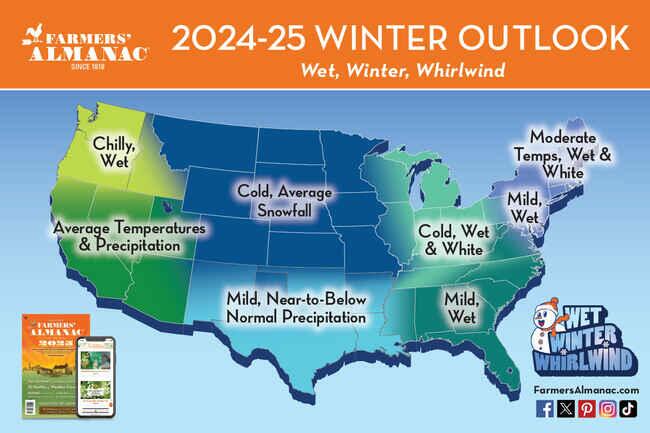
The 208th edition of the Farmers’ Almanac is titled “Wet Winter Whirlwind” and revealed, “There will be a lot of precipitation and storms”—all dependent on location.  

Winter Temperatures – How Cold?

The Almanac is predicting a deep chill to settle over the Northern Plains and Great Lakes regions for much of the winter season. But don’t think the South is off the hook. Southern areas can still expect some frigid blasts from Old Man Winter, even if the temperatures are slightly more moderate overall. Cold snaps are forecast to hit during the final week of January into early February, with the Northern Plains potentially seeing the most extreme cold.

Snow?

The Northeast is in the bullseye for a barrage of storms this winter, with the Farmers’ Almanac calling for above-normal amounts of winter precipitation. Ski-lovers will enjoy nice powder days. Snow will likely be more plentiful in the interior and mountainous regions of New England and the Northeast, while those near the coast can expect more sleet and rain. And if you live in the Pacific Northwest, Great Lakes, or Southeast, get ready for a wet, white, and slushy season.

On the flip side, the Southwest and South Central States are looking at a drier winter with below-normal precipitation.

Here is the Farmers’ Almanac’s forecast map for the upcoming 2024-25 winter season across the Lower 48.

Farmers’ Almanac Editor Sandi Duncan told USA TODAY, “It definitely looks more wet than white in many areas,” adding, “Obviously, depending on where you live, there might be more white than wet, but we’re focusing in on the wet winter ahead.”

The weather prediction formula that Farmers’ Almanac uses revolves around a climate pattern known as La Niña, likely to emerge in September-November. 

Remember that the emergence of La Nina can impact weather conditions across the Lower 48 this coming winter season.

Duncan said, “The coldest temperatures look like they’re going to be over the North Central States into the Great Lakes area.” 

She noted that much of the country can expect a wet Thanksgiving holiday, “except for way out in the Southwest,” and even said Christmas “looks wet rather than white for most areas.”

Tyler Durden
Sun, 08/18/2024 – 14:35

WHO Raises Outbreak Alarm As Once Eradicated Polio Returns To Gaza

0
WHO Raises Outbreak Alarm As Once Eradicated Polio Returns To Gaza

Authored by Brett Wilkins via Common Dreams,

Following over a month of warnings, Gaza recorded its first case of polio since the highly contagious virus was eradicated there 25 years ago, prompting a Friday call by United Nations Secretary-General António Guterres for a temporary truce to enable a vaccination drive in the embattled strip.

The Gaza Health Ministry said Friday that an 10-month-old infant in the central city of Deir al-Balah “who has not received any polio vaccine dose” has tested positive for the virus, which often causes paralysis and can be fatal. The ministry said the baby is one of “a number of children” who have presented with symptoms consistent with polio in recent days.

Via AFP

“The continued brutal Israeli aggression on the Gaza Strip has caused a health disaster as witnessed by international organizations,” the ministry added, citing “the lack of basic hygiene needs, the lack of sanitation services, the accumulation of waste on the streets and around the shelters of the displaced, and the lack of safe drinking water” as factors that “have created a conducive environment for outbreaks.”

Responding to the news, Guterres implored Israeli and Palestinian forces to lay down their arms so that U.N. humanitarian aid workers can launch a campaign to vaccinate half a million Gazan children.

“I am appealing to all parties to provide concrete assurances right away guaranteeing humanitarian pauses for the campaign,” he told reporters at the U.N. headquarters in New York.

“Let’s be clear: The ultimate vaccine for polio is peace and an immediate humanitarian cease-fire,” Guterres stressed. “But in any case, a polio pause is a must.”

The U.N. World Health Organization and other groups sounded the alarm after poliovirus type 2 was found in Gaza wastewater last month. The discovery prompted the Israel Defense Forces to offer polio vaccines to its soldiers taking part in the invasion of the coastal enclave. Earlier this month, the Gaza Health Ministry declared the entire strip a “polio epidemic zone.”

Guterres said Friday that Gaza’s health, water, and sanitation systems “have been decimated” by Israeli attacks, which have destroyed or damaged most hospitals and primary care facilities and created fertile ground for the spread of disease.

As Leslie Roberts wrote recently for Science:

The poliovirus is transmitted through the “fecal-oral” route—by contact with the feces of an infected child or consumption of water or food contaminated by fecal matter. The conditions in which the 1.9 million displaced Gazans are living—crammed into unhygienic camps with little access to clean water and sanitation and untreated sewage flowing openly between tents—create an ideal environment for the virus to thrive.

Since the war began in October 2023, 70% of water and sanitation facilities in Gaza have been significantly damaged, and about 340,000 tons of solid waste have accumulated in or near populated areas, according to an estimate from the U.N. Water, Sanitation, and Hygiene Cluster. In June, Oxfam estimated there is just one toilet for every 4,130 people in Al-Mawasi, a supposed “safe zone” west of Khan Younis that recently came under Israeli attack.

In addition to polio, Israel’s assault on Gaza and its disruption of medical supplies have fueled the spread of other preventable diseases including measles and hepatitis A.

“We know how an effective polio vaccination campaign must be administered,” Guterres said. “Given the wholesale devastation in Gaza, at least 95% vaccination coverage will be needed during each round of the two-round campaign to prevent polio’s spread and reduce its emergence.”

The Gaza Health Ministry said that it has been working with the U.N. and other international organizations “over the past weeks on developing an integrated comprehensive plan for the implementation of an expanded polio vaccination campaign in the Gaza Strip,” and that it will “carry out a vaccination campaign in the next few days targeting children under the age of 10.”

Children, who make up around half of Gaza’s population of 2.3 million people, have been particularly hard-hit by Israel’s 316-day Gaza onslaught. More than 16,000 of the at least 40,000 Palestinians killed by Israeli bombs and bullets are minors. The “complete siege” of Gaza—which has been entered as evidence in the International Court of Justice genocide trial against Israel—has disrupted the entry of food, medicine, and other vital supplies, fueling a famine that has killed dozens of Palestinian children.

The Gaza Health Ministry said 1.1 million doses of a two-dose, orally administered type 2 polio vaccine have been provided by the United Nations Children’s Fund, with another 400,000 doses on the way. UNICEF said it “is coordinating delivery efforts and the cold chain equipment needed for storage.”

Medical teams from the United Nations Relief and Works Agency for Palestine Refugees in the Near East (UNRWA)—which is the largest healthcare provider in Gaza, even as Israeli forces have killed around 200 of its workers—said they are ready to administer the polio vaccines and assist in their distribution.

The Gaza Health Ministry renewed its “appeal to the international community and the international health organizations to speed up intervention to immediately stop the barbaric Israeli aggression on the Gaza Strip, work to prepare the ground conditions in order to rescue what can be salvaged, and provide immediate healthcare services to… our people.”

The agency also made an “urgent appeal” for “the necessity of immediate action to rebuild safe drinking water and sanitation systems, dispose of medical and solid waste, work on importing fuel to pump clean fresh water, and allow unconditional entry of medical supplies, medicines, and special materials used for personal hygiene.”

Guterres underscored the need to “defeat a vicious virus that, left unchecked, would have a disastrous effect not only for Palestinian children in Gaza, but also in neighboring countries and the region.”

“Polio does not care about dividing lines, and polio does not wait,” he said. “Polio goes beyond politics. It transcends all divisions. And so it is our shared obligation to come together. To mobilize—not to fight people, but to fight polio.” However, he stressed, “it is impossible to conduct a polio vaccination campaign with war raging all over.”

“A successful polio vaccination campaign needs safety,” Guterres added. “Safety for health workers to do their jobs. Safety for children and families to get to the health facilities. And safety for those health facilities to be protected from bombardment.”

Tyler Durden
Sun, 08/18/2024 – 14:00

Belarus Says Ukraine Amassing Troops At Border; Zaporizhzhia Nuclear Plant Suffers Drone Attack

0
Belarus Says Ukraine Amassing Troops At Border; Zaporizhzhia Nuclear Plant Suffers Drone Attack

Belarusian President Alexander Lukashenko has warned Sunday that Ukraine is also amassing troops on Belarus’ border amid the ongoing incursion into Russia’s Kursk Oblast. Lukashenko alleged that Kiev has positioned more than 120,000 soldiers along its border with Belarus and this is being deemed an act of ‘aggression’ by military authorities. But it is curious where Ukraine got the manpower for this, if accurate.

State-run BelTA quoted Lukashenko as saying, “Seeing their aggressive policy, we have introduced there and placed in certain points – in case of war, they would be defense – our military along the entire border.”

West Asia News Agency/Reuters

Thus he made it clear that Belarusian forces could counter-attack into Ukraine if Minsk observes any Ukrainian incursion on its sovereign territory.

These extreme border tensions are nothing new, given Belarus has long been a logistics hub and staging ground for Russia’s Ukraine operations; however, the whole Kursk shock cross-border operation has certainly upped the ante.

While these constitute serious threats from Lukashenko, it is as yet unclear how many regular army troops have been sent to bolster the state security services’ some 12,000 border guards already typically deployed.

Meanwhile, Russia has launched another ballistic missile attack on Kiev in retaliation for the Kursk invasion. This one was an early morning Sunday assault, with the Kyiv City Military Administration stating on Telegram: “This is the third ballistic missile attack on the capital in August with a clear interval of six days between each attack.” Drones were also sent, with Ukraine’s military saying it intercepted all of them.

Also, the International Atomic Energy Agency (IAEA) has issued new warnings and concerns over the situation at Ukraine’s Zaporizhzhia nuclear power plant, which since early in the war has been occupied by Russian troops and authorities. The IAEA warned the safety of the complex is “deteriorating” following a nearby weekend drone strike. The IAEA further—

…warned on Saturday of an escalation in the security dangers at the plant, reporting “intense” military activity over the past week in the area, including very close to the plant.

…IAEA experts on site reported that the damage “seemed to have been caused by a drone equipped with an explosive payload”, affecting the road between the plant’s two main gates.

It seems the Ukrainians are attempting to stage a provocation in a desperate act following accusations from President Zelensky last week that the Russians set fire to the plant.

Fighting inside Kursk is still intense, with Ukraine forces have destroyed a second key bridge, which strongly suggests they plan to seek to hold territory for significantly longer. The Associated Press details on Sunday:

Ukraine has destroyed a key bridge in Russia’s Kursk region and struck a second one nearby, less than two weeks into its stunning cross-border incursion, disrupting Russian supply routes and possibly signaling that its troops are planning to dig in.

Russia’s pro-Kremlin military bloggers have acknowledged that the destruction of the first bridge, which spanned the Seim River near the town of Glushkovo, will impede deliveries of supplies to Russian forces repelling Ukraine’s incursion, although Moscow could still use pontoons and smaller bridges in the area. Ukraine’s air force chief, Lt. Mykola Oleshchuk, on Friday released a video of a Ukrainian airstrike that split the bridge in two.

Less than two days later, Ukrainian troops hit a second bridge in Russia, according to Oleshchuk and the Russian regional governor, Alexei Smirnov.

Still, Russian defense ministry statements continue to try and paint a positive picture, with a top ranking Commander Major General Apty Alaudinov telling TASS on Sunday “Our situation is completely under control.”

“The enemy is trying to break through into our territory around the clock. All these attempts end with the elimination of the enemy and the burning of the equipment. That is why we are destroying the enemy’s reserves,” he told TASS.

Tyler Durden
Sun, 08/18/2024 – 13:25

The Curious Story Of Taylor Lorenz … And Belated Concerns Of The Washington Post

0
The Curious Story Of Taylor Lorenz … And Belated Concerns Of The Washington Post

Authored by Jonathan Turley via jonathanturley.org,

There is a rather curious controversy brewing over one of the Washington Post’s most controversial writers, Taylor Lorenz. The “tech columnist” for the Post has drawn continual criticism over public meltdowns and alleged doxxing. However, the Post seemed to value her notoriety…until she posted a picture of President Joe Biden with “war criminal” on it. Lorenz appeared to suggest that others added those words before various mainstream media outlets contradicted her account. She is now denying that she denied it was her words and the Post is investigating. What is most curious, however, is what it takes for the Post to investigate alleged false claims by its columnists.

Lorenz posted the image during the White House Creator Economy Conference with the President. Many on the left have characterized Biden as a “war criminal” for his stance on Gaza.

Mainstream media outlets reported the posting by a prominent Post columnist in echoing the criticism of Biden.

Lorenz then responded by seemingly denying that she posted the words, chiding others on X that “[y]ou people will fall for any dumbass edit someone makes.”

Many outlets then covered the story that Lorenz was denying the post. However, that produced a torrent of skepticism from even liberal outlets. For example, NPR ran a story that verified that the photo and “war criminal” caption were real:

NPR has obtained a screengrab of Lorenz’s actual post, which contained that caption. … Four people with direct knowledge of the private Instagram story confirmed its authenticity to NPR. They spoke to NPR on condition they not be identified due to the professional sensitivity of the situation for Lorenz.

After the NPR and other stories questioned her account, Lorenz publicly issued her denial of the earlier denial. She tweeted that “I literally never ‘denied it was real.’” She added “Yeah that’s saying they’re falling for (charitable view) something that’s an obvious meme reference by taking it seriously. Please don’t put words in my mouth[.]”

So now, the Post is looking into it.

For some of us, the controversy only adds to the uncertainty over the current standards at the Post. For example, there is apparently no problem in a White House Post reporter supporting government censorship of Donald Trump as an “America issue.”

Likewise, the Post has publicly stood with reporters who have repeatedly published false claims and conspiracy theories. Take Philip Bump, who had a meltdown in an interview when confronted over past false claims. After I wrote a column about the litany of such false claims, the Post surprised many of us by issuing a statement that they stood by all of Bump’s reporting, including false columns on the Lafayette Park protests, Hunter Biden laptop and other stories.  That was long after other media debunked the claims, but the Post stood by the false reporting.

There was no announced or apparent investigation into those claims, or similar alleged false or misleading claims by political or legal columnists. Many of those past controversies involved false claims directed against former president Donald Trump.

The future of Taylor Lorenz is hardly a weighty question for American journalism. However, the lack of consistency on these issues is a matter of concern, particularly as the Post tries to come to grips with falling readership and revenue.

Tyler Durden
Sun, 08/18/2024 – 12:50

“Make It Great Like ’68”: Chicago Businesses Board Up As Protesters Threaten To Shut Down DNC 

0
“Make It Great Like ’68”: Chicago Businesses Board Up As Protesters Threaten To Shut Down DNC 

Tens of thousands of protesters are expected to descend near the Democratic National Convention in downtown Chicago in the coming days. Local media reports that shops have already boarded up doors and windows with plywood ahead of what could be a chaotic week. 

Crews with Chicago Board Up Services told WGN-TV that at least a dozen shops around the West Loop, downtown, and Daley Plaza have been completely boarded up. They expect additional businesses to do the same. 

Scott Schapiro, the owner of Syd Jerome, a menswear shop at 20 N. Clark St., told NBC Chicago that he is no stranger to smash-and-grab and looting in the metro area and decided to take extra precautions, such as boarding up doors and windows ahead of the convention – where thousands of protesters are expected.

“You get that phone call in the middle of the night and your heart jumps out of your chest,” Schapiro told the local media outlet.

He continued, “We want to sleep a little more soundly at night, and this gives us a little security, and we hope that there isn’t any incident obviously, but in the event there is, we want to have maximum protection.” 

Protest organizers told NBC News that 20,000 demonstrators from several states will take over downtown streets in an approved protest area near the Democratic National Convention. 

“The 264 protest groups that have said they will participate are primarily focused on Palestinian rights, ending the war in Gaza and reducing US aid to Israel,” NBC said, adding, “Others represent a patchwork of left-leaning causes: climate activists, socialists, anti-racist organizations, queer and trans rights groups.” 

Mayor Brandon Johnson informed business owners and residents last week that the metro area is well prepared for social unrest. He reiterated that Chicago’s police force has worked with the Secret Service and other law enforcement agencies. 

Illinois Gov. JB Pritzker brushed off fears that next week’s Democratic National Convention could erupt into the same kind of violence experienced during the 1968 convention.

Other local media outlets predict a much larger crowd size, upwards of 100,000 pro-Palestinian protesters.

One protest organization, Behind Enemy Lines, has called for “Make it Great like ’68,” referring to the riots at the 1968 Democratic Convention. 

“We’re not calling for violence or planning on anything illegal, but we think that there’s ways for people to protest that do go beyond business as usual,” the group spokesperson said, who asked not to be named and quoted by WBEZ Chicago. 

The media outlet explained, “Behind Enemy Lines has opened a temporary office on Chicago’s Northwest Side, decorated with posters bearing slogans such as “Stop Killer Kamala” and “Fight Back for Gaza!”” 

Any outbreak of civil disobedience could ignite a wave of bad press for VP Harris and the Democrats.

VP Harris is already coming off a week of terrible headlines after debuting her first economic policies, including communist-style price controls.

Tyler Durden
Sun, 08/18/2024 – 12:15

The Super-Wealthy Have A Problem

0
The Super-Wealthy Have A Problem

Authored by Charles Hugh Smith via OfTwoMinds blog,

The less self-congratulatory camp of the super-wealthy understand the pressure cooker of inequality and unfairness is going to blow unless they relinquish some of their unearned gains generated by Fed policies.

The cultural consensus holds that the super-wealthy always manage to come out ahead in any spot of bother. Due to their grip on the levers of financial and political power, whatever lays waste to the bottom 90% of the populace is either 1) an opportunity to increase their wealth or 2) a minor bump in the road to ever-expanding wealth.

History offers an abundance of examples. A favorite of mine is the guest books of the French chateaus owned by the super-wealthy, which logged visits from the Usual Suspects (political and financial bigshots) until 1940, when the names of Nazi bigshots began filling the ledgers, and then in 1945, the visitor list reverted to the Usual Suspects: a seamless transition from one set of political overlords to the next that the chateau owners rode without difficulty.

But there are counter-examples as well. Consider the family estate of famed architect I.M. Pei in Suzhou, China. I visited the impressive Pei residence, which is now a government-owned property open to the public. The Pei family was wealthy enough to be comfortably in the top tier of Chinese society. Life was good for China’s elite, right up to 1949. These elites did not glide though the revolution intact; their wealth was confiscated.

They were replaced with a new elite, who now holds vast troves of wealth secreted away in the West, and just as I.M. Pei attended prestigious American Ivy League universities, so too do the sons and daughters of China’s party elites, under assumed names, of course, to allow them a private experience outside the limelight.

So the super-wealthy don’t always skate through tumultuous times, emerging richer than ever. We all understand how vast wealth inequality influences the political and social responses to crises. What is less well understood is the role of fairness in the social and political realms: if the inequality is understood to be the result of extremes of unfairness, the public mood darkens considerably, as humans are innately sensitive to unfairness.

The porousness of the border between the wealthy and the poor matters greatly in assessing fairness. If the financial-social membrane between the two classes is relatively porous, enabling the most ambitious and brightest of the poor to enter the ranks of the wealthy (or the ranks of the the top 10% who serve them), then the society maintains a minimum level of fairness that alleviates the pressure to overthrow the regime.

The remedial actions of the state also matter greatly. If the government acts decisively to raise estate taxes, taxes on unearned (i.e. rentier) income and on the higher reaches of earned income, and devotes some minimal attention to the basic needs of the bottom 90%, these policies also alleviate the pressure to overthrow the regime.

The book The Great Leveler: Violence and the History of Inequality from the Stone Age to the Twenty-First Century addresses these dynamics in admirable detail.

In other words, extremes of wealth/power inequality set the stage, but the closing act is decided by our responses to soaring inequality. If the response is PR artifice, i.e. the rich keep getting richer as the suffering of the bottom 90% increases, regime change starts looking like the only solution available.

If, on the other hand, policy makers and the public push back against the dominance of the super-wealthy, then the status quo can avoid fragmentation and dissolution.

The super-wealthy play a key role in this choice of response, and this fragments the elites into warring camps, a dynamic I’ve addressed many times over the years, including in my chart of some of the overlapping crises that will demand more than duct-tape responses:

The backdrop is the policies that have handed the super-wealthy immense gains in wealth and power via policy-driven asset appreciation and the gradual diminishment of the purchasing power of wages. Over the past 45 years, the value of earnings has declined $149 trillion to the benefit of unearned gains reaped by the already-wealthy:

This chart shows how wealth inequality has risen from the late 1970s, and how it was rocket-boosted by the Federal Reserve’s “wealth effect” policies of quantitative easing (QE):

The bottom 80% own a mere fraction of the wealth owned by the top 1% and top 10%

While the wealthy cling to the self-serving narcissistic view that since we’re doing fine, everyone’s doing fine, the reality is the bottom 80% are awakening to the reality that they’re not doing fine, a divide that will only widen as recession tightens its grip on the throats of the bottom 80%:

This is the vision of the “our wealth is rightly all ours” camp of the super-wealthy: the rest of us will own nothing and we’ll be gloriously happy. Uh, sure. Since we’re so happy, why don’t we switch places?

The less self-congratulatory camp of the super-wealthy understand the pressure cooker of inequality and unfairness is going to blow unless they relinquish some of their unearned gains generated by Fed policies. While they naturally intend on keeping the vast majority of their gains, they realize the dividends of limitless greed might just be the overthrow of the regime they control to serve their own interests.

The rest of us play a part, too, of course, and our choice boils down to this: “And you want me to join this?”

The super-wealthy have a problem: if they refuse to release the pressure building in a grossly unfair, rigged system that’s enriched them beyond measure, then the pendulum may swing to the other extreme and they’ll be visiting their former estates as tourists in a few years.

But if they agree to relinquish some part of their gains, they fear the tides of history may erode their sand castles. Aiya, what a dilemma.

*  *  *

Become a $3/month patron of my work via patreon.com.

Subscribe to my Substack for free

Tyler Durden
Sun, 08/18/2024 – 11:40

Disney Fights ‘Wrongful Death’ Lawsuit Claiming Plaintiff Waived Rights When He Signed Up For A Disney+ Trial

0
Disney Fights ‘Wrongful Death’ Lawsuit Claiming Plaintiff Waived Rights When He Signed Up For A Disney+ Trial

This might be the most stone cold lawyer trick we’ve seen in a while and remember: we deal with the financial world on a daily basis, so that’s saying something.

Disney is fighting a wrongful death lawsuit by claiming the complainant agreed to arbitration when he signed up for a one month trial of Disney+ streaming services, according to the Hollywood Reporter.

The suit was brought by Jeffrey Piccolo, the husband of Kanokporn Tangsuan, a 42 year old doctor who allegedly had a “fatal allergic reaction” to food at an Irish Pub in Disney Springs last October. 

In a motion to the court, Disney’s lawyers argued that he had “agreed to settle any lawsuits against Disney out of court through the arbitration process when he signed up for a one-month trial of Disney+ in 2019”.

They wrote: “The Terms of Use, which were provided with the Subscriber Agreement, include a binding arbitration clause.”

The motion continued: “The first page of the Subscriber Agreement states, in all capital letters, that ‘any dispute between You and Us, Except for Small Claims, is subject to a class action waiver and must be resolved by individual binding arbitration’.”

Disney points out that Piccolo also agreed to arbitration when he signed up on their website and app before visiting the theme park.

The report says Piccolo’s attorney fired back: “The notion that terms agreed to by a consumer when creating a Disney+ free trial account would forever bar that consumer’s right to a jury trial in any dispute with any Disney affiliate or subsidiary, is so outrageously unreasonable and unfair as to shock the judicial conscience, and this court should not enforce such an agreement.”

Disney commented that its “deeply saddened” by the suit and said: “We are merely defending ourselves against the plaintiff’s attorney’s attempt to include us in their lawsuit against the restaurant.”

Disney argued in its May 31 filing that whether Piccolo reviewed the service terms is irrelevant, noting the arbitration provision covers “all disputes,” including those involving Disney or its affiliates.

The Reporter notes that Raglan Road, the Irish pub at Disney Springs where Tangsuan dined, didn’t respond to requests for comment.

Piccolo’s February lawsuit claims that despite repeated warnings about Tangsuan’s severe nut and dairy allergies, the restaurant served her food that was not properly flagged as allergen-free. Tangsuan later died from anaphylaxis, with a medical examiner confirming the presence of dairy and nuts in her system.

Tyler Durden
Sun, 08/18/2024 – 11:05

Gold Revaluation Is A More Responsible Money Creation Method

0
Gold Revaluation Is A More Responsible Money Creation Method

Authored by Chris Powell via Money Metals,

Last week, financial analyst Mike Maharrey of Money Metals revisited the recent dream of inflationists…

…to increase the U.S. money supply by means of the U.S. government’s creation of one or two platinum coins with trillion-dollar denominations.

The idea would have the U.S. Treasury Department mint the coins and deposit them with the Federal Reserve, whereupon the Fed could create and distribute U.S. dollars matching the trillion-dollar deposits.

Since a longstanding obscure statute authorizes the Treasury to mint platinum coins of any denomination, this would be a way of increasing the U.S. money supply in a big way without addressing the stupendous and rapidly growing U.S. government debt and without obtaining approval from Congress. 

But the trillion-dollar coin idea is similar to a policy change that gold advocates long have been rooting for: a formal revaluation of gold by governments and central banks, including the U.S. Treasury and Federal Reserve.

For if the U.S. government really has full control over what it long has claimed — a reserve of 8,133 tonnes of gold — gold revaluation also could support a lot of money creation.

Gold researcher Jan Nieuwenhuis has been noting for months that many governments and central banks recognize the money-creation potential of gold revaluation and provide for it explicitly with gold revaluation accounts.

Back in 2012, the U.S. economists Paul Brodsky and Lee Quaintance described the potential of gold revaluation.

They even hypothesized that it was already the plan of major central banks, by which they would redistribute gold reserves among themselves and then with gold revaluation devalue government debt and society’s debts generally while reliquefying themselves:

Writing in 2013 under a pen name — Koos Jansen — Nieuwenhuis called attention to a discussion of gold revaluation at the highest levels of the U.S. State Department in 1974, where Assistant Undersecretary of State Thomas O. Enders explained to Secretary of State Henry Kissinger that gold reserves are the crucial “reserve-creating instrument” of government.

Enders said Western European governments, having then acquired more gold than the U.S. government had, were in a position to control not only the gold price but also, through gold revaluation, the price of all currencies and assets.

Enders told Kissinger that to protect the dollar and its power in the world, the United States had to prevent Western European governments from revaluing gold and indeed had to kick gold out of the world financial system entirely. 

“It’s against our interest to have gold in the system because for it to remain there it would result in it being evaluated periodically,” Enders said.

“Although we have still some substantial gold holdings — about $11 billion — a larger part of the official gold in the world is concentrated in Western Europe. This gives them the dominant position in world reserves and the dominant means of creating reserves. We’ve been trying to get away from that into a system in which we can control. …”

Read more here.

So the U.S. government might much prefer to “create reserves” via the gimmick of trillion-dollar platinum coins rather than via gold revaluation because the platinum coins would restrict an increase in reserves to the Federal Reserve and the Treasury Department, while a general revaluation of gold would increase the reserves of all governments and central banks holding gold.

That is, gold revaluation would be a far more democratic mechanism of money creation and debt relief or default.

As is suggested by the slow but steady international trend away from U.S. dollars and U.S. government debt and into gold, acknowledged this week by the Japanese news service Nikkei, much of the world has caught on to the U.S. government’s gold price suppression policy. GATA’s work exposing the policy has had a lot to do with this.

The world has not caught on to it because of the work of mainstream financial news organizations and mainstream market analysts, who have refused to report the proof and other evidence of gold price suppression policy, which GATA has compiled here.

Those news organizations and analysts know all about gold price suppression policy because GATA repeatedly has shown them the documentation. They are corrupt, the tools of governments and big money.

But history is that the bad guys always go too far, and maybe with gold price suppression, they have gone too far already, exploiting poor, developing, commodity-producing nations for the benefit of rich nations and particularly for the benefit of the United States, whose extravagant debt is to a great extent a brutal tax on the rest of the world, a modern but little-understood form of slavery. 

For as the poet warned almost two centuries ago:

Truth forever on the scaffold, Wrong forever on the throne, Yet that scaffold sways the future, and, behind the dim unknown, Standeth God within the shadow, keeping watch above his own.

Tyler Durden
Sun, 08/18/2024 – 10:30

75% Of Bitcoin Hasn’t Moved In Over 6 Months, Signaling Strong HODLing Trend

0
75% Of Bitcoin Hasn’t Moved In Over 6 Months, Signaling Strong HODLing Trend

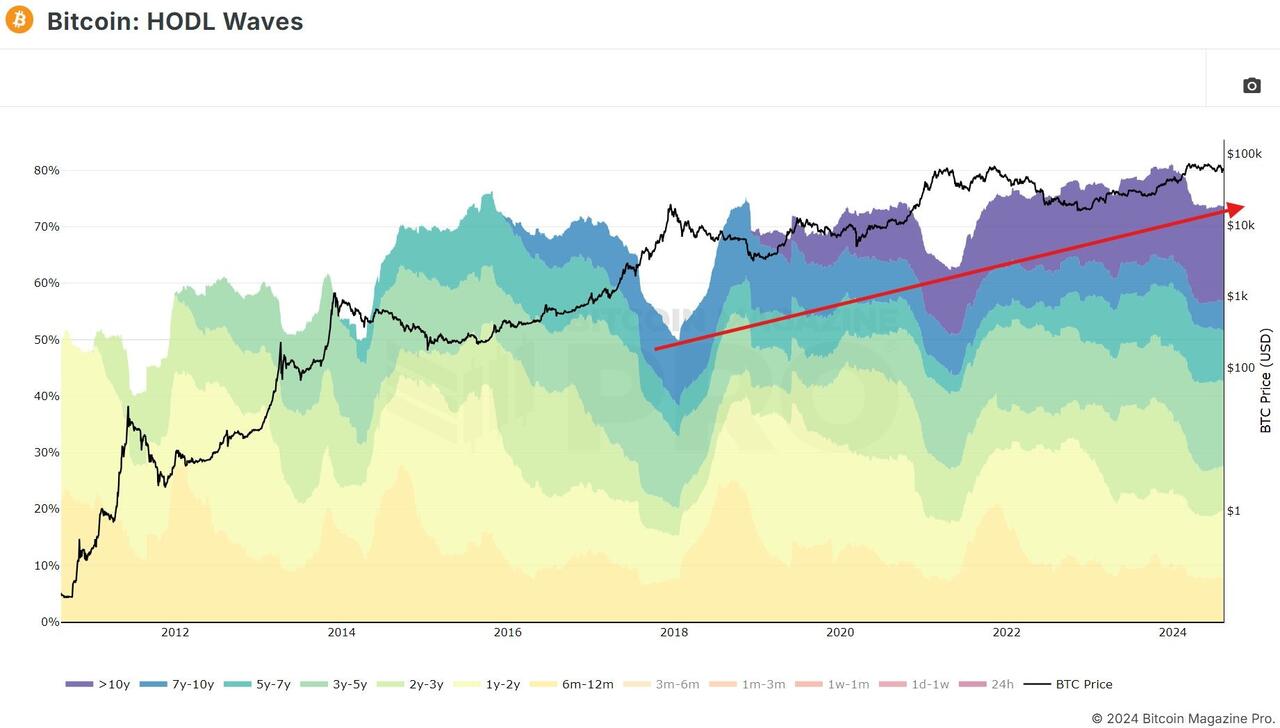
Recent data from Bitcoin Magazine Pro shows a significant trend among Bitcoin holders: nearly 75% of all circulating Bitcoin has remained dormant for over six months.

This strong HODLing behavior reflects a steadfast belief in Bitcoin’s long-term value, despite market fluctuations.

Bitcoin Magazine Pro X

The “HODL Waves” chart, a tool that visualizes the age of Bitcoins based on when they last moved, illustrates how various groups of holders react to market conditions.

The dominance of older coins (those held for 6 months or more) suggests that long-term investors are increasingly holding onto their Bitcoin, possibly anticipating future price increases.

This trend of HODLing is significant because it indicates a reduced supply of Bitcoin available for trading, which could lead to increased price stability or even potential price appreciation as demand grows.

The data also highlights the contrast between short-term traders and long-term investors, with the latter group—often considered ‘smart money’—likely to hold their positions during periods of market volatility.

For new Bitcoin investors, this trend emphasizes the potential benefits of adopting a long-term investment strategy.

Consistently buying and holding Bitcoin over time, rather than attempting to time the market, aligns with the behavior of those who have historically seen the most significant gains holding Bitcoin.

For more detailed information, insights, and to sign up to access Bitcoin Magazine Pro’s data and analytics, visit the official website here.

Tyler Durden
Sun, 08/18/2024 – 09:55