72.2 F
Chicago
Wednesday, September 30, 2026
Home Blog Page 2378

Transitioning From A Seller’s Market To A Buyer’s Market

0
Transitioning From A Seller’s Market To A Buyer’s Market

By Stefan Koopman, Senior Macro Strategist at Rabobank

Buyer’s Market

US producer price inflation was soft in July. Both headline (0.1% m/m and 2.2% y/y) and core (0.0% m/m and 2.4% y/y) PPI inflation came in below expectations. Goods prices rose by 0.6% m/m, while services fell by 0.2% m/m, suggesting that a fall in retail markups drove down this otherwise hotter report. This indicates that retail firms are losing pricing power and are discounting more heavily, as reflected in various company earnings reports.

The components of the PPI that feed into the PCE price gauge, due later this month, were also relatively benign, adding to the case for investors betting on lower interest rates from September onwards. Following this muted report, stocks ended the US session firmly higher, with the S&P 500 and Nasdaq 100 posting 1.5-week highs and adding further to the market’s recovery from the early-month selloff. Bond yields fell, with the 10-year UST yielding 3.84%, down 5 bps from before the report. In Europe, the German 10-year rate has fallen to 2.18%. The dollar softened, with the DXY at 102.69 and EUR/USD just below the 1.10 handle.

Earlier yesterday, the NFIB small business optimism index surged to a two-year high in July, driven by expectations of an improving economy. This optimism is likely influenced by confidence in a Trump victory following President Biden’s weak performances and the ensuing uncertainty about the Democratic presidential candidate during much of July. However, this optimism may have waned by the time the August survey is conducted. The survey also showed that the share of firms planning price increases fell to 24%, the lowest since April 2023, though still historically elevated. Businesses are increasingly concerned about softening demand amid persistent input price pressures, and less so about labor shortages. This ongoing transition from seller’s markets to buyer’s markets marks a post-COVID priority change. The survey indicates that businesses are dealing with margin squeezes more by slowing wage increases rather than resorting to layoffs.

The UK is also transitioning from seller’s markets to buyer’s markets. The headline CPI ticked up slightly this morning, from 2% to 2.2%, but this was a tenth less than expected. The rise in the annual rate is mainly due to energy prices, which fell less than they did a year ago. This was somewhat offset by hotel prices, which saw a monthly fall of 6.4% compared with a rise of 8.2% a year ago. This print helped lower the services inflation figure, suggesting that June’s elevated services print, which raised doubts about an interest rate cut ahead of the August MPC, was driven by one-offs. Indeed, both core CPI and services CPI, which are more indicative of pricing power, fell more than expected, to 3.3% and 5.2% y/y respectively.

Yesterday’s UK labor market figures showed that regular pay growth slowed to 5.4% y/y, in line with expectations. Total pay growth, including bonuses, slowed significantly to 4.5% from 5.7%, with last year’s one-off NHS bonuses affecting the y/y comparison. Meanwhile, the number of job openings continues to decline and is now at 884,000, barely above pre-COVID levels. This all suggests a labor market that is gradually transitioning into a buyer’s market too. Based on the relationship between vacancies and unemployment, we expect regular wage growth to fall further towards the 4-4.5% range in the coming months.

The MPC welcomes these numbers, as it ex-post validates their narrow decision to cut rates by 25bp. We don’t see this immediately leading to another 25bp cut at the forthcoming meeting, as this month’s 5-4 split and the current guidance clearly suggests that the MPC wants to take a gradual approach. It does, however, set us up for another Bank of England cut come November.

Speaking of cuts, the RBNZ today lowered the official cash rate (OCR) by 25 bps to 5.25%. We had previously forecasted a cut this month, but recently pushed this call to October due to resilience in non-tradable inflation. However, the RBNZ indicated that the output gap appears more negative than previously thought, with downside risks to employment and growth becoming more apparent. The RBNZ now forecasts a recession in the second half of this year, with the published OCR track implying a little over two rate cuts before Christmas and a terminal rate of 2.98% in Q3 2027.

We have long held the view that the New Zealand economy is weakening quickly and that rate cuts would need to come sooner rather than later (until recently, the market consensus was for cuts to begin in 2025). Nevertheless, we believe the RBNZ’s estimates of the terminal rate published today look low compared to comparable economies. Our forecast is that the RBNZ will cut rates five times in total, reaching an OCR of 4.25% by July next year. This is partially informed by our belief that the R* is higher than the RBNZ’s estimates and our expectations of persistent supply-side inflationary pressures. However, we agree that the risk skew for this forecast is to the downside.

Tyler Durden
Wed, 08/14/2024 – 11:45

Mars Candy Bars To Buy Cheez-It Maker Kellanova In “Largest Package-Food Deal In Decade”

0
Mars Candy Bars To Buy Cheez-It Maker Kellanova In “Largest Package-Food Deal In Decade”

One of the largest food industry mega-deals in nearly a decade was unveiled as snack giant Mars announced a deal to purchase food maker Kellanova for nearly $30 billion. This marks one of the biggest M&A deals this year, second to Capital One Financial’s agreement to purchase Discover Financial Services for $35 billion in February. 

Family-owned Mars agreed to pay $83.50 per share in cash for all outstanding equity of Kellanova, representing a total enterprise value of $35.9 billion. 

“All of Kellanova’s brands, assets and operations, including its snacking brands, portfolio of international cereal and noodles, North American plant-based foods and frozen breakfast are included in the transaction,” Mars noted in a press release, adding it “intends to fully finance the acquisition through a combination of cash-on-hand and new debt, for which commitments have been secured.” 

Late last year, WK Kellogg Co. spun off Kellanova, the company behind Pringles, Cheez-It, Pop-Tarts, Eggo, MorningStar Farms, and other brands that include cereals and noodles. Kellanova has been outperforming many of its peers, raising its full-year guidance as new products and marketing efforts boosted sales in the second quarter. 

Buying Kellanova will allow Mars, known for its chocolate-heavy portfolio, including brands such as Dove Chocolate, M&Ms, Life Savers, Skittles, Starburst, Twix, Orbit, and Milky Way, to expand into the chips and crackers aisles at grocery stores. In other words, Mars will take a more significant market share of the snacking pie as consumers eat fewer sit-down meals and graze on junk food throughout the day. 

“In welcoming Kellanova’s portfolio of growing global brands, we have a substantial opportunity for Mars to further develop a sustainable snacking business that is fit for the future,” Mars Chief Executive Poul Weihrauch wrote in a statement. 

Bloomberg Intelligence analyst Jennifer Bartashus said the deal is the “largest packaged-food deal in nearly a decade and could spur more M&A in the sector.” 

Shares of Kellanova were higher at the start of the cash session, up above 7.5% to the $80 handle.

“We are excited for Kellanova’s next chapter as part of Mars, which will bring together both companies’ world-class talent and capabilities and our shared commitment to helping our communities thrive,” said Kellanova CEO Steve Cahillane. 

Jefferies analyst Rob Dickerson told clients, “Mars enhances its global snacking business, possibly raising competitive levels for other large food players.” 

If the deal fails to secure regulatory approval, Mars must pay Kellanova a termination fee of $1.25 billion. 

This mega deal in the junk food space suggests these companies aren’t afraid of GLP-1s. 

Tyler Durden
Wed, 08/14/2024 – 11:30

WTI Extends Losses Despite Cushing Stocks Tumbling To 6-Month Lows

0
WTI Extends Losses Despite Cushing Stocks Tumbling To 6-Month Lows

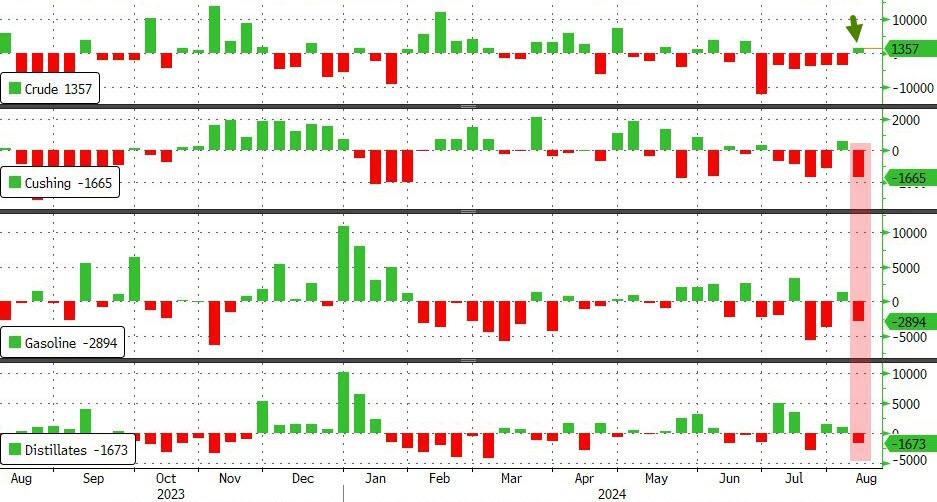
Oil prices are lower this morning – following bond yields, bitcoin and big-cap all lower post-CPI – erasing the small gains overnight following API’s reported big crude draw.

“Macroeconomic eyes remain very much glued on the state of inflation in the United States this week. With US PPI coming in 0.1% softer-than-expected yesterday, any such replication in the CPI reading today will hear not only a clamour of calls for the US Federal Reserve to cut interest rates but see another bout of speculative equity buying,” PVM Oil Associates noted.

For now, the official DOE data will likely decide the next leg.

API

  • Crude: -5.2mm

  • Cushing: -2.277mm

  • Gasoline: -3.689mm

  • Distillate: +612k

DOE

  • Crude: +1.36mm

  • Cushing: -1.665mm

  • Gasoline: -2.894mm

  • Distillate: -1.673mm

Bucking the API reported draw, DOE official data reports that crude stocks rose last week, ending a six-week streak of draws, but Cushing stockpiles continued to sink as did product inventories…

Source: Bloomberg

Stocks at the Cushing hub fell to their lowest since February…

Source: Bloomberg

The Biden admin added 694k barrels of oil to the SPR…

Source: Bloomberg

For context, there’s a long way to go..

Source: Bloomberg

US Crude production dipped off record highs…

Source: Bloomberg

WTI is extending its losses for now…

Middle East tensions remain heightened, with Iran still claiming the right to retaliate against Israel following the assassinations of key leaders in the Hamas and Hezbollah militant groups it backs. A direct attack on Israel is expected, but Iran has so far delayed any strike.

Notypist
Wed, 08/14/2024 – 10:41

Germany Issues First Arrest Warrant In Nord Stream Sabotage Investigation 

0
Germany Issues First Arrest Warrant In Nord Stream Sabotage Investigation 

The Nord Stream pipeline explosion was one the largest acts of industrial sabotage in modern history. Nearly two years later, speculation continues to swirl about who was behind the attack. 

Was it the CIA, as famed journalist and Pulitzer prize winner Seymour Hersh claimed? Did the Russians blow up their own undersea pipeline in the Baltic Sea? Or was it a Ukrainian commando with a sailing yacht? 

A new report surfaced on Wednesday, released by several German media outlets, including ARD, Sueddeutsche Zeitung, and Die Zeit. It details how German officials obtained an arrest warrant for a Ukrainian citizen named ‘Volodymyr Z’ in June, who was living in Poland at the time.

Polish National Public Prosecutor’s Office spokeswoman Anna Adamiak told Reuters that the arrest warrant was sent to the District Prosecutor’s Office in Warsaw in June.

Volodymyr Z was a diver wanted in connection with the Nord Stream explosion that rocked the NatGas pipeline, which stretches from Russia to Germany, in September 2022. 

“Ultimately, Volodymyr Z. was not detained, because at the beginning of July he left Polish territory, crossing the Polish-Ukrainian border,” Adamiak said. 

She continued, “Free crossing of the Polish-Ukrainian border by the above-mentioned person was possible because German authorities… did not include him in the database of wanted persons, which meant that the Polish Border Guard had no knowledge and no grounds to detain Volodymyr Z.”

In February, Swedish and Danish authorities closed their investigation into who was behind the pipeline sabotage. 

In early 2023, months after the pipeline attack, journalist Seymour Hersh published a bombshell report on his Substack that alleged the US blew up the Russia-to-Germany NatGas pipeline as part of a covert operation under the guise of the BALTOPS 22 NATO exercise. 

“The Navy proposed using a newly commissioned submarine to assault the pipeline directly. The Air Force discussed dropping bombs with delayed fuses that could be set off remotely. The CIA argued that whatever was done, it would have to be covert. Everyone involved understood the stakes,” the report, entitled How America Took Out The Nord Stream Pipeline, reads.

Days after the explosion, America’s corporate media outlets pushed this propaganda. 

One can’t help but wonder if the latest push by EU corporate media is yet another misinformation and disinformation campaign to shift the blame from the US to Ukraine.  

Tyler Durden
Wed, 08/14/2024 – 10:05

One Step Away From The Biggest Oil Shock In History

0
One Step Away From The Biggest Oil Shock In History

Authored by Nick Giambruno via InternationalMan.com,

The Strait of Hormuz is a narrow strip of water that links the Persian Gulf to the rest of the world.

It’s the world’s single-most important energy corridor, and there’s no alternative route.

Five of the world’s top 10 oil-producing countries—Saudi Arabia, Iran, Iraq, United Arab Emirates, and Kuwait—border the Persian Gulf, as does Qatar, the world’s largest liquefied natural gas (LNG) exporter. The Strait of Hormuz is their only sea route to the open ocean… and world markets.

At its narrowest point, the space available for shipping lanes is just 3.2 kilometers wide.

According to the US Energy Information Administration, more than 40% of global oil exports (around 21 million barrels) transit the Strait daily.

That’s more than $1.5 billion worth of oil every day.

And that’s not considering the immense amount of LNG— about 33% of the world’s daily LNG exports—and other goods transiting the Strait.

It’s hard to overstate the importance of the Strait of Hormuz to the global economy.

If someone were to disrupt the Strait, it would cause immediate global economic chaos as energy prices skyrocket.

Thanks to its commanding geography and expertise in unconventional and asymmetric warfare, Iran can shut down the Strait, and there’s not much anyone can do about it.

It’s Iran’s geopolitical trump card.

Analysts believe it would take weeks for the US military to reopen it, but nobody really knows if it would ultimately be successful. The Millennium Challenge 2002 war game suggests it wouldn’t be.

Military strategists have known about this situation for decades. But no one has found a realistic way to neutralize Iran’s power over the Strait.

Iran has been crystal clear that it will close the Strait in the case Israel or the US attacks it.

In other words, Iran holds a knife to the throat of the global economy.

The US has sought to overthrow the Iranian government since the 1979 Revolution—for over 40 years. Iran’s control over the Strait of Hormuz has always served as a big deterrent to US regime change ambitions and invasion plans.

Now, Iran and the US are headed toward a confrontation that will almost certainly disrupt the Strait.

The potential outbreak of an enormous regional war in the Middle East could force the US to act against Iran this time.

If war breaks out between the US and Iran—an increasingly likely outcome—I have no doubt that Iran will close the Strait of Hormuz.

To call that a severe oil supply disruption would be a major understatement.

Consider this…

During the first oil shock in 1973, about 5 million barrels were removed from the global oil market. Daily global oil production was approximately 56 million barrels per day at the time, which means about 9% of the supply vanished.

Oil prices roughly quadrupled.

During the second oil shock in 1979, about 4 million barrels were removed from the global oil market. Daily global oil production was approximately 67 million barrels per day at the time, which means about 6% of the supply vanished.

Oil prices nearly tripled.

During the third oil shock in 1990, about 4.3 million barrels were removed from the global oil market. Daily global oil production was approximately 66 million barrels per day at the time, which means about 7% of the supply vanished.

Oil prices more than doubled.

If Iran were to shut down the Strait of Hormuz, it would remove a whopping 21 million barrels of oil from the global market. Today, global oil production is approximately 94 million barrels per day, which means about 22% of the worldwide oil supply could disappear.

As we can see in the chart below, it would be the largest oil supply shock the world has ever seen… by far.

If war with Iran proceeds and Tehran closes the Strait of Hormuz, I think the effect on the price of oil will be at least as severe as it was during the 1973 oil shock, which saw oil prices go up 4x.

A similar move today could see oil prices above $300 a barrel.

However, I consider that a conservative estimate because closing the Strait of Hormuz would cause a much larger supply shock than the 1973 OPEC oil embargo.

I think the market doesn’t appreciate how close we are to a war with Iran and the implications of it.

I’m certainly not cheering for war. I despise war, which is the health of the State.

Regardless, a big war is highly likely, with significant investment implications that would be foolish to ignore.

That’s precisely why I just released an urgent new report with all the details, including what you must do to prepare. It’s called The Most Dangerous Economic Crisis in 100 Years… the Top 3 Strategies You Need Right Now. Click here to download the PDF now.

Tyler Durden
Wed, 08/14/2024 – 09:45

Japan’s PM Kishida Announces Resignation Amid Scandals, Opening Door To Political Chaos

0
Japan’s PM Kishida Announces Resignation Amid Scandals, Opening Door To Political Chaos

After the late Shinzo Abe valiantly tried to break Japan’s dismal tradition of having Prime Ministers who last on average about a year – before quitting and eventually getting assassinated – it appears that Japan is back to its own ungovernable self.

On Wednesday morning, Japan’s Prime Minister Fumio Kishida surprised markets when he said he would step down as leader of the ruling Liberal Democratic party in September and effectively end his tenure as the country’s prime minister, ending months of speculation over his ability to survive scandal and rising living costs.

Japan’s Prime Minister Fumio Kishida speaks during a press conference at his office in Tokyo as he announced he will not run in the upcoming party leadership vote in September, on Wednesday

At a press conference on Wednesday, Kishida said he would not seek re-election at next month’s internal poll for the LDP presidency, which in effect grants the holder the position of Japanese prime minister.

“Japan continues to face tough situations at home and abroad. It is extremely important that we tackle these issues with a firm hand,” Kishida said. “The first and clearest step to show that the LDP is changing is for me to step down.”

Kishida said his decision was based on the need to restore trust in politics, and that an ideal successor would be reform-minded.

“Trust in politics and trust from the people is critical,” he told reporters. “It is only by regaining the understanding and trust of the general public that we can move forward, and this is why the LDP must change.”

In short, Kishida wants to get the hell out of Dodge before all hell breaks loose again.

The unexpected shake-up comes at a key moment for Japan, which as the FT reports, has taken on a more muscular defense role in the Pacific and deepened security co-operation with the US in the face of a rising China. The country’s economy also began to emerge from a decades-long campaign against deflation and low growth, while its equity markets have become a favored destination for investors seeking an alternative to China amid rising geopolitical risks.

But Kishida’s three-year premiership was dogged by low approval ratings, caused in large part by a political funding scandal that forced him to sack four cabinet ministers in 2023. In February, a poll by the Mainichi newspaper found that only 14% of voters approved of his administration’s performance, far below the 30% level that has felled previous Japanese prime ministers. The recent transitory surge in inflation – it’s transitory because Japan has the highest debt load of any country in the world at over 400% of total debt including government and corporate – did not help Kishida’s approval either.

Political analysts have ascribed Kishida’s survival to the weakness of Japan’s opposition parties and a dearth of serious challengers within the LDP.

As the FT notes, Kishida’s decision came as a surprise within the LDP, where very senior figures had firmly believed that the prime minister intended to stand in the leadership election, according to several people close to the cabinet.

By pulling out of the leadership election, which is expected to be held around September 20, Kishida, 67, opens the way for  multiple candidates to compete for the position. Speculation among political analysts on his most likely successor has centred on former trade minister Toshimitsu Motegi, 68, former defense minister Shigeru Ishiba, 67, and former foreign minister Taro Kono, 61, all career politicians.

“It is important to show a new face of the LDP in this leadership race,” Kishida said.

Masatoshi Honda, a political analyst and academic, said the depth of the LDP’s woes meant the leadership contest would attract candidates who under normal circumstances would not be seen as potential contenders. But public dissatisfaction with the ruling party went well beyond its top leadership. “Whoever wins, it will be very difficult to revive support for the LDP,” Honda said. One possible younger contender is Takayuki Kobayashi, 49, a graduate of the Harvard Kennedy School, who is credited with showing a steady hand as economic security minister from 2021-22.

Whoever is elected LDP president can expect to lead the party into a general election that must be held by the end of October 2025.

Business executives said one critical question was whether the next LDP leader would be experienced and tough enough to deal with international challenges, including an increasingly assertive China and the possible re-election of Donald Trump as US president.

Kishida, who previously served as foreign minister, came to power in October 2021 with a promise of establishing a “New Capitalism”. His initial failure to fully explain his plans for wealth redistribution resulted in a rapid collapse in the Tokyo stock market that became known as the “Kishida Shock”. Ironically, his tenure ended with another shock, this time the result of the logical rate hike meant to contain Japan’s runaway inflation, which sent stocks plummeting, and forced the BOJ to quickly backtrack effectively promising no more rate hikes.

That said, Kishida’s three-year term included a number of modest achievements that had eluded his predecessors, including a landmark increase in Japanese defence spending in 2022 that would, in stages, raise the military budget from about 1% of gross domestic product to roughly 2% over five years.

Kishida’s efforts to convince corporate Japan to raise wages also bore fruit. This year’s shunto wage negotiations in March secured the largest pay increase since 1991 for workers at large companies. Alas, that has since led to the highest inflation in Japan in generations, and forced the BOJ to hike rates, jeopardizing the stability of the Japanese bond market, the world’s biggest financial Frankenstein monster, where the BOJ owns more than half of all JGBs.

US ambassador to Japan Rahm Emanuel on Wednesday hailed the departing prime minister as “a true friend” of Washington.

“Kishida worked with President Biden to open a new chapter in the US-Japan relationship, which went from alliance protection to alliance projection,” said Emanuel.

Tyler Durden
Wed, 08/14/2024 – 09:25

Stealth QE Or Rubbish From Dr Doom?

0
Stealth QE Or Rubbish From Dr Doom?

Authored by Michael Lebowtiz via RealInvestmentAdvice.com,

A recent article co-authored by Stephen Miran and Dr. Nouriel Roubini, aka Dr. Doom, accuses the U.S. Treasury Department of using its debt-issuance powers to manipulate financial conditions. They liken recent Treasury debt issuance decisions to stealth QE. Per the first paragraph of the article’s executive summary:

By adjusting the maturity profile of its debt issuance, the Treasury is dynamically managing financial conditions and through them, the economy, usurping core functions of the Federal Reserve. We dub this novel tool “activist Treasury issuance,” or ATI. By manipulating the amount of interest rate risk owned by investors, ATI works through the same channels as the Fed’s quantitative easing programs. 

Is their accusation reasonable?

Given the significant impact that liquidity has on financial markets, the answer is much more important for investors than it may appear.

Reviewing The Allegation

The authors claim that recent Treasury debt issuance patterns were intentionally implemented to boost economic activity and support the financial markets, thus easing financial conditions. Even more damning, the article insinuates the Treasury is using ATI “to stimulate the economy into election season.“

Below, we share a few quotes and our summarization of the article to bring you up to speed on their thesis.

Whereas Treasury has historically striven for “regular and predictable”-read: boring-issuance, recent aggressive changes to the relative levels of long- and short-term security auction sizes have made issuance irregular and unpredictable. Because Treasury is using this novel tool for managing financial markets and through them, the economy, we dub it “activist Treasury issuance,” or ATI.

Essentially, they assert the Treasury has purposely issued less long-term debt in favor of more short-term bills. The authors hypothesize its actions equate to an approximate one percent cut in the Fed Funds rate.

The article likens ATI to QE as follows:

Whereas QE works by removing interest rate risk from the market and hiding it away on the Fed’s balance sheet, ATI works by limiting the production of interest rate risk at the source. The net effect, however, is similar.

The paper states there are two channels through which ATI and QE operate.

The Portfolio Balance Channel

The portfolio balance channel argues that the financial markets have a fixed amount of total risk investors can hold in aggregate. If the Treasury were to issue bonds, thus adding duration risk to the market, investors would have to reduce other risks, i.e., sell different assets, to buy Treasury bonds. Therefore, investors can more easily absorb Treasury debt if the Treasury reduces or limits sales of its longer-term notes and bonds, which possess more duration risk.

Money Supply Channel

The money supply channel says issuing bonds instead of bills requires a more significant drawdown in bank reserves. Ergo, because Treasury bills require fewer reserves than bonds, the banking system retains more reserves when it owns bills versus bonds. Therefore, banks are less restricted in making loans that stimulate the economy and financial markets.

The following table summarizes their argument that ATI is stealth QE.

Historical Precedence

To further make their case, the article introduces “historical precedent.” They claim ATI is like the Fed’s “Operation Twist.”

Operation Twist, which originated in 1961, involved the Fed buying long-term Treasury notes and bonds and offsetting the purchase by selling short-term notes and bills. Such activity doesn’t change the Fed’s balance sheet size, but it has a market and economic impact.

Similarly, the paper argues that the Treasury can accomplish a comparable feat by issuing fewer bonds and more bills.

The authors deem such an act a “creative issuance policy to achieve unorthodox economic goals.” They believe that because the Fed has done Operation Twist numerous times with some success, the Treasury certainly appreciates the same game plan.  

Debt Issuance Patterns

The authors write that in 2015, the Treasury decided to increase its share of bills to total debt issuance to 15% for various reasons. In 2020, they extended it to 15-20%. Per the authors, the motivation for the changes was not interest rates or the business cycle.

The graphs from the article show that bills as a percent of debt outstanding have recently risen to their long-term average of 22.4% due to significantly more bill issuance than other debt, as shown on the right. While the percentage of bills outstanding is only slightly above the 15-20% target, in dollar terms, the difference is substantial.

Our Take On Stealth QE

At first blush, the article makes an excellent case the Treasury is conducting stealth QE.

However, before drawing conclusions, let’s consider what the U.S. Treasury Department is tasked with regarding government funding. Per its website:

The Treasury Department’s primary goal in debt management policy is to finance the government at the lowest cost over time. To meet this objective we issue debt in a regular and predictable manner, provide transparency in our decision-making, and seek continuous improvements in the auction process. In creating and executing our financing plans, we must contend with various uncertainties and potential challenges, such as unexpected changes in our borrowing needs, changes in the demand for our securities, and anything that inhibits efficient and timely sales of our securities. To manage

Simply put, the Treasury Department is responsible to the taxpayers for funding the country as efficiently and cost-effectively as possible. To do so, it must foster healthy markets.

Let’s address their primary low-cost goal and “uncertainties and potential challenges” that they face in their task.

Reducing Debt Costs

In trying to fund the nation at the lowest cost over time, the Treasury Department always tries to determine how current interest rates compare to expected future rates. They have skilled market personnel and a committee of Wall Street executives to help them in this endeavor.

As shown below, short- and long-term Treasury yields have been decreasing for the last 40+ years. This is the result of slowing economic growth and lower rates of inflation. Suppose the numerous factors impacting yields over the previous 40 years continue to exert themselves as we and many economists expect. In that case, the pre-pandemic rate levels and trends are likely still intact. Accordingly, it’s fair to assume that short-term and long-term rates will gravitate back to pre-pandemic levels.

Let’s revisit the debt issuance graphs we showed earlier.

From 2012 through 2022, the issuance of Treasury bills as a percentage of all debt was well below average. During this period, longer-term note and bond yields were at or near historical lows. The Treasury was smartly terming out its debt needs instead of issuing short-term debt and risking reissuing it at higher interest rates when the debt matures.

That was an opportunistic funding decision that proved wise. It was not manipulation.

Borrowing Needs and Market Demand For Treasury Securities

Federal Deficits have been running well above average, forcing the Treasury to issue more debt than typical. Accordingly, the Treasury must carefully distribute its debt so they don’t overwhelm the demand for a specific maturity while not meeting the demand for another.

Money market balances have been soaring, causing retail and institutional investors to clamor for Treasury bills. At the same time, longer-term bond investors have been shying away from bonds due to inflation and worries that yields will increase further.

The Treasury doesn’t manage demand for its products; it only controls the supply. Given market conditions, it has made the most sense to meet the insatiable demand from short-term investors and try to limit the supply to longer-term bond investors choking on what could be deemed an oversupply of bonds.

Again, shifting issuance amongst different debt maturities constitutes smart funding decisions, not manipulation.

Fostering Healthy Markets

Headlines like the ones below occurred regularly through most of 2023 and the first half of 2024.

  • “30-Year Treasury Auction Breaks Bad, Sinks Stock Market”- Barron’s November 2023

  • “10-year Treasury yield rises above 4.5% following weak auctions” CNBC March 2024

  • “Treasury yield end at four-week highs after another poorly received auction” Morningstar May 2024

  • “Why Treasury Auctions Have Wall Street on Edge” WSJ December 2023

Large Treasury auctions, particularly longer-term maturity ones, overwhelmed the markets, resulting in poor auctions and extreme volatility. The graph below highlights that bond market volatility (MOVE) in 2022 and 2023 was the highest since the financial crisis. Volatility is a sign of market instability.

Should the Treasury have been issuing even more notes and bonds into a market exhibiting signs of instability?

From a market perspective, the Treasury was trying to limit the volatility in the bond markets, not elevate it. Taking such responsibility for market conditions is appropriate, not manipulation.

Rebuttal

Joseph Adinolfi of MarketWatch recently wrote about the Miran and Roubini article: Is the Treasury Conspiring to Manipulate Markets and the Economy? Within the article, he provides the following rebuttals to the paper’s assertions.

Lou Crandall, chief economist at Wrightson ICAP and a longtime follower of the bond market, rejected the paper’s conclusions in a report shared with MarketWatch. “The bottom line is that Treasury issuance over the past year has evolved in ways that are consistent both with its historical behavior and with more recent Treasury guidance,” Crandall said. “The Treasury is simply doing what it said it was going to do.“

“I can assure you 100% that there is no such strategy. We have never, ever discussed anything of the sort,” said Treasury Secretary Yellen in a comment shared with MarketWatch.

One Treasury official who spoke with MarketWatch but asked for anonymity said the paper misrepresented the importance of guidance issued by the Treasury Borrowing Advisory Committee. The paper’s authors used this guidance as a benchmark when calculating excess bill issuance by the Treasury.

Guy LeBas, chief fixed-income strategist at Janney Montgomery Scott, said in an interview with MarketWatch. LeBas made a similar point about the impact of the Treasury’s bill issuance. “The authors are claiming when Treasury issues more short-term debt, that’s constructive for financial conditions, and when they issue more long-term debt, that’s negative for financial conditions,” he said. “Nothing in the world is that simple.”

LeBas added that the more likely scenario is that the Treasury is simply issuing debt along the segment of the curve where there is the most demand. Right now, that is on the short end.

Summary

Is the Treasury manipulating the bond market with stealth QE to boost the financial market and economy to help the Democrats win the election in November?

While it’s certainly possible, we think Treasury Secretary Janet Yellen did what was best for the taxpayers and the financial markets by adjusting its issuance patterns. Had the Treasury Department ignored troubling market signals and its low-cost funding objective, it would have significantly raised borrowing costs and possibly introduced bond market turmoil that could have easily spread to the equity and currency markets.

Recent Treasury debt issuance patterns are appropriate and will likely have and will save the nation significantly.


Tyler Durden
Wed, 08/14/2024 – 09:10

Generic Brand Mucinex Found To Contain Cancer Causing Benzene

0
Generic Brand Mucinex Found To Contain Cancer Causing Benzene

The cancer causing chemical benzene has been found in generic store-brand versions of Mucinex cold medicine, according to a new report by Bloomberg.

While both the brand-name and generic versions contain the same active ingredient, guaifenesin, and have similar packaging, the key difference lies in the inactive ingredients.

The brand-name medicine, made by Reckitt Benckiser, uses a benzene-free carbomer, while the generic versions sold by CVS, Walmart, Target, and Walgreens use a cheaper carbomer containing benzene to achieve the same 12-hour extended-release effect.

Bloomberg writes that despite international warnings, U.S. regulators have permitted the use of benzene in drugs for decades.

Recent tests have revealed dangerously high levels of the chemical in some U.S. products, sparking concern. The FDA announced plans to phase out benzene by 2025, but the deadline was extended to 2026 after pushback from the industry.

FDA spokeswoman Amanda Hills said: “The FDA is continuously working to ensure that all drugs meet the highest quality standards with the health and well-being of Americans top of mind.”

In response to questions about benzene in generic Mucinex, CVS Health said it would work with suppliers to replace the ingredient, the report says. 

Walgreens stated it follows FDA regulations, while Walmart, Target, and Rite Aid did not comment. The FDA is studying gel-based drugs with carbomers but not tablets like generic Mucinex. Bloomberg said it found that other store-brand products, including pain relievers and moisturizers, also contain benzene-made carbomers.

Despite consumer trust in store-brand medicines, they aren’t always as safe as brand-name versions. Major U.S. chains source their generic Mucinex from Amneal Pharmaceuticals, which did not comment on testing or compliance with future FDA rules.

Swapping benzene-containing carbomers is costly and time-consuming due to the need for additional testing and FDA approval. Prices for safer carbomers are higher, with Bloomberg noting a $4 price difference on Amazon between benzene-made and benzene-free versions.

The inventor of Mucinex, Jeff Keyser, asserts there’s no scientific reason to use benzene-made carbomers, as safer alternatives are available.

Tyler Durden
Wed, 08/14/2024 – 05:45

US Seeks Iran De-Escalation With Turkey’s Help

0
US Seeks Iran De-Escalation With Turkey’s Help

By Tsvetana Paraskova of OilPrice.com

The United States is calling on its allies that also maintain relations with Iran to persuade them not to escalate further the tensions in the Middle East, the U.S. Ambassador to Turkey, Jeff Flake, said.

“We ask all of our allies that have any relations with Iran to prevail on them to de-escalate, and that includes Turkey,” Flake told reporters in Istanbul, as carried by Reuters.

Turkey officials with whom the U.S. is talking “seem more confident than we are that it won’t escalate,” the ambassador said of the current situation in the region.

The recent escalation of tensions in the Middle East has rekindled concerns about a direct conflict between Israel and Iran after Israel killed Hamas’s political leader Ismail Haniyeh in Iran and a senior Hezbollah official in Lebanon.

The region and Israel’s allies are bracing for some kind of retaliatory attack from Iran on Israel. Fears of an escalating conflict have increased the geopolitical premium in crude oil prices.

After the market meltdown over concerns about a possible U.S. recession early last week, prices jumped at the end of the week and on Monday, amid anxiety over what Iran’s response to the Israeli assassinations would be and when it would come.

Brent Crude prices returned to above $80 per barrel on Monday as tensions in the Middle East continue to run high and as some analysts expressed views that the U.S. Fed has managed a soft landing of the economy and no recession is in the cards.

After the spike on Monday, oil prices were down by 0.4% in Asian trade on Tuesday amid renewed concerns about global oil demand.

OPEC on Monday cut its forecasts of global oil demand growth this year and next, in the first downward revision since the organization issued its initial estimate for 2024 a year ago. Underwhelming data so far this year and expectations of softening Chinese demand growth weighed on OPEC’s latest demand forecast.

Tyler Durden
Wed, 08/14/2024 – 05:00

Who Is Running America? NYT Discloses Lloyd Austin ‘Ordered’ Major Deployment To Conflict Zone

0
Who Is Running America? NYT Discloses Lloyd Austin ‘Ordered’ Major Deployment To Conflict Zone

A Monday NY Times report revealed of Defense Secretary Lloyd Austin’s recent phone call with Israeli counterpart, Yoav Gallant, the following: “In an unusual disclosure, it said Mr. Austin had ordered a submarine to the Middle East.” This line alone begs the question, where is the elected civilian authority of the executive branch, the Commander-in-Chief, right now? And where is Congressional authority and oversight to wage war and put troops in harm’s way? NY Times described further that in the call Austin “reiterated the United States’ commitment to take every possible step to defend Israel.”

Journalist Glenn Greenwald has some similar questions which every American should be asking right now at this dangerous moment the United States is deeply involved in no less than two major wars simultaneously (by heavily funding and arming one side of each)…

Or to put it another way: who is currently in charge over at the White House? Have we now reached such a post-Constitutional arrangement that that the major decisions of war and peace are being made by a military-intelligence complex beholden to no one? (…akin to what’s more commonly the case in Third World Banana Republics).

Comedian and Libertarian commentator Dave Smith just went on Tucker Carlson’s show and voiced a similar theme. Here is what he said according to the transcript: 

“It’s the greatest scandal in American history… we don’t have a president. The President of the United States, everyone has essentially admitted, is too senile to run for president.

Yet he’s going to be president until January?

We are in a proxy war with the biggest nuclear power in the history of the world, and we have another proxy war-ish type thing devolving into a wider regional war in Israel, and we don’t have a president.”

Not long following this interview, President Biden briefly emerged and fielded a few impromptu questions from the press, and let’s just say it did not instill confidence:

Likely, the assumption of a huge portion of the American public is that Vice President Kamala Harris is basically running things in coordination with a bunch of twenty- and thirty-something unelected White House staffers. 

But again, if the NY Times is accurate on Lloyd Austin being the one now ‘ordering’ major military deployments (and who knows with what oversight), America might more currently resemble some military-ruled central Asian or African nation at this point.

Meanwhile, Babylon Bee once again nails it…

* * *

The newTucker Carlson interview of Dave Smith can be viewed in its entirety below.

Tyler Durden
Wed, 08/14/2024 – 04:15