Labor Talks At Major US East Coast & Gulf Coast Ports “Very Far Apart” As Potential Paralyzing Strike Looms
The US may be headed for a supply chain crisis this fall as a labor contract between the International Longshoremen’s Association (ILA) and the United States Maritime Alliance (USMX) approaches expiration on Sept. 30. This could ignite strikes as soon as Oct. 1 across major ports along the US East Coast and Gulf Coast, instantly paralyzing complex supply chains ahead of the Christmas shopping season.
The ILA represents more than 45,000 dockworkers across the US at major ports. On Sunday, Executive Vice President Dennis Daggett addressed members in a Facebook post, indicating talks between the union and USMX are still far apart.
Here is Daggett’s memo to union members:
Attention ILA Members,
I want to address the recent communication from USMX and make it clear—do not be fooled by this letter. We are indeed continuing to bargain in good faith to settle all local contracts, but the reality on the ground is far different from the picture they are trying to paint.
Employers like APM Mobile have been dragging their feet on resolving critical issues. One such issue is their use of Autogate in TIR Lanes, which we consider a clear violation of our Master Agreement. This isn’t just happening in one location; many other ports are facing similar challenges in getting local management to agree on terms and conditions for local supplemental agreements.
On top of that, when it comes to the Master Contract negotiations, let me be frank—we are very far apart, particularly on the economic issues. In fact, we are at an impasse. The propaganda coming from USMX is just that—propaganda, likely the work of a PR firm trying to spin the situation in their favor.
Remember, unless you hear it directly from us, it’s not the truth. Stay strong, stay united, and know that we are fighting every day for the fair contract that you deserve.
In Solidarity,
Harold and Dennis Daggett
ILA workers “operate multimillion-dollar pieces of equipment with precision, maintain them with the expertise of highly skilled technicians, and clerks who manage complex operating systems for gates, vessels, and yards,” the union head said in a separate Facebook post from several days ago.
Daggett continued, “What I find particularly appalling is that while CEOs like those from CMA-CGM are taking home bonuses in the billions, ocean carriers continue to rake in skyrocketing profits by raising rates on their customers due to global conflicts or natural disruptions.”
Bloomberg noted, “Daggett has repeatedly warned of a strike if no deal is reached by the deadline and last weekend set a meeting in early September for union delegates to discuss wage demands and strike strategies.”
USMX released a statement late last week: “We are very far apart, particularly on the economic issues. In fact, we are at an impasse.”
Major importers are paying close attention because any strikes at major ports on the East Coast and Gulf Coast ports will instantly spark significant delays in the delivery of goods and the return of the inflation monster that still haunts Fed head, Jerome Powell.
Logistics news site More Than Shipping outlined the widespread economic fallout that could occur if a strike materializes in the coming months:
Supply Chain Disruptions: A strike would cause significant delays in the delivery of goods, severely disrupting supply chains. This would particularly affect industries that rely on just-in-time inventory systems, such as retail and manufacturing.
Economic Losses: The East Coast ports handle a large portion of the nation’s imports and exports. A strike could result in economic losses running into billions of dollars, impacting businesses that depend on these ports for importing raw materials and exporting finished products.
Retail and Consumer Goods: There could be delays and shortages in consumer goods, ranging from electronics to clothing and food items. Retailers might face empty shelves, leading to increased prices and reduced availability of products for consumers.
Automotive Industry: The automotive sector, which heavily relies on parts imported through these ports, could face production halts and delays in vehicle availability, affecting both manufacturers and consumers.
Agriculture: The export of agricultural products, including grains and produce, could be delayed, affecting farmers and exporters who rely on timely shipments to maintain market access and pricing.
Economic Ripple Effect: The strike’s impact would ripple through the economy, affecting jobs not just at the ports but also in transportation, warehousing, and other related industries.
International Trade Relations: Supply chain disruptions could strain trade relationships with other countries, potentially leading to long-term consequences for US trade policy and agreements.
Shipping and Logistics: Shipping companies might need to reroute vessels to other ports, increasing transportation costs and times. This could lead to congestion at other ports and further complicate the logistics network.
Let’s not forget that President Biden pledged to be “the most pro-union president in American history.” Does the president still remember what he said a couple years ago?
The Office of Israeli Prime Minister Benjamin Netanyahu reiterated the call for “absolute victory” against Hamas following critical remarks regarding such a strategy by Defense Minister Yoav Gallant, the Times of Israel reported Monday.
Defense Minister Gallant took a jab at Prime Minister Netanyahu during a Knesset committee discussion about Israel’s response to the ongoing fighting against Hezbollah along the northern border with Lebanon. “I hear all the heroes with the war drums, the ‘absolute victory’ and this gibberish,” he said during a meeting of Knesset’s Foreign Affairs and Defense Committee.
Gallant made the statement after he was asked why Israel has not initiated a full-scale war against Hezbollah in Lebanon, adding, “The conditions today for war in Lebanon are unlike those at the beginning of the war [last October].”
A short time later, the Prime Minister’s Office released a statement titled: “Gallant is bound by ‘absolute victory,’ too.”
“When Gallant adopts an anti-Israel narrative, he hurts the chances of reaching a hostage deal,” the statement said.
“He should have attacked [Hamas leader Yahya Sinwar], who refuses to send a delegation to negotiations and who was and remains the only obstacle to the hostage deal.”
Netanyahu has stated that Israel must achieve “absolute victory” by eliminating Hamas’s military and governance capabilities and winning the release of the remaining 111 Israeli captives held by the Hamas since its ‘Operation Al-Aqsa Flood’ on 7 October.
“This is the clear directive of Prime Minister Netanyahu and the cabinet, and it is binding on everyone – including Gallant,” the statement concludes.
In contrast, top Israeli officials, negotiators, and families of the captive Israelis have alleged that Netanyahu seeks to sabotage a ceasefire deal with Hamas.
FITNA! Israeli journalist Amit Segal: The relationship between Netanyahu and Gallant is a threat to Israel’s security. Gallant believes Netanyahu is misleading the public, and Netanyahu believes Gallant is an American spy.
The ministers in Netanyahu’s government, including National Security Minister Itamar Ben Gvir and Finance Minister Bezalel Smotrich, have stated they want to continue the war. They say they wish to destroy Gaza, ethnically cleanse the strip of its 2.3 million indigenous Palestinian inhabitants, and settle Israeli Jews in their place.
Former US army Colonel Douglas McGregor has asserted that Netanyahu’s objective is to “systematically destroy or kill the population of Gaza.”
Based on data from a U.S. Treasury report, the federal government has amassed $142 trillion in debts, liabilities, and unfunded obligations. This staggering figure equals 93 percent of all the wealth Americans have accumulated since the nation’s founding, estimated by the Federal Reserve to be $152 trillion.
Unlike other measures of federal red ink that cover an arbitrary period, extend into the infinite future, or ignore government resources, the figure of $142 trillion applies strictly to Americans who are alive right now and includes the government’s commercial assets. Thus, it quantifies the financial burden that today’s Americans are leaving to their children and future generations.
Complete Versus Incomplete Accounting
Federal law requires the U.S. Treasury to publish an annual report that details the government’s “overall financial position.” In addition to the national debt, the “Financial Report of the United States Government” also includes the government’s explicit and implicit financial commitments, such as:
• unfunded obligations for social insurance programs like Medicare.
Such “fiscal exposures,” as explained by the U.S. Government Accountability Office (GAO), “represent significant commitments that ultimately have to be addressed.” Thus, GAO stresses that ignoring them can “make it difficult for policymakers and the public to adequately understand the government’s overall performance and true financial condition.”
Yet, that is precisely what the media does. Although the Treasury published the report in February, Google News indicates that no major media outlet has mentioned it. Meanwhile, the same outlets have frequently reported on the national debt and federal budget, which are incomplete measures of the federal government’s fiscal situation.
The commonly cited national debt and federal budget are mainly based on cash accounting, which is the simplistic process of counting money as it flows in or out. Thus, liabilities like pension benefits for federal workers aren’t measured until they are actually paid, which is often decades after they are promised.
In contrast, the Treasury report mainly uses accrual accounting, which measures financial commitments as they are made. This is how the federal government requires large corporations to report their finances. In the words of the Financial Accounting Standards Board, which is tasked by the U.S. Securities and Exchange Commission to create private-sector accounting rules, accrual accounting is the “most relevant and reliable” way to measure the financial health of pension plans.
The same applies to other retirement benefits like healthcare. The accounting rule that governs such benefits explains that “a failure to accrue” implies “that no obligation exists prior to the payment of benefits.” Since an obligation does exist, failing to account for it “impairs the usefulness and integrity” of financial statements.
The Grand Total
A methodical tally of accrual accounting data in the Treasury report shows that the federal government has amassed $142 trillion in debts, liabilities, and unfunded obligations beyond the value of its commercial assets. This reflects the government’s finances at the close of its 2023 fiscal year on Sept. 30, 2023.
The primary components of this burden, which are unpacked below, include:
These figures tally to $147.1 trillion in debts, liabilities, and unfunded obligations. Offsetting this is $5.4 trillion in commercial assets owned by the federal government, leaving a grand total shortfall of $141.7 trillion.
Numbers in the trillions are hard to conceive, so it’s revealing to place them in context. The figure of $142 trillion amounts to 93 percent of the net wealth Americans have accumulated since the nation’s founding, estimated by the Federal Reserve to be $152 trillion. This includes all of their assets in savings, real estate, corporate stocks, private businesses, and consumer durable goods like automobiles and furniture.
The government’s $142 trillion shortfall also amounts to:
• $430,252 for every person living in the United States.
• $1,098,087 for every household in the United States.
• 2 times annual U.S. economic output (GDP).
• 30 times annual federal revenues.
Publicly Held Debt
The simplest major item quantified by the Treasury report is the publicly held debt, which is $26.3 trillion. This is the money the federal government owes to non-federal entities like individuals, corporations, state governments, and foreign governments.
Publicly held debt is a partial measure of the national debt that excludes $6.9 trillion the federal government owes to federal programs like Social Security and Medicare. The Treasury report also details these intergovernmental debts and consolidates them with the items below.
Liabilities
Pension and other retirement benefits are a large part of compensation packages for government employees. With these generous benefits included, civilian non-postal federal employees receive an average of 17 percent more total compensation than private-sector workers with comparable education and work experience. Postal workers receive even greater premiums ranging from 25 percent to 43 percent.
In 2022, federal, state, and local governments spent $2.3 trillion on employee compensation, costing each household in the nation an average of $17,299.
The Treasury report shows that the federal government currently owes $14.3 trillion in pensions and other benefits to federal employees and veterans that are not accounted for in the publicly held national debt. To pay the present value of these benefits will require an average of $109,005 from every household in the United States.
The Treasury reports other liabilities of the federal government, such as:
• $124 billion in accounts payable.
• $645 billion in environmental and disposal liabilities.
• $99 billion in insurance and guarantee program liabilities.
Altogether, the Treasury records $16.6 trillion in liabilities that are not accounted for in the publicly held debt.
Social Security & Medicare
A similar but far more expensive situation exists with social insurance programs like Social Security and Medicare. This is because—contrary to popular belief—these programs don’t save workers’ taxes for their retirements. Instead, they immediately spend the vast majority of those taxes to pay benefits to current recipients. Thus, they are called “pay-as-you-go” programs.
In stark contrast, the U.S. Bureau of Economic Analysis explains that “federal law requires private pension plans to operate as funded plans, not as pay-as-you-go plans.” The reasons for this, as explained by the American Academy of Actuaries, are to increase “benefit security” and ensure “intergenerational equity.”
Social Security and Medicare, on the other hand, have levied dramatically increased tax burdens on succeeding generations of Americans, thus creating severe generational inequality. And unless retirement ages are raised or benefits are reduced in some other way, taxes will need to be increased again to keep the programs solvent.
Federal actuaries measure the unfunded obligations of Social Security and Medicare in several different ways, but only one of them approximates accrual accounting. This is called the “closed-group” unfunded obligation, which is the money needed to cover the shortfalls for all current taxpayers and beneficiaries in these programs.
In the words of Harvard Law School professor and federal budget specialist Howell E. Jackson, the closed-group measure “reflects the financial burden or liability being passed on to future generations.” These burdens are $49.8 trillion for Social Security and $53.9 trillion for Medicare. Placing these figures in context:
• Social Security’s unfunded obligations amount to an additional $272,237 from every person who currently pays Social Security payroll taxes.
• Medicare’s unfunded obligations amount to an additional $201,932 from every U.S. resident aged 16 or older.
Those shortfalls are what remain after the federal government has paid back with interest all of the money it has borrowed from Social Security and Medicare.
Social Security and Medicare differ from true pensions because taxpayers don’t have a contractual right to receive these benefits. Nevertheless, paying these benefits is an implied commitment of the federal government, and federal law requires that these programs be included in the Treasury report.
The Treasury report estimates that the combined closed group unfunded obligations of Social Security, Medicare, and some smaller social insurance programs are $104.2 trillion. This figure doesn’t include intergovernmental debt, which is consolidated with other data in the report.
Federal Assets
The Treasury also records the federal government’s commercial assets, such as:
• $922 billion in cash and other monetary assets.
• $1.2 trillion in property, plants, and equipment.
• $1.7 trillion in receivable loans, mainly comprised of student loans.
However, the report doesn’t account for federal stewardship land and heritage assets, such as national parks and the original copy of the Declaration of Independence. While these items have tangible value, the report explains that they “are intended to be preserved as national treasures,” not sold to the highest bidder to cover debts.
In total, the government owned $5.4 trillion in commercial assets at the close of its 2023 fiscal year.
Adding up the federal government’s debts, liabilities, and unfunded obligations and then subtracting the value of its commercial assets yields a fiscal shortfall of $142 trillion.
Root Causes
The first critical step in solving a problem is to understand its root causes. However, scientific surveys show that many voters are misinformed about the root causes of government debt.
A scientific, nationally representative survey commissioned in 2020 by Just Facts found that 25 percent of voters believe the main driver of the rising national debt is military spending. This accords with the reporting of media outlets that frequently blame the debt on military spending.
In reality, military spending has plummeted from 53 percent of all federal expenses in 1960 to 17 percent in 2022:
The same survey found that another 25 percent of voters believe tax cuts were the main driver of debt, in accord with news stories that blame the debt on tax cuts.
In reality, federal revenues have stayed at a roughly level portion of the U.S. economy for the past 80 years:
As shown in the charts above, the primary driver of the national debt is increased spending, particularly on social programs. These programs—which provide healthcare, income security, education, nutrition, housing, and cultural services—have grown from 21 percent of all federal spending in 1960 to 64 percent in 2022.
Yet, only 39 percent of voters correctly identify social spending as the primary cause of rising debt.
Moreover, the vast bulk of the government’s unfunded obligations are due to Social Security and Medicare. Thus, the Congressional Budget Office projects that the main drivers of future debt will be Social Security, Medicare, Medicaid, the Children’s Health Insurance Program, Obamacare, and interest on the national debt. Under the weight of these, the publicly held debt is due to soar to unprecedented levels over coming decades.
Harmful Effects
A broad range of academic publications explain that excessive government debt can cause far-reaching negative outcomes, such as lower wages, increased inflation, weak economic growth, higher taxes, reduced government benefits, or combinations of such results.
Likewise,GAO warns that “the costs of federal borrowing will be borne by tomorrow’s workers and taxpayers,” which “may reduce or slow the growth of the living standards of future generations.”
While some believe the U.S. government can spend and borrow with abandon because it can print money, one of the most established laws of economics is that there is no such thing as a free lunch. The prolific economist William A. McEachern explains why this is so:
“There is no free lunch because all goods and services involve a cost to someone. The lunch may seem free to you, but it draws scarce resources away from the production of other goods and services, and whoever provides a free lunch often expects something in return. A Russian proverb makes a similar point but with a bit more bite: ‘The only place you find free cheese is in a mousetrap.’”
Biden, European Leaders Tell Iran to ‘Stand Down’ Amid Frenzied Speculation
Is tonight the night? In a familiar refrain of the past several days, Israel Defense Forces (IDF) Spokesman Rear Adm. Daniel Hagari said Monday the military is on “peak alert” for an attack from Iran or Hezbollah.
The White House too believes an attack is imminent or at least within “days” away. At the same time a senior Israeli official told Axios: “The Iranians openly signal (on the ground) their determination to carry out a significant attack in addition to their public statements that the attack will exceed the one they carried out in April.”
The official additionally observed that “Iranian public statements do not reflect any retreat.” Warnings from the West urging Tehran to not retaliate have been on repeat for a week-and-a-half following the July 31st Israeli killing of Hamas leader Ismail Haniyeh in Tehran.
The US has been joined by European countries in calling on Iran to “stand down” amid reports of significant Iranian and Hezbollah weapons movement and positioning.
US President Joe Biden alongside the leaders of the UK, France, Germany, and Italy issued a fresh joint statement Monday: “We called on Iran to stand down its ongoing threats of a military attack against Israel and discussed the serious consequences for regional security should such an attack take place,” a joint statement said after their presidents and prime ministers spoke by phone.
As for the IDF, its latest statement also described that the Israeli Air Force has increased its patrols over Lebanon “to detect and intercept threats.”
“We view the statements of our enemies seriously, and are therefore prepared at the highest level of readiness for defense and attack,” it continued.
Even the Vatican has tried to intervene toward preventing a broader regional war:
Following Haniyeh’s assassination, Iran’s Supreme Leader Ayatollah Ali Khamenei said Haniyeh’s death would “not pass in vain,” and its Islamic Revolutionary Guard Corps warned that “blood vengeance” for the killing is “certain.”
Iranian President Masoud Pezeshkian furthered those threats on Monday, telling a Vatican official in a phone call that the assassination warrants Iran’s right to “self defense” and to “respond to an aggressor,” Iranian state news agency IRNA reported.
Meanwhile amid fears of the wider Israeli confrontation with the ‘Iran axis’, the IDF has kept up its operations and strikes inside Gaza.
UPDATE
• US: Iran attack ‘could be this week’
• Another US destroyer 🚢to region
• Israel on alert, situation tense
• Gallant clashes with Netanyahu
• Israel hits South Lebanon
• UK PM 📞 Iran prez
• Europeans, US push for ceasefire talks https://t.co/3WxtvahzB0
“Palestinian medics said Israeli military strikes on several areas of Khan Younis on Monday killed at least 16 people and wounded several,” reports Reuters. “Meanwhile more families and displaced persons streamed out of areas threatened by new evacuation orders telling people to clear the area.”
The U.S. Marshals Service has announced the conclusion of “Operation Silver Shield,” a 90-day interagency operation that resulted in the arrest of 232 fugitives across Maryland, including individuals wanted for serious crimes such as rape and murder.
The large-scale, public safety initiative, which ran from May through August 2024, targeted non-compliant sex offenders and fugitives associated with violent crimes, the U.S. Marshals said in an Aug. 9 press release. Among the arrested were 36 individuals wanted for sex offender registration violations, 17 for rape, and 14 for homicide.
“The arrest of these fugitives represents a step in the right direction to keep Maryland safe,” Erek L. Barron, U.S. Attorney for the District of Maryland, said in a statement.
As part of the operation, law enforcement also seized seven firearms and successfully recovered four critically missing children.
Dozens of federal, state, and local agencies participated in the operation, with deputies from the District of Maryland prioritizing the arrest of non-compliant sex offenders, while members of the Capital Area Regional Fugitive Task Force, a unit of the U.S. Marshals, focused on catching violent fugitives.
“Throughout this operation, we worked hand-in-hand with local communities to take dangerous offenders off the streets,“ Mathew Silverman, chief deputy U.S. Marshal for the District of Maryland, said in a statement, adding that the results of the operation reflect ”the true power of our public safety partnership.”
The Capital Area Regional Fugitive Task Force, which has apprehended over 78,000 fugitives since its inception in 2004, has partnership agreements with over 133 federal, state, and local agencies operating in Virginia, Maryland, and the District of Columbia.
Besides the U.S. Marshals Service, some of the law enforcement agencies involved in Operation Silver Shield include the Baltimore Police Department, Homeland Security Investigations, the Bureau of Alcohol, Tobacco, Firearms, and Explosives (ATF), and the FBI.
Operation Silver Shield was launched on May 3, 2024, aiming to protect the community by prioritizing the recovery of critically missing children and arresting offenders who pose the biggest risk to public safety.
A similar operation in 2023, dubbed “Operation We Will Find You,” led to the recovery of 225 missing or endangered children.
At the time, the U.S. Marshals noted that cases involving missing or endangered children are some of the most challenging due to the presence of “high-risk factors,” such as involvement in child sex trafficking, child exploitation, sexual and physical abuse, and serious medical and mental health conditions.
The passage of the Justice for Victims of Trafficking Act in 2015 strengthened law enforcement’s ability to recover missing children. The legislation enhanced the U.S. Marshals’ authority, enabling them to better address cases involving endangered children, even when a fugitive or sex offender wasn’t directly involved.
Since the law’s enactment, the U.S. Marshals, in collaboration with the National Center for Missing and Exploited Children, have successfully recovered over 3,100 missing children.
Amnesty On The Table: Biden Officials Want Maduro To Regime Change Himself
A fresh Wall Street Journal report reveals just how desperate Washington officials are to see Venezuelan President Nicolás Maduro swiftly exit power, after the US has accused him and his officials of stealing the vote, keeping former diplomat Edmundo González from power while reportedly locking up thousands of opposition supporters.
“The U.S. is pursuing a long-shot bid to push Venezuelan President Nicolás Maduro to give up power in exchange for amnesty as overwhelming evidence emerges that the strongman lost last month’s election, people familiar with the matter said,” WSJ writes.
“The U.S. has discussed pardons for Maduro and top lieutenants of his who face Justice Department indictments, said three people familiar with the Biden administration deliberation. One of the sources said that the Biden administration is putting “everything on the table” in order to peaceably persuade Maduro to step down before his term is up in January. To translate, Biden officials are asking nicely: please Mr. Maduro, won’t you cancel yourself?
But Maduro and his government have hailed him as the legitimate victor of the July 28th national election. He’s set to enter a third 6-year term. He has many times over the last several years accused Washington of plotting coup and regime change against his rule, and there is ample evidence that there is more truth than falsehood to these accusations.
Rather than present the US as in a position of power vis-a-vis Caracas, the whole WSJ report and its claims—largely the product of the usual ‘anon security and defense officials’—is a testament to just how pathetic, weak, and desperate US policy toward the ‘rogue’ state remains.
Maduro will supposedly turn himself in on cocaine charges in return for an ‘amnesty’ based on what he sees as total fictions of a fraudulent and ‘imperialist’ American system? The following could arguably be some of the dumbest and most fantastical lines ever cooked up by the gaggle of career national security pencil pushers in charge of Latin America policy:
Another person familiar with the talks said the U.S. would be open to providing guarantees not to pursue those regime figures for extradition. The U.S. in 2020 placed a $15 million bounty for information leading to Maduro’s arrest on charges of conspiring with his allies to flood the U.S. with cocaine.
The talks represent a flicker of hope for a Venezuelan political opposition that meticulously collected voter tallies showing its candidate, little-known former diplomat Edmundo González, defeated Maduro in a landslide in the July 28 election. Over the past two weeks, Maduro has jailed thousands of dissidents, maintained the military’s loyalty and tasked the Supreme Court, stacked with his handpicked allies, with resolving the election impasse, buying him time.
As recently as Friday, Maduro put it very simply in a televised news conference: “Don’t mess with Venezuela’s internal affairs, that’s all I ask for,” Maduro said.
‘In Secret Talks, U.S. Offers Amnesty to Venezuela’s Maduro for Ceding Power’
I can’t stress how weak of a move this is for the U.S.
The U.S. is offering Maduro a pardon if he steps down. This is an absolute joke. “Kindly step down bc the coup we orchestrated didn’t work” pic.twitter.com/0bNfM65TMc
Where does US policy go from here? Biden’s gambit to ease sanctions on Venezuelan crude, bring Maduro ‘in from the cold’, and tap cheap energy at a crucial moment of wars in Eastern Europe and the Middle East appears at a standstill.
Now with a crack-brained plan to offer “amnesty” to Maduro having been floated (surely an object of laughter and mockery among Venezuelan officials), perhaps Washington is ready to try the whole Guaidó-style thing with González, who has even less name recognitions internationally, and declare him ‘Interim President’.
U.S. gun maker Smith & Wesson asked the U.S. Supreme Court on Aug. 8 for “immediate review” of its appeal in Mexico’s ongoing $10 billion lawsuit against U.S. firearms companies.
The request was made after a lower court on Aug. 7 threw out the case against six out of eight gun companies in the lawsuit, which is pending in federal district court in Massachusetts. The decision left gun maker Smith & Wesson and gun wholesaler Interstate Arms remaining as defendants.
In the suit, Mexico is seeking $10 billion from U.S. gun companies for allegedly flooding that country with firearms. Mexico blames the companies for a violent crime wave, saying their actions benefited criminal cartels.
Although some gun control activists welcome Mexico’s lawsuit, gun rights advocates say it constitutes foreign interference in U.S. affairs and is aimed at crippling the U.S. firearms industry and weakening the Second Amendment protections enjoyed by Americans.
The gun companies say the suit is barred by the federal Protection of Lawful Commerce in Arms Act (PLCAA) of 2005, which was enacted to protect the industry from frivolous lawsuits.
The Supreme Court already is scheduled to consider on Sept. 30 whether to hear the appeal of the eight gun companies called Smith & Wesson Brands Inc. v. Estados Unidos Mexicanos.
The appeal concerns the Jan. 22 decision of a three-judge panel of the U.S. Court of Appeals for the First Circuit that allowed the lawsuit to proceed.
Circuit Judge William Kayatta wrote that even though the PLCAA limits lawsuits that foreign governments may bring in U.S. courts for harm experienced outside the United States, Mexico could move forward because it made a plausible argument that the companies committed “knowing violations of statutes regulating the sale or marketing of firearms.”
Mexico claims that illegal gun trafficking into that country is driven largely by Mexican drug cartels’ demands for military-style weapons.
Kayatta wrote that a spike in gun violence in Mexico in recent years “correlates” with the boost in gun production in the United States that started when the U.S. assault weapon ban lapsed in 2004.
The First Circuit returned the case to U.S. District Judge Dennis Saylor of Massachusetts, who had previously dismissed the lawsuit against all eight corporate defendants on Sept. 30, 2022.
Saylor found in 2022 that the PLCAA “unequivocally bars lawsuits seeking to hold gun manufacturers responsible for the acts of individuals using guns for their intended purpose.”
When Saylor revisited the case on Aug. 7, he ruled that Mexico had failed to present enough evidence to show that six of the companies were connected to gun crime in Mexico.
The six defendants Saylor dismissed from the suit are Sturm, Ruger & Co.; Barrett Firearms Manufacturing Inc.; Glock Inc.; Colt’s Manufacturing Co. LLC; Century International Arms Inc.; and Beretta U.S.A. Corp.
Mexico indicated it may appeal the dismissal decision.
In the meantime, this means that Smith & Wesson and Witmer Public Safety Group, which does business as Interstate Arms, are still named as defendants in the suit pending in Saylor’s court.
In the Aug. 8 filing, Smith & Wesson attorney Noel Francisco of Jones Day in Washington told the Supreme Court that “immediate review … is still needed” because Smith & Wesson and Interstate Arms are “unaffected by” the Aug. 7 decision.
“As a result, Mexico is still pursuing ‘joint and several’ liability—to the tune of billions of dollars, plus far-reaching injunctive relief—against those two defendants,” Francisco wrote.
With joint and several liability, a plaintiff who secures a judgment against the defendants collectively may collect the full value of the judgment from any of the defendants.
“So just as before, leading members of the American firearms industry are facing years of litigation costs and the specter of business-crushing liability,” Francisco wrote.
“And just as before, this Court’s review is warranted now, because Congress made clear in PLCAA that this sort of lawfare against any law-abiding member of the firearms industry has no business in American courts, and must be promptly dismissed.”
Lawfare is the strategic use of legal proceedings to undermine or frustrate the efforts of an opponent.
Mexico argued in a brief that it filed with the Supreme Court on July 3 that the First Circuit’s decision was correct.
The lawsuit should be allowed to proceed because the companies “deliberately chose to engage in unlawful … conduct to profit off the criminal market for their products.”
According to the brief, the gun companies were wrong to argue that the prospect of them being held “liable for negligence and public nuisance” presents “an existential threat to the gun industry.”
Mexico’s attorney, Cate Stetson of Hogan Lovells in Washington, didn’t respond by publication time to a request by The Epoch Times for comment.
West Threatens Iran Over Plan To Supply Russia With Ballistic Missiles
NATO countries have been warning of swift and severe consequences in the wake of widespread reports that Iran is considering transferring sophisticated ballistic missiles to Russia for use in the Ukraine war.
A weekend Reuters story authored by multiple national security veteran reporters alleged that Russian personnel are already being trained to operate the Fath-360 close-range ballistic missile system. Several European intelligence sources were cited as the basis of the report, which Iranian leaders subsequently denied.
Biden’s national security council has said this would mark a “dramatic escalation” in military cooperation between Tehran and Moscow, which has so far seen thousands of small Iranian drones transferred and utilized over Ukraine’s skies.
Citing multiple confidential intelligence sources, the officials said that Russian personnel have visited Iran to learn how to operate the Fath-360 defence system, which launches missiles with a maximum range of 120 km (75 miles) and a warhead of 150 kg. One of the sources said that that “the only next possible” step after training would be actual delivery of the missiles to Russia.
Moscow possesses an array of its own ballistic missiles, but the supply of Fath-360s could allow Russia to use more of its arsenal for targets beyond the front line, while employing Iranian warheads for closer-range targets, a military expert said.
An expected delivery date wasn’t disclosed in the report, but it would be consistent with the trend of much closer cooperation on defense between the two ‘pariah’ nations which are highly sanctioned by the West.
At his point there’s not much left to sanction, and so increasingly both Russian and Iranian leaders have demonstrated a “nothing to lose” attitude in terms of flaunting their defiance of Western warnings.
We also recently highlighted that Russia has appeared to step up supplies of air defense equipment to the Islamic Republic, at a moment Tehran is threatening massive retaliation attacks on Israel for the July 31 killing of Hamas leader Ismail Haniyeh in Tehran. The expectation in such a scenario is that Israel’s counter-response would be bigger.
Allegations further say Russia has already received many Iranian ballistic missiles…
⚡️BREAKING
Iran has supplied Russia with a large number of powerful precision ballistic missiles.
According to Reuters, Iran has sent 400 missiles, many of which belong to the Fateh-110 family of short-range ballistic weapons, as well as Zolfaghar missiles.
The Iranians are reportedly also pressuring Moscow to fulfill delivery of Su-35S fighter jet fighters which were previously pledged in a defense deal, given the regional temperature is heating up fast.
Moscow likely feels obliged given the significant Iranian drone transfers it has received throughout the course of the Ukraine war. Iran has heavily aided Russian forces, and now Russia is quickly coming to Iran’s assistance.
“I’ve never heard her [Kamala Harris] say anything original or observant; at her best, she simply recites the party line. At her worst, she’s too lazy to memorize the party line.”
– Lionel Shriver
Does anybody know what this shape-shifting chimera passed off as “our democracy” actually is? I will tell you. Like everything else in the Democratic Party’s tool-bag these days, it’s the opposite of what it appears to mean, namely: You, the demos, give us, officialdom, the power to take whatever we like from you: your savings, your liberty, your stuff, your identity, and your posterity — because we are the boss-of-you, and don’t you forget it. . . and, by the way, the beatings will continue until morale improves.
It’s really that simple, though the deceptions cooked up to hide it are convoluted to the max. Like: engineering the illegal entrance to the US of millions from other lands and then using procedural hocus-pocus such as motor-voter registration and public assistance applications (free money + automatic voter registration) to stuff the election drop-boxes with the ballots of non-citizens — who, get this, don’t even have to be the ones casting those ballots, which can just be harvested, like so many oven-ready pullets, by lowly hired shills. If you catch onto the ruse, you’ll be instructed that borders are arbitrary roadblocks to social justice thrown up by the old white male patriarchy, and that these are “free and fair elections.”
And if you object loudly enough, you lose your job, your livelihood, your Facebook account, and maybe get thrown into solitary confinement for a year.
Our democracy.
Meanwhile, we’re enjoying the spectacle of this evil party’s candidate selection tour with their joyful warriors/avatars, Harris and Walz — joyful because they laugh and laugh in the absence of articulating any actual views on the particulars of governance, and it’s infectious to witness all that mirth. There is, of course, an artificially strenuous air about all this hoopla. It rolls out in an alternative reality like one of those summer techno-pop raves where everyone is stoned on MDMA. The dream girl gets launched into center-stage by invisible forces and is joined by her prom king, and it’s just so heartwarming to get waved at by the grinning, hand-holding couple nobody voted for. This is your demos-free ticket!
Will anybody at the imminent Democratic National Convention notice how this all mysteriously came to be? And might there be any active consternation over it? Perhaps even a welling movement to pull the plug on this rave? You may be apt to wonder what is going on in the Chappaqua redoubt of She-Whose-Turn-Has-Been-(so far)-Thwarted, HRC, boss-of-all-girl-bosses, putatively retired from public life. She’s been awfully quiet since that night over a week ago when she was obliged on-stage somewhere to hug and air-kiss Ms. Harris, and made a face seconds after as if she had thrown up in her mouth.
Is she stewing in the broth of grievance but still and nonetheless tirelessly working her phone to canvas the delegates of that looming party meet-up? She might remind them that the DNC (that is, the Democratic National Committee, Inc), went broke in 2016 and got bailed out by the Clinton Foundation checkbook, and, Jeez, we can’t seem to find any repayment check from all’y’all. It seems maybe you owe us. . . something.
And, by the way, HRC could remind said delegates: you have allowed a laughing hyena who drinks her lunch to land at the head of the ticket for the worst reasons (viz., DEI) minus any votes from the party membership, and then managed to duct-tape a China-owned, Cluster-B head-case to her as the veep sidekick. . . and maybe when all the hee-hawing and hooting dies down, you’ll discover what a pair of losers you’ve allowed to be undemocratically implanted to (ha!) represent you. And also, by the way, I happen to be available as her capable-and-experienced replacement. . . whom you can actually vote for on the convention floor, if you manage to get your shit together. . . you know. . . our democracy, and all. Just sayin’.
That is, I’m just sayin’ what She might be thinkin’ (and sayin’). I am in no position to predict any actual outcome, but it’s hard to imagine any winning moves by the Harris & Walz team in actual play-by-play. In case you have forgotten amid all the week-long laughter and euphoria, there are important national issues to discuss about how to manage the malevolent leviathan the federal government has become, and many dilemmas and threats the people face. And there are very different records of each team’s views on these things, party by party.
Some of that discussion could happen in the (so far) one scheduled September 10 debate. If Mr. Trump can manage to be polite, he can press Kamala Harris to explain herself on things like the wide-open border, failure to negotiate with the Russians to end the Ukraine War, her party’s antipathy to public safety, her party’s promotion of gender identity insanity, its Gestapo-style lawfare operations, its endless hoaxes, and its disgraceful documented efforts to censor free speech. The record is pretty clear on all of that, and there’s a fair chance that Ms. Harris can’t possibly explain it away. Or laugh it off.
Mr. Trump has requested two more head-to-head debates, which Ms. Harris apparently wants to forego. Mr. Trump has come up with an excellent alternative: two “town hall” format appearances in which he fields questions from citizens, or from news reporters, or some combo of both. That would be much to his advantage, without Ms. Harris on stage to defend her positions — or, more likely, to dodge any coherent reply by repeating “racist racist racist,” and laughing her head off.
That is, if she even remains the nominee. Let’s see how it goes this week leading to the convention. For instance, if she and Mr. Walz can still weasel out of taking any questions from the news media. Or whether the White House (remember “Joe Biden” still lives there) and his blob compadres can engineer a major escalation into world war, to take everybody’s mind off the election race. Or if any tremors of apprehension emanate from the delegate corps packing their rolly-bags for the dreaded party confab in Chicago. You have to kind of wonder if they’re bringing any riot gear.
Gold, Oil, & Bonds Soar As Stocks Swing Wildly To Unch Ahead Of Big Data Week
Stocks were relatively quiet today (relative to recent history and relative to other asset-classes today) as traders await July CPI and Retail Sales data later this week, as well as earnings reports prints from bellwethers including WMT and HD.
Small Caps and The Dow were the day’s laggards with Nasdaq and the S&P basically unchanged…
There have been seven 30-handle SPX swings today...
…yet, Goldman’s trading desk notes that overall activity levels are down dramatically (-40% vs. the trailing 2 weeks with market volumes down -20% vs the 10dma) with the floor tilting +2% better to buy, with LOs net to buy and HFs net for sale.
HFs are -9% better for sale, this is 95th %-ile over the last 1yr following a week where PB noted single stocks saw the largest net buying in 6 months. They are better for sale in every sector ex-HCare, Tech & REITs. The largest supply is from Macro Products, while Fins, Cons Disc and Mats follow close behind.
LOs are +1% better to buy. Macro Products is at the top, more than 3x better to buy than the next closest sector (HCare). Also buying Staples, Tech & Comms Svcs while selling Cons Disc, Indust, Energy & Fins.
Additionally, Goldman highlights that CTA supply is almost over with $81B out of global equities and $24B out of SPX in the last week…still for sale over the this week, but much more manageable supply…
Source: Goldman Sachs
VIX also ended practically unchanged, roundtripping the tumble at the cash open…
Source: Bloomberg
Treasury yields were all lower on the day by around 4bps (30Y underperformed)…
Source: Bloomberg
The 2Y yield fell to 4.00% and found some support on the day…
Source: Bloomberg
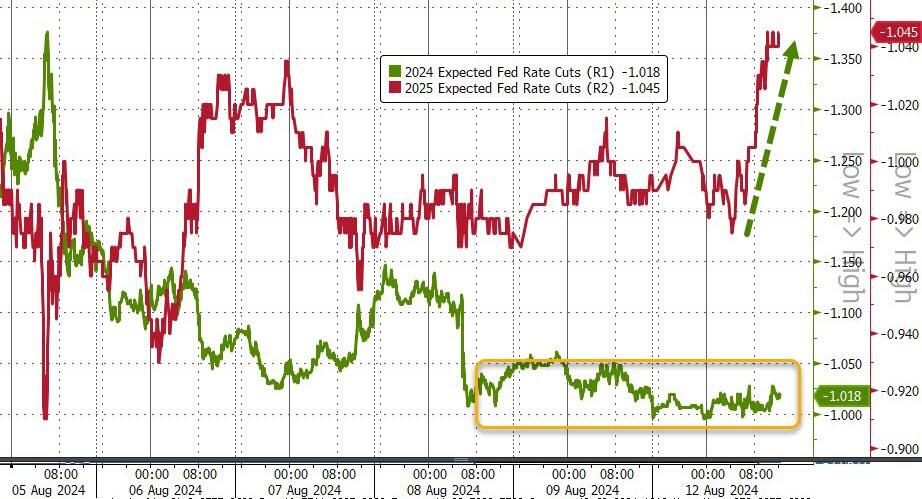
Rate-cut expectations rose today but the dovishness was all pushed into 2025 (with 2024 stuck at four 25bps cuts)…
Source: Bloomberg
Gold soared up towards record highs once again (a record high close today)…
Source: Bloomberg
Crude prices also exploded higher today amid geopolitcal tensions with WTI topping $80 for the first time in three weeks)…
Source: Bloomberg
And while commodities were rising, so was the Dollar
Source: Bloomberg
Crypto markets were just as chaotic as stocks today with some serious intraday swings (as BTC whipsawed between $58,000 and $60,000)…
Source: Bloomberg
But for a change, ETH outperformed BTC on the day…
Source: Bloomberg
Finally, it’s worth noting just how dramatically inverted the S&P 500’s vol term structure is…
Source: Bloomberg
With VIX liquidity at or near record lows, and gamma negative, there’s still plenty of room for chaotic swings before NVDA’s earnings.