63.6 F
Chicago
Tuesday, September 29, 2026
Home Blog Page 2394

US Hints At Regime Change In Tehran If Israel Is Attacked

US Hints At Regime Change In Tehran If Israel Is Attacked

The US is preparing to play Air Force for Israel’s skies as it deploys a dozen F-22 stealth raptor jets to the Middle East region. This change in ‘force posture’ was not debated in Congress (nor is it even really being debated on the mainstream networks), despite that clearly US service members could soon find themselves in the middle of a war between Iran and Israel.

The White House has issued a fresh warning to Tehran on Thursday as it is said to still be gearing up for a strike on Israel in retaliation for the July 31st killing of Hamas leader Ismail Haniyeh at a residence in Tehran. The new warning from Washington includes both negative economic consequences and threats of destabilizing actions directed against the newly elected government of Masoud Pezeshkian.

The attack on Tehran’s embassy compound in Damascus, Syria, on April 1, marked an unprecedented escalation. AFP/Getty Images

“The United States has sent clear messaging to Iran that the risk of a major escalation if they do a significant retaliatory attack against Israel is extremely high,” a US admin official told The Wall Street Journal.

The official further said that Tehran has been put on notice over “a serious risk of consequences for Iran’s economy and the stability of its newly elected government if it goes down that path.”

Is this a threat of regime change? To the ears of Iranian officials, it will sure sound like it given the country on its eastern border and the country on its western border were both regime-changed by Washington.

Currently, the consensus among US national security officials is that Hezbollah is likely to play a much bigger and coordinated role in any potential Iranian ballistic missile and drone attack on Israel:

Officials also don’t know for sure whether Hezbollah plans to attack at the same time in a coordinated offensive with Iran or separately. Hezbollah has a large arsenal of missiles that can reach Israel and the concern is that the group and Iran might attack at the same time to try to overwhelm Israel’s missile defenses. 

“Last time we got more of a heads up, and this time people are making their best guesses,” said a third U.S. official. 

But while the US mainstream media narrative remains that it is exclusively Iran and its regional allies that are the regional ‘aggressors’ against Israel and the US, the fact remains that it is Israel which has attacked close Tehran ally Syria literally hundreds of times over the past years.

You will find more infographics at Statista

And more recently, Israel attacked the Iranian embassy in Damascus (the aftermath which is pictured above). Nation-states did not attack each other’s embassies even during World Wars I and II, and the strike on the diplomatic complex was unprecedented in history as an intentional act prior to Israel’s April 1st operation in the Syrian capital.

Tyler Durden
Thu, 08/08/2024 – 20:30

Why Did Kamala Snub The Obvious VP Choice In Josh Shapiro

Why Did Kamala Snub The Obvious VP Choice In Josh Shapiro

Submitted by QTR’s Fringe Finance

It was just a couple of days ago that I wrote an article labeling Kamala Harris “The Next Worst Thing” to Joe Biden, and suggesting that her ascent to the top of the Democratic Party was another tried and true product of a guarantee I call “politicians always make the worst decisions possible.”

My theory was given a serious shot in the arm this week when Kamala Harris announced Minnesota Governor Tim Walz as her vice-presidential candidate.

As somebody who thinks the country would implode into itself like a dying star if Harris won the election, I was extraordinarily relieved to see her pick.

I was all but certain that Harris was going to pick Pennsylvania governor Josh Shapiro as her running mate. Everything about the pick made sense: he was racially her foil, he was younger, a well-spoken candidate, he was viewed as more of a moderate, he has great support in the extraordinarily crucial swinging state of Pennsylvania, and he could help the Democratic Party claw back some of the Jewish vote that they’ve (deservedly) lost over the last year while their far left fringe, including ‘the squad’, has all but openly supported Hamas.

The Shapiro pick made so much sense and, in my opinion, guaranteed the election for Harris so much, that I thought it would even break through the dumb-ass-politician-blood-brain barrier and be the inevitable selection.

But instead, nope! We get Tim Walz. The party who claims to hate old milquetoast white men, instead selected an even further left old milquetoast white man. What a time to be alive!

Without going into the worst points about Walz, not the least of which is he oversaw the destruction of his own state during the George Floyd riots of 2020, the pick is so conservative strategically, it just might fail. It reminds me of when Hillary Clinton picked Tim Kaine as her running mate.

It was as if, all of a sudden, millions of voices cried out in terror…

Tim Walz is a pick that you make when you are far ahead in the polls and literally have nothing to worry about. He’s an NFL prevent defense that should only be run when you are multiple touchdowns ahead and the clock has less than 20 seconds on it.

Walz is a declaration that the Democrats do not think they, in any way, need to be aggressive in order to earn your vote…as if Kamala Harris not holding a press conference since becoming the presidential nominee hasn’t told you that already.

I also have an unfounded and unproven theory on how Walz became Harris’s running mate.

If you remember, on Friday, Philadelphia mayor Cherelle Parker, or a staffer of hers, accidentally tweeted out a pre-made and clearly pre-planned congratulatory message on Josh Shapiro being picked as Kamala’s vice president. The pre-planned nature of it made it clear that the leak was a legitimate accident and the pick was likely legitimate.

On the 2nd, PBS reported on the leak:

Everybody, including myself, braced for what I thought would be the inevitable this week: Josh Shapiro would become Kamala Harris’s running mate.

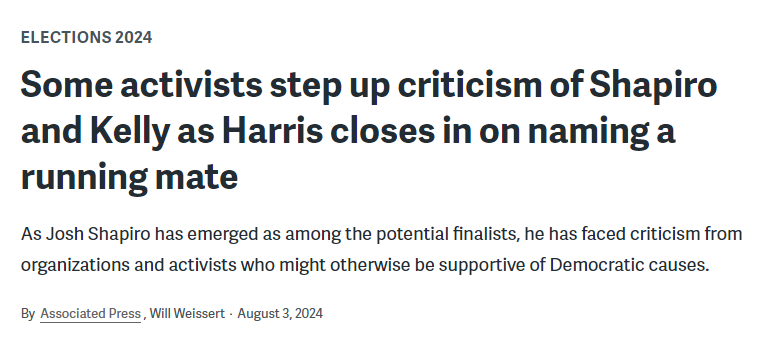
But then there were scattered reports this weekend that Harris was still doing some last-minute vetting. On the 3rd, the next day, this article hit the wires:

Now we know, at some point, assuming the Shapiro pick was legitimate, Harris changed her mind. Could it have possibly been that after the leak on Friday, members of the progressive base and Democratic voters lashed out at Harris for picking a Jewish running mate?

After all, there were widespread reports last week of whitewashing Josh Shapiro’s Wikipedia page and attempts to try and cover up his past support for Israel.

In Walz, did the Democratic Party choose to abandon its Jewish base and side with activists and supporters of Palestine?

One way to make that statement would be to pick the man who oversaw the looting and riots of 2020, that’s for sure.

Either way, the sugar high of Harris becoming the nominee is going to soon start to run out, and it’s difficult for me to see how the Democratic base is going to get any sort of additional dopamine hit from her vice-presidential selection.

In fact, I think this pick will force the onus to be aggressive to shift back to Harris and the momentum back to the Trump campaign. Everybody knows there was a fair amount of second-guessing regarding Trump’s vice-presidential pick. Shapiro likely could have given Vance a run for his money in attracting moderates and debating. But Walz is just the opposite: my guess is that to people in the center, Vance now looks more like the moderate and, in general, the candidate who has their sh*t together the most.


🔥 50% OFF FOR LIFE: Using the coupon entitles you to 50% off an annual subscription to Fringe Finance for as long as you wish to remain a subscriber: Get 50% off forever


I like that the Trump campaign isn’t giving in to having a debate on ABC. I don’t think anybody on either side of the aisle thinks that Trump is afraid to debate Kamala Harris, no matter how many times she repeats it. The Democratic Party got absolutely everything they wanted for the first debate with Joe Biden: they got their favorite network, they got their favorite anchors, and they got rules, including microphone control and no audience, that obviously favored President Biden. And they still got their ass kicked. Now, like an NBA playoff series, the Trump campaign is owed a match on their home territory.

As many said this week, if Harris can’t handle a debate on Fox News, how in God’s name is she going to negotiate with world leaders like Vladimir Putin and Xi Jinping?

I said it earlier this year and I will say it again: the Eagles and Doug Pederson won the Super Bowl against Tom Brady and the New England Patriots by being aggressive.

The Democratic Party right now is the Tom Brady dynasty New England Patriots. They deflate the balls before the game, you wouldn’t be surprised to find out they cheat, and they have an incredible winning record over the last 10 years. This move by the Harris campaign is taking a victory lap way too soon, and if Trump dials up his aggressiveness from this point forward, including directly addressing Walz’s record repeatedly on immigration, law and order, and socialism in general, the Republicans can take the momentum back quicker than I would’ve ever guessed they would have had a chance to.

And if you’re Kamala Harris, news flash: you are out of cheap gimmicks to attract attention. It’s time to debate, it’s time to hold press conferences, and it’s time to see how excited all-important independent voters get when she is put to explaining the substance behind her policy positions.

Now read:

QTR’s Disclaimer: Please read my full legal disclaimer on my About page here. This post represents my opinions only. In addition, please understand I am an idiot and often get things wrong and lose money. I may own or transact in any names mentioned in this piece at any time without warning. Contributor posts and aggregated posts have been hand selected by me, have not been fact checked and are the opinions of their authors. They are either submitted to QTR by their author, reprinted under a Creative Commons license with my best effort to uphold what the license asks, or with the permission of the author. This is not a recommendation to buy or sell any stocks or securities, just my opinions. I often lose money on positions I trade/invest in. I may add any name mentioned in this article and sell any name mentioned in this piece at any time, without further warning. None of this is a solicitation to buy or sell securities. I may or may not own names I write about and are watching. Sometimes I’m bullish without owning things, sometimes I’m bearish and do own things. Just assume my positions could be exactly the opposite of what you think they are just in case. All positions can change immediately as soon as I publish this, with or without notice and at any point I can be long, short or neutral on any position. You are on your own. Do not make decisions based on my blog. I exist on the fringe. The publisher does not guarantee the accuracy or completeness of the information provided in this page. These are not the opinions of any of my employers, partners, or associates. I did my best to be honest about my disclosures but can’t guarantee I am right; I write these posts after a couple beers sometimes. I edit after my posts are published because I’m impatient and lazy, so if you see a typo, check back in a half hour. Also, I just straight up get shit wrong a lot. I mention it twice because it’s that important.


Tyler Durden
Thu, 08/08/2024 – 18:25

50 Years On… The Bait-And-Switch Behind Post-Watergate “Reforms”

50 Years On… The Bait-And-Switch Behind Post-Watergate “Reforms”

Authored by Stephen Anderson via The Mises Institute,

Today is the fiftieth anniversary of the resignation of President Richard Nixon, who later was pardoned of all Watergate crimes by President Gerald Ford. The Watergate break-in occurred at the Democratic National Committee headquarters office in June 1972 at the Watergate building in Washington, DC, during a presidential election year. The Nixon Administration exerted great effort to conceal its involvement in the break-in. The United States Department of Justice and press reporters (Carl Bernstein and Bob Woodward) found five people involved in the break-in received thousands of dollars of hush money from the Committee to Reelect the President, which was the fundraising organization of President Nixon’s reelection campaign.

Many of Nixon’s administration staff were convicted of federal crimes, leading to their being sentenced to federal prison from the Watergate scandal. President Nixon used presidential powers to obstruct the Watergate investigation which pundits claim led to greater public cynicism and distrust of the federal government. The response of Washington’s political elites, naturally, was to further expand centralized power.

Members of Congress claimed that Watergate evils came from the misuse of presidential campaign donations used in the break-in cover-up. One “solution” to solve these election finance evils and rein in presidential power excesses was to expand federal power through legislation into federal election finances.

One post-Watergate legacy was the passage of new federal election finance laws and the creation of a new agency to enforce, finance, record, and regulate them. This law was passed by Congress in 1974, creating the Federal Election Commission (FEC). One FEC function is to dole out federal taxpayer money to congressional, senatorial, and presidential election campaigns, which incentivizes federal election control.

These new laws required candidates, political parties, and political action committees that were raising and spending money in federal elections to file periodic campaign finance reports subject to FEC audit and enforcement. When a campaign chose to receive federal tax dollars for their federal election campaign, one requirement was accepting campaign contribution limits from nonfederal sources and hold to campaign spending limits.

Mises Institute executive editor Ryan McMaken, in a Mises Wire article in October 2016 entitled “Decentralize the Elections,” described the history of states administering elections for federal offices and the methodical takeover of elections by the federal government over time. Presidential candidates began receiving federal funds for their campaigns from the 1971 campaign finance law, and funds distribution expanded in 1974.

The stated intent of federal taxpayer financing for presidential campaigns was to level the candidates’ playing field and remove the major party nominees’ need to seek political contributions during the general election. Taxpayer funding and the increased campaign fundraising demand included Congressional candidates. Expanded federal funding allowed more presidential candidates to run and extended the campaign season, with increased fundraising pressures on each candidate. Major party nominees spend much of their time today raising campaign cash for their parties, despite the fact that the alleged reason for government campaign funding was to eliminate the need for such fundraising.

The federal government’s campaign-funding intervention resulted in a presidential candidate’s campaign depending on federal taxpayer dollars to function. This long-term federal intervention has led to higher campaign costs with candidates chasing money.

The FEC board is composed of six members, with three affiliations each from the Democratic Party and the Republican Party. Each member is nominated by the president and confirmed by a Senate majority for staggered six-year terms. A presidential campaign contributor can be nominated by the president to the FEC board as a favor for past sizable campaign contributions.

The board needs four sitting members for a quorum to conduct agency business. FEC board functionality in the twenty-first century is partisan with each side pointing fingers at each other on alleged federal campaign financial wrongdoing. Sometimes the board only had three sitting members, so a quorum was not attained, and agency decisions halted. Some members remained after completing their six-year term when no nominee was confirmed to replace them.

For all the lessons supposedly learned from the Watergate scandal, the only real lesson is that so-called reform in Washington is little more than bait-and-switch. While Congress passed a number of post-Watergate laws that supposedly reined in what progressives were calling Nixon’s so-called imperial presidency along with its phantom campaign funding, the power of the executive branch has grown exponentially in the past five decades, and campaign spending has grown with it.

No doubt, the usual suspects in the media will be praising the Watergate reforms and claim that Congress rescued the nation from Richard Nixon’s lawlessness and set the country on the right path again. The truth is that whatever executive power Nixon abused probably would seem trivial when compared to what happens regularly today in the White House.

Tyler Durden
Thu, 08/08/2024 – 17:40

Hezbollah-Aligned Newspaper Urges Rockets On Tel Aviv

Hezbollah-Aligned Newspaper Urges Rockets On Tel Aviv

Israel has informed Washington that if Hezbollah harms more civilians in a retaliation campaign for the assassination of its top military commander Fuad Shukr last week, Israel’s military will have no choice but to launch a disproportionate response.

“In the internal discussions with the U.S., Israel stressed that the cost of another Hezbollah mishap would be heavy and that Hezbollah would pay a disproportionate price if it harmed civilians as part of its retaliation,” a senior Israeli official told Axios.

Getty Images

The report continues, “Two Israeli officials said that in recent days Israel told the U.S. via several military channels that it is concerned Hezbollah could hit civilian population centers if it tries to target military bases in central Israel.”

Last month 12 children were killed in the occupied Golan Heights town of Majdal Shams during a Hezbollah rocket attack. Israeli officials believe the rocket was intended to hit a nearby IDF military base, while Hezbollah leadership has claimed an errant Israeli anti-air missile struck the soccer field where civilians died.

Meanwhile, Hezbollah has since the killing of Shukr in Beirut declared that its strikes will hit targets deeper inside Israel.

On Tuesday, the Lebanese newspaper Al-Akhbar – widely seen as sympathetic to Hezbollah – wrote that Hezbollah could decide to hit Tel Aviv, which would mark a new major escalation, likely leading to all-out war.

“If Hezbollah can choose targets, it is possible that it will target Tel Aviv and civilians might be harmed on the margins. The effective thing will be to hit a significant center of the organization that made the decision about the assassination and took part in it,” the Al-Akhbar op-ed said. This too has been seen as a severe warning conveyed indirectly via Lebanese media.

Axios cites Israeli officials who “interpreted the article as saying the target for Hezbollah’s response could be the IDF headquarters in the center of Tel Aviv or the Mossad headquarters and other key intelligence bases in northern Tel Aviv.” They conclude: “The bases are all close to civilian neighborhoods and if a rocket were to miss them, it would likely harm civilians.”

In a fresh speech, Hezbollah Secretary-General Hassan Nasrallah stated, “The fact that Israel is waiting for the response for a week is part of the punishment because it is also a psychological war that influences morale.” At the same time, Iran is expected to launch an attack on Israel following the assassination of Hamas leader Ismail Haniyeh which occurred in Tehran. But nothing has happened and some observers believe that Iran’s leadership is being talked down amid a global diplomatic press.

Tyler Durden
Thu, 08/08/2024 – 17:20

LA County To Extend Guaranteed-Income Plan To 2,000 Foster Dependents

LA County To Extend Guaranteed-Income Plan To 2,000 Foster Dependents

Via City News Service,

The Board of Supervisors voted Aug. 6 to expand its “Breathe” guaranteed-income program to provide financial stipends to more than 2,000 non-minor dependents in the foster care system.

Holly Mitchell, a member of the Los Angeles County Board of Supervisors, speaks to the media in Los Angeles on April 1, 2021. (Patrick T. Fallon/AFP via Getty Images)

In addition to the stipends, the foster dependents will also have access to career and education counseling, financial empowerment training, housing and other programs as recommended by the Department of Consumer and Business Affairs’ Center for Financial Empowerment.

The Breathe guaranteed income program began as a pilot project in March 2022, providing monthly $1,000 payments to 1,000 in-need residents.

Last year, the board agreed to expand the program to include 200 former foster care youth adjusting to life outside the system.

“While Breathe’s initial expansion supports 200 former foster youth, the continued support of transitioning foster youth can provide essential financial stability during such a critical and pivotal time in their lives where data has demonstrated the risks youth exiting care face, including homelessness to justice system involvement,” according to a motion by Supervisor Holly Mitchell.

According to the motion, funding to expand the program is available through the state’s Flexible Family Support funding. The FFS funding requires that recipients use the money for specific purposes, defined as “extracurricular and enrichment activities that are designed to enhance the foster child or non-minor dependant’s skills, abilities, self-esteem, relationships, and overall well-being and healing.’’

Noting that L.A. County is home to the largest population of youth living in foster care, Mitchell on Tuesday called guaranteed income a “powerful and effective way to truly disrupt poverty.’’

Supervisor Lindsey Horvath also spoke out in favor of the idea, saying foster youth often have the worst outcomes when transitioning out of the system, including homelessness, dropping out of schools, poor health and poverty.

“By offering financial support combined with career and education counseling, financial literacy, housing and benefit access support, we‘ll begin to provide stable transition out of care,’’ Horvath said.

The expansion will provide support to two groups of people in the foster system between ages 18 and 21:

— The first group will be 1,000 people aged 18 and 19, providing them $500 monthly stipends for 18 months, along with access to career and education counseling, financial empowerment training, and other supportive services.

— The second group will be 1,000 individuals between ages 19 and 21 who are likely to age out of foster care during the 18-month program, providing them with $1,500 quarterly stipends, with the final payment provided in the quarter in which the person turns 21. They would also be provided access to counseling and other supportive services.

To enact the expansion, the board approved through the motion a $4 million increase to a contract with Strength Based Community Change— the program administrator– which will also evaluate the program’s impact and how recipients are using the funds.

It also backed a roughly $15 million expansion in the contract with MoCaFi, which distributes the debit cards used in the program and also distributes the stipends to those cards, to cover the costs of the payments.

Tyler Durden
Thu, 08/08/2024 – 17:00

UK Authorities Now Arresting People For Posting “Inaccurate Information” On Social Media

UK Authorities Now Arresting People For Posting “Inaccurate Information” On Social Media

Authored by Paul Joseph Watson via Modernity.news,

Authorities in the UK are now arresting people for posting “inaccurate information” on social media, according to a new report.

Sky News reports that a woman has been arrested by Cheshire Police for posting “inaccurate information on social media” about the attacker who stabbed three girls to death in Southport last week.

The 55-year-old woman was arrested near the northern town of Chester on “suspicion of publishing written material to stir up racial hatred and false communications.”

Chief Superintendent Allison Ross gave a statement explaining how the post is alleged to have “fueled” the protests and riots in the UK over the last week, which she asserts started as a result of “malicious and inaccurate communications online.”

Ross said the arrest was a warning to others about “the dangers of posting information on social media platforms without checking the accuracy” and that “we are all accountable for our actions.”

UK police are now arresting people for being wrong on the Internet. Let that sink in.

Presumably, the woman will now be thrown in prison along with people who attended the protests, such as Steven Mailen, who has been jailed for 26 months for “shouting” at police officers.

As we highlighted earlier, head of the Met Police Sir Mark Rowley warned that “keyboard warriors” could be hit with terrorism charges for inciting riots online, even if they are living abroad.

Brits have also been warned that merely retweeting information about the riots could lead to criminal charges.

Stephen Parkinson, the Director of Public Prosecutions, told Sky News that people do not even need to personally post the content themselves to be deemed to be committing an offence.

Parkinson said social media users could be guilty of “incitement to racial hatred” if they post “insulting or abusive” content that is “likely to stir up racial hatred.”

*  *  *

Your support is crucial in helping us defeat mass censorship. Please consider donating via Locals or check out our unique merch. Follow us on X @ModernityNews.

Tyler Durden
Thu, 08/08/2024 – 16:40

“I F**king Told Them!”: Enraged Butler Cop On Bodycam Says He Told Secret Service To Cover Warehouse Used By Shooter, And They Agreed

“I F**king Told Them!”: Enraged Butler Cop On Bodycam Says He Told Secret Service To Cover Warehouse Used By Shooter, And They Agreed

Bodycam footage from local Pennsylvania police reveal that in the moments after last month’s attempted assassination of Donald Trump, an officer says he told the Secret Service to cover the warehouse used by shooter Thomas Matthew Crooks.

The new bodycamera footage was released by the Butler County Police Department, showing the officer who confronted the shooter. (Butler County Police Department)

“I f—ing told them that they needed to post guys f—ing over here…I told them that f—ing Tuesday,” said a Butler Township officer in audio captured by his body-worn camera and obtained by the Wall Street Journal.

“I talked to the Secret Service guys. They’re like, ‘Yeah, no problem. We’re going to post guys over here,’” the officer continues.

The footage paints a more complete picture of the anger and frustration moments after Thomas Matthew Crooks was able to fire eight shots at the former president from an AR-style assault rifle. A spectator was killed, two others were injured, and Trump suffered a bullet wound to the ear. The Journal obtained the videos under a public-records request Thursday.

A police officer in one of the videos at one point refers to a suspicious individual who had been lost by authorities. The unidentified officer referred to “a gentleman with a flat face that we were looking for earlier. He was creeping people out.” 

The officer’s account, which was broadcast over radio channels, was captured by one of the body cameras. “He was watching people out in the woods by the water tower. I’m not sure he is the gentleman down or not,” the officer says.

Around 10 minutes after the shooting, another officer says to a fellow officer “I thought you guys were on the roof. I thought it was you. I thought it was you.”

To which “No” can be heard in response.

“What the fuck! Why were we not on the roof? Why weren’t we?” the officer replies.

As the Epoch Times notes further, the footage also shows the moment an officer with the Butler Township Police Department tried to get on the roof of a building where suspected gunman Thomas Matthew Crooks was perched. Another officer helped lift the responding officer to the roof after rally attendees alerted police that there was an individual on the roof near the rally where Trump was set to speak.

In the clip, an officer is seen moving toward a building before another officer tries to hoist him onto the roof. The officer is then seen trying to climb onto the building before he drops down.

Only officers’ hands are seen as he tries to get onto the roof in the video, which does not show Crooks.

Butler Township Police Department Lt. Matthew Pearson last month told a local Pennsylvania news outlet that the officer was not able to draw his firearm because he was holding onto the building. And Butler County Sheriff Michael Slupe told the New York Post last month that the officers who interrupted Crooks may have distracted the shooter before he shot at the former president, hitting him in the ear.

“If I’m interrupted, and I move my gun, you are going to have to reassess that whole situation at this point, so yes, you can make a case that those two officers saved the president’s life,” Slupe told the paper.

He then asked, “Can you imagine 10 seconds before that? That the president was looking straight ahead and where that bullet could have potentially landed.”

More than three weeks after the assassination attempt, federal officials have not disclosed the Crooks’s motive. So far, few details have emerged about the suspect, and his family has not issued a public statement responding to the incident.

The Epoch Times has contacted the Butler Township Police Department for comment.

Previous Footage Released

Separate bodycam footage from a responding official was released in connection to the July 13 shooting, which killed a rally attendee and injured two others. In late July, Sen. Chuck Grassley’s (R-Iowa) office released rooftop bodycam footage of an officer who responded to the shooting—after Crooks was killed by a Secret Service sniper.

It shows an officer with the Beaver County Emergency Services Unit standing next to a dark-suited man, who appears to be a Secret Service agent, according to a press release from Grassley’s office.

In the clip, at least three other law enforcement officials can be seen, although it is not clear exactly how many were present on the roof when the footage was filmed.

On the ground next to them appears to be the body of Crooks. Although the shooter’s body has been partially blurred in the video, a long trail of blood on the roof can be seen.

The Beaver County officer and the purported Secret Service agent can be heard discussing the timeline of events they believe led up to the assassination attempt, including whether the man lying on the ground next to them is the same man seen in a photo sent out by a member of Beaver County’s sniper team.

“So, this is the guy … that the sniper saw,” the agent says.

“Yes, a Beaver County sniper seen [sic] and sent the pictures out, this is him,” the officer replies.

The Secret Service agent then asks whether or not an abandoned bike that was found in the area belonged to the shooter.

“We don’t know,” the officer responds.

The Beaver County officer then shows the agent photos on his phone.

“I don’t know if you got the same ones I did?” the officer asks the agent, referring to the photos.

“I think I did, yeah, he’s [the shooter] got his glasses on,” the agent replies.

Two days later, Grassley released additional bodycam footage “filmed in the hour following the attempted assassination,” also obtained from the Beaver County emergency department.

That footage shows law enforcement talking about a need to use a drone to secure and inspect a water tower that was onsite, according to his office.

Katabella Reporters contributed to this report.

Tyler Durden
Thu, 08/08/2024 – 16:20

Big-Tech, Bond Yields, Bitcoin, & Bullion Bounce But Rate-Cut Hopes Fade

Big-Tech, Bond Yields, Bitcoin, & Bullion Bounce But Rate-Cut Hopes Fade

A de minimus improvement in (the incredibly noisy) initial jobless claims was all it took to enable the machines to run stocks higher, bond yields followed suit (higher) along with another ugly auctions (30Y). Crude, bitcoin, and gold also rallied (despite the dollar being basically flat).

For some context on the size of the labor market ‘surprise’ in today’s claims data… here is the macro surprise index…

Source: Bloomberg

Before we get into the color, of particular note is the fact that rate-cut expectations have now retraced all of the post-payrolls spike (with the shift still biased more into 2024 than 2025)…

Source: Bloomberg

Nasdaq was the day’s best performer (best day since Feb 2023) and the S&P’s gain was the best day since Nov 2022…

Stocks, broadly speaking, remain notably lower from payrolls still…

Of particular note, Nasdaq’s surge was very technical – ramping up to yesterday’s high and then fading back…

The Dow and S&P 500 stalled at critical technical levels too.

Dow at 50DMA…

S&P at 100DMA…

Mag7 stocks bounced to yesterday’s highs too, but remain down on the week and down from pre-payrolls…

Source: Bloomberg

VIX slid lower once again (but remains above yesterday’s lows)…

Source: Bloomberg

Finally, before we leave equities, Goldman’s trading desk notes volumes were down (-15% vs this past week) and S&P top of book (liquidity) continues to be very poor sitting around the 4mm level (YTD average closer to 13mm).

  • LOs 4% better for sale (selling macro hedges, pockets of tech and semis on strength, and cons discretionary vs buying industrials, fins, and utes).

  • HFs +1.4% better to buy (buying ETFs, info tech, and industrials vs selling cons discretionary, HC, and Utes)

Treasury yields surged higher once again, now back above the pre-payrolls level (for all but the 2Y yield)…

Source: Bloomberg

The 10Y yield surged up to 4.00% (and 2Y moved above it)…

Source: Bloomberg

The dollar ended very modestly lower…

Source: Bloomberg

Gold rallied back above $2400…

Source: Bloomberg

Oil prices extended their rebound today (erasing the payrolls plunge) as tensions in Ukraine and the MidEast picked up once again…

Source: Bloomberg

Bitcoin ripped higher today, touching $60,000 and erasing the Jump-Trading liquidation from Sunday night…

Source: Bloomberg

Finally, as we noted earlier, the rise in rates led to the implied odds of a US recession jumping much higher. But in the UK and Europe they are still relatively low.

Source: Bloomberg

The question is – how long can that divergence remain? Either US odds have to decline or UK and EU recession odds have to rise.

Tyler Durden
Thu, 08/08/2024 – 16:00

Apple Revises EU App Store After ‘Anti-Steering’ Probe

Apple Revises EU App Store After ‘Anti-Steering’ Probe

Following the European Commission’s announcement in June that Apple violated the Digital Markets Act with its App Store anti-steering rules, the world’s most valuable company has revised its policy.

Apple introduced a new fee structure for the EU App Store’s “link-outs.” This allows app developers to include a link that redirects customers to a web page where they can complete a transaction.

For context, the tech blog 9to5Mac explained:

Previously, Apple enforced strict rules that dictated how apps in the EU were allowed to link out. This included requirements that the link be statically defined, and go directly to their own website, without any parameters to identify the logged-in user in the URL. This limited the ability of apps to directly send users to a webpage where they could pay to add upgrades to their account.

As for the new fee structure, 9to5Mac explained further:

Under today’s changes, all of those restrictions are now gone. Apps can offer actionable links with as many dynamic URLs as they please. These links can take the user to anywhere, including as a way to promote other sales channels like alternative app marketplaces. The URLs can include parameters, as long as those parameters are not used for advertising or user profiling.

These links also used to be required to kick the user outside of the current app and into their web browser, like Safari. However, Apple is now allowing these links to be opened inside the originating app, as a modal web view.

Apple is also updating the user disclosure sheet with a new design that is more friendly, and includes an interface toggle for users to opt-out of seeing disclosure sheets when tapping external purchase links in the future. For now, developers have to continue to implement this sheet manually, but Apple announced it will be automatically managed and presented by the ExternalPurchaseCustomLink API in a future iOS update.

Moreover, developers can now take advantage of these capabilities in the EU, without agreeing to alternative business terms. That means they can remain in the App Store and avoid paying the Core Technology Fee on installs. However, there is a new substitute fee structure instead …

Apple will also introduce two new fee structures for apps that link out of its App Store, including an initial 5% acquisition fee for new users and a 10% store services fee for any sales made by app users on any platform within the 12 months of the app installation.

9to5Mac pointed out:

Apple says the new structure results in lower fees for developers in both the alternative and existing terms for linking out, especially for existing users. This is because previously Apple charged upwards of 17% and the Core Technology Fee, for the privilege of linking out to an alternative payment method.

In June, the commission officially investigated Apple App Store’s anti-steering rules outside the platform. 

Apple is changing its App Store policies to comply with the Digital Markets Act and avoid fines by the EU. 

Tyler Durden
Thu, 08/08/2024 – 15:40

‘Dubious About A Soft Landing’: JPMorgan Chase CEO Jamie Dimon Warns Of Possibility Of Stagflation

‘Dubious About A Soft Landing’: JPMorgan Chase CEO Jamie Dimon Warns Of Possibility Of Stagflation

Authored by Jack Phillips via The Epoch Times (emphasis ours),

Jamie Dimon, the chief executive of JPMorgan Chase, warned that the chance of the U.S. economy making a “soft landing” is not a certainty, coming amid volatility spikes seen in the major U.S. stock indexes over the past week.

JPMorgan Chase & Co. CEO Jamie Dimon speaks during the Business Roundtable CEO Innovation Summit in Washington on Dec. 6, 2018. (Jim Waton/AFP via Getty Images)

“There’s a lot of uncertainty out there,” Dimon told CNBC on Wednesday. “I’ve always pointed to geopolitics, housing, the deficits, the spending, the quantitative tightening, the elections, all these things cause some consternation in markets.”

For the past few years, Dimon has been issuing warnings about persistently high inflation and whether a soft landing, meaning the economy would avoid a recession, is feasible.

The executive added that he’s not sure whether the Federal Reserve can meet its inflation goal of about 2 percent. He told CNBC that the chance of a soft landing is about 35 or 40 percent.

“There’s always a large range of outcomes,” Dimon said. “I’m fully optimistic that if we have a mild recession, even a harder one, we would be okay. Of course, I’m very sympathetic to people who lose their jobs. You don’t want a hard landing.”

In April, in an interview with The Associated Press, he said that people “should be worried about” the possibility of stagflation but was still hopeful for a soft landing. “I’m just a little more dubious than others that a [soft landing] is a given,” he said at the time.

The Federal Reserve rapidly raised interest rates in 2022 and 2023 after inflation hit the highest levels in decades. Officials with the central bank said they want to lower rates at some point with the 2 percent goal as their target.

Dimon’s prediction comes as the three major U.S. stock indexes saw another loss on Wednesday as tremors from Monday’s plunge continue to reverberate. But on Thursday’s opening, the Dow Jones Industrial Average rose 0.69 percent, or about 300 points, while the Nasdaq Composite index increased nearly 1 percent. The S&P 500 also rose nearly 1 percent Thursday morning.

The market rose as it was reported by the U.S. Department of Labor that first-time filings for jobless benefits fell to 233,000 for the past week, or a decline of 17,000 from the previous one. New U.S. unemployment claims have been rising and hit their highest since August last year in the most recent week before that.

Other Activity

Outside the United States, European shares fell and Japan’s Nikkei 225 index closed 0.7 percent lower, undoing some of the calm a day earlier when the Bank of Japan (BOJ) indicated it would be more cautious with any future interest rate increases. The South Korea-based Kospi index also dropped slightly, closing down 0.45 percent.

Deputy BOJ Governor Shinichi Uchida told reporters and business leaders in the Japanese city of Hakodate on Wednesday that the central bank will not increase interest rates when markets are experiencing instability.

“As we’re seeing sharp volatility in domestic and overseas financial markets, it’s necessary to maintain current levels of monetary easing for the time being,” Uchida said, adding that the interest rates will “obviously” be changed if the volatility affects the price outlook.

But he stressed that “we won’t raise interest rates when financial markets are unstable.”

Europe’s continent-wide Stoxx 600 index fell 0.9 percent after climbing 1.5 percent on Wednesday. Germany’s DAX index was down 0.6 percent and Britain’s FTSE 100 decreased by 1 percent.

In late August, Federal Reserve Chair Jerome Powell is expected to offer remarks on what he believes the United States needs when global bankers and Fed officials gather at an annual economic symposium in Jackson Hole, Wyoming. After that, the Fed’s Open Market Committee is slated to meet in mid-September.

“If we do get the data that we hope we get, then a reduction in our policy rate could be on the table at the September meeting,” Powell said last week.

Reuters contributed to this report.

Tyler Durden
Thu, 08/08/2024 – 15:20