60.5 F
Chicago
Tuesday, September 29, 2026
Home Blog Page 2406

The BITCOIN Act Of 2024 Explained

The BITCOIN Act Of 2024 Explained

Authored by Colin Crossman via Bitcoin Magazine,

Following the announcement on July 27th at the Bitcoin conference in Nashville, the “Boosting Innovation, Technology, and Competitiveness through Optimized Investment Nationwide” or BITCOIN Act of 2024, introduced by Senator Cynthia Lummis of Wyoming, seeks to firmly establish Bitcoin as a strategic asset in the United States’ financial arsenal. At its core, the Act proposes the creation of a Strategic Bitcoin Reserve (SBR) and a structured Bitcoin Purchase Program, and comprehensive national custody policy. While the bill is quite brief, what follows is a breakdown of the Act’s key provisions, their implications, and the innovative funding mechanisms employed.

The Strategic Bitcoin Reserve

The establishment of the SBR signifies a paradigm shift in how the United States government manages and custodies Bitcoin at the Federal level. Mirroring many of the best practices currently discussed in the field, such as geographically distributed keys, a cold storage mandate, and independent proof-of-reserves audits, the SBR creates a decentralized network of secure Bitcoin storage facilities across the United States. (Notably not mentioned, however, is a multi-signature system, however it is not explicitly prevented either.) The Act thereby aims to protect against breaches and vulnerabilities to a single catastrophic event.

Bitcoin Purchase Program

The Act lays out a plan to acquire up to 1,000,000 Bitcoins over a five-year period, capping purchases at 200,000 Bitcoins annually, and then holding such reserves for twenty years. Furthermore, the Act places limits on the use and sale of the reserve following the holding period. During the minimum holding period, no Bitcoin held by the Federal government in the SBR may be sold, swapped, auctioned, encumbered, or otherwise disposed of for any purpose other than retiring outstanding Federal debt instruments.

Funding the Bitcoin Purchase Program

In order to minimize the impact on taxpayers, the Act employs several methods to finance the acquisition of Bitcoin, ensuring economic sustainability without increasing Federal debt.

It first proposes an amendment to the Federal Reserve Act to reallocate discretionary surplus funds from the Federal Reserve Banks. This reduces the discretionary surplus funds from $6.825 billion to $2.4 billion. The Federal Reserve is then required to remit net earnings to the Treasury, and the Act redirects the first $6 billion towards purchasing Bitcoin.

Furthermore, the Act also involves an adjustment in the valuation of gold certificates held by the Federal Reserve. Currently, the Federal Reserve holds gold certificates which are marked at $42.22/oz, while the market price of gold is closer to $2,400 today. Essentially, this forces the Federal Reserve to mark-to-market the gold certificates, then remit the gain on the gold to the Treasury for the purpose of funding the initial acquisition.

State Participation

The Act contemplates accepting State-level Bitcoin holdings into the national framework through voluntary participation. This aspect allows individual states to store their Bitcoin holdings within the SBR in segregated accounts. By offering this option, the Federal government allows (but does not require) States to add Bitcoin to their own treasuries, without having to reinvent and reimplement a robust security plan.

States participating in the program maintain exclusive and segregated title to their Bitcoin, and the right to withdraw or transfer their Bitcoin holdings from the SBR, subject to the terms of their contractual agreement and any applicable Federal regulations, but are not subject to the Federal restrictions otherwise applicable to the SBR. This flexibility ensures that States can manage their Bitcoin treasuries in accordance with their specific financial strategies and needs.

Implications & Next Steps

By tapping into existing financial resources and leveraging the economic value of gold, the BITCOIN Act aims to acquire Bitcoin without directly burdening taxpayers or increasing federal debt. This multifaceted approach underscores the innovative financial strategies the Act employs to integrate Bitcoin into the national reserve system, setting the stage for a comprehensive Bitcoin policy throughout all levels of the United States government.

Readers who wish to support the Act should contact their legislators, either directly or through a tool such as this one built by the Satoshi Action Fund.

Tyler Durden
Mon, 08/05/2024 – 06:30

Zelensky Shows Off Newly Arrived US F-16 Jets From Secret Location

Zelensky Shows Off Newly Arrived US F-16 Jets From Secret Location

Ukraine’s President Zelensky has continued poking the Russian bear, this time by showing off $60+ million (a pop) new toys given by Western allies.

His office published video of Zelensky addressing a military ceremony from an undisclosed location inaugurating the country’s first US-made F-16s into combat deployment.

A Ukrainian Air Force F-16 fighter jet at an undisclosed location in Ukraine on Aug.4. via AP

The video featured scenes of a pair of F-16s flying low over the event, as well as a jet fighter with a newly minted national trident logo parked on the tarmac behind him.

“We often heard the word ‘impossible’. Now it is a reality. Reality in our skies. F-16s in Ukraine. We made it happen,” Zelensky said with jets flying overhead.

“I am proud of all our guys who are mastering these aircraft and have already started using them for our country,” he said, following an over year-long training program which was based in the United States and northern Europe.

AFP and other international journalists present for the event witnessed at least two of the newly transferred F-16s, but the public has been kept in the dark as to precisely how many have already been transferred.

Kiev will be immediately worried about Russian forces taking them out, given the symbolism of such a big transfer from external backers. In prior months, Ukraine even signaled it would park some at nearby partner countries’ airbases, just out of Moscow’s reach.

Ironically, even while unveiling the first of dozens of jets to be transferred, Zelensky complained that it is still not enough from the West. “Our partners know that the number of F-16s we have in Ukraine, the number of pilots who have already been trained, is not enough,” he said. “The good news is that we are expecting additional F-16s.”

“Our guys are training a lot,” he also confirmed of the ongoing pilot program which includes learning English technical terms which are unique to the aircraft. He further thanked Denmark, the Netherlands, the United States and additional allies for providing the jets and supporting the training program.

While something like 80 of the jets have been promised, Zelensky has been urging that partner nations secure at least 130 jets so Ukraine can secure its skies, which thus far Russia has dominated.

Tyler Durden
Mon, 08/05/2024 – 05:45

Anti-Immigration Protests In UK Spreads As Elon Musk Warns “Civil War Is Inevitable” 

Anti-Immigration Protests In UK Spreads As Elon Musk Warns “Civil War Is Inevitable” 

European countries on the front lines, such as Greece and Italy, have been overwhelmed with migrants over the years due to failed open-border policies facilitated by radical leftist politicians. These unaccountable leaders (elected & unelected) have created the perfect storm of migrant crime and chaos across the continent. 

For readers, who are not caught up with the news cycle, anti-immigration demonstrations have erupted across the UK following the horrific stabbing of three children in Southport by the 17-year-old son of Rwandan immigrants. 

Here’s the latest reporting: 

Now weekend anti-immigration demonstrations were seen in Liverpool, Bristol, Manchester, Hull, Belfast, Stoke, and other cities. Some turned violent while others did not. 

Citizens are enraged with progressive officials who have promoted open borders, leading to an influx of migrants. This has resulted in increased crime and chaos and has adversely affected working-class families by pushing down wages for low-skilled jobs. 

The Guardian quoted protesters on Saturday as chanting, “Get them out” and “Yorkshire.” 

In the southwest city of Bristol, folks shouted, “We want our country back,” while others yelled, “England ’til I die.” There were small pockets of counter-protesters who called called anti-immigration protesters ‘racist’. 

It seems that the working-class people in the West are beginning to speak up. After all, Christianity played a major role in the development of Western civilization. 

On Sunday, Policing and Crime Minister Diana Johnson told Sky News that unrest is viewed as “criminal disorder” and that people participating were “thugs.” She said some protesters may face “imprisonment.” 

Folks are not happy about the two-tier judicial system. Where have we seen this before? 

Prime Minister Keir Starmer told the nation that the government will do “whatever it takes” to quell the violence. 

On Saturday evening, Musk weighed in on the unrest, warning: “Civil war is inevitable.”

Musk’s assumption might not be too far off from what could be coming to Europe. In fact, far-left EU elites who have pushed years of open borders, flooding countries across the bloc with hundreds of thousands of migrants, if not millions, have intentionally or unintentionally stoked incredibly high divisions among the population over migration. Meanwhile, failed open-border policies have supercharged nationalist movements. 

One interesting note: leftist corporate media are pushing that X has been the epicenter of fueling misinformation and disinformation, as it’s likely EU leftist officials are going to attempt to clamp down some more (remember the Olympics censorship) on Musk’s free speech efforts. 

Here comes the censorship. 

Europe’s slow-motion crisis has undoubtedly gained momentum as social unrest ignites. This couldn’t have come at the worst possible timing as Russia and Ukraine are locked in a multi-year war in Eastern Europe with elevated risks of broadening conflict. Furthermore, risks of broadening conflict are also seen in the Middle East between Iran and Israel. 

The West is in chaos, thanks to far-left lawmakers from the US to Europe who have promoted failed open-border policies – destroyed meritocracy – and still can’t describe what a woman is.

Tyler Durden
Mon, 08/05/2024 – 05:11

US Intelligence Claims Russian Military Is Advising Houthis Inside Yemen

US Intelligence Claims Russian Military Is Advising Houthis Inside Yemen

Via Middle East Eye

Russian military intelligence officers are believed to have been deployed to Yemen to assist the Iran-backed Houthis with targeting commercial vessels in the Red Sea, Middle East Eye can reveal. Members of Russia’s GRU military intelligence are operating in the Houthi-controlled territory of Yemen in an advisory role, a senior US official told MEE, speaking on condition of anonymity and citing US intelligence.

The exact nature of the Russians’ role is murky, but the US official said that GRU officers have been operating in Yemen for “several months” to assist the Houthis in their targeting of commercial shipping, which the Houthis say is in solidarity with besieged Palestinians in Gaza.

Targeting of Chios Lion on July 15. Ansarullah media centre/AFP

The sensitive deployment comes as Russia has been eyeing ways to step up its support for the Iran-backed Houthis.

President Vladimir Putin mulled providing the Houthis with sophisticated anti-ship cruise missiles, but was dissuaded from doing so after the direct intervention of Saudi Arabia’s Crown Prince Mohammed bin Salman, MEE revealed in June.

The Wall Street Journal confirmed the report in July but added that the US is still concerned Putin could arm the Houthis, potentially as a way to dissuade the US from allowing Ukraine to strike deeper into Russian territory. 

“If Russia were to give the Houthis arms, putting technical advisors on the ground would be the first step to doing so,” Samuel Ramani, an expert on Russia’s foreign policy in the Middle East and Africa at the Royal United Services Institute, told MEE.

“But it could also just be a sign of deepening cooperation. Given the Saudis’ concerns, this would be a middle ground as Putin holds off on arming the Houthis.”

The US intelligence shared with MEE did not reveal where the Russian advisors are operating. The White House and Department of Defence didn’t respond to MEE’s request for comment on this story by the time of publication. 

The US anticipates Iran’s so-called “axis of resistance”- which includes Yemen’s Houthis, Lebanese Hezbollah and Iraq’s Popular Mobilisation Forces – to take a more prominent role in a retaliatory attack on Israel compared to April when Iran directly launched hundreds of drones and missiles at Israel. 

Publicly, the Houthis and Russians have been engaging more closely. In July, Putin’s top Middle East diplomat, deputy foreign minister Mikhail Bogdanov, met in Moscow with a Houthi delegation led by the group’s spokesman, Mohamed Abdel Salam. 

Middle East Eye reached out to Russia’s foreign ministry for comment on the story but did not receive a reply by the time of publication.

‘Red Sea payback’

The Houthis started firing missiles and drones at commercial ships in the Red Sea shortly after the Hamas-led 7 October attacks on southern Israel. They say the attacks have been in response to Israel’s offensive on the Gaza Strip. In January, the US started bombing the Houthis but the strikes have not deterred the group.

The US says the Houthi attacks have been “indiscriminate” but the Houthis have guaranteed that vessels linked to Russia, Iran and China are safe in the Red Sea. But while Russian-flagged vessels have avoided attacks, those carrying Russian cargo have been hit.

Analysts say those attacks underscore the difficulty the Houthis face trying to sort through the interconnected world of global shipping, and their maritime intelligence limitations. Current and former US officials have told MEE they believe Putin sees the rising tensions in the Middle East as a weak spot to pressure the US over its support for Ukraine.

“There is a connection between Russia’s war on Ukraine and the Red Sea,” General Frank Mckenzie, the retired commander of US Central Command, previously told MEE. “Putin sees the US responsible for Ukrainian attacks on Russian vessels in the Black Sea. It is possible he could see doing something in the Red Sea as payback,” he said.

The US says the Houthis are relying on Iranian support to conduct their strikes, but the group also appears to be leaning heavily on open-source shipping data to draw up their target lists.

Putin’s decision to dispatch GRU officials on the ground in Yemen could be motivated by a desire to better organize the Houthis’ intelligence capabilities. Russia is not shy about putting boots on the ground in the Middle East.

Russia’s Wagner mercenary group operates in Libya and the arid Sahel region. Russia’s military is also deployed in Syria where it supports President Bashar al-Assad. Meanwhile, in Sudan, Russia is pushing ahead with plans for a Red Sea naval base, MEE has reported. “It makes sense Putin would want people on the ground to see how the Houthis are targeting and make sure Russian vessels aren’t hit,” Ramani said.

Tyler Durden
Mon, 08/05/2024 – 03:30

China Is The World’s Biggest Beer-Producer

China Is The World’s Biggest Beer-Producer

China is the world’s leading producer of beer, according to the BarthHaas Report released today. In 2023, the country’s output stood at 360 million hectoliters of beer. A hectoliter is equivalent to one hundred liters.

As Statista’s Anna Fleck shows in the following chart, the United States is the second biggest producer of beer with an output of 193m hl in 2023.

Infographic: China Is the World’s Biggest Producer of Beer | Statista

You will find more infographics at Statista

Rounding off the top ten countries are Poland in ninth place with 36m hl and South Africa in tenth position with an estimated 35m hl. Across Europe, beer production decreased by a total of 9m hl.

In the Americas, output fell by 7.2m hl. This figure hides the fact that while the U.S. saw a drop in output of -9.9m hl, South America saw growth of 2.4m hl and Central America and the Caribbean saw an increase of 0.2m hl.

Asia showed more of a mixed picture with production increasing significantly in India (+3.8m hl) and Cambodia (+2m hl), while it fell in Vietnam (-8m hectolitres), as well as declines of over 1m hl in South Korea, Thailand, China and Kazakhstan.

Meanwhile, the African continent saw a 4.6m hl increase in output, with the most significant growth in South Africa (+1.4m hl), Ethiopia (+1.1m hl) and Cameroon (+1.1m hl).

In 2023, world beer production decreased by nearly 17m hl to 1.88 billion hl. In Europe, production fell by 9m hl, largely driven by a drop in output from the United Kingdom (-3.3m hl), Germany (-2.9m hl) and Poland (-2m hl).

Tyler Durden
Mon, 08/05/2024 – 02:45

UK Riots: The Agenda Becomes Clear…

UK Riots: The Agenda Becomes Clear…

Authored by Kit Knightly via Off-Guardian.org,

Those outside the UK might not have heard, but it’s been a violent week in the UK. Here’s a quick rundown of the official story so far:

Four days ago a 17-year-old allegedly walked into a children’s “Taylor Swift dance class” (whatever that might be)  in Southport and started stabbing little girls, wounding 10 and killing 3.

It was initially reported the boy was a muslim immigrant.

This story was, however, reversed within hours, the new story “revealing” that he was actually born in Cardiff, the son of Rwandan immigrants. He was named as “Axel Muganwa Rudakubana” late yesterday.

His  religious affiliation, if any, seems not to have been firmly established.

Another young man was, allegedly,  arrested later while in possession of a machete and balaclava at  a vigil for the victims. He was, again, reportedly Muslim.

This, allegedly, resulted in what are described as protests and riots, the destruction of a brick wall outside a mosque and the burning of a police van.

Further alleged riots subsequently sprang up in London and Hartlepool.

This is the current narrative. None of the details has been substantiated as yet, so how much you decide to believe is your personal preference at this point.

At OffG we reserve the right to be sceptical. Of everything.

There are a lot of unanswered questions, and the current level of  “mourning” by government institutions and groups in no way directly affected  by the tragedy always has a taint of the performative that shouldn’t be too quickly conflated with  insincerity or worse.

And, of course, all of this is coming hot on the heels of the Manchester Airport incident, where police officers and Muslim youths allegedly clashed violently in as yet obscure circumstances.

Plus the violence in Whitechapel and Leeds a couple of weeks ago.

Then, as now, both sides were provided with adequate rage-bait to get them worked up.

Whatever the truth of this latest incident, and whatever long term aims it might be used to further, this “strategy of tension” has an immediate political agenda already becoming clear – and it’s as predictable as ever.

  1. Further limit social media/free speech

  2. Normalise constant surveillance

Attacking free speech is the ever-present, eternal agenda that comes before everything else and it’s been a real pile-on the last few days.

The Hill headlines “Misinformation floods social media in wake of breakneck news cycle”, Sky News went with “Southport attack misinformation fuels far-right discourse on social media”

ABC News reports: “Online misinformation fueled tensions over the stabbing attack in Britain that killed 3 children”

The Byline Times collectively scolds society’s negligence: “‘We All Need To Consider Our Role in the Wild West of Social Media Hypercriminality’”

The Institute for Strategic Dialogue (an NGO funded by the usual suspects) has timelined it all for our convenience: From rumours to riots: How online misinformation fuelled violence in the aftermath of the Southport attack

The BBC asks “Did social media fan the flames of riot in Southport?” and Telepgraph answers very much in the affirmative, cutting right to the heart of the matter [emphasis added]:

Unregulated social media disinformation is wrecking Britain – Free speech must come with accountability

The Times skips past establishing the problem right to apportioning blame: “Who is behind Southport social media storm — and can they be stopped?”

The Guardian has decided the answer is TikTok (and AI): “How TikTok bots and AI have powered a resurgence in UK far-right violence”

The New York Times demands to know what social media companies are going to do about it:

The U.K. Riots Were Fomented Online. Will Social Media Companies Act?

One particularly drunk uncle decided the whole thing is Putin’s fault, for some reason, but most of the fire is directed at Twitter/X.

Writing in Prospect, former-Guardian editor Alan Rusbridger claims “Elon Musk’s misinformation machine made the horrors of Southport much worse”, while Forbes wails “Elon Musk Isn’t Stopping Misinformation, He’s Helped Spread It”.

This is dual-purpose propaganda, it attacks the idea of free speech but also reinforces Musk/X’s totally false reputation as the savior of free expression.

You cannot begin to fathom how irritating it is to the ruling class that ordinary people are allowed to just say whatever they want whenever they want – including having the audacity to fact check the media in real time, with no repercussions at all.

That, more than anything else, has stalled the Great Reset in its tracks.

So it has to go.

Finally and forever.

It’s why  almost everything in the news cycle – from disease to climate change – can  allegedly be “solved” with censorship.

Because once free speech is abolished everything that comes afterward gets so much easier – including the second agenda being pushed right now: Mass surveillance and facial recognition technology.

When it comes to this secondary goal the media are yet to reach the “call for action” phase. They are still locked into “fearmongering”, with widespread warnings about nineteen future “far-right” marches and calls to proscribe Tommy Robinson’s EDL as a “terrorist organization”

Which, again, has the useful secondary effect of making this gentleman look more like a genuine force for opposition.

Funnily enough, UK Home Secretary Yvette Cooper was already discussing giving police “new powers to crackdown on antisocial behaviour” just a day before the Southport attack occurred.

But it fell to Prime Minister Sir Keir Starmer to formally lay it out in his address yesterday afternoon [transcript].

Pledging to counter the “far-right” with a new police division, and increased use of surveillance and facial recognition technology to “limit their movements”:

Wider deployment of facial recognition technology…And preventive action – criminal behaviour orders…To restrict their movements…

And firing a warning shot across the bows of social media:

And let me also say to large social media companies and those who run them…Violent disorder clearly whipped up online…That is also a crime. It’s happening on your premises. And the law must be upheld everywhere.

He even pointedly made clear his response wasn’t just about now or about countering the “far-right”, rather it was about ALL civil disobedience, for any reason:

A response both to the immediate challenge which is clearly driven by far-right hatred. But als “all violent disorder that flares up […] whatever the apparent cause or motivation – we make no distinction…Crime is crime.”

That means everything.

It means pro-free speech rallies, it means “bladerunners” cutting down ULEZ cameras. It means any potential anti-lockdown and/or anti-vaccine mandate protests during “the next pandemic”.

This is the beginning of a new crackdown on digital free speech and real-world protest…

and people are cheering him on, of course. Because they believe the State is our only shield from the nasty brick throwing baddies of the far-right.

To sum up the last three days in British politics for those not well versed in reading past headlines  and propaganda:

For the cost of one broken wall and a burnt out police van, the new “Labour” government have just won public approval  for new police powers and open season being called on  what remains of our free speech – and they get to distract from the now-inevitable tax raises too.

Not a bad trade.

Tyler Durden
Mon, 08/05/2024 – 02:00

PBoC’s Gold Conduit Revealed: Chinese Central Bank Did Not Stop Buying Gold In May

PBoC’s Gold Conduit Revealed: Chinese Central Bank Did Not Stop Buying Gold In May

By Jan Nieuwenhuijs of Gainesville Coins

This article is an analysis of how the Chinese central bank (PBoC) buys gold in London from Western bullion banks. Because the bullion banks take care of the gold transport for the PBoC, the shipments from London to Beijing are disclosed in UK customs data. The customs data reveals that the PBoC continued to buy gold in May — when it communicated to the market it discontinued buying — at a rate of 53 tonnes. The PBoC stated it stopped buying to dampen the gold price so it could acquire more gold.

Several months ago, I discovered that supply in the Chinese gold market was outstripping demand. During my investigation of this anomaly, I found circumstantial evidence that led me to conclude the surplus is imported in 400-ounce bars from the United Kingdom, and surreptitiously procured by the PBoC.

Let’s go through some of the mechanics of the global gold market before we can stitch it all together.

PBoC Gold Buying Hidden in Plain Sight

In global customs data — officially called International Merchandise Trade Statistics (IMTS) — all gold disclosed is “non-monetary,” meaning not owned by a monetary authority such as a central bank. In the United Nations IMTS rulebook it reads that customs data excludes monetary gold:

Since monetary gold is treated as a financial asset rather than a good, transactions pertaining to it should be excluded from international merchandise trade statistics.

Though, someone familiar with the matter but who prefers to stay anonymous, shared with me that gold import and export data can relate to monetary gold. Commonly, central banks will buy gold from Western bullion banks that arrange transportation and insurance of the metal. The moment these banks ship the gold from the UK it is thus non-monetary bullion, but when it arrives in China it is monetized (changes ownership) and brought to vaults of the central bank, supposedly in Beijing.

Exports from the UK are mainly from the wholesale gold market in London where virtually all bars traded weigh 400 ounces. The retail market in Britain dealing in smaller bars pales in comparison, and the refining industry in the UK is relatively small.

In turn, at the core of the Chinese domestic gold market, which excludes Free Trade Zones (FTZs), is the Shanghai Gold Exchange (SGE) where predominantly 1Kg gold bars are traded.

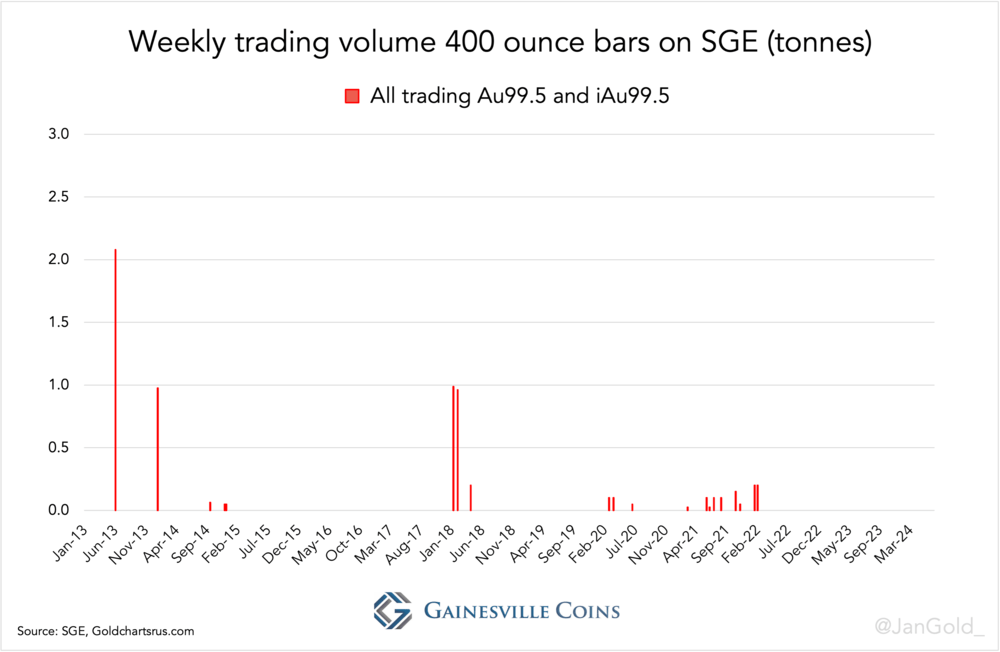
Chart 1. In the entire history of the SGE large 400-ounce bars have hardly ever traded. The most traded product on the SGE is the 1Kg 99.99 fine physical contract.

The private sector in China trades 1Kg bars through SGE, while the central bank buys “large bars” (400-ounce bars) abroad. As all gold on the SGE is traded in yuan, the PBoC can only diversify its international reserves by buying gold overseas with dollars or other foreign exchange. Aside from logic, there are multiple sources that have made clear the PBoC doesn’t purchase gold on the SGE. For example, the World Gold Council (WGC, page 9), the SGE (page 4), and it was confirmed to me personally by an ex-gold trader from a Chinese state-owned bank.

The SGE captures the lion share of all gold trading in the Chinese private market. There are rules and incentives that steer most supply—imports, domestic mine production, and recycled metal—towards the SGE, which for liquidity reasons attracts most demand. Hence, the gold withdrawn from the SGE vaults is often used as a proxy for Chinese wholesale demand. In a formula:

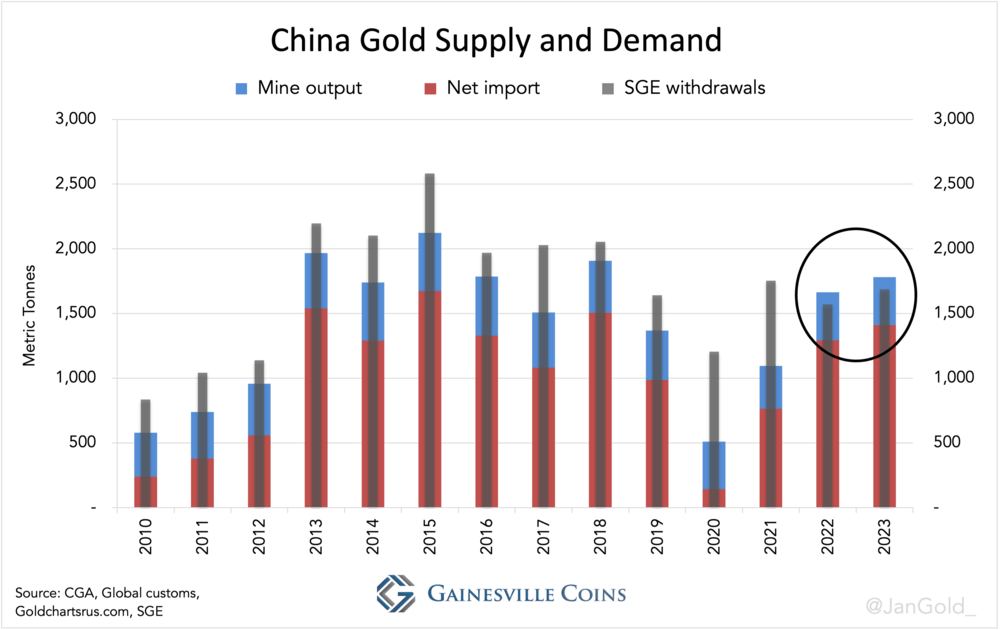
SGE withdrawals = net import + domestic mine output + recycled metal

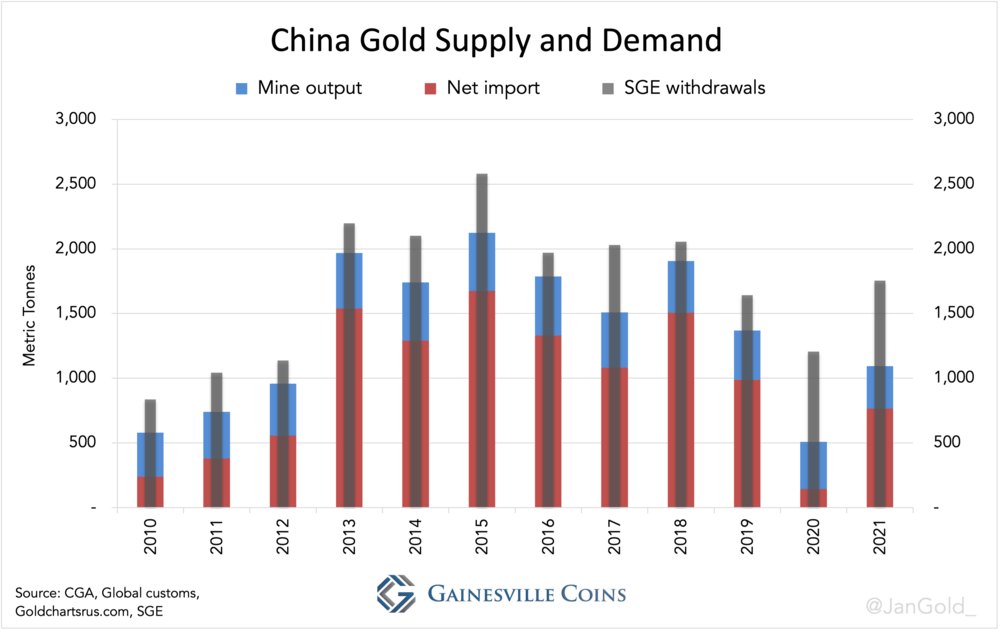
Chart 2. Apparent Chinese gold supply and demand.

Before 2022, gold supply and demand in the Chinese market matched. SGE withdrawals were always higher, to varying degrees, than net import plus domestic mine output, the difference being gold recycled through the central bourse.

If it were true that bullion banks ship gold to China, as non-monetary gold visible in customs data, that doesn’t flow into the SGE system, we would see a discrepancy between apparent Chinese gold supply and SGE withdrawals. As more gold would be supplied to China than sold through the SGE. In a formula:

SGE withdrawals < net import + domestic mine output + recycled metal

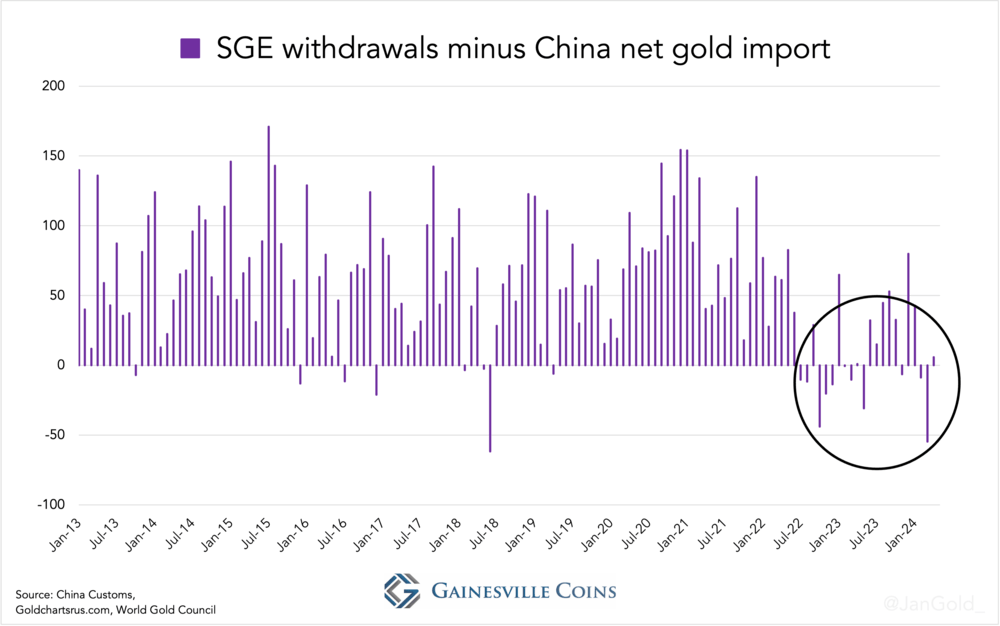
Chart 3. Starting in 2022 there has been an increase in months wherein net imports alone are higher than SGE withdrawals.

Indeed, both in 2022 and 2023 China’s net import plus mine output transcended SGE withdrawals (let alone if we would add recycled gold).

Chart 4. In 2022 and 2023 apparent supply was higher than demand (SGE withdrawals).

As we shall see, the surplus in the Chinese gold market—imports that are not sold through the SGE—is being absorbed by the PBoC.

Readers with deep knowledge of the Chinese gold market might think: “what if the large bars are refined in FTZs and loaded into SGE vaults without being withdrawn?” I checked with a source that has connections to refineries in China, and according to this person the refineries don’t use any large bars as feedstock for producing 1kg bars for the SGE*. Another contact I have, close to the SGE, shared with me that SGE inventory in April 2024 accounted for about 300 tonnes. Inventory had gone up recently together with a rise in the price of gold, this person said. However, the increase in SGE inventory can’t make up for the surplus in the market, which is at least 400 tonnes according to my calculations.

More Data Supporting the Thesis

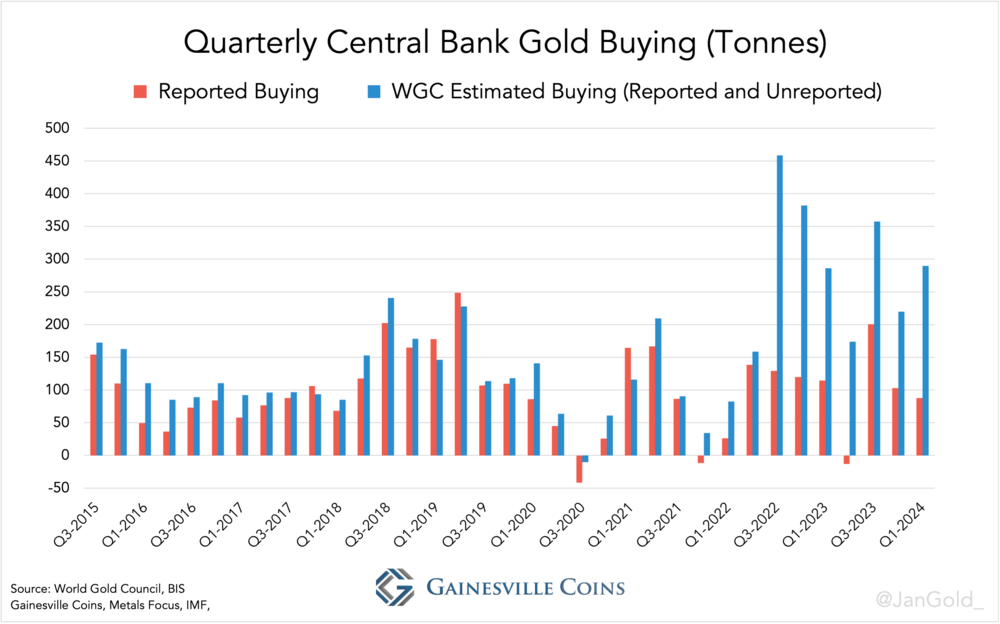
By comparing estimated central bank purchases by the WGC, based on field research, to official statistics regarding gold buying by central banks, we know that since the start of the Ukraine war, in February 2022, monetary authorities in aggregate are secretly buying much more than they report. I have written before that these covert purchases can be attributed for roughly eighty percent to the PBoC.

Chart 5. Total estimated central bank gold buying by the WGC, versus official statistics by the International Monetary Fund (IMF). The difference reflects covert acquisitions.

“Unreported” PBoC gold purchases exploded when $300 billion in foreign exchange reserves from the Russian central bank were frozen by the West early 2022 due to the war. Notably, the UK began exporting 400-ounce bars to China in huge tonnages at the same time. Coincidence? I think not. Ever since, China has taken over gold price control from the West and broke the gold price’s correlation with “real rates” (10-year TIPS yield).

Chart 6. The UK’s direct export to China is likely destined for the PBoC
Chart 7. The US dollar gold price versus the 10-year TIPS yield (real rates). Early 2022 the correlation broke because of, inter alia, massive PBoC purchases

The final clue is that there is a relationship between what the Chinese central bank officially reports to be accumulating, and gold exports from the UK to China. What frequently happens, exposed by comparing these numbers, is that the PBoC starts buying gold a few months before it tells the world about it, and severely underreports its additions. This was the case in 2015, 2019, and 2022.

Chart 8. Official data on PBoC gold buying versus UK gold exports to China. Previous exports from the UK for the PBoC were not large enough to create an apparent surplus in the Chinese gold market.

Conclusion

It all fits and makes sense: the motive, the data, and the anecdotal evidence. Let’s summarize our key findings:

  • The Chinese central bank desperately needs to diversify its foreign exchange reserves since the beginning of 2022. Since then, the PBoC secretly buys large amounts of gold.
  • At the same time, export of large gold bars from the UK to China explodes.
  • A “surplus” in the Chinese market appears, while the bullion is not to be found in SGE vaults. As if it has gone up in smoke.
  • A source indicates that gold shipments for central banks are often included in customs data.
  • There is a correlation between PBoC official buying and UK exports to China, suggesting the Chinese central bank buys gold in England’s capital and lets banks supervise transport (maybe because the PBoC reaches the limits of its own capacity to ship gold when volumes are sizable).

It all points towards UK gold exports to China are destined for the PBoC—although probably not every ounce of these flows is for the Chinese central bank. Clearly, the PBoC is accumulating more gold than it wants to disclose.

When the PBoC stated it had stopped buying gold in May 2024, after continuous purchases for 18 months, I didn’t believe it. The PBoC has few reasons to cease growing its gold reserves in the current geo-political and monetary landscape with a plethora of challenges.

Probably, the PBoC wants the most gold for its dollars, so when the price rises fast it will signal it stopped buying, trying to cool the market. In the meantime, the United Kingdom exported 53 tonnes to China in May, of which likely most found its way to Beijing.

Note, the PBoC also buys in Switzerland and other countries, flows that can be included or excluded in customs reports, but it’s impossible, from where I stand now, to measure all these separately.

Finally, some of my previous analyses have been skewed by the above. Private demand in China has been lower because some (“non-monetary”) imports were taken by the central bank.

Tyler Durden
Sun, 08/04/2024 – 23:20

YouTuber WhistlinDiesel ‘Full Sends’ Cybertruck Through Durability Test, Including ‘C-4’ Denotation 

YouTuber WhistlinDiesel ‘Full Sends’ Cybertruck Through Durability Test, Including ‘C-4’ Denotation 

YouTuber Cody Detwiler, known as WhistlinDiesel, released a video on Friday in which he stress-tested a Tesla Cybertruck and a Ford F-150. Although Detwiler’s testing of the EV truck comes months after other social media users, his tests may be some of the most rigorous yet. 

Before the series of durability tests started, the Cybertruck rolled off a rollback tow truck, surviving while the Ford F-150’s driveshaft instantly broke. Detwiler was infuriated that it took half the day to figure out how to charge the Cybertruck at a Supercharging station (full context: Detwiler did not have a Tesla account for charging). 

While the Cybertruck outperformed the F-150 on the ‘speed bump test,’ ‘offroad test,’ and ‘pothole test,’ the EV truck suffered a rear frame separation of the tow hitch and bumper when pulling the stuck F-150.

“Our whole frame just snapped!” Detwiler yelled, adding, “The hitch is hooked up to what? It just came off. You can’t even fix that.” 

“The rear gigacasting… just fails! I mean, it just tears right off! You can see in the screenshot above that a bolt hole acts as a stress concentration,” car blog The Autopian noted after reviewing Detwiler’s YouTube video. 

Source: The Autopian

“Pulling an F150 will not break a Cybertruck’s rear frame,” one X user said, adding, “This video shows that prior to pulling the F150, the Cybertruck’s rear frame slammed onto a concrete block, which is what caused the actual damage.” 

After that, Detwiler strapped explosives to the door panels of both trucks. The YouTuber claims ‘C-4’… It appears the Cybertruck withstood the blast. 

The F-150, not so much.

The Autopian summarized the rest of the video as follows: “The rest of the video shows the Cybertruck’s numerous build quality issues, its steer-by-wire failure making it hard to tow the thing onto a trailer, and other problems, though it does ultimately demonstrate the truck’s superior off-road capability and the toughness of its body panels.”

The auto blog concluded, “The Cybertruck’s performance in the video is mixed, though the host ultimately crowns the F-150 the winner by one point.” 

Tyler Durden
Sun, 08/04/2024 – 22:45

Nearly Half Of Dementia Cases Could Be Prevented Or Delayed: Lancet Commission

Nearly Half Of Dementia Cases Could Be Prevented Or Delayed: Lancet Commission

Authored by A.C. Daahnke via The Epoch Times (emphasis ours),

An estimated 57 million people around the world are living with dementia, and that number is expected to increase to 153 million by 2050.

With the increasing number of countries entering an aged society, dementia has become a pressing issue that a lot of families and the general public need to face. (Robert Kneschke/Shutterstock)

But a new report published by the Lancet Commission on dementia estimates that almost half of the cases of the neurological disease can likely be avoided or delayed. Twenty-seven of the world’s leading dementia experts co-authored the report.

These experts point to 12 existing risk factors and two new ones that could prevent or delay dementia.

The two new risk factors included are vision loss and having high low-density lipoprotein or LDL cholesterol.

The previous 12 risk factors include less education, hearing loss, depression, traumatic brain injury, physical inactivity, smoking, diabetes, hypertension, obesity, excessive alcohol consumption, social isolation, and air pollution.

Some of these risk factors play a greater contributing role in early life rather than late life. For example, having less education is a more prominent risk factor in early life. Risk factors like social isolation, air pollution, and untreated vision loss are greater risk factors in late life, while the other risk factors pose a greater risk in midlife.

“In short, these factors put a person at higher or lower risk of developing dementia,” Carol Brayne, professor of public health medicine at the University of Cambridge, and her doctoral student Seb Walsh told The Epoch Times over email.

“That means that you cannot say to an individual person, if you stop smoking, or if you get your blood pressure under control, then you definitely won’t get dementia. But if we do this for many people across society then we expect some reduction in dementia prevalence across age groups, even though not ‘preventing’ it entirely.”

14 Risk Factors

The risk factors were determined from data from 37,000 participants aged 45 and older who participated in the Norwegian HUNT study. The Commission looked at evidence from the data and other reviews to decide what factors were most likely associated with dementia.

Specifically, new evidence supports vision loss and high cholesterol as new modifiable risk factors for dementia, the report notes.

The initial 12 risk factors were linked with 40 percent of cases, but the new report notes that addressing all 14 factors could prevent or delay 45 percent of dementia cases.

The report did not assess the number of years dementia may be delayed if a person reduces their risk factors.

“Dementia increases exponentially with age. So we are generally talking about a population where, if you delay its onset by a few years, some will die of other things in the meantime and dementia will effectively be ‘prevented’ for that person. For others, they will still develop dementia but later in their life and closer to death,” said Brayne and Walsh.

In particular, the report found that high LDL cholesterol and hearing loss had the greatest weighting in their link to dementia. The two factors were attributed to around a third of preventable dementia cases.

Less education in early life was associated with 11 percent of all preventable cases, leading to a call for good quality education and “cognitively stimulating activities in midlife to protect cognition” by the Commission.

For those risk factors that occurred during midlife, depression and traumatic brain injury comprised 6 percent of preventable cases respectively, and physical inactivity, smoking, diabetes, hypertension, and obesity were all associated with 2 to 4 percent of preventable cases.

Among all risk factors, depression in midlife had the lowest prevalence but made up a significant proportion of preventable dementia cases.

“Depression is both risk and early symptom as well as often being present during dementia progression until moderate stages. So it’s a particularly challenging risk to examine and many studies look earlier in life to try and tease out the risk factor element specifically to make sure it is a risk not a prodrome,” Brayne and Walsh said.

For cases affecting older individuals, social isolation was associated with around 10 percent of preventable cases, while air pollution was associated with 5 percent.

The Commission noted that prevention should be “ambitious.” “Prevention involves both policy changes at national and international governmental levels and individually tailored interventions.”

The Commission recommended specific actions to reduce dementia risk across one’s life. They include:

  • Having good quality education and engage in cognitively stimulating activities in mid-life
  • Using hearing aids and reducing harmful noise exposure, for those with hearing loss
  • Treating depression
  • Using helmets and head protection in contact sports and when riding
  • Exercising
  • Reducing smoking
  • Preventing or reducing hypertension
  • Detecting and treating high LDL cholesterol from midlife
  • Maintaining a healthy weight and treating obesity as early as possible; this can also help to prevent diabetes
  • Reducing high alcohol consumption
  • Prioritizing age-friendly and supportive community environments and housing
  • Reducing social isolation by facilitating participation in activities and living with others
  • Making screening and treatment for vision loss accessible

Will tackling all risk factors completely ameliorate dementia cases?

“Some people will still develop dementia,” Professor Gill Livington said in an interview with The Epoch Times. “We expect those that do to have a longer life span of which they are healthy and a shorter time with dementia at the end of their life.”

Tyler Durden
Sun, 08/04/2024 – 22:10

Bronx ADA Resigns After Being Caught On Camera Allegedly Attempting To Meet 13 Year Old Boy

Bronx ADA Resigns After Being Caught On Camera Allegedly Attempting To Meet 13 Year Old Boy

A prosecutor for the Bronx has been forced to resign after being caught on camera allegedly trying to meet up with a 13 year old boy he met online, the New York Post reported last week. 

30 year old William C.C. Kemp-Neal resigned from the Bronx District Attorney’s office after Dads Against Predators posted a video of him in a Target parking lot in Mount Vernon.

In the July 8 footage, vigilantes confront Kemp-Neal, identifying him as “Marcus,” causing him to flee. According to the Post, Kemp-Neal, a Fordham Law graduate, earned $84,990 as an ADA, focusing on assault, harassment, and child endangerment cases.

“Excuse me everybody, this man right here came to meet a 13-year-old boy,” the vigilantes can be heard yelling, while chasing Kemp-Neal. 

“You wanna take him to get a milkshake, right Marcus?” another asks after they catch up to him. 

The chase ended when a bystander intervened, putting Kemp-Neal in a chokehold, according to the footage. Kemp-Neal struggles to breathe and tries to escape while being interrogated by one of the men, before police broke up the scene, the report said. 

A police statement said officers “encountered several individuals making allegations of wrongdoing,” and said they would undertake a “comprehensive investigation.”

He has not been arrested or charged with a crime so far. Meanwhile, DA Darcel Clark’s office told The Post: “William Kemp-Neal worked here as an ADA from June 28, 2020, until July 17, 2024.”

Video of the confrontation can be seen here. 

Tyler Durden
Sun, 08/04/2024 – 21:35