69.2 F
Chicago
Monday, September 28, 2026
Home Blog Page 2420

Activist Tommy Robinson Arrested Under Terror Provisions After Massive Rally Of British Patriots

Activist Tommy Robinson Arrested Under Terror Provisions After Massive Rally Of British Patriots

British patriot activist Tommy Robinson is in trouble again for speaking his mind, and the details are rather strange.  Robinson (real name Stephen Yaxley-Lennon) was arrested on Sunday at the Eurotunnel terminal in Folkestone by police who used counter-terrorism powers, but was released on unconditional bail.  

A judge issued the warrant at the high court for the arrest of Robinson but ordered that it not be carried out until early October to allow the activist time to indicate that he would attend the next hearing voluntarily, or to apply to “set aside” the warrant.  Robinson was also due to appear at the court on Monday after he was accused of contempt for making a documentary; ironically the film is called ‘Silenced’. 

The activist chose to escape the country instead and is now reportedly in Europe. Robinson’s arrest was initiated only one day after he attended a massive British patriot march in London against open borders.  Marchers called for an end to open borders while flying flags emblazoned with the St. George Cross, a centuries-old standard which leftist officials and activists claim is a “symbol of racism.”

Robinson is best known for his opposition to mass immigration and open border policies in the UK, allowing third world migrants from Islamic countries to flood the nation and overwhelm the indigenous British culture.  The UK government has been rabidly pro-migrant for over a decade and has attempted on numerous occasions to censor and intimidate British citizens who speak out against open border policies.  Around 40% of London’s population is now made up of migrants, the majority of them with Islamic backgrounds.

Pro-Islam, pro-migrant and pro-Palestine rallies have become constant fixtures in the UK.  The events are regularly painted in a positive light by the media despite violence and mass arrests.  Meanwhile, the slander of British patriot marches is widely accepted.

Public anger has grown over the migrant situation despite the government’s best efforts to suppress information and speech.  UK stats deliberately remove references to a criminal’s migrant status and the media often refuses to report on the origins of perpetrators behind violent crimes, grooming gangs and human trafficking.  Robinson described the problem in a recent interview with Jordan Peterson.

In 2021 Robinson was sued for defamation after arguing online that a viral video of a Syrian student being bullied by white students was a misrepresentation of events and that the Syrian student had been known for abusing others, including female classmates. 

Robinson was taken to court, fined for his claims and ordered to no longer speak on the incident or the student in public again.  Robinson’s documentary ‘Silenced’ includes evidence that the video of the Syrian student was part of an organized propaganda campaign planned for 6 months before the video was ever released online.  The documentary is held up as the catalyst for contempt of court charges that led to Robinson’s arrest after he screened it at the patriot rally last week.  The use of anti-terror protocols has not yet been explained by law enforcement.  

Tyler Durden
Wed, 07/31/2024 – 02:45

Blinken, Foreign Ministers “Seriously Concerned” About Indo-Pacific Security

Blinken, Foreign Ministers “Seriously Concerned” About Indo-Pacific Security

Authored by Frank Fang via The Epoch Times,

U.S. Secretary of State Antony Blinken and top diplomats from Australia, India, and Japan said they are “seriously concerned” about the situation in the South and East China seas and are working on ways to maintain maritime safety and security in the region.

Mr. Blinken, Japanese Foreign Minister Yoko Kamikawa, Australian Foreign Minister Penny Wong, and Indian External Affairs Minister Subrahmanyam Jaishankar were in Tokyo on July 29 for a ministerial meeting of the Quad (Quadrilateral Security Dialogue) partners.

In a joint statement following their meeting, the four diplomats expressed their concerns about recent Chinese maritime activities, without directly mentioning China.

“We are seriously concerned about the situation in the East and South China seas and reiterate our strong opposition to any unilateral actions that seek to change the status quo by force or coercion,” the foreign ministers stated.

“We continue to express our serious concern about the militarization of disputed features, and coercive and intimidating maneuvers in the South China Sea.

“We also express our serious concern about the dangerous use of coast guard and maritime militia vessels, the increasing use of various kinds of dangerous maneuvers, and efforts to disrupt other countries’ offshore resource exploitation activities.”

In recent months, China’s coast guard and other forces have clashed with Philippine ships seeking to bring supplies to its military personnel stationed at the Second Thomas Shoal. There appears to be an easing of tensions after the Armed Forces of the Philippines successfully transported supplies to the shoal without any incident on July 27, after the two sides reached a provisional agreement on July 21.

The Quad partners said they are working on multiple initiatives to maintain “the free and open maritime order,” including assisting partners to enhance maritime domain awareness through satellite data, training, and capacity building. They also announced a plan to launch “a Quad maritime legal dialogue” to support their efforts to “uphold the rules-based maritime order in the Indo-Pacific.”

Additionally, the Quad partners said they intend to “geographically expand” the Indo-Pacific Partnership for Maritime Domain Awareness to the Indian Ocean region. The initiative was launched in 2022 to better track illegal fishing and “dark shipping” in the Indo-Pacific.

“All countries have a role in contributing to regional peace, stability, and prosperity, while seeking a region in which no country dominates and no country is dominated, competition is managed responsibly, and each country is free from coercion in all its forms and can exercise its agency to determine its own future,” the partners stated.

‘Free and Open Indo-Pacific’

The four Quad partners held a joint news conference following their meeting, and they spoke of their shared vision of a “free and open Indo-Pacific.”

“We are charting a course for a more secure and open Indo-Pacific and Indian Ocean region by bolstering maritime security,” Mr. Blinken told reporters after the meeting.

“In practical terms what does this mean? It means strengthening the capacity of partners across the region to know what’s happening in their own waters.”

The United States will continue to ensure freedom of navigation, overflight, and the unimpeded flow of lawful maritime commerce, he said.

Mr. Jaishankar said the Quad partners are working together “for a free and open Indo-Pacific, for a rules-based order, and for global good.”

Asked about the Quad’s concerns about the South and East China seas at a regular briefing on July 29, Chinese foreign ministry spokesperson Lin Jian accused the group of “artificially creating tension” and “inciting confrontation” in the region, according to China’s state-run media.

Mr. Blinken and U.S. Secretary of Defense Lloyd Austin also met with Japanese Prime Minister Kishida Fumio in Tokyo on July 29. According to a readout of the meeting from the Pentagon, the three officials discussed opportunities to continue expanding trilateral cooperation with South Korea.

On July 28, Mr. Austin, South Korean Defense Minister Shin Won-sik, and Japanese Defense Minister Minoru Kihara signed a memorandum institutionalizing trilateral security cooperation, including information sharing and trilateral exercises, according to a Pentagon statement. Their shared aim is to bring stability to the Korean Peninsula and the Indo-Pacific region.

Also on July 28, Mr. Blinken, Mr. Austin, Ms. Kamikawa, and Mr. Kihara held a “2+2” security meeting, where they agreed that China’s foreign policy “seeks to reshape the international order” and that threats from China are “the greatest strategic challenge,” according to a statement. They agreed to further bolster bilateral military cooperation by upgrading the command and control of the U.S. forces in Japan.

The four U.S. and Japanese officials also emphasized the importance of peace across the Taiwan Strait as “an indispensable element of security and prosperity in the international community.”

Taiwan, which is under the threat of China’s military, welcomed the support voiced by the Japanese and U.S. officials.

“As a responsible member of the Indo-Pacific, Taiwan will work steadfastly to deepen cooperation with the United States, Japan, and other like-minded nations to jointly safeguard the shared values of freedom, democracy, and the rule of law,” Taiwan’s foreign ministry said in a statement on July 28.

Tyler Durden
Wed, 07/31/2024 – 02:00

Are The Olympics A Trial-Run For A 1984-Style Digital-State?

Are The Olympics A Trial-Run For A 1984-Style Digital-State?

Authored by Aaron Hertzberg via The Brownstone Institute,

First-person report of QR Codes, Digital IDs, and police militarization of Paris

This is a guest post from a friend who is on the ground in Paris reporting what the situation is like.

The best way to begin might be to say that there are three distinct categories of Olympic games sites that the City of Paris wants to make ultra-safe for visitors and athletes, each with its own unique security challenges. 

First, there are the many official, already-existing sporting venues (stadiums, arenas, tennis courts, aquatic centers, etc.) located throughout Paris and France. These require the least amount of novel security measures, whether in the form of protective perimeters or the (unusual) methods used to maintain them. 

Included among these is the historic Grand Palais, an architectural jewel from 1900 located at the foot of the Champs-Elysées. A monumentally massive building with a marvelously versatile interior space, it regularly plays host to museum exhibitions of all types, in addition to galas, elaborate fashion shows, concerts, conventions, and even an ice-skating rink. Turning it into an Olympic sporting event site wouldn’t have been very difficult. 

Second, and complementing these dedicated sporting facilities, are several famous outdoor public monuments and historic landmarks that have been transformed into temporary games sites. 

These comprise, most notably, the Trocadero and the area next to the Eiffel Tower, the Château de Versailles, the Place de la Concorde, the Alexandre III Bridge, and the expansive lawns in front of the Hôtel des Invalides. 

Massive amounts of bleachers and facilities for ticketed spectators have been brought in and creatively set up to adapt to the often unusual contours and spatial constraints of these areas. Seeing the obelisk at la Place de la Concorde hidden behind a patchwork of crisscrossing bars and stands was strange indeed. From the outside, the expansive fenced-in area, with giant stands rising out from the emptied-out streets, looks like a curious sort of fairground. 

Third, and arguably most importantly, there is the Seine River itself, which will be the location of the opening ceremony as well as several aquatic competitions. 

From a security standpoint, the first category of venues is the most straightforward because entrances and exits are already part of the structures. All that is necessary to guarantee spectator and athlete safety is to set up slightly expanded perimeters around the buildings and flood the access points with staff and security guards so that no one – or anything – dangerous gets through. 

Think of the Barclays Center on game night. Plenty of space to accommodate the crowds at the entrance waiting to go through security, with minimal disruptions to the immediate surroundings. 

The second category of event sites, as mentioned above, significantly modify public spaces outdoors; they pose greater security and logistical challenges, as the physical enclosures separating “outside from inside” – separating the ticketed spectators from the unticketed – have to be brought in on trucks and set up. 

These barriers are made up of hundreds of miles of what are essentially chain link fence units (about 10 feet long and 7 feet high) set into concrete slabs that can be moved around and connected as needed. 

They wrap around the temporary outdoor sporting event sites in odd, unsightly ways and, notwithstanding the considerable effort to line them up neatly, look to many like human kennels. (Upset Parisians are referring to them as cages.) 

The last site/category of Olympic events, and the location of the opening ceremony, the Seine River, is the most problematic in terms of security perimeters. 

In fact, in order to meet the endless safety, commercial, and sanitary needs associated with the many uses to which the river is being put, an unprecedented thing has taken place: for 8 days leading up to the opening ceremony (tomorrow), the Seine and its immediate surroundings have undergone a form of privatization that has kept almost the entirety of the Parisian population off its riverbanks and away from its nearest surrounding streets and bridges. 

Implementing this shutting down of the river has involved widespread use of the aforementioned chainlink-type moveable fences – thousands of them – along with a novel but not entirely unfamiliar technological device: the QR-coded pass. 

To help explain what this is looking like on the ground, I’ll attempt to draw a hypothetical analogy with NYC. 

It’s a highly flawed comparison due to the very different layout and features of the two cities, with the proportions off, but it’s the best I could come up with under pressure to illustrate the point. 

Imagine that 42nd Street in NYC was the Seine River, and that all of the Avenues slicing through it were Paris’ many bridges connecting the North and South sides of the city. 

Now picture the sidewalks of 42nd Street as Paris’ Right and Left banks, or riversides, and all the buildings on the North and South sides of 42nd Street, extending down its entire length, like the rows of charming old Parisian apartment buildings you see overlooking the Seine in postcards. 

Okay, now think of what life would be like in Manhattan if, for 8 days, all of 42nd Street (street, sidewalks, avenues, entire blocks of buildings) was completely off limits to all motorized traffic and most foot and cycle traffic, with only two avenues – one on the East Side (say, 2nd Avenue), and one on the West Side (say, 8th Avenue) – left open to handle all of midtown Manhattan’s North-to-South movements: foot, bicycle, and motorized traffic. 

On top of these restrictions on 42nd Street, imagine the entire area encompassing 41st and 43rd Streets – cross streets and all – every inch, being cut off to all motorized traffic for 8 days, except for emergency and police vehicles. Buses would be rerouted out of the area. 

Random pedestrians and cyclists approaching from uptown or downtown could move freely within this outlying area immediately to the north and south of 42nd Street, but they could still not access 42nd Street itself, and as they entered into the outlying pedestrian areas through police checkpoints, they would be subject to random bag searches by a police presence resembling that of an occupying army. 

Subway service would continue to run uninterrupted through the zone, but would not make any stops on 41st, 42nd and 43rd Streets. All major subway hubs in the area would be completely closed for those 8 days, including MetroNorth and LIRR trains running into and out of Grand Central. 

Drivers wishing to travel from, say, the Upper East Side to Kip’s Bay might find it faster and easier at rush hour to take the Queensborough Bridge to the Queens Midtown Tunnel, swinging back again into Manhattan, rather than sitting in the bottleneck forming for blocks and blocks along the approach to the 2nd Avenue 42nd Street southbound crossing. 

Imagine in addition that more than half of the width of 42nd Street sidewalks was completely taken up with metal stands and bleachers in preparation for an opening ceremony parade of slow-moving trucks that would traverse 42nd Street from east to west all the way across. 

(In Paris, the opening ceremony will feature decked-out boats gliding down the river representing the participating nations, so in addition to the river banks, most of the bridges in the center of Paris are also filled with empty steep metal bleachers. 

My fanciful comparison with NYC, unfortunately, doesn’t allow the avenues to behave like bridges, but if you can picture the Park Avenue Viaduct over 42nd Street filled with empty seats and benches stacked high and looking down over the street, you can get a sense of how this vitally important public space has been turned into one vast seating area, sitting idle for 8 days.)

Controlled access to the thousands of residences, businesses, and shops on 42nd Street via the many otherwise closed-off avenues would begin as far away as 41st and 43rd Streets (and sometimes one or two streets farther removed) behind hundreds of feet of the aforementioned chainlink barriers and through select access points guarded by police units 24/7. 

Entry would be granted only to authorized individuals in possession of a special QR-coded “Games Pass.” 

The “authorized” individuals allowed to enter this area, on foot or on bicycle only, would be: local residents, owners, or employees of shops and businesses on 42nd Street, and/or tourists and others with valid reasons for needing to be there. 

The latter reasons would include and be essentially limited to medical appointments, lunch/dinner reservations in restaurants, and the need for guests staying at hotels or Airbnbs within this “secure” perimeter to return to their accommodations. 

The QR-coded “Games Pass” itself would be issued to applicants only after the successful submission of detailed personal information and supporting documents to the NYPD well in advance of the shutdown period. 

The NYPD would record all the personal information about who lived and worked within this soon-to-be shut-down perimeter, presumably verify the accuracy of the information provided, and then give, or withhold giving, the green light for issuance of the “Games Pass.”

For reasons unknown, many employees of small businesses would never get their QR-coded “Games Pass” after correctly providing all necessary personal information to the authorities. 

(In Paris, this inexplicable failure to issue “Games Passes” to employees whose workplaces were inside the locked-down areas, whether due to human or machine error, initially created much tension between cops and workers at numerous access points, as the latter tried by many means (getting their bosses on the phone, showing proof of employment, providing friendly assurances, etc., often in vain, to justify their right and need to enter the area.)

On the afternoon of the opening ceremony, the bleachers lining the sidewalks of 42nd Street, along with the rows of stands looking down from the Park Avenue Viaduct, would slowly fill up with the more than 300,000 ticketed spectators allowed to watch the Olympic Parade. 

No one else in NYC – unless they happened to be lucky enough to live in a building on 42nd Street with a window facing the street – would be allowed to get close enough to the event to see it with their own two eyes. 

It’s hard to capture the universal exasperation caused by this 8-day near-total shutdown of the Seine River, its upper and lower riverbanks, the buildings all around it, and most of its bridges. 

The rerouting of motorized traffic and resulting colossal bottlenecks around this central part of the city have been an absolute nightmare to taxis and commuters at rush hour – even after the significant reduction in the number of vehicles on the roads following the seasonal exodus of Parisians fleeing the city for summer homes and foreign vacation destinations.

But it’s the restrictions on pedestrian and cyclist movements around the water and riverside areas that have enraged Parisians the most. 

Hemmed in and funneled through long narrow spaces between sidewalks and empty roads, local residents and visitors to Paris alike are bristling at the intrusive, intimidating metal fences, which are more in line with the types of structures you would see at a detention center or migrant camp than at an international sporting event. 

It’s hard to overstate how violently these unsightly barriers clash with the otherwise beautiful surroundings they are keeping people out of. 

All of these restrictions have, not surprisingly, led to a serious dropoff in tourist activities in the area. Restaurants within the cordoned-off “security perimeters” are making 30%-70% less than this time last year. This is the case even in the buffer zones leading up to the river where motorized traffic is prohibited but foot and bicycle access is allowed without restrictions. Terraces and restaurant interiors are empty here too. 

(Fortunately, the many other stadium/arena/transformed venues around Paris that will be hosting events in the days following the opening ceremony will not cause similar disruptions to neighboring businesses, interrupting traffic flows in the immediate area only for a few hours preceding and following the events. 

In such spots, the QR-Coded Games Pass will play a less important role, and won’t be needed by local residents or shopkeepers because no shops or businesses open to the public will be located on the same site as the sporting venue. Only visitors/spectators to these sites will have to worry about QR codes and QR-coded tickets.)

But to return to the river opening ceremony “security” preparations, in order to monitor the hundreds of access points along the North and South banks of the Seine (as well as to monitor the many other Olympic Games venues around the city), 45,000 police and gendarmes have been mobilized, with thousands pouring into Paris from all over France. 

I spoke with about a dozen such officers stationed at checkpoints all along the river, and I asked them how things were going. Most – in carefully chosen words and professional tones — said it was a shitshow. 

Interestingly, all the police I happened upon were from other parts of France and most were not at all familiar with Paris and its streets and bridges. So when asked by annoyed locals or confused/lost tourists about how to navigate around the off-limit zones, such officers were often of little to no help. 

On the two occasions I witnessed local Parisians ask how to get around a closed-off area, the out-of-town police shrugged and apologetically explained how they weren’t from Paris and didn’t know.

Standing for hours on end at the hundreds of cordoned-off access points, they would repeat calmly and patiently that they were stationed there solely to check passes and make sure unauthorized persons did not get beyond them. It was unreasonable to expect anything more of them, they seemed to be saying. 

This led me to ask how the actual process of checking the “Games Pass” – their primary responsibility – was unfolding. 

It turns out that the way things were supposed to happen was that a person in possession of a “Games Pass” seeking access to the restricted area also needed to show police a separate ID, and sometimes further proof of what they claimed to be doing in the area (if they didn’t live or work there), at which the police could cross-check the name with the information called up by the QR-code scanner. 

But it seems there are not (or at least weren’t as of Monday) enough scanners to go around, and, making matters worse, the scanner screens can’t be read properly on sunny days due to the glare. 

So in such situations – which also include instances of people not receiving their “Games Pass,” or having lost their paper copy – the police have to “use their best judgment,” and let people through on the basis of simple ID checks and the believability of the person’s story for needing to be in the off-limits area. 

The police officers I spoke with said a small number of people, like myself, objected to the use of QR-coded passes on principle, saying that it reminded them of the health and vaccine pass nightmares and that hosting an international event was no justification for denying freedom of movement in this way. 

When I asked what they themselves thought of the kennel-like security restrictions, and if they agreed with any of the freedom of movement concerns raised by angry residents, most seemed to miss the point entirely. They would invariably utter something about the size and scope of the event requiring the extraordinary security measures, that terrorists would be plotting, etc. Almost like a pre-recorded message (though eloquently conveyed). 

But one cop I spoke to at length raised another issue I hadn’t thought of keeping the entire city away from the Seine for 8 days and nights was also aimed at preventing the newly cleaned river from filling up with human garbage again. 

The banks of the river in the warm summer months are thronged with revelers all through the evenings, and this leads to tons of junk and pollution ending up in the water. 

It turns out that 1.4 billion euros went into a massive 6-year river cleanup project, beginning in 2018, to make the Seine safe enough to swim in for the handful of aquatic events set to take place in it this summer. 

E coli and other bacteria seem to have disappeared (or at least no longer pose a threat to human health) and the number of fish species has made a huge comeback, jumping from 3 to 30 in the last few years due to the significant increase in oxygen in the water. 

Understandably, the Olympic Games organizers and the City of Paris didn’t want flotsam in the form of empty wine bottles to be seen bobbing up and down between the parade boats on the opening night, so they decided not to take any chances and simply banned everyone from getting within spitting distance of the water. 

This got me thinking. 

This whole 8-day Seine shutdown – which in some ways amounts to privatizing the river, making access available to only a fraction of the tax-paying population – could not have been imaginable without the availability of digital passes such as this QR-coded “Games Pass,” which can store and instantly call up huge amounts of pre-vetted personal data. 

Though there aren’t enough of the scanners to go around, there are enough to just about make it all work. 

Without such on-the-spot digital data-storage technology, the thousands of local residents and other “authorized” persons needing to access the areas around the river on a daily basis would have to carry around with them at all times: IDs, proof of residence, and proof of employment papers. And they would need to show them all every day to every cop they came across at the checkpoints.

Police stationed at these checkpoints, in turn, would have to spend endless time cross-checking all these documents, and querying every non-resident about their purpose for being in the area – a mini-interrogation each time a local resident or worker sought to cross an access point. 

It’s hard to imagine the proposal to shut down the Seine River for over a week being taken seriously even in an informal spitballing session of city counselors (let alone in a national-level ministerial meeting) if it involved local residents living by the river having to produce reams of documentation every time they came back from work or the supermarket. 

One would hope that such an imaginary discussion, after eliciting groans at the idea of such intrusive on-the-spot background and ID checking by police, would have quickly led to other considerations being raised, such as freedom of movement and the unreasonable obligation to justify one’s presence in public areas.

So there had to be a way to streamline such an extensively coordinated, large-scale shutdown of a heavily populated urban area requiring such tight control of people and their movements, ideally, without people taking too much notice of the personal intrusions and infringements on certain rights and freedoms. 

Cue the QR-coded “Games Pass.”

Had there been no sophisticated QR-coded tools to facilitate such an undertaking, it’s likely the hair-brained and outrageous idea of emptying out and privatizing the center of a major metropolis – with all its attendant civil rights questions – would have been immediately apparent. 

One wonders if questions over the feasibility and legality/constitutionality of such a proposal were ever brought up in official discussions in 2016. Perhaps, instead, the fascination with the vast organizational and control/surveillance potential of the QR-coded “Games Passes” caused such concerns to be dismissed or downplayed – or eclipsed entirely – once again revealing the dangerous hidden biases of these digital technologies.  

In my experience, asking proponents of surveillance/control tools like QR-coded “Games Passes” or Health/Vaccine Passports about the totalitarian nature of the use cases that such technologies inevitably give rise to typically elicits ironic eye-rolling and accusations of alarmism, followed by reassurances about the benefits of enhanced security on a limited time scale. 

In the case of the Paris “Games Pass,” such enthusiasts are also quick to highlight the added bonus of having a cleaned-up river to enjoy going forward. The 100-year ban on swimming on the Seine is set to be lifted after the Summer Games, with the opening up of select swimming areas along the river next summer.

But those of us who lived for two-plus years under the totalitarian Corona regime, with its QR-coded health and vaccine passes, see this as a clear attempt to continue testing out these technologies in new contexts involving restrictions on basic rights and freedoms, slowly and steadily conditioning public acceptance of their use in preparation for the inevitable rollout of digital IDs in France and the EU (unless the Europeans start organizing to oppose these out-in-the-open Orwellian plans).

Indeed, it seems the French government misses no opportunity these days to insinuate QR codes into large-scale public celebrations and gatherings where they are not needed. 

To wit, the annual Bal des Pompiers (Fireman’s Ball) this year (a uniquely French outdoor celebration held inside the courtyards of Fire Stations all over France on the 13th and 14th of July, which is free and open to the public and draws massive crowds of revelers, featuring the presence of French Foreign Legionnaires and other elite military personnel), for the first time ever, prohibited the use of cash and credit cards for purchases of food and drink and instead required partygoers to buy a QR-coded “credit card” at the entrance.

In order to consume food or alcohol within the firehouse, one had to line up at a special booth and exchange money for a special one-off QR-coded plastic card (the size and shape of a credit card) which then became the only accepted form of currency for purchases during the all-night outdoor celebration. 

Unlike previous years, where the firemen serving food and alcohol also handled cash and credit cards, this year they were armed with little scanners, with which they beeped and deducted credit from these disposable digital money cards. 

It introduced a wholly unnecessary, illogical, time-wasting step into the normal “money-food” transaction process on the grounds that it would streamline the handover of food and drink in an extremely busy and crowded space by freeing vendors from the need to handle money. 

It of course did exactly the opposite, causing people to waste more time standing in the QR-coded card line each time they wanted to buy or top up their card. Worse still, drunk party-goers undoubtedly lost hundreds, if not thousands of euros, from putting more money on their QR-cards than they were able (or remembered) to spend on food and alcohol during the rollicking festivities. 

To those of us still reeling from the use of the health passes, it was a terrifying, flagrant further example of the incremental social engineering that has been going on in Europe for the last 4 years, with its two-fold aim of phasing out cash while preparing the public for a sudden shift to a digital euro during the next manufactured emergency. 

I can only hope the uproar caused by the Summer Games’ disruptions to people’s ability to live, work in, and enjoy their city will shine a light on these dangerous technologies of control and surveillance that I believe are irreconcilably incompatible with the values and principles of a free society.


Tyler Durden
Tue, 07/30/2024 – 23:45

School That Gave Child COVID-19 Vaccine Against Parents’ Wishes Immune From Lawsuits: Court

School That Gave Child COVID-19 Vaccine Against Parents’ Wishes Immune From Lawsuits: Court

Authored by Zachary Stieber via The Epoch Times (emphasis ours),

A school that injected a minor with a COVID-19 vaccine despite the boy’s parents telling school officials they did not want him to receive a COVID-19 vaccine is immune under federal law, the Vermont Supreme Court has ruled.

A health care worker prepares a COVID-19 vaccine, in this file photograph. (Michael M. Santiago/Getty Images)

The Federal Public Readiness and Emergency Preparedness Act (PREP Act) protects state and school officials who were named as defendants in a lawsuit brought by the minor’s parents, justices said in a July 26 decision.

“We conclude that when the federal PREP Act immunizes a defendant, the PREP Act bars all state-law claims against that defendant as a matter of law,” Justice Karen Carroll said.

The PREP Act, signed in 2005, grants immunity to administrators of covered vaccines except in cases involving willful misconduct. COVID-19 vaccines are covered because of a 2020 declaration, extended multiple times thereafter, by the U.S. health secretary.

Dario and Shujen Politella sued officials after their son was injected with a Pfizer-BioNTech COVID-19 shot in 2021 at the Academy School in the Windham Southeast School District. Before the school hosted a vaccine clinic, district and state officials confirmed that students needed parental consent to receive a vaccine, and the boy’s parents said they did not consent. Just days before holding the clinic, Mr. Politella emphasized to the school’s assistant principal that the parents did not want the boy to receive a shot.

The boy was removed from class on the day of the clinic and labeled as another child, who had already been vaccinated. The boy told workers his father said not to give him a vaccine, but they distracted him with a stuffed animal and gave him a shot, according to court documents.

The Vermont Superior Court dismissed the suit from the parents, finding that they needed to bring litigation in federal court under the PREP Act’s immunity exemption.

Lawyers for the parents, though, argued that officials did not show that the PREP Act covered their actions and that the case should play out in state court according to state laws. In a brief to Vermont justices, they pointed to other cases in which that has happened.

Justices said that each defendant, including the school’s nurse, is covered by the PREP Act and that the allegations against them are related to the administration of the vaccine, which makes all defendants immune.

While there have been rulings in other cases that the PREP Act only preempts claims against covered people for willful misconduct, “none of these cases supports the proposition that plaintiffs can proceed in state court against defendants who are completely immunized from liability under the Act,” Justice Carroll said.

She wrote later that “other state courts faced with similar facts have concluded that state-law claims against immunized defendants cannot proceed in state court in light of the PREP Act’s immunity and preemption provisions, including claims based on the failure to secure parental consent.”

Attorneys representing Mr. and Mrs. Politella and the defendants did not respond to requests for comment.

Tyler Durden
Tue, 07/30/2024 – 22:55

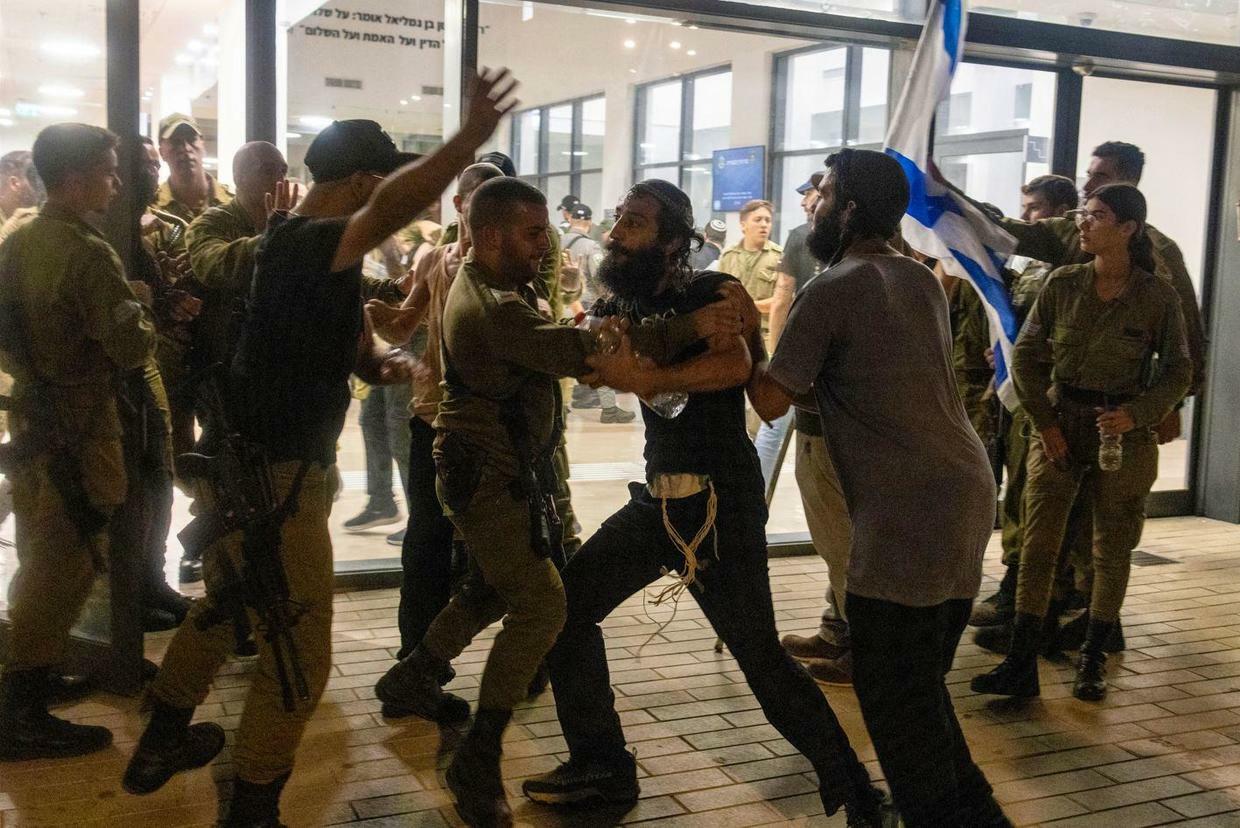
Israeli Police Detain Soldiers Suspected Of Raping A Palestinian, Sparking Protests

Israeli Police Detain Soldiers Suspected Of Raping A Palestinian, Sparking Protests

Authored by Dave DeCamp via AntiWar.com,

On Monday, Israeli military police detained Israeli soldiers who were suspected of raping a Palestinian prisoner at the notorious Sde Teiman prison in southern Israel. Israeli media reported that the Palestinian prisoner was transferred from Sde Teiman to a hospital with an injury to his anus that was so severe he could not walk.

When the Israeli military police went to Sde Teiman to detain soldiers suspected of forcibly sodomizing the Palestinian man, they were met with resistance. A security source told Haaretz that Israeli soldiers at the facility refused to leave and barricaded themselves in. They also reportedly used pepper spray on the military police.

The police ended up detaining nine out of 10 of the Israeli Defense Forces (IDF) soldiers suspected of abusing the Palestinian detainee. The arrest of the suspected rapists sparked protests from far-right Israeli activists.

Members of the Israeli Knesset joined protesters as they stormed Sde Teiman, including Zvi Sukkot of the Religious Zionism party. At least one member of Prime Minister Benjamin Netanyahu’s coalition was spotted among the protesters, Heritage Minister Amichai Eliyahu, a member of the Jewish Power party. Later in the day, protesters stormed Beit Lid, the base where the Israeli soldiers are being held.

Israeli Minister of National Security Itamar Ben Gvir, leader of the Jewish Power party, praised the detained Israeli soldiers, calling them the “best heroes” and denouncing their arrest as “shameful.”

According to The Telegraph, Ben Gvir said the Israeli security establishment should support the soldiers and “learn from the prison service: light treatment of terrorists is over. Soldiers need to have our full support.” According to CBS News:

Lawmaker Hanoch Milwidsky was asked as he defended the alleged abuse whether it was legitimate, “to insert a stick into a person’s rectum?”

“Yes!” he shouted in reply to his fellow parliamentarian. “If he is a Nukhba [Hamas militant], everything is legitimate to do! Everything!”

Israel’s far-right National Security Minister Itamar Ben Gvir, who’s drawn U.S. reprimands with his provocative actions since the war started, wrote in a post on social media: “Take your hands off the reservists.”

Israeli whistleblowers have detailed widespread abuse and torture at the Sde Teiman prison, which holds Palestinians detained from Gaza. The New York Times reported last month that Palestinians who made it out of the facility said they were subject to sexual torture.

Younis al-Hamlawi, a senior nurse who was detained by Israeli forces in Gaza after he left Al-Shifa Hospital over allegations that he was tied to Hamas, told the Times that Israeli soldiers penetrated his rectum with a metal stick, causing him to bleed and leaving him in “unbearable pain.“

All of this was sparked due to an internal Israeli military investigation, after pressure from US officials…

The Times report said a leaked report from the UN “cited a 41-year-old detainee who said that interrogators ‘made me sit on something like a hot metal stick and it felt like fire,’ and also said that another detainee ‘died after they put the electric stick up’ his anus.”

Tyler Durden
Tue, 07/30/2024 – 22:30

Democrats Vs. The Man Who Could Get To The Bottom Of The Trump Shooting

Democrats Vs. The Man Who Could Get To The Bottom Of The Trump Shooting

Authored by Julie Kelly via RealClearInvestigations,

After the evasive House testimony of now-former Secret Service Director Kimberly Cheatle and FBI Director Christopher Wray’s shortlived suggestion that Donald Trump may not have been hit by a bullet, one man alone may help allay Republican fears that the Biden administration will not conduct a forthright investigation into the attempted assassination of Trump last month: Joseph Cuffari.

The Trump-appointed inspector general for the Department of Homeland Security has already opened two investigations into the U.S. Secret Service, which is under the purview of the DHS, related to the agency’s handling of the July 13 shooting.

But some Republicans are concerned because, they say, Cuffari has been stonewalled by Homeland Security Secretary Alejandro Mayorkas on other internal examinations – including one that might have revealed Secret Service lapses that might have prevented the attempt on Trump’s life. 

Specifically, congressional sources tell RCI that Cuffari’s report, “USSS Preparation for and Response to the Events of January 6, 2021,” has been on Mayorkas’ desk since at least April.

The report, according to Politico, will “cast light on a series of embarrassing security lapses for the agency.” And given some comparisons between Jan. 6 and July 13, the report might shed light on systemic issues that impacted both events.

For example, unanswered questions remain as to why the Secret Service allowed Trump to take the stage at The Ellipse outside the White House around noon on Jan. 6 amid reports of individuals with weapons in the vicinity – a question many Americans have about the July 13 assassination attempt. Law enforcement and spectators noted the presence of a suspicious individual, later identified as the gunman, Thomas Matthew Crooks, at least a half hour before Trump took the stage in Butler, Pennsylvania.

In addition, no one has explained how the Secret Service failed to notice an alleged pipe bomb found outside the Democrat National Committee DC office on Jan. 6 – while then Vice President-elect Harris was inside the building. Previous reporting by RCI shows multiple law enforcement officers, including one with a bomb-sniffing dog, walking past the bench where the device was found. 

Rep. Barry Loudermilk, chairman of a House subcommittee tasked with a separate investigation into Jan. 6 as well as the now-defunct J6 committee, recently accused Mayorkas of intentionally holding the release of the report. The Georgia Republican told Mayorkas in a letter that “the failure to provide an in-depth review of the department’s security planning and operational failures related to January 6 not only raises concerns about the department’s botched planning for former president Trump’s rally in Pennsylvania on July 13, 2024, but it is quite possible that such reports could have prevented the security breakdown that resulted in the near assassination of a former president and presidential candidate.”

Top Democrats have long sought to remove Cuffari – a former investigator for the Air Force and Department of Justice whom Trump appointed in 2019 in 2019 – from office. The coordinated effort began when the IG notified Congress that a trove of Secret Service texts from January 5 and 6, 2021 had been deleted in late January 2021 under the Biden administration. The purge occurred weeks after every federal agency received a directive from Congress to preserve all evidence related to January 6. 

Cuffari said messages belonging to at least 24 Secret Service officials including then director James Murray and Cheatle, who was an assistant director of the agency on January 6, were gone. So, too, were the texts of then acting Homeland Security Secretary Chad Wolf and acting deputy secretary Ken Cuccinelli, both Trump appointees.

His office subsequently opened a criminal investigation into the matter.

“The USSS erased those text messages after OIG [Office of Inspector General] requested records of electronic communications from the USSS, as part of our evaluation of events at the Capitol on January 6,” the inspector general wrote in a July 2022 letter to chairmen of both the Senate and House Homeland Security committees, including Rep. Bennie Thompson, who also chaired the Jan. 6 committee at the same time. 

Cuffari further flagged the DHS’s lack of cooperation with his inquiry, something he had already pointed out in an earlier report to the committees. “DHS personnel have repeatedly told OIG inspectors that they were not permitted to provide records directly to OIG and that such records had to first undergo review by DHS attorneys,” Cuffari continued in the letter.

Not true, responded Secret Service spokesman Anthony Guglielmi. He claimed the texts had been deleted when cell phones were reset to factory settings as part of a device replacement program. “The insinuation that the Secret Service maliciously deleted text messages following a request is false.” (Guglielmi’s truthfulness was brought into question recently when he claimed it was “absolutely false” that the Secret Service rejected the Trump campaign’s multiple requests for additional security prior to the Pennsylvania rally. The Washington Post later confirmed that top Secret Service officials “repeatedly denied” requests for more manpower and equipment to protect the former president at large events.)

And despite initially insisting the texts were not lost, Guglielmi shortly thereafter said the missing Jan. 6-related messages were not recoverable. Cuffari did acquire the cell phones of two dozen Secret Service agents on duty that day, which did not have texts from that day but could have other pertinent information.

But rather than demand that the DHS use its extensive investigative tools to retrieve the texts, Thompson instead turned his fire on Cuffari. Thompson suggested Cuffari’s alleged delay in notifying the committee about the purged texts represented a cover-up and “cost investigators precious time to capture relevant evidence.” Cuffari had, in fact, notified the Homeland Security committee of both the Senate and House, of which Thompson was chairman, at least twice that DHS officials were not cooperating in his J6 probe.

“The Department repeatedly suggested that OIG might not have a right of access to the records sought, but during the months-long period in which access was delayed the Department did not cite any legal authority – that would have justified withholding the information,” Cuffari disclosed in a September 2021 report to Congress.

Despite Cuffari’s warnings related to stonewalling by DHS brass, Thompson accused Cuffari of withholding news of the deleted messages. In a July 2022 letter, just two weeks after Cuffari disclosed the missing texts, Thompson asked him to step aside from the J6 inquiry. Calls for Cuffari’s dismissal have also been driven by the nonprofit “watchdog” group, the Project on Government Oversight. The vice chair of POGO’s board is Debra Katz, a lawyer for Brett Kavanagh’s accuser, Christine Blasey Ford, during his tawdry Supreme Court nomination hearings.   

Critics say Thompson’s demand for Cuffari’s recusal appeared to contradict his stated mission to find the truth about Jan. 6. For example, former White House aide Cassidy Hutchinson, a star witness for the committee, provided a shocking account about how Trump allegedly assaulted one of the Secret Service agents on his detail that afternoon. Wouldn’t Thompson and the other committee members want records to prove her claims, which are now in dispute by several individuals, including the driver she said Trump tried to attack? Why would Thompson want to get rid of the watchdog attempting to locate messages critical to filling an important missing piece of the Jan. 6 puzzle? 

In fact, Thompson told Rep. Thomas Massie (R-Ky) in February his committee “could have had a better, more thorough report had we had access to all those records.” Thompson further said that the deletions not only violated the Federal Records Act but may have also amounted to obstruction of justice since he had issued a subpoena, the only one his committee sought from an executive office, seeking the records.

Talk but No Action

But neither his committee nor a Democrat-controlled Congress did anything about it. Unlike the committee’s criminal referral to the Department of Justice against Trump for obstructing an official proceeding, Thompson did not pursue criminal charges against any DHS official responsible for erasing the text records.

But Thompson did continue his attacks on Cuffari aided by his House colleagues and DHS IG employees, who wrote a letter accusing Cuffari of “continued mismanagement.” “IG Cuffari has made it clear that he wishes to remain in his position, even in the face of prolonged, deserved criticism in the media, from Congress, from other oversight entities and from his own staff. A true leader would recognize the effect of his actions on his workforce and understand the right thing to do would be to step aside,” anonymous staffers wrote in a September 2022 letter to Joe Biden asking him to fire Cuffari.

The Council of the Inspectors General on Integrity and Efficiency, or CIGIE, which oversees federal inspector generals, also went after Cuffari by opening a flood of inquiries into the DHS IG’s office. In response, Cuffari filed a lawsuit seeking relief  from “an unjust, Kafkaesque system produced by an unconstitutionally structured entity and abetted by a complete absence of independent oversight, accountability and lawful due process.”  A federal judge dismissed his effort to stop the investigation, ruling that he had not suffered any harm. 

CIGIE is mired in its own scandals; in May, several Republican House members sent a letter to a top CIGIE official demanding answers about the “politicization” of the organization. During a House hearing on July 24, committee members accused CIGIE chairman Mark Greenblatt of a lack of transparency and the “subjective” nature of CIGIE’s work.

House Democrats, including Thompson, continue to seek Cuffari’s resignation more recently for deleting text messages off his government device. Cuffari told Congress he did not consider the texts applicable under the Federal Records Act.

Intriguingly, as Cuffari begins his probe of the attempt on Trump’s life, his Jan. 6 report may shed light on an alleged threat to Vice President Harris.  

More than three-and-a-half years later, investigators still have not arrested anyone for planting pipe bombs outside the headquarters of both the Democratic National Committee and the Republican National Committee on the evening of Jan. 5. The FBI’s investigation reportedly remains open but apparently went cold.

For reasons still unknown, Harris left Capitol Hill around 11:15 a.m. on Jan. 6 following a briefing for the Senate Intelligence Committee. Although an official schedule indicated she planned to go home, she instead arrived at DNC headquarters along with a Secret Service detail at 11:25 a.m.

Video captured by a security camera outside the building showed a bomb-sniffing dog conducting a vehicle search at 9:44 a.m., roughly two hours before Harris’ arrival. The canine did not detect the explosive device sitting just a few feet away near an outdoor bench.

Neither did officers from Capitol Police and D.C. Metropolitan Police, who intermittently arrived at the building throughout the morning and into the early afternoon. Harris’ Secret Service detail did not appear to conduct any meaningful search of the premises before or during her visit.

And when a plainclothes Capitol Police officer discovered the pipe bomb at 1:07 p.m., no officer appeared overly concerned that a device the FBI later said was viable and deadly was within distance of the incoming vice president.

She was evacuated about 10 minutes later.

How did the Secret Service miss the device in plain view? Was anyone fired for failing to properly sweep the area and endangering the life of their protectee? Were new protocols put in place to avoid repeating such a frightening scenario in the future?

Cuffari’s report presumably will finally answer those questions because agency officials have not.

Not only are the FBI and Secret Service tight-lipped about the incident, but Harris herself has yet to discuss it publicly. 

Harris has not explained why she, a sitting U.S. senator at the time, left the Capitol 90 minutes before the beginning of the joint session of Congress to certify her groundbreaking election. She appears to have been the only senator not in attendance as the proceedings commenced. Why did she plan to miss such a historic event? How did she feel when she was told of the alleged bomb?

It would be nearly impossible for the national news media to continue to ignore her ties to the pipe bomb story if Cuffari addressed it in his investigation. 

“Any delay or obstruction by Mayorkas is unacceptable,” Loudermilk said in an email, “especially now that the DHS IG is investigating the serious USSS security failures at the Trump rally in Butler PA.”

Tyler Durden
Tue, 07/30/2024 – 22:05

FDA Approves New Blood Test For Colon Cancer

FDA Approves New Blood Test For Colon Cancer

Authored by Chase Smith via The Epoch Times (emphasis ours),

The U.S. Food and Drug Administration (FDA) has approved a new blood test for colorectal cancer (CRC) screening for adults ages 45 and older who are at average risk for the disease, according to a statement from Guardant Health Inc.

The U.S. Food and Drug Administration in White Oak, Md., on June 5, 2023. (Madalina Vasiliu/The Epoch Times)

The FDA’s decision follows a strong recommendation for approval from an advisory committee panel in May 2024.

The approval of Guardant Health’s “Shield” test marks the first time that a blood test has been recognized by the FDA as a primary screening option for CRC, offering a noninvasive alternative to traditional methods such as colonoscopies and stool-based tests, according to the statement.

Colorectal cancer is the second-leading cause of cancer-related deaths in the United States, with the American Cancer Society estimating more than 150,000 new diagnoses and 53,000 deaths in 2024 alone.

Early detection is crucial, as the five-year relative survival rate is 91 percent when CRC is identified early, compared with just 14 percent if the cancer has spread to distant parts of the body, according to the company’s statement.

The screening rate for CRC in the United States stands at about 59 percent, significantly below the National Colorectal Cancer Roundtable’s goal of at least 80 percent. Many people avoid traditional screening methods because of their invasive and unpleasant nature, according to the statement.

“The persistent gap in colorectal cancer screening rates shows that the existing screening options do not appeal to millions of people,” Dr. Daniel Chung, a gastroenterologist at Massachusetts General Hospital and professor of medicine at Harvard Medical School, said in the statement.

“The FDA’s approval of the Shield blood test marks a tremendous leap forward, offering a compelling new solution to close this gap. This decision will help make screening tests more broadly accessible and propel blood-based testing and CRC screening into a new era.

“With increased screening rates and early cancer detection, many more lives can be saved.”

The Shield blood test has been in development for more than a decade, according to the company.

A major clinical trial, the ECLIPSE study, demonstrated that the Shield test has an 83 percent sensitivity for detecting CRC and a 90 percent specificity for advanced neoplasia, according to the company. The results are comparable to those of other noninvasive screening methods currently recommended by guidelines, according to the statement.

“Shield can help improve colorectal cancer screening rates so we can detect more cancers at an early stage, when they are treatable,” Guardant Health Co-CEO AmirAli Talasaz said in the statement.

The advisory committee panel acknowledged the test’s reliability for detecting stages 2, 3, and 4 CRC and emphasized the benefit of having a blood test that can achieve higher adherence rates among patients who avoid colonoscopies or stool-based tests. However, it stressed that Guardant Health must make sure that consumers are aware that the blood test is not equivalent to a colonoscopy in its ability to detect and remove benign polyps before they can become cancerous.

The panel highlighted the importance of clear labeling and patient education to mitigate risks associated with the test’s lower sensitivity for detecting pre-cancerous advanced adenomas, according to the minutes from the panel’s meeting.

The panel noted that patients with pre-cancerous advanced adenomas have a high risk of developing CRC and that Shield’s lower test sensitivity for detecting these adenomas means that there is a risk that patients might receive a negative test result despite having pre-cancerous advanced adenomas, potentially leading to missed opportunities for early intervention.

The panel said it’s crucial that the test’s limitations were clearly communicated for patients to understand that while the Shield test is an effective tool for CRC screening, it “is not a replacement for diagnostic colonoscopy or for surveillance colonoscopy in high-risk individuals.”

Guardant Health’s Shield test will be available by prescription and is expected to be covered by Medicare for eligible beneficiaries. Commercial insurance coverage is also anticipated to expand following future guideline inclusions by the American Cancer Society and the U.S. Preventive Services Task Force, according to the statement.

“The test, which has an accuracy rate for colon cancer detection similar to stool tests used for early detection of cancer, could offer an alternative for patients who may otherwise decline current screening options,” said Dr. William M. Grady, a gastroenterologist at Fred Hutchinson Cancer Center.

Tyler Durden
Tue, 07/30/2024 – 21:40

The Top 3 Proxy Wars To Determine WW3 And Reshape The World Order

The Top 3 Proxy Wars To Determine WW3 And Reshape The World Order

Authored by Nick Giambruno via InternationalMan.com,

Today, I will closely examine the most important proxy wars of World War 3, which I believe will be decisive in determining who wins the overall conflict and gets to shape the new world order.

Proxy wars are a method by which major powers fight their battles indirectly, using smaller nations or groups as stand-ins rather than confronting each other directly.

Major powers support, equip, and finance smaller groups or nations in a proxy war to fight against a common adversary. This support can include military training, weapons, funding, and other resources. The critical point is that the major powers do not engage directly in combat.

There are numerous ongoing proxy wars in World War 3.

However, the ones I believe will prove decisive will be in Taiwan, Ukraine, and the Middle East. The other proxy wars are peripheral in comparison.

Proxy War #1: Taiwan

Recently, China performed a two-day military exercise around Taiwan, named Joint Sharp Sword-2024A, as a response to what it calls Taiwan’s separatist acts.

This drill involved the Chinese air force and navy completely surrounding the island of Taiwan with ships and warplanes. It aimed at testing their combat readiness for a full-scale attack.

Many believe the drills are practice for an invasion.

This show of force comes just after Taiwan’s new President, Lai Ching-te, took office. Lai once expressed support for Taiwan’s independence.

If Taiwan officially declared independence, it would be tantamount to declaring war with China.

The unofficial status quo maintains an ambiguous stance on Taiwan’s sovereignty; they aren’t declaring independence (yet), nor are they committing to reunifying with China.

Lai’s presidency is significant in the context of the already strained China-Taiwan relations. A new president with pro-independence sympathies could be the tipping point that causes China to act.

However, I am skeptical that the US military would directly intervene.

That’s because China (and Russia) are the only countries with sophisticated enough nuclear arsenals to go toe-to-toe with the US up to the top of the military escalation ladder, a concept that describes how the severity of a military conflict can increase.

In other words, the US military can’t attack China with impunity because Beijing can match each move up to all-out nuclear war—the very top of the military escalation ladder.

The operative question is, will the US risk nuclear Armageddon over Taiwan?

I don’t think it will.

Considering everything, China seems to have the advantage and will reunify Taiwan in the not-so-distant future.

I think China—and thus BRICS+—will prevail in this crucial proxy war of World War 3. If that happens, it will likely permanently alter the geopolitical landscape of East Asia.

Proxy War #2: Ukraine

Ukraine has been the arena of choice for NATO & Friends to confront Russia for many years.

To briefly summarize, the US has been spending many billions meddling in Ukraine long before the current conflict broke out in February of 2022.

It has been estimated that the US spent around $5 billion on “democratization” in Ukraine before 2022. What that means is covert mischief executed through nongovernmental organizations (NGOs), which are simply fronts for the CIA.

A partial list of the culprits includes USAID, the National Democratic Institute, and the International Republican Institute, as well as nominally nongovernmental organizations like Freedom House, George Soros’ Open Society Foundations, and the National Endowment for Democracy.

It all culminated in the violent overthrow of Ukraine’s corrupt pro-Russia government in 2014, which a corrupt pro-US government replaced. It sowed the seeds for the current conflict.

As I write this, in mid-2024, the conflict in Ukraine appears to be reaching a tipping point.

Ukraine has suffered serious battlefield setbacks as Russia has steadily gained territory. The Russians now have the momentum and initiative.

US funding is also drying up. American and European voters are increasingly tired of the war as regular people struggle with a sputtering economy and rising inflation.

In short, there’s not much more that NATO & Friends can do to turn things around for Ukraine.

They can’t intervene directly; the Russians have been clear they would view that as a declaration of direct and open war, which could lead to nuclear exchanges.

About all NATO & Friends can do is send more weapons shipments to Kiev.

However, that is unlikely to deliver victory to Ukraine. At best, it will only prolong the conflict without changing the ultimate outcome.

Further, it seems Russian patience is wearing thin on this issue.

In response to NATO & Friends supplying arms to Ukraine, Putin recently announced that Russia will start supplying arms to countries in conflict with the US and other NATO countries.

Dmitry Medvedev is a former Russian president and prime minister. He is now the deputy chairman of the Security Council and recently said this regarding the new policy:

“Now, may the United States and its allies experience firsthand the direct use of Russian weapons by third parties.

These persons or regions have been intentionally left unnamed, but they can include all those who consider Yankeeland & Co. their enemy, regardless of their political outlook and international recognition.

Their enemy is the US, which means they are friends to us.”

There is little doubt that the countries and groups to receive Russian arms that Medvedev was referring to would include those in the Middle East, which is the third key proxy war of World War 3. An influx of Russian arms in the Middle East could tip the balance in this crucial region.

When you consider everything regarding Ukraine, it seems that a negotiated settlement that is mainly favorable to Russia will eventually be reached.

Absent that, I expect the Russians to continue to make steady gains.

Either way, I believe the Russians will win through battlefield gains or a favorable negotiated settlement.

Here’s the bottom line.

All signs point to an eventual Russian victory in Ukraine and another critical World War 3 proxy war that will end in favor of BRICS+. If that happens, it will likely permanently alter the geopolitical landscape of Europe.

Proxy War #3: The Middle East

I think it’s clear the proxy wars in Ukraine and Taiwan are likely to end in favor of BRICS+.

That’s why I expect NATO & Friends will make their last stand to scuttle the emergence of a multipolar world order and preserve the US-led world order in the Middle East.

In my next article, I’ll examine the Middle East in-depth and how I think it will play out.

Here’s the bottom line.

I think the Middle East will be the decisive battleground that determines who wins WW3 and gets to shape the new world order.

The stakes could not be higher.

Countless millions throughout history were wiped out financially—or worse—during the previous world wars because they failed to see the correct Big Picture and take appropriate action.

Fortunately, WW3 doesn’t have to blindside you, your family, or your portfolio.

Quite the contrary.

That’s exactly why I just released an urgent new report with all the details, including what you must do to prepare. Click here to download the PDF now.

Tyler Durden
Tue, 07/30/2024 – 21:15

“Hundreds” Of Cars Stolen And Robbed Each Year From Seattle Airport “Park-N-Fly” Lots

“Hundreds” Of Cars Stolen And Robbed Each Year From Seattle Airport “Park-N-Fly” Lots

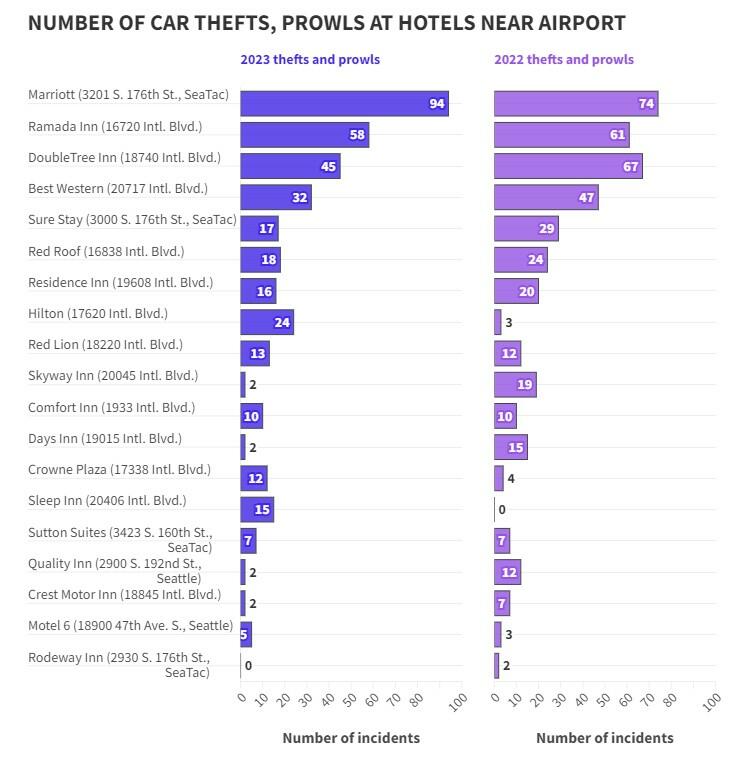
‘Hundreds’ of cars are being stolen from Seattle-Tacoma International Airport every year, investigators from KING NBC 5 have found. 

Car thieves frequently target hotel and motel lots offering “park-n-fly” or “stay-n-fly” packages. Data reviewed by KING NBC 5 shows that some of the most well-known lodging names have the highest crime rates, leaving customers liable.

According to public records, the airport Marriott tops the list for crimes at hotel and “park-n-fly” lots. Data from the King County Sheriff’s Office shows 94 car thefts and prowls in 2023, including 27 stolen vehicles. In 2022, there were 74 reported incidents, according to KING NBC 5. 

Carol Olson of Snohomish County commented: “Something needs to be done.”

KING NBC 5 reported that her insurance covered $15,000 in repairs after her truck was stolen and trashed at the Seattle Airport Marriott on South 176th Street in December. She returned from a trip to Disneyland with her grandkids to find her parking spot empty.

Another woman Piper Logg told hotel security her truck was gone and wasn’t happy with the response: “They all made it sound like this is an everyday, normal thing and that nobody was surprised that it happens all the time. It seems like it’s something that happens all the time and they’re choosing to do nothing.”

Logg said the lot’s cameras weren’t recording, and thieves evaded the pay gates. A SeaTac police officer explained that no charge applies if exiting within 15-20 minutes. Thieves often tailgate behind an accomplice or a paying customer, and one report mentioned a thief ramming the gate to escape.

“It’s even more disconcerting because Marriott is a well-known company. You actually think it is going to be safer than the smaller hotels,” another woman said. “It just leaves a bad taste in your mouth.”

Can’t we just go back to the days when things made sense and cars were only being stolen from their owners in designated, marked autonomous zones in the center of the city?

Tyler Durden
Tue, 07/30/2024 – 20:50

Trump’s VP Pick Is A Climate Skeptic, And The Knives Are Out

Trump’s VP Pick Is A Climate Skeptic, And The Knives Are Out

Authored by Tilak Doshi via RealClearEnergy,

Within a day of ex-President Trump’s announcement of “climate denier” Mr. J. D. Vance as the Republican Vice Presidential nominee, the climate industrial complex and supportive mainstream media had the knives out. A few headlines of the past 24 hours are an indication.

  • The New York Times: “JD Vance Is an Oil Booster and Doubter of Human-Caused Climate Change”

  • The Independent: JD Vance: “Climate activists alarmed by Trump’s ‘dangerous’ pick for vice president”

  • The Guardian: “Climate advocates fear picking JD Vance for VP is ‘a dangerous step backward’”

The umbrage taken by media commentators is familiar. CNBC laments that “the former venture capitalist though is a known critic of climate change and renewable energy [italics added].” UK’s The Independent newspaper reports that “[c]ampaigners are responding with alarm to the selection of climate denier and Ohio senator JD Vance as Donald Trump’s vice presidential nominee, with activists warning he represents a “dangerous” voice for the US.” Mr. Vance’s “eagerness to please Donald Trump” adds to the image of the vice-presidential nominee as an unprincipled politician seeking office.

Climate advocacy group Fossil Free Media spokesperson Cassidy DiPaola asserted that “This [VP] choice signals that a potential Trump-Vance administration would likely double down on fossil fuel expansion at a time when we desperately need to transition to clean energy.” Communications director Stevie O’Hanlon of Sunrise Movement, a climate activist organization, said that “Like Donald Trump, JD Vance has proven that he will make it a top priority to roll back climate protections while answering to the demands of oil and gas CEOs.”

Does Mr. Vance have a principled stand and is his stance on climate and energy policy worthy of consideration?

Climate Denialism

As the highly polarized debate over climate change over the past few decades has amply demonstrated, the discourse often descends into ad hominem attacks and name calling. “Climate denier” is a charge that is often used by proponents of climate alarm to shut down critical debate and to deplatform climate sceptics. Lena Moffitt, executive director of the environmental advocacy group Evergreen Action, said this of Mr. Vance: “Donald Trump has chosen an avowed climate denier as his running mate who has used his time in Congress to vote against the environment and shill for fossil fuel corporations at every opportunity.”

The “denier” accusation is among the more pernicious if popular epithets used to denigrate sceptics of the so-called “consensus science.” It invokes a comparison to those who engage in Holocaust denial. To be sure, most observers would consider it ludicrous to suggest that questioning the accuracy and predictive power of scientific models is like questioning the historical fact of the genocide of Jews in Europe.

What Is Mr. Vance’s Position on Climate?

Putting aside epithets and journalistic hit-pieces, it seems a fair question to ask just what do politicians skeptical of the climate alarmist narrative believe? And what are their policy positions regarding the Paris Agreement’s “net zero by 2050” target. This policy target is an imperative, at least nominally, for most current governments in North America and Western Europe?

Mr. Vance – lawyer, businessman, former Marine and writer of the bestselling memoir “Hillbilly Elegy”, arisen from the humblest working class background – places himself firmly in the populist right movement. It now looks very likely that Mr. Trump will be the next US president. The assassination attempt Saturday, his miraculous split-second turn of the head which saved him and the iconic picture of his raised fist with the US flag in the background seconds after being injured make him almost irresistible. Thus Mr. Vance will likely join the Donald Trump next year as his VP in an administration that will seek to rapidly unwind the myriad policy and regulatory constraints that the Biden administration has imposed to shackle the US oil and gas industry at every turn.

Vance has also criticized the “green energy fantasy” of the Biden administration, pointing out that “solar panels can’t power a modern manufacturing economy” and “that’s why the Chinese are building coal power plants.” He has similarly called out wind power turbines. At the Turning Point Action conference last year, he said “they’re hideously ugly. They kill all the birds. And they’re mostly made in China.” The Biden administration’s all-out support for EVs comes in for the same critique. In a July 2022 radio interview, he said: “The whole EV thing is a scam. If you plug it into your wall, do these people think there are Keebler elves back there making electricity in the wall? It comes, of course, from fossil fuels.”

Mr. Vance’s climate skepticism goes beyond encouraging US oil and gas dominance in global markets once again – a strong theme of Trump’s first term in office – if the Republicans get elected to office. He has come out fiercely against the ESG (Environmental, Social and Governance) movement. In an interview with Breitbart in 2022, he said “ESG is basically a massive racket to enrich Wall Street and enrich the financial sector of the country, at the expense of the industries that actually employ a lot of Ohio’s workers for middle-class jobs.” The push against ESG occurring through the red states in the U.S. and the increasingly evident lack of success of ESG-focused firms and investment advisors suggests that Mr. Vance has probably got a better finger on the pulse than his critics would care to admit.

Who’s More Credible?

As a climate change skeptic, Mr. Vance stands in good company. For instance, the 2022 Nobel Laureate in physics John Clauser exposed in a recent lecture how the Intergovernmental Panel on Climate Change (IPCC) models and analyses do not meet basic standards of scientific enquiry.  IPCC models have been used as “proof” of scientific consensus by politicians and activists to support claims of a “climate crisis.” Another example would be Richard Lindzen, an American atmospheric physicist and Emeritus Professor of Meteorology at the Massachusetts Institute of Technology who published an assessment of the global warming narrative in 2022. Prof. Lindzen finds climate alarmism “a quasi-religious movement predicated on an absurd ‘scientific’ narrative. The policies invoked on behalf of this movement have led to the US hobbling its energy system.” Whatever one’s views on climate science, it is apparent that Mr. Vance is not a wild-eyed outlier in his skepticism of the claims of climate policy advocates as asserted by his many critics.

JD Vance’s criticisms of subsidy-supported renewable energy and EV sectors accord with the empirical evidence emerging in the current context of higher inflation, higher interest rates and a deep slump in renewable energy stocks. For instance, an Associated Press report last November described the travails of the Biden administration’s ambitious plans for offshore wind: “The cancellation of two large offshore wind projects in New Jersey is the latest in a series of setbacks for the nascent U.S. offshore wind industry, jeopardizing the Biden administration’s goals of powering 10 million homes from towering ocean-based turbines by 2030 and establishing a carbon-free electric grid five years later.” This news was preceded by earlier reports of developers cancelling three offshore wind power projects in New England. They said their projects were “no longer financially feasible” despite the ample subsidies on offer.

The news on the EV front, called out as a “scam” by Mr. Vance, is just as dire for green technology enthusiasts. As David Blackmon, a keen observer of the renewable energy space, notes: surveys show that the vast majority of US car buyers will not purchase an EV even at “bargain basement” prices (and despite government subsidies); the overall growth in private EV sales in the US has slowed “to a trickle”, just as is happening in the UK and EU; and the market for used EVs is practically non-existent. “Pure play” EV maker Fisker recently declared bankruptcy while Rivian approaches the same fate. Giant US automakers GM and Ford have turned to gasoline-powered vehicles to sustain their profits as the global EV sales slowdown force them to delay investments and cuts costs in their EV production lines.

Partisans may criticize the man all they want, but the realities of thermodynamics and economics support JD Vance. He may prove to be the best Vice President in a Republican administration geared to supporting the country’s oil and gas industries and Making America Great Again.

Tyler Durden
Tue, 07/30/2024 – 20:25