60 F
Chicago
Monday, September 28, 2026
Home Blog Page 2440

DOJ Asks Supreme Court To Allow Some Blocked Title IX Rule Changes

DOJ Asks Supreme Court To Allow Some Blocked Title IX Rule Changes

Authored by Caden Pearson via The Epoch Times (emphasis ours),

The Department of Justice (DOJ) filed an emergency application on July 22 asking the Supreme Court to allow some parts of the changes the federal government made to Title IX rules related to sex discrimination, which were blocked by a lower court.

The U.S. Supreme Court in Washington on June 30, 2018. (Charlotte Cuthbertson/The Epoch Times)

The DOJ is arguing that the wholesale pause to the rule changes was “more burdensome” than necessary, asking the Supreme Court to limit the district court’s injunction to 10 states and to only those changes related to gender identity.

In the emergency application, U.S. Solicitor General Elizabeth Prelogar argued that the more than two dozen states challenging the expansion of Title IX rules focused their objections on three provisions related to “gender identity,” leaving the vast majority of the Department of Education’s (DOE’s) expanded rules alone.

In April, the DOE issued guidance changing the scope of Title IX rules for educational institutions that receive federal funds. Title IX rules, which prohibit sex discrimination in schools, were expanded to include sexual orientation and “gender identity.”

The rule changes would mean that male students who identify as female could use women’s restrooms and spaces and join women-only organizations.

It would also expand the definition of “harassment” to include using a pronoun that aligns with sex at birth but conflicts with chosen gender identity. Schools that receive federal funding but refuse to comply risk losing that funding and facing lawsuits.

The expansion of the rules also included changes to recordkeeping requirements, grievance procedures, and protections for pregnant and postpartum students and employees. However, the changes at the heart of the lawsuits filed by Republican-led states and other groups related to the three provisions on gender identity.

On June 17, a federal district court in Kentucky blocked the new regulations in several Republican-led states while lawsuits were ongoing.

DOJ Asks For Narrowing of Injunction

On July 22, Ms. Prelogar asked the Supreme Court to narrow the district court’s injunction to the 10 states where the rule bans discrimination based on “gender identity”: Idaho, Indiana, Kentucky, Louisiana, Mississippi, Montana, Ohio, Tennessee, Virginia, and West Virginia.

“The district court held that respondents’ challenges are likely to succeed and issued a preliminary injunction. But the court refused to tailor the injunction to the two provisions of the Rule that are the source of respondents’ asserted injuries—or even to the three provisions they have challenged on the merits,” Ms. Prelogar wrote.

“Instead, the court enjoined the entire Rule, including dozens of provisions that respondents had not challenged and that the court did not purport to find likely invalid.”

The solicitor general has asked the Supreme Court for a partial stay of the district court’s order that would allow the unchallenged portions of the Title IX rule changes, such as provisions related to new mothers, to be implemented while the legal challenges play out.

The emergency application comes days after the Sixth U.S. Circuit Court of Appeals upheld the district court’s preliminary injunction.

Federal district court judges had ruled in favor of the states in three cases, blocking the rule from being implemented in 15 states and at schools attended by the children of members of two conservative groups: Moms for Liberty and Young America’s Foundation.

However, the regulation is still expected to go into effect in the remaining states by Aug. 1.

The rule change came after President Joe Biden issued an executive order on March 8, 2021, formally tasking the DOE with amending Title IX to include “discrimination on the basis of sexual orientation and gender identity.”

Tyler Durden
Wed, 07/24/2024 – 10:45

Bank of Canada Cuts Rates For Second Consecutive Month, Says “Reasonable” To Expect More

Bank of Canada Cuts Rates For Second Consecutive Month, Says “Reasonable” To Expect More

The Bank of Canada, which last month became the first G7 bank to launch an easing cycle, moments ago cut interest rates by a quarter percentage point for a second consecutive meeting and signaled further easing ahead as inflation worries wane.

The cut was expected by virtually all surveyed economists; OIS priced in about 22bps of cuts into the decision. A recent easing of inflationary pressures and the central bank’s inflation forecast prompted the decision.

The central bank said “CPI inflation moderated to 2.7% in June after increasing in May. Broad inflationary pressures are easing. The Bank’s preferred measures of core inflation have been below 3% for several months and the breadth of price increases across components of the CPI is now near its historical norm.”

“With the target in sight and more excess supply in the economy, the downside risks are taking on increased weight in our monetary policy deliberations,” BOC Governor Tiff Macklem said in prepared remarks.

Macklem reiterated that it’s “reasonable” to expect further interest rate cuts, and that the bank will be taking its decisions “one at a time,” pushing back on expectations that the bank is on a predetermined cutting path.

The Bank’s preferred measures of core inflation are expected to slow to about 2½% in the second half of 2024 and ease gradually through 2025. The Bank expects CPI inflation to come down below core inflation in the second half of this year, largely because of base year effects on gasoline prices. As those effects wear off, CPI inflation may edge up again before settling around the 2% target next year.”

BOC officials say they’ve continued to make progress on bringing price pressures to heel, and that a return to the 2% inflation target is “in sight.” The June consumer price index, which showed inflation decelerated to a 2.7% yearly pace, also pointed to slowing underlying price pressures, the bank said.

Overall, Bloomberg summarizes, officials seems more convinced that price pressures are under control, and are increasingly focused on preserving a soft landing for the economy. The dovish suite of communications suggest that governing council has shifted their attention to ensuring inflation does not substantially undershoot the 2% target.

The bank said wage growth, while elevated, is moderating as the labor market loosens. Corporate pricing behavior has “largely normalized”, and inflation expectations have come down. In June, the final paragraph of the bank’s policy statement had focused on those concerns, but the July statement was largely rewritten to focus on “ongoing excess supply” and “opposing forces” on inflation — the bank sees shelter and services holding up progress.

There was no mention of the recent reacceleration of the 3-month moving average of the bank’s preferred core measures, which accelerated to 2.91% in June. Instead, policymakers highlighted progress on the yearly change of median and trim CPI — which is expected to decelerate to 2.5%, according to newly added projections.

It’s a marked shift in the bank’s attitude toward inflation. A summary of deliberations from the officials’ June meeting showed policymakers had debated whether more disinflation proof was needed before easing. Now they’re more convinced they have enough evidence. The balance of risks is changing too. Officials listed weaker-than-expected household spending as a main downside risk, pointing to upcoming mortgage renewals as a risk to consumption growth. In its statement, the bank said it’s seeing more “signs of slack” in the labor market, and said job-seekers are taking longer to find work.

As noted above, last month the Bank of Canada became the first Group of Seven central bank to cut interest rates. Since then, the ECB has also started easing, with the Fed expected to join the party, potentially as soon as July.

USDCAD rose 0.1% after the decision, rising to 1.38, the highest level in 3 months, while Canada’s 2y yield fell about 2bp.

Tyler Durden
Wed, 07/24/2024 – 10:25

US New Home Sales Unexpectedly Tumbled In June As Homebuyer Confidence Crashes To Record Low

US New Home Sales Unexpectedly Tumbled In June As Homebuyer Confidence Crashes To Record Low

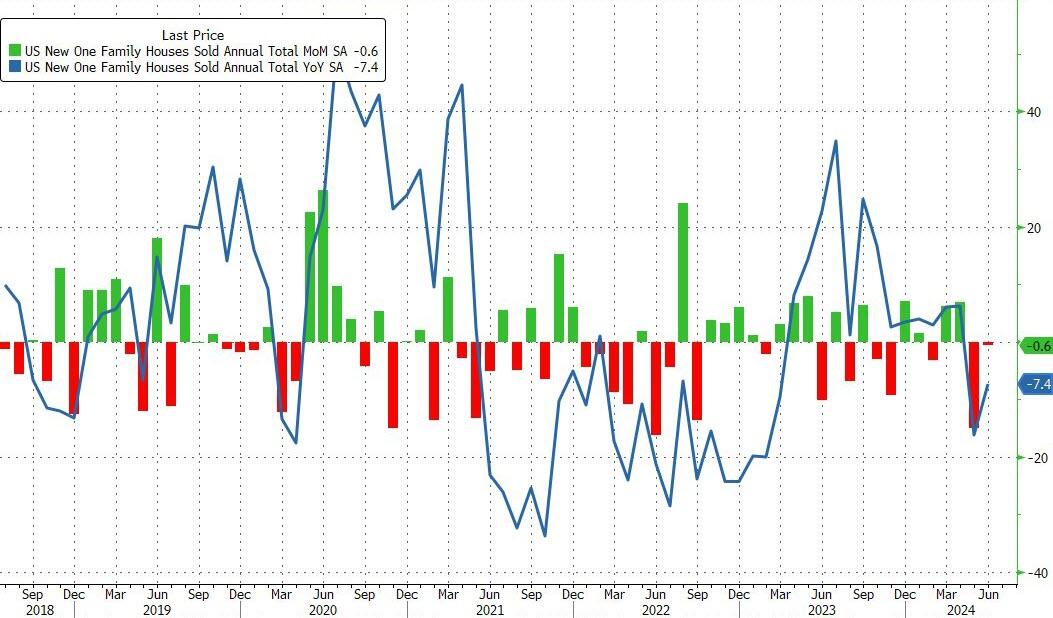
After a disappointing dump in existing home sales in June, new home sales just confirmed the slowdown, dropping 0.6% MoM (notably below the 3.4% MoM expected) and also saw a major downward revision in May from -11.3% MoM to -14.9% MoM. That leaves new home sales down 7.4% YoY…

Source: Bloomberg

That shift dragged the new home sales SAAR down to 617k – basically unchanged since 2016…

Source: Bloomberg

While the median new home price rose in June, it remains below the median existing home price…

Source: Bloomberg

It appears the homebuilder subsidy fad is wearing off as mortgage rates show no signs of easing significantly…

Source: Bloomberg

Of course, none of this should be a surprise as homebuyer confidence has collapsed to an all-time record low…

Source: Bloomberg

Will cutting rates help?


Tyler Durden
Wed, 07/24/2024 – 10:10

US Services Soar, Manufacturing Slumps In Preliminary July PMIs

US Services Soar, Manufacturing Slumps In Preliminary July PMIs

The Euro area composite flash PMI declined by 0.9pt to 50.1, notably below consensus. The deceleration in the composite index was broad-based across sectors, with the manufacturing output index falling to 45.3, and the services index declining to 51.9. Across countries, the decline in the area-wide index was driven by Germany and the periphery. 

Source: Goldman Sachs

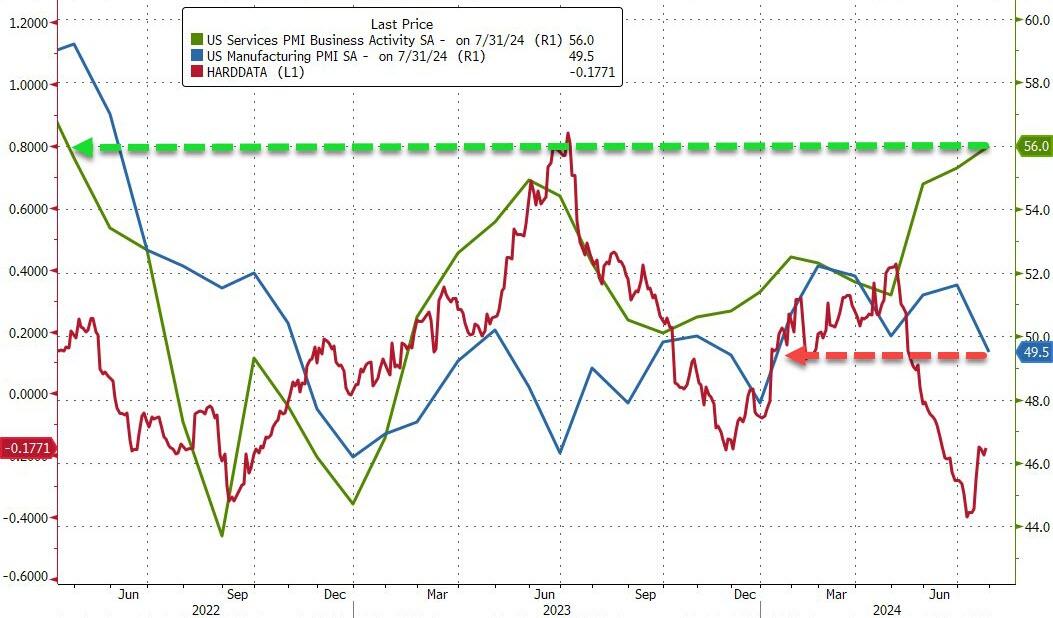
However, amid plummeting ‘hard’ data signals over the last two months, S&P Global’s ‘soft’ surveys have soared (somehow) in the US (even as European PMIs slipped lower), but were expected to dip a little in the flash July print.

But the picture – as always – was mixed with Manufacturing tumbling to 49.5 from 51.6 (51.6 exp) while Services accelerated further to 56 from 55.3 (54.9 exp)…

Source: Bloomberg

That dragged the Composite US PMI up to 55.0 – a 27-month high (as Europe hits 4-month lows)…

Source: Bloomberg

Commenting on the data, Chris Williamson, Chief Business Economist at S&P Global Market Intelligence said:

“The flash PMI data signal a ‘Goldilocks’ scenario at the start of the third quarter, with the economy growing at a robust pace while inflation moderates.

“Output across manufacturing and services is expanding at the strongest rate for over two years in July, the survey data indicative of GDP rising at an annualized rate of 2.5% after a 2.0% gain was signaled for the second quarter.

“The rate of increase of average prices charged for goods and services has meanwhile slowed further, dropping to a level consistent with the Fed’s 2% target.

However, Williamson warns that the good news is qualified, however, with both the growth and inflation pictures containing some worrying elements to monitor in the coming months.

“From the output perspective, growth has become worryingly skewed, with manufacturing slipping back into contraction as the service sector gains further strength. Some of the production decline was linked to staff shortages, so could prove temporary – something which is supported by the sector reporting improved confidence about future growth prospects. However, both manufacturers and service providers are reporting heightened uncertainty around the election, which is dampening investment and hiring.

“In terms of inflation, the July survey saw input costs rise at an increased rate, linked to rising raw material, shipping and labour costs. These higher costs could feed through to higher selling prices if sustained, or cause a squeeze on margins.”

Not exactly rate-cutting ‘bad’ news for the doves.


credittrader
Wed, 07/24/2024 – 09:54

Netanyahu Faces ‘Day Of Rage’ Pro-Palestinian Protest In DC As Many “Willing To Get Arrested This Time” 

Netanyahu Faces ‘Day Of Rage’ Pro-Palestinian Protest In DC As Many “Willing To Get Arrested This Time” 

Israeli Prime Minister Benjamin Netanyahu arrived in Washington, DC, on Monday. Today, he plans to address Congress to strengthen American support for his multi-month war in Gaza to eliminate Hamas terrorists. Meanwhile, outside the Capitol Complex, thousands of pro-Palestinian protesters are set to participate in what organizers are calling a ‘day of rage.’ 

On Tuesday evening, X user Andy Ngo said, “A large mob has flooded the US Capitol one day ahead of the planned “Day of Rage” against Netanyahu’s visit to Congress.” 

Ngo said, “Far-left and Palestinian nationalist groups have announced plans to shut down Washington, DC in response to Israeli prime minister Benjamin Netanyahu speaking at the Capitol on July 24.” 

Ahmad Abuznaid, executive director of the US Campaign for Palestinian Rights and organizer of the event, told BBC News that protesters will “make the statement that war criminals like Netanyahu are not welcome” in Washington. 

Republican House Speaker Mike Johnson invited Netanyahu to give his first address to Congress in nine years. He is scheduled to address lawmakers at 1400 ET. Johnson has warned against demonstrations inside the House chamber, saying there would be arrests “if we have to do it.”

Another protest organizer said, “More people are willing to get arrested this time” compared to previous demonstrations. 

“All the protests have shown a tone of rage, but this time is definitely different,” said one of the organizers with the Palestinian Youth Movement, adding, “It is our enemy, our primary enemy, they are inviting into the White House.”

Meanwhile, most leftist corporate media outlets are radio silent about the ‘day of rage’… Most likely because protests would generate bad optics for the presumptive Democratic nominee, Vice-President Kamala Harris.

Netanyahu is also due to speak with President Biden and VP Harris at the White House. Former President Trump announced on Tuesday that he will talk with Netanyahu later this week at Mar-a-Lago in Palm Beach, Florida.

Tyler Durden
Wed, 07/24/2024 – 09:40

Futures Slide As Ugly Mag 7, European Earnings Sour Trader Mood

Futures Slide As Ugly Mag 7, European Earnings Sour Trader Mood

Stock futures and global markets slumped, with tech dragging the indices lower, after disappointing results from Tesla and Alphabet were followed by lackluster reports from LVMH and Deutsche Bank in Europe. The first Mag7 earnings results were – as we warned in “Now Comes The Hard Part: AI Stocks Face Brutal Q2 Earnings Day Of Reckoning” – a flashing red  warning with TSLA tumbling 7%, GOOG down -3%, and the rest of the Mag7 all lower. The yield curve is steepening with 2Y seeing follow-thru buying following yesterday’s strong auction. USD is stronger and commodities are weaker excluding energy. Today’s macro data focus is on Flash PMIs, New Home Sales/mortgage applications, and Inventories. 

In premarket trading, it was all about the carnage in the first Mag7 reporters: Tesla shares plunged 8% in premarket trading after the company reported profit which missed estimates and postponed the unveiling of its highly anticipated autonomous robotaxis. Alphabet shares drop 3.4% as analysts highlight weakness in YouTube and higher capex spending. However, Google’s parent company reported second-quarter results that beat expectations on other key metrics. Here are some other notable US premarket movers:

  • Enphase Energy shares jump 6.8% after the solar-equipment manufacturer reported second-quarter gross margin that was higher than estimates. Truist Securities said the third-quarter guidance, while below consensus estimates, should give investors confidence.
  • Geron shares fall 6.7% after the biopharmaceutical company said Anil Kapur, its chief commercial officer, will depart on Aug. 31. Analysts note that the optics are not great as the reorganization comes shortly after Geron launched its highly-anticipated blood disorder drug, Rytelo.
  • Seagate shares gain 4.9% after it forecast adjusted earnings per share for the first quarter that beat the average analyst estimate. The company also reported better-than-expected fourth-quarter adjusted EPS and revenue.
  • Tesla shares fall 7.8% after the world’s most valuable automaker reported its fourth straight quarter of disappointing profits. Analysts noted that the stock might be pressured by the unexpectedly weak automotive gross margins in the second quarter.
  • Texas Instruments shares rose 2.8% after the chipmaker reported its second-quarter results and gave a forecast that was largely in line with expectations, reassuring investors that a revival is underway in key markets.
  • Visa shares fall 3.2% after the company reported third-quarter net revenue and payment volume that fell short of the average Wall Street estimate.

Almost a month after our warning that this earnings season will be ugly (see here), analysts are poring over this week’s raft of earnings for signs that the tech-driven rally of the first half of the year has longer to run.. and so far they aren’t finding them. The market is facing pressure into the summer months, with volatility also likely to be heightened by uncertainty as the US presidential race gathers pace. Hopes for the so-called Magnificent Seven are lofty. Analysts project profits at these companies to have jumped 30% in the second quarter, compared with a 10% increase for the S&P 500 as a whole, according to data compiled by Bloomberg Intelligence.

“What we’re seeing during this earnings season is the growing gap between the rather optimistic profit consensus from analysts and slowing economic growth,” said Benoit Peloille, chief investment officer at Natixis Wealth Management. “With unemployment now on the rise, earnings disappointment is to be expected and that’s what we’re seeing this season. This is true for the US and to some extent for Europe.”

So far, about a fifth of S&P 500 companies have reported results. Analyst estimates slid ahead of the season as they usually do, but market strategists including Morgan Stanley’s Michael Wilson and Barclays’ Emmanuel Cau have warned that the downgrades have been milder on this occasion, setting the bar for positive surprises higher. Investors appear particularly worried about sales, with less than half of companies beating expectations.

“Mixed earnings, alongside softening activity data and high political uncertainty keep markets on edge,” said Barclays’ Cau.

Major European markets are all lower with most down at least 1 sigma: Spain is outperforming, and France is lagging. Eurozone PMIs were weaker than expected, missing Mfg, Services and Composite as well as printing lower MoM. The Stoxx 600 is down almost 1% led lower by consumer product names and banks: Deutsche Bank dropped on its first quarterly loss in four years and scrapped plans for a buyback Germany’s largest lender said trading slowed and that it would most likely refrain from conducting a second share buyback this year, after a €1.3 billion ($1.4 billion) litigation provision tied to its Postbank retail unit. LVMH tumbled 6.5% to a six month low after sales in China plummeted during the quarter, adding evidence that an economic slowdown is hurting European companies and that even the strongest brands are succumbing to a slowdown in demand for high-end items. Analysts flagged a hit from currency movements as well as weakness in China. Here are the other notable European movers:

  • Nexans shares jump as much as 9.6% to their highest intraday level since July 2007, after the French cable manufacturer boosted its full-year adjusted Ebitda forecast above consensus expectations.
  • Reckitt Benckiser shares rise as much as 5% with investors encouraged by the decision to sell non-core homecare brands and review options for its baby formula arm.
  • Dassault Aviation shares gain as much as 11% after the French airplane maker reported 1H earnings that impressed on cash flows, reassuring investors after a selloff in recent months.
  • EasyJet shares rise as much as 9.7% after the company reported in-line third-quarter results, quelling concerns about summer demand after Ryanair’s reduced fare outlook.
  • Sodexo shares climb as much as 5.1% after the firm announced the sale of subsidiary Sofinsod, which analysts note simplifies the ownership structure and monetizes an illiquid asset.
  • Aston Martin shares rise as much as 12% after the carmaker reported revenue for the second quarter that beat the average analyst estimate.
  • LVMH shares drop as much as 5.2% to a six-month low after a disappointing set of results signals that even the strongest brands are succumbing to a slowdown in demand for high-end items.
  • Bank stocks sink to be among the worst-performing sectors, weighed down by Deutsche Bank which slumped after posting a loss and saying it will most likely skip a second share buyback this year.
  • Iveco shares drop as much as 12.5%, the biggest decline since January 2022, after the Italian truckmaker reported a free cash flow which “disappointed again,” according to Morgan Stanley.
  • ASMI shares fall as much as 4.5%, giving back Tuesday’s pre-earnings gains. The chip equipment maker reported lower-than-expected profitability, likely due to weaker sales from China.
  • Metso shares slide as much as 7.3% after the Finnish industrial machine group presented disappointing second-quarter earnings, affirming faltering investor confidence.
  • Temenos shares decline as much as 5.9% after the financial software firm cut its sales growth guidance for the full-year, albeit with other targets maintained for now.

In FX, the dollar is steady. The yen is the best performer among G-10 FX, extending gains versus the dollar after a Reuters report said the BOJ will weigh raising interest rates at its meeting next week. The euro slipped as European data showed private-sector activity barely grew.

In rates, treasuries hold small gains in early US trading Wednesday, led by short maturities following record foreign demand for Tuesday’s 2-year note auction; 10Y yields edged lower to 4.23% as investors awaited US debt auctions and manufacturing PMI data, while yields in the 2-year sector are more than 2bp lower on the day near session lows, further steepening the yield curve. With 10- to 30-year yields lower by only ~1bp, key curve spreads are approaching year’s steepest (or least inverted) levels; new 2-year note’s yield is less than 20bp higher than 10-year note’s, the smallest margin since January.  The supply cycle continues with $70b 5-year note sale at 1 p.m. New York time. German and French 10-year government bonds are little changed and the euro is slightly lower after soft PMI data from the bloc, most notably in manufacturing. Gilts are also steady after the UK figures were more encouraging while the pound has pared an earlier fall.

In commodities, oil prices advance, with WTI rising 0.9% to ~$77.70 a barrel. Spot gold is steady around $2,413/oz.

Today’s US economic data calendar includes June preliminary wholesale inventories and June advance goods trade balance (8:30am), July preliminary S&P Global US manufacturing and services PMIs (9:45am) and June new home sales (10am). Fed Governor Bowman and Dallas Fed President Logan are slated to give opening remarks at an event on Texas community partnerships at 4:05pm, the only scheduled appearances until after the next FOMC meeting ends July 31

Market Snapshot

  • S&P 500 futures down 0.8% to 5,554.00
  • STOXX Europe 600 down 0.8% to 511.09
  • MXAP down 0.5% to 181.88
  • MXAPJ down 0.4% to 564.38
  • Nikkei down 1.1% to 39,154.85
  • Topix down 1.4% to 2,793.12
  • Hang Seng Index down 0.9% to 17,311.05
  • Shanghai Composite down 0.5% to 2,901.95
  • Sensex down 0.7% to 79,843.44
  • Australia S&P/ASX 200 little changed at 7,963.72
  • Kospi down 0.6% to 2,758.71
  • German 10Y yield -2bps at 2.42%
  • Euro down 0.2% to $1.0833
  • Brent Futures up 0.7% to $81.57/bbl
  • Gold spot up 0.1% to $2,412.56
  • US Dollar Index little changed at 104.52

Top Overnight News

  • LVMH led a sell-off in global luxury stocks on Wednesday after the industry bellwether reported slower than expected sales from shoppers reining in spending on champagne and handbags. Other luxury stocks also declined as investors worried about demand from Chinese consumers and the outlook for a sector that is slowing down after several years of record growth. FT
  • Deutsche Bank stock dropped after the lender posted its first quarterly loss in four years because of a legal provision and said it probably won’t buy back shares this year. Revenue from fixed-income and currencies fell about 3%, trailing the average 5% gain on Wall Street. IB income rose about 10%. BBG
  • Europe’s flash PMIs fall short of expectations in Jul, with manufacturing coming in at 45.6 (down from 45.8 in June and below the Street’s 46.1) while services dips to 51.9 (down from 52.8 in June and below the Street’s 52.9), and inflation was mixed (with higher input costs but cooler selling prices). S&P
  • Donald Trump filed a legal complaint against the transfer of Joe Biden’s $96 million campaign war chest to Kamala Harris. Elon Musk said he’s donating to a pro-Trump super PAC but at significantly lower levels than the $45 million per month previously reported. BBG
  • Blackstone is doubling down on its international credit business and will target growth in a broader range of debt including local-currency investments. BBG
  • US crude inventories fell by 3.86 million barrels last week, with a drop also seen at Cushing, the API is said to have reported. The fourth week of declines would be the longest stretch since September if confirmed by the EIA today. BBG
  • CrowdStrike blamed a bug in a safety mechanism for allowing flawed data to go out to customers in a botched update, causing last week’s meltdown. BBG
  • The Federal Trade Commission is seeking information about how artificial intelligence and other technological tools may allow companies to vary prices using data they collect about individual consumers’ finances and shopping habits. WSJ

Earnings

  • Alphabet Inc (GOOG) Q2 2024 (USD): EPS 1.89 (exp. 1.84), Revenue 84.742bln (exp. 84.18bln). Revenue breakdown. Google Advertising rev 64.6bln (exp. 64.4bln).Google Cloud Revenue 10.35bln (exp. 10.158bln). Google Search & Other Revenue 48.51bln (exp. 47.65bln). Shares fell 2.2% after hours
  • Tesla Inc (TSLA) Q2 2024 (USD): Adj. EPS 0.52 (exp. 0.62), Revenue 25.5bln (exp. 24.77bln). Co. said the focus remains on company-wide cost reduction. Shares fell 7.8% after hours.
  • Visa Inc (V) Q3 2024 (USD): Adj. EPS 2.51 (exp. 2.43), Revenue 8.9bln (exp. 8.89bln). Shares fell 3.3% after hours.

A more detailed look at global markets courtesy of Newsquawk

APAC stocks were mostly rangebound with a negative bias seen following the lacklustre handover from Wall Street after risk appetite was dampened by underwhelming earnings results. ASX 200 was indecisive and briefly clawed back early losses with sentiment clouded by mixed Flash PMI data. Nikkei 225 retreated at the open amid headwinds from a firmer currency, while PMI data was also varied. Hang Seng and Shanghai Comp. were subdued with early pressure from demand concerns after China’s slowdown weighed on luxury spending which was evident in the 14% decline in LVMH sales in the region, while Chow Tai Fook Jewellery was among the worst hit in Hong Kong after its quarterly group retail sales fell 20% Y/Y. However, the mainland bourse managed to recover losses to return to relatively flat territory after rebounding from a brief dip beneath the 2,900 level.

Top Asian News

  • BoJ to weigh rate hike next week and have a detailed plan to halve bond buying in the coming years, according to Reuters citing sources. BoJ to taper bond buying gradually at pace near market consensus . July rate hike decision is a close call and consumption outlook is key; source describes it as a judgement call in terms of acting now or later in the year. BoJ sees no compelling reason to rush, given price rises remain moderate and inflation expectations are stable. Source adds the BoJ is likely to taper its bond purchases gradually and in several stages, at a pace roughly in-line with the markets dominate view, to avoid any yield spike.

European bourses, Stoxx 600 (-0.9%) began the session on a weaker footing, and sentiment has continued to dwindle as the morning progressed; as it stands indices resides at lows. Today’s European PMI releases have been poor, with Germany’s composite surprisingly falling into contractionary territory, whilst the EZ managed to stay in expansionary territory and noted that its GDP Nowcast still pointed towards growth in Q3. European sectors hold a strong negative bias, with only Travel & Leisure remaining afloat, which is assisted by post-earning gains in easyJet (+5.7%). Consumer Products is the clear underperformer, after LVMH (-4.7%) results, which has also weighed on peers. Banks are also towards the foot of the pile, given the significant losses in Deutsche Bank (-6.7%).

Top European News

  • Deutsche Bank Scraps Buyback After First Loss in Four Years
  • Temenos Drops on Guidance Cut, Hindenburg Report Hurts Sales
  • Reckitt to Sell Some Homecare Brands, Review Formula Unit
  • Informa to Buy Cannes Lions Owner Ascential for £1.2 Billion
  • Atos Chair Mustier Becomes CEO as Restructuring Moves Ahead
  • DWS Promises Better 2024 Despite Quarterly Client Outflows
  • DSV Is Ready For Big M&A, CEO Says Amid DB Schenker Reports

FX

  • DXY is steady around the 104.50 mark with the USD showing mixed performance vs. peers. The USD is softer against havens such as CHF and JPY whilst faring better against risk-sensitive currencies. 104.55 marks today’s peak for the DXY with not much in the way of resistance until the 100DMA at 104.82.
  • EUR is hampered by a soft set of PMI metrics with the German report a notable lowlight for the region; the release suggests a 0.4% Q/Q contraction for German GDP in Q3. As such, EUR/USD’s journey to the low 1.08’s has continued, currently around 1.0830.
  • GBP is a touch softer vs. the USD with Cable extending its move below the 1.29 mark. GBP/USD saw some slight reprieve from mixed PMI metrics with the low for the pair currently at 1.2878.
  • JPY is continuing to edge out gains vs. the USD. Price action has followed the recent broader trend but is also likely being aided by the current risk environment. USD/JPY has taken out support at the 155 level, which some desks had seen as a key test for the pair,slipping to a 154.31 base on a recent Reuters source piece.
  • Antipodeans are both the G10 underperformers. AUD is extending its losing streak vs. the USD to an 8th consecutive session with the pair now below the 0.66 level for the first time since 17th June.
  • CAD is steady vs. the USD in the run up to today’s BoC policy announcement. Consensus is for a cut, however, analysts are not unanimous in this view and therefore there could be some choppiness on the decision itself.
  • PBoC set USD/CNY mid-point at 7.1358 exp. 7.2795 (prev. 7.1334).

Fixed Income

  • Bunds are firmer after a dismal German PMI series and, by extension, a poor EZ report. The French release earlier sparked some modest pressure in Bunds, but could ultimately be caveated by the impending Olympics. Bunds to a 132.66 new WTD peak but stalling before last week’s 132.77 best. Bunds were heading lower into the German auction, which then fuelled further weakness
  • USTs are moving in-line with EGBs thus far with macro newsflow, but docket does pick up later on with the region’s own PMIs and a 5yr auction both scheduled. Currently, at a 110-31 peak with yesterday’s best just above at 111-00.
  • Gilts were bid their own PMIs, which were mixed, but had an overall hawkish skew, and as such, fell from 98.13 to a 97.94 base, before paring back towards the 98.00 mark, following a strong 2054 auction.
  • UK sells GBP 2.25bln 4.375% 2054 Gilt: b/c 3.35x, average yield 4.636%, tail 0.2bps

Commodities

  • Crude is trading with modest gains thus far following another slump yesterday. Weak Chinese demand is the factor cited for the recent persisting weakness in crude. Brent counterpart resides in a 81.12-67/bbl range.
  • Overally mixed and contained trade across precious metals amid a lack of pertinent catalysts to drive price action overnight, whilst the morning saw the complex unreactive to Flash PMI data from Europe. Spot gold trades in a USD 2,419.26-2,405.01/oz parameter after topping resistance around USD 2,412/oz.
  • Mixed trade for base metals with the complex awaiting the next catalysts after being unfazed by European Flash PMIs.
  • US Private Inventory Data (bbls): Crude -3.9mln (exp. -1.6mln), Distillate -1.5mln (exp. +0.2mln), Gasoline -2.8mln (exp. -0.4mln), Cushing -1.6mln.

Geopolitics: Middle East

  • IDF launched a new incursion into West Bank’s Tulkarem, according to a source cited by Times of Israel.
  • Artillery shelling and Israeli tank fire was reported on east of Khan Younis, according to Al Jazeera.
  • Islamic Resistance in Iraq said it conducted a drone attack on a vital target in the north of Eilat, according to Al Jazeera.

Geopolitics: Other

  • French prosecutors said a Russian was arrested over ‘destabilisation’ plot during Paris Olympics, according to AFP.
  • Japanese Chief Cabinet Secretary Hayashi said Russia’s decision to restrict 13 Japanese individuals’ entry including Toyota Motor’s Chairman is “totally unacceptable” and they filed a complaint against Russia over their decision to restrict entry.

US Event Calendar

  • 07:00: July MBA Mortgage Applications -2.2%, prior 3.9%
  • 08:30: June Wholesale Inventories MoM, est. 0.5%, prior 0.6%
    • June Retail Inventories MoM, est. 0.5%, prior 0.7%
  • 08:30: June Advance Goods Trade Balance, est. -$98.7b, prior -$100.6b, revised -$99.4b
  • 09:45: July S&P Global US Manufacturing PM, est. 51.6, prior 51.6
    • July S&P Global US Composite PMI, est. 54.2, prior 54.8
    • July S&P Global US Services PMI, est. 54.9, prior 55.3
  • 10:00: June New Home Sales, est. 640,000, prior 619,000

DB’s Jim Reid concludes the overnight wrap

The Olympics unofficially starts today in Paris ahead of Friday’s opening ceremony. The five of us are going to Paris for a long weekend in two weeks’ time to a) watch the synchronised swimming finals (artistic swimming as it’s now called), and b) go to EuroDisney. I’ve refused to waste good money on tickets for the twins for the artistic swimming so we’ll be roaming the streets in Paris while my wife and Maisie go. In addition I’ll be also trying to find some urgent client meetings to do in Paris which means I can avoid two days at EuroDisney. Help!

The market’s torch has shone slightly less brightly in the last 12 hours with the S&P 500 (-0.16%) losing some late traction after Monday’s rebound with S&P (-0.65%) and Nasdaq (-0.95%) futures notably lower this morning after a soft start to Mag-7 earnings after the bell. At the close last night the S&P 500 declined for the fourth time in five sessions, the first such occurrence since April, and having seen its biggest 3-day fall since October at the back end of last week. These choppy markets come as the focus is now squarely on earnings season. Alphabet and Tesla last night will be followed by Apple, Meta, Microsoft and Amazon next week but with Nvidia the laggard on August 28th.

Those tech earnings started on an underwhelming note last night. Alphabet did post a modest revenue and earnings beat, boosted by cloud computing and advertising growth, but its shares slid -2.2% in post-market trading after the management call alluded to upcoming expense pressures. Meanwhile, Tesla fell by -7.7% after-hours as it missed earnings expectations for a fourth consecutive quarter and delayed its Robotaxi event until October. Both Alphabet and Tesla had earlier fallen by about 1% in the final 30 minutes of regular trading (they were +0.07% and -2.04% on the day respectively), contributing to a weak equity close.

Earlier yesterday, we had plenty of other results that dictated the market narrative. For instance, Spotify (+11.96%) had its best performance since January 2023 after announcing a record profit, along with growth in paid subscribers of 12% from the previous year. Other outperformers included General Electric (+5.68%), which had its best day since April after raising its guidance, whilst SAP (+7.15%) had its best day since January after their own results. That said, it wasn’t all good news, as UPS (-12.05%) saw the biggest daily decline in its share price since it first went public in 1999, after its earnings missed estimates.

Amidst all those results, equity indices had a mixed day across both sides of the Atlantic. In the US, both the Magnificent 7 (-0.05%) and the NASDAQ (-0.06%) saw marginal losses, but small caps had an excellent day, with the Russell 2000 up +1.02% and with the more cyclical sectors leading the upside. Over in Europe the STOXX 600 was marginally higher (+0.13%) amid strong gains for Germany’s DAX (+0.82%), itself helped along by the SAP advance mentioned above. But there were losses for the UK’s FTSE 100 (-0.38%) and France’s CAC 40 (-0.31%).

Meanwhile for sovereign bonds, there were gains on both sides of the Atlantic. In part, that came amidst a fresh decline in oil prices, which added to hopes that inflationary pressures were waning. Indeed, WTI crude was down -3.53% yesterday to a one-month low of $76.96/bbl. Alongside that, there was some weaker second-tier data out of the US, which cemented investors’ confidence that the Fed were on course to cut rates at their September meeting. The data showed existing home sales were down -5.4% in June (vs. -3.2% expected), taking them down to an annualised rate of just 3.89m, their lowest in six months. Separately, the Richmond Fed’s manufacturing index was down to -17 in July (vs. -7 expected), which is its lowest level since May 2020 during the Covid lockdowns.

With growing conviction about future rate cuts, that helped push yields on 2yr Treasuries down -2.6bps to 4.49%, whilst those on 10yr Treasuries were down – 0.2bps to 4.25%. Front-end outperformance was aided by a very strong 2yr auction which saw $69bn of bonds issued 2.3bps below the pre-sale yield as primary dealer take up fell to its lowest since the start of the data in 2003.

The bond gains were larger in Europe, but there was also a fairly sharp widening in sovereign bond spreads there, with those on 10yr bunds down -5.7bps, whereas those on 10yr OATs (-1.9bps) and BTPs (-2.6bps) saw much smaller declines. Indeed, the Franco-German spread moved back up to 69bps, which is its widest level since the second-round election results that led to gridlock in the National Assembly. On the topic of French politics, yesterday we heard that the left-wing New Popular Front alliance agreed to put forward Lucie Castets, an official for the city of Paris and relatively unknown, as their candidate for prime minister. As a  reminder the left-wing finished first in the election but well short of a majority. It will now be up to President Macron whether to nominate her as PM. Last night he commented that he would not appoint a PM until after the end of the Paris Olympics (on August 11).

In terms of US politics, it’s become clear that Vice President Harris has all-but-won the Democratic nomination, setting up a November general election contest with Donald Trump. As mentioned yesterday, the Associated Press have surveyed the Democratic delegates, and found that a majority of them support Harris as the nominee. And even though they could change their minds in theory, no other challenger has emerged against Harris, who has received endorsements from right across the party. Tonight we’ll also hear from President Biden, who’s delivering an Oval Office address at 8pm Eastern Time.

Those overnight losses on Wall Street are echoing across Asian equity markets this morning. Across the region, the Hang Seng (-0.59%) is leading losses with the Nikkei (-0.22%), the KOSPI (-0.11%) and the CSI (-0.10%) all trading slightly lower while the Shanghai Composite (+0.01%) is holding in slightly better.

Early morning data showed that Japan’s flash manufacturing PMI fell to 49.2 from the previous month’s 50.0. However, the weakness in manufacturing sector was largely offset by the flash services PMI surging to 53.9 in July from 49.4 in June. The latter reading was the strongest expansion since April, and came amid improving consumer demand and confidence. As a result, the flash composite output index rose to 52.6 in July from 49.7 in June.

On the back of this, the Japanese yen (+0.44%) continues to gain ground for the third consecutive day trading at 154.91 against the dollar. Meanwhile, the Bank of Japan (BOJ) is scheduled to meet next week with around 30% of economists expecting a hike, albeit with pretty much all saying the balance of risks are biased towards a hike around their central case scenario.

To the day ahead now, and data releases include the flash PMIs for July from the US and Europe. Other US data includes new home sales for June, and the advance goods trade balance for June. From central banks, we’ll get a policy decision from the Bank of Canada. And we’ll also hear from ECB Vice President de Guindos, the ECB’s Lane, and the Fed’s Bowman and Logan. Finally, earnings releases include IBM, AT&T and Ford.


Tyler Durden
Wed, 07/24/2024 – 07:55

Which Countries Have The Most Olympic Medals Of All-Time?

Which Countries Have The Most Olympic Medals Of All-Time?

This summer, 10,500 athletes will compete at the peak of their careers in the Paris Olympics.

In more than half of the Olympic Games, the U.S. has claimed the most medals out of any country. This success is partly due to substantial sports funding, with the United States Olympic and Paralympic Committee directing over $750 million to national sports federations since 2000.

This graphic, via Visual Capitalist’s Dorothy Neufeld, shows the countries with the highest Olympic medal count of all-time, based on data from the International Olympic Committee.

The Top 20 Countries by Olympic Medal Count

Here are the countries with the most medals in history, spanning from the first modern Olympic Games in 1896:

As of July 5, 2024

With a total of 2,959 medals, the U.S. surpasses the second-highest country, the former USSR, by more than twofold.

Overall, Team USA has won 827 medals in track and field events – more than the total medal counts of nearly all other countries. Going further, track and field has received more funding than any other summer sport by the United States Olympic and Paralympic Committee, bringing in $54.1 million between 2003 and 2019.

Notably, the U.S. has also won 578 medals in swimming, outpacing runner-up Australia, which has 213 medals. It is the second-highest funded summer sport, receiving $49.2 million over the period.

The former Soviet Union, which existed between 1922 and 1991, won 1,204 medals. Despite competing in just 18 Olympics beginning in the 1950s, the country had the most medals in 13 of these games. During communist rule, state-run athletic programs became increasingly important as competition between the U.S. and the USSR dramatically intensified as a means of displaying ideological dominance.

Like the USSR, China first briefly competed in the Olympics in the 1950s, but then did not compete for the next 30 years. Even with this absence, it ranks fifth in the world by Olympic medal count, excelling in gymnastics, diving, and badminton.

From a regional perspective, European countries comprise 13 of the top 20 countries in combined Olympic medals, led by Germany, Great Britain, and France. On the other hand, over 60 countries, including Bolivia and Bangladesh, have yet to win an Olympic medal.

Tyler Durden
Wed, 07/24/2024 – 07:45

Unelected Technocrats Are Now The Nation’s Chief Executives

Unelected Technocrats Are Now The Nation’s Chief Executives

Authored by Ryan McMaken via The Mises Institute,

President Biden has not been seen in public since announcing he would not seek re-election on Sunday. Biden’s “resignation” was nothing more than a text-only post on Twitter/X—and we know that the president does not manage his own social media accounts. There has been no video of the president making an announcement, and the White House is apparently planning no press conference or official act of any kind. Biden has not been seen by anyone except his inner circle in days.

(We can contrast this situation with Lyndon Johnson’s televised address announcing his withdrawal from the 1968 presidential campaign.) 

This is, in the words of Glenn Greenwald, “strange.” Moreover, Biden’s silence is inexplicable if Biden actually made the decision to withdraw from the race. After all, Greenwald, notes, if Biden is “well enough to decide, then he’s well enough to speak.” Yet, following one of the most important announcements of his political career, Biden has disappeared, and few things could better illustrate how irrelevant Biden now is to the matter of who is actually running the executive branch of the United States government.

(We do have some audio of him speaking on a Monday phone call.) 

A chain of events like this is characteristic of a palace coup—something along the lines of the 1991 August Coup in the Soviet Union, had it succeeded. In such cases, the chief executive is marginalized and replaced at the discretion of high-ranking bureaucrats and elites from within the ruling government itself. 

It’s too early to get many facts about the details of what threats may have been used against Biden to get him to effectively step aside in favor of Kamala Harris.  What we do know, however, is that the president is essentially absent and it is Harris who is conducting public events at the White House. 

So, who is running the executive branch and the White House?

The fact that Biden himself is clearly not equipped for such a task has been undeniable since his performance at the presidential debate with Donald Trump last month.

Since then, the official gaslighting propaganda about how Biden is “sharp as a tack“ has been exposed as an obvious lie. 

Biden’s lack of any meaningful presence on the public stage does make it clear that someone other than Biden is running the White House, and someone is making decisions about policy. This could be an individual who is the de facto president, or it could be a group of people. If it is a group of people it is unknown if this group if coordinating decisions, of if these people are simply making decisions haphazardly as needed. Joe Biden’s inability to answer even basic questions during the debate makes it clear that Biden is not the one making these decisions, and he’s not equipped to manage the federal bureaucracy in any meaningful sense. 

For example, the White House yesterday released a memorandum further outsourcing the president’s duties to the State Department and the Treasury Department. That is, according to the memo, “the functions and authorities vested in the President by sections … of the Rebuilding Economic Prosperity and Opportunity for Ukrainians Act” are delegated to technocrats. The president apparently can’t even personally make decisions in areas that the White House calls a priority.

For all the regime’s talk about “democracy,” it is undeniable at this point that the White House is actually run by unseen, unelected personnel who function in the shadows and are accountable only to the elites within their own ruling coalition. Some call it the “deep state.” Others call it “the headless fourth branch of government.” In any case, we are reminded that the United States is a technocracy and not a democracy, a republic, or whatever word one wants to use to describe a system that is in some meaningful way answerable to the taxpayers who pay all the bills. 

It is these unelected, unknown figures who are deciding the nation’s foreign policy, its immigration policy, and its political appointments. We simply have no idea who is deciding US policy in Ukraine, in the Levant, or in east Asia—three regions that are in danger of flaring up into major conflicts. Who really controls the nuclear launch codes? It seems only the oligarchs and some high-ranking technocrats know. Nor do we know who is crafting the present open-border policy that funnels billions of dollars to hundreds of thousands of unemployed foreign nationals who receive blank checks to live in luxury hotels in American cities.

This legislative capriciousness is all the more dangerous now that the United States is no longer governed primarily by legislation debated and passed by an elected legislature. Instead, most new policy in the United States is a matter of rule-by-decree in which presidential executive orders are handed down and enacted by the technocrats. 

In practice, it looks like the United States has now degenerated into the ideal technocracy – from the technocrat’s viewpoint.

There is no political figure at the head of this bureaucracy to offer resistance to whatever it is that the technocrats feel like inflicting on the public at any given time. Rather, the bureaucracy is free to live out its collective vision for the country learned from Marxist humanities professors at places like Vassar and Harvard. 

After all, the technocrats don’t have to run for re-election, and it’s virtually impossible to fire them. But who would fire them in any case? With someone like Joe Biden at the helm, it’s all smooth sailing for the deep state. 

Naturally, the deep state would like to make sure this state of affairs continues.

Thus, Biden has been replaced by the party elites with a candidate who is likely to be nearly as easy to manipulate and control as Biden: Kamala Harris.

The technocrats have cunningly managed to appoint Harris as the Democratic nominee without a single primary debate or primary election. Consequently, Harris has no political organization loyal to her personally, and she has no independent constituency she can call on for political support outside the permanent government. 

That is, her “base” is the technocracy itself. Under these conditions, Harris is likely to do as she is told, and that’s just how the deep state likes it.

Tyler Durden
Wed, 07/24/2024 – 07:20

New Car Incentives Soar 53% Amid Rising Inventories & Lackluster Demand Hint At Downturn 

New Car Incentives Soar 53% Amid Rising Inventories & Lackluster Demand Hint At Downturn 

Auto dealers are seeing an uptick in inventory while many consumers remain on the sidelines, deterred by the toxic combination of high interest rates and elevated inflation. In response to what seems to be a more pronounced slowdown, dealers are slashing prices and increasing incentives to stimulate demand this summer. 

A new report from the Financial Times, citing data from Motor Intelligence, with manufacturers such as Hyundai, General Motors, and Volkswagen, shows that the average incentive package to sweeten the deal jumped 53% in June, compared with the same month last year.

Anytime manufacturers and dealers increase incentives, such as offering low interest rates, cash back, and price cuts to entice consumers, that’s usually an ominous sign of an alarming demand problem. 

The unaffordability crisis impacting the auto market is straightforward: New car prices still linger at near record highs while the cost of financing is at the highest since the late Dot Com era. Folks still need to drive, so financing the big SUV is no longer possible. Instead, compact SUVs have become in high demand. 

“If folks can put off a purchase they’re doing that, but when they do need a car, now more so than a year ago, they’re looking for ones that are less expensive because they are having to deal with higher interest rates,” said Matt Smith, deputy editor, head of automotive insights at digital auto platform CarGurus. 

Data from Bankrate shows the new auto 60mo average rate most recently peaked at 8%. 

Data from consumer analytics company JD Power shows that in June, new cars sold at a premium versus the manufacturer’s suggested retail price were around 16.9%, down from nearly 35% in the same month one year ago. 

Federal Reserve data shows the average amount consumers financed for a new car is around $38.8k, down from $40k in 2022. 

Bank of America economist Stephen Juneau said “rising supplies” and “moderating demand” are some of the reasons why “manufacturers try to get cars off the lot by offering much more attractive deals.”

According to Automotive News, dealer inventory has been below 3 million vehicles for over four years. However, that’s likely changing, with June data showing inventories climbed to 2.96 million vehicles, or about a 76-day supply, up from 1.95 million one year before.

Even though inventory levels are not back to pre-Covid levels, no dealer wants to sit on many unsold vehicles and will continue offering incentives. If the higher-for-longer interest rate environment continues through the end of the year, this could seriously pressure new auto prices. But as soon as the Federal Reserve begins cutting, which according to rate traders could be as early as September, increased demand will quickly soak up the supply and send prices higher.

Let’s not forget there’s a perfect storm brewing in the auto market, as the latest data shows auto repossessions are soaring. 

Tyler Durden
Wed, 07/24/2024 – 06:55

Growing Power Needs Call For Grid-Enhancing Technologies

Growing Power Needs Call For Grid-Enhancing Technologies

Authored by Andrew Phillips via RealClearEnergy,

The rise of AI data centers, growing electrification, and industrial growth is heralding a new era of U.S. power consumption. As our country advances, so too must our power grid. Building new transmission lines can take a significant amount of time and investment. With America’s growing power appetite not slowing down and an increasing need for renewables to meet net-zero targets, interim steps can be taken to ensure continued reliable, affordable electricity to keep pace with our growing economy.

Grid-enhancing technologies (GETs) can promote efforts to increase the capacity, efficiency, reliability, and safety of existing transmission lines. GETs are hardware and/or software that can reduce congestion costs and improve integration of renewables while increasing capacity and reliability. According to the U.S. Department of Energy, GETs can defer or reduce the need for significant investment in new infrastructure projects and increase the use of renewables by maximizing the capacity of the current infrastructure.

Power companies are seeking all options for increasing delivery capacity to support energy transition objectives and large demand increases from AI and manufacturing growth. The recent Energy Future Forum, sponsored by RealClearEnergy, underscored the urgency of addressing these challenges (see the video linked above for the part from James Danly, previously Commissioner at FERC, on the subject). 

As DOE noted in its October 2023 “National Transmission Needs Study,” there is a pressing need for additional transmission infrastructure in nearly all regions of the country. Specifically, the study projected regional transmission capacity will need to more than double to 20% by 2035 and interregional capacity will need to grow more than five-fold. According to the study, significant transmission deployment is needed as soon as 2030 in the Plains, Midwest, and Texas regions. By 2040, large deployments will also be needed in the Mountain, Mid-Atlantic, and Southeast regions.

 To address the more immediate, interim steps, EPRI recently launched a new GETs-related initiative to expand and accelerate laboratory testing, research, and lessons learned to create a smarter and more resilient energy infrastructure. The Grid-Enhancing Technologies for a Smart Energy Transition (GET SET) initiative is focused on four potentially high-impact technologies that can increase capacity for transmission:

These technologies have the potential to reduce congestion costs, improve the integration of renewables, increase capacity, and provide grid service applications in new and existing transmission networks. GETs can maximize the capacity of existing assets now, while transmission providers build new capacity for the long term. How do they do that?

For example, advanced conductors are designed to operate at higher temperatures, can increase the power transfer capacity of existing transmission networks and fully utilize existing rights-of-way. While these conductors have been available for several years, uncertainty remains on some aspects of procurement, installation, inspection methods, and long-term performance. At our advanced laboratories in Lenox, Mass., and Charlotte, N.C., has been and will continue to perform extensive life expectancy and specifications testing of multiple carbon, ceramic, and ultra-high strength, steel-cored conductor systems.

Evaluating and vetting these technologies today as they are being deployed on a wider scale can reduce the risk upon full deployment. However, the scale to which these technologies have been studied vary widely between the four categories. These technologies can also be integrated into the new infrastructure that is built to maximize the capacity of the entire grid.

EPRI’s work cannot be done in a vacuum. As part of GET SET, we’re also collaborating with numerous organizations, including the North American Electric Reliability Corporation, Energy Systems Integration Group, the North American Transmission Forum, and more than two dozen electric utilities. EPRI is working with several companies and technology providers to deploy GETs now, while leveraging further research needed to deploy more broadly in the future.

Electricity is the backbone of the U.S. economy. As our country’s power needs grow while electricity companies balance affordability and reliability, we need all the tools in the toolbox at our disposal.

Andrew Phillips is Corporate Vice President of Transmission and Distribution Infrastructure at the Electric Power Research Institute (EPRI). 

Tyler Durden
Wed, 07/24/2024 – 06:30