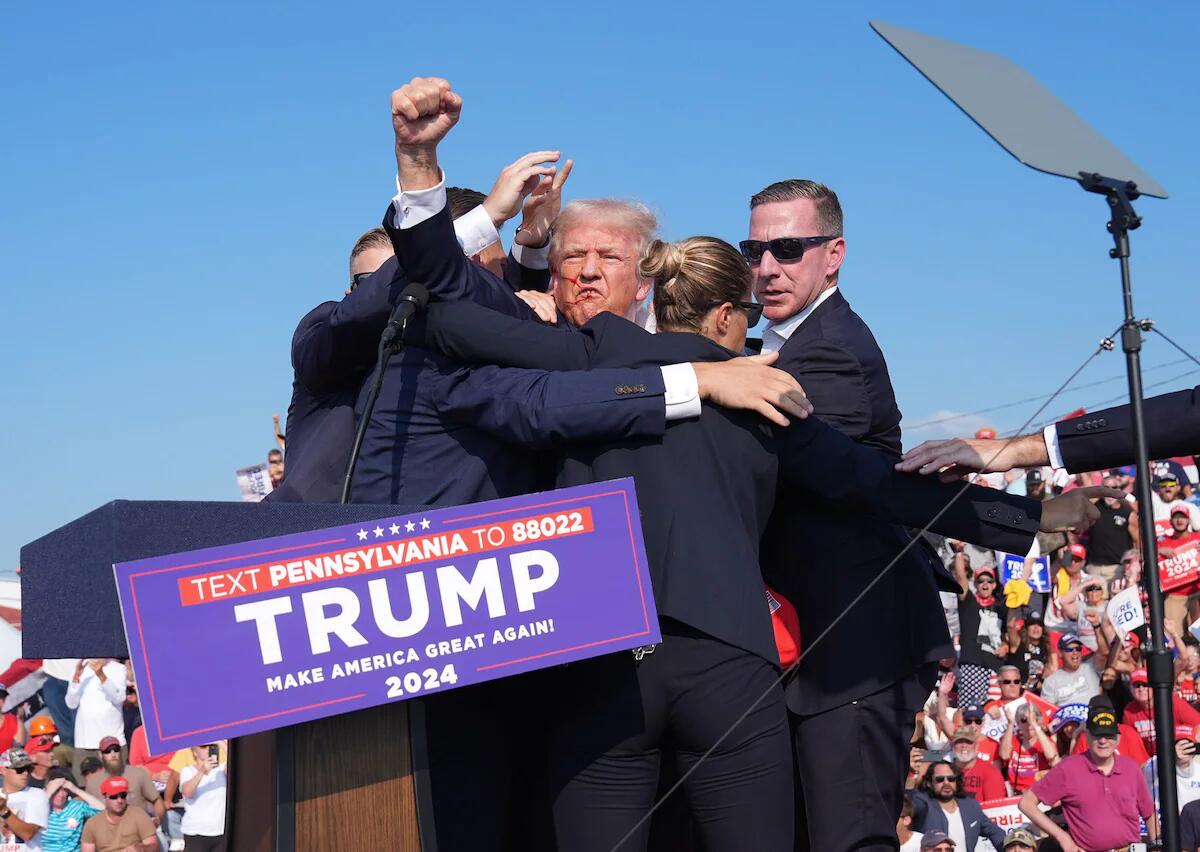
On Wednesday, the Patriots for Europe Group in the European Parliament initiated a plenary debate and a resolution condemning political violence, including the attempted assassination of former U.S. President Donald Trump, the current presidential candidate, but the majority of MEPs voted against it, Kinga Gál, the group’s first vice-president, said in Strasbourg.
Fidesz EP caucus leader Kinga Gál. (MTI/Tamás Purger)
At her press conference, Kinga Gál criticized the EU parliament for doing virtually nothing to combat the political violence that has already been rife in Europe.
She cited as examples the attack on Slovak Prime Minister Robert Fico and the case of Antifa activist Ilaria Salis, who was arrested in Budapest and “despite almost killing an innocent man, is now sitting in the EU parliament benches, and despite all the procedures, is lecturing us on how to behave.”
NEW: 🇸🇰🚨 Chilling footage of Slovak Prime Minister Robert Fico predicting his own assassination just a month before yesterday’s shooting.
Kinga Gál said that in her speech before the agenda, she also referred to Tuesday’s EU parliament vote on the vice-presidencies, calling it disrespectful to the 18 million or so voters behind the Patriots for Europe group and to the basic rules of democracy and the rule of law that neither of the two candidates — Klara Dostalova and Fabrice Leggeri — from the parliament’s third-largest group received enough votes.
“The fact that practically an extreme communist was voted into the positions belonging to the Patriot MEPs with the help of the European People’s Party is unacceptable,” she said, adding that she did not rule out legal action.
“We must fight for what we deserve for parliamentary rules,” she said.
She said that Patriots for Europe had issued a political declaration on the issue, in which it said it strongly condemned all forms of violence in political life, in the light of recent manifestations of political violence in Europe and the U.S.
“The assassination attempts on U.S. presidential candidate Donald Trump and Slovak Prime Minister Robert Fico must not go unpunished,” the statement said.
“We find unacceptable the conniving silence of the left-wing political forces and the legitimization of violent acts against patriotic politicians. We demand respect for political opponents in the left discourse and expect fair and balanced treatment from the media,” Kinga Gál wrote in a Facebook post.
Yuval Harari is best known as a globalist “philosopher” or “guru” closely tied to the World Economic Forum. He is infamous for his Ted Talks and summit speeches declaring the coming abandonment of personal individualism and independence while elevating AI as the harbinger of a new technological religion. He joyously preaches about the fusion of AI technology with the human body to give certain elitist groups the power of “gods.” His notions of the supposedly infinite abilities of algorithms to influence culture and politics are so overblown they enter into the realm of children’s fantasy.
I mention Harari often in my work because I believe he is a kind of litmus test for the true intentions of globalists. He’s a lot like Henry Kissinger in his New World Order zealotry – He has a hard time keeping his mouth shut about the greater agenda and this works to our advantage. If you really want to know what the elites plans are, look up past discussions by true believers like Harari. When they start preaching their dark gospel they can barely control themselves.
It’s important to understand that Harari’s ideology is common among the globalists and the only thing I can accurately describe it as is “Luciferianism” – A narcissistic belief system that claims CERTAIN human beings can become gods and should be worshiped as gods. Harari and many globalists seem to think AI is their ticket to godhood. I would compare them to the corrupt high priests of ancient cultures like the Aztecs who used their secret knowledge of mathematics and the movements of the planets to predict solar eclipses and terrify the peasants into compliance. AI is the new solar eclipse; the great serpent eating the sun.
Combine this corruption with elitist desires for a one-world government and you can see the incredible danger here.
In his book ‘From Animals into Gods: A Brief History of Humankind’ in a passage that has recently been removed from newer additions, Harari says this:
“As the twenty-first century unfolds, nationalism is fast losing ground. More and more people believe that all of humankind is the legitimate source of political authority, rather than the members of a particular nationality, and that safeguarding human rights and protecting the interests of the entire human species should be the guiding light of politics. If so, having close to 200 independent states is a hindrance rather than a help. Since Swedes, Indonesians and Nigerians deserve the same human rights, wouldn’t it be simpler for a single global government to safeguard them?”
(From Animals into Gods: A Brief History of Humankind (2012), p. 244
Keep in mind that when Harari talks about “human rights” he is referring to human desires. He has stated on numerous occasions that he believes freedom and individuality are fantasies, constructs of the mind with no importance in the real world. For globalists, “human rights” are special privileges used as leverage to buy popular compliance. They are a gift from government, not a gift from God.
In the past couple of years Harari has suddenly shifted his rhetoric and argues that global government is not the ideal. He also talks about AI as a danger that needs to be contained by bureaucracy rather than a deity that needs to be worshiped. I suspect this is because there has been a sea change in public awareness since 2012 and now he has to be more careful about how he talks in the media. I have been working within the Liberty Movement since 2006 and I can say with some authority that many MILLIONS more people are aware of the threats posed by globalism today compared to 2012. This puts the globalist agenda in peril.
With the failure of the pandemic lockdowns I think the power brokers have been left stunned. This was clearly their big play to get the global governance they have long lusted after and it fell apart. Attempting to induce mass fear over a virus that 99.8% of the population would easily survive did not work out well for them.
Everything was riding on medical tyranny: They thought they were going to get vaccine passports which would have given them total economic control of the populace. They thought they were going to introduce CBDCs (digital currencies) and create a cashless society. They thought they were going to leverage the covid lockdowns into perpetual “climate lockdowns.” They got nothing and their agenda was fully exposed. The patriot movement in the US has exploded in popularity in response and now they have millions more rebels to contend with in the future.
In response to their failure, many of the prominent names during the lockdowns have faded into the background.
Klaus Schwab from the WEF was EVERYWHERE during covid; now he is gone.
Anthony Fauci has slipped into obscurity.
Authoritarian leaders like New Zealand’s Jacinda Ardern have stepped out of the political limelight. Where did they go?
I think they know what’s coming. I think they fear a populist backlash, a rising of torches and pitchforks, and they are going into hiding.
This is where we must address the issue of Donald Trump and how he is viewed by the globalists…
In light of the recent assassination attempt on Donald Trump I think it’s important to revisit the long running globalist narrative on the “world order” and Trump’s position as scapegoat for any and all calamities that befall it.
Their primary assertion is that any movement that values national interests over global centralization is an evil movement that must be suppressed or destroyed. This very rhetoric has permeated leftist political organizations (including Joe Biden’s administration) and the corporate media; it is being used as a justification for subterfuge and extreme violence against conservatives.
In an interview earlier this year, Harari suggested that the return of Donald Trump would mean the “death of the global order.” He then gaslights, claiming that there is no fight between nationalism and globalism and that the idea of a “globalist conspiracy” is entirely a fabrication of populist movements. These people truly expect us to forget the censorship and oppression they attempted during covid.
What I find most interesting is Harari’s take on the next few years, in which he offers what I would interpret as a thinly veiled threat. He argues that war is coming on an expansive scale unless nationalists (defenders of sovereignty) end their rebellion and return to “order” (the centralized control of the globalists). He ties this threat directly to Donald Trump.
The thing is, Trump is just a reflection of a larger movement against the globalist regime. Getting rid of Trump would change nothing. In fact, getting rid of Trump might make the populace commit to full bore revolution even faster. And, if it ultimately turns out that Trump doesn’t benefit the cause of freedom from the elites, that same revolution will eventually happen without him.
I have my own concerns about Trump, primarily what kinds of people he will place in his cabinet. But I have long said that above all else Trump is the most likely scapegoat for an international collapse that the GLOBALISTS CREATED. They set the stage for these crisis events by encouraging economic instability and geopolitical conflicts (Ukraine being one of many). I don’t see any globalists vying for legitimate peace. I do see them pushing to escalate various conflicts into WWIII.
The trick is, by blaming Trump they think that all conservatives and “nationalists” will be blamed by extension. It’s an obvious but somewhat clever ploy; by making conservatives into the villains behind a planetary catasrophe the elites can deflect suspicion while operating with impunity in the future.
Anyone who questions them can simply be labeled as “nationalist terrorists” as history is rewritten.
But is the “death of the global order” really a bad thing? I would say that it is only a negative if the globalists are left alive to continue to manipulate the chaos that follows. The real culprits behind war and economic collapse should be punished. They should be removed from power, imprisoned or done away with forever. Bottom line? The globalists need to go if real peace and order is ever to be established.
* * *
If you would like to support the work that Alt-Market does while also receiving content on advanced tactics for defeating the globalist agenda, subscribe to our exclusive newsletter The Wild Bunch Dispatch. Learn more about it HERE.
Despite the fact that the “traditional” TV model (i.e. live TV, broadcast and cable) has been under severe pressure from streaming services and changing media consumption habitsin recent years, many people would argue that the past decade has in fact been the golden age of TV.
That is, the golden age of scripted TV series, which have enjoyed a level of attention, critical acclaim and appreciation as never before.
Not more than a decade ago, you would have been hard-pressed to find an established, successful actor in Hollywood willing to play a major role in a TV series.
TV actor was used as a derogatory term for those who had failed to make an impression on the big screen.
These days, elaborate productions such as HBO’s smash hit “Game of Thrones” or Netflix’s “Stranger Things” arguably grab more attention than most Hollywood blockbusters, and not only has TV acting lost its stigma, it is now a prestigious gig that many Hollywood stars are striving for.
The risen esteem of TV drama, a seemingly insatiable consumer appetite for new content to devour and of course the entrance of deep-pocketed streaming-only players such as Netflix, Amazon and Apple have led to a steep increase in the production of original scripted TV content over the past decade.
As Statista’s Felkix Richter reports, according to estimates by FX Networks Research, the number of original scripted TV series (excl. re-runs) aired in the United States climbed from 216 in 2010 to 600 by 2022 – a moment now widely seen as “peak TV”.
Last year, due in part to the Hollywood writers’ strike and in part by focus shifting from growth at all costs to profitability, the number of shows on TV declined 14 percent to 516.
FX chairman John Landgraf, a major voice within the TV industry, predicted this trend in 2022, saying that the year would mark “the peak of the peak TV era”, even before the writers’s strike disrupted production for large parts of 2023.
“I don’t see new major purveyors of programming entering the scene as they have been continuously over the past decade or more,” Landgraf explained in August 2022. “And in fact, there are some prior purveyors of television programming that are kind of exiting the scenes. So, in other words, you’re at the point now where you’re not really adding new suppliers, but you are, to some extent, subtracting suppliers.”
The United States is following Europe’s lead in instituting cap-and-trade regimes to reduce CO2 emissions, but America’s journey is split between two paths—Democrat-run states that have passed cap-and-trade mandates, and Republican-run states that appear to have no intention of doing so.
In the middle are several swing states that have entered, then exited, cap-and-trade pacts, depending on which party gains the upper hand.
As global demand for oil, gas, and coal hits record levels and shows no signs of slowing, cap-and-trade has been hailed as an alternative way to reduce the use of fossil fuels by setting caps on how much CO2 companies can emit, and then allowing those that exceed the cap to purchase credits from companies that emit less, or to invest in projects, such as preserving forests, that purport to offset emissions.
The financial currency of the cap-and-trade market is called an “allowance,” which gives companies the right to emit greenhouse gasses. Each allowance is valued in terms of tons of emitted CO2, currently priced at less than $10 per ton, though organizations such as the World Bank have said that pricing in the range of $50–$100 per ton is needed to meet the net-zero goals of the Paris Climate Accords.
Advocates of cap-and-trade hail it as a “market-based” solution.
“Cap and trade harnesses the power of the market to fight global warming,” a report by the Environmental Defense Fund states.
“The cap on emissions guarantees the environmental results we need,” the report states. “Trading gets it done in the cheapest way possible.”
But some critics are skeptical, arguing that it is essentially a tax on energy that gets passed on to consumers and commuters, and that insiders may benefit more than the environment from the enormous sums of cash paid into the system.
“Cap-and-trade is a very interesting theoretical model to try to solve a policy problem, but it’s one that ultimately ends up just moving the costs around,” Ryan Yonk, an energy economist at the American Institute for Economic Research, told The Epoch Times.
“Ultimately, the people that pay are the end consumers. The people that benefit are the market creators, and that’s really one of the major concerns,” Mr. Yonk said.
“If you’re going to have a cap-and-trade system, those that are facilitating the transactions, the middlemen that are involved, will ultimately be those that benefit most directly.”
And indeed, an industry has sprung up around carbon pricing regimes, with stock exchanges vying to become financial centers for carbon trading and financial firms looking to profit from making markets in this new currency.
In addition, accountants and consultants earn fees to develop investable carbon-offset projects and to quantify the environmental benefits. Companies that develop wind and solar production or carbon-capture technology are also often recipients of carbon-offset payments under these regimes.
Europe led the way in mandating cap-and-trade, establishing the European Union Emissions Trading System (EU ETS) in 2005, which regulates approximately 10,000 manufacturing and energy facilities, as well as air and maritime transport. According to the EU, this system has reduced industrial emissions by 37 percent since its founding.
The Obama administration attempted to implement a nationwide cap-and-trade system, but noted that Americans would end up paying more.
President Barack Obama stated in 2008: “Under my plan of a cap-and-trade system, electricity rates would necessarily skyrocket.”
He said coal powered plants or the natural gas industry, for example, “would have to retrofit their operations—that will cost money [and] they will pass that money on to consumers.”
According to a report by the Heritage Foundation, enabling legislation in Congress “failed to reach President Barack Obama’s desk because constituents gave their members an earful that cap and trade would amount to a massive energy tax.”
Since then, Democrats have been successful in implementing these mandates only at the state level.
According to the Center for Climate and Energy Solutions, more than one-fourth of Americans now reside in a state with a cap-and-trade program, which together comprise one-third of U.S. GDP.
In 2009, Connecticut, Delaware, Maine, New Hampshire, New Jersey, New York, Vermont, Massachusetts, Rhode Island, and Maryland officially launched the Regional Greenhouse Gas Initiative, a cap-and-trade pact that ultimately expanded to include a dozen states throughout the northeast and Mid-Atlantic region.
California enacted its own cap-and-trade regime in 2012, and advocates say it has generated significant results.
A May report by California’s Air Resources Board stated that the state’s cap-and-trade program has funded $28 billion in climate-related investments over the past decade. Of the money spent, $11 billion financed various projects to “fight climate change and cut pollution.”
The remaining $17 billion was designated for projects such as putting affordable housing near job centers, building high-speed rail, and “adding zero-emission transportation options in underserved communities.”
In 2021, Washington State established a similar program, calling it “cap-and-invest,” through its Climate Commitment Act (CCA). The state now conducts quarterly auctions of CO2 allowances that emitters must purchase if they exceed emissions caps. The caps will be progressively reduced so that the state can get to net-zero emissions by 2050.
“These 2030, 2040, and 2050 limits were set into state law before the CCA was passed, and they’re based on the latest climate science,” Caroline Halter, communications manager for Washington’s Department of Ecology Climate Pollution Reduction Program, told The Epoch Times.
“In other words, they’re what scientists have said all governments need to do in order to avoid the worst impacts of climate change.”
BlueAnon Watch: One-Third Of Democrats Believe Trump Faked Assassination Attempt As Conspiracy Theory Goes Mainstream
At the height of the “QAnon” fervor in 2021 – roughly 23% of Republicans said they believed the theory that Donald Trump is fighting a cabal of satanic, sex-trafficking pedophiles.
On Monday, a Morning Consult poll found that 34% of Democrats think Trump faked his own assassination attempt last Saturday. Such left-wing conspiracy theorists have been referred to as “BlueAnon,” and as the Washington Free Beacon reports, this particular notion – that Trump faked the assassination attempt – originated with Democratic powerbroker Dmitri Mehlhorn, who has made at least 10 visits to the Biden White House.
Hours after the shooting on Saturday, Mehlhorn – and adviser to LinkedIn founder Reid Hoffman (who joked about assassinating Trump the week before the attempt) – sent a memo to reports suggesting they portray the shooting as a false-flag operation directly from Vladimir Putin’s playbook, designed to give Trump an iconic photo-op.
“This is a classic Russian tactic, such as when Putin killed 300 civilians in 1999 and blamed it on terrorists to ride the backlash to winning power,” wrote Melhorn, who failed to address numerous photos – such as the one showing a bullet whizzing past Trump’s head, the obvious bullet wound across Trump’s right ear, or the death of a rally attendee – Corey Comperatore, who was shot while shielding his family from bullets.
Oh?
Clip of bullet ripping Trumps ear ‼️
This should silence the Left Wing Conspiracy Nuts who say the entire Trump shooting was staged. pic.twitter.com/E2tcmKsVcn
— Concerned Citizen (@BGatesIsaPyscho) July 18, 2024
As the Free Beacon reports, the conspiracy theory is spreading like wildfire:
Jeff Tiedrich, a liberal social media influencer with 1.1 million followers who attended an Oct. 2022 White House influencer summit to coordinate midterm election messaging with the Biden administration, on Monday posted a Substack screed “connecting some weird dots” surrounding the shooting.
“Did the extreme right want this to happen?” Tiedrich wrote, speculating the shooting could have been connected to a plot to replace Trump atop the GOP ticket with former national security adviser Michael Flynn.
Tiedrich, who did not return a request for comment, on Thursday mocked the Washington Post for describing the shooting as “Trump’s near-death experience” and said there was no hard evidence that a bullet grazed the former president’s ear.
“What the fuck is going on under that bandage?” Tiedrich asked. “And why is the press so disinterested in finding out?”
Liberal MSNBC commentators have adopted a subtler approach to fanning the conspiratorial flames, suggesting in recent days that Trump could not have been shot in the ear by a high-caliber rifle bullet and that the former president is hiding something by not releasing detailed medical records about his wound.
“If he was shot by a high-caliber bullet, there should probably be very little ear there,” MSNBC host Michael Steele told viewers on Tuesday.
Steele’s fellow MSNBC host Joy Reid on Wednesday joined him in asking questions about Trump’s injuries.
“I have many questions!” Reid wrote on Threads. “Like where are the medical reports? What caused Trump’s injury and what was the injury? Sheapnel? [sic] Glass? A bullet?”
Reid doubled down on her baseless conjecture Thursday morning, posting a video to TikTok in which she said that “we still don’t know for sure whether Donald Trump was hit by a bullet,” glass fragments, or something else. She then suggested something nefarious was behind the Secret Service’s having “allowed” Trump to pump his fist as agents led him off the rally stage.
Joy Reid of MSNBC is now suggesting that Donald Trump was never hit by a bullet, and that his campaign and the Secret Service colluded to kill two people in a fake assassination attempt just so Trump could have a photo op.
Meanwhile, former CNN reporter John Harwood, who admitted he’s “not familiar with ballistics at all,” suggested that Trump’s ear shouldn’t exist if an AR-15 bullet grazed it.
how often have AR-15 bullets “pierced” part of someone’s body, “ripping through the skin,” while leaving the body part intact and without serious injury?
on the other hand it’s easy to imagine a shard of shattered glass causing the bleeding Trump suffered
I have known President Donald Trump for 30 years. Callista and I consider him a dear friend. Watching him get shot at his rally in Butler, Pa. was stunning and horrifying.
President Trump’s reaction to being shot was immediately iconic. He stood up with blood running down his face, raised his fist, and said “fight, fight, fight,” and then “USA.” It was a tremendous vision of courage and power. It struck home all around the world. Within minutes images began to circulate on the internet tying President Trump’s courage to the courage of other historic figures and moments. There is even a Japanese anime about President Trump’s heroic reaction.
When it was clear the President was going to be alright, Callista and I were deeply relieved. For me, that emotion was then immediately replaced by fury. This assassination attempt was the result of the left’s nine-year effort to demonize our friend, President Trump. I had to take some time to get my emotions under control before going on Fox with Sean Hannity to talk about the event.
During that cooling off period, my old friend Ambassador Randy Evans called to say that his Pastor, Michael Youssef, had told him it was a providential event. President Trump had turned to look up at a big sign behind him. The shooter took aim at his head while he was looking to one side. When the President turned back to look at the audience the bullet missed his head by less than an inch and hit his ear.
If President Trump had not turned at exactly the right moment, he would have almost certainly been killed.
When I told Hannity that I really believed President Trump’s survival was providential, that term went around the world.
The concepts of divine intervention and providence have a long record in American history.
When young George Washington went west with Maj. Gen. Edward Braddock’s British army in the French and Indian War, they were ambushed on July 9, 1755. Braddock was wounded when the battle began. The Army began to panic and fall apart. Washington, then-23 years old, took control and rallied the British troops saving them from annihilation.
Washington wrote his brother, “by the All-powerful Dispensations of Providence, I have been protected beyond all human probability or expectation; for I had four Bullets through my Coat, and two Horses shot under me; yet escaped unhurt, altho[ugh] Death was leveling my Companions on every side of me.”
Washington’s belief in providence was further expressed in his farewell address to the troops after the success of the Revolutionary War: “The singular interpositions of Providence in our feeble condition were such, as could scarcely escape the attention of the most unobserving.”
When President Ronald Reagan met with Pope John Paul II to determine how to defeat the spread of communism, one of the unifying facts was that both had been shot in assassination attempts. Coming to grips with why God had spared them – and finding a common mission in defeating the Soviet Empire – were inextricably intertwined. Callista and I talked about this our documentaries “Ronald Reagan: Rendezvous with Destiny” and “Nine Days that Changed the World.”
President Trump now joins the list of historic figures who have been saved from almost certain death.
When President Trump came to the Republican National Convention, I could tell that he was already calmer, more deliberative, and grateful to be alive. There was a humility and gratitude in his attitude that showed the act of having been spared had a deep impact.
Virtually anyone who had been within a half-inch of being killed would have a deep and sobering reaction. “But for God, I would have been dead,” is a legitimate sentiment.
President Trump’s courage and determination after having been shot has created new level of affection – and a new intensity of support – among those who believe in him. He was always the champion of a movement rather than a traditional candidate. Now he has become a symbol of courage, defiance, and determination.
Neither America – nor President Trump – will ever be the same after Saturday’s nights assassination attempt.
We are on the edge of a new stage in American history.
The combined sense of gratitude, awe, and historic challenge make this convention different from any of the nine others I have attended.
The Supreme Court’s decision to strike down the Chevron deference, which had the effect of enhancing federal agency power, has been deemed a “seismic” change for U.S. administrative law.
Members of Congress tell The Epoch Times that they believe the Supreme Court ruling will equally shake up the process of lawmaking.
On June 28, in Loper Bright Enterprises v. Raimondo, the Supreme Court struck down its 40-year-old precedent in Chevron v. Natural Resources Defense Council, which required federal courts to defer to government agencies’ “reasonable interpretation” of ambiguous laws that the agencies enforce through federal regulations—even if the courts disagreed with those interpretations.
Chief Justice John Roberts wrote that the Loper Bright decision now empowers courts to “independently interpret the statute and effectuate the will of Congress.”
Members of Congress have since been considering how to update the way that laws and regulations are drafted to meet the requirements outlined by the Loper Bright decision, such that the “will of Congress” may be clear when regulations are challenged in court.
Specify Laws
Lawmakers on Capitol Hill indicated that several reforms to the legislative process are likely to follow the Loper Bright decision.
“This institution is going to have to change; how we staff committees is going to have to change, and how we work with the administrative state will have to change,” Rep. Patrick McHenry (R-N.C.), chairman of the House Financial Services Committee, told The Epoch Times.
“We’re going to have to be much more specific in the lawmaking exercise … we’re going to have to have committees that have more staff in order to accommodate specific legislative writing.”
He said Congress will “have to have some changes in our internal processes of what comes to the floor.”
“We don’t have the muscle memory of how to write laws specific enough … it’s muscle memory that has to be recreated here. And it’s possible but it’s going to be hard,” Mr. McHenry said. He briefly acted as the House Speaker pro tempore in 2023 after Rep. Kevin McCarthy (R-Calif.) was stripped of the gavel.
The Supreme Court in Loper Bright opined that non-specificity in statutes is unintentional, suggesting that Congress could now intentionally write laws more specifically.
“A statutory ambiguity does not necessarily reflect a congressional intent that an agency, as opposed to a court, resolve the resulting interpretive question. Many or perhaps most statutory ambiguities may be unintentional,” Justice Roberts wrote for the court’s majority opinion.
However, members of Congress say ambiguous laws are a political necessity, given disagreements between lawmakers over a law’s scope and purpose.
In those situations, Congress, for convenience, often delegated the interpretation of some laws to federal agencies, which gave them wide discretion to regulate.
“The vast majority of all regulations in the last 40 years have been because of the ambiguity,” Sen. Rand Paul (R-Ky.) told The Epoch Times.
“When people know there are not votes to pass the laws, they figure: ‘Well, let’s make it ambiguous, and then the agency will interpret it in a way we like,’” Sen. John Cornyn (R-Texas) told The Epoch Times. “None of that will be able to occur anymore.”
“The Supreme Court seems to be pointing at Congress to say: Be more specific,” Sen. Tim Kaine (D-Va.) told The Epoch Times. “That does put a little more of a burden on our shoulders when we’re doing legislation, to not just broadly defer. Exactly how specific [laws] have to be, I don’t know.”
That level of specificity has divided members as they draft legislation, with some believing it’s impossible.
“There is always going to be some ambiguity in the bills that we pass … as much as you want to write bills that are very, very specific, you can’t,” Rep. Carlos Giménez (R-Fla.) said.
Instead, some lawmakers believe Congress should now specify how courts treat post-Chevron disputes about regulations, such as making evidence reviewable “de novo”—whereby courts can examine evidence beyond the agency’s administrative record, to which they are currently limited by the Administrative Procedures Act (APA).
That proposal goes beyond Loper Bright, in that courts would not only interpret the law authorizing a regulation but also judge the validity of scientific and technical evidence supporting it.
“Moving forward, we need to prescribe and be very clear that … [there] is a de novo review,” Sen. Eric Schmitt (R-Mo.) told The Epoch Times.
Others think that all new regulations should require Congressional approval before passage.
“Rulemaking should come back to the House. If the administrative branch writes a rule based on our law, we as Congress should be able to approve that rule: up or down,” Mr. Giménez said.
Some Lawmakers Favor Reversing Loper Bright
As some members of Congress consider how to adapt to Chevron’s departure, several Democrat lawmakers have responded by looking for ways to restore Chevron deference to agencies.
“We’re going to fix what the Supreme Court did when they overruled precedent for no good reason, in what is known as Chevron case,” House Democratic Caucus Vice Chair Ted Lieu (D-Calif.) said.
“The Supreme Court has now essentially said that, ‘Hey, judges are better than the technical experts at agencies and looking at congressional statutes’ … No, judges are not better,” he said.
Efforts to codify Chevron deference into law have been gaining steam among congressional Democrats.
In March of 2023, Congressional Progressive Caucus Chair Pramila Jayapal (D-Wash.) introduced a related bill with several co-sponsors. After the recent Loper Bright decision, 35 Democrats have joined as co-sponsors, including Rep. Jerry Nadler (D-N.Y.), ranking member of the House Judiciary Committee, which has jurisdiction over reforms to federal courts.
The Senate’s 60-vote “cloture” requirement to overcome a filibuster means such reforms are unlikely unless Democrats force a rule change to rescind it. Moreover, some legal experts raise constitutional and practical concerns about the idea.
“Over the years, Chevron had acquired many exceptions, qualifications, and acknowledged ambiguities,” said Jeremy Rabkin, a distinguished fellow at the C. Boyden Gray Center for the Study of the Administrative State.
“It wouldn’t be enough for a statute to say, ‘Never mind Loper Bright, just go back to Chevron.’ The statute would have to explain what that was supposed to mean. But, once you get down to the details, I am doubtful Congress could reach an agreement on what it would like,” Mr. Rabkin said.
“Beyond all that, I think there are serious constitutional problems with a statute that tells courts how they should interpret statutes.”
Other Democrats have suggested more measured reforms.
“We’re still looking into [reforms] and whether a general amendment of some kind to the Administrative Procedures Act, or more specific bill by bill ramparts, to protect the expertise from judicial meddling are the best way to go,” Sen. Sheldon Whitehouse (D-R.I.), the chairman of the Senate Budget Committee, told The Epoch Times.
Since the Loper Bright decision, Congress has not taken up any major administrative proposals that would invite regulation.
Whenever that may be, it will likely prove to be the first test of how Congress proceeds with legislation post-Chevron.
“There’s been a sea change of how this place operates. I think, how the whole government operates,” Rep. Dean Phillips (D-Minn.) said of the impact of the decision.
Watch Live: Tucker, Hulk Hogan, & Dana White Intro Trump’s Address To RNC
It’s the last day of the 2024 Republican National Convention – and it’s going to be a big one.
7:30 p.m. Central
Tucker Carlson, founder of Tucker Carlson Network
7:30-8 p.m. Central
Carrie Ruiz
Hulk Hogan, former professional entertainer and wrestler
Annette Albright
8-9 p.m. Central
Franklin Graham, president and CEO of the Billy Graham Evangelistic Association
Eric Trump
Dana White, CEO of Ultimate Fighting Championship
9-10:30 p.m. Central
Former President Donald J. Trump
Former first son Donald Trump Jr. predicted Thursday that his father’s upcoming speech at the Republican National Convention will be “personal” since it changed after the assassination attempt.
“Listen, you get shot in the face, it changes a lot. And so, I’m actually looking forward to hearing it.”
Trump Jr. said he looked over his father’s original speech and thought it was good. He added that the first speech had gone in the “wastepaper basket” after the assassination attempt at a rally in Pennsylvania.
Eating junk food is as pervasive in our current culture as eating naturally was in our not-so-long-ago past—and it shows. A systematic review published in The BMJ this year, involving 9.8 million participants, indicated an association between the consumption of ultra-processed foods and an increased risk of 32 diseases, including heart disease, cancer, Type 2 diabetes, anxiety, and premature death.
Dr. Zheng Yuanyu, former attending physician of the Infectious Disease Department at Taipei Veterans General Hospital in Taiwan, discussed the addictive nature of ultra-processed foods and strategies for managing their consumption rationally on the “Health 1+1” program.
What Are Ultra-Processed Foods?
Some examples of ultra-processed foods include ready-to-eat meals, packaged baked goods, snacks, sugary cereals, and carbonated drinks, according to a BMJ Group press release. These items undergo multiple industrial processing steps and typically contain colorings, emulsifiers, flavorings, and other additives. Additionally, they are often high in added sugars, fats, and salts, while being low in fiber and vitamins.
Dr. Zheng noted that the definition of “processed foods” is broad, and not all processed foods are classified as “ultra-processed” or unhealthy. For example, he said, foods that are heated and sealed in a factory are considered minimally processed. However, some simple processed products can still be unhealthy. The most common ultra-processed foods, such as various snacks, beverages, and factory-produced cookies and bread, undergo more complex manufacturing processes and contain multiple chemical additives, resulting in a less healthy nutritional profile.
7 Health Risks of Ultra-Processed Foods
The BMJ review included 45 distinct studies involving over 9.8 million participants. The results multitude of adverse health outcomes revealed by the review can be broadly classified into the following seven categories:
Cancer: Overall cancer, breast cancer, colorectal cancer, central nervous system tumors, chronic lymphocytic leukemia, pancreatic cancer, and prostate cancer.
Mental health: Poor sleep, anxiety, common mental disorders, and depression.
Gastrointestinal health: Crohn’s disease and ulcerative colitis.
Metabolic health: Abdominal obesity, high blood sugar, metabolic syndrome, non-alcoholic fatty liver disease, overweight, obesity, and Type 2 diabetes.
The researchers assessed the credibility and quality of evidence from various studies and found that excessive consumption of ultra-processed foods was particularly associated with a higher risk of cardiometabolic issues, common mental disorders, and mortality outcomes.
Specifically, the researchers noted that “compelling evidence” indicated a higher intake of ultra-processed foods was linked to a 50 percent increased risk of cardiovascular disease-related mortality, as well as a 48 to 53 percent increased risk of anxiety and common mental disorders. Furthermore, it was associated with a 12 percent increased risk of Type 2 diabetes.
Additionally, highly suggestive evidence showed that a higher intake of ultra-processed foods was associated with a 21 percent increased risk of all-cause mortality, a 22 percent increased risk of depression, and a 40 to 66 percent increased risk of heart disease-related mortality, Type 2 diabetes, obesity, and sleep problems.
Dr. Zheng highlighted that while ultra-processed foods are linked to numerous diseases, this does not necessarily indicate a direct causal relationship. However, he specifically emphasized that the evidence connecting ultra-processed foods to diabetes is the most compelling, with relatively high-quality research supporting this association. Diabetes can deteriorate vascular and immune functions throughout the body, increasing the risk of various other diseases in patients already predisposed to diabetes.
Dr. Zheng cited a study published in JAMA Network Open in 2023, which explored the association between ultra-processed foods and the risk of mental illness. The study suggested that ultra-processed foods may increase the likelihood of developing depression. The researchers tracked more than 30,000 health care professionals for 15 years and found that individuals in the highest quintile of ultra-processed food intake had a 49 percent higher risk of depression compared to those in the lowest quintile. The study revealed that eating more ultra-processed foods, especially those containing artificial sweeteners, significantly increased the risk of depression.
The Addictive Nature of Ultra-Processed Foods
A 2023 study published in The BMJ estimated that approximately 14 percent of adults and 12 percent of children may experience issues related to ultra-processed food addiction.
Dr. Zheng stated that issues related to ultra-processed food addiction, much like smartphone and alcohol addiction, can significantly impact mental health. He explained that the complex ingredients in ultra-processed foods, such as refined carbohydrates and fats, can stimulate the brain to release large amounts of dopamine, reaching levels similar to those triggered by substances like nicotine and alcohol, thereby contributing to addiction.
Furthermore, Dr. Zheng pointed out that ultra-processed foods are high in refined carbohydrates and often contain added fats and chemical additives. Due to various processing methods, these foods can produce certain effects that disrupt the body’s appetite regulation mechanisms, leading to increased calorie consumption without realizing it. The long-term accumulation of excess calories can, in turn, result in subsequent health issues.
Health Tips for Moderating Ultra-Processed Food Intake
In today’s environment, the temptation of ultra-processed foods is unavoidable. Dr. Zheng emphasized the importance of recognizing the addictive nature and health hazards of these foods. They should be enjoyed in moderation, avoiding excessive consumption. If signs of addiction appear, early intervention is crucial.
Among ultra-processed foods, it is recommended to choose relatively healthier options. For instance, for breakfast, opt for cereals that are lower in sugar, sodium, and salt, and higher in fiber, while avoiding refined carbohydrates. Additionally, mixing sugary cereals with unsweetened ones can help reduce the overall sugar content.
Dr. Zheng used a popular chocolate cake product as an example, highlighting that its ingredient list contains a significant amount of chemical additives, such as complex thickeners, emulsifiers, and agents for improving baking fat quality. Each 3.53 ounces (100 grams) of the cake contains 0.93 ounces (26.3 grams) of sugar, which accounts for over a quarter of its composition, indicating a very high sugar content, along with 0.62 ounces (17.7 grams) of fat. Dr. Zheng cautions that such a cake should not be consumed as a daily snack and should be avoided unless there is a special occasion.
YouTube Tightens Stranglehold On Firearms Content – Blocks All Gun Related Sponsors
When Google and YouTube first announced that they would be demonetizing a host of channels back in 2017 (including firearms related content) they said is was because advertisers were “complaining” about their ads being featured in videos that were contrary to their messaging. In other words, the excuse was that ads embedded on firearms channels might give their customers the “wrong impression” about those companies and their products, and Google didn’t want to anger their advertising partners.
It’s hard to say how accurate this claim was. The exposure of ESG and Big Tech collusion with government agencies to censor conservative platforms supports the idea that there was probably an organized corporate push to suppress the political opposition on YouTube as much as there was an effort to shut them down on social media.
The majority of conservative content creators understood that this was not about advertisers, it was about narratives. The exploding popularity of gun channels runs contrary to the media assertion that American society is moving increasingly to the left. And, even though gun channels mostly focus on firearms and instruction, they also promoted conservative and constitutional values which represent a thorn in the side of the establishment.
More proof has surfaced that randomized advertising and company complaints were never the issue. Gun related channels are reporting that Google/YouTube is not only demonetizing them, they are also no longer allowed to feature private sponsors that market gun related products.
That is to say, YouTube tried to crush these channels by removing cash incentives. That didn’t work because gun channels adapted and found their own outside sponsors. So, YouTube is doubling down and denying them the option of getting ad money from any gun associated sponsor. And apparently, what constitutes a “gun sponsor” is up to the discretion of Google.
The channels will still be allowed to post content, however, making any money while doing so will be increasingly difficult. Videos posted after June 18th that include gun-related sponsors will be removed and the channel will receive a strike. Strikes can lead to the cancellation of the entire channel.
Remember, these are not random sponsors that work with Google, they are outside sponsors working directly with the content creators. There is no chance that the presence of these sponsors will hurt Google in any way. The move to stop them from working directly with creators appears to be motivated by politics, not by business. It also showcases an active hostility within Google towards the free market.
The decision comes only weeks after YouTube changed their official policy on firearms videos to include possible age restrictions, along with the removal of some videos which give instructions on how to modify firearms or produce ammunition. Ostensibly, this was to prevent the publishing of “ghost gun” and 3D printing content.
As long as creators continue to rely on highly centralized and controlled platforms like YouTube the potential for censorship will loom large. These policies are rarely reversed, the restrictions only continue to grow. Alternative platforms need to be explored (Rumble and Gunstreamer are a good start) because it’s unlikely that Big Tech will ever back away from its hostility towards conservative content.