55.6 F
Chicago
Saturday, September 26, 2026
Home Blog Page 2486

Worst Of All Worlds… For Democrats

Worst Of All Worlds… For Democrats

Authored by Christopher Roach via American Greatness,

The time for a political party to deal with a decrepit, elderly figurehead is not after the primaries, in which he won millions of votes and is presumptively guaranteed to be the party’s nominee. The recent attempts to replace President Biden as the Democrats’ candidate, coupled with his steadfast refusal to withdraw, put him and his party in a terrible position.

Not only was he obviously suffering from some form of cognitive impairment during his early debate with Trump, but now large numbers of senior Democrats and media figures have admitted this, demanded his resignation, and otherwise expressed a lack of confidence. This is, of course, a desperate attempt to win after internal polling shows he had fallen even further behind, because it was already obvious to most people that Biden wasn’t “all there.”

To some extent, the conspiracy of silence and Biden’s occasional moments of lucidity permitted these concerns to be denied and deflected until now. But this kind of careful stage management can only go so far. He is who he is, and his avoidance of some core parts of the job—meeting with regular people, press conferences, and the use of his brain—has been enabled to the fullest extent possible.

If Biden were to cooperate in these efforts and refuse the nomination, it would beg the question of whether he maintains sufficient fitness for office. After all, his term is not done until January 2025. Such a departure would also lead to an open question of whom to replace him with.

Kamala Harris has obvious problems; not least, she has never won a single state previously as a primary candidate. She is notoriously awkward, devoid of charisma, and kind of dumb. She got the job because she met Biden’s minimum standards to be a vice president, not least his demand that the person be a woman and a minority.

The bigger problem with the recent rebellion against Biden’s candidacy is Biden himself. Nothing about his rise was organic. He has been around a long time and has always been a blowhard, dishonest, kind of rude person, and all of this was capped off by an astronomical ego. He has problems today because he was installed in 2020 with the blessing and machinations of the highest Democratic Party leadership, likely with Barack Obama pulling most of the strings.

Thus, Elizabeth Warren and Pete Buttigieg all pulled out of the race before Super Tuesday in 2020. And the COVID hysteria permitted Biden’s shortcomings – his lack of energy and inability to think and speak clearly – to be largely hidden from the public. He campaigned from the basement, with television ads and news media complicity doing most of the heavy lifting.

In addition, the 2020 general election was rather notoriously “fortified.” We do not know the exact manner and extent to which various changes affected the outcome in 2020, but we do know there was an unprecedented use of hard-to-verify mailed ballots, late-night stoppages of vote counts, and lots of people paid by anti-Trump partisans involved in the vote counting process.

In other words, Biden and his presidency have always been fragile because Biden’s 2020 election does not reflect the normal democratic process and the stratagems that artificially inflated his support created a corresponding reduction in his long-term popularity.

Perhaps, having installed Biden, the Democratic Party’s leadership and big donors figured Biden would do as he was told. But like so many people placed into jobs because of nepotism, affirmative action, and other anti-competitive tricks, he has quickly assumed a strong sense of personal entitlement. It does not get more powerful than President of the United States, where a cast of thousands makes life as orderly, pleasant, and reflective of one’s wishes as possible. Already blessed with a huge ego, Biden’s ego could only grow in office.

Plus, his wife clearly is very comfortable with the trappings of money and power that her husband’s office provides. We should not forget that Biden is the central node in a sprawling and complicated family-wide scheme of grifting, influence peddling, and self-enrichment. These are people who like money, pomp, and power. It is no surprise that his failson Hunter Biden assumed a big role as an advisor and leads the effort to persuade his dad to remain in office and continue his reelection campaign.

Even if there were some ideal candidate waiting in the wings, the optics of changing horses this late in the race and the logistical challenges of ballot access may not be easily surmountable. Biden, if nothing else, has name recognition and did win (sorta) at least one national election, which is more than could be said for Kamala Harris, California Governor Gavin Newsome, or others whose names have been bandied about.

It is, honestly, a beautiful thing to behold. One faction of the Democratic Party tried to create insurmountable pressure on Biden to drop out, citing his manifest cognitive issues, which were on display in the televised debate with Trump. The early debate itself was a risk that Biden undertook to give his failing campaign shock therapy.

In the course of the post-debate discussions about Biden’s competence, internal polls leaked, which showed the extent of the damage.

Then heavy hitters like Obama and Bill Clinton weighed in and said everyone should chill out and stick with Biden. Biden himself said he was going nowhere. Then everyone rather unpersuasively began to shift gears and suggest Biden merely had a “bad night.”

A disunified Democratic Party played a clever game in 2020, and now that game is backfiring. They were able to rig things one time and pull an incompetent and incapable candidate over the finish line, but now the guy they installed won’t leave. They can’t figure out how to make him win again or whom to embrace as an alternative, even as the party is unified in its loathing of Donald Trump.

The party that makes a fetish of democracy is now going to be beaten democratically because its antidemocratic tricks failed to account for their figurehead not cooperating and the people themselves being disgusted with his performance.

Tyler Durden
Tue, 07/09/2024 – 15:25

AriZona Iced Tea CEO ‘Fights Hard’ To Keep Prices At 99 Cents

AriZona Iced Tea CEO ‘Fights Hard’ To Keep Prices At 99 Cents

AriZona Beverages first debuted its 99-cent cans at retail brick-and-mortar shops in 1992. Thirty-two years later, the price has yet to be raised a single penny. 

“I don’t know about never, but not in the foreseeable future,” Arizona Beverages chairman and founder Don Vultaggio said in a recent interview with NBC Morning News and Today, who was asked if price hikes were imminent.

Vultaggio said, “We’re going to fight as hard as we can for consumers because consumers are my friends.”

He explained that keeping prices for the 23-ounce cans was “maybe … my little way to give back.”

“We’re successful. We’re debt-free. We own everything,” he said. “Why have people who are having a hard time paying their rent … pay more for our drink?”

In a 2022 CNBC interview, Vultaggio explained the way his company keeps prices low is not through large advertising campaigns, like major competitors, but instead relies on word-of-mouth.

“I tell people every day I go to a gunfight with Coke and Pepsi,” the billionaire said, adding, “I have a water gun and they have machine guns.”

According to Bloomberg, Vultaggio has a roughly $4.5 billion net worth. 

Vultaggio’s 99-cent cans remind us of Costco’s commitment to a $1.50 hot dog-soda combo, which has been in place since the mid-1980s. 

In recent months, Costco CFO Gary Millerchip had to clarify with inflation-weary customers that the $1.50 hot dog-soda combo won’t be hiked:

“To clear up some recent media speculation, I also want to confirm the $1.50 hot dog price is safe.”  

Consumers need all the help they can get after watching prices of food at-home and away surge during the era of failed Bidenomics. 

Earlier this year, a WSJ report showed how consumers were spending 11.3% of their disposable income on food, the highest level since the early 1990s. 

Source: WSJ 

Many consumers believe that supermarket food inflation has risen much more sharply than what is printed in government datasets.

The best deals in town include 99-cent AriZona teas and Costco hotdogs. The other week, Goldman said the best supermarket deals are at Walmart.

Tyler Durden
Tue, 07/09/2024 – 15:05

Robusta Rockets To 16-Year High After Major Grower Vietnam Records Export Plunge

Robusta Rockets To 16-Year High After Major Grower Vietnam Records Export Plunge

The global robusta coffee shortage continues unabated, with prices reaching new highs in London trading on Tuesday. The surge, according to Bloomberg, is directly linked to concerns over sliding bean exports from Vietnam due to ongoing droughts. 

Vietnam, the world’s second-largest producer of robusta beans, recorded a 50% plunge in June exports from one year ago to 70,202 tons, according to the country’s customs department. Bloomberg calculations show this is the lowest amount of beans exported since the 2010-11 crop season. 

“Dry weather continues to have an impact on production in Vietnam,” said Michael McDougall, managing director at Paragon Global Markets.

Robusta bean contracts in London rose as much as 3.5% to $4,500 a ton on Tuesday, the highest in data going back to 2008. Arabica futures in New York jumped 4%. 

Here’s our latest coverage on the global coffee market:

Let’s not forget that a third of the world’s robusta beans come from Vietnam. The bean is primarily used in instant coffee and espresso. 

Last month, J.M. Smucker Co., whose brands include Folgers, Dunkin’, Café Bustelo, Pilon, and Medaglia d’Oro, warned of imminent price hikes across its brands due to the surge in bean prices. 

Get used to elevated food prices. 

Tyler Durden
Tue, 07/09/2024 – 12:25

Scene Of Misery

Scene Of Misery

By Michael Every of Rabobank

Today’s market action is obviously going to be Fed Chair Powell’s first round of semi-annual Congressional testimony. The expectation is that recent US data will have been enough for him to open the door to September as being the magical date when the Fed first cuts rates in this cycle, something market Pavlov’s dogs had first penciled in for this January. Better late than never, as far as markets are concerned, as after that first cut, it’s all (more) gravy, baby. Of course, if Powell doesn’t deliver on that promise, yet again, we can expect some testy money.

While we are waiting for him –and developments in post-election France, which markets decided ‘doesn’t matter much’ with a shoulder-shrugging arrogance any Parisian would be proud of, but ‘Fractured France’ by Erik-Jan Harn shows does— I want to ponder the bigger picture.

In that light, here’s my mise-en-scène. (Subtitle: “Scene of misery.”)

President Biden has made it even clearer that he won’t be stepping down, regardless of what his own party or big donors in Hollywood or Silicon Valley say. Some press reports he is personally convinced he still has 2024 in the bag, even if the bagmen aren’t. Others say Jill and Hunter Biden, and a coterie of senior advisors, are circling wagons around him.

The Wall Street Journal has an article introducing US Senator Vance, reportedly a strong contender for Trump’s Vice-Presidential slot. Long story short: Vance is an intelligent, eloquent, energetic proponent of a ‘national conservatism’ opposed to Reaganomics and Gordon Gecko-ism; imagine him alongside now neo-Hamiltonian former USTR Lighthizer as Treasury Secretary, and the signal that would send to Wall Street. Yes, Trump would have to win first, and neither appointment might happen if he does, but the potential should be evident that we could see a paradigm shift which markets can’t say ‘doesn’t matter much’.

‘China’s financial elite face pay caps, bonus clawbacks’ “to comply with President Xi Jinping’s “common prosperity” campaign. The nation’s largest financial conglomerates have asked senior staff to forgo deferred bonuses, and in some cases return pay from previous years to comply with a pre-tax cap of 2.9m yuan, according to sources familiar with the matter. Vilified by Beijing as “hedonists” over their lavish lifestyles, top-earning finance workers including investment bankers and fund managers have been among the hardest hit by Xi’s push for a more equal distribution of wealth.” Of course, that pay cap is still vastly higher than any comparable local position, and in the West we also saw action taken on bonuses and higher taxes post-2008; and the French LFI party angling for a role in government are no fans of markets, and in favour of 90% top income tax rates.

‘Chinese bond traders fear ‘dagger to the heart’ as bond yields vanish’. The pay-cap means the plunge in yields this year (the 2-year has fallen from 2.31% to 1.64%, the 10-year from 2.61% to 2.27% and the 30-year from 2.83% to 2.49%) won’t translate into anything extra in the pay packet, while traders wonder how long they will have a job at all if this slide continues, looking at the JGB market as portent. Ironically, the JGB market is roaring back to life as the BOJ tries to normalise rates, and Western bond markets flirted with death by a thousand cuts prior to this latest rate hike cycle. Yet China seems very unlikely to follow that lead given its very high debt levels and evidently slower GDP growth (on the housing/consumer side).

However, even that yield trend has a sting in the tail.

When the PBOC recently stepped into their bond market, the expectation –based on Western experience– was that they would buy bonds to push yields lower in an attempt to jump-start their low-demand economy, as we did via QE. Yet the PBOC, based on the same Western experience, instead borrowed bonds and sold them at a lower price to try to push yields UP(!) Why? Because the last thing the PBOC is interested in is financial speculation in assets. China is focused on channeling capital into “productive capital”, meaning making things, not into making money from money, which Marx called “fictitious capital”. Yes, they want low rates to encourage productive investment – but only that.

Yet once the Fed starts cutting, there will inevitably be a flood of ‘What if they have to go back to zero?’ speculation, especially if data turn south, and/or, ‘What if they have to do that even if inflation isn’t under control?’ Ignoring the latter, no doubt, Wall Street would not just be salivating but swimming in an Olympic pool of its own drool: Zero rates! Speculation! Financialisation! Leverage! Bonuses! Buy All The Things! And just imagine what this would translate into in assets elsewhere, like Australian house prices: a starter home in Sydney might be, what, A$10m? I’m making that number up: but lots of spruikers would be doing it for real too.

So, let’s join the dots from the above:

Powell might open the door to a September cut today — which has been our house call for months — but he almost certainly won’t open the door to pre-Covid ‘new normal’ monetary policy.

After all, even if he cuts on ‘stag’ not ‘flation’, a further step-up in US/Western fictitious capital would be of no use in a world which the need for productive capital of some kinds is going to be underlined by the NATO summit held in Washington, DC – where President Biden is clearly going to try to look his most vigorous. China; and Russia; and Iran; and North Korea are making it abundantly clear what really matters in that regard.

More broadly, France, the UK, and both Biden and Trump, all in very different ways, show the door is opening for significant changes in the Western political economy to recognise this harsh geopolitical reality.

As such, markets’ golden age of ‘elections don’t matter’ is seeing the door slowly closed on it. L’Age d’Or (Subtitle: “Large Door”)

FIN (Subtitle: “Isn’t fine”)

Tyler Durden
Tue, 07/09/2024 – 12:05

2024 Hurricane Season Predicted To Be Particularly Active

2024 Hurricane Season Predicted To Be Particularly Active

Hurricane Beryl made landfall in Texas on Monday, moving inland after having torn across the eastern Caribbean last week, killing 11 people. According to the National Hurricane Center (NHC), Beryl was a Category 1 hurricane when it reached the coast of Matagorda at 4:00 a.m. local time with maximum sustained winds of 80 mph.

As Statista’s Anna Fleck reports, the National Oceanic and Atmospheric Administration (NOAA) has forecast this year’s hurricane season to be particularly active, with between 17 to 25 storms anticipated where winds are expected to be upwards of 39 mph.

Infographic: 2024 Hurricane Season Predicted to be Particularly Active | Statista

You will find more infographics at Statista

The average number of named storms for a season is 14.

Last year was tied with 1933 as the fourth most active season for named storms, with 20 that season. 

Data collected by the Department of Atmospheric Science at Colorado State University shows that 2005 was a particularly bad year in terms of more powerful weather events, with 15 hurricanes.

It also had the highest number of major hurricanes at seven, three of which were Category 5 hurricanes, the most extreme group on the Saffir Simpson scale, known to bring catastrophic damage – Katrina, Rita, and Wilma.

Tyler Durden
Tue, 07/09/2024 – 11:45

Senile, Drooling, But Mostly Fabulous

Senile, Drooling, But Mostly Fabulous

Authored by Tom Luongo via Gold, Goats, n’ Guns blog,

Well, here we are.  It’s a full blown panic.

It is now obvious that President Biden lacks the mental faculties to carry on the office of the presidency.  And the nervous mice are starting to tiptoe out on the ice and do the ‘noticing in public’ they have avoided the last three and a half years.

The Democrats are now dividing themselves between the culpable and those with culpable deniability.  Who knew?  Who could have known?

It’s time to call a lid on the whole damn thing, Jack.

Now Republicans don’t want to hear that, they want to keep Biden in the race, for obvious reasons.  That’s easy to understand and if he was just running as a candidate and not for reelection, it wouldn’t be a big deal.

But, there is a country to run, every single day.  And we do not know who is running it.  That is beyond politics.  And beyond unacceptable.

Democrats are nervous about Kamala.  Who cares?  She is the Vice President of the United States of America and her job is to step into the vacuum at moments like this.

There will be plenty of time for a post-mortem later, but there can be no pretending that Biden is capable of finishing out his term.  It’s nonsense and everyone knows it.

But the Democrats have never met a rule or standard that they weren’t willing to politicize, and relativize, to their own ends.

They can always screw over President Harris at the convention in six weeks, and give the nomination to someone else.  They can fight the ballot issues at the state level.  

But I bet she winds up with the Senile Ice Cream Man’s superdelegates, so maybe everyone should stop worrying and learn to love the Kam…ala.

How did we get here?

According to some, it was because the right wing crankosphere has been too mean.  Calling out the obvious denied the establishment press their ability to do their jobs.

They had to spend all their time doing counter-narrative against internet meanies, otherwise they would have noticed the president is unfit for office.

Well, we’ve been calling him the Senile Ice Cream Man ™ for over three years over here, so it must be our fault.  We are deeply sorry about that.  Sorry about being able to perceive reality.

Meanwhile, the press is still getting their heads around the possibility of consequences.

Give credit to the New York Times for being able to sniff a change in the zeitgeist and move quickly towards it.  Even as they deserve heaps of scorn for carrying on the farce for so long, they’ve quickly put on their big girl pants and are out doing the journalism thing.  It’s been cringeworthy to watch.

So the press is doing the careful lane change.

But we still have to watch all the Democrats pretend they didn’t know.

“Whip smart” Joe Biden is the best he’s ever been!  That’s what they said on Morning Joe!

You know the show where marriages, and credibility, goes to die.  But, it wasn’t a lie, exactly.

In some ways, Biden hasn’t changed at all.  He was always an egotistical prick who said dumb stuff.  Joe has always made up thinly believable lies based on his patronizing view of the world.  He’s always been awkwardly sniffing people.

Even if you believe “Corn Pop was a bad dude,” do you not remember Biden was the life insurance policy for the first black president?

Obama thought “…I sure don’t want to get shot, who could I pick for VP that would make even an assassin think twice?  Oh, I know, Joe Biden.  No one wants that dumbass in charge!”

Feng Shui of Deck Chairs on the Titanic

Supposedly, poor Doug Emhoff, you know the ‘second gentleman’ was at a debate watch party with Rob Reiner and Jane Fonda.  What did he do to deserve that?

Meathead and Hanoi Jane?

In any case, five minutes in Reiner reportedly started screaming while Jane was crying.  Awkward.  Not as bad as listening to Kamala practice a speech, but pretty bad.

Then you have the Hollywood elites, with their fake surprise and lamentations of betrayal.

I can think of a lot of off-color compound words people might use to describe Ari Emmanuel.  Dumbfuck is not on that list.

He was so surprised to see Biden’s performance, shocked I tell you.  Bitch, please.

It’s instructive that Democrats are only lamenting Biden’s display of mental deficiency because it hurts his chances of winning in November.

They don’t think it’s in any way important to encourage Biden to step down from the presidency because he lacks the mental fitness to execute his office for the seven months remaining in his term.

And because they are so absorbed in the current fire drill that none of them have considered how that makes them look.

C’mon MAN!

In its heyday, the sun never set on the British Empire.  But the sun goes down on Joe Biden every day around three hours after he gets up.  He requires a coterie of flunkies to stage manage his every waking moment.  To insulate him from embarrassing himself.  To help him find the podium in the middle of an empty stage.

He probably can’t even legally sign Hunter’s pardon due to diminished capacity.

But he ain’t leaving.  Not after flubbing a softball interview with Stephanopoulos (22 minutes unedited, what stamina!), followed by angry letters to Democrats challenging them to a convention fight.  Biden was always an antagonizing putz, but now we are just seeing demented defiant rage.

Look, I’m old enough to remember that Smells Like Children is an EP by Marilyn Manson, not what the President says when he’s left unsupervised.  So believe me when I tell you there is a new campaign slogan coming…

Joe is only senile sixteen hours a day, but TRUMP IS CRAZY ALL DAY LONG!

Tyler Durden
Tue, 07/09/2024 – 11:25

Panama Cracks Down On Darien Gap Migrant Trail – US To Pay For Deportations

Panama Cracks Down On Darien Gap Migrant Trail – US To Pay For Deportations

Days into his first term in office, Panama’s new president has started following through on his promise to cut off a major avenue used by immigrants bent on entering the United States — the notorious Darien Gap. However, migrant smugglers are encouraging their customers to keep on coming, assuring them new barriers are being easily bypassed. 

On July 1, President Jose Raul Mulino was sworn into office. On the same day, Panama announced it had signed an agreement with the United States with a goal of cutting the flow of migrants through the isthmus. Under the deal, the US government has committed to covering Panama’s expenses for deporting people who enter Panama illegally, and to help with “equipment, transportation and logistics.” 

“By returning such individuals to their country of origin, we will help deter irregular migration in the region and at our southern border,” the US National Security Council said in a July 1 statement, adding that the program will also help “halt the enrichment of malign smuggling networks that prey on vulnerable migrants.” 

Panama’s new President Jose Raul Mulino at his July 1 inauguration (Matias Delacroix/AP via NBC News)

About a half-million migrants made the journey across the gap in 2023, and about 200,000 so far this year. On the campaign trail, President Jose Raul Mulino emphasized his intent to end Panama’s role as a critical link in a path that funnels northbound migrants into Central America. He reiterated that intention in his inaugural address, saying, “I will not allow Panama to be a path open to thousands of people who illegally enter our country supported by an entire international organization related to drug trafficking and human trafficking.”

Fulfilling that promise is no easy feat. To do so, Mulino’s administration must shut down migrant trails that traverse the Darien Gap, a roadless, 60-mile expanse of of swamps, mountains and rain forest that is the only terrestrial connection between South and Central America. Within the gap, migrants are routinely preyed upon by criminal gangs known to commit assaults, robberies and rapes, and to abandon beaten, hungry victims in the jungle. More than 60 migrants reportedly died in the first half of 2023, but some believe that number is a large understatement. 

Even ahead of Mulino’s inauguration, Panama started installing concertina-wire fences inside the Darien Gap. “The patrol at the national border service has begun to block the majority of border passages,” said Frank Abrego, Panama’s minister of public security during a June 28 visit to the area. 

According to NBC News, the first imagery of the new barriers appeared as early as June 27. Videos were initially shared in WhatsApp groups used as information-sharing hubs by would-be emigrants to the United States, and have now spread to social media.   

This video shows fencing comprising some eight rolls of concertina wire; underscoring the challenge of blocking travel through a wilderness area, it also shows a single-file line of migrants queued up, apparently waiting for their turn to crawl under under the fence: 

Smugglers are taking to WhatsApp to tell potential customers there’s nothing to worry about: 

“Listen to me, everything is active — Carreto, Acandi, Capurgana, Caledonia,” one smuggler said Sunday in a WhatsApp group, listing off popular routes he said are still open. “The guards did put a fence along Capurgana but people are passing one by one — kids, adults and they are passing the same. They have not sent anyone back nor are they sending anyone back.” –NBC News

A long list of perils awaits those traversing the Darien Gap, including heat, rain, mud, dehydration, dangerous water crossings, disease, thieves and rapists (John Moore/Getty Images via Council on Foreign Relations)

Portraying news reports as mere scare tactics, another smuggler said only “negative” and “lazy” people are deterred by the new fences — essentially daring would-be migrants into making the harrowing journey.  

Given the Biden administration’s reflexive opposition to walls and fences, we shouldn’t be surprised that it would distance itself from the concertina wire. “The U.S. has not provided support to the Government of Panama to erect barriers at its borders,” a National Security Council spokesperson told NBC, noting that Panama nonetheless “has a right to protect its borders.” 

Tyler Durden
Tue, 07/09/2024 – 11:05

Private Equity – Do You Feel Lucky?

Private Equity – Do You Feel Lucky?

Authored by Lance Roberts via RealInvestmentAdvice.com,

Lately, I have been getting many questions about investing in private equity. Such is common during raging bull markets, as individuals seek higher rates of return than the market generates. Also, during these periods, Wall Street tends to bring new companies to market to fill the demand of the investing public. Private equity is always alluring, as is the tale of someone who bought the company’s shares when it was private and made a massive fortune when it went public.

Who wouldn’t want a piece of that?

The private equity (PE) business is huge. When I say huge, I mean $4.4 Trillion huge.

Those PE companies have been extremely busy over the last several years. While there has been a surge in private equity startups, there has also been the privatizing of public companies. The Atlantic shared some data about the dwindling number of publicly traded stocks along with the corresponding growth in private equity investments:

The publicly traded company is disappearing. In 1996, about 8,000 firms were listed in the U.S. stock market. Since then, the national economy has grown by nearly $20 trillion. The population has increased by 70 million people. And yet, today, the number of American public companies stands at fewer than 4,000. How can that be?

One answer is that the private-equity industry is devouring them.

In 2000, private-equity firms managed about 4 percent of total U.S. corporate equity. By 2021, that number was closer to 20 percent. In other words, private equity has been growing nearly five times faster than the U.S. economy as a whole.

PE firms managed less than $1 billion in the mid-1970s. Today, it’s more than $4 trillion. There is more than $2.5 trillion in dry powder alone globally:

However, that “dry powder” is problematic for PE companies as they must invest it or return it to the investors. Therefore, the demand for deals often means that the deals getting funding may not be the “best” deals.

That is a substantial risk we will discuss in more detail momentarily.

Is Private Equity Right For You?

Many individuals hear tales of how high-net-worth individuals (the smart money) own private equity in their allocations. As shown in the chart below from Long Angle, roughly 17% of their allocations are to private equities. These reports don’t generally tell you that their allocation to “private equity” often tends to be their personal businesses. Nonetheless, individual investors frequently see this type of analysis and think they should be replicating that process. But should they?

There are significant differences to consider between the vast majority of retail investors and high-net-worth individuals before investing in private equity. The underlying risks of private equity investments can define these differences. There are many risks, but I want to focus on three.

  1. Liquidity Risk

  2. Duration

  3. Loss Absorption

Liquidity Risk: Many individuals don’t realize when entering into private equity investments that they cannot liquidate them if capital is needed for another reason. While investors often enter into private equity with the anticipation of making outsized returns, they frequently leave themselves vulnerable to the impact of having capital tied up in an illiquid investment. When the eventual crisis happens, the illiquid status of private equity becomes problematic.

Duration Risk: The duration of private equity can often be much longer duration than initially estimated. When a private equity deal is pitched to an individual, it is always accompanied by the most optimistic projections. The projections always include optimistic exit assumptions where the individual will receive an enormous windfall. More often than not, the projections fall very short of reality. A market downturn, economic recession, or a change in underlying industries, interest rates, or inflation can turn an initial 3-year investment into a decade or more. That duration risk multiplies the liquidity risk of keeping capital tied up for much longer than anticipated, sometimes with little or no return. While high-net-worth individuals can absorb both the duration and liquidity issues, most individual investors can not.

Loss Risk: Lastly, high-net-worth individuals can absorb losses. Many private equity deals inevitably fail, leaving investors with enormous losses on their balance sheets. While high-net-worth investors can invest in numerous deals, the hope is that a successful private equity venture will offset the losses of one or more that failed. Individuals often do not have the capital for that kind of diversification, and a loss on a private equity investment can be very detrimental. The chart below from S&P Global shows the number of private transactions terminated between 2020-2023.

To that point, you should realize that most private equity investments (65%) either fail or return the initial investment at best.

Yes, private equity can be very lucrative. Depending on the deal you invest in, it can also be very harmful. This brings us to the most important question to ask: “Why am I so lucky?”

Why Am I So Lucky?

If you are approached by someone pitching a “private investment,” the first question you should ask is, “Why am I so lucky to be given this opportunity?”

As noted above, the global PE dry powder has soared to an unprecedented $2.59 trillion in 2023 as a slow year in dealmaking closes with limited opportunities for firms to deploy capital raised in previous years. The dry powder total as of Dec. 1st represented close to an 8% increase over December 2022, according to S&P Global Market Intelligence and Preqin data.

That capital is held by some of the largest PE companies in the world. The list below is just a view of the names that you will likely recognize.

Importantly, as noted, these firms must deploy that “dry powder,” or they will eventually lose it. As such, they have armies of employees to scout for the best opportunities, analysts, legal and accounting professionals to analyze those deals, and immediate capital to fund them.

Therefore, as an individual, several questions need to be thoroughly answered.

If this private equity investment is such a good opportunity, then:

  1. Why did the company not approach one of the major P/E firms with capital ready to invest?

  2. If they did and were turned down, why?

  3. How many private equity investors did the company approach before you contacted me?

  4. What is the track record of this salesman’s previous investments in private equity, if any?

  5. Can you analyze the many investment risks associated with illiquid investments?

Yes, some private equity transactions are too small for a major private equity company like Black Rock, which must invest billions at once. However, many mid-tier private equity companies will take those types of deals.

Most importantly, for you to “exit” the investment and realize the windfall, does the person selling you the investment have the network of investment banks, market makers, and institutions to provide that exit? Finding a future buyer or taking a company from private to public can be exceedingly difficult without that network.

These are just some things to consider before committing your hard-earned capital to a risky, highly illiquid investment.

Does this mean that you should never make a private equity investment? Of course not. However, you must understand the risk of investing and the potential ramifications on your financial situation when something goes wrong.

So, “Why am I so lucky?”

Tyler Durden
Tue, 07/09/2024 – 10:05

Watch Live: Fed Chair Powell Testifies In Senate – “Inflation Not The Only Risk We Face”

Watch Live: Fed Chair Powell Testifies In Senate – “Inflation Not The Only Risk We Face”

Update (1000ET): Fed Chair Powell’s prepared remarks have dropped and are dovish at the nuanced margin:

“We continue to make decisions meeting by meeting. We know that reducing policy restraint too soon or too much could stall or even reverse the progress we have seen on inflation. At the same time, in light of the progress made both in lowering inflation and in cooling the labor market over the past two years, elevated inflation is not the only risk we face. Reducing policy restraint too late or too little could unduly weaken economic activity and employment.”

Additionally, Powell called the labor market “strong, but not overheated” — a pretty clear indication that the Fed is not trying to moderate the job market further.

Overall, Powell seems pretty balanced in his monetary policy take. Recent inflation data have shown modest further progress and more good data would strengthen the Fed’s confidence in inflation returning to 2%, a condition for cutting rates.

And the chair stresses that there are two-sided risks for policy: moving too soon or moving too late.

*  *  *

Fed Chair Powell will give his dual testimonies to Congress on Tuesday (to the Senate Banking Committee) and Wednesday (to the House Financial Services Committee), both due to start at 10 am Eastern Time. Powell will be testifying in his capacity as Fed Chair, and therefore, what he says is likely to reflect the overall feelings of the Committee (his remarks to the House will likely be a copy-and-paste of his remarks to the Senate).

Market participants expect very little with Powell sticking to the script that modest further progress on inflation has been seen this year, but officials still needed ‘greater confidence’ before moving on to rate cuts, and it expects that housing-related inflation pressures will gradually decline.

On the labor market, supply and demand now resembles the period right before the pandemic, when the labor market was relatively tight but not overheated but despite the improvements, the report said that significant disparities in the job market still exist.

On financial conditions, the Fed said they appeared somewhat restrictive on balance, and the pace of bank lending was somewhat tepid.

The financial system remains ‘sound and resilient’ though parts of banks’ ORE portfolios are facing stress. Though liquidity at most domestic banks was ample. It added that valuations were high relative to fundamentals in major asset classes.

As Newsquawk summarizes, analysts are generally of the view that Powell will stick to the script on the comments that he gave after the FOMC meeting, as well as his remarks from the ECB’s monetary policy conference in Sintra last week.

Powell said that the disinflation trend is showing signs of resuming and that they are getting back on the disinflationary path. And while he noted progress on inflation, he reiterated that officials want more confidence before being comfortable with reducing policy rates. He added his recently usual line that if the labor market unexpectedly weakens, the Fed would react. He acknowledged the Fed has the ability to take their time and get it right.

Meanwhile, minutes of the FOMC’s June meeting, which Powell is likely to underscore in his testimonies, noted that most policymakers saw the current policy stance as restrictive; several said if inflation were to persist at elevated levels or rise further, the Fed funds rate might need to be raised. Participants saw ‘modest further progress’ toward the inflation objective, with May’s CPI data seen by participants as providing additional evidence of progress toward the inflation goal. Participants affirmed that additional favourable data was required to give them greater confidence that inflation was moving sustainably towards target.

Participants highlighted a variety of factors that were likely to help contribute to continued disinflation in the period ahead, including the continued easing of demand-supply pressures in product and labor markets, lagged effects on wages and prices of past monetary policy tightening, the delayed response of measured shelter prices to rental market developments, and the prospect of additional supply-side improvements.

With inflation data now showing some signs that the economy is back onto the path of disinflation, many analysts are becoming more attentive to policymakers’ remarks on the jobs market, where the recent data showed the unemployment rate ticking above the Fed’s end-2024 projection (4.1% vs the Fed’s forecast for 4.0%), and was received dovishly by markets. On the labor market specifically, a number of participants said policy should stand ready to respond to unexpected economic weakness, with the vast majority seeing US economic growth as having cooled gradually. Several specifically emphasized further demand weakening could generate a larger unemployment response than in the recent past, and observed that many labor market indicators pointed to a reduced degree of tightness in labor market conditions.

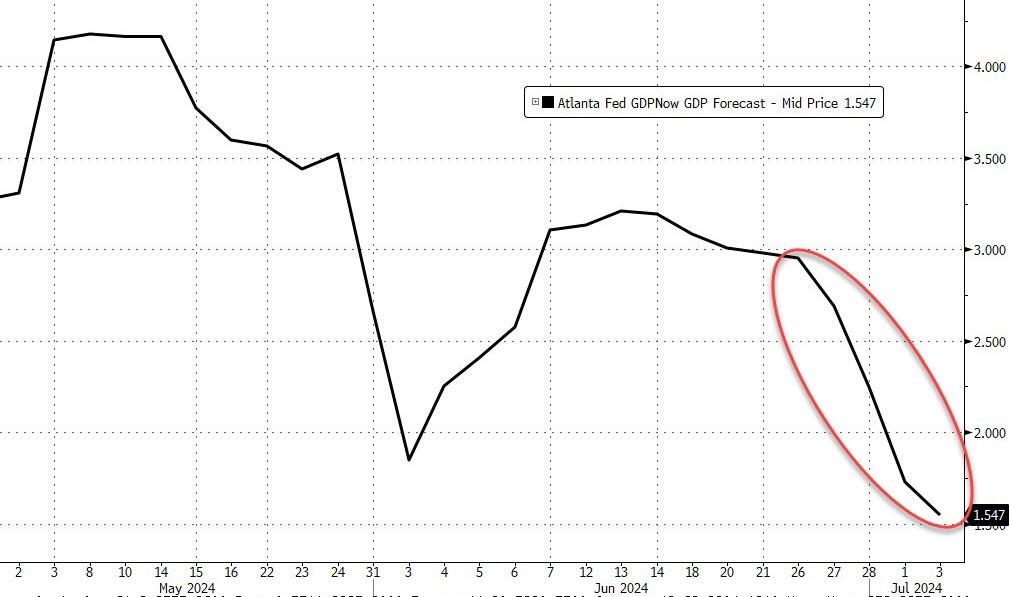
And since the last FOMC meeting, macro data has serially disappointed…

Source: Bloomberg

As Powell prepares to speak, STIRs have fully discounted two rate cuts this year, with around 51bps of rate cuts priced in by the end of the year; this pricing has moved dovishly in the wake of the June jobs data. This is in contrast to the Fed’s median projection, which has penciled in just one reduction this year. The first cut is fully priced by November, though there is around an 80% chance of it being seen in September.

Source: Bloomberg

We would also expect some partisan pressure from the Right over The Fed’s independence and the need to cut rates with inflation still high (though falling) and unemployment still so low (though rising).

Why so desperate to cut? Is the banking system really as solid as The Fed claims? Or will rate-cuts be just the juice to avoid a recession call right before the election?

Source: Bloomberg

Biden’s gonna need more rate-cuts…

Source: Bloomberg

Watch Live (due to start at 1000ET):

Tyler Durden
Tue, 07/09/2024 – 09:50

Consumer Slowdown Spreads: Helen Of Troy Shares Crash After Big Earnings Miss, EPS Outlook Cut

Consumer Slowdown Spreads: Helen Of Troy Shares Crash After Big Earnings Miss, EPS Outlook Cut

Consumer products company Helen of Troy crashed in premarket trading in New York after missing earnings expectations and slashing its full-year outlook. This is yet another warning of lingering inflation and high interest rates impacting consumer spending. 

“We are disappointed with the start to our fiscal year. We battled an unusual number of internal and external challenges in the quarter, which resulted in net sales and adjusted EPS below our outlook,” CEO Noel Geoffroy wrote in a statement. 

Geoffroy said, “Many of these challenges became more pronounced toward the end of the first quarter and some continue to evolve.”

Helen of Troy designs, develops, and markets branded housewares, health and home products, and beauty products worldwide. Some of those brands include kitchen supplies manufacturer OXO, water bottle maker Hydro Flask, and electric shaver maker Braun. 

The company reported a big fiscal first-quarter earnings miss, coming in at 99 cents a share a share on revenue of $416.8 million. Analysts tracked by Bloomberg expected earnings of $1.59 a share on revenue of $445.8 million. 

Here’s a snapshot of the first quarter results (courtesy of Bloomberg): 

  • Adjusted EPS 99c vs. $1.94 y/y, estimate $1.59

  • Net sales $416.8 million, -12% y/y, estimate $445.8 million

  • Home & Outdoor net sales revenue $198.5 million, -8.6% y/y, estimate $221.8 million

  • Beauty & Wellness net sales rev $218.4 million, -15% y/y, estimate $224.8 million

  • Adjusted Ebitda $52.4 million, -28% y/y, estimate $64.8 million

  • Adjusted operating margin 10.3% vs. 13.9% y/y, estimate 13.1%

  • Gross margin 48.7% vs. 45.4% y/y, estimate 46.6%

  • Inventory $444.7 million, +2.5% y/y

Notice above how quarterly sales in beauty and wellness plunged. The company blamed “softer consumer demand” and “shifts in consumer spending” and “shipping disruption at the Company’s Tennessee distribution facility due to automation startup issues” for its woes. 

For fiscal 2025, the company slashed its outlook:

  • Sees adjusted EPS $7.00 to $7.50, saw $8.70 to $9.20, estimate $8.93 (Bloomberg Consensus)

  • Sees net sales $1.89 billion to $1.94 billion, saw $1.97 billion to $2.03 billion, estimate $1.99 billion

“We now see this fiscal year as a time to take action to reset and revitalize our business. As a result, we are lowering our annual outlook, which delays the delivery of the long-term financial algorithm in our strategic plan,” CEO Geoffroy said.

As a result of this dismal outlook for the company and major warning signs of a consumer slowdown will persist, shares in premarket trading in New York crashed as much as 25.5%. 

If premarket losses hold into the cash session, Helen of Troy will be set for its biggest daily decline on record and lowest level since early 2015. 

Helen of Troy is the latest example of consumer companies crushed in the consumer slowdown. Bloomberg noted:

Consumer companies, including Nike Inc. and Walgreens Boots Alliance Inc., saw shares tumble to multi-year lows after disappointing earnings and guidance.

With the S&P500 index hitting new highs by the day, let’s not forget about apparel stocks negatively diverging on weak consumer trends. 

Bloomberg pointed out in a report Monday, “A labor market indicator signaled it has passed a tipping point for recession ahead, and options skew favors calls on Fed funds futures.” 

We have been vocal about the ongoing consumer slowdown:

It’s clear that cracks in the middle class are widening as folks reduce their spending. Is a recession ahead? 

Tyler Durden
Tue, 07/09/2024 – 09:32