

63.3 F
Chicago
Friday, September 25, 2026
Home Blog Page 2506

Earnings Bar Lowered As Q2 Reports Begin

Earnings Bar Lowered As Q2 Reports Begin

Authored by Lance Roberts via RealInvestmentAdvice.com,

Wall Street analysts continue significantly lowering the earnings bar as we enter the Q2 reporting period. Even as analysts lower that earnings bar, stocks have rallied sharply over the last few months.

As we have discussed previously, it will be unsurprising that we will see a high percentage of companies “beat” Wall Street estimates. Of course, the high beat rate is always the case due to the sharp downward revisions in analysts’ estimates as the reporting period begins. The chart below shows the changes for the Q2 earnings period from when analysts provided their first estimates in March 2023. Analysts have slashed estimates over the last 30 days, dropping estimates by roughly $5/share.

That is why we call it “Millennial Earnings Season.” Wall Street continuously lowers estimates as the reporting period approaches so “everyone gets a trophy.” An easy way to see this is the number of companies beating estimates each quarter, regardless of economic and financial conditions. Since 2000, roughly 70% of companies regularly beat estimates by 5%, but since 2017, that average has risen to approximately 75%. Again, that “beat rate” would be substantially lower if investors held analysts to their original estimates.

Analysts remain optimistic about earnings even with economic growth weakening, inflation remaining elevated, and liquidity declining. However, despite the decline in Q2 earnings estimates, analysts still believe that the first quarter of 2023 marked the bottom for the earnings decline. Again, this is despite the Fed rate hikes and tighter bank lending standards that will act to slow economic growth.

However, between March and June of this year, analysts cut forward expectations for 2025 by roughly $9/share.

However, even with the earnings bar lowered going forward, earnings estimates remain detached from the long-term growth trend.

As discussed previously, economic growth, from which companies derive revenue and earnings, must also strongly grow for earnings to grow at such an expected pace.

Since 1947, earnings per share have grown at 7.72%, while the economy has expanded by 6.35% annually. That close relationship in growth rates is logical, given the significant role that consumer spending has in the GDP equation. However, while nominal stock prices have averaged 9.35% (including dividends), reversions to underlying economic growth will eventually occur. Such is because corporate earnings are a function of consumptive spending, corporate investments, imports, and exports. The same goes for corporate profits, where stock prices have significantly deviated.

Such is essential to investors due to the coming impact on “valuations.”

Given current economic assessments from Wall Street to the Federal Reserve, strong growth rates are unlikely. The data also suggest a reversion to the mean is entirely possible.

The Reversion To The Mean

Following the pandemic-driven surge in monetary policy and a shuttering of the economy, the economy is slowly returning to normal. Of course, normal may seem very different compared to the economic activity we have witnessed over the last several years. Numerous factors at play support the idea of weaker economic growth rates and, subsequently, weaker earnings over the next few years.

  1. The economy is returning to a slow growth environment with a risk of recession.

  2. Inflation is falling, meaning less pricing power for corporations.

  3. No artificial stimulus to support demand.

  4. Over the last three years, the pull forward of consumption will now drag on future demand.

  5. Interest rates remain substantially higher, impacting consumption.

  6. Consumers have sharply reduced savings and higher debt loads.

  7. Previous inventory droughts are now surpluses.

Notably, this reversion of activity will become exacerbated by the “void” created by pulling forward consumption from future years.

“We have previously noted an inherent problem with ongoing monetary interventions. Notably, the fiscal policies implemented post the pandemic-driven economic shutdown created a surge in demand and unprecedented corporate earnings.”

As shown below, the surge in the M2 money supply is over. Without further stimulus, economic growth will revert to more sustainable and lower levels.

While the media often states that “stocks are not the economy,” as noted, economic activity creates corporate revenues and earnings. As such, stocks can not grow faster than the economy over long periods. A decent correlation exists between the expansion and contraction of M2 less GDP growth (a measure of liquidity excess) and the annual rate of change in the S&P 500 index. Currently, the deviation seems unsustainable. More notably, the current percentage annual change in the S&P 500 is approaching levels that have preceded a reversal of that growth rate.

So, either the annualized rate of return from the S&P 500 will decline due to repricing the market for lower-than-expected earnings growth rates, or the liquidity measure is about to turn sharply higher.

Valuations Remain A Risk

The problem with Wall Street consistently lowering the earnings bar by reducing forward estimates should be obvious. Given that Wall Street touts forward earnings estimates, investors overpay for investments. As should be obvious, overpaying for an investment today leads to lower future returns.

Even with the decline in earnings from the peak, valuations remain historically expensive on both a trailing and forward basis. (Notice the significant divergences in valuations during recessionary periods as adjusted earnings do NOT reflect what is occurring with actual earnings.)
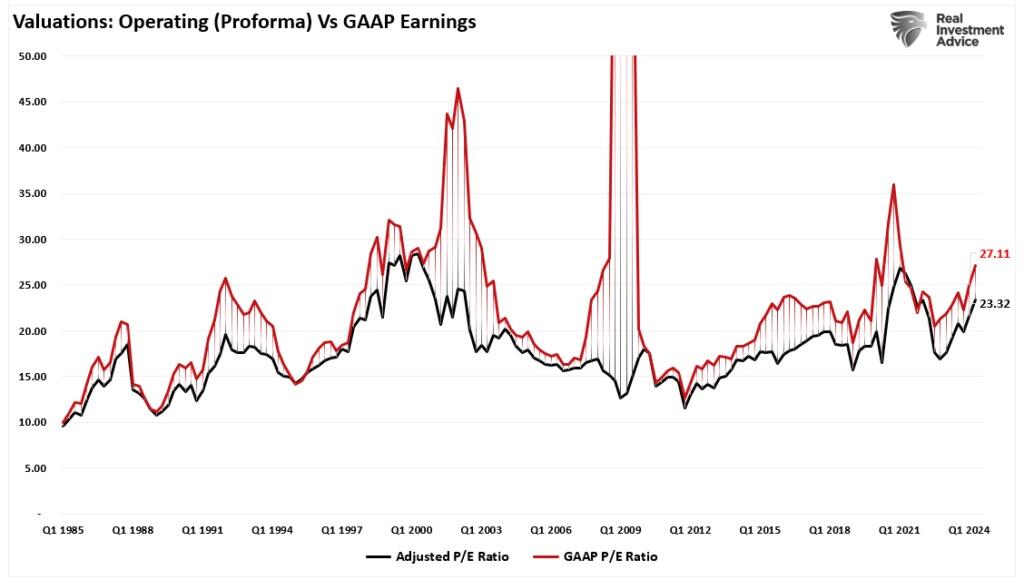
Most companies report “operating” earnings, which obfuscate profitability by excluding all the “bad stuff.” A significant divergence exists between operating (or adjusted) and GAAP earnings. When such a wide gap exists, you must question the “quality” of those earnings.

The chart below uses GAAP earnings. If we assume current earnings are correct, then such leaves the market trading above 27x earnings. (That valuation level remains near previous bull market peak valuations.)

Since markets are already trading well above historical valuation ranges, this suggests that outcomes will likely not be as “bullish” as many currently expect. Such is particularly the case if more monetary accommodations from the Federal Reserve and the Government are absent.

Trojan Horses

As always, the hope is that Q2 earnings and the entire coming year’s reports will rise to justify the market’s overvaluation. However, when earnings are rising, so are the markets.

Most importantly, analysts have a long and sordid history of being overly bullish on growth expectations, which fall short. Such is particularly the case today. Much of the economic and earnings growth was not organic. Instead, it was from the flood of stimulus into the economy, which is now evaporating.

Overpaying for assets has never worked out well for investors.

With the Federal Reserve intent on slowing economic growth to quell inflation, it is only logical that earnings will decline. If this is the case, prices must accommodate lower earnings by reducing current valuation multiples.

When it comes to analysts’ estimates, always remain wary of “Greeks bearing gifts.”

Tyler Durden
Tue, 07/02/2024 – 12:05

IDF To Re-Invade Khan Younis, Issues New Evacuation Orders

IDF To Re-Invade Khan Younis, Issues New Evacuation Orders

The Israeli army issued a new order for Palestinians to evacuate from the eastern portion of the southern Gaza Strip city of Khan Younis on Monday, suggesting a new offensive against the enclave is being prepared, after fresh rocket attacks from militants.

The military is reportedly focused on destroying a major rocket factory in the city which is oversee by Palestinian Islamic Jihad (PIJ). The IDF is urgently warning residents in specified districts they must move into the Western part of the city, as well as al-Mawasi camp on the coast. designated a “humanitarian zone”. Regional reports say at least 250,000 are directly impacted by the initial evacuation order.

The IDF had pulled out of Khan Younis in April, declaring military operations there complete, thus this would mark a re-invasion of the city akin to the limited operations still happening in the north upon the return of armed fighters to these areas. Monday saw some 20 rockets fired at IDF positions from Khan Younis, a first in many months.

Via Reuters

Already many of the over one million Palestinians who had been sheltering in Rafah before it came under Israel’s offensive were again displaced to Khan Younis. So this will mark a third mass displacement of these refugees.

Commenting on this, UN agency for Palestinian refugees (UNRWA) official Sam Rose, told Al Jazeera of the “harrowing, horrific, and incredibly difficult” situation. “It means yet another day, week, chapter of misery for these hundreds of thousands of people … most of them have been displaced several times. Some had just returned from Rafah where they were displaced a few weeks ago,” he said.

“They ought to go west, to al-Mawasi – the beachy, sandy area on the coast, but it’s already so overcrowded. There is no room to pitch a tent, there is no water, no infrastructure, no sanitary services. Many spend the night in vehicles or they sleep on their donkey charts,” Rose added.

“They go without knowing precisely where they will end up because this evacuation order told people to go urgently – they know that if they don’t go out within 24 hours the worst is to come,” the UNRWA official concluded in the statement.

By some estimates over 80% of Khan Younis’ buildings had been destroyed by the first Israeli assault, and hospital infrastructure is barely existent, as medical personnel must evacuate patients again.

There are meanwhile new reports that IDF leadership is lobbying the government for a ceasefire even if it means leaving Hamas intact. This is part of an increasingly public spat among war planners and top decision-makers.

“Israel’s top generals want to begin a cease-fire in Gaza even if it keeps Hamas in power for the time being, widening a rift between the military and Prime Minister Benjamin Netanyahu, who has opposed a truce that would allow Hamas to survive the war,” the NY Times reports Monday.

“The generals think that a truce would be the best way of freeing the roughly 120 Israelis still held, both dead and alive, in Gaza, according to interviews with six current and former security officials,” the report added.

IDF spokesman Rear Adm. Daniel Hagari said last month, “This business of destroying Hamas, making Hamas disappear – it’s simply throwing sand in the eyes of the public.” He had explained: “Hamas is an idea, Hamas is a party. It’s rooted in the hearts of the people – whoever thinks we can eliminate Hamas is wrong.”

Tyler Durden
Tue, 07/02/2024 – 09:50

Is France The Next Greece?

Is France The Next Greece?

Via SchiffGold.com,

French markets have found some relief after the first round of its latest election, with stocks recovering somewhat and bond yields falling after reaching a 12-year high.

But no matter which side wins in France, the market is afraid that an increase in unsustainable spending could be the common denominator. 

Greece’s sovereign debt crisis after the global 2008 implosion was characterized by an excessively high debt-to-GDP ratio, budget deficits, low growth, and an over-reliance on revenues from the tourism industry. Now, whispers abound in the Eurozone that in France, a similar crisis could be on the horizon.

With its entry into the Eurozone, Greece’s central bank lost much of its ability to kick the can down the road by printing money. 

Long and short-term bond yields skyrocketed as the value of Greek debt plunged and bond investors fled to greener pastures. Greece’s 2015 default to the IMF totaled €1.6 billion.

Source: Bloomberg

France’s debt-to-GDP skyrocketed during COVID-19, and after inching downwards, it’s now trending back up and is expected to exceed COVID levels within a few years. 

The French economy is unsure of how to react to the policy promises of the left or the right, so whispers of a potential debt crisis have far from stopped just because volatile French markets are experiencing a momentary breath of relief.

Eyes are on the yield spread between France and Germany.

Source: Bloomberg

Yields for “safe haven” German bonds have become the Eurozone benchmark, so the difference between German yields and those of other countries has become an indicator of the relative risk tolerance for investors in European government debt.

Both France and Belgium were once considered low-risk “core” nations among European economies, but that narrative is now changing as the problem of overspending is recognized across what were once regarded as economically stable countries.

Meanwhile, the US has many of the same problems — raging deficits, low growth, rising debt-to-GDP ratio, and high inflation. The US also has more tricks to kick the can down the road, but few options for truly fixing the problem.

In 2010, the IMF defined an “unsustainable” debt-to-GDP ratio of an advanced economy to be around 180%. Officially, the current US debt-to-GDP ratio is “only” about 125%. But along with the Fed itself, Global lenders like the IMF are beginning to express concern about out-of-control budget deficits in major economies.

GDP alone doesn’t tell the story. A large part of the US GDP total is based on housing and the over-leveraged real estate market, an economic paper tiger that’s utterly dependent on low interest rates and central bank money printing. With real estate taking a range of 12 to 18% or more of the GDP pie depending on who you ask, the picture isn’t so reassuring. In Greece, the tourism industry was too dominant to handle an economic shock. In the US, it’s real estate.

There’s also the inconvenient truth that high inflation can make nominal GDP appear higher since the “market value” of the economy’s goods is higher on paper. When things cost more it can pump the GDP numbers, even though market value alone has nothing to do with whether an economy is healthy or unhealthy. Of course, Keynesians insist that this can equate to “real” growth, and economists continue debating if high GDP fuels high inflation, or the other way around.

Politicians love spending other people’s money because it makes them look good in the short term — and all that matters is winning that next election. But whether it’s Greece, France, Japan, or the US, there’s only so much debt a country can take on before entering a black hole. And there’s only so long that central banks can postpone the inevitable.

Tyler Durden
Tue, 07/02/2024 – 09:30

TSLA Shares Soar After Better-Than-Expected Q2 Deliveries

TSLA Shares Soar After Better-Than-Expected Q2 Deliveries

Despite the downbeat talk about the EV market globally, Tesla found a way to surprise investors with better than expected deliveries data for Q2

The carmaker said Tuesday that it delivered 443,956 vehicles in the second quarter, better than the 439,302 average analyst estimate.

While sales were down 4.8% from a year ago, Tesla improved on a sequential basis from the 386,810 vehicles delivered in the first three months of the year.

The Austin-based carmaker delivered 422,405 of its top-selling Model 3 and Model Y vehicles in the second quarter, down from 446,915 a year ago.

The company produced 410,831 vehicles during the quarter.

TSLA shares are up around 5% in the pre-market, having soared from below $170 to almost $220 in the last three weeks to its highest since January…

…helped by a major short-squeeze (up 25% since this tweet)…

…which we suspect has more legs…

…and the countdown to the unveiling of Musk’s fully autonomous robotaxi concept on August 8th begins.

Tyler Durden
Tue, 07/02/2024 – 09:19

WTI Trades At Multi-Month High On Middle East, Hurricane Concerns 

WTI Trades At Multi-Month High On Middle East, Hurricane Concerns 

 Hurricane Beryl strengthened overnight to a powerful Category 5 storm as it churned in the Caribbean Sea. The Cat. 5 storm is the earliest on record in the Atlantic hurricane season and has caused concern among energy traders about potential Gulf Coast disruptions. 

On Monday morning, Beryl made landfall on Grenada’s Carriacou Island in the Caribbean Sea with winds around 150 mph. According to NOAA data dating back to 1851, this is the strongest known storm to traverse the Grenadines area.

Beryl’s arrival marks an early start to what some meteorologists had said would be an active hurricane season. The storm’s intensity has spooked energy traders, sending West Texas Intermediate (occasionally called Texas Light Sweet) to two-month highs on Monday.

Bloomberg noted, “Oil futures rose Tuesday, trading at their highest since late April, with gains tied to expectations for heavy travel around the Independence Day holiday and concerns that powerful Hurricane Beryl could later cause disruptions to offshore crude production in the Gulf of Mexico.” 

Senior analyst Ipek Ozkardeskaya from Swissquote Bank, in a note to clients, emphasized that while Beryl may not immediately impact operations in the Gulf of Mexico, it could potentially cause disruptions later in the week.

Computer models show the storm making landfall on or around Mexico’s Yucatan Peninsula around Friday morning and possibly curving north towards the US Gulf Coast afterward. 

A combination of tensions in the Middle East, robust demand ahead of July 4, a big short squeeze, and a rapid start to the Atlantic hurricane season are some factors driving WTI higher, up 10% since April 26.

As we predicted on June 6, an active Atlantic hurricane season with storms like Beryl could potentially disrupt major US Gulf Coast refineries. This disruption could drive prices at the gas pump to the politically sensitive $4-a-gallon level for the Biden administration ahead of the presidential elections this fall.

 Queue up more SPR dumps…

Tyler Durden
Tue, 07/02/2024 – 08:50

If The High Cost Of Groceries Makes You Feel Sick, You Are Not Alone

If The High Cost Of Groceries Makes You Feel Sick, You Are Not Alone

Authored by Michael Snyder via The Economic Collapse blog,

If you are really struggling with the high cost of living, I want you to know that you aren’t alone.  In recent months, I have been hearing from so many people that feel like they are drowning financially.  Have you experienced a palpable sense of panic when you compare your rising bills to the level of income that you are currently bringing in?  So many people out there are stressed out of their minds because it has become such a struggle to pay the bills each month.  As I discussed a few days ago, a typical U.S. household must now spend $1,069 more a month just to buy the exact same goods and services that it did three years ago.  Over the course of an entire year, that is almost an extra $13,000 dollars.  Month after month, prices just keep going higher, but those that are running things continue to insist that everything is just fine.

No, everything is not just fine.

Last week, a TikTok video about rising grocery prices at Walmart quickly garnered more than a million views.  The person that made the video found a grocery order that he had placed two years ago, and he decided to hit the “Reorder All” button to see what that same order would cost today…

A recent TikTok video has gone viral, showing a user’s surprising experience with Walmart’s grocery prices. The user explained in his video that he tried to use the “Reorder All” button for an order he placed two years ago, which originally cost $126.67. To his shock, the same order would now cost $414.39.

I was quite stunned by this video.

Many of the things that I regularly purchase at the grocery store have doubled or more than doubled in price, but in this case the total cost of the grocery order had more than tripled…

The TikTok (@sewerlidd) explained that the original $126.16 purchase was for a month’s worth of groceries, which included 53 items.

“A whole month of groceries just for me,” he said in the video.

The total was updated to $414.39, almost quadrupling.

“I feel like I’m going to be sick,” he said.

Needless to say, this video has generated a ton of discussion online.

When Walmart was asked about this, they responded by saying that the primary reason there was such a difference is because the person that made the video was attempting to order “discontinued items”…

Walmart representatives have responded, stating that the claims in the video are not accurate. According to them, the discrepancies in prices are due to discontinued items rather than actual inflation.

But this explanation certainly did not satisfy everyone.

Another person hit the “Reorder All” button on an old order, and that order went from $180 back then to $430 today…

Viewers expressed both shock and frustration in the comments.

“Now I feel a little less gaslit about grocery prices because it has gone crazy, and it’s not just me!” wrote one person.

“Walmart, can you explain yourself, please,” added another.

A fellow shopper said they used to spend $180 for two weeks’ worth of groceries and are now spending over $430 for the same amount.

If you think that the price of groceries is not a problem, I have a challenge for you.

Fill up a grocery cart all the way to the very top with items that you typically eat, and try to keep the final bill under 300 dollars.

If you are smart, you can do it, but it won’t be easy.

In the old days, you could buy a used vehicle for 300 dollars.

Now, many people burn through more than 300 dollars in just one trip to the grocery store.

This is just one of the reasons why inflation has become such a huge political issue.

According to Gallup, inflation was not really considered to be an important issue at all prior to 2022…

For the third year in a row, the percentage of Americans naming inflation or the high cost of living as the most important financial problem facing their family has reached a new high. The 41% naming the issue this year is up slightly from 35% a year ago and 32% in 2022. Before 2022, the highest percentage mentioning inflation was 18% in 2008. Inflation has been named by less than 10% in most other readings since the question was first asked in 2005.

The last three years have been an inflationary nightmare, and no matter how much our leaders try to deny it, a lot more inflation is on the way.

Things are particularly bad in our major cities.  In fact, it is being reported that Manhattan is the most expensive place to live in the United States by a wide margin…

The New York borough of Manhattan is the most expensive place to live in the U.S. — and the cost of living in the No. 2 place isn’t even close.

The cost of living in Manhattan is more than twice the national average. The second- and third-most expensive places are Honolulu and San Jose, California, but in comparison, they are much more affordable. Manhattan is 24% more expensive than Honolulu and 30% more expensive than San Jose.

It isn’t a big mystery why this is the case.

When our leaders pumped trillions upon trillions of dollars into the system, the financial markets benefitted greatly.

So Manhattan is swimming in cash, and prices there have gone into the stratosphere.

Many of us relentlessly warned about what would happen when our leaders flooded the system with cash, and now we are facing economic distortions that are extremely painful.

For most Americans, prices have been rising much faster than their paychecks.

As a result, our national standard of living has been steadily declining.

And now we have entered a time when it appears that economic conditions are really slowing down.

For example, it is being reported that Ford is preparing for yet another round of layoffs…

Ford Motor is preparing for a new round of layoffs for its salaried workers in the United States, the Wall Street Journal reported on Thursday, citing people familiar with the matter.

The company in March last year announced plans to reduce structural costs of up to $3 billion at its gas-powered vehicle unit. In August, Ford said it would cut a total of 3,000 salaried and contract jobs, mostly in North America and India.

Over the past several years, our politicians in Washington have borrowed and spent trillions upon trillions of dollars, and the “experts” at the Federal Reserve have pumped trillions upon trillions of dollars into the financial system.

All that did was buy us a little more time.

All that did was delay the inevitable.

Now we are facing a crisis of absolutely epic proportions, and the economic suffering that we are currently experiencing is nothing compared to the economic suffering that is ahead of us.

*  *  *

Michael’s new book entitled “Chaos” is available in paperback and for the Kindle on Amazon.com, and you can subscribe to his Substack newsletter at michaeltsnyder.substack.com.

Tyler Durden
Tue, 07/02/2024 – 08:30

Dozens Injured After Boeing 787 Jet Hit By Heavy Turbulence Over Atlantic 

Dozens Injured After Boeing 787 Jet Hit By Heavy Turbulence Over Atlantic 

A Boeing 787-9 Dreamliner operated by Air Europa from Spain to Uruguay encountered severe turbulence over the Atlantic and had to be diverted to Brazil. Injuries in the cabin were reported, including some passengers with neck and skull fractures. 

On Monday morning, Flight UX045 made an emergency landing in the seaside city of Natal, Brazil, after “heavy” turbulence. Thirty-six passengers were treated for injuries, and 23 were taken to a hospital, according to The New York Times, citing local health and airport officials.

Passengers explained to media outlet Telemundo that at least one passenger flew out of his seat and became stuck in the overhead luggage bins. 

Passenger videos uploaded on X show the chaos in the cabin:

“Due to the nature of the turbulence and for safety reasons, it was decided to divert the flight to Natal International Airport in Brazil,” Air Europa wrote in a statement quoted by ABC News. 

Air Europa said the 787-9 was carrying 325 passengers at the time of the incident. 

“The sensation was one of terror, feeling that you are falling and that it does not end,” one passenger told media outlet El Observador, adding, “And you are aware that you are falling at an incalculable speed. And you felt that it ended there, that you died.”

Turbulence is common across the aviation industry. However, severe events like this are less common.

About 1.5 months ago, in mid-May, a Singapore Airlines Boeing 777-300ER experienced an abrupt drop that injured dozens. 

Tyler Durden
Tue, 07/02/2024 – 06:55

US, Mexican Truckers Unite To Protest Low Wages, Poor Working Conditions

US, Mexican Truckers Unite To Protest Low Wages, Poor Working Conditions

By Noi Mahoney of FreightWaves

A cross-border trucker-led convoy will be rolling through parts of West Texas on Monday to spotlight everything from violence against drivers, low wages to poor working conditions in both Mexico and the U.S., organizers said.

“Truck drivers from Mexico are routinely used to push down the wages and working conditions of American truck drivers,” said Jesus Chuy, a Mexico-based trucker. (Photo: Jim Allen/FreightWaves)

The convoy — a joint action between the U.S.-based Truckers Movement for Justice (TMJ) and the Mexico-based United Mexican Carriers (TAMEXUN) and the Binational Carriers Union (STB) — will consist of about 75 truckers from both sides of the border on a 150-mile trek from Odessa, Texas, through Kermit and Monahans, Texas.

“TMJ, STB and TAMEXUN are fighting for the rights of the drivers to organize and to negotiate collectively with trucking companies,” Billy Randel, founder of TMJ, told FreightWaves in an interview. 

Randel and members of TMJ, STB and TAMEXUN said they are seeking “respect” and “justice” from the trucking industry and want government action or changes in the industry.

“In one word, we want justice. We’re all talking about justice for truck drivers. We carry the backs of the world on us,” said Jazmin Lovos, a member of TMJ. Lovos and her husband Oscar are truck drivers in the Permian Basin.

The majority of drivers participating in the Texas protest are owner-operators working in the oilfields of West Texas or Mexico-based B1 visa drivers hauling goods into the U.S.

Across the border, drivers from Mexico said they are often recruited by U.S.-based trucking companies initially offering pay rates of 30 cents a mile, then later the company will reduce a Mexico-based driver’s rate to 19 cents a mile.

“There’s a lot of people who also care about the 19 cents a mile because they think they are making money with that,” Jesus Chuy, a driver from Mexico and member of STB, said. “The industries get the best of Mexican drivers with that.”

Randel said it doesn’t matter which side of the border truckers are from.

“We go back to the simple fact that trucking companies are using our brothers and sisters in Mexico, against our brothers and sisters in the United States,” Randel said. “This is why we have the solidarity, an alliance that we built with the TAMEXUN, STB and TMJ, we’ve got to fight.”

The majority of drivers participating in the Texas protest are owner-operators working in the oilfields of West Texas. (Photo: Shutterstock)

Poor working conditions for truck drivers in the U.S.

Oscar Lovos, a member of TMJ, and several other drivers said truckers have faced poor work conditions in the Permian Basin area of West Texas for years. 

The Permian Basin is an oil and gas producing area mainly in West Texas, as well as southeastern New Mexico. 

The issues drivers in the region face range from low wages, long waits to unload trucks, to companies that don’t pay for fuel surcharges, TMJ members said. 

“I’ve been in the oil field for over 11 years, driving in the Permian Basin. The oil field has gone downhill tremendously. Inflation is going high, the price of oil is still high, but yet our wages are going lower and lower,” Lovos said. “It seems like every month they’re going to lower the rates on us. We’re barely surviving as it is.”

Lovo said being an oil field truck driver can be tough physically due to the condition of roads in the Permian Basin.

“I’ve been in the oil field for over 11 years, driving in the Permian Basin … wages are going lower and lower,” truck driver Oscar Lovos said. (Photo: Jim Allen/FreightWaves)

“The roads out here are extremely bad. Driving on these roads beat up our trucks, then we have to pay for repairs and nobody helps us with the repairs,” Lovo said. 

Jazmin Lovo said truck drivers working in the oil fields often get stuck waiting in long lines when they are dropping off shipments. Many shippers in the Permian Basin don’t pay detention or demurrage fees to owner-operators, she said.

“Some days they spend a long, long time unloading the trucks and they don’t pay detention time or demurrage,” Jazmin Lovo said. “They use our trucks like a storage unit, like a warehouse. But if you’re going to rent a warehouse to have your stuff, you get charged. But the companies that hire us to carry the frac sand are not paying detention time.

Other complaints include the lack of adequate restrooms for drivers in the region.

“We’re lucky if they give us port-a-johns. We demand restrooms that have air conditioning in them. My wife Jazmin is a truck driver. Me as man, I don’t want to go inside of port-a-john when it’s 100 degrees outside. Do you think she wants to go in there? The restrooms they give are not fair, not right,” Oscar Lovo said.


Marco Mery, who drives trucks in the Permian Basin, said the detention times and road conditions cost them money.

“We don’t get any respect,” Mery said. “There’s too many things involved in being a driver. We have to pay to be a truck driver, owner-operators, we pay the insurance, the stickers, license plates and everything. Everything is a lot of money. And we don’t get that money back.”

Truck drivers in Mexico face theft and assault everyday

Across the border in Mexico, truck drivers face hijackings, theft, low wages and lack of adequate facilities, such as restrooms and rest areas, members of TAMEXUN and STB said.

“In Mexico, one of the biggest issues is there is absolutely no security for the drivers,” Chuy said. “Drivers are routinely beaten every day. There are trucks stolen from drivers every day and the National Guard and the federal government as well as the state governments do nothing to protect the drivers from assaults.” 

In the first five months of 2024, Mexico totaled 700 cargo truck thefts, according to the National Association of Vehicle Tracking and Protection Companies (ANERPV).

More than 65% of cargo robberies involve the use of violence, according to ANERPV. The lack of cargo security is why many Mexican truck drivers choose to get a visa and work in the U.S., Chuy said.

“Drivers get assaulted from both government police as well as criminals,” Chuy said. “A driver was murdered earlier this year, killed while he was working. This is a struggle. We need respect and we need protection of law.” 

Once Mexico-based drivers begin working in the U.S., trucking companies often use them to keep wages lower for U.S. drivers., Chuy said.

“Truck drivers from Mexico are routinely used to push down the wages and working conditions of American truck drivers,” Chuy said. “This is why we formed this alliance. We feel strongly that we need to equalize the working conditions for truck drivers in both countries, so we can all have a quality of life.”

Manuel Mendoza, president of TAMEXUN said truck drivers keep the economies of the U.S. and Mexico moving, but make very little money.

Truck driver salaries in Mexico averaged $4,400 in 2022.

“The truth is that every day there is more and more discrimination. Our work is made more humiliating, subjected to the whims of carriers, big businessmen who come from political parties,” Mendoza said. “We want better payments for our drivers. We don’t need brokers. We need to deal directly with the shippers so that we have a better life.”

Tyler Durden
Tue, 07/02/2024 – 06:30

Trump Organization Announces New Tower In Saudi Arabia

Trump Organization Announces New Tower In Saudi Arabia

Authored by Jack Phillips via The Epoch Times,

The Trump Organization confirmed it will construct a new Trump Tower in Saudi Arabia, according to a company announcement Monday.

The firm, owned and led by Donald Trump since 1971 before he handed over the reins to his children upon winning the election to become the 45th president, announced it partnered with a Saudi-owned developer Dar Global to build the tower in Jeddah. It’s the first building that the Trump Organization would develop in the country.

“We are thrilled to expand our footprint in the Middle East and bring the Trump standard of luxury to the region through our long-standing relationship with Dar Global,” Eric Trump, the former president’s son and executive vice president of the company, said in a statement.

“This collaboration embodies our shared vision of creating landmark developments that exude luxury, quality, and sophistication.”

The head of Dar Global added that it is “delighted to strengthen our ongoing relationship with The Trump Organization and expand our portfolio by delivering premium properties to redefine Saudi Arabia’s high-growth real estate market.”

He added, “The new agreement in Saudi Arabia will leverage the strengths of both organizations to attract more international investors and vacationers.”

About two weeks ago, Dar Global announced it agreed to a licensing deal for a Trump International hotel building in Oman, although the building isn’t owned by the Trump Organization. The team that is working on the project is also headed by Eric Trump.

Some Democratic lawmakers have said that the Trump investments in the Middle East and Saudi Arabia could present a conflict of interest.

The Trump Organization is owned by a private trust that includes the former president as its sole beneficiary. It’s run by his sons Eric Trump and Donald Trump Jr..

The company was fined $1.6 million by a New York judge after it was accused by prosecutors of running a tax-fraud scheme. The organization denied any wrongdoing.

In February, another New York judge fined former President Trump $454 million in total penalties after ruling that his company and others inflated assets to boost his net worth and gain financial benefits.

Weeks later, the former president appealed the judgment, alleging that the court abused its discretion or “acted in excess of its jurisdiction.” He and his attorneys also accused the judge and attorney general of political bias, while arguing that neither he nor his company engaged in any wrongdoing.

Tyler Durden
Tue, 07/02/2024 – 05:45

European Youth Have Had Enough Of Brussels’ Politics

European Youth Have Had Enough Of Brussels’ Politics

Authored by Denes Albert via rmx.news,

In Germany, France, and even Belgium, the EU election results have created internal political crises. In some countries, new parliamentary elections have been called to clarify the political values and direction that voters want their respective countries to take.

At the same time, there has been little discussion as to which demographics have turned against the liberal status quo in Brussels the most.

Which social group has been the most opposed to EU bureaucracy and open borders.

Perhaps unsurprisingly, young people indicated their inability to lead a normal life within the European structure and its ideological backdrop.

They simply feel that they have no future because their current lives and the conditions in which they live, which appear to be objective, are in total chaos.

We are talking about a generation, people of an age who are no longer dependent but who have not yet been able to establish a stable existence of their own.

They are our children and grandchildren, not categories with an “X,” “Y” or “Z.” They are young people, “the envied age” of our elders,  but also a generation doomed to be lost in terms of Europe’s situation and future vision. Moreover, their unacceptable alphabetical designation is reminiscent of the degenerate ideology that seeks to ensure that more and more “minority” groups form the fabric of civilized societies, with the result that all forms of division within nations are exacerbated, as is already the case in the international arena.

This fact is further proof that today, subjective will is overriding necessity and the objective values of the community.

Young people have clearly had enough of this, and their votes are a clear sign of it.

On June 9, they voted against it, trusting in the power of democracy and assuming that their demand for change would be understood by the officials at Brussels headquarters.

But tomorrow, when it is clear that the ladies and gentlemen who have been addressed are bureaucrats interested only and exclusively in maintaining their power, and have no regard for the interests of the people of Europe, there will be no other means left to those who want change but to blow up the increasingly petrified edifice.

The only question is whether we, the ancestors, the parents, will be offended by the efforts of our “impudent” successors, or whether we will accept that what we have done wrong, they will be able to put right, or at least try to.

Let them allow the truth to once again be the totality of objective facts, as opposed to the subjective will of those who see themselves as the chosen ones. Let them remove the vested interests that prevent normal functioning.

Good work, young people!

Read more here…

Tyler Durden
Tue, 07/02/2024 – 05:00
