War Secretary Pete Hegseth offered support for U.S. Navy Blue Angels pilots on Thursday after a review of a low-altitude jet maneuver over Pensacola Beach, Florida, the day before.
Dramatic video shows the U.S. Navy Blue Angels making a low-altitude flyover above Pensacola Beach, Florida, on Wednesday. Navy officials confirmed in a statement that Blue Angels leadership is “reviewing the circumstances surrounding the maneuver and conducting a thorough safety… pic.twitter.com/ZUa1ryk4X8
Video posted online showed one of the demonstration jets flying unusually close to the ground during an arrival maneuver on Wednesday.
The jet kicked up sand and beach items among spectators at a “Breakfast with the Blues” event. Children were seen covering their ears with their heads bowed.
The maneuver occurred during events tied to the squadron’s 80th anniversary.
“The flyovers will continue until morale improves,” Hegseth posted on X.
The Blue Angels said it is conducting a review of the maneuver.
“The safety of our hometown community, spectators, and our pilots is our highest priority. Team leadership is reviewing the circumstances surrounding the maneuver and conducting a thorough safety review to ensure all operations adhere to strict Navy and FAA safety standards,” the squadron said in a statement.
Acting Navy Secretary Hung Cao said later Thursday that a flight debrief had been completed and there would be no reprimands.
“No reprimands. No firings. No problem. That’s the sound of Freedom,” Cao wrote on X. “Semper fi and Hooyah.”
Wednesday’s incident took place during preparations for the Pensacola Beach Air Show. The show features expanded performances this year for the anniversaries. Organizers predicted large crowds.
No injuries were reported. One spectator told local media she had been in attendance at the air show for 10 years and never witnessed such a pass. She said she thought the jet might hit them but called the experience amazing.
This was at least the third time in recent months that Hegseth supported pilots after aerial maneuvers that drew scrutiny over safety concerns. The Pentagon lifted suspensions of helicopter pilots who flew low over the coast of South Carolina. In March, Hegseth said Army pilots would not be punished after flying attack helicopters near singer Kid Rock’s house.
Some lawmakers criticized the maneuver.
“Aviation safety rules are written in blood. Glamorizing and excusing reckless behavior like this will only lead to more, until we reach the point where a horrific tragedy occurs because of brazen, careless rhetoric like this,” Rep. Seth Moulton (D-Mass.) said on X.
The Blue Angels were created in 1946 and perform precision maneuvers at air shows and other events. Its home base is located in Pensacola.
Military aviation is closely regulated. Low-altitude flying limits reaction time for pilots. Blue Angels operations follow strict parameters on minimum altitudes.
The review followed standard Navy procedures for deviations from flight profiles. Past investigations into demonstration squadron incidents have examined precision requirements.
The Blue Angels squadron is made up of pilots and supporting personnel who perform for millions of spectators annually. The team remains set to continue its demonstrations.
Elon Musk has acquired a power company based in Jacksonville, Fla., paying $1 billion for the mobile gas-turbine provider as a possible solution to data center energy needs.
The Federal Trade Commission (FTC) lists Musk as the acquiring party, with New APR Energy, LLC listed as the acquired entity.
Neither party issued public statements on the deal that closed May 14. Local business news outlet Jacksonville Daily Record first reported on the news in June before it gained national media attention in recent days.
The potential cost of the deal was found in a separate filing with the U.S. Securities and Exchange Commission (SEC) in which Technologies Group reported selling its 5 percent non-voting stake in New APR Energy in a May 28 SEC report.
Duos said its sale generated $50.4 million in net proceeds, which implies the Musk deal was worth at least $1 billion.
Musk continues to invest in artificial intelligence (AI) development with the research company he founded, xAI, and its chatbot Grok.
His xAI company runs the Colossus data center in Tennessee, a $20 billion facility near a power plant site, where he has had to rent turbine units as he waits for grid power to the site.
New APR Energy owns and maintains a fleet of gas turbines with more than 1 gigawatt of power generation capacity, according to a statement from the company in January, when it expanded capacity.
The company has been delivering power to clients for more than 20 years, deploying its fleets “in as little as 30 to 90 days,” the statement said.
Grok is a generative artificial intelligence (GenAI) chatbot developed by xAI, based on a large language model (LLM). It was developed at the initiative of Elon Musk in response to the rise of OpenAI’s ChatGPT. Riccardo Milani/Hans Lucas/AFP via Getty Images
Musk’s purchase of the Florida company represents his second investment in the energy sector. In 2006, Musk helped fund SolarCity, a company founded by his cousins, Peter and Lyndon Rive, which grew to be the largest residential solar installer in the United States.
Tesla bought SolarCity in an all-stock deal worth about $2.6 billion in 2016 and turned it into Tesla Energy.
Tech expert and podcaster Aakash Gupta said Musk’s latest transaction exposed the AI industry’s current problems.
“What [Musk] bought tells you where the real bottleneck in AI is,” Gupta said in a July 16 post on X.
New APR Energy operates a fleet of mobile gas and diesel turbines with over 1 gigawatt of generation capacity—enough to power 750,000 homes at once.
The fleet, which was built for disaster response, arrives on trucks and can be delivered, installed, and commissioned in a month.
The fast set-up time makes sense for Musk, who has already lived through delays with xAI’s first Memphis plant, Gupta said.
“Environmental groups sued. The [Justice Department] intervened to keep the turbines running. He was renting the most important input to his most important company,” Gupta said. “So he bought the landlord. … Every AI lab can buy the same chips. Only one of them now owns a power plant fleet that ships by truck.”
New APR Energy and Tesla did not return requests for comments about the purchase by publication time.
US Sends Dozens More Refueling Planes To Israel Amid Widening Iran War, Oil Climbs
Update(12:25ET): Oil prices are climbing on fresh reports Friday that President Trump is ready to continue escalating and expanding strikes on the Islamic Republic, after a Situation Room briefing this week where the Commander-in-Chief was presented with various options. It bears repeating that the White House in the opening days of Operation Epic Fury promised the American public a fast and hasty, limited military engagement – but this is where we are four months later…
“The Trump administration notified Israel it is sending dozens more refueling planes to the country ahead of a potential expansion of military operations against Iran, three U.S. and Israeli officials said,” reports Axios. “After he was presented with several new military plans in a Situation Room meeting Tuesday, President Trump is considering a massive offensive in Iran that would be wider in scope than the current strikes around the Strait of Hormuz.” This is but the latest signal that the ceasefire and negotiations are fully dead, and the potential for runaway escalation is bigger than ever:
OIL RISES TO SESSION HIGHS, BRENT TRADES ABOVE $87/BBL
US YIELDS RISE TO DAY’S HIGH ON REPORTS OF US-IRAN ESCALATION
US TO SEND DOZENS MORE REFUELING PLANES: AXIOS
* * *
Iran has on Friday warned of a “more crushing” retaliation following the conclusion of last night’s sixth consecutive day of US attacks, targeting military targets and logistics infrastructure, but also civilian sites connected to the power grid. By all accounts this current wave goes beyond the prior strikes in size and scope compared to the past several days.
Iranian state media has reported that eight people were killed from the overnight attacks, and that several bridges had been attacked overnight.
The country is feeling the strain under what is now nearly a week of constant US heavy attacks. This is being seen in that Iran’s energy ministry has urgently called on citizens to reduce electricity use after the power grid came under strain following US strikes on energy infrastructure in the south.
In a statement on Friday, the ministry said those areas in the south “are currently experiencing extreme heat and attacks on power infrastructure.” But as Al Jazeeranotes, “The ministry however did not elaborate on whether it was power plants, transmission lines or other equipment that had been attacked.” According to more details:
Iran’s Energy Ministry urged citizens to reduce electricity consumption to help stabilize power supply in the country’s southern provinces following US strikes on energy facilities, citing extreme heat and infrastructure damage, the semi-official ISNA news agency reported Friday.
The ministry asked subscribers to turn off air conditioners for one hour during peak consumption periods to help ensure a more stable electricity supply to the affected provinces, ISNA said.
Report: Hormuz Strait transit falls to three week low–
Hormuz traffic reaches three week low
MarineTraffic data indicate confirmed crossings through the monitored Strait of Hormuz zone fell to eight on 16 July, down from 15 a day earlier and marking a three week low. Seven of the eight transits followed the Iranian route, with no… pic.twitter.com/mEXVxsx40d
Friday was the first time that Iran’s government acknowledged American “attacks on power infrastructure” during the campaign, which comes after Trump’s prior warning to go after key civilian infrastructure.
And on the bridges: “Iranian media reported that five bridges were hit in the latest round of US strikes, as well as the train station in coastal Bandar Khamir and Iranshahr Airport in southeastern Iran,” Reuters reports. An airport has also reportedly been attacked.
Iran has warned of an “infrastructure for infrastructure” tit-for-tat:
Kuwait says that one of the country’s power and water desalinations plans suffered “severe damage” after an Iranian attack.
There are signs of renewed attacks on rail as well, per NBC:
A railway junction station just west of Bandar Abbas was also hit, the state-owned IRIB news agency said. The highway and railway bridge strikes appeared aimed at cutting off Bandar Abbas, Iran’s main port, from roads leading toward Tehran, the capital.
While other routes still are open, the U.S. strikes could expand further, potentially disrupting both the movement of military materiel and goods needed for Iran’s 90 million people.
Regional Arab states which host American bases say they were busy overnight intercepting missiles and drones sent from Iran, including Kuwait, Bahrain, Qatar, Oman, and with reports of projectiles inbound even in Syria.
The IRGC announced Friday that it carried out an attack on the US Al Udeid Air Base in Qatar, asserting that it destroyed a long-range radar system and several US aerial refueling aircraft.
Iran’s Chabahar port control tower COLLAPSES after more than a week of US strikes — Pete Hegseth boasts of destruction in X photo
Iranian FM Araghchi calls the attacks one of many US ‘war crimes’ committed over the past week pic.twitter.com/lDBz6ufJ5j
Its Aerospace Force described that carried out a “surprise and powerful” attack on Al Udeid Air Base, claiming to have taken out a long-range radar system along with the refueling aircraft parked there.
Per IRIB news agency, the elite Iranian force stated, “The American enemy and the hosts of its bases in the region should know that crossing red lines and attacking people and civilian infrastructure will have a very severe and miserable price. If the enemy continues this trend, more crushing responses are on the way; responses that will remain in the history of battles.”
The IRGC further warned that American forces will “pay a heavy price” for what it called crossing “red lines” and targeting civilians and civilian infrastructure. Tehran has not backed off its assertion of ‘control’ over the Strait of Hormuz – also calling this its red line.
The day or evening prior saw US Marines having conducted “a verification boarding” of a tanker in the Gulf of Oman – which the Pentagon characterized as part of operations enforcing the new naval blockade of Iranian ports.
The New York Times on July 15 asked a court to toss out grand jury subpoenas of three of its reporters who published a story about the new Air Force One plane that Qatar gifted to President Donald Trump.
The paper published the story earlier this month alleging the new plane lacked some defensive features of the older Air Force One aircraft, which the White House denied. That led Manhattan U.S. Attorney Jay Clayton to issue subpoenas to find out where the reporters were getting their information.
Acting Attorney General Todd Blanche, during his Senate confirmation hearing on Wednesday, said the subpoenas were issued to find out who leaked information to the NY Times. Justice Department rules required him to authorize the subpoenas.
“We’re not targeting reporters,” Blanche told Sen. Peter Welch (D-Vt.), later adding, “The question we want to ask them is who provided them with classified national security information.”
David McCraw, senior vice president and deputy general counsel of The NY Times, said the subpoenas were “brought in bad faith to punish The Times for its coverage.”
“We are going to court to defend our journalists’ rights to report freely on the administration and to provide the public with stories that matter,” McCraw said.
Motions to quash a subpoena are usually sealed. McCraw has asked the court to make the contents of his motion public, arguing that people have a right to know about the case.
Like Blanche, Clayton is under congressional scrutiny this week as he looks to the Senate to confirm him as Director of National Intelligence. He hopes to replace Bill Pulte, who is filling in for Tulsi Gabbard. She stepped down from the role earlier this year to be with her husband, who she revealed has cancer.
Clayton told Sen. Ron Wyden (D-Ore.) that he did not want to publicly go into details about the subpoenas—or who asked that they be issued.
But he said that he was “absolutely committed to” respect for the First Amendment and journalists. He added that he and his team “followed the processes that we’re required to follow.”
First Amendment advocacy groups like the National Press Club have asked the Justice Department to withdraw the subpoenas.
“A free and independent press serves the people, not the government,” the organization’s president, Mark Schoeff Jr., said in a statement.
“The greatest danger isn’t the subpoena itself. It’s the message it sends. It tells sources to stay silent. It tells whistleblowers to think twice.”
Days after subpoenas were issued to the New York Times journalists, War Secretary Pete Hegseth announced on July 13 that the War Department and the Department of Justice launched a joint task force to investigate and prosecute anyone involved in leaking sensitive information to the media.
“Access to confidential and secret information is a sacred trust,” Hegseth said in a video posted on X.
“And those who betray that trust will be met with the full force of the law.”
Hegseth did not mention the past week’s incident but spoke in general about threats that leaks pose to national security and the U.S. military.
“The unauthorized disclosure of War Department information has the very real potential to cause exceptionally grave damage to our national security and the operational integrity of our armed forces,” Hegseth said.
IRGC Targets US Command Center In Syria In Unprecedented Attack
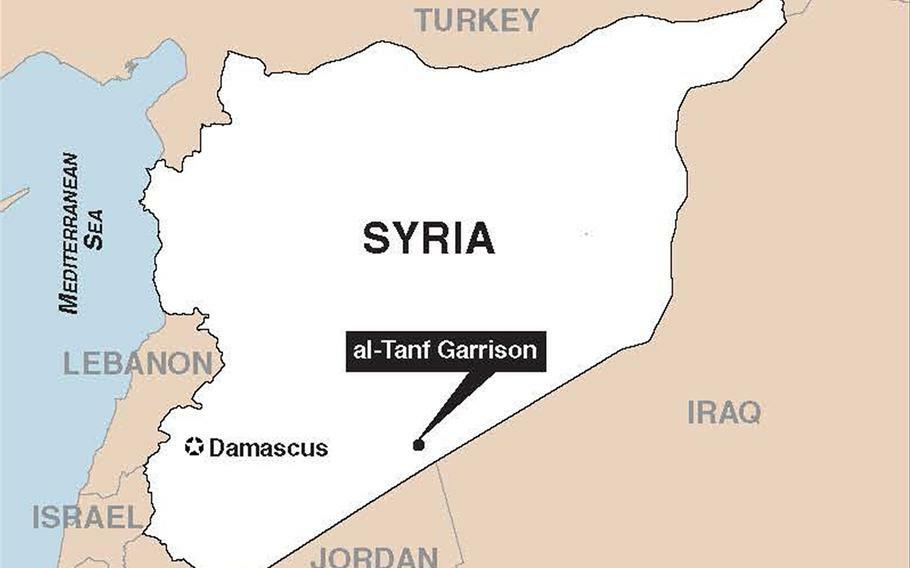
Iran’s large-scale ‘retaliation’ on US bases and Gulf states overnight included a rare first if confirmed. The Islamic Revolutionary Guard Corps (IRGC) said it conducted a missile or drone attack on an American special operations command center at al-Tanf in Syria on Friday.
The action came after the US bombed Iran for a sixth consecutive night, and while Iranian targets have on several occasions reached into Jordan, it is unprecedented that the Iranians take active aim at sites within Syria.
The IRGC stated the attack was in retaliation for the killing of Iranian soldiers in Iranshahr, in southern Iran.
While the hit on Syria was reported in Reuters based on state media claims, the alleged Tanf strike hasn’t been independently verified:
A Syrian military source told Reuters that Iran carried out an attack near al-Tanf, but it had not hit the base itself. There were no casualties or material damage, the source added.
The episode is the first reported attack on Syria since the US-Israeli war on Iran began in late February.
And more: “The IRGC statement claimed that a radar system, multiple helicopters, and several US personnel were destroyed in the strike. Reuters reported that it has not yet been able to independently verify these claims.”
While it is unprecedented or at least unusual for US bases in Syria to come under direct attack by Iran, Tanf base has on multiple occasions come under attack from Iran-aligned Iraqi paramilitaries, and other hostile actors both within Syria and Iraq.
US troops had long operated out of Tanf to pressure the Assad government as part of the long-running US-backed regime change project.
The US primarily trained the Syrian Free Army (FSA) in that remote desert area – which was an umbrella group of various factions, likely among them jihadists, armed and funded by Washington.
But when Assad was finally ousted in December 2024, replaced by an Al-Qaeda group founder (Jolani/Sharaa), this also put Iranian forces in rapid retreat from the country after an over decade-long proxy war.
Syria’s new AQ-linked government has been trying to impress its backers by claiming to bust up Iran-Hezbollah axis arms shipments:
🇸🇾🇮🇷🇱🇧 Here’s footage of the massive weapons cache that was hidden inside an oil tanker by Iran and bound for Hezbollah in Lebanon.
Until Syria intercepted it along the way.
Inside were hundreds of drones, missiles, and components…
Iran, alongside Russia, had been a close military supporter of the Syrian army, but the Syrian government’s collapse – along with the weaking of Hezbollah with the recent Israeli assassination of much of its leadership in Lebanon, caused most Russian and Iranian troops into a hasty and forced withdrawal.
Zelensky’s Cabinet Reshuffle Backfiring As He Names New Defense Minister
Amid a continuing status of martial law in Ukraine, one European headline underscores that President Zelensky’s significant cabinet and defense ministry reshuffling has ‘backfired’.
Public outrage and rare protests have ensued in the capital and across various cities after he sacked popular Defense Minister Mykhailo Fedorov, who many Ukrainians see as having turned the tide of the war with Russia, implementing an ambitious tech-focused drone strategy.
Zelensky has now confirmed the dismissal by appointing Security Service of Ukraine (SBU) chief Yevhen Khmara as acting defense minister.
“Once the necessary legal procedures are completed, I will ask lawmakers to support Yevhen Khmara’s appointment as defense minister,” Zelensky announced.
None of this is being received very well among the public, also days after the forced resignation of Prime Minister Yulia Svyrydenko, who was merely six months into the job:
The removal of Svyrydenko and swift appointment of Sergii Koretskyi as Ukraine’s new prime minister barely registered in the public debate, but there was uproar around the defence portfolio.
On Thursday lawmakers approved almost an entirely new wartime cabinet and Koretskyi’s nomination – a move largely seen as logical given his track record as chief executive of state energy giant Naftogaz and his crisis‑management roles at Ukrnafta and Ukrtatnafta.
Inside parliament, Koretskyi vowed to focus on defense, economic stability and EU integration. Outside, thousands of demonstrators made it clear that the real battle who controls the armed forces – and how – had only just started.
Zelensky seemed on the defensive in a Thursday night address explaining his choice for new acting defense chief.
“Yevhen Khmara will serve as acting Minister of Defence of Ukraine. He headed the SSU’s Centre of Special Operations Alpha, which has achieved the most effective results in eliminating the occupiers on the front. Alpha consistently ranks number one in the monthly results,” he said.
“Khmara was responsible for the long-range operations of the Security Service of Ukraine,” Zelensky added. “We agreed that Khmara will also oversee the long-range operations of the Security Forces – this is a priority.”
Seeking to put a positive spin on a move which is proving deeply unpopular, Zelensky continued: “He knows exactly what Ukraine needs and is also capable of maintaining control over the internal situation across the components of the defense forces. He has sufficient security experience to prevent disgraceful incidents.”
⚡️🇺🇦 BREAKING: Zelenskyy confirms tensions between Fedorov and Syrskyi: “Without me, they won’t sit down together”
Ukrainian President Volodymyr Zelenskyy has confirmed tensions between former Defense Minister Mykhailo Fedorov and Commander-in-Chief Oleksandr Syrskyi, saying he… pic.twitter.com/olt7DuSalu
Chief Foreign-Affairs Correspondent of the WSJ, Yaroslav Trofimov, has pointed out that “Many Ukrainians (and not just Ukrainians) see this as Zelensky putting petty politics ahead of winning the war.” If the protests grow rapidly, it could cause Zelensky’s external supporters to sour on him.
UMich Sentiment Extends Bounce From Record 46-Year-Lows As Gas Prices Ease
Having rebounded from record (46 year) lows in June, University of Michigan’s preliminary July Sentiment survey was expected to show further improvement as gas prices fell since the US-Iran ‘peace’ MoU signing (before rising modestly in the last few days of the reignited conflict).
And indeed it did, headline Consumer Sentiment jumped from 49.5 to 54.4 (51.0 exp) – its highest since February…
“With the second straight month of 10% jumps,” said UMich Dirctor of Surveys, Joanne Hsu, pointing out that “consumer sentiment climbed to its highest reading since February of this year on the basis of easing price pressures at the pump in recent weeks.”
All five index components improved, led by significant 20% increases in buying conditions for durables as well as year-ahead business conditions.
This month’s rise in sentiment was pervasive across the population, seen across groups by age, income, wealth, and political party.
Particularly strong increases were seen among consumers without a bachelor’s degree.
Year-ahead inflation expectations ticked down from 4.6% in June to a still-elevated 4.2% this month.
However, Hsu concludes by pouring cold water on the bounce by noting that sentiment’s upward momentum may prove difficult to sustain if recent declines in gas prices continue to reverse course.
Interviews for this release spanned June 23 to July 13, with more than 70% completed before the resumption of US strikes against Iran on July 7 and the subsequent increase in gas prices.
Burnham Is Facing The Same Dilemma That Has Trapped British Politics Over The Past Decade
By Stefan Koopman, senior macro strategist at Rabobank
To Govern Is To Choose
Today, Andy Burnham will formally be confirmed as Labour leader. Barring any last-minute surprises, he will become prime minister on Monday. The UK will then have had seven prime ministers in a decade, with five taking office without a general election: May in 2016, Johnson in 2019, Truss and Sunak in 2022, and now Burnham in 2026.
We have often used these mid-term transfers to make the point that Brexit is like a monster devouring its babies. While we do think that this analogy is becoming increasingly stretched ten years after the vote, Brexit remains an important part of the UK’s story. It has contributed to weak productivity growth, subdued gains in real incomes and stagnant living standards, despite the explicit promise of sunlit uplands. The result is even more disappointment than before, and a never-ending search for a messiah who promises to restore rising prosperity.
The macroeconomic backdrop helps explain why this search keeps ending in disappointment. The UK’s problem increasingly appears to be one of supply rather than demand. In our forecasts for 2024-29, consumption growth never exceeds a paltry 1.2% per year, while per capita spending is broadly flat. Yet inflation remains above target in five of those six years. Weak demand alongside persistent inflation points at persistent supply-side constraints.
This leaves Burnham facing a dilemma that has trapped much of British politics over the past decade. He inherits high public debt, elevated borrowing costs and weak growth, while demands on the state continue to rise from defence, net-zero and an ageing population. At the same time, investors are increasingly reluctant to finance ever-higher levels of current spending, fearing persistent inflation. That limits the scope for the traditional political response of boosting demand to generate a short-term feel-good factor. If Burnham wants to change the UK’s economic trajectory in the run-up to the 2029 election, he will have to focus on expanding supply sooner than later.
The problem is that expanding supply requires investment long before it delivers results. The UK needs more electricity generation and grid capacity if it wants to electrify industry, housing and transport. It needs more housing, infrastructure and business investment, which means overcoming planning constraints and local opposition. It needs greater labour supply in an economy still characterized by high inactivity and politically toxic immigration. And it needs both public and private capital directed to physical production after years of underinvestment. None of these bottlenecks can be removed quickly.
For now, markets appear reassured by the expected composition of Burnham’s government. The appointment investors feared most, Ed Miliband as Chancellor, appears to have been avoided. Shabana Mahmood is now reported to be the frontrunner for the Treasury. She is widely viewed as closer to Rachel Reeves in her approach to fiscal policy than Miliband is.
At the same time, she has signalled support for a more active state where investment generates clear economic returns. That matters. If the UK’s binding constraint is supply, then it will have to increase public investment. Expanding energy capacity, building housing, upgrading infrastructure and crowding in private capital all require the state to play a role. But higher investment spending cannot easily be layered on top of existing commitments in an environment of limited fiscal space. To create room for supply-enhancing investment, other areas of spending may ultimately face greater scrutiny.
Markets welcomed this week the absence of a sharp turn to the left, but that alone does not solve the underlying growth problem. A supply-side agenda requires money, political capital, and time. Money remains scarce, with gilt yields near 5%. Political capital depreciates quickly. And recent British prime ministers have rarely been granted much time. If Burnham wants even a remote chance of changing the economic narrative before the 2029 election, he will have to make difficult decisions sooner rather than later. This may also mean testing his popularity with markets once the honeymoon period is over. To govern is to choose.
SpaceX’s highly anticipated Starship test flight never made it off the pad Thursday evening. Instead, the launch was scrubbed after what appeared to be an automatic abort during engine startup, marking the first major operational disappointment since the company became publicly traded just weeks ago.
As of this writing, the company has not released a detailed explanation for what happened. SpaceX has only said there will be no launch today, that engineers will review the issue, determine the cause, and announce the next launch opportunity after completing their analysis. Until then, everything circulating online should be treated as speculation, not fact.
That hasn’t stopped launch watchers from dissecting the video frame by frame.
Several engineers and enthusiasts posting on X believe the booster triggered the abort after multiple Raptor engines failed to ignite properly. One widely shared theory suggests four engines in the center ring never achieved a successful startup sequence, while others have speculated that the new Raptor V3 engines may have a more demanding ignition process than previous versions. Those observations may ultimately prove correct, or they may prove completely wrong. At this point, nobody outside SpaceX knows.
But here’s what I know. What makes this different from every previous Starship launch is that SpaceX is no longer just a private engineering experiment. This is the company’s first Starship campaign as a publicly traded company, and that changes some things.
Before the IPO, a scrubbed launch was simply another engineering milestone…on the way to the company’s valuation doing this:
Investors weren’t watching every second because there were no public shareholders marking billions of dollars in value to market every afternoon. Now there are. Every countdown, every static fire, every launch, every anomaly and every explosion is effectively a public earnings report.
That’s simply the reality of being a public company.
I’ve argued repeatedly over the last several weeks that SpaceX’s valuation made very little sense. At one point investors briefly valued the company at well over $2 trillion before the shares gave back a substantial portion of those gains. The stock has now fallen below its $135 IPO price after peaking above $225 shortly after listing, leaving it down roughly one-third from its highs while still carrying an enormous valuation. It’s down another -3.8% after hours as of the time of this writing.
And look…my argument hasn’t been that SpaceX isn’t an extraordinary company, despite what some people argue when I’m being skeptical about valuation. It clearly is. My argument has been that no company deserves a valuation that assumes near perfection forever.
Operational execution has always been the foundation of SpaceX’s story, but now it’s also the foundation of the stock. To be clear, one launch scrub means almost nothing by itself. Launch scrubs happen across the industry and are often the result of systems doing exactly what they’re supposed to do by preventing a launch under questionable conditions.
But now-public investors should not forget that Starship’s development has been marked by a number of high-profile setbacks. The first integrated flight test in April 2023 lost control after failing to achieve stage separation and was intentionally destroyed by SpaceX’s flight termination system. The second integrated test in November 2023 successfully achieved hot-stage separation for the first time, but both the Super Heavy booster and Starship upper stage were ultimately lost before completing their planned objectives.
Flight 7 in January 2025 ended with the loss of the Starship upper stage during ascent, and Flight 8 in March 2025 also resulted in the loss of the upper stage following another propulsion-system failure. More recently, Flight 12 in May 2026 suffered a significant setback when the Super Heavy booster failed during its return after multiple Raptor engines did not successfully relight. The Starship upper stage, however, continued its mission, deployed its test payloads, survived reentry and completed a controlled splashdown in the Indian Ocean.
🔥 50% OFF FOR LIFE: Using this coupon entitles you to 50% off an annual subscription to Fringe Finance for life: Get 50% off forever
Every one of these flights produced valuable engineering data and moved the program forward, but they also served as reminders that developing the world’s largest and most powerful launch system remains one of the most technically demanding challenges in aerospace. The difference now is that every one of those outcomes has immediate consequences for shareholders.
For years, SpaceX always had another exciting story to tell. Another funding round. Another valuation increase. Another government contract. Another Starlink milestone. Another private market markup.
Now the company has entered a different phase. It’s put up or shut up time. Public investors will increasingly want to see successful launches, expanding cash flow, continued Starlink execution and tangible evidence that the next phase of growth is materializing.
With the stock now trading below its offering price after a sharp post-IPO reversal, there’s still plenty of optimism embedded in the valuation despite the recent decline. The market may start to demand (at least some) demand execution instead of simply rewarding potential.
None of this means today’s scrub is the beginning of a larger problem. It may wind up being nothing more than a minor startup issue that engineers resolve in a matter of days.
But that’s precisely why it’s worth watching. From this point forward, every Starship launch is no longer just a rocket launch. It’s also a referendum on one of the largest and most expensive public companies in the world.
That dynamic didn’t exist a month ago. Now it does.
—
QTR’s Disclaimer:Please read my full legal disclaimer on my About page here. This post represents my opinions only.In addition, please understand I am an idiot and often get things wrong and lose money. I may own or transact in any names mentioned in this piece at any time without warning. Contributor posts and aggregated posts have been hand selected by me, have not been fact checked and are the opinions of their authors. They are either submitted to QTR by their author, reprinted under a Creative Commons license with my best effort to uphold what the license asks, or with the permission of the author.
This is not a recommendation to buy or sell any stocks or securities, just my opinions. I often lose money on positions I trade/invest in. I may add any name mentioned in this article and sell any name mentioned in this piece at any time, without further warning. None of this is a solicitation to buy or sell securities. I may or may not own names I write about and are watching. Sometimes I’m bullish without owning things, sometimes I’m bearish and do own things. Just assume my positions could be exactly the opposite of what you think they are just in case. If I’m long I could quickly be short and vice versa. I won’t update my positions.
And all positions can change immediately as soon as I publish this, with or without notice and at any point I can be long, short or neutral on any position. You are on your own. Do not make decisions based on my blog. I exist on the fringe. If you see numbers and calculations of any sort, assume they are wrong and double check them. I failed Algebra in 8th grade and topped off my high school math accolades by getting a D- in remedial Calculus my senior year, before becoming an English major in college so I could bullshit my way through things easier.
The publisher does not guarantee the accuracy or completeness of the information provided in this page. These are not the opinions of any of my employers, partners, or associates. I did my best to be honest about my disclosures but can’t guarantee I am right; I write these posts after a couple beers sometimes. I edit after my posts are published because I’m impatient and lazy, so if you see a typo, check back in a half hour. Also, I just straight up get shit wrong a lot. I mention it twice because it’s that important.
US Industrial Production Disappoints (Again) In June
US Industrial Production rose just 0.1% MoM in June (less than the 0.2% MoM rise expected), after also disappointing in May. That slowed the annual growth in production from 1.6% YoY to +1.1% YoY…
The recent blip higher in Capacity Utilization faded last month (76.1% vs 76.2% exp) with the down-trend seemingly still in tact…
If ‘soft’ survey data is in any way predictive of reality, then we should be seeing a sizable trend higher in industrial production…
…or maybe it’s just another useless sentiment signal.