64.4 F
Chicago
Friday, September 25, 2026
Home Blog Page 2527

ZeroHedge Presents “The Border Debate”: Pundits Clash Over Illegal Immigration In The US

ZeroHedge Presents “The Border Debate”: Pundits Clash Over Illegal Immigration In The US

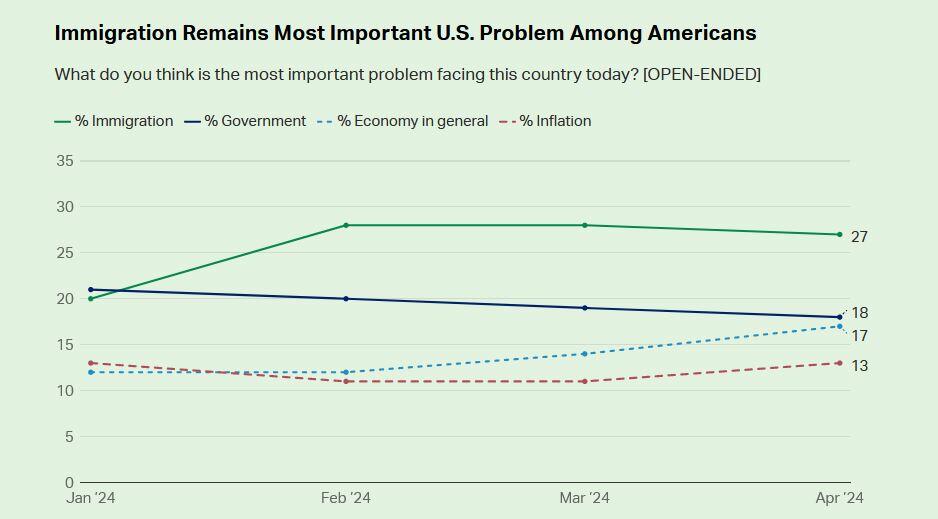
Immigration is the most important problem facing the US, according to Gallup and about a half-dozen other pollsters, not to mention at least half of America.

In May, Trump vowed to deport ‘nearly 20 million‘ illegal migrants after Biden shredded his Executive Orders on border security on his first day in office. What’s more, the number of ‘gotaways’ – those who Customs and Border Protection (CBP) think evaded Border Patrol – has spiked even more under Biden. In total, Customs data suggests that at least 10 million illegals have crossed into the US illegally during the BIden admin.

That said, Trump also said last Friday on David Sacks’ All-In podcast that legal immigrants should automatically receive green cards once they’ve graduated from college, because “we need brilliant people.” So expect much more debate on this issue, even if Trump wins.

Time for another debate!

Tomorrow, Wednesday the 26th at 7PM ET, join us for a ZeroHedge debate ln the topic of porous US border, and the millions of illegals who have entered the US.

Joining us will be former Navy intel officer Jack Posobiec, Libertarian presidential Candidate Chase Oliver, The Hill‘s Robby Soave, and author Ryan Girdusky. The debate will be moderated by The Intercept’s Ryan Grim and Unherd’s Emily Jashinsky who host the Counter Points show on YouTube.

Posobiec and Girdusky will make the case in favor of a border crackdown and even an all-out immigration moratorium, while Oliver and Soave will argue that our economy needs immigrants and that our government should admit more of them.

Tune in live tomorrow evening at 7PM ET on the ZeroHedge homepage, X feed, Rumble channel, or YouTube. The debate will also be uploaded the following date to the ZeroHedge Spotify page.

Tyler Durden
Tue, 06/25/2024 – 13:45

Cannon Fodder: The Media Piles On Federal Judge After Lionizing Manhattan Judge

Cannon Fodder: The Media Piles On Federal Judge After Lionizing Manhattan Judge

Authored by Jonathan Turley,

The politicians, the press, and pundits are in a feeding frenzy around Judge Aileen Cannon, the federal judge presiding in the Florida case against former President Donald Trump.

There is a torrent of hit pieces and petty attacks on virtually every media platform.

What is impressive is the complete lack of self-awareness over the hypocrisy of these attacks. 

Just a few weeks ago, the New York Times and other media outlets went into vapors when anyone uttered criticism of Manhattan Justice Juan Merchan in another Trump case.

In 2020, Judge Cannon was confirmed in a bipartisan vote, with the support of liberals such as Senator Patrick Leahy (D-Vt.) and Dianne Feinstein (D-Cal.).

https://babylonbee.com/news/trump-preps-for-debate-against-biden-by-goi…

Now she is being denounced as a “partisan, petty prima donna, “wacko, crazy, loony, nutty, ridiculous, and outlandish,” and a “right-wing hack.” From the descriptions in the Washington Post, New York Times and virtually every mainstream media outlet, you would think that Cannon was a freak in the courtroom, raving uncontrollably at any passerby.

These critics often stress that she is an appointee of Trump, even though many Trump appointees have ruled against the former president on 2020 election issues. And these same figures denounced Trump for attacking the perceived political bias of Democratic nominees in some of his cases.

Cannon was randomly selected, as opposed to Merchan, who was hand-picked to try Trump even though he is a political donor to President Joe Biden and has a daughter who is a major Democratic operative.

Yet these same figures denounced those who questioned Merchan’s refusal to step aside or criticized his rulings against Trump throughout the trial.

In reality, the “loose Cannon” spin is utterly disconnected with her actual rulings.

She has ruled for and against both parties on major issues. That includes the rejection of major motions filed by the Trump team and most recently challenged Trump counsel on their claims that the Special Counsel is part of “a shadow government.”

Notably, when Cannon recently rejected the main motion for dismissal by the Trump team, the Washington Post buried that fact in an article titled “Judge Cannon Strikes Paragraph in Trump Classified Document Indictment.” The suggestion was that the striking of a single paragraph was more newsworthy than insisting that Trump go to trial on these counts. (Also buried in the article is a recognition that the removal of this one paragraph “does not have a substantive effect on the case.”)

Most recently, the left expressed nothing short of horror that Judge Cannon allowed the Trump team to argue a point of constitutional law in a hearing.

Scholars and former prosecutors (including former attorneys general) have argued that the appointment of special counsels like Smith are unconstitutional.

This is a novel and intriguing constitutional objection that is based on the text of the Constitution, which requires that high-ranking executive officers like U.S. Attorneys be appointed under statute or nominated by the president (and confirmed by the Senate).

Yet after the expiration of the Independent Counsel Act in Jun 1999, the Justice Department asserts the right to take any private citizen like Smith and effectively give him greater authority than a U.S. Attorney.

This glaring inconsistency has led to a number of challenges. Thus far, they have been unsuccessful, but none have gone to the Supreme Court. Cannon wanted to hear oral arguments before ruling on the question.

That decision has sent the politicians and reporters into another frenzy of faux outrage and indignation.

MSNBC legal analyst and NYU law professor Melissa Murray went on with host Chris Hayes to tell Judge Cannon to “stay in her lane” and mock her consideration of constitutional claim:

“Girl, stay in your lane. Stay. In. Your. Lane. So, yes, not only has the issue of whether the special counsel comports with the structures of constitutional law, that’s been settled. That’s been addressed in multiple courts. Settled. We don’t have to rehash that … If this were an actual issue it would ultimately be decided by the Supreme Court, not by a district court judge in Fort Pierce, Florida.”

It is a baffling lecture. Cannon is precisely in her lane in hearing a claim without controlling authority. The fact is that the Supreme Court has not ruled on the issue and many lawyers have objected to the summary treatment given the claim by other courts. The point of creating a record is to allow a full review that could well end up at the Supreme Court.

Who isn’t staying in their lane? Cannon’s colleagues.

The New York Times recently reported that two judges attempted to get Cannon to hand off the case when it was randomly assigned to her. So the suggestion is that two of her colleagues breached any sense of collegiality and confidentiality to contribute to a hit piece on Cannon.

It is worth noting that there was no reason for Cannon to decline the selection, particularly not due to her appointment by Trump. A variety of Trump appointees have ruled against Trump on matters without a hint of objection from the left.

While it is true that Cannon was just put on the bench a couple years ago, that did not seem to bother these same pundits in the Georgia case. Fulton County Superior Court Judge Scott McAfee was put on the bench only shortly before being assigned the Georgia case against Trump and associates.

Cannon is a true American success story and, if she were only to rule in favor of the left, she would certainly be the subject of glowing stories of how she went from being born in Cali, Colombia to joining the federal bench. Her mother escaped Cuba after the revolution and she grew up with a deep-seated faith in the rule of law. She graduated from Duke University and, after a stint as a journalist, graduated from Michigan Law School magna cum laude.

Yet there will be no “American dream” stories for Cannon like the ones that ran for Sonia Sotomayor after her nomination.

Cannon is a Republican and has the temerity to follow a conservative jurisprudence. For the media, that makes her unworthy (much like the lack of coverage on Justice Clarence Thomas’ incredible life story).

There is little chance that the scorched Earth campaign against Cannon will work. When your family escapes Communist Cuba and then the drug-ravaged city of Cali, partisan media hit pieces are hardly intimidating.

That may be frustrating for many in the media, but she is fulfilling the purpose of Article III of the Framers. She will rule and she will not yield.

*   *   *

Jonathan Turley is the J.B. and Maurice C. Shapiro Professor of Public Interest Law at the George Washington University School of Law. He is the author of “The Indispensable Right: Free Speech in an Age of Rage” (Simon and Schuster, 2024).

Tyler Durden
Tue, 06/25/2024 – 13:25

Solid 2Y Auction Stops ‘On The Screws’, Highest Bid To Cover In A Year

Solid 2Y Auction Stops ‘On The Screws’, Highest Bid To Cover In A Year

Another week of coupon auctions has begun, and with $70BN in 5Y paper due Wednesday, and $44BN in 7Ys for sale on Thursday, moments ago the Treasury sold $69BN in 2Y paper in a solid auction.

The high yield of 4.706% was “on the screws” with the When Issued which was also 4.706% ahead of the 1pm auction deadline, in fact this was the 2nd On The Screws auction this year, following a similar result in January; it was also the lowest 2Y auction yield since March and well below the 4.90% in both April and May.

The bid to cover jumped from last month’s 2.406% (which was the lowest since Nov 2021) to 2.751%, well above the six-auction average of 2.57% and the highest since last July.

The internals were also solid, with Indirects awarded 65.6%, up from 57.9% in May which was the worst foreign demand since November. And with Directs taking down 20.9%, Dealers were left holding just 13.5%, the lowest since March.

Overall, a solid auction yet one which had no impact on secondary pricing levels with the 10Y unchanged after the result which was pretty much right as expected.

Tyler Durden
Tue, 06/25/2024 – 13:20

Softer Inflation But Fewer Rate Cuts?

Softer Inflation But Fewer Rate Cuts?

Authored by Will Denyer via Evergreen Gavekal blog,

US inflation slowed in April, according to CPI data released Wednesday. Yet even though they had this softer inflation data in hand, Federal Reserve policymakers still pared back their rate cut expectations for the year. In the new dot plot published Wednesday, the median projection showed just one rate cut before the end of 2024. That compares with three cuts in the March dot plot.

What gives?

Is inflation data no longer the main driver of interest rate policy?

Despite appearances, nothing is further from the truth.

Inflation trends are still massively important for Fed policy – and for markets.

The apparent contradiction between softer inflation and more hawkish rate projections is explained by two things: timing and confidence.

On timing, the reduced rate cut projections are a delayed response to the first quarter’s inflation scare.

When policymakers made their previous projections, on March 20, they only had two “hot” inflation prints in hand— January and February. These they largely brushed off as noise, or as Fed chair Jay Powell put it, “bumps in the road.” It was only when data for March was released on April 10 showing the third hot inflation print in a row that policymakers started to take seriously the possibility that inflation could be reaccelerating. Wednesday was the first opportunity since then for policymakers to revise their rate expectations for the year, and they took it.

Confidence, or a lack of it, explains why, despite two months of relatively benign inflation data in April and May, policymakers then didn’t go back to projecting three rate cuts this year.

The first quarter’s inflation scare effectively reset the clock. After three successive hot inflation prints, the Fed’s policymakers necessarily pushed back their prospective start date for rate cuts. Barring a crisis, that start date will remain pushed back, despite any subsequent softer prints.

The Fed will now need to see a string of benign inflation numbers before it regains the confidence that inflation is heading back to somewhere near its 2% target in a lasting fashion. This means that even if inflation continues to be benign, this year’s window for rate cuts is a lot smaller than it was in March. So, policymakers duly pared back their expectations for the number of rate cuts likely in 2024 (and had inflation continued to accelerate in the second quarter, we might even have got projections for rate hikes).

Allowing for these considerations of timing and confidence, there is no contradiction between May’s softer inflation and Wednesday’s more hawkish guidance from the Fed. Inflation remains the primary driver of rate decisions, not politics, nor government finances. This will remain the case at least until the end of Powell’s term in 2026. Although if Powell is then replaced by a political lackey, all bets will be off.

So, what will inflation do next?

With money supply contracting, supply chain pressures benign, growth data mixed, and gasoline prices down, the base case is that inflation will continue to moderate.

If so, the Fed will likely be justified in cutting once or perhaps even twice before year-end.

But the risks to this outlook are substantial.

The wealth effect from rising asset prices could drive an upsurge in demand. Anatole has also highlighted the risk that housing rent, as measured by US inflation indexes, could moderate more slowly than many expect. On this note, Powell acknowledged this week that the lag between new rents and their impact on US inflation data may be longer than previously thought.

Valuations remain a concern both for bonds and for equities, with equity earnings yields very low compared to real yields on bonds, and even lower compared to real yields on bills. But with inflation moderating, hopes of rate cuts still alive, continued excitement over AI, and chunky share buybacks (thanks Apple), investors are currently inclined to ignore relative valuations and bid up the price of bonds and equities alike.

Tyler Durden
Tue, 06/25/2024 – 12:40

Dallas Fed Respondents Blast “Poor National Leadership” As Stagflation ‘Erodes Business Confidence’

Dallas Fed Respondents Blast “Poor National Leadership” As Stagflation ‘Erodes Business Confidence’

It has been a mixed morning on the macro side… to say the least.

Philly Fed Services jumped into expansion (to two year highs?), Chicago Fed National Activity Index surged, Case-Shiller home prices hit a new record high but appreciation slowed, Conference Board Expectations hovers near decade lows, Richmond Fed Manufacturing tumbled, Dallas Fed Services improved but remains in contraction…

But, below the hood of the last one we see some more interesting dynamics evolving as revenues and employment decline while prices re-accelerate…

Source: Bloomberg

This is the 25th straight month of contraction (sub-zero) for the Dallas Fed Services index and judging by the respondents’ comments, there is a clear place to point the finger of blame:

Poor national leadership and lack of confidence have eroded the business environment.

  • The Federal Reserve’s recent  announcement of no rate cuts in the near future is concerning regarding the  immediate and lag effect it could  have on the local economy. We have received  direct feedback from many of our clients in various industries, and they are  increasingly concerned. They are freezing hires and spending, with many  reducing spending. The primary reason is the economic stagnation locally and  nationally affecting their businesses.

  • People are adjusting to new economic realities. Few are expecting salary increases and are instead making lifestyle  adjustments to deal with higher living costs. Reality is also setting  in for the apartment owners we serve. They understand rents aren’t going up and  interest rates aren’t coming down. As rate caps expire and loans mature,  lenders are having to adapt as well. Ultimately, a lot of private equity (much  in the form of individual retirement savings put into syndications) is getting  wiped out.

  • We need a rate cut before we will  see any revenue improvement from home sales.

  • As elections draw near, the political environment worsens, creating more uncertainty in our business.

  • We feel inflation and fear of more inflation plus the rise in cost of living are holding consumers back. Hopefully we will adapt to the new realities soon.

Customers are concerned about the election, so they are holding off on large purchases.

  • The lack of building activity is  shutting down the appliance industry.

  • Affordability has become an ever-increasing problem for new car dealers. The price increases of new cars combined with  higher interest rates have put new cars out of reach for more and more people.

  • [Car] inventories continue to swell, and  interest rates remain high. Our grosses are off, and margins continue to  decline. Profits are down 20  percent from the prior year.

  • The economy is slowing. The consumer  is more cautious and more reluctant to purchase at higher prices and payments.

And finally, this seemed to sum up just how business-owners feel in general about the current occupant of The White House:

“Our outlook depends heavily on the presidential  election.”

But, but, but… Bidenomics!!!!???

Tyler Durden
Tue, 06/25/2024 – 12:20

Kenya Protesters Storm Parliament, Police Fire Live Rounds, After Lawmakers Unleash Eco-Austerity

Kenya Protesters Storm Parliament, Police Fire Live Rounds, After Lawmakers Unleash Eco-Austerity

The Kenyan capital of Nairobi has descended into violence and mayhem as large street protests by Kenyans outraged at new tax policies and a harsh ‘Eco-Austerity’ program imposed by the government have resulted in the parliament building being set on fire.

Legislators are evacuating after the anti-tax protesters initially breached parliament. They quickly overwhelmed police soon after the lawmakers voted to pass a bill which introduces new nationwide taxes, including an eco-levy which raises the price of basic goods such as diapers, as part of efforts to curb waste management and be more environmentally friendly.

Via AP

The new taxes were tucked away in Kenya’s Finance Bill 2024, and directly impacts imports, prices, and sales of diapers, batteries/dry cells, smartphones, earphones, clocks, radios, TV sets, cameras… staplers, printers, calculators, photocopying machines, keyboards, mice, projectors and LCD monitors.

The stringent Eco Levy especially impacts those who intend to import plastics into the Kenyan market, imposing a hefty fee per kilo on the products.

Protesters have been shouting while entering parliament, “We’re coming for every politician.” There are widespread reports that police have begun utilizing live fire against the throngs, also amid riot control measures such as tear-gas.

Currently, President William Ruto is outside the capital attending an African Union event, but he’s tried to strike a conciliatory tone, praising the enthusiasm of the youth – who are by and large the backbone of the demonstrations.

But the increasingly violent confrontations with police on the streets of Nairobi, which have been intensifying since last week when two people died, are also the result of alleged abductions by security services. The AP reports:

The Kenya Law Society President Faith Odhiambo said Tuesday that 50 Kenyans, including her personal assistant, had been “abducted” by people believed to be police officers.

Some of those missing included those who were vocal in the demonstrations and were taken away from their homes, workplaces and public spaces ahead of Tuesday’s protests, according to civil society groups.

Initial reports say at least eight people have been killed, according to a Kenya national broadcaster cited AP. The Kenya Human Rights Commission has also confirmed police are “firing live rounds” at demonstrators.

Dozens more have been injured, and likely the casualty count will rise through the day and evening as the crisis shows no signs of abating.

Lawmakers have reportedly escaped the burning and occupied parliament building unscathed through a tunnel.

Protesters have filmed themselves occupying the parliament building, now emptied of lawmakers and staff…

Sadly all of this is part of a familiar and historic pattern in Africa. The so-called international community and powerful global/Western institutions like the International Monetary Fund (IMF) regularly induce governments to take on huge debts, and then begin to impose from abroad drastic societal reform measures on the population. 

And in the process of billions being exchanged, corrupt local government figures line their own pockets while imposing stringent and very sudden measures on the lower class and impoverished citizens.

The following lines concerning the Kenya crisis seem like a scenario taken straight out of Confessions of an Economic Hit Man… “The stringent Eco Levy aims to enhance existing weaker and less effective waste and pollution control mechanisms, such as the Extended Producer Responsibility (EPR) regulations that Kenya embraced two years ago. The EPR is a comprehensive global framework designed to hold manufacturers accountable for the entire lifecycle of their plastic and electronic products.”

Tyler Durden
Tue, 06/25/2024 – 10:40

Central Banks’ Appetite For Gold Hasn’t Been Satisfied

Central Banks’ Appetite For Gold Hasn’t Been Satisfied

Authored by Mike Maharrey via Money Metals,

Central banks have been gobbling up gold, and based on responses to the World Gold Council’s 2024 Central Bank Gold Reserves Survey, their appetites for the yellow metal aren’t going to be satisfied any time soon.

Last year, central banks added a net 1,037 tons of gold to their reserves, just slightly below the record of 1,082 tons in the previous year.

That pace of buying will likely continue.

Based on a World Gold Council survey that included 70 respondents, 29 percent of central banks plan to add more gold to their reserves in the next 12 months. The WGC said it was the highest level since the survey began in 2018.

Only 3 percent said they had plans to decrease gold reserves.

Eighty-one percent of the respondents said they expect overall global gold reserves to increase in the next 12 months. That was up from 71 percent in the 2023 survey.

Meanwhile, 69 percent of the central bankers surveyed said they think global gold reserves will be higher in five years. That was up from 62 percent in last year’s survey. In 2022, only 46 percent of the respondents thought gold reserves would be higher in five years.

The results would seem to indicate the panic and gold selloff that happened recently when China didn’t announce any change to its reserves for the first time in well over a year was probably overblown. Central banks aren’t about to stop increasing their gold reserves any time soon.

Why Gold?

Why do central banks hold gold in their reserves?

According to the World Gold Council, “[Gold] purchases are chiefly motivated by a desire to rebalance to a more preferred strategic level of gold holdings, domestic gold production, and financial market concerns including higher crisis risks and rising inflation.”

When asked about specific factors that influence overall reserve decisions, interest rate levels ranked first. Inflation concerns and geopolitical instability were the second and third biggest factors influencing reserve decisions.   

A growing number of emerging market central bankers said they were concerned about shifts in global economic power. This likely reflects the growing de-dollarization trend and worries that the U.S. and other Western powers could use the dollar as a foreign policy weapon. In fact, 32 percent of the central bankers surveyed admitted that de-dollarization was a factor in their decisions to hold gold.

Central banks specifically hold gold for several reasons.

The number one reason is gold serves as a long-term store of value, and it creates a hedge against inflation.

Other key reasons given for holding gold were its performance during times of crisis, its role as a portfolio diversifier, and the fact that there is no default risk.

Emerging and developing market central banks view risks differently than those in developed markets. A higher proportion of EMDE central banks viewed the following factors as more relevant to their decision to hold gold: 

  • Concerns about systemic financial risks
  • Lack of political risk
  • Concerns about sanctions
  • Anticipations of changes in the international monetary system

This likely reflects the ongoing shift of gold from the West to the East. Policymakers in the U.S. and Europe don’t seem to grasp the significance of this shift.

Mike Maharrey is a journalist and market analyst for MoneyMetals.com with over a decade of experience in precious metals. He holds a BS in accounting from the University of Kentucky and a BA in journalism from the University of South Florida.

Tyler Durden
Tue, 06/25/2024 – 10:20

Conference Board Confidence ‘Hope’ Hovers Near Decade-Lows

Conference Board Confidence ‘Hope’ Hovers Near Decade-Lows

Consumer Confidence, as survey by The Conference Board, dipped in June to 100.4 from a revised lower May print of 101.3. The present situation index improved but the expectations index declined further (hovering near decade lows)…

Source: Bloomberg

…and for the 7th month in the last 8, confidence was revised down…

Source: Bloomberg

The overall trend in the labor market indicator remains weaker…

Source: Bloomberg

Interest rate and inflation expectations dipped… as did hopes for a higher stock market…

Source: Bloomberg

Plan to buy a car or a major appliance dipped…

Source: Bloomberg

Just remind us again how ‘confidence’ can be revised lower?

Tyler Durden
Tue, 06/25/2024 – 10:10

China Dangles A Car-Rot

China Dangles A Car-Rot

By Bas van Geffen, CFA, Senior Macro Strategist at Rabobank

The European tariff hike on Chinese electric vehicles hasn’t even come into effect, but parties on both sides are already looking for a diplomatic solution. In a meeting between German Economy Minister Habeck and China’s Commerce Minister Wang Wentao, China reportedly offered to lower its existing tariffs on large-engine cars if the European Union cancels the punitive import duties on Chinese EVs.

It’s China dangling the carrot, after it already threatened to apply the stick on European pork exports, and the (predominantly German) car industry, for example. And at the same time that China expresses a willingness to negotiate, it also threatens to file a dispute at the World Trade Organisation.

This apparent willingness to work out an agreement underscores the completely different approach to trade between the parties involved. Brussels’ decision to impose tariffs is based on a formal procedure and an in-depth investigation into unfair state subsidies; it is not intended to be a tool for negotiations and its goal is not to get China to lower its duties on European products.

Yet, Germany’s Scholz reiterated on Monday that he would like to see a negotiated solution. And so, China’s carrots might be driving some change. Minister Habeck was “hopeful” about China’s apparent willingness to negotiate, and German industrial leaders will probably hail the prospect of lower tariffs as a victory. This raises the risk that the German government could try to revert the import duties. That could turn out to be a colossal mistake in the long run. It may bring some short-term gains to Europe’s industry, but it would not help the structural outlook for these manufacturers. It may also drive another wedge into European unity.

The current weakness of the German industry offers some explanation for Germany’s position in the car tariffs discussion. The IFO business climate survey yesterday confirmed that German manufacturing remains in a weak state, echoing the signal from last Friday’s PMI report. The IFO index dropped 0.7 points to 88.6 led by lower expectations. Services and construction (which are both more domestic-oriented sectors) actually improved a bit, but this was offset by a renewed deterioration in trade and manufacturing activity.

After the US and Europe, Canada is now also putting up no-entry signs for Chinese EVs. Finance Minister Freeland formally launched a consultation, which is a first step towards tariffs. Additionally, the Canadian government will also examine the list of electric vehicles that is currently eligible for federal consumer incentives, and potentially “broader investment restrictions” in the Canadian EV industry.

Contrary to the German opposition, the auto industry is actually pushing Trudeau’s government to impose tariffs in order to protect the domestic industry and jobs. But, more importantly, the country will feel some pressure to re-align with the US – who recently raised the import duties on Chinese EVs to prohibitive levels. A review of the North American Free Trade Agreement is coming up in less than two years, and Canada probably does not want to be scolded as the side road into the US market. At the same time, Canada will be mindful of any Chinese retaliation, its second-largest trading partner.

It once again underscores the difficult trade-off facing Western leaders. China, meanwhile, is taking a more strategic approach to its domestic industry. President Xi reiterated that several key technologies are currently controlled by others. Xi said China must strive for self-reliance when it comes to advance technologies, and he called for a greater sense of urgency in research and development in areas like artificial intelligence, quantum technology, and biotech.

But will that be the new growth impulse that the economy needs? Despite all the headwinds that still plague China’s economy, Premier Li expressed confidence that the 5% growth target for this year can be achieved. Li did acknowledge that shaking off the difficulty of growth requires new growth drivers.

Unofficially, China may still be looking abroad for some of this growth. In fact, it may be another reason why the Chinese government expressed willingness to negotiate on the European tariffs – apart from trying to sow discord in the European ranks. Of course, officially, Premier Li rebutted accusations of industrial overcapacity and dumping: he stressed that Chinese products first and foremost satisfy domestic demand. We would add that this domestic demand has been one of the weak spots in China’s economy, though. And perhaps somewhat contradictory, Li added that China’s manufactured goods help to ease global inflationary pressures and warned that decoupling and protectionism will only raise operating costs across the global economy. At the very least, note that Li is saying this to the West while Xi has just pleaded for more decoupling in key Chinese technologies.

Tyler Durden
Tue, 06/25/2024 – 10:00

Novo Nordisk Shares Hit New Record As Wegovy Gets Approval In China 

Novo Nordisk Shares Hit New Record As Wegovy Gets Approval In China 

China’s National Medical Products Administration has approved Novo Nordisk A/S’ blockbuster Wegovy drug for “long-term weight management” in the world’s second-largest economy. 

Wegovy will first be made available to Chinese patients with a body mass index (BMI) of 30kg/m2, which qualifies as obese, and who also have at least one weight-related disease, according to a press release from the Danish big pharma company posted on WeChat. Novo Nordisk also noted that Ozempic, the diabetes treatment version of the drug, was approved in China in early 2021.

“Up to now, there is still a lack of effective clinical drug treatments for obesity patients in China, and there is a huge medical need to be met,” Novo Nordisk said. 

The much-anticipated approval means Novo Nordisk could soon capitalize on some of the more than half of China’s 1.4 billion overweight population. It comes as the patent on the drug’s active ingredient, semaglutide, is set to expire in China in 2026 (this is five years ahead of Europe and six years earlier than in the US).

Meanwhile, more than 15 generic versions of Ozempic and Wegovy are in clinical trials in China, Reuters reported last month.

Last month, Eli Lilly’s diabetes drug, Mounjaro, received approval in China. Meanwhile, Zepbound, the company’s obesity drug, which contains the same active ingredient as Mounjaro, called tirzepatide, is still undergoing regulatory review.

In markets, Novo shares rose more than 2% in Copenhagen to new record highs. 

Companies with exposure to GLP-1s are re-accelerating this week after pausing as companies at risk from GLP-1s’ success are fading fast…

On Monday, Novo Nordisk announced a $4.1 billion investment to expand its manufacturing capacity in the US as sales of its weight loss drug soar.

In a recent Goldman note titled “Weighing The GLP-1 Market,” analysts expect the rising popularity of GLP-1 drugs and healthcare innovations to be larger in the US than anywhere in the world, explaining this in three bullet points:

  • First, the US has relatively more to gain from the widespread adoption of GLP-1 drugs than other economies given its higher rates of obesity and generally worse health outcomes, although China has the largest number of people with obesity in the world and therefore looks poised to majorly benefit from GLP-1 drugs.

  • Second, the US will likely outpace other economies in its rate of innovation and adoption of new health treatments. Indeed, historical patterns suggest that over half of all new drugs are first launched in the US, with an average delay of one year before launch in other major markets.

  • And third, while the scope for health improvements in EM economies is significant, near-term health advances in these economies will likely stem from high-impact investments in relatively inexpensive existing therapies rather than cutting edge research and development.

The GLP-1 craze is going worldwide. 

Tyler Durden
Tue, 06/25/2024 – 09:40