67 F
Chicago
Thursday, September 24, 2026
Home Blog Page 2537

Why Has China Purchased Farmland Near 19 Different Military Bases Inside The US?

Why Has China Purchased Farmland Near 19 Different Military Bases Inside The US?

Authored by Michael Snyder via The End of The American Dream blog,

The Chinese aren’t exactly being subtle about what they are trying to do.  Today, they own more than 300,000 acres of farmland inside the United States, and they have been specifically targeting areas that are located near important military bases.  As you will see below, the Chinese now own farmland very close to 19 different U.S. military bases.  How in the world could our leaders have allowed this to happen?  Foreign adversaries should not be allowed to purchase farmland at all, and yet somehow they have been able to acquire land that is ideal for spying on our military bases over and over again. 

In fact, the New York Post has “identified 19 bases across the US from Florida to Hawaii which are in close proximity to land bought up by Chinese entities”…

China has been buying up strategically placed farmland next to military installations across the US, raising national security fears over potential espionage or even sabotage.

The Post has identified 19 bases across the US from Florida to Hawaii which are in close proximity to land bought up by Chinese entities and could be exploited by spies working for the communist nation.

When I read stuff like that, it makes me want to tear my hair out.

Are the people that are in charge of our national security really this incompetent?

According to the New York Post, the list includes some of our “most strategically important bases”…

They include some of the military’s most strategically important bases: Fort Liberty (formerly Fort Bragg) in Fayetteville, North Carolina; Fort Cavazos (formerly Fort Hood) in Killeen, Texas; Marine Corps Base Camp Pendleton in San Diego, California, and MacDill air force base in Tampa, Florida.

We know that the Chinese are very interested in our military bases.

Do you remember the Chinese spy balloon that was allowed to fly over our country?

The path that it took allowed it to gather intelligence on Malmstrom Air Force Base, which is where some of our key nuclear assets are located.

And the Wall Street Journal has reported that Chinese nationals have been caught accessing “military bases and other sensitive sites” inside the United States close to 100 times…

Chinese nationals, sometimes posing as tourists, have accessed military bases and other sensitive sites in the U.S. as many as 100 times in recent years, according to U.S. officials, who describe the incidents as a potential espionage threat.

The Defense Department, FBI and other agencies held a review last year to try to limit these incidents, which involve people whom officials have dubbed gate-crashers because of their attempts—either by accident or intentionally—to get onto U.S. military bases and other installations without proper authorization. They range from Chinese nationals found crossing into a U.S. missile range in New Mexico to what appeared to be scuba divers swimming in murky waters near a U.S. government rocket-launch site in Florida.

Look, everyone knows that the Chinese are trying to spy on us.

That isn’t a big secret.

Just don’t make it easy for them.

At the same time all of this spying is going on, there has been an unprecedented surge in Chinese migrants coming across the southern border…

US border officials said they detained 37,000 Chinese migrants attempting to cross the border in 2023, or 10 times the number detained in the year before. The true number of those attempting to cross the border is likely higher.

The flow of Chinese migrants continued to surge in 2024, with CBS reporting in February that it observed 600 migrants, many of whom were Chinese, entering the US in a single day.

The House Homeland Security Subcommittee on Oversight, Investigations, and Accountability said in May that the number of Chinese nationals encountered by authorities at the US border in March had jumped 8,000% from the same period in 2021.

Most of the Chinese migrants that are coming across the southern border are men of military age, and they commonly travel to the border in groups.

Suspiciously, these groups of military age Chinese men are often decked out in matching equipment.

But they are let into the country anyway, because that is what our leaders have decided to do.

So now we have tens of thousands of military age “Chinese migrants” that are running around inside our country, and we have no idea where they are or what they are doing.

The Chinese are preparing to win a war, and we are preparing to lose one.

At this point, everyone realizes that the Chinese are going to invade Taiwan eventually.  In fact, the Daily Mail ran a big story about the coming invasion this week…

Xi Jinping views Taiwan as a breakaway Chinese province and has vowed to ‘reunify’ it with the mainland, by force if necessary.

He is in the midst of a huge military buildup, regularly sending fighter jets and warships to harass Taiwan, and staging menacing war games in the area.

When Taiwan is invaded, the U.S. military will be expected to intervene, and then we will be at war with China…

Taiwan views itself as independent of Beijing and is allied to America – a legacy that stretches back to the Chinese Civil War 75 years ago.

America supplies the islands with weapons and is expected to go to war to defend them if they are attacked.

By most estimates, a war over Taiwan would be one of the biggest, bloodiest, and most expensive in history.

Most people don’t realize this, but China and the Philippines are also on the verge of military conflict.  Recently, there was a very alarming clash in the South China Sea that resulted in one Filipino soldier losing a thumb…

Filipino soldiers had to defend themselves with bare hands against Chinese coast guard armed with swords and knives, according to the Philippines.

General Romeo Brawner, the Philippines’ top military commander, criticized China for what he described as “reckless and aggressive” behavior while the Philippines navy and coast guard were delivering supplies to Filipino soldiers in the disputed South China Sea on Monday.

Chinese coast guard personnel rammed their vessels into boats belonging to the Philippines, and boarded and attacked them, the BBC reported Brawner as saying, leaving some injured and one soldier having lost a thumb.

The Chinese have become extremely aggressive, and it is just a matter of time before we are at war with them.

But even though many of our leaders publicly talk about the coming war, we are still allowing the Chinese to take advantage of us in unthinkable ways.

We should have never allowed the Chinese to purchase large tracts of farmland near 19 of our most important military bases.

Unfortunately, they are there now, and that will give them a major advantage when war finally erupts.

*  *  *

Michael’s new book entitled “Chaos” is available in paperback and for the Kindle on Amazon.com, and you can subscribe to his Substack  newsletter at michaeltsnyder.substack.com.

Tyler Durden
Fri, 06/21/2024 – 21:40

‘Total Lawlessness’ & Looting Has Made Gaza Aid Delivery Nearly Impossible: UN Chief

‘Total Lawlessness’ & Looting Has Made Gaza Aid Delivery Nearly Impossible: UN Chief

“On the Gazan side of the Kerem Shalom Crossing, where over 1,000 trucks are awaiting collection and distribution… there are hundreds of aid pallets awaiting collection and distribution by the UN aid agencies,” Maj. Gen. Ghassan Alian of the Israel Defense Forces (IDF) has announced.

For months, there have been two primary threats to aid convoys entering the Gaza Strip. First, on their way in, trucks carrying vital humanitarian supplies often come under attack by Israeli settlers. Second, once convoys are inside the Strip, they face the potential of being swarmed and coming under attack by desperate Palestinians who rip the supplies away before they arrive at intended drop-off points.

AP: Palestinians loot a humanitarian aid truck as it crosses into the Gaza Strip in Rafah, December 17, 2023.

Also, in many cases even population enclaves in the Strip which are not currently witnessing direct battles are in desperation and civil chaos amid fuel, food, and medicine shortages – given there is no overall governing authority.

UN Secretary-General Antonio Guterres on Friday called the situation one of “total lawlessness” and decried that it has led to wide-spread looting at aid storehouses.

“The situation in Gaza became a situation of total lawlessness. Most of the trucks with humanitarian aid inside Gaza are now looted because this is a war that is different from any other one,” Guterres said a news conference.

He said this is large-part due to the nature of this conflict, where Israel has not occupied and managed any single territory with enough permanence to bring any level of stability, also amid a state of internecine attacks and continued bombings.

Guterres further characterized “total chaos in Gaza” in which there is “no authority in most of the territory,” as it remains that “Israel does not even allow the so-called blue police to escort our (UN) convoys, because it’s a local police linked to local administration.”

This has made it nearly impossible to run a legitimate and timely system of aid delivery and distribution, given that for this to work there must be minimum rule of law and order.

“The problem is not only to bring things to Gaza,” he said, after explaining that once inside the shipments are an easy target for looting. “That’s why a cease-fire is so necessary to … properly organize and implement a plan,” he stressed.

The past months have witnessed dangerous scenes from Gaza like the following:

Below are some of the latest breaking developments via Al Jazeera:

  • At least 25 killed, 50 wounded in Israeli attack on tents of displaced people in Mawasi, says Palestinian Health Ministry.
  • Israeli tanks push deeper into western Rafah in south Gaza, firing shells at displaced people’s tents, with one armoured vehicle blown up by a Hamas-planted improvised explosive device.
  • The White House has described Benjamin Netanyahu’s criticism of the suspension of one US weapons delivery to Israel as “vexing” and “disappointing” as the public rift between the two allies intensifies.
  • Israeli forces have carried out deadly air attacks across Gaza over the past 24 hours, including a strike on a home that has killed eight people in Gaza City’s Zeitoun neighbourhood.
  • United Nations experts have warned arms manufacturers against transferring weapons to Israel, saying they could be complicit in violations of international law carried out in Gaza.
  • At least 37,431 people have been killed and 85,653 wounded in Israel’s war on Gaza since October 7. The death toll in Israel from the Hamas-led attacks stands at 1,139, with dozens of people still held captive in Gaza.

Tyler Durden
Fri, 06/21/2024 – 21:20

Supreme Court Broadens Use Of Expert Testimony Against Accused Criminals

Supreme Court Broadens Use Of Expert Testimony Against Accused Criminals

Authored by Zachary Stieber via The Epoch Times (emphasis ours),

The U.S. Supreme Court on June 20 sided with the government in a case centering on expert testimony in criminal trials.

Supreme Court Associate Justice Clarence Thomas poses for an official portrait at the East Conference Room of the Supreme Court building in Washington on Oct. 7, 2022. (Alex Wong/Getty Images)

In a 6–3 ruling, the justices said that experts can testify to how “most people” in a group to which a defendant belongs think, upholding a lower court ruling.

The case was brought by Delilah Diaz, a U.S. citizen who was stopped at the U.S.-Mexico border. Officers found nearly 28 kilograms of drugs hidden in the door panels of the car she was driving, and she was charged with violating a law that requires showing a defendant “knowingly” transported drugs.

Ms. Diaz said her boyfriend used her by luring her to Mexico, then loaning her a car to return to the United States that was, unbeknownst to her, filled with drugs.

The government called Andrew Flood, a special agent, to testify that drug traffickers typically don’t give large quantities of drugs to people unless the people know they are transporting the drugs.

“Generally, it’s a risk of your—your cargo not making it to the new market; not knowing where it’s going; not being able to retrieve it at the ending point, at your point B. So there’s a risk of not delivering your product and, therefore, you’re not going to make any money,” he testified.

Mr. Flood also said that there were cases where drug traffickers placed drugs in vehicles without the drivers knowing, but that none of those known “schemes” matched the circumstances of Ms. Diaz.

Challenging Testimony

Ms. Diaz brought up a federal rule known as Rule 704(b) that states expert witnesses “must not state an opinion about whether the defendant did or did not have a mental state or condition that constitutes an element of the crime charged or of a defense.” But a district judge ruled that Mr. Flood could tell jurors about whether couriers generally knew they were transporting drugs. At trial, he testified to that effect. The jury found Ms. Diaz guilty.

Ms. Diaz appealed, but a federal appeals court also rejected her arguments against the testimony.

Lawyers for Ms. Diaz had written in a filing to the Supreme Court that the plain text of the rule “forecloses limiting its reach to an ‘explicit opinion’ regarding the defendant’s knowledge.” Generalizing about most drug carriers was an improper workaround of the rule, they said.

“This is true of many generalizations about a class of individuals,” they wrote. “Say a patient asks his therapist whether he is depressed and she responds, ‘People do not usually have trouble getting out of bed in the morning unless they are depressed.’ She has clearly expressed an ‘opinion about’ her patient’s mental state. Likewise for a high-school teacher who, when asked whether one of her students knew that he was not supposed to get outside help on a take-home exam, responds, ‘High-school seniors generally know the honor code.’”

In the Supreme Court ruling siding against Ms. Diaz, Justice Clarence Thomas wrote that “because the expert witness did not state an opinion about whether petitioner herself had a particular mental state, we conclude that the testimony did not violate Rule 704(b).”

“Agent Flood instead testified about the knowledge of most drug couriers,” he added later. “Specifically, he explained that ‘in most circumstances, the driver knows they are hired … to take the drugs from point A to point B.’ That opinion does not necessarily describe Diaz’s mental state. After all, Diaz may or may not be like most drug couriers.”

Defense Arguments

Defense lawyers, during cross-examination of the agent, also established that Mr. Flood was not involved in Ms. Diaz’s case and that there had been cases before involving people carrying drugs without their knowledge.

“The jury was thus well aware that unknowing couriers exist and that there was evidence to suggest Diaz could be one of them. It simply concluded that the evidence as a whole pointed to a different conclusion: that Diaz knowingly transported the drugs. The jury alone drew that conclusion,” Justice Thomas said.

Justice Thomas was joined by Justices John Roberts, Samuel Alito, Brett Kavanaugh, Amy Coney Barrett, and Ketanji Brown Jackson.

Justice Neil Gorsuch said in a dissent that the majority was “carv[ing] a new path” around the federal rule.

The ruling means “prosecutors can now put an expert on the stand—someone who apparently has the convenient ability to read minds—and let him hold forth on what ’most‘ people like the defendant think when they commit a legally proscribed act,” he wrote. “Then, the government need do no more than urge the jury to find that the defendant is like ’most’ people and convict. What authority exists for allowing that kind of charade in federal criminal trials is anybody’s guess, but certainly it cannot be found in Rule 704.”

Justice Gorsuch was joined his dissent by Justices Sonia Sotomayor and Elena Kagan.

Tyler Durden
Fri, 06/21/2024 – 21:00

Being Frank About Costco’s $1.50 Hot Dog Combo

Being Frank About Costco’s $1.50 Hot Dog Combo

Authored by Thomas McArdle via The Epoch Times (emphasis ours),

Costco’s new CFO, Gary Millerchip, sent disciples of the ultra-low-priced warehouse chain into ecstasy when he told Wall Street analysts in May that the price of its legendary $1.50 quarter-pound, all-beef hot dog and soda with free refills would, despite raging inflation, remain at the price it’s held for about four decades.

“To clear up some recent media speculation, I also want to confirm the $1.50 hot dog price is safe,” Millerchip said, correcting an iffier statement that had been made by his immediate predecessor, Richard Galanti.

Customers wait in line to order below signage for the Costco Kirkland Signature $1.50 hot dog and soda combo, which has maintained the same price since 1985 despite consumer price increases and inflation, at the food court outside a Costco Wholesale Corp. store in Hawthorne, California, on June 14, 2022. (Patrick T. Fallon/AFP via Getty Images)

A free market means sellers having full freedom to set the prices of their wares or services, even if it includes the “loss leader” practice of selling at a price that seems to lose the business money. There are many reasons a retailer sells something at a money-losing price, such as to make a splash as a new business in first entering a market or to engender customer loyalty—which can result in sales of other items that do make a profit.

An infamous case of loss-leader strategy was the federally subsidized Chevrolet Volt plug-in hybrid car of the last decade, a four-seater originally costing nearly $40,000 even after the $7,500 federal check for each buyer. A showcase for the new, post-2008 financial crisis General Motors, which was purchased courtesy of the taxpayers by the Obama administration, its sales were disappointing. But GM insisted that the Volt, fleets of them parked unsold in dealer lots, wasn’t a product designed to make money but, rather, an assertion of “vision and leadership.”

If a supermarket wants to lose money on half-gallons of milk located in the back of the store because it believes shoppers will, during their long stroll, grab a few of the profit-generating items on the shelves between the entrance and the dairy section, it should have every right to do so. This is Costco’s thinking, since each of its over 600 aircraft-hangar-like stores in the United States is like a Disneyland of rock-bottom deals on everything from groceries to clothes to appliances.

Another celebrated example and resoundingly successful use of loss leader is Gillette selling its razors at far below cost, then pulling in lots of revenue through sales of replacement blades made exclusively for its own razors, while at the same time building a large customer base that leads to sales of other of its products with big profit margins, like aftershave and deodorant.

Costco or Gillette’s competitors, or the media, of course, have every right to call out the practice as a cynical ploy. Even running rival businesses into the ground is a legitimate motive for loss-leader pricing; after all, the materialization of any new competitor offering attractive prices can be deemed an unfair burden that could crush a long-established, popular small business. Once government is allowed to make judgments on what constitutes unlawful “predatory” pricing, there is no knowing how much healthy competition it will restrict.

Utilized in what looks to be such cutthroat purposes, loss leader facilitates and accelerates “creative destruction,” the term used by socialist economists Joseph Schumpeter and Werner Sombart to describe what Marx had vilified as capitalism’s “constant revolutionizing of production” and “uninterrupted disturbance of all social conditions.” The unprofitable neighborhood deli shuttering in the wake of the low prices offered by the supermarket chain opening a new store a short drive away is as much an example of creative destruction as the dislocation caused by Henry Ford’s assembly line or the brick-and-mortar businesses that could not survive the online marketplaces of the Internet. Who visits the mall to sit down with a travel agent when they can click on booking.com, begun by a recent graduate of a Dutch technical college nearly 30 years ago? (Answer: no one; such physical travel agencies no longer exist.)

For government to poke a finger in the dike holding back creative destruction is to seek the artificial prevention of the inevitable, like attempting to hold back the Industrial Revolution. If politicians crusade against loss leader, declaring it an immorality, can it be long before it will criminalize free samples or giveaways by retailers? Absent the liberty to set prices there is no economic freedom in a free country.

In Costco’s case, loss leader is turned somewhat on its head, since its customers are providing it with its profits before they even have access to the head-spinning deal at the snack bar. The members-only warehouse club has become the world’s third-largest retailer, and with a razor-thin 2 percent profit margin, Costco makes its real money—$242 billion in revenue last year—through the $60 annual fee it charges for a membership card (double that for an executive membership providing reductions on some already low prices, plus some fringe benefits).

After shelling out that kind of dough for the privilege of being able to flash your card at the door, to walk in and see that impossible-to-believe deal at the snack counter for the iconic American junk food meal of frankfurter and fizzy drink provides a strong jolt of psychological validation. If one had doubts about parting with that $60 they might be allayed, replaced by self-congratulation.

The buck-fifty deal, however, dates all the way back to 1983, which means that adjusted for inflation Costco members were at that time paying today’s equivalent of about $4.60. It was then that Costco’s co-founders, the late Jeffrey Brotman and retired Jim Sinegal, expressed the sentimental hope that the price would never rise. In the decades since, some unusual efforts have gone into keeping intact today’s version of Vice President Thomas Marshall’s tongue-in-cheek pronouncement that “What this country needs is a good five-cent cigar” from 110 years ago.

For instance, to avoid reliance on the greater expense of outside suppliers, Costco established its own hot dog manufacturing plants in Los Angeles and Chicago. In January, Joey Kinsley of Cleveland spent a whole week eating nothing but Costco’s $1.50 hot dogs and soda, chronicling the experience on social media and explaining that he was doing so to take refuge from inflation. “It’s a deal that is unheard of in 2024,” Mr. Kinsley told Fox News.

If Costco’s $1.50 hot dog and soda went by the wayside it would have a symbolic force not unlike Dollar Tree announcing that “In the midst of unprecedented inflation, Dollar Tree recently changed its primary price point to $1.25”—the absurdity of the dollar store no longer charging a dollar on most items. In fact, last month Dollar Tree further announced that its prices are rising to $1.50 on average, with some products to be sold at $7.

So Costco bending over backward to continue to give away hot dogs for $1.50 will no doubt go down as one of the most effective uses of loss leader in corporate history, as its $60 and $120 memberships get renewed en masse year after year. But any notion that seeing that amazing price of yesteryear on the sign above the counter will persuade people into believing that inflation might not be as high as they think is belied by what consumers see just about everywhere other than at the warehouse snack bar.

Tyler Durden
Fri, 06/21/2024 – 19:00

Israel Intent On Launching An Incursion Into Lebanon, Blinken Warns

Israel Intent On Launching An Incursion Into Lebanon, Blinken Warns

CNN has revealed that Secretary of State Antony Blinken warned top Arab officials that Israel is intent on launching an incursion into Lebanon. “It seems that they [Israel] are very serious about going into Lebanon,” a source who was privy to Blinken’s meeting with an Arab counterpart during his latest trip to the region said.

CNN described further, “The Arab official’s response to Blinken, the source added, was that Hezbollah has communicated that they will not stop their strikes on Israel until Israel stops its operations in Gaza.”

Via Reuters

Hezbollah Secretary-General Hassan Nasrallah has warned this week that in the scenario of all-out war, no place in Israel would be safe and even nearby allies of Tel Aviv could come under Hezbollah rocket fire if they offer assistance – in a threat specifically warning Cyprus. This came soon after Israel’s top generals approved battle plans and acknowledged the IDF is on the ‘brink’ of launching an offensive against the Shia paramilitary group backed by Tehran.

The US is till seeking to cool tensions and making the argument that broader war is good for no one. CNN additionally included the following surprising statement from the Israeli side (surprising given that Israeli military leaders know full well that Hamas is far more formidable a foe than Hamas):

Israel has made the case that it can pull off a “blitzkrieg,” but the US is warning them that they may not be able to ensure that it remains a limited campaign, the official said.

Israel’s strategy in a ground invasion scenario would be to keep the offensive ‘limited’ inasmuch as possible, primarily with the aim of creating a buffer zone of some 10km, which could allow the return of the tens of thousands of residents of northern Israel who have been within easy reach of Hezbollah’s constant drone and rocket barrages.

Washington too has been pressing a ceasefire plan that would ideally see Hezbollah agree to a buffer zone. Referencing Biden’s special envoy in the region Amos Hochstein, who has been in Beirut the last couple of days (and in Israel before that), CNN writes that “If war is averted and Hochstein’s plan goes into effect, it would similarly see Hezbollah pull back around six miles, or ten kilometers, away from the border.” And more:

“The fact that we have managed to even hold the front for this long has been a miracle,” a senior US official said, referring to the US’ efforts to keep the Israel-Hezbollah attacks from spiraling into an all-out war.

“We’re entering a very dangerous period,” another senior Biden administration official said. “Something could start with little warning.”

However the IDF might have trouble keeping operations limited: “But in order to prevent a return by the group in the future, Israel may want to further destroy Hezbollah’s infrastructure in the area,” notes the report.

It must be remembered that all the way back in January, Israel received a warning from US military intelligence (DIA) laying out that fighting a two-front war with Hamas in the south and Hezbollah in the north would be devastating, and likely a losing situation.

This surprise revelation and blunt warning was buried in a prior Washington Post story: 

In private conversations, the administration has warned Israel against a significant escalation in Lebanon. If it were to do so, a new secret assessment from the Defense Intelligence Agency (DIA) found that it will be difficult for the Israel Defense Forces (IDF) to succeed because its military assets and resources would be spread too thin given the conflict in Gaza, according to two people familiar with those findings. A spokesperson for the DIA did not offer comment.

We previously unpacked the implication in special analysis If Full War With Hezbollah Opens, Israel Will Lose.

Blinken’s office was cited in the same report as saying at the time: “It is in no one’s interest — not Israel’s, not the region’s, not the world’s — for this conflict to spread beyond Gaza.” This has been the official US line since then as well. Of course, this would likely hasten a broader Israel-Iran war, likely to also spill into Syrian and Iraq.

Tyler Durden
Fri, 06/21/2024 – 18:40

The Game Theory Of Biden’s Replacement And Trump’s VP Pick

The Game Theory Of Biden’s Replacement And Trump’s VP Pick

Submitted by QTR’s Fringe Finance

If there’s one political rule that always seems to hold true, it’s that both parties will wind up choosing the worst possible selection for whatever needs they seek to fulfill.

That’s just the miracle of government. Who knew that doing things as inefficiently as humanly possible — selecting candidates, spending tax money, passing legislation, appointing cabinets — was such an art form, reserved for the likes of brilliant visionaries like Jeb Bush, Jasmine Crockett, Nancy Pelosi, Mitch McConnell and the likes?

The talent is uncanny. If you gave me 20 years as President, all $80 trillion in tax receipts the country brought in over that time and made it my one sole objective to do so, I still wouldn’t be able to engineer the following headline during my tenure:

Anyway, every two years, we have a major round of elections, and every two years I’m stunned that the slate of candidates we put up for election are passed off as representing the best we can do on both sides of the aisle.

And every four years, it seems like there are always running jokes during the presidential election that most people would vote for literally anybody other than the two choices they are being given.

As someone who leans conservative, I hope this maxim of choosing the worst possible replacement continues to hold true when it comes to Joe Biden’s coming replacement.

It seems fairly obvious at this point that the generally incomprehensible Biden is going to have to be swapped out with someone who is at least semi-conscious. If Democrats don’t do it between now and the election, Biden almost certainly will (1) lose the election or (2) not be finishing a second term.

The good news for conservatives is that Democrats don’t show any signs of letting up from their current strategy of torpedoing their own party.

I’ve mentioned in passing that I think a long line of centrist Democrats, including the likes of former candidate Dean Phillips or potentially Michelle Obama, would throttle Donald Trump in a national election.

This will be an unpopular statement with some, but I believe Trump is beating Biden by a wide margin not because Trump is the overwhelming objective favorite of the country, but because he’s the overwhelming favorite relative to the idea of another 4 years of Joe Biden.

If you were to stack Trump up against any middle aged centrist Democrat with a pulse who promises to pull back on woke policy and return the country to some form of normalcy, he’d likely slip significantly in the polls. I don’t know why this is so difficult for Democrats to understand, but then again they don’t exactly seem to be the party of common sense decision making. If liberals ignore this obvious decision that could instantly win them the election and instead continue playing “the game” that dictates people who have “put their time in” deserve a chance more than somebody like Dean Phillips, they’re going to lose the election.

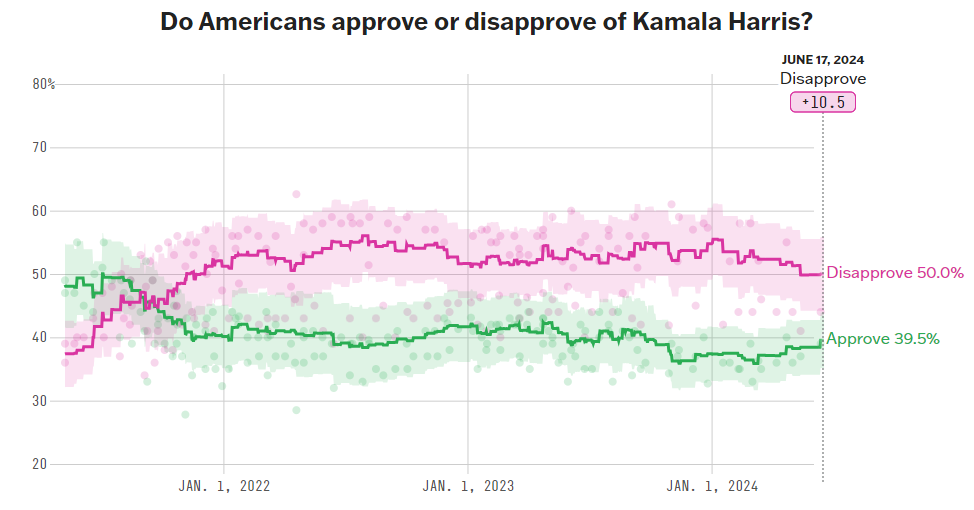
If you think Hillary Clinton’s appearance at the Tony Awards the other night was a coincidence, think again. I think it is a sign there’s a very real chance that she is in the running to replace Joe Biden. If I had to guess, second to Hillary would be Kamala Harris because the Democrats probably feel like they “owe it” to her, not only for being current vice president but also for DEI purposes.

I can’t even begin to tell you how terrible either of these selections would be, not only for the country but for the Democratic Party. Both candidates are unbearable, and the country has already had their fill of both of them.

Clinton would be the closer race of the two, in my opinion, because if you recall correctly, Harris got curb-stomped during the Democratic primaries while making her run for president. And for the most part, it appears the country still finds her detestable.

To boot, the last four years have proven, on top of that, that she’s an airhead.

Either way, the nation would see both of these candidates as more of the same, and they would do little to advance Democrats’ against Donald Trump.

But it isn’t just Democrats that are horrific political strategists, and all one needs to do is look at Donald Trump’s shortlist for vice president to understand that.

When I read the list of those in serious consideration, I couldn’t help but quote this scene in Major League:

“Ricky Vaughn? Willie Hayes. I never heard of most of these guys. Mitchell Friedman?”

“Who’re these f*ckin’ guys?”

At first glance, it appears Trump’s strategy in picking a vice president is to get somebody milquetoast enough to move him closer to the center, not eclipse his bombast, and support him vehemently. We’ll call it the “Pence strategy”.

But as Trump quickly found out with endorsing Mike Johnson for the Speaker of the House role, a good portion of his base wants somebody who isn’t a centrist, and instead unapologetically supports the Make America Great Again agenda.

It’s baffling to me that with potential picks like Tulsi Gabbard, Kari Lake, and Vivek Ramaswamy out there, Trump would be mulling over a list that includes the likes of “Little” Marco Rubio and Doug Burgum, both of whom have the personality and likability of a damp washcloth.

I think Trump could be in the right neighborhood looking at somebody like Byron Donalds, who is strong and outspoken, and would obviously give Trump further reach into the black community, but I think the key issue he needs to defend heading into November is the abortion issue. He’s not going to lose on the issues of law and order, inflation or the economy, that’s for sure.

Trump selecting a female vice president would check a lot of boxes: it softens up his image, it gives him an inroad with women on the abortion issue, and it checks the equality box that a lot of undecided/independent liberal-ish voters close to the center wouldn’t mind checking off.


🔥 80% OFF: Since it’s officially summer, I’m going to offer up my largest discount of the year for Fringe Finance: Get 80% off forever


I do understand the strategy of not wanting to change much when you’re already ahead, and I understand a guy like Doug Burgum has appeal because he brings nothing positive or negative to the campaign, but I do think Trump doesn’t need to totally focus on playing defense with his pick. Someone like Ramaswamy would bring another sharp tongue, adept at slicing and dicing through the mainstream media’s bullsh*t. Former Democrat Gabbard would bring inroads not only to women voters, but to Democrats. Someone like Elise Stefanik or Kari Lake would also be a value add if Trump needs to defend the abortion issue as top priority.

The Democrats still have a legitimate shot to pull this election out, but their window to make a change is closing every day. The nonsense of not being able to pull Biden out of the race because he’s an incumbent will come back to bite them in the ass if that’s the road they want to take.

Perhaps the strategy is to allow Biden to humiliate himself at the first debate so whoever they put in his place for the second one looks that much better. But as days and weeks pass by without making a change, they are losing crucial time. They will need to warm up a second candidate — and entire second campaign — to the public, even if it is somebody they already know like Hillary Clinton.

The name of the game for the conservatives is simply not to screw anything up. I understand that there’s a case for playing “prevent defense” and slotting in somebody like Burgum as vice president, but resting on their laurels when they’re only ahead slightly could wind up doing more harm than good.

The Philadelphia Eagles beat the New England Patriots in Super Bowl LII by consistently being aggressive. When you are going up against the entire Washington machine in the Democratic Party—essentially Tom Brady’s dynastic New England Patriots of the political world—sometimes it can do more harm than good to keep your foot off the gas instead of on it. Sometimes you have to go for the strategic jugular.

If you were a Democratic strategist or a Republican strategist, who would your choices be for Biden’s replacement and Trump’s VP? After all, they can’t be any worse than the leading candidates for both as they stand right now.

QTR’s Disclaimer: Please read my full legal disclaimer on my About page here. This post represents my opinions only. In addition, please understand I am an idiot and often get things wrong and lose money. I may own or transact in any names mentioned in this piece at any time without warning. Contributor posts and aggregated posts have been hand selected by me, have not been fact checked and are the opinions of their authors. They are either submitted to QTR by their author, reprinted under a Creative Commons license with my best effort to uphold what the license asks, or with the permission of the author. This is not a recommendation to buy or sell any stocks or securities, just my opinions. I often lose money on positions I trade/invest in. I may add any name mentioned in this article and sell any name mentioned in this piece at any time, without further warning. None of this is a solicitation to buy or sell securities. These positions can change immediately as soon as I publish this, with or without notice. You are on your own. Do not make decisions based on my blog. I exist on the fringe. The publisher does not guarantee the accuracy or completeness of the information provided in this page. These are not the opinions of any of my employers, partners, or associates. I did my best to be honest about my disclosures but can’t guarantee I am right; I write these posts after a couple beers sometimes. I edit after my posts are published because I’m impatient and lazy, so if you see a typo, check back in a half hour. Also, I just straight up get sh*t wrong a lot. I mention it twice because it’s that important.

Tyler Durden
Fri, 06/21/2024 – 18:20

US Bank Deposits & Money-Market Funds See Small Outflows As Stock Market Decoupling Hits Record High

US Bank Deposits & Money-Market Funds See Small Outflows As Stock Market Decoupling Hits Record High

On a seasonally-adjusted basis, total bank deposits rose a tiny $2.1BN increase last week as money-market funds saw a $22.3BN outflow…

Source: Bloomberg

Notably, the MM fund outflows were dominated by a $30BN decline in institutional funds as Retail funds continued to see inflows (+8BN)…

Source: Bloomberg

On a non-seasonally-adjusted basis, total bank deposits rose by 8BN (the third weekly NSA inflow in a row)…

Source: Bloomberg

However, excluding foreign deposits, US banks saw a net $5BN SA deposit outflow (large banks -$1.4BN, small banks -$3.6BN) while on an NSA basis, domestic deposits rose by $15.7BN (large banks +$14.6BN, small banks +$1.1BN)…

Source: Bloomberg

The Fed’s balance sheet barely budged for the second week in a row (-$6BN after last week’s +$3BN)…

Source: Bloomberg

The Fed’s now-expired Bank Bailout fund (BTFP) saw a tiny $352 million decrease – erasing all the arb-driven surge in demand for the facility, but leaving a whopping $107BN left out there filling holes in bank balance sheets…

Source: Bloomberg

And finally, with money-market fund and bank deposit outflows, it’s not hard to see where that money is flowing… the decoupling between US equity market cap and bank reserves at The Fed is now way beyond record highs…

Source: Bloomberg

Is Powell’s acquiescence to a bigger, sooner ‘QT taper’ (in the face of not-under-control inflation) to soften the blow when this crocodile mouth snaps shut.

Tyler Durden
Fri, 06/21/2024 – 18:00

WH Calls House Intel Chair’s Comments About Russian Space Nuke Program “Irresponsible”

WH Calls House Intel Chair’s Comments About Russian Space Nuke Program “Irresponsible”

Authored by Andrew Thornebrooke via The Epoch Times,

The White House is rebuking a congressman from Ohio for allegedly politicizing the nation’s response to a Russian nuclear weapons program.

On June 20, National Security Council spokesperson John Kirby said that Rep. Mike Turner (R-Ohio), who is chairman of the House Intelligence Committee, had gone against the wishes of the intelligence community in publicizing the existence of a Russian program to develop a nuclear anti-satellite weapon.

“Publicizing this highly-sensitive intelligence was highly irresponsible, and it was something that the intelligence community themselves had serious concerns with,” Mr. Kirby told reporters.

Mr. Kirby’s comments followed a speech by Mr. Turner earlier in the day, in which the congressman claimed that Russian President Vladimir Putin was “reassembling the Soviet Union” and that the Biden administration was “incapable” of preventing it from deploying more nuclear weapons.

Should Moscow succeed in its attempts to deploy a space-based nuclear weapon, Mr. Turner said that it could be used to destroy the whole of the low-orbit infrastructure, including the satellites that are relied on for vital systems such as GPS.

“This crisis is the Cuban missile crisis in space and the administration is failing,” Mr. Turner said at the Center for Strategic and International Studies think tank.

“This would be a catastrophic and devastating attack upon Western economic and democratic systems. Vladimir Putin knows this. Checkmate.”

Moscow has denied it is attempting to deploy nuclear weapons in space.

Despite his initial warning about the “possible immediate impact” of the threat, Mr. Turner later said that there was no evidence to suggest the system was very far into development.

Likewise, Mr. Turner did not answer a request to clarify what made this weapon system qualitatively different from others—given that Russia has had the ability to detonate a nuclear weapon in space via ballistic missile for decades.

Mr. Kirby said that the congressman was “just flat out wrong” about the Biden administration’s response to Russia’s weapon program and that the United States has been engaged with international partners and Russia itself on the issue for several months.

“We’ve been working this particular problem set from every possible angle, including through intense diplomacy with countries around the world, and obviously through direct conversations with Russia,” Mr. Kirby said.

“We’re going to continue our efforts to dissuade Russia from putting a nuclear weapon into orbit. We’re going to do everything possible to prevent that outcome.”

Mr. Turner first revealed the existence of a grave “national security threat” in February, following classified congressional intelligence briefings on the matter.

He subsequently led a political campaign to pressure the Biden administration to declassify the existence of Russia’s attempt to create a space-based nuclear anti-satellite weapon.

Mr. Kirby previously said that declassifying all information about the program, which Mr. Turner has requested, would risk revealing key sources of U.S. intelligence.

Mr. Turner, however, claimed that the administration was “avoiding having to admit they’re not really doing anything.”

“This is not a priority of the administration. This needs to be a priority.”

In response, Mr. Kirby said that Mr. Turner’s public comments had prevented the United States from pursuing the most effective and direct means of halting its development.

“We had assessed that starting private engagement rather than immediately publicizing the intelligence would have been a much more effective approach,” Mr. Kirby said.

“This is a national security issue, and quite frankly, it’s not something that anyone should be playing politics one way or the other.”

Tyler Durden
Fri, 06/21/2024 – 15:40

Record July Fourth Travel Expected As Gas Prices Will “Remain Stable Until After Labor Day” 

Record July Fourth Travel Expected As Gas Prices Will “Remain Stable Until After Labor Day” 

Gasoline prices at the pump could rise next week as a record 71 million Americans start their travel before early next month’s Independence Day holiday. Prices peaked at $3.67 per gallon in mid-April and have recently dipped to $3.449 due to weakening demand. 

New data from the American Automobile Association shows that 70.9 million folks will travel 50 miles or more from home during the Independence Day holiday travel period between June 29 and July 7. This is a 5% rise compared to 2023 and an 8% increase over 2019. 

“With summer vacations in full swing and the flexibility of remote work, more Americans are taking extended trips around Independence Day,” said Paula Twidale, Senior Vice President of AAA Travel, adding, “We anticipate this July 4th week will be the busiest ever with an additional 5.7 million people traveling compared to 2019.”

Of the 71 million, a record 60.6 million people are expected to travel by car, and that’s a 2.8 million increase from last year. This number also exceeds 2019 figures of 55.3 million. 

AAA projects the national average for gasoline at the pump “will likely continue going down leading up to Independence Day” and “remain relatively stable until after Labor Day.” 

Prices are currently around $3.49, tumbling in recent weeks from $3.70 on the news the Biden administration is planning to drain the entire US Northeast gas reserve to push prices further down from the politically sensitive $4 level ahead of the presidential elections in November. 

AAA noted, “An important caveat is hurricane season – underway now – which could affect gas prices should a storm negatively impact Gulf Coast oil production and refining centers.” 

In a recent note, we’ve pointed out that the La Nina weather phenomenon is expected to fuel an active Atlantic hurricane season. This could disrupt major US Gulf Coast refineries and ignite a gas price storm for the Biden camp. 

Overall, gasoline demand is expected to remain soft despite an increasing number of Americans traveling more miles. According to RBC Capital Markets, gas station spending during the Memorial Day holiday was flat year over year. 

On Tuesday, Phillips 66 CEO Mark Lashier told the audience at the JPMorgan conference that gasoline demand has not “hit its normal driving season stride,” mostly due to a “bifurcated” economy that has depressed fuel demand among the working poor. 

Patrick De Haan, head of petroleum analysis at GasBuddy, told Bloomberg that gas demand is running softer than last summer: 

“We usually see demand peak for gasoline sometime in late July, so there’s still some opportunity … but it does look like we are running a little bit lower than last year.”

Meanwhile… 

Given these factors, gas prices are likely to remain stable around $3.5, if not start to rise due to higher WTI prices. The real concern for the Biden administration would be a tropical system taking out a Gulf Coast refinery. 

Tyler Durden
Fri, 06/21/2024 – 15:20

The Unsustainable AI-Driven Lending Boom

The Unsustainable AI-Driven Lending Boom

Authored by Douglas French via The Mises Institute,

For lending, as in all things, necessity is the mother of invention. No matter the rate, lenders want to lend and borrowers want to borrow, with both sides tending to overdo it.

The Wall Street Journal (WSJ) reports that the newest collateral thing is the artificial intelligence (AI) chip. Wall Street heavyweight Blackstone led a $7.5 billion round of financing at the end of May for CoreWeave, “a New Jersey-based startup that owns artificial-intelligence chips and associated computing gear in data centers.”

The collateral of the realm these days is Nvidia’s graphics-processing unit, or GPU, chip. For the moment, Nvidia can’t keep up with demand from the likes of Amazon and Microsoft. These companies are gorging themselves on the chips, sending GPU chip prices skyward.

“For Wall Street, their utility has given them another kind of power, turning them into assets that can backstop loans,” Asa Fitch and Miriam Gottfried wrote for the WSJ.

More than $10 billion has been raised using GPU chips as collateral. Startups in the AI space, while growing quickly, are not profitable. Thus, loan interest rates are in the low double digits as traditional lenders, which charge lower rates, have avoided the sector. Instead, asset-based lenders, which small businesses and real estate developers have typically had to turn to are providing capital for this high-flying technology niche.

“When you’re trying to build and scale a company at the speed that we’re going, it is access to capital that defines success or failure,” Michael Intrator, CoreWeave’s CEO, told the WSJ.

Over time, he hopes his company can obtain cheaper funding.

However, for now, “it gets us what we need, which is the powder to be able to move at this size and scale.”

Mr. Fitch and Ms. Gottfried describe the deal structure as “a metaphorical lockbox, housing all of CoreWeave’s AI chips,” with all “revenue the company generates from clients using those chips … [going] first toward paying its lenders.” Most accounts-receivable factoring structures work much the same way. However, the term “metaphorical lockbox” will make a veteran lender scoff.

“When I started doing this, everybody thought I was nuts. Now people are starting to see the light,” said Stéphane Fisch, a principal at Argo Capital who has pitched one such deal.

At the retail investor end of the AI boom, lending and borrowing continues apace. Almost Daily Grant’s reports that the people’s brokerage, Robinhood, has cut margin lending rates to “6.75 percent financing on balances up to $50,000, with that rate dropping to 5.7 percent on accounts of $50 million and above.” The favorite of millennials and Gen Zers previously was made to pony up margin loan rates ranging from 8 percent to 12 percent. Rival brokerage Charles Schwab offers much stiffer rates of 11.83 percent to 13.58 percent.

For readers wondering when the next market accident is about to happen, Robinhood Chief Brokerage Officer Steve Quirk may be offering a clue when he told MarketWatch: “People use [margin investing] episodically when they see a great opportunity or love a specific investment. But I think where the opportunity lies is, in addition to our current customers, we’re seeing a whole lot of new customers that are more frequent margin users with larger balances.”

Almost Daily Grant’s warns us:

“Aggregate margin debt outstanding registered at $775.5 billion at the end of April according to FINRA. That’s up 23 percent from the year-ago period and equivalent to 2.8 percent of 2023 GDP, roughly matching the output-adjusted figure logged at the peak of the late 1990s dot.com bubble.”

Those numbers are no match for the $936 billion reached in the fall of 2021, equivalent to 3.43 percent of the GDP.

Of course, lending and borrowing success depends on the strength of the AI boom.

For the moment, the demand for AI chips appears insatiable.

At the same time, big tech companies and startups can’t seem to generate enough revenue from AI to justify the cost of the computing power that underlies it—a story that sounds very familiar.

Tyler Durden
Fri, 06/21/2024 – 15:00