64.4 F
Chicago
Thursday, September 24, 2026
Home Blog Page 2555

US Worried Israel Is Rushing Into War With Hezbollah With No Clear Strategy

US Worried Israel Is Rushing Into War With Hezbollah With No Clear Strategy

Authored by Dave DeCamp via AntiWar.com,

The Biden administration is concerned that the violence on the Israel-Lebanon border could soon escalate into a full-blown war and that Israel is rushing into the conflict without a clear strategyAxios reported this week.

US officials told Axios that the administration has cautioned Israel against the idea of a “limited war,” warning that Iran could intervene and militants in Iraq and Syria could join the fighting.

Image: Israel Defense Forces

The report said the White House believes a ceasefire in Gaza is the only thing that could reduce tensions on the Israel-Lebanon border. However, Israeli officials have previously threatened to escalate in Lebanon if a truce is reached in Gaza.

The report comes after Israeli airstrikes killed a Hezbollah commander who was described as the most senior member of Hezbollah to be killed by Israel since October 2023.

Hezbollah responded with a large volley of rockets. On Thursday, Israeli soldiers were spotted launching large fireballs into southern Lebanon to start fires.

According to a tally from AFP, Israeli bombings in southern Lebanon have killed at least 468 people in southern Lebanon since October, including 89 civilians. On the Israeli side, Israeli authorities have said 15 soldiers and 11 civilians have been killed by Hezbollah.

The US is calling for de-escalation on the border after the latest round of strikes, but there’s no sign diplomatic efforts are making any progress.

There’s also no sign that the US is putting any real pressure on Israel to change what it’s doing in the north since US military aid continues to flow.

Hezbollah publishes footage of fresh attacks on settlements of Kiryat Shmona, Kafr Sold, & Margaliot in northern Israel:

Back in January, The Washington Post reported that Israeli Prime Minister Benjamin Netanyahu might view a war in Lebanon as key to his political survival. President Biden said recently that people have “every reason” to believe that Netanyahu is dragging out the onslaught in Gaza for his own political self-preservation.

Tyler Durden
Fri, 06/14/2024 – 22:00

Eat More Pork Chops – A “Really Tasty Alternative” To Beeflation 

Eat More Pork Chops – A “Really Tasty Alternative” To Beeflation 

Cash-strapped consumers are on the hunt for deals this summer. We highlighted in a note earlier Friday that Goldman analysts revealed that Walmart offers the best grocery deals among major brick-and-mortar supermarkets. Digging deeper, the discussion has now shifted to the meat aisle. 

Consumers are well aware of soaring beef prices over the last several years, primarily due to the collapse of the US cattle herd to its smallest size since the 1950s

Collapsing herd. 

Retail ground beef prices. 

The good news for consumers is that with an abundance of pork supplies, prices are much more affordable than beef. 

How much cheaper?

Well… Wholesale pork prices are currently $2.13 per pound cheaper than beef. This added savings means consumers have increased purchasing power if they switch from beef to pork during this summer’s grilling season. 

According to Bloomberg, the pork industry is finally about to catch some tailwinds after oversupplied conditions severely dented margins in recent years. Now, industry leaders are raising awareness about pork savings. 

Pork producers have been under pressure as meat demand hasn’t kept pace with supplies and higher crop prices made it more expensive to feed herds. Still, attendees at the World Pork Expo in Des Moines, Iowa, last week expect the industry’s fortunes to start turning, with more demand giving them the bump needed to further improve margins. -BBG

“I would ask that every American go out and buy as many pork chops as they can and share with their neighbors,” said Bryan Humphreys, CEO of the National Pork Producers Council, a hog producer trade group. 

More from Bloomberg about the good fortunes coming to hog farmers: 

Hog producers are seeing the beginnings of a turnaround after a pork glut sent profits plunging over the past year. For operators who bulk up pigs from farrowing to slaughter weight, margins in April turned profitable for the first time in seven months, according to Iowa State University data.

“Every time that things get tough, people eat more pizza,” Rabobank senior animal protein analyst Christine McCracken explained, adding that ground pork is a “really tasty alternative” to ground beef. 

And there you have it. Beef is becoming a luxury item. Pork is for the poors. 

Tyler Durden
Fri, 06/14/2024 – 21:30

76 Percent Of Those Under Age 40 Would Consider A China-Model Car

76 Percent Of Those Under Age 40 Would Consider A China-Model Car

Authored by Mike Shedlock via mishtalk.com,

Would You Buy a China-Made Car?

The Wall Street Journal reports 2024 Polestar 2: Built to Compete With Tesla

Our guest this week is the facelifted Polestar 2, a chic if somewhat cramped premium compact crossover built in China and brought to you by Volvo Cars in Gothenburg, Sweden. In 2010, the China-based conglomerate Geely bought Volvo Cars and now owns a 24% stake in the Polestar brand.

Last week AutoPacific market research released survey results gauging Americans’ openness to Chinese imported vehicles. Of the 800 people surveyed, 35% said they would be open to buying a car from a China-based brand. Among the under-40, that number hits 76%, despite widespread concerns about personal privacy.

It’s the age-based survey aspect that caught my eye, not the performance of the P2 that will cost close to $50,000.

BYD to Slash EV Prices Even More

Electrek reports BYD to Slash EV Prices Even More with New Platform as it Looks to Crush ICE Car Sales.

BYD is leading an offensive against ICE vehicles. A new report claims BYD’s new EV platform will slash costs even further as the automaker kicks off a “liberation battle” against gas-powered cars.

Best known for its low-cost EVs, such as the Dolphin, Atto 3, and sleek Seal sedan, BYD is taking its game up a notch in 2024.

BYD launched a price war on ICE vehicles last month with the new Qin Plus EV and PHEV models. Starting at $15,200 (109,800 yuan), the new EV officially opened a “new era of electricity is cheaper than oil.”

The DM-i (PHEV) version is even cheaper, starting at around $11,000 (79,800 yuan). It includes up to 74 mi (120 km) NEDC all-electric range.

The all-electric Qin Plus is offered with 48 kWh or 57.6 kWh battery packs for up to 261 mi (420 km) or 316 mi (510 km) CLTC range, respectively.

Last year, BYD introduced a DM-i model priced below the 100,000 yuan ($13,900) mark for the first time. The automaker said it was “directly destroying the moat of joint venture vehicles.” In other words, legacy automakers that are still selling gas-powered cars.

Its next-gen DM-i system will enable PHEVs to drive over 1,200 miles (2,000 km) with a fuel tank and full charge. This will make it hard for traditional gas cars to compete.

Although BYD isn’t planning to launch passenger EVs in the US, it is taking market share in key global markets, including Europe, Japan, South America, and Thailand.

Electrek Reader Comment

Personally I don’t care if all legacy US auto companies go out of business. BYD can make cheap $10,000 quality EV’s and US consumers should be able to buy them. Legacy automakers have been ripping us off for years by selling polluting gas guzzlers that break down far too often and cost us thousands of dollars to repair. The cheaper Chinese EV’s have less moving parts and are much cheaper to buy and maintain. BYD should be allowed to import their EV’s into the US and build an EV factory in the US.

Deflationary Push From China

On April 22, I cautioned A Big Deflationary Push From China But Will Biden or Trump Allow That?

China keeps returning to a well that has run dry, using exports as a means for growth. China is about to hit a brick wall, with global consequences.

Everyone thinks they can win a trade war. The only way to win is not play the game.

Neither China, nor the US, nor Germany or Japan has figured this out. And everyone wants to be a big exporter. It’s mathematically impossible.

Biden Hikes Tariffs 100 Percent

On May 10, I noted Biden Wants EVs so Badly That He Will Quadruple Tariffs on Them

Astute readers will immediately notice the title of this post makes no sense. It’s not supposed to. But it is exactly what President Biden is doing.

Conflicting Goals

We don’t want EVs unless people are willing to pay 100% more for them. And this is despite the claim that the world as we know it will end in 12 years if we don’t act on them.

The EU Taxes Vehicles from China that its Own Companies Make

Yesterday, I commented The EU Taxes Vehicles from China that its Own Companies Make

As with the EU, Biden insists you buy an EV and he wants you to pay the most possible for it (no cheap BYD vehicles).

On top of it, Biden has a Green mandate with no infrastructure in place, no way to produce the needed batteries with US materials, and no way to get the minerals given China has a 90 percent monopoly on nearly all of the processing and most of the mining.

Trump wants to stop China as well.

Look towards Mexico for China’s hoped for work around. Please note BYD Unveils the “Shark” a Plug-in Hybrid Pickup Truck Built in Mexico

The Chinese automaker BYD (Build Your Dreams) announces a 700-mile range PHEV that will be built in Mexico, this year.

China Shock II Is Coming, the EU Will Be Hit Hard, Then the US

On May 17, I commented China Shock II Is Coming, the EU Will Be Hit Hard, Then the US

Germany is feeling the pinch of China shock. But the US is on deck too. A global trade war looms.

We are right on schedule for China Shock. And it will happen no matter who wins the election.

Meanwhile, If you are interested in an inexpensive EV, both Trump and Biden want to stop you from having one.

Short-term, a recession will help the Fed. Long-term, inflation pressures are still huge.

Tyler Durden
Fri, 06/14/2024 – 21:00

Mondelez Says Oreo Cookie Prices Won’t Be Hiked Despite Cocoa Chaos In West Africa

Mondelez Says Oreo Cookie Prices Won’t Be Hiked Despite Cocoa Chaos In West Africa

Junk food maker Mondelez International remains optimistic that cocoa prices will drop at some point next year despite a global shortage sparked by adverse weather conditions in West Africa. This week, futures contracts in New York topped $10k/ton again. And the company reassured investors that it won’t raise prices on its chocolate-based products to protect its sales volume. 

“My most probable scenario into next year is that costs will come down,” Chief Financial Officer Luca Zaramella said during the 4th Annual Evercore ISI Consumer & Retail Conference held virtually this week. 

Zaramella, who was first quoted by Bloomberg, revealed that Mondelez, the maker of Oreo cookies and Toblerone bars, is well-prepared to purchase cocoa at lower prices. He also acknowledged the possibility of a temporary gap between high cocoa costs and affordable chocolate prices.

“The name of the game for us is — particularly in a context where we believe chocolate costs will come down — to go through a potential temporary dislocation and protect volume and share as much as possible,” he added.

The comments come as cocoa prices in New York surged above $10k/ton this week on the news the world’s top producers, Ivory Coast and Ghana, are experiencing worsening shortages of the bean.  

Here’s our latest reports: 

With prices above $10k/ton this week, commodity trader Pierre Andurand, who turned cocoa bull in March, is still bullish on his $20k/ton price target for later this year or next on the thesis of a continued slide in the inventory-to-grinding ratio.

So, will Zaramella’s forecast of slumping cocoa prices next year be correct? Or will the junk food maker cave and eventually raise prices for consumers? 

Tyler Durden
Fri, 06/14/2024 – 20:30

Grant: Rates Are Going Much Higher. Is He Right?

Grant: Rates Are Going Much Higher. Is He Right?

Authored by Lance Roberts via RealInvestmentAdvice.com,

Recently, James Grant, editor of the Interest Rate Observer, was asked about his outlook for interest rates. He sees interest rates moving in a cyclical pattern, potentially rising for another multi-decade period. Grant bases his view on historical observations rather than a mystical belief in cycles. He states that finance has shown a cyclical nature, moving from extremes of euphoria to revulsion in various asset classes. Therefore, he proposes that persistent inflation, increased military spending, and significant fiscal deficits could drive rates higher. The Fed’s target of a 2% inflation rate and the electorate’s preference for policies that lead to inflation also contribute to this trend.

Let me state that I have a tremendous amount of respect for Grant and his work. However, I can’t entirely agree with his view. I will focus today’s discussion on the outlook for interest rates based on the two bolded sentences above.

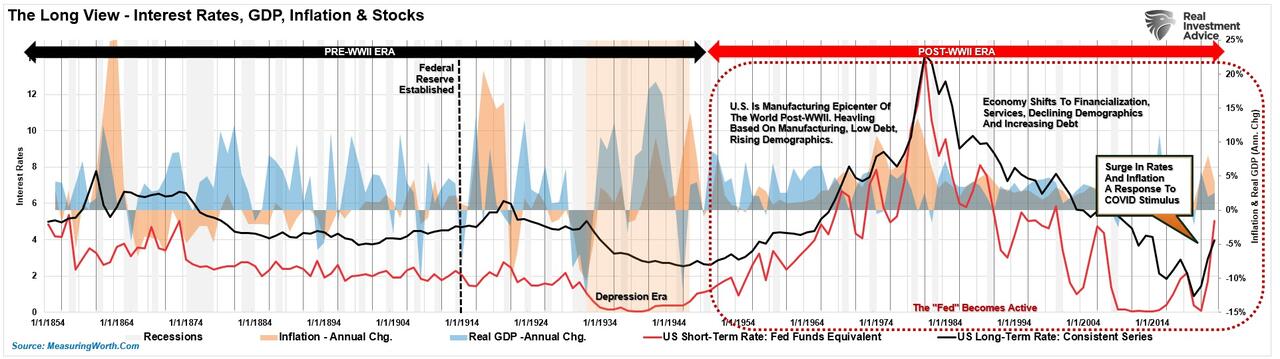
The chart below shows the long-term view of short and long-bond interest rates, inflation, and GDP. As Grant notes, there is a cycle to interest rates previously.

Interest rates rose during three previous periods in history.

  1. During the economic/inflationary spike in the early 1860s

  2. The “Golden Age” from 1900-1929 saw inflation rise as economic growth resulted from the Industrial Revolution.

  3. The most recent period was the prolonged manufacturing cycle in the 1950s and 1960s. That cycle followed the end of WWII when the U.S. was the global manufacturing epicenter.

Remembering History

However, while interest rates fell during the Depression, economic growth and inflationary pressures remained robust. Such was due to the very lopsided nature of the economy at that time. Like the current economic cycle, the wealthy prospered while the middle class suffered. Therefore, money did not flow through the system, leading to a decline in monetary velocity.

The 1950s and 60s are the most important.

Following World War II, America became the “last man standing.” France, England, Russia, Germany, Poland, Japan, and others were devastated, with little ability to produce for themselves. America found its most substantial economic growth as the “boys of war” returned home to start rebuilding a war-ravaged globe.

But that was just the start of it.

In the late ’50s, America stepped into the abyss as humankind took its first steps into space. The space race, which lasted nearly two decades, led to leaps in innovation and technology that paved the way for America’s future.

These advances, combined with the industrial and manufacturing backdrop, fostered high levels of economic growth, increased savings rates, and capital investment, which supported higher interest rates.

Furthermore, the Government ran NO deficit, and household debt to net worth was about 60%. So, while inflation increased and interest rates rose in tandem, the average household could sustain its living standard. 

So, why is this bit of history so important to the outlook of interest rates,

What Drives Interest Rates

Grant suggests that interest rates will rise because they have been low for so long. That is akin to saying that since the Atlanta Falcons have not won a Super Bowl in the last 58 years, they should now win it every year for the next 58 years. What drives the Atlanta Falcons to win a Super Bowl are the ingredients to lead to a great team, not just the fact that they have never won one. The same goes for interest rates.

Interest rates are a function of the general trend of economic growth and inflation. More robust growth and inflation rates allow lenders to charge higher borrowing costs within the economy. Such is also why bonds can’t be overvalued. To wit:

“Unlike stocks, bonds have a finite value. The principal and final interest payments are returned to the lender at maturity. Therefore, bond buyers know the price they pay today for the return they will get tomorrow. Unlike an equity buyer taking on investment risk, a bond buyer loans money to another entity for a specific period. Therefore, the interest rate takes into account several substantial risks:”

  • Default risk

  • Rate risk

  • Inflation risk

  • Opportunity risk

  • Economic growth risk

Since the future return of any bond, on the date of purchase, is calculable to the 1/100th of a cent, a bond buyer will not pay a price that yields a negative return in the future. (This assumes a holding period until maturity. One might purchase a negative yield on a trading basis if expectations are benchmark rates will decline further.) “

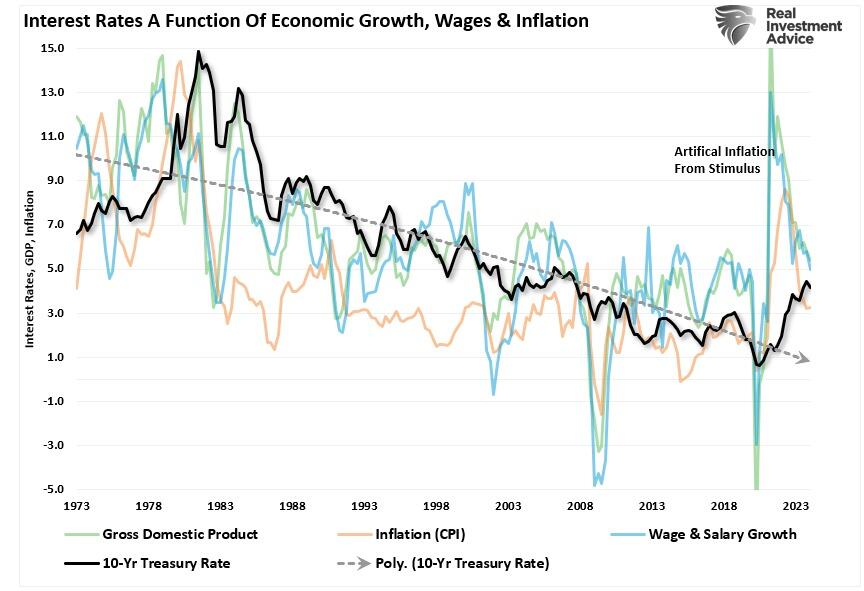
The chart below shows the correlation between economic growth, inflation, and interest rates. Unsurprisingly, interest rates rise when economic growth increases, leading to more demand for credit. Inflation rises with economic activity as the supply/demand imbalance increases prices. That is basic economics.

The chart above shows a lot going on, so let’s create a composite index of wages (which provides consumer purchasing power, aka demand), economic growth (the result of production and consumption), and inflation (the byproduct of increased demand from rising economic activity). We then compare that composite index to interest rates. Unsurprisingly, there is a high correlation between economic activity, inflation, and interest rates as rates respond to the drivers of inflation.

Grant further suggests that interest rates will be higher due to increased debt and deficits. Unfortunately, there is no evidence supporting that hypothesis.

The Deficit Fallacy

As shown below, the 10-year economic growth average correlates with interest rates. When economic growth rises, lenders can charge higher interest rates.

What should immediately jump out at you is that the 10-year average economic growth rate was around 8%, except for the Great Depression era, from 1900 through 1980. However, there has been a marked decline in economic growth since then. (The current spike in interest rates is a function of the artificial stimulus injected into the economy, which is now reversing.)

Increases in the national debt squandered on non-productive investments and rising debt service results in a negative return on investment. Therefore, the larger the debt balance, the more economically destructive it is by diverting increasing amounts of dollars from productive assets to debt service.

Since 1980, the overall increase in debt has surged to levels that currently usurp the entirety of economic growth. What should be evident is that increases in debt and deficits continue to divert more tax dollars away from productive investments into the service of debt and social welfare. The result is lower, not higher, economic growth, inflation, and, ultimately, interest rates.

When put into perspective, one can understand the more significant problem plaguing economic growth. A long look at history clearly shows the negative impact of debt on economic growth.

Furthermore, changes in structural employment, demographics, and deflationary pressures derived from changes in productivity will magnify these problems.

Inflation Wasn’t Just The 1970s

While many focus on the inflation surge during the late 1970s, as noted above, the entire period from the 1950s through 1980 was marked by rising interest rates and inflation due to a more robust economic growth cycle.

Like today, the Fed was hiking rates to quell inflationary pressures from exogenous factors. In the late 70s, the oil crisis led to inflationary pressures as oil prices fed through a manufacturing-intensive economy. Today, inflation resulted from monetary interventions that created demand against a supply-constrained economy.

Such is a critical point.

During “That 70s Show,” the economy was primarily manufacturing-based, providing a high multiplier effect on economic growth. Today, the mix has reversed, with services making up the bulk of economic activity. While services are essential, they have an extremely low multiplier effect on economic activity.

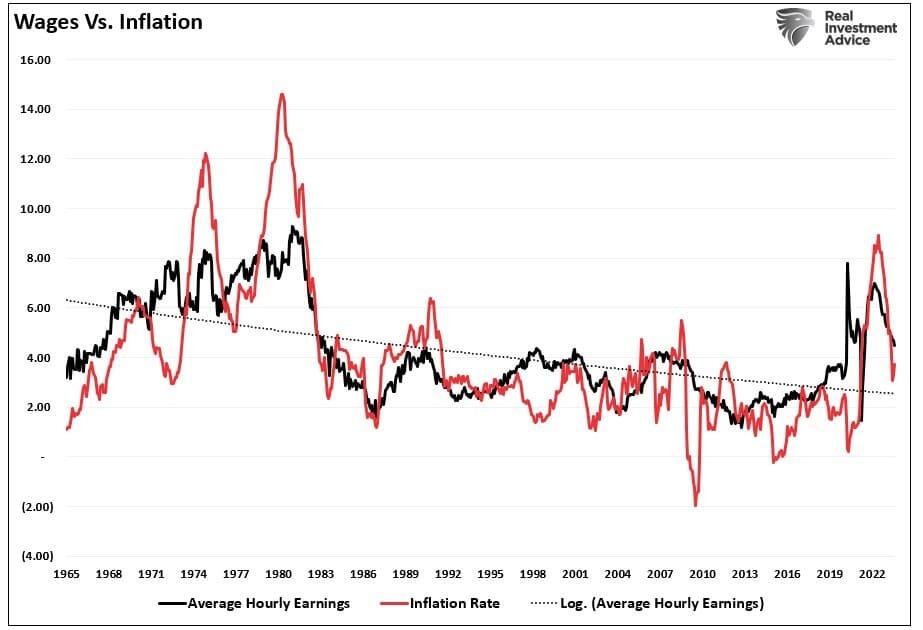
One primary reason is that services require lower wage growth than manufacturing. Inflation rose in the 1970s due to a steady trend of increasing wages, which created more economic demand. Outside of the artificial spike in demand from government stimulus in 2020, the longer-term trend of wage growth, and ultimately inflation, is lower as wage growth remains suppressed.

Wages come from the type of employment. Full-time employment provides higher salaries to support economic growth. Unfortunately, full-time employment as a percentage of the working-age population has declined since the turn of the century. Such is due to increased productivity levels through technology, offshoring, and immigration. The byproduct of fewer full-time employees is lower consumption and lower rates of economic growth.

Today’s economic environment vastly differs from the economic boom years of the 1970s. Rising debt levels, increased deficits, productivity, and wage suppression erode economic growth, not support it. Therefore, while Grant makes the case for higher interest rates for “much, much longer,” the economic evidence does not support that thesis.

Conclusion

However, even if Grant is correct and increasing debt levels and deficits do cause higher rates, central banks will take actions to artificially lower rates.

At 4% on 10-year Treasury bonds, borrowing costs remain relatively low from a historical perspective. However, we still see signs of economic deterioration and negative consumer impacts even at that rate. When the economy’s leverage ratio is nearly 5:1, 5% to 6% rates are an entirely different matter.

  • Interest payments on the Government debt increase, requiring further deficit spending.

  • The housing market will decline. People buy payments, not houses, and rising rates mean higher payments.

  • Higher interest rates will increase borrowing costs, which leads to lower profit margins for corporations. 

  • There is a negative impact on the massive derivatives market, leading to another potential credit crisis as interest rate spread derivatives go bust.

  • As rates increase, so do the variable interest payments on credit cards. Such will lead to a contraction in disposable income and rising defaults. 

  • Rising rates negatively impact banks, as higher rates impair the banks’ collateral, leading to bank failures.

I could go on, but you get the idea.

Therefore, as debt and deficits increase, Central Banks are forced to suppress interest rates to keep borrowing costs down and sustain weak economic growth rates.

The problem with Grant’s assumption that rates MUST go higher is three-fold:

  1. All interest rates are relative. The assumption that rates in the U.S. are about to spike higher is likely wrong. Higher yields on U.S. debt attract flows of capital from countries with low to negative yields, pushing rates lower in the U.S. Given the current push by Central Banks globally to suppress interest rates to keep nascent economic growth going, an eventual zero-yield on U.S. debt is not unrealistic.

  2. The budget deficit balloon. Given Washington’s lack of fiscal policy controls and promises of continued largesse, the budget deficit is set to swell above $2 Trillion in coming years. This will require more government bond issuance to fund future expenditures, which will be magnified during the next recessionary spat as tax revenue falls.

  3. Central Banks will continue to buy bonds to maintain the current status quo but will become more aggressive buyers during the next recession. The Fed’s next QE program to offset the next economic downturn will likely be $4 trillion or more, pushing the 10-year yield toward zero.

If you need a road map of how this ends with lower rates, look at Japan.

Historical evidence suggests that interest rates will be lower, not higher, unless the Government embarks on a massive infrastructure development program. Such would potentially revitalize the American economy and lead to higher rates, stronger wages, and a prosperous society.

However, outside of that, the path of interest rates in the future remains lower.

Tyler Durden
Fri, 06/14/2024 – 10:10

Counterfeit Titanium Found In Some Boeing And Airbus Jets

Counterfeit Titanium Found In Some Boeing And Airbus Jets

Boeing is no longer the pride of American aviation. The plane manufacturer is riddled with so many problems it’s impossible to keep track. Yesterday, the FAA announced an investigation (yet another…) into a 737 Max 8 jet that encountered a dangerous mid-flight ‘Dutch roll’ several weeks ago. Now, a report from the New York Times reveals that some Boeing jets are built with ‘counterfeit titanium.’ 

Some recently manufactured Boeing and Airbus jets have components made from titanium that was sold using fake documentation verifying the material’s authenticity, according to a supplier for the plane makers, raising concerns about the structural integrity of those airliners.

The falsified documents are being investigated by Spirit AeroSystems, which supplies fuselages for Boeing and wings for Airbus, as well as the Federal Aviation Administration. The investigation comes after a parts supplier found small holes in the material from corrosion. -NYT

The report continued:

The planes that included components made with the material were built between 2019 and 2023, among them some Boeing 737 Max and 787 Dreamliner airliners as well as Airbus A220 jets, according to three people familiar with the matter who spoke on the condition of anonymity because they were not authorized to speak publicly. It is not clear how many of those planes are in service or which airlines own them.

Fuselage maker Spirit is investigating the source of the titanium and whether the metal meets aviation standards. The big question is if the metal used in critical parts of the airframe is structurally sound enough to last the projected life spans of the jets. If the metal is tested and found to be below aviation specs, the parts must be removed and replaced. 

“This is about documents that have been falsified, forged and counterfeited,” Joe Buccino, a Spirit spokesman, told NYT, adding, “Once we realized the counterfeit titanium made its way into the supply chain, we immediately contained all suspected parts to determine the scope of the issues.”

According to Spirit officials, counterfeit titanium was used in passenger entry doors, cargo doors, and a component that connects the engines to the plane’s airframe for 787 Dreamliners. The affected parts of the 737 Max and the Airbus A220 include a heat shield on the engine. 

NYT pointed out, “Boeing and Airbus both said their tests of affected materials so far had shown no signs of problems,” adding, “Boeing said it directly purchased most of the titanium used in its plane production, so most of its supply was unaffected.” 

Boeing released this statement: 

“This industrywide issue affects some shipments of titanium received by a limited set of suppliers, and tests performed to date have indicated that the correct titanium alloy was used.

“To ensure compliance, we are removing any affected parts on airplanes prior to delivery. Our analysis shows the in-service fleet can continue to fly safely.”

A complex global supply chain for producing commercial jets is likely at fault. Late last year, a London-based firm flooded the aviation market with “unapproved parts” for jet engines on older Airbus SE A320s and Boeing Co. 737s.

The counterfeit titanium issue first emerged in 2019: 

The issue appears to date to 2019 when a Turkish material supplier, Turkish Aerospace Industries, purchased a batch of titanium from a supplier in China, according to the people familiar with the issue. The Turkish company then sold that titanium to several companies that make aircraft parts, and those parts made their way to Spirit, which used them in Boeing and Airbus planes.

In December 2023, an Italian company that bought the titanium from Turkish Aerospace Industries noticed that the material looked different from what the company typically received. The company, Titanium International Group, also found that the certificates that came with the titanium seemed inauthentic.

Turkish Aerospace Industries did not respond to a request for a comment.

Spirit began investigating the matter, and the company notified Boeing and Airbus in January that it could not verify the source of the titanium used to make certain parts. Titanium International Group told Spirit that when it bought the material in 2019, it had no clue that the paperwork had been forged, according to Spirit officials.

… People familiar with the situation said it appeared that an employee at the Chinese company that sold the titanium had forged the details on the certificates, writing that the material came from another Chinese company, Baoji Titanium Industry, a firm that often supplies verified titanium. Baoji Titanium later confirmed that it had not supplied the titanium. The origin of the titanium remains unclear.

This is yet another problem for the aviation industry and Boeing. Stories like these erode confidence in commercial air travel and raise the question: Has the FAA been asleep at the yoke?

Tyler Durden
Fri, 06/14/2024 – 09:50

Macron Has Gambled… And Lost

Macron Has Gambled… And Lost

By Elwin de Groot, Head of Macro Strategy at Rabobank

We still have one more day to go in the European session before the weekend, but the week in review is already showing to be one of quick decisions, where the bond market was ‘saved’ by the US inflation data and where Macron may have asked for a Papal blessing. But whether that turns out to be sufficient remains to be seen.

Macron has gambled… and lost? According to the latest polls, only 40% of Macron’s MPs would gather enough support to even qualify for a second round of run-off votes. In a surprise move, the French president announced elections last Sunday. Macron may have acted quickly after the results of the European Parliament elections in the hope that he could ride a fear-inspired wave of solidarity that could stop Marine Le Pen’s National Rally in its tracks. However, that move could backfire pretty badly.

According to an Elabe/Les Echos survey, Macron’s approval rating fell to its lowest level in 5.5 years. Macron has made an appeal on voters and the more moderate political parties on both the left and the right to not succumb to the “fever of the extremes”, but it remains to be seen whether his strategy will succeed.

Left-wing parties have equally quickly decided to unite, with a joint programme and a joint list of candidates for the Greens, Socialists, Communists and France Unbowed. The Socialist Party issued a statement yesterday saying that “There was an expectation of union expressed”; but obviously not the unity that Macron was looking for. This quick decision may just undercut Macron’s. It means that the president’s centrist MPs could be squeezed out of parliament by their competition from the left and right side of the field.

Fever of the centre? Finance Minister Le Maire predicted earlier this week that France would face a debt crisis if the National Rally should come to power. This suggests that Macron’s strategy is first and foremost one of sowing fear, and that things have to get worse before they get better. But there seems very little time for that second leg of Macron’s strategy: to get better. Sometimes quick decisions are not always the best decisions.

Macron’s European peers seemed bewildered at the G7 meeting in Italy. According to the news wires Macron only met with Canada’s Trudeau, as well as the leaders of Algeria, India, and Brazil. And with the Pope. You’d wonder if he asked for a little prayer or perhaps a Papal blessing.

The political uncertainty in France seems to have turned into a classic risk-off sentiment. The search for safe havens were one of the reasons that the yield on 10y Bunds declined 6bp yesterday. Meanwhile, the spread between 10y French and German bond yields has widened to the highest level since April 2017. Alongside, the euro dropped below 1.073 and European equities were in the red (Eurostoxx 50 -2%). Prayer or blessing, it definitely did not reassure investors.

But safe-haven assets in both the US and Germany also found some support in the better-than-expected inflation data. Both the headline and core US PPI inflation were significantly lower than expected, strengthening the view that inflationary pressures have finally started to ease. The yield on 2y Treasury notes of fell the lowest level since 4 April, despite the Fed adjusting its dot-plot to reflect one instead of three rate cuts for this year and despite Powell’s reluctance to embrace the most recent CPI report.

More quick decisions. In any case, the prospect of further backlashes after the French elections, political uncertainty in Europe, and a possible Trump re-election are perhaps forcing more quick decisions.

G7 leaders agree to provide a $50 billion loan to Ukraine. The agreement was reached on the first day of the G7 meeting in Italy. The G7 leaders quickly agreed to the loan that is backed by frozen Russian assets. The proceeds on these assets (estimated at some $260 billion in Europe) will be used to pay off an upfront loan to Ukraine. As AP news notes, member states may treat this differently according to national preference/regulations. But the lenders do of course bear the risk that those proceeds would stop if a peace agreement is reached and the Russian assets are unfrozen in the future.

The EU announced additional tariffs on Chinese EVs. It’s another quick decision after the investigation into unfair state subsidies was completed, and it will enter into force with little delay. The EU announced additional tariffs on Chinese EVs ranging from 17 to 38% this week, which will take effect on July 4.

The Germans seem to be hopeful that there is still wiggling room to negotiate with China before the tariff is hiked, but France’s Le Maire applauded the European Commission’s decision to increase import duties on Chinese cars: “It’s a first decision that I hope will be followed by others, notably on solar panels, and on other Chinese over-capacities.” However, as my colleague quipped yesterday, imposing tariffs on Chinese solar panels is only a decade too late. Still, it shows that the French government is ready to “re-establish the balance of power with China.”

That European industry is still struggling was underscored by the data: Eurozone industry output fell 0.1% in April. Although it wasn’t a big decline it was still weaker than expected (+0.2% m/m). Together with downward revisions in earlier data the annual growth rate fell to -3% y/y. That is still a firm ‘recession’ indication and underscores that the economic recovery in the Eurozone is still a wobbly one, weighed down by structural issues in the manufacturing/export sector and weakness of demand from China (China’s imports from Germany, for example, were down 14% y/y in May after 0% in April).

The Bank of Japan needs a little more time for an exit strategy. The overnight call rate was left unchanged at 0.0% to 0.1%. And policymakers voted to continue their current asset purchases until the July meeting, despite Governor Ueda’s earlier indications that a reduction in the bond buying programmes may be due. The central bank will come with a plan for reducing its bond purchases over the coming 1 to 2 years at their next meeting.

In his press conference, Ueda stated that the reduction in bond purchases will be substantial. But not all decisions can be quick. The central bank will be mindful of the potential market disruptions if policymakers move too hastily. The Bank will not want to inject undue volatility into the JGB market given the potential impact on the balance sheets of Japan’s large insurers and in view of its own huge holdings of domestic bonds. Yet, moving slowly will continue to weigh on the currency. The market had anticipated some adjustments today, so the postponing the decision to next month caused some further weakness in JPY. USD/JPY rose above 158.

Tyler Durden
Fri, 06/14/2024 – 09:32

French Development Banks Pulls Bond Sale As Macron Sparks EU Market Meltdown

French Development Banks Pulls Bond Sale As Macron Sparks EU Market Meltdown

Sacre bleu!!

The implications of French President Macron’s shock announcement of snap legislative elections after sustaining a hammering from the far-right Rassemblement National in European elections are starting to show up in some much more worrying systemic signals for the EU overall.

The OATS Spread (the gap between the yields of 10-year bonds issued by France, known as OATS for obligations assimilables du Trésor, and German bunds) is back at the center of discussion …

Complicating the situation further is the news that left-leaning political parties in France sealed an alliance to join forces in the upcoming legislative election, with polls showing it can win the second-biggest bloc behind Marine Le Pen’s National Rally.

The FT warns that Macron’s centrist alliance could be facing a wipeout in snap parliamentary elections after France’s leftwing parties struck a unity pact.

New projections suggested only around 40 of Macron’s MPs would qualify for the second round vote on July 7, in run-off races that would predominantly be fought between candidates fielded by the far right or the leftwing bloc for the 589-strong assembly.

The market’s response should not be a surprise as the prospect of the far-left getting a sway over policy has rattled investors in the past.

When polls in 2017 showed the presidential election could end up as a head-to-head between Le Pen and Melenchon, French debt sold off sharply, quadrupling its premium over safer German peers in a matter of months.

France’s CAC 40 index erased its gains for the year, with banking shares such as BNP Paribas SA and Societe Generale SA among the biggest losers.

“It’s hard to ignore the parallels between our current situation and the time of the sovereign debt crisis, as there’s that familiar focus on election results, sovereign bond spreads and debt sustainability,” said Jim Reid, an analyst at Deutsche Bank AG.

That’s “coupled with no obvious sign about where things are headed next.”

Of course, as we noted on X, what Macron’s decision has done is merely pull back the curtain on the reality that nothing is fixed in Europe…

“It’s a risk-off tone with concerns over France driving the markets,” said Mohit Kumar, chief economist for Europe at Jefferies International. “Particularly going into the weekend, investors would be taking some positions off the table.”

And today, as Bloomberg reports, we see further implications as funding markets freeze up, as a French public development bank has delayed the sale of a green bond

SFIL SA postponed the offering of a green bond on Friday, without giving a specific reason, according to a person familiar with the matter.

The delay was due to volatility in the French market, said another person with knowledge of the offering, asking not to be identified as the matter was private.

A day earlier, SFIL had mandated six banks to arrange the sale of a five-year note, with the aim of raising at least €500 million ($535 million).

The question of whether he was crazy to call a snap election was posed to him directly by Le Figaro earlier this week.

His response: “Not at all, I can confirm.”

When he was asked about it again by reporters at the G-7, he said that other leaders had described his actions as “courageous.”

Merde alors…

Tyler Durden
Fri, 06/14/2024 – 09:10

Watch: Biden Wanders Off On His Own At G7 Meeting Like A Dementia Patient

Watch: Biden Wanders Off On His Own At G7 Meeting Like A Dementia Patient

Authored by Steve Watson via Modernity.news,

Joe Biden’s cognitive decline was on show for the entire world at the G7 summit in an Italy Thursday as he randomly wandered off from the other dignitaries during a sky diving demo.

While everyone else concentrated on the military personnel doing a live show right in front of them, Biden looked around, turned his back on it and began to wander away looking lost. 

Italian Prime Minister Georgia Meloni had to play the role of Dr Jill by grabbing a Biden and bringing him back.

He looked utterly bamboozed by what was happening around him.

Apparently it’s now customary in Italy to kiss a lady’s hair:

He looked like he didn’t know where he was or what he was supposed to be doing the entire time:

When he tried to speak at the summit, it went as it usually does.

Biden’s daily meds list was leaked earlier, but judging by this he is going to need more.

And of course, the NY Post nails it on the front page:

*  *  *

Your support is crucial in helping us defeat mass censorship. Please consider donating via Locals or check out our unique merch. Follow us on X @ModernityNews.

Tyler Durden
Fri, 06/14/2024 – 08:53

‘Grand Tour’ Presenter Stands Ground After Calling Rows Of Pride Flags “Oppressive”

‘Grand Tour’ Presenter Stands Ground After Calling Rows Of Pride Flags “Oppressive”

Authored by Steve Watson via Modernity.news,

British TV presenter James May, most famous for being a part of motoring shows The Grand Tour and Top Gear with Jeremy Clarkson, is under fire for pointing out that the uniform rows and rows of Pride flags installed every year in central London look “oppressive.”

May made what was supposed to be a tongue in cheek comment on X, noting that while he has “observed and admired” the Pride movement for years, the recent displays are guilty of “Too Much Bunting,” which “may be seen as authoritarian, and therefore oppressive.”

May added, “Please remember that some terrible things, with which you would not wish to be allied, began with TMB. World War Two, for example. Nice flag, though.”

And then they came for him.

But May stood firm.

Still they came at May:

How dare he talk in any way negatively about the precious symbol.

What about Christmas lights though?

They kept coming and May kept batting them away:

But but but Nazis uh uh uh:

He wasn’t backing away.

Some among the LGBTQ community agreed with May’s original point of ‘it’s a bit over the top’.

Flags are interesting.

*  *  *

Your support is crucial in helping us defeat mass censorship. Please consider donating via Locals or check out our unique merch. Follow us on X @ModernityNews.

Tyler Durden
Fri, 06/14/2024 – 06:30