61.6 F
Chicago
Wednesday, September 23, 2026
Home Blog Page 2575

“Buy Everything”: S&P Hits All Time High As Nvidia Passes $3 Trillion

“Buy Everything”: S&P Hits All Time High As Nvidia Passes $3 Trillion

Remember when “developed world” central banks pretended their inflation target was 2%? Well, that lie died a miserable death today – and will do so again for good measure tomorrow – after the BOC cut rates for the first time in 4 years, and less than a year after its last rate hike, from 5.0% to 4.75% even as Canada’s inflation remains a very sticky 2.7%.

And just to underscore the death of the 2% inflation target, tomorrow the ECB will also cut rates for the first time since March 2016 (and 8 months after the last rate hike), even though core Eurozone CPI remains 3%.

Of course, despite all the posturing, the Fed won’t be far behind especially once it becomes clear that the myth of strong US job growth was just a mirage (as explained yesterday), and either in July or September, the Fed will join the party despite core US inflation stuck at a blistering 2.8%.

It was this long overdue realization that the G7 central banks have officially raised their inflation target by about 1% that helped pushed bond yields to fresh two month lows, and down more some 35bps in just the past week…

… as financial conditions have eased dramatically (see chart of Goldman Financial Conditions Index below), undoing any jawboned tightening the Fed tried to inject into the market in recent months.

And with the tidal wave of easing about to be unleashed by all central banks, it is no surprise that the S&P just hit a new all time high of 5,350, up a whopping 30% from the October lows.

Superficially, there was some intraday variation, with some sectors red (hilariously, energy, which is supposed to power this new AI renaissance continues to get dumped)…

… yet looking below the surface, those hoping that one day… soon… perhaps… the market will broaden out will be disappointed: while the S&P is up 13% YTD, the “Mag 7″” is up 30%, while the S&P493 is up just 6.5%.

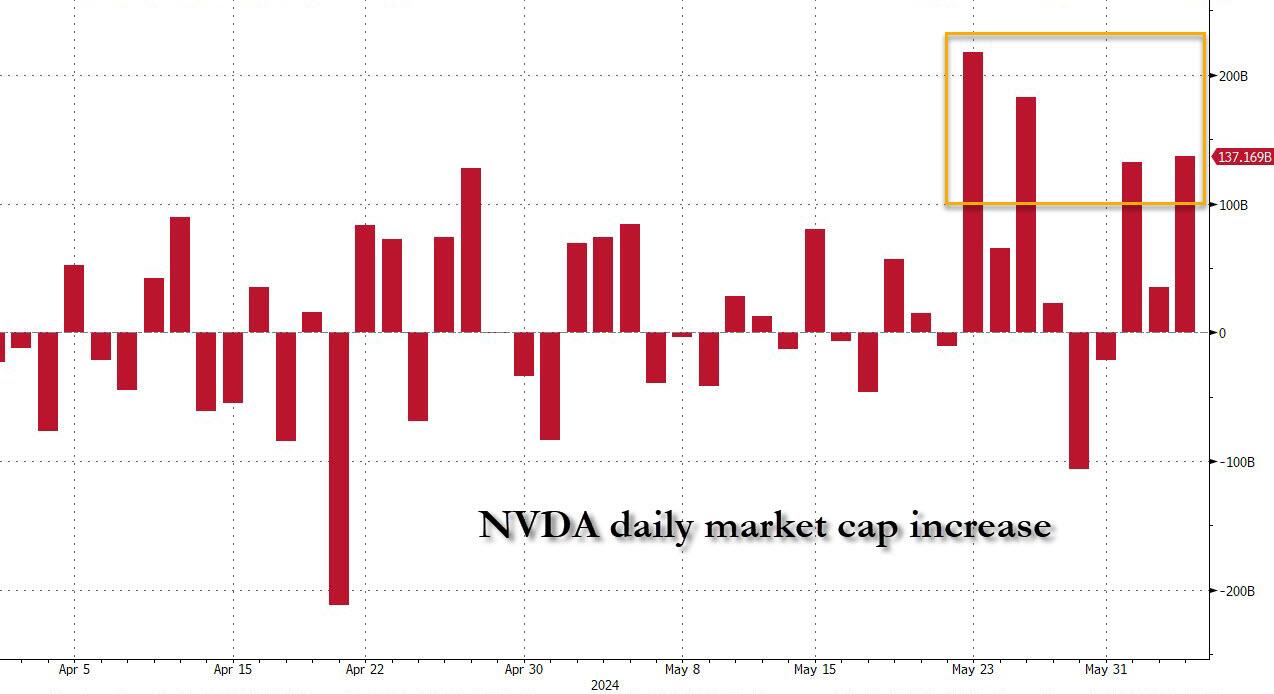
And when we talk about the Magnificent 7, we mean really just Magnificent  1: Nvidia is now up a ridiculous145% in just the past 5 months…

… and moments ago NVDA’s market cap rose above $3 trillion, up more than $140 billion today alone, having risen more than $100 billion on 4 of the past 9 trading days…

… but also briefly topped Apple’s $3.005 trillion, and this pace of insane meltup – which will require every tech company buying AI chips for the next several decades to justify the valuation – will make NVDA the world’s biggest company some time tomorrow!

And as we boldly go into yet another absolutely massive asset bubble, one where three companies alone have a market cap of $9 trillion, it is not surprising that cryptos – those assets that sniff out fiat destruction ahead of most – are surging, with bitcoin also on the verge of another record high and trading above $71,000 with ethereum also finally breaking out higher…

… but gold is also starting to move after the recent profit taking, and is up a solid $27 today and fast approaching it own all-time highs.

In fact, the only commodity that is not exploding higher is oil, which instead if getting crushed to boost Biden’s approval rating; indeed, oil will not be allowed to spike until the election… after which all hell will finally break loose.

Tyler Durden
Wed, 06/05/2024 – 16:03

3 Reasons There’s Something Sinister With The Big Push For Electric Vehicles

3 Reasons There’s Something Sinister With The Big Push For Electric Vehicles

Authored by Nick Gimabruno via InternationalMan.com,

25 refrigerators.

That’s how much the additional electricity consumption per household would be if the average US home adopted electric vehicles (EVs).

Congressman Thomas Massie – an electrical engineer – revealed this information while discussing with Pete Buttigieg, the Secretary of Transportation, President Biden’s plan to have 50% of cars sold in the US be electric by 2030.

The current and future grid in most places will not be able to support each home running 25 refrigerators—not even close. Just look at California, where the grid is already buckling under the existing load.

Massie claims, correctly, in my view, that the notion of widespread adoption of electric vehicles anytime soon is a dangerous fantasy based on political science, not sound engineering.

Nonetheless, governments, the media, academia, large corporations, and celebrities tout an imminent “transition” to EVs as if it’s preordained from above.

It’s not.

They’re trying to manufacture your consent for a scam of almost unimaginable proportions.

Below are three reasons why something sinister is going on with the big push for EVs.

But first, a necessary clarification.

You no doubt have heard of the term “fossil fuels” before.

When the average person hears “fossil fuels,” they think of a dirty technology that belongs in the 1800s. Many believe they are burning dead dinosaurs to power their cars.

They also think “fossil fuels” will destroy the planet within a decade and run out soon—despite the fact that, after water, oil is the second most abundant liquid on this planet.

None of these ridiculous notions are true, but many people believe them. Using propaganda terms like “fossil fuels” plays a large role.

Orwell was correct when he said that corrupting the language can corrupt people’s thoughts.

I suggest expunging “fossil fuels” from your vocabulary in favor of hydrocarbons—a much better and more precise word.

A hydrocarbon is a molecule made up of carbon and hydrogen atoms. These molecules are the building blocks of many different substances, including energy sources like coal, oil, and gas. These energy sources have been the backbone of the global economy for decades, providing power for industries, transportation, and homes.

Now, on to the three reasons EVs are a giant scam at best and possibly something much worse.

Reason #1: EVs Are Not Green

The central premise for EVs is they help to save the planet from carbon because they use electricity instead of gas.

It’s astounding so few think to ask, what generates the electricity that powers EVs?

Hydrocarbons generate over 60% of the electricity in the US. That means there’s an excellent chance that oil, coal, or gas is behind the electricity charging an EV.

It’s important to emphasize carbon is an essential element for life on this planet. It’s what humans exhale and what plants need to survive.

After decades of propaganda, Malthusian hysterics have created a twisted perception in many people’s minds that carbon is a dangerous substance that must be reduced to save the planet.

Let’s entertain this bogus premise momentarily and assume carbon is bad.

Even by this logic, EVs do not really reduce carbon emissions; they just rearrange them.

Further, extracting and processing the exotic materials needed to make EVs requires tremendous power in remote locations, which only hydrocarbons can provide.

Additionally, EVs require an enormous amount of rare elements and metals—like lithium and cobalt—that companies mine in conditions that couldn’t remotely be considered friendly to the environment.

Analysts estimate that each EV requires around one kilogram of rare earth elements. Extracting and processing these rare elements produces a massive amount of toxic waste. That’s why it mainly occurs in China, which doesn’t care much about environmental concerns.

In short, the notion that EVs are green is laughable.

It’s simply the thin patina of propaganda that governments need as a pretext to justify the astronomical taxpayer subsidies for EVs.

Reason #2: EVs Can’t Compete Without Government Support

For many years, governments have heavily subsidized EVs through rebates, sales tax exemptions, loans, grants, tax credits, and other means.

According to the Wall Street Journal, US taxpayers will subsidize EVs by at least $393 billion in the coming years—more than the GDP of Hong Kong.

To put that in perspective, if you earned $1 a second 24/7/365—about $31 million per year—it would take you over 12,677 YEARS to make $393 billion.

And that’s not even considering the immense subsidies and government support that have occurred in the past.

Furthermore, governments impose burdensome regulations and taxes on gasoline vehicles to make EVs seem relatively more attractive.

Even with this enormous government support, EVs can barely compete with gasoline vehicles.

According to J.D. Power, a consumer research firm, the average EV still costs at least 21% more than the average gasoline vehicle.

Without government support, it’s not hard to see how the market for EVs would evaporate as they would become unaffordable for the vast majority of people.

In other words, the EV market is a giant mirage artificially propped up by extensive government intervention.

It begs the question, why are governments going all out to push an obviously uneconomic scam?

While they are undoubtedly corrupt thieves and simply stupid, something more nefarious could also be at play.

Reason #3: EVs Are About Controlling You

EVs are spying machines.

They collect an unimaginable amount of data on you, which governments can access easily.

Analysts estimate that cars generate about 25 gigabytes of data every hour.

Seeing how governments could integrate EVs into a larger high-tech control grid doesn’t take much imagination. The potential for busybodies—or worse—to abuse such a system is obvious.

Consider this.

The last thing any government wants is an incident like what happened with the Canadian truckers rebelling against vaccine mandates.

Had the Canadian truckers’ vehicles been EVs, the government would have been able to stamp out the resistance much easier.

Here’s the bottom line.

The people really in charge do not want the average person to have genuine freedom of movement or access to independent power sources.

They want to know everything, keep you dependent, and have the ability to control everything, just like how a farmer would with his cattle. They think of you in similar terms.

That’s why gasoline vehicles have to go and why they are trying to herd us into EVs.

Conclusion

To summarize, EVs are not green, cannot compete with gas cars without enormous government support, and are probably a crucial piece of the emerging high-tech control grid.

The solution is simple: eliminate all government subsidies and support and let EVs compete on their own merits in a totally free market.

But that’s unlikely to happen.

Instead, it’s only prudent to expect them to push EVs harder and harder.

If EVs were simply government-subsidized status symbols for wealthy liberals who want to virtue signal how they think they’re saving the planet, that would be bad enough.

But chances are, the big push for EVs represents something much worse.

Along with 15-minute cities, carbon credits, CBDCs, digital IDs, phasing out hydrocarbons and meat, vaccine passports, an ESG social credit system, and the war on farmers, EVs are likely an integral part of the Great Reset—the dystopian future the global elite has envisioned for mankind.

In reality, the so-called Great Reset is a high-tech form of feudalism.

Sadly, most of humanity has no idea what is coming.

Worse, many have become unwitting foot soldiers for this agenda because they have been gaslighted into believing they are saving the planet or acting for the greater good.

This trend is already in motion… and the coming weeks will be pivotal.

That’s precisely why I recently released an urgent video with legendary investor Doug Casey and renowned hedge fund manager Chris MacIntosh.

The Green Energy Deception:  The Collapse of the Green Scam… How Investors Can Profit Right Now Click here to watch it now.

Tyler Durden
Wed, 06/05/2024 – 15:35

NY Times Confirms ‘First’ Ukraine Strike On Russia With US Long-Range Missiles

NY Times Confirms ‘First’ Ukraine Strike On Russia With US Long-Range Missiles

Ukraine is already attacking Russian territory with US-supplied long-range weapons, a fresh NY Times investigation has acknowledged. It comes a mere days after the Biden administration greenlighted Ukraine’s request to fire American weapons onto Russian soil.

“Yehor Chernev, the deputy chairman of the Ukrainian Parliament’s committee on national security, defense and intelligence, said on Tuesday that Ukrainian forces had destroyed Russian missile launchers with a strike in the Belgorod region, about 20 miles into Russia,” NY Times wrote, describing it as a ‘first’.

The Ukraine official said that the army used a US-supplied High Mobility Artillery Rocket System, or HIMARS. The revelation came the same day that a UK Telegraph report detailed NATO logistics plans for US troop ‘land corridors’ in the event of a European ground war with Russia.

Various social media videos and images appeared to show burning and destroyed S-300 and S-400 systems inside Russian territory…

Examining some of the new to emerge images, Rob Lee, a senior fellow at the Foreign Policy Research Institute, described to the Times, “Given the range, type of target, munition availability and change in the Biden administration’s policy, I think it is probable this strike was conducted with HIMARS.”

Additionally the report highlighted other evidence pointing to US munitions used in the attack:

On Saturday, Evgeny Poddubny, a war correspondent for Russian state television, shared photographs of what were presented as fragments of American guided rockets found in Russian territory. It was not possible to independently verify when or where the fragments were found.

Ukrainian Deputy Prime Minister Iryna Vereshchuk also hinted that the strike was conducted with American weapons. 

Vereshchuk shared a picture (above) of a burning S-300 system on Telegram – but soon after deleted – with the caption, “It’s burning well. This is a Russian S-300. On Russian territory. The first days after permission to use Western weapons on the enemy’s territory.”

Russian Deputy Foreign Minister Sergey Ryabkov warned earlier this week, “I would like to caution American officials against miscalculations which may have fatal consequences. For some unknown reason, they underestimate the seriousness of the rebuff they may receive.”

Russian media has meanwhile on Wednesday announced the destruction of more foreign weapons stores inside Ukraine with the below statement:

The Russian Ministry of Defense has reported that its forces have successfully hit weapon and equipment storage sites used by the Foreign Legion fighting alongside Ukraine.

Using operational-tactical aviation, unmanned aerial vehicles, missile troops, and artillery, the Armed Forces of the Russian Federation destroyed the weapon and military equipment depots of the Ukrainian Armed Forces’ Hortitsa operational-strategic group and the ‘Foreign Legion’ fighters, the ministry clarified.

Several videos of destroyed Russian anti-air systems:

Thus far the Pentagon has not officially commented, neither confirming nor denying, on whether Ukraine has used US long-range weapons inside Russia yet. But the situation is clearly escalating, and quite rapidly, by the day at this point.

Tyler Durden
Wed, 06/05/2024 – 15:10

U.S. Could Accelerate Refill Rate Of Strategic Petroleum Reserve

U.S. Could Accelerate Refill Rate Of Strategic Petroleum Reserve

By Tsvetana Paraskova of OilPrice.com

The United States could accelerate the pace of buying crude to refill the Strategic Petroleum Reserve (SPR), as all four sites would be available by the end of the year after a maintenance period, U.S. Secretary of Energy Jennifer Granholm told Reuters in an interview.

“All four sites will be back up by the end of the year, so one could imagine that pace would pick up, depending on the market,” Secretary Granholm said, commenting on the current pace of buying about 3 million barrels of crude for the reserve per month this year.

The U.S. saw the stockpiles of crude oil in the SPR fall from 638 million barrels at President Joe Biden’s inauguration to just 347 million barrels by the summer of 2023 as the Administration tried to bring down gasoline prices for consumers. The large sell-off in the country’s safety supply of crude oil was met with criticism. Also met with criticism has been the Administration’s slow response to falling oil prices—a perfect opportunity for any Administration earnestly looking to replenish SPR oil inventories.

In March, the U.S. Department of Energy expected only 40 million barrels to be refilled by the end of this year, but another 140 million barrels of crude will stay in the SPR after the cancellation of congressionally mandated sales from 2022, according to Reuters.

The Biden Administration could now accelerate the rate of repurchases of crude for the SPR as it views the global oil markets well-supplied and does not expect wild swings in prices or spikes in the “next short while,” Secretary Granholm told Reuters.

Earlier this year, the energy secretary said that the Biden Administration aims to have crude in the SPR by the end of the year back up to the levels before the massive sales of 180 million barrels in the past two years.

The Administration continues to target purchases of crude for the strategic reserve at a price of $79 per barrel or below. Early on Wednesday, the WTI Crude price was at around $73 a barrel.

Tyler Durden
Wed, 06/05/2024 – 14:50

“He’s Not The Same Person”: Biden Allies Freak After WSJ Blasts “Slipping” Brain

“He’s Not The Same Person”: Biden Allies Freak After WSJ Blasts “Slipping” Brain

The Biden administration is scrambling for damage control over the president’s mental condition. Over the past month, the White House claimed executive privilege over an audio tape of Biden’s classified documents interview with Special Counsel Robert Hur, the transcripts of which were altered to make Biden seem more competent.

Next, TIME Magazine’s Massimo Calabresi couldn’t give a straight answer over Biden’s serious cognitive decline exhibited during an interview.

Now, the White House and Biden allies are slamming a Tuesday report from the Wall Street Journal in which 45 people from both sides of the aisle told the outlet that Biden is, to put it mildly, two sandwiches short of a picnic.

The Journal cites a January meeting behind closed doors during a critical discussion about Ukraine funding, Biden’s soft-spoken nursing home demeanor led some participants to question his engagement, as he occasionally read from notes and paused. “You couldn’t be there and not feel uncomfortable,” one attendee noted about the meeting’s dynamics, adding “I’ll just say that.”

In another example, Biden completely forgot the details of ‘his’ own policy on big energy projects during a one-on-one meeting with House Speaker Mike Johnson.

Others who attended said Biden’s demeanor and level of engagement fluctuated and he seemed lively and engaged at some points. When the topic moved to an immigration overhaul, Johnson, the House speaker, offered Biden a list of dozens of executive actions he could undo to improve border security. Biden, rather than responding to Johnson’s suggestions, chided him, according to people at the meeting, “I’ve forgotten more about immigration than you’ll ever know.” -WSJ

Then, during debt ceiling negotiations with House Republicans, former House Speaker Kevin McCarthy and others noted that Biden’s demeanor and command of the details varied significantly from day to day. On some days, Biden was described as relying heavily on notes and mumbling, which could suggest inconsistency in cognitive performance.

“I used to meet with him when he was vice president. I’d go to his house,” McCarthy said in an interview. “He’s not the same person.” -WSJ

The article also lays out public speaking errors, such as mixing up names of his Hispanic cabinet secretaries, mistakenly speaking about conversations with long-deceased leaders, and other factual errors. These instances contribute to the narrative of cognitive decline.

In another section, the Journal reports that “The president moved so slowly around the Cabinet Room to greet the nearly two dozen congressional leaders that it took about 10 minutes for the meeting to begin, some people who attended recalled.”

White House Responds

Well, not officially anyway… but several administration aides shared a lengthy segment from MSNBC‘s Morning Joe, who was picked to carry the water this time.

“I’ve spent time with both of those guys privately. Spent time with Biden and Trump privately. I’ve spent time with every House Speaker over the past 30 years. And Joe Biden, I’m not just — it’s just not close,” said host Joe Scarborough.

“If you want to talk about international affairs, if you want to talk about how to get bipartisan legislation, Joe Biden is light-years ahead of all of them,” he continued.

The pushback didn’t stop there.

Deputy press secretary Andrew Bates posted on the social platform X a series of past quotes from McCarthy in which he praised Biden’s conduct during their private meetings over the debt ceiling. McCarthy told reporters publicly after those meetings that Biden was “very professional, very smart. Very tough at the same time,” and he reportedly told colleagues in private that he found Biden to be mentally sharp.

“What a surprise – Republicans employing their election year messaging strategy that contradicts their own prior words about @POTUS,” White House communications director Ben LaBolt posted on X. “Gambling in Casablanca!”

Sen. Patty Murray (D-Wash.) posted on X that she was interviewed for the piece but was not quoted.

Surprise, surprise—everyone attacking @POTUS is a Republican with an agenda,” she posted. “I made clear to the @WSJ regarding the January meeting on Ukraine that the President was absolutely engaged & ran that meeting in a way that brought everyone together. I’m not quoted—I wonder why.” –The Hill

“As someone who has spent and continues to spend a lot of time with the president and continues to, I think ensure that I am living up to sort of his… strategic approach at every turn, I will say that he is, you know, just one of the strongest leaders that I’ve been able to engage and to be able to work with and to advise,” said Biden campaign manager, Julie Chavez Rodriguez.

Remember when the left wanted to impeach Trump under the 25th Amendment for ‘mental instability?’ Where are those people now?

Tyler Durden
Wed, 06/05/2024 – 14:30

Nvidia Carries The World (& The S&P 500) On Its Shoulders

Nvidia Carries The World (& The S&P 500) On Its Shoulders

Following a strong start to the year and a brief setback in April, the stock market returned to form in May, with the S&P 500 returning almost 5 percent last month. Overall, the index returned 11.3 percent in the first five months of 2024, bringing the 12-month return of the index to 28.2 percent.

As Statista’s Felix Richter reports, like last year’s rally, the index’s latest strength was largely fueled by the excitement surrounding artificial intelligence, as chipmaker Nvidia and Microsoft, a key investor in OpenAI, were the biggest contributors to the S&P 500’s overall gains. The former, fueled by strong earnings reports and the announcement of a 10-to-1 stock split, single-handedly carried the market through the first months of 2024, accounting for 32 percent of the S&P 500’s total year-to-date return.

Infographic: Nvidia Carries the World (and the S&P 500) on its Shoulders | Statista

You will find more infographics at Statista

According to Howard Silverblatt, Senior Index Analyst at S&P Dow Jones Indices, Nvidia’s 121-percent return through May 31, contributed 3.65 percentage points to the S&P 500’s overall return, putting it miles ahead of Microsoft, Meta and Amazon, who each contributed 0.78, 0.66 and 0.58 percentage points to the index’ year-to-date return, respectively.

At the other end of the scale, Tesla dragged the index down 0.52 percentage points, as the company struggles with a slowdown in demand for electric vehicles, growing competition from China and the controversies surrounding Elon Musk, which are reportedly having a negative effect on Tesla’s reputation.

Tyler Durden
Wed, 06/05/2024 – 12:30

Who Governs Ethereum? Galaxy Report Reveals All

Who Governs Ethereum? Galaxy Report Reveals All

Authored by Josh O’Sullivan via CoinTelegraph.com,

Galaxy Digital has released a report showing that Ethereum’s decentralized governance is steered by off-chain voting rather than on-chain Ether (ETH) holder voting.

Christine Kim, vice president of Galaxy Digital’s research team, released the report on June 3. It reveals multiple stakeholders who hold the keys to Ethereum’s governance.

Speaking with Cointelegraph on the risks of not having direct on-chain voting by ETH holders, Kim said:

“The less Ethereum as a technology needs to rely on governance for value and sustainability, the better. The more Ethereum can ossify parts of its codebase, the less the network will be at risk of regulatory capture and centralization. The risks of Ethereum being governed by off-chain forums and processes are not unlike the risks that exist even with on-chain forms of governance. 

According to the report, the groups collaborating on the off-chain processes include client teams, validator node operators, the Ethereum Foundation (EF) and decentralized application (DApp) developers.”

Client teams and validator node operators

According to the report, client teams are central to decision-making, proposals, discussion and implementation of changes through Ethereum Improvement Proposals.

“Client teams build and maintain the software needed to run and connect to the Ethereum network.” 

Validator node operators were also highlighted by the report as they have “the agency to implement or reject code changes” made to the Ethereum network — essentially voting by choosing which software version to run.

Although the EF’s direct influence has waned over time, it still supports the development efforts on Ethereum as its “earliest and most prominent […] nonprofit organization.”

DApp devs, forums and communities

Kim’s report also revealed that DApp developers influence certain features and upgrades based on user needs.

“DApp developers are the primary users of Ethereum, interacting with the Ethereum codebase to deploy smart contract code.”

According to the report, off-chain governance discussions are also carried out across forums, facilitating stakeholder consensus-building.

“Governance discussions occur in several forums: Ethereum All Core Developers (ACD) calls, ETHMagicians, Ethresear.ch, Discord, and GitHub.”

On the topic of whether Kim believes Ethereum’s off-chain governance model remains transparent and inclusive for all community members, she told Cointelegraph:

Yes, I do. I think some improvements can be made to Ethereum’s off-chain governance model, particularly concerning the Ethereum Foundation’s role in the Ethereum ecosystem. Still, I think the forums outlined in the report through which stakeholders can voice their opinions about Ethereum’s development roadmap are inclusive and transparent.”

Off-chain or on-chain?

Discussing which is the less evil of the two, off-chain or on-chain, Kim told Cointelegraph: 

“Both very broad forms of blockchain governance are at risk of becoming opaque, unscalable, and closed off to new participants over time, but with smart contract-based governance solutions, you have the added risk of smart contract bugs and failures.”

The report also emphasizes the reasoning behind Ethereum’s preference for off-chain governance over on-chain voting due to the risk of large Ether holders exerting heavier influence.

“No decisions are voted on by ETH holders through on-chain proposals or decentralized autonomous organizations (DAOs).”

The off-chain approach prevents centralization and maintains nuanced decision-making despite being “difficult to audit and objectively evaluate.”

Tyler Durden
Wed, 06/05/2024 – 12:10

Psychedelic Stocks Hit With Bad Trip After FDA Advisers Reject MDMA Treatment For PTSD

Psychedelic Stocks Hit With Bad Trip After FDA Advisers Reject MDMA Treatment For PTSD

Psychedelic stocks were battered in premarket trading after a panel of experts advising the Food and Drug Administration rejected the approval of MDMA for post-traumatic (PTSD) stress disorder. 

There were two votes – one for MDMA’s efficacy and another for safety, by the FDA’s Psychopharmacologic Drugs Advisory Committee. They voted 9-2 that MDMA – with talk therapy – is not effective for treating PTSD. The second vote was 10-1 that the benefits of MDMA treatment don’t outweigh its risks. 

This was the first time FDA advisers have considered a Schedule I psychedelic for medical treatment. Also, there has not been a new treatment for PTSD in over two decades, as more than 13 million Americans, many of who are veterans, suffer from the mental disorder. 

The outcome of the two votes reflected panel members’ struggle between new PTSD treatments and the clinical data submitted by drugmaker Lykos Pharmaceuticals. They pointed out the data had inconsistencies and unanswered questions and lacked evidence supporting the MDMA treatment used in the therapy sessions.

It seems like there are so many problems with the data,” Melissa Barone, one of the panelists and a psychologist with the VA Maryland Health Care System, told NPR News, adding, “Each one alone might be okay, but when you pile them up on top of each other…”

Several panel members raised concerns about allegations of potential misconduct and bias in the trials, which could have affected the results.

“I have real concerns with the validity of the data and the allegations of misconduct,” said Elizabeth Joniak-Grant, a sociologist and a panel member, adding, “I can’t in good conscience support something where these many harms are being reported.”

However, Dr. Walter Dunn, a psychiatrist at UCLA, was one of the few panelists who voted in favor of MDMA.

Dunn acknowledged the misconduct allegations but added the data showed the treatment could be effective for PTSD. 

In premarket trading, psychedelic stocks were clubbed like a baby seal. Mind Medicine fell 14%, Compass Pathways down 11%, and Atai Life Sciences slid 8%. 

Jefferies analyst Andrew Tsai wrote in a note, “Contrary to our expectation, the FDA AdCom voted negatively on Lykos’ racemic MDMA having adequate data to demonstrate effectiveness in PTSD.” He pointed out there are differences between Lykos’ trial and other psychedelic programs, “we may see some increased uncertainty around the approvability of psychedelics.”

Tyler Durden
Wed, 06/05/2024 – 11:50

Merchant Ship Off Saudi Coast Reports “Significant Explosion” A “Short Distance” From Port Side

Merchant Ship Off Saudi Coast Reports “Significant Explosion” A “Short Distance” From Port Side

UK Maritime Trade Operations (UKMTO) reports a commercial vessel experienced a “significant explosion … a short distance from the port side of the vessel.” The incident occurred 50 nautical miles southwest of Al Shuqaiq, Saudi Arabia, in the southern Red Sea. 

“On inspection, no damage was found, vessel and crew are reported safe and is continuing to its next port of call,” UKMTO wrote in an advisory on X. 

Bloomberg said, “There was no immediate claim for the blast but Houthi fighters based in Yemen have carried out multiple attacks on vessels in the Red Sea and have escalated such incidents since the Israel-Hamas war broke out last October.” 

The Houthi’s latest attack was on a bulk carrier last week near the Bab al-Mandab Strait. Also, the Houthis have downed six US MQ-9 Reaper drones.

The ongoing chaos in the Red Sea comes as the Iranian-backed terror group vowed it will continue its operations until the war in Gaza is brought to an end. 

One significant consequence of turmoil in the region is soaring containerized freight costs as capacity is stretched thin worldwide. A.P. Moller-Maersk A/S warned about this on Tuesday.

*Developing… 

Tyler Durden
Wed, 06/05/2024 – 11:10

“Liftoff!”: After A Series Of Delays, Crewed Boeing Starliner Finally Launches, Inbound To ISS 

“Liftoff!”: After A Series Of Delays, Crewed Boeing Starliner Finally Launches, Inbound To ISS 

Update (1100ET):

The Boeing CST-100 Starliner finally lifted off from NASA’s Kennedy Space Center in Florida and is en route to the International Space Station. 

Watch Live:

*   *   * 

The third time may be the charm.

No one knows for sure, as the Boeing CST-100 Starliner launch was first scrubbed last month due to a leak, and the most recent attempt on Saturday was canceled because of a computer glitch.

Let’s hope this time around, the Starliner, seven years behind schedule and more than a billion-dollar cost overrun, will experience no more technical mishaps on its long-delayed space taxi flight with the vehicle’s first crewed mission from NASA’s Kennedy Space Center in Florida, atop an Atlas V rocket from the Boeing-Lockheed Martin joint venture United Launch Alliance, to the International Space Station. 

Two veteran astronauts – Sunita “Suni” Williams and Barry “Butch” Wilmore – will be inside the Starliner. Launch time from Kennedy Space Center is expected around 10:52 ET. 

Meanwhile, all eyes are on Thursday’s SpaceX’s Starship Flight 4 test mission.

Tyler Durden
Wed, 06/05/2024 – 11:00