Australia Slaps Power, Water, And Copyright Rules On Data Centers After Anthropic Lobbying Push
Over the last year or so, several US states have taken measures to regulate or prevent data centers from being built, citing local concerns over electricity and water use, pollution (noise and otherwise), and the fact that they’re a godawful eyesore. On Tuesday, New York became the first state to enact a one-year ban on data centers. Pennsylvania, meanwhile, is slapping heavy new regulations on them.
The revolt has gone worldwide – as Australia will impose mandatory national rules on large-scale artificial-intelligence data centers, requiring operators to minimize water consumption, fully fund their power needs and underwrite new electricity generation, Prime Minister Anthony Albanese announced Wednesday.
The measures, part of a broader push to define AI’s “social licence,” come after extensive engagement with AI companies – including Anthropic – and reflect the government’s determination to balance investment attraction with protections for energy resources, the environment, creators, and national interests.
In a major speech at the University of Sydney, Albanese warned of a narrow window to set conditions before major foreign investments lock in – suggesting that the new rules are in response to intense industry lobbying and consultations, while rejecting softer approaches on copyright favored by some tech players.
He also gave assurances to Australian musicians, writers, artists and journalists, declaring that they must retain ownership and control of their work – including the right to name their price in any AI licensing deals.
“Anything less is theft,” he said. “No company should use Australian books, music, art or news to build or train AI without the artist’s control.”
The remarks push back against proposals from AI developers, including Anthropic, which had advocated for alternatives such as a shared creative fund. Albanese made clear the government would not dilute existing copyright principles. He told reporters he was unconcerned that the firm stance would deter investment, noting direct meetings with companies including Anthropic where the position was conveyed plainly.
“We’re confident the advantages that Australia provides will see significant investment here,” he said.
Anthropic’s general counsel, Jeff Bleich, responded positively, saying the company respects the process and takes seriously its responsibility to meet the Australian government’s terms for AI developers. He noted that societal-level solutions are needed given AI’s benefits and challenges for economies and national security.
Data-Center Rules Target Resource Strain
The mandatory standards, to be agreed at a National Cabinet meeting next month and legislated early next year, will replace fragmented state-level approaches. They will specify permissible locations for data centers and impose obligations on power and water use.
Operators must pay the full cost of grid connections, underwrite new generation capacity, and contribute at least as much energy to the grid as they consume – including renewables backed by firming power – so households do not bear the burden. Water use must be minimized, with companies covering additional infrastructure costs where needed.
Albanese framed the rules as essential for sovereign capability. “Our great country can be much more than a data warehouse for AI products made overseas,” he said.
The approach aims to provide investor certainty while preserving community confidence. South Australia already maintains a dedicated framework, while Queensland has expressed caution on national renewable-energy proposals.
Coordinated Oversight and Worker Input
A new Office of AI will be established within the Department of the Prime Minister and Cabinet to coordinate efforts across portfolios ranging from education and employment to energy, copyright and defence.
On the labor front, Albanese encouraged workers to engage actively in shaping AI deployment in their workplaces rather than being sidelined. Businesses could reap “massive productivity benefits,” he said, but employees have a stake in ensuring those gains translate into better conditions. ACTU Secretary Sally McManus welcomed the coordinated national approach and stressed employers’ duty to consult and mitigate harms.
The only question is – will New Zealand step up and protect Flight of the Conchords from AI replicants and copyright malarkey?
President Donald Trump on Wednesday announced he is endorsing MyPillow CEO Mike Lindell as the Republican candidate for Minnesota governor, saying he is one of “America’s greatest and most hard working Patriots.”
“Mike will be SPECTACULAR!!! He truly loves Minnesota, as do I, and wants to bring it back from oblivion and embarrassment. He can do it!” Trump wrote via his Truth Social platform, calling Lindell “the ‘Pillow Man.’”
The president added that “nobody has sacrificed more than Mike Lindell in fighting for our country, especially when it comes to Election Integrity.”
Trump was referring to backlash against the MyPillow brand in response to Lindell’s statements following the 2020 presidential election that significant fraud was involved in the contest.
In response, Lindell wrote on X that he is “honored” to have received Trump’s backing.
Lindell is part of a Republican field competing in an Aug. 11 primary for the state’s seat in a bid to replace outgoing Gov. Tim Walz, a Democrat who announced earlier this year that he would not seek reelection. The announcement came after scrutiny of his state’s handling of a widespread fraud scandal that also drew federal attention.
The GOP list includes Minnesota Republican House Speaker Lisa Demuth. On the Democratic side, longtime Sen. Amy Klobuchar (D-Minn.) headlines the field.
In a separate post on Wednesday, Trump criticized Klobuchar as “corrupt” and “incompetent” before he accused Minnesota’s elections of being rigged against Republicans since President Richard Nixon won the state in the 1972 presidential election. He reiterated his support for Lindell in his post.
Story continues below advertisement
Responding to Trump’s announcement on Wednesday, Klobuchar wrote in a post on X: “Mike Lindell is Donald Trump’s choice. I hope to be Minnesota’s.”
While the Trump administration and Republicans have focused on childcare and other welfare fraud accusations in Minnesota, Democrats, including Klobuchar, have focused on the Trump administration’s immigration crackdown that involved federal officers killing two Minnesotans earlier this year, which drew protests in Minneapolis. Klobuchar has mostly avoided direct mention of the childcare programs and fraud inquiries.
Walz, a former Democratic vice presidential candidate, has disputed the Trump administration’s characterizations and said that his administration has moved to tackle fraud in Minnesota, including a statement in December that they “have made systematic changes” to the state’s government.
The Department of Justice has charged dozens of defendants in Minnesota fraud-related cases, and a large majority of them are of Somali origin, with dozens of convictions. The FBI also launched numerous investigations into allegations of fraud at state healthcare and home care providers accused of criminal activity.
Story continues below advertisement
In June, Lindell told a local radio station that, to win the state’s governor’s race, Republicans “need name recognition, which I have.” Previewing a possible battle between him and Klobuchar ahead of the midterm election, he added, “You don’t have the marketing I have and the money I have to raise to market this against Amy [Klobuchar] come fall.”
Klobuchar’s office did not respond to a request for comment by publication time.
In a sudden and very surprising Wednesday evening development, President Trump announced that Iran has released an American woman from prison who had been deemed wrongfully detained since December 2024.
“Iran has allowed an American Citizen, who was wrongfully detained in December of 2024 under the ‘presidency’ of Sleepy Joe Biden, to leave the Country. She is now safely outside of Iran, and in good condition,” Trump said on Truth Social. And then most surprisingly: “The United States of America appreciates this gesture of Goodwill by Iran!” Trump added.
She’s been identified in a breaking report from The Hill:
The American citizen was later identified as Dena Karari by her lawyer Jared Genser on the social media platform X. He said his client has been trapped in Iran since December 2024 “on bogus charges” and that “this would not have happened but for the extraordinary and relentless efforts” of President Trump.
“Dena is now safe and traveling back to the United States,” Genser concluded.
The New York Times reported last year that an Iranian American woman who was first imprisoned and prevented from leaving the country in December 2024, but released from custody, “works for an American technological company and runs a charity for underprivileged children in Iran”.
After the US joined Israel in bombing Iran in 2025, she was charged with espionage.
Trump has further confirmed, “She is now safely outside of Iran, and in good condition.”
There’s a possibility the White House could use this as an ‘opening’ with Tehran, in order to get diplomacy back on track, after days of bombing – especially Trump just appeared to give a rare positive shoutout to the Iranians.
Could this signal a move toward de-escalation?
President Trump announced that Iran has allowed an American citizen, who had been wrongfully detained since December 2024, to leave the country.
— Wladimir van Wilgenburg (@vvanwilgenburg) July 15, 2026
Pentagon Announces Another Wave of Strikes Later Wednesday
It is night time in Iran, and apparently the US ‘break’ is over, and bombing resumes: (CENTCOM) “At 3 p.m. ET, U.S. forces launched operations for a second wave of strikes today against Iran. The strikes are targeting Iranian military capabilities used to threaten vessels freely transiting through the Strait of Hormuz, an international waterway vital to global commerce. The U.S. military is holding Iran accountable at the Commander in Chief’s direction.”
Without doubt these attack waves are getting heavier, but so is Iran’s ‘retaliation’… from earlier: Kuwait Hit By Worst Iran Attacks in Weeks As War Escalates (Bloomberg).
Meanwhile an interestingly ambiguous admission from President Trump Wednesday afternoon:
US President Trump says oil price will yo-yo for a while; thinks inflation at year-end will be lower than now. Would like to see rates go down but better to pause than hike
Later into the night, the US military disabled an unladen oil tanker attempting to sail toward an Iranian port in the Arabian Gulf:
U.S. forces enforced naval blockade measures against Iran, July 15, by disabling an unladen oil tanker attempting to sail toward an Iranian port in the Arabian Gulf.
U.S. Central Command (CENTCOM) forces observed Curacao-flagged M/T Belma transiting international waters toward Kharg Island. The commercial vessel ignored multiple warnings as it attempted to violate the U.S. blockade. A U.S. aircraft disabled the vessel after firing hellfire missiles into the ship’s smokestack. The ship is no longer transiting to Iran.
Trump: Strikes Will ‘Expand’
Earlier in the day, within hours after the morning’s 90-minutes salvo of latest US strikes on Iran was completed, President Trump once again claimed that Iran is desperately seeking diplomatic talks. However Iran was quick to respond that it has “no plans” for returning to the negotiating table.
With this, President Trump is ready to escalate militarily, telling FOX that strikes on the Islamic Republic will “expand” next week – though some are wondering why he is signaling the delay.
President Trump tells Fox News that strikes against Iran will expand next week as the Middle East braces for what comes next. pic.twitter.com/zOwaGc44KF
De-escalation seems nowhere on the horizon, also as the more ‘hardline’ influence within Iran seems ascendant, per Al Jazeera:
The Iranian government is releasing the statistic of the seven soldiers killed in US attacks “very deliberately” to solidify its popular support through the war, says Mehran Kamrava, professor of government at Georgetown University Qatar.
“What we have seen in Iran … is a resurgence of Iranian nationalism, and by highlighting the fact that Iranian soldiers are dying and giving their lives for defending the country, what the government is trying to do is to ensure that that popular support remains intact,” Kamrava told Al Jazeera.
That support is important as there is little doubt the country is struggling with high inflation, unemployment, and $270bn in damages to the economy, he said. Meanwhile, the Iranians are aware that they cannot go “toe-to-toe militarily with the Americans, so they are turning the conflict from a military one into an economic one, hence the attacks on shipping,” Kamrava said.
Attack Waves Halted, For Now…
The Pentagon opened Wednesday morning (US time) by announcing yet another round of strikes on Iran, in what looks like sustained action – also increasingly expanding to include civil and energy infrastructure of the Islamic Republic.
“At 6 a.m. ET today, U.S. Central Command forces began launching a wave of strikes against Iran,” Centcom announced. “The strikes are designed to further degrade military capabilities Iranian forces have used to attack commercial shipping in the Strait of Hormuz.”
The US military further indicated it launched a “seven-hour wave” of strikes overnight – and followed during the next day (Wednesday) by a 90-minute wave. Also the evening prior, the US reimposed a naval blockade on Iranian ports and alongside launching its fourth consecutive night of strikes on the country, also as President Trump freshly warned that if Iran does not return to the negotiating table, “next week it gets really bad for them, because next week comes the power plants.“
“You better make a deal, or you’re not going to have anything left,” Trump has warned. “Ultimately, we’ll hit energy targets in Iran. Next week comes the bridges. We’re going to knock out all of their power plants. We’ll knock out all of their bridges unless they get to the table and negotiate.”
US Strike Hits Iranian Military Barracks
Iranian government spokesperson Fatemeh Mohajerani announced that at least 30 civilians have been killed across the country over 260 people wounded by American strikes of the last few days.
Airstrikes also reportedly took out an Iranian military barracks in southeastern Iran, leaving seven dead. The Associated Pressdetails that “One strike targeted a barracks for Iran’s 388th Mechanized Infantry Brigade, which operates tanks and armored vehicles, in Sistan and Baluchestan province, Iranian state television reported.”
“The report said the Americans fired at least 13 missiles in the attack and that the seven dead included conscripts and career soldiers,” AP continues. “A number of troops were wounded.”
Heavy bombardments have focused on the coastal areas, with US strikes reportedly having hit a civilian maritime control tower in Chabahar, southern Iran – location of country’s only deep-water port outside the Strait of Hormuz, which allows Iran direct access to the Indian Ocean without passing through the Gulf.
US strikes hit a civilian maritime control tower in Chabahar, southern Iran.
Chabahar is strategically critical for Iran.
It’s the country’s only deep-water port outside the Strait of Hormuz, giving Iran direct access to the Indian Ocean without passing through the Gulf.… pic.twitter.com/NYNoy0azAI
As expected, Iran’s IRGC has continued launching a wave of retaliatory strikes targeting critical US military infrastructure across the Gulf and even reaching into Jordan.
The list of targets hit, according to an array of regional sources, include – Bahrain’s Sheikh Isa Air Base, the US Navy’s 5th Fleet support facility, Kuwait’s Ali Al-Salem and Camp Buehring, and Jordan’s Muwaffaq Salti Air Base.
Also, Emirati sources have reported strikes on the critical Fujairah Port, while Kuwait confirms one of its navy vessels was struck, leaving four crew members injured. Additionally, social media is awash with unverified footage showing Shahed kamikaze drones striking Kuwait, as well as massive plumes of black smoke rising from burning facilities in Kuwait. US 5th Fleet HQ locations in Bahrain also show signs of damage from inbound projectiles.
The IRGC has insisted that the “export of oil and gas from the region will be either for everyone or for no one.”
The Iranians have continued to tout their nationalist defiance and have at no point shown signs of backing down as is hoped by Trump:
Addressing the Civilized and Courageous Nation of Iran with derogatory language does not diminish its Greatness.
Iranians are known for their civility, culture, and strong moral values. We do not answer vulgarity with vulgarity, but with action: fearlessly and with great valor.
President Trump continues facing pressure over what’s next or what the ultimate objectives are. Related to this, he was pressed by Fox News Wednesday night about taking Kharg Island. Trump responded:
“We already hit Kharg Island, as you know, twice. Even three times. I said hit everything but just leave that little area from 25 yards out because I don’t want that in terms of the world economy. As far as taking it is concerned, if we degrade them far enough and deep enough back, I would do that.”
But Iranian forces show no signs of backing down. Instead a message from its army command via state TV says that “a decisive response to this aggressive action by the American enemy” will keep coming.
Footage, reportedly taken during Iranian drone and missile strikes against Kuwait earlier, shows a Shahed-136 impact. The U.S. continues to trade strikes with Iran, as targets inside Bahrain and Kuwait are now bearing the brunt of Iranian fires. pic.twitter.com/AC07mtqi96
Missile alert warnings have continued to sound in Bahrain and Kuwait early Wednesday amid the Iranian fire, which has at this point grown to a daily occurrence.
Meanwhile, strikes on nuclear plans return?
Video US air strike which destroyed an Iranian 35 mm Samavat anti-aircraft gun (Swiss Oerlikon GDF-001 copy) stationed to protect Bushehr nuclear powerplant.
Geo-located by @GEOIMINT at 28.83027, 50.87936. pic.twitter.com/RXrnCO9TJA
US President Trump said in a pre-recorded Fox News interview that they are beating up Iran badly and Hormuz has to stay open, while he added that strikes will continue until he says it is enough, as well as stated they will save energy targets for last and will ultimately hit energy targets. Trump also said they will hit Iran hard on Wednesday night, and that next week will get really bad for Iran, in which they will hit Iran’s power plants and bridges next week unless Iran comes to the negotiating table. Furthermore, he said US officials spoke to Iran on Tuesday and told Iran that it better make a deal.
US Central Command forces began launching an additional round of strikes against Iran at 15:00EDT/20:00BST on Tuesday, to continue degrading Iranian capabilities used to attack commercial shipping in the Strait of Hormuz, while CENTCOM later announced the completion of strikes against Iran.
US struck Qeshm Island in southern Iran, and explosions were heard in the maritime area of eastern Hormozgan and Sirik, while explosions were heard in Bandar Abbas and Hengam Island. Explosions were also heard in Bampur and Chabahar in Iran, although Iran’s semi-official news agency Tasnim noted officials denied reports of explosions in Chabahar, while explosions were reported in Iran’s port city of Bandar Imam Khomeini, and a mineral water plant in Deloran was hit by three projectiles. Furthermore, reports noted that air defences around the Bushehr Nuclear Power Plant in Iran became active.
IRGC said it targeted enemy weapons and parts storage in Bahrain and Kuwait, while it targeted a drone ramp in Kuwait’s Ali Al Salem air base and targeted US positions at Jordan’s Azraq base, as well as the US Fifth Fleet Command HQ, fuel facilities and equipment in Bahrain. IRGC said as long as the US evil stays in the region, not a drop of oil and gas will be exported from the region, and that US aggression will have no result other than delaying the opening of the Strait of Hormuz.
Iran will respond to the US attacks, Tasnim reported.
Iran’s Deputy Foreign Minister Gharibabadi said the US is making a mistake if it thinks its military attacks and blockade will force them to request negotiations, but also commented that Iran’s return to negotiations and tolerance regarding the Strait of Hormuz is possible. Furthermore, he said the MoU effectively no longer exists and that no country should expect Iran to continue implementing the terms of the memorandum.
Israeli PM Netanyahu is reportedly to travel to Washington on Saturday evening, aiming to meet with US President Trump, Yedioth reported.
A University of California advisory board suspended the much-celebrated planned review of the system’s admissions policies to bring back standardized testing requirements for undergraduate applicants. The decision of the academic senate’s Board of Admissions and Relations with Schools is not surprising to many of us who have been critical of the system in abandoning objective standards for admissions.
Ahmet Palazoglu, chair of the system’s academic senate, confirmed that the faculty group was ”revising its timeline” for ”a comprehensive review of standardized testing in admissions.”
As various schools reversed the disastrous abandonment of standardized testing, the California system continues to slow-walk the process. Many of the advocates of abandoning standardized testing to advance diversity in admissions are relatively silent in the face of falling academic standards. However, there was still a successful effort behind the scenes to delay any restoration.
As I have previously written, the University of California system was an early supporter of this disastrous move. It was heralded as a way to preserve diversity after voters in California repeatedly rejected race-based admissions and the Supreme Court appeared ready to bar such practices (commonly proven with reference to standardized test differentials among applicants).
Now, many professors in the California system have come to the same conclusion as some of us who denounced the move years ago. They have witnessed the drop in academic skills and abilities among incoming students.
The value of standardized testing was well established years ago. The claim that additional time is needed to contemplate the change is consistent with the university’s prior record. It previously studied the question and then ignored the findings to end the use of standardized testing.
These tests not only have the greatest predictive power for performance but also play an important role in advancing minority students. Former University of California President Janet Napolitano, however, overrode those conclusions.
Napolitano responded to such criticism with a Standardized Testing Task Force in 2019. Many people expected the task force to recommend the cessation of standardized testing. The task force did find that 59 percent of high school graduates were Latino, African-American, or Native American, but only 37 percent were admitted as UC freshman students. The Task Force did not find standardized testing to be unreliable or call for its abandonment, however.
Instead, its final report concluded that “At UC, test scores are currently better predictors of first-year GPA than high school grade point average (HSGPA), and about as good at predicting first-year retention, [University] GPA, and graduation.”
Not only that, it found: “Further, the amount of variance in student outcomes explained by test scores has increased since 2007 … Test scores are predictive for all demographic groups and disciplines … In fact, test scores are better predictors of success for students who are Underrepresented Minority Students (URMs), who are first generation, or whose families are low-income.”
In other words, test scores remain the best indicator for continued performance in college.
That clearly was not the result Napolitano or some others wanted. So, she simply announced a cessation of the use of such scores in admissions.
The system would go to a “test-blind” system until it developed its own test.
Ending standardized testing had an obvious secondary purpose: to frustrate new legal challenges to the use of race in college admissions.
We have also seen the dismal decline in standards at elite universities like Harvard, where faculty have been compelled to teach high school-level math classes to students.
Various schools have now reversed this ridiculous move pushed by faculty and administrators in the cause of racial diversity. The proponents of the change, such as Napolitano, have said little after they decimated the academic integrity and standing of their schools.
The UC faculty cited the UC San Diego Senate–Administration Workgroup on Admissions report, which found that 70 percent of these students are performing below a middle-school level.
Like Harvard, faculty are now teaching high-school-level math.
The trust of the new push to restore standardized testing has focused on STEM subjects. In a June 5 open letter, STEM faculty raised the alarm that UC has regularly admitted students who cannot complete college-level coursework.
UC Board Chair Maria Anguiano insisted that they just needed more time before reintroducing testing that it required by the vast majority of schools: “The goal of this review is not to rehash old questions or data but an opportunity to take a fresh look at how we define and evaluate college readiness in a rapidly changing world.”
For many critics, this comes off as a state academic system contemplating its collective navel as academic standards plummet. Neither the public nor many of the faculty want to continue on the terrible course taken under Napolitano. However, even on this easy and straightforward question, the faculty is dragging its feet to study the matter further — after previously disregarding the results of a study supporting standardized testing.
Indian Companies Increasingly Turn To Chinese LLMs Due To “Unsustainable” US Token Bills
Several weeks ago we laid out the increasingly attractive proposition for global enterprises that are Chinese LLM: 95% of the latest US frontier model capabilities and 10% of the cost. Why pay the premium, when one way or another someone will steal your IP, be it Dario Amodei or Beijing? India, it appears, agrees.
According to the NIkkei, Indian companies are increasingly leaning on Chinese large language models – developed by DeepSeek, Alibaba and Moonshot AI (the same LLMs which we said recently are poised to overtake US models as the best “value proposition“, and profiled here) – to contain their artificial intelligence spends, in the process extending India’s reliance on China for cutting-edge technologies despite a long history of standoffs between the neighbors.
A schematic of China’s AI/Hyperscaler ecosystem is shown below (excerpted from here).
Puneet Kumar, CEO at Mirae Asset Venture Investments India, said that several consumer technology startups that he has met since mid-2025 use such Chinese open-weight LLMs — those that rely on publicly accessible parameters — which help drive down costs by an “order of magnitude.”
Because these parameters are publicly available, users can download and modify them on their own computers, in contrast to the proprietary offerings by US frontier labs such as OpenAI and Anthropic. The Chinese open-weight LLMs can be accessed in India through service providers such as Microsoft at a fraction of the price of their American counterparts, thanks to their low cost of development. And thanks to reverse engineering distillation, Chinese models have almost caught up with US frontier models in terms of capabilities.
“The US models are expensive, and for a lot of basic things, you don’t need them,” Gupta said. “It’s overkill, like trying to drive a sports car on a crowded city road.”
For the DeepSeek models that Microsoft makes available in southern India through its Foundry platform, charges range between 19 cents and $1.74 per million input tokens, while the price per 1 million output tokens varies from 51 cents to $5.40. Input costs for Moonshot’s Kimi go up to 95 cents and output costs up to $4.
In comparison, input costs for OpenAI’s GPT 5.5 series range from $5 to $12 per million input tokens, while output costs hover between $30 and $54.
The adoption of Chinese LLMs comes at a time when the likes of OpenAI and Anthropic are opening offices and expanding their offerings in the South Asian nation. Both OpenAI CEO Sam Altman and Anthropic CEO Dario Amodei showed up at the India AI Summit earlier this year, underscoring the importance of India as a market, thanks to its large number of programmers, who have emerged as by far the most active users of AI. Anthropic has bagged Tata Group-owned airline Air India, software maker Cognizant and payment processor Razorpay as customers, while OpenAI counts India’s largest software maker, Tata Consultancy Services, as a client. However, unless their token costs crater, the companies can spend billions on marketing and still nobody will use them.
The cost pressures driving the soaring popularity of Chinese LLMs in India are mirrored globally, with major companies including Tesla, Amazon, Uber and Walmart capping AI usage to arrest soaring technology spends as focus shifts from indiscriminate usage, called tokenmaxxing, to return on investment. Chinese LLMs are emerging as winners with aggressive pricing, with their usage more than doubling to 25 trillion tokens in the final week of June from the end of May, according to Open Router, a marketplace for AI models. That was 78% more than U.S. models, a sharp reversal in fortunes from the start of the year, when usage was less than half that of their American counterparts.
Companies like Coinbase, DoorDash and Airbnb have publicly said that they have begun using Chinese models.
Vidya Madhavan, founder of Elevation Capital-backed dating app Schmooze, said that possibilities of “substantial” savings, coupled with wider uptake of open-weight LLMs globally and their ability to deliver a satisfactory performance in comparison with their American peers, encouraged her to deploy Alibaba’s Qwen models after some initial hesitation.
“Our approach has been to use solutions from Google, OpenAI, Anthropic, ElevenLabs, etc., to start with, so that we have a sense of what great looks like, and then use a combination of open source plus our tuning to achieve the same outcome and save money wherever applicable,” she said.
Nikhil Narendran, a partner at law firm Trilegal, sees startups and developers as early adopters in India, though larger firms are also deliberating over the deployment of Chinese LLMs.
“The token bills are a serious issue — it is increasingly becoming unsustainable,” he said.
Adding to the appeal of open-weight LLMs is that, by virtue of being locally hosted, data stays in India, Narendran said, although “there might be unverified deployment artifacts such as malware or trojans, which is a concern.”
“Unless the token-intensive nature of the US frontier AI models changes, the Chinese are likely to take a significant lead over the Americans,” he said. “Since it’s mainly the trust factor that goes against them, I am sure Chinese developers understand that risk, and hence are likely to be extra careful.”
The incursion of Chinese models into India is raising questions about the South Asian nation’s ambitions around AI sovereignty, even as companies such as Sarvam and Gnani build LLMs in Indic languages.
In 2024, India earmarked about 104 billion rupees (about $1.1 billion at current exchange rates) for the technology over a five-year period, but this pales in comparison to China’s public investments “running into tens of billions of dollars annually,” estimates research firm Bernstein. Moreover, disbursals have been patchy, with actual spending in the fiscal year ending March 2025 totaling 190 million rupees, against an allocation of 5.52 billion rupees, while expenditure for the following fiscal year stood at 3.79 billion rupees, versus an allocation of 20 billion rupees. Government officials have said that disbursals will increase in sync with use of graphics processing units, which have taken time to procure but are crucial to developing AI models.
The risk of being cut off from foreign AI models amid a fragile geopolitical situation has increased the pressure on India to develop its own capabilities. Washington has already prevented Anthropic from giving foreign entities access to its latest models, Fable and Mythos, though the restrictions were lifted late last month. In addition, Reuters reported earlier this week that Beijing is now considering restricting overseas access to advanced Chinese AI models.
Analysts warned that India’s dependence on China — which is also evident in other advanced technologies like electric vehicles and lithium-ion cells — is risky, given the two nations’ recent history of tensions, particularly over a territorial dispute in the Himalayas. In 2020, New Delhi tightened restrictions on Chinese investments after an outbreak of fighting there, although these were eased in March this year.
Sameer Patil, director at the Centre for Security, Strategy and Technology at the Observer Research Foundation think tank, said India’s ambitions with sovereign LLMs are restricted to domestic usage, unlike the U.S. and China, which are eyeing global dominance.
“Deepening the dependence on the foreign tech, whether American or Chinese, is a concern because access can be shut down overnight and you will be left in the lurch,” Patil said. “Therefore, we have to develop that kind of resilience.”
Commercial shipping through the Strait of Hormuz is once again off-limits in the near term as the renewed hostilities and threats to vessels led to another spike in risks of transiting the key tanker and container shipping lane, according to Masahiro Okafuji, chair of the Japan Foreign Trade Council.
“No one would go there, because it’s dangerous,” Okafuji told a media conference on Wednesday, as carried by Bloomberg.
Renewed re-routing of the shipping lanes around the Cape of Good Hope on Africa’s southern tip would hike transportation costs by over 30%, according to Okafuji, who is also chief executive at major Japanese trading house Itochu Corporation.
Following the re-escalation in regional hostilities in recent days, the Joint Maritime Information Center (JMIC) reaffirmed on Tuesday its regional threat level for the Strait of Hormuz at “severe”, which it had raised last week after the first signs emerged of the collapse of the U.S.-Iran ceasefire.
“The regional maritime security threat level remains SEVERE with further deliberate hostile activity likely under current conditions,” JMIC said.
“Mariners should expect sustained naval presence, increased IRGC hailing and monitoring along transit routes, and possible diversion of AIS-equipped vessels to the northern Iranian-controlled route. Enhanced force protection measures, increased VHF hailing, and congestion near anchorage areas should also be anticipated.”
Japan, meanwhile, has been scrambling for alternative oil supply in recent months as its key import route, the Strait of Hormuz, was blocked.
Before the Iran war, Japan and its refiners relied on the Middle East for a massive 95% of all crude imports. But the shock loss of supply forced refiners to seek alternatives and the government to release oil from strategic reserves to offset the lack of supply through the Strait of Hormuz.
Japan in April imported the lowest volume of crude oil from the Middle East on record dating back to 1979 as the Iran war and the closure of the Strait of Hormuz choked supply from the region.
The oil stocks release, Japan’s biggest ever, has helped refiners increase throughput in recent weeks. So has alternative supply from producers outside the Middle East, including the United States, as well as rare cargoes from Azerbaijan and Latin America.
Amy Coney Barrett Warns Of Escalating Death Threats Against Supreme Court
It’s sad to say, but the truth must be acknowledged – Mob violence and threats of political assassination can often be effective in influencing the policy decisions of courts and governments. It’s the reason why the militant left has consistently used these methods over the course of generations. It works, and they know it.
It’s not that political violence and terrorism produce direct results. Rather, these actions tent to produce indirect effects by sowing the seeds of fear in the minds of people in the middle – People who are not particularly dedicated to conservative or nationalist causes. They just want to do their jobs and go home to their families; they have never before considered the possibility that doing their jobs could lead to horrific consequences.
There have been numerous failed assassination attempts against Donald Trump. An almost successful attempt on the life of Republican Rep. Steve Scalise by a Bernie Sanders supporter. A foiled assassination plot against conservative Supreme Court Justice Brett Kavanaugh by a leftist seeking to change the balance of the court. And finally, the successful assassination of conservative speaker and head of TPUSA, Charlie Kirk. All the evidence points to a radical leftist by the name of Tyler Robinson, who confessed to his own parents and his gay partner that he committed the crime.
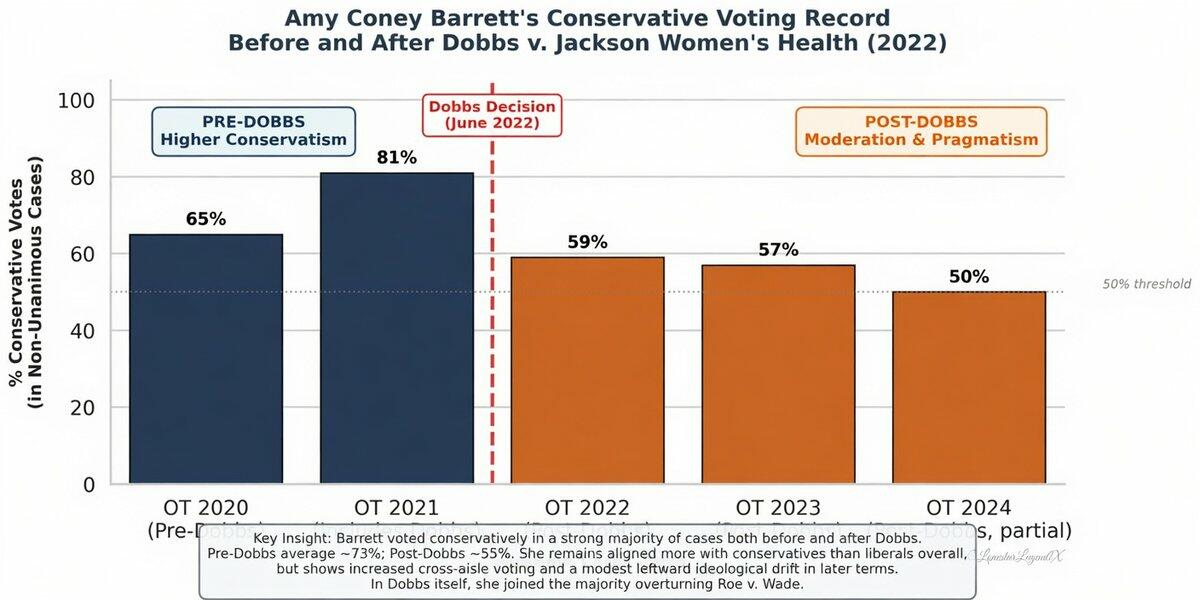
Beyond these cases, there has been a steady stream of threats made against conservative politicians and SCOTUS judges. Justice Amy Coney Barrett, who used to vote predominantly conservative in her decisions, recently detailed the many threats made against her and her family since the Dobbs v Jackson case which ultimately overturned Roe v Wade and made abortion a states issue instead of a federal issue.
Justice Amy Coney Barrett details threats she and her family have faced: “I didn’t expect that performing this service was going to put me in the position of explaining to my children what a bulletproof vest was and why I had to wear one.” pic.twitter.com/aph9X4mfEm
Barrett mentions the growing number of threats made against her in the wake of the Dobbs leak, as well as being required to wear a bulletproof vest and having her family home swatted. These kinds of intimidation tactics are grotesque, yes, but if we examine Barrett’s voting record after Dobbs it becomes increasingly clear that the threats are working.
This revelation helps to explain why Barrett has recently turned against obvious decisions on such issues as birthright citizenship and mail-in ballots. She is most likely afraid and trying to mitigate the rage of activist freaks.
Barrett told a House subcommittee on Tuesday that “the threat level” against her and other federal judges “is really high” as she testified about the high court’s 2027 budget request.
“Those statistics sound abstract, but being on the receiving end of them is not,” Barrett told the House Appropriations subcommittee on financial services and general government, before she shared several anecdotes about threats affecting her and her family.
The Supreme Court is asking Congress to appropriate $228.4 million for fiscal 2027, a nearly 10% rise since the $207.8 million appropriated for 2026. The increase reflects higher spending on security-related measures, both for the protection of justices and for cybersecurity
Perhaps more disconcerting than the constant threats is the fact that leftist movements largely dodge the blame for these events when they do happen, which makes it more difficult for exposed figures to do their jobs. If leftist movements are not called out for their involvement, then the problem will never go away. Activists are free to continue their campaign of terror.
Until recently, groups like Antifa were not even treated as real by the government or the media. If a terrorist organization is not technically “real”, then they can’t be investigated or prosecuted.
After nearly every assassination attempt, whether the attackers succeed or not, the propaganda machine floods social media with conspiracy theories scapegoating anyone other than radical progressives. This is a highly organized psy-op designed to disable conservative anger by sowing seeds of doubt. Leftist ideology and the groups that promote it always seem to escape culpability.
Right leaning judges facing potential assassination see this trend; they know that if they are attacked or killed, the spin agents will slither out from under their rocks and turn them into the bad guys. Even if they survive, they will be accused of “staging” the incident. The incentive to stand by their convictions diminishes.
Furthermore, less and less people near the center will feel compelled to seek offices of authority, because they know they will be immediately added to the hit list if they deviate at all from woke demands. At bottom, if Amy Coney Barrett is compromised by fear, then she should step down from her position. Even though the viciousness of the discourse is not her fault, she needs to be replaced by someone who can handle the heat.
It should be noted that the aggressive and unhinged nature of the left-wing will, in the end, result in the most hardcore right-wingers moving to the top. This is the last thing the progressives should want. With the center-right, they still might find an empathetic ear; but with hardened conservatives in power – men who are fed up with compromise – leftists are unlikely to find fairness or compassion for their causes.
The more violent the political left becomes, the more callous conservatives will become. Until, one day, progressives will be hit with a freight train of retribution, and no one will care.
If we examine the history of alleged “democratic” socialism around the globe, it’s not difficult to flesh out the contradictions within its entire framework.
However, for someone who hasn’t studied history or been grounded in the timeless principles of hard work and individual responsibility, socialism might tug at their heartstrings with its utopian claims. They fail to realize that the words “democratic” and “socialism” don’t mix well.
Buzzwords such as affordability, equality, and social justice sound appealing to almost anyone, especially those facing life challenges. However, if you dig deeper, the path toward those ideals involves seizing from those who pull their own weight and handing it over to those who want the easy way out in life. This forced collectivism lies at the root of socialism’s dysfunction, as it generates resentment.
Marxist socialism promises the moon and stars in the form of free this and free that. What the purveyors of this ideology don’t tell the masses is that nothing in life is free and someone has to fork over the money for all the “free” stuff. Folks in the middle- and upper-income strata are coerced into surrendering greater amounts of their hard-won earnings to a centralized government that, in turn, redistributes funds or services to the indigent.
Moreover, socialists demand that everyone practice a minimalist lifestyle while political ideologues enjoy the blessings of a free-market economy. There’s nothing wrong with embracing minimalism if it’s a voluntary decision, but that’s not how socialism operates.
Coercion is the key element in socialism’s playbook, and it tends to hurt the lower-income folks that it claims to fight for in society.
Instead of encouraging poor folks to utilize initiative to succeed, socialists encourage dependency on a bureaucratic state that plays favorites in the battle for resources. This often runs counter to the human drive to freely choose between competing goods, ideas, and services.
Socialism stifles intellectual diversity and is anti-spiritual, since it believes that humans possess all the answers and a divine presence doesn’t play a role in human affairs.
What many young folks fail to realize when they listen to socialist narratives is that socialism is based on emotions and class envy rather than well-reasoned arguments and solutions. The arbitrary nature of socialism can turn any human being into a target of scorn, depending on the mood of those who run the circus. In unfree societies, socialism is kept on life support despite its colossal failures and millions of victims since Russia’s 1917 Bolshevik Revolution.
Socialist apologists often repeat the mantra that socialism hasn’t been applied the “correct” way and that is why it continues to fall short. So they triple down on their internal contradictions and hypocrisy, and are doomed to repeat the same dystopian slogans over and over again despite shortages in goods, opportunities, and services.
In a free society, socialists attempt to apply coercion with a gentler demeanor that hides a relentless ambition to dismantle democratic institutions.
In their zeal for permanent revolution, socialists don’t have time to take a breath and actually produce anything of substance. Indeed, they are great at lecturing us and taking from others, but very weak on producing quality products and services that consumers want.
Indeed, socialist leaders exacerbate the cycle of poverty by distorting the free market with price controls and a fixation with victimhood. Socialists ignore the reality that in a free society, victimhood is a choice, as there are countless opportunities to succeed.
Most socialist gatherings and protests involve educated middle- and upper-class folks who have time on their hands to clamor for Marxist ideas they don’t even practice in their daily lives. They benefit from the free market, yet they want the poor to be enslaved to ineffective government programs instead of pursuing the American Dream. Indeed, socialist rabblerousers aren’t fighting the oligarchy because they are the oligarchy.
Another fatal flaw in the socialist edifice is the opposition to charter schools. Why do they oppose alternatives to so many failing public schools? Charters more often than not outperform their public school counterparts in educational outcomes. This can help students succeed more in higher education and the workforce.
What does socialism deliver to society? It plays the zero-sum game by falsely believing that if one person succeeds, someone else fails. How about the possibility that if one person succeeds, it inspires others to work hard in attaining a worthy goal? The road to success can be uneven for anyone, but the persevering effort is what counts.
The primary objective of socialism is power over others by initiating anarchy and class warfare. It stifles natural competition, inherent liberty, and social relations. Socialist activists are adept at pulling the victim card in order to become victimizers of folks they envy, such as the wealthy who already create countless jobs and pay heavy taxes.
To sum up, socialism is a criminal enterprise that utilizes propaganda to convince us that it cares for the poor. In truth, socialists crave power, while their policies only serve to keep lower-income folks in misery. The antidote is equal human rights, free market exchanges, and limited government.
Widow Of Butler Rally Victim: Trump Assassination Attempt Was “An Inside Job”
Two years after a gunman opened fire at a campaign rally in Butler, Pennsylvania, killing one attendee and wounding President Donald Trump, the widow of the man who was slain has expressed deep skepticism about the circumstances of the attack. Helen Comperatore, whose husband Corey, a 50-year-old volunteer firefighter and father of two, was fatally shot while shielding his family, told NewsNation that she believes the July 13, 2024, assassination attempt was “an inside job.”
In the explosive interview, Helen Comperatore stopped short of alleging a second shooter but claimed that Thomas Matthew Crooks, the 20-year-old identified as the gunman, did not act alone.
“I believe he was working with somebody,” she said. “I believe it was an inside job – inside the government somewhere.”
The widow of Corey Comperatore says she has reason to believe that the assassination attempt in Butler, which took the life of her husband, was an inside job.
Helen Comperatore is pleading with Trump to do something and says she won’t have closure until the people responsible… pic.twitter.com/QAwkcRXIKp
Corey Comperatore died protecting his wife and daughter as shots rang out from a rooftop approximately 400 feet from the stage. Trump was grazed in the ear, and two other spectators were injured. The incident, which occurred amid a series of documented security lapses, has continued to fuel public outrage and congressional scrutiny.
Later in the interview Helen Comperatore issued a poignant message to Trump.
“Don’t forget us and remember what we went through that day. We’re still here, and we need answers,” she said.
Federal investigations have consistently portrayed Crooks as a lone actor, with the FBI. examining the shooting as an assassination attempt and a potential act of domestic terrorism. Extensive searches of his devices and home, along with interviews, yielded no clear motive or evidence of accomplices. Yet, multiple inquiries have highlighted systemic failures by the Secret Service. As of mid-2026, congressional and inspector general reports continue to underscore preventable shortcomings.
A recent Office of Inspector General report found that the Secret Service shockingly missed over 100 radio transmissions from local law enforcement about a suspicious individual, who is now believed to be Crooks, armed with a rangefinder and rifle. Agents failed to relay critical warnings, establish proper joint communications or secure the rooftop vantage point.
Many American families are struggling to make ends meet on their incomes alone and have resorted to credit cards, payday loans, and Buy Now Pay Later (BNPL) options for groceries, according to nonprofit research center Urban Institute.
The findings are based on a survey of 18-to 64-year-old working-age adults conducted in December 2025. About 8.7 percent of adults said they used a credit card for groceries and were unable to make the minimum payment, up from 7.1 percent in 2023, the Urban Institute said in a July 13 report. This suggests “worsening financial distress” among families.
Almost one in 10 used BNPL to pay for groceries, out of which more than a third missed a timely repayment last year.
About 19.6 percent used savings not meant for daily expenses to buy groceries, while 5.2 percent used cash from a payday loan.
The report highlighted that groceries are one of the largest household budget items for families and that food costs have jumped by about 32 percent over the past five years, posing a challenge for many households.
Adults who reported that their grocery costs increased significantly last year were more likely to use their savings or credit to buy food. According to the report, 51.3 percent of adults said grocery costs rose a lot during the 12 months preceding December 2025.
Data from the Bureau of Labor Statistics show that among bread, chicken, eggs, beef, and milk, only beef recorded a price increase between December 2024 and December 2025.
The price of a pound of ground 100 percent beef rose from $5.58 to $6.52 during this period. In contrast, the price of a pound of white bread declined from $1.91 to $1.83, a pound of fresh whole chicken fell from $2.06 to $2.02, a dozen large grade A eggs decreased from $4.15 to $2.71, and a gallon of fresh whole fortified milk declined from $4.10 to $4.05.
When families are unable to pay for groceries from their regular income, they resort to using credit, drawing down savings, and cutting down grocery spending, the Urban Institute report said.
Low- and moderate-income adults were more likely to report paying for groceries with a credit card, though they didn’t always pay the required minimum payment, the nonprofit said.
Steaks for sale at a store in Elkridge, Md., on Feb. 27, 2026. Madalina Kilroy/The Epoch Times
Amid straining finances, U.S. household debt rose last year. By the end of the fourth quarter of 2025, total U.S. household debt stood at $18.77 trillion, up $740 billion from a year ago, according to data from the Federal Reserve Bank of New York.
For the first quarter of 2026, household debt rose marginally by 0.1 percent from the previous quarter to $18.8 trillion, the bank said in a May 12 statement.
More Americans are also filing for bankruptcy. In 2025, individual bankruptcy filings rose by 12 percent from 2024, according to the American Bankruptcy Institute (ABI).
In the first six months of 2026, individual bankruptcy filings rose by 12 percent from the same period last year, ABI said.
Unemployment, GDP Growth
For the week ending July 4, initial unemployment claims fell to 215,000, down from the previous week and the lowest level since late May. Overall employment conditions show signs of stability, with the four-week average of unemployment claims declining,
According to minutes from June’s Federal Reserve policy meeting, the central bank believes the labor market will “remain stable in the near term, with the unemployment rate staying close to current levels.”
People shop for meat at a store in Mount Laurel, N.J., on Feb. 5, 2025. Samira Bouaou/The Epoch Times
GDP grew by 2.1 percent in 2025 from the previous year, according to data from the Bureau of Economic Analysis. For the January–March quarter this year, GDP rose by 2.1 percent. Consumer spending rose by 0.5 percent despite inflationary pressures.
In a recent Consumer Checkpoint report, Bank of America noted that consumer spending momentum was “remarkably robust.”
Consultancy Deloitte predicted in a July 1 report that in its baseline scenario, real U.S. GDP growth is expected to grow by a “healthy” 2 percent this year and 1.8 percent in 2027.