

60.4 F
Chicago
Tuesday, September 22, 2026
Home Blog Page 2589

Like Biden’s Busted Gaza Pier, So Drifts Away Our Economy

Like Biden’s Busted Gaza Pier, So Drifts Away Our Economy

Submitted by QTR’s Fringe Finance

Chances are, if you’re reading this blog, you have completely given up on any semblance of fiscal responsibility from the current administration, and perhaps maybe from the nation as a whole, already. But if you’re one of the few still holding on to a shred of hope for fiscal responsibility…well…stop.

As best as I can tell, the Biden administration’s current policy stance towards spending is basically “f*ck it, we’ve almost run up the credit card to its limit, so we might as well just blow the rest on a massive bender.”

Biden reminds me of Michael Jackson in the Living With Michael Jackson documentary with Martin Bashir, walking into a (very likely insanely overpriced) Las Vegas antique store, filled with lavish looking garbage that no one ever needs to own, for any reason, and pointing at and buying literally every single item he doesn’t own yet.

The trillions of dollars in tax revenue that the country is bringing in pales in comparison to the speed with which the Biden administration has figured out ways to spend. Our nation’s cumulative debt to GDP is at record levels and has surpassed levels that have broken many nations in the past.
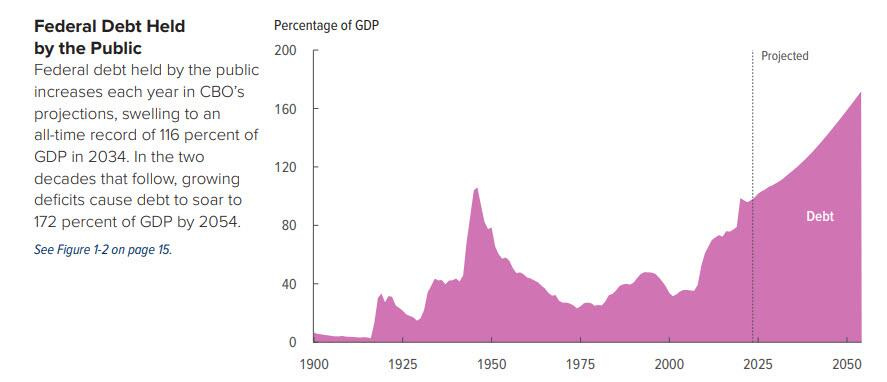
The nation’s spending habit has gotten so out of control that the Biden administration is actually thinking about implementing a tax on unrealized gains, one of the worst ideas I’ve heard over the last decade, even giving the “trillion dollar coin” idea a run for its money. I wrote about why this would be such a horrific idea just weeks ago, pointing out that it would obliterate what’s left of the economy.

The above Michael Jackson analogy is apt because the spending he was doing in that store was needless. Does anyone need another bronze gargoyle or $89,000 emerald chess set? Of course not! But, fuck it, we’re here to spend, and spend is what we’ll do!

To quote Oscar Martinez from The Office:

“This scary black bar is what you spend on things that no one ever, ever needs, like multiple magic sets, professional bass fishing equipment.”

These examples do well to explain the Biden administration’s reckless spending on things like hundreds of billions of dollars to foreign countries, unaudited, to help them fight wars, $7.5 billion dollar subsidies that over 2 years produce just 7 EV charging stations and bailing out university students from the debt they accrued while pursuing their degree in 18th-century intersexual French philosophies of applied communism and their respective effects on non-binary seagulls.

And while it’s not professional bass fishing equipment, there might be no better example of how careless we have become with our spending than the $320 million pier that the Biden administration just constructed in Gaza, supposedly to help ship aid to Palestinians.

Putting aside the inconvenient fact that the administration can’t seem to make up its mind which side of the Israeli-Palestinian conflict it’s on, this $320 million monstrosity was so wonderfully built and such an effective bastion of government efficiency, it didn’t even last two weeks before being washed out to shore.

Incinerating $320 million over the course of just 12 days has to be some type of record.

The US halted aid delivery from the $320 million “floating pier” off Gaza’s coast due to structural damage from severe weather, barely a week after its debut, Fox News reported this week. Although 569 metric tons of aid were transferred to the dock, none had reached Palestinians by last week, per the Pentagon.

And what a surprise: the National Review noted that the pier wasn’t intended to be used in waters with over three-foot waves, which “occur in that part of the Mediterranean Sea frequently”:

It turns out that the pier system was not intended to be used in waters with waves higher than three feet, and three-foot waves occur in that part of the Mediterranean Sea frequently. We know that Pentagon officials can read a weather and surf report. Now the question is, did someone in the administration tell them to go ahead with the operation, knowing the risks?

A lot of us figured that Hamas or the Palestinian Islamic Jihad would have targeted the U.S.-built Gaza pier by now. But the wind and the sea got there first; what few of us realized was that the Pentagon built the pier in a location where it would regularly operate at the maximum safe-wave height and wind, and any bout of bad weather could break the structure apart.

Incredible work all around, everybody.

And to be frank, I wasn’t even planning on writing an article about this, but this morning, as I watched one headline after the next continue to go across my social media feed—each one sporting a picture of the pier drifting further and further out to sea—I couldn’t help but be struck by what an astute microcosm of our nation’s failed economic policies it was.

It’s baffling to me to think about the juxtaposition between then excruciating planning that goes into collecting tax revenue versus the near-zero planning that obviously goes into how and why our country spends. Anti-money laundering and Know Your Customer laws in the United States won’t let you move more than a couple thousand dollars without setting off alarm bells at banks. Venmo transactions over $600 are monitored by the government. They are literally thinking about taxes that take gains you haven’t even realized yet.

Yet when absolutely gargantuan sums of money turn up missing, or boondoggle projects fail miserably, it’s no big deal.
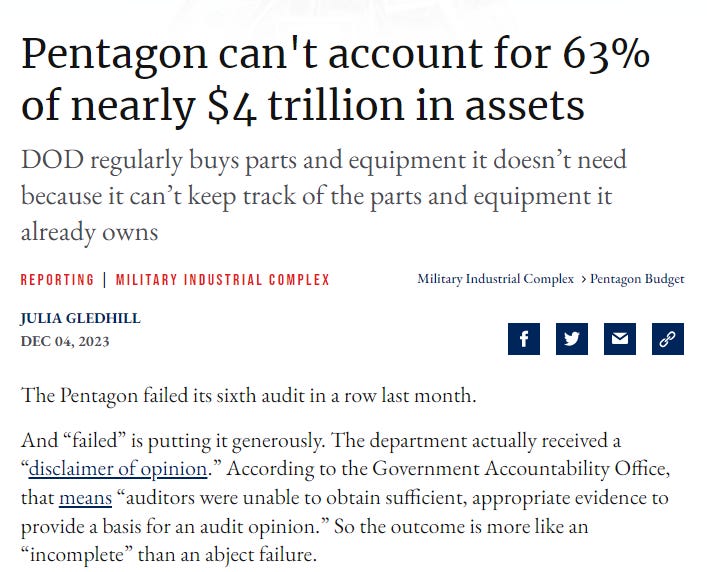
Trillions of dollars go unaccounted for at the Pentagon, hundreds of billions go unmonitored in the form of foreign aid, billions get handed out to hostile nation-states like Iran — and now, as the icing on the cake, there’s $320 million worth of shit floating in the Mediterranean Sea somewhere.

And in the grand old tradition of our nation’s fiscal policy on both sides of the aisle, nobody will be held accountable or have learned anything from the experience, except the contractors who likely overcharged the government to get the project done and are likely now touring the beautiful beaches of Tel Aviv in exotic cars.

I know. Every day we bear witness to dozens of examples of inefficiency in government spending. But for some reason, maybe it’s the timing, this one just stood out to me.

I’m not trying to be a doomsday sayer, but with the Fed caught between the rock of inflation and the hard place of a coming economic depression as the result of 5.5% interest rates — and half of the modern world in the BRICS nations openly challenging the dollar’s reserve currency status, the carelessness with which we spend sadly really does seem like it has reached “end of Empire” levels.


🔥 40% OFF FOR LIFE: Using this coupon entitles you to 40% off an annual subscription to Fringe Finance for as long as you wish to remain a subscriber.


QTR’s Disclaimer: Please read my full legal disclaimer on my About page hereThis post represents my opinions only. In addition, please understand I am an idiot and often get things wrong and lose money. I may own or transact in any names mentioned in this piece at any time without warning. Contributor posts and aggregated posts have been hand selected by me, have not been fact checked and are the opinions of their authors. They are either submitted to QTR by their author, reprinted under a Creative Commons license with my best effort to uphold what the license asks, or with the permission of the author. This is not a recommendation to buy or sell any stocks or securities, just my opinions. I often lose money on positions I trade/invest in. I may add any name mentioned in this article and sell any name mentioned in this piece at any time, without further warning. None of this is a solicitation to buy or sell securities. These positions can change immediately as soon as I publish this, with or without notice. You are on your own. Do not make decisions based on my blog. I exist on the fringe. The publisher does not guarantee the accuracy or completeness of the information provided in this page. These are not the opinions of any of my employers, partners, or associates. I did my best to be honest about my disclosures but can’t guarantee I am right; I write these posts after a couple beers sometimes. Also, I just straight up get shit wrong a lot. I mention it twice because it’s that important.

Tyler Durden
Thu, 05/30/2024 – 13:25

‘Kohllapse’: Retailer Routed As Consumer Turnaround Stalls 

‘Kohllapse’: Retailer Routed As Consumer Turnaround Stalls 

Shares of Kohl’s Corp. crashed during the early morning cash session following a dismal earnings report. Or better yet, let’s call it what it is: a ‘Kohllapse’…

Kohl’s slashed guidance for the full year after reporting first-quarter results that missed about every metric.  

Comparable sales, which measure the performance of stores open for more than one year, dropped 4.4% in the quarter ended May 4 — the ninth consecutive decline. Analysts tracked by Bloomberg were expecting a 1.74% decline. 

Here’s a snapshot of the first quarter (courtesy of Bloomberg): 

  • Comparable sales -4.4%, estimate -1.74% (Bloomberg Consensus)

  • Adjusted loss per share 24c vs. EPS 13c y/y, estimate EPS 6.7c

  • Gross margin 39.5% vs. 39% y/y, estimate 39.5%

  • Net sales $3.18 billion, -5.3% y/y, estimate $3.34 billion

  • Merchandise inventories $3.08 billion, -13% y/y, estimate $3.24 billion (2 estimates)

The midmarket department store chain also slashed its full-year forecast to $1.25 to $1.85 a share, well below the Bloomberg consensus estimate of $2.39 a share. 

Here’s a snapshot of the full-year forecast (courtesy of Bloomberg): 

  • Sees adjusted EPS $1.25 to $1.85, saw $2.10 to $2.70, estimate $2.39

  • Sees net sales -2% to -4%, saw -1% to +1%

  • Sees operating margin 3% to 3.5%, saw 3.6% to 4.1%, estimate 3.89%

“Regular price sales increased year-over-year, with early success in underpenetrated categories, positive trends in our Women’s business, and continued strong growth in Sephora. However, lower clearance sales versus last year represented a more than 600 basis point drag on comparable sales,” CEO Tom Kingsbury wrote in a statement. 

Kingsbury continued, “We are approaching our financial outlook for the year more conservatively given the first quarter underperformance and the ongoing uncertainty in the consumer environment.” 

Here’s how Wall Street analysts responded to the earnings report:

Vital Knowledge

  • “This very ugly KSS report/guide reflects how big box retailers without 1) a powerful consumables anchor and/or 2) aggressive pricing are being squeezed hard in the present environment,” analyst Adam Crisafulli writes

Citi (neutral)

  • “Although gross margin and SG&A were both better than consensus, the issue with KSS has been (and continues to be) the top-line,” analyst Paul Lejuez writes

  • The department store operator has several merchandising initiatives this year to help drive sales, including baby, gifting and impulse, but they “have yet to provide any sales boost,” he says

Bloomberg Intelligence

  • Kohl’s “weak” 1Q results delays company turnaround, writes analyst Mary Ross Gilbert

  • “Strong Sephora sales — up 60% in 1Q with comp sales up 20% — are masked by lower revenue in adjacent categories, postponing prospects to restore growth,” she says

If Kohl’s intraday plunge of 25% holds until close, it would mark the largest single-day crash in the company’s history.

Shares are crashing to Covid lows. 

Elsewhere, Foot Locker Inc. soared as much as 27%, the highest in years, after better-than-expected comparable sales provided insight into CEO Mary Dillon’s turnaround plan, which showed some signs of working. 

Still, Dillon warned about consumers: “There’s still pressure on the consumer for us—exposure to inflation, interest rates and reduced savings,” adding, “But it’s discretionary for a reason. They decide where to spend it.”

More headlines this AM from retailers (courtesy of Bloomberg): 

  • Dollar General Inc., in the midst of turnaround efforts under two-time CEO Todd Vasos, said Thursday that gains in traffic and market share drove sales growth, though shoppers are spending less per transaction on average. Consumable products are growing, but more discretionary items such as apparel, seasonal and home products are declining.

  • Best Buy Co., the last big US electronics chain, is all about discretionary items — and comparable sales slumped 6.1% in its most recent quarter, missing estimates. Still, the company outperformed on profit thanks to membership and service offerings.

  • Discount chain Burlington Stores Inc. surged as much as 16% in premarket trading after reporting comparable sales and earnings that topped estimates. The company also raised its full-year guidance. “The quarter got off to a slow start in February, likely due to disruptive weather and delayed tax refunds, but then our sales trend picked up,” CEO Michael O’Sullivan said in a statement.

The overall theme about the working poor, recently laid out by Goldman analysts, has been an ominous one:

This week’s news from retailers continues to reinforce Goldman’s theme about deteriorating working poor consumers. 

Tyler Durden
Thu, 05/30/2024 – 13:05

Elite Colleges More Likely To Have Tent-Cities, Research Confirms

Elite Colleges More Likely To Have Tent-Cities, Research Confirms

Authored by Matt Lamb via The College Fix,

Pro-Palestinian green tent cities are more likely to pop up at elite colleges with students from high-income families, new research suggests.

Washington Monthly recently published an analysis that looked at pro-Palestinian protests, including encampments, and found they were clustered among institutions with a lower percentage of Pell grant recipients. Those grants go to poorer college students, so they serve as a good proxy of the overall income of enrollees.

“Pro-Palestinian protests have been rare at colleges with high percentages of Pell students,” the article reported.

“Encampments at such colleges have been rarer still. A few outliers exist, such as Cal State Los Angeles, the City College of New York, and Rutgers University–Newark.”

The authors, Marc Novicoff and University of Tennessee Professor Robert Kelchen, said in a “vast majority of cases,” campuses with poorer students “have not had any protest activity.”

They offered several reasons why this might be.

“They may have off-campus jobs and nearby family members to see and take care of,” the researchers wrote.

The students might be sympathetic to the cause, but not place a high priority on it.

The authors wrote:

They might sympathize with the protesters—a nationwide poll of college students in May found that 45 percent support the encampments, 24 percent oppose them, and 30 percent are neutral. But in the same poll, only 13 percent rated conflict in the Middle East as the issue most important to them. That was well behind health care reform (40 percent), educational funding and access (38 percent), and economic fairness and opportunity (37 percent).

This might lead students working “a low-paying job” to be “unlikely to devote what little free time they have to protesting about an issue they don’t see as a high priority.”

Politically inclined students might be more drawn to colleges such as Columbia University, with a history of activism.

The article also looked at the political leaning of the student populations, using data from the Foundation for Individual Rights and Expression, and suggested less liberal campuses might be less friendly to pro-Palestinian activity.

“Whatever the cause, the pattern is clear: Pro-Palestinian protests are overwhelmingly an elite college phenomenon,” the article concluded.

Professor William Jacobson commented on the findings at his Legal Insurrection website.

“[The ‘elite college phenomenon’] doesn’t make the Red-Green Alliance among elites any less dangerous. Terrorist groups in the west traditionally have been drawn from the wealthy and the elites,” he wrote. “These may be dangerous people, but they are elite dangerous people. This is not a mass working class revolution.”

Tyler Durden
Thu, 05/30/2024 – 12:45

Dozens Attend Divisive Biden “Black Outreach” Event In Philadelphia

Dozens Attend Divisive Biden “Black Outreach” Event In Philadelphia

President Joe Biden and VP Kamala Harris were in Philadelphia, Pennsylvania on Wednesday, where they struggled to fill a college gymnasium with supporters for a the media called a “black voter outreach” event amid the Biden campaign’s struggle to keep black voters in his electoral coalition.

President Joe Biden (L) and Vice President Kamala Harris (R) take the stage at a campaign rally at Girard College in Philadelphia, on May 29, 2024. (Andrew Harnik/Getty Images)

The pair launched a new campaign effort, “Black Voters for Biden-Harris,” during a visit to Girard College – a boarding school primarily made up of black students. As part of the new drive, the campaign will partner with black organizations in an attempt to increase outreach among voters in key states, while also collaborating with groups on voter education and registration activation, both online and on the ground.

According to the Epoch Times, the campaign will also utilize partner organizations’ networks to “strengthen our voter protection efforts to safeguard the Black vote from continued MAGA attacks,” according to the press release.

The Biden-Harris campaign plans to hold multiple events in battleground states, including black church engagement in Arizona, new office openings throughout Georgia, and a community-led block party-style celebration in Nevada, campaign officials said.

Further organizing events will also take place throughout the weekend in Florida, Maine, Michigan, Nebraska, New Hampshire, Pennsylvania, Virginia, and Wisconsin.

As the Conservative Treehouse notes, the event was “one of the most divisive, toxic and bitter racist events in modern political history.”

The Biden campaign is relying on the formula they used in 2020, where James Clyburn, Barack Obama, the AME Church and Black Lives Matter organizers activated a regional playbook to influence the election.

In the big picture the Black Lives Matter (BLM) group are the ballot harvesters, the essential foot soldiers for the race-based electoral system Clyburn and Obama constructed. The AME network are the ballot counters, the precinct poll workers, spread throughout the various urban enclaves of Pennsylvania, Wisconsin, Georgia, Michigan, Arizona, Virgina and both Carolinas. It’s a race-based coalition, dependent on conformity to achieve the 2024 objective.

The extremely toxic remarks made by Joe Biden were intended to rally the racist sentiment amid the black voters in the key precincts within key states.  However, for 2024 the challenge is larger. Minorities are just like all Americans who are negatively impacted by Bidenomics, inflation, energy prices, the open border and illegal migration ¹intended to suppress wages.

Watch:

The event comes as Biden’s support continues to slip among black voters. More via the Epoch Times;

The president used his appearance in Philadelphia to criticize his rival, former President Donald Trump, whose recent South Bronx campaign stop drew thousands of supporters in one of the most Democrat-leaning counties in the nation.

President Biden also used the opportunity to tout his successes during his time in office, including appointing the first black woman to the United States Supreme Court, Justice Ketanji Brown Jackson, and appointing more black women to the federal circuit courts than“every other president in American history combined.”

His visit came as recent polling showed support for the president among black adults—one of his most loyal constituencies in 2020—has declined dramatically while President Trump appears to be gaining support among African Americans, in particular men.

President Biden’s overall approval rating among black Americans has decreased from 87 percent in March 2021 to 55 percent in April 2023, according to Pew Research.

“Because Black Americans voted, Kamala and I are President and Vice President of the United States — because of you,” President Biden said at Girard College.

“That’s not hyperbole,” he continued. “Because you voted, Donald Trump is a defeated former president and with your vote in 2024, we’re going to make Donald Trump a loser again.

Oh?

Tyler Durden
Thu, 05/30/2024 – 12:25

Supreme Court Unanimously Rules For NRA In Free Speech Case

Supreme Court Unanimously Rules For NRA In Free Speech Case

Authored by Sam Doorman via The Epoch Times,

The Supreme Court ruled unanimously that the National Rifle Association plausibly alleged that the administration of the state of New York violated the First Amendment by pressuring insurance companies to cut ties with the gun rights organization.

The case, NRA v. Vullo, emerged out of the aftermath of the Parkland shooting on Feb. 14, 2018.

“A government official can share her views freely and criticize particular beliefs, and she can do so forcefully in the hopes of persuading others to follow her lead,” Supreme Court Justice Sonia Sotomayor wrote in the majority opinion.

Justices Neil Gorsuch and Ketanji Brown Jackson filed concurring opinions.

“In doing so, she can rely on the merits and force of her ideas, the strength of her convictions, and her ability to inspire others. What she cannot do, however, is use the power of the State to punish or suppress disfavored expression,” Justice Sotomayor added.

The U.S. Court of Appeals for the Second Circuit had rejected the NRA’s First Amendment arguments and said that regardless, New York Department of Financial Services Superintendent Maria Vullo was entitled to qualified immunity.

David Cole, who argued for the NRA on March 18, maintained that New York state engaged in a type of coercive activity that violated the First Amendment.

“This was not about enforcing insurance law or mere government speech,” Mr. Cole said.

“It was a campaign by the state’s highest political officials to use their power to coerce a boycott of a political advocacy organization because they disagreed with its advocacy.”

The U.S. solicitor general’s office similarly argued that Ms. Vullo’s conduct, and former New York Gov. Andrew Cuomo’s communications, showed that the state was engaging in coercion prohibited under the First Amendment.

Neal Katyal, who argued for Ms.Vullo, said the state targeted the NRA based on illegal insurance products and therefore was justified in telling companies to cease its work with them.

Tyler Durden
Thu, 05/30/2024 – 12:05

Beware Of A Market Trading At All-Time Highs

Beware Of A Market Trading At All-Time Highs

Authored by Jan-Patrick Barnert via Bloomberg,

The tricky thing about markets at all-time highs is that they can easily flip. And what currently looks like a bit of a sideways consolidation has all the ingredients to make things messy in the next few weeks.

Take the seemingly endless risk appetite for all things artificial intelligence, epitomized by the explosion higher in Nvidia shares after Musk headlines sparked an options gamma squeeze. We can argue all day about the fair value of the leading AI chip maker, but the rally has the potential to keep risk taking, especially from retail, on a relatively high level almost regardless of fundamentals.

Hedge funds’ exposure to the so-called Magnificent Seven companies is at a record high since Nvidia Corp.’s estimate-beating earnings last week, according to Goldman Sachs’s prime brokerage. The firms now accounts for almost 21% of hedge funds’ total net exposure to US single stocks. Supportive? Yes. High risk of profit taking and stops being triggered? Also yes.

Then there’s rates, another major sentiment building block that’s looking wobbly again. European stocks fell for a second day and bonds retreated, tracking a drop in US Treasuries overnight. US 10-year yields have smashed through 4.5% after weak debt auctions and hawkish remarks from a Federal Reserve speaker. And while stocks were mostly ignoring a rise in bond yields since mid-May it seems that once again the overflow container for rate concerns is at maximum capacity and stocks can’t ignore the issue any longer.

The move is awakening the sleepy volatility readings and shows that markets, while still very calm, are mindful of the path of inflation and rates. Wording from central banks seems to increase in weight when it comes to describing not just the timing of the first cut but also the path beyond it. And while demand for hedges is still rather low, the rise in skew is a key measure many are watching when it comes to determining if markets reach a conditional state of increased downside risks.

Systematic investors are once again in a state where their influence on stocks is very asymmetric. Goldman Sachs traders predict that CTA funds have to buy about $4 billion in stocks over the next month both in a flat or up market. That stands in contrast to $217 billion of selling should the market decline.

“High positioning and low volatility feel complacent, but may continue into summer and fuel systematic buying,” notes Emmanuel Cau, a strategist at Barclays, adding that both fundamentals and share buybacks are still a boost to equity demand.

As low-volatility seasonal patterns are upon us, the strategist expects equity volatility to persist at extremely depressed levels. That said, investors might want to make use of it again, not just to buy hedges but to play the upside as well. “We like using extremely low cost of optionality for equity replacement by buying calls or call spreads instead of being outright long equities,” Cau says.

Still, the super low volatility backdrop, despite macro risk events such as the US GDP release and inflation data out of Europe, is a bit of a head scratcher, especially as the economic surprise index is deteriorating and making the elevated stock market more vulnerable.


It raises the risk that the “unhedged pot may indeed boil,” write the strategists at Tier 1 Alpha. They add that the risk is higher than normal given dealers’ option positioning and a put/call skew across multiple tenors that suggests a modest increase in downside protection demand.

Tyler Durden
Thu, 05/30/2024 – 10:15

US Pending Home Sales Plunged To Record Lows In April As Rates Rose

US Pending Home Sales Plunged To Record Lows In April As Rates Rose

After an unexpected jump in March, pending home sales were expected to drop 1.0% MoM in April as mortgage rates pushed back above 7.00% and stayed there.

Well, the analysts had the direction right but magnitude was way off as pending home sales plunged 7.7% MoM – the biggest drop since Feb 2021 (and below the lowest estimate), leaving sales down 0.7% YoY…

Source: Bloomberg

This is the 29th straight month of YoY declines for non-seasonally-adjusted pending home sales.

This MoM decline pushed the Pending Home Sales Index back to record lows…

Source: Bloomberg

The Midwest saw the biggest drop in pending sales, down 9.5% in April, followed by declines of 8.5% and 7.6% in the West and South, respectively. Contract signings in the Northeast fell 3.5%.

“The impact of escalating interest rates throughout April dampened home buying, even with more inventory in the market,” NAR Chief Economist Lawrence Yun said in a statement.

“But the Federal Reserve’s anticipated rate cut later this year should lead to better conditions, with improved affordability and more supply.”

All driven by affordability crisis as mortgage rates surged back above 7.00%…

Source: Bloomberg

“The prospect of measurable home price declines appears minimal,” Yun said.

“The few markets experiencing price declines will be viewed as second-chance opportunities for buyers to enter the market if those regions continue to add jobs.”

As a reminder, the pending-sales report tends to be a leading indicator of sales of previously owned homes, because houses typically go under contract a month or two before they’re sold.

Tyler Durden
Thu, 05/30/2024 – 10:08

Judge Denies Hunter Biden’s “Frivolous” Bid To Halt Delaware Gun Case

Judge Denies Hunter Biden’s “Frivolous” Bid To Halt Delaware Gun Case

Authored by Caden Pearson via The Epoch Times,

A federal judge on Wednesday denied Hunter Biden’s bid to halt the prosecution of his Delaware gun case, deeming it unconvincing and “frivolous.”

U.S. District Judge Maryellen Noreika issued the ruling on Wednesday, rejecting Mr. Biden’s request to enjoin the investigation led by Special Counsel David Weiss.

Mr. Biden contended that Mr. Weiss’s appointment violated the Appropriations Clause, arguing that he is not an “independent counsel” and was not approved by Congress.

“The Court should enjoin the Special Counsel from continuing to fund his investigation and prosecution of Mr. Biden without an appropriation from Congress or promptly deny the motion so it can be appealed,” Mr. Biden’s motion, filed on May 14, stated.

The judge found no merit in Mr. Biden’s claims, stating that the use of permanent appropriations to fund special counsels has been well-established and previously upheld.

“Mr. Weiss was lawfully appointed,” under relevant statutes, “to serve as special counsel to conduct investigations and prosecutions relating to this criminal matter,” Judge Noreika wrote in her decision, “and he is an ‘independent counsel’ appointed pursuant to ‘other law’ within the mining of the permanent appropriation.”

‘Not as a Serious Request’: Judge

Judge Noreika ruled that Mr. Biden’s motion was not presented as a “serious request” but rather as a necessary procedural step before he could appeal.

Mr. Biden contended that Mr. Weiss lacked authority from Congress because he “is not an independent counsel and that is by design.”

In their response motion, the prosecution highlighted that Mr. Biden’s attempts to claim Appropriations Clause violations had been struck down in two district and two circuit courts, using the same arguments. Additionally, they contended that Mr. Biden “now offers no new facts or law” to support his motion for an injunction.

Mr. Biden acknowledged that his motion relied on previously rejected arguments. He asked the judge to either enjoin Mr. Weiss “or promptly deny the motion so it can be appealed.”

His motion filed on May 14 stated that if the district court found against him regarding his argument of Appropriations Clause violations, “as it did previously,” then he would “have the basis” to take it to the Third Circuit “to address this issue when considering Mr. Biden’s forthcoming petition for rehearing and rehearing en banc.”

In calling his request unserious, the judge highlighted the motion’s length, at four and a half pages, and noted that half of it was dedicated to “explaining why the Third Circuit would have jurisdiction over an appeal should this Court deny the requested injunction.”

“The Court has no reason to believe that Defendant’s inevitable appeal of this denial of his motion for an injunction is any more meritorious than his prior efforts,” Judge Noreika wrote.

Attorney General Merrick Garland appointed Mr. Weiss as special counsel on Aug. 11, 2023, to oversee this case and Mr. Biden’s separate tax case in a California court.

Prior Rejected Arguments

Despite Mr. Biden’s series of legal maneuvers, which largely challenged procedural aspects of the prosecution rather than substantive charges, the courts have consistently upheld the legitimacy of the special counsel’s appointment and funding.

Mr. Biden is facing three federal firearm offenses stemming from his 2018 purchase and brief possession of a handgun while struggling with drug addiction.

Mr. Biden, the son of President Joe Biden, was initially charged on June 20, 2023. A grand jury indicted him in September 2023. He first sought to dismiss the charges in December 2023. This was denied on April 12, after which he unsuccessfully appealed various rulings.

Judge Noreika’s ruling on Wednesday came a day after the Third Circuit Court of Appeal rejected Mr. Biden’s appeal to have the indictment dismissed. That decision by a panel of three judges found that the district court’s order denying his motion to dismiss was not appealable, stating that “criminal defendants ordinarily cannot appeal until after final judgment.”

Earlier in the case, on May 14, the district court rejected his request to delay the trial, and on May 21, the Third Circuit denied his motion to stay the district court proceedings. These setbacks came after the Third Circuit dismissed Mr. Biden’s appeal for lack of jurisdiction on May 9.

The case is set to go to trial next week on June 3.

Tyler Durden
Thu, 05/30/2024 – 09:50

Trump And Musk Discussing Advisory Role In Next Administration: Report

Trump And Musk Discussing Advisory Role In Next Administration: Report

In a notable shift from past acrimony, Donald Trump, the presumptive Republican nominee, has engaged in discussions with Elon Musk about a possible advisory role for the Tesla mogul should Trump retake the White House, the Wall Street Journal reports. The move could see Musk influencing policies on border security and the economy.

Musk, known for his outspoken views and innovative leadership at Tesla and SpaceX, has increasingly voiced his concerns over national issues, aligning more with conservative viewpoints in recent months. Alongside billionaire investor Nelson Peltz, Musk has also taken a proactive stance against what they perceive as electoral vulnerabilities, briefing Trump on a data-centric project aimed at curbing voter fraud—a topic of significant controversy and debate.

The discussion around the advisory role and voting project took place at a March gathering at Montsorrel, Peltz’s sprawling oceanfront estate in Palm Beach, Fla., with a group of wealthy and powerful friends, some of the people familiar with the discussions said. The New York Times earlier reported the meeting had occurred, but details of the discussions haven’t been previously disclosed.

As guests nibbled on a Sunday morning breakfast of eggs, bacon and fresh fruit served by Peltz’s household staff, Peltz, Trump and Musk held forth on the November elections, criticizing Biden’s stewardship of the country, the people said.WSJ

The discussions, still in preliminary stages and without definitive roles, would mark a notable pivot in Trump’s strategy – embracing influential tech and business leaders to bolster his campaign promises of economic revitalization and stringent border controls. The meeting with Peltz suggests a concerted effort to integrate Musk’s technological prowess and worldview into the fabric of Trump’s policy initiatives.

Investor Nelson Peltz and Elon Musk, seen in February, have briefed Donald Trump on a planned data-driven project to prevent voter fraud, people familiar with the talks say. Photo: Bauer-Griffin/FilmMagic/Getty Images

According to the report, “the role hasn’t been fully hammered out and might not happen.

During a March interview, former CNN host (and failed X contributor) Don Lemon asked Musk about the meeting with Trump – to which Musk replied: “I was at a breakfast at a friend’s place and Donald Trump came by—that’s it,” adding “I went to a friend of mine’s house and he said, ‘Donald Trump’s coming by for breakfast, just so you know.’ I said, ‘Okay, fine.'”

“Let’s just say he did most of the talking,” Musk said of Trump – adding that the former president did not ask him for donations, nor help with mounting legal bills.

Musk doesn’t simply want to write a check to a super PAC – he wants to use his clout within elite business and technology circles to steer the US in a better direction.

Water under the bridge?

Musk’s potential involvement in Trump’s orbit marks a stark contrast from their previous public exchanges, which included a series of sharp criticisms and disagreements over policies like the Paris climate accord. However, their relationship has evolved, with Musk not only reevaluating his political allegiance—publicly shifting his support to the Republican party in 2022—but also seeking to exert his influence through more direct and personal engagements with Trump.

Now, according to the report, Musk and Trump speak on the phone several times per month.

The potential collaboration also extends to Musk’s broader ambitions in the political arena, where he has expressed dissatisfaction with the current administration’s direction, particularly criticizing the so-called “woke mind virus” that he argues undermines societal cohesion and economic progress.

Musk says he’s a centrist, who wants secure borders, safe & clean cities, and to stop ‘sterilization below age of consent,’ among other things.

As the NY Times‘ Andrew Ross Sorkin and six other NYT journalists (for some reason) noted on Thursday:

Musk voted for Biden in 2020 but has turned to the right. He has increasingly used X, his social media platform, to berate the president on migration and health care policies, and has criticized diversity, equity and inclusion programs that the political left has embraced. Musk was also miffed that the White House didn’t invite Tesla to an electric vehicle event in 2021.

Biden has seemingly been keen to fuel the feud. The president has had a habit of dismissing Musk’s views, a tactic that could backfire. As Andrew has pointed out, whether you like him or not, Musk is a natural ally on issues like tackling climate change. The Biden campaign’s latest comments suggest that it sees political mileages in distancing itself from the billionaire class (its pitching hard for working-class votes in battleground states.)

As the election looms closer, these discussions underscore a critical realignment of influential figures in American politics, with Trump poised to capitalize on Musk’s vast resources and network. However, Trump’s campaign spokesperson, Brian Hughes, emphasizes that any official role would be solely at the discretion of Trump himself, reflecting the campaign’s cautious approach to formalizing such high-profile partnerships.

This evolving partnership between Trump and Musk, if solidified, could have significant implications for the upcoming presidential race, potentially altering the dynamics of electoral strategies and national policy debates.

Tyler Durden
Thu, 05/30/2024 – 09:35

The $150,000 Housekeeper: Wage Inflation Kicks Into Second Gear

The $150,000 Housekeeper: Wage Inflation Kicks Into Second Gear

Authored by Charles Hugh Smith via OfTwoMinds blog,

If we add up all these tidal forces, the conclusion is self-evident: labor “inflation” has just shifted into second gear.

One of the lesser known manifestations of the inflationary crisis in early-1920s Germany was rampant wage inflation. Bourgeois burghers complained bitterly about the high wages being demanded–and received–by tradespeople. This reversal of fortune–wage earners gaining some power over the upper-middle class and wealthy–was naturally upsetting to those accustomed to wielding power over mere laborers.

But when the roof is leaking or the car won’t start, negotiations favor the few who can actually fix the problem. Despite the overblown hoopla about AI, ChatGPT can’t fix leaky pipes or roofs, nor will it ever be able to do so because all it can actually do is play around with words. Since we can’t repair a leaky roof or prune a tree with words, Large Language Model (LLM) – Machine Learning AI is useless in the real world.

Which brings us to the remarkable competition among the uber-wealthy for competent housekeepers: Palm Beach housekeepers are making $150,000 a year due to massive demand from the wealthy.

It’s certainly tempting to collect a cool $120,000 to $150,000 a year for dusting the Dali and other fine art, but as with many other forms of labor, the skillset required isn’t quite as easy as it looks from the outside:

The mass wealth migration to Florida from New York and other high-tax states has created record demand for household staff in elite Florida enclaves–especially Palm Beach. Demand for butlers (now called ‘hospitality managers’ or ‘estate managers’) as well as nannies, chefs, drivers and personal security has surged, according to staffing agencies.

It’s the shortage of housekeepers, however, that has created the biggest mess for wealthy homeowners. Many of the wealthy emigres to Florida bought big homes and now need people to clean them. Hotels, resorts and businesses are also vying for cleaning staff. The result: Typical pay for housekeepers has rocketed from about $25 an hour in 2020 to $45 or $50 an hour today, according to some agencies.

Bidding wars between wealthy homeowners have become common. Staffing agencies are posting ‘Help Wanted’ ads all over the web and throughout West Palm Beach. Clients are growing frustrated.

“At first they’re in shock, and they say, ‘No way I’m paying that,'” Berube said. “It’s even uncomfortable for me to give them the numbers. But when they try to hire someone for less, with less experience, they almost always come back to us and say, ‘I learned my lesson. We are willing to pay for the experience.'”

Berube said the housekeepers for the wealthy need highly specific skills–from how to move quietly and unnoticed throughout the house, to how to carefully clean antiques, flatware and fine art and how to properly wash and press fine linens.

“There are specific tools and skills you need to work in fine homes,” she said.

In other words, Jeeves won’t come cheap, and the outraged wealthy must swallow their targeted frugality–lavish spending on themselves, low pay for the help–if they want things done properly in the real world.

The backdrop for sustained wage inflation is already firmly in place. As the chart below illustrates, wages’ share of the economy have been declining for 49 years, and has plenty of room to move sharply higher, in effect reversing the tide of trillions of dollars siphoned off by capital in the 50-year long experiment of elevating globalization and financialization to dominance.

Demographically, millions of people have left the workforce for good. This trend is especially visible in males who didn’t earn a college degree. We can debate the specifics of this massive demographic shift, but not its impact: the labor force of those willing and able to do in-demand tasks is shrinking.

Generationally, millions of Boomers are working past traditional retirement age for a variety of reasons, but this boost to labor force numbers has an expiration date: at some point full-time physical labor is no longer viable. Yes, there are plumbers over the age of 80 still working, but they’re working part-time and they’re not working for chump-change.

Work is more demanding nowadays. Those with little real-world knowledge may dismiss fast-food workers, for example, as low-skilled “burger flippers,” but this is not the lived reality of the work: fast-food is a high-production, demanding industry. Not everyone can keep up the pace or do the work. This describes many of the jobs wrongly dismissed as “low-skill.”

Now overlay the soaring number of disabled. Again, we can quibble about the causes until doomsday, but the reality isn’t changed by our debate.

Then there’s the cultural shift of denigrating physical, skilled labor in favor of trading meme stocks and becoming a social media influencer. The worship of celebrity and the lotus-eater class has deformed the culture so that pride in the quality of one’s work has been replaced with a frantic scramble for digital visibility. The real world demands skills and quality work, and those who are able to perform are scarcer than most imagine.

It isn’t easy or quick to acquire real-world skills. Armchair pundits airily propose expanding training programs and the like, but training is only Step One of a much longer process of experiential learning. We may well have mis-trained millions of people to work in fields that will shrink as economic realities intrude–for example, fine dining and marketing. The labor scarcities that will only become more acute won’t be solved with quickie half-measures.

If we add up all these tidal forces, the conclusion is self-evident: labor “inflation” has just shifted into second gear. The real acceleration is still ahead. From the perspective of history and the real world, it isn’t “inflation,” it’s simply a return to properly valuing what’s actually valuable.

*  *  *

Become a $3/month patron of my work via patreon.com.

Subscribe to my Substack for free

Tyler Durden
Thu, 05/30/2024 – 09:15
