62.8 F
Chicago
Tuesday, September 22, 2026
Home Blog Page 2603

Exceptionally Strong PBoC And Chinese Private Sector Buying Continues To Boost Gold Price

Exceptionally Strong PBoC And Chinese Private Sector Buying Continues To Boost Gold Price

By Jan Nieuwenhuijs of Gainesville Coins

Chinese private sector gold imports accounted for 543 tonnes in the first quarter, while the People’s Bank of China (PBoC) added 189 tonnes to its reserves over this time horizon. Most of the PBoC’s purchases are “unreported.” China continues to be the marginal buyer in the gold market, driving up the price. I expect that China will remain a robust buyer of gold going forward in support of the price.

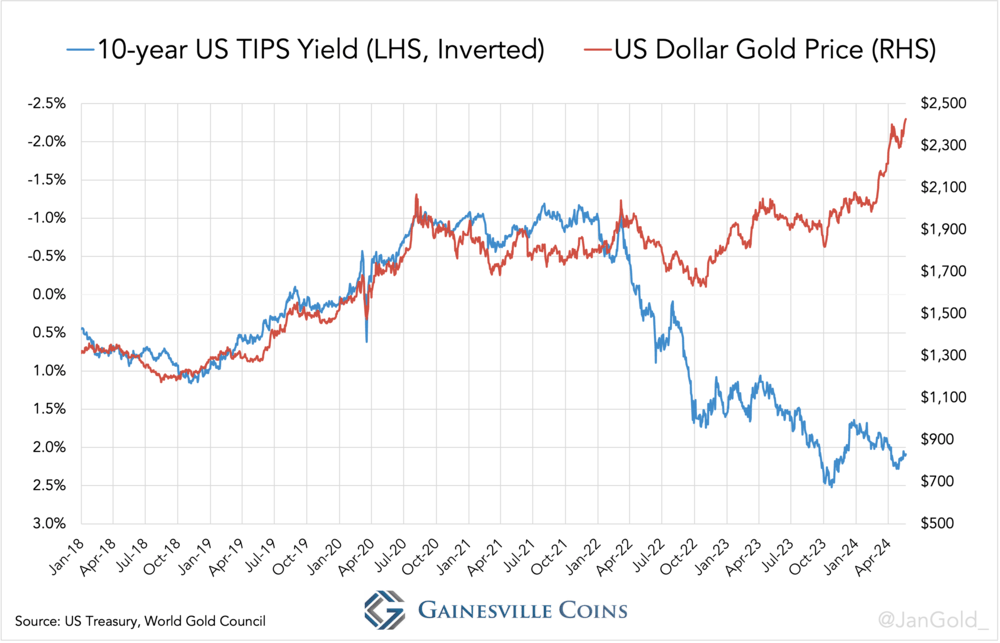
In my latest article on global gold flows from March 2024, “China Has Taken Over Gold Price Control from the West,” I showed that in 2022 China broke the peg between the US dollar gold price and “real yields.” Instead of being price sensitive China had become a driving force of the gold price. The data at my disposal ran until December 2023 which made me hesitant to conclude the sharp increase in the gold price since late February was also caused by the Chinese. However, as new data has been released, I can confidently say that China initiated the current bull market.

PBoC Gold Buying Increased by 38% in Q1

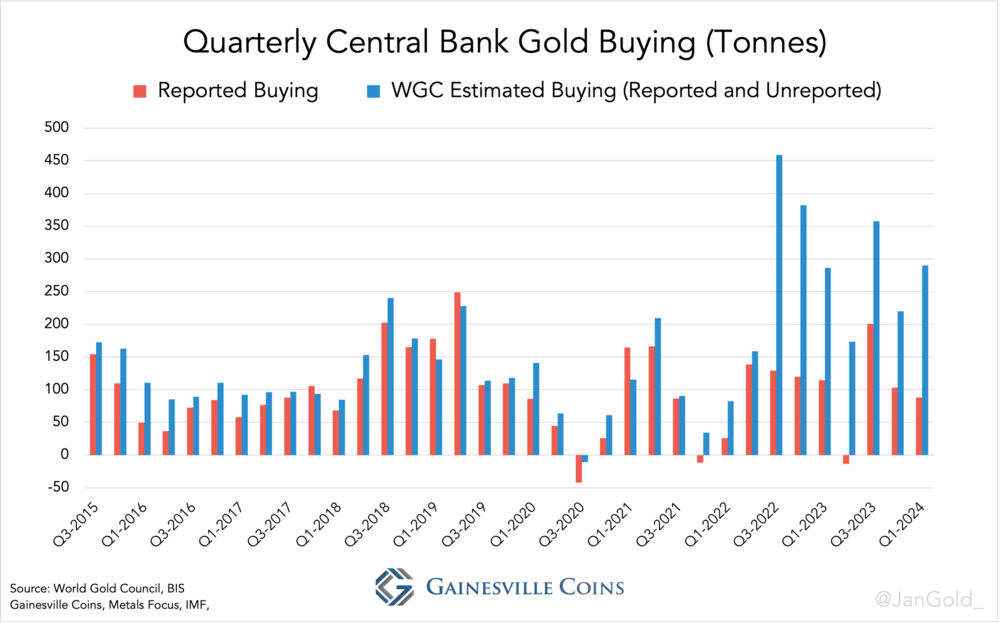
The media is aware that since 2022 central banks mostly buy gold covertly (often referred to as “unreported” purchases). By now it’s widely known that the World Gold Council (WGC) publishes a single statistic on aggregate central bank buying each quarter, which is markedly higher than what all monetary authorities combined report to have bought. Which central banks are causing the difference isn’t made clear though.

In February 2023 I broke the story on unreported buying being mostly acquisitions by the PBoC. Two people familiar with the matter shared with me the Chinese central bank is responsible for “the majority” of secretive additions by monetary authorities. Emerging markets such as Saudi Arabia take up the rest.

Based on field research, the WGC states central banks bought 290 tonnes of gold in the first quarter of 2024. Most of the difference—I use eighty percent—between the WGC’s estimate and total purchases as disclosed by the IMF is 162 tonnes. When we add what the PBoC has reported to have bought during this period, total purchases come in at 189 tonnes, 38% more than the previous quarter. Possibly, the PBoC had a stake in boosting the price since late February.

Taking into account unreported purchases, the Chinese central bank now holds gold reserves weighing 5,542 tonnes, according to my research (my methodology is explained here).

Exceptionally Strong Chinese Private Gold Demand in Q1

Chinese net gold imports by the private sector have been extremely strong. From January through March imports accounted for a mammoth 543 tonnes, up 74% from Q4 2023. This is definitely what pushed up the gold price. Import in April decreased somewhat to 125 tonnes.

India imported a healthy 95 tonnes in February, but less than 30 tonnes both in January and March. The Indians remain price sensitive and are not driving this rally.

Hong Kong saw notable net inflows in the past months, which mainly reflects strong demand in China in my view. Chinese housewives buy VAT free jewelry in Hong Kong and take it across the border to Shenzhen. In addition, bullion banks that export gold to China store gold in Hong Kong before re-exporting to the mainland.

In Q1 the UK and Switzerland both were net exporters, and Western ETF inventories declined. At the time of writing the West has not yet joined the bull market, which primarily has its roots in China.

Chinese Gold Demand Will Stay Powerful

Bloomberg recently reported that Beijing offloaded a record of $53 billion in US Treasuries and agency bonds combined in Q1, which illustrates the PBoC is selling dollars for gold. No wonder, as enthusiasm to seize Russia’s foreign exchange reserves—deposited at Belgium-based clearinghouse Euroclear—is rising among G-7 nations. In turn, Russia is freezing €700 million of assets from Western commercial banks such as UniCredit and Deutsche Bank, further strengthening gold’s global position as a safe haven. China’s foreign exchange reserves stand at $3.2 trillion so there is plenty of firepower left for gold.

Private gold demand in China is likely to uphold as well as the end of the property slump is not in sight. Home prices have declined in 30 out of the last 33 months. The State Council is floating a plan to buy unsold houses through local governments, but these are already drowning in debt. The Chinese public, which doesn’t have many investment options due to capital controls, will continue to invest in gold and support the price.

I’m expecting the West to join the bull market soon. ETF outflows appear to have stopped, and it would only be logical for Western investors to rotate into gold at some point because of high asset valuations and an overconfidence in credit instruments.

Tyler Durden
Sat, 05/25/2024 – 15:10

13th Oregon County Votes To Secede And Join ‘Greater Idaho’

13th Oregon County Votes To Secede And Join ‘Greater Idaho’

The “Greater Idaho” movement notched another victory this week, as Oregon’s Crook County became the 13th county to vote to secede from leftist domination and join its more like-minded neighbors to the east. About 53% of voters approved a referendum recommending that county leaders engage in “continued negotiations regarding a potential relocation of the Oregon-Idaho border to include Crook County.” 

“The voters of eastern Oregon have spoken loudly and clearly about their desire to see border talks move forward,” said Greater Idaho executive director Matt McCaw. “With this latest result in Crook County, there’s no excuse left for the Legislature and Governor to continue to ignore the people’s wishes.”

The yellow line marks the border that the Greater Idaho organization aspires to achieve (via Greater Idaho)

The group said the final tally was only as close as it was due to spending by Western State Strategies, which it described as a “social justice non-profit based in Portland.” On its own site, Western State Strategies has accused Greater Idaho of “writing the most recent chapter in a long history of dangerous secessionist movements that appeal to bigotry to fuel division.” 

Greater Idaho sees things differently. “Northwestern Oregon is embarking on social experiments: a cultural revolution that rural counties want no part of,” the group writes on its website. “Eastern Oregon has a different culture and values.” The group notes that 80% of Idaho’s legislature is Republican, and that it “govern[s] according to the concerns and priorities of rural counties.”

Greater Idaho’s ultimate goal would see 13 entire counties leave Oregon, along with portions of four more. One of the counties targeted for a split is Deschutes County, which would be cleaved east of Bend, an outdoor mecca in Oregon’s high desert that has been spiraling deeper into blue depths, prompting some to flee. Crook County joins Jackson, Klamath, Lake, Harney, Malheur, Baker, Grant, Wheeler, Jefferson, Wallowa, Union and Morrow counties, which have previously approved measures to negotiate an exit.   

If the group’s goal comes to full fruition, Oregon would end up 62% smaller by size, but only 9% smaller by population. That math that underscores the contrast between the sparsely populated, rural eastern region and the more densely-populated coastal areas. It also highlights the eastern counties’ lack of political strength in influencing statewide decisions.

“Oregon politicians don’t understand how we make a living,” argues Greater Idaho. “Their decisions damage industries like timber, mining, trucking, ranching and farming. They want to remake the Oregon we’ve known our whole lives. We want to preserve the values and way of life of old Oregon as a part of Idaho.”

While the group’s momentum is undeniable, there are daunting hurdles ahead. For the border to move, the Oregon and Idaho legislatures must approve it, along with the US Congress. In 2023, the Idaho house passed a measure to pursue discussions of a border change, but it stalled in the Idaho senate. 

The Greater Idaho movement is fully consistent with American values rooted in the principal of self-determination and government by consent. While leftist opponents of the movement call it “dangerous,” a calmly-negotiated border move is certainly the least dangerous path to a new governing arrangement that eastern Oregonians are entitled to.  

Tyler Durden
Sat, 05/25/2024 – 14:35

Extreme Hurricane Season Could Trigger “Carrier Revenge”

Extreme Hurricane Season Could Trigger “Carrier Revenge”

By Craig Fuller, CEO of FreightWaves

For the past two years, shippers have had enormous leverage in the freight market, as excess capacity has kept rates under significant pressure. Shippers, who suffered under the weight of sizable market stress during COVID have inflicted “shippers revenge” on motor carriers, something we were warned was coming back in August 2022. 

Truckload spot rates, when adjusted for inflation, have plummeted to lows not seen since 2009.

In the early part of the Great Freight Recession, contract rates stayed persistently high as shippers monitored the market and wondered if the market reset was a short-term development or something greater.

In the first quarter of 2023, reassured that the Great Freight Recession was unlikely to end quickly, shippers started to insist on significant rate concessions from carriers. This process accelerated earlier this year. 

As a result, carrier profitability hit 14-year lows in the first quarter. 

According to FreightWaves channel checks, shippers still insist on rate concessions from motor carriers. This may be ill-advised. 

On April 17, FreightWaves reported that we were likely at the bottom of the market and the “end to the worst freight markets in history may be closer than it appears.” 

We believe that this analysis is still true, and shippers, not carriers, bear the greater risk. In fact, if the economy continues to grow, freight market volumes will do so as well. 

While we are not expecting a massive surge in freight activity, we continue to monitor risks that could change this perspective. 

Like all commodity markets, rates become massively volatile when an unexpected sudden demand shock occurs. For trucking markets, no event has more short-term impact on demand than a major hurricane hitting a large U.S. city. 

FreightWaves’ early success was largely due to its coverage of Hurricane Harvey, which devastated Galveston and parts of the Texas Gulf Coast around Houston. 

NOAA released its May hurricane forecast, where it spells a warning to shippers to prepare for significant disruptions. It is the most aggressive forecast on record. NOAA forecasts that there will be 17-25 named storms, with 4-7 being Category 3 or greater. On average, a hurricane season usually has 14 named storms and three Category 3 or greater storms. 

The administration described the 2024 season as “hyperactive” and “the highest NOAA has ever issued in the May forecast.” 

Shippers that assume they will be able to react to changing market conditions, in time, may find that carriers lack sympathy for their plight. In fact, carriers have been warning shippers that forcing significant rate concessions will be a mistake when the market flips in the carrier’s favor. 

Whether the hurricane season lives up to NOAA’s forecast or ends on a whimper, one thing is certain: at some point, the freight market pendulum will swing against shippers and when it does trucking firms will inflict carrier revenge. 

In many ways, Carrier’s revenge is more vicious than shipper’s revenge in the sense that price is easier for shippers to deal with than having freight left on their docks and factories disrupted. 

Tyler Durden
Sat, 05/25/2024 – 14:00

52% Of Top US Hedge Funds Own Bitcoin ETFs

52% Of Top US Hedge Funds Own Bitcoin ETFs

534 institutions with over $1 billion in assets now hold Bitcoin ETFs, according to bitcoin app River.

In a blog post published this week, River noted that over 534 entities, each managing assets exceeding $1 billion, have now incorporated Bitcoin ETFs into their portfolios.

The diverse group of owners includes hedge funds, pension funds, and insurance companies, underscoring the wide-ranging acceptance of Bitcoin, the blog wrote, adding that notably, more than half of the top 25 hedge funds in the United States are now exposed to Bitcoin.

Among these are Millennium Management, which now holds an impressive $2 billion in Bitcoin assets. Furthermore, 11 of the top 25 Registered Investment Advisors (RIAs), alongside numerous smaller advisors, have also allocated investments in Bitcoin.

“If you sell your bitcoin to Blackrock, you probably won’t be getting it back,” River’s CEO Alex Leishman said. 

Specific to their company, they wrote that they are witnessing a trend of bitcoin becoming a staple on every company’s balance sheet live. 

Currently, over a thousand companies using River’s platform maintain bitcoin in their financial reserves, the company wrote. Just a year ago, the typical business held 2.5 BTC, valued at approximately $70,000. Since then, these holdings have grown to more than 4 BTC, with their value surging to beyond $280,000.

They wrote: “It is no longer just the MicroStrategy’s of the world accumulating Bitcoin, but businesses of all sizes.”

Recall days ago, Michael Saylor commented in wide-ranging interview that bitcoin had now officially pierced the veil into the KYC and AML regulated banking world.

When asked about how bitcoin is homogenizing itself in a world of increasing regulations, he said: “I think it’s doing it now. I mean, you’re watching it, right? For example, Block sells $10 billion worth of Bitcoin every year via Cash App. They’re a publicly traded company. They abide by AML and KYC regulations. They have compliance. They have responsibilities.” 

“Fidelity, you know, Fidelity Digital Assets is custodying billions and billions of dollars of Bitcoin. I’m sure they’ve got an army of lawyers and finance people thinking about it.”

Tyler Durden
Sat, 05/25/2024 – 13:25

Inflation To The Nines

Inflation To The Nines

By Peter C. Earle of the American Institute for Economic Research

Twice in the past few weeks President Joe Biden has claimed that when he took office in January 2021 inflation was “over nine percent.” First on CNN’s OutFront with Erin Burnett on May 8 and again on May 14 in a Yahoo! Finance interview, the bizarre comment was made. And as has become a routine with the gaffe-prone chief executive, White House staffers added shamelessness to what could have been limited to embarrassment by issuing a statement: “The President was making the point that the factors that caused inflation were in place when he took office. The pandemic caused inflation around the world by disrupting our economy and breaking our supply chains.”

Americans will have to decide for themselves if the claim made by Biden was a lie intended to mislead anyone not familiar with the trajectory of prices over the past several years, or an innocent error. It is a choice US citizens have been confronted with frequently, in particular where assertions regarding the health of the economy have been made. 

If an honest mistake, it simply may be that the President confused the January 2021 inflation number with a number of other price statistics beginning with the number nine in the month of his inauguration. Below are several possibilities.

  • In January 2021, the Bureau of Labor Statistics reported in their consumer prices summary that the average price of a boneless sirloin steak was $9.418. By April 2024 that price had risen 27.5 percent to $11.662. 

  • In January 2021, fifteen subindices of CPI began with the number nine. Their levels in that month, in the April 2024 report, and the percent change are shown below.

Alternatively, Mr. Biden may have mistaken a different January 2021 economic statistic with the July 2022 year-over-year headline CPI number.

  • The spread between the 1-year US Treasury bill and the 10-year US Treasury note was 97.9 basis points (0.98 percent) in mid-January 2021. That spread inverted in mid-2022, about the time that headline CPI year-over-year actually reached 9.1 percent. A normal yield curve slopes upward, with a positive spread showing that longer-term bonds yield more than shorter-term ones, typically reflecting expectations of economic growth and rising future interest rates. An inverted yield curve slopes downward with a negative spread as shorter-term bonds yield more than longer-term ones. Those conditions are often considered a predictor of an economic recession. As of May 2024, the 1-to-10 year spread has been negative for over 600 days.

1-year Treasury bill 10-year Treasury note spread (Jan 2021 – present)

  • The Federal Reserve’s Industrial Production (IP) Index was at 98.8 in January 2021. Owing to lockdowns and other pandemic policies, the index plummeted to a low of 84.6 in April 2020 and was recovering early in 2021. But despite hitting a post-pandemic high of 103.5 in September 2022, the IP Index hasn’t yet recovered its September 2018 all-time high of 104.1. Since the start of 2024, the index has declined, currently oscillating between 101.8 and 102.8.

Industrial Production (2014 – present), with all-time high (red dotted line), and January 2021 (black vertical line) indicated 

It’s possible that Mr. Biden has once again fumbled details accidentally. Yet the consistency of those blundered messages, each absolving his administration of responsibility for declining economic conditions, is simply not consistent with randomness. American citizens have been told that corporate profits, Vladimir Putin, owners of gas stations, and ocean shippers are responsible for the huge surge in prices. Month-to-month and year-to-year price change data has been conflated misleadingly, as have statistics regarding how the US inflationary surge compares to those in other nations.

Whatever the specific reasons, the desperate evasiveness is glaring. Knowing that the CPI was not “over 9 percent” in January 2021, but rather 1.4 percent, hitting 9.1 percent in July 2022, is one thing. Recognizing that the administration of monetary policy has become a third-rail issue to be evaded at all costs is another, more pressing, matter. Instead of properly attributing the increase in prices to expansionary monetary policies (and to a lesser extent, massive debt and deficits), many in the political establishment prefer to tell ham handed-lies which further erode an already ramshackle credibility.

It may be that the political establishment believes that the American public is not sophisticated enough to understand the Fed. More likely, the ability of the Fed to provide a swift economic boost during crises (without the lengthy process that fiscal stimuli require) is deemed too important to endanger by drawing attention to: even the staunchly anti-high finance Elizabeth Warren voted against auditing the Fed in 2016. The bipartisan inclination to keep the US central bank out of critical discussions is one which, whether inflation subsides or the Fed heeds calls to normalize at the 3-percent level, demands closer scrutiny.

Tyler Durden
Sat, 05/25/2024 – 12:50

Biden’s $320M Gaza Pier Has Detached & Drifted Onto Israeli Beach

Biden’s $320M Gaza Pier Has Detached & Drifted Onto Israeli Beach

A section of the $320 million floating pier built and erected off Gaza’s coast has broken off and floated onto an Israeli beach. The Saturday mishap is the latest setback for the US humanitarian aid project, after three US troops were reported injured aboard the pier two days prior, including one critically.

The Times of Isreal’s military correspondent Emanuel Fabian has reported that “An American vessel used to unload humanitarian aid from ships into the Gaza Strip via a floating pier disconnected from a small boat tugging it this morning due to stormy seas, leading it to get stuck on the coast of Ashdod, eyewitnesses say.”

The recovery operation has not gone well either, as “Another ship was then sent to try and extract the stuck vessel, but also got beached,” Fabian writes.

And yet a second US Army vessel also got stuck in shallow waters while trying to rescue the pier section. Overnight US ships had been moving two pieces of the floating pier to the Port of Ashdod in southern Israel when the now beached section detached and drifted away. American troops can be seen in footage standing helplessly on the beach.

An official US Central Command (CENTCOM) statement says the following:

This morning four U.S. Army vessels supporting the maritime humanitarian aid mission in Gaza were affected by heavy sea states. The vessels broke free from their moorings and two vessels are now anchored on the beach near the pier.

The third and fourth vessels are beached on the coast of Israel near Ashkelon. Efforts to recover the vessels are under way with assistance from the Israeli Navy.

The pier operation was already last week off to a rough start — and was paused for two days — after desperate Palestinians mobbed and ransacked the first trucks transporting aid unloaded from the pier before they could reach a distribution warehouse managed by the World Food Programme.   

Emanuel Fabian/Times of Israel

The pier has been center of controversy, given a number of land routes for aid into Gaza are possible, but have been blocked by Israel’s military.

Now, to mitigate that devastation amid reports of famine the US government has spent $320 million to build a pier to bypass its own beneficiary’s land-route blockade. But operating it has proven tricky especially due to inclement conditions in the eastern Mediterranean

At best, the pier will only put a dent in the daunting humanitarian challenge. “I just want to be clear that this humanitarian maritime corridor alone is not enough to meet the staggering needs in Gaza, but it is an important addition,” said USAID Levant response management team director Daniel Dieckhaus. “It is meant to augment, not replace or substitute for land crossings into Gaza.”    

At this point, with a section of the pier stuck on an Israel beach, and coming over two months after President Biden first unveiled the ambitious project, the whole initiative is becoming a bit of an embarrassment involving setback after setback.

Tyler Durden
Sat, 05/25/2024 – 12:15

Supreme Court Faces Historic Finish To Eventful Term

Supreme Court Faces Historic Finish To Eventful Term

Authored by John Malcolm via The Epoch Times,

Oral arguments are over at the Supreme Court for this term. Although the rallies and protesters have dispersed (for now, anyway), the justices remain frantically at work on the numerous opinions they have yet to hand down. With several closely watched cases still pending, it will likely be a historic finish to this Supreme Court term.

The court heard 61 arguments in 69 cases this term (some of the cases were consolidated for oral argument), 20 of which the court has already decided.

The most newsworthy of those cases was the unanimous ruling in Trump v. Anderson, in which the court reversed the Colorado Supreme Court and held that former President Donald Trump could not be removed from the state ballot under Section 3 of the 14th Amendment.

Because, the court said, “the Constitution makes Congress, rather than the States, responsible for enforcing Section 3 against federal officeholders and candidates,” state courts and state officials have no power to remove federal candidates from the ballot.

Opinions in some of the biggest cases, however, have yet to be issued.

These cases address issues ranging from government censorship of online speech to abortion drug regulation to Trump’s immunity from criminal prosecution to how much deference courts should give to federal agencies’ interpretations of the scope of their own authority.

The court heard five cases this term that could significantly reshape administrative law and the regulatory state.

In Relentless, Inc. v. Department of Commerce and Loper Bright Enterprises v. Raimondo, for instance, the court will decide how much courts should defer to agencies’ often expansive interpretations of federal law.

In both cases, fishing companies challenged a federal agency’s rule that the companies had to pay for the government to monitor their compliance with federal laws and regulations. A majority of justices appear ready to say that agencies cannot define their own powers by interpreting vague laws however they want. If that happens, this will represent a sea change in the area of administrative law, will curtail the vast power currently exercised by federal agencies, and may well force Congress to write clearer laws in the future.

In another administrative law case, FDA v. Alliance for Hippocratic Medicine, the court will decide a challenge brought by doctors and a medical association against the Food and Drug Administration’s repeal of safety measures that protected women who use mifepristone, a drug commonly known as the abortion pill.

If the court rules for the FDA, it could sidestep the question of whether the FDA violated the law and only hold that the doctors and medical association were not harmed and thus lacked standing to sue. A win for the doctors, however, would bring back the repealed safety restrictions.

And in a third administrative law case, Corner Post, Inc. v. Board of Governors of the Federal Reserve System, the court is grappling with the question of when someone can sue because they were harmed by a federal regulation. Under the government’s reading of the relevant statute, a person can sue only up to six years after a regulation is issued—meaning that a company created more than six years later can’t get into court to challenge the regulation.

The court will also decide whether the funding scheme for the Consumer Financial Protection Bureau, or CFPB, is unconstitutional in Consumer Financial Protection Bureau v. Community Financial Services Association, Limited.

The case focuses on whether Congress, in the name of “efficient” solutions to modern problems, can abdicate its fiscal oversight powers by passing a statute that perpetually funds an agency, as it did for the CFPB. If the CFPB prevails, Congress could easily sidestep the democratic process by guaranteeing forever-funding for the entire regulatory state.

Last but not least of the administrative law cases, Securities and Exchange Commission v. Jarkesy presents the court with three questions about the SEC’s enforcement proceedings. The court mostly focused its attention at oral arguments on one question, however: whether George Jarkesy had a right to a jury trial when the SEC brought an enforcement action against him.

For context, the SEC alleged that Jarkesy committed wrongs that look like common law fraud. Thus, when it brought an in-agency enforcement proceeding before agency judges, Jarkesy argued he had a right to a jury trial because he would have that right if a private person sued him for fraud.

The catch is that the court already held years ago that when the government creates and enforces a public right—something given to the public collectively, like a right to a deception-free securities market—the enforcing agency can decide the case itself without having to face a jury.

If the court chooses to address the jury issue, it will need to address whether Congress can convert a private right into a public one and let the agency have one of its own decide the agency’s enforcement actions.

The court will also decide in three separate cases whether government officials and Big Tech companies can suppress online speech that they disfavor.

In Moody v. NetChoice, LLC and NetChoice, LLC v. Paxton, the court will decide whether Florida and Texas can restrain Big Tech from “deplatforming” online speech (removing users’ content from their websites or apps).

And in Murthy v. Missouri, the court is weighing whether federal officials’ relentless pressure on those companies to suppress disfavored speech was unconstitutional censorship or nothing more than the bully pulpit in action.

Although the justices could side with Florida and Texas in the NetChoice cases without reaching the merits of the cases and instead by deciding them on a procedural question, they appeared skeptical in Murthy that the government violated the First Amendment.

The justices also appeared concerned about the government’s broad reading of a federal statute that the Justice Department is using to prosecute a Jan. 6 defendant in Fischer v. United States. If the court agrees that the federal law covers a narrower range of criminal acts than the government argues it covers, this could have an impact on the pending criminal case against Trump, since two of the four charges in that case rely on the same statute.

Speaking of the former president, the court will decide in Trump v. United States whether Trump enjoys absolute immunity from subsequent prosecution for official acts he took while he was president. Trump’s attorneys are arguing that the only exception would be for acts that led to a president’s impeachment and removal from office.

While Trump was impeached twice while in office, he was acquitted both times by the Senate. A ruling in Trump’s favor would make it very difficult for special counsel Jack Smith to criminally prosecute him for contesting the 2020 election and for Fulton County District Attorney Fani Willis to prosecute him in Georgia as well.

But that’s not all.

In City of Grants Pass v. Johnson, the court appears likely to reverse a 9th U.S. Circuit Court of Appeals decision that fining a homeless individual for sleeping on public property violates the Eighth Amendment’s cruel and unusual punishment clause.

In Moore v. United States, the justices will decide whether a tax on unrealized wealth – such as an increase in your stock portfolio’s value—is constitutional under the 16th Amendment, which only allows Congress to impose a direct tax on “income.”

The court is also still working on two firearms cases. The first, United States v. Rahimi, poses the question of whether a federal statute violates the Second Amendment by prohibiting a person subject to a domestic violence restraining order from possessing firearms. The second, Garland v. Cargill, will determine whether the Bureau of Alcohol, Tobacco, Firearms and Explosives can define a bump stock device as a “machine gun.”

In yet another chapter of the ongoing controversy over the Environmental Protection Agency’s (EPA) “Good Neighbor Plan”—which imposes national emission standards for certain states that are “upwind” of other states—Ohio, other affected states, and various organizations have asked the court to stay the plan while they challenge it in the D.C. Circuit Court of Appeals.

The plan, they point out in four consolidated cases (captioned Ohio v. Environmental Protection Agency), was designed for 23 states, but a dozen of those states, and three-quarters of the emissions the plan would have originally regulated, are now exempt. Among the potential costs the challengers point out as justifying a stay is the likelihood that compliance would trigger power-grid emergencies.

Finally, in Alexander v. South Carolina State Conference of the NAACP, the court will decide South Carolina state officials’ appeal of a decision from a three-judge district court panel that held that the state’s Congressional District 1 was racially gerrymandered.

The officials argued that the panel concluded that partisan gerrymandering—which is permissible under the Constitution—was racial gerrymandering by wrongly inferring that a correlation between race and politics meant that race was the true basis for the election map.

If you feel overwhelmed, that is only a snapshot of some of the remaining cases this term.

And if some (or many) of them seem rather partisan or controversial, keep in mind that the Supreme Court frequently hands down rulings that are not decided on partisan lines—such as its unanimous judgment earlier this term that Colorado cannot unilaterally remove Trump from the ballot.

At the end of the day, no one but the justices and their clerks know what the results are in the cases still to be handed down or when those opinions will be released.

But one thing is certain: It will be a historic end to an already historic term.

*  *  *

Reprinted by permission from The Daily Signal, a publication of The Heritage Foundation.

Views expressed in this article are opinions of the author and do not necessarily reflect the views of The Epoch Times or ZeroHedge.


Tyler Durden
Sat, 05/25/2024 – 11:40

US Special Forces Operator Kills Undocumented Chechen Outside Home In Possible Spy Incident

US Special Forces Operator Kills Undocumented Chechen Outside Home In Possible Spy Incident

Two Chechens with no personal identification – and who were in no US national databases, otherwise illegal aliens that likely invaded the nation through the southern border, were ‘taking photos’ – or possibly surveilling – outside the home of an elite US Army special forces colonel near Fort Liberty, formerly Fort Bragg, in North Carolina.

Fox News reports the colonel confronted the men, one of which was using a “telephoto lens” and taking “photos of his children” outside his home on the evening of May 3, and that’s the moment when an altercation broke out, with the special forces operator shooting and killing one of the Chechens. 

The FBI told Fox News, “Our law enforcement partners at the Moore County Sheriff’s Office contacted the FBI after a shooting death in Carthage. A special agent met with investigators and provided a linguist to assist with a language barrier for interviews.”

Local Sheriff Ronnie Fields said, “The caller indicated that an individual was observed taking photographs on the property and had become aggressive towards a resident outside their home…. The deceased was found approximately 250 yards from the roadway, along a powerline on the residential property.”

Over the years, special operations soldiers have seen an increase in “strange interactions” and “suspicious surveillance of them and their families,” according to Fox News. Some say this is part of foreign spy programs. 

The illegal alien who was killed, 35-year-old Ramzan Daraev, was working as a subcontractor for Utilities One, but at the time of the incident, “Daraev was not in possession of any utility equipment, utility clothing, or identification,” Fox News said.

Intel sources explain to Fox that “power company employment is often a cover for status/action.” 

This incident is still a mystery. The biggest red flag is an illegal alien using a telephoto lens to snap photos outside the home of an elite special forces officer. Maybe if Joe Biden and the Democrats didn’t flood the nation with ten million illegals, incidents like this wouldn’t happen.

Also, why is a “foreign corporation” working on US critical infrastructure? 

There are a lot of questions here.

Tyler Durden
Sat, 05/25/2024 – 11:05

Elon Warns AI Will “Do Everything Better Than You”, Make Employment Obsolete

Elon Warns AI Will “Do Everything Better Than You”, Make Employment Obsolete

Authored by Tristan Greene via CoinTelegraph.com,

Elon Musk recently doubled-down on his predictions that humans would need a “universal high income” in the wake of artificial intelligence-driven job displacement.

This time claiming that without our jobs our purpose in life may eventually be to “give AI meaning.”

The bleak prognostication from the world’s richest person came during the VivaTech 2024 event in Paris as part of a winding speech wherein Musk made fervent claims that AI would provide all of our goods and services in the future.

“My biggest fear is AI,” the mogul said.

He also claimed that AI will be better than humans at everything, thus relegating our species to doing our best to support the machines:

“The question will really be one of meaning – if the computer and robots can do everything better than you, does your life have meaning? I do think there’s perhaps still a role for humans in this – in that we may give AI meaning.”

Musk, the father of at least 10 children, said humans might be able to work “as a hobby,” if they chose, but ultimately painted a bleak picture of the future where, according to his previous predictions, AI will supplant us in all endeavors.

In related news, Musk’s AI company, dubbed simply “xAI,” has reportedly secured $6 billion in funding from Lightspeed Venture Partners, Andreessen Horowitz, Sequoia Capital and Tribe Capital at a total valuation of $18 billion.

As Cointelegraph recently reported, Musk says that xAI lags behind industry leaders OpenAI and DeepMind, but could catch up by the end of 2024:

“xAI is a new company so it still has a lot of catching up to do before it has an AI that is competitive with Google Deepmind and OpenAI. Maybe towards the end of the year, we will have that.”

This sentiment, combined with his prediction that AI will surpass humans by 2025, indicates that he believes his company will be among those who could potentially create AI capable of human-level cognition.

It bears mentioning that Musk’s AI-related predictions haven’t always fared so well. In 2019 he famously promised that Tesla would field a million fully autonomous robotaxis on the road by 2020.

More recently, he claimed that Tesla would unveil its first robotaxi in August of 2024.

Tyler Durden
Sat, 05/25/2024 – 10:30

OJ Prices Squeeze Into Blue-Sky Breakout As Food Inflation Fears Soar 

OJ Prices Squeeze Into Blue-Sky Breakout As Food Inflation Fears Soar 

Orange juice futures in New York surged to new record highs on Friday morning, with prices squeezing over 30% in just a few short weeks. The latest price jump comes as citrus crop troubles across Brazil and the US continue to worsen global supply fears

The price of orange juice futures has soared to records, adding strain for consumers of the staple breakfast beverage. Citrus-crop woes in Brazil and the US are helping to fuel the relentless surge higher. Brazil is expected to see its worst orange harvest in 36 years, which will have a dramatic impact on global juice supplies — the South American nation accounts for about 70% of total exports of the beverage. In the US, Florida’s orange groves have also suffered from decades of damage from disease and weather, putting limits on supplies from the top US juice producer. -Bloomberg 

According to Bloomberg data, OJ prices rose 10 cents, or 2.14%, to $4.765/lb, the exchange limit. Prices are in blue-sky breakout territory. 

As of 0912 et, the futures spread for July FCOJA-A versus Sept. FCOJA-A widened 1.75 cents/lb to 19.25 cents/lb. This is a sign of a market fraught with supply fears. 

This long timeframe view of OJ futures shows prices have hyperinflated nearly 400% since early 2020. 

The most recent driver of the price surge: Sliding production in Brazil. Let’s not forget about collapsing production in Florida. 

Ignore hyperinflating food prices. No alarm bells here… 

Whoops! But Democrats say food inflation is caused by ‘greedy’ corporations. 

Enjoy higher prices. Inflation is sticky. 

Tyler Durden
Sat, 05/25/2024 – 09:55